

Combination of anti-angiogenic therapy and immune checkpoint blockade normalizes vascular-immune crosstalk to potentiate cancer immunity
Open accessThe DOI matches its Crossref record; 100 of the 100 references it cites were found in a registry or an index.
Abstract
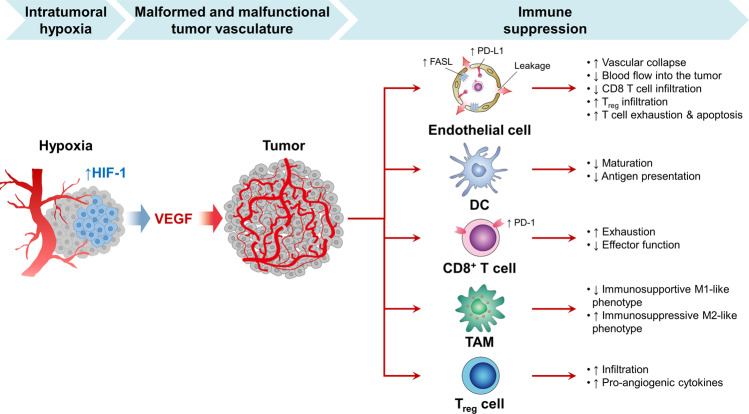
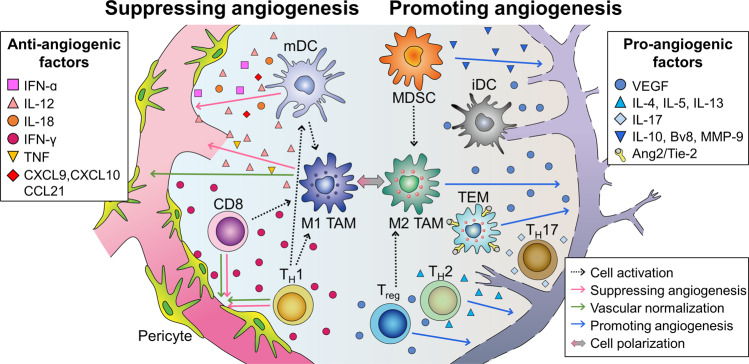
Cancer immunotherapy with immune checkpoint inhibitors (ICIs) has revolutionized the treatment of advanced cancers. However, the tumor microenvironment (TME) functions as a formidable barrier that severely impairs the efficacy of ICIs. While the crosstalk between tumor vessels and immune cells determines the nature of anti-tumor immunity, it is skewed toward a destructive cycle in growing tumors. First, the disorganized tumor vessels hinder CD8+T cell trafficking into the TME, disable effector functions, and even kill T cells. Moreover, VEGF, the key driver of angiogenesis, interferes with the maturation of dendritic cells, thereby suppressing T cell priming, and VEGF also induces TOX-mediated exhaustion of CD8+T cells. Meanwhile, a variety of innate and adaptive immune cells contribute to the malformation of tumor vessels. Protumoral M2-like macrophages as well as T H 2 and Treg cells secrete pro-angiogenic factors that accelerate uncontrolled angiogenesis and promote vascular immaturity. While CD8+T and CD4+T H 1 cells suppress angiogenesis and induce vascular maturation by secreting IFN-γ, they are unable to infiltrate the TME due to malformed tumor vessels. These findings led to preclinical studies that demonstrated that simultaneous targeting of tumor vessels and immunity is a viable strategy to normalize aberrant vascular-immune crosstalk and potentiate cancer immunotherapy. Furthermore, this combination strategy has been evidently demonstrated through recent pivotal clinical trials, granted approval from FDA, and is now being used in patients with kidney, liver, lung, or uterine cancer. Overall, combining anti-angiogenic therapy and ICI is a valid therapeutic strategy that can enhance cancer immunity and will further expand the landscape of cancer treatment.
Overview
The claims and statistics of this paper haven’t been checked yet.
Free: it reads the open-access text and checks the first 5 claims that cite a source we can check. Create a free account to check every claim.
Integrity signals
Registry
Cites
Statistics
Figures
Verification
Claims the paper makes
The claims and statistics of this paper haven’t been checked yet.
Free: it reads the open-access text and checks the first 5 claims that cite a source we can check. Create a free account to check every claim.
Self-check
Percentages, sums and reported differences re-computed from the paper’s own numbers.
The self-check needs the paper’s full text.
Citations
Cites
Cancer immunotherapy using checkpoint blockade
Ribas, A., & Wolchok, J. D. (2018) · Science · doi:10.1126/science.aar4060 · Cited by 6,791
Normalization of Tumor Vasculature: An Emerging Concept in Antiangiogenic Therapy
Jain, R. K. (2005) · Science · doi:10.1126/science.1104819 · Cited by 5,527
Macrophage Diversity Enhances Tumor Progression and Metastasis
Qian, B.-Z., & Pollard, J. W. (2010) · Cell · doi:10.1016/j.cell.2010.03.014 · Cited by 5,188
Interleukin-12 and the regulation of innate resistance and adaptive immunity
Trinchieri, G. (2003) · Nature Reviews Immunology · doi:10.1038/nri1001 · Cited by 3,927
Macrophage plasticity and interaction with lymphocyte subsets: cancer as a paradigm
Biswas, S. K., & Mantovani, A. (2010) · Nature Immunology · doi:10.1038/ni.1937 · Cited by 3,840
Atezolizumab for First-Line Treatment of Metastatic Nonsquamous NSCLC
Socinski, M. A., Jotte, R. M., Cappuzzo, F., Orlandi, F., Stroyakovskiy, D., Nogami, N., Rodríguez-Abreu, D., Moro-Sibilot, D., Thomas, C. A., Barlesi, F., et al. (2018) · New England Journal of Medicine · doi:10.1056/nejmoa1716948 · Cited by 3,733
Pembrolizumab plus axitinib versus sunitinib for advanced renal-cell carcinoma
Rini, B. I., Plimack, E. R., Stus, V., Gafanov, R., Hawkins, R., Nosov, D., Pouliot, F., Alekseev, B., Soulières, D., Melichar, B., et al. (2019) · New England Journal of Medicine · doi:10.1056/nejmoa1816714 · Cited by 3,403
Avelumab plus Axitinib versus Sunitinib for Advanced Renal-Cell Carcinoma
Motzer, R. J., Penkov, K., Haanen, J., Rini, B., Albiges, L., Campbell, M. T., Venugopal, B., Kollmannsberger, C., Negrier, S., Uemura, M., et al. (2019) · New England Journal of Medicine · doi:10.1056/nejmoa1816047 · Cited by 2,503
Macrophage plasticity and polarization in tissue repair and remodelling
Mantovani, A., Biswas, S. K., Galdiero, M. R., Sica, A., & Locati, M. (2013) · The Journal of Pathology · doi:10.1002/path.4133 · Cited by 2,384
Pàez-Ribes, M., Allen, E., Hudock, J., Takeda, T., Okuyama, H., Viñals, F., Inoue, M., Bergers, G., Hanahan, D., & Casanovas, O. (2009) · Cancer Cell · doi:10.1016/j.ccr.2009.01.027 · Cited by 2,339
Cited by
Combination strategies with PD-1/PD-L1 blockade: current advances and future directions
Yi, M., Zheng, X., Niu, M., Zhu, S., Ge, H., & Wu, K. (2022) · Molecular Cancer · doi:10.1186/s12943-021-01489-2 · Cited by 1,445
Treatment landscape of triple-negative breast cancer — expanded options, evolving needs
Bianchini, G., De Angelis, C., Licata, L., & Gianni, L. (2022) · Nature Reviews Clinical Oncology · doi:10.1038/s41571-021-00565-2 · Cited by 1,382
Angiogenic signaling pathways and anti-angiogenic therapy for cancer
Liu, Z.-L., Chen, H.-H., Zheng, L.-L., Sun, L.-P., & Shi, L. (2023) · Signal Transduction and Targeted Therapy · doi:10.1038/s41392-023-01460-1 · Cited by 1,300
Zhu, A. X., Abbas, A. R., de Galarreta, M. R., Guan, Y., Lu, S., Koeppen, H., Zhang, W., Hsu, C.-H., He, A. R., Ryoo, B.-Y., et al. (2022) · Nature Medicine · doi:10.1038/s41591-022-01868-2 · Cited by 652
Molecular Mechanisms and Future Implications of VEGF/VEGFR in Cancer Therapy
Patel, S. A., Nilsson, M. B., Le, X., Cascone, T., Jain, R. K., & Heymach, J. V. (2023) · Clinical Cancer Research · doi:10.1158/1078-0432.ccr-22-1366 · Cited by 481
The Evasion Mechanisms of Cancer Immunity and Drug Intervention in the Tumor Microenvironment
Kim, S. K., & Cho, S. W. (2022) · Frontiers in Pharmacology · doi:10.3389/fphar.2022.868695 · Cited by 460
Cancer associated-fibroblast-derived exosomes in cancer progression
Li, C., Teixeira, A. F., Zhu, H.-J., & ten Dijke, P. (2021) · Molecular Cancer · doi:10.1186/s12943-021-01463-y · Cited by 336
“This combination strategy targeting on TME has demonstrated more clinical benefits and promising outcomes in many clinical trials [14].”
BackgroundTargeting angiogenesis in oncology, ophthalmology and beyond
Cao, Y., Langer, R., & Ferrara, N. (2023) · Nature Reviews Drug Discovery · doi:10.1038/s41573-023-00671-z · Cited by 315
Pu, W., Shi, X., Yu, P., Zhang, M., Liu, Z., Tan, L., Han, P., Wang, Y., Ji, D., Gan, H., et al. (2021) · Nature Communications · doi:10.1038/s41467-021-26343-3 · Cited by 261
Immune Checkpoint Inhibitors in Non-Small Cell Lung Cancer: Progress, Challenges, and Prospects
Tang, S., Qin, C., Hu, H., Liu, T., He, Y., Guo, H., Yan, H., Zhang, J., Tang, S., & Zhou, H. (2022) · Cells · doi:10.3390/cells11030320 · Cited by 256
“On the one hand, the beneficiaries are still in the minority—only 20–30% of cancer patients respond to ICIs treatment [117].”
BackgroundMechanisms of cancer metastasis
Castaneda, M., den Hollander, P., Kuburich, N. A., Rosen, J. M., & Mani, S. A. (2022) · Seminars in Cancer Biology · doi:10.1016/j.semcancer.2022.10.006 · Cited by 249
PD-1/PD-L1 checkpoint inhibitors in advanced hepatocellular carcinoma immunotherapy
Li, Q., Han, J., Yang, Y., & Chen, Y. (2022) · Frontiers in Immunology · doi:10.3389/fimmu.2022.1070961 · Cited by 246
Reckamp, K. L., Redman, M. W., Dragnev, K. H., Minichiello, K., Villaruz, L. C., Faller, B., Al Baghdadi, T., Hines, S., Everhart, L., Highleyman, L., et al. (2022) · Journal of Clinical Oncology · doi:10.1200/jco.22.00912 · Cited by 233
“Patients on RP received a median (range) of six (1-37) cycles of ramucirumab and six (0-35) cycles of pembrolizumab.”
BackgroundInfluentialBiomarkers for immunotherapy of hepatocellular carcinoma
Greten, T. F., Villanueva, A., Korangy, F., Ruf, B., Yarchoan, M., Ma, L., Ruppin, E., & Wang, X. W. (2023) · Nature Reviews Clinical Oncology · doi:10.1038/s41571-023-00816-4 · Cited by 227
“…VEGF-targeted therapies plus atezolizumab as compared with sunitinib alone in patients with renal cell carcinoma 166 and in preclinical models 37,167–169 , providing further evidence that certain myeloid cell populations might be an important mechanism through which VEGF-targeted therapies can…”
BackgroundAsleh, K., Riaz, N., & Nielsen, T. O. (2022) · Journal of Experimental & Clinical Cancer Research · doi:10.1186/s13046-022-02476-1 · Cited by 209
TGF-β Signaling in Liver, Pancreas, and Gastrointestinal Diseases and Cancer
Gough, N. R., Xiang, X., & Mishra, L. (2021) · Gastroenterology · doi:10.1053/j.gastro.2021.04.064 · Cited by 202
“For example, targeting the TGF-β –regulated protein vascular endothelial growth factor and immune checkpoint blockade in HCC. 150”
InfluentialTargeting the tumour vasculature: from vessel destruction to promotion
Guelfi, S., Hodivala-Dilke, K., & Bergers, G. (2024) · Nature Reviews Cancer · doi:10.1038/s41568-024-00736-0 · Cited by 183
“…of the observations described earlier, it is perhaps not surprising that vessel-normalizing and in part also anti-angiocrine and potentially vessel-promoting therapies can have counteractive effects on intratumoural immunosuppressive cells and thereby support an immune-stimulating milieu 243,251 .”
Immunobiology of high-grade serous ovarian cancer: lessons for clinical translation
Kandalaft, L. E., Dangaj Laniti, D., & Coukos, G. (2022) · Nature Reviews Cancer · doi:10.1038/s41568-022-00503-z · Cited by 180
PD-1 and PD-L1 inhibitors in cold colorectal cancer: challenges and strategies
Lin, K. X., Istl, A. C., Quan, D., Skaro, A. I., Tang, E. S.-T., & Zheng, X. (2023) · Cancer Immunology Immunotherapy · doi:10.1007/s00262-023-03520-5 · Cited by 180
“Moreover, it increases the abundance of suppressive or pro-tumor cells such as Treg, myeloid-derived suppressor cell (MDSC), and M2-like immunosuppressive TAM and drives T cell exhaustion [101, 113–115].”
BackgroundCheng, Y., Chen, J., Zhang, W., Xie, C., Hu, Q., Zhou, N., Huang, C., Wei, S., Sun, H., Li, X., et al. (2024) · Nature Medicine · doi:10.1038/s41591-024-03132-1 · Cited by 178
“Anti-angiogenesis is known to augment the efficacy of ICIs in multiple cancer types 7 , and the normalization of blood vessels may promote immune cell infiltration and change the tumor microenvironment 8,9 .”
Self-citationRecurrent or primary metastatic cervical cancer: current and future treatments
Gennigens, C., Jérusalem, G., Lapaille, L., Cuypere, M. D., Streel, S., Kridelka, F., & Ray-Coquard, I. (2022) · ESMO Open · doi:10.1016/j.esmoop.2022.100579 · Cited by 166
“This later induces malformed and malfunctional vasculature that can stop the penetration of CD8þ tumor-infiltrating lymphocytes (TILs) into the tumor.(65) In a phase II trial, Friedman et al.”
BackgroundSharma, R., Kadife, E., Myers, M., Kannourakis, G., Prithviraj, P., & Ahmed, N. (2021) · Journal of Experimental & Clinical Cancer Research · doi:10.1186/s13046-021-01961-3 · Cited by 162
Monotherapy and Combination Therapy Using Anti‐Angiogenic Nanoagents to Fight Cancer
Liang, P., Ballou, B. T., Lv, X., Si, W., Bruchez, M. P., Huang, W., & Dong, X. (2021) · Advanced Materials · doi:10.1002/adma.202005155 · Cited by 161
Stromal HIF2 Regulates Immune Suppression in the Pancreatic Cancer Microenvironment
Garcia Garcia, C. J., Huang, Y., Fuentes, N. R., Turner, M. C., Monberg, M. E., Lin, D., Nguyen, N. D., Fujimoto, T. N., Zhao, J., Lee, J. J., et al. (2022) · Gastroenterology · doi:10.1053/j.gastro.2022.02.024 · Cited by 158
Ju, W., Xia, R., Zhu, D., Dou, S., Zhu, G., Dong, M., Wang, L., Sun, Q., Zhao, T., Zhou, Z., et al. (2022) · Nature Communications · doi:10.1038/s41467-022-33080-8 · Cited by 152
Challenges in neoantigen-directed therapeutics
Lybaert, L., Lefever, S., Fant, B., Smits, E., De Geest, B., Breckpot, K., Dirix, L., Feldman, S. A., van Criekinge, W., Thielemans, K., et al. (2023) · Cancer Cell · doi:10.1016/j.ccell.2022.10.013 · Cited by 142
TKIs in combination with immunotherapy for hepatocellular carcinoma
Stefanini, B., Ielasi, L., Chen, R., Abbati, C., Tonnini, M., Tovoli, F., & Granito, A. (2023) · Expert Review of Anticancer Therapy · doi:10.1080/14737140.2023.2181162 · Cited by 135
“Recent studies support the enhanced antitumor efficacy of combined therapies having shown both immunomodulatory effects of TKI agents on TME and a pro-angiogenic action of some pro-tumor immune cells [45].”
BackgroundMettu, N. B., Ou, F.-S., Zemla, T. J., Halfdanarson, T. R., Lenz, H.-J., Breakstone, R. A., Boland, P. M., Crysler, O. V., Wu, C., Nixon, A. B., et al. (2022) · JAMA Network Open · doi:10.1001/jamanetworkopen.2021.49040 · Cited by 126
Du, Y., Shi, J., Wang, J., Xun, Z., Yu, Z., Sun, H., Bao, R., Zheng, J., Li, Z., & Ye, Y. (2023) · Cancer Research · doi:10.1158/0008-5472.can-23-1418 · Cited by 121
Hepatocellular Carcinoma: An Overview of the Changing Landscape of Treatment Options
Koulouris, A., Tsagkaris, C., Spyrou, V., Pappa, E. V., Troullinou, A., & Nikolaou, M. (2021) · Journal of Hepatocellular Carcinoma · doi:10.2147/jhc.s300182 · Cited by 120
“Preclinical data as those mentioned above have already been translated into clinical benefit and have shown the way to the future.(81)”
MethodLee, S. J., Yang, H., Kim, W. R., Lee, Y. S., Lee, W. S., Kong, S. J., Lee, H. J., Kim, J. H., Cheon, J., Kang, B., et al. (2021) · Journal for ImmunoTherapy of Cancer · doi:10.1136/jitc-2020-002195 · Cited by 118
Self-citationLi, B., Jin, J., Guo, D., Tao, Z., & Hu, X. (2023) · Cancers · doi:10.3390/cancers15102858 · Cited by 117
“In addition, active angiogenesis of tumor upregulates the suppressive immune molecules, such as PD-L1, IL-6, IL-10, and Fas ligand, which recruit Tregs into TME and clean up cytotoxic T lymphocytes to make it difficult to kill the tumor cells [44,45].”
BackgroundKim, H., Shim, B. Y., Lee, S., Lee, J. Y., Lee, H. J., & Kim, I.-H. (2021) · International Journal of Molecular Sciences · doi:10.3390/ijms22189795 · Cited by 117
“It alleviates the hypoxic TME state and facilitates more efficient drug delivery [88].”
BackgroundTumor microenvironment targeted nano-drug delivery systems for multidrug resistant tumor therapy
Shao, X., Zhao, X., Wang, B., Fan, J., Wang, J., & An, H. (2025) · Theranostics · doi:10.7150/thno.103636 · Cited by 113
Peripheral Blood-Based Biomarkers for Immune Checkpoint Inhibitors
An, H. J., Chon, H. J., & Kim, C. (2021) · International Journal of Molecular Sciences · doi:10.3390/ijms22179414 · Cited by 113
“They show immunosuppressive activity by inhibiting T and NK cells, stimulating Tregs, and playing an important role in various malignancies [5,62].”
BackgroundSelf-citationLiu, S., Kumari, S., He, H., Mishra, P., Singh, B. N., Singh, D., Liu, S., Srivastava, P., & Li, C. (2023) · Biosensors and Bioelectronics · doi:10.1016/j.bios.2023.115285 · Cited by 112
Mahaki, H., Nobari, S., Tanzadehpanah, H., Babaeizad, A., Kazemzadeh, G., Mehrabzadeh, M., Valipour, A., Yazdinezhad, N., Manoochehri, H., Yang, P., et al. (2025) · Biomedicine & Pharmacotherapy · doi:10.1016/j.biopha.2025.118023 · Cited by 112
Tumor vessel co-option probed by single-cell analysis
Teuwen, L.-A. M. N., de Rooij, L. P. M. H., Cuypers, A., Rohlenová, K., Dumas, S. J., García‐Caballero, M., Meta, E., Amersfoort, J., Taverna, F., Becker, L. M., et al. (2021) · Cell Reports · doi:10.1016/j.celrep.2021.109253 · Cited by 106
Tumor microenvironment: recent advances in understanding and its role in modulating cancer therapies
Shah, D. D., Chorawala, M. R., Raghani, N. R., Patel, R., Fareed, M., Kashid, V. A., & Prajapati, B. G. (2025) · Medical Oncology · doi:10.1007/s12032-025-02641-4 · Cited by 102
“Nonetheless, the effectiveness of TME-targeting modalities depends on cancer type, stage, and patient-specific characteristics, necessitating ongoing research to refine and optimize these therapeutic approaches with the goal of enhancing outcomes in cancer therapy [121].”
Cancer-Associated Angiogenesis: The Endothelial Cell as a Checkpoint for Immunological Patrolling
Solimando, A. G., Summa, S. D., Vacca, A., & Ribatti, D. (2020) · Cancers · doi:10.3390/cancers12113380 · Cited by 98
“Many attempts have been proposed to unbridle an effective immune response while breaking the vicious cycle between abnormal angiogenesis and immune patrolling actors in aggressive and refractory malignancies [209–211] Collectively, the combination of angiogenesis and immunity targeting has been studied a lot in pre-cl…”
BackgroundYang, H., Kang, B., Ha, Y., Lee, S. H., Kim, I. H., Kim, H., Lee, W. S., Kim, G., Jung, S., Rha, S. Y., et al. (2023) · JHEP Reports · doi:10.1016/j.jhepr.2023.100672 · Cited by 97
Self-citationHashimoto, K. (2021) · Cancers · doi:10.3390/cancers13102288 · Cited by 88
“However, CD8+ T cells can have difficulty infiltrating the tumor microenvironment due to malformed tumor vessels [89].”
BackgroundFighting in a wasteland: deleterious metabolites and antitumor immunity
Watson, M. J., & Delgoffe, G. M. (2022) · Journal of Clinical Investigation · doi:10.1172/jci148549 · Cited by 87
“In an attempt to oxygenate the TME, tumors secrete VEGF and promote angiogenesis, but the blood vessels formed are highly disorganized and leaky, providing inadequate oxygen (1, 134, 135).”
BackgroundThe Good, the Bad, and the Ugly: Neutrophils, Angiogenesis, and Cancer
Ozel, I., Duerig, I., Domnich, M., Lang, S., Pylaeva, E., & Jablonska, J. (2022) · Cancers · doi:10.3390/cancers14030536 · Cited by 86
“In fact, combining anti-angiogenic therapy and immunotherapy has already been demonstrated as a beneficial strategy in cancer treatment [178,179].”
BackgroundBu, M. T., Chandrasekhar, P., Ding, L., & Hugo, W. (2022) · Pharmacology & Therapeutics · doi:10.1016/j.pharmthera.2022.108211 · Cited by 85
“The mechanism of action and clinical testing of these agents (alone and in combination with existing therapies) have been extensively reviewed (Ciardiello, Elez, Tabernero, & Seoane, 2020; Derynck et al., 2021; Haque & Morris, 2017; Lee, 2020).”
BackgroundLurje, I., Werner, W., Mohr, R. U., Roderburg, C., Tacke, F., & Hammerich, L. (2021) · Frontiers in Immunology · doi:10.3389/fimmu.2021.650486 · Cited by 85
Modulation of the tumor microenvironment (TME) by melatonin
Qi, M., & Najafi, M. (2021) · European Journal of Pharmacology · doi:10.1016/j.ejphar.2021.174365 · Cited by 85
Gang, X., Yan, J., Li, X., Shi, S., Xu, L., Liu, R. M., Cai, L., Li, H., & Zhao, M. (2024) · Cancer Letters · doi:10.1016/j.canlet.2024.217241 · Cited by 81
Matsumae, T., Kodama, T., Myojin, Y., Maesaka, K., Sakamori, R., Takuwa, A., Oku, K., Motooka, D., Sawai, Y., Oshita, M., et al. (2022) · Cancers · doi:10.3390/cancers14143367 · Cited by 81
“Since anti-VEGF antibody is known to potentiate tumor immunity via normalization of vascularimmune crosstalk [34], it will be interesting in future studies to see whether bevacizumab promotes intratumor immune cell infiltration and changes the CTNNB1-mutated immunecold TME to an immune-hot TME favorable to atezolizuma…”
BackgroundAntiangiogenic therapy reverses the immunosuppressive breast cancer microenvironment
Chen, W., Shen, L., Jiang, J., Zhang, L., Zhang, Z., Pan, J., Ni, C., & Chen, Z. (2021) · Biomarker Research · doi:10.1186/s40364-021-00312-w · Cited by 80
“endothelium [14, 30, 31] or transform into other immune cell types, which indirectly affects the quantity and quality of tumor blood vessels [32, 33].”
BackgroundInfluentialDevelopment of oncolytic viruses for cancer therapy
Abd-Aziz, N., & Poh, C. L. (2021) · Translational research · doi:10.1016/j.trsl.2021.04.008 · Cited by 80
Immunotherapy in Pancreatic Adenocarcinoma: Beyond “Copy/Paste”
Hester, R., Mazur, P. K., & McAllister, F. M. (2021) · Clinical Cancer Research · doi:10.1158/1078-0432.ccr-18-0900 · Cited by 76
“The use of VEGFR inhibitors in combination with immunotherapy has been successful in several tumor types including hepatocellular carcinoma and renal cell carcinoma, through normalization of the tumor vasculature, and is currently being evaluate in pancreatic cancer in combination with immunotherapy (26).”
BackgroundVisualizing vasculature and its response to therapy in the tumor microenvironment
Lin, Q., Choyke, P. L., & Sato, N. (2023) · Theranostics · doi:10.7150/thno.84947 · Cited by 76
Sen, T., Dotsu, Y., Corbett, V., Puri, S., Sen, U., Boyle, T. A., Mack, P. C., Hirsch, F. R., Aljumaily, R. M., Naqash, A. R., et al. (2025) · The Lancet Oncology · doi:10.1016/s1470-2045(24)00374-7 · Cited by 77
Yan, W., Qiu, L., Yang, M., Xu, A., Ma, M., Yuan, Q., Ma, X., Liang, W., Li, X., & Lu, Y. (2023) · Cancer Letters · doi:10.1016/j.canlet.2023.216263 · Cited by 75
Oncolytic viruses: advanced strategies in cancer therapy
Xiao, D., Zhang, H., Liu, Y., Li, Y., Li, G., & Ning, Y. (2026) · Signal Transduction and Targeted Therapy · doi:10.1038/s41392-025-02343-3 · Cited by 72
“321 324 However, the ef fi cacy of ICIs is often constrained by both intrinsic and extrinsic factors within the TME.”
Shao, S., Miao, H., & Ma, W. (2023) · Frontiers in Immunology · doi:10.3389/fimmu.2023.1295684 · Cited by 71
Angiogenesis in Lung Cancer: Understanding the Roles of Growth Factors
Tchawe, Y. S. N., Zhilenkova, A. V., Essogmo, F. E., Uchendu, I. K., Owoicho, A. M., Fossa, L. T., Sangadzhieva, Z. D., Sanikovich, V. D., Rusanov, A. S., Pirogova, Y. N., et al. (2023) · Cancers · doi:10.3390/cancers15184648 · Cited by 70
Lorusso, D., Colombo, N., Dubot, C., Cáceres, M. V., Hasegawa, K., Shapira‐Frommer, R., Salman, P., Yáñez, E., Gümüş, M., Olivera, M., et al. (2024) · Annals of Oncology · doi:10.1016/j.annonc.2024.10.002 · Cited by 69
Lee, Y. S., Lee, W. S., Kim, C. W., Lee, S. J., Yang, H. J., Kong, S. J., Ning, J., Yang, K.-M., Kang, B., Kim, W. R., et al. (2020) · Journal for ImmunoTherapy of Cancer · doi:10.1136/jitc-2020-000857 · Cited by 68
Self-citationLiu, Z., Zhang, Y., Shen, N., Sun, J., Tang, Z., & Chen, X. (2022) · Advanced Drug Delivery Reviews · doi:10.1016/j.addr.2022.114138 · Cited by 68
Combination Immunotherapy Using Oncolytic Virus for the Treatment of Advanced Solid Tumors
Oh, C., Chon, H. J., & Kim, C. (2020) · International Journal of Molecular Sciences · doi:10.3390/ijms21207743 · Cited by 67
“Tumor cells continuously secrete immunosuppressive chemokines and cytokines such as IL-10, TFG-β, and arginase-1 to reduce the amplitude of OV-induced anti-cancer immune responses [19,93,94].”
BackgroundSelf-citationZalpoor, H., Aziziyan, F., Liaghat, M., Bakhtiyari, M., Akbari, A., Nabi‐Afjadi, M., Forghaniesfidvajani, R., & Rezaei, N. (2022) · Cell Communication and Signaling · doi:10.1186/s12964-022-00951-y · Cited by 66
“Hypoxia results from insufficient blood supply in the TME area and lead to activation of HIF-1 and upregulation of VEGF [211, 212].”
BackgroundNanomaterials for Antiangiogenic Therapies for Cancer: A Promising Tool for Personalized Medicine
Alsaab, H. O., Al-Hibs, A. S., Alzhrani, R. M., Alrabighi, K. K., Alqathama, A. A., Alwithenani, A., Almalki, A. H., & Althobaiti, Y. S. (2021) · International Journal of Molecular Sciences · doi:10.3390/ijms22041631 · Cited by 66
Li, Y., Jia, G.-D., Lv, X., Xie, S., Guo, S.-S., Lin, D.-F., Liu, L., Luo, D., Li, Y., Deng, S.-W., et al. (2023) · Nature Communications · doi:10.1038/s41467-023-40402-x · Cited by 66
Žvirblytė, J., Nainys, J., Juzėnas, S., Goda, K., Kubiliūtė, R., Dasevičius, D., Kinčius, M., Ulys, A., Jarmalaitė, S., & Mažutis, L. (2024) · Communications Biology · doi:10.1038/s42003-024-06478-x · Cited by 64
“Forexample, placental growthfactor( PGF ), amemberofVEGF family, can directly interact with VEGF receptors and increase vascular permeability while promoting M2 macrophage polarization 55 .”
Ferrarotto, R., de Sousa, L. G., Feng, L., Mott, F. E., Blumenschein, G. R., Altan, M., Bell, D., Bonini, F., Li, K., Marques-Piubelli, M. L., et al. (2023) · Journal of Clinical Oncology · doi:10.1200/jco.22.02221 · Cited by 64
“In mouse models, treatment with VEGFR inhibitors has yielded an increase in T-cell recruitment and infiltration into tumors and synergism with anti-PD1 antibodies.(20,22) Consistently, VEGFR MKI combined with PD-1/PD-L1 inhibitors have shown higher efficacy than single-agent VEGFR MKI and have become the standard-of-c…”
BackgroundMetal nanoparticles in cancer: from synthesis and metabolism to cellular interactions
Tuli, H. S., Joshi, R., Kaur, G., Garg, V. K., Sak, K., Varol, M., Kaur, J., Alharbi, S. A., Alahmadi, T. A., Aggarwal, D., et al. (2022) · Journal of nanostructure in chemistry · doi:10.1007/s40097-022-00504-2 · Cited by 64
Breaking Boundaries: Chronic Diseases and the Frontiers of Immune Microenvironments
Li, G., Wan, Y., Jiao, A., Jiang, K., Cui, G., Tang, J., Yu, S., Hu, Z., Zhao, S., Yi, Z., et al. (2025) · Med Research · doi:10.1002/mdr2.70007 · Cited by 63
Ju, S., Zhou, C., Yang, C., Wang, C., Liu, J., Wang, Y., Huang, S., Li, T., Chen, Y., Bai, Y., et al. (2022) · Frontiers in Oncology · doi:10.3389/fonc.2021.835889 · Cited by 63
“However, the efficacy of monotherapy still needs to be improved, and combination therapy could provide additional clinical benefit to patients (3, 4, 15, 23).”
BackgroundNew strategies for targeting kinase networks in cancer
Yesilkanal, A. E., Johnson, G. L., Ramos, A. F., & Rosner, M. R. (2021) · Journal of Biological Chemistry · doi:10.1016/j.jbc.2021.101128 · Cited by 62
“Immune checkpoint inhibitors that block tumor evasion of host immunity are being studied in combination with inhibitors of angiogenesis, based on the hypothesis that increased tumor perfusion allows for increased tumor infiltration of immune cells such as cytotoxic T-cells (64).”
BackgroundExploring the Past, Present, and Future of Anti-Angiogenic Therapy in Glioblastoma
Zhang, A. B., Mozaffari, K., Aguirre, B., Li, V., Kubba, R., Desai, N. C., Wei, D., Yang, I., & Wadehra, M. (2023) · Cancers · doi:10.3390/cancers15030830 · Cited by 61
“In addition to members of the VEGF family, which constitute the most potent pro-angiogenic factors, other key inducers of angiogenesis including fibroblast growth factors and membrane-bound integrins have also been identified [13,14].”
BackgroundImmunotherapy in liver cancer: overcoming the tolerogenic liver microenvironment
Liu, Y., Yang, H., Li, T. X., & Zhang, N. (2024) · Frontiers in Immunology · doi:10.3389/fimmu.2024.1460282 · Cited by 60
Self-citationOvercoming cancer therapy resistance: From drug innovation to therapeutics
Wei, J., Lu, M., Wei, T., Fleishman, J. S., Yu, H. J., Chen, X.-L., Kong, X.-T., Sun, S., Li, N., Yang, Y., et al. (2025) · Drug Resistance Updates · doi:10.1016/j.drup.2025.101229 · Cited by 60
Duan, X., Xu, X., Zhang, Y., Gao, Y., Zhou, J., & Li, J. (2022) · Cancer Science · doi:10.1111/cas.15533 · Cited by 60
Hou, J., He, Z., Liu, T., Chen, D., Wang, B., Wen, Q., & Zheng, X. (2022) · Frontiers in Oncology · doi:10.3389/fonc.2022.755053 · Cited by 59
“Consistent with this notion, anti-angiogenesis therapy has been shown to enhance clinical efficacies of immune checkpoint blockade, which represent a combinatory therapeutic strategy to expand the landscape of cancer immunotherapy (208).”
BackgroundLiu, J., Gao, T., Tan, Z., Li, S., Xu, J. H., Bai, C., Xue, R., Xie, L., Zhang, L., Fan, Z., et al. (2022) · Clinical Cancer Research · doi:10.1158/1078-0432.ccr-22-0871 · Cited by 59
“At the same time, antiangiogenic therapy can normalize blood vessels in a short period, which in turn stabilizes endothelial cells, increases oxygen and drug delivery, reduces vascular permeability, and promotes the infiltration of T cells into the tumor (10, 11).”
BackgroundBeyond Cancer Cells: How the Tumor Microenvironment Drives Cancer Progression
Sabit, H., Arneth, B. M., Abdel-Ghany, S. E., Madyan, E. F., Ghaleb, A. H., Selvaraj, P., Shin, D. M., Bommireddy, R., & El-Hashash, A. H. K. (2024) · Cells · doi:10.3390/cells13191666 · Cited by 59
“TAMs also exert indirect proangiogenic effects by inhibiting the maturation of dendritic cells (DCs), which contributes to immunological tolerance and tumor progression [154].”
BackgroundHuang, F., Zhang, Q., Xiao, J., Zhang, X., Han, X., Shi, X., Hu, J., Li, L., & Qian, X. (2023) · International Journal of Nanomedicine · doi:10.2147/ijn.s408521 · Cited by 59
Kim, C. W., Chon, H. J., & Kim, C. (2021) · Cancers · doi:10.3390/cancers13194906 · Cited by 58
“MSS mCRC is refractory to ICI therapy because of the lack of tumor antigens, exclusion of T cells by WNT/β-catenin activation, and VEGF-driven immunosuppressive TME.”
BackgroundInfluentialSelf-citationStoltzfus, C. R., Sivakumar, R., Kunz, L., Olin, B. E., Menietti, E., Speziale, D., Adelfio, R., Bacac, M., Colombetti, S., Perro, M., et al. (2021) · Frontiers in Immunology · doi:10.3389/fimmu.2021.726492 · Cited by 57
T cell exhaustion in human cancers
Kang, K., Lin, X., Chen, P., Liu, H., Liu, F., Xiong, W., Li, G., Yi, M., Li, X., Wang, H., et al. (2024) · Biochimica et Biophysica Acta (BBA) - Reviews on Cancer · doi:10.1016/j.bbcan.2024.189162 · Cited by 56
Issafras, H., Fan, S., Tseng, C.-L., Cheng, Y., Lin, P.-H., Xiao, L., Huang, Y.-J., Tu, C., Hsiao, Y.-C., Li, M., et al. (2021) · PLoS ONE · doi:10.1371/journal.pone.0257972 · Cited by 55
“In recent years, studies have found that many cancers are closely related to abnormal blood vessel formations, and normalization of the tumor vasculature is thought to promote and synergize with immunotherapy [24].”
BackgroundAnti‐angiogenic therapy enhances cancer immunotherapy: Mechanism and clinical application
Li, A., & Fang, J. (2024) · Interdisciplinary medicine · doi:10.1002/inmd.20230025 · Cited by 55
Overcoming physical stromal barriers to cancer immunotherapy
Chung, S. W., Xie, Y., & Suk, J. S. (2021) · Drug Delivery and Translational Research · doi:10.1007/s13346-021-01036-y · Cited by 54
“As a result, combination regimens of ICIs and antiangiogenic agents have been recently approved by the FDA for treating different cancers, including metastatic hepatocellular carcinoma and renal cell carcinoma (Table 1), and many more are currently under clinical investigation (Table 2) [11, 94].”
BackgroundChasing Immune Checkpoint Inhibitors in Ovarian Cancer: Novel Combinations and Biomarker Discovery
Colombo, I., Karakasis, K., Sneha, S., & Oza, A. M. (2023) · Cancers · doi:10.3390/cancers15123220 · Cited by 54
“The presence of malfunctional blood vessels induces immunosuppression through different mechanisms such as an increased expression of PD-L1, a reduced infiltration of cytotoxic T-cells but an increased activation of Tregs and an infiltration of MDSC [71,72].”
BackgroundNew Approaches to Targeted Therapy in Melanoma
Fernandez, M. F., Choi, J. S., & Sosman, J. A. (2023) · Cancers · doi:10.3390/cancers15123224 · Cited by 54
Ouyang, P., Zhang, J., He, X., Yang, C., Zeng, D., & Xu, D. (2025) · Frontiers in Immunology · doi:10.3389/fimmu.2025.1661545 · Cited by 54
Gao, Y., Xu, Y., Zhao, S., Qian, L., Song, T., Zheng, J., Zhang, J., & Chen, B. (2021) · Experimental Cell Research · doi:10.1016/j.yexcr.2021.112522 · Cited by 53
Zheng, W., Qian, C., Tang, Y., Yang, C., Zhou, Y., Shen, P., Chen, W., Yu, S., Wei, Z., Wang, A., et al. (2022) · Frontiers in Immunology · doi:10.3389/fimmu.2022.1035323 · Cited by 53
Current Treatments and New Possible Complementary Therapies for Epithelial Ovarian Cancer
Garrido, M. P., Fredes, A. N., Lobos‐González, L., Valenzuela, M., Vera, D. B., & Romero, C. (2021) · Biomedicines · doi:10.3390/biomedicines10010077 · Cited by 53
“A current perspective using immune checkpoint inhibitors is the combination of these drugs with anti-angiogenic therapies [141] and with PARP inhibitors [142] which could decrease primary resistance, improving therapy results.”
BackgroundHuang, L., Zhu, H., & Shi, Y. (2025) · Journal of Hematology & Oncology · doi:10.1186/s13045-025-01734-x · Cited by 52
Overview of Immune Checkpoint Inhibitors in Gynecological Cancer Treatment
Pirš, B., Škof, E., Smrkolj, V., & Smrkolj, Š. (2022) · Cancers · doi:10.3390/cancers14030631 · Cited by 52
Wang, Z., & Yang, L. (2024) · Pharmacological Research · doi:10.1016/j.phrs.2024.107150 · Cited by 51
Recent advances in immunotherapy for cervical cancer
Ogasawara, A., & Hasegawa, K. (2025) · International Journal of Clinical Oncology · doi:10.1007/s10147-025-02699-0 · Cited by 51
“Anti-angiogenic therapy normalizes the tumor vasculature, facilitating T cell infiltration and enhancing the efficacy of ICIs [38].”
Su, X., Li, J., Xu, X., Ye, Y., Wang, C., Pang, G., Liu, W., Liu, A., Zhao, C., & Hao, X. (2024) · Journal of Translational Medicine · doi:10.1186/s12967-024-05552-6 · Cited by 50
“Antiangiogenic drugs work by blocking the vascular endothelial growth factor (VEGF)/VEGF receptor (VEGFR) signaling pathway, leading to reduced blood supply to tumor tissues, hypoxia, and a decrease in nutrient supply to cancer tissues [92–94].”
BackgroundZhu, Y., Chen, J., Chen, C., Tang, R., Xu, J., Shi, S., & Yu, X. (2025) · Biomarker Research · doi:10.1186/s40364-025-00727-9 · Cited by 50
Enhanced plant-derived vesicles for nucleotide delivery for cancer therapy
Corvigno, S., Liu, Y., Bayraktar, E., Stur, E., Bayram, N. N., Ahumada, A. L., Nagaraju, S., Rodriguez‐Aguayo, C., Chen, H., Vu, T. C., et al. (2024) · npj Precision Oncology · doi:10.1038/s41698-024-00556-3 · Cited by 50
“Toovercometheselimitations,we considered plant-derived vesicles (PDVs) for ef fi cient delivery of small RNAs to the TME.”
BackgroundInfluentialTumor vessel co-option: The past & the future
Cuypers, A., Truong, A.-C. K., Becker, L. M., Saavedra-García, P., & Carmeliet, P. (2022) · Frontiers in Oncology · doi:10.3389/fonc.2022.965277 · Cited by 50
Current status of immunotherapy for non-small cell lung cancer
Yang, T., Xiong, Y., Zeng, Y., Wang, Y., Zeng, J., Liu, J., Xu, S., & Li, L. (2022) · Frontiers in Pharmacology · doi:10.3389/fphar.2022.989461 · Cited by 49
“…binding to programmed death-1 (PD-1) all inhibit T cells (Chen and Mellman, 2017); and during the infiltration stage of tumor tissue, vascular endothelial growth factor (VEGF) production of vascular structures and transforming growth factor-β expression all reduce invasion (Lee et al., 2020).”
Background
Metadata
- Authors
- Lee, W. S., Yang, H., Chon, H. J., & Kim, C.
- Affiliations
- CHA University Bundang Medical Center (KR)
- Corresponding author
- Chon, Hong Jae
- Kim, Chan
- Venue
- Experimental & Molecular Medicine
- Published
- 2020-09
- Volume
- 52
- Issue
- 9
- Pages
- 1475-1485
- ISSN
- 1226-3613 (ISSN-L)
- 2092-6413
- PMC
- PMC8080646
- OpenAlex
- W3084409519
- Cited by
- 796
- References
- 99
- Citations by year
- 2026: 154 · 2025: 187 · 2024: 128 · 2023: 137 · 2022: 123 · 2021: 63 · 2020: 4
- FWCI
- 8.94
- Type
- journal article
- Language
- en
- Open access
- gold
- doi.org
- Licence
- cc-by
- creativecommons.org/licenses/by/4.0 (tdm)
- creativecommons.org/licenses/by/4.0 (vor, 10 d)
- Locations
- Experimental & Molecular Medicine (publishedVersion, cc-by)
- PubMed Central (publishedVersion, cc-by)
- PubMed (publishedVersion)
- DOAJ (DOAJ: Directory of Open Access Journals) (submittedVersion)
- Funders
- National Research Foundation
- National Research Foundation of Korea (NRF-2020R1C1C1010722, 2020R1C1C1010722, NRF-2020R1A2C2004530, 2020R1A2C2004530)
- Ministry of Science and ICT, South Korea
- Topics
- Health Sciences › Medicine › Oncology › Cancer Immunotherapy and Biomarkers
- Life Sciences › Biochemistry, Genetics and Molecular Biology › Molecular Biology › Angiogenesis and VEGF in Cancer
- Life Sciences › Immunology and Microbiology › Immunology › Immunotherapy and Immune Responses
- Keywords
- anti-angiogenic therapy, immune checkpoint inhibitors, tumor microenvironment, tumor angiogenesis, vascular endothelial growth factor, CD8+ T cell exhaustion, dendritic cell maturation, M2 macrophages, regulatory T cells, Th2 cells, vascular normalization, cancer immunotherapy, combination therapy, interferon-gamma
- MeSH terms
- Immune Checkpoint Inhibitors, Animals, Antineoplastic Combined Chemotherapy Protocols, Cell Communication, Humans, Neoplasms, Neovascularization, Pathologic, Signal Transduction, Treatment Outcome, Angiogenesis Inhibitors, Immunomodulation, Molecular Targeted Therapy, Tumor Microenvironment
About these checks
Registry, retraction, Cites and statistics results are computed, not judged, with one exception: a printed reference that no index lists is read once by a model before it counts as a citation error. Claims are extracted by a model and kept only when their quote appears verbatim in the text; each cited source is then checked, with a model’s help, for whether it says what the claim relies on. Those verdicts can be wrong — read the claim’s quote and the cited source before relying on one.
Statistics and arithmetic are recomputed, not judged.
Confidence bands are shown only for fields calibrated on our annotated test set. None is calibrated yet, so no band is shown.
What counts as a claim ›How we measure confidence ›How we check this ›
Are you an author, or do you see a problem with this page? Request a review
Data sources
Bibliographic data: Semantic Scholar, OpenAlex, Crossref.
Contains information from the Semantic Scholar Academic Graph Datasets, made available under the ODC Attribution License (ODC-BY 1.0).
Semantic Scholar’s data is described in: Kinney, R., et al. (2023). The Semantic Scholar Open Data Platform. arXiv:2301.10140.
