

Early deprivation disruption of associative learning is a developmental pathway to depression and social problems
Open accessThe DOI matches its Crossref record; 69 of the 69 references it cites were found in a registry or an index.
Abstract
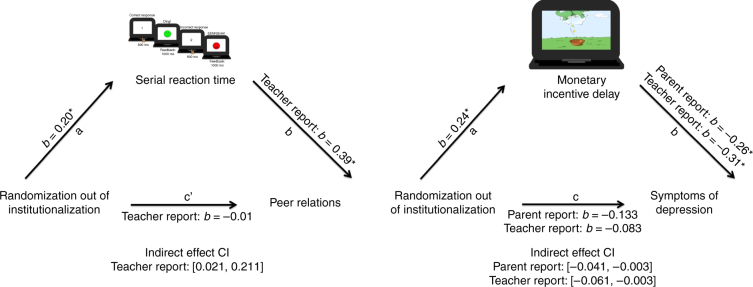
Exposure to psychosocial deprivation is associated with elevations in numerous forms of impairment throughout the life-course. Disruptions in associative learning may be a key mechanism through which adversity, particularly psychosocial deprivation, increases risk for impairment. Existing data consistent with this claim come entirely from correlational studies. Here, we present the first experimental evidence relating psychosocial deprivation and disruptions in multiple forms of associative learning. Using data from the Bucharest Early Intervention Project, we demonstrate that randomized placement into a family caregiving environment during the infant/toddler period as compared to prolonged institutional care normalizes two forms of associative learning in early adolescence: reward responsivity and implicit motor learning. These forms of associative learning significantly mediate the effect of institutional rearing on depressive symptoms and peer relationships. In sum, we provide evidence for a novel pathway linking early experience to psychopathology and peer relationships through basic associative learning mechanisms.
Overview
The claims and statistics of this paper haven’t been checked yet.
Free: it reads the open-access text and checks the first 5 claims that cite a source we can check. Create a free account to check every claim.
Integrity signals
Registry
Cites
Statistics
Figures
Verification
Claims the paper makes
The claims and statistics of this paper haven’t been checked yet.
Free: it reads the open-access text and checks the first 5 claims that cite a source we can check. Create a free account to check every claim.
Claims other papers make about this one
Each is checked against this paper’s own text: does it say what the citing paper says it does?
The cited source says what the claim attributes to it.
In the citing paper
“↑ Associative learning (i.e., reward responsivity, implicit motor learning) (Sheridan et al., 2018)”
From Resilience following severe early life neglect: A review of longitudinal evidence from the Bucharest Early Intervention Project (2026) · cites this paper as Sheridan et al., 2018
The cited source says what the claim attributes to it.
In the citing paper
“Second, recent evidence suggests that there is remediation in basic associative learning processes, including implicit pattern learning, among FCG compared with CAUG children (25).”
From Long-term effects of institutional rearing, foster care, and brain activity on memory and executive functioning (2019) · cites this paper as [25]
Self-check
Percentages, sums and reported differences re-computed from the paper’s own numbers.
The self-check needs the paper’s full text.
Citations
Cites
Preacher, K. J., & Hayes, A. F. (2008) · Behavior Research Methods · doi:10.3758/brm.40.3.879 · Cited by 34,117
Applied Multiple Regression/Correlation Analysis for the Behavioral Sciences
Cohen, P., Cohen, P., West, S. G., & Aiken, L. S. (2014) · Psychology Press eBooks · doi:10.4324/9781410606266 · Cited by 20,737
SPSS and SAS procedures for estimating indirect effects in simple mediation models
Preacher, K. J., & Hayes, A. F. (2004) · Behavior Research Methods, Instruments, & Computers · doi:10.3758/bf03206553 · Cited by 17,383
Mediation in experimental and nonexperimental studies: New procedures and recommendations.
Shrout, P. E., & Bolger, N. (2002) · Psychological Methods · doi:10.1037/1082-989x.7.4.422 · Cited by 11,335
Beyond Baron and Kenny: Statistical Mediation Analysis in the New Millennium
Hayes, A. F. (2009) · Communication Monographs · doi:10.1080/03637750903310360 · Cited by 9,757
A neural substrate of prediction and reward
Schultz, W., Dayan, P., & Montague, P. R. (1997) · Science · doi:10.1126/science.275.5306.1593 · Cited by 9,388
Applied Multiple Regression/Correlation Analysis for the Behavioral Sciences.
Henry, N. W., Cohen, J., & Cohen, P. (1977) · Contemporary Sociology · doi:10.2307/2064799 · Cited by 7,089
Statistical mediation analysis with a multicategorical independent variable
Hayes, A. F., & Preacher, K. J. (2014) · British Journal of Mathematical and Statistical Psychology · doi:10.1111/bmsp.12028 · Cited by 3,403
Hayes, A. F., & Matthes, J. (2009) · Behavior Research Methods · doi:10.3758/brm.41.3.924 · Cited by 2,448
Cognition and Depression: Current Status and Future Directions
Gotlib, I. H., & Joormann, J. (2010) · Annual Review of Clinical Psychology · doi:10.1146/annurev.clinpsy.121208.131305 · Cited by 2,420
Interoceptive predictions in the brain
Barrett, L. F., & Simmons, W. K. (2015) · Nature Reviews Neuroscience · doi:10.1038/nrn3950 · Cited by 1,766
Depression, Stress, and Anhedonia: Toward a Synthesis and Integrated Model
Pizzagalli, D. A. (2014) · Annual Review of Clinical Psychology · doi:10.1146/annurev-clinpsy-050212-185606 · Cited by 1,155
Eugene Charniak, D. (1994) · Medical Entomology and Zoology · Cited by 811
Impulsivity, frontal lobes and risk for addiction
Crews, F. T., & Boettiger, C. A. (2009) · Pharmacology Biochemistry and Behavior · doi:10.1016/j.pbb.2009.04.018 · Cited by 679
Statistical Language Learning: Mechanisms and Constraints
Saffran, J. R. (2003) · Current Directions in Psychological Science · doi:10.1111/1467-8721.01243 · Cited by 624
Pearson, R. M., Evans, J., Kounali, D., Lewis, G., Heron, J., Ramchandani, P. G., O’Connor, T. G., & Stein, A. (2013) · JAMA Psychiatry · doi:10.1001/jamapsychiatry.2013.2163 · Cited by 589
Attachment in institutionalized and community children in Romania.
Zeanah, C. H., Smyke, A. T., Koga, S. F., Carlson, E., & The Bucharest Early Intervention Project Core Group (2005) · Child Development · doi:10.1111/j.1467-8624.2005.00894.x · Cited by 516
Self-citationMapping anhedonia onto reinforcement learning: a behavioural meta-analysis
Huys, Q. J., Pizzagalli, D. A., Bogdan, R., & Dayan, P. (2013) · Biology of Mood & Anxiety Disorders · doi:10.1186/2045-5380-3-12 · Cited by 480
Statistical Learning in a Natural Language by 8-Month-Old Infants
Pelucchi, B., Hay, J. F., & Saffran, J. R. (2009) · Child Development · doi:10.1111/j.1467-8624.2009.01290.x · Cited by 474
The Serial Reaction Time Task: Implicit Motor Skill Learning?: Figure 1.
Robertson, E. M. (2007) · The Journal of Neuroscience · doi:10.1523/jneurosci.2747-07.2007 · Cited by 450
ZEANAH, C. H., NELSON, C. A., FOX, N. A., SMYKE, A. T., MARSHALL, P., PARKER, S. W., & KOGA, S. (2003) · Development and Psychopathology · doi:10.1017/s0954579403000452 · Cited by 447
Self-citationImplicit learning as an ability
Kaufman, S. B., DeYoung, C. G., Gray, J. R., Jiménez, L., Brown, J., & Mackintosh, N. (2010) · Cognition · doi:10.1016/j.cognition.2010.05.011 · Cited by 370
Dillon, D. G., Holmes, A. J., Birk, J. L., Brooks, N., Lyons-Ruth, K., & Pizzagalli, D. A. (2009) · Biological Psychiatry · doi:10.1016/j.biopsych.2009.02.019 · Cited by 370
Institutional rearing and psychiatric disorders in Romanian preschool children
Zeanah, C. H., Egger, H. L., Smyke, A. T., Nelson, C. A., Fox, N. A., Marshall, P. J., & Guthrie, D. (2009) · American Journal of Psychiatry · doi:10.1176/appi.ajp.2009.08091438 · Cited by 365
Self-citationThe Effects of Global Severe Privation on Cognitive Competence: Extension and Longitudinal Follow-up
O’Connor, T. G., Rutter, M., Beckett, C., Keaveney, L., Kreppner, J. M., & the English and Romanian Adoptees Study Team (2000) · Child Development · doi:10.1111/1467-8624.00151 · Cited by 353
Dysfunctional reward processing in depression
Admon, R., & Pizzagalli, D. A. (2015) · Current Opinion in Psychology · doi:10.1016/j.copsyc.2014.12.011 · Cited by 343
Hanson, J. L., Hariri, A. R., & Williamson, D. E. (2015) · Biological Psychiatry · doi:10.1016/j.biopsych.2015.05.010 · Cited by 338
Rauch, S. L., Whalen, P. J., Savage, C. R., Curran, T., Kendrick, A., Brown, H. D., Bush, G., Breiter, H. C., & Rosen, B. R. (1997) · Human Brain Mapping · doi:10.1002/(sici)1097-0193(1997)5:2<124::aid-hbm6>3.0.co;2-5 · Cited by 327
The caregiving context in institution-reared and family-reared infants and toddlers in Romania
Smyke, A. T., Koga, S. F., Johnson, D. E., Fox, N. A., Marshall, P. J., Nelson, C. A., Zeanah, C. H., & the BEIP Core Group (2007) · Journal of Child Psychology and Psychiatry · doi:10.1111/j.1469-7610.2006.01694.x · Cited by 319
Self-citationNeglect as a violation of species-expectant experience: neurodevelopmental consequences
McLaughlin, K. A., Sheridan, M. A., & Nelson, C. A. (2017) · Biological Psychiatry · doi:10.1016/j.biopsych.2017.02.1096 · Cited by 295
Self-citationPrinstein, M. J., Borelli, J. L., Cheah, C. S. L., Simon, V. A., & Aikins, J. W. (2005) · Journal of Abnormal Psychology · doi:10.1037/0021-843x.114.4.676 · Cited by 266
Mehta, M. A., Gore-Langton, E., Golembo, N., Colvert, E., Williams, S. C. R., & Sonuga-Barke, E. (2010) · Journal of Cognitive Neuroscience · doi:10.1162/jocn.2009.21394 · Cited by 258
ESSEX, M. J., BOYCE, W. T., GOLDSTEIN, L. H., ARMSTRONG, J. M., KRAEMER, H. C., & KUPFER, D. J. (2002) · Journal of the American Academy of Child & Adolescent Psychiatry · doi:10.1097/00004583-200205000-00017 · Cited by 253
Reduced nucleus accumbens reactivity and adolescent depression following early-life stress
Goff, B., Gee, D. G., Telzer, E. H., Humphreys, K. L., Gabard-Durnam, L., Flannery, J., & Tottenham, N. (2013) · Neuroscience · doi:10.1016/j.neuroscience.2012.12.010 · Cited by 234
Humphreys, K. L., Gleason, M. M., Drury, S. S., Miron, D., Nelson, C. A., Fox, N. A., & Zeanah, C. H. (2015) · The Lancet Psychiatry · doi:10.1016/s2215-0366(15)00095-4 · Cited by 199
Self-citationWhy Don't You Try Harder? An Investigation of Effort Production in Major Depression
Cléry-Melin, M.-L., Schmidt, L., Lafargue, G., Baup, N., Fossati, P., & Pessiglione, M. (2011) · PLoS ONE · doi:10.1371/journal.pone.0023178 · Cited by 195
Cumulative stress in childhood is associated with blunted reward-related brain activity in adulthood
Hanson, J. L., Albert, D., Iselin, A.-M. R., Carré, J. M., Dodge, K. A., & Hariri, A. R. (2016) · Social Cognitive and Affective Neuroscience · doi:10.1093/scan/nsv124 · Cited by 185
A Neurobiological Perspective on Early Human Deprivation
Nelson, C. A. (2007) · Child Development Perspectives · doi:10.1111/j.1750-8606.2007.00004.x · Cited by 168
Self-citationThe development of adopted children after institutional care: A follow-up study
Vorria, P., Papaligoura, Z., Sarafidou, J., Kopakaki, M., Dunn, J., Van IJzendoorn, M. H., & Kontopoulou, A. (2006) · Journal of Child Psychology and Psychiatry · doi:10.1111/j.1469-7610.2006.01666.x · Cited by 158
Kujawa, A., Proudfit, G. H., & Klein, D. N. (2014) · Journal of Abnormal Psychology · doi:10.1037/a0036285 · Cited by 153
Behavioral Alterations in Reward System Function
GUYER, A. E., KAUFMAN, J., HODGDON, H. B., MASTEN, C. L., JAZBEC, S., PINE, D. S., & ERNST, M. (2006) · Journal of the American Academy of Child & Adolescent Psychiatry · doi:10.1097/01.chi.0000227882.50404.11 · Cited by 137
Early adversity and learning: implications for typical and atypical behavioral development
Hanson, J. L., van den Bos, W., Roeber, B. J., Rudolph, K. D., Davidson, R. J., & Pollak, S. D. (2017) · Journal of Child Psychology and Psychiatry · doi:10.1111/jcpp.12694 · Cited by 136
Perceptual foundations of bilingual acquisition in infancy
Werker, J. F. (2012) · Annals of the New York Academy of Sciences · doi:10.1111/j.1749-6632.2012.06484.x · Cited by 134
The Importance of Early Experiences for Neuro-Affective Development
Tottenham, N. (2013) · Current topics in behavioral neurosciences · doi:10.1007/7854_2013_254 · Cited by 131
Borelli, J. L., & Prinstein, M. J. (2006) · Journal of Abnormal Child Psychology · doi:10.1007/s10802-005-9010-y · Cited by 119
Kaplan, P. S., Bachorowski, J.-A., & Zarlengo-Strouse, P. (1999) · Child Development · doi:10.1111/1467-8624.00041 · Cited by 118
Harms, M. B., Shannon Bowen, K. E., Hanson, J. L., & Pollak, S. D. (2018) · Developmental Science · doi:10.1111/desc.12596 · Cited by 118
Dobrova‐Krol, N. A., Bakermans‐Kranenburg, M. J., van IJzendoorn, M. H., & Juffer, F. (2010) · Journal of Child Psychology and Psychiatry · doi:10.1111/j.1469-7610.2010.02243.x · Cited by 116
Almas, A. N., Degnan, K. A., Radulescu, A., Nelson, C. A., Zeanah, C. H., & Fox, N. A. (2012) · Proceedings of the National Academy of Sciences · doi:10.1073/pnas.1121256109 · Cited by 115
Self-citationKaplan, P. S., Bachorowski, J.-A., Smoski, M. J., & Hudenko, W. J. (2002) · Psychological Science · doi:10.1111/1467-9280.00449 · Cited by 113
Lemery‐Chalfant, K., Schreiber, J. E., Schmidt, N. L., Hulle, C. A. V., Essex, M. J., & Goldsmith, H. H. (2007) · Journal of the American Academy of Child & Adolescent Psychiatry · doi:10.1097/chi.0b013e3180f616c6 · Cited by 105
Sharp, C., Kim, S., Herman, L., Pane, H., Reuter, T., & Strathearn, L. (2014) · Journal of Abnormal Psychology · doi:10.1037/a0036191 · Cited by 93
Infant-directed versus adult-directed speech as signals for faces
Kaplan, P. S., Jung, P. C., Ryther, J. S., & Zarlengo-Strouse, P. (1996) · Developmental Psychology · doi:10.1037/0012-1649.32.5.880 · Cited by 77
The Bucharest Early Intervention Project: Case Study in the Ethics of Mental Health Research
Zeanah, C. H., Fox, N. A., & Nelson, C. A. (2012) · Journal of Nervous & Mental Disease · doi:10.1097/nmd.0b013e318247d275 · Cited by 74
Self-citationPechtel, P., & Pizzagalli, D. A. (2013) · JAMA Psychiatry · doi:10.1001/jamapsychiatry.2013.728 · Cited by 74
Language and cognitive outcomes in internationally adopted children
Eigsti, I.-M., Weitzman, C., Schuh, J., de Marchena, A., & Casey, B. J. (2011) · Development and Psychopathology · doi:10.1017/s0954579411000204 · Cited by 70
Social communication difficulties and autism in previously institutionalized children
Levin, A. R., Fox, N. A., Zeanah, C. H., & Nelson, C. A. (2015) · Journal of the American Academy of Child & Adolescent Psychiatry · doi:10.1016/j.jaac.2014.11.011 · Cited by 68
Self-citationReward from bugs to bipeds: a comparative approach to understanding how reward circuits function
Scaplen, K. M., & Kaun, K. R. (2016) · Journal of Neurogenetics · doi:10.1080/01677063.2016.1180385 · Cited by 66
The role of the striatum in implicit learning: a functional magnetic resonance imaging study
Reiss, J. P., Campbell, D. W., Leslie, W. D., Paulus, M. P., Stroman, P. W., Polimeni, J. O., Malcolmson, K. A., & Sareen, J. (2005) · NeuroReport · doi:10.1097/01.wnr.0000175615.93312.1a · Cited by 63
Validation of a child-friendly version of the monetary incentive delay task
Helfinstein, S. M., Kirwan, M. L., Benson, B. E., Hardin, M. G., Pine, D. S., Ernst, M., & Fox, N. A. (2013) · Social Cognitive and Affective Neuroscience · doi:10.1093/scan/nss057 · Cited by 58
Self-citationPollak, S. D. (2015) · Development and Psychopathology · doi:10.1017/s0954579415000826 · Cited by 56
Reeb-Sutherland, B. C., Levitt, P., & Fox, N. A. (2012) · PLoS ONE · doi:10.1371/journal.pone.0030511 · Cited by 51
Self-citationKujawa, A., Proudfit, G. H., Laptook, R., & Klein, D. N. (2015) · Clinical Psychological Science · doi:10.1177/2167702614542464 · Cited by 48
Humphreys, K. L., McGoron, L., Sheridan, M. A., McLaughlin, K. A., Fox, N. A., Nelson, C. A., & Zeanah, C. H. (2015) · Journal of the American Academy of Child & Adolescent Psychiatry · doi:10.1016/j.jaac.2015.09.010 · Cited by 41
Self-citationColich, N. L., Ho, T. C., Ellwood-Lowe, M. E., Foland‐Ross, L. C., Sacchet, M. D., LeMoult, J., & Gotlib, I. H. (2017) · Social Cognitive and Affective Neuroscience · doi:10.1093/scan/nsx073 · Cited by 40
Cerebral activation related to implicit sequence learning in a Double Serial Reaction Time task
van der Graaf, F. H. C. E., Maguire, R. P., Leenders, K. L., & de Jong, B. M. (2006) · Brain Research · doi:10.1016/j.brainres.2006.01.103 · Cited by 36
The Randomized Controlled Trial as a Demonstration Project: An Ethical Perspective
Miller, F. G. (2009) · American Journal of Psychiatry · doi:10.1176/appi.ajp.2009.09040538 · Cited by 36
The role of learning in social development: Illustrations from neglected children
Wismer Fries, A. B., & Pollak, S. D. (2017) · Developmental Science · doi:10.1111/desc.12431 · Cited by 36
Winter, W., & Sheridan, M. A. (2014) · Developmental Science · doi:10.1111/desc.12168 · Cited by 33
Self-citation
Research works printed but not linked: 1
- Sheridan, M. A. & Bard, K. A. in The Cultural Nature of Attachment: Contextualizing Relationships and Development. Strungmann Forum Reports (eds Keller, H. & Bard, K. A.) 231–244 (MIT Press, 2017).
Cited by
Behavioral and Psychological Effects of Coronavirus Disease-19 Quarantine in Patients With Dementia
Cagnin, A., Di Lorenzo, R., Marra, C., Bonanni, L., Cupidi, C., Laganà, V., Rubino, E., Vacca, A., Provero, P., Isella, V., et al. (2020) · Frontiers in Psychiatry · doi:10.3389/fpsyt.2020.578015 · Cited by 364
“org 10 influences subsequent psychopathology and alters cognitive developmental abilities (32, 33).”
BackgroundSchmaal, L., Pozzi, E., C. Ho, T., van Velzen, L. S., Veer, I. M., Opel, N., Van Someren, E. J. W., Han, L. K. M., Aftanas, L., Aleman, A., et al. (2020) · Translational Psychiatry · doi:10.1038/s41398-020-0842-6 · Cited by 245
Herzberg, M. P., & Gunnar, M. R. (2020) · NeuroImage · doi:10.1016/j.neuroimage.2019.116493 · Cited by 234
Mechanisms linking childhood adversity with psychopathology: Learning as an intervention target
McLaughlin, K. A., DeCross, S. N., Jovanovic, T., & Tottenham, N. (2019) · Behaviour Research and Therapy · doi:10.1016/j.brat.2019.04.008 · Cited by 187
“Differences in behavioral measures of approach motivation (Sheridan et al., 2018), neural measures of reward responsiveness (Goff et al.”
BackgroundSelf-citationEarly life adversity shapes neural circuit function during sensitive postnatal developmental periods
Malave, L., van Dijk, M. T., & Anacker, C. (2022) · Translational Psychiatry · doi:10.1038/s41398-022-02092-9 · Cited by 177
“For example, being raised by a parent with MDD, confers 2–4 fold higher risk for psychopathology in offspring [24].”
BackgroundInfluential
Metadata
- Authors
- Sheridan, M. A., McLaughlin, K. A., Winter, W., Fox, N., Zeanah, C., & Nelson, C. A.
- Affiliations
- University of North Carolina at Chapel Hill (US)
- University of Washington (US)
- Boston Children's Hospital (US)
- University of Maryland, College Park (US)
- Tulane University (US)
- Corresponding author
- Sheridan, Margaret A.
- Venue
- Nature Communications
- Published
- 2018-06-07
- Volume
- 9
- Issue
- 1
- Pages
- 2216-2216
- ISSN
- 2041-1723 (ISSN-L)
- PMC
- PMC5992195
- OpenAlex
- W2807418811
- Semantic Scholar
- 03bd3200511adbd35c3c323fda348d849ab77612
- Cited by
- 101
- References
- 68
- Citations by year
- 2026: 10 · 2025: 9 · 2024: 12 · 2023: 9 · 2022: 15 · 2021: 13 · 2020: 19 · 2019: 12 · 2018: 2
- FWCI
- 22.93
- Type
- journal article
- Language
- en
- Open access
- gold
- doi.org
- Licence
- cc-by
- creativecommons.org/licenses/by/4.0 (tdm)
- creativecommons.org/licenses/by/4.0 (vor)
- Locations
- Nature Communications (publishedVersion, cc-by)
- Europe PMC (PubMed Central) (publishedVersion, cc-by)
- PubMed Central (publishedVersion, cc-by)
- PubMed (publishedVersion)
- Digital Access to Scholarship at Harvard (DASH) (Harvard University) (submittedVersion, cc-by)
- RePEc: Research Papers in Economics (submittedVersion)
- DOAJ (DOAJ: Directory of Open Access Journals) (submittedVersion, cc-by-sa)
- DOAJ (DOAJ: Directory of Open Access Journals) (submittedVersion)
- Funders
- John D. and Catherine T. MacArthur Foundation
- National Institutes of Health (7r03da037405-02)
- National Institute of Mental Health (K01MH092555, R01MH091363, K01MH092526, R01MH103291, R01MH106482)
- National Institute on Drug Abuse (R03-DA037405)
- Topics
- Social Sciences › Sociology and Political Science › Child Welfare and Adoption
- Social Sciences › Psychology › Clinical Psychology › Child Abuse and Trauma
- Social Sciences › Psychology › Clinical Psychology › Child and Adolescent Psychosocial and Emotional Development
- Keywords
- psychosocial deprivation, institutional upbringing, early deprivation, associative learning, reward sensitivity, implicit motor learning, depression, peer relationships, social problems, early intervention, Bucharest Early Intervention Project
- MeSH terms
- Adolescent, Association Learning, Child, Child Development, Depression, Female, Foster Home Care, Humans, Longitudinal Studies, Male, Psychosocial Deprivation, Reward, Time Factors, Adolescent Development
About these checks
Registry, retraction, Cites and statistics results are computed, not judged, with one exception: a printed reference that no index lists is read once by a model before it counts as a citation error. Claims are extracted by a model and kept only when their quote appears verbatim in the text; each cited source is then checked, with a model’s help, for whether it says what the claim relies on. Those verdicts can be wrong — read the claim’s quote and the cited source before relying on one.
Statistics and arithmetic are recomputed, not judged.
Confidence bands are shown only for fields calibrated on our annotated test set. None is calibrated yet, so no band is shown.
What counts as a claim ›How we measure confidence ›How we check this ›
Are you an author, or do you see a problem with this page? Request a review
Data sources
Bibliographic data: Semantic Scholar, OpenAlex, Crossref.
Contains information from the Semantic Scholar Academic Graph Datasets, made available under the ODC Attribution License (ODC-BY 1.0).
Semantic Scholar’s data is described in: Kinney, R., et al. (2023). The Semantic Scholar Open Data Platform. arXiv:2301.10140.
