

Efficient and self-adaptive in-situ learning in multilayer memristor neural networks
Open accessThe DOI matches its Crossref record; 52 of the 52 references it cites were found in a registry or an index.
Abstract
Memristors with tunable resistance states are emerging building blocks of artificial neural networks. However, in situ learning on a large-scale multiple-layer memristor network has yet to be demonstrated because of challenges in device property engineering and circuit integration. Here we monolithically integrate hafnium oxide-based memristors with a foundry-made transistor array into a multiple-layer neural network. We experimentally demonstrate in situ learning capability and achieve competitive classification accuracy on a standard machine learning dataset, which further confirms that the training algorithm allows the network to adapt to hardware imperfections. Our simulation using the experimental parameters suggests that a larger network would further increase the classification accuracy. The memristor neural network is a promising hardware platform for artificial intelligence with high speed-energy efficiency.
Overview
The claims and statistics of this paper haven’t been checked yet.
Free: it reads the open-access text and checks the first 5 claims that cite a source we can check. Create a free account to check every claim.
Integrity signals
Registry
Cites
Statistics
Figures
Verification
Claims the paper makes
The claims and statistics of this paper haven’t been checked yet.
Free: it reads the open-access text and checks the first 5 claims that cite a source we can check. Create a free account to check every claim.
Claims other papers make about this one
Each is checked against this paper’s own text: does it say what the citing paper says it does?
The cited source says what the claim attributes to it.
In the citing paper
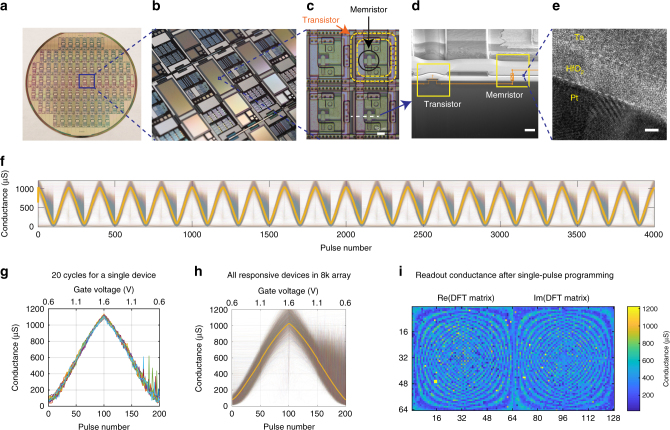
“However, severe non-linearity and asymmetry during the LTP-LTD are observed in Fig. 1b, similar to other conventional oxide-based memristors.23,32,33”
The cited source says what the claim attributes to it.
In the citing paper
“the memristive dot product engine (MDPE), which performs large-scale vector-matrix multiplication (VMM) operations using a memristive crossbar array6–13”
From Flexible self-rectifying synapse array for energy-efficient edge multiplication in electrocardiogram diagnosis (2025) · cites this paper as [8]
Self-check
Percentages, sums and reported differences re-computed from the paper’s own numbers.
The self-check needs the paper’s full text.
Citations
Cites
Deep Residual Learning for Image Recognition
He, K., Zhang, X., Ren, S., & Sun, J. (2016) · 2016 IEEE Conference on Computer Vision and Pattern Recognition (CVPR) · doi:10.1109/cvpr.2016.90 · Cited by 235,474 · cited 1×
“ith the introduction of hardware accelerators 1 – 4 for inference in deep neural networks (DNNs) 5 – 9 , the focus on improving overall energy and time performance arti fi cial intelligence applications is now on training.”
BackgroundVery Deep Convolutional Networks for Large-Scale Image Recognition
Simonyan, K., & Zisserman, A. (2014) · arXiv · doi:10.48550/arxiv.1409.1556 · Cited by 114,148
ImageNet classification with deep convolutional neural networks
Krizhevsky, A., Sutskever, I., & Hinton, G. E. (2017) · Communications of the ACM · doi:10.1145/3065386 · Cited by 112,155
LeCun, Y., Bengio, Y., & Hinton, G. (2015) · Nature · doi:10.1038/nature14539 · Cited by 84,126
Gradient-based learning applied to document recognition
Lecun, Y., Bottou, L., Bengio, Y., & Haffner, P. (1998) · Proceedings of the IEEE · doi:10.1109/5.726791 · Cited by 58,805 · cited 2×
“Here the network was trained using stochastic gradient descent (SGD) 32 to classify handwritten digits in MNIST dataset.”
MethodInfluentialLearning representations by back-propagating errors
Rumelhart, D. E., Hinton, G. E., & Williams, R. J. (1986) · Nature · doi:10.1038/323533a0 · Cited by 31,892 · cited 1×
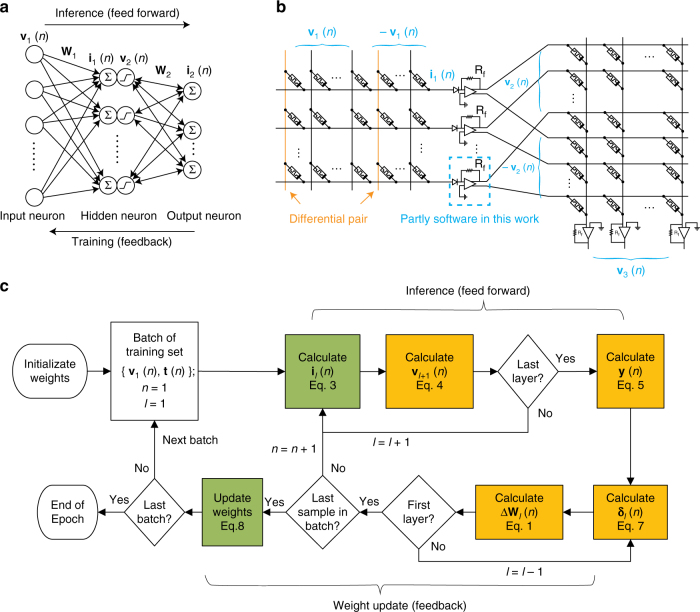
“The error backpropagation 39,40 in this work is calculated in software from the values of the readout weights (see Methods).”
MethodSelf-citationMastering the game of Go with deep neural networks and tree search
Silver, D., Huang, A., Maddison, C. J., Guez, A., Sifre, L., van den Driessche, G., Schrittwieser, J., Antonoglou, I., Panneershelvam, V., Lanctot, M., et al. (2016) · Nature · doi:10.1038/nature16961 · Cited by 15,612
Strukov, D. B., Snider, G. S., Stewart, D. R., & Williams, R. S. (2008) · Nature · doi:10.1038/nature06932 · Cited by 11,828
Self-citationTensorFlow: A system for large-scale machine learning
Abadi, M., Barham, P., Chen, J., Chen, Z., Davis, A., Dean, J., Devin, M., Ghemawat, S., Irving, G., Isard, M., et al. (2016) · arXiv (Cornell University) · doi:10.48550/arxiv.1605.08695 · Cited by 11,822
In-Datacenter Performance Analysis of a Tensor Processing Unit
Jouppi, N. P., Young, C., Patil, N., Patterson, D., Agrawal, G., Bajwa, R., Bates, S., Bhatia, S., Boden, N., Borchers, A., et al. (2017) · Proceedings of the 44th Annual International Symposium on Computer Architecture · doi:10.1145/3079856.3080246 · Cited by 4,537
Research works printed but not linked: 2
- 40. LeCun, Y. A theoretical framework of back-propagation. In Proc. of Connectionist Models Summer School (eds Touretzky, D., Hinton, G. E. & Sejnowski, T. J.) 21–28 (CMU, Pittsburgh, PA, USA, 1988).
- 53. Gokmen, T. & Vlasov, Y. Acceleration of deep neural network training with resistive cross-point devices: design considerations. Front. Neurosci.10, 333 (2016). 10.3389/fnins.2016.00333 PMC4954855 27493624 · DOI · Paper page
Cited by
Items 901–926 of 926
Ramadhan, I. F., & Wang, P.-H. (2026) · Conference on Lasers and Electro-Optics · doi:10.1364/cleo_at.2026.jtu.70
An Analog Frequency-Domain Systolic Array for Energy-Efficient AI Acceleration at the Edge
Iliescu, A., Ionescu, O. N., & Iosif, A. (2026) · Electronics · doi:10.3390/electronics15153344
Evolutionary chemical learning in dimerization networks
Anonymous, Mognetti, B. M., & Maslov, S. (2026) · Physical review. E · doi:10.1103/bszq-gftl
Single‐Step Analog In‐Memory Matrix Computation in Three‐Dimensional Circuits
Rad, A. J., Kumar, K., Kiani, F., Huang, Y., Abdel-Maksoud, A., Xiong, Z., Ling, Y., Zhao, W., & Xia, Q. (2026) · Advanced Intelligent Systems · doi:10.1002/aisy.70500
Self-citationImpact of memory device precision in analog combinatorial optimization solvers
Hizzani, M., Yang, M.-J., Heittmann, A., Hutchinson, G. H., Strukov, D., & Strachan, J. P. (2026) · npj Unconventional Computing · doi:10.1038/s44335-026-00082-4
Self-citationRicci, S., Mannocci, P., Porzani, M., Bridarolli, D., Carletti, F., Farronato, M., & Ielmini, D. (2026) · Advanced Electronic Materials · doi:10.1002/aelm.202600012
MnO2/WO3 electrochromic synapses for optical neuromorphic computing with adaptation effect
Liu, Y., & Chen, X. (2026) · AIP Advances · doi:10.1063/5.0330656
Battery‐Inspired Electrochemical Synapses for Neuromorphic Applications
Lee, W., Jang, S. C., Choi, W., Park, J., Hur, J., Yoo, H., & Kim, H. (2026) · Advanced Science · doi:10.1002/advs.77065
“By dynamically adjusting network weights to compensate for the remaining non-linear and asymmetric conductance updates, high-precision neuromorphic training could be successfully realized despite the underlying hardware imperfections [ 221 ].”
Analysis and Applications of Neuromorphic Memristors in Artificial Intelligence Computing
Wang, J., Chen, Q., Zhang, J., Meng, J., & Wang, T. (2026) · Nano-Micro Letters · doi:10.1007/s40820-026-02322-5
“These advances indicate that the historical development of memristors has been driven not only by new switching media, but also by the urgent need for large-array reliability, training capability, and compatibility with hardware neural systems [89].”
Li, Y., Hao, P., Wang, Z., Tang, L., Wang, J., Ren, Y., & Yue, Z. (2026) · Materials Today Chemistry · doi:10.1016/j.mtchem.2026.103985
Self-citationAdaptive conductance optimization for suppressing wire-resistance-induced errors in crossbar arrays
Zhao, Y., Wang, C., Wu, Z., Kong, D., Wei, W., Ding, S., Yangdong, X.-J., Shen, Y., Wang, Y., Zhang, J., et al. (2026) · Device · doi:10.1016/j.device.2026.101280
Zhou, T., Zhao, X., & Ma, M. (2026) · Chaos An Interdisciplinary Journal of Nonlinear Science · doi:10.1063/5.0343851
Xu, Z., Zhang, M., Lu, W., Xu, L., Feng, Z., Zhu, Y., Wu, Z., & Dai, Y. (2026) · IEEE Transactions on Electron Devices · doi:10.1109/ted.2026.3728400
“These issues directly limit the accuracy and reliability of large-scale neuromorphic systems, where stable resistance states and nearly linear weight updates are required for accurate vector–matrix multiplication [7], [8], [9].”
Smirnov, A., Troyan, E., Stsiapanau, A., & Khinevich, A. (2026) · SID Symposium Digest of Technical Papers · doi:10.1002/sdtp.70003_36
Hajiabadi, Z., Thomas, D. B., Chong, H. M. H., & Simanjuntak, F. M. (2026) · Advanced Electronic Materials · doi:10.1002/aelm.70558
“Similarly, Yang’s group implemented TaO x -based 1T1M arrays (up to 128 × 64) for vector–matrix multiplication, convolution, signal processing, and in situ learning [ 115–119 ].”
Rossetti, D., Xu, Y., Asselta, L., Yang, J. J., Williams, R. S., & Corinto, F. (2026) · Advanced Electronic Materials · doi:10.1002/aelm.70580
Self-citationIn-Memory Computing Enabled by 32 × 8 1T1R Memristive Crossbar Arrays
Mikhaylov, A. N., Shchanikov, S., Koryazhkina, M. N., Bordanov, I., Lukoyanov, V., Belov, A. I., Zharkov, G. D., Серов, Д. А., Antonov, I. N., Kotina, A., et al. (2026) · Electronics · doi:10.3390/electronics15184267
Sun, J., Bi, P., Li, Z., Li, Z., Sun, Y., & Xiao, Z. (2026) · Nonlinear Dynamics · doi:10.1007/s11071-026-13073-8
Xie, Q., Pan, X., Luo, W., Shuai, Y., Wu, C., Pu, Y., Chen, J., Gao, D., Fu, Q., & Zhang, W. (2026) · Journal of Applied Physics · doi:10.1063/5.0353639
Dong, C., Xie, X., Chen, J., Tan, G., Huang, Y., & Cao, S. (2026) · Electronics · doi:10.3390/electronics15194512
Lattice Disorder in CuI Enables Filament‐Free Transparent Memristors
Ouyang, Y., Qu, K., Wang, H., Liu, J., Li, W., Ji, Z., Yang, J., Zhu, Q., Yang, Z., Tang, X., et al. (2026) · Advanced Science · doi:10.1002/advs.78209
“While significant progress has been made in n-type transparent semiconductors (e.g., HfO x , WO x , IGZO) [ 9–14 ], transparent p-type semiconductors remain comparatively limited, particularly for applications requiring stable and continuously tunable electronic states.”
Self-citationWang, S., Xu, M. K., Yang, J., Chen, Z., Chen, H., Liu, S., Zhang, X., Wong, K., Lin, N., Li, Y., et al. (2026) · ACM/IEEE Design Automation Conference (DAC) · doi:10.1145/3770743.3804081
“State-of-the-art flow-matching implementations rely on digital ODE solvers [16, 17] that discretize time into many steps; each step requires multiple vector–matrix multiplication (VMM) and memory accesses [18, 19].”
Self-citationMemristive Neural Networks-Assisted Training Algorithms: Current State and Future Challenges
Samardžić, N., Vranjković, V. S., Teodorovic, P., Maričić, J., Shchanikov, S., Gordleeva, S., Mikhaylov, A. N., Talanov, M. O., Kazantsev, V., STRUHARIK, R. J. R., et al. (2026) · Electronics · doi:10.3390/electronics15214892
Memristors based brain-like chip towards human-computer interaction
Tuo, S., Dong, X., Wang, S. L., Lu, Z., & Sun, B. T. (2026) · Materials Today Nano · doi:10.1016/j.mtnano.2026.100987
Yeom, J.-H., Kim, Y.-G., Lee, J.-H., Ban, S.-H., Gautam, S., Ray, A. K., Kim, T., Lee, H.-D., & Kwon, H.-M. (2026) · Materials Science in Semiconductor Processing · doi:10.1016/j.mssp.2026.111343
Metadata
- Authors
- Li, C., Belkin, D., Li, Y., Yan, P., Hu, M., Ge, N., Jiang, H., Montgomery, E., Lin, P., Wang, Z., Song, W., Strachan, J. P., Barnell, M., Wu, Q., Williams, R. S., Yang, J. J., & Xia, Q.
- Affiliations
- University of Massachusetts Amherst (US)
- Swarthmore College (US)
- Binghamton University (US)
- Hewlett-Packard (United States) (US)
- U.S. Air Force Research Laboratory Information Directorate (US)
- Corresponding author
- Yang, J. Joshua
- Xia, Qiangfei
- ORCID
- Venue
- Nature Communications
- Published
- 2018-06-19
- Volume
- 9
- Issue
- 1
- Pages
- 2385-2385
- ISSN
- 2041-1723 (ISSN-L)
- PMC
- PMC6008303
- OpenAlex
- W2807750997
- Cited by
- 931
- References
- 49
- Citations by year
- 2026: 76 · 2025: 112 · 2024: 103 · 2023: 131 · 2022: 120 · 2021: 126 · 2020: 147 · 2019: 100 · 2018: 16
- FWCI
- 37.17
- Type
- journal article
- Language
- en
- Open access
- gold
- doi.org
- Licence
- cc-by
- creativecommons.org/licenses/by/4.0 (tdm)
- creativecommons.org/licenses/by/4.0 (vor)
- Locations
- Nature Communications (publishedVersion, cc-by)
- Europe PMC (PubMed Central) (publishedVersion, other-oa)
- PubMed Central (publishedVersion, cc-by)
- PubMed (publishedVersion)
- RePEc: Research Papers in Economics (submittedVersion)
- DOAJ (DOAJ: Directory of Open Access Journals) (submittedVersion, cc-by-sa)
- Funders
- Air Force Research Laboratory (FA8750-15-2-0044)
- National Science Foundation (ECCS-1253073)
- Topics
- Physical Sciences › Engineering › Electrical and Electronic Engineering › Advanced Memory and Neural Computing
- Physical Sciences › Engineering › Electrical and Electronic Engineering › Ferroelectric and Negative Capacitance Devices
- Physical Sciences › Computer Science › Artificial Intelligence › Neural Networks and Applications
- Keywords
- memristor neural networks, in situ learning, multilayer neural networks, monolithic integration, energy-efficient hardware, neuromorphic computing, classification accuracy
About these checks
Registry, retraction, Cites and statistics results are computed, not judged, with one exception: a printed reference that no index lists is read once by a model before it counts as a citation error. Claims are extracted by a model and kept only when their quote appears verbatim in the text; each cited source is then checked, with a model’s help, for whether it says what the claim relies on. Those verdicts can be wrong — read the claim’s quote and the cited source before relying on one.
Statistics and arithmetic are recomputed, not judged.
Confidence bands are shown only for fields calibrated on our annotated test set. None is calibrated yet, so no band is shown.
What counts as a claim ›How we measure confidence ›How we check this ›
Are you an author, or do you see a problem with this page? Request a review
Data sources
Bibliographic data: Semantic Scholar, OpenAlex, Crossref.
Contains information from the Semantic Scholar Academic Graph Datasets, made available under the ODC Attribution License (ODC-BY 1.0).
Semantic Scholar’s data is described in: Kinney, R., et al. (2023). The Semantic Scholar Open Data Platform. arXiv:2301.10140.
