

Efficient and self-adaptive in-situ learning in multilayer memristor neural networks
Open accessThe DOI matches its Crossref record; 52 of the 52 references it cites were found in a registry or an index.
Abstract
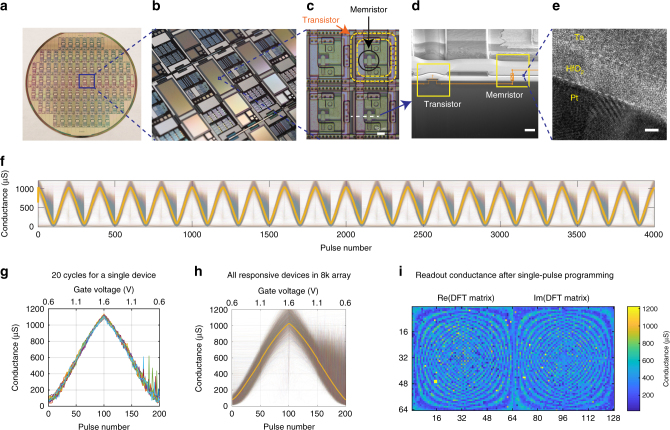
Memristors with tunable resistance states are emerging building blocks of artificial neural networks. However, in situ learning on a large-scale multiple-layer memristor network has yet to be demonstrated because of challenges in device property engineering and circuit integration. Here we monolithically integrate hafnium oxide-based memristors with a foundry-made transistor array into a multiple-layer neural network. We experimentally demonstrate in situ learning capability and achieve competitive classification accuracy on a standard machine learning dataset, which further confirms that the training algorithm allows the network to adapt to hardware imperfections. Our simulation using the experimental parameters suggests that a larger network would further increase the classification accuracy. The memristor neural network is a promising hardware platform for artificial intelligence with high speed-energy efficiency.
Overview
The claims and statistics of this paper haven’t been checked yet.
Free: it reads the open-access text and checks the first 5 claims that cite a source we can check. Create a free account to check every claim.
Integrity signals
Registry
Cites
Statistics
Figures
Verification
Claims the paper makes
The claims and statistics of this paper haven’t been checked yet.
Free: it reads the open-access text and checks the first 5 claims that cite a source we can check. Create a free account to check every claim.
Claims other papers make about this one
Each is checked against this paper’s own text: does it say what the citing paper says it does?
The cited source says what the claim attributes to it.
In the citing paper
“However, severe non-linearity and asymmetry during the LTP-LTD are observed in Fig. 1b, similar to other conventional oxide-based memristors.23,32,33”
The cited source says what the claim attributes to it.
In the citing paper
“the memristive dot product engine (MDPE), which performs large-scale vector-matrix multiplication (VMM) operations using a memristive crossbar array6–13”
From Flexible self-rectifying synapse array for energy-efficient edge multiplication in electrocardiogram diagnosis (2025) · cites this paper as [8]
Self-check
Percentages, sums and reported differences re-computed from the paper’s own numbers.
The self-check needs the paper’s full text.
Citations
Cites
Deep Residual Learning for Image Recognition
He, K., Zhang, X., Ren, S., & Sun, J. (2016) · 2016 IEEE Conference on Computer Vision and Pattern Recognition (CVPR) · doi:10.1109/cvpr.2016.90 · Cited by 235,474 · cited 1×
“ith the introduction of hardware accelerators 1 – 4 for inference in deep neural networks (DNNs) 5 – 9 , the focus on improving overall energy and time performance arti fi cial intelligence applications is now on training.”
BackgroundVery Deep Convolutional Networks for Large-Scale Image Recognition
Simonyan, K., & Zisserman, A. (2014) · arXiv · doi:10.48550/arxiv.1409.1556 · Cited by 114,148
ImageNet classification with deep convolutional neural networks
Krizhevsky, A., Sutskever, I., & Hinton, G. E. (2017) · Communications of the ACM · doi:10.1145/3065386 · Cited by 112,155
LeCun, Y., Bengio, Y., & Hinton, G. (2015) · Nature · doi:10.1038/nature14539 · Cited by 84,126
Gradient-based learning applied to document recognition
Lecun, Y., Bottou, L., Bengio, Y., & Haffner, P. (1998) · Proceedings of the IEEE · doi:10.1109/5.726791 · Cited by 58,805 · cited 2×
“Here the network was trained using stochastic gradient descent (SGD) 32 to classify handwritten digits in MNIST dataset.”
MethodInfluentialLearning representations by back-propagating errors
Rumelhart, D. E., Hinton, G. E., & Williams, R. J. (1986) · Nature · doi:10.1038/323533a0 · Cited by 31,892 · cited 1×
“The error backpropagation 39,40 in this work is calculated in software from the values of the readout weights (see Methods).”
MethodSelf-citationMastering the game of Go with deep neural networks and tree search
Silver, D., Huang, A., Maddison, C. J., Guez, A., Sifre, L., van den Driessche, G., Schrittwieser, J., Antonoglou, I., Panneershelvam, V., Lanctot, M., et al. (2016) · Nature · doi:10.1038/nature16961 · Cited by 15,612
Strukov, D. B., Snider, G. S., Stewart, D. R., & Williams, R. S. (2008) · Nature · doi:10.1038/nature06932 · Cited by 11,828
Self-citationTensorFlow: A system for large-scale machine learning
Abadi, M., Barham, P., Chen, J., Chen, Z., Davis, A., Dean, J., Devin, M., Ghemawat, S., Irving, G., Isard, M., et al. (2016) · arXiv (Cornell University) · doi:10.48550/arxiv.1605.08695 · Cited by 11,822
In-Datacenter Performance Analysis of a Tensor Processing Unit
Jouppi, N. P., Young, C., Patil, N., Patterson, D., Agrawal, G., Bajwa, R., Bates, S., Bhatia, S., Boden, N., Borchers, A., et al. (2017) · Proceedings of the 44th Annual International Symposium on Computer Architecture · doi:10.1145/3079856.3080246 · Cited by 4,537
Research works printed but not linked: 2
- 40. LeCun, Y. A theoretical framework of back-propagation. In Proc. of Connectionist Models Summer School (eds Touretzky, D., Hinton, G. E. & Sejnowski, T. J.) 21–28 (CMU, Pittsburgh, PA, USA, 1988).
- 53. Gokmen, T. & Vlasov, Y. Acceleration of deep neural network training with resistive cross-point devices: design considerations. Front. Neurosci.10, 333 (2016). 10.3389/fnins.2016.00333 PMC4954855 27493624 · DOI · Paper page
Cited by
Items 301–400 of 926
Nguyen, T. V., An, J., & Min, K. (2021) · Micromachines · doi:10.3390/mi12070791 · Cited by 35
“Actually, for considering the yield-limited memristor defects, a defect-aware in-situ crossbar training can be used with the parasitic-resistance correction circuit proposed in this paper [37].”
MethodSneak, discharge, and leakage current issues in a high-dimensional 1T1M memristive crossbar
Demin, V. A., Surazhevsky, I. A., Emelyanov, A. V., Kashkarov, P. K., & Kovalchuk, M. V. (2020) · Journal of Computational Electronics · doi:10.1007/s10825-020-01470-0 · Cited by 34
“On the basis of memristive structures, the implementation of mixed analog–digital hardware multilayer neural networks becomes possible [14–16].”
BackgroundFlexible Memristor Devices Using Hybrid Polymer/Electrodeposited GeSbTe Nanoscale Thin Films
Jaafar, A. H., Meng, L., Zhang, T., Guo, D., Newbrook, D. W., Zhang, W., Reid, G., de Groot, C. H., Bartlett, P. N., & Huang, R. (2022) · ACS Applied Nano Materials · doi:10.1021/acsanm.2c03639 · Cited by 30
van Doremaele, E. R. W., Stevens, T., Ringeling, S., Spolaor, S., Fattori, M., & van de Burgt, Y. (2024) · Science Advances · doi:10.1126/sciadv.ado8999 · Cited by 31
“In situ training, on the other hand, can adapt the weights and compensate for these imperfections automatically ( 15 , 16 ) and allows for faster and more scalable computing systems ( 17 ).”
BackgroundIonotronic Neuromorphic Devices for Bionic Neural Network Applications
Yu, F., & Zhu, L. Q. (2019) · physica status solidi (RRL) - Rapid Research Letters · doi:10.1002/pssr.201800674 · Cited by 35
Liu, Y., & Iu, H. H. (2020) · IEEE Access · doi:10.1109/access.2020.3004160 · Cited by 31
Misba, W. A., Lozano, M., Querlioz, D., & Atulasimha, J. (2022) · IEEE Access · doi:10.1109/access.2022.3196688 · Cited by 31
“Computational memory such as phase change random access memory (PCM) [11,12], resistive random-access memory (RRAM) [13,14], arranged in a crossbar array have been shown to classify handwritten digits [9,15] and recognize human faces [16].”
BackgroundSelf‐selective memristor‐enabled i n‐memory search for highly efficient data mining
Yang, L., Huang, X., Li, Y., Zhou, H., Yu, Y., Bao, H., Li, J., Ren, S., Wang, F., Ye, L., et al. (2023) · InfoMat · doi:10.1002/inf2.12416 · Cited by 33
Self-citationKwon, D., Woo, S. Y., Lee, K.-H., Hwang, J., Kim, H., Park, S., Shin, W., Bae, J., Kim, J., & Lee, J. (2023) · Science Advances · doi:10.1126/sciadv.adg9123 · Cited by 29
“Moreover, according to Kirchhoff ’ s and Ohm ’ s laws, NC architectures perform massively parallel operations with high energy efficiency and reduced area overhead ( 19 – 23 ).”
Kwon, D., Park, E. C., Shin, W., Koo, R., Hwang, J., Bae, J., Kwon, D., & Lee, J. (2023) · Advanced Intelligent Systems · doi:10.1002/aisy.202300125 · Cited by 34
Noise Tailoring in Memristive Filaments
Sánta, B., Balogh, Z., Pósa, L., Krisztián, D., Török, T. N., Molnár, D., Sinkó, C., Hauert, R., Csontos, M., & Halbritter, A. (2021) · ACS Applied Materials & Interfaces · doi:10.1021/acsami.0c21156 · Cited by 33
Koo, R., Shin, W., Kim, S., Im, J., Park, S., Ko, J., Kwon, D., Kim, J., Kwon, D., & Lee, J. (2023) · Advanced Science · doi:10.1002/advs.202303735 · Cited by 29
Artificial neural networks based on memristive devices
Ravichandran, V., Li, C., BanaGozar, A., Yang, J. J., & Xia, Q. (2018) · Science China Information Sciences · doi:10.1007/s11432-018-9425-1 · Cited by 29
Self-citationA Memristive Neural Network Model With Associative Memory for Modeling Affections
Ma, D., Wang, G., Han, C., Shen, Y., & Liang, Y. (2018) · IEEE Access · doi:10.1109/access.2018.2875433 · Cited by 30
“Learning in memristor crossbar-based spiking neural networks and efficient and self-adaptive in-situ learning inmultilayer memristor neural networks are also reported [22], [23].”
BackgroundMemristor-Based Image Enhancement: High Efficiency and Robustness
Zhu, R., Tang, Z., Ye, S., Huang, Q., Guo, L., & Chang, S. (2020) · IEEE Transactions on Electron Devices · doi:10.1109/ted.2020.3045684 · Cited by 30
Multi-level resistance switching and random telegraph noise analysis of nitride based memristors
Vasileiadis, N., Loukas, P., Karakolis, P., Ioannou-Sougleridis, V., Normand, P., Ntinas, V. G., Fyrigos, I.-A., Karafyllidis, I. G., Sirakoulis, G. C., & Dimitrakis, P. (2021) · Chaos Solitons & Fractals · doi:10.1016/j.chaos.2021.111533 · Cited by 29
Lead-free halide perovskites, beyond solar cells and LEDs
Pareja‐Rivera, C., Morett, D., Barreiro‐Argüelles, D., Olalde-Velasco, P., & Solís-Ibarra, D. (2021) · Journal of Physics Energy · doi:10.1088/2515-7655/ac01bf · Cited by 35
Zeumault, A., Alam, S., Wood, Z., Weiss, R., Aziz, A., & Rose, G. S. (2021) · Frontiers in Nanotechnology · doi:10.3389/fnano.2021.734121 · Cited by 30
A Universal, Analog, In-Memory Computing Primitive for Linear Algebra Using Memristors
Mannocci, P., Pedretti, G., Giannone, E., Melacarne, E., Sun, Z., & Ielmini, D. (2021) · IEEE Transactions on Circuits and Systems I Regular Papers · doi:10.1109/tcsi.2021.3122278 · Cited by 41
Woo, H. C., Kim, J., Lee, S., Kim, H. J., & Hwang, C. S. (2022) · Advanced Electronic Materials · doi:10.1002/aelm.202200656 · Cited by 30
Metal–Organic Frameworks–Based Memristors: Materials, Devices, and Applications
Shu, F., Chen, X., Yu, Z., Gao, P., & Liu, G. (2022) · Molecules · doi:10.3390/molecules27248888 · Cited by 28
Synapse-Mimetic Hardware-Implemented Resistive Random-Access Memory for Artificial Neural Network
Seok, H., Son, S., Jathar, S. B., Lee, J., & Kim, T. (2023) · Sensors · doi:10.3390/s23063118 · Cited by 31
An Analysis of Components and Enhancement Strategies for Advancing Memristive Neural Networks
Park, H., Han, J., Yim, S., Shin, D. H., Park, T. W., Woo, K. S., Lee, S. H., Cho, J. M., Kim, H. W., Park, T., et al. (2025) · Advanced Materials · doi:10.1002/adma.202412549 · Cited by 27
Refreshable memristor via dynamic allocation of ferro-ionic phase for neural reuse
Chen, J., Wen, Z., Yang, F., Bian, R., Zhang, Q., Pan, E., Zeng, Y., Luo, X. D., Liu, Q., Deng, L.-J., et al. (2025) · Nature Communications · doi:10.1038/s41467-024-55701-0 · Cited by 34
Memristor-Based Neuromorphic Hardware Improvement for Privacy-Preserving ANN
Fu, J., Liao, Z., & Wang, J. (2019) · IEEE Transactions on Very Large Scale Integration (VLSI) Systems · doi:10.1109/tvlsi.2019.2923722 · Cited by 30
Kim, D., Bang, H., Baac, H. W., Lee, J., Truong, P. L., Jeong, B. H., Appadurai, T., Park, K. K., Heo, D., Nam, V. B., et al. (2023) · Advanced Functional Materials · doi:10.1002/adfm.202213064 · Cited by 28
Neuromorphic behaviors in a neuron circuit based on current-controlled Chua Corsage Memristor
Li, Z., & Chen, K. (2023) · Chaos Solitons & Fractals · doi:10.1016/j.chaos.2023.114017 · Cited by 27
Nath, S. K., Sun, X., Nandi, S. K., Chen, X., Wang, Z., Das, S. K., Lei, W., Faraone, L., Rickard, W. D. A., & Elliman, R. G. (2023) · Advanced Functional Materials · doi:10.1002/adfm.202306428 · Cited by 27
Self-citationZarrin, P. S., Zahari, F., Mahadevaiah, M. K., Pérez, E., Kohlstedt, H., & Wenger, C. (2020) · Scientific Reports · doi:10.1038/s41598-020-76823-7 · Cited by 29
“Nevertheless, RRAM neuromorphic systems can also be used for on-chip learning and adaptation to new input patterns by developing network structures and acquiring algorithms 30,37 .”
BackgroundZhang, Y. L., Dong, M., Du, Y., Yang, S., Ren, Y., Guo, Y., Gao, D., Lin, X., Dong, Y., Zhou, G., et al. (2025) · Matter · doi:10.1016/j.matt.2024.101945 · Cited by 27
Yang, J., Mao, R., Jiang, M., Cheng, Y., Sun, P.-S. V., Dong, S., Pedretti, G., Sheng, X., Ignowski, J., Li, H., et al. (2025) · Nature Communications · doi:10.1038/s41467-025-56254-6 · Cited by 38
Self-citationSasikumar, K., Chan, H., Narayanan, B., & Sankaranarayanan, S. K. R. S. (2019) · Chemistry of Materials · doi:10.1021/acs.chemmater.8b03969 · Cited by 29
Sakellaropoulos, D., Bousoulas, P., Nikas, G., Arvanitis, C., Bagakis, E., & Tsoukalas, D. (2020) · Microelectronic Engineering · doi:10.1016/j.mee.2020.111358 · Cited by 27
Differentiable Content Addressable Memory with Memristors
Pedretti, G., Graves, C. E., Vaerenbergh, T. V., Serebryakov, S., Foltín, M., Sheng, X., Mao, R., Li, C., & Strachan, J. P. (2022) · Advanced Electronic Materials · doi:10.1002/aelm.202101198 · Cited by 31
Self-citationAirNN: Over-the-Air Computation for Neural Networks via Reconfigurable Intelligent Surfaces
Sánchez, S. G., Reus-Muns, G., Bocanegra, C., Li, Y., Muncuk, U., Naderi, M. Y., Wang, Y., Ioannidis, S., & Chowdhury, K. R. (2022) · IEEE/ACM Transactions on Networking · doi:10.1109/tnet.2022.3225883 · Cited by 48
“In-situ learning for a memristor-based multi-layer perceptron is demonstrated in [15].”
Self-citationVein fate determined by flow-based but time-delayed integration of network architecture
Marbach, S., Ziethen, N., Bastin, L., Bäuerle, F., & Alim, K. (2023) · eLife · doi:10.7554/elife.78100 · Cited by 26
Lu, C., Meng, J., Yu, J., Song, J., Wang, T., Zhu, H., Sun, Q., Zhang, D. W., & Chen, L. (2024) · Nano Letters · doi:10.1021/acs.nanolett.3c04577 · Cited by 28
Kim, M., & Kim, S. (2024) · ACS Applied Electronic Materials · doi:10.1021/acsaelm.4c00428 · Cited by 29
Li, R., Gao, X., & Cao, J. (2019) · IEEE Transactions on Neural Networks and Learning Systems · doi:10.1109/tnnls.2019.2938774 · Cited by 25
Analog error correcting codes for defect tolerant matrix multiplication in crossbars
Li, C., Roth, R. M., Graves, C., Sheng, X., & Strachan, J. P. (2020) · Technical digest - International Electron Devices Meeting/Technical digest · doi:10.1109/iedm13553.2020.9371978 · Cited by 25
Self-citationRedundancy and Analog Slicing for Precise In-Memory Machine Learning—Part I: Programming Techniques
Pedretti, G., Mannocci, P., Li, C., Sun, Z., Strachan, J. P., & Ielmini, D. (2021) · IEEE Transactions on Electron Devices · doi:10.1109/ted.2021.3095433 · Cited by 28
Self-citationVETAM-M: A General Model for Voltage-Controlled Memcapacitive-Coupled Memristors
Ren, K., Zhang, K., Qin, X., Yang, F., Sun, B. T., Zhao, Y. X., & Zhang, Y. (2021) · IEEE Transactions on Circuits & Systems II Express Briefs · doi:10.1109/tcsii.2021.3103553 · Cited by 34
Memristor-Based Light-Weight Transformer Circuit Implementation for Speech Recognizing
Xiao, H., Zhou, Y., Gao, T., Duan, S., Chen, G., & Hu, X. (2023) · IEEE Journal on Emerging and Selected Topics in Circuits and Systems · doi:10.1109/jetcas.2023.3237582 · Cited by 26
“Memristor-based neuromorphic computation can produce massively parallel multi-adds while consuming little power, making memristor-based neuromorphic computation a reliable choice for implementing various neural networks and algorithms [19], [20], [21], [22], [23], [24], [25].”
BackgroundPruning and quantization algorithm with applications in memristor-based convolutional neural network
Guo, M. L., Sun, Y., Zhu, Y., Han, M., Dou, G., & Wen, S. (2023) · Cognitive Neurodynamics · doi:10.1007/s11571-022-09927-7 · Cited by 28
“In recent years, many achievements have been made in memristor-based convolutional neural networks (see Yakopcic et al. 2016, 2017; Li et al. 2018; Jeong and Shi 2018; Zhang et al. 2017; Shafiee et al. 2016; Chen et al. 2021; Lehtonen and Laiho 2010; Yao et al. 2020).”
Self-Powered Memristive Systems for Storage and Neuromorphic Computing
Shi, J., Wang, Z., Tao, Y., Xu, H., Zhao, X., Lin, Y., & Liu, Y. (2021) · Frontiers in Neuroscience · doi:10.3389/fnins.2021.662457 · Cited by 24
“…the significant advantage of resistance-tunable features for behaving like a synapse and is universally considered to be the emerging building blocks of brain-like ANNs (Wang et al., 2016; Li C. et al., 2018; Liu et al., 2018; Yan et al., 2018, 2019a,b; Yoon et al., 2018; Zhao et al., 2020).”
BackgroundSelf-citationYang, Y., Sun, B. T., Zhou, G., Ke, C., Zhang, J., Zhou, Y., Mao, S., Qin, J., & Zhao, Y. X. (2023) · Materials Today Communications · doi:10.1016/j.mtcomm.2023.105512 · Cited by 27
Wang, P., Wang, Z., Sun, X., Hur, J. H., Datta, S., Khan, A. I., & Yu, S. (2020) · IEEE Transactions on Electron Devices · doi:10.1109/ted.2020.3009956 · Cited by 25
“Recently, CIM prototypes with static random-access memory (SRAM) [2] and emerging nonvolatile memories (eNVMs) such as phase change memory (PCM) [3], [4] and resistive random-access memory (RRAM) [5]–[8] have been demonstrated at array level.”
BackgroundSelf-citationLü, J., Wu, Z., Zhang, X., Wei, J., Fang, Y., Shi, T., Liu, Q., Wu, F., & Liu, M. (2020) · IEEE Electron Device Letters · doi:10.1109/led.2020.3021593 · Cited by 25
“Thus, it has been recognized as a promising candidate to build such a high-performance computing system to execute compute-intensive tasks, such as pattern recognition, decision making, dimensionality reduction, equation solver, NP-hard problem [11]–[18].”
BackgroundJeong, H., Han, S., Park, S., Kim, T. R., Bae, J., Jang, T., Cho, Y., Seo, S., Jeong, H.-J., Park, S., et al. (2025) · Nature Electronics · doi:10.1038/s41928-024-01318-6 · Cited by 47
“18 for training weights).”
Yan, B., He, S., & Wang, S. (2020) · Mathematical Problems in Engineering · doi:10.1155/2020/2468134 · Cited by 23
“Moreover, collective behaviours in the coupled nonlinear network have aroused much research interests, and these networks usually consist of nonlinear chaotic systems [28, 29], neural models [30, 31], and neural models with memristors [32, 33].”
BackgroundImproved Performance of HfxZnyO‐Based RRAM and its Switching Characteristics down to 4 K Temperature
Lan, J., Li, Z., Chen, Z., Zhu, Q., Wang, W., Zaheer, M., Lu, J., Liang, J., Shen, M., Chen, P., et al. (2023) · Advanced Electronic Materials · doi:10.1002/aelm.202201250 · Cited by 29
Self-citationVohra, S. K., Thomas, S. A., Shivdeep, S., Sakare, M., & Das, D. M. (2023) · IEEE Transactions on Very Large Scale Integration (VLSI) Systems · doi:10.1109/tvlsi.2023.3268173 · Cited by 23
“It allows the system to continuously adapt and learn according to the training data, making the network adaptable to the hardware imperfections [27].”
BackgroundBioinspired Memristive Neural Network Circuit Design of Cross-Modal Associative Memory
Liu, J., Xiong, F., Zhou, Y., Duan, S., & Hu, X. (2023) · IEEE Transactions on Cognitive and Developmental Systems · doi:10.1109/tcds.2023.3303653 · Cited by 25
“The memristor has been demonstrated for a wide variety of applications, including memory [8], [9], [10], [11], analog circuits [12], [13], [14], [15], neuromorphic computing [16], [17], [18], [19], and so on.”
BackgroundOptical Monitoring of the Resistive States of a Polyaniline‐Based Memristive Device
Lapkin, D. A., Коровин, А. Н., Malakhov, S. N., Emelyanov, A. V., Demin, V. A., & Erokhin, V. V. (2020) · Advanced Electronic Materials · doi:10.1002/aelm.202000511 · Cited by 23
Emerging 2D materials hardware for in-sensor computing
Shi, Y., Duong, N. T., & Ang, K. (2025) · Nanoscale Horizons · doi:10.1039/d4nh00405a · Cited by 26
An, Y., Kim, D., Park, Y. R., Eo, J. S., Kim, M., Kim, D., Kim, H. B., Lee, B., & Wang, G. (2025) · Nano Energy · doi:10.1016/j.nanoen.2025.110999 · Cited by 23
Investigation of Low-Frequency Noise Characteristics in Gated Schottky Diodes
Kwon, D., Shin, W., Bae, J., Lim, S., Park, B., & Lee, J. (2021) · IEEE Electron Device Letters · doi:10.1109/led.2021.3051197 · Cited by 23
“Most of the previous studies investigated the LFN characteristics of the synaptic devices based on the 2-terminal RRAM devices.”
BackgroundInfluentialCost- and Dataset-free Stuck-at Fault Mitigation for ReRAM-based Deep Learning Accelerators
Jung, G., Fouda, M. E., Lee, S., Lee, J., Eltawil, A. M., & Kurdahi, F. J. (2021) · Design, Automation, and Test in Europe · doi:10.23919/date51398.2021.9474226 · Cited by 25
Kim, S., Yoon, C., Oh, G., Lee, Y. W., Shin, M., Kee, E. H., Park, B. H., Lee, J. H., Park, S., Kang, B. S., et al. (2022) · Advanced Science · doi:10.1002/advs.202201502 · Cited by 23
Sahu, U., Pandey, A., Goyal, K., & Bhowmik, D. (2019) · AIP Advances · doi:10.1063/1.5129729 · Cited by 22
Graph processing and machine learning architectures with emerging memory technologies: a survey
Qian, X. (2021) · Science China Information Sciences · doi:10.1007/s11432-020-3219-6 · Cited by 25
Global-Gate Controlled One-Transistor One-Digital-Memristor Structure for Low-Bit Neural Network
Huang, M., Zhao, G., Wang, X., Zhang, W., Coquet, P., Tay, B. K., Zhong, G., & Li, J. (2020) · IEEE Electron Device Letters · doi:10.1109/led.2020.3037203 · Cited by 21
A Memristor‐Based Bioinspired Multimodal Sensory Memory System for Sensory Adaptation of Robots
Pan, X., Wang, J., Deng, Z., Shuai, Y., Luo, W., Luo, W., Xie, Q., Xiao, Y., Tang, S. Y., Jiang, S., et al. (2022) · Advanced Intelligent Systems · doi:10.1002/aisy.202200031 · Cited by 22
Artificial Astrocyte Memristor with Recoverable Linearity for Neuromorphic Computing
Cheng, C., Wang, Y., Xu, L., Liu, K., Dang, B., Lu, Y., Yan, X., Huang, R., & Yang, Y. (2021) · Advanced Electronic Materials · doi:10.1002/aelm.202100669 · Cited by 21
A Braitenberg Vehicle Based on Memristive Neuromorphic Circuits
Wang, C., Yang, Z.-Z., Wang, S., Wang, P., Wang, C., Pan, C., Cheng, B., Liang, S., & Miao, F. (2019) · Advanced Intelligent Systems · doi:10.1002/aisy.201900103 · Cited by 23
A review of memristive reservoir computing for temporal data processing and sensing
Jang, Y. H., Han, J., & Hwang, C. S. (2024) · InfoScience. · doi:10.1002/inc2.12013 · Cited by 25
Yeo, I., Gi, S.-G., Wang, G., & Lee, B. (2021) · IEEE Transactions on Industrial Electronics · doi:10.1109/tie.2020.3032867 · Cited by 25
“several leading research groups and successful outcomes have been reported [9]–[11], [19].”
BackgroundMethodDynamic resistive switching devices for neuromorphic computing
Wu, Y., Wang, X., & Lu, W. D. (2021) · Semiconductor Science and Technology · doi:10.1088/1361-6641/ac41e4 · Cited by 24
“For example, a bilayer fully connected network and a 5-layer CNN with online learning capabilities have been demonstrated for MNIST classification with 97.3% and 97.99% accuracy, respectively [123, 130].”
InfluentialChee, M. Y., Dananjaya, P. A., Lim, G. J., Du, Y., & Lew, W. S. (2022) · ACS Applied Materials & Interfaces · doi:10.1021/acsami.2c11016 · Cited by 21
Silicon–van der Waals heterointegration for CMOS-compatible logic-in-memory design
Lee, M., Gao, C., Tsai, M., Lin, C.-Y., Yang, F., Sung, H., Zhang, C., Li, W., Li, J., Zhang, J., et al. (2023) · Science Advances · doi:10.1126/sciadv.adk1597 · Cited by 22
Advancing Neural Networks: Innovations and Impacts on Energy Consumption
Fedorova, A., Jovišić, N., Vallverdú, J., Battistoni, S., Jovičić, M., Medojević, M., Toschev, A. S., Alshanskaia, E., Talanov, M. O., & Erokhin, V. V. (2024) · Advanced Electronic Materials · doi:10.1002/aelm.202400258 · Cited by 24
Memristive Spiking Neural Networks Trained with Unsupervised STDP
Zhou, E., Fang, L., & Yang, B. (2018) · Electronics · doi:10.3390/electronics7120396 · Cited by 20
“Though our proposed architecture and learning method are demonstrated by simulation, the used models and parameters are set according to experimental results [1,2,7,11].”
BackgroundMethodA Survey on Architecture Advances Enabled by Emerging Beyond-CMOS Technologies
Chen, A., Datta, S., Hu, X. S., Niemier, M. T., Simunic, T., & Yang, J. J. (2019) · IEEE Design and Test · doi:10.1109/mdat.2019.2902359 · Cited by 27
Self-citationOn Learning With Nonlinear Memristor-Based Neural Network and its Replication
Yang, C., Adhikari, S. P., & Kim, H. (2019) · IEEE Transactions on Circuits and Systems I Regular Papers · doi:10.1109/tcsi.2019.2914125 · Cited by 20
“Most of the existing works in the literature regarding hardware implementation of neural networks rely on the chipin-the-loop method [16], [20], [23] where the actual learning is performed in computer software and the computed weight updates are downloaded to the neural circuits.”
BackgroundInfluentialResearch on Pt/NiOx/WO3–x:Ti/W Multijunction Memristors with Synaptic Learning and Memory Functions
Zhang, H., Cheng, C., Huang, B., Zhang, H., Chen, R., Huang, Y., Chen, H., & Pei, W. (2021) · The Journal of Physical Chemistry Letters · doi:10.1021/acs.jpclett.1c00704 · Cited by 21
Lee, Y., Rhee, H., Kim, G., Cheong, W. H., Kim, D. H., Song, H., Kay, S. N., Lee, J., & Kim, K. M. (2025) · Nature Communications · doi:10.1038/s41467-025-59589-2 · Cited by 19
“In suchcases, a commonapproach is to represent one weight using a pair of columns, each representing positive or negative weight values 8,48,49 .”
Framework for In-Memory Computing Based on Memristor and Memcapacitor for On-Chip Training
Singh, A., & Lee, B.-G. (2023) · IEEE Access · doi:10.1109/access.2023.3324375 · Cited by 19
“As a result, a myriad of CNN hardware designs featuring mem-elements-based VMM accelerators have been proposed [4], [5], [6], and their efficacy has been impressively demonstrated.”
BackgroundCurrent opinions on memristor-accelerated machine learning hardware
Jiang, M., Xu, Y., Li, Z., & Li, C. (2025) · Current Opinion in Solid State and Materials Science · doi:10.1016/j.cossms.2025.101226 · Cited by 28
Self-citationBioinspired artificial vision system based on photoelectric memristors
Mao, S., Zhao, Y. X., Cao, Z., Zhu, S., Zhou, G., & Sun, B. T. (2025) · Materials Science and Engineering R Reports · doi:10.1016/j.mser.2025.101137 · Cited by 22
Subramanian, A., Tiwale, N. M., Kisslinger, K., & Nam, C. (2022) · Advanced Electronic Materials · doi:10.1002/aelm.202200172 · Cited by 20
Wei, Y., Duan, Q., Yuan, R., Yan, X., & Yang, Y. (2022) · Microelectronic Engineering · doi:10.1016/j.mee.2022.111778 · Cited by 21
Wei, Q., Gao, B., Tang, J., Qian, H., & Wu, H. (2023) · IEEE Electron Devices Magazine · doi:10.1109/med.2023.3296084 · Cited by 22
“…and improve programming precision in large-scale arrays, 1T1R memristor arrays were used in several studies to implement algorithms such as image compression, convolutional filtering, and the in situ training of two-layer perceptions and long short-term memory (LSTM) networks [60], [67], [68] .”
MethodThreshold learning algorithm for memristive neural network with binary switching behavior
Youn, S., Hwang, Y., Kim, T., Kim, S., Hwang, H., Park, J., & Kim, H. (2024) · Neural Networks · doi:10.1016/j.neunet.2024.106355 · Cited by 19
Unconventional Inorganic‐Based Memristive Devices for Advanced Intelligent Systems
Sung, S. H., Kim, D. H., Kim, T., Kang, I., & Lee, K. J. (2019) · Advanced Materials Technologies · doi:10.1002/admt.201900080 · Cited by 20
Fault tolerance in memristive crossbar-based neuromorphic computing systems
Xu, Q., Chen, S., Geng, H., Yuan, B., Yu, B., Wu, F., & Huang, Z. (2019) · Integration · doi:10.1016/j.vlsi.2019.09.008 · Cited by 19
“[20,21], most of the memristor faults are caused by insufficient dopants or impurities.”
BackgroundDonor–Acceptor Metallopolymers Containing Ferrocene for Brain Inspired Memristive Devices
Zhang, M., Ma, C., Du, D., Xiang, J., Yao, S., Hu, E., Liu, S., Tong, Y., Wong, W., & Zhao, Q. (2020) · Advanced Electronic Materials · doi:10.1002/aelm.202000841 · Cited by 21
Song, H., Kim, Y. S., Park, J., & Kim, K. M. (2019) · Advanced Electronic Materials · doi:10.1002/aelm.201800740 · Cited by 18
Towards scalable memristive hardware for spiking neural networks
Chen, P., Zhang, B., He, E., Xiao, Y., Liu, F., Lin, P., Wang, Z., & Pan, G. (2025) · Materials Horizons · doi:10.1039/d4mh01676a · Cited by 19
Self-citationLarge-scale crossbar arrays based on three-terminal MoS2 memtransistors
Schranghamer, T. F., Pannone, A., Kumar, J. M., Baiju, D. K. T., Chen, C., Knight, T. V. M., Tadekawa, S., Haines, E., Ordoñez, R. C., Hayashi, C. K., et al. (2025) · Nature Communications · doi:10.1038/s41467-025-64536-2 · Cited by 27
“Furthermore, as shown in Supplementary Note 10, experimental testing has veri fi ed that each gate access line is suf fi ciently electrostatically isolated to prevent programming of devices in adjacent rows, thus allowing for subsets of devices to be initialized without affecting the entire array.”
InfluentialTsioustas, C., Bousoulas, P., Hadfield, J., Chatzinikolaou, T. P., Fyrigos, I.-A., Ntinas, V. G., Tsompanas, M., Sirakoulis, G. C., & Tsoukalas, D. (2022) · IEEE Transactions on Nanotechnology · doi:10.1109/tnano.2022.3205698 · Cited by 22
“To perform the stochastic gradient descent in the back propagation process, the error functions for every layer l were computed after comparing the output probabilities y j with the sample label t j , (9) [41].”
MethodInfluentialHong, Q., Fu, H., Liu, Y., & Zhang, J. (2023) · IEEE Transactions on Computer-Aided Design of Integrated Circuits and Systems · doi:10.1109/tcad.2023.3242858 · Cited by 18
“This can greatly improve the computing efficiency and reduce the energy consumption of the system, which has important practical significance, especially, for the application of portrait restoration in the IoT [45], [46], [47].”
BackgroundSynaptic learning behavior and neuromorphic computing of Au/MXene/NiO/FTO artificial synapse
Fang, J., Tang, Z., Li, X.-Q., Fan, Z.-Y., Jiang, Y., Liu, Q., Tang, X., Fan, J., Gao, J., & Shang, J. (2023) · Applied Physics Letters · doi:10.1063/5.0167497 · Cited by 18
Review of memristor based neuromorphic computation: opportunities, challenges and applications
Shekinah Archita, S., & Ravi, V. K. K. (2024) · Engineering Research Express · doi:10.1088/2631-8695/ad6662 · Cited by 25
Hu, W., Fan, Z. H., Mo, L., Lin, H., Li, M., Li, W., Ou, J., Tao, R., Tian, G., Qin, M., et al. (2025) · ACS Applied Materials & Interfaces · doi:10.1021/acsami.4c19627 · Cited by 19
BPLight-CNN: A Photonics-Based Backpropagation Accelerator for Deep Learning
Dang, D., Chittamuru, S. V. R., Pasricha, S., Mahapatra, R., & Sahoo, D. (2021) · ACM Journal on Emerging Technologies in Computing Systems · doi:10.1145/3446212 · Cited by 18
Adaptive Precision CNN Accelerator Using Radix-X Parallel Connected Memristor CrossbarsPreprint
Lee, J., Eshraghian, J. K., Cho, K.-R., & Eshraghian, K. (2019) · arXiv (Cornell University) · doi:10.48550/arxiv.1906.09395 · Cited by 31
Lin, Q., Zhu, Y., Hu, X., Sun, J., Wang, Z., You, K., Guo, X., Wang, Y., Li, D., Lin, L., et al. (2025) · npj Flexible Electronics · doi:10.1038/s41528-025-00459-8 · Cited by 23
“The degree of connection betweenneuronswasde fi nedassynapticweights,whichareusuallymapped by the conductance or current in an arti fi cial synapse 18,32 – 34 .”
Self-citationExperimental Demonstration of CeO 2 -Based Tunable Gated Memristor for RRAM Applications
Saha, S., Pal, S., Roy, S., Sahatiya, P., & Dan, S. S. (2023) · ACS Applied Electronic Materials · doi:10.1021/acsaelm.3c01269 · Cited by 17
Fractional order memcapacitive neuromorphic elements reproduce and predict neuronal function
Vázquez-Guerrero, P., Tuladhar, R., Psychalinos, C., Elwakil, A. S., Chacron, M. J., & Santamaría, F. (2024) · Scientific Reports · doi:10.1038/s41598-024-55784-1 · Cited by 22
Light-gated amorphous carbon memristors with indium-free transparent electrodes
Murdoch, B. J., Raeber, T. J., Zhao, Z. C., Barlow, A. J., McKenzie, D. R., McCulloch, D. G., & Partridge, J. G. (2019) · Carbon · doi:10.1016/j.carbon.2019.06.022 · Cited by 17
Metadata
- Authors
- Li, C., Belkin, D., Li, Y., Yan, P., Hu, M., Ge, N., Jiang, H., Montgomery, E., Lin, P., Wang, Z., Song, W., Strachan, J. P., Barnell, M., Wu, Q., Williams, R. S., Yang, J. J., & Xia, Q.
- Affiliations
- University of Massachusetts Amherst (US)
- Swarthmore College (US)
- Binghamton University (US)
- Hewlett-Packard (United States) (US)
- U.S. Air Force Research Laboratory Information Directorate (US)
- Corresponding author
- Yang, J. Joshua
- Xia, Qiangfei
- ORCID
- Venue
- Nature Communications
- Published
- 2018-06-19
- Volume
- 9
- Issue
- 1
- Pages
- 2385-2385
- ISSN
- 2041-1723 (ISSN-L)
- PMC
- PMC6008303
- OpenAlex
- W2807750997
- Cited by
- 931
- References
- 49
- Citations by year
- 2026: 76 · 2025: 112 · 2024: 103 · 2023: 131 · 2022: 120 · 2021: 126 · 2020: 147 · 2019: 100 · 2018: 16
- FWCI
- 37.17
- Type
- journal article
- Language
- en
- Open access
- gold
- doi.org
- Licence
- cc-by
- creativecommons.org/licenses/by/4.0 (tdm)
- creativecommons.org/licenses/by/4.0 (vor)
- Locations
- Nature Communications (publishedVersion, cc-by)
- Europe PMC (PubMed Central) (publishedVersion, other-oa)
- PubMed Central (publishedVersion, cc-by)
- PubMed (publishedVersion)
- RePEc: Research Papers in Economics (submittedVersion)
- DOAJ (DOAJ: Directory of Open Access Journals) (submittedVersion, cc-by-sa)
- Funders
- Air Force Research Laboratory (FA8750-15-2-0044)
- National Science Foundation (ECCS-1253073)
- Topics
- Physical Sciences › Engineering › Electrical and Electronic Engineering › Advanced Memory and Neural Computing
- Physical Sciences › Engineering › Electrical and Electronic Engineering › Ferroelectric and Negative Capacitance Devices
- Physical Sciences › Computer Science › Artificial Intelligence › Neural Networks and Applications
- Keywords
- memristor neural networks, in situ learning, multilayer neural networks, monolithic integration, energy-efficient hardware, neuromorphic computing, classification accuracy
About these checks
Registry, retraction, Cites and statistics results are computed, not judged, with one exception: a printed reference that no index lists is read once by a model before it counts as a citation error. Claims are extracted by a model and kept only when their quote appears verbatim in the text; each cited source is then checked, with a model’s help, for whether it says what the claim relies on. Those verdicts can be wrong — read the claim’s quote and the cited source before relying on one.
Statistics and arithmetic are recomputed, not judged.
Confidence bands are shown only for fields calibrated on our annotated test set. None is calibrated yet, so no band is shown.
What counts as a claim ›How we measure confidence ›How we check this ›
Are you an author, or do you see a problem with this page? Request a review
Data sources
Bibliographic data: Semantic Scholar, OpenAlex, Crossref.
Contains information from the Semantic Scholar Academic Graph Datasets, made available under the ODC Attribution License (ODC-BY 1.0).
Semantic Scholar’s data is described in: Kinney, R., et al. (2023). The Semantic Scholar Open Data Platform. arXiv:2301.10140.
