

Efficient and self-adaptive in-situ learning in multilayer memristor neural networks
Open accessThe DOI matches its Crossref record; 52 of the 52 references it cites were found in a registry or an index.
Abstract
Memristors with tunable resistance states are emerging building blocks of artificial neural networks. However, in situ learning on a large-scale multiple-layer memristor network has yet to be demonstrated because of challenges in device property engineering and circuit integration. Here we monolithically integrate hafnium oxide-based memristors with a foundry-made transistor array into a multiple-layer neural network. We experimentally demonstrate in situ learning capability and achieve competitive classification accuracy on a standard machine learning dataset, which further confirms that the training algorithm allows the network to adapt to hardware imperfections. Our simulation using the experimental parameters suggests that a larger network would further increase the classification accuracy. The memristor neural network is a promising hardware platform for artificial intelligence with high speed-energy efficiency.
Overview
The claims and statistics of this paper haven’t been checked yet.
Free: it reads the open-access text and checks the first 5 claims that cite a source we can check. Create a free account to check every claim.
Integrity signals
Registry
Cites
Statistics
Figures
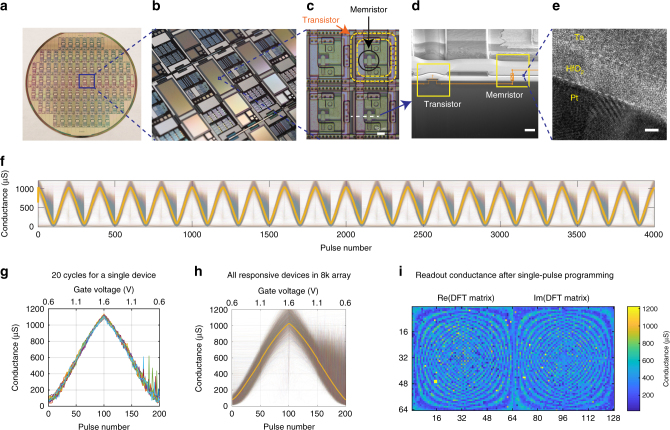
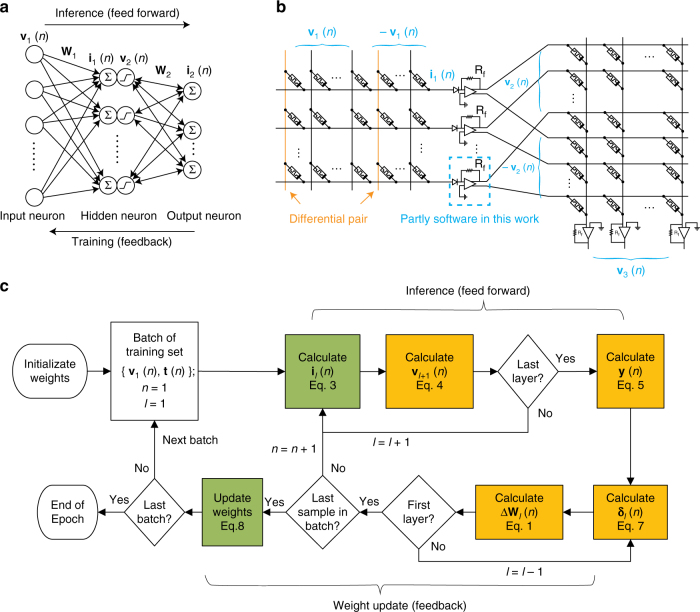
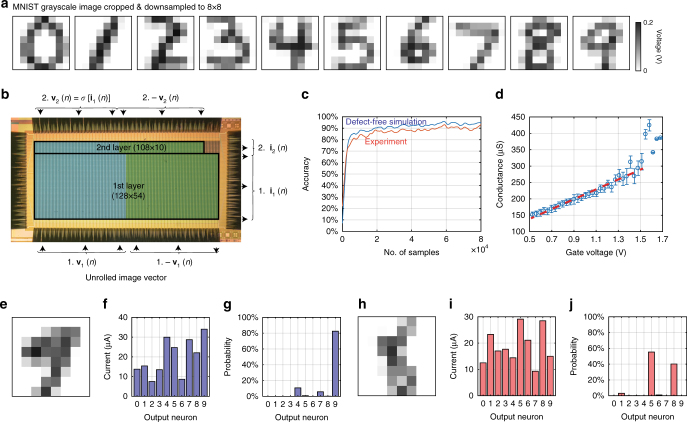
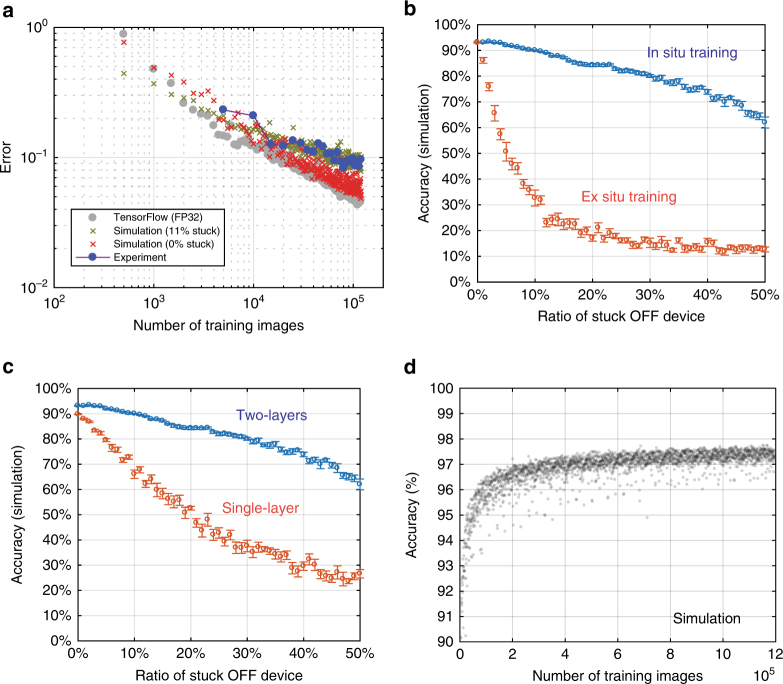
Verification
Claims the paper makes
The claims and statistics of this paper haven’t been checked yet.
Free: it reads the open-access text and checks the first 5 claims that cite a source we can check. Create a free account to check every claim.
Claims other papers make about this one
Each is checked against this paper’s own text: does it say what the citing paper says it does?
The cited source says what the claim attributes to it.
In the citing paper
“However, severe non-linearity and asymmetry during the LTP-LTD are observed in Fig. 1b, similar to other conventional oxide-based memristors.23,32,33”
The cited source says what the claim attributes to it.
In the citing paper
“the memristive dot product engine (MDPE), which performs large-scale vector-matrix multiplication (VMM) operations using a memristive crossbar array6–13”
From Flexible self-rectifying synapse array for energy-efficient edge multiplication in electrocardiogram diagnosis (2025) · cites this paper as [8]
Self-check
Percentages, sums and reported differences re-computed from the paper’s own numbers.
The self-check needs the paper’s full text.
Citations
Cites
Deep Residual Learning for Image Recognition
He, K., Zhang, X., Ren, S., & Sun, J. (2016) · 2016 IEEE Conference on Computer Vision and Pattern Recognition (CVPR) · doi:10.1109/cvpr.2016.90 · Cited by 235,474 · cited 1×
“ith the introduction of hardware accelerators 1 – 4 for inference in deep neural networks (DNNs) 5 – 9 , the focus on improving overall energy and time performance arti fi cial intelligence applications is now on training.”
BackgroundVery Deep Convolutional Networks for Large-Scale Image Recognition
Simonyan, K., & Zisserman, A. (2014) · arXiv · doi:10.48550/arxiv.1409.1556 · Cited by 114,148
ImageNet classification with deep convolutional neural networks
Krizhevsky, A., Sutskever, I., & Hinton, G. E. (2017) · Communications of the ACM · doi:10.1145/3065386 · Cited by 112,155
LeCun, Y., Bengio, Y., & Hinton, G. (2015) · Nature · doi:10.1038/nature14539 · Cited by 84,126
Gradient-based learning applied to document recognition
Lecun, Y., Bottou, L., Bengio, Y., & Haffner, P. (1998) · Proceedings of the IEEE · doi:10.1109/5.726791 · Cited by 58,805 · cited 2×
“Here the network was trained using stochastic gradient descent (SGD) 32 to classify handwritten digits in MNIST dataset.”
MethodInfluentialLearning representations by back-propagating errors
Rumelhart, D. E., Hinton, G. E., & Williams, R. J. (1986) · Nature · doi:10.1038/323533a0 · Cited by 31,892 · cited 1×
“The error backpropagation 39,40 in this work is calculated in software from the values of the readout weights (see Methods).”
MethodSelf-citationMastering the game of Go with deep neural networks and tree search
Silver, D., Huang, A., Maddison, C. J., Guez, A., Sifre, L., van den Driessche, G., Schrittwieser, J., Antonoglou, I., Panneershelvam, V., Lanctot, M., et al. (2016) · Nature · doi:10.1038/nature16961 · Cited by 15,612
Strukov, D. B., Snider, G. S., Stewart, D. R., & Williams, R. S. (2008) · Nature · doi:10.1038/nature06932 · Cited by 11,828
Self-citationTensorFlow: A system for large-scale machine learning
Abadi, M., Barham, P., Chen, J., Chen, Z., Davis, A., Dean, J., Devin, M., Ghemawat, S., Irving, G., Isard, M., et al. (2016) · arXiv (Cornell University) · doi:10.48550/arxiv.1605.08695 · Cited by 11,822
In-Datacenter Performance Analysis of a Tensor Processing Unit
Jouppi, N. P., Young, C., Patil, N., Patterson, D., Agrawal, G., Bajwa, R., Bates, S., Bhatia, S., Boden, N., Borchers, A., et al. (2017) · Proceedings of the 44th Annual International Symposium on Computer Architecture · doi:10.1145/3079856.3080246 · Cited by 4,537
Research works printed but not linked: 2
- 40. LeCun, Y. A theoretical framework of back-propagation. In Proc. of Connectionist Models Summer School (eds Touretzky, D., Hinton, G. E. & Sejnowski, T. J.) 21–28 (CMU, Pittsburgh, PA, USA, 1988).
- 53. Gokmen, T. & Vlasov, Y. Acceleration of deep neural network training with resistive cross-point devices: design considerations. Front. Neurosci.10, 333 (2016). 10.3389/fnins.2016.00333 PMC4954855 27493624 · DOI · Paper page
Cited by
Items 101–200 of 926
Neuroinspired unsupervised learning and pruning with subquantum CBRAM arrays
Shi, Y., Nguyen, L., Oh, S., Liu, X., Koushan, F., Jameson, J. R., & Kuzum, D. (2018) · Nature Communications · doi:10.1038/s41467-018-07682-0 · Cited by 106
Huang, X., Li, Y., Li, H., Xue, K., Wang, X., & Miao, X. (2020) · IEEE Electron Device Letters · doi:10.1109/led.2020.2977397 · Cited by 110
“I. INTRODUCTION MEMRISTORS based on transition metal oxides (TMOs),such as HfOx [1], [2], TaOx [3]–[5], WOx [6], [7], AlOx, [8]–[13] have been extensively studied for storage class memory, in-memory computing and neuromorphic computing, but they are still facing challenges in several aspects.”
BackgroundSelf-citationXiang, S., Ren, Z., Song, Z., Zhang, Y., Guo, X., Han, G., & Hao, Y. (2020) · IEEE Transactions on Neural Networks and Learning Systems · doi:10.1109/tnnls.2020.3006263 · Cited by 121
Hardware-Aware In Situ Learning Based on Stochastic Magnetic Tunnel Junctions
Kaiser, J., Borders, W. A., Camsari, K. Y., Fukami, S., Ohno, H., & Datta, S. (2022) · Physical Review Applied · doi:10.1103/physrevapplied.17.014016 · Cited by 124
Two-Dimensional Materials for Brain-Inspired Computing Hardware
Hadke, S. S., Kang, M., Sangwan, V. K., & Hersam, M. C. (2025) · Chemical Reviews · doi:10.1021/acs.chemrev.4c00631 · Cited by 112
Mahmoodi, M. R., Prezioso, M., & Strukov, D. B. (2019) · Nature Communications · doi:10.1038/s41467-019-13103-7 · Cited by 104
In-Memory Computing with Resistive Memory Circuits: Status and Outlook
Pedretti, G., & Ielmini, D. (2021) · Electronics · doi:10.3390/electronics10091063 · Cited by 113
“Since the forward propagation in a neural networks basically consists in extensive MVM of activation signal multiplied by synaptic weights [74], MVM crosspoint circuits have been heavily used for accelerating both the inference [22,43] and the training [41,42] stage of neural networks.”
BackgroundMethodA fully hardware-based memristive multilayer neural network
Kiani, F., Yin, J., Wang, Z., Yang, J. J., & Xia, Q. (2021) · Science Advances · doi:10.1126/sciadv.abj4801 · Cited by 97
Self-citationMultiply accumulate operations in memristor crossbar arrays for analog computing
Chen, J., Li, J., Li, Y., & Miao, X. (2021) · Journal of Semiconductors · doi:10.1088/1674-4926/42/1/013104 · Cited by 109
“[71]: (f) Die micrograph with SW-2T2R layout.”
Self-citationA Memristor with Low Switching Current and Voltage for 1S1R Integration and Array Operation
Upadhyay, N. K., Sun, W., Lin, P., Joshi, S., Midya, R., Zhang, X., Wang, Z., Jiang, H., Yoon, J. H., Rao, M., et al. (2020) · Advanced Electronic Materials · doi:10.1002/aelm.201901411 · Cited by 95
Self-citationHirtzlin, T., Bocquet, M., Penkovsky, B., Klein, J.-O., Nowak, E., Vianello, E., Portal, J.-M., & Querlioz, D. (2020) · Frontiers in Neuroscience · doi:10.3389/fnins.2019.01383 · Cited by 93
“To a large extent, neural network computation can be done using analog electronics: weight/neuron multiplication is performed based on Ohm’s law, and addition is natively implemented with Kirchoff’s current law (Prezioso et al., 2015; Serb et al., 2016; Ambrogio et al., 2018; Li et al., 2018; Wang et al., 2018).”
MethodSpiking Neural Network (SNN) With Memristor Synapses Having Non-linear Weight Update
Kim, T.-Y., Hu, S., Kim, J., Kwak, J. Y., Park, J., Lee, S., Kim, I., Park, J., & Jeong, Y. (2021) · Frontiers in Computational Neuroscience · doi:10.3389/fncom.2021.646125 · Cited by 107
“…and non-linear conductance update can severely degrade network performances and the hardware system often requires additional operation protocols or circuits to compensate the non-idealities (Jeong et al., 2017; Brivio et al., 2018; Frascaroli et al., 2018; Li et al., 2018; Cüppers et al., 2019).”
BackgroundA provable key destruction scheme based on memristive crossbar arrays
Jiang, H., Li, C., Zhang, R., Yan, P., Lin, P., Li, Y., Yang, J. J., Holcomb, D. E., & Xia, Q. (2018) · Nature Electronics · doi:10.1038/s41928-018-0146-5 · Cited by 98
Self-citationZhang, H., Jiang, B., Cheng, C., Huang, B., Zhang, H., Chen, R., Xu, J., Huang, Y., Chen, H., Pei, W., et al. (2023) · Nano Letters · doi:10.1021/acs.nanolett.2c03624 · Cited by 98
MoS2 Synapses with Ultra-low Variability and Their Implementation in Boolean Logic
Krishnaprasad, A., Dev, D., Han, S. S., Shen, Y., Chung, H., Bae, T., Yoo, C., Jung, Y., Lanza, M., & Roy, T. (2022) · ACS Nano · doi:10.1021/acsnano.1c09904 · Cited by 95
Memristive Devices and Networks for Brain‐Inspired Computing
Zhang, T., Ke, Y., Xu, X., Cai, Y., Yang, Y., & Huang, R. (2019) · physica status solidi (RRL) - Rapid Research Letters · doi:10.1002/pssr.201900029 · Cited by 95
Ismail, M., Abbas, H., Choi, C., & Kim, S. (2020) · Applied Surface Science · doi:10.1016/j.apsusc.2020.147107 · Cited by 89
Reconfigurable Compute-In-Memory on Field-Programmable Ferroelectric Diodes
Liu, X., Ting, J., He, Y., Fiagbenu, M. M. A., Zheng, J. X., Wang, D., Frost, J., Musavigharavi, P., Esteves, G., Kisslinger, K., et al. (2022) · Nano Letters · doi:10.1021/acs.nanolett.2c03169 · Cited by 100
“Then, without breaking vacuum, a layer 30 nm Al layer was sputtered as the top electrode and as a capping layer to prevent the oxidation of ferroelectric Al 0.68 Sc 0.32 N.”
BackgroundResultInfluentialZheng, Q., Wang, Z., Gong, N., Yu, Z., Chen, C., Cai, Y., Huang, Q., Jiang, H., Xia, Q., & Huang, R. (2019) · IEEE Electron Device Letters · doi:10.1109/led.2019.2921737 · Cited by 90
“transistors in 1T1R architecture [9], [10].”
Self-citationDemonstration of Decentralized Physics-Driven Learning
Dillavou, S., Stern, M., Liu, A. J., & Durian, D. J. (2022) · Physical Review Applied · doi:10.1103/physrevapplied.18.014040 · Cited by 140
“Several of these have only been realized in silico [14–16] or in hybrid in situ - in silico form [17–19].”
BackgroundHfO 2 -based resistive switching memory devices for neuromorphic computing
Brivio, S., Spiga, S., & Ielmini, D. (2022) · Neuromorphic Computing and Engineering · doi:10.1088/2634-4386/ac9012 · Cited by 119
“The on-line training was achieved by the stochastic gradient descent algorithm, where the synaptic update was executed directly on the device by adjusting the gate voltage, similar to the IGVVA approach [95].”
MethodRyu, J.-H., & Kim, S. (2020) · Chaos, Solitons & Fractals · doi:10.1016/j.chaos.2020.110236 · Cited by 87
From Memristive Materials to Neural Networks
Guo, T., Sun, B. T., Ranjan, S., Jiao, Y., Wei, L., Zhou, Y., & Wu, Y. A. (2020) · ACS Applied Materials & Interfaces · doi:10.1021/acsami.0c10796 · Cited by 90
On non-von Neumann flexible neuromorphic vision sensors
Wang, H., Sun, B., Ge, S. S., Su, J., & Jin, M. (2024) · npj Flexible Electronics · doi:10.1038/s41528-024-00313-3 · Cited by 109
“Furthermore,optoelectronictransistorscanbeconnectedinserieswith memristors to form a 1T1R structure 58,71,91 – 95 .”
Design of a Controllable Redox‐Diffusive Threshold Switching Memristor
Sun, Y., Song, C., Yin, S., Qiao, L., Wan, Q., Wang, R., Zeng, F., & Pan, F. (2020) · Advanced Electronic Materials · doi:10.1002/aelm.202000695 · Cited by 87
Rao, J., Fan, Z. H., Hong, L., Cheng, S., Huang, Q., Zhao, J., Xiang, X., Guo, E., Guo, H., Hou, Z., et al. (2021) · Materials Today Physics · doi:10.1016/j.mtphys.2021.100392 · Cited by 89
Integration and Co-design of Memristive Devices and Algorithms for Artificial Intelligence
Wang, W., Song, W., Yao, P., Li, Y., Van Nostrand, J., Qiu, Q., Ielmini, D., & Yang, J. J. (2020) · iScience · doi:10.1016/j.isci.2020.101809 · Cited by 84
“With the output error calculation performed in situ in the memristive network, the weight learning partially adapts to the nonidealities of memristive devices (write noise and device failure), thus mitigating the impact of the memristive nonidealities (Li et al., 2018).”
BackgroundMethodInfluentialSelf-citationMemristor crossbar architectures for implementing deep neural networks
Liu, X., & Zeng, Z. (2021) · Complex & Intelligent Systems · doi:10.1007/s40747-021-00282-4 · Cited by 93
“Besides memristor-based MNNs, there are also works for memristor-based CNNs.”
BackgroundMethodInfluentialDang, B., Liu, K., Wu, X., Yang, Z., Xu, L., Yang, Y., & Huang, R. (2022) · Advanced Materials · doi:10.1002/adma.202204844 · Cited by 86
Compute-in-Memory with Emerging Nonvolatile-Memories: Challenges and Prospects
Yu, S., Sun, X., Peng, X., & Huang, S. (2020) · Custom Integrated Circuits Conference · doi:10.1109/cicc48029.2020.9075887 · Cited by 87
“Since then, there are more reported designs [14-16] using RRAM with more functionalities built on-chip, e.g. ADC periphery and parallel read-out to realize nature of CIM.”
MethodArtificial Neural Networks Based on Memristive Devices: From Device to System
Huang, H.-M., Wang, Z., Wang, T., Xiao, Y., & Guo, X. (2020) · Advanced Intelligent Systems · doi:10.1002/aisy.202000149 · Cited by 82
Self-citation2D photonic memristor beyond graphene: progress and prospects
Feng, X., Liu, X., & Ang, K. (2020) · Nanophotonics · doi:10.1515/nanoph-2019-0543 · Cited by 86
Design of defect-chemical properties and device performance in memristive systems
Lübben, M., Cüppers, F., Mohr, J., von Witzleben, M., Breuer, U., Waser, R. M., Neumann, C., & Valov, I. (2020) · Science Advances · doi:10.1126/sciadv.aaz9079 · Cited by 87
Bio‐Inspired 3D Artificial Neuromorphic Circuits
Liu, X., Wang, F., Su, J., Zhou, Y., & Ramakrishna, S. (2022) · Advanced Functional Materials · doi:10.1002/adfm.202113050 · Cited by 91
BiFeO3-Based Flexible Ferroelectric Memristors for Neuromorphic Pattern Recognition
Sun, H., Luo, Z. L., Zhao, L., Liu, C., Ma, C., Lin, Y., Gao, G., Chen, Z., Bao, Z., Jin, X., et al. (2020) · ACS Applied Electronic Materials · doi:10.1021/acsaelm.0c00094 · Cited by 84
Memristor-based neural networks with weight simultaneous perturbation training
Wang, C., Xiong, L., Sun, J., & Yao, W. (2018) · Nonlinear Dynamics · doi:10.1007/s11071-018-4730-z · Cited by 82
DenRAM: neuromorphic dendritic architecture with RRAM for efficient temporal processing with delays
D’Agostino, S., Moro, F., Torchet, T., Demirağ, Y., Grenouillet, L., Castellani, N., Indiveri, G., Vianello, E., & Payvand, M. (2024) · Nature Communications · doi:10.1038/s41467-024-47764-w · Cited by 111
Ding, D., Xiao, H., Yang, Z., Luo, H., Hu, Y., Zhang, X., & Liu, Y. (2022) · Nonlinear Dynamics · doi:10.1007/s11071-022-07371-0 · Cited by 78
“the research significance of artificial neural network [32], [33].”
BackgroundFORMS: Fine-grained Polarized ReRAM-based In-situ Computation for Mixed-signal DNN Accelerator
Yuan, G., Behnam, P., Li, Z., Shafiee, A. R., Lin, S., Ma, X., Liu, H., Qian, X., Bojnordi, M. N., Wang, Y., et al. (2021) · Proceedings - International Symposium on Computer Architecture/Proceedings · doi:10.1109/isca52012.2021.00029 · Cited by 98
“The general way is to decompose each weight into a positive magnitude portion and a negative magnitude portion, then use two crossbars to represent each of the portions [17, 26–28 , 41].”
MethodFunctional Demonstration of a Memristive Arithmetic Logic Unit (MemALU) for In‐Memory Computing
Cheng, L., Li, Y., Yin, K., Hu, S., Su, Y., Jin, M., Wang, Z., Chang, T., & Miao, X. (2019) · Advanced Functional Materials · doi:10.1002/adfm.201905660 · Cited by 75
Self-citationActivity-difference training of deep neural networks using memristor crossbars
Yi, S.-I., Kendall, J. D., Williams, R. S., & Kumar, S. (2022) · Nature Electronics · doi:10.1038/s41928-022-00869-w · Cited by 75
“We demonstrate further scalability using various examples in Supplementary Sections 3–7 and 15.”
MethodSelf-citationAssociative Memory for Image Recovery with a High‐Performance Memristor Array
Zhou, Y., Wu, H., Gao, B., Wu, W., Xi, Y., Yao, P., Zhang, S., Zhang, Q., & Qian, H. (2019) · Advanced Functional Materials · doi:10.1002/adfm.201900155 · Cited by 74
Integrated neuromorphic computing networks by artificial spin synapses and spin neurons
Yang, S., Shin, J., Kim, T.-Y., Moon, K., Kim, J., Jang, G., Hyeon, D. S., Yang, J., Hwang, C., Jeong, Y., et al. (2021) · NPG Asia Materials · doi:10.1038/s41427-021-00282-3 · Cited by 79
Self-citationHybrid training of optical neural networks
Spall, J. C., Guo, X., & Lvovsky, A. I. (2022) · Optica · doi:10.1364/optica.456108 · Cited by 99
Kim, G., Son, S., Song, H., Jeon, J. B., Lee, J., Cheong, W. H., Choi, S., & Kim, K. M. (2023) · Advanced Science · doi:10.1002/advs.202205654 · Cited by 72
Memristive Imitation of Synaptic Transmission and Plasticity
Mannan, Z. I., Adhikari, S. P., Yang, C., Budhathoki, R. K., Kim, H., & Chua, L. O. (2019) · IEEE Transactions on Neural Networks and Learning Systems · doi:10.1109/tnnls.2019.2892385 · Cited by 73
“Such linear operation can be implementable with the recent technology of real memristor [52] when Ron and Roff are 1 k and 12.”
BackgroundMultichannel parallel processing of neural signals in memristor arrays
Liu, Z., Tang, J., Gao, B., Li, X., Yao, P., Lin, Y., Liu, D., Hong, B., Qian, H., & Wu, H. (2020) · Science Advances · doi:10.1126/sciadv.abc4797 · Cited by 76
Memristive Circuit Design of Brain-Like Emotional Learning and Generation
Wang, Z., Wang, X., & Zeng, Z. (2021) · IEEE Transactions on Cybernetics · doi:10.1109/tcyb.2021.3090811 · Cited by 79
“It has been demonstrated for a wide variety of applications, including memory [29]–[31]; biosystem emulators [32], [33]; analog circuits [34]–[36]; neuromorphic computing [37]–[39]; and so on.”
BackgroundSelf-citationIn-memory computing with emerging nonvolatile memory devices
Cheng, C., Tiw, P. J., Cai, Y., Yan, X., Yang, Y., & Huang, R. (2021) · Science China Information Sciences · doi:10.1007/s11432-021-3327-7 · Cited by 78
A Self-Rectification and Quasi-Linear Analogue Memristor for Artificial Neural Networks
Wang, W., Wang, R., Shi, T., Wei, J., Cao, R., Zhao, X., Wu, Z., Zhang, X., Lü, J., Xu, H. F., et al. (2019) · IEEE Electron Device Letters · doi:10.1109/led.2019.2929240 · Cited by 76
“Memristor crossbar array is usually employed as vector-matrix multiplication (VMM) in various computing tasks, such as pattern classification [1], [16]–[18], associative memory [19], [20]”
MethodMajumdar, S. (2021) · Advanced Intelligent Systems · doi:10.1002/aisy.202100175 · Cited by 81
Memristive Circuit Design of Emotional Generation and Evolution Based on Skin-Like Sensory Processor
Wang, Z., Hong, Q., & Wang, X. (2019) · IEEE Transactions on Biomedical Circuits and Systems · doi:10.1109/tbcas.2019.2923055 · Cited by 73
Self-citationIn-memory computing to break the memory wall*
Huang, X., Liu, C., Jiang, Y., & Zhou, P. (2020) · Chinese Physics B · doi:10.1088/1674-1056/ab90e7 · Cited by 79
Kim, K., Song, M. S., Hwang, H., Hwang, S., & Kim, H. (2024) · Frontiers in Neuroscience · doi:10.3389/fnins.2024.1279708 · Cited by 81
“This method possesses tolerance and self-adapting capabilities toward hardware imperfections (Li et al., 2018).”
BackgroundMethodXu, G., Zhang, M., Mei, T., Liu, W., Wang, L., & Xiao, K. (2024) · ACS Nano · doi:10.1021/acsnano.4c06467 · Cited by 96
Kim, Y. S., Baek, J. H., Im, I. H., Lee, D. H., Park, M. H., & Jang, H. W. (2024) · ACS Nano · doi:10.1021/acsnano.4c12884 · Cited by 76
A flexible BiFeO3-based ferroelectric tunnel junction memristor for neuromorphic computing
Sun, H., Luo, Z. L., Liu, C., Ma, C., Wang, Z., Yin, Y., & Li, X. (2021) · Journal of Materiomics · doi:10.1016/j.jmat.2021.04.009 · Cited by 71
Self-citationStrategic Development of Memristors for Neuromorphic Systems: Low‐Power and Reconfigurable Operation
Lee, J. W., Han, J., Kang, B., Hong, Y. J., Lee, S., & Jeon, I. (2025) · Advanced Materials · doi:10.1002/adma.202413916 · Cited by 81
Memristors for Neuromorphic Circuits and Artificial Intelligence Applications
Miranda, E. A., & Suñé, J. (2020) · Materials · doi:10.3390/ma13040938 · Cited by 72
Jang, J., Gi, S., Yeo, I., Choi, S., Jang, S., Ham, S., Lee, B., & Wang, G. (2022) · Advanced Science · doi:10.1002/advs.202201117 · Cited by 68
Guo, Z., Liu, G., Sun, Y., Zhang, Y., Zhao, J., Liu, P., Wang, H., Zhou, Z., Zhao, Z., Jia, X., et al. (2023) · ACS Nano · doi:10.1021/acsnano.3c06510 · Cited by 72
LiSiOX-Based Analog Memristive Synapse for Neuromorphic Computing
Chen, J., Lin, C.-Y., Li, Y., Qin, C., Lu, K., Wang, J., Chen, C.-K., He, Y., Chang, T., Sze, S. M., et al. (2019) · IEEE Electron Device Letters · doi:10.1109/led.2019.2898443 · Cited by 71
Self-citationQuantitative, Dynamic TaO x Memristor/Resistive Random Access Memory Model
Lee, S. H., Moon, J., Jeong, Y., Lee, J., Li, X., Wu, H., & Lu, W. D. (2020) · ACS Applied Electronic Materials · doi:10.1021/acsaelm.9b00792 · Cited by 79
Full-Circuit Implementation of Transformer Network Based on Memristor
Yang, C., Wang, X., & Zeng, Z. (2022) · IEEE Transactions on Circuits and Systems I Regular Papers · doi:10.1109/tcsi.2021.3136355 · Cited by 76
Wang, W., Wang, Y., Yin, F., Niu, H., Shin, Y. K., Li, Y., Kim, E., & Kim, N. (2024) · Nano-Micro Letters · doi:10.1007/s40820-024-01338-z · Cited by 73
“Artificial intelligence (AI) has made significant advancements in recent decades, thus leading to transformative changes in the means of gathering and interpreting information individually [1–6].”
Self-citationResistance switching characteristics and mechanisms of MXene/SiO2 structure-based memristor
Lian, X., Shen, X., Zhang, M., Xu, J., Gao, F., Wan, X., Hu, E., Guo, Y., Zhao, J. H., & Tong, Y. (2019) · Applied Physics Letters · doi:10.1063/1.5087423 · Cited by 66
On-chip learning for domain wall synapse based Fully Connected Neural Network
Bhowmik, D., Saxena, U., Dankar, A., Verma, A., Kaushik, D., Chatterjee, S., & Singh, U. (2019) · Journal of Magnetism and Magnetic Materials · doi:10.1016/j.jmmm.2019.165434 · Cited by 71
“, memristor [41] and phase change memory [42], as synapses, if we make slight device specific modifications.”
BackgroundSpontaneous sparse learning for PCM-based memristor neural networks
Lim, D., Wu, S., Zhao, R. J., Lee, J.-H., Jeong, H., & Shi, L. (2021) · Nature Communications · doi:10.1038/s41467-020-20519-z · Cited by 77
Neuromorphic sensory computing
Wan, T., Ma, S., Liao, F., Fan, L., & Chai, Y. (2021) · Science China Information Sciences · doi:10.1007/s11432-021-3336-8 · Cited by 74
Neuromorphic-computing-based adaptive learning using ion dynamics in flexible energy storage devices
Zhao, S., Ran, W., Lou, Z., Li, L., Poddar, S., Wang, L., Fan, Z., & Shen, G. (2022) · National Science Review · doi:10.1093/nsr/nwac158 · Cited by 68
“The FMES device can be adjusted using an adaptive method based on the stored weight value, which avoids the time and energy loss caused by recalculation [31] (see Supplementary Note 5).”
Direct Feedback Alignment With Sparse Connections for Local Learning
Crafton, B., Parihar, A., Gebhardt, E., & Raychowdhury, A. (2019) · Frontiers in Neuroscience · doi:10.3389/fnins.2019.00525 · Cited by 96
“In particular, hardware implementations of deep neural networks (DNNs) and their many variants, either in complementary metal oxide semiconductor (CMOS) [4] or emerging technologies [5], rely on arrays of spatial processors where near-memory [6], [4], [7] or in-memory [8] logic computes inference from layers of neuron…”
BackgroundKim, G. S., Song, H., Lee, Y. K., Kim, J. H., Kim, W., Park, T. H., Kim, H. J., Min Kim, K., & Hwang, C. S. (2019) · ACS Applied Materials & Interfaces · doi:10.1021/acsami.9b16499 · Cited by 64
Byun, K., Choi, I., Kwon, S., Kim, Y., Kang, D., Cho, Y. W., Yoon, S. K., & Kim, S. (2022) · Advanced Materials Technologies · doi:10.1002/admt.202200884 · Cited by 68
Memristors for the Curious Outsiders
Carbajal, J. P., & Caravelli, F. (2018) · Technologies · doi:10.3390/technologies6040118 · Cited by 82
Dongale, T. D., Kamble, G. U., Kang, D. Y., Kundale, S. S., An, H.-M., & Kim, T. G. (2021) · physica status solidi (RRL) - Rapid Research Letters · doi:10.1002/pssr.202100199 · Cited by 65
Toward memristive in-memory computing: principles and applications
Bao, H., Zhou, H., Li, J., Pei, H.-Z., Tian, J., Yang, L., Ren, S., Tong, S.-Q., Li, Y., He, Y., et al. (2022) · Frontiers of Optoelectronics · doi:10.1007/s12200-022-00025-4 · Cited by 80
“The easiest solution is to use the memristor arrays for forward propagation while the software for BP, which ensures the high accuracy of the calculations [22, 42, 45].”
MethodSelf-citationSu, T., Cheng, W., Chen, C., Wang, W., Chuang, Y., Tan, G., Lin, H., Hou, C., Liu, C.-M., Chang, Y.-C., et al. (2022) · ACS Nano · doi:10.1021/acsnano.2c05436 · Cited by 65
Memristor-based storage system with convolutional autoencoder-based image compression network
Feng, Y., Zhang, Y., Zhou, Z., Huang, P. C., Liu, L., Liu, X., & Kang, J. (2024) · Nature Communications · doi:10.1038/s41467-024-45312-0 · Cited by 71
Fang, J., Tang, Z., Lai, X.-C., Qiu, F., Jiang, Y., Liu, Q., Tang, X., Sun, Q., Zhou, Y., Fan, J., et al. (2024) · ACS Applied Materials & Interfaces · doi:10.1021/acsami.4c05316 · Cited by 66
AI hardware acceleration with analog memory: Microarchitectures for low energy at high speed
Chang, H.-Y., Narayanan, P., Lewis, S. C., Farinha, N. C. P., Hosokawa, K., Mackin, C., Tsai, H., Ambrogio, S., Chen, A., & Burr, G. W. (2019) · IBM Journal of Research and Development · doi:10.1147/jrd.2019.2934050 · Cited by 62
An Interface‐Type Memristive Device for Artificial Synapse and Neuromorphic Computing
Kunwar, S., Jernigan, Z., Hughes, Z., Somodi, C. B., Saccone, M., Caravelli, F., Roy, P., Zhang, D., Wang, H., Jia, Q. X., et al. (2023) · Advanced Intelligent Systems · doi:10.1002/aisy.202300035 · Cited by 67
Bao, H., Zhu, D., Liu, W., Xu, Q., Chen, M., & Bao, B. (2020) · International Journal of Bifurcation and Chaos · doi:10.1142/s0218127420500455 · Cited by 59
Resistive Switching Crossbar Arrays Based on Layered Materials
Lanza, M., Hui, F., Wen, C., & Ferrari, A. C. (2023) · Advanced Materials · doi:10.1002/adma.202205402 · Cited by 63
Leng, Y., Yu, D., Hu, Y., Yu, S. S., & Ye, Z. (2020) · Chaos An Interdisciplinary Journal of Nonlinear Science · doi:10.1063/5.0002076 · Cited by 59
In situ training of an in-sensor artificial neural network based on ferroelectric photosensors
Lin, H., Ou, J., Fan, Z. H., Yan, X., Hu, W., Cui, B., Xu, J., Li, W., Chen, Z., Yang, B., et al. (2025) · Nature Communications · doi:10.1038/s41467-024-55508-z · Cited by 71
Review of Memristors for In‐Memory Computing and Spiking Neural Networks
Shooshtari, M., Serrano‐Gotarredona, T., & Linares‐Barranco, B. (2025) · Advanced Intelligent Systems · doi:10.1002/aisy.202500806 · Cited by 75
The Design of Memristive Circuit for Affective Multi-Associative Learning
Wang, Z., Wang, X., Lu, Z., Wu, W., & Zeng, Z. (2020) · IEEE Transactions on Biomedical Circuits and Systems · doi:10.1109/tbcas.2019.2961569 · Cited by 59
Self-citationPerspective on Nanofluidic Memristors: From Mechanism to Application
Xie, B., Xiong, T., Li, W., Gao, T., Zong, J., Liu, Y., & Yu, P. (2022) · Chemistry - An Asian Journal · doi:10.1002/asia.202200682 · Cited by 59
2D-Material-Based Volatile and Nonvolatile Memristive Devices for Neuromorphic Computing
Xia, X., Huang, W., Hang, P., Guo, T., Yan, Y., Yang, J., Yang, D., Yu, X., & Li, X. (2023) · ACS Materials Letters · doi:10.1021/acsmaterialslett.2c01026 · Cited by 59
Self-citationMemristive Ion Dynamics to Enable Biorealistic Computing
Zhao, R., Kim, S. J., Xu, Y., Zhao, J., Wang, T., Midya, R., Ganguli, S., Roy, A. K., Dubey, M., Williams, R. S., et al. (2024) · Chemical Reviews · doi:10.1021/acs.chemrev.4c00587 · Cited by 62
Self-citationLiu, A., Zhao, H. Y., Wang, Q., Niu, S., Gao, X., Chen, C., & Li, L. (2022) · Neural Networks · doi:10.1016/j.neunet.2022.05.031 · Cited by 57
Open-loop analog programmable electrochemical memory array
Chen, P., Liu, F., Lin, P., Li, P., Xiao, Y., Zhang, B., & Pan, G. (2023) · Nature Communications · doi:10.1038/s41467-023-41958-4 · Cited by 67
Self-citationPeng, H., Gan, L., & Guo, X. (2024) · Chip · doi:10.1016/j.chip.2024.100093 · Cited by 69
Memristor-based signal processing for edge computing
Zhao, H., Liu, Z., Tang, J., Gao, B., Zhang, Y., Qian, H., & Wu, H. (2021) · Tsinghua Science & Technology · doi:10.26599/tst.2021.9010043 · Cited by 59
Memristor-based LSTM network with in situ training and its applications
Liu, X., Zeng, Z., & Wunsch, D. C. (2020) · Neural Networks · doi:10.1016/j.neunet.2020.07.035 · Cited by 60
Training End-to-End Analog Neural Networks with Equilibrium PropagationPreprint
Kendall, J. D., Pantone, R. D., Manickavasagam, K., Bengio, Y., & Scellier, B. (2020) · arXiv (Cornell University) · doi:10.48550/arxiv.2006.01981 · Cited by 153
“Crossbar arrays have been proposed to accelerate the hardware implementation of the backpropagation algorithm, which is the key algorithm of deep learning to train conventional neural networks [Li et al., 2018, Rekhi et al., 2019].”
BackgroundMethodStochastic model of memristor based on the length of conductive region
Викторович, А. Н., Dubkov, A. A., Safonov, A. V., Krichigin, A. V., Kharcheva, A. A., Guseinov, D. V., Koryazhkina, M. N., Novikov, A. S., Shishmakova, V. A., Antonov, I. N., et al. (2021) · Chaos Solitons & Fractals · doi:10.1016/j.chaos.2021.111131 · Cited by 56
Design Guidelines of RRAM based Neural-Processing-Unit: A Joint Device-Circuit-Algorithm Analysis
Zhang, W., Peng, X., Wu, H., Gao, B., He, H., Zhang, Y., Yu, S., & Qian, H. (2019) · Proceedings of the 56th Annual Design Automation Conference 2019 · doi:10.1145/3316781.3317797 · Cited by 54
“Recently, Resistive Random-Access Memory (RRAM) has demonstrated great progresses on accelerating some neural networks with specific topology efficiently [10-12].”
BackgroundDesai, T. R., Dongale, T. D., Patil, S. R., Tiwari, A. P., Pawar, P. K., Kamat, R. K., & Kim, T. G. (2021) · Journal of Materials Research and Technology · doi:10.1016/j.jmrt.2021.01.108 · Cited by 55
Fu, S., Park, J. H., Gao, H., Zhang, T., Ji, X., Fu, T., Sun, L., Kong, J., & Yao, J. (2023) · Nano Letters · doi:10.1021/acs.nanolett.2c05007 · Cited by 58
Metadata
- Authors
- Li, C., Belkin, D., Li, Y., Yan, P., Hu, M., Ge, N., Jiang, H., Montgomery, E., Lin, P., Wang, Z., Song, W., Strachan, J. P., Barnell, M., Wu, Q., Williams, R. S., Yang, J. J., & Xia, Q.
- Affiliations
- University of Massachusetts Amherst (US)
- Swarthmore College (US)
- Binghamton University (US)
- Hewlett-Packard (United States) (US)
- U.S. Air Force Research Laboratory Information Directorate (US)
- Corresponding author
- Yang, J. Joshua
- Xia, Qiangfei
- ORCID
- Venue
- Nature Communications
- Published
- 2018-06-19
- Volume
- 9
- Issue
- 1
- Pages
- 2385-2385
- ISSN
- 2041-1723 (ISSN-L)
- PMC
- PMC6008303
- OpenAlex
- W2807750997
- Cited by
- 931
- References
- 49
- Citations by year
- 2026: 76 · 2025: 112 · 2024: 103 · 2023: 131 · 2022: 120 · 2021: 126 · 2020: 147 · 2019: 100 · 2018: 16
- FWCI
- 37.17
- Type
- journal article
- Language
- en
- Open access
- gold
- doi.org
- Licence
- cc-by
- creativecommons.org/licenses/by/4.0 (tdm)
- creativecommons.org/licenses/by/4.0 (vor)
- Locations
- Nature Communications (publishedVersion, cc-by)
- Europe PMC (PubMed Central) (publishedVersion, other-oa)
- PubMed Central (publishedVersion, cc-by)
- PubMed (publishedVersion)
- RePEc: Research Papers in Economics (submittedVersion)
- DOAJ (DOAJ: Directory of Open Access Journals) (submittedVersion, cc-by-sa)
- Funders
- Air Force Research Laboratory (FA8750-15-2-0044)
- National Science Foundation (ECCS-1253073)
- Topics
- Physical Sciences › Engineering › Electrical and Electronic Engineering › Advanced Memory and Neural Computing
- Physical Sciences › Engineering › Electrical and Electronic Engineering › Ferroelectric and Negative Capacitance Devices
- Physical Sciences › Computer Science › Artificial Intelligence › Neural Networks and Applications
- Keywords
- memristor neural networks, in situ learning, multilayer neural networks, monolithic integration, energy-efficient hardware, neuromorphic computing, classification accuracy
About these checks
Registry, retraction, Cites and statistics results are computed, not judged, with one exception: a printed reference that no index lists is read once by a model before it counts as a citation error. Claims are extracted by a model and kept only when their quote appears verbatim in the text; each cited source is then checked, with a model’s help, for whether it says what the claim relies on. Those verdicts can be wrong — read the claim’s quote and the cited source before relying on one.
Statistics and arithmetic are recomputed, not judged.
Confidence bands are shown only for fields calibrated on our annotated test set. None is calibrated yet, so no band is shown.
What counts as a claim ›How we measure confidence ›How we check this ›
Are you an author, or do you see a problem with this page? Request a review
Data sources
Bibliographic data: Semantic Scholar, OpenAlex, Crossref.
Contains information from the Semantic Scholar Academic Graph Datasets, made available under the ODC Attribution License (ODC-BY 1.0).
Semantic Scholar’s data is described in: Kinney, R., et al. (2023). The Semantic Scholar Open Data Platform. arXiv:2301.10140.
