

Efficient and self-adaptive in-situ learning in multilayer memristor neural networks
Open accessThe DOI matches its Crossref record; 52 of the 52 references it cites were found in a registry or an index.
Abstract
Memristors with tunable resistance states are emerging building blocks of artificial neural networks. However, in situ learning on a large-scale multiple-layer memristor network has yet to be demonstrated because of challenges in device property engineering and circuit integration. Here we monolithically integrate hafnium oxide-based memristors with a foundry-made transistor array into a multiple-layer neural network. We experimentally demonstrate in situ learning capability and achieve competitive classification accuracy on a standard machine learning dataset, which further confirms that the training algorithm allows the network to adapt to hardware imperfections. Our simulation using the experimental parameters suggests that a larger network would further increase the classification accuracy. The memristor neural network is a promising hardware platform for artificial intelligence with high speed-energy efficiency.
Overview
The claims and statistics of this paper haven’t been checked yet.
Free: it reads the open-access text and checks the first 5 claims that cite a source we can check. Create a free account to check every claim.
Integrity signals
Registry
Cites
Statistics
Figures
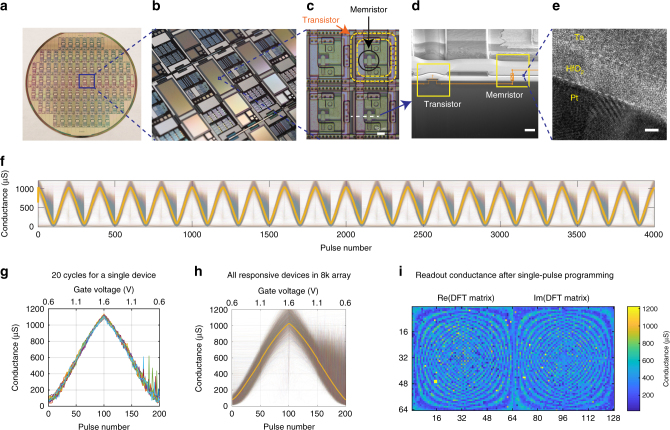
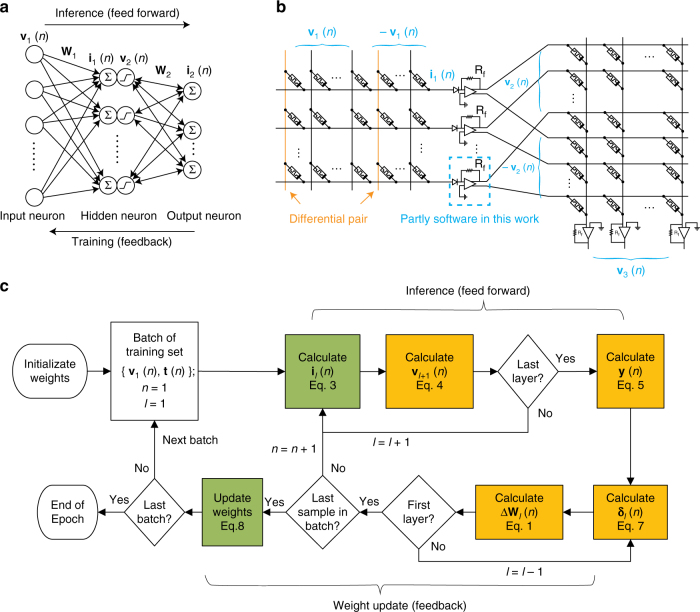
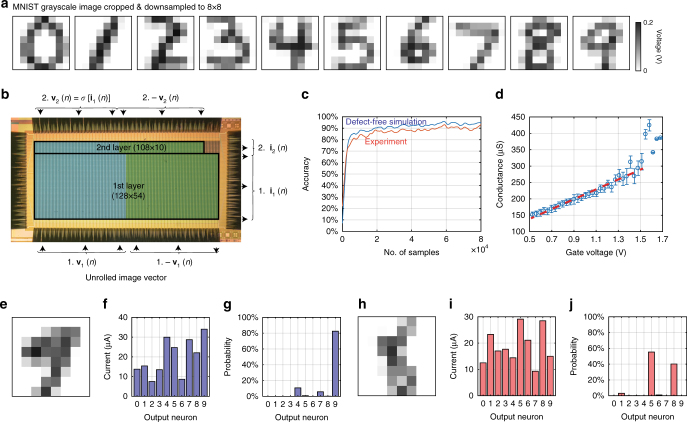
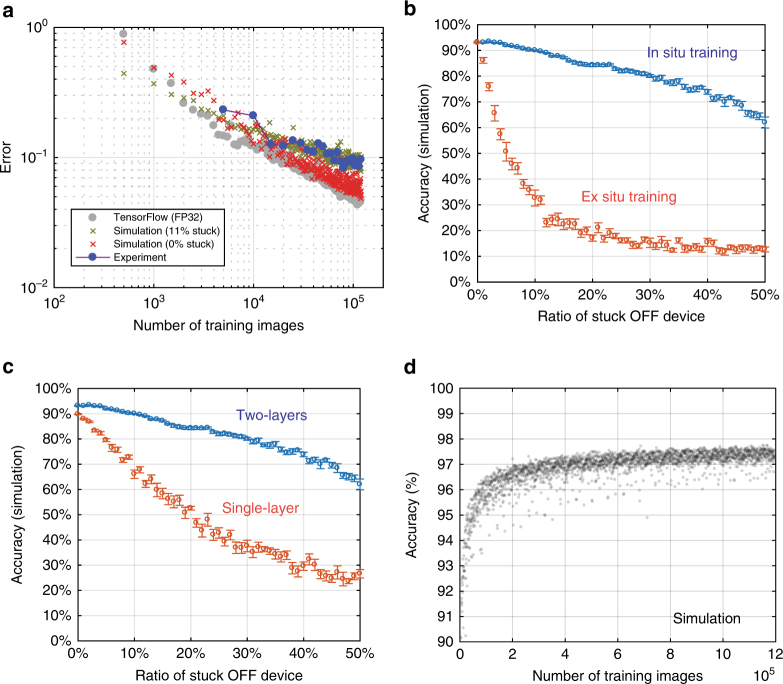
Verification
Claims the paper makes
The claims and statistics of this paper haven’t been checked yet.
Free: it reads the open-access text and checks the first 5 claims that cite a source we can check. Create a free account to check every claim.
Claims other papers make about this one
Each is checked against this paper’s own text: does it say what the citing paper says it does?
The cited source says what the claim attributes to it.
In the citing paper
“However, severe non-linearity and asymmetry during the LTP-LTD are observed in Fig. 1b, similar to other conventional oxide-based memristors.23,32,33”
The cited source says what the claim attributes to it.
In the citing paper
“the memristive dot product engine (MDPE), which performs large-scale vector-matrix multiplication (VMM) operations using a memristive crossbar array6–13”
From Flexible self-rectifying synapse array for energy-efficient edge multiplication in electrocardiogram diagnosis (2025) · cites this paper as [8]
Self-check
Percentages, sums and reported differences re-computed from the paper’s own numbers.
The self-check needs the paper’s full text.
Citations
Cites
Deep Residual Learning for Image Recognition
He, K., Zhang, X., Ren, S., & Sun, J. (2016) · 2016 IEEE Conference on Computer Vision and Pattern Recognition (CVPR) · doi:10.1109/cvpr.2016.90 · Cited by 235,474 · cited 1×
“ith the introduction of hardware accelerators 1 – 4 for inference in deep neural networks (DNNs) 5 – 9 , the focus on improving overall energy and time performance arti fi cial intelligence applications is now on training.”
BackgroundVery Deep Convolutional Networks for Large-Scale Image Recognition
Simonyan, K., & Zisserman, A. (2014) · arXiv · doi:10.48550/arxiv.1409.1556 · Cited by 114,148
ImageNet classification with deep convolutional neural networks
Krizhevsky, A., Sutskever, I., & Hinton, G. E. (2017) · Communications of the ACM · doi:10.1145/3065386 · Cited by 112,155
LeCun, Y., Bengio, Y., & Hinton, G. (2015) · Nature · doi:10.1038/nature14539 · Cited by 84,126
Gradient-based learning applied to document recognition
Lecun, Y., Bottou, L., Bengio, Y., & Haffner, P. (1998) · Proceedings of the IEEE · doi:10.1109/5.726791 · Cited by 58,805 · cited 2×
“Here the network was trained using stochastic gradient descent (SGD) 32 to classify handwritten digits in MNIST dataset.”
MethodInfluentialLearning representations by back-propagating errors
Rumelhart, D. E., Hinton, G. E., & Williams, R. J. (1986) · Nature · doi:10.1038/323533a0 · Cited by 31,892 · cited 1×
“The error backpropagation 39,40 in this work is calculated in software from the values of the readout weights (see Methods).”
MethodSelf-citationMastering the game of Go with deep neural networks and tree search
Silver, D., Huang, A., Maddison, C. J., Guez, A., Sifre, L., van den Driessche, G., Schrittwieser, J., Antonoglou, I., Panneershelvam, V., Lanctot, M., et al. (2016) · Nature · doi:10.1038/nature16961 · Cited by 15,612
Strukov, D. B., Snider, G. S., Stewart, D. R., & Williams, R. S. (2008) · Nature · doi:10.1038/nature06932 · Cited by 11,828
Self-citationTensorFlow: A system for large-scale machine learning
Abadi, M., Barham, P., Chen, J., Chen, Z., Davis, A., Dean, J., Devin, M., Ghemawat, S., Irving, G., Isard, M., et al. (2016) · arXiv (Cornell University) · doi:10.48550/arxiv.1605.08695 · Cited by 11,822
In-Datacenter Performance Analysis of a Tensor Processing Unit
Jouppi, N. P., Young, C., Patil, N., Patterson, D., Agrawal, G., Bajwa, R., Bates, S., Bhatia, S., Boden, N., Borchers, A., et al. (2017) · Proceedings of the 44th Annual International Symposium on Computer Architecture · doi:10.1145/3079856.3080246 · Cited by 4,537
Research works printed but not linked: 2
- 40. LeCun, Y. A theoretical framework of back-propagation. In Proc. of Connectionist Models Summer School (eds Touretzky, D., Hinton, G. E. & Sejnowski, T. J.) 21–28 (CMU, Pittsburgh, PA, USA, 1988).
- 53. Gokmen, T. & Vlasov, Y. Acceleration of deep neural network training with resistive cross-point devices: design considerations. Front. Neurosci.10, 333 (2016). 10.3389/fnins.2016.00333 PMC4954855 27493624 · DOI · Paper page
Cited by
Items 201–300 of 926
Time Complexity of In-Memory Solution of Linear Systems
Sun, Z., Pedretti, G., Mannocci, P., Ambrosi, E., Bricalli, A., & Ielmini, D. (2020) · IEEE Transactions on Electron Devices · doi:10.1109/ted.2020.2992435 · Cited by 62
“writing schemes [21] are favored to retain the advantage of IMC.”
BackgroundMulti-level resistive switching in hafnium-oxide-based devices for neuromorphic computing
Hellenbrand, M., & MacManus‐Driscoll, J. L. (2023) · Nano Convergence · doi:10.1186/s40580-023-00392-4 · Cited by 57
Lee, J.-H., Lim, D., Jeong, H., Ma, H., & Shi, L. (2019) · IEEE Transactions on Electron Devices · doi:10.1109/ted.2019.2906249 · Cited by 58
“However, although ANN applications are less strict regarding device variation [6], device variation is still one of the biggest challenges for MLC devices fabricated at a smaller technology node [7], particularly for training [8].”
BackgroundMitigating Nonlinear Effect of Memristive Synaptic Device for Neuromorphic Computing
Fu, J., Liao, Z., Gong, N., & Wang, J. (2019) · IEEE Journal on Emerging and Selected Topics in Circuits and Systems · doi:10.1109/jetcas.2019.2910749 · Cited by 54
“A linear and symmetric relation is demonstrated but using a much larger digital memory and multiple types of pulses [27].”
BackgroundMethodFunctional Oxides for Photoneuromorphic Engineering: Toward a Solar Brain
Pérez‐Tomás, A. (2019) · Advanced Materials Interfaces · doi:10.1002/admi.201900471 · Cited by 52
Chen, J., Pan, W.-Q., Li, Y., Kuang, R., He, Y., Lin, C.-Y., Duan, N., Feng, G.-R., Zheng, H.-X., Chang, T., et al. (2020) · IEEE Electron Device Letters · doi:10.1109/led.2020.2968388 · Cited by 51
“Recently, Li et al. achieved linear and symmetric 100-level conductance with small variations in a 1T1R Ta/HfO 2 /Pt memristor [18].”
BackgroundSelf-citationTwo-step write–verify scheme and impact of the read noise in multilevel RRAM-based inference engine
Shim, W., Seo, J.-S., & Yu, S. (2020) · Semiconductor Science and Technology · doi:10.1088/1361-6641/abb842 · Cited by 61
Xu, C., Wang, C., Jiang, J., Sun, J., & Lin, H. (2021) · IEEE Transactions on Computer-Aided Design of Integrated Circuits and Systems · doi:10.1109/tcad.2021.3116463 · Cited by 51
“Besides, considering that the most memristive neural networks are usually used to deal with a single problem or task [24]–[28], we propose a multi-input multioutput circuit of the CD-ELN and apply it to multitask classification.”
MethodShim, W., Luo, Y., Seo, J.-S., & Yu, S. (2020) · IEEE Transactions on Electron Devices · doi:10.1109/ted.2020.2985013 · Cited by 58
In-Memory Nearest Neighbor Search with FeFET Multi-Bit Content-Addressable Memories
Kazemi, A., Sharifi, M. M., Laguna, A. F., Muller, F., Rajaei, R., Olivo, R. R., Kämpfe, T., Niemier, M. T., & Hu, X. S. (2021) · Design, Automation, and Test in Europe · doi:10.23919/date51398.2021.9474025 · Cited by 57
Kwon, D., Jung, G., Shin, W., Jeong, Y., Hong, S., Oh, S., Kim, J., Bae, J., Park, B., & Lee, J.-H. (2021) · Sensors and Actuators B Chemical · doi:10.1016/j.snb.2021.130419 · Cited by 57
FeFET Multi-Bit Content-Addressable Memories for In-Memory Nearest Neighbor Search
Kazemi, A., Sharifi, M. M., Laguna, A. F., Muller, F., Yin, X., Kämpfe, T., Niemier, M. T., & Hu, X. S. (2021) · IEEE Transactions on Computers · doi:10.1109/tc.2021.3136576 · Cited by 58
“behavior as a regularization factor [33].”
Toward Reflective Spiking Neural Networks Exploiting Memristive Devices
Makarov, V. A., Lobov, S. A., Shchanikov, S., Mikhaylov, A. N., & Kazantsev, V. (2022) · Frontiers in Computational Neuroscience · doi:10.3389/fncom.2022.859874 · Cited by 51
A Systematic Literature Review on Binary Neural Networks
Sayed, R., Azmi, H., Shawkey, H., Khalil, A. H., & Refky, M. A. (2023) · IEEE Access · doi:10.1109/access.2023.3258360 · Cited by 62
“Li et al. [149] proposed in-situ learning using a memristor.”
BackgroundChen, M., Xie, Y., Cheng, B., Yang, Z., Li, X., Chen, F., Li, Q., Xie, J., Watanabe, K., Taniguchi, T., et al. (2024) · Nature Nanotechnology · doi:10.1038/s41565-024-01698-y · Cited by 65
“Thereby, it is promising to use these quantized conductance values of the device as the weights of the convolutional neural network to realize neuro-morphic computing that can be immune to external noise, which has been a grand challenge in the field of neuromorphic computing 42–46 .”
Tao, J., Sarkar, D., Kale, S., Singh, P. K., & Kapadia, R. (2020) · Nano Letters · doi:10.1021/acs.nanolett.0c03548 · Cited by 49
Fully CMOS-compatible passive TiO2-based memristor crossbars for in-memory computing
Mesoudy, A. E., Lamri, G., Dawant, R., Arias‐Zapata, J., Gliech, P., Beilliard, Y., Ecoffey, S., Ruediger, A. P., Alibart, F., & Drouin, D. (2022) · Microelectronic Engineering · doi:10.1016/j.mee.2021.111706 · Cited by 51
Low-power and reliable gas sensing system based on recurrent neural networks
Kwon, D., Jung, G., Shin, W., Jeong, Y., Hong, S., Oh, S., Bae, J., Park, B., & Lee, J. (2020) · Sensors and Actuators B Chemical · doi:10.1016/j.snb.2020.129258 · Cited by 49
Bai, J., He, D., Dang, B., Liu, K., Yang, Z., Wang, J., Zhang, X., Wang, Y., Tao, Y., & Yang, Y. (2024) · Advanced Materials · doi:10.1002/adma.202401060 · Cited by 48
An innovative biomimetic technology: Memristors mimic human sensation
Wang, K., Wang, M., Sun, B. T., Yang, C. S., Cao, Z., Wu, T., Gao, K., Ma, H., Yan, W., Wang, H., et al. (2025) · Nano Energy · doi:10.1016/j.nanoen.2025.110698 · Cited by 50
Kwon, D., Lim, S., Bae, J., Lee, S., Kim, H., Seo, Y.-T., Oh, S., Kim, J., Yeom, K., Park, B., et al. (2020) · Frontiers in Neuroscience · doi:10.3389/fnins.2020.00423 · Cited by 55
Xu, C., Wang, C., Sun, Y., Hong, Q., Deng, Q., & Chen, H. (2021) · Neurocomputing · doi:10.1016/j.neucom.2021.08.072 · Cited by 46
“Some multi-layer neural networks based on memristor were proposed by using memristor to simulate weight [18–20].”
MethodIntegrated Memristor Network for Physiological Signal Processing
Cai, L., Yu, L., Yue, W., Zhu, Y., Yang, Z., Li, Y., Tao, Y., & Yang, Y. (2023) · Advanced Electronic Materials · doi:10.1002/aelm.202300021 · Cited by 50
Self-citationSolid‐State Oxide‐Ion Synaptic Transistor for Neuromorphic Computing
Langner, P., Chiabrera, F. M., Alayo, N., Nizet, P., Morrone, L., Bozal‐Ginesta, C., Morata, À., & Tarancón, A. (2024) · Advanced Materials · doi:10.1002/adma.202415743 · Cited by 50
Yang, J., Tang, X.-G., Gu, X., Sun, Q., Tang, Z., Li, W., & Jiang, Y. (2025) · Nano-Micro Letters · doi:10.1007/s40820-025-01891-1 · Cited by 59
Self-citationMemristive Quantized Neural Networks: A Novel Approach to Accelerate Deep Learning On-Chip
Zhang, Y., Cui, M., Shen, L., & Zeng, Z. (2019) · IEEE Transactions on Cybernetics · doi:10.1109/tcyb.2019.2912205 · Cited by 50
“Efficient and self-adaptive in-situ learning [25] and on-chip training [26] 2168-2267 c (cid”
BackgroundMethodKim, S., Lee, Y., Kim, H., & Choi, S. (2020) · Nanoscale · doi:10.1039/c9nr08979a · Cited by 48
Multilayer Memristive Neural Network Circuit Based on Online Learning for License Plate Detection
Yan, R., Hong, Q., Wang, C., Sun, J., & Li, Y. (2021) · IEEE Transactions on Computer-Aided Design of Integrated Circuits and Systems · doi:10.1109/tcad.2021.3121347 · Cited by 46
“The speed advantage arises because full circuit implementation of MNN can implement massively parallel calculation and effectively save processing time compared with the conventional von Neumann architecture [24], [37].”
ResultSelf-citationSpiking neural networks for inference and learning: a memristor-based design perspective
Fouda, M. E., Kurdahi, F. J., Eltawil, A. M., & Neftci, E. (2020) · Elsevier eBooks · doi:10.1016/b978-0-08-102782-0.00019-8 · Cited by 54
A Novel Universal Interface for Constructing Memory Elements for Circuit Applications
Zheng, C., Yu, D., Iu, H. H., Fernando, T. L., Sun, T., Eshraghian, J. K., & Guo, H. (2019) · IEEE Transactions on Circuits and Systems I Regular Papers · doi:10.1109/tcsi.2019.2938094 · Cited by 46
Application of Memristors in Hardware Security: A Current State‐of‐the‐Art Technology
Lv, S., Liu, J., & Geng, Z. (2020) · Advanced Intelligent Systems · doi:10.1002/aisy.202000127 · Cited by 51
In situ Parallel Training of Analog Neural Network Using Electrochemical Random-Access Memory
Li, Y., Xiao, T. P., Bennett, C. H., Isele, E., Melianas, A., Tao, H., Marinella, M. J., Salleo, A., Fuller, E. J., & Talin, A. A. (2021) · Frontiers in Neuroscience · doi:10.3389/fnins.2021.636127 · Cited by 53
“Instead, in situ training utilize sequential device-by-device weight updates (Prezioso et al., 2015; Bayat et al., 2018; Li et al., 2018a; Cai et al., 2019), resulting in extra latency and energy consumption for larger array sizes between 10 3 and 10 6 devices.”
BackgroundSelf-citationLiu, L., Cheng, Y., Han, F., Fan, S., & Zhang, Y. (2023) · Chemical Engineering Journal · doi:10.1016/j.cej.2023.144678 · Cited by 44
Multimodal Artificial Synapses for Neuromorphic Application
Li, R., Yue, Z., Luan, H., Dong, Y., Chen, X., & Gu, M. (2024) · Research · doi:10.34133/research.0427 · Cited by 51
“Besides, the nonlinear computational capability of memristor arrays has enabled them to be used in various AI tasks such as recognition [31] and classification [32,33].”
Methodvan de Burgt, Y., & Gkoupidenis, P. (2020) · MRS Bulletin · doi:10.1557/mrs.2020.194 · Cited by 46
Ismail, M., Mahata, C., Abbas, H., Choi, C., & Kim, S. (2021) · Journal of Alloys and Compounds · doi:10.1016/j.jallcom.2020.158416 · Cited by 44
Lag projective synchronization of nonidentical fractional delayed memristive neural networks
Ding, Z., Chen, C., Wen, S., Li, S., & Wang, L. (2021) · Neurocomputing · doi:10.1016/j.neucom.2021.10.061 · Cited by 45
Precision of bit slicing with in-memory computing based on analog phase-change memory crossbars
Le Gallo, M., Nandakumar, S. R., Ciric, L., Boybat, I., Khaddam-Aljameh, R., Mackin, C., & Sebastian, A. (2022) · Neuromorphic Computing and Engineering · doi:10.1088/2634-4386/ac4fb7 · Cited by 42
Khan, M. U., Abbas, Y., Rezeq, M., Alazzam, A., & Mohammad, B. S. (2023) · Advanced Functional Materials · doi:10.1002/adfm.202305869 · Cited by 43
Trainable Bilingual Synaptic Functions in Bio-enabled Synaptic Transistors
Han, M. J., & Tsukruk, V. V. (2023) · ACS Nano · doi:10.1021/acsnano.3c04113 · Cited by 44
Redox transistors for neuromorphic computing
Fuller, E. J., Li, Y., Bennet, C., Keene, S. T., Melianas, A., Agarwal, S., Marinella, M. J., Salleo, A., & Talin, A. A. (2019) · IBM Journal of Research and Development · doi:10.1147/jrd.2019.2942285 · Cited by 50
Self-citationXiang, S., Ren, Z., Zhang, Y., Song, Z., Guo, X., Han, G., & Hao, Y. (2020) · IEEE Journal of Selected Topics in Quantum Electronics · doi:10.1109/jstqe.2020.3005589 · Cited by 46
NITI: Training Integer Neural Networks Using Integer-Only Arithmetic
Wang, M., Rasoulinezhad, S. A., Leong, P. H. W., & So, H. K. (2022) · IEEE Transactions on Parallel and Distributed Systems · doi:10.1109/tpds.2022.3149787 · Cited by 73
“For example, [20], [21] explored training neural networks with memristor crossbar, whose underlying operations were integer arith-”
BackgroundIR-QNN Framework: An IR Drop-Aware Offline Training of Quantized Crossbar Arrays
Fouda, M. E., Lee, S., Lee, J., Kim, G. H., Kurdahi, F. J., & Eltawil, A. M. (2020) · IEEE Access · doi:10.1109/access.2020.3044652 · Cited by 44
“Recently, memristor-based crossbar arrays have been used to implement and accelerate many machine learning and deep learning algorithms including pattern recognition [7]–[11], sentimental analysis [12], neural”
MethodRecent advances in ferroelectric materials, devices, and in-memory computing applications
Hwang, H., Youn, S., & Kim, H. (2025) · Nano Convergence · doi:10.1186/s40580-025-00520-2 · Cited by 59
Shi, J., & Zeng, Z. (2020) · IEEE Transactions on Emerging Topics in Computational Intelligence · doi:10.1109/tetci.2020.3005703 · Cited by 45
Ferroelectric devices and circuits for neuro-inspired computing
Wang, P., & Yu, S. (2020) · MRS Communications · doi:10.1557/mrc.2020.71 · Cited by 45
Kim, T., Lee, J., Kim, S., Park, J., Park, B., & Kim, H. (2021) · Nanotechnology · doi:10.1088/1361-6528/abf0cc · Cited by 46
“Figure 5(b) illustrates the schematic circuit diagram considered for vector-matrix multiplication (VMM) operations with differential memristor pairs [53, 54].”
BackgroundAsghar, M. S., Arslan, S., & Kim, H. (2021) · Sensors · doi:10.3390/s21134462 · Cited by 47
“…memristor crossbar architectures still require additional process requirements and are currently under study for simpler problems with discrete devices, whereas conventional CMOS, by virtue of its robustness and scalability has clear advantages for realizing large-scale neuromorphic hardware [25].”
BackgroundMask Technique for Fast and Efficient Training of Binary Resistive Crossbar Arrays
Fouda, M. E., Lee, S., Lee, J., Eltawil, A., & Kurdahi, F. (2019) · IEEE Transactions on Nanotechnology · doi:10.1109/tnano.2019.2927493 · Cited by 41
Tang, Z., Zhu, R., Hu, R., Chen, Y., Wu, E. Q., Wang, H., He, J. L., Huang, Q., & Chang, S. (2020) · IEEE Transactions on Cognitive and Developmental Systems · doi:10.1109/tcds.2020.3003377 · Cited by 41
“ESIL-MMNN [38] demonstrates an in-situ learning with multilayer memristive neural network for pattern recognition.”
BackgroundMethodInfluentialRecent Progress in Multiterminal Memristors for Neuromorphic Applications
Leng, Y., Zhang, Y., Lv, Z., Wang, J., Xie, T., Zhu, S., Qin, J., Xu, R., Zhou, Y., & Han, S. (2023) · Advanced Electronic Materials · doi:10.1002/aelm.202300108 · Cited by 43
Park, S.-M., Hwang, H.-G., Woo, J.-U., Lee, W.-H., Chae, S.-J., & Nahm, S. (2020) · ACS Applied Materials & Interfaces · doi:10.1021/acsami.9b18794 · Cited by 41
Pedretti, G., Mannocci, P., Hashemkhani, S., Milo, V., Melnic, O., Chicca, E., & Ielmini, D. (2020) · IEEE Journal on Exploratory Solid-State Computational Devices and Circuits · doi:10.1109/jxcdc.2020.2992691 · Cited by 44
“[8], inference [9], image processing [10], and the solution of algebraic problems [11]–[14].”
BackgroundMeng, J., Wang, T., He, Z., Li, Q., Zhu, H., Li, J., Chen, L., Sun, Q., & Zhang, D. W. (2021) · Nano Research · doi:10.1007/s12274-021-3729-9 · Cited by 45
Lu, Y., Li, X., Yan, B., Yan, L., Zhang, T., Song, Z., Huang, R., & Yang, Y. (2021) · Advanced Materials · doi:10.1002/adma.202107811 · Cited by 44
An ovonic threshold switching selector based on Se-rich GeSe chalcogenide
Song, B., Xu, H. F., Liu, S., Liu, H., Liu, Q., & Li, Q. (2019) · Applied Physics A · doi:10.1007/s00339-019-3073-z · Cited by 42
Kaushik, D., Singh, U., Sahu, U., Indu, S., & Bhowmik, D. (2020) · AIP Advances · doi:10.1063/1.5128344 · Cited by 41
Impact of Read Disturb on Multilevel RRAM based Inference Engine: Experiments and Model Prediction
Shim, W., Luo, Y., Seo, J.-S., & Yu, S. (2020) · IEEE International Reliability Physics Symposium proceedings · doi:10.1109/irps45951.2020.9129252 · Cited by 49
“Multilevel RRAM [14]-[15] can achieve higher density and larger MAC throughput.”
Nonideality‐Aware Training for Accurate and Robust Low‐Power Memristive Neural Networks
Joksas, D., Wang, E., Barmpatsalos, N., Ng, W. H., Kenyon, A. J., Constantinides, G. A., & Mehonic, A. (2022) · Advanced Science · doi:10.1002/advs.202105784 · Cited by 39
“Fabrication process is described in more detail in [42].”
Han, X., Wang, Z., Wang, Y., Wang, D., Zheng, L., Zhao, L., Huang, Q., Cao, Q., Chen, Y., Bai, L., et al. (2024) · Advanced Functional Materials · doi:10.1002/adfm.202404679 · Cited by 42
Self-citationPhotonic spiking neural network based on excitable VCSELs-SA for sound azimuth detection
Song, Z. W., Xiang, S., Ren, Z. X., Wang, S. H., Wen, A. J., & Hao, Y. (2020) · Optics Express · doi:10.1364/oe.381229 · Cited by 44
Self-organization of an inhomogeneous memristive hardware for sequence learning
Payvand, M., Moro, F., Nomura, K., Dalgaty, T., Vianello, E., Nishi, Y., & Indiveri, G. (2022) · Nature Communications · doi:10.1038/s41467-022-33476-6 · Cited by 49
Yadav, R. S., Gupta, P., Holla, A., Khan, K. I. A., Muduli, P. K., & Bhowmik, D. (2023) · ACS Applied Electronic Materials · doi:10.1021/acsaelm.2c01488 · Cited by 40
Pedretti, G., Ambrosi, E., & Ielmini, D. (2021) · 2021 IEEE International Reliability Physics Symposium (IRPS) · doi:10.1109/irps46558.2021.9405130 · Cited by 39
“These effects might be mitigated for example by taking their effect into account while performing network training [31], or by using redundancy [28].”
BackgroundSo, H., Ji, H., Kim, S., & Kim, S. (2024) · Advanced Functional Materials · doi:10.1002/adfm.202405544 · Cited by 59
Endurance and Retention Degradation of Intermediate Levels in Filamentary Analog RRAM
Zhao, M., Gao, B., Xi, Y., Xu, F., Wu, H., & Qian, H. (2019) · IEEE Journal of the Electron Devices Society · doi:10.1109/jeds.2019.2943017 · Cited by 42
“INTRODUCTION Recent advance in brain-inspired neuromorphic computing has been demonstrated plenty of complex tasks based on resistive random access memory (RRAM) [1]–[3].”
BackgroundWang, P., Shim, W., Wang, Z., Hur, J. H., Datta, S., Khan, A. I., & Yu, S. (2020) · IEEE Transactions on Electron Devices · doi:10.1109/ted.2020.2969383 · Cited by 40
“tion (PCM) [2], [3] and resistive random-access memory (RRAM) [4]–[7] have been explored for both in situ training and inference.”
BackgroundSelf-citationOptimized programming algorithms for multilevel RRAM in hardware neural networks
Milo, V., Anzalone, F., Zambelli, C., Pérez, E., Mahadevaiah, M. K., Ossorio, Ó. G., Olivo, P., Wenger, C., & Ielmini, D. (2021) · IEEE International Reliability Physics Symposium proceedings · doi:10.1109/irps46558.2021.9405119 · Cited by 50
Memristor-Inspired Digital Logic Circuits and Comparison With 90-/180-nm CMOS Technologies
Nawaria, M., Kumar, S., Gautam, M. K., Dhakad, N. S., Singh, R. K., Singhal, S., Kumar, P., Vishvakarma, S. K., & Mukherjee, S. (2023) · IEEE Transactions on Electron Devices · doi:10.1109/ted.2023.3278625 · Cited by 37
“The nanoscale memristors have the remarkable potential to overcome these limitations with their high scalability [3], high operating speed [4], high density in crossbar array architecture [4], and nonvolatile nature [5].”
BackgroundBioinspired ion-shuttling memristor with both neuromorphic functions and ion selectivity
Xie, B., Xiong, T., Guo, G., Pan, C., Ma, W., & Yu, P. (2025) · Proceedings of the National Academy of Sciences · doi:10.1073/pnas.2417040122 · Cited by 45
“…multifarious neuronal and synaptic functions such as short - term plasticity (STP) ( 4 , 5 ), long - term plasticity (LTP) ( 6 ), and spike - time - dependent plasticity (STDP) ( 7 ), realizing brain - inspired computing applications like pattern recognition ( 8 – 10 ) with memristive devices.”
Luo, Y., Han, X., Ye, Z., Barnaby, H., Seo, J.-S., & Yu, S. (2020) · IEEE Transactions on Electron Devices · doi:10.1109/ted.2020.3015940 · Cited by 40
Overview of Memristor-Based Neural Network Design and Applications
Ye, L., Gao, Z., Fu, J., Ren, W., Yang, C., Wen, J., Wan, X., Ren, Q., Gu, S., Liu, X., et al. (2022) · Frontiers in Physics · doi:10.3389/fphy.2022.839243 · Cited by 44
Aguirre, F. L., Pazos, S. M., Palumbo, F., Sune, J., & Miranda, E. (2020) · IEEE Access · doi:10.1109/access.2020.3035638 · Cited by 36
Zheng, Y., Wu, R., Ren, Y., Bao, R., Liu, J., Ma, Y., Wang, M., & Cheng, Y. (2024) · Laser & Photonics Review · doi:10.1002/lpor.202400565 · Cited by 41
A biomorphic neuroprocessor based on a composite memristor-diode crossbar
Pisarev, A. D., Busygin, A. N., Udovichenko, S. Y., & Maevsky, O. V. (2020) · Microelectronics Journal · doi:10.1016/j.mejo.2020.104827 · Cited by 41
Recent Progress on Memristive Convolutional Neural Networks for Edge Intelligence
Qin, Y., Bao, H., Wang, F., Chen, J., Li, Y., & Miao, X. (2020) · Advanced Intelligent Systems · doi:10.1002/aisy.202000114 · Cited by 41
Self-citationImplementation of Neuro-Memristive Synapse for Long-and Short-Term Bio-Synaptic Plasticity
Mannan, Z. I., Kim, H., & Chua, L. O. (2021) · Sensors · doi:10.3390/s21020644 · Cited by 39
“To avoid the unintended consequences of nonlinear ionic dopant drift (Section S1 of Supplementary Materials) at boundaries of a memristor [29–31], we follow the common practice of initializing the memristance of a memristor in a linear region (2 KΩ~14 KΩ) [32,33].”
BackgroundMemory-centric neuromorphic computing for unstructured data processing
Sung, S. H., Kim, T., Shin, H., Namkung, H., Im, T. H., Wang, H. S., & Lee, K. J. (2021) · Nano Research · doi:10.1007/s12274-021-3452-6 · Cited by 36
From memristive devices to neuromorphic systems
Huang, Y., Kiani, F., Ye, F., & Xia, Q. (2023) · Applied Physics Letters · doi:10.1063/5.0133044 · Cited by 37
Self-citationTraining neural networks with end-to-end optical backpropagation
Spall, J. C., Guo, X., & Lvovsky, A. I. (2025) · Advanced Photonics · doi:10.1117/1.ap.7.1.016004 · Cited by 56
Li, Y., Yin, L., Wu, Z., Li, X., Song, X., Gao, X., & Fu, L. (2019) · IEEE Electron Device Letters · doi:10.1109/led.2019.2934145 · Cited by 37
Self-citationHuang, H., Yu, X. Y., Yang, R., Yu, Y., He, H., Wang, Z., & Guo, X. (2020) · Advanced Science · doi:10.1002/advs.202001842 · Cited by 36
Self-citationRecent Advancements in Emerging Neuromorphic Device Technologies
Woo, J., Kim, J. H., Im, J., & Moon, S. E. (2020) · Advanced Intelligent Systems · doi:10.1002/aisy.202000111 · Cited by 37
Analogue pattern recognition with stochastic switching binary CMOS-integrated memristive devices
Zahari, F., Pérez, E., Mahadevaiah, M. K., Kohlstedt, H., Wenger, C., & Ziegler, M. (2020) · Scientific Reports · doi:10.1038/s41598-020-71334-x · Cited by 38
“In this case, the classification layer has to be trained in the frame domain using stochastic gradient decent (SGD).”
MethodWang, Z., Wang, X., & Zeng, Z. (2021) · IEEE Transactions on Biomedical Circuits and Systems · doi:10.1109/tbcas.2021.3127573 · Cited by 35
Self-citationKhan, M. U., Kim, J., Chougale, M. Y., Shaukat, R. A., Saqib, Q. M., Patil, S. R., Mohammad, B. S., & Bae, J. (2022) · Advanced Intelligent Systems · doi:10.1002/aisy.202200281 · Cited by 35
Iliasov, A. I., Matsukatova, A. N., Emelyanov, A. V., Slepov, P. S., Nikiruy, K. E., & Rylkov, V. V. (2024) · Nanoscale Horizons · doi:10.1039/d3nh00421j · Cited by 34
Metal oxide-based resistive switching memristors for neuromorphic computing
Tian, Q., Shan, X., Bian, J., Cheng, Y., Zheng, J., Wang, Z., Zhao, X., Xu, H., & Liu, Y. (2025) · Journal of Materials Chemistry C · doi:10.1039/d5tc01467k · Cited by 40
Self-citationImprovement in conductance modulation linearity of artificial synapses based on NaNbO3 memristor
Woo, J., Hwang, H.-G., Park, S.-M., Lee, T., & Nahm, S. (2020) · Applied Materials Today · doi:10.1016/j.apmt.2020.100582 · Cited by 35
Hardware Design for Autonomous Bayesian Networks
Faria, R., Kaiser, J., Camsari, K. Y., & Datta, S. (2021) · Frontiers in Computational Neuroscience · doi:10.3389/fncom.2021.584797 · Cited by 34
“…(Alibart et al., 2013; Camsari et al., 2017b), although there are also other types of hardware synapse implementations based on memristors (Li et al., 2018; Mahmoodi et al., 2019; Mansueto et al., 2019), magnetic tunnel junctions (Ostwal et al., 2019), spin orbit torque driven domain wall…”
BackgroundOxide-based filamentary RRAM for deep learning
Zhang, Y., Huang, P. C., Gao, B., Kang, J., & Wu, H. (2020) · Journal of Physics D Applied Physics · doi:10.1088/1361-6463/abc5e7 · Cited by 39
“The existence of stuck-on and stuck-off devices can both affect the accuracy of a neural network, but the influence of a stuck-on device is much worse [81].”
BackgroundRealizing In-Memory Baseband Processing for Ultrafast and Energy-Efficient 6G
Zeng, Q., Liu, J., Jiang, M., Lan, J., Gong, Y., Wang, Z., Li, Y., Li, C., Ignowski, J., & Huang, K. (2023) · IEEE Internet of Things Journal · doi:10.1109/jiot.2023.3307405 · Cited by 43
“This makes in-memory computing a UFEE solution for MVM intensive applications, such as deep neural networks [27], [28], [29], [30], [31], [32], [33], [34], [35], [36], [37], [38], [39], [40], [41], [42] and linear algebra computation [43], [44], [45], [46].”
MethodSelf-citationBae, J., Han, M.-H., Lee, S., Kim, E., Lee, K., Lee, G.-S., Park, J.-H., & Park, J. (2022) · Nanomaterials · doi:10.3390/nano12213893 · Cited by 37
Transverse barrier formation by electrical triggering of a metal-to-insulator transition
Salev, P., Fratino, L., Sasaki, D., Berkoun, R., del Valle, J., Kalcheim, Y., Takamura, Y., Rozenberg, M. J., & Schuller, I. K. (2021) · Nature Communications · doi:10.1038/s41467-021-25802-1 · Cited by 40
Park, S.-O., Park, T., Jeong, H., Hong, S., Seo, S., Kwon, Y., Lee, J., & Choi, S. (2023) · Nanoscale Horizons · doi:10.1039/d3nh00121k · Cited by 31
Wang, J., Pan, X., Zhao, Z., Xie, Y., Luo, W., Xie, Q., Zeng, H., Shuai, Y., Song, Z., Wu, C., et al. (2023) · Advanced Science · doi:10.1002/advs.202307359 · Cited by 32
Chang, L.-Y., Simanjuntak, F. M., Hsu, C.-L., Chandrasekaran, S., & Tseng, T. (2020) · Applied Physics Letters · doi:10.1063/5.0014829 · Cited by 32
On-Chip Error-Triggered Learning of Multi-Layer Memristive Spiking Neural Networks
Payvand, M., Fouda, M. E., Kurdahi, F. J., Eltawil, A. M., & Neftci, E. (2020) · IEEE Journal on Emerging and Selected Topics in Circuits and Systems · doi:10.1109/jetcas.2020.3040248 · Cited by 38
“(ANNs) such as [11]–[14] but comparatively few work utilize RCAs for spiking neural networks trained with gradient-based methods [7], [9], [15].”
The viability of analog-based accelerators for neuromorphic computing: a survey
Musisi‐Nkambwe, M., Afshari, S., Barnaby, H., Kozicki, M. N., & Esqueda, I. S. (2021) · Neuromorphic Computing and Engineering · doi:10.1088/2634-4386/ac0242 · Cited by 36
“Also to consider is stuck-ats/device unresponsiveness [88, 96] where stuck at R LRS and unable to reset to R HRS occur due to too many defects in the switching layer.”
Background
Metadata
- Authors
- Li, C., Belkin, D., Li, Y., Yan, P., Hu, M., Ge, N., Jiang, H., Montgomery, E., Lin, P., Wang, Z., Song, W., Strachan, J. P., Barnell, M., Wu, Q., Williams, R. S., Yang, J. J., & Xia, Q.
- Affiliations
- University of Massachusetts Amherst (US)
- Swarthmore College (US)
- Binghamton University (US)
- Hewlett-Packard (United States) (US)
- U.S. Air Force Research Laboratory Information Directorate (US)
- Corresponding author
- Yang, J. Joshua
- Xia, Qiangfei
- ORCID
- Venue
- Nature Communications
- Published
- 2018-06-19
- Volume
- 9
- Issue
- 1
- Pages
- 2385-2385
- ISSN
- 2041-1723 (ISSN-L)
- PMC
- PMC6008303
- OpenAlex
- W2807750997
- Cited by
- 931
- References
- 49
- Citations by year
- 2026: 76 · 2025: 112 · 2024: 103 · 2023: 131 · 2022: 120 · 2021: 126 · 2020: 147 · 2019: 100 · 2018: 16
- FWCI
- 37.17
- Type
- journal article
- Language
- en
- Open access
- gold
- doi.org
- Licence
- cc-by
- creativecommons.org/licenses/by/4.0 (tdm)
- creativecommons.org/licenses/by/4.0 (vor)
- Locations
- Nature Communications (publishedVersion, cc-by)
- Europe PMC (PubMed Central) (publishedVersion, other-oa)
- PubMed Central (publishedVersion, cc-by)
- PubMed (publishedVersion)
- RePEc: Research Papers in Economics (submittedVersion)
- DOAJ (DOAJ: Directory of Open Access Journals) (submittedVersion, cc-by-sa)
- Funders
- Air Force Research Laboratory (FA8750-15-2-0044)
- National Science Foundation (ECCS-1253073)
- Topics
- Physical Sciences › Engineering › Electrical and Electronic Engineering › Advanced Memory and Neural Computing
- Physical Sciences › Engineering › Electrical and Electronic Engineering › Ferroelectric and Negative Capacitance Devices
- Physical Sciences › Computer Science › Artificial Intelligence › Neural Networks and Applications
- Keywords
- memristor neural networks, in situ learning, multilayer neural networks, monolithic integration, energy-efficient hardware, neuromorphic computing, classification accuracy
About these checks
Registry, retraction, Cites and statistics results are computed, not judged, with one exception: a printed reference that no index lists is read once by a model before it counts as a citation error. Claims are extracted by a model and kept only when their quote appears verbatim in the text; each cited source is then checked, with a model’s help, for whether it says what the claim relies on. Those verdicts can be wrong — read the claim’s quote and the cited source before relying on one.
Statistics and arithmetic are recomputed, not judged.
Confidence bands are shown only for fields calibrated on our annotated test set. None is calibrated yet, so no band is shown.
What counts as a claim ›How we measure confidence ›How we check this ›
Are you an author, or do you see a problem with this page? Request a review
Data sources
Bibliographic data: Semantic Scholar, OpenAlex, Crossref.
Contains information from the Semantic Scholar Academic Graph Datasets, made available under the ODC Attribution License (ODC-BY 1.0).
Semantic Scholar’s data is described in: Kinney, R., et al. (2023). The Semantic Scholar Open Data Platform. arXiv:2301.10140.
