

Efficient and self-adaptive in-situ learning in multilayer memristor neural networks
Open accessThe DOI matches its Crossref record; 52 of the 52 references it cites were found in a registry or an index.
Abstract
Memristors with tunable resistance states are emerging building blocks of artificial neural networks. However, in situ learning on a large-scale multiple-layer memristor network has yet to be demonstrated because of challenges in device property engineering and circuit integration. Here we monolithically integrate hafnium oxide-based memristors with a foundry-made transistor array into a multiple-layer neural network. We experimentally demonstrate in situ learning capability and achieve competitive classification accuracy on a standard machine learning dataset, which further confirms that the training algorithm allows the network to adapt to hardware imperfections. Our simulation using the experimental parameters suggests that a larger network would further increase the classification accuracy. The memristor neural network is a promising hardware platform for artificial intelligence with high speed-energy efficiency.
Overview
The claims and statistics of this paper haven’t been checked yet.
Free: it reads the open-access text and checks the first 5 claims that cite a source we can check. Create a free account to check every claim.
Integrity signals
Registry
Cites
Statistics
Figures
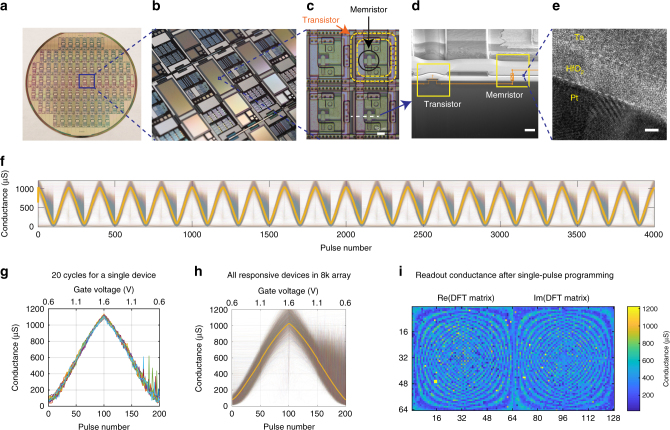
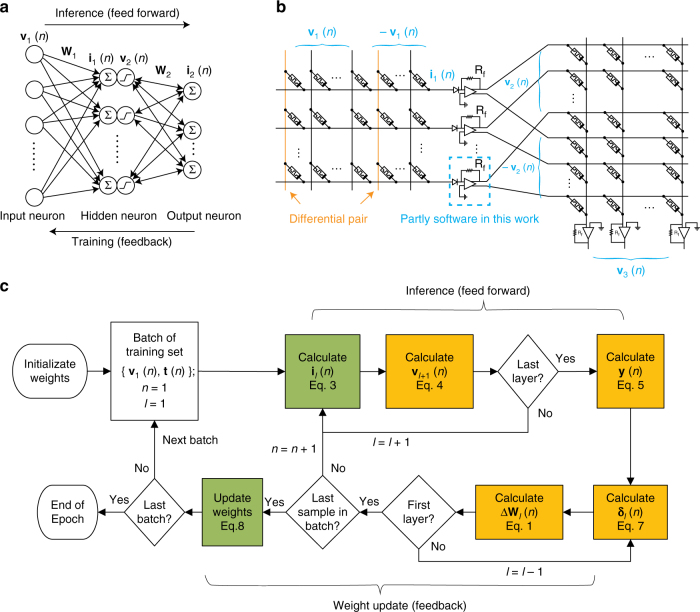
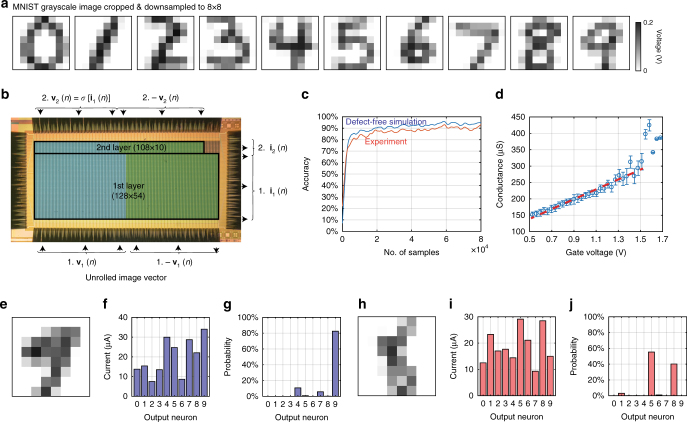
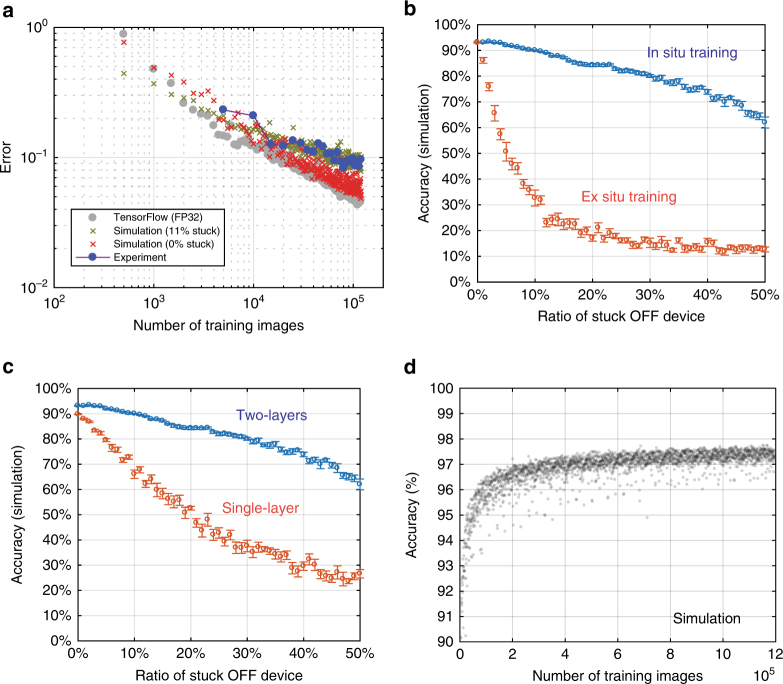
Verification
Claims the paper makes
The claims and statistics of this paper haven’t been checked yet.
Free: it reads the open-access text and checks the first 5 claims that cite a source we can check. Create a free account to check every claim.
Claims other papers make about this one
Each is checked against this paper’s own text: does it say what the citing paper says it does?
The cited source says what the claim attributes to it.
In the citing paper
“However, severe non-linearity and asymmetry during the LTP-LTD are observed in Fig. 1b, similar to other conventional oxide-based memristors.23,32,33”
The cited source says what the claim attributes to it.
In the citing paper
“the memristive dot product engine (MDPE), which performs large-scale vector-matrix multiplication (VMM) operations using a memristive crossbar array6–13”
From Flexible self-rectifying synapse array for energy-efficient edge multiplication in electrocardiogram diagnosis (2025) · cites this paper as [8]
Self-check
Percentages, sums and reported differences re-computed from the paper’s own numbers.
The self-check needs the paper’s full text.
Citations
Cites
Deep Residual Learning for Image Recognition
He, K., Zhang, X., Ren, S., & Sun, J. (2016) · 2016 IEEE Conference on Computer Vision and Pattern Recognition (CVPR) · doi:10.1109/cvpr.2016.90 · Cited by 235,474 · cited 1×
“ith the introduction of hardware accelerators 1 – 4 for inference in deep neural networks (DNNs) 5 – 9 , the focus on improving overall energy and time performance arti fi cial intelligence applications is now on training.”
BackgroundVery Deep Convolutional Networks for Large-Scale Image Recognition
Simonyan, K., & Zisserman, A. (2014) · arXiv · doi:10.48550/arxiv.1409.1556 · Cited by 114,148
ImageNet classification with deep convolutional neural networks
Krizhevsky, A., Sutskever, I., & Hinton, G. E. (2017) · Communications of the ACM · doi:10.1145/3065386 · Cited by 112,155
LeCun, Y., Bengio, Y., & Hinton, G. (2015) · Nature · doi:10.1038/nature14539 · Cited by 84,126
Gradient-based learning applied to document recognition
Lecun, Y., Bottou, L., Bengio, Y., & Haffner, P. (1998) · Proceedings of the IEEE · doi:10.1109/5.726791 · Cited by 58,805 · cited 2×
“Here the network was trained using stochastic gradient descent (SGD) 32 to classify handwritten digits in MNIST dataset.”
MethodInfluentialLearning representations by back-propagating errors
Rumelhart, D. E., Hinton, G. E., & Williams, R. J. (1986) · Nature · doi:10.1038/323533a0 · Cited by 31,892 · cited 1×
“The error backpropagation 39,40 in this work is calculated in software from the values of the readout weights (see Methods).”
MethodSelf-citationMastering the game of Go with deep neural networks and tree search
Silver, D., Huang, A., Maddison, C. J., Guez, A., Sifre, L., van den Driessche, G., Schrittwieser, J., Antonoglou, I., Panneershelvam, V., Lanctot, M., et al. (2016) · Nature · doi:10.1038/nature16961 · Cited by 15,612
Strukov, D. B., Snider, G. S., Stewart, D. R., & Williams, R. S. (2008) · Nature · doi:10.1038/nature06932 · Cited by 11,828
Self-citationTensorFlow: A system for large-scale machine learning
Abadi, M., Barham, P., Chen, J., Chen, Z., Davis, A., Dean, J., Devin, M., Ghemawat, S., Irving, G., Isard, M., et al. (2016) · arXiv (Cornell University) · doi:10.48550/arxiv.1605.08695 · Cited by 11,822
In-Datacenter Performance Analysis of a Tensor Processing Unit
Jouppi, N. P., Young, C., Patil, N., Patterson, D., Agrawal, G., Bajwa, R., Bates, S., Bhatia, S., Boden, N., Borchers, A., et al. (2017) · Proceedings of the 44th Annual International Symposium on Computer Architecture · doi:10.1145/3079856.3080246 · Cited by 4,537
Research works printed but not linked: 2
- 40. LeCun, Y. A theoretical framework of back-propagation. In Proc. of Connectionist Models Summer School (eds Touretzky, D., Hinton, G. E. & Sejnowski, T. J.) 21–28 (CMU, Pittsburgh, PA, USA, 1988).
- 53. Gokmen, T. & Vlasov, Y. Acceleration of deep neural network training with resistive cross-point devices: design considerations. Front. Neurosci.10, 333 (2016). 10.3389/fnins.2016.00333 PMC4954855 27493624 · DOI · Paper page
Cited by
Items 601–700 of 926
Interface modification of HfO 2 -based ReRAM via low temperature anneal
Beckmann, K., Suguitan, N., Nostrand, J. V., & Cady, N. C. (2019) · Semiconductor Science and Technology · doi:10.1088/1361-6641/ab362a · Cited by 6
Learning to Approximate Functions Using Nb-Doped SrTiO3 Memristors
Tiotto, T. F., Goossens, A. S., Borst, J. P., Banerjee, T., & Taatgen, N. (2021) · Frontiers in Neuroscience · doi:10.3389/fnins.2020.627276 · Cited by 6
“For example, a memristor simply used as a physical implementation of a network weight needs to exhibit reliable, linear, and symmetric conductance response in order to approximate the idealised weight it stands in for [44].”
MethodA Mixed-Signal Convolutional Neural Network Using Hybrid CMOS-RRAM Circuits
Saxena, V. (2021) · IEEE International Symposium on Circuits and Systems proceedings · doi:10.1109/iscas51556.2021.9401319 · Cited by 7
Architecting for Artificial Intelligence with Emerging Nanotechnology
Kulkarni, S., Bhat, S., & Moritz, C. A. (2021) · ACM Journal on Emerging Technologies in Computing Systems · doi:10.1145/3445977 · Cited by 7
Pan, X., Luo, W., Shuai, Y., Hu, S. G., Luo, W., Qiao, G., Zhou, T. H., Wang, J., Xie, Q., Huang, S., et al. (2023) · IEEE Sensors Journal · doi:10.1109/jsen.2023.3248123 · Cited by 6
“In previous work, researchers connected one transistor with one memristor in series to generate a 1T1R (one transistor and one memristor) structure and controlled the resistance state of memristor through controlling the gate voltage to solve problems caused by device-to-device variation [15].”
BackgroundMethodLearning with Resistive Switching Neural Networks
Rao, M., Wang, Z., Li, C., Jiang, H., Midya, R., Lin, P., Belkin, D., Song, W., Asapu, S., Xia, Q., et al. (2019) · Technical digest - International Electron Devices Meeting/Technical digest · doi:10.1109/iedm19573.2019.8993465 · Cited by 7
Self-citationKamsma, T. M., Teijema, J. J., van Roij, R., & Spitoni, C. (2025) · Chaos An Interdisciplinary Journal of Nonlinear Science · doi:10.1063/5.0273574 · Cited by 7
“Current-to-voltage converting peripheral circuits are common within neuromorphics [47], supporting that such circuitry can efficiently be implemented.”
Anvari, R., Akinwande, D., & Wang, W. (2025) · ACS Nano · doi:10.1021/acsnano.5c05302 · Cited by 5
Chougale, M. Y., Ghode, S. B., Patil, S. L., Kim, J., Lohar, G. M., Patil, S. R., Shaukat, R. A., Saqib, Q. M., Dongale, T. D., Dubal, D. P., et al. (2025) · eScience · doi:10.1016/j.esci.2025.100520 · Cited by 6
Kwon, D., Park, M., Kang, W.-M., Hwang, J., Koo, R., Bae, J., & Lee, J. (2023) · IEEE Transactions on Electron Devices · doi:10.1109/ted.2023.3287824 · Cited by 6
“Various kinds of synaptic devices have been reported, including memristors [14], [15], [16], charge-trap flash (CTF) [17], [18], [19], [20], [21], and ferroelectric field-effect transistors (FeFETs) [22], [23], [24].”
BackgroundZhang, H., Huang, B., Zhang, Z., Cheng, C., Zhang, Z., Chen, R., Bao, L., & Xie, Y. (2023) · Optics Communications · doi:10.1016/j.optcom.2023.130017 · Cited by 5
Rasheed, H., & Nelapati, R. P. (2024) · Circuits Systems and Signal Processing · doi:10.1007/s00034-024-02935-4 · Cited by 5
Jiang, N., Jiang, M., Huang, H., Yang, L., Huang, Y., & Zeng, Z. (2025) · IEEE Transactions on Circuits and Systems I Regular Papers · doi:10.1109/tcsi.2025.3544554 · Cited by 7
“Up to now, various R-W schemes have been developed, such as incremental voltage [25], [26], self voltage ( V / 2) [27], [28], [29], one-third voltage ( V / 3) [30], [31], [32], and quarter-bias [33], [34] schemes, as shown in Fig.”
InfluentialDynamics of neural motifs realized with a minimal memristive neurosynaptic unit
Wu, J., d’Hollande, A., Du, H., & Rozenberg, M. J. (2025) · Physical Review Applied · doi:10.1103/physrevapplied.23.034030 · Cited by 7
Analysis of a Memcapacitor‐Based Online Learning Neural Network Accelerator Framework
Singh, A., Kim, D., & Lee, B. (2025) · Advanced Intelligent Systems · doi:10.1002/aisy.202400795 · Cited by 5
Electrochemical modulation enhancing the saturation absorption of polyaniline
Gao, X., Sun, Y., Li, H., Dong, J., Huang, Z., & Chi Zhang, A. (2021) · Optical Materials · doi:10.1016/j.optmat.2021.111272 · Cited by 5
Wu, L., Yu, Z., Qin, Y., Chen, Q., Cai, Y., & Huang, R. (2021) · IEEE Journal of the Electron Devices Society · doi:10.1109/jeds.2021.3110877 · Cited by 6
“Moreover, the multilevel RRAM-based array has been adopted to accelerate inference process of deep neural networks (DNN) and behaves well in various tasks, such as image classification and object detection [13]-[15].”
Rasheed, U., Imran, M., ArifKhalil, R. M., Ashiq, M. N., Mahata, C., & Hussain, F. A. (2022) · Physica E Low-dimensional Systems and Nanostructures · doi:10.1016/j.physe.2022.115514 · Cited by 5
Efficient Memristive Stochastic Differential Equation Solver
Dong, X., Primeau, L., Genov, R., Azghadi, M. R., & Amirsoleimani, A. (2023) · Advanced Intelligent Systems · doi:10.1002/aisy.202300008 · Cited by 5
Xie, Q., Pan, X., Luo, W., Shuai, Y., Zeng, H., Wang, J., Liu, Y., Yang, X., Lv, L., Xu, J., et al. (2023) · Nanoscale · doi:10.1039/d3nr02395h · Cited by 5
Török, T. N., Makk, P., Balogh, Z., Csontos, M., & Halbritter, A. (2023) · ACS Applied Nano Materials · doi:10.1021/acsanm.3c04769 · Cited by 6
Song, H., Liu, Y., Yan, J., Zhong, X., Wang, J., & Guo, H. (2023) · Applied Physics Letters · doi:10.1063/5.0147593 · Cited by 5
Woo, G., Kim, H., Jang, B. C., Naqi, M., Hong, S., Bala, A., Kang, S., Kim, Y., Kim, S., Kim, T., et al. (2024) · Journal of Materials Chemistry C · doi:10.1039/d3tc04265k · Cited by 5
Survey of Security Issues in Memristor-Based Machine Learning Accelerators for RF Analysis
Lillis, W., Hoffing, M. C., & Burleson, W. P. (2024) · Chips · doi:10.3390/chips3020009 · Cited by 5
Vohra, S. K., Sakare, M., James, A. P., & Das, D. M. (2024) · IEEE Transactions on Circuits and Systems I Regular Papers · doi:10.1109/tcsi.2024.3427387 · Cited by 6
Dong, X., Chen, B., Genov, R., Azghadi, M. R., & Amirsoleimani, A. (2024) · Neurocomputing · doi:10.1016/j.neucom.2024.128275 · Cited by 5
Shekinah Archita, S., & Ravi, V. K. K. (2025) · Physica Scripta · doi:10.1088/1402-4896/adae42 · Cited by 5
Influence of a Novel 2D Material MXene on the Behavior of Memristor and Its Crossbar Array
He, N., Liu, X., Gao, F., Wang, Y., Zhang, M., Shen, X., Hu, E., Wan, X., Gong, X., He, L., et al. (2019) · IEEE International Conference on Electron Devices and Solid-State Circuits (EDSSC) · doi:10.1109/edssc.2019.8754215 · Cited by 5
“Due to the similarity to synapses and COMScompatibility, resistance switching (RS) devices exhibit a huge potential to be used as a key component of neuromorphic systems and artificial neural networks [1]-[4].”
BackgroundVector multiplications using memristive devices and applications thereof
Zidan, M. A., & Lu, W. D. (2020) · Elsevier eBooks · doi:10.1016/b978-0-08-102782-0.00009-5 · Cited by 6
Mitigating State-Drift in Memristor Crossbar Arrays for Vector Matrix Multiplication
Amirsoleimani, A., Liu, T., Alibart, F., Eccofey, S., Chang, Y., Drouin, D., & Genov, R. (2021) · IntechOpen eBooks · doi:10.5772/intechopen.100246 · Cited by 6
Computing with nonvolatile memories for artificial intelligence
Pedretti, G., & Ielmini, D. (2022) · Elsevier eBooks · doi:10.1016/b978-0-12-820758-1.00009-1 · Cited by 7
RRAM-Based Neuromorphic Computing Systems
Dananjaya, P. A., Gopalakrishnan, R., & Lew, W. S. (2021) · Springer eBooks · doi:10.1007/978-981-15-6912-8_12 · Cited by 6
Aguirre, F. L., Pazos, S. M., Palumbo, F., Morell, A., Suñé, J., & Miranda, E. A. (2021) · Electronics · doi:10.3390/electronics10192427 · Cited by 5
Harnessing intrinsic memristor randomness with Bayesian neural networks
Dalgaty, T., Vianello, E., & Querlioz, D. (2021) · IEEE International Conference on IC Design and Technology (ICICDT) · doi:10.1109/icicdt51558.2021.9626535 · Cited by 8
Implementation of habituation on single ferroelectric memristor
Li, X., Li, G., Zhang, Z., Zhai, W., Zheng, W., Chen, L., Lin, L., Zhou, X., Yan, Z. B., & Liu, J. (2023) · Applied Physics Letters · doi:10.1063/5.0141710 · Cited by 5
Song, H., An, J., Son, S., Kim, Y. S., Park, J., Jeon, J. B., Kim, G., & Kim, K. M. (2020) · Advanced Intelligent Systems · doi:10.1002/aisy.202000014 · Cited by 4
Yang, D.-P., Deng, J., Sun, Q., Li, D., & Tang, X. (2025) · ACS Applied Materials & Interfaces · doi:10.1021/acsami.5c10805 · Cited by 4
Lv, W., Zeng, Y., Wang, X., Lv, W., Wu, X., Tian, H., Zhang, B., Huang, L., & Zeng, Z. (2025) · ACS Omega · doi:10.1021/acsomega.5c04929 · Cited by 4
Flexible memristors based on ZrO2/ZnO heterojunctions for neuromorphic computing
Ren, Q.-Z., Nie, L.-H., Li, D., Jiang, Y., Jiang, X., & Tang, X. (2026) · Materials Science in Semiconductor Processing · doi:10.1016/j.mssp.2026.110445 · Cited by 4
Neurochemical memory diversification towards liquid reinforcement learning
Lou, H., Yuan, C., Zhu, Y.-C., Chen, F., Jia, H.-M., Xu, J., & Zhao, W. (2026) · Iontronics · doi:10.20517/iontronics.2026.03 · Cited by 4
Reliability of Memristive Devices for High-Performance Neuromorphic Computing: (Invited Paper)
Xi, Y., Li, X., Chen, J., Hu, R., Zhang, Q., Jiang, Z., Xu, F., & Tang, J. (2023) · IEEE International Reliability Physics Symposium proceedings · doi:10.1109/irps48203.2023.10118214 · Cited by 5
“Several artificial neural networks (ANNs) have been implemented in hardware, including multilayer perceptron (MLP) [8, 9], convolutional neural network (CNN) [10], reservoir computing (RC) [11, 12], exhibiting appealing potential in computing power and energy efficiency.”
BackgroundCircuit Implementation of Memristive Fuzzy Logic for Blood Pressure Grading Quantification
Li, Y., Ji, S., & Hong, Q. (2024) · IEEE Transactions on Emerging Topics in Computational Intelligence · doi:10.1109/tetci.2024.3404004 · Cited by 5
Self-citationTransport properties of interface-type analog memristors
Vegesna, S. V., Rayapati, V. R., & Schmidt, H. (2024) · Physical Review Applied · doi:10.1103/physrevapplied.22.034028 · Cited by 4
“Memristors serve as pivotal elements with extensive applicability [7–10] in advancing the domains of AI [11, 12], neural networks [13, 14] and secure electronics [15, 16].”
BackgroundJang, J., Song, Y., & Park, S. (2024) · Advanced Intelligent Systems · doi:10.1002/aisy.202400710 · Cited by 5
Advancements in artificial synapses: The role of fluorite–structured ferroelectrics
Reddy, P. R. S. (2025) · Nano Trends · doi:10.1016/j.nwnano.2025.100074 · Cited by 4
Biorealistic response in a technology-compatible graphene synaptic transistor
Chouprik, A., Guberna, E., Mutaev, I., Margolin, I., Guberna, E., & Rybin, M. (2025) · Applied Physics Letters · doi:10.1063/5.0243814 · Cited by 4
Capocasa, F., Rumaiz, A. K., Weiland, C. R., Goul, R. W., Marshall, A., Harding, I., Ozbay, A., Kuczewski, A. J., Karmakar, S., Boukhicha, M., et al. (2025) · Scientific Reports · doi:10.1038/s41598-025-30246-4 · Cited by 6
Bakhit, B., Xie, X., Fairclough, S. M., Jan, A., Persson, I. R., Martino, G. D., Zhu, B., Ducati, C., Jia, Q., Yildiz, B., et al. (2026) · Science Advances · doi:10.1126/sciadv.aec2324 · Cited by 11
Convergence of Soft Electronics and Artificial Intelligence: From Materials to Intelligent Systems
Park, H., Choi, G., Yoon, S., Lee, D., & Ko, S. H. (2026) · Nano-Micro Letters · doi:10.1007/s40820-026-02265-x · Cited by 7
Microstrip Memristive Switch and Its Applications to RF Devices
Xu, Z.-R., Ye, Y.-F., Wu, L., & Mao, J. (2020) · International Conference on Microwave and Millimeter Wave Technology (ICMMT) · doi:10.1109/icmmt49418.2020.9386898 · Cited by 4
“A multiple layer neural network was made with memristors and the training algorithm could make up for hardware imperfections [4].”
MethodHigh-throughput growth of HfO 2 films using temperature-gradient laser chemical vapor deposition
Tu, R., Liu, Z., Wang, C., Lu, P., Guo, B., Xu, Q., Li, B., Zhang, S., ZHANG, L., & Zhang, S. (2022) · RSC Advances · doi:10.1039/d2ra01573k · Cited by 4
“Introduction Supercomputers based on a combination of uprated dielectric layers (UDLs) and environmental barriers (EBs) offer the advantages of a compact size, adaptive integration, and massive parallelization [1].”
BackgroundAnalog Acceleration of the Power Method using Memristor Crossbars
Korkmaz, A., Zoppo, G., Marrone, F., Corinto, F., Williams, R. S., & Palermo, S. M. (2022) · IEEE International Symposium on Circuits and Systems proceedings · doi:10.1109/iscas48785.2022.9937543 · Cited by 6
“Numerous papers which make use of memristor crossbars [8]–[10], [21] implement a transimpedence amplifier to convert crossbar output currents into voltage.”
BackgroundSelf-citationA Novel Structured Single Device Neuron for Low Standby Power and Compact System Application
Lee, G., Oh, J., Shin, E. J., Kim, S., Park, Y., Kim, M. J., Choi, S., & Cho, B. J. (2023) · IEEE Electron Device Letters · doi:10.1109/led.2023.3240419 · Cited by 5
Revelation of resistive switching mechanism in AlOx based RRAM device
Fu, L., Liu, H., Fan, X., & Li, Y. (2023) · Physica Scripta · doi:10.1088/1402-4896/acedd4 · Cited by 6
Self-citationDeng, Y., Li, S., Zhang, P., Yuan, F., & Li, Y. (2023) · Nonlinear Dynamics · doi:10.1007/s11071-023-09032-2 · Cited by 6
“In particular, nonlinear memristive circuits could potentially involve a reduced number of components, thus producing architectures that would be particularly simple and well suited for large-scale application circuits, such as chaos, neurons, and synapses [16, 17].”
Self-citationLim, K., Go, S., Tan, C., Jiang, Y., Cai, K., Chong, T., Elliott, S. R., Lee, T. H., & Loke, D. K. (2024) · Advanced Physics Research · doi:10.1002/apxr.202300085 · Cited by 4
Zhao, X., Liu, L., Liu, Y., Gao, B., & Sun, H. (2024) · Microelectronics Journal · doi:10.1016/j.mejo.2024.106189 · Cited by 4
Bimodal alteration of cognitive accuracy for spintronic artificial neural networks
Kumar, A., Das, D., Lin, D. J. X., Huang, L., Yap, S. L. K., Tan, H. K., Lim, R. J. J., Tan, H. R., Toh, Y. T., Lim, S. T., et al. (2024) · Nanoscale Horizons · doi:10.1039/d4nh00097h · Cited by 5
Difficulties and approaches in enabling learning-in-memory using crossbar arrays of memristors
Wang, W. J., Li, Y., & Wang, M. (2024) · Neuromorphic Computing and Engineering · doi:10.1088/2634-4386/ad6732 · Cited by 6
“The weight updates are performed in the memristive array after a single batch of training samples is processed [19–21].”
Self-citationDai, Q., Pei, M., Hao, Z., Li, X., Ai, C., Li, Y., Lu, K., Chen, X., Wang, Q., Wan, C., et al. (2025) · Advanced Functional Materials · doi:10.1002/adfm.202419179 · Cited by 6
Self-citationAll Hardware-Based Two-Layer Perceptron Implemented in Memristor Crossbar Arrays
Kiani, F., Yin, J., Wang, Z., Yang, J. J., & Xia, Q. (2021) · IEEE International Symposium on Circuits and Systems proceedings · doi:10.1109/iscas51556.2021.9401793 · Cited by 4
Self-citationImpact of Bottom Electrode Roughness on the Analog Switching Characteristics in Nanoscale RRAM Array
Zhang, W., Tang, J., Gao, B., Sun, W. B., Liu, W., Wang, K., Wu, W. M., Qian, H., & Wu, H. (2021) · Conference digest · doi:10.1109/drc52342.2021.9467220 · Cited by 4
Lee, J., Hwang, J., Cho, Y., Park, M., Choi, W. Y., Kim, S., & Lee, J. (2022) · IEEE Journal on Exploratory Solid-State Computational Devices and Circuits · doi:10.1109/jxcdc.2022.3220032 · Cited by 8
“It is well known that CIM crossbar arrays based on synaptic devices have advantages in size, speed, and power consumption compared to those in conventional digital CMOS circuits [4], [5], [6].”
BackgroundFeng, Y., Huang, P. C., Chen, Y., Zhang, Y., Li, R., Zhou, Z., Liu, L., Liu, X., & Kang, J. (2023) · IEEE Electron Device Letters · doi:10.1109/led.2023.3239608 · Cited by 4
“A two-pulse scheme is proposed at device level to tune the conductance of the 1-transistor 1-RRAM (1T1R) cell at sufficient accuracy with up to two pulses [17], [18].”
BackgroundState-Space Modeling and Tuning of Memristors for Neuromorphic Computing Applications
Yang, M.-J., & Strachan, J. P. (2023) · International Conference on Neuromorphic Systems (ICONS) · doi:10.1145/3589737.3605966 · Cited by 6
“also be performed efficiently in arrays of memristor synapses [21, 22, 23, 24] for on-chip/in-situ learning applications.”
BackgroundSelf-citationReview of candidate devices for neuromorphic applications
Lee, J., Woo, S. Y., Lee, S., Lim, S., Kang, W.-M., Seo, Y.-T., Lee, S., Kwon, D., Oh, S., Noh, Y., et al. (2019) · European Solid-State Device Research Conference · doi:10.1109/essderc.2019.8901694 · Cited by 5
A scalable optical neural network architecture using coherent detection
Sludds, A., Bernstein, L., Hamerly, R., Marin Soljacic, A., & Englund, D. (2020) · AI and Optical Data Sciences · doi:10.1117/12.2546940 · Cited by 4
Emerging Neural Workloads and Their Impact on Hardware
Brooks, D., Frank, M. M., Gokmen, T., Gupta, U., Hu, X. S., Jain, S., Laguna, A. F., Niemier, M. T., O’Connor, I., Raghunathan, A., et al. (2020) · Design, Automation, and Test in Europe · doi:10.23919/date48585.2020.9116435 · Cited by 7
Herranz, A. D. G., & López‐Vallejo, M. (2020) · Integration · doi:10.1016/j.vlsi.2020.07.001 · Cited by 4
Ta/HfO2 memristors: from device physics to neural networks
Jiang, H., Li, C., & Xia, Q. (2022) · Japanese Journal of Applied Physics · doi:10.35848/1347-4065/ac665d · Cited by 4
Self-citationMitigating Non-idealities of Memristive-based Artificial Neural Networks - an Algorithmic Approach
Mehonić, A., Joksas, D., Barmpatsalos, N., Ng, W. H., Kenyon, A. J., Wang, E., & Constantinides, G. A. (2022) · IEEE Electron Devices Technology & Manufacturing Conference (EDTM) · doi:10.1109/edtm53872.2022.9798334 · Cited by 4
Exploiting device-level non-idealities for adversarial attacks on ReRAM-based neural networks
McLemore, T., Sunbury, R., Brodzik, S., Cronin, Z., Timmons, E., & Chakraborty, D. (2023) · Memories - Materials Devices Circuits and Systems · doi:10.1016/j.memori.2023.100053 · Cited by 4
Neuromemristive Multi-Layer Random Projection Network with On-Device Learning
Zyarah, A. M., & Kudithipudi, D. (2019) · International Joint Conference on Neural Networks (IJCNN) · doi:10.1109/ijcnn.2019.8851735 · Cited by 4
“In this work, the authors exploited the pass transistors associated with each memristor in the crossbar to improve the linearity in memristor conductance change and enhance the learning process [10].”
BackgroundUltra-low Energy charge trap flash based synapse enabled by parasitic leakage mitigationPreprint
Shrivastava, S., Chavan, T., & Ganguly, U. (2019) · arXiv (Cornell University) · doi:10.48550/arxiv.1902.09417 · Cited by 5
“1c), which is widely shown [13][18].”
Ding, D., Xiao, H., Yang, Z., Luo, H., Hu, Y., Liu, Y., & Wang, M. (2022) · SSRN Electronic Journal · doi:10.2139/ssrn.4133023 · Cited by 4
Zhu, M., Yao, C., Zhang, X., He, S., Cheng, B., & Zhao, J. (2024) · Journal of Applied Physics · doi:10.1063/5.0220511 · Cited by 4
Inkjet-printed niobium tungsten oxide thin-film memristors for neuromorphic computing
Zhu, G., Chen, X. L., Ma, J., Dai, G., & Liu, Z. (2025) · Materials Today Communications · doi:10.1016/j.mtcomm.2025.112088 · Cited by 6
Geopolymer memristor-based physical reservoir computing for digit recognition
Shakib, M. A., Maraj, J. J., Gao, Z., Ahmadipour, M., Montazami, R., Sarles, S. A., & Lamuta, C. (2025) · AIP Advances · doi:10.1063/5.0285689 · Cited by 3
Hybrid functional 3D artificial synapses for convolution and reinforcement learning
Im, J., Kim, J., Ko, J., Shin, W., Koo, R., Kim, J., & Lee, J. (2025) · Science Advances · doi:10.1126/sciadv.adw7498 · Cited by 3
Devnath, A., Alimkhanuly, B., Lee, M., Lee, S., Patil, S. V., Choi, J., & Lee, S. (2025) · ACS Nano · doi:10.1021/acsnano.5c04653 · Cited by 4
Su, C., Wen, X., Lei, W., Lin, G., Liu, T., Fan, Y. F., Peng, Y., Hu, C., Tang, Z., Chen, Z., et al. (2026) · Applied Physics Letters · doi:10.1063/5.0276050 · Cited by 3
Privacy-preserving data analysis using a memristor chip with colocated authentication and processing
Liu, Z., Wang, Z., Ding, C., Lin, B., Tang, J., Gao, B., Wong, N., & Wu, H. (2026) · Science Advances · doi:10.1126/sciadv.ady5485 · Cited by 6
Self-citationBiomimetic halide perovskite synapses for neuromorphic computing
Sun, Z., Zhao, X., Si, H., Liao, Q., & Zhang, Y. (2026) · eScience · doi:10.1016/j.esci.2026.100558 · Cited by 6
Stretchable neuromorphic electronics for future human-integrated intelligence
Fu, T., Yang, R., Weires, M., Yin, J., Liao, Y., & Guo, Y. (2026) · International Journal of Extreme Manufacturing · doi:10.1088/2631-7990/ae5004 · Cited by 4
“…a digital-to-analog convertor (DAC) to deliver precise programming voltages to the device and an op-amp-based transimpedance amplifier plus an analog-to-digital convertor (ADC) to digitize current outputs [63,159,160] —blocks that are power-hungry and footprint-dominated, ill-suited for wear-ables.”
Periodic and quasi-periodic dynamics of neuronal oscillators based on an inorganic memristive device
Kipelkin, I., Gerasimova, S. A., Guseinov, D. V., Belov, A. I., Tyukin, I., Mikhaylov, A. N., & Kazantsev, V. (2026) · Chaos Solitons & Fractals · doi:10.1016/j.chaos.2026.118304 · Cited by 4
Kim, Y. W., An, Y.-J., Kim, S.-H., Kim, Y.-B., Kim, D.-M., Gautam, S. K., Ban, S.-H., Lee, J.-H., Yeom, J.-H., Kim, K., et al. (2026) · ACS Applied Electronic Materials · doi:10.1021/acsaelm.5c02491 · Cited by 3
Memristive Neural Network with Efficient In-Situ Supervised Training
Prajaprati, S., Mondal, M. N., & Sur‐Kolay, S. (2022) · IEEE International System-on-Chip Conference (SOCC) · doi:10.1109/socc56010.2022.9908131 · Cited by 5
Modeling Cycle-to-Cycle Variation in Memristors for In-Situ Unsupervised Trace-STDP Learning
Xu, J., Zheng, Y., Li, F., Stathis, D., Shen, R., Chu, H., Lansner, A., Zheng, L., Zou, Z., & Hemani, A. (2023) · IEEE Transactions on Circuits & Systems II Express Briefs · doi:10.1109/tcsii.2023.3309329 · Cited by 9
“However, for learning tasks, a greater number of write operations are typically required as the weights are adjusted during the learning process [18], [19], [20], [21].”
BackgroundApplication of two general Memristor models in chaotic systems
Xu, X., Zhang, T., Zhao, Y., Dai, W., Wu, S., & Li, G. (2023) · IntechOpen eBooks · doi:10.5772/intechopen.1003257 · Cited by 3
Tilt‐Engineered Molecular‐Scale Selector for Enhanced Learning in Artificial Neural Networks
Eo, J. S., Shin, J., Jeon, T., Jang, J., & Wang, G. (2023) · Advanced Functional Materials · doi:10.1002/adfm.202311103 · Cited by 3
Zhao, X., Liu, L., Liu, Y., Gao, B., & Sun, H. (2024) · IEEE International Symposium on Circuits and Systems proceedings · doi:10.1109/iscas58744.2024.10558665 · Cited by 3
“Several researchers proposed online training [7] [8] [9] by in-situ updating weights in memristor crossbars.”
BackgroundOxygen vacancies kinetics in TaO 2 − h /Ta2O 5 − x memristive interfaces
Ferreyra, C., Martir, R. L., Rubi, D., & Sánchez, M. J. (2024) · Journal of Physics D Applied Physics · doi:10.1088/1361-6463/ad7155 · Cited by 3
Scaling of hardware-compatible perturbative training algorithms
Oripov, B., Dienstfrey, A., McCaughan, A. N., & Buckley, S. M. (2025) · APL Machine Learning · doi:10.1063/5.0258271 · Cited by 8
Time multiplexed single node reservoir computing enabled by transient photon magnon coupling
Jeon, H., Kim, B., Millet, L., & Kim, S. (2025) · npj Spintronics · doi:10.1038/s44306-025-00092-1 · Cited by 4
Meng, J., Shi, N., Yan, T., Wan, Y., & Li, L. (2025) · Materials Today Physics · doi:10.1016/j.mtphys.2025.102000 · Cited by 5
Design of Hopfield network for cryptographic application by spintronic memristors
Bevi, A. R., Monurajan, P., & Manjula, J. (2019) · Neural Computing and Applications · doi:10.1007/s00521-019-04454-9 · Cited by 3
On-Chip Trainable Spiking Neural Networks Using Time-To-First-Spike Encoding
Im, J., Kim, J., Yoo, H.-N., Baek, J.-W., Kwon, D., Oh, S., Kim, J., Hwang, J., Park, B., & Lee, J. (2022) · IEEE Access · doi:10.1109/access.2022.3160271 · Cited by 3
Ternary Neural Networks Based on on/off Memristors: Set-Up and Training
Morell, A., Machado, E. D., Miranda, E. A., Boquet, G., & Vicario, J. L. (2022) · Electronics · doi:10.3390/electronics11101526 · Cited by 3
TID Effect and Damage Model of 60CO γ for the TiO2 Nano-Rod-Based Resistive Switching Memory
Song, H., Luo, Y., Zhong, X., Wang, J., Guo, H., & Cong, P. (2022) · IEEE Transactions on Electron Devices · doi:10.1109/ted.2022.3206723 · Cited by 3
“AS A representative of the next generation of nonvolatile memory, oxide-based resistive random access memory (ReRAM) [1], [2], [3], [4] would show good potential in Space for which can not only deliver high write/read speed, high memory density, and low power consumption but also can tolerate defect induced by irradia…”
BackgroundEvolutionary FPGA-Based Spiking Neural Networks for Continual Learning
Otero, A., Sanllorente, G., de la Torre, E., & Nunez-Yanez, J. L. (2023) · Lecture notes in computer science · doi:10.1007/978-3-031-42921-7_18 · Cited by 3
Metadata
- Authors
- Li, C., Belkin, D., Li, Y., Yan, P., Hu, M., Ge, N., Jiang, H., Montgomery, E., Lin, P., Wang, Z., Song, W., Strachan, J. P., Barnell, M., Wu, Q., Williams, R. S., Yang, J. J., & Xia, Q.
- Affiliations
- University of Massachusetts Amherst (US)
- Swarthmore College (US)
- Binghamton University (US)
- Hewlett-Packard (United States) (US)
- U.S. Air Force Research Laboratory Information Directorate (US)
- Corresponding author
- Yang, J. Joshua
- Xia, Qiangfei
- ORCID
- Venue
- Nature Communications
- Published
- 2018-06-19
- Volume
- 9
- Issue
- 1
- Pages
- 2385-2385
- ISSN
- 2041-1723 (ISSN-L)
- PMC
- PMC6008303
- OpenAlex
- W2807750997
- Cited by
- 931
- References
- 49
- Citations by year
- 2026: 76 · 2025: 112 · 2024: 103 · 2023: 131 · 2022: 120 · 2021: 126 · 2020: 147 · 2019: 100 · 2018: 16
- FWCI
- 37.17
- Type
- journal article
- Language
- en
- Open access
- gold
- doi.org
- Licence
- cc-by
- creativecommons.org/licenses/by/4.0 (tdm)
- creativecommons.org/licenses/by/4.0 (vor)
- Locations
- Nature Communications (publishedVersion, cc-by)
- Europe PMC (PubMed Central) (publishedVersion, other-oa)
- PubMed Central (publishedVersion, cc-by)
- PubMed (publishedVersion)
- RePEc: Research Papers in Economics (submittedVersion)
- DOAJ (DOAJ: Directory of Open Access Journals) (submittedVersion, cc-by-sa)
- Funders
- Air Force Research Laboratory (FA8750-15-2-0044)
- National Science Foundation (ECCS-1253073)
- Topics
- Physical Sciences › Engineering › Electrical and Electronic Engineering › Advanced Memory and Neural Computing
- Physical Sciences › Engineering › Electrical and Electronic Engineering › Ferroelectric and Negative Capacitance Devices
- Physical Sciences › Computer Science › Artificial Intelligence › Neural Networks and Applications
- Keywords
- memristor neural networks, in situ learning, multilayer neural networks, monolithic integration, energy-efficient hardware, neuromorphic computing, classification accuracy
About these checks
Registry, retraction, Cites and statistics results are computed, not judged, with one exception: a printed reference that no index lists is read once by a model before it counts as a citation error. Claims are extracted by a model and kept only when their quote appears verbatim in the text; each cited source is then checked, with a model’s help, for whether it says what the claim relies on. Those verdicts can be wrong — read the claim’s quote and the cited source before relying on one.
Statistics and arithmetic are recomputed, not judged.
Confidence bands are shown only for fields calibrated on our annotated test set. None is calibrated yet, so no band is shown.
What counts as a claim ›How we measure confidence ›How we check this ›
Are you an author, or do you see a problem with this page? Request a review
Data sources
Bibliographic data: Semantic Scholar, OpenAlex, Crossref.
Contains information from the Semantic Scholar Academic Graph Datasets, made available under the ODC Attribution License (ODC-BY 1.0).
Semantic Scholar’s data is described in: Kinney, R., et al. (2023). The Semantic Scholar Open Data Platform. arXiv:2301.10140.
