

Efficient and self-adaptive in-situ learning in multilayer memristor neural networks
Open accessThe DOI matches its Crossref record; 52 of the 52 references it cites were found in a registry or an index.
Abstract
Memristors with tunable resistance states are emerging building blocks of artificial neural networks. However, in situ learning on a large-scale multiple-layer memristor network has yet to be demonstrated because of challenges in device property engineering and circuit integration. Here we monolithically integrate hafnium oxide-based memristors with a foundry-made transistor array into a multiple-layer neural network. We experimentally demonstrate in situ learning capability and achieve competitive classification accuracy on a standard machine learning dataset, which further confirms that the training algorithm allows the network to adapt to hardware imperfections. Our simulation using the experimental parameters suggests that a larger network would further increase the classification accuracy. The memristor neural network is a promising hardware platform for artificial intelligence with high speed-energy efficiency.
Overview
The claims and statistics of this paper haven’t been checked yet.
Free: it reads the open-access text and checks the first 5 claims that cite a source we can check. Create a free account to check every claim.
Integrity signals
Registry
Cites
Statistics
Figures
Verification
Claims the paper makes
The claims and statistics of this paper haven’t been checked yet.
Free: it reads the open-access text and checks the first 5 claims that cite a source we can check. Create a free account to check every claim.
Claims other papers make about this one
Each is checked against this paper’s own text: does it say what the citing paper says it does?
The cited source says what the claim attributes to it.
In the citing paper
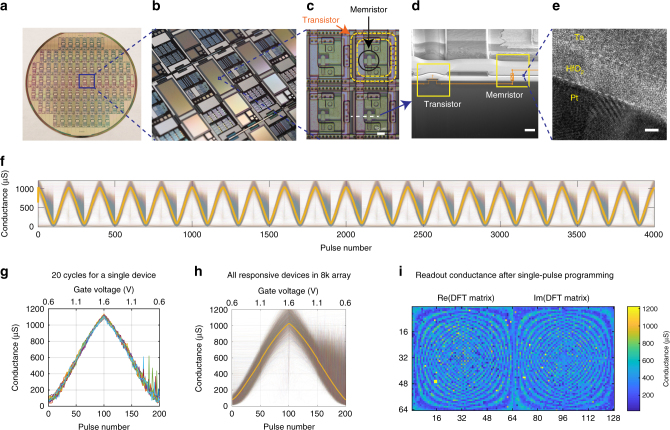
“However, severe non-linearity and asymmetry during the LTP-LTD are observed in Fig. 1b, similar to other conventional oxide-based memristors.23,32,33”
The cited source says what the claim attributes to it.
In the citing paper
“the memristive dot product engine (MDPE), which performs large-scale vector-matrix multiplication (VMM) operations using a memristive crossbar array6–13”
From Flexible self-rectifying synapse array for energy-efficient edge multiplication in electrocardiogram diagnosis (2025) · cites this paper as [8]
Self-check
Percentages, sums and reported differences re-computed from the paper’s own numbers.
The self-check needs the paper’s full text.
Citations
Cites
Deep Residual Learning for Image Recognition
He, K., Zhang, X., Ren, S., & Sun, J. (2016) · 2016 IEEE Conference on Computer Vision and Pattern Recognition (CVPR) · doi:10.1109/cvpr.2016.90 · Cited by 235,474 · cited 1×
“ith the introduction of hardware accelerators 1 – 4 for inference in deep neural networks (DNNs) 5 – 9 , the focus on improving overall energy and time performance arti fi cial intelligence applications is now on training.”
BackgroundVery Deep Convolutional Networks for Large-Scale Image Recognition
Simonyan, K., & Zisserman, A. (2014) · arXiv · doi:10.48550/arxiv.1409.1556 · Cited by 114,148
ImageNet classification with deep convolutional neural networks
Krizhevsky, A., Sutskever, I., & Hinton, G. E. (2017) · Communications of the ACM · doi:10.1145/3065386 · Cited by 112,155
LeCun, Y., Bengio, Y., & Hinton, G. (2015) · Nature · doi:10.1038/nature14539 · Cited by 84,126
Gradient-based learning applied to document recognition
Lecun, Y., Bottou, L., Bengio, Y., & Haffner, P. (1998) · Proceedings of the IEEE · doi:10.1109/5.726791 · Cited by 58,805 · cited 2×
“Here the network was trained using stochastic gradient descent (SGD) 32 to classify handwritten digits in MNIST dataset.”
MethodInfluentialLearning representations by back-propagating errors
Rumelhart, D. E., Hinton, G. E., & Williams, R. J. (1986) · Nature · doi:10.1038/323533a0 · Cited by 31,892 · cited 1×
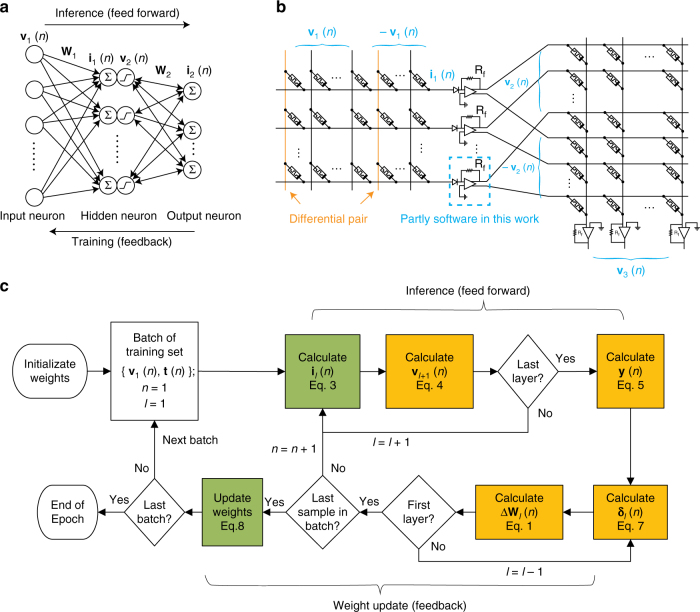
“The error backpropagation 39,40 in this work is calculated in software from the values of the readout weights (see Methods).”
MethodSelf-citationMastering the game of Go with deep neural networks and tree search
Silver, D., Huang, A., Maddison, C. J., Guez, A., Sifre, L., van den Driessche, G., Schrittwieser, J., Antonoglou, I., Panneershelvam, V., Lanctot, M., et al. (2016) · Nature · doi:10.1038/nature16961 · Cited by 15,612
Strukov, D. B., Snider, G. S., Stewart, D. R., & Williams, R. S. (2008) · Nature · doi:10.1038/nature06932 · Cited by 11,828
Self-citationTensorFlow: A system for large-scale machine learning
Abadi, M., Barham, P., Chen, J., Chen, Z., Davis, A., Dean, J., Devin, M., Ghemawat, S., Irving, G., Isard, M., et al. (2016) · arXiv (Cornell University) · doi:10.48550/arxiv.1605.08695 · Cited by 11,822
In-Datacenter Performance Analysis of a Tensor Processing Unit
Jouppi, N. P., Young, C., Patil, N., Patterson, D., Agrawal, G., Bajwa, R., Bates, S., Bhatia, S., Boden, N., Borchers, A., et al. (2017) · Proceedings of the 44th Annual International Symposium on Computer Architecture · doi:10.1145/3079856.3080246 · Cited by 4,537
Research works printed but not linked: 2
- 40. LeCun, Y. A theoretical framework of back-propagation. In Proc. of Connectionist Models Summer School (eds Touretzky, D., Hinton, G. E. & Sejnowski, T. J.) 21–28 (CMU, Pittsburgh, PA, USA, 1988).
- 53. Gokmen, T. & Vlasov, Y. Acceleration of deep neural network training with resistive cross-point devices: design considerations. Front. Neurosci.10, 333 (2016). 10.3389/fnins.2016.00333 PMC4954855 27493624 · DOI · Paper page
Cited by
Items 801–900 of 926
Modeling the Functional Features of a Memristive Crossbar Array in Neuromorphic Electronic Modules
Dudkin, A. P., Ryndin, E. A., & Andreeva, N. V. (2024) · Russian Microelectronics · doi:10.1134/s1063739724600675 · Cited by 1
Fu, L., 潘, G. 高. P., 郝, R. 瑞. H., Fan, X., & Li, Y. (2025) · Chinese Physics B · doi:10.1088/1674-1056/adcc86 · Cited by 1
Self-citationHaidar, A., Ntinas, V. G., & Tetzlaff, R. (2025) · IEEE International Conference on Artificial Intelligence Circuits and Systems (AICAS) · doi:10.1109/aicas64808.2025.11173140 · Cited by 2
Future Computing Systems (FCS) to Support "Understanding" Capability
Beausoleil, R. G., Vaerenbergh, T. V., Bresniker, K., Graves, C., Keeton, K., Kumar, S., Li, C., Milojicic, D. S., Serebryakov, S., & Strachan, J. P. (2019) · IEEE International Conference on Rebooting Computing (ICRC) · doi:10.1109/icrc.2019.8914712 · Cited by 1
“The research into this issue currently follows two main tracks: the unaltered transfer of traditional software learning algorithms to novel accelerator platforms (resulting in struggles with lack of linearly symmetric weight update mechanisms), the other approach is to take the physics from the accelerators into accou…”
BackgroundSelf-citationRRAM-based coprocessors for deep learning
Zhou, Y., Gao, B., Dou, C., Chang, M., & Wu, H. (2020) · Elsevier eBooks · doi:10.1016/b978-0-08-102782-0.00014-9 · Cited by 1
Synaptic realizations based on memristive devices
Milo, V., Dalgaty, T., Ielmini, D., & Vianello, E. (2020) · Elsevier eBooks · doi:10.1016/b978-0-08-102782-0.00017-4 · Cited by 2
TiO x -based self-rectifying memory device for crossbar WORM memory array applications*
Fu, L., Song, X., Gao, X., Wu, Z., Chen, S., & Li, Y. (2020) · Chinese Physics B · doi:10.1088/1674-1056/abc548 · Cited by 1
Self-citationCircuit Design Steps for Nano-Crossbar Arrays: Area-Delay-Power Optimization With Fault Tolerance
Morgul, M. C., Frontini, L., Tunali, O., Anghel, L., Ciriani, V., Vatajelu, E. I., Moritz, C. A., Stan, M. R., Alexandrescu, D., & Altun, M. (2020) · IEEE Transactions on Nanotechnology · doi:10.1109/tnano.2020.3044017 · Cited by 1
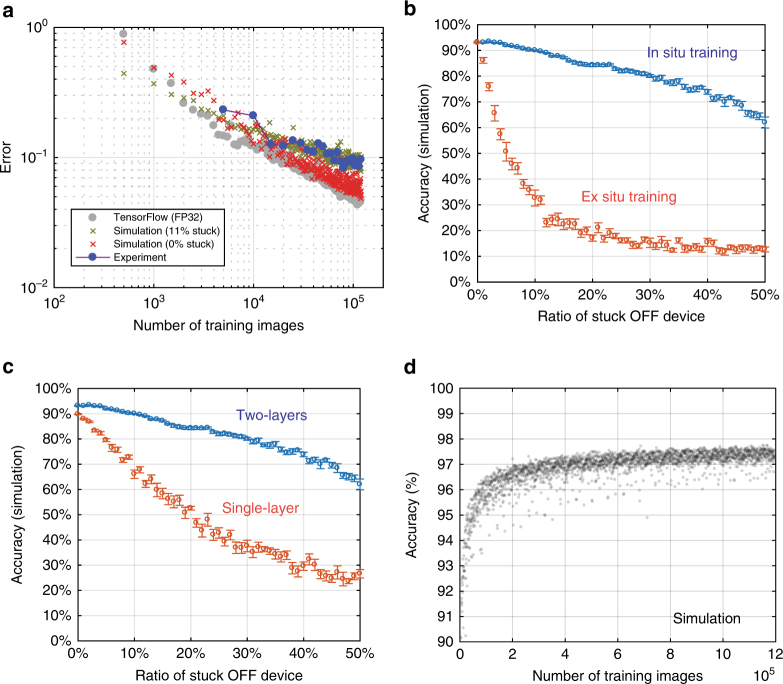
“This categorization is based on actual physical realization of nano-crossbar array as reported in [22] and [12] which state that fault rates reach up to 10% and the most common faults are stuck-at-0 (open).”
BackgroundModified Dropout and Maxout based on the MNN for improving accuracy
Wang, C., Zha, X., & Xia, Y. (2020) · IEEE International Conference on Solid-State and Integrated Circuit Technology · doi:10.1109/icsict49897.2020.9278252 · Cited by 1
One Step in-Memory Solution of Inverse Algebraic Problems
Pedretti, G. (2021) · SpringerBriefs in applied sciences and technology · doi:10.1007/978-3-030-62476-7_6 · Cited by 1
“Memristive crosspoint has been shown able to accelerate different problems based on MVM, such as the training [16, 27, 38] and inference [20, 41] of neural networks, image processing [18], sparse coding [29], optimization problems [6, 24] and the solution of linear equations through iterative…”
BackgroundSimanjuntak, F. M., Chandrasekaran, S., Panda, D., Saleem, A., & Prodromakis, T. (2021) · IntechOpen eBooks · doi:10.5772/intechopen.98607 · Cited by 2
“In-memory computing utilizes the synaptic plasticity of the memristors, where they can mimic the biological synapse or neuron (neuromorphic) [3].”
BackgroundAn analytic modeling strategy for memristor cell applicable to large-scale memristive networks
Hu, W., Liao, J.-B., & Du, Y. (2021) · Acta Physica Sinica · doi:10.7498/aps.70.20210116 · Cited by 1
Ta/HfO2-based Memristor and Crossbar Arrays for In-Memory Computing
Jiang, H., Li, C., Lin, P., Wang, Z., Yang, J. J., & Xia, Q. (2022) · Springer eBooks · doi:10.1007/978-3-030-90582-8_8 · Cited by 1
Self-citationP-ReTiNA: Photonic Tensor Core Based Real- Time AI
Dang, D. (2023) · IEEE International Symposium on Smart Electronic Systems (iSES) · doi:10.1109/ises58672.2023.00050 · Cited by 1
LSTM neural network implementation using memristive crossbar circuits and its various topologies
Adam, K. (2018) · Nazarbayev University Repository (Nazarbayev University) · Cited by 1
2022 roadmap on neuromorphic computing and engineering
Christensen, D. V., Dittmann, R., Linares-Barranco, B., Sebastian, A., Le Gallo, M., Redaelli, A., Slesazeck, S., Mikolajick, T., Spiga, S., Menzel, S., et al. (2022) · Neuromorphic Computing and Engineering · doi:10.1088/2634-4386/ac4a83
Self-citationA Flexible Memristor-Based Neural Network
Sun, J., Han, G., & Wang, Y. (2018) · Communications in computer and information science · doi:10.1007/978-981-13-2826-8_23 · Cited by 1
Non-filamentary Pd/Al2O3/TaOx/Ta Memristor as Artificial Synapse for Neuromorphic Computing
Wang, R., Zhang, X., Shi, T., Wei, J., Lv, H., Liu, Q., & Liu, M. (2018) · IEEE International Conference on Solid-State and Integrated Circuit Technology · doi:10.1109/icsict.2018.8565785
Neuromorphic Computing with Memristors: From Devices to Integrated Systems
Cai, F. (2019) · Deep Blue (University of Michigan)
Rethinking Neuromorphic Hardware Design - A Complexity Engineering Approach.Preprint
Ganesh, N. (2020) · arXiv (Cornell University)
Low-Complexity Vector Quantized Compressed Sensing via Deep Neural Networks
Leinonen, M., & Codreanu, M. (2020) · IEEE Open Journal of the Communications Society · doi:10.1109/ojcoms.2020.3020131 · Cited by 5
“However, owing to the recent advances in neuromorphic computing systems, EncNet can be implemented on an analog circuit prior to a (possibly) low-resolution ADC via memristors10 [58], [60].”
MethodLarge-scale neuromorphic computing hardware for analog AI enabled by epitaxial random access memory
Choi, C. (2019) · DSpace@MIT (Massachusetts Institute of Technology) · Cited by 1
Introductory Chapter: Challenges in Neuro-Memristive Circuit Design
James, A. P. (2020) · Contact-less Assessment of In-vivo Body Signals Using Microwave Doppler Radar (InTech) · doi:10.5772/intechopen.91969
BPhoton-CNN: An Ultrafast Photonic Backpropagation Accelerator for Deep Learning
Dang, D., Khansama, A., Mahapatra, R., & Sahoo, D. (2020) · ACM Great Lakes Symposium on VLSI (GLSVLSI) · doi:10.1145/3386263.3406932 · Cited by 1
“ISAAC [2], PipeLayer [4], RCP [7], and MNN [8].”
MethodInfluentialA Novel On-chip Photonic Synapse Based on Slot-ridge Waveguides with PCMs
Zhang, H., Huang, B., Cheng, C., & Chen, H. (2020) · IEEE Photonics Conference · doi:10.1109/ipc47351.2020.9252447
“many electronic devices have recently been developed, such as memory[2], memristor[3, 4], and the field-effect transistor[5].”
Design and implementation of memristive neuron leakage integrator, and learning feedback
Masaev, D., Talanov, M. O., Zykov, E. Y., Suleimanova, A., Toschev, A. S., & Erokhin, V. V. (2021) · International Siberian Conference on Control and Communications · doi:10.1109/sibcon50419.2021.9438877
Defect tolerant in-memory analog computing with CMOS-integrated nanoscale crossbars: Invited
Jiang, M., Mao, R., Strachan, J. P., & Li, C. (2021) · IEEE International Conference on Electronics, Circuits and Systems (ICECS) · doi:10.1109/icecs53924.2021.9665649
Self-citationMemristive/CMOS Devices for Neuromorphic Applications
Milo, V., Malavena, G., Compagnoni, C. M., & Ielmini, D. (2022) · Springer handbooks · doi:10.1007/978-3-030-79827-7_32 · Cited by 1
BaFe12O19 based Ferroelectric Memristor for Applications of True Random Number Generator
Chen, Z., Zhang, M., Ding, Z., Han, A., Chen, X., Wang, X., Wang, L., Zhang, H., & Tong, Y. (2022) · IEEE International Conference on Integrated Circuits, Technologies and Applications (ICTA) · doi:10.1109/icta56932.2022.9963047
“As one of the candidates for surpassing traditional logic devices, memristors possess excellent performance of high speed, low power consumption, CMOS compatibility, and the application potential of computing in memory (CIM) [2-3].”
BackgroundLogic gates based on nonlinear oscillators
Bonnin, M., Bonani, F., & Traversa, F. L. (2022) · Complexity in Engineering (COMPENG) · doi:10.1109/compeng50184.2022.9905446
“For these applications two main approaches exist: digital, such as Google’s TPU [7], and analogue, as the memristor crossbar neural networks on chip [8]–[10].”
MethodChen, K., Fan, Z. H., Dong, S., Li, W., Chen, Y., Tian, G., Chen, D., Qin, M., Zeng, M., Lu, X., et al. (2022) · Acta Physica Sinica · doi:10.7498/aps.72.20221934
Active Traffic Signal Decisions Using Vector‐Matrix Multiplication
Jang, J., Jeon, T., & Wang, G. (2023) · Advanced Intelligent Systems · doi:10.1002/aisy.202200228
Algorithmic Optimisation for Memristive Deep Learning Accelerators
Mehonić, A., & Joksas, D. (2023) · Royal Society of Chemistry eBooks · doi:10.1039/bk9781839169946-00656
Control method and analysis of potential application based on memristor
Gu, Z. (2023) · Applied and Computational Engineering · doi:10.54254/2755-2721/14/20230758
A Simplified Analog Neuron Model with Modified Memristor-based Positive Synaptic Weights
Kirilov, S., Tsenov, G. T., & Mladenov, V. (2023) · International Scientific Conference on Computer Science (COMSCI) · doi:10.1109/comsci59259.2023.10315912
“They have a potential to be used for application of neural networks that could perform both memory storage and computation in a single element [18], [19], [20].”
BackgroundTowards efficient deep neural network inference and training for ubiquitous AI
Yuan, G. (2023) · Digital Repository Service (Northeastern University) · doi:10.17760/d20581919
A Memristor-Based Adaptive Pooling Network for Cnn OptimizationPreprint
Guo, W., Feng, Z., Zou, J., Shi, T., Wang, Z., Tan, S. E., Xu, Z., Zhu, Y., Dai, Y., & Wu, Z. (2023) · SSRN Electronic Journal · doi:10.2139/ssrn.4648000
Self-citationGao, S., & Ohsawa, T. (2024) · Japanese Journal of Applied Physics · doi:10.35848/1347-4065/ad1895
An Efficient Implementation of Modified Digital Synapse Design for Neural Network
Malini, P., & Maheswari, M. (2023) · International Conference on Advances in Electrical, Electronics and Computational Intelligence (ICAEECI) · doi:10.1109/icaeeci58247.2023.10370828
“Better hardware design produced by using scalability and technological advancements in the Very Large-Scale Integration (VLSI) industry [9].”
MethodRead and write circuit for memristive neural networks
Elhamdaoui, M., Mbarek, K., Rziga, F. O., & Besbes, K. (2023) · International Multi-Conference on Systems, Signals & Devices (SSD) · doi:10.1109/ssd58187.2023.10411157
“Developing efficient hardware neuromorphic systems presents an important progress in future big data computing [1] [2].”
BackgroundInterfacing Memristors for Reliable Computing
Herranz, A. D. G. (2023) · UPM Digital Archive (Technical University of Madrid) · doi:10.20868/upm.thesis.78885
Memristor-Based Analog Multiplier
Lei, J. W., Yang, L., Ding, Z., Li, S., & Cheng, M. (2023) · International Conference on Neuromorphic Computing (ICNC) · doi:10.1109/icnc59488.2023.10462752
An Analysis of Fault Diagnosis Approaches in Memristor Crossbar Array
Yadav, D. N., Thangkhiew, P. L., & Sengupta, I. (2023) · IEEE International Symposium on Smart Electronic Systems (iSES) · doi:10.1109/ises58672.2023.00057
Chee, M. Y. (2023) · DR-NTU (Nanyang Technological University) · doi:10.32657/10356/173840
Advances in Nanochannel Energy Harvesting and Computing System
Xiong, Z., Chen, K., Chen, Q., Miao, X., & He, Y. (2024) · Asia Conference on Power and Electrical Engineering (ACPEE) · doi:10.1109/acpee60788.2024.10532757
“Inspired by the highly efficient operational modes of the human brain, memristor-based neuromorphic computing architectures offer substantial potential in terms of information processing efficiency, model complexity, and parallel processing capabilities[10], [11], [38], [39].”
BackgroundP-ReTI: Silicon Photonic Accelerator for Greener and Real-Time AI
Dang, D., Dash, P., & Aziz, A. (2024) · ACM Great Lakes Symposium on VLSI (GLSVLSI) · doi:10.1145/3649476.3660376
“Because of the large computing overhead, the battery of Google Glass stands for only 45 minutes [5] when tracking consecutive human actions.”
BackgroundRecent Progress of Memristor-based Neuromorphic Computing
Zhou, J. (2024) · Transactions on Computer Science and Intelligent Systems Research · doi:10.62051/1kany131
“The information in the table comes from [23, 10, 9, 12, 5, 18, 20, 21, 22, 14, 17, 19], with the citations listed in the same order as the table.”
BackgroundA Case for 3D Integrated System Design for Neuromorphic Computing & AI ApplicationsPreprint
Kurshan, E., Li, H. H., Seok, M., & Xie, Y. (2024) · SSRN Electronic Journal · doi:10.2139/ssrn.4941369
Circuit Design of a Seven-Piecewise Linear Activation Function
Cai, R., Yang, L., Jiang, Z., Ding, Z., & Li, S. (2024) · International Conference on Information Science and Technology · doi:10.1109/icist63249.2024.10805455
“Additionally, some scholars have also utilized computer software to implement sigmoid and tanh functions [17], [18], but this method mostly relies on computers and microcontrollers for realization.”
A simple interface circuit for edge inference kernels based on SC-LNO memristor crossbar
Wang, S.-C., Liu, Y., Liu, X., Liu, Y., Liu, Z., & Xing, Z. (2025) · Microelectronics Journal · doi:10.1016/j.mejo.2024.106537
Brief Review of Neuron Typology and Analysis of the Use of Memristor Crossbars
Tokarev, A. A., & Khorin, I. A. (2024) · Russian Microelectronics · doi:10.1134/s1063739724600766
“An example is the in-situ learning of a multilayer neural network based on hafnium-oxide memristor arrays (1T1R) [18].”
Cho, J. R., Park, J., Myoung, S. J., Yang, T. J., Kim, C., Bae, J., Choi, S., Kim, D. M., Song, I., & Kim, D. H. (2025) · Solid-State Electronics · doi:10.1016/j.sse.2025.109084
Jiao, Z., Chen, X., Hong, T., Dai, W., Tu, C., Li, S., Chen, H., & Song, Z. (2024) · IEEE High Performance Extreme Computing Conference · doi:10.1109/hpec62836.2024.10938478
Xu, J., & Lu, Y. (2025) · Arabian Journal of Chemistry · doi:10.25259/ajc_308_2024
Research and Application of Artificial Synapses Based on ZrO2/ZnO Heterojunction
任, 齐. (2025) · Artificial Intelligence and Robotics Research · doi:10.12677/airr.2025.143050
Kim, S., Byun, J., Kim, H., Son, J., & Kim, S. (2025) · IEEE Transactions on Electron Devices · doi:10.1109/ted.2025.3566348
Artificial Electrochromic Synapses for Optical Neuromorphic Computing
刘, 成. (2025) · Modeling and Simulation · doi:10.12677/mos.2025.145423
Synaptic plasticity in Co/Nb:STO memristive devices: The role of oxygen vacancies
Quiñonez, W., Goossens, A. S., Rubi, D., Banerjee, T., & Sánchez, M. J. (2025) · APL Electronic Devices · doi:10.1063/5.0271898 · Cited by 1
Leveraging ReRAM Crossbar for Octave Convolution in Deep Neural Networks
Abdurrob, A., & Salman, E. (2025) · IEEE International Symposium on Circuits and Systems proceedings · doi:10.1109/iscas56072.2025.11043525
“In the co-design approach proposed in this paper, low-frequency convolutions are run on the energy-efficient ReRAM crossbar, known for its parallel processing and energy efficiency [13], [14], and high-frequency convolutions, which play an important role in inference accuracy, are run on the CPU.”
Kotadiya, H. J., Jatkar, M., & Rai, S. (2025) · Lecture notes in electrical engineering · doi:10.1007/978-981-96-3694-5_29
Bioinspired Fully On‐Chip Learning Implemented on Memristive Neural Networks
Wen, Z., Wang, G., Luo, X. D., Liang, L., Yang, F., Wang, X., Zhang, Q., Chen, J., Liu, Q., & Liu, F. (2025) · Advanced Intelligent Systems · doi:10.1002/aisy.202500071
Wei, J., He, Y., Yang, Y. G., Zhang, H., Xie, Y., Zhang, C., Liu, Y., Chen, M., & Cao, D. (2025) · Applied Physics Letters · doi:10.1063/5.0273610
Ren, X., Sun, B. T., Liu, G., Zhou, C., Cao, Z., Gao, K., Cui, Y., Xu, Z., Wang, M., Yan, W., et al. (2025) · Advanced Materials Technologies · doi:10.1002/admt.202501052
The Versatility of Nickel: Advances in C–S Bond Formation
Wang, S., & Muhammad, H. (2025) · Synlett · doi:10.1055/s-0043-1775431
Memristors for neuromorphic computing systems: basic parameters and methods of their optimization
Ilin, A. S., Matsukatova, A. N., Николаевич, М. М., Emelyanov, A. V., Rylkov, V. V., Demin, V. A., Форш, П. А., Kashkarov, P. K., & Kovalchuk, M. V. (2025) · Uspekhi Fizicheskih Nauk · doi:10.3367/ufnr.2025.09.040037
Şahintekin, B., & Taşkıran, Z. G. Ç. (2025) · Gazi Üniversitesi Mühendislik-Mimarlık Fakültesi Dergisi · doi:10.17341/gazimmfd.1539981
CsPbBr3 perovskite nanoplatelets capped with inorganic ligands for stable deep blue emission
Zhang, A., Yao, Z., Sun, C. H., Lee, B. R., Song, J., Wang, Z., Li, Y., Liu, F., Yang, E., Kim, D., et al. (2025) · iScience · doi:10.1016/j.isci.2025.114078
“1,2 Although the CsPbX 3 NCs have been considered as ‘‘defect-tolerant’’ nanomaterials compared with traditional metal chalcogenide NCs, 3 the photoluminescence (PL) quantum yields (PLQYs) of blue light-emitting CsPb(Cl/Br) 3 NCs still lag far away from the near unity of the green light-and red…”
Self-citationTun, T. T. T., Huo, J., & Ang, K. (2025) · Nanoscale Horizons · doi:10.1039/d5nh00675a · Cited by 1
Neuromorphic Computing With Emerging Memories
Zhao, R., & Yang, J. J. (2025) · Computer · doi:10.1109/mc.2025.3615214
“Weights are commonly represented with differential pairs (two devices per weight) to encode the sign and cancel common-mode errors 36 ; larger weights can be bit-sliced across multiple cells, trading array area for precision.”
Self-citationLin, C.-W., Chuang, R. W., Shih, C.-F., & Huang, C.-L. (2025) · Materials Science in Semiconductor Processing · doi:10.1016/j.mssp.2025.110255
In-sensor computing: A comprehensive review
Syed, I., Khanday, M. A., Rashid, S., & Khanday, F. A. (2025) · Elsevier eBooks · doi:10.1016/b978-0-443-29981-0.00010-0
Jiang, N., Xie, J., Li, D., Huang, H., & Zeng, Z. (2026) · Nonlinear Dynamics · doi:10.1007/s11071-025-11955-x · Cited by 1
The Embodiment Paradox: Integrating Prosthetic Systems to Enhance Human-Machine Integration
Gentile, C., & Gruppioni, E. (2026) · Springer eBooks · doi:10.1007/978-3-032-06713-5_2
Yoo, D.-G., Kim, G.-B., Park, S. W., & Baek, M.-H. (2026) · ACS Applied Electronic Materials · doi:10.1021/acsaelm.5c02162 · Cited by 1
Exploiting Hardware Nonidealities for Robust Low-Precision Ensembles on ACIM
Lee, D., & Kim, T. (2026) · IEEE Transactions on Very Large Scale Integration (VLSI) Systems · doi:10.1109/tvlsi.2026.3666118
“To address this issue, several techniques have been proposed, including 1) on-chip training [3], [4], [5]; 2) o ff -chip training and mapping with variation awareness [6], [7], [8]; 3) hardware-assisted write-accuracy enhancement [9], [10]; and 4) multiple read-verify-write schemes [11], [12].”
Hybrid Memristor-CMOS System: Circuit Design Solutions for Control and Data Processing
Tokarev, A. A., & Khorin, I. A. (2025) · Russian Microelectronics · doi:10.1134/s1063739725601183
Zhong, L., Lin, Y., Liu, Z., Wang, L., Liu, Y., & Geng, K. (2026) · Materials Today Chemistry · doi:10.1016/j.mtchem.2026.103573
Digital Implementation of Neuromorphic systems using Emerging Memory devices
Hirtzlin, T. (2020) · theses.fr (ABES) · doi:10.70675/7c42d7b9z4001z4424z8a0az6c7cb2079ec8 · Cited by 7
Bayesian neuromorphic computing based on resistive memory
Dalgaty, T. (2020) · theses.fr (ABES) · doi:10.70675/e5b4f3e2z44a5z4c41zbac6z4c933e86b101 · Cited by 1
Embracing Imperfections : Hardware-compatible Neural Networks for Neuromorphic Computing
Majumdar, A. (2023) · theses.fr (ABES) · doi:10.70675/4bf81ddbz25cfz48c6zaf34zcaedca216e17
In-memory computing based on CMOS-RRAM hybrid architectures
Esmanhotto, E. (2022) · theses.fr (ABES) · doi:10.70675/1cf79608z3789z4025z8efcz817e8621bdd9 · Cited by 1
Liu, T., Ren, H., Tong, P., Wang, W., Li, Q. Y., Xia, M., Sun, Y., Cao, R., Song, B., Li, Z., et al. (2026) · Micromachines · doi:10.3390/mi17040481
Coupling atomic layer design with switching dynamics in sub-2 nanometer oxide memristors
Marshall, A. D., Seacat, S., Avalos, D. T., Tabassum, A., Goul, R. W., Dodson, B., Peelaers, H., Hernández, C. M., Sakidja, R., & Wu, J. Z. (2026) · Communications Materials · doi:10.1038/s43246-026-01116-x · Cited by 1
“For memristor samples with bothM1 and M2 layers made using iALD , thenumberofatomiclayersisintherangeof11 – 17,yieldingatotalM1/M2 thickness in the sub-2nm range since each of the Al 2 O 3, MgO, and Ga 2 O 3 atomic layers has a thickness of ~ 0.11 – 0.12 nm 23,56 – 59 .”
InfluentialSingh, V., Rajput, K., Mahaur, P., Jaiswal, B., Singh, S., & Srivastava, V. (2026) · Synthesis · doi:10.1055/a-2869-6243
Unified matrix-parallel outer-product updates for pretrained deployment and on-device adaptationPreprint
Lee, J., Lee, I.-S., Lee, K. H., Koo, R., Im, J., Park, S., Ko, J., Hwang, J., Ryu, S., & Lee, K. H. (2026) · Research Square · doi:10.21203/rs.3.rs-9144413/v1
Liu, X. Y., Xie, X., Yin, B., & Ju, R. (2026) · Neural Networks · doi:10.1016/j.neunet.2026.109104
Modeling and Simulation of a 3×3 Memristor Crossbar Architecture Using the Yakopcic Memristor Model
Prajapati, S., Bodile, R. M., & Singh, R. (2026) · International Conference on Intelligent Processing, Hardware, Electronics, and Radio Systems (CIPHER) · doi:10.1109/cipher70417.2026.11523744
Analog Error-Correcting Codes for Dependable In-Memory Computing of Neural Networks
Jiang, A. A. (2026) · Springer eBooks · doi:10.1007/978-3-032-17948-7_7
Energy-efficient water quality modeling using memristor-based neuromorphic computing
Jeung, M., Son, G., Kim, M., & Baek, S.-S. (2026) · npj Clean Water · doi:10.1038/s41545-026-00586-3
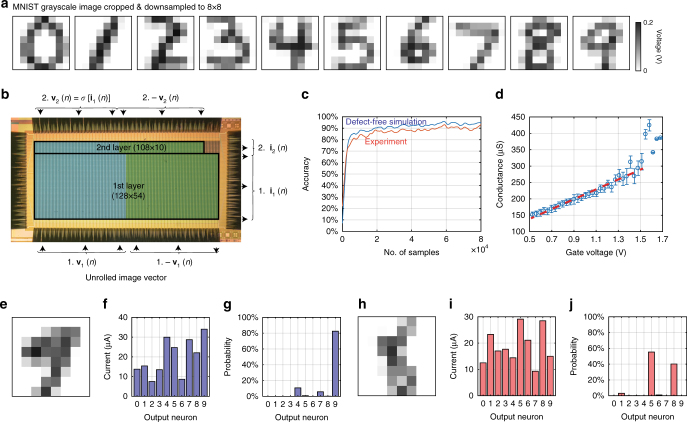
“In addition, Li et al. 21 . demonstrated ef fi cient in situ learning in a multilayer neural network implemented in a 128 × 64 memristor array, and they achieved 91.71% accuracy on the MNIST handwritten-digit classi fi - cation task even with defective devices.”
InfluentialAbdollahi, A., Kamal, M., & Pedram, M. (2026) · International Symposium on Quality Electronic Design (ISQED) · doi:10.1109/isqed69900.2026.11534656 · Cited by 1
“[12] demonstrates using memristor-based neural networks for efficient in situ learning with adaptive capabilities to hardware imperfections, achieving competitive classification accuracy on standard machine learning datasets.”
Wave-based neuromorphic circuit networks: tunable 2D transmission-line metamaterials [Invited]
Thakkar, S., & Grbic, A. (2026) · Optical Materials Express · doi:10.1364/ome.599576
“…parameters in the WNC using only two steady-state excitations of the WNC. Specifically, the gradient is computed from nodal voltage measurements under forward excitation (inference) and backward/reverse excitation (error backpropagation) on the same WNC, using an error signal [8,10,11,14].”
Zhang, J., Chaocheng, S., Yan, J., Pei, Y., Xu, J., Yan, X., & Zhao, J. (2026) · 中国科学通报:英文版 · doi:10.1016/j.scib.2026.06.005
An RRAM-based Neuromorphic Sleep Monitoring System for Energy-efficient Edge Healthcare Applications
Chen, J., Zhu, F., Li, Z. J., Xu, Z., Zhu, Y., ZHANG, J., Liang, J., Zhang, X., & Liu, Q. (2026) · IEEE International Symposium on Circuits and Systems proceedings · doi:10.1109/iscas66217.2026.11562757
Mitigating Conductance Drift via In-Situ Calibration for Reliable RRAM-Based CIM Edge Inference
Kong, Z., Dong, W.-K., He, J., Yang, Z., Lan, J., Liang, Y., Li, J., Li, Y., & Lin, L. (2026) · IEEE International Symposium on Circuits and Systems proceedings · doi:10.1109/iscas66217.2026.11562039
“Conventional full-weight calibration schemes [11], [12] rely on off-chip retraining followed by reprogramming of all RRAM cells, incurring excessive write energy, latency, and endurance degradation.”
Self-citationZhang, Z., Yan, J., Gu, J., Chen, X., Shen, W., Bao, C., Lu, M., Qiu, J., Guo, H., & Jiang, S. S. (2026) · Nanoscale · doi:10.1039/d6nr01710j
Lu, H., Yuxuan, H., Wang, M., Shijia, Y., & Su, W. (2026) · Journal of Materials Science · doi:10.1007/s10853-026-13180-2
“Multilayer dielectric films enable functional decoupling among individual layers, allowing complementary mechanisms to operate synergistically and thereby improving overall performance [15].”
Analog neural network–based wireless receiver
He, C., Huang, Y., Korkmaz, A., Rad, A. J., Xia, Q., & Katehi, L. (2026) · Science Advances · doi:10.1126/sciadv.aeg7153
“The mapped conductance matrix is then programmed to the memristor crossbar array, which integrates Ta/HfO 2 - based memristors ( 19 , 49 ), using the optimized fine-tuning method ( 50 , 51 ).”
Self-citationNon-idealities in artificial synapses
Hamid, S. B., Incorvia, J. A. C., & Liu, S. (2026) · Nature Reviews Physics · doi:10.1038/s42254-026-00957-2 · Cited by 1
“To address variability and asymmetry, a two-pulse programming scheme was reported in which each weight update was performed by splitting a single pulse into a pair of pulses 140 .”
Polycrystalline NiCuZnCoMnFe-O Memristors with Low-Voltage Operation for Neuromorphic Synapses
Ding, R., Qin, J., Wang, W., Yang, S., Wu, R., Zheng, H., & Zheng, L. (2026) · Magnetochemistry · doi:10.3390/magnetochemistry12070076
Metadata
- Authors
- Li, C., Belkin, D., Li, Y., Yan, P., Hu, M., Ge, N., Jiang, H., Montgomery, E., Lin, P., Wang, Z., Song, W., Strachan, J. P., Barnell, M., Wu, Q., Williams, R. S., Yang, J. J., & Xia, Q.
- Affiliations
- University of Massachusetts Amherst (US)
- Swarthmore College (US)
- Binghamton University (US)
- Hewlett-Packard (United States) (US)
- U.S. Air Force Research Laboratory Information Directorate (US)
- Corresponding author
- Yang, J. Joshua
- Xia, Qiangfei
- ORCID
- Venue
- Nature Communications
- Published
- 2018-06-19
- Volume
- 9
- Issue
- 1
- Pages
- 2385-2385
- ISSN
- 2041-1723 (ISSN-L)
- PMC
- PMC6008303
- OpenAlex
- W2807750997
- Cited by
- 931
- References
- 49
- Citations by year
- 2026: 76 · 2025: 112 · 2024: 103 · 2023: 131 · 2022: 120 · 2021: 126 · 2020: 147 · 2019: 100 · 2018: 16
- FWCI
- 37.17
- Type
- journal article
- Language
- en
- Open access
- gold
- doi.org
- Licence
- cc-by
- creativecommons.org/licenses/by/4.0 (tdm)
- creativecommons.org/licenses/by/4.0 (vor)
- Locations
- Nature Communications (publishedVersion, cc-by)
- Europe PMC (PubMed Central) (publishedVersion, other-oa)
- PubMed Central (publishedVersion, cc-by)
- PubMed (publishedVersion)
- RePEc: Research Papers in Economics (submittedVersion)
- DOAJ (DOAJ: Directory of Open Access Journals) (submittedVersion, cc-by-sa)
- Funders
- Air Force Research Laboratory (FA8750-15-2-0044)
- National Science Foundation (ECCS-1253073)
- Topics
- Physical Sciences › Engineering › Electrical and Electronic Engineering › Advanced Memory and Neural Computing
- Physical Sciences › Engineering › Electrical and Electronic Engineering › Ferroelectric and Negative Capacitance Devices
- Physical Sciences › Computer Science › Artificial Intelligence › Neural Networks and Applications
- Keywords
- memristor neural networks, in situ learning, multilayer neural networks, monolithic integration, energy-efficient hardware, neuromorphic computing, classification accuracy
About these checks
Registry, retraction, Cites and statistics results are computed, not judged, with one exception: a printed reference that no index lists is read once by a model before it counts as a citation error. Claims are extracted by a model and kept only when their quote appears verbatim in the text; each cited source is then checked, with a model’s help, for whether it says what the claim relies on. Those verdicts can be wrong — read the claim’s quote and the cited source before relying on one.
Statistics and arithmetic are recomputed, not judged.
Confidence bands are shown only for fields calibrated on our annotated test set. None is calibrated yet, so no band is shown.
What counts as a claim ›How we measure confidence ›How we check this ›
Are you an author, or do you see a problem with this page? Request a review
Data sources
Bibliographic data: Semantic Scholar, OpenAlex, Crossref.
Contains information from the Semantic Scholar Academic Graph Datasets, made available under the ODC Attribution License (ODC-BY 1.0).
Semantic Scholar’s data is described in: Kinney, R., et al. (2023). The Semantic Scholar Open Data Platform. arXiv:2301.10140.
