

Efficient and self-adaptive in-situ learning in multilayer memristor neural networks
Open accessThe DOI matches its Crossref record; 52 of the 52 references it cites were found in a registry or an index.
Abstract
Memristors with tunable resistance states are emerging building blocks of artificial neural networks. However, in situ learning on a large-scale multiple-layer memristor network has yet to be demonstrated because of challenges in device property engineering and circuit integration. Here we monolithically integrate hafnium oxide-based memristors with a foundry-made transistor array into a multiple-layer neural network. We experimentally demonstrate in situ learning capability and achieve competitive classification accuracy on a standard machine learning dataset, which further confirms that the training algorithm allows the network to adapt to hardware imperfections. Our simulation using the experimental parameters suggests that a larger network would further increase the classification accuracy. The memristor neural network is a promising hardware platform for artificial intelligence with high speed-energy efficiency.
Overview
The claims and statistics of this paper haven’t been checked yet.
Free: it reads the open-access text and checks the first 5 claims that cite a source we can check. Create a free account to check every claim.
Integrity signals
Registry
Cites
Statistics
Figures
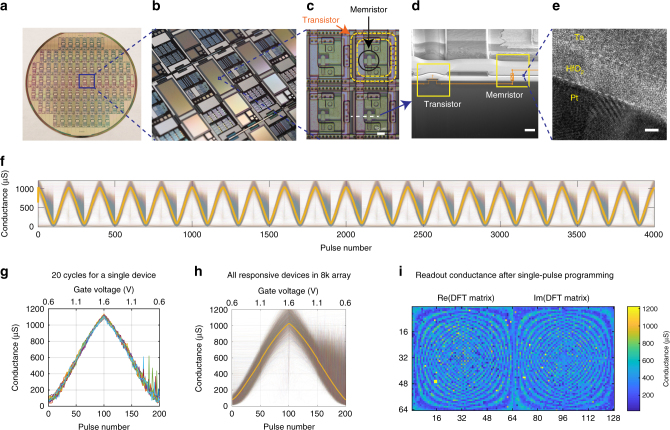
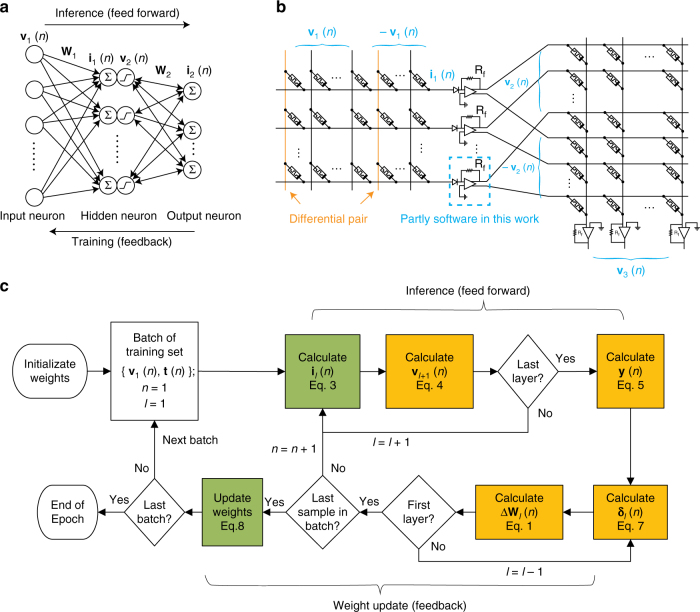
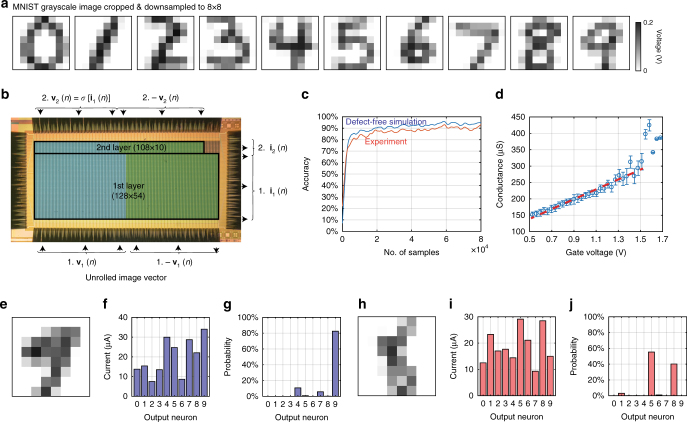
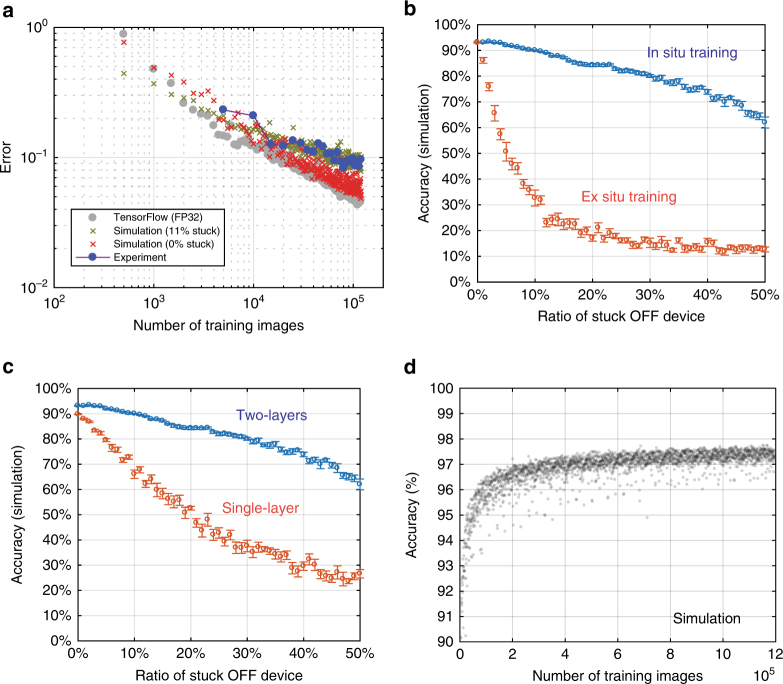
Verification
Claims the paper makes
The claims and statistics of this paper haven’t been checked yet.
Free: it reads the open-access text and checks the first 5 claims that cite a source we can check. Create a free account to check every claim.
Claims other papers make about this one
Each is checked against this paper’s own text: does it say what the citing paper says it does?
The cited source says what the claim attributes to it.
In the citing paper
“However, severe non-linearity and asymmetry during the LTP-LTD are observed in Fig. 1b, similar to other conventional oxide-based memristors.23,32,33”
The cited source says what the claim attributes to it.
In the citing paper
“the memristive dot product engine (MDPE), which performs large-scale vector-matrix multiplication (VMM) operations using a memristive crossbar array6–13”
From Flexible self-rectifying synapse array for energy-efficient edge multiplication in electrocardiogram diagnosis (2025) · cites this paper as [8]
Self-check
Percentages, sums and reported differences re-computed from the paper’s own numbers.
The self-check needs the paper’s full text.
Citations
Cites
Deep Residual Learning for Image Recognition
He, K., Zhang, X., Ren, S., & Sun, J. (2016) · 2016 IEEE Conference on Computer Vision and Pattern Recognition (CVPR) · doi:10.1109/cvpr.2016.90 · Cited by 235,474 · cited 1×
“ith the introduction of hardware accelerators 1 – 4 for inference in deep neural networks (DNNs) 5 – 9 , the focus on improving overall energy and time performance arti fi cial intelligence applications is now on training.”
BackgroundVery Deep Convolutional Networks for Large-Scale Image Recognition
Simonyan, K., & Zisserman, A. (2014) · arXiv · doi:10.48550/arxiv.1409.1556 · Cited by 114,148
ImageNet classification with deep convolutional neural networks
Krizhevsky, A., Sutskever, I., & Hinton, G. E. (2017) · Communications of the ACM · doi:10.1145/3065386 · Cited by 112,155
LeCun, Y., Bengio, Y., & Hinton, G. (2015) · Nature · doi:10.1038/nature14539 · Cited by 84,126
Gradient-based learning applied to document recognition
Lecun, Y., Bottou, L., Bengio, Y., & Haffner, P. (1998) · Proceedings of the IEEE · doi:10.1109/5.726791 · Cited by 58,805 · cited 2×
“Here the network was trained using stochastic gradient descent (SGD) 32 to classify handwritten digits in MNIST dataset.”
MethodInfluentialLearning representations by back-propagating errors
Rumelhart, D. E., Hinton, G. E., & Williams, R. J. (1986) · Nature · doi:10.1038/323533a0 · Cited by 31,892 · cited 1×
“The error backpropagation 39,40 in this work is calculated in software from the values of the readout weights (see Methods).”
MethodSelf-citationMastering the game of Go with deep neural networks and tree search
Silver, D., Huang, A., Maddison, C. J., Guez, A., Sifre, L., van den Driessche, G., Schrittwieser, J., Antonoglou, I., Panneershelvam, V., Lanctot, M., et al. (2016) · Nature · doi:10.1038/nature16961 · Cited by 15,612
Strukov, D. B., Snider, G. S., Stewart, D. R., & Williams, R. S. (2008) · Nature · doi:10.1038/nature06932 · Cited by 11,828
Self-citationTensorFlow: A system for large-scale machine learning
Abadi, M., Barham, P., Chen, J., Chen, Z., Davis, A., Dean, J., Devin, M., Ghemawat, S., Irving, G., Isard, M., et al. (2016) · arXiv (Cornell University) · doi:10.48550/arxiv.1605.08695 · Cited by 11,822
In-Datacenter Performance Analysis of a Tensor Processing Unit
Jouppi, N. P., Young, C., Patil, N., Patterson, D., Agrawal, G., Bajwa, R., Bates, S., Bhatia, S., Boden, N., Borchers, A., et al. (2017) · Proceedings of the 44th Annual International Symposium on Computer Architecture · doi:10.1145/3079856.3080246 · Cited by 4,537
Research works printed but not linked: 2
- 40. LeCun, Y. A theoretical framework of back-propagation. In Proc. of Connectionist Models Summer School (eds Touretzky, D., Hinton, G. E. & Sejnowski, T. J.) 21–28 (CMU, Pittsburgh, PA, USA, 1988).
- 53. Gokmen, T. & Vlasov, Y. Acceleration of deep neural network training with resistive cross-point devices: design considerations. Front. Neurosci.10, 333 (2016). 10.3389/fnins.2016.00333 PMC4954855 27493624 · DOI · Paper page
Cited by
Items 701–800 of 926
Kawano, C., & Hashimoto, M. (2023) · IEEE International Conference on Rebooting Computing (ICRC) · doi:10.1109/icrc60800.2023.10386352 · Cited by 3
“Actual hardware implementations are also demonstrated, for example, in [3], [6].”
BackgroundFast and Accurate Output Error Estimation for Memristor-Based Deep Neural Networks
Kern, J., Henwood, S., Mordido, G., Dupraz, E., Bey, A. A. E., Savaria, Y., & Leduc-Primeau, F. (2024) · IEEE Transactions on Signal Processing · doi:10.1109/tsp.2024.3369423 · Cited by 6
“Even though memristor-based DNN implementations have recently gained in popularity, their analyses, design, and optimization have been primarily empirical in nature [23], [24], [25], [26].”
A Parallel Read-Write Circuit Design for Driving Memristor Crossbar Array
Jiang, N., Jiang, M., & Zeng, Z. (2023) · International Conference on Neuromorphic Computing (ICNC) · doi:10.1109/icnc59488.2023.10462881 · Cited by 3
“…1T1R array have been adopted in various neural network circuits, including single-layer neural networks [7], multi-layer neural networks [8]–[11], convolution neural networks (CNNs) [12]–[14], transformer networks (TNs) [15], long-short-term memory (LSTM) networks [16], and spiking…”
BackgroundHwang, S., Lee, W., Park, J., & Suh, D. (2024) · IEEE Transactions on Nanotechnology · doi:10.1109/tnano.2024.3466128 · Cited by 3
“The typical cell area of 1T1R array is 12F 2 , and we assumed the resistance values of 1 M Ω and 10 k Ω for HRS and LRS states with a read voltage of 0.2V, respectively, based on previous researches [21], [22], [23], [24], [25].”
MethodXie, R., Liu, S., Yang, T., Zhu, M., Huang, Q., Cao, Q., & Yan, S. (2024) · Journal of Magnetism and Magnetic Materials · doi:10.1016/j.jmmm.2024.172726 · Cited by 3
DTGA: an in-situ training scheme for memristor neural networks with high performance
Shen, S., Guo, M., Wang, L., & Duan, S. (2024) · Applied Intelligence · doi:10.1007/s10489-024-06091-9 · Cited by 3
Udovichenko, S. Y., Pisarev, A. D., Busygin, A. N., & Bobylev, A. N. (2020) · Nanoindustry Russia · doi:10.22184/1993-8578.2020.13.7-8.466.475 · Cited by 3
Analogue In-Memory Computing with Resistive Switching Memories
Pedretti, G., & Ielmini, D. (2022) · Springer eBooks · doi:10.1007/978-3-031-03841-9_4 · Cited by 3
Leveraging Voltage-Controlled Magnetic Anisotropy to Solve Sneak Path Issues in Crossbar Arrays
Yang, K., & Sengupta, A. (2023) · IEEE Transactions on Electron Devices · doi:10.1109/ted.2023.3246949 · Cited by 3
Nonuniform magnetic domain-wall synapses enabled by population coding
Qiao, Y., Zhang, Y., & Yuan, Z. (2023) · New Journal of Physics · doi:10.1088/1367-2630/acc5a7 · Cited by 3
Neural Information Processing and Time‐Series Prediction with Only Two Dynamical Memristors
Molnár, D., Török, T. N., Volk, J., Kövecs, R., Pósa, L., Balázs, P., Molnár, G., Olalla, N. J., Balogh, Z., Volk, J., et al. (2025) · Advanced Electronic Materials · doi:10.1002/aelm.202500353 · Cited by 5
Neko: a Library for Exploring Neuromorphic Learning Rules
Zhao, Z., Wycoff, N., Getty, N., Stevens, R. L., & Xia, F. (2021) · International Conference on Neuromorphic Systems (ICONS) · doi:10.1145/3477145.3477155 · Cited by 3
“arge crossbar architectures. Compared with digital implementations of neural networks, these analog circuits offer promising advantages in parallel processing, in-situ learning, and energy efficiency [12, 24]. However, they also place constraints on how the weights can be updated. A classic way to train these networks…”
MethodMemSE: Fast MSE Prediction for Noisy Memristor-Based DNN Accelerators
Kern, J., Henwood, S., Mordido, G., Dupraz, E., Bey, A. A. E., Savaria, Y., & Leduc-Primeau, F. (2022) · IEEE International Conference on Artificial Intelligence Circuits and Systems (AICAS) · doi:10.1109/aicas54282.2022.9869978 · Cited by 5
“Over the past few years, implementing neural networks using memristors has attracted a lot of attention [5], [10].”
BackgroundShchanikov, S., Zuev, A. D., Bordanov, I., Danilin, S. N., Korolev, D. S., Belov, A. I., Pigareva, Y., Pimashkin, A. S., Mikhaylov, A. N., & Kazantsev, V. (2020) · arXiv (Cornell University) · doi:10.48550/arxiv.2004.00154 · Cited by 3
“19 A similar approach is described, for example, in papers (Yang et al., 2016; Bayat et al., 2018; Li et al., 2018) and makes it possible to provide the required accuracy of ANNM training.”
MethodTunable magnetic synapse for reliable neuromorphic computing
Mou, H., Luo, Z., & Zhang, X. (2024) · Applied Physics Letters · doi:10.1063/5.0210317 · Cited by 2
Stability analysis of stochastic Lyapunov functions: Applications to memristor neural networks
Rahimi, V., & Ahmadian, D. (2025) · Mathematical Methods in the Applied Sciences · doi:10.1002/mma.10574 · Cited by 2
“Due to their ability to perform extensive array of vector multiplication, memristors can enable efficient and self-adaptive in situ learning in multilayer neural networks [9].”
Park, M., Chien, H.-T., Chen, W.-C., Mimi, A. A., Wan, W., Woo, K. S., Yi, S., & Kumar, S. (2025) · npj Unconventional Computing · doi:10.1038/s44335-025-00035-3 · Cited by 4
Improved Memristor Control using Device Physics and Deep Reinforcement Learning
Yang, M.-J., Yu, Z., Pedretti, G., Neftci, E., & Strachan, J. P. (2025) · IEEE International Conference on Artificial Intelligence Circuits and Systems (AICAS) · doi:10.1109/aicas64808.2025.11173161 · Cited by 3
“These WV techniques are widely adopted in memristive hardware accelerators and neuromorphic computing architectures [6], [7], [12].”
Self-citationGuo, X., Zeng, J., Yun, J., Zuo, Y., Xi, L., Liu, X., & Cui, B. (2025) · ACS Applied Materials & Interfaces · doi:10.1021/acsami.5c13941 · Cited by 2
Optical convolutional neural network with the hybrid training method
Gene, J., Park, S., Shin, H. C., & Sohn, J. M. (2025) · Neurocomputing · doi:10.1016/j.neucom.2025.132080 · Cited by 3
Evolution of Neural Network Models and Computing-in-Memory Architectures
Kumar, A., Devi, M., Singh, S. K., Singh, K., & Mishra, D. (2025) · Archives of Computational Methods in Engineering · doi:10.1007/s11831-025-10481-8 · Cited by 3
“In 2018, C. Li et al. demonstrated the implementation of a multilayer perceptron (MLP) by partitioning a 128 × 64 1T1R crossbar array to achieve highly efficient adaptive learning [ 37], as represented in Fig.”
Zhou, J., Chen, G., Shen, M., Wen, S., & Wei, F. (2026) · Journal of the Franklin Institute · doi:10.1016/j.jfranklin.2026.108731 · Cited by 2
COFFEE: A Carbon-Modeling and Optimization Framework for HZO-based FeFET eNVMs
Wu, H., Chen, X., Jadhav, S., Lal, A., Pentecost, L., & Gupta, U. (2026) · Design, Automation, and Test in Europe · doi:10.23919/date69613.2026.11539619 · Cited by 3
“Together, the two stages capture both manufacturing and execution, providing a life cycle analysis on the carbon footprint for FeFET. energy-efficiency advantages [8], [9].”
Dong, M., Zhang, Y., Luo, M., Liu, B., Tu, Z., Lin, Y., Xu, C., Yu, Z., Gao, C., Yan, Y., et al. (2026) · Advanced Materials · doi:10.1002/adma.73698 · Cited by 2
“…vision sensors based on artificial synapses have evolved from simple two-terminal memristors to more biologically plausible three-terminal transistor synapses for providing a new hardware foundation for real-time and “sensing–computing integrated” vision processing [3, 4, 7, 8, 13, 14].”
Robust memristive neural networks with efficient in-situ training
Prajapati, S., Mondal, M. N., & Sur‐Kolay, S. (2026) · Integration · doi:10.1016/j.vlsi.2026.102897 · Cited by 2
Modeling of Information Processing in Biomorphic Neuroprocessor
Udovichenko, S. Y., Pisarev, A. D., Busygin, A. N., Ebrahim, A., Bobylev, A. N., & Gubin, A. A. (2022) · OBM Neurobiology · doi:10.21926/obm.neurobiol.2203134 · Cited by 2
Combinatorial Optimization in Hopfield Networks with Noise and Diagonal Perturbations
Yi, S., Kumar, S., & Williams, R. S. (2022) · IEEE International Symposium on Circuits and Systems proceedings · doi:10.1109/iscas48785.2022.9937983 · Cited by 2
“Physically realized memristor arrays [7] are now being used for both deep learning accelerators [8-11] and combinatorial optimization, wherein intrinsic circuit fluctuations, especially Johnson noise, emulates stochastic simulated annealing [12].”
MethodSelf-citationTong, P., Wang, W., Xu, H., Sun, Y. K., Wang, Y., Chen, M., & Li, Q. (2023) · IEEE Transactions on Circuits & Systems II Express Briefs · doi:10.1109/tcsii.2023.3329829 · Cited by 2
“In this section, we analyze the input resistance effects during a complete neuromorphic operation, using a feature classification algorithm that is considered to underlie higher level cognitive functions [14], [15], [16].”
MethodJin, H., Zhu, H., Zhu, K., Leonard, T., Kwon, J., Alamdar, M., Kim, K.-S., Park, J., Hase, N., Pan, D. Z., et al. (2023) · IEEE Transactions on Nanotechnology · doi:10.1109/tnano.2023.3343667 · Cited by 2
“…architectures and nonvolatile memory (NVM) such as resistive random-access memory (RRAM) and has shown many applications in neural network acceleration [1], [2], [3], neuromorphic computing [4], statistical learning [5], signal processing [6], [7], scien-tific computing [8], [9], and other fields.”
BackgroundWei, W., Wang, C., Pan, C., Yangdong, X.-J., Yang, Z.-Z., Yang, Y., Cheng, B., Liang, S., & Miao, F. (2024) · APL Machine Learning · doi:10.1063/5.0195190 · Cited by 2
Analysis of Conductance Variability in RRAM for Accurate Neuromorphic Computing
Aziza, H., Postel-Pellerin, J., Fieback, M., Hamdioui, S., Xun, H., Taouil, M., Castellani-Coulié, K., & Rahajandraibe, W. (2024) · IEEE Latin American Test Symposium (LATS) · doi:10.1109/lats62223.2024.10534620 · Cited by 3
“Also, although functional silicon-based RRAM NN accelerators have been published in the literature [21,22], we cannot but notice that a demonstrator combining high recognition accuracy with analog weight storage and low-power operation is still missing.”
BackgroundStructurally simplified GCMO crossbar design for artificial synaptic networks
Antola, A., Angervo, I., Huhtinen, H., Miettinen, M., Schulman, A., & Paturi, P. (2024) · Applied Physics Letters · doi:10.1063/5.0210544 · Cited by 4
Memristive Synapses as Building Blocks of Neuromorphic Artificial Intelligence (AI) Hardware
Gül, F. (2024) · International Artificial Intelligence and Data Processing Symposium (IDAP) · doi:10.1109/idap64064.2024.10711094 · Cited by 3
“For example, in tasks such as recognizing handwritten digits or classifying images, neural networks can deliver precise outcomes by detecting particular patterns and features [22], [23].”
MethodPetrov, M. O., Ryndin, E. A., & Andreeva, N. V. (2024) · The European Physical Journal Special Topics · doi:10.1140/epjs/s11734-024-01369-y · Cited by 3
Nomura, K., & Nishi, Y. (2024) · Frontiers in Neuroscience · doi:10.3389/fnins.2024.1402646 · Cited by 2
Shen, S.-F., Guo, M., Tan, J., Duan, S., & Wang, L. (2024) · Expert Systems with Applications · doi:10.1016/j.eswa.2024.126205 · Cited by 2
Improving Self-Fault-Tolerance Capability of Memristor Crossbar Using a Weight-Sharing Approach
Yadav, D. N., Thangkhiew, P. L., Lalchhandama, F., Datta, K., Drechsler, R., & Sengupta, I. (2024) · Proceedings - Asian Test Symposium/Proceedings · doi:10.1109/ats64447.2024.10915508 · Cited by 2
“Various works are available in the literature that use memristive technology in neuromorphic applications [10], [11].”
Low-energy inference machine with multilevel HfO2 RRAM arrays
Milo, V., Zambelli, C., Olivo, P., Pérez, E., Ossorio, Ó. G., Wenger, C., & Ielmini, D. (2019) · European Solid-State Device Research Conference · doi:10.1109/essderc.2019.8901818 · Cited by 3
“On the other hand, [9] reaches a classification accuracy higher than our implementation but using gray-scale 8x8 MNIST images and RRAM devices exhibiting a very linear conductance response and mainly a high maximum conductance value,”
BackgroundMethodInvestigating Dynamic Minor Loop of Ferroelectric Capacitor
Wang, P., Wang, Z., Tasneem, N., Hur, J., Khan, A. I., & Yu, S. (2019) · Non-Volatile Memory Technology Symposium · doi:10.1109/nvmts47818.2019.8986179 · Cited by 2
“Therefore, eNVMs such as phase-change memory (PCM) [2-3] and resistive random-access memory (RRAM) [4-7] have been explored for both training and inference for DNNs leveraging their low leakage power and potential scalability.”
BackgroundSelf-citationQuiñonez, W., Sánchez, M. J., & Rubi, D. (2023) · Physica Scripta · doi:10.1088/1402-4896/aceb98 · Cited by 2
Zhang, R., Su, R., Shen, C., Xiao, R., Cheng, W., & Miao, X. (2023) · Sensors · doi:10.3390/s23218838 · Cited by 2
Programming Strategies for Memristor Crossbar Arrays
Shi, J., Huang, J., Nandha Kumar, T., & Almurib, H. A. F. (2024) · IEEE Symposium on Industrial Electronics & Applications (ISIEA) · doi:10.1109/isiea61920.2024.10607177 · Cited by 2
“It is the most widely used structure in large-scale crossbararrays, especially in neural networks for synaptic weight storage, and energy-efficient computations [12].”
MethodSpiking Neural Networks with Nonidealities from Memristive Silicon Oxide Devices
Vu, V. C., Kenyon, A. J., Joksas, D., Mehonić, A., Mannion, D. J., & Ng, W. H. (2024) · IEEE International Conference on Nanotechnology (IEEE-NANO) · doi:10.1109/nano61778.2024.10628612 · Cited by 4
“Additional operation protocols or circuits may be necessary to compensate for these non-idealities [11].”
BackgroundQuantum graph models for transport in filamentary switching
Silva, A. A., Andrade, F. M., & Caravelli, F. (2025) · Physical review. B./Physical review. B · doi:10.1103/physrevb.111.045145 · Cited by 2
Ahsan, S. M. M., Shahriar, M. S., Chowdhury, M., Hossain, T., Hasan, M. S., & Hoque, T. (2024) · doi:10.1145/3676536.3676827 · Cited by 2
Joule Heating in SiOx RRAM Device Studied by an Integrated Micro-Thermal Stage
Polino, N., Laudato, M., Ambrosi, E., Bricalli, A., & Ielmini, D. (2019) · European Solid-State Device Research Conference · doi:10.1109/essderc.2019.8901771 · Cited by 3
Huang, X., Li, Y., Li, H., & Miao, X. (2019) · IEEE International Conference on Integrated Circuits, Technologies and Applications (ICTA) · doi:10.1109/icta48799.2019.9012899 · Cited by 2
Self-citationSpecial Topics in Information Technology
Geraci, A. (2021) · SpringerBriefs in applied sciences and technology · doi:10.1007/978-3-030-62476-7 · Cited by 2
A Quantization Framework for Neural Network Adaption at the Edge
Li, M., & Hu, X. S. (2021) · Design, Automation, and Test in Europe · doi:10.23919/date51398.2021.9474037 · Cited by 4
Line Resistance Impact in Memristor-based Multi Layer Perceptron for Pattern Recognition
Aguirre, F. L., Pazos, S. M., Palumbo, F., Gomez, N., Miranda, E. A., & Suñé, J. (2021) · IEEE Latin American Symposium on Circuits and Systems (LASCAS) · doi:10.1109/lascas51355.2021.9667132 · Cited by 2
Zian, C. H. E. N., & Ohsawa, T. (2022) · IEICE Transactions on Electronics · doi:10.1587/transele.2021ecp5040 · Cited by 2
Summary of the Principles and Related Applications of Memristors
孙, 赫. (2021) · Applied Physics · doi:10.12677/app.2021.116037 · Cited by 2
Empirical Characterization of ReRAM Devices Using Memory Maps and a Dynamic Route Map
Picos, R., Stavrinides, S. G., Chawa, M. M. A., de Benito, C., Dueñas, S., Castán, H., Hatzikraniotis, E., & Chua, L. O. (2022) · Electronics · doi:10.3390/electronics11111672 · Cited by 3
Temperature-aware writing architecture for multilevel memristive cells
Herranz, A. D. G., & López‐Vallejo, M. (2019) · International Workshop on Power and Timing Modeling, Optimization and Simulation (PATMOS) · doi:10.1109/patmos.2019.8862049 · Cited by 2
“Memristors offer exceptional size scalability, fast switching and low energy per resistance update [2].”
BackgroundCoupled Oscillator Networks for von Neumann and Non-von Neumann Computing
Bonnin, M., Traversa, F. L., & Bonani, F. (2021) · Learning and analytics in intelligent systems · doi:10.1007/978-3-030-80571-5_11 · Cited by 2
Realization of Memory Effect on Hysteresis Lobe Area of the TiO2 Based HP Memristor
Pratyusha, N., & Mandal, S. (2019) · International Journal of Innovative Technology and Exploring Engineering · doi:10.35940/ijitee.k1982.1081219 · Cited by 2
An HAM-Based Analytic Modeling Methodology for Memristor Enabling Fast ConvergencePreprint
Hu, W., Du, Y., Luo, H., Chen, C., & Wei, R. (2018) · arXiv (Cornell University) · doi:10.48550/arxiv.1812.00317 · Cited by 4
“EMRISTOR (also known as Resistive Random Access Memory) can be used in memory [1]–[4], neurobiology [5]–[7], artificial intelligence [8]–[10], and neural networks [11], [12], etc., with great application prospects, due to its advantages such as fast speed [13], nanometers scale [14], and low-power…”
BackgroundFully Memristive Neural Network Merging Image Preprocessing and Pattern Recognition.Preprint
Tang, Z., Chen, Y., Hu, R., Zhu, R., Wang, H., He, J. L., Huang, Q., & Chang, S. (2019) · arXiv (Cornell University) · Cited by 2
The neuromorphic Mosaic: re-configurable in-memory small-world graphsPreprint
Dalgaty, T., Moro, F., Prà, A. D., Indiveri, G., Vianello, E., & Payvand, M. (2021) · Research Square · doi:10.21203/rs.3.rs-780916/v1 · Cited by 2
Neuromorphic Computing Systems with Emerging Devices
Wei, Q., Tang, J., Gao, B., Li, X., Qian, H., & Wu, H. (2021) · Wiley eBooks · doi:10.1002/9783527835317.ch6 · Cited by 2
Two‐Terminal Neuromorphic Memristors
He, H., Huang, H., & Yang, R. (2021) · Wiley eBooks · doi:10.1002/9783527835317.ch1 · Cited by 6
Evolutionary chemical learning in dimerization networksPreprint
Tkachenko, A. V., Mognetti, B. M., & Maslov, S. (2025) · bioRxiv (Cold Spring Harbor Laboratory) · doi:10.1101/2025.06.16.660005 · Cited by 3
“A further evolution of this idea is the concept of physical learning , where the system not only performs computation but can also learn desired functions through self-adjustment of its physical parameters, rather than through explicit programming [5–11].”
Yang, Y., & Maass, W. (2025) · bioRxiv (Cold Spring Harbor Laboratory) · doi:10.1101/2025.10.25.684594 · Cited by 3
House Price Prediction Model Using Bridge Memristors Recurrent Neural Network
Shi, W. (2022) · International Conference on Cyber Security and Information Engineering (ICCSIE) · doi:10.1145/3558819.3565221 · Cited by 1
Memristors: Device Modeling, Design and Verification
Datta, K., & Drechsler, R. (2023) · IEEE International Symposium on Smart Electronic Systems (iSES) · doi:10.1109/ises58672.2023.00059 · Cited by 1
“Various works exist in this domain [14], [15], [45]–[49].”
BackgroundVibration may Break the Conductive Filament in amorphous Germanium based Memristor
Li, Z., Börner, P. D., Müller, M., Bablich, A., Bolívar, P. H., & Choubey, B. (2024) · IEEE International Conference on Artificial Intelligence Circuits and Systems (AICAS) · doi:10.1109/aicas59952.2024.10595884 · Cited by 1
Harnessing RRAM Technology for Efficient AI Implementation
Gu, F.-Y. (2024) · Artificial intelligence · doi:10.5772/intechopen.1006094 · Cited by 1
IMSSA: Deploying modern state-space models on memristive in-memory compute hardware
Siegel, S., Yang, M.-J., & Strachan, J.-P. (2025) · IEEE International Symposium on Circuits and Systems proceedings · doi:10.1109/iscas56072.2025.11043527 · Cited by 2
Self-citationNoiseZO: RRAM Noise-Driven Zeroth-Order Optimization for Efficient Forward-Only Training
Wang, S., Liu, Z., Ding, C., Zhang, C., Wu, T., Zhou, J., & Wong, N. (2025) · ACM/IEEE Design Automation Conference (DAC) · doi:10.1109/dac63849.2025.11132557 · Cited by 3
“I, fine-grained NoiseZO ultimately achieves 95.58% and 98.61% accuracy on MNIST and vowel tasks respectively, surpassing ZO and approaching standard BP performance while outperforming existing BP-based methods [6], [32] for RRAM-based neural networks.”
InfluentialRat-SLAM with neuromorphic computing
Pirozzo, B. M., Fernández-León, J. A., Paula, M. D., Picos, R., & Acosta, G. G. (2026) · Neurocomputing · doi:10.1016/j.neucom.2026.133572 · Cited by 1
Synaptic Dynamics in Soft PVA-Based Electrolytes for Neuromorphic Computing
Ferreira, P. M., Silva, A. V., Costa, R. S., Ventura, J., & Dias, C. (2026) · ACS Applied Electronic Materials · doi:10.1021/acsaelm.6c00268 · Cited by 1
Jang, S., Lee, D. K., Shin, U., Kang, Y. G., Choi, Y., Han, D., Kwak, J. Y., & Kim, S. (2026) · Nanoscale Horizons · doi:10.1039/d6nh00158k · Cited by 1
Designing MOFs and COFs from a structural chemistry perspective for advanced applications
Muzammal, S., Ahmad, A., Al-Douri, Y., Ali, G., Sadiqa, A., Dai-Huo, L., Ravi, S. K., Verpoort, F., & Wang, J. (2026) · Applied Materials Today · doi:10.1016/j.apmt.2026.103334 · Cited by 1
Design and Analysis of XNOR-SRAM for In-Memory Computing
Kumar, S., Agarwal, A., & Chaurasia, K. N. (2023) · International Journal for Research in Applied Science and Engineering Technology · doi:10.22214/ijraset.2023.52189 · Cited by 1
Design of Memristor-Based Binarized Multi-layer Neural Network with High Robustness
Liu, X., Zeng, Z., & Ju, R. (2023) · Communications in computer and information science · doi:10.1007/978-981-99-8132-8_19 · Cited by 2
Genetic Algorithm-Based Training Method for Memristor Neural Networks
Zhang, W., Zhang, Q., & Wu, H. (2024) · International Journal of Computer Applications · doi:10.5120/ijca2024924139 · Cited by 2
“…memristor crossbars, including single-and multi-layer perceptrons [25, 28, 12], spiking neural network [13] and convolutional neural network(CNN) [29], and have demonstrated efficacy in a range of applications, including image recognition [12], image classification [18] and target detection [23].”
Impacts of Wire Resistance and Capacitance on Memristor Crossbar Arrays
Shi, J., Huang, J., Kumar, T. N., & Almurib, H. A. F. (2024) · IEEE Student Conference on Research and Development (SCOReD) · doi:10.1109/scored64708.2024.10872668 · Cited by 1
Enhancing Digital Circuit Efficiency with Memristor-CMOS Hybrid Technology
Koneru, L. S., Usha, S. B., Nagendra, P. V., & Mani, S. U. (2024) · OITS International Conference on Information Technology (OCIT) · doi:10.1109/ocit65031.2024.00117 · Cited by 1
“These devices are distinguished by their exceptional scalability, rapid operating speeds, high density in crossbar array configurations, and non-volatile characteristics [3] [5].”
Memristor-based multilayer neural network with edge learning and weight update
Jiang, N., Xie, J., Jiang, M., Huang, H., & Zeng, Z. (2025) · Neurocomputing · doi:10.1016/j.neucom.2025.130549 · Cited by 2
Artificial neurons made of active matter memristors
Liu, J., Mazza, M. G., Li, Y., Marchesoni, F., & Savel'ev, S. E. (2025) · Soft Matter · doi:10.1039/d5sm00402k · Cited by 1
Self-citationKang, J., Hong, S., Kim, S., & Kim, S. (2025) · Advanced Intelligent Systems · doi:10.1002/aisy.202500150 · Cited by 1
Spiking Neural Network with Silicon Oxide Memristive Devices in the Subthreshold Regime
Vu, V. C., Mannion, D. J., Joksas, D., Ng, W. H., Mehonić, A., & Kenyon, A. J. (2025) · IEEE International Conference on Software Engineering and Artificial Intelligence (SEAI) · doi:10.1109/seai65851.2025.11108769 · Cited by 2
“Memristors offer analogue weight storage and dynamic conductance modulation [6, 7], but face challenges such as asymmetric updates and variability [8, 9].”
Quiñonez, W., Sánchez, M. J., & Rubi, D. (2026) · APL Electronic Devices · doi:10.1063/5.0310714 · Cited by 1
Fault-free analogue computing with imperfect hardware
Xu, Z., Liu, J., Huang, S., Li, Z., Wang, S., Wen, B., Mao, R., Jiang, M., Pedretti, G., Ignowski, J., et al. (2026) · Nature Electronics · doi:10.1038/s41928-026-01638-9 · Cited by 4
“To address these inaccuracies, two approaches in algorithm–circuit–device co-design have recently been explored: redundancy 30–32 and retraining 16,33–37 .”
Self-citationLiu, J., Yang, D.-P., Deng, J.-P., Gu, X., Li, S.-M., Zhang, D., Tang, Z., Sun, Q., & Tang, X. (2026) · Small · doi:10.1002/smll.75586 · Cited by 1
VeRA+: Vector-Based Lightweight Compensation for Drift-Resilient RRAM In-Memory Computing
Dong, W.-K., Zhou, K., Kong, Z., Yang, Z., Cheng, Q., Li, H., Huang, J., Lan, J., Li, Y., Hashimoto, M., et al. (2026) · ACM/IEEE Design Automation Conference (DAC) · doi:10.1145/3770743.3804309 · Cited by 2
“On-chip retraining [8], [9], though conceptually appealing, is throttled by RRAM’s slow write-and-verify cycle [10], limited endurance [11] and large training dataset.”
Self-citationActivated Current Sensing Circuit for Resistive Neuromorphic Networks
Fouda, M. E., Eltawil, A. M., & Kurdahi, F. J. (2019) · IEEE International New Circuits and Systems Conference (NEWCAS) · doi:10.1109/newcas44328.2019.8961245 · Cited by 1
“For instance, the input voltages and their inverted version (multiplied by −1) are used to realize the negative weights as explained in [8].”
MethodTraining of Mixed-Signal Optical Convolutional Neural Networks With Reduced Quantization Levels
Zhu, Z., Ulseth, J., Li, G., & Pang, S. (2021) · IEEE Access · doi:10.1109/access.2021.3072193 · Cited by 1
赵, 亮., 高, 世., 张, 圣., 邱, 翔., 杨, 帆., 李, 杰., 陈, 泽., & Zhao, Y. (2022) · Scientia Sinica Informationis · doi:10.1360/ssi-2021-0157 · Cited by 2
Memristors for Neuromorphic Circuits and Artificial Intelligence Applications
Suñé, J. (2020) · MDPI eBooks · doi:10.3390/books978-3-03928-577-8 · Cited by 1
Synapse with versatility based on the Pt /LaMnO3/Pt heterojunction
Ma, L., Yin, Y., Jia, C., & Zhang, W. (2023) · Journal of Physics D Applied Physics · doi:10.1088/1361-6463/acbe0b · Cited by 1
Circuits that train themselves: decentralized, physics-driven learning
Dillavou, S., Beyer, B., Stern, M., Miskin, M. Z., Liu, A. J., & Durian, D. J. (2023) · AI and Optical Data Sciences · doi:10.1117/12.2648618 · Cited by 1
Memristor devices denoised to achieve thousands of conductance levels
(2023) · Nature · doi:10.1038/d41586-023-00724-8 · Cited by 1
Kim, G., Han, J., Kim, D., & Jung, O. (2023) · CrystEngComm · doi:10.1039/d3ce00671a · Cited by 1
Memristor based Multi-vortex Neural Network Chaotic System
Wang, L., Duan, S., & Wang, L. (2023) · International Conference on Computing, Communication, Perception and Quantum Technology (CCPQT) · doi:10.1109/ccpqt60491.2023.00031 · Cited by 1
“Furthermore, (cid:1) memristors have (cid:1) the (cid:1) potential (cid:1) to (cid:1) construct (cid:1) artificial (cid:1) n eural (cid:1) networks that possess adaptive learning and memory capabilities [11].”
BackgroundInfluence of unique behaviors in an atomic switch operation on hardware-based deep learning
Tomatsuri, K., & Hasegawa, T. (2024) · Japanese Journal of Applied Physics · doi:10.35848/1347-4065/ad2746 · Cited by 1
Feng, Z., Wu, Z., Wang, X., Fang, X., Zhang, X., Zou, J., Lü, J., Guo, W., Li, X., Shi, T., et al. (2024) · Advanced Electronic Materials · doi:10.1002/aelm.202400106 · Cited by 1
Memristor-Based Progressive Hierarchical Conformer Architecture for Speech Emotion Recognition
Zhao, T., Zhou, Y., & Hu, X. (2024) · International Journal of Bifurcation and Chaos · doi:10.1142/s0218127424501177 · Cited by 2
Manhattan Rule for Robust In-Situ Training of Memristive Deep Neural Network Accelerators
Zhang, E., Cai, J., Amirsoleimani, A., Azghadi, M. R., Genov, R., & Ahmadi, M. (2024) · IEEE International Midwest Symposium on Circuits and Systems (MWSCAS) · doi:10.1109/mwscas60917.2024.10658688 · Cited by 1
Synaptic Weights in a Neuromemristive Radioisotope Classifier
Canales-Verdial, J. I. (2024) · Engineering headway · doi:10.4028/p-qi5dkx · Cited by 1
“These two methods have already been demonstrated by using memristors to implement multilayer neural networks [19] and to approximate the ReLU functions [20].”
Metadata
- Authors
- Li, C., Belkin, D., Li, Y., Yan, P., Hu, M., Ge, N., Jiang, H., Montgomery, E., Lin, P., Wang, Z., Song, W., Strachan, J. P., Barnell, M., Wu, Q., Williams, R. S., Yang, J. J., & Xia, Q.
- Affiliations
- University of Massachusetts Amherst (US)
- Swarthmore College (US)
- Binghamton University (US)
- Hewlett-Packard (United States) (US)
- U.S. Air Force Research Laboratory Information Directorate (US)
- Corresponding author
- Yang, J. Joshua
- Xia, Qiangfei
- ORCID
- Venue
- Nature Communications
- Published
- 2018-06-19
- Volume
- 9
- Issue
- 1
- Pages
- 2385-2385
- ISSN
- 2041-1723 (ISSN-L)
- PMC
- PMC6008303
- OpenAlex
- W2807750997
- Cited by
- 931
- References
- 49
- Citations by year
- 2026: 76 · 2025: 112 · 2024: 103 · 2023: 131 · 2022: 120 · 2021: 126 · 2020: 147 · 2019: 100 · 2018: 16
- FWCI
- 37.17
- Type
- journal article
- Language
- en
- Open access
- gold
- doi.org
- Licence
- cc-by
- creativecommons.org/licenses/by/4.0 (tdm)
- creativecommons.org/licenses/by/4.0 (vor)
- Locations
- Nature Communications (publishedVersion, cc-by)
- Europe PMC (PubMed Central) (publishedVersion, other-oa)
- PubMed Central (publishedVersion, cc-by)
- PubMed (publishedVersion)
- RePEc: Research Papers in Economics (submittedVersion)
- DOAJ (DOAJ: Directory of Open Access Journals) (submittedVersion, cc-by-sa)
- Funders
- Air Force Research Laboratory (FA8750-15-2-0044)
- National Science Foundation (ECCS-1253073)
- Topics
- Physical Sciences › Engineering › Electrical and Electronic Engineering › Advanced Memory and Neural Computing
- Physical Sciences › Engineering › Electrical and Electronic Engineering › Ferroelectric and Negative Capacitance Devices
- Physical Sciences › Computer Science › Artificial Intelligence › Neural Networks and Applications
- Keywords
- memristor neural networks, in situ learning, multilayer neural networks, monolithic integration, energy-efficient hardware, neuromorphic computing, classification accuracy
About these checks
Registry, retraction, Cites and statistics results are computed, not judged, with one exception: a printed reference that no index lists is read once by a model before it counts as a citation error. Claims are extracted by a model and kept only when their quote appears verbatim in the text; each cited source is then checked, with a model’s help, for whether it says what the claim relies on. Those verdicts can be wrong — read the claim’s quote and the cited source before relying on one.
Statistics and arithmetic are recomputed, not judged.
Confidence bands are shown only for fields calibrated on our annotated test set. None is calibrated yet, so no band is shown.
What counts as a claim ›How we measure confidence ›How we check this ›
Are you an author, or do you see a problem with this page? Request a review
Data sources
Bibliographic data: Semantic Scholar, OpenAlex, Crossref.
Contains information from the Semantic Scholar Academic Graph Datasets, made available under the ODC Attribution License (ODC-BY 1.0).
Semantic Scholar’s data is described in: Kinney, R., et al. (2023). The Semantic Scholar Open Data Platform. arXiv:2301.10140.
