

The negative emission potential of alkaline materials
Open accessThe DOI matches its Crossref record; 55 of the 55 references it cites were found in a registry or an index.
Abstract
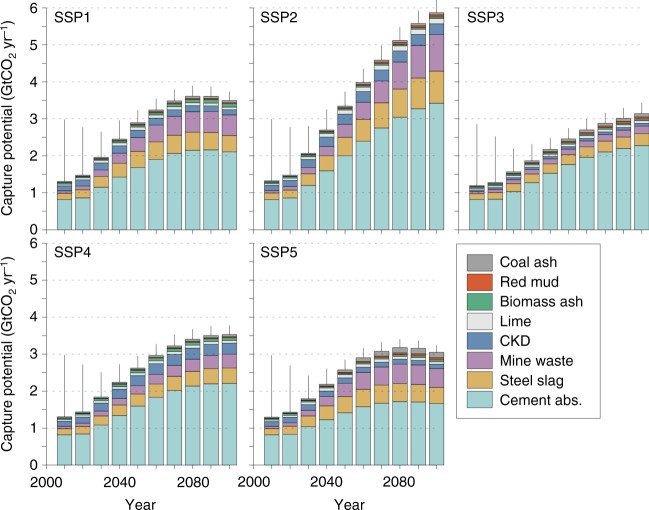
7 billion tonnes of alkaline materials are produced globally each year as a product or by-product of industrial activity. The aqueous dissolution of these materials creates high pH solutions that dissolves CO 2 to store carbon in the form of solid carbonate minerals or dissolved bicarbonate ions. Here we show that these materials have a carbon dioxide storage potential of 2.9–8.5 billion tonnes per year by 2100, and may contribute a substantial proportion of the negative emissions required to limit global temperature change to <2 °C.
Overview
The claims and statistics of this paper haven’t been checked yet.
Free: it reads the open-access text and checks the first 5 claims that cite a source we can check. Create a free account to check every claim.
Integrity signals
Registry
Cites
Statistics
Figures
Verification
Claims the paper makes
The claims and statistics of this paper haven’t been checked yet.
Free: it reads the open-access text and checks the first 5 claims that cite a source we can check. Create a free account to check every claim.
Claims other papers make about this one
Each is checked against this paper’s own text: does it say what the citing paper says it does?
The source backs part of the claim, not all of it — or backs it for a different population, condition or comparison.
In the citing paper
“In parallel, up to 3.5 Gt/year of ultrabasic mine wastes will be generated at nickel and PGM mines like Stillwater [16].”
From Carbon Mineralization with North American PGM Mine Tailings—Characterization and Reactivity Analysis (2021) · cites this paper as [16]
Experimental — accuracy not yet measuredThe cited source says what the claim attributes to it.
In the citing paper
“Requirement for mining may be further reduced by utilizing artificial silicate by-products from industrial processes 37,38 , including calcium-rich silicates produced by iron and steel manufacturing (slags) with a long history of agricultural usage 4,39 .”
From Potential for large-scale CO2 removal via enhanced rock weathering with croplands (2020) · cites this paper as [38]
The cited source says what the claim attributes to it.
In the citing paper
“forecasts project these values to increase to 25 Mt and 5 kt per year by 2100, which would result in the co-production of up to 3.5 Gt/year of ultrabasic mine tailings [16].”
From Carbon Mineralization with North American PGM Mine Tailings—Characterization and Reactivity Analysis (2021) · cites this paper as [16]
In the citing paper
“China and India dominate with above-average per capita cement consumption compared to the global average, and substantially larger populations than the USA and Brazil 38 .”
From Potential for large-scale CO2 removal via enhanced rock weathering with croplands (2020) · cites this paper as [38]
Self-check
Percentages, sums and reported differences re-computed from the paper’s own numbers.
The self-check needs the paper’s full text.
Citations
Cites
The representative concentration pathways: an overview
van Vuuren, D. P., Edmonds, J., Kainuma, M., Riahi, K., Thomson, A., Hibbard, K., Hurtt, G. C., Kram, T., Krey, V., Lamarque, J.-F., et al. (2011) · Climatic Change · doi:10.1007/s10584-011-0148-z · Cited by 7,741
Riahi, K., van Vuuren, D. P., Kriegler, E., Edmonds, J., O’Neill, B. C., Fujimori, S., Bauer, N., Calvin, K., Dellink, R., Fricko, O., et al. (2017) · Global Environmental Change · doi:10.1016/j.gloenvcha.2016.05.009 · Cited by 6,607
IPCC (2022) · Cambridge University Press eBooks · doi:10.1017/9781009157940 · Cited by 1,482
Dai, S., Ren, D., Chou, C.-L., Finkelman, R. B., Seredin, V. V., & Zhou, Y. (2012) · International Journal of Coal Geology · doi:10.1016/j.coal.2011.02.003 · Cited by 1,184
Fuss, S., Canadell, J. G., Peters, G. P., Tavoni, M., Andrew, R. M., Ciais, P., Jackson, R. B., Jones, C. D., Kraxner, F., Nakicenovic, N., et al. (2014) · Nature Climate Change · doi:10.1038/nclimate2392 · Cited by 1,114
FERNANDEZBERTOS, M., SIMONS, S., HILLS, C., & CAREY, P. (2004) · Journal of Hazardous Materials · doi:10.1016/j.jhazmat.2004.04.019 · Cited by 1,079
Vassilev, S. V., Baxter, D., Andersen, L. K., & Vassileva, C. G. (2013) · Fuel · doi:10.1016/j.fuel.2012.09.041 · Cited by 1,031
Carbon dioxide disposal in carbonate minerals
Lackner, K. S., Wendt, C. H., Butt, D. P., Joyce, E. L., & Sharp, D. H. (1995) · Energy · doi:10.1016/0360-5442(95)00071-n · Cited by 1,021
Negative emissions—Part 1: Research landscape and synthesis
Minx, J. C., Lamb, W. F., Callaghan, M. W., Fuss, S., Hilaire, J., Creutzig, F., Amann, T., Beringer, T., de Oliveira Garcia, W., Hartmann, J., et al. (2018) · Environmental Research Letters · doi:10.1088/1748-9326/aabf9b · Cited by 865
Mineral CO 2 Sequestration by Steel Slag Carbonation
Huijgen, W. J. J., Witkamp, G.-J., & Comans, R. N. J. (2005) · Environmental Science & Technology · doi:10.1021/es050795f · Cited by 858
Assessment of hydrogen direct reduction for fossil-free steelmaking
Vogl, V., Åhman, M., & Nilsson, L. J. (2018) · Journal of Cleaner Production · doi:10.1016/j.jclepro.2018.08.279 · Cited by 779
An Overview of Utilization of Steel Slag
Yi, H., Xu, G., Cheng, H., Wang, J., Wan, Y., & Chen, H. (2012) · Procedia Environmental Sciences · doi:10.1016/j.proenv.2012.10.108 · Cited by 764
Hartmann, J., West, A. J., Renforth, P., Köhler, P., De La Rocha, C. L., Wolf‐Gladrow, D. A., Dürr, H. H., & Scheffran, J. (2013) · Reviews of Geophysics · doi:10.1002/rog.20004 · Cited by 717
Self-citationKrausmann, F., Wiedenhofer, D., Lauk, C., Haas, W., Tanikawa, H., Fishman, T., Miatto, A., Schandl, H., & Haberl, H. (2017) · Proceedings of the National Academy of Sciences · doi:10.1073/pnas.1613773114 · Cited by 710
Substantial global carbon uptake by cement carbonation
Xi, F., Davis, S. J., Ciais, P., Crawford-Brown, D., Guan, D., Pade, C., Shi, T., Syddall, M., Lv, J., Ji, L., et al. (2016) · Nature Geoscience · doi:10.1038/ngeo2840 · Cited by 689
Carbon capture and storage using alkaline industrial wastes
Bobicki, E. R., Liu, Q., Xu, Z., & Zeng, H. (2012) · Progress in Energy and Combustion Science · doi:10.1016/j.pecs.2011.11.002 · Cited by 666
Assessing ocean alkalinity for carbon sequestration
Renforth, P., & Henderson, G. (2017) · Reviews of Geophysics · doi:10.1002/2016rg000533 · Cited by 655
Self-citationBauxite residue issues: III. Alkalinity and associated chemistry
Gräfe, M., Power, G., & Klauber, C. (2011) · Hydrometallurgy · doi:10.1016/j.hydromet.2011.02.004 · Cited by 513
Proctor, D. M., Fehling, K. A., Shay, E. C., Wittenborn, J. L., Green, J. J., Avent, C., Bigham, R. D., Connolly, M., Lee, B., Shepker, T. O., et al. (2000) · Environmental Science & Technology · doi:10.1021/es9906002 · Cited by 493
Evaluation of steel slag coarse aggregate in hot mix asphalt concrete
Ahmedzade, P., & Sengoz, B. (2009) · Journal of Hazardous Materials · doi:10.1016/j.jhazmat.2008.09.105 · Cited by 493
Carbon dioxide sequestration in cement kiln dust through mineral carbonation
Huntzinger, D. N., Gierke, J. S., Kawatra, S. K., Eisele, T. C., & Sutter, L. L. (2009) · Environmental Science & Technology · doi:10.1021/es802910z · Cited by 442
Mineral sequestration of CO2 by aqueous carbonation of coal combustion fly-ash
Montes-Hernandez, G., Pérez-López, R., Renard, F., Nieto, J. M., & Charlet, L. (2009) · Journal of Hazardous Materials · doi:10.1016/j.jhazmat.2008.04.104 · Cited by 403
Can BECCS deliver sustainable and resource efficient negative emissions?
Fajardy, M., & Mac Dowell, N. (2017) · Energy & Environmental Science · doi:10.1039/c7ee00465f · Cited by 392
Accelerated Curing of Compacted Calcium Silicate Mortars on Exposure to CO 2
YOUNG, J. F., BERGER, R. L., & BREESE, J. (1974) · Journal of the American Ceramic Society · doi:10.1111/j.1151-2916.1974.tb11420.x · Cited by 356
A Detailed Assessment of Global Nickel Resource Trends and Endowments
Mudd, G. M., & Jowitt, S. M. (2014) · Economic Geology · doi:10.2113/econgeo.109.7.1813 · Cited by 308
van Ruijven, B. J., van Vuuren, D. P., Boskaljon, W., Neelis, M. L., Saygin, D., & Patel, M. K. (2016) · Resources, Conservation and Recycling · doi:10.1016/j.resconrec.2016.04.016 · Cited by 305
Negative Emissions Technologies and Reliable Sequestration: A Research Agenda
Committee on Developing a Research Agenda for Carbon Dioxide Removal and Reliable Sequestration, Board on Atmospheric Sciences and Climate, Board on Energy and Environmental Systems, Board on Agriculture and Natural Resources, Board on Earth Sciences and Resources, Board on Chemical Sciences and Technology, Ocean Studies Board, Studies, D. O. E. A. L., & National Academies of Sciences, E. (2019) · doi:10.17226/25259 · Cited by 287
Ash Management Review—Applications of Biomass Bottom Ash
James, A., Thring, R., Helle, S., & Ghuman, H. (2012) · Energies · doi:10.3390/en5103856 · Cited by 271
Wilson, S., Dipple, G. M., Power, I. M., Thom, J. M., Anderson, R. G., Raudsepp, M., Gabites, J. E., & Southam, G. (2009) · Economic Geology · doi:10.2113/gsecongeo.104.1.95 · Cited by 261
Gutowski, T. G., Sahni, S., Allwood, J. M., Ashby, M. F., & Worrell, E. (2013) · Philosophical Transactions of the Royal Society A: Mathematical, Physical and Engineering Sciences · doi:10.1098/rsta.2012.0003 · Cited by 247
Sequestration of carbon dioxide (CO2) using red mud
Yadav, V. S., Prasad, M., Khan, J., Amritphale, S. S., Singh, M., & Raju, C. B. (2010) · Journal of Hazardous Materials · doi:10.1016/j.jhazmat.2009.11.146 · Cited by 233
Silicate production and availability for mineral carbonation.
Renforth, P., Washbourne, C.-L., Taylder, J., & Manning, D. A. C. (2011) · Environmental Science & Technology · doi:10.1021/es103241w · Cited by 225
Self-citationAccelerated carbonation treatment of industrial wastes
Gunning, P. J., Hills, C. D., & Carey, P. J. (2010) · Waste Management · doi:10.1016/j.wasman.2010.01.005 · Cited by 217
Hydration, Structure, and Properties of Blast Furnace Slag Cements, Mortars, and Concrete
(1982) · ACI Journal Proceedings · doi:10.14359/10919 · Cited by 178
Energy Transitions: Global and National Perspectives
Smil, V. (2016) · doi:10.5040/9798400646126 · Cited by 172
Carbonate precipitation in artificial soils as a sink for atmospheric carbon dioxide
Renforth, P., Manning, D. A. C., & Lopez-Capel, E. (2009) · Applied Geochemistry · doi:10.1016/j.apgeochem.2009.05.005 · Cited by 161
Self-citationField observations of clogging in a landfill leachate collection system
Fleming, I., Rowe, R. K., & Cullimore, D. R. (1999) · Canadian Geotechnical Journal · doi:10.1139/t99-036 · Cited by 145
Washbourne, C.-L., Renforth, P., & Manning, D. A. C. (2012) · Science of The Total Environment · doi:10.1016/j.scitotenv.2012.05.037 · Cited by 129
Self-citationCarbon sequestration kinetic and storage capacity of ultramafic mining waste
Pronost, J., Beaudoin, G., Tremblay, J., Larachi, F., Duchesne, J., Hébert, R., & Constantin, M. (2011) · Environmental Science & Technology · doi:10.1021/es203063a · Cited by 128
Hydrogeochemistry of Alkaline Steel Slag Leachates in the UK
Mayes, W. M., Younger, P. L., & Aumônier, J. (2008) · Water, Air, and Soil Pollution · doi:10.1007/s11270-008-9725-9 · Cited by 120
CO2 Sequestration by Aqueous Red Mud Carbonation at Ambient Pressure and Temperature
Bonenfant, D., Kharoune, L., Sauvé, S., Hausler, R., Niquette, P., Mimeault, M., & Kharoune, M. (2008) · Industrial & Engineering Chemistry Research · doi:10.1021/ie7017228 · Cited by 116
Bertram, M., Ramkumar, S., Rechberger, H., Rombach, G., Bayliss, C., Martchek, K. J., Müller, D. B., & Liu, G. (2017) · Resources Conservation and Recycling · doi:10.1016/j.resconrec.2017.05.014 · Cited by 116
Renforth, P., Mayes, W. M., Jarvis, A. P., Burke, I. T., Manning, D. A. C., & Gruiz, K. (2012) · Science of The Total Environment · doi:10.1016/j.scitotenv.2012.01.046 · Cited by 115
Self-citationEvaluating the use of biomass energy with carbon capture and storage in low emission scenarios
Vaughan, N. E., Gough, C., Mander, S., Littleton, E. W., Welfle, A., Gernaat, D. E. H. J., & van Vuuren, D. P. (2018) · Environmental Research Letters · doi:10.1088/1748-9326/aaaa02 · Cited by 114
Ni-Co laterite deposits of the world — Database and grade and tonnage models
Berger, V. I., Singer, D. A., Bliss, J. D., & Moring, B. C. (2011) · Antarctica A Keystone in a Changing World · doi:10.3133/ofr20111058 · Cited by 94
Atmospheric CO2 Sequestration in Iron and Steel Slag: Consett, County Durham, United Kingdom
Mayes, W. M., Riley, A. L., Gomes, H. I., Brabham, P., Hamlyn, J., Pullin, H., & Renforth, P. (2018) · Environmental Science & Technology · doi:10.1021/acs.est.8b01883 · Cited by 89
Self-citationWilson, S., Raudsepp, M., & Dipple, G. M. (2009) · Applied Geochemistry · doi:10.1016/j.apgeochem.2009.09.018 · Cited by 78
Nickel-cobalt laterites: A deposit model
Marsh, E. E., Anderson, E. D., & Gray, F. (2013) · Scientific investigations report · doi:10.3133/sir20105070h · Cited by 77
Miller, S. A., Horvath, A., Monteiro, P. J. M., & Ostertag, C. P. (2015) · Environmental Research Letters · doi:10.1088/1748-9326/10/11/114017 · Cited by 70
Investigation of the potential for mineral carbonation of PGM tailings in South Africa
Vogeli, J., Reid, D. L., Becker, M., Broadhurst, J., & Franzidis, J.-P. (2011) · Minerals Engineering · doi:10.1016/j.mineng.2011.07.005 · Cited by 62
Platinum-group metals--world supply and demand
Wilburn, D. R., & Bleiwas, D. I. (2005) · Antarctica A Keystone in a Changing World · doi:10.3133/ofr20041224 · Cited by 56
Worldwide potential for ex-situ mineral carbonation
Picot, J. C., Cassard, D., Maldan, F., Greffié, C., & Bodénan, F. (2011) · Energy Procedia · doi:10.1016/j.egypro.2011.02.206 · Cited by 22
Ni-Co laterite deposits of the world
(2018) · Cited by 7
Oates, T. (2002) · Kirk-Othmer Encyclopedia of Chemical Technology · doi:10.1002/0471238961.1209130507212019.a01.pub2 · Cited by 6
Blast-furnace slag as agricultural liming material.
Davis, F. L., Collier, B., & Carter, O. R. (1950) · Cited by 4
Cited by
Environmental impacts and decarbonization strategies in the cement and concrete industries
Habert, G., Miller, S. A., John, V. M., Provis, J. L., Favier, A., Horvath, A., & Scrivener, K. L. (2020) · Nature Reviews Earth & Environment · doi:10.1038/s43017-020-0093-3 · Cited by 1,572
Strategies for mitigation of climate change: a review
Fawzy, S., Osman, A. I., Doran, J., & Rooney, D. W. (2020) · Environmental Chemistry Letters · doi:10.1007/s10311-020-01059-w · Cited by 1,522
“Potential materials include wastes from mining operations, cement, steel, aluminium, and coal or biomass combustion activities (Renforth 2019).”
BackgroundPotential for large-scale CO2 removal via enhanced rock weathering with croplands
Beerling, D. J., Kantzas, E. P., Lomas, M. R., Wade, P., Eufrasio, R. M., Renforth, P., Sarkar, B., Andrews, M. G., James, R. H., Pearce, C. R., et al. (2020) · Nature · doi:10.1038/s41586-020-2448-9 · Cited by 700
Self-citationBach, L. T., Gill, S. J., Rickaby, R. E. M., Gore, S., & Renforth, P. (2019) · Frontiers in Climate · doi:10.3389/fclim.2019.00007 · Cited by 445
“Furthermore, a suite of anthropogenic materials (e.g., slag from the production of steel, or mining residuals) could be used for EW (Renforth, 2019).”
BackgroundMethodSelf-citationGeopolymer foams: An overview of recent advancements
Novais, R. M., Pullar, R. C., & Labrincha, J. A. (2020) · Progress in Materials Science · doi:10.1016/j.pmatsci.2019.100621 · Cited by 303
Metadata
- Authors
- Renforth, P.
- Affiliations
- Heriot-Watt University (GB)
- Corresponding author
- Renforth, Phil
- ORCID
- Renforth, Phil
- Venue
- Nature Communications
- Published
- 2019-03-28
- Volume
- 10
- Issue
- 1
- Pages
- 1401-1401
- ISSN
- 2041-1723 (ISSN-L)
- PMC
- PMC6438983
- OpenAlex
- W2923823446
- Cited by
- 403
- References
- 54
- Citations by year
- 2026: 65 · 2025: 74 · 2024: 71 · 2023: 74 · 2022: 60 · 2021: 37 · 2020: 16 · 2019: 6
- FWCI
- 12.61
- Type
- journal article
- Language
- en
- Open access
- gold
- doi.org
- Licence
- cc-by
- creativecommons.org/licenses/by/4.0 (tdm)
- creativecommons.org/licenses/by/4.0 (vor)
- Locations
- Nature Communications (publishedVersion, cc-by)
- Europe PMC (PubMed Central) (publishedVersion, cc-by)
- PubMed Central (publishedVersion, cc-by)
- PubMed (publishedVersion)
- RePEc: Research Papers in Economics (submittedVersion)
- DOAJ (DOAJ: Directory of Open Access Journals) (submittedVersion)
- DOAJ (DOAJ: Directory of Open Access Journals) (submittedVersion, cc-by-sa)
- Funders
- Engineering and Physical Sciences Research Council
- Natural Environment Research Council (NE/P019943/1, NE/P019943/2)
- Topics
- Physical Sciences › Environmental Science › Environmental Engineering › CO2 Sequestration and Geologic Interactions
- Physical Sciences › Chemical Engineering › Filtration and Separation › Carbon Dioxide Capture Technologies
- Physical Sciences › Engineering › Civil and Structural Engineering › Concrete and Cement Materials Research
- Keywords
- carbon dioxide removal, alkaline materials, CO2 sequestration, alkaline dissolution, carbonate formation, bicarbonate, CO2 capture, 2°C target, industrial by-products
About these checks
Registry, retraction, Cites and statistics results are computed, not judged, with one exception: a printed reference that no index lists is read once by a model before it counts as a citation error. Claims are extracted by a model and kept only when their quote appears verbatim in the text; each cited source is then checked, with a model’s help, for whether it says what the claim relies on. Those verdicts can be wrong — read the claim’s quote and the cited source before relying on one.
Statistics and arithmetic are recomputed, not judged.
Confidence bands are shown only for fields calibrated on our annotated test set. None is calibrated yet, so no band is shown.
What counts as a claim ›How we measure confidence ›How we check this ›
Are you an author, or do you see a problem with this page? Request a review
Data sources
Bibliographic data: Semantic Scholar, OpenAlex, Crossref.
Contains information from the Semantic Scholar Academic Graph Datasets, made available under the ODC Attribution License (ODC-BY 1.0).
Semantic Scholar’s data is described in: Kinney, R., et al. (2023). The Semantic Scholar Open Data Platform. arXiv:2301.10140.
