

A high-stringency blueprint of the human proteome
Open accessThe DOI matches its Crossref record; 178 of the 181 references it cites were found in a registry or an index, and 2 are not checked yet; 51 of the 96 sources its claims cite were checked for support.
Abstract
The Human Proteome Organization (HUPO) launched the Human Proteome Project (HPP) in 2010, creating an international framework for global collaboration, data sharing, quality assurance and enhancing accurate annotation of the genome-encoded proteome. During the subsequent decade, the HPP established collaborations, developed guidelines and metrics, and undertook reanalysis of previously deposited community data, continuously increasing the coverage of the human proteome. On the occasion of the HPP’s tenth anniversary, we here report a 90.4% complete high-stringency human proteome blueprint. This knowledge is essential for discerning molecular processes in health and disease, as we demonstrate by highlighting potential roles the human proteome plays in our understanding, diagnosis and treatment of cancers, cardiovascular and infectious diseases.
Verified 2026-10-05 · 2 references not checked yet
Overview
CoChat Summary
TL;DR
The Human Proteome Project reports a 90.4% complete high-stringency human proteome blueprint after its first decade, based on neXtProt release 17-01-2020. It highlights progress in cataloguing protein existence and applications in cancer, cardiovascular disease, and infectious disease, including SARS-CoV-2.
Key findings
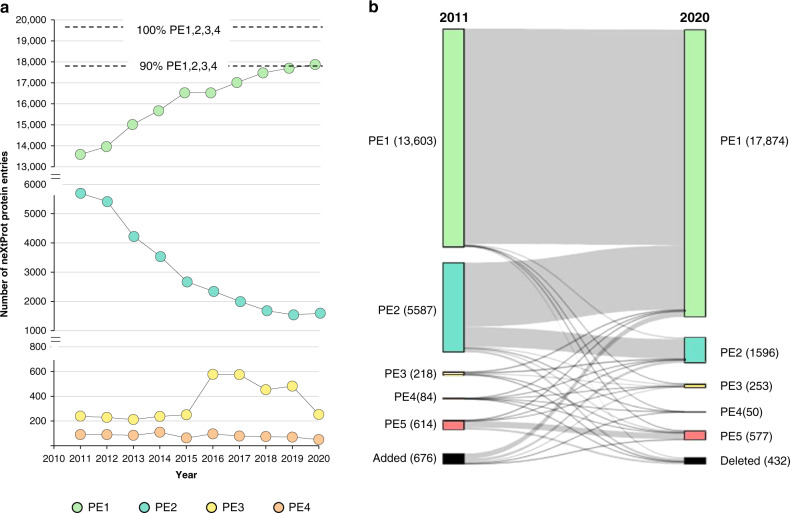
- The 17-01-2020 neXtProt HPP release designates credible PE1 evidence for 17,874 proteins, or 90.4% of the 19,773 PE1,2,3,4 protein entries excluding 577 dubious PE5 entries; 1,899 (9.6%) PE2,3,4 entries remain missing.
- PE1 identifications rose from 13,588 in 2011 to 17,874 in 2020, while PE2 entries fell from 5,696 to 1,596; linear regression of PE1 increases against PE2 decreases gave R² = 97%, and extrapolation suggested 95% PE1s may be reached between 2024 and 2027.
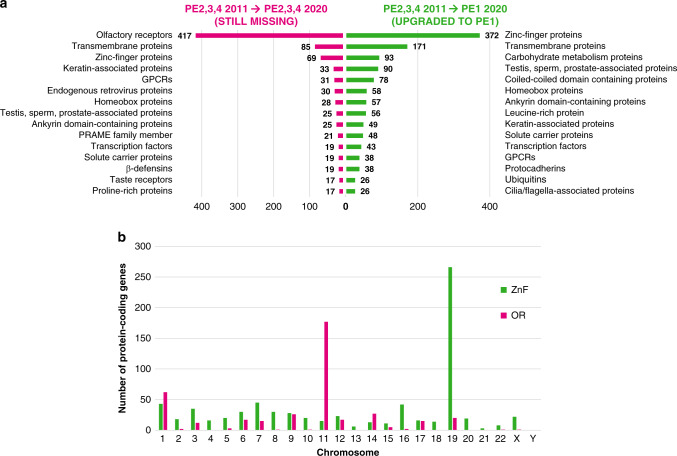
- Some protein families were resistant to PE1 upgrade: 417 of the 2011 PE2,3,4 olfactory receptor entries remained missing in 2020, and 17 of 20 taste receptors remained PE2,3,4; in contrast, 372 zinc finger proteins were upgraded from PE2,3,4 to PE1 between 2011 and 2020.
- HPP resources include the Human SRMAtlas, developed from 166,174 synthetic proteotypic peptides and enabling targeted identification/quantification of a theoretical maximum of 99.7% of the human proteome, and the HPA, which targets ~87% of the proteome with >1 antibody.
Methods
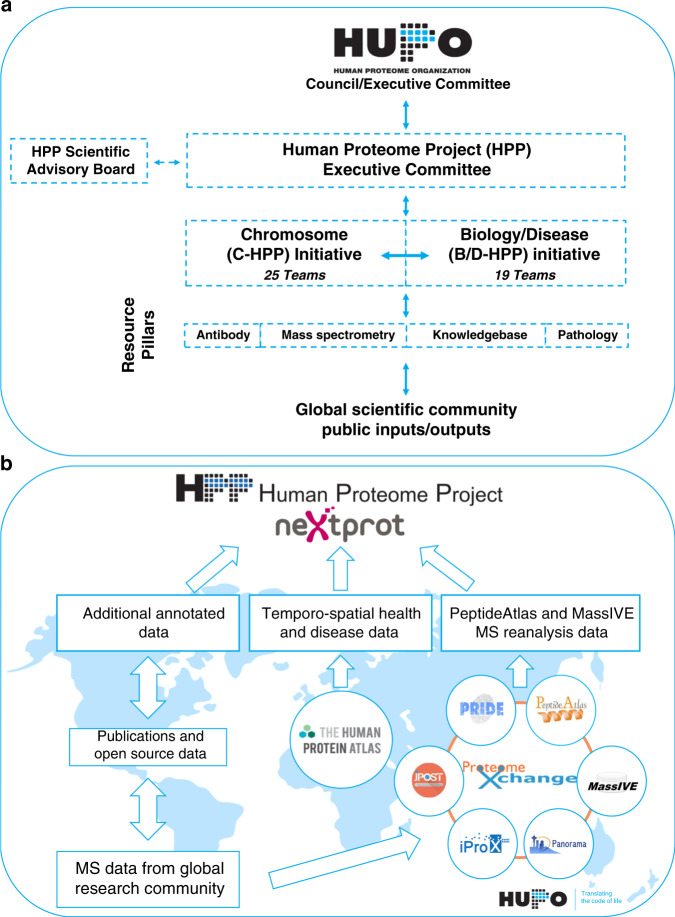
- Community MS data are deposited through ProteomeXchange repositories, reprocessed by PeptideAtlas and MassIVE, and integrated into neXtProt, which is the HPP reference knowledgebase and issues annual HPP releases.
- High-stringency protein inference requires at least two uniquely mapping, non-nested peptides of at least nine amino acid residues, coverage exceeding 18 residues, and a maximum protein-level FDR of 1%; missing-protein publications require further synthetic peptide spectra matching.
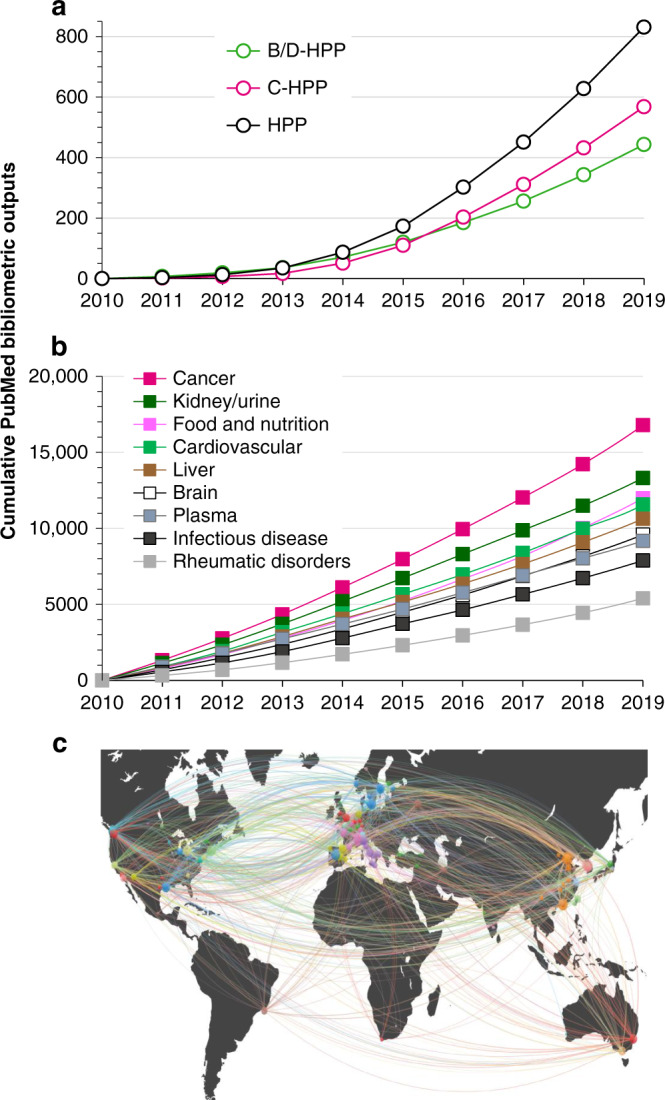
- The paper analyses decadal neXtProt PE1–PE5 metrics, including Sankey diagrams, linear regression, chromosome-level missing-protein statistics, and bibliometric/community impact via the Human Proteome Reference Library and VOSviewer.
Limitations
- The paper states that progress has recently slowed, suggesting it may be difficult to confidently identify all 1,899 missing proteins; many may be below detection limits, in under-studied cell types/tissues, expressed only under particular conditions or developmental stages, or difficult to solubilize as hydrophobic multi-transmembrane proteins.
- The paper states that the current HPP KB processing pipeline makes it impossible to isolate decadal PE1 contributions from any particular C-HPP team versus the overall community, so PE1s emanating from community deposition can only be historically estimated.
- Evident from the text: the blueprint is tied to the 17-01-2020 neXtProt release and PE-based protein-existence tracking, while future priorities note a needed shift toward proteoforms and single-cell proteomic technology.
Model-written summary. Check it against the paper before relying on it.
Integrity signals
Registry
Cites
Statistics
Figures
Verification
Claims the paper makes
27 Valid · 0 Not valid · 28 Not checked · 43 Own results and interpretations
Every source the paper cites for this claim was checked and supports it.
In the paper
“The HPP routinely applies high-stringency protein inference analytics10, generated through the Trans-Proteomic Pipeline11.”
§ A high-stringency blueprint of the human proteome > HPP structure and achievements > Defining the human proteome at high-stringency
What the sources say
- Supportedcites [10] Deutsch EW Human proteome project mass spectrometry data interpretation guidelines 3.0 J. Proteome Res. 2019 18 4108 4116 10.1021/acs.jproteome.9b00542 31599596 PMC6986310 source
In “Changes to the HPP PE2,3,4 Missing Protein Strategy,” the paper describes the HPP pipeline’s routine reprocessing of MS data with Trans-Proteomic Pipeline tools. It also says PeptideAtlas sets extremely high thresholds to achieve a 1% protein-level false discovery rate, supporting the high-stringency characterization. (LLM, conf=0.93)
- Supportedcites [11] Deutsch EW Trans-Proteomic Pipeline, a standardized data processing pipeline for large-scale reproducible proteomics informatics Proteom. Clin. Appl. 2015 9 745 754 10.1002/prca.201400164 PMC4506239 25631240 source
The citation is attached to “generated through the Trans-Proteomic Pipeline,” not to the separate assertion that the HPP routinely applies high-stringency analytics. The Basic Workflow section identifies ProteinProphet as a TPP protein-inference tool that assigns protein probabilities, and Data analysis perils describes stringent protein-level thresholds. (LLM, conf=0.91)
plain- Asserted: passes — The authors put it forward as true.
- Checkable: passes — It can be checked against evidence.
- Load-bearing: passes — The paper’s conclusions depend on it.
- Based: passes — The paper gives a reason why it holds.
- Supported
Every source the paper cites for this claim was checked and supports it.
In the paper
“The HPP relies upon a coordinated system developed by neXtProt and UniProtKB, which attributes five levels of supporting evidence for protein existence (PE)6.”
§ A high-stringency blueprint of the human proteome > HPP structure and achievements > Defining the human proteome at high-stringency
What the sources say
- Supportedcites [6] Lane L Metrics for the human proteome project 2013-2014 and strategies for finding missing proteins J. Proteome Res. 2014 13 15 20 10.1021/pr401144x 24364385 PMC3928647 source
The section 'The neXtProt and UniProt/SwissProt Scheme of Levels of Evidence' states that the protein evidence levels used by neXtProt (and UniProt/SwissProt) are classified in five categories, PE1-PE5, and defines each. The Abstract and the September 2013 metrics section confirm the HPP designated neXtProt (with its PE levels) as the baseline resource, and the Pie Chart section refers to UniProtKB/SwissProt alongside neXtProt. The only slight wording shift is 'developed by' versus the paper's 'used by'/jointly named scheme, which does not alter the attributed content. (LLM, conf=0.90)
plain- Asserted: passes — The authors put it forward as true.
- Checkable: passes — It can be checked against evidence.
- Load-bearing: passes — The paper’s conclusions depend on it.
- Based: passes — The paper gives a reason why it holds.
- Supported
The cited sources support only part of this claim — read each source’s verdict below.
In the paper
“We emphasize that MS-based data from high-accuracy14,15 MS instruments combined with subsequent high-stringency protein inference analysis provide definitive best-practice confirmation of protein identification and abundance.”
§ A high-stringency blueprint of the human proteome > HPP structure and achievements > Defining the human proteome at high-stringency
What the sources say
- Partly supportedcites [14] Zubarev R Mann M On the proper use of mass accuracy in proteomics Mol. Cell. Proteomics 2007 6 377 381 10.1074/mcp.M600380-MCP200 17164402 sourceExperimental — accuracy not yet measured
The paper’s “HOW ACCURATE IS ACCURATE ENOUGH?” passage says high mass accuracy improves peptide-identification specificity and could eliminate many false positives. Its conclusion limits the potential for near-error-free results to peptide identification. It does not establish that combining high-accuracy instruments with high-stringency protein inference definitively confirms protein identification or abundance. (LLM, conf=0.86)
- Not checked yetcites [15] Mann M Kelleher NL Precision proteomics: the case for high resolution and high mass accuracy Proc. Natl Acad. Sci. USA 2008 105 18132 18138 10.1073/pnas.0800788105 18818311 PMC2587563 source
boostedstates a cause- Asserted: passes — The authors put it forward as true.
- Checkable: passes — It can be checked against evidence.
- Load-bearing: passes — The paper’s conclusions depend on it.
- Based: passes — The paper gives a reason why it holds.
- Partly supported
Every source the paper cites for this claim was checked and supports it.
In the paper
“This assay library enables targeted identification and quantification of a theoretical maximum of 99.7% of the human proteome36, provided proteins are expressed spatiotemporally at concentrations amenable to MS detection.”
§ A high-stringency blueprint of the human proteome > HPP structure and achievements > Biology/disease-centric (B/D)-HPP
What the sources say
- Supportedcites [36] Kusebauch U Human SRMAtlas: a resource of targeted assays to quantify the complete human proteome Cell 2016 166 766 778 10.1016/j.cell.2016.06.041 27453469 PMC5245710 source
The Results (Step 4: Development of SRM Assays and a Complete Human Peptide Library) state that the 158,015 successfully developed assays 'covered 99.7% of the predicted human proteome with at least one SRM assay per protein', matching the claimed figure and its status as an upper bound (only 22 proteins were inaccessible by selectable tryptic peptides, Step 3). The Introduction and Discussion attribute to this resource the purpose of 'targeted identification and quantification' of any human protein 'in principle ... in any sample', which supports the enabling part of the claim. The spatiotemporal-expression/abundance caveat is consistent with the paper's own qualification that 'Currently the technique cannot attain the entire range of proteins in higher eukaryotes' due to complexity and dynamic range (Discussion), so the added condition does not overstate the source. (LLM, conf=0.90)
plainstates a cause- Asserted: passes — The authors put it forward as true.
- Checkable: passes — It can be checked against evidence.
- Load-bearing: passes — The paper’s conclusions depend on it.
- Based: passes — The paper gives a reason why it holds.
- Supported
Every source the paper cites for this claim was checked and supports it.
In the paper
“To ensure only high-quality Ab data are used, in 2018 neXtProt/HPP Ab pillar revised criteria to upgrade entries to PE1, including specificity and other rigorous criteria suggested by the International Working Group for Ab Validation50.”
§ A high-stringency blueprint of the human proteome > The human proteome in the neXtProt HPP reference KB > Assembly and curation of neXtProt
What the sources say
- Supportedcites [50] Uhlen M A proposal for validation of antibodies Nat. Methods 2016 13 823 827 10.1038/nmeth.3995 27595404 PMC10335836 source
The part attributed to this source is the existence of rigorous validation criteria suggested by the International Working Group for Antibody Validation, including specificity. Our copy states exactly that: the Abstract (IWGAV convened; five conceptual pillars proposed; 'at least one of these pillars should be used as a minimum criterion for claiming that a particular antibody has been adequately validated for a specific application') and the section 'Determining antibody specificity' (pillars provide evidence of target binding and allow evaluation of crossreactivity). The 2018 neXtProt/HPP PE1 criteria revision is the citing authors' own statement and is not attributed to this paper, so nothing here falls outside the source; note the paper is from 2016 and does not mention neXtProt, HPP or PE1 levels. (LLM, conf=0.85)
plainstates a cause- Asserted: passes — The authors put it forward as true.
- Checkable: passes — It can be checked against evidence.
- Load-bearing: passes — The paper’s conclusions depend on it.
- Based: passes — The paper gives a reason why it holds.
- Supported
35 more claims · 11 with their cited sources checked
Create a free account to see all 98 claims and to verify the 45 references still open.
- It may state two separate claims as one. 43
- Probably not a substantial claim. 24
Claims other papers make about this one
Each is checked against this paper’s own text: does it say what the citing paper says it does?
In the citing paper
“the Human Proteome Organization has called for the community to “systematically map all human proteoforms” ( 36 ).”
From The Human Proteoform Project: Defining the human proteome (2021) · cites this paper as [36]
Self-check
Percentages, sums and reported differences re-computed from the paper’s own numbers.
Each contradiction between two passages listed here was confirmed by an independent check.
Rated minor: it would not touch a result — a value no result rests on, a p-value that stays on the same side of the significance level, or a conflict that is clerical, resolved elsewhere in the paper, or outside its own findings.
In the paper
§ A high-stringency blueprint of the human proteome > The human proteome in the neXtProt HPP reference KB > Expansion of the high-stringency proteome
“PE2 (5,696 to 1596)”
§ A high-stringency blueprint of the human proteome > The human proteome in the neXtProt HPP reference KB > Expansion of the high-stringency proteome
“PE2s (5,587 down to 1,596)”
Rated minor: it would not touch a result — a value no result rests on, a p-value that stays on the same side of the significance level, or a conflict that is clerical, resolved elsewhere in the paper, or outside its own findings.
In the paper
§ A high-stringency blueprint of the human proteome > The human proteome in the neXtProt HPP reference KB > Expansion of the high-stringency proteome
“13,588 in 2011 to 17,874 in 2020”
§ A high-stringency blueprint of the human proteome > The human proteome in the neXtProt HPP reference KB > Expansion of the high-stringency proteome
“PE1s (13,603 up to 17,874)”
Citations
Cites
Hallmarks of Cancer: The Next Generation
Hanahan, D., & Weinberg, R. A. (2011) · Cell · doi:10.1016/j.cell.2011.02.013 · Cited by 66,590
Software survey: VOSviewer, a computer program for bibliometric mapping
van Eck, N. J., & Waltman, L. (2010) · Scientometrics · doi:10.1007/s11192-009-0146-3 · Cited by 21,484
Hoffmann, M., Kleine-Weber, H., Schroeder, S., Krüger, N., Herrler, T., Erichsen, S., Schiergens, T. S., Herrler, G., Wu, N.-H., Nitsche, A., et al. (2020) · Cell · doi:10.1016/j.cell.2020.02.052 · Cited by 20,286
The FAIR Guiding Principles for scientific data management and stewardship
Wilkinson, M. D., Dumontier, M., Aalbersberg, I. J., Appleton, G., Axton, M., Baak, A., Blomberg, N., Boiten, J.-W., da Silva Santos, L. B., Bourne, P. E., et al. (2016) · Scientific Data · doi:10.1038/sdata.2016.18 · Cited by 18,423
Tissue-based map of the human proteome
Uhlén, M., Fagerberg, L., Hallström, B. M., Lindskog, C., Oksvold, P., Mardinoglu, A., Sivertsson, Å., Kampf, C., Sjöstedt, E., Asplund, A., et al. (2015) · Science · doi:10.1126/science.1260419 · Cited by 15,286
Self-citationA new coronavirus associated with human respiratory disease in China
Wu, F., Zhao, S., Yu, B., Chen, Y.-M., Wang, W., Song, Z.-G., Hu, Y., Tao, Z.-W., Tian, J.-H., Pei, Y.-Y., et al. (2020) · Nature · doi:10.1038/s41586-020-2008-3 · Cited by 11,688
An interactive web-based dashboard to track COVID-19 in real time
Dong, E., Du, H., & Gardner, L. (2020) · The Lancet Infectious Diseases · doi:10.1016/s1473-3099(20)30120-1 · Cited by 10,048
Perez-Riverol, Y., Csordas, A., Bai, J., Bernal-Llinares, M., Hewapathirana, S., Kundu, D. J., Inuganti, A., Griss, J., Mayer, G., Eisenacher, M., et al. (2019) · Nucleic Acids Research · doi:10.1093/nar/gky1106 · Cited by 6,693
Angiotensin-converting enzyme 2 is a functional receptor for the SARS coronavirus
Li, W., Moore, M. J., Vasilieva, N., Sui, J., Wong, S. K., Berne, M. A., Somasundaran, M., Sullivan, J. L., Luzuriaga, K., Greenough, T. C., et al. (2003) · Nature · doi:10.1038/nature02145 · Cited by 5,923
A SARS-CoV-2 protein interaction map reveals targets for drug repurposing
Gordon, D. E., Jang, G. M., Bouhaddou, M., Xu, J., Obernier, K., White, K. M., O’Meara, M. J., Rezelj, V. V., Guo, J. Z., Swaney, D. L., et al. (2020) · Nature · doi:10.1038/s41586-020-2286-9 · Cited by 4,405
Research works printed but not linked: 1
- Minakshi, P. et al. in Single-Cell Omics (eds Barh, D. & Azevedo, V.) (Academic Press, 2019).
Cited by
Items 201–221 of 221
Wei, B., Gao, K., Wang, Y., Sun, B., Feng, Z., Zhang, C., Sun, C., & Liu, H. (2025) · Regenerative Engineering and Translational Medicine · doi:10.1007/s40883-025-00431-y
Herderschee, H. R. (2025) · Deep Blue (University of Michigan) · doi:10.7302/25500
Tonoyama, Y., & Ishida, Y.-I. (2025) · Lymphatics · doi:10.3390/lymphatics3040038
Hannane, N., Kuhn, P.-H., & München, T. U. (2023)
Hong, Y. (2023) · UTUPub (University of Turku)
Nanostructured biosensors with DNA-based receptors for real-time detection of small analytes
Klinghammer, S. (2023) · Qucosa (Saxon State and University Library Dresden)
Hikmet Noraddin, F. (2024) · Uppsala University Publications (Uppsala University)
Data analysis tools for mass spectrometry proteomics
Suomi, T. (2021) · UTUPub (University of Turku)
A Multipurpose Protein Compressor Based on MDL and Genetic Algorithm
Nawaz, M. Z., Nawaz, M. S., Fournier‐Viger, P., Niu, X., & Li, M. (2025) · IEEE International Conference on Bioinformatics and Biomedicine (BIBM) · doi:10.1109/bibm66473.2025.11356259
“Advances in next-generation sequencing technologies [1] and large-scale efforts such as the Human Proteome Project [2] have accelerated the accumulation of amino acid sequence data, resulting in repositories that now store terabytes of information.”
Manousopoulou, A., White, C. H., Hamal, S. A., Nihalani, R., Budoff, M. J., & Garbis, S. D. (2026) · bioRxiv (Cold Spring Harbor Laboratory) · doi:10.64898/2026.02.16.706239
Masuga, C. D., Riper, J. M. V., & Pillon, M. C. (2026) · Journal of Visualized Experiments · doi:10.3791/70393
Applications of metabolomics and proteomics to study the biological effects of drugs (本文)
カク, セ., Guo, J., & 郭, 婧. (2023) · Institutional Repositories DataBase (IRDB)
Chemical Editing of Proteins: From a Specific Residue to Functional Domains
Gao, Z., Zhang, J., Wang, J., & Wang, J. (2026) · Accounts of Chemical Research · doi:10.1021/acs.accounts.6c00037
Ahn, S. B., Krishnamurthy, S., Alnakli, A., Heng, B., Chan, C., Shin, J., Chapuis, P., Steffens, D., Solomon, M. J., Baker, M. S., et al. (2026) · Research Square · doi:10.21203/rs.3.rs-9258373/v1
Self-citationSmall ORFs from the bioinformatics perspective: a scientometric analysis
de Souza, N. (2023) · Institutional Repository of the Federal Technological University of Paraná (RIUT) (Federal University of Technology – Paraná)
(2026) · Continental Veterinary Journal · doi:10.71081/cvj/2026.076
A multiplex tissue resource for high‐resolution spatial protein profiling in the Human Protein Atlas
Katona, B., Schutten, R., Bertilsson, F., Hikmet, F., Oksvold, P., Forsberg, M., von Feilitzen, K., Méar, L., Uhlén, M., & Lindskog, C. (2026) · Protein Science · doi:10.1002/pro.70764
Self-citationMetaTIS: a tool to predict cognate and near-cognate translation initiation sites in human
Papazian, A., & Helms, V. (2026) · NAR Genomics and Bioinformatics · doi:10.1093/nargab/lqag100
“…incorporating data from Ensembl/GENCODE [ 11 ], the HUGO Gene Nomenclature Committee (HGNC) [ 12 ], UniProtKB [ 13 ], the Human Proteome Organization/Human Proteome Project [ 14 ], and PeptideAtlas [ 15 ] to develop a standardized catalogue of human Ribo-seq open reading frames (ORFs) [ 16 ].”
Chen, J., Wu, W., Wang, Z., Zhai, C., Deng, B., Alzogool, M., & Wang, Y. (2021) · doi:10.3389/fcell.2021.689917.s002
Ruiz-Romero, C., Fernández-Puente, P., González, L., Illiano, A., Lourido, L., Paz, R., Quaranta, P., Perez-Pampín, E., González, A., Blanco, F. J., et al. (2022) · doi:10.3389/fmed.2022.963540.s001
Metadata
- Authors
- Adhikari, S., Nice, E. C., Deutsch, E. W., Lane, L., Omenn, G. S., Pennington, S. R., Paik, Y.-K., Overall, C. M., Corrales, F. J., Cristea, I. M., Van Eyk, J. E., Uhlén, M., Lindskog, C., Chan, D. W., Bairoch, A., Waddington, J. C., Justice, J. L., LaBaer, J., Rodriguez, H., He, F., Kostrzewa, M., Ping, P., Gundry, R. L., Stewart, P., Srivastava, S., Srivastava, S., Nogueira, F. C. S., Domont, G. B., Vandenbrouck, Y., Lam, M. P. Y., Wennersten, S., Vizcaino, J. A., Wilkins, M., Schwenk, J. M., Lundberg, E., Bandeira, N., Marko-Varga, G., Weintraub, S. T., Pineau, C., Kusebauch, U., Moritz, R. L., Ahn, S. B., Palmblad, M., Snyder, M. P., Aebersold, R., & Baker, M. S.
- Affiliations
- Macquarie University (AU)
- Monash University (AU)
- Institute for Systems Biology (US)
- University of Geneva (CH)
- University of Michigan (US)
- University College Dublin (IE)
- Yonsei University (KR)
- University of British Columbia (CA)
- Consejo Superior de Investigaciones Científicas (ES)
- Princeton University (US)
- Science for Life Laboratory (SE)
- Uppsala University (SE)
- Johns Hopkins University (US)
- Arizona State University (US)
- National Institutes of Health (US)
- Beijing Proteome Research Center (CN)
- University of Bremen (DE)
- University of California, Los Angeles (US)
- University of Nebraska Medical Center (US)
- Royal Prince Alfred Hospital (AU)
- Universidade Federal do Rio de Janeiro (BR)
- Inserm (FR)
- University of Colorado Anschutz (US)
- UNSW Sydney (AU)
- University of California San Diego (US)
- The University of Texas at San Antonio Health Science Center (US)
- Leiden University (NL)
- Stanford Medicine (US)
- University of Zurich (CH)
- Corresponding author
- Baker, Mark S.
- ORCID
- Adhikari, Subash
- Nice, Edouard C.
- Deutsch, Eric W.
- Lane, Lydie
- Omenn, Gilbert S.
- Pennington, Stephen R.
- Paik, Young-Ki
- Overall, Christopher M.
- Corrales, Fernando J.
- Cristea, Ileana M.
- Van Eyk, Jennifer E.
- Uhlén, Mathias
- Lindskog, Cecilia
- Chan, Daniel W.
- Bairoch, Amos
- Waddington, James C.
- Justice, Joshua L.
- LaBaer, Joshua
- Rodriguez, Henry
- He, Fuchu
- Kostrzewa, Markus
- Ping, Peipei
- Gundry, Rebekah L.
- Stewart, Peter
- Srivastava, Sanjeeva
- Srivastava, Sudhir
- Domont, Gilberto B.
- Vandenbrouck, Yves
- Lam, Maggie P. Y.
- Wennersten, Sara
- Vizcaino, Juan Antonio
- Wilkins, Marc
- Schwenk, Jochen M.
- Lundberg, Emma
- Bandeira, Nuno
- Weintraub, Susan T.
- Pineau, Charles
- Kusebauch, Ulrike
- Moritz, Robert L.
- Ahn, Seong Beom
- Palmblad, Magnus
- Snyder, Michael P.
- Aebersold, Ruedi
- Baker, Mark S.
- Venue
- Nature Communications
- Published
- 2020-10-16
- Volume
- 11
- Issue
- 1
- Pages
- 5301-5301
- ISSN
- 2041-1723 (ISSN-L)
- PMC
- PMC7568584
- OpenAlex
- W3092794487
- Cited by
- 210
- References
- 181
- Citations by year
- 2026: 8 · 2025: 22 · 2024: 37 · 2023: 42 · 2022: 57 · 2021: 40 · 2020: 4
- FWCI
- 4.22
- Type
- journal article
- Language
- en
- Open access
- gold
- doi.org
- Licence
- cc-by
- creativecommons.org/licenses/by/4.0 (tdm)
- creativecommons.org/licenses/by/4.0 (vor)
- Locations
- Nature Communications (publishedVersion, cc-by)
- PubMed Central (publishedVersion, cc-by)
- PubMed (publishedVersion)
- Archive ouverte UNIGE (University of Geneva) (publishedVersion, other-oa)
- Leiden Repository (Leiden University) (submittedVersion, cc-by)
- Data Archiving and Networked Services (DANS) (submittedVersion, cc-by)
- KTH Publication Database DiVA (KTH Royal Institute of Technology) (submittedVersion, other-oa)
- HAL (submittedVersion, other-oa)
- RePEc: Research Papers in Economics (submittedVersion)
- DIGITAL.CSIC (Spanish National Research Council (CSIC)) (submittedVersion, cc-by)
- DOAJ (DOAJ: Directory of Open Access Journals) (submittedVersion, cc-by-sa)
- Lund University Publications (Lund University) (submittedVersion)
- Archive ouverte UNIGE (University of Geneva) (submittedVersion, cc-by)
- Repository for Publications and Research Data (ETH Zurich) (submittedVersion, cc-by)
- ETH Zürich Research Collection (cc-by)
- Funders
- National Science Foundation (U24CA210985, 1933311, DBI-193331.1, P30ES017885, PT17/0019)
- Wellcome Trust (WT101477MA, 208391/Z/17/Z, Z/17/Z, 208391)
- Comunidad de Madrid (B2017, B2017/BMD‐3817)
- Cancer Institute NSW (15/ECF/1-38)
- Agence Nationale de la Recherche (ANR-10-INBS-0008, ANR-10-INBS-08, 10-INBS-08, ANR-10)
- Coordenação de Aperfeiçoamento de Pessoal de Nível Superior (88887, 2016-7, 88887.130697)
- Conselho Nacional de Desenvolvimento Científico e Tecnológico (440613/2016-7)
- Knut och Alice Wallenbergs Stiftelse
- Fundação Carlos Chagas Filho de Amparo à Pesquisa do Estado do Rio de Janeiro (E-26/, E-26/202, E-26/210, E-26/210.173/2018, E-26/202.650/2018, 26/202)
- National Institutes of Health (COVID-19, PT17/0019)
- Canadian Institutes of Health Research (COVID-19 Rapid Research, COVID-19, F20-01013)
- National Health and Medical Research Council (1010303)
- Cancer Council NSW (RG19-04)
- Instituto de Salud Carlos III (PT17/0019, PT17/0019/0001, B2017/BMD-3817)
- National Institute on Aging (U19AG023122)
- National Heart, Lung, and Blood Institute (R01HL111362)
- National Cancer Institute (U24CA210967, U24CA115102, U24CA210985)
- National Institute of General Medical Sciences (R24GM127667, R01GM087221, R01GM114141)
- National Institute of Environmental Health Sciences (P30ES017885)
- Division of Biological Infrastructure (DBI-1933311, 1933311)
- Topics
- Physical Sciences › Chemistry › Spectroscopy › Advanced Proteomics Techniques and Applications
- Life Sciences › Biochemistry, Genetics and Molecular Biology › Molecular Biology › Bioinformatics and Genomic Networks
- Life Sciences › Biochemistry, Genetics and Molecular Biology › Molecular Biology › Advanced Biosensing Techniques and Applications
- Keywords
- human proteome, Human Proteome Project, Human Proteome Organization, proteome annotation, quality assurance, cancer, cardiovascular disease, infectious diseases
- MeSH terms
- Disease, Humans, Human Genome Project, Proteome, Proteomics
About these checks
Registry, retraction, Cites and statistics results are computed, not judged, with one exception: a printed reference that no index lists is read once by a model before it counts as a citation error. Claims are extracted by a model and kept only when their quote appears verbatim in the text; each cited source is then checked, with a model’s help, for whether it says what the claim relies on. Those verdicts can be wrong — read the claim’s quote and the cited source before relying on one.
The claim verdicts this report counts are experimental: their accuracy is not yet measured.
A language model drew the claims from the paper on 2026-10-05, under version 3 of the claim definition (model deepseek-v4.1-flash, prompt extract-v3).
A second model labelled each claim on 2026-10-05 (model jev-1.13-20260917, definition revision gold-guideline-v0.2).
Cited sources are checked with a language model’s help (gpt-6-sol and qwen3.8-omni-flash).
Statistics and arithmetic are recomputed, not judged.
Confidence bands are shown only for fields calibrated on our annotated test set. None is calibrated yet, so no band is shown.
What counts as a claim ›How we measure confidence ›How we check this ›
Are you an author, or do you see a problem with this page? Request a review
Data sources
Bibliographic data: Semantic Scholar, OpenAlex, Crossref.
Contains information from the Semantic Scholar Academic Graph Datasets, made available under the ODC Attribution License (ODC-BY 1.0).
Semantic Scholar’s data is described in: Kinney, R., et al. (2023). The Semantic Scholar Open Data Platform. arXiv:2301.10140.
