

New material platform for superconducting transmon qubits with coherence times exceeding 0.3 milliseconds
Open accessThe DOI matches its Crossref record; 54 of the 54 references it cites were found in a registry or an index.
Abstract
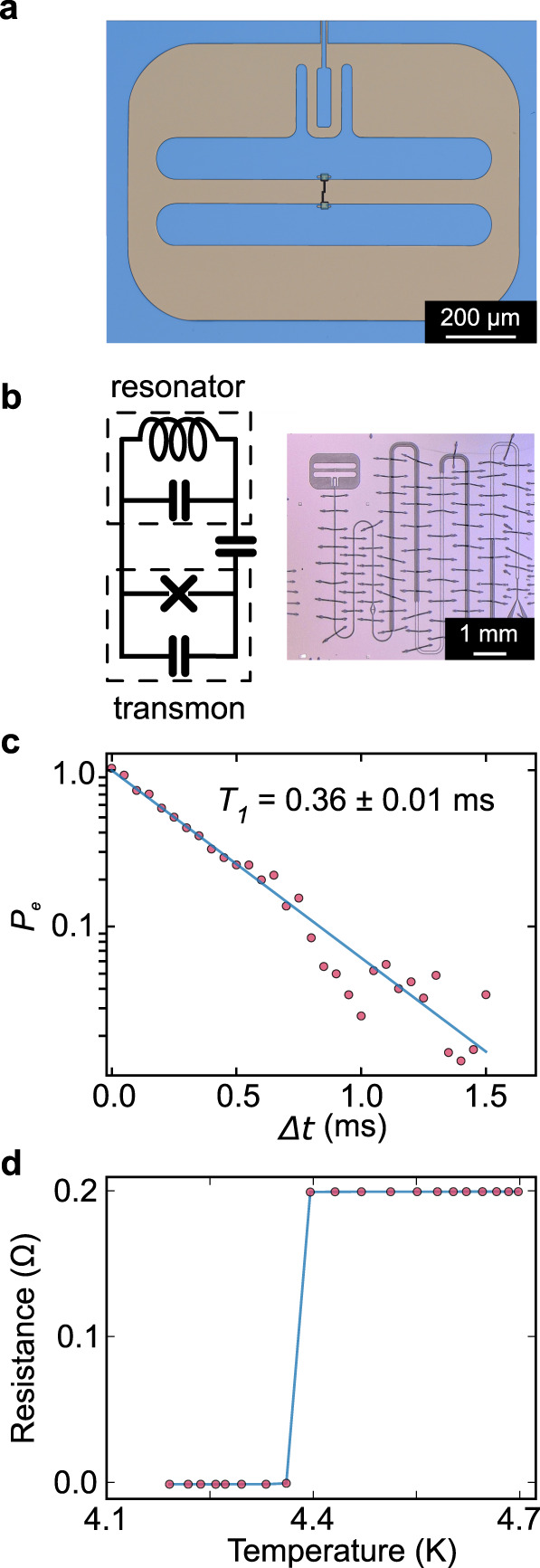
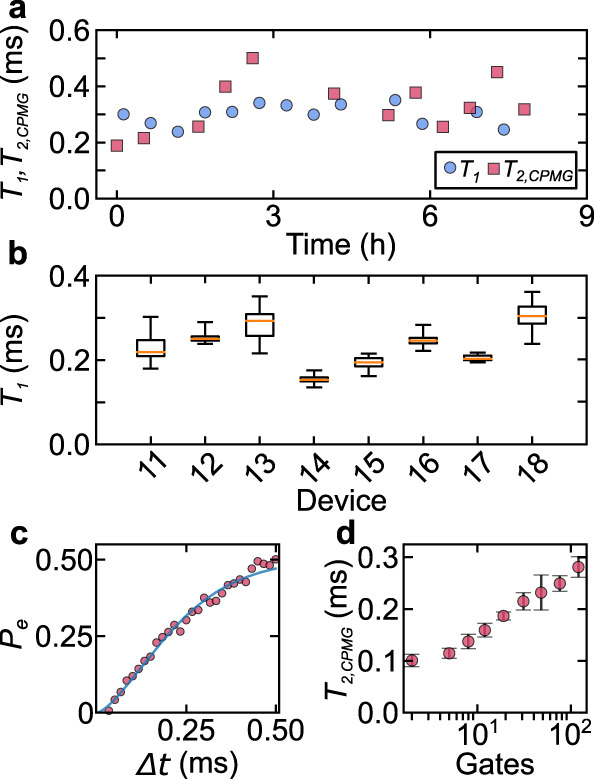
The superconducting transmon qubit is a leading platform for quantum computing and quantum science. Building large, useful quantum systems based on transmon qubits will require significant improvements in qubit relaxation and coherence times, which are orders of magnitude shorter than limits imposed by bulk properties of the constituent materials. This indicates that relaxation likely originates from uncontrolled surfaces, interfaces, and contaminants. Previous efforts to improve qubit lifetimes have focused primarily on designs that minimize contributions from surfaces. However, significant improvements in the lifetime of two-dimensional transmon qubits have remained elusive for several years. Here, we fabricate two-dimensional transmon qubits that have both lifetimes and coherence times with dynamical decoupling exceeding 0.3 milliseconds by replacing niobium with tantalum in the device. We have observed increased lifetimes for seventeen devices, indicating that these material improvements are robust, paving the way for higher gate fidelities in multi-qubit processors.
Overview
The claims and statistics of this paper haven’t been checked yet.
Free: it reads the open-access text and checks the first 5 claims that cite a source we can check. Create a free account to check every claim.
Integrity signals
Registry
Cites
Statistics
Figures
Verification
Claims the paper makes
The claims and statistics of this paper haven’t been checked yet.
Free: it reads the open-access text and checks the first 5 claims that cite a source we can check. Create a free account to check every claim.
Claims other papers make about this one
Each is checked against this paper’s own text: does it say what the citing paper says it does?
The source backs part of the claim, not all of it — or backs it for a different population, condition or comparison.
In the citing paper
“The advantage of this fabrication technique is the possibility for in situ fabrication of the JJ and minimal etch damage to achieve high-coherence qubits of up to hundreds of microseconds19–22.”
From Advanced CMOS manufacturing of superconducting qubits on 300 mm wafers (2024) · cites this paper as [19]
Experimental — accuracy not yet measured
Self-check
Percentages, sums and reported differences re-computed from the paper’s own numbers.
The self-check needs the paper’s full text.
Citations
Cites
Quantum supremacy using a programmable superconducting processor
Arute, F., Arya, K., Babbush, R., Bacon, D., Bardin, J. C., Barends, R., Biswas, R., Boixo, S., Brandao, F. G. S. L., Buell, D. A., et al. (2019) · Nature · doi:10.1038/s41586-019-1666-5 · Cited by 7,720
Hardware-efficient variational quantum eigensolver for small molecules and quantum magnets
Kandala, A., Mezzacapo, A., Temme, K., Takita, M., Brink, M., Chow, J. M., & Gambetta, J. M. (2017) · Nature · doi:10.1038/nature23879 · Cited by 2,982
Superconducting Circuits for Quantum Information: An Outlook
Devoret, M. H., & Schoelkopf, R. J. (2013) · Science · doi:10.1126/science.1231930 · Cited by 2,114
Superconducting quantum circuits at the surface code threshold for fault tolerance
Barends, R., Kelly, J., Megrant, A., Veitia, A., Sank, D., Jeffrey, E., White, T. C., Mutus, J., Fowler, A. G., Campbell, B., et al. (2014) · Nature · doi:10.1038/nature13171 · Cited by 1,733
Quantum algorithms: an overview
Montanaro, A. (2016) · npj Quantum Information · doi:10.1038/npjqi.2015.23 · Cited by 1,071
Scalable Quantum Simulation of Molecular Energies
O’Malley, P. J. J., Babbush, R., Kivlichan, I. D., Romero, J., McClean, J. R., Barends, R., Kelly, J., Roushan, P., Tranter, A., Ding, N., et al. (2016) · Physical Review X · doi:10.1103/physrevx.6.031007 · Cited by 1,059 · cited 1×
“We developed our sapphire etch recipe by (1) looking for crystal formation in an optical microscope, (2) ensuring that zinc was removed in XPS, and (3) checking that we preserved smooth surface morphology in AFM.”
MethodPaik, H., Schuster, D. I., Bishop, L. S., Kirchmair, G., Catelani, G., Sears, A. P., Johnson, B. R., Reagor, M. J., Frunzio, L., Glazman, L. I., et al. (2011) · Physical Review Letters · doi:10.1103/physrevlett.107.240501 · Cited by 1,054
Extending the lifetime of a quantum bit with error correction in superconducting circuits
Ofek, N., Petrenko, A., Heeres, R., Reinhold, P., Leghtas, Z., Vlastakis, B., Liu, Y., Frunzio, L., Girvin, S. M., Jiang, L., et al. (2016) · Nature · doi:10.1038/nature18949 · Cited by 941
State preservation by repetitive error detection in a superconducting quantum circuit
Kelly, J., Barends, R., Fowler, A. G., Megrant, A., Jeffrey, E., White, T. C., Sank, D., Mutus, J. Y., Campbell, B., Chen, Y., et al. (2015) · Nature · doi:10.1038/nature14270 · Cited by 916
A quantum-dot spin qubit with coherence limited by charge noise and fidelity higher than 99.9%
Yoneda, J., Takeda, K., Otsuka, T., Nakajima, T., Delbecq, M. R., Allison, G., Honda, T., Kodera, T., Oda, S., Hoshi, Y., et al. (2018) · Nature Nanotechnology · doi:10.1038/s41565-017-0014-x · Cited by 900
Research works printed but not linked: 5
- Kjaergaard, M. et al. Superconducting Qubits: current state of play. https://arxiv.org/abs/1905.13641 (2019). · arXiv
- Premkumar, A. et al. Microscopic relaxation channels in materials for superconducting Qubits. https://arxiv.org/abs/2004.02908 (2020). · arXiv
- Reese, M. Superconducting Hot Electron Bolometers for Terahertz Sensing. PhD thesis. Yale (2006).
- Face D Prober D Nucleation of body-centered-cubic tantalum films with a thin niobium underlayer J. Vac. Sci. Technol. A: Vac.,Surf., Films 1987 5 3408 3411 10.1116/1.574203 · DOI · Paper page
- Huang, Z. et al. Engineering dynamical sweet spots to protect Qubits from 1/f noise. https://arxiv.org/abs/2004.12458 (2020). · arXiv
Cited by
Items 501–600 of 815
Cheng, Y.-T., Wan, H.-W., Yan, W.-J., Young, L. B., Lin, Y. H., Lai, K.-H., Chen, W.-S., Cheng, C.-K., Chen, K. H. M., Pi, T., et al. (2026) · APL Quantum · doi:10.1063/5.0301974 · Cited by 3
Chen, C., Aghaeimeibodi, S., Sato, Y., Matheny, M. H., Painter, O. J., & Gao, J. (2025) · Physical Review Applied · doi:10.1103/2l7h-zn9s · Cited by 3
Atomic-layer precision etching of SiO 2 using sequential molecular adsorption and plasma activation
Venugopal, R., Ran, N., Blick, R. H., Zierold, R., & Peng, J. (2026) · Journal of Materials Chemistry C · doi:10.1039/d5tc03428k · Cited by 3
Tantalum alloy–based resonators for quantum information systems
Yang, C., Bahrami, F., Cheng, G., Feldman, M. M., Liu, T., Shumiya, N., Yao, N., Lyon, S. A., Houck, A., de Leon, N. P., et al. (2026) · Proceedings of the National Academy of Sciences · doi:10.1073/pnas.2519940123 · Cited by 3
“Among the materials investigated for superconducting qubits, Ta has emerged as a compelling candidate due to its self-terminating stoichiometric surface oxide and chemical resistance to harsh postfabrication processes (16–21).”
Self-citationControlled- Z gates with giant atoms in structured waveguides
Rieck, W., Soro, A., Kockum, A. F., & Chen, G. (2026) · Physical Review A · doi:10.1103/yfm3-qmqq · Cited by 2
Kim, D.-Y., Kwon, H., Han, D. S., Kim, K., Kim, H. K., Lee, C., Kim, G., Lee, J.-Y. M., Kim, D., Kim, E.-A., et al. (2026) · Scientific Reports · doi:10.1038/s41598-026-46352-w · Cited by 3
Banerjee, T., Olszewski, M. W., & Fatemi, V. (2026) · AIP Advances · doi:10.1063/5.0325433 · Cited by 3
Lee, J., Isheim, D., Sung, Z., Crisa, F., Garattoni, S., Bal, M., Kopas, C., Mutus, J., Cansizoglu, H., Marshall, J., et al. (2026) · ACS Nano · doi:10.1021/acsnano.6c00626 · Cited by 3
Highly crystalline superconducting TiN resonators grown on thermally reconstructed sapphire
Smart, T. J., Neis, M., Lorenz, J., Guardascione, M. P., Hanna, R., Schleenvoigt, M., Gao, Y., Domnick, J., Bennemann, B., Jalil, A. R., et al. (2026) · Superconductor Science and Technology · doi:10.1088/1361-6668/aea939 · Cited by 3
“Alongside these established platforms, alternative superconducting materials have been investigated for decades with the aim of improving device performance and expanding fabrication capabilities [4–6].”
Entangling superconducting qubits via energy-selective local reservoirs
Anonymous, Du, B., & Ma, R. (2026) · Physical Review Research · doi:10.1103/mr1g-zqtq · Cited by 4
“Recently, it has been demonstrated that the trade-off between dissipative preparation time and fidelity can be circumvented via dark-state engineering utilizing multilevel interactions [17].”
Cheng, J.-M., Zhang, Y.-C., Zhou, X.-F., & Zhou, Z.-W. (2022) · New Journal of Physics · doi:10.1088/1367-2630/acacbd · Cited by 3
Yang, T., Wang, W., Zhao, B., Wang, L., Ding, X., Liang, C., & Shan, Z. (2024) · Quantum Information Processing · doi:10.1007/s11128-024-04425-7 · Cited by 3
“Currently, researchers are not only making great efforts to improve metrics such as the qubit number [12–15], coherence time [16, 17], and gate fidelity [18–21], but also paying more attention to the optimization of processor architecture, such as optimizing the layout and connectivity between…”
Quantum Voting Machine Encoded with Microwave Photons
张, Y. 钰. Z., 杨, C. 垂. Y., 苏, Q. 奇. S., 康, Y. 逸. K., 郑, W. 文. Z., 李, S. 邵. L., & Yu, Y. (2024) · Chinese Physics Letters · doi:10.1088/0256-307x/41/7/070302 · Cited by 3
Robust multimode superconducting circuit optimized for quantum information processing
Garcia-Azorin, P., Cárdenas-López, F. A., Huber, G. B. P., Romero, G., Werninghaus, M., Motzoi, F., Filipp, S., & Sanz, M. (2026) · Physical Review Applied · doi:10.1103/ksnb-vhsl · Cited by 3
“Strategies to mitigate [5] and to model [6] this phenomenon have been widely studied, leading to advancements in coherence [7, 8].”
Scalable Quantum Processor Based on Superconducting Fluxonium Qubits
Mazhorin, G. S., Kazmina, A. S., Chudakova, T. A., Simakov, I. A., Maleeva, N., Moskalenko, I. N., & Ryazanov, V. V. (2024) · Radiophysics and Quantum Electronics · doi:10.1007/s11141-024-10341-8 · Cited by 4
Ni, J.-H., Zhang, D.-X., Lv, W.-C., Bin, L., Kang, Y., Su, Q.-P., & Yang, C. (2024) · Applied Physics Letters · doi:10.1063/5.0230436 · Cited by 3
Fan, Y., Liu, Y., Liu, Y., Peng, W., Wu, Y., Mu, G., & Lin, Z. (2025) · Physica C Superconductivity · doi:10.1016/j.physc.2025.1354652 · Cited by 3
Impact of biased cooling on the operation of undoped silicon quantum well field-effect devices
Diebel, L. K., Zinkl, L. G., Hötzinger, A., Reichmann, F., Lisker, M., Yamamoto, Y., & Bougeard, D. (2025) · AIP Advances · doi:10.1063/5.0250968 · Cited by 3
Duan, H., Dhundhwal, R., Marques, G. C., Fuchs, D., Pop, I. M., Reisinger, T. J. G., & Aghassi‐Hagmann, J. (2025) · IEEE Transactions on Applied Superconductivity · doi:10.1109/tasc.2025.3604329 · Cited by 3
Detector of microwave photon pairs based on a Josephson photomultiplier
Stolyarov, E. V., & Baskov, R. (2025) · Physical Review Research · doi:10.1103/6p8x-snzm · Cited by 3
“We anticipate that with different materials such as tantalum [109–111] and refined fabrication techniques [110, 112], it is possible to considerably reduce the JPM internal losses and achieve the values we used in the simulations.”
Learning thermodynamic master equations for open quantum systems
Sentz, P., Nicholson, S., Cho, Y., Reddy, S. R., Keith, B., & Günther, S. (2026) · Quantum · doi:10.22331/q-2026-07-01-2151 · Cited by 3
A useful metric for the NISQ era: Qubit error probability and its role in zero noise extrapolation
Sobrino, N., Aseginolaza, U., Jornet-Somoza, J., & Borge, J. (2026) · AVS Quantum Science · doi:10.1116/5.0287324 · Cited by 3
“The probability of finding the qubit in the excited state decays exponentially with time 46,47 , so the larger the quantum circuit the less likely is to find the qubit in the expected state.”
Localized Josephson hot spots due to two-level systems
Heath, J. T., Tyner, A. C., Thann, T. C., Michal, V. P., Krogstrup, P., Svendsen, M. K., & Balatsky, A. V. (2025) · Physical Review Applied · doi:10.1103/ncn4-m48z · Cited by 3
Multimode physics of the unimon circuit
Tuohino, S., Vadimov, V., Teixeira, W. S., Malmelin, T., Silveri, M., & Möttönen, M. (2024) · Physical Review Research · doi:10.1103/physrevresearch.6.033001 · Cited by 3
Room temperature pure α-phase tantalum films on sapphire for superconducting qubits
Bu, K., Zong, Z., Zhang, Z., Ma, X., Shao, M., Li, D., Li, Y., Hu, J., Huai, S., An, S., et al. (2025) · Superconductor Science and Technology · doi:10.1088/1361-6668/adaaa8 · Cited by 3
Two-dimensional topological effect in a transmon qubit array with tunable couplings
Zhao, Y.-J., Wang, Y., Yang, X., Xu, X., Zhang, Y.-Y., Liu, W.-M., & Liu, Y.-X. (2025) · Physical Review A · doi:10.1103/physreva.111.032614 · Cited by 3
“On the other hand, adopting the tantalum material, the qubit has elevated the lifetime to the remarkable hundreds of microseconds [12, 13].”
Lang, S., Eisele, I., Weber, J., Schewski, A., Music, E., Maiwald, A., Hahn, M., Zahn, D., Luo, Z., Nebrich, L., et al. (2026) · Nanomaterials · doi:10.3390/nano16100569 · Cited by 3
Out-of-plane beam shaping with UV-written tilted Bragg gratings for beam delivery on quantum chips
Ko, D.-W., Ahmed, Q. S., Field, J. W., Gates, J. C., & Horák, P. (2022) · Optics Express · doi:10.1364/oe.469501 · Cited by 3
“Examples of this include gravity sensors [1], magnetic imaging in healthcare [2], secure methods of communication [3], and computing [4–6].”
Realization of the iSWAP-like gate among the superconducting qutrits
Xu, P., Zhang, R., & Zhao, S. (2022) · Chinese Physics B · doi:10.1088/1674-1056/ac89e7 · Cited by 3
Qiu, J., Sun, H., Hu, Y., Wang, S., Han, C., & Shan, Z. (2023) · Nanomaterials · doi:10.3390/nano13030542 · Cited by 3
Fault-Tolerant One-Way Noiseless Amplification for Microwave Bosonic Quantum Information Processing
Khalifa, H., Jäntti, R., & Paraoanu, G. S. (2024) · IEEE Transactions on Quantum Engineering · doi:10.1109/tqe.2024.3440192 · Cited by 3
“Approximately the coherence time that can be achieved with the current state of the art technology is in the range of 1 − 3 ms [50], [51], which suggests a maximum sharing distance of ≈ 30 km.”
BackgroundCharacterizing Non-Markovian Dynamics of Open Quantum SystemsPreprint
Reddy, S. R. (2025) · arXiv (Cornell University) · doi:10.48550/arxiv.2503.22147 · Cited by 3
“The qubit is a 2D single Tantalum transmon on a sapphire substrate [15] mounted at 10 mK in a dilution fridge.”
Modeling and Suppressing Unwanted Parasitic Interactions in Superconducting Circuits
Xu, X. (2021) · arXiv (Cornell University) · doi:10.18154/rwth-2021-08161 · Cited by 3
Simple analytical flux-tuned $\small{iSWAP}$ pulses for leakage suppression
Georgiadis, D., Li, B., Galicia, A., Barends, R., Cárdenas-López, F. A., & Motzoi, F. (2026) · Physical Review Applied · doi:10.48550/arxiv.2606.13052 · Cited by 3
Practical Quantum Error Correction with the XZZX Code and Kerr-Cat Qubits
Darmawan, A. S., Brown, B. J., Grimsmo, A. L., Tuckett, D. K., & Puri, S. (2021) · PRX Quantum · doi:10.1103/prxquantum.2.030345 · Cited by 2
Rebar, D. J., Ponce, F., Liu, M., Nanayakkara, T., Zhou, C., Macy, J. J., VanDevender, B. A., Warner, M. G., Bhatia, E., & Rao, S. S. P. (2024) · IEEE International Conference on Quantum Computing and Engineering (QCE) · doi:10.1109/qce60285.2024.10391 · Cited by 2
Realization of two-qubit gates operations in asymmetric superconducting circuits
Zhang, T., & Zhao, C. (2025) · Indian Journal of Physics · doi:10.1007/s12648-025-03598-w · Cited by 2
Li, J., Zhou, T.-Y., & Wang, X. (2025) · Physical Review A · doi:10.1103/4mql-32sg · Cited by 2
Lim, P. G., Santos, G., dos Reis, R., Pham, T., Goronzy, D. P., Hersam, M. C., & Dravid, V. P. (2025) · Microscopy and Microanalysis · doi:10.1093/mam/ozaf048.325 · Cited by 2
1/ f noise and two-level systems in MBE-grown Al thin films
Sahu, S. K., Lin, Y. H., Lai, K.-H., Cheng, C. K., Wu, C.-W., Heredia, E. A., Wang, R.-T., Lin, Y., Kwo, J., Hong, M., et al. (2025) · APL Materials · doi:10.1063/5.0273345 · Cited by 2
Ion-assisted sputter-deposition of superconducting NbN thin films on silicon
Košutová, T., Yao, Y., Fernandes, D. F., Zhang, Z., Zhang, S., Gustavo, F., Lefloch, F., & Kubart, T. (2025) · Superconductor Science and Technology · doi:10.1088/1361-6668/ae01e9 · Cited by 2
“Alternative metallization has been shown to reduce the decoherence [7] and there is a growing interest in superconducting materials with high kinetic inductance such as granular aluminum, NbTiN, or InO x [8–12].”
Modern Quantum Computing: Languages, Simulators, Architectures and Future Directions
Karhan, D., Çimen, S., & Güllü, M. (2025) · International Conference on Artificial Intelligence, Computer, Data Sciences and Applications (ACDSA) · doi:10.1109/acdsa65407.2025.11165857 · Cited by 2
“Regarding physical qubit realization, no single dominant technology exists; leading platforms include superconducting circuits and trapped-ion systems [65], [66].”
Fast CZ gate via energy-level engineering in superconducting qubits with a tunable coupler
Yuan, B., Zhang, C., Han, C., Wang, S., Xu, P., Sun, H., Mu, Q., Wang, L., Zhao, B., Wang, W., et al. (2026) · Physical Review A · doi:10.1103/kc8w-nvnn · Cited by 2
Zhang, D.-X., Ni, J.-H., Zhang, Y., Yu, L. Z., Kang, Y., Su, Q.-P., & Yang, C. (2025) · Chinese Journal of Physics · doi:10.1016/j.cjph.2025.11.035 · Cited by 2
Rao, S. G. (2025) · AVS Quantum Science · doi:10.1116/5.0283809 · Cited by 2
Tutorial on Superconducting Quantum Circuits: From Basics to Applications
Brito, D. D. C., Valadares, F., & Chaves, A. J. C. (2025) · Brazilian Journal of Physics · doi:10.1007/s13538-025-01983-8 · Cited by 2
“Although mercury below a specific critical temperature T c was initially assumed to be a perfect conductor, it was later demonstrated that this is not the case for a superconductor 17 .”
Kushwaha, R. K., Jangid, S., Mishra, P., Sharma, S., & Singh, R. P. (2026) · Materials Advances · doi:10.1039/d5ma01057h · Cited by 2
“In addition to industrial applications, Nb and Ta are widely recognized as suitable materials for superconducting radio frequency (SRF) cavities [19] and Josephson junctions [20, 21], which facilitate the development of super-conducting qubits [22, 23].”
From quantum computing to mRNA therapeutics: seven technologies to watch in 2026
Eisenstein, M. S. (2026) · Nature · doi:10.1038/d41586-026-00188-6 · Cited by 2
Improving coherence and stability of superconducting qubits by thermal annealing in vacuum
Song, J., Yan, H., Song, Y. H., Liang, X., Sun, W., Chen, M., Mi, Z., Xue, G., Chen, C., Ma, Y., et al. (2026) · Applied Physics Letters · doi:10.1063/5.0299372 · Cited by 2
Quantum Coherence as a Resource for Quantum Information Processing and System Stability: A Review
Judijanto, L. (2026) · EJSMT · doi:10.59324/ejsmt.2026.2(1).16 · Cited by 2
Review of Superconducting Qubit Devices and Their Large-Scale Integration
Wong, H. Y. (2026) · IEEE electron devices reviews. · doi:10.1109/edr.2026.3680072 · Cited by 3
“𝑒𝑒 −�𝐸𝐸 𝐽𝐽 / 𝐸𝐸 𝐶𝐶 �𝐸𝐸 / 𝐸𝐸 [ ] The transmon qubit is the most commonly used superconducting qubit for large-scale integrations [9], [13], [21], [73], [74].”
On-demand microwave single-photon source based on tantalum thin films
Hu, Y., Li, S. W., Chen, E.-Q., Gong, R.-Y., Zhang, J., Liu, Y.-X., Feng, J.-G., & Peng, Z. (2026) · Applied Physics Letters · doi:10.1063/5.0316437 · Cited by 2
Microwave crosstalk in planar superconducting quantum devices
Song, Y., Hagmann, D., Dalton, K., Henrich, F., Wagner, F., Panah, M. B., Pechal, M., & Wallraff, A. J. (2026) · Physical Review Applied · doi:10.1103/fdd3-sqxm · Cited by 2
Quasiparticle spectroscopy in tantalum films with different Ta/sapphire interfaces
Moirangthem, B. S., Joshi, K. R., McFadden, A., Oh, J., Datta, A., Tanatar, M. A., Lecocq, F., Simmonds, R. W., Zhou, L., Kramer, M. J., et al. (2026) · Quantum Science and Technology · doi:10.1088/2058-9565/ae7827 · Cited by 2
“Tantalum has recently emerged as an attractive materials platform for SC transmon-style qubits and related circuits because, in some experiments, Ta films exhibit exceptionally low microwave loss and longer lifetimes [10–12].”
Gupta, H., Singer, M., Schoof, B., Cattani‐Scholz, A., Sharma, S., Rommeis, L., & Tornow, M. (2026) · Advanced Functional Materials · doi:10.1002/adfm.77131 · Cited by 2
Price, N., Londoño, J. D. D. G., Padhye, S., McGinnis, S., Wade, C., Yusuf, H., Don, L. D. M., Eyink, K. G., Back, T. C., Guerrero-Sánchez, J., et al. (2026) · AVS Quantum Science · doi:10.1116/5.0332825 · Cited by 2
Practical quantum tokens: challenges and perspectives
Kukharchyk, N., Boche, H., Deppe, C., Fedorov, K. G., Garcia, M. E., Gerhardt, I., Groß, R., Halfmann, T., Huebl, H., Hunger, D., et al. (2026) · Quantum Science and Technology · doi:10.1088/2058-9565/ae92ad · Cited by 2
“In applications, which do not require ultra-long storage times, other systems are no less useful, such as 3D microwave cavities [46–48], superconducting artificial atoms [49–51], quantum dots [52], trapped atom and ions [53–56], and even phononic modes [57, 58].”
Anonymous (2026) · APS Open Science · doi:10.1103/b11b-3hm4 · Cited by 2
Towards a micromechanical qubit based on quantized oscillations in superfluid helium
Sharma, P., Koch, J., & Ginossar, E. (2026) · npj Quantum Information · doi:10.1038/s41534-026-01355-3 · Cited by 2
“The #5 design in Table II offers most promise as a SHOQ bit as the estimated coherence time (based on known sources of dissipation) competes with state-of-the-art fluxonium [39] and transmon qubits [40] having the longest sub-millisecond/millisecond coherence times thus far.”
Purification of copper foils driven by single crystallization
Kou, J., Zhao, M., Li, X.-G., He, M.-L., Yang, F.-Y., Liu, K., Cheng, Q.-Q., Ren, Y., Liu, C., Fu, Y., et al. (2023) · Chinese Physics B · doi:10.1088/1674-1056/ad0ec5 · Cited by 2
Harris, V. G., & Andalib, P. (2024) · Frontiers in Materials · doi:10.3389/fmats.2024.1343005 · Cited by 2
Effective Hamiltonian and parametric tuning for the cross-cross-resonance gate in the transmon model
Kang, Y., & Moon, K. (2025) · Physical Review Applied · doi:10.1103/physrevapplied.23.014062 · Cited by 2
Park, S. H., Choi, G., Kim, E., Park, G., Choi, J., Choi, J., Chong, Y., Lee, Y., & Hahn, S. (2026) · npj Quantum Information · doi:10.1038/s41534-026-01187-1 · Cited by 2
“Significant progress in superconducting qubit design 1–4 , control 5–7 , and fabrication 8–10 techniques have established superconducting quantum circuits as a promising platform for scalable quantum information processing 11–15 .”
Study of Phase Method in Tantalum Superconducting Qubit T2 *Measurements
Wong, H. Y., Beck, K. M., Iaia, V., Zaman, A., & Rosen, Y. J. (2024) · IEEE International Conference on Quantum Computing and Engineering (QCE) · doi:10.1109/qce60285.2024.00154 · Cited by 2
“A tantalum transmon is used in this study [17] [18].”
Tunable qubit quantum battery with delta-pulse driving
Ukhtary, M. S., & Rangkuti, C. N. (2025) · Applied Physics Letters · doi:10.1063/5.0245610 · Cited by 2
Inverse Design of Molecular Qudits for Quantum Circuitry
Latham, E., Bowen, A. M., Cox, N. J., & Chilton, N. F. (2025) · Inorganic Chemistry · doi:10.1021/acs.inorgchem.5c00298 · Cited by 2
Stolyarov, E. V., Andriichuk, V. L., & Sokolov, A. M. (2026) · Physical Review A · doi:10.1103/znff-859f · Cited by 2
Cao, X. (2021) · D-Scholarship@Pitt (University of Pittsburgh) · Cited by 2
Quantum Computing using Superconducting Qubits: A Review
Priya, N., Kour, P., Pradhan, S. K., & Senapati, K. K. (2023) · Evergreen · doi:10.5109/6781091 · Cited by 2
Addressing individual electronic spins with a microwave superconducting resonator
Wang, Z. (2023) · theses.fr (ABES) · doi:10.70675/2ef00470z031dz4bc2z8186z736e756a1ca0 · Cited by 2
Material Loss Model Calibration for Tantalum Superconducting ResonatorsPreprint
Moshel, G., Masis, S., Schechter, M., & Hacohen-Gourgy, S. (2025) · arXiv (Cornell University) · doi:10.48550/arxiv.2507.12141 · Cited by 2
Surface-code Superconducting Quantum Processors: From Calibration To Logical PerformancePreprint
Ali, H. A. (2025) · arXiv (Cornell University) · doi:10.48550/arxiv.2504.17082 · Cited by 2
Quantum Design Automation: Foundations, Challenges, and the Road AheadPreprint
Wu, F., Guo, J., Xia, T., Kong, L., Zhang, F., Wang, Z., Dai, A., Wang, Z., Yang, Z., Deng, H., et al. (2025) · arXiv (Cornell University) · doi:10.48550/arxiv.2511.10479 · Cited by 2
Response of a classical mesoscopic oscillator to a two-level quantum systemPreprint
Sobrero, F., Abrahão, L., Guerreiro, T., & Paraguassú, P. V. (2026) · SSRN Electronic Journal · doi:10.2139/ssrn.7657135 · Cited by 2
Near-limit quantum control beyond analytic tractability in many-body spin systemsPreprint
Zhang, J., Peng, B., Wang, Y., Cheung, C. K., Bian, G., Pang, H., Edmonds, A. M., Markham, M., Zhao, Z., Hou, Y., et al. (2025) · arXiv (Cornell University) · doi:10.48550/arxiv.2510.07802 · Cited by 2
“Since Hahn’s seminal work in 1950, pulse-sequence design has relied on average Hamiltonian theory (AHT) as its analytic foundation [17, 18], underpinning progress from NMR and MRI to a workhorse control technique across quantum platforms [13, 23, 24].”
α-Ta (111) Thin Films for Qubit Applications: A Study of Thickness Dependence and Universal ScalingPreprint
Price, N., Gutiérrez, J., Padhye, S., McGinnis, S., Wade, C., Yusuf, H., Don, L. D. M., Eyink, K., Guerrero-Sánchez, J., Mikheev, E., et al. (2025) · arXiv (Cornell University) · doi:10.48550/arxiv.2504.01130 · Cited by 2
Modeling Charge Noise in Superconducting Qubits Using Memory Multi-Fractional Brownian MotionPreprint
Haq, M. U. (2025) · arXiv (Cornell University) · doi:10.48550/arxiv.2507.20097 · Cited by 2
“Traditionally, charge noise in superconducting qubits has been modeled using stationary Gaussian processes, ensembles of two-level systems (TLS) [9], or Markovian master equations [10].”
Magic and Majorana Fermions in Quantum Computing, Topological Matter, and Dynamics
McLauchlan, C. (2024) · Apollo (University of Cambridge) · doi:10.17863/cam.109559 · Cited by 2
Development of potential-based time domain integral equations for quantum electrodynamics modeling
Roth, T. E. (2020) · Illinois Digital Environment for Access to Learning and Scholarship (University of Illinois at Urbana-Champaign) · Cited by 2
Khalifa, H. (2024) · Aaltodoc (Aalto University) · Cited by 2
Lattice-Renormalized Tunneling Models for Superconducting Qubit MaterialsPreprint
Pritchard, P. G., & Rondinelli, J. M. (2025) · arXiv (Cornell University) · doi:10.48550/arxiv.2512.18156 · Cited by 2
Dissipation in superconducting quantum circuits
Bharadwaj, K. S. (2021) · theses.fr (ABES) · doi:10.70675/ddcf68a5z5ed4z4a91z8227z04bad212275d · Cited by 2
Milchakov, V. (2022) · theses.fr (ABES) · doi:10.70675/5977f52bzfe81z48b6zac1czb920eb3e800d · Cited by 2
Quantum circuits and the superconductor-insulator transition in a disordered superconductor
Charpentier, T. (2023) · theses.fr (ABES) · doi:10.70675/0bb60c01z35b8z4102z94b9zb2ade73370a5 · Cited by 2
Alkhazaleh, A., Villegas, J., Ravaux, F., & Zharinov, A. (2026) · arXiv (Cornell University) · doi:10.48550/arxiv.2604.09050 · Cited by 2
Qiao, L., Luo, F., & Guo, Q. (2026) · arXiv (Cornell University) · doi:10.48550/arxiv.2604.11379 · Cited by 2
“Sapphire is widely adopted owing to its extremely low microwave dielectric loss ( tan δ 10 − 6 ) at millikelvin temperatures [18].”
Dynamical Regimes of Finite-Length Transmission Lines in Circuit Quantum ElectrodynamicsPreprint
Borrelli, F., Miano, G., Parra-Rodriguez, A., & Forestiere, C. (2026) · arXiv (Cornell University) · doi:10.48550/arxiv.2604.21463 · Cited by 2
“For a transmon operating in the standard microwave-frequency window [4, 69], we take where the shunt-capacitance range covers typical planar transmon designs [69, 72].”
Evidence of Quantum Machine Learning Advantage with Tens of Noisy QubitsPreprint
Danaci, O., Patel, Y. J., Molteni, R., van Nieuwenburg, E., Dunjko, V., & Krzywda, J. A. (2026) · arXiv (Cornell University) · doi:10.48550/arxiv.2605.21346 · Cited by 3
Connectivity-induced surface-loss penalty in superconducting qubit-coupler latticesPreprint
Gu, X.-Y., Liang, G.-H., Wang, M.-C., Xiao, Y., Deng, C.-L., Liu, Z.-H., Li, T.-M., Xu, K., Xiang, Z., & Fan, H. (2026) · arXiv (Cornell University) · doi:10.48550/arxiv.2607.10743 · Cited by 2
Algebraic structure of Tiger codesPreprint
Poirson, C., Leverrier, A., & Vuillot, C. (2026) · arXiv (Cornell University) · doi:10.48550/arxiv.2607.22460 · Cited by 2
Quantum Technologies: System-Level Performance and Validation PrioritiesPreprint
Turyshev, S. G. (2026) · arXiv (Cornell University) · doi:10.48550/arxiv.2608.21436 · Cited by 2
“3 ms in selected devices [183]; the manufacturing observable is the joint distribution of T 1 , T 2 , frequency, anharmonicity, gate error, and package loss across sites, wafers, and cooldowns.”
Bound-state-mediated remote charging of a quantum batteryPreprint
Cheng, J.-J., Qiu, H., Zhang, L., & Hu, M.-L. (2026) · arXiv (Cornell University) · doi:10.48550/arxiv.2608.26862 · Cited by 2
“5 are compatible with the superconducting coupled-resonator arrays and the high-coherence transmons [58].”
The Gain-Engineered TransmonPreprint
Yang, I., Adinolfi, F., Bruno, A., Kamrul, V. H., Haxell, D. Z., & Grimm, A. (2026) · arXiv · doi:10.48550/arxiv.2608.26018 · Cited by 2
Bosonic Error Correction with FluxoniumPreprint
Jha, S., Chowdhury, S. D., Rolleri, G., Ali, A., Sellem, L.-A., Assouly, R., Pahl, D., Pahl, L., An, J., Hassani, F., et al. (2026) · arXiv (Cornell University) · doi:10.48550/arxiv.2609.26880 · Cited by 2
Quantum environment afterglow from broadband excitation spectroscopy in superconducting qubitsPreprint
Guimarães, J. R., Liu, Y. L., Gao, Y., Haddad, Y., Galicia, A., Volkov, D. A., Schmieder, J. T., Bhardwaj, H., Neis, M., Cereijo, J., et al. (2026) · arXiv (Cornell University) · doi:10.48550/arxiv.2609.31280 · Cited by 2
Mishra, H., Bonam, S., Pandey, U., & Singh, S. G. (2024) · APL Quantum · doi:10.1063/5.0196880 · Cited by 1
Complete population transfer between next-adjacent energy levels of a transmon qudit
Zhang, Y., Liu, P., Zhang, J.-N., 王, R. 睿. W., 刘, W. 伟. L., Han, J., Jin, Y., & 于, H. 海. Y. (2023) · Chinese Physics B · doi:10.1088/1674-1056/ad02e4 · Cited by 1
Inverse-proximity effect and 2D superconductivity of Ta/Au bilayer thin films
Lin, C.-W., Chung, C.-J., Chen, D., Chiang, C.-C., Chen, I. N., Lei, Z., Huang, S. Y., & Wang, L.-M. (2024) · Journal of Alloys and Compounds · doi:10.1016/j.jallcom.2024.176700 · Cited by 1
Introduction to Superconducting Quantum Circuits
Stern, M. (2024) · Lecture notes in physics · doi:10.1007/978-3-031-55657-9_2 · Cited by 1
High-fidelity remote entanglement between superconducting fixed-frequency qubits
Ohfuchi, M., & Sato, S. (2024) · New Journal of Physics · doi:10.1088/1367-2630/ad8954 · Cited by 1
Metadata
- Authors
- Place, A. P. M., Rodgers, L. V. H., Mundada, P., Smitham, B. M., Fitzpatrick, M., Leng, Z., Premkumar, A., Bryon, J., Vrajitoarea, A., Sussman, S., Cheng, G., Madhavan, T., Babla, H. K., Le, X. H., Gang, Y., Jäck, B., Gyenis, A., Yao, N., Cava, R. J., de Leon, N. P., & Houck, A. A.
- Affiliations
- Princeton University (US)
- Corresponding author
- Houck, Andrew A.
- ORCID
- Venue
- Nature Communications
- Published
- 2021-03-19
- Volume
- 12
- Issue
- 1
- Pages
- 1779-1779
- ISSN
- 2041-1723 (ISSN-L)
- PMC
- PMC7979772
- OpenAlex
- W3006932841
- Semantic Scholar
- fe6a5ecce382e9484fc68e2549d682a760d5293c
- Cited by
- 563
- References
- 52
- Citations by year
- 2026: 87 · 2025: 124 · 2024: 117 · 2023: 95 · 2022: 85 · 2021: 43
- FWCI
- 30.01
- Type
- journal article
- Language
- en
- Open access
- gold
- doi.org
- Licence
- cc-by
- creativecommons.org/licenses/by/4.0 (tdm)
- creativecommons.org/licenses/by/4.0 (vor)
- Locations
- Nature Communications (publishedVersion, cc-by)
- PubMed Central (publishedVersion, cc-by)
- PubMed (publishedVersion)
- arXiv (Cornell University) (submittedVersion)
- OSTI OAI (U.S. Department of Energy Office of Scientific and Technical Information) (submittedVersion)
- RePEc: Research Papers in Economics (submittedVersion)
- DOAJ (DOAJ: Directory of Open Access Journals) (submittedVersion, cc-by-sa)
- Rare & Special e-Zone (The Hong Kong University of Science and Technology) (submittedVersion)
- arXiv (Cornell University)
- Bulletin of the American Physical Society
- Funders
- United States Department of Defense | United States Army | U.S. Army Research, Development and Engineering Command | Army Research Office (W911NF1910016, HIPS W911NF1910016)
- ODNI | Intelligence Community Postdoctoral Research Fellowship Program
- National Science Foundation (MRSEC DMR-1420541)
- Topics
- Physical Sciences › Physics and Astronomy › Atomic and Molecular Physics, and Optics › Quantum Information and Cryptography
- Physical Sciences › Computer Science › Artificial Intelligence › Quantum Computing Algorithms and Architecture
- Physical Sciences › Engineering › Electrical and Electronic Engineering › Superconducting and THz Device Technology
- Keywords
- transmon qubits, superconducting qubits, qubit coherence time, qubit relaxation, tantalum, niobium, dynamical decoupling, superconducting quantum computing
About these checks
Registry, retraction, Cites and statistics results are computed, not judged, with one exception: a printed reference that no index lists is read once by a model before it counts as a citation error. Claims are extracted by a model and kept only when their quote appears verbatim in the text; each cited source is then checked, with a model’s help, for whether it says what the claim relies on. Those verdicts can be wrong — read the claim’s quote and the cited source before relying on one.
Statistics and arithmetic are recomputed, not judged.
Confidence bands are shown only for fields calibrated on our annotated test set. None is calibrated yet, so no band is shown.
What counts as a claim ›How we measure confidence ›How we check this ›
Are you an author, or do you see a problem with this page? Request a review
Data sources
Bibliographic data: Semantic Scholar, OpenAlex, Crossref.
Contains information from the Semantic Scholar Academic Graph Datasets, made available under the ODC Attribution License (ODC-BY 1.0).
Semantic Scholar’s data is described in: Kinney, R., et al. (2023). The Semantic Scholar Open Data Platform. arXiv:2301.10140.
