

New material platform for superconducting transmon qubits with coherence times exceeding 0.3 milliseconds
Open accessThe DOI matches its Crossref record; 54 of the 54 references it cites were found in a registry or an index.
Abstract
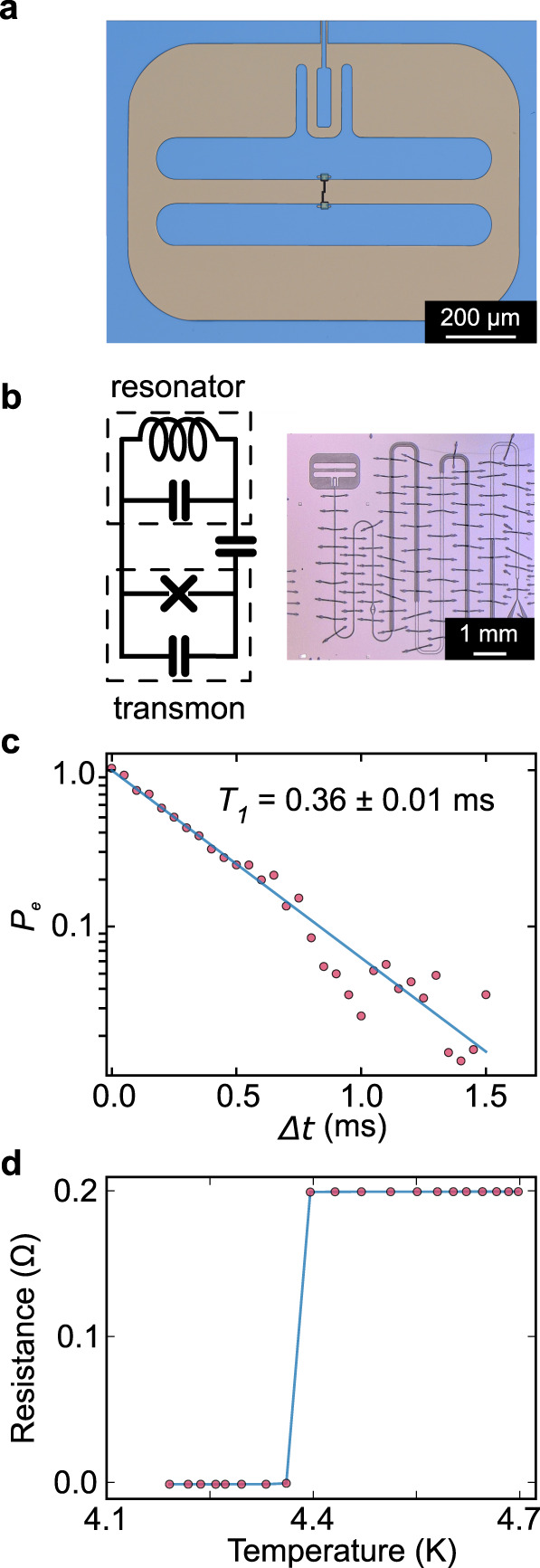
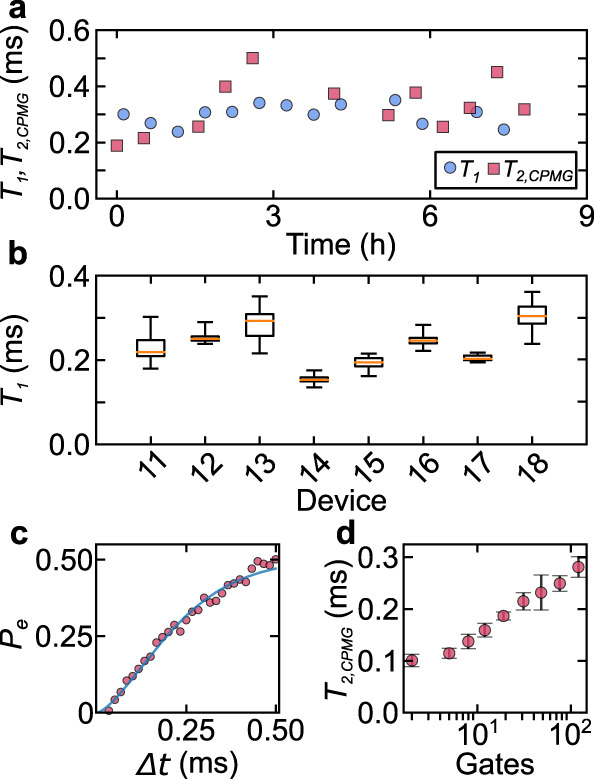
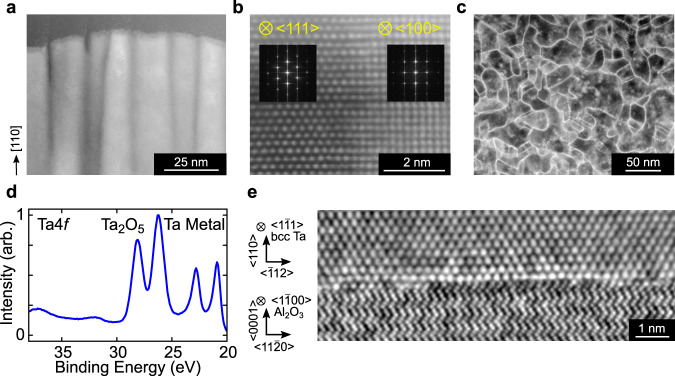
The superconducting transmon qubit is a leading platform for quantum computing and quantum science. Building large, useful quantum systems based on transmon qubits will require significant improvements in qubit relaxation and coherence times, which are orders of magnitude shorter than limits imposed by bulk properties of the constituent materials. This indicates that relaxation likely originates from uncontrolled surfaces, interfaces, and contaminants. Previous efforts to improve qubit lifetimes have focused primarily on designs that minimize contributions from surfaces. However, significant improvements in the lifetime of two-dimensional transmon qubits have remained elusive for several years. Here, we fabricate two-dimensional transmon qubits that have both lifetimes and coherence times with dynamical decoupling exceeding 0.3 milliseconds by replacing niobium with tantalum in the device. We have observed increased lifetimes for seventeen devices, indicating that these material improvements are robust, paving the way for higher gate fidelities in multi-qubit processors.
Overview
The claims and statistics of this paper haven’t been checked yet.
Free: it reads the open-access text and checks the first 5 claims that cite a source we can check. Create a free account to check every claim.
Integrity signals
Registry
Cites
Statistics
Figures
Verification
Claims the paper makes
The claims and statistics of this paper haven’t been checked yet.
Free: it reads the open-access text and checks the first 5 claims that cite a source we can check. Create a free account to check every claim.
Claims other papers make about this one
Each is checked against this paper’s own text: does it say what the citing paper says it does?
The source backs part of the claim, not all of it — or backs it for a different population, condition or comparison.
In the citing paper
“The advantage of this fabrication technique is the possibility for in situ fabrication of the JJ and minimal etch damage to achieve high-coherence qubits of up to hundreds of microseconds19–22.”
From Advanced CMOS manufacturing of superconducting qubits on 300 mm wafers (2024) · cites this paper as [19]
Experimental — accuracy not yet measured
Self-check
Percentages, sums and reported differences re-computed from the paper’s own numbers.
The self-check needs the paper’s full text.
Citations
Cites
Quantum supremacy using a programmable superconducting processor
Arute, F., Arya, K., Babbush, R., Bacon, D., Bardin, J. C., Barends, R., Biswas, R., Boixo, S., Brandao, F. G. S. L., Buell, D. A., et al. (2019) · Nature · doi:10.1038/s41586-019-1666-5 · Cited by 7,720
Hardware-efficient variational quantum eigensolver for small molecules and quantum magnets
Kandala, A., Mezzacapo, A., Temme, K., Takita, M., Brink, M., Chow, J. M., & Gambetta, J. M. (2017) · Nature · doi:10.1038/nature23879 · Cited by 2,982
Superconducting Circuits for Quantum Information: An Outlook
Devoret, M. H., & Schoelkopf, R. J. (2013) · Science · doi:10.1126/science.1231930 · Cited by 2,114
Superconducting quantum circuits at the surface code threshold for fault tolerance
Barends, R., Kelly, J., Megrant, A., Veitia, A., Sank, D., Jeffrey, E., White, T. C., Mutus, J., Fowler, A. G., Campbell, B., et al. (2014) · Nature · doi:10.1038/nature13171 · Cited by 1,733
Quantum algorithms: an overview
Montanaro, A. (2016) · npj Quantum Information · doi:10.1038/npjqi.2015.23 · Cited by 1,071
Scalable Quantum Simulation of Molecular Energies
O’Malley, P. J. J., Babbush, R., Kivlichan, I. D., Romero, J., McClean, J. R., Barends, R., Kelly, J., Roushan, P., Tranter, A., Ding, N., et al. (2016) · Physical Review X · doi:10.1103/physrevx.6.031007 · Cited by 1,059 · cited 1×
“We developed our sapphire etch recipe by (1) looking for crystal formation in an optical microscope, (2) ensuring that zinc was removed in XPS, and (3) checking that we preserved smooth surface morphology in AFM.”
MethodPaik, H., Schuster, D. I., Bishop, L. S., Kirchmair, G., Catelani, G., Sears, A. P., Johnson, B. R., Reagor, M. J., Frunzio, L., Glazman, L. I., et al. (2011) · Physical Review Letters · doi:10.1103/physrevlett.107.240501 · Cited by 1,054
Extending the lifetime of a quantum bit with error correction in superconducting circuits
Ofek, N., Petrenko, A., Heeres, R., Reinhold, P., Leghtas, Z., Vlastakis, B., Liu, Y., Frunzio, L., Girvin, S. M., Jiang, L., et al. (2016) · Nature · doi:10.1038/nature18949 · Cited by 941
State preservation by repetitive error detection in a superconducting quantum circuit
Kelly, J., Barends, R., Fowler, A. G., Megrant, A., Jeffrey, E., White, T. C., Sank, D., Mutus, J. Y., Campbell, B., Chen, Y., et al. (2015) · Nature · doi:10.1038/nature14270 · Cited by 916
A quantum-dot spin qubit with coherence limited by charge noise and fidelity higher than 99.9%
Yoneda, J., Takeda, K., Otsuka, T., Nakajima, T., Delbecq, M. R., Allison, G., Honda, T., Kodera, T., Oda, S., Hoshi, Y., et al. (2018) · Nature Nanotechnology · doi:10.1038/s41565-017-0014-x · Cited by 900
Research works printed but not linked: 5
- Kjaergaard, M. et al. Superconducting Qubits: current state of play. https://arxiv.org/abs/1905.13641 (2019). · arXiv
- Premkumar, A. et al. Microscopic relaxation channels in materials for superconducting Qubits. https://arxiv.org/abs/2004.02908 (2020). · arXiv
- Reese, M. Superconducting Hot Electron Bolometers for Terahertz Sensing. PhD thesis. Yale (2006).
- Face D Prober D Nucleation of body-centered-cubic tantalum films with a thin niobium underlayer J. Vac. Sci. Technol. A: Vac.,Surf., Films 1987 5 3408 3411 10.1116/1.574203 · DOI · Paper page
- Huang, Z. et al. Engineering dynamical sweet spots to protect Qubits from 1/f noise. https://arxiv.org/abs/2004.12458 (2020). · arXiv
Cited by
Items 801–815 of 815
Salih, M. A. (2026) · Journal of Experimental and Theoretical Physics · doi:10.1134/s1063776126601539
Deterministic quantum states storage via dynamical control of subradiant states
Anonymous, & Chang, Y. (2026) · Physical Review A · doi:10.1103/7ldk-6h18
Honda, K., Kurihara, D., Kutsuma, H., Terai, H., & Taro, Y. (2026) · arXiv (Cornell University) · doi:10.48550/arxiv.2610.04820
“Because of tremendous advances in circuit architecture [1, 2] and materials [3, 4], the coherence time of state-of-the-art superconducting qubits has reached the millisecond regime [5, 6] and gate fidelities have exceeded the break-even point [7, 8].”
Exploring topology via momentum-selective tomographyPreprint
Huai, S., Lin, L., Bu, K., Cai, T., Zong, Z., Yang, X., Li, Y., Ye, Y., Zhang, Z., Zhang, S., et al. (2026) · arXiv (Cornell University) · doi:10.48550/arxiv.2610.09673
“Fabrication begins with the deposition of a 200 nm - thick α -phase tantalum film 76,77 onto a sapphire substrate via high-temperature magnetron sputtering.”
Protecting bosonic codes from ancilla-induced errors with continuous-variable flagsPreprint
Décultot, T., Gautier, R., & Mirrahimi, M. (2026) · arXiv (Cornell University) · doi:10.48550/arxiv.2610.07139
Dynamically protected erasure qubit via low-frequency charge drivingPreprint
Hajr, A., Wang, K., Qing, B., Hashim, A., Bhandari, B., Briseño-Colunga, D. D., Dressel, J., Jordan, A. N., & Siddiqi, I. A. (2026) · arXiv (Cornell University) · doi:10.48550/arxiv.2610.10432
“This architecture proved very promising, with coherence times on the order of hundreds of microseconds 17,18 , and multi-qubit processors capable of demonstrating quantum advantage 19,20 and quantum error correction 21–24 .”
Yihui, S., Li, Q., Beibei, G., Shilong, C., Xiaoni, W., Yun, F., Wei, P., Yu, W., Gang, M., & Zhirong, L. (2026) · Acta Physica Sinica · doi:10.7498/aps.76.20261250
Gravitational redshift as a template for correlated dephasing in quantum processors
Abdel‐Aty, A., Altuijri, R., Alharthi, N. S., Matoog, R. T., Shaaban, S. M., Voon, B. W., & Hafez, M. (2026) · Ain Shams Engineering Journal · doi:10.1016/j.asej.2026.104502
Huang, C.-H., & Goan, H. (2026) · arXiv (Cornell University) · doi:10.48550/arxiv.2610.30056
Chi, T., Wu, J., Shi, L., Zang, S., Tan, R., Zhu, Y., Su, R., 陈俊华, Tu, X., Zhao, Q., et al. (2026) · APL Photonics · doi:10.1063/5.0346769
Huang, C.-H., & Goan, H. (2026) · arXiv (Cornell University) · doi:10.48550/arxiv.2610.30681
Eji, M. O., Kirkpatrick, T. J., Cawein, T. J., & Corbett, J. (2026) · arXiv (Cornell University) · doi:10.48550/arxiv.2610.35768
“The dimensionless parameter ε is an apparent upper -limit estimate of microstrain and is reported in units of 10⁻³ [9,18,19].”
InfluentialTa-based S-I-S junctions for integrated superconducting electronicsPreprint
Borman, T. M., Bullock, C., Chason, C., Christensen, B., Cochran, J., Din, E., Donohue, E., Flagg, J., Graninger, A. L., Jones, E., et al. (2026) · arXiv (Cornell University) · doi:10.48550/arxiv.2611.04982
آلة الصوت الكمية: رحلة الاهتزاز من وتر العود إلى الحاسوب الكم ّي
elnoshokaty, I. (2026) · doi:10.66661/enosh.book.2026.005
Quantum Computing and VLSI: Technology Impact and Emerging Challenges
Prajapati, M., & Killana, K. B. (2026) · Advances in computational intelligence and robotics book series · doi:10.4018/979-8-2600-0482-1.ch002
Metadata
- Authors
- Place, A. P. M., Rodgers, L. V. H., Mundada, P., Smitham, B. M., Fitzpatrick, M., Leng, Z., Premkumar, A., Bryon, J., Vrajitoarea, A., Sussman, S., Cheng, G., Madhavan, T., Babla, H. K., Le, X. H., Gang, Y., Jäck, B., Gyenis, A., Yao, N., Cava, R. J., de Leon, N. P., & Houck, A. A.
- Affiliations
- Princeton University (US)
- Corresponding author
- Houck, Andrew A.
- ORCID
- Venue
- Nature Communications
- Published
- 2021-03-19
- Volume
- 12
- Issue
- 1
- Pages
- 1779-1779
- ISSN
- 2041-1723 (ISSN-L)
- PMC
- PMC7979772
- OpenAlex
- W3006932841
- Semantic Scholar
- fe6a5ecce382e9484fc68e2549d682a760d5293c
- Cited by
- 563
- References
- 52
- Citations by year
- 2026: 87 · 2025: 124 · 2024: 117 · 2023: 95 · 2022: 85 · 2021: 43
- FWCI
- 30.01
- Type
- journal article
- Language
- en
- Open access
- gold
- doi.org
- Licence
- cc-by
- creativecommons.org/licenses/by/4.0 (tdm)
- creativecommons.org/licenses/by/4.0 (vor)
- Locations
- Nature Communications (publishedVersion, cc-by)
- PubMed Central (publishedVersion, cc-by)
- PubMed (publishedVersion)
- arXiv (Cornell University) (submittedVersion)
- OSTI OAI (U.S. Department of Energy Office of Scientific and Technical Information) (submittedVersion)
- RePEc: Research Papers in Economics (submittedVersion)
- DOAJ (DOAJ: Directory of Open Access Journals) (submittedVersion, cc-by-sa)
- Rare & Special e-Zone (The Hong Kong University of Science and Technology) (submittedVersion)
- arXiv (Cornell University)
- Bulletin of the American Physical Society
- Funders
- United States Department of Defense | United States Army | U.S. Army Research, Development and Engineering Command | Army Research Office (W911NF1910016, HIPS W911NF1910016)
- ODNI | Intelligence Community Postdoctoral Research Fellowship Program
- National Science Foundation (MRSEC DMR-1420541)
- Topics
- Physical Sciences › Physics and Astronomy › Atomic and Molecular Physics, and Optics › Quantum Information and Cryptography
- Physical Sciences › Computer Science › Artificial Intelligence › Quantum Computing Algorithms and Architecture
- Physical Sciences › Engineering › Electrical and Electronic Engineering › Superconducting and THz Device Technology
- Keywords
- transmon qubits, superconducting qubits, qubit coherence time, qubit relaxation, tantalum, niobium, dynamical decoupling, superconducting quantum computing
About these checks
Registry, retraction, Cites and statistics results are computed, not judged, with one exception: a printed reference that no index lists is read once by a model before it counts as a citation error. Claims are extracted by a model and kept only when their quote appears verbatim in the text; each cited source is then checked, with a model’s help, for whether it says what the claim relies on. Those verdicts can be wrong — read the claim’s quote and the cited source before relying on one.
Statistics and arithmetic are recomputed, not judged.
Confidence bands are shown only for fields calibrated on our annotated test set. None is calibrated yet, so no band is shown.
What counts as a claim ›How we measure confidence ›How we check this ›
Are you an author, or do you see a problem with this page? Request a review
Data sources
Bibliographic data: Semantic Scholar, OpenAlex, Crossref.
Contains information from the Semantic Scholar Academic Graph Datasets, made available under the ODC Attribution License (ODC-BY 1.0).
Semantic Scholar’s data is described in: Kinney, R., et al. (2023). The Semantic Scholar Open Data Platform. arXiv:2301.10140.
