

New material platform for superconducting transmon qubits with coherence times exceeding 0.3 milliseconds
Open accessThe DOI matches its Crossref record; 54 of the 54 references it cites were found in a registry or an index.
Abstract
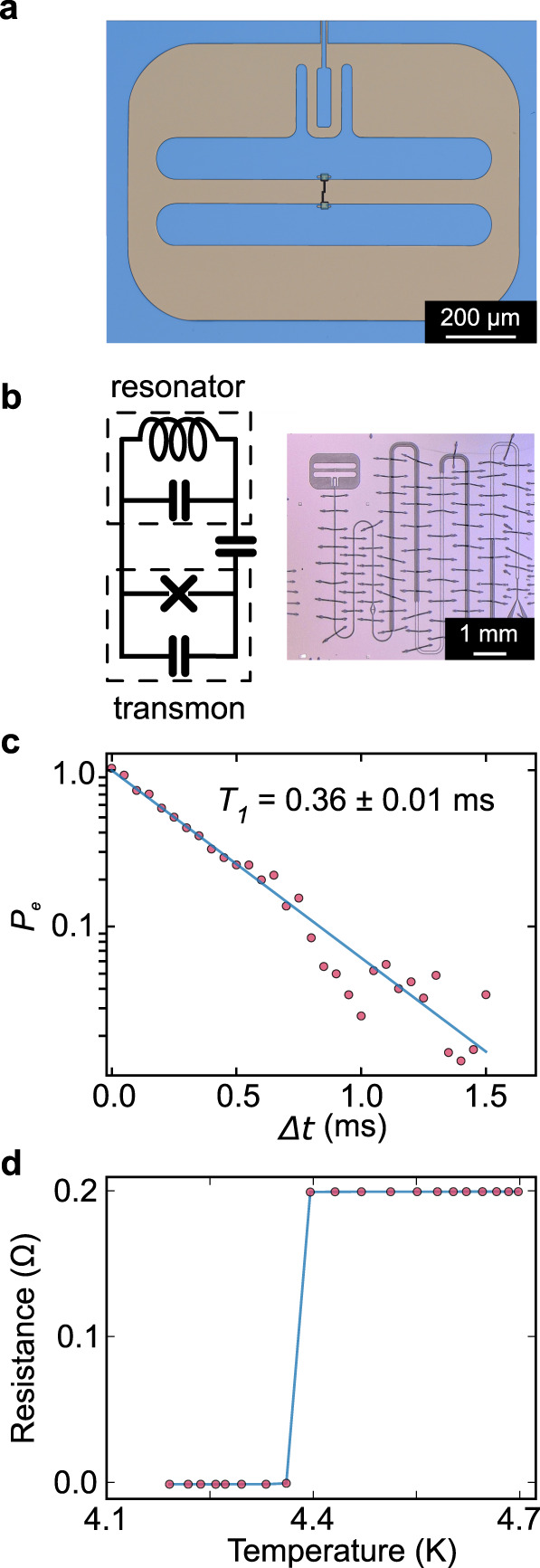
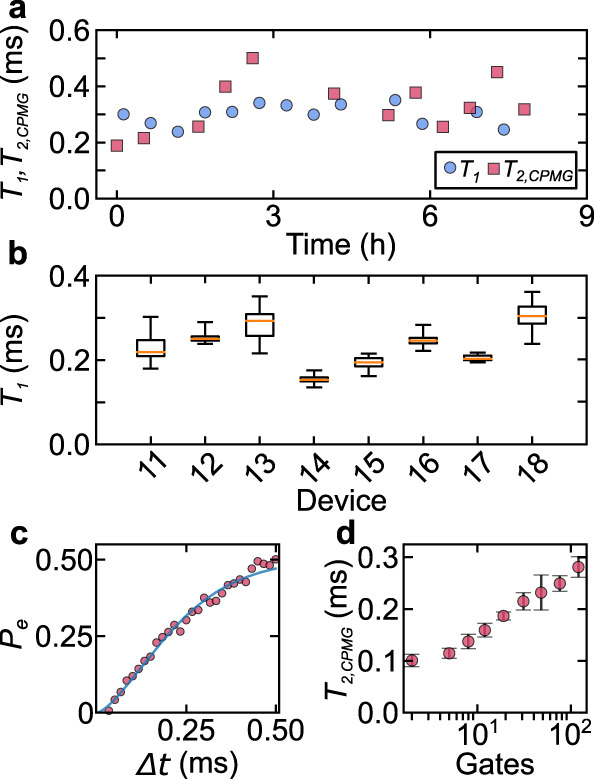
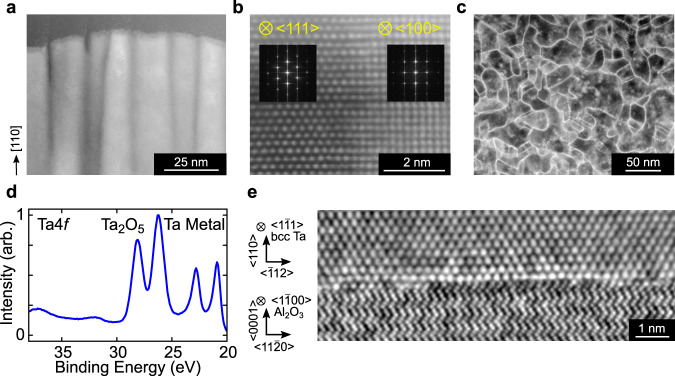
The superconducting transmon qubit is a leading platform for quantum computing and quantum science. Building large, useful quantum systems based on transmon qubits will require significant improvements in qubit relaxation and coherence times, which are orders of magnitude shorter than limits imposed by bulk properties of the constituent materials. This indicates that relaxation likely originates from uncontrolled surfaces, interfaces, and contaminants. Previous efforts to improve qubit lifetimes have focused primarily on designs that minimize contributions from surfaces. However, significant improvements in the lifetime of two-dimensional transmon qubits have remained elusive for several years. Here, we fabricate two-dimensional transmon qubits that have both lifetimes and coherence times with dynamical decoupling exceeding 0.3 milliseconds by replacing niobium with tantalum in the device. We have observed increased lifetimes for seventeen devices, indicating that these material improvements are robust, paving the way for higher gate fidelities in multi-qubit processors.
Overview
The claims and statistics of this paper haven’t been checked yet.
Free: it reads the open-access text and checks the first 5 claims that cite a source we can check. Create a free account to check every claim.
Integrity signals
Registry
Cites
Statistics
Figures
Verification
Claims the paper makes
The claims and statistics of this paper haven’t been checked yet.
Free: it reads the open-access text and checks the first 5 claims that cite a source we can check. Create a free account to check every claim.
Claims other papers make about this one
Each is checked against this paper’s own text: does it say what the citing paper says it does?
The source backs part of the claim, not all of it — or backs it for a different population, condition or comparison.
In the citing paper
“The advantage of this fabrication technique is the possibility for in situ fabrication of the JJ and minimal etch damage to achieve high-coherence qubits of up to hundreds of microseconds19–22.”
From Advanced CMOS manufacturing of superconducting qubits on 300 mm wafers (2024) · cites this paper as [19]
Experimental — accuracy not yet measured
Self-check
Percentages, sums and reported differences re-computed from the paper’s own numbers.
The self-check needs the paper’s full text.
Citations
Cites
Quantum supremacy using a programmable superconducting processor
Arute, F., Arya, K., Babbush, R., Bacon, D., Bardin, J. C., Barends, R., Biswas, R., Boixo, S., Brandao, F. G. S. L., Buell, D. A., et al. (2019) · Nature · doi:10.1038/s41586-019-1666-5 · Cited by 7,720
Hardware-efficient variational quantum eigensolver for small molecules and quantum magnets
Kandala, A., Mezzacapo, A., Temme, K., Takita, M., Brink, M., Chow, J. M., & Gambetta, J. M. (2017) · Nature · doi:10.1038/nature23879 · Cited by 2,982
Superconducting Circuits for Quantum Information: An Outlook
Devoret, M. H., & Schoelkopf, R. J. (2013) · Science · doi:10.1126/science.1231930 · Cited by 2,114
Superconducting quantum circuits at the surface code threshold for fault tolerance
Barends, R., Kelly, J., Megrant, A., Veitia, A., Sank, D., Jeffrey, E., White, T. C., Mutus, J., Fowler, A. G., Campbell, B., et al. (2014) · Nature · doi:10.1038/nature13171 · Cited by 1,733
Quantum algorithms: an overview
Montanaro, A. (2016) · npj Quantum Information · doi:10.1038/npjqi.2015.23 · Cited by 1,071
Scalable Quantum Simulation of Molecular Energies
O’Malley, P. J. J., Babbush, R., Kivlichan, I. D., Romero, J., McClean, J. R., Barends, R., Kelly, J., Roushan, P., Tranter, A., Ding, N., et al. (2016) · Physical Review X · doi:10.1103/physrevx.6.031007 · Cited by 1,059 · cited 1×
“We developed our sapphire etch recipe by (1) looking for crystal formation in an optical microscope, (2) ensuring that zinc was removed in XPS, and (3) checking that we preserved smooth surface morphology in AFM.”
MethodPaik, H., Schuster, D. I., Bishop, L. S., Kirchmair, G., Catelani, G., Sears, A. P., Johnson, B. R., Reagor, M. J., Frunzio, L., Glazman, L. I., et al. (2011) · Physical Review Letters · doi:10.1103/physrevlett.107.240501 · Cited by 1,054
Extending the lifetime of a quantum bit with error correction in superconducting circuits
Ofek, N., Petrenko, A., Heeres, R., Reinhold, P., Leghtas, Z., Vlastakis, B., Liu, Y., Frunzio, L., Girvin, S. M., Jiang, L., et al. (2016) · Nature · doi:10.1038/nature18949 · Cited by 941
State preservation by repetitive error detection in a superconducting quantum circuit
Kelly, J., Barends, R., Fowler, A. G., Megrant, A., Jeffrey, E., White, T. C., Sank, D., Mutus, J. Y., Campbell, B., Chen, Y., et al. (2015) · Nature · doi:10.1038/nature14270 · Cited by 916
A quantum-dot spin qubit with coherence limited by charge noise and fidelity higher than 99.9%
Yoneda, J., Takeda, K., Otsuka, T., Nakajima, T., Delbecq, M. R., Allison, G., Honda, T., Kodera, T., Oda, S., Hoshi, Y., et al. (2018) · Nature Nanotechnology · doi:10.1038/s41565-017-0014-x · Cited by 900
Research works printed but not linked: 5
- Kjaergaard, M. et al. Superconducting Qubits: current state of play. https://arxiv.org/abs/1905.13641 (2019). · arXiv
- Premkumar, A. et al. Microscopic relaxation channels in materials for superconducting Qubits. https://arxiv.org/abs/2004.02908 (2020). · arXiv
- Reese, M. Superconducting Hot Electron Bolometers for Terahertz Sensing. PhD thesis. Yale (2006).
- Face D Prober D Nucleation of body-centered-cubic tantalum films with a thin niobium underlayer J. Vac. Sci. Technol. A: Vac.,Surf., Films 1987 5 3408 3411 10.1116/1.574203 · DOI · Paper page
- Huang, Z. et al. Engineering dynamical sweet spots to protect Qubits from 1/f noise. https://arxiv.org/abs/2004.12458 (2020). · arXiv
Cited by
Items 701–800 of 815
Superconducting qubit coherence metrics for device engineering
McRae, C. R., Ramirez, J., Acharya, M., Pitten, J. R., Lindström, T., & Bennett, D. A. (2024) · Conference on Precision Electromagnetic Measurements · doi:10.1109/cpem61406.2024.10646055
“Currently, state-of-the-art single transmon qubits report T 1 and T 2 of a fraction of a millisecond [3]–[5].”
BackgroundMethodRETRACTED: Tripartite W-States and LOCC Marvel: Quantum Communication's Dynamic DuoPreprint
Aman, M. N., Khan, M. A., Ullah, N., & Sikdar, B. (2024) · Research Square · doi:10.21203/rs.3.rs-4724445/v1
RetractedQuantum Computing for Bioinformatics
Cinaglia, P., & Cannataro, M. (2024) · Elsevier eBooks · doi:10.1016/b978-0-323-95502-7.00182-2
Design and Simulation of High Tc Superconducting Charge-Based Qubit
Choubi, M. H. P., & Fardmanesh, M. (2024) · International Conference on Electrical Engineering and Photonics (EExPolytech) · doi:10.1109/eexpolytech62224.2024.10755851
“The resulted relaxation time for the designed qubit is 7.34 μs which is lower compared to the best reported values of conventional superconductor qubit relaxation times which is approximately above 300 μs [17].”
InfluentialQuantum Information for Fusion Energy Sciences (Final Technical Report)
Evert, B., (NNSA), U. N. N. S. A., Fusion Energy Sciences (FES) (SC-24) USDOE Office of Science (SC), Sete, E. A., Cho, Y., Joseph, I., & Lidar, D. A. (2025) · OSTI OAI (U.S. Department of Energy Office of Scientific and Technical Information) · doi:10.2172/2497384
Transmission of photonic entangled states encoded via eigenstates of photon-number parity operator
Bin, L., Zhang, D.-X., Chen, L., Kang, Y.-H., Zhong, Z., Su, Q.-P., & Yang, C. (2025) · Applied Physics Letters · doi:10.1063/5.0249115
CHEMICAL AND PHYSICAL FRONTIERS IN HIGH-TEMPERATURE SUPERCONDUCTIVITY
Sany, M. A. H., Khan, Z., Ullah, H., Khan, A., Rahman, A., & Javed, M. (2025) · Kashf Journal of Multidisciplinary Research · doi:10.71146/kjmr273
Selective Area Growth of Josephson Junctions in Ladder‐Like Structures of Bismuth Islands
Chen, H., Ma, X., Jiang, L., Xia, B., Yang, B., Cai, J., Zhang, Y. X., Yang, H., Liu, L., Liu, X., et al. (2025) · Small Methods · doi:10.1002/smtd.202402208
Photon number splitting in a multilevel transmon with different microwave photon sources
Li, Z., Guo, T., Zhang, K., Xu, W., Zuo, Q., Li, J., Pan, J., Sun, H., Cao, C., Sun, G., et al. (2025) · Physical review. B./Physical review. B · doi:10.1103/physrevb.111.054525
Development of Superconducting Qubits Based on Nitride Superconductors
Terai, H., Kim, S., Yamashita, T., Inomata, K., & Semba, K. (2025) · Vacuum and Surface Science · doi:10.1380/vss.68.137
Quantum Information for Fusion Energy Sciences (Final Technical Report)
Fusion Energy Sciences (FES) USDOE Office of Science (SC), Evert, B., Rigetti Computing, B., Sundar, B., Sete, E. A., Reagor, M., DuBois, J. L., Joseph, I., Cho, Y., Shi, Y., et al. (2024) · OSTI OAI (U.S. Department of Energy Office of Scientific and Technical Information) · doi:10.2172/2483480
Decoherence-protected holonomic gates with reduced requirements for physical resources
Wu, C., Sun, C., Ma, J., Huang, D., Feng, X., & Kwek, L. C. (2025) · Physical Review Applied · doi:10.1103/physrevapplied.23.044016
Conclusions and Future Directions
Venkatraman, J. (2025) · Springer theses · doi:10.1007/978-3-031-83270-3_8
Hua, M., & Tao, M. (2025) · Physica Scripta · doi:10.1088/1402-4896/add2a0
Probing Quantum Entanglement in Superconducting Circuits at Ultra-Low Temperatures
Chawale, K. V. (2025) · International Journal for Research in Applied Science and Engineering Technology · doi:10.22214/ijraset.2025.72914
Proposal for implementing quantum walks on multidimensional networks
Su, Q.-P., Shen, R.-Q., Yu, L. Z., Wang, Y., Kang, Y., Shen, L., Feng, W., Zhang, G.-Q., & Yang, C. (2025) · Physical Review A · doi:10.1103/f3kt-qf1d · Cited by 1
Deterministic controlled-phase gates on remote transmon qutrits with input–output theory
Hua, M., Li, J., Wei, H., & Tao, M. (2025) · Quantum Information Processing · doi:10.1007/s11128-025-04911-6
“…between microwave photons and superconducting qubits (SQs), the coherence time of superconducting transmon qubit has been dramatically extended [3], and the compatibility with electron beam lithography and all-electrical control—using standard microwave and radio-frequency engineering…”
Epitaxial growth of gold films on the elemental superconductors V(100), Nb(100) and Nb(110)Preprint
Wang, D., Vaxevani, K., Longo, D., Kerschbaumer, S., Ortuzar, J., Trivini, S., Li, J., Ilyn, M., Rogero, C., & Pascual, J. I. (2025) · arXiv (Cornell University) · doi:10.48550/arxiv.2505.08914
Trajectory-Protected Quantum ComputingPreprint
Šoda, B., Graham, P.-A., Perche, T. R., & Singh, G. (2025) · arXiv (Cornell University) · doi:10.48550/arxiv.2510.12771
Urquijo-Rodríguez, A. F., Gómez, E. A., & Vinck-Posada, H. (2025) · Physical Review Research · doi:10.1103/b8q1-hn3f
Quantum Beatings in Optical CavitiesPreprint
Ganti, I., & Cao, J. (2025) · arXiv (Cornell University) · doi:10.48550/arxiv.2507.17339
“Experimentally realizing this would require a polariton coherence time approximately given by The qubit decay rates and cavity decay rates of modern circuit QED systems allow for coherence times comfortably greater than 100 ns [18], demonstrating the relevance of our predictions.”
RELAXATION TIME FLUCTUATIONS IN TRANSMONS WITH DIFFERENT SUPERCONDUCTING GAPS
Li, K. (2023) · University Libraries (University of Maryland) · doi:10.13016/kni0-yeyn
Advances in modelling and material characterization of hole spin qubits in Ge
Ciocoiu, A. (2023) · cIRcle (University of British Columbia) · doi:10.14288/1.0434219
Modeling Superconducting Circuits for Quantum Computing and Quantum Sensing Applications
Richman, B. (2025) · University Libraries (University of Maryland) · doi:10.13016/amn1-j5r1
Material-Driven Optimization of Transmon Qubits for Scalable and Efficient Quantum ArchitecturesPreprint
Gayatri, J., & Veni, S. S. (2025) · arXiv (Cornell University) · doi:10.48550/arxiv.2508.05339
La dinámica de paridad y el control del estado cuántico en Qubits de Andreev
Ackermann, N. (2025) · Biblos-e Archivo (Universidad Autónoma de Madrid)
Physical systems for quantum computing
Mena López, A. (2021) · Repositorio Institucional de la Universidad de Alicante (Universidad de Alicante)
Zaman, S. (2024) · DSpace@MIT (Massachusetts Institute of Technology)
Transmon-based Quantum Processing Units: Design, Control and Implementations
Corti, H. A. (2024) · Electronic Theses and Dissertations Repository (University of Pisa)
Tarkkojen alkeisoperaatioiden implementointi suprajohtavissa kvanttitietokoneissa
Hyyppä, E. (2024) · Aaltodoc (Aalto University)
Engineering Exotic Baths for Superconducting Quantum Circuits Using Parametric Drives
Mucci, M. (2024) · D-Scholarship@Pitt (University of Pittsburgh)
Mode temperature analysis of a readout resonator
Borgognoni, A. (2020) · Digital Library of the University of Innsbruck (University of Innsbruck)
Primerjava programskih jezikov za programiranje sodobnih kvantnih računalnikov
Likar, R. (2023) · Repository of the University of Ljubljana (University of Ljubljana)
Mavrogordatos, T. K. (2026) · Optics Communications · doi:10.1016/j.optcom.2026.133903
Study of quantum computation: applications, challenges and opportunities
Χελιώτης, Κ.-Κ. Φ., & Χελιώτης, Κ.-Κ. Φ. (2025) · University of Thessaly Institutional Repository (University of Thessaly)
Kvanttibittien defektispektroskopia spin-lukinta pulssisekvensseillä
Förbom, C. (2023) · Aaltodoc (Aalto University)
Varaussaareton suprajohtava kubitti
Hyyppä, E. (2021) · Aaltodoc (Aalto University)
Non -degenerate marginal-likelihood calibration with application to quantum characterization
Motamed, M., & Petersson, N. A. (2026) · Journal of Computational Physics · doi:10.1016/j.jcp.2026.114655
“Second, we apply the proposed approach to characterize a tantalum-based transmon quantum device within the Quantum Device and Integration Testbed (QuDIT) system at Lawrence Livermore National Laboratory (LLNL) [17].”
Zhang, Q., Bin, L., Zhang, Y., Kong, W.-H., Ni, J.-H., Yu, L. Z., Kang, Y., Su, Q.-P., & Yang, C. (2026) · Physical Review A · doi:10.1103/g2nv-9cy7
Quality-factor of tantalum resonators on 300mm silicon substrate
Ng, Y. C., Jaafar, N. B., Varghese, B., & Li, H. (2026) · Quantum Computing, Communication, and Simulation · doi:10.1117/12.3079433
Bukhari, M. H. S. (2026) · arXiv (Cornell University) · doi:10.48550/arxiv.2601.21528
“The architecture is based upon two distinct improvements, first, it involves the qubits made with Tantalum films, based upon the original work by Place et al. [8], and the modifications made by Wang et al. [12], especially the usage of a dry etching process in fabrication, and at second, we propose…”
InfluentialEngineering the Quantum Future: Impact of Electrical Engineering in the Field of Quantum Mechanics
Kaza, S. V. M., & Beg, O. A. (2026) · World Journal of Engineering and Technology · doi:10.4236/wjet.2026.141012
Deepak, R., Kanawat, L., Jayadeep, K., & Shukla, P. (2026) · arXiv (Cornell University) · doi:10.48550/arxiv.2602.14165
Born-Rule Deviations Tested on Quantum ProcessorsPreprint
Balfagon, C. (2026) · Research Square · doi:10.21203/rs.3.rs-8579693/v1
Toward Scalable Quantum Computing: A Comparative Review of Qubit Platforms
Zhang, Y. (2025) · International Conference on Communication Technology and Information Technology (ICCTIT) · doi:10.1109/icctit68197.2025.11406484
“Mitigation efforts focus on improving material quality [28] and surface processing [29], with recent progress achieving transmon qubit coherence times beyond 0.3 ms.”
InfluentialKim, Y., Kim, S., Kim, S., Jung, K., An, S., Lee, J., Yoo, H., Park, J. Y., & Yi, G. (2026) · NPG Asia Materials · doi:10.1038/s41427-026-00665-4
“10-12 Extending the operating temperature range and improving device performance therefore require the use of superconductors with higher transition temperatures, such as niobium (Nb).”
High-throughput microwave package for precise superconducting device measurement
Syong, W.-R., Miller, A., Davis, E., Pitten, J. R., Ramirez, J., Ortiz, N. J., Vissers, M. R., Bennett, D., & McRae, C. R. (2026) · Applied Physics Letters · doi:10.1063/5.0318350
“3,14,15 These oxides can be removed with fluorine-based etching but regrow with air exposure.”
Quantum dialPreprint
Sah, A., Kundu, S., Singh, P., Forsbom, E., Vadimov, V., & Möttönen, M. (2026) · arXiv (Cornell University) · doi:10.48550/arxiv.2603.13653
Implementation of Microwave-Activated Conditional Quantum Operations in Superconducting Circuits
白井, 菖. (2024) · Institutional Repositories DataBase (IRDB) · doi:10.15083/0002012607
Rahnama, M. (2026) · Preprints.org · doi:10.20944/preprints202602.1739.v3
Quantum Error Correction using cat qubits
Marquet, A. (2023) · theses.fr (ABES) · doi:10.70675/6748815fz4d8fz484dz94cfz143f5f473a21
Quantum information processing for quantum simulations
Calonnec, C. L. (2023) · theses.fr (ABES) · doi:10.70675/b46267d0z0466z489dzbda2z220bc68889cb
Effect of gamma radiation on low kinetic inductance superconducting microwave resonators
Thobaben, N. J., Zheng, K., Osmon, G. A., Sohm, A. E., Cherry, D. T., Kowsari, D., Zhao, X., Murch, K. W., Cooper, R. L., Goodman, K. D., et al. (2026) · Applied Physics Letters · doi:10.1063/5.0305040 · Cited by 1
Quantum control of a cat-qubit with macroscopic bit-flip times
Réglade, U. (2024) · theses.fr (ABES) · doi:10.70675/e7668ef7z8a9ez4febz83b5z90dbee9cc472
Anharmonicity and gate tunability in a graphene-based superconducting quantum circuit
Aparicio, N. (2025) · theses.fr (ABES) · doi:10.70675/b541d0c2z90cdz4923za0a5z15fb5daed545
Investigation of coherence of niobium-based resonators enabled by a fast-sealing microwave cavityPreprint
Zhang, C., Germond, R., Janzen, N., Valente-Feliciano, A.-M., Bal, M., & Lupaşcu, A. (2026) · arXiv (Cornell University) · doi:10.48550/arxiv.2604.08813
Transferring quantum entangled states of photonic qubits via a quantum switch
Kong, W.-H., Ni, J.-H., Kang, Y., Yu, L. Z., Zhang, Q., Zhang, Y., Su, Q.-P., & Yang, C. (2026) · Frontiers of Physics · doi:10.15302/frontphys.2026.053201
Coherence-gated quantum devices via real-time weak measurementPreprint
Singh, P. (2026) · arXiv (Cornell University) · doi:10.48550/arxiv.2604.18662
Implementation of deterministic quantum spatial searches in a circuit QED system
Su, Q.-P., Shen, R.-Q., Kang, Y., Shen, L., & Yang, C.-P. (2026) · Science China Information Sciences · doi:10.1007/s11432-025-4566-7
“125 GHz; (ii) the relaxation and dephasing rates are γ − 1 eg = T and γ − 1 φ,e = T [42,43]; (iii) g ′ = g .”
Noise resilience in symmetric exchange interactions on NISQ processors
AbuGhanem, M. (2026) · The European Physical Journal Plus · doi:10.1140/epjp/s13360-026-07757-8
“Advanced nanofabrication enables scalability and relatively long coherence times [30, 32, 34, 35].”
Zhao, Z., Zhuang, W., Gu, Y., 钱, P. 鹏. Q., Xiao, X., & Dong, L. (2026) · Quantum Science and Technology · doi:10.1088/2058-9565/ae6fe6
Quantum information processing in modular cavity QED architecturesPreprint
McIntyre, Z. (2025) · arXiv (Cornell University) · doi:10.48550/arxiv.2505.04747
Unified Flux Control Architecture for Fluxonium QubitsPreprint
Pan, X., Wang, J., Zhou, T., Guo, Y., Wang, F., Zhan, Z., Xiang, L., Li, Z., Ma, L., Ma, X., et al. (2026) · arXiv (Cornell University) · doi:10.48550/arxiv.2605.25948
Step-flow homoepitaxial growth of m -sapphire and integration with superconducting TiN
Verma, M., McCandless, J. P., Savant, C., Ithepalli, A., Singh, R., Protasenko, V. V., Xing, H. G., & Jena, D. (2026) · AIP Advances · doi:10.1063/5.0305249
The Compact High-Coherence Superconducting Qubit: Realization via Meander-Shaped Capacitor
Mu, Q., Zha, Z., Shen, Y., Han, C., Liu, F., Zhao, B., Zhang, C., Gao, Y., Yu, W., Cai, X., et al. (2026) · Engineering · doi:10.1016/j.eng.2026.05.011
Symmetry of the critical current function in superconducting nanodevicesPreprint
Zhao, Z., Sun, C., Huang, C.-Y., Zhang, J., Song, X., & Bezryadin, A. (2026) · arXiv (Cornell University) · doi:10.48550/arxiv.2606.14051
“The Device B used the same SiN-bridge platform, but was coated with 20nm Ta since Ta is a material of interest for qubit fabrication 22 .”
Tantalum as a base material for superconducting integrated circuits
Zikiy, E. V., Smirnov, N. S., Kotenkov, S. A., Stepanov, I. A., Agafonova, J. A., Moskaleva, D. A., Matanin, A. R., Ivanov, А. I., Moskalev, D. O., Kurochkina, J. A., et al. (2026) · Communications Materials · doi:10.1038/s43246-026-01352-1
“RIEprovidesa more productive andreproducible approach 42 , but likewise demands careful optimization to avoid etching defects 41 .”
InfluentialPandharpatte, A. S., Singh, M., & Saxena, A. (2026) · Nanotechnology · doi:10.1088/1361-6528/ae7df7
“Progress required parallel advances across diverse fields including applied physics, condensed matter physics, materials science, nanofabrication, quantum control, and device engineering [12, 13].”
InfluentialFabless Quantum Chip Design and Commercial ProductionPreprint
Cai, Qiao, L., Yang, B., Luo, F., Guo, W., Zhang, G. M., Liu, X., Guo, Q., & Wu, B. (2026) · arXiv (Cornell University) · doi:10.48550/arxiv.2606.17956
SPICE-Q and Large-Scale Quantum Chip ProductionPreprint
Cai, Qiao, L., Yang, B., Luo, F., Liu, C., Guo, W., Zhang, G. M., Liu, X., Guo, Q., & Wu, B. (2026) · arXiv (Cornell University) · doi:10.48550/arxiv.2606.17907
A high-fidelity two-qubit gate for multimode superconducting P-mon qubitsPreprint
Pfeiffer, F., Roy, F. A., Glaser, N. J., Feigl, J., Koch, L., Kiener, K., Krylov, G., Schirk, J., Schneider, C. M. F., Södergren, L., et al. (2026) · arXiv (Cornell University) · doi:10.48550/arxiv.2606.24772
“As fabrication techniques continue to mature [4– 7], the central challenge is to develop scalable processor architectures that preserve the high performance of individual qubits when integrated into large-scale arrays.”
Collective rotational cat states of molecules in microwave cavitiesPreprint
Karle, V., Kluibenschedl, F., Lemeshko, M., & Rokaj, V. (2026) · arXiv (Cornell University) · doi:10.48550/arxiv.2606.25815
“On the cavity side, superconducting microwave resonators routinely achieve millisecond photon lifetimes, with state-of-the-art devices extending into the tens-of-milliseconds regime [61].”
Wan, H.-W., Cheng, Y.-T., Cheng, C. K., Chia, J.-M., Wu, C.-T., Yeh, S.-S., Hsu, C.-H., Kwo, J., & Hong, M. (2026) · Communications Materials · doi:10.1038/s43246-026-01253-3
“The JJsofthesequbits,typicallybasedonnativealuminiumoxide(AlO ₓ )/aluminium (Al) heterostructures, have achieved coherence times exceeding one millisecond 1 – 3 .”
Vanadium superconducting microwave resonators on silicon wafersPreprint
Fujita, Y., Urade, Y., Hibino, Y., Tsujimoto, M., Inomata, K., Fujii, G., & Mizubayashi, W. (2026) · arXiv (Cornell University) · doi:10.48550/arxiv.2607.00809
“…origins and mitigation of losses in quantum devices fabricated from a variety of superconducting materials, including aluminum (Al) [8–15], niobium (Nb) [16–23], tantalum (Ta) [24–29], and several nitrides [30–34], have been explored through development of material systems and process technologies.”
Advances in Quantum Materials for Therapeutic Applications
Mahata, A. (2026) · Springer eBooks · doi:10.1007/978-3-032-19536-4_12
Anonymous, da Motta, O., Castelano, L. K., & Napolitano, R. D. J. (2026) · Physical Review A · doi:10.1103/x847-zclc
Singer, M., Gupta, H., Schoof, B., Willinger, E., Orekhov, A., Schewski, A., Kostadinov, S., Schneider, P. C., & Tornow, M. (2026) · arXiv (Cornell University) · doi:10.48550/arxiv.2607.22294
“Amongst others, elements like niobium (Nb) [8], [9], [10], tantalum (Ta) [11], [12], [13] and aluminum (Al) [14], [15] , as well as nitrides like niobium nitride (NbN) [16] and titanium nitride (TiN) [17], [18] have been used to fabricate superconducting quantum circuits [6], [7].”
Energy‐Based Classification of Qubit Platforms for Quantum Battery Applications
Taşaltın, N., & Yıldız, D. E. (2026) · Advanced Quantum Technologies · doi:10.1002/qute.70383
Characterization of Tantalum and Tantalum-alloyed Films for Quantum Devices
Cheng, G., & Yao, N. (2026) · Microscopy and Microanalysis · doi:10.1093/mam/ozag053.561
Self-citationDas, S., Chand, M., John, S., Haldankar, S., Patankar, M. P., Prabhu, S., & Vijay, R. (2026) · Scientific Reports · doi:10.1038/s41598-026-63969-z
An Introduction to Photonic Quantum Information Processing
Strömberg, T. (2026) · Springer theses · doi:10.1007/978-3-032-14267-2_2
Wu, H., Hu, L., Mai, J., Zhang, M., Zhang, L., Cai, Y., Deng, X., Zheng, P., Ni, Z., Liu, S., et al. (2026) · arXiv (Cornell University) · doi:10.48550/arxiv.2608.04780
“The device comprises a high-purity (5N5) aluminum coaxial λ / 4 cavity [34], a tantalum-film-based superconducting transmon ancilla [72, 73], and a Purcell-filtered stripline readout resonator [35].”
Flux-Pulsed Two-Qubit Gates in Transmons: Simulation, Pulse Shaping, and Calibration
Yavasoglu, G. (2026) · Aaltodoc (Aalto University)
Hagag, M. F., El‐Gendy, K. H., Zyoud, B., Jones, T. R., Seddik, K. G., & Peroulis, D. (2026) · IEEE Transactions on Quantum Engineering · doi:10.1109/tqe.2026.3728781
“Ta is preferred and utilized due to its low-loss native oxide, which mitigates dielectric losses associated with surface oxides and reduces the surface participation ratio [26], [27].”
Padamsee, H., Roy, T., Romanenko, A., & Grassellino, A. (2026) · Wiley eBooks · doi:10.1002/9781394294619.ref
Implementation of quantum gates by Floquet analysis of kicked quantum systemPreprint
Luca, A. D., Ciaramelletti, C., & Paganelli, S. (2026) · arXiv (Cornell University) · doi:10.48550/arxiv.2609.02372
Padamsee, H., Roy, T., Romanenko, A., & Grassellino, A. (2026) · Wiley eBooks · doi:10.1002/9781394294619.ch5
Strong-Drive Limits in Josephson Circuits: From Chaos to an Unbound-Resonance ThresholdPreprint
You, X., Maiti, A., & Lu, Y. (2026) · arXiv (Cornell University) · doi:10.48550/arxiv.2609.04704
“Although coherence times of superconducting qubits have improved substantially [2, 3], they remain finite, making faster operation a complementary route to reducing errors.”
High-purity fluorescence photon bundle emission from two separate emittersPreprint
Chen, Z., Xu, J., Kong, D., Hu, X., & Wang, F. (2026) · arXiv (Cornell University) · doi:10.48550/arxiv.2609.07454
“3 ms, corresponding to intrinsic decoherence rates in the kilohertz range, well below the engineered megahertz-scale radiative decay rates considered here [50].”
Jamalzadeh, M., Manzo-Perez, M., Nguyen, M. D., Nadeau, C., Hwang, S., Park, J., Shiravand, I., Kisslinger, K., Tong, X., LaHaye, M., et al. (2026) · Applied Physics Letters · doi:10.1063/5.0341196
Materials for Quantum Information Science: Roles in the Quantum Evolution 2.0Preprint
Pham, T., Ivanov, V., Goronzy, D. P., Devata, A., Feldon, J., Barton, D., & Zhou, Y. (2026) · arXiv (Cornell University) · doi:10.48550/arxiv.2609.09371
Adaptive thresholding for scalable measurement-based qubit resetPreprint
Cao, Q., Akhouri, U., Vizvary, S. R., Ofek, N., Dai, W., & Murch, K. (2026) · arXiv (Cornell University) · doi:10.48550/arxiv.2609.25208
“In superconducting quantum processors, initialization is often performed by waiting several energy relaxation times for the system to return to thermal equilibrium [9, 10].”
Zhao, Y., Xin, W., Zhang, Z., Ouyang, Y., Sun, Y., Xia, X., Zhao, J., Zheng, W., & Yu, Y. (2026) · Chinese Physics B · doi:10.1088/1674-1056/aea75f
Effect of Buried-Interface Preparation for Nb Superconducting Resonators on InPPreprint
Kusher, L. S., Peng, D., Zhu, Z., Bordoloi, A., Leblanc, A., Baker, L., Adnan, N., Issokson, J., Wang, A., Knudsen, F. H., et al. (2026) · arXiv (Cornell University) · doi:10.48550/arxiv.2609.13673
Self-citationYang, J., Chu, T., Xu, B., Li, H., Zhang, Y., Liang, J., & Ma, H. (2026) · Advanced Quantum Technologies · doi:10.1002/qute.70463
Dissipation-assisted steady-state entanglement preparation in a hybrid quantum system
Jin, Z., Liu, J.-X., Buren, B., Zhang, Y., Cui, T.-R., Liang, C.-J., Li, X., & Liu, Z.-J. (2026) · Laser Physics Letters · doi:10.1088/1612-202x/aea495
Li, Y., Huang, D., & Xiao, X. M. (2026) · Physica Scripta · doi:10.1088/1402-4896/aead60
Wu, J., Wang, C., Cameron, A., Lu, Y., & Zorzetti, S. (2026) · Quantum Science and Technology · doi:10.1088/2058-9565/aeaf81
“In a typical microwave system, the coherence time of a state-of-the-art superconducting multi-qubit processors routinely exceeds 300 µ s [75, 76], while the time separation ∆ t = t 2 (cid:0) t 1 is on the order of 10 (cid:0) 100 ns, determined by the gate time [60].”
Toffoli Gate Rewrite Rules for Quantum Circuit Optimisation
Bui, L. (2026) · Aaltodoc (Aalto University)
Metadata
- Authors
- Place, A. P. M., Rodgers, L. V. H., Mundada, P., Smitham, B. M., Fitzpatrick, M., Leng, Z., Premkumar, A., Bryon, J., Vrajitoarea, A., Sussman, S., Cheng, G., Madhavan, T., Babla, H. K., Le, X. H., Gang, Y., Jäck, B., Gyenis, A., Yao, N., Cava, R. J., de Leon, N. P., & Houck, A. A.
- Affiliations
- Princeton University (US)
- Corresponding author
- Houck, Andrew A.
- ORCID
- Venue
- Nature Communications
- Published
- 2021-03-19
- Volume
- 12
- Issue
- 1
- Pages
- 1779-1779
- ISSN
- 2041-1723 (ISSN-L)
- PMC
- PMC7979772
- OpenAlex
- W3006932841
- Semantic Scholar
- fe6a5ecce382e9484fc68e2549d682a760d5293c
- Cited by
- 563
- References
- 52
- Citations by year
- 2026: 87 · 2025: 124 · 2024: 117 · 2023: 95 · 2022: 85 · 2021: 43
- FWCI
- 30.01
- Type
- journal article
- Language
- en
- Open access
- gold
- doi.org
- Licence
- cc-by
- creativecommons.org/licenses/by/4.0 (tdm)
- creativecommons.org/licenses/by/4.0 (vor)
- Locations
- Nature Communications (publishedVersion, cc-by)
- PubMed Central (publishedVersion, cc-by)
- PubMed (publishedVersion)
- arXiv (Cornell University) (submittedVersion)
- OSTI OAI (U.S. Department of Energy Office of Scientific and Technical Information) (submittedVersion)
- RePEc: Research Papers in Economics (submittedVersion)
- DOAJ (DOAJ: Directory of Open Access Journals) (submittedVersion, cc-by-sa)
- Rare & Special e-Zone (The Hong Kong University of Science and Technology) (submittedVersion)
- arXiv (Cornell University)
- Bulletin of the American Physical Society
- Funders
- United States Department of Defense | United States Army | U.S. Army Research, Development and Engineering Command | Army Research Office (W911NF1910016, HIPS W911NF1910016)
- ODNI | Intelligence Community Postdoctoral Research Fellowship Program
- National Science Foundation (MRSEC DMR-1420541)
- Topics
- Physical Sciences › Physics and Astronomy › Atomic and Molecular Physics, and Optics › Quantum Information and Cryptography
- Physical Sciences › Computer Science › Artificial Intelligence › Quantum Computing Algorithms and Architecture
- Physical Sciences › Engineering › Electrical and Electronic Engineering › Superconducting and THz Device Technology
- Keywords
- transmon qubits, superconducting qubits, qubit coherence time, qubit relaxation, tantalum, niobium, dynamical decoupling, superconducting quantum computing
About these checks
Registry, retraction, Cites and statistics results are computed, not judged, with one exception: a printed reference that no index lists is read once by a model before it counts as a citation error. Claims are extracted by a model and kept only when their quote appears verbatim in the text; each cited source is then checked, with a model’s help, for whether it says what the claim relies on. Those verdicts can be wrong — read the claim’s quote and the cited source before relying on one.
Statistics and arithmetic are recomputed, not judged.
Confidence bands are shown only for fields calibrated on our annotated test set. None is calibrated yet, so no band is shown.
What counts as a claim ›How we measure confidence ›How we check this ›
Are you an author, or do you see a problem with this page? Request a review
Data sources
Bibliographic data: Semantic Scholar, OpenAlex, Crossref.
Contains information from the Semantic Scholar Academic Graph Datasets, made available under the ODC Attribution License (ODC-BY 1.0).
Semantic Scholar’s data is described in: Kinney, R., et al. (2023). The Semantic Scholar Open Data Platform. arXiv:2301.10140.
