

New material platform for superconducting transmon qubits with coherence times exceeding 0.3 milliseconds
Open accessThe DOI matches its Crossref record; 54 of the 54 references it cites were found in a registry or an index.
Abstract
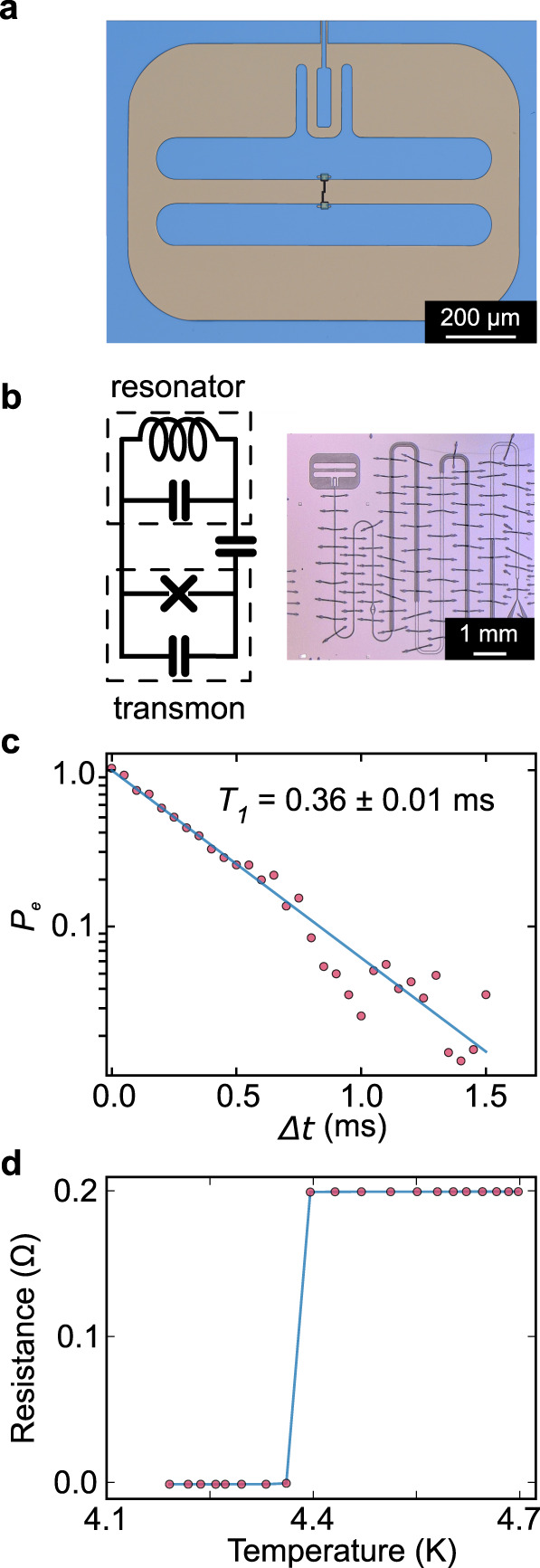
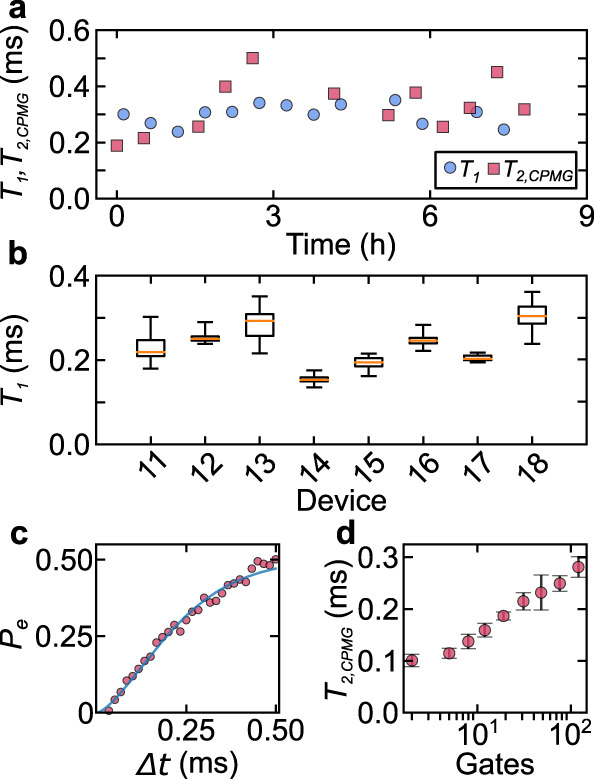
The superconducting transmon qubit is a leading platform for quantum computing and quantum science. Building large, useful quantum systems based on transmon qubits will require significant improvements in qubit relaxation and coherence times, which are orders of magnitude shorter than limits imposed by bulk properties of the constituent materials. This indicates that relaxation likely originates from uncontrolled surfaces, interfaces, and contaminants. Previous efforts to improve qubit lifetimes have focused primarily on designs that minimize contributions from surfaces. However, significant improvements in the lifetime of two-dimensional transmon qubits have remained elusive for several years. Here, we fabricate two-dimensional transmon qubits that have both lifetimes and coherence times with dynamical decoupling exceeding 0.3 milliseconds by replacing niobium with tantalum in the device. We have observed increased lifetimes for seventeen devices, indicating that these material improvements are robust, paving the way for higher gate fidelities in multi-qubit processors.
Overview
The claims and statistics of this paper haven’t been checked yet.
Free: it reads the open-access text and checks the first 5 claims that cite a source we can check. Create a free account to check every claim.
Integrity signals
Registry
Cites
Statistics
Figures
Verification
Claims the paper makes
The claims and statistics of this paper haven’t been checked yet.
Free: it reads the open-access text and checks the first 5 claims that cite a source we can check. Create a free account to check every claim.
Claims other papers make about this one
Each is checked against this paper’s own text: does it say what the citing paper says it does?
The source backs part of the claim, not all of it — or backs it for a different population, condition or comparison.
In the citing paper
“The advantage of this fabrication technique is the possibility for in situ fabrication of the JJ and minimal etch damage to achieve high-coherence qubits of up to hundreds of microseconds19–22.”
From Advanced CMOS manufacturing of superconducting qubits on 300 mm wafers (2024) · cites this paper as [19]
Experimental — accuracy not yet measured
Self-check
Percentages, sums and reported differences re-computed from the paper’s own numbers.
The self-check needs the paper’s full text.
Citations
Cites
Quantum supremacy using a programmable superconducting processor
Arute, F., Arya, K., Babbush, R., Bacon, D., Bardin, J. C., Barends, R., Biswas, R., Boixo, S., Brandao, F. G. S. L., Buell, D. A., et al. (2019) · Nature · doi:10.1038/s41586-019-1666-5 · Cited by 7,720
Hardware-efficient variational quantum eigensolver for small molecules and quantum magnets
Kandala, A., Mezzacapo, A., Temme, K., Takita, M., Brink, M., Chow, J. M., & Gambetta, J. M. (2017) · Nature · doi:10.1038/nature23879 · Cited by 2,982
Superconducting Circuits for Quantum Information: An Outlook
Devoret, M. H., & Schoelkopf, R. J. (2013) · Science · doi:10.1126/science.1231930 · Cited by 2,114
Superconducting quantum circuits at the surface code threshold for fault tolerance
Barends, R., Kelly, J., Megrant, A., Veitia, A., Sank, D., Jeffrey, E., White, T. C., Mutus, J., Fowler, A. G., Campbell, B., et al. (2014) · Nature · doi:10.1038/nature13171 · Cited by 1,733
Quantum algorithms: an overview
Montanaro, A. (2016) · npj Quantum Information · doi:10.1038/npjqi.2015.23 · Cited by 1,071
Scalable Quantum Simulation of Molecular Energies
O’Malley, P. J. J., Babbush, R., Kivlichan, I. D., Romero, J., McClean, J. R., Barends, R., Kelly, J., Roushan, P., Tranter, A., Ding, N., et al. (2016) · Physical Review X · doi:10.1103/physrevx.6.031007 · Cited by 1,059 · cited 1×
“We developed our sapphire etch recipe by (1) looking for crystal formation in an optical microscope, (2) ensuring that zinc was removed in XPS, and (3) checking that we preserved smooth surface morphology in AFM.”
MethodPaik, H., Schuster, D. I., Bishop, L. S., Kirchmair, G., Catelani, G., Sears, A. P., Johnson, B. R., Reagor, M. J., Frunzio, L., Glazman, L. I., et al. (2011) · Physical Review Letters · doi:10.1103/physrevlett.107.240501 · Cited by 1,054
Extending the lifetime of a quantum bit with error correction in superconducting circuits
Ofek, N., Petrenko, A., Heeres, R., Reinhold, P., Leghtas, Z., Vlastakis, B., Liu, Y., Frunzio, L., Girvin, S. M., Jiang, L., et al. (2016) · Nature · doi:10.1038/nature18949 · Cited by 941
State preservation by repetitive error detection in a superconducting quantum circuit
Kelly, J., Barends, R., Fowler, A. G., Megrant, A., Jeffrey, E., White, T. C., Sank, D., Mutus, J. Y., Campbell, B., Chen, Y., et al. (2015) · Nature · doi:10.1038/nature14270 · Cited by 916
A quantum-dot spin qubit with coherence limited by charge noise and fidelity higher than 99.9%
Yoneda, J., Takeda, K., Otsuka, T., Nakajima, T., Delbecq, M. R., Allison, G., Honda, T., Kodera, T., Oda, S., Hoshi, Y., et al. (2018) · Nature Nanotechnology · doi:10.1038/s41565-017-0014-x · Cited by 900
Research works printed but not linked: 5
- Kjaergaard, M. et al. Superconducting Qubits: current state of play. https://arxiv.org/abs/1905.13641 (2019). · arXiv
- Premkumar, A. et al. Microscopic relaxation channels in materials for superconducting Qubits. https://arxiv.org/abs/2004.02908 (2020). · arXiv
- Reese, M. Superconducting Hot Electron Bolometers for Terahertz Sensing. PhD thesis. Yale (2006).
- Face D Prober D Nucleation of body-centered-cubic tantalum films with a thin niobium underlayer J. Vac. Sci. Technol. A: Vac.,Surf., Films 1987 5 3408 3411 10.1116/1.574203 · DOI · Paper page
- Huang, Z. et al. Engineering dynamical sweet spots to protect Qubits from 1/f noise. https://arxiv.org/abs/2004.12458 (2020). · arXiv
Cited by
Items 601–700 of 815
Spin amplification in realistic systems
Iakoupov, I., Bastidas, V. M., Matsuzaki, Y., Saito, S., & Munro, W. J. (2026) · Physical Review Research · doi:10.1103/4nqk-9t5s · Cited by 1
“Compared to other su-∗ ivan.iakoupov@oist.jp perconducting artificial atoms with much better coherence properties [29–32], the primary advantage of the persistent-current artificial atoms is the small size that permits fabrication of thousands of spins on a compact chip [33].”
Tight-binding energy-phase calculation for topological Josephson junction nanowire architecture
Scheppe, A. D., & Pak, M. V. (2025) · Nanotechnology · doi:10.1088/1361-6528/adea7f · Cited by 1
Rocha-Soto, L. E., Damián, C., Saldaña‐Robles, A., & Cano-Andrade, S. (2025) · Journal of Physics A Mathematical and Theoretical · doi:10.1088/1751-8121/adffcd · Cited by 1
Anim, F. S., & Rahman, M. S. (2025) · IEEE International Conference on Quantum Photonics, Artificial Intelligence & Networking (QPAIN) · doi:10.1109/qpain66474.2025.11171660 · Cited by 1
Yanez, W., van Schijndel, T. A. J., McFadden, A., Ji, K., Tan, S., Wu, Y., Frolov, S., Zollner, S., Simmonds, R. W., & Palmstrøm, C. J. (2026) · Physical Review Materials · doi:10.1103/7kzr-571v · Cited by 1
“A first step would be to implement more careful substrate preparation with different cleaning procedures [23] or with higher temperature anneals in a different atmosphere [52] as a way to improve this interface.”
Xiong, N. N., Li, S., Chen, L., Liang, W., & Chen, Y. (2025) · IEEE Transactions on Green Communications and Networking · doi:10.1109/tgcn.2025.3626366 · Cited by 1
Superconducting transmon qubits with niobium-buffered α -tantalum on sapphire substrates
Guo, T., Li, Z., Shi, L., Jiang, J., Sheng, Y., Xu, W., 景, L. 凌. J., Li, B., Zhang, K., Zhou, T., et al. (2025) · Chinese Physics B · doi:10.1088/1674-1056/ae23af · Cited by 1
Quantum supremacy through Fock state q -boson sampling with transmon qubits
Kam, C., & Kuo, E.-J. (2025) · New Journal of Physics · doi:10.1088/1367-2630/ae2539 · Cited by 2
Anonymous, Zheng, W., Zhang, Y., Liu, T., Li, S., & Yu, Y. (2026) · Applied Physics Letters · doi:10.1063/5.0305064 · Cited by 1
Atomic layer etch process for Nb and Ta using CF4/H2 plasma
Walsh, R. F., Macera, M. B., & Renzas, R. (2026) · Journal of Vacuum Science & Technology A Vacuum Surfaces and Films · doi:10.1116/6.0005119 · Cited by 1
The Coherence Challenge: Foundations and Advancements in Superconducting Quantum Circuits
Rao, S. G. (2026) · Arabian Journal for Science and Engineering · doi:10.1007/s13369-025-10979-0 · Cited by 1
“The push for scalable quantum processors has highlighted the critical role of materials research in enhancing the coherence of these quantum systems [18, 24–27].”
InfluentialApproaching the critical point through an exact ground-state evolution
Lin, J., Yan, K.-X., Song, J., Chen, Y., & Xia, Y. (2026) · Physical Review Research · doi:10.1103/yd3b-r78m · Cited by 1
Synthesis and transport properties of epitaxial Bi (111) films on GaAs (111) substrates
Jena, J., Ark, E., Ambhire, S. C., Smith, M., Wood, J. S., Yang, J., Pearson, J., Arava, H., Rosenmann, D., Welp, U., et al. (2026) · APL Materials · doi:10.1063/5.0304277 · Cited by 1
Systematic Characterization of Transmon Qubit Stability with Thermal Cycling
Li, C., Yang, Z., Zhang, X., Wu, Z., Xue, S., & Deng, M. (2026) · Entropy · doi:10.3390/e28030296 · Cited by 1
Ab initio theory of eliminating surface oxides of superconductors with noble-metal encapsulation
Méndez, C., Sitaraman, N., Liepe, M., & Arias, T. A. (2026) · Physical Review Applied · doi:10.1103/l5jh-sldp · Cited by 1
Banerjee, T., Funni, S. D., Roy, S., Cha, J. J., & Fatemi, V. (2026) · Nano Letters · doi:10.1021/acs.nanolett.6c02734 · Cited by 1
Improvement of superconducting Ta films on sapphire via controlled vacuum annealing
Yihui, S., Li, Q., Fun, Y., Wang, X., Liu, Y., Shilong, C., Peng, W., Wu, Y., Mu, G., & Lin, Z.-R. (2026) · Superconductor Science and Technology · doi:10.1088/1361-6668/ae6200 · Cited by 1
σ Bands Driven High-Temperature Superconductivity in Hydrogenated Hexagonal BC 3 Monolayer
陈, G. 果. C., Zheng, R., Sun, J.-H., Ma, F., Yan, X.-W., Gao, M., Cui, T., & Lu, Z.-Y. (2026) · Chinese Physics Letters · doi:10.1088/0256-307x/43/6/060709 · Cited by 1
Quantum feature analysis in double qubit–cavity coupling system under dephasing
Hassan, T., Ali, S. I., Mesmouli, M. B., Zaidi, H. N., & Ramadan, R. Α. (2026) · Physica Scripta · doi:10.1088/1402-4896/ae6a48 · Cited by 1
On Generating Special Quasirandom Structures: Optimization for the DFT Computational Efficiency
Kądzielawa, A. P. (2026) · Acta Physica Polonica B · doi:10.5506/aphyspolb.57.5-a15 · Cited by 1
Point defects in semiconductors: Friends and foes for quantum technologies
Zhu, Y., Zhang, Z.-H., Chen, W., Sakib, M. A., Weber‐Bargioni, A. F., Griffin, S. M., Raja, A., Sipahigil, A., & Hautier, G. (2026) · MRS Bulletin · doi:10.1557/s43577-026-01095-x · Cited by 1
Bhatia, E., Gonzalez, A. L., Hettige, Y., Vo, T., Schujman, S. B., Musick, K., Murray, T., Kisslinger, K., Zhou, C., Liu, M., et al. (2026) · Journal of Vacuum Science & Technology B Nanotechnology and Microelectronics Materials Processing Measurement and Phenomena · doi:10.1116/5.0333748 · Cited by 1
Coherent errors in a superconducting six-qubit network with beyond-nearest-neighbor connectivity
Deshmukh, J., Das, S., Nambiar, B., Chand, M., Salunkhe, K. V., Umasankar, G., Kamat, A., Bhowal, K., Agarwal, G., -, L. B., et al. (2026) · Physical Review Research · doi:10.1103/6jdh-pm39 · Cited by 1
Chiral interaction enhanced magnon bundle emission
Chen, Z., Kong, D., Gou, C., Hu, X., & Wang, F. (2026) · Physical Review A · doi:10.1103/p6sp-bz7p · Cited by 1
“Experimentally, strong coupling between a superconducting qubit and a microwave cavity has been demonstrated in circuit-QED platforms [60–63].”
Wang, S.-Y., Wang, D.-S., Yu, X.-H., Zhao, B., Wang, W.-L., Hui-hui, S., Wang, L., Liu, F.-D., Qi, X.-Y., & Shan, Z. (2026) · EPJ Quantum Technology · doi:10.1140/epjqt/s40507-026-00527-6 · Cited by 1
Multireference Density Matrix Embedding for Spin-Phonon Relaxation
Verma, S., Mariano, A. L., Hermes, M. R., Lunghi, A., Galli, G., & Gagliardi, L. (2026) · Journal of Chemical Theory and Computation · doi:10.1021/acs.jctc.6c01503 · Cited by 1
“4 Unlike many solid-state qubits, where spin-lattice relaxation times ( T 1 ) can greatly exceed coherence times ( T 2 ), 5 molecular spin systems often exhibit comparatively short ( T 1 ) values that can be of the same order of magnitude as ( T 2 ).”
Anonymous, Liu, H., Zhou, M., Wei, B., Li, Q., & Zhu, J.-J. (2026) · Physical Review A · doi:10.1103/lwy7-fs72 · Cited by 1
Sui, Q., & Qui, X.-G. (2022) · Chinese Physics B · doi:10.1088/1674-1056/ac76ae · Cited by 1
Stolyarov, E. V. (2022) · Physical Review A · doi:10.1103/physreva.106.052420 · Cited by 1
Construction of tunnel junction and research on Josephson effect in iron-based superconductors
Teng, W. A. N. G., Yu, A., ChunHong, L. I., YiXin, L. I. U., Wei, P. E. N. G., Jiang, D., & Mu, G. (2023) · Zhongguo kexue. Wulixue Lixue Tianwenxue · doi:10.1360/sspma-2023-0196 · Cited by 1
Electromagnetically induced acoustic transparency amplifier using a superconducting transmon circuit
Batool, S. A., Rahmatullah, R., & Qamar, S. (2023) · Physica Scripta · doi:10.1088/1402-4896/acb32f · Cited by 1
Machine-Guided Design of Oxidation-Resistant Superconductors for Quantum Information Applications
Koppel, C., Wilfong, B., Iwanicki, A. G., Hedrick, E., Berry, T., & McQueen, T. M. (2023) · Inorganics · doi:10.3390/inorganics11030117 · Cited by 1
Proposal for quantum memory miniaturization in superconducting circuit QED
Dai, G., He, K., He, Y., Zhao, C., Liu, J., & Chen, W. (2023) · Physical Review A · doi:10.1103/physreva.107.042428 · Cited by 1
Sensitivity Analysis of Manufacturing Uncertainty Errors in Superconducting Quantum Circuits
Park, S. H., Lee, B., Seo, K., & Hahn, S. (2024) · IEEE Transactions on Applied Superconductivity · doi:10.1109/tasc.2024.3350595 · Cited by 1
“Over the past few decades, superconducting quantum circuits have been improved in qubit coherence time [2], [3], [4], quantum gate fidelity [5], [6], [7], and qubit state readout fidelity [8], [9], [10].”
BackgroundStudy of Phase Method in Tantalum Superconducting Qubit T2* Measurements
Wong, H. Y. [. J. S. U. B. (2024) · OSTI OAI (U.S. Department of Energy Office of Scientific and Technical Information) · Cited by 1
Near-term applications of superconducting digital quantum simulation
Yao, Y., & Wang, Z. (2024) · Journal of Zhejiang University. Science A · doi:10.1631/jzus.a2400397 · Cited by 1
“In recent years, the coherence time of qubits has been improved from a few microseconds to several hundred microseconds (Place et al., 2021; Wang et al., 2022), enabling us to perform thousands of effective operations (quantum gates).”
Ni, J.-H., Lv, W.-C., Zhang, D.-X., Bin, L., Zhang, Y., Yu, Y., Su, Q.-P., & Yang, C. (2025) · Chinese Journal of Physics · doi:10.1016/j.cjph.2025.01.040 · Cited by 1
Richman, B., Lobb, C. J., & Taylor, J. M. (2026) · Physical review. B./Physical review. B · doi:10.1103/2zqn-6r1k · Cited by 1
Quantum Design for Advanced QubitsPreprint
Lu, C., Liu, F., Chen, M.-C., Wang, C., Li, S., Shang, Z.-X., Ying, C., Wang, J., Peng, C.-Z., Zhu, X., et al. (2022) · Research Square · doi:10.21203/rs.3.rs-903650/v1 · Cited by 1
Manenti, R., & Motta, M. (2023) · Oxford University Press eBooks · doi:10.1093/oso/9780198787488.005.0003 · Cited by 1
Influence of Trotterization error on single-particle tunnelingPreprint
Khvalyuk, A. V., Kechedzhi, K., Smelyansky, V. S., & Ioffe, L. B. (2023) · arXiv (Cornell University) · doi:10.48550/arxiv.2312.04735 · Cited by 1
“The resulting tunneling amplitude is exponentially enhanced due to the presence of an intermediate state.”
AQM: A Refresh of the Abstract Qubit Model for Quantum Computing Co-designPreprint
Liu, C., Stein, S. A., Zheng, M., Ang, J., & Li, A. (2024) · arXiv (Cornell University) · doi:10.48550/arxiv.2403.11329 · Cited by 1
“With the current improvement of material choices and fabrication techniques, the lifetime of transmon qubits has been improved from ∼ 1 µ s [124, 99] to 100 [101, 125, 126] to 500 µ s [127, 128], while the coherence time T ∗ 2 can reach 0 .”
MethodWhite, G. A. L. (2024) · arXiv · doi:10.48550/arxiv.2405.05416 · Cited by 2
Park, G., Baity, P., Yoon, B.-J., & Hoisie, A. (2024) · arXiv (Cornell University) · doi:10.48550/arxiv.2410.04251 · Cited by 1
“…of quantum computers (Krantz et al., 2019; Kjaergaard et al., 2020), and the further development of robust quantum processors involves an increasingly wide range of conditions (Huang et al., 2021; Mar-tinis, 2021), material characteristics (Murray, 2021; Place et al., 2021), and physical phenomena.”
BackgroundFrost, H., Bhatia, E., Xiao, Z., Olson, S., Johnson, C. S., Musick, K., Murray, T., Borst, C. L., & Rao, S. S. P. (2024) · arXiv (Cornell University) · doi:10.48550/arxiv.2411.10410 · Cited by 1
Atomic layer etching of SiO$_2$ using sequential SF$_6$ gas and Ar plasmaPreprint
Peng, J., Venugopal, R., Blick, R. H., & Zierold, R. (2024) · arXiv (Cornell University) · doi:10.48550/arxiv.2412.20653 · Cited by 1
Mediating high-order photon-photon interactions by Cooper-pair pairing
Borgognoni, A. (2024) · theses.fr (ABES) · doi:10.70675/9f2d9a93z1349z479bz973azd46699aa2d1f · Cited by 1
Construction of new type of CNOT gate using cross-resonance pulse in the transmon-PPQ systemPreprint
Kang, J., & Kwon, Y. (2025) · arXiv (Cornell University) · doi:10.48550/arxiv.2501.15218 · Cited by 1
Quantum Field Theory Simulation using Digital Quantum Computers
Wadhia, V. (2021) · Durham e-Theses (Durham University) · Cited by 1
Machine Learning Enables Optimization of Diamond for Quantum ApplicationsPreprint
deQuilettes, D. W., Price, E. P., Pham, L., Kurlej, A., Vattam, S. S., Melville, A. J., Osadchy, T., Li, B., Wang, G., Muniz, C. N., et al. (2025) · arXiv (Cornell University) · doi:10.48550/arxiv.2510.22121 · Cited by 1
Low-Gap Hf-HfOx-Hf Josephson Junctions for meV-Scale Particle DetectionPreprint
Balaji, Y., Surendran, M., Li, X., Kemelbay, A., Gashi, A., Salemi, C. P., Suzuki, A., Aloni, S., Hammack, A. T., & Schwartzberg, A. M. (2025) · arXiv (Cornell University) · doi:10.48550/arxiv.2510.25203 · Cited by 1
“Progress in superconducting qubits has been driven by advances in device fabrication, materials engineering, and noise mitigation [1–3].”
High-Throughput Microwave Package for Precise Superconducting Device MeasurementPreprint
Syong, W.-R., Miller, A., Davis, E., Pitten, J. R., Ramirez, J., Ortiz, N., Vissers, M., Bennett, D., & McRae, C. R. (2025) · arXiv (Cornell University) · doi:10.48550/arxiv.2512.18198 · Cited by 1
“3,14,15 These oxides can be removed with fluorine-based etching but regrow with air exposure.”
Characterizing Quantum Error Correction Performance of Radiation-induced ErrorsPreprint
Baity, P., Nayak, A. K., Varshney, L. R., Jeon, N., Yoon, B.-J., Love, P. J., & Hoisie, A. (2026) · arXiv (Cornell University) · doi:10.48550/arxiv.2602.06202 · Cited by 1
“In practice, however, a quantitative model of the noise may provide more accurate predictions in the context of phonon caustics [23, 24], material dependence [25, 26], or the implementation of physical error mitigation strategies [8, 13].”
Rahnama, M. (2026) · Preprints.org · doi:10.20944/preprints202602.1739.v2 · Cited by 1
Effect of the Environment on Fluxonium Qubits and Thermodynamics of Quantum Measurement
Stevens, J. (2021) · theses.fr (ABES) · doi:10.70675/45412444z86eaz418fzabfaz7d4012e9145b · Cited by 1
Dravid, V. P., Murthy, A. A., Lim, P., dos Santos, G. T., Mandia, R., Rondinelli, J. M., Hersam, M. C., & dos Reis, R. (2026) · arXiv (Cornell University) · doi:10.48550/arxiv.2604.03951 · Cited by 1
“Coherence times have advanced from submicrosecond values to the millisecond regime [9–13] through improvements in materials processing, surface treatment, and circuit design.”
Superconducting Quantum Node for Quantum Sensing
Assouly, R. (2022) · theses.fr (ABES) · doi:10.70675/0137d52bz641fz4773za5cfz52438ce6d34c · Cited by 1
Meunier, M. (2023) · theses.fr (ABES) · doi:10.70675/f4be783dzb1e7z4eb2z8d74z77e2d5753b86 · Cited by 1
Superconducting Resonators for Hybrid Semiconducting and Magnetic Quantum Systems
Cools, I. P. C. (2026) · Chalmers Research (Chalmers University of Technology) · doi:10.63959/chalmers.dt/5858 · Cited by 1
Tantalum Damascene Coplanar Waveguide Resonators Fabricated Using 300 mm Scale ProcessesPreprint
Bhatia, E., Du, Y., Koirala, K. P., Kow, C., Liu, M., Macy, J. J., Nanayakkara, T., Ponce, F., Rao, S. S. P., Rebar, D. J., et al. (2026) · arXiv (Cornell University) · doi:10.48550/arxiv.2604.22086 · Cited by 1
Blind Quantum Computation on a Modular Superconducting ProcessorPreprint
Song, Y., Knörzer, J., Dalton, K., Wallraff, A. J., & Besse, J.-C. (2026) · arXiv (Cornell University) · doi:10.48550/arxiv.2605.14656 · Cited by 1
“We assume an error rate of 1 × 10 − 4 per single-qubit gate [75–78], 1 × 10 − 3 per two-qubit gate [55, 78–82], and 1 × 10 − 3 per readout [57, 83, 84], together with relaxation and dephasing times of 1 ms for T 1 and T 2 [75, 85–89].”
Wigner-Negative Magnon Steady States from Incoherent Qubit PumpingPreprint
Liu, Y., & Li, J. (2026) · arXiv (Cornell University) · doi:10.48550/arxiv.2606.22753 · Cited by 2
Cooperative control of dissipative qubits: steering along the fastest dissipative contractionPreprint
Weiss, R., Wimberger, S., & Guéry-Odelin, D. (2026) · arXiv (Cornell University) · doi:10.48550/arxiv.2606.30073 · Cited by 1
“[8, 9, 40– 42]; NV-center values by Refs.”
Singer, M., Gupta, H., Schoof, B., Willinger, E., Orekhov, A., & Tornow, M. (2026) · arXiv (Cornell University) · doi:10.48550/arxiv.2607.02238 · Cited by 1
“The circle is not perfectly closed due to impedance mismatches, cable delays, and residual background transmission in the measurement setup, which introduce asymmetry and rotation in the complex response.”
Almansouri, M., Alhuwaymel, U. T., AlYousef, I., Shafi, A., Albogime, A., Getmanov, I., Hajr, A., & Shamim, A. (2026) · arXiv (Cornell University) · doi:10.48550/arxiv.2607.22265 · Cited by 1
“Superconducting quantum computing has come a long way since its initial demonstrations, owing to advances in circuit design, nanofabrication, and materials engineering that have dramatically improved qubit coherence and control [10, 35].”
Native multi-qubit gates on a single-junction unimon circuitPreprint
Tuohino, S., Möttönen, M., & Silveri, M. (2026) · arXiv (Cornell University) · doi:10.48550/arxiv.2608.14357 · Cited by 1
“Raising the dielectric quality factor Q diel above 10 6 , which is within experimental reach [75, 76], would already yield substantial gains.”
AlphaClifford: Efficient Clifford Synthesis and Transpilation with Model-based RLPreprint
Bosco, D. L., Cossio, J., Piazza, C., & Serra, G. (2026) · arXiv (Cornell University) · doi:10.48550/arxiv.2608.18946 · Cited by 1
“…collective works, for resale or redistribution to servers or lists, or reuse of any copyrighted component of this work in other works. coherence time improvements [6], [7]—the execution of quantum algorithms remains fundamentally constrained by circuit depth and the total number of physical gates.”
Unified scaling of transmon sub-resonant parametric drive strength limitsPreprint
Repicky, J., Kumbhar, G., Xia, M., Baskov, R., Patel, P., Nowicki, M., Frunzio, L., Girvin, S. M., & Hatridge, M. J. (2026) · arXiv (Cornell University) · doi:10.48550/arxiv.2609.13055 · Cited by 1
“Circuit elements are lithographically patterned into an α -Ta film grown on sapphire [46], except for the Josephson junctions which are Al/AlO x /Al.”
An All-van-der-Waals QubitPreprint
Park, S., Zaman, S., Kim, J., An, J., Rodan‐Legrain, D., Tsao, H.-Y., Tsai, C.-C., Goswami, A., Assouly, R., Banner, W. P., et al. (2026) · arXiv (Cornell University) · doi:10.48550/arxiv.2609.14230 · Cited by 1
“Efforts to mitigate this loss have focused on reducing the participation of lossy surface and interfacial regions, where two-level systems (TLS) can form and couple dissipatively to qubits ( 8, 17, 18 ).”
Sah, A., Ranadive, A., Suominen, H., Chen, Q., & Möttönen, M. (2024) · Zenodo (CERN European Organization for Nuclear Research) · doi:10.5281/zenodo.11234842 · Cited by 1
Simulated randomized benchmarking of a dynamically corrected cross-resonance gate
Colmenar, R. K., Güngördü, U., & Kestner, J. P. (2020) · Physical Review A · doi:10.1103/physreva.102.032626
Merged-element transmons on Si fins: the FinMETPreprint
Goswami, A., McFadden, A., Inbar, H. S., Zhao, R., McRae, C. R., Palmstrøm, C. J., & Pappas, D. P. (2021) · arXiv (Cornell University)
Emerging qubit systems: Guest editorial
Sigillito, A. J., Covey, J. P., Fink, J. M., Petersson, K. D., & Preble, S. F. (2022) · Applied Physics Letters · doi:10.1063/5.0097339
STEM Study on the Native Amorphous Surface Axides of Tantalum Film for a Superconducting Qubit
Mun, J., Zhou, C., Sushko, P. V., Brass, E., Qu, X., Liu, M., & Zhu, Y. (2023) · Microscopy and Microanalysis · doi:10.1093/micmic/ozad067.376
Non-degenerate Marginal-Likelihood Calibration with Application to Quantum CharacterizationPreprint
Motamed, M., & Petersson, N. A. (2023) · arXiv (Cornell University) · doi:10.48550/arxiv.2308.12552
“Second, we apply the proposed approach to characterize a tantalum-based transmon quantum device within the Quantum Device and Integration Testbed (QuDIT) system at Lawrence Livermore National Laboratory (LLNL) [17].”
Manenti, R., & Motta, M. (2023) · Oxford University Press eBooks · doi:10.1093/oso/9780198787488.003.0006
Microwave resonators for superconducting devices
Manenti, R., & Motta, M. (2023) · Oxford University Press eBooks · doi:10.1093/oso/9780198787488.003.0013
(2023) · Oxford University Press eBooks · doi:10.1093/oso/9780198787488.002.0003
The rotating wave approximation
Manenti, R., & Motta, M. (2023) · Oxford University Press eBooks · doi:10.1093/oso/9780198787488.005.0001
Manenti, R., & Motta, M. (2023) · Oxford University Press eBooks · doi:10.1093/oso/9780198787488.003.0004
Manenti, R., & Motta, M. (2023) · Oxford University Press eBooks · doi:10.1093/oso/9780198787488.003.0007
Quantum simulation of Hamiltonian eigenstates
Manenti, R., & Motta, M. (2023) · Oxford University Press eBooks · doi:10.1093/oso/9780198787488.003.0012
Manenti, R., & Motta, M. (2023) · Oxford University Press eBooks · doi:10.1093/oso/9780198787488.003.0002
Quantum simulation of Hamiltonian dynamics
Manenti, R., & Motta, M. (2023) · Oxford University Press eBooks · doi:10.1093/oso/9780198787488.003.0011
Manenti, R., & Motta, M. (2023) · Oxford University Press eBooks · doi:10.1093/oso/9780198787488.003.0009
The molecular Hamiltonian in second quantization
Manenti, R., & Motta, M. (2023) · Oxford University Press eBooks · doi:10.1093/oso/9780198787488.005.0004
Manenti, R., & Motta, M. (2023) · Oxford University Press eBooks · doi:10.1093/oso/9780198787488.003.0005
Manenti, R., & Motta, M. (2023) · Oxford University Press eBooks · doi:10.1093/oso/9780198787488.003.0008
Oblivious amplitude amplification lemma
Manenti, R., & Motta, M. (2023) · Oxford University Press eBooks · doi:10.1093/oso/9780198787488.005.0005
Manenti, R., & Motta, M. (2023) · Oxford University Press eBooks · doi:10.1093/oso/9780198787488.005.0006
Manenti, R., & Motta, M. (2023) · Oxford University Press eBooks · doi:10.1093/oso/9780198787488.003.0003
Manenti, R., & Motta, M. (2023) · Oxford University Press eBooks · doi:10.1093/oso/9780198787488.003.0001
Manenti, R., & Motta, M. (2023) · Oxford University Press eBooks · doi:10.1093/oso/9780198787488.003.0014
(2023) · Oxford University Press eBooks · doi:10.1093/oso/9780198787488.002.0005
(2023) · Oxford University Press eBooks · doi:10.1093/oso/9780198787488.002.0004
Manenti, R., & Motta, M. (2023) · Oxford University Press eBooks · doi:10.1093/oso/9780198787488.003.0010
Stochastic Model of Qudit Measurement for Superconducting Quantum Information ProcessingPreprint
Yu, K. (2023) · arXiv (Cornell University) · doi:10.48550/arxiv.2312.03754
Local dose distribution and changing resist cross-sectional shapes in electron beam lithography
Sugihara, T., & Kaneko, A. (2024) · Transactions of the JSME (in Japanese) · doi:10.1299/transjsme.23-00232
Ferry, D. K. (2024) · Synthesis lectures on engineering, science, and technology · doi:10.1007/978-3-031-62925-9_3
Metadata
- Authors
- Place, A. P. M., Rodgers, L. V. H., Mundada, P., Smitham, B. M., Fitzpatrick, M., Leng, Z., Premkumar, A., Bryon, J., Vrajitoarea, A., Sussman, S., Cheng, G., Madhavan, T., Babla, H. K., Le, X. H., Gang, Y., Jäck, B., Gyenis, A., Yao, N., Cava, R. J., de Leon, N. P., & Houck, A. A.
- Affiliations
- Princeton University (US)
- Corresponding author
- Houck, Andrew A.
- ORCID
- Venue
- Nature Communications
- Published
- 2021-03-19
- Volume
- 12
- Issue
- 1
- Pages
- 1779-1779
- ISSN
- 2041-1723 (ISSN-L)
- PMC
- PMC7979772
- OpenAlex
- W3006932841
- Semantic Scholar
- fe6a5ecce382e9484fc68e2549d682a760d5293c
- Cited by
- 563
- References
- 52
- Citations by year
- 2026: 87 · 2025: 124 · 2024: 117 · 2023: 95 · 2022: 85 · 2021: 43
- FWCI
- 30.01
- Type
- journal article
- Language
- en
- Open access
- gold
- doi.org
- Licence
- cc-by
- creativecommons.org/licenses/by/4.0 (tdm)
- creativecommons.org/licenses/by/4.0 (vor)
- Locations
- Nature Communications (publishedVersion, cc-by)
- PubMed Central (publishedVersion, cc-by)
- PubMed (publishedVersion)
- arXiv (Cornell University) (submittedVersion)
- OSTI OAI (U.S. Department of Energy Office of Scientific and Technical Information) (submittedVersion)
- RePEc: Research Papers in Economics (submittedVersion)
- DOAJ (DOAJ: Directory of Open Access Journals) (submittedVersion, cc-by-sa)
- Rare & Special e-Zone (The Hong Kong University of Science and Technology) (submittedVersion)
- arXiv (Cornell University)
- Bulletin of the American Physical Society
- Funders
- United States Department of Defense | United States Army | U.S. Army Research, Development and Engineering Command | Army Research Office (W911NF1910016, HIPS W911NF1910016)
- ODNI | Intelligence Community Postdoctoral Research Fellowship Program
- National Science Foundation (MRSEC DMR-1420541)
- Topics
- Physical Sciences › Physics and Astronomy › Atomic and Molecular Physics, and Optics › Quantum Information and Cryptography
- Physical Sciences › Computer Science › Artificial Intelligence › Quantum Computing Algorithms and Architecture
- Physical Sciences › Engineering › Electrical and Electronic Engineering › Superconducting and THz Device Technology
- Keywords
- transmon qubits, superconducting qubits, qubit coherence time, qubit relaxation, tantalum, niobium, dynamical decoupling, superconducting quantum computing
About these checks
Registry, retraction, Cites and statistics results are computed, not judged, with one exception: a printed reference that no index lists is read once by a model before it counts as a citation error. Claims are extracted by a model and kept only when their quote appears verbatim in the text; each cited source is then checked, with a model’s help, for whether it says what the claim relies on. Those verdicts can be wrong — read the claim’s quote and the cited source before relying on one.
Statistics and arithmetic are recomputed, not judged.
Confidence bands are shown only for fields calibrated on our annotated test set. None is calibrated yet, so no band is shown.
What counts as a claim ›How we measure confidence ›How we check this ›
Are you an author, or do you see a problem with this page? Request a review
Data sources
Bibliographic data: Semantic Scholar, OpenAlex, Crossref.
Contains information from the Semantic Scholar Academic Graph Datasets, made available under the ODC Attribution License (ODC-BY 1.0).
Semantic Scholar’s data is described in: Kinney, R., et al. (2023). The Semantic Scholar Open Data Platform. arXiv:2301.10140.
