

Power of data in quantum machine learning
Open accessThe DOI matches its Crossref record; 67 of the 69 references it cites were found in a registry or an index.
Abstract
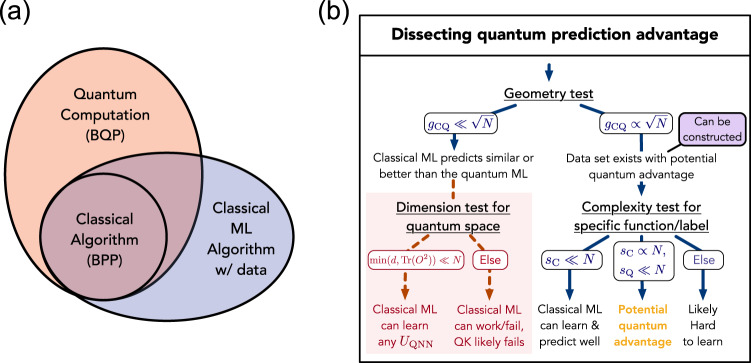
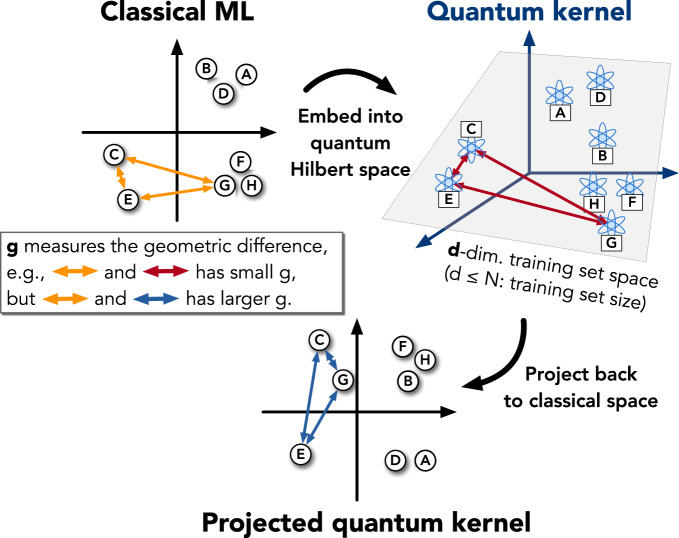
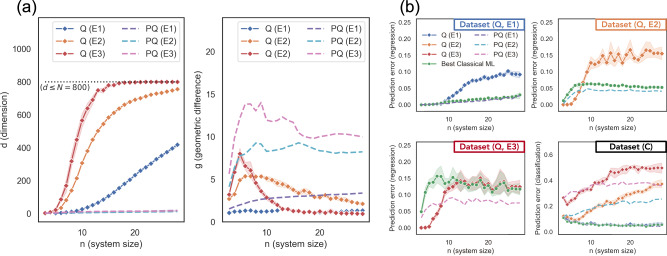
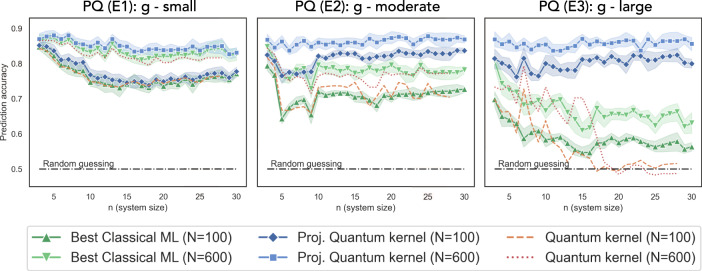
The use of quantum computing for machine learning is among the most exciting prospective applications of quantum technologies. However, machine learning tasks where data is provided can be considerably different than commonly studied computational tasks. In this work, we show that some problems that are classically hard to compute can be easily predicted by classical machines learning from data. Using rigorous prediction error bounds as a foundation, we develop a methodology for assessing potential quantum advantage in learning tasks. The bounds are tight asymptotically and empirically predictive for a wide range of learning models. These constructions explain numerical results showing that with the help of data, classical machine learning models can be competitive with quantum models even if they are tailored to quantum problems. We then propose a projected quantum model that provides a simple and rigorous quantum speed-up for a learning problem in the fault-tolerant regime. For near-term implementations, we demonstrate a significant prediction advantage over some classical models on engineered data sets designed to demonstrate a maximal quantum advantage in one of the largest numerical tests for gate-based quantum machine learning to date, up to 30 qubits.
Overview
The claims and statistics of this paper haven’t been checked yet.
Free: it reads the open-access text and checks the first 5 claims that cite a source we can check. Create a free account to check every claim.
Integrity signals
Registry
Cites
Statistics
Figures
Verification
Claims the paper makes
The claims and statistics of this paper haven’t been checked yet.
Free: it reads the open-access text and checks the first 5 claims that cite a source we can check. Create a free account to check every claim.
Claims other papers make about this one
Each is checked against this paper’s own text: does it say what the citing paper says it does?
The source backs part of the claim, not all of it — or backs it for a different population, condition or comparison.
In the citing paper
“measures such as the effective dimension have been motivated from an information-theoretic standpoint and depend on the Fisher information”
From The power of quantum neural networks (2021) · cites this paper as [21]
Experimental — accuracy not yet measuredThe cited source says what the claim attributes to it.
In the citing paper
“For instance, in [57], it is shown how the quality and the amount of data can sensibly affect the performance of classical and QML models in such a way that the quantum advantage is not always guaranteed.”
From On Circuit-Based Hybrid Quantum Neural Networks for Remote Sensing Imagery Classification (2022) · cites this paper as [57]
The cited source says what the claim attributes to it.
In the citing paper
“However, there is not a shared consensus on how and when QML can be advantageous with respect to its classical counterpart on general classes of problems.”
From On Circuit-Based Hybrid Quantum Neural Networks for Remote Sensing Imagery Classification (2022) · cites this paper as [57]
In the citing paper
“a quantity that describes the geometry of a model's parameter space and is essential in both statistics and machine learning [20-22].”
From The power of quantum neural networks (2021) · cites this paper as [21]
Self-check
Percentages, sums and reported differences re-computed from the paper’s own numbers.
The self-check needs the paper’s full text.
Citations
Cites
Breiman, L. (2001) · Machine Learning · doi:10.1023/a:1010933404324 · Cited by 133,538
Cortes, C., & Vapnik, V. (1995) · Machine Learning · doi:10.1007/bf00994018 · Cited by 59,421
Hohenberg, P., & Kohn, W. (1964) · Physical Review · doi:10.1103/physrev.136.b864 · Cited by 53,541
Learning with Kernels: Support Vector Machines, Regularization, Optimization, and Beyond
Schölkopf, B., & Smola, A. J. (2001) · The MIT Press eBooks · doi:10.7551/mitpress/4175.001.0001 · Cited by 11,703
Libsvm : A library for support vector machines
Ferrari, V. (2008) · Medical Entomology and Zoology · Cited by 10,123
Least Squares Support Vector Machine Classifiers
Suykens, J. A. K., & Vandewalle, J. (1999) · Neural Processing Letters · doi:10.1023/a:1018628609742 · Cited by 9,362
Density-Functional Theory for Time-Dependent Systems
Runge, E., & Gross, E. K. U. (1984) · Physical Review Letters · doi:10.1103/physrevlett.52.997 · Cited by 8,914
A fast quantum mechanical algorithm for database search
Grover, L. K. (1996) · Proceedings of the twenty-eighth annual ACM symposium on Theory of computing - STOC '96 · doi:10.1145/237814.237866 · Cited by 8,830
Re-epithelialization and immune cell behaviour in an ex vivo human skin model
Rakita, A., Nikolić, N., Mildner, M., Matiasek, J., & Elbe-Bürger, A. (2020) · Scientific Reports · doi:10.1038/s41598-019-56847-4 · Cited by 8,228
Quantum supremacy using a programmable superconducting processor
Arute, F., Arya, K., Babbush, R., Bacon, D., Bardin, J. C., Barends, R., Biswas, R., Boixo, S., Brandao, F. G. S. L., Buell, D. A., et al. (2019) · Nature · doi:10.1038/s41586-019-1666-5 · Cited by 7,720
Self-citation
Cited by
Items 901–925 of 925
Multi-Split Quantum–Classical Normalizing Flows via Analytically Invertible Quantum Transforms
Jain, A., Nair, A. R., & Singh, D. (2026) · IEEE International Joint Conference on Neural Network · doi:10.1109/ijcnn69854.2026.11729263
“Variational quantum circuits can represent functions in exponentially large Hilbert spaces, theoretically offering expressivity advantages over classical networks of comparable parameter count [8].”
Arshad, M. W., Liu, D. Q., & Hassan, S. R. (2026) · Mathematics · doi:10.3390/math14203774
A quantum-inspired spectral encoding framework for rolling-element bearing fault diagnosis
Mushtaq, Z., Turki, A., Aboalela, R., Almutawa, A., Alduailij, M. A., & Daud, A. (2026) · Nondestructive Testing And Evaluation · doi:10.1080/10589759.2026.2743831
Quantum Support Vector for Accelerometer-Based Intrusion Detection
Napoleone, F. P., Simonov, N., Zich, E. L., Chiaudani, F., Copelli, S., Amigoni, Y., & Zich, R. E. (2026) · International Conference on Electromagnetics in Advanced Applications (ICEAA) · doi:10.23919/iceaa69870.2026.11724932
Beyond the Hoopla: What Quantum AI Actually Delivers
Feretzakis, G., & Verykios, V. S. (2026) · Pan-Hellenic Conference on Progress in Computing and Informatics (PCI) · doi:10.1145/3829216.3829326
Phase-aware photovoltaic forecasting with multi-basis quantum covariance graphs
Pham, L. (2026) · Physica Scripta · doi:10.1088/1402-4896/aeb756
“Theoretical capacity or effective dimension does not by itself establish a practical advantage [40], and access to classical data can remove apparent separations if the controls are not sufficiently strong [41].”
sudharsan, M., Prakash, K., Margaret Mary, T., S, D. K., N, S. K., & Amalorpavam, G. (2026) · Research Square · doi:10.21203/rs.3.rs-11105581/v1
Genç, S., & ÇElİKaslan, Ş. G. (2026) · International Artificial Intelligence and Data Processing Symposium (IDAP) · doi:10.1109/idap71869.2026.11728025
“Huang et al. [6], theoretically demonstrated that quantum models can achieve more efficient learning than classical models under conditions dependent on specific data structures and kernel choices.”
Genç, S. (2026) · International Artificial Intelligence and Data Processing Symposium (IDAP) · doi:10.1109/idap71869.2026.11728068
“Broader surveys of quantum machine learning [13], [14] frame the potential and the present limits of these methods.”
Duong, L. T., Maswita, P. W., Sumaryada, T. I., Yani, S., Tài, D. T., Omer, H. B., Tamam, N. M., & Sulieman, A. (2026) · Diagnostics · doi:10.3390/diagnostics16213485
Protected Residual Augmentation of Deep Neural Networks With Quantum Trajectory Features
Shimauchi, H. (2026) · IEEE Access · doi:10.1109/access.2026.3747792
Kutlu, H. (2026) · Balkan Journal of Electrical and Computer Engineering · doi:10.17694/bajece.2009386
Sudhakar, G. (2026) · Journal of Intelligent Decision Making and Information Science · doi:10.17762/jidmis.v3.5288
“Foundational analyses establish both the promise and the limits of quantum models trained on classical data [35], [37] and catalog the landscape of variational quantum algorithms [49].”
Quantum Reduced-Order Modeling via Variational Quantum SVD and Linear-Layer-Enhanced Quantum LSTM
Lou, Y., & Xiao, D. (2026) · SIAM Journal on Scientific Computing · doi:10.1137/26m1844852 · Cited by 1
Cui, G., Tokuda, Y., & Touyama, H. (2026) · Sensors · doi:10.3390/s26216840
Quantum Machine Learning in Healthcare: Bridging Quantum Computing and Clinical Practice
Goutham, B., Kannan, P., & Visali, C. (2026) · Advances in computational intelligence and robotics book series · doi:10.4018/979-8-2600-1985-6.ch022
Mahmood, S. (2026) · Arabian Journal for Science and Engineering · doi:10.1007/s13369-026-11772-3
Quantum-Enhanced Explainable Deep Learning for Brain Tumor Diagnosis Using a Hybrid Framework
Anitha, Y., Prakash, R. V., & Dubey, R. S. (2026) · Advances in computational intelligence and robotics book series · doi:10.4018/979-8-2600-1985-6.ch008
Quantum Machine Learning for Smart Healthcare Systems Privacy and Medical Image Intelligence
Deepti, A. R., & Basith, F. (2026) · Advances in computational intelligence and robotics book series · doi:10.4018/979-8-2600-1985-6.ch009
王, 烁., & Zeng, B. (2025) · Journal of Business and Data Analytics · doi:10.63646/jcmz3065
QBM: A Quantum Bayesian Machine for Relaxed Energy Prediction on Metal-Oxide CatalystsPreprint
Chang, C.-C. (2026) · Research Square · doi:10.21203/rs.3.rs-11557640/v1
Shevchenko, O., Shevchenko, O. O., Bibichkov, I., & Bondarenko, D. (2026) · Eastern-European Journal of Enterprise Technologies · doi:10.15587/1729-4061.2026.373496
Majidi, F. (2026) · Research Square · doi:10.21203/rs.3.rs-11188049/v1
Rabby, M. S. M., Misran, N. B., Mansor, M. F., Alenezie, A. M., Alawad, M. A., & Islam, M. T. (2026) · Journal of Engineering Research · doi:10.1016/j.jer.2026.10.040
Quantum Transfer Learning with Distilled Quantum Teachers for Low-Resource Classification Tasks
Kavitha, S. (2026) · Journal of Quantum Artificial Intelligence · doi:10.63913/jqai.v1i2.8
Metadata
- Authors
- Huang, H.-Y., Broughton, M., Mohseni, M., Babbush, R., Boixo, S., Neven, H., & McClean, J. R.
- Affiliations
- California Institute of Technology (US)
- Google (United States) (US)
- Corresponding author
- McClean, Jarrod R.
- Venue
- Nature Communications
- Published
- 2021-05-11
- Volume
- 12
- Issue
- 1
- Pages
- 2631-2631
- ISSN
- 2041-1723 (ISSN-L)
- PMC
- PMC8113501
- OpenAlex
- W3096052452
- Cited by
- 896
- References
- 67
- Citations by year
- 2026: 220 · 2025: 220 · 2024: 157 · 2023: 140 · 2022: 107 · 2021: 52
- FWCI
- 39.93
- Type
- journal article
- Language
- en
- Open access
- gold
- doi.org
- Licence
- cc-by
- creativecommons.org/licenses/by/4.0 (tdm)
- creativecommons.org/licenses/by/4.0 (vor)
- Locations
- Nature Communications (publishedVersion, cc-by)
- PubMed Central (publishedVersion, cc-by)
- PubMed (publishedVersion)
- arXiv (Cornell University) (submittedVersion)
- CaltechAUTHORS (California Institute of Technology) (submittedVersion, cc-by)
- RePEc: Research Papers in Economics (submittedVersion)
- DOAJ (DOAJ: Directory of Open Access Journals) (submittedVersion, cc-by-sa)
- arXiv (Cornell University)
- Bulletin of the American Physical Society
- Topics
- Physical Sciences › Computer Science › Artificial Intelligence › Quantum Computing Algorithms and Architecture
- Physical Sciences › Physics and Astronomy › Atomic and Molecular Physics, and Optics › Quantum many-body systems
- Physical Sciences › Physics and Astronomy › Atomic and Molecular Physics, and Optics › Quantum Information and Cryptography
- Keywords
- quantum machine learning, quantum advantage, prediction error bounds, classical machine learning, fault-tolerant quantum computing, gate-based quantum computing, quantum-classical comparison
About these checks
Registry, retraction, Cites and statistics results are computed, not judged, with one exception: a printed reference that no index lists is read once by a model before it counts as a citation error. Claims are extracted by a model and kept only when their quote appears verbatim in the text; each cited source is then checked, with a model’s help, for whether it says what the claim relies on. Those verdicts can be wrong — read the claim’s quote and the cited source before relying on one.
Statistics and arithmetic are recomputed, not judged.
Confidence bands are shown only for fields calibrated on our annotated test set. None is calibrated yet, so no band is shown.
What counts as a claim ›How we measure confidence ›How we check this ›
Are you an author, or do you see a problem with this page? Request a review
Data sources
Bibliographic data: Semantic Scholar, OpenAlex, Crossref.
Contains information from the Semantic Scholar Academic Graph Datasets, made available under the ODC Attribution License (ODC-BY 1.0).
Semantic Scholar’s data is described in: Kinney, R., et al. (2023). The Semantic Scholar Open Data Platform. arXiv:2301.10140.
