

Power of data in quantum machine learning
Open accessThe DOI matches its Crossref record; 67 of the 69 references it cites were found in a registry or an index.
Abstract
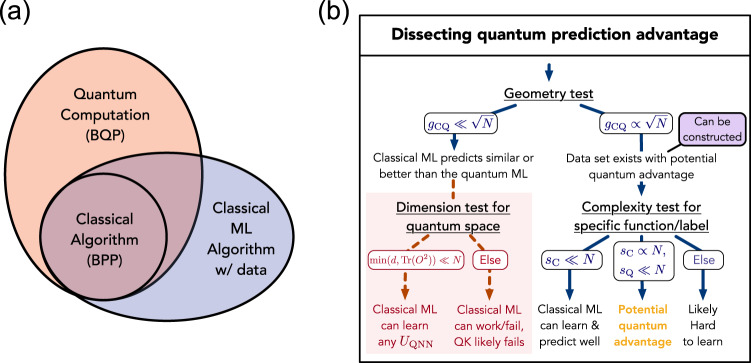
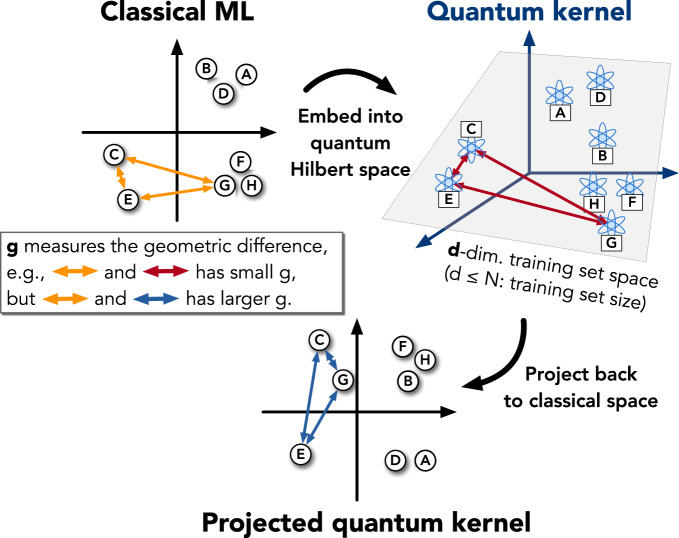
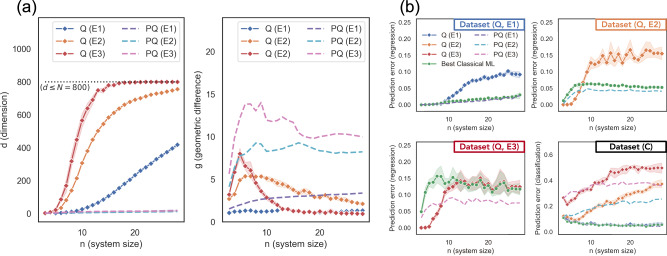
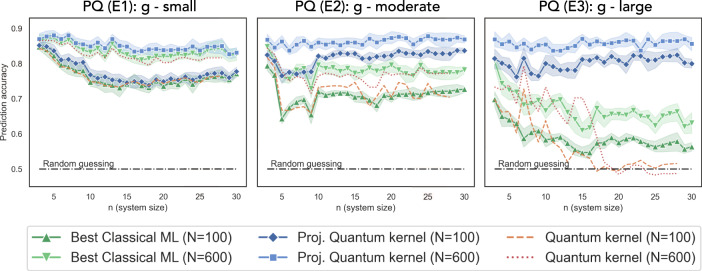
The use of quantum computing for machine learning is among the most exciting prospective applications of quantum technologies. However, machine learning tasks where data is provided can be considerably different than commonly studied computational tasks. In this work, we show that some problems that are classically hard to compute can be easily predicted by classical machines learning from data. Using rigorous prediction error bounds as a foundation, we develop a methodology for assessing potential quantum advantage in learning tasks. The bounds are tight asymptotically and empirically predictive for a wide range of learning models. These constructions explain numerical results showing that with the help of data, classical machine learning models can be competitive with quantum models even if they are tailored to quantum problems. We then propose a projected quantum model that provides a simple and rigorous quantum speed-up for a learning problem in the fault-tolerant regime. For near-term implementations, we demonstrate a significant prediction advantage over some classical models on engineered data sets designed to demonstrate a maximal quantum advantage in one of the largest numerical tests for gate-based quantum machine learning to date, up to 30 qubits.
Overview
The claims and statistics of this paper haven’t been checked yet.
Free: it reads the open-access text and checks the first 5 claims that cite a source we can check. Create a free account to check every claim.
Integrity signals
Registry
Cites
Statistics
Figures
Verification
Claims the paper makes
The claims and statistics of this paper haven’t been checked yet.
Free: it reads the open-access text and checks the first 5 claims that cite a source we can check. Create a free account to check every claim.
Claims other papers make about this one
Each is checked against this paper’s own text: does it say what the citing paper says it does?
The source backs part of the claim, not all of it — or backs it for a different population, condition or comparison.
In the citing paper
“measures such as the effective dimension have been motivated from an information-theoretic standpoint and depend on the Fisher information”
From The power of quantum neural networks (2021) · cites this paper as [21]
Experimental — accuracy not yet measuredThe cited source says what the claim attributes to it.
In the citing paper
“For instance, in [57], it is shown how the quality and the amount of data can sensibly affect the performance of classical and QML models in such a way that the quantum advantage is not always guaranteed.”
From On Circuit-Based Hybrid Quantum Neural Networks for Remote Sensing Imagery Classification (2022) · cites this paper as [57]
The cited source says what the claim attributes to it.
In the citing paper
“However, there is not a shared consensus on how and when QML can be advantageous with respect to its classical counterpart on general classes of problems.”
From On Circuit-Based Hybrid Quantum Neural Networks for Remote Sensing Imagery Classification (2022) · cites this paper as [57]
In the citing paper
“a quantity that describes the geometry of a model's parameter space and is essential in both statistics and machine learning [20-22].”
From The power of quantum neural networks (2021) · cites this paper as [21]
Self-check
Percentages, sums and reported differences re-computed from the paper’s own numbers.
The self-check needs the paper’s full text.
Citations
Cites
Breiman, L. (2001) · Machine Learning · doi:10.1023/a:1010933404324 · Cited by 133,538
Cortes, C., & Vapnik, V. (1995) · Machine Learning · doi:10.1007/bf00994018 · Cited by 59,421
Hohenberg, P., & Kohn, W. (1964) · Physical Review · doi:10.1103/physrev.136.b864 · Cited by 53,541
Learning with Kernels: Support Vector Machines, Regularization, Optimization, and Beyond
Schölkopf, B., & Smola, A. J. (2001) · The MIT Press eBooks · doi:10.7551/mitpress/4175.001.0001 · Cited by 11,703
Libsvm : A library for support vector machines
Ferrari, V. (2008) · Medical Entomology and Zoology · Cited by 10,123
Least Squares Support Vector Machine Classifiers
Suykens, J. A. K., & Vandewalle, J. (1999) · Neural Processing Letters · doi:10.1023/a:1018628609742 · Cited by 9,362
Density-Functional Theory for Time-Dependent Systems
Runge, E., & Gross, E. K. U. (1984) · Physical Review Letters · doi:10.1103/physrevlett.52.997 · Cited by 8,914
A fast quantum mechanical algorithm for database search
Grover, L. K. (1996) · Proceedings of the twenty-eighth annual ACM symposium on Theory of computing - STOC '96 · doi:10.1145/237814.237866 · Cited by 8,830
Re-epithelialization and immune cell behaviour in an ex vivo human skin model
Rakita, A., Nikolić, N., Mildner, M., Matiasek, J., & Elbe-Bürger, A. (2020) · Scientific Reports · doi:10.1038/s41598-019-56847-4 · Cited by 8,228
Quantum supremacy using a programmable superconducting processor
Arute, F., Arya, K., Babbush, R., Bacon, D., Bardin, J. C., Barends, R., Biswas, R., Boixo, S., Brandao, F. G. S. L., Buell, D. A., et al. (2019) · Nature · doi:10.1038/s41586-019-1666-5 · Cited by 7,720
Self-citation
Cited by
Items 701–800 of 925
Simple measurements and efficient optimization of linear optical networks
Ray, S. M., Smith, A. M., Koch, D., Ellis, S., Tison, C. C., & Alsing, P. M. (2025) · Quantum Computing, Communication, and Simulation · doi:10.1117/12.3043503
Enhancing Machine Learning with Quantum Methods
Hickmann, M. L., Lange, M., & Rieser, H.-M. (2025) · European Symposium on Artificial Neural Networks, Computational Intelligence and Machine Learning (ESANN) · doi:10.14428/esann/2025.es2025-29
Quantum QSAR for drug discoveryPreprint
Caruso, M., Giraldo, A., Ruiz, D., & Bellomo, G. (2025) · ChemRxiv · doi:10.26434/chemrxiv-2025-l2t8v
Subject Review:AI-Driven Security in Quantum Machine Learning:Vulnerabilities,Threats, and Defenses
Abbas, F. N., Ghanim, M. R., & Saleh, R. N. (2025) · International Journal of Engineering Research and Advanced Technology · doi:10.31695/ijerat.2025.4.1 · Cited by 2
Variational quantum neural networks based on dynamic layerwise strategy
Qi, H., Zhang, L., Gong, C., Por, L. Y., & Gani, A. (2025) · The Journal of Supercomputing · doi:10.1007/s11227-025-07394-5 · Cited by 2
Hybrid classical-quantum computation of heat diffusion in multilayer materialsPreprint
Moradi, S. (2025) · Research Square · doi:10.21203/rs.3.rs-6887498/v1
Quantum Computing Use Cases and Impacts for the Aerospace Industry
Chung, C., Ward, T., & Dirgo, B. (2025) · IEEE Aerospace Conference (AERO) · doi:10.1109/aero63441.2025.11068435
“21 On an image classification dataset, QML has been shown to reduce error rates by more than 3x. 30 Anomaly detection has wide application, such as fault prediction, fault detection, root cause identification, predictive maintenance, unusual network activity, software error detection, and fraud…”
A multi-axis diagnostic framework for Hybrid Quantum-Classical Neural Networks in Empirical settingPreprint
Gore, P. (2025) · Research Square · doi:10.21203/rs.3.rs-7093575/v1
40516 Quantum Machine Learning for Sensor Fusion
Anoop, M. A., & Karthikeyan, P. (2025) · De Gruyter eBooks · doi:10.1515/9783111619323-016
Sadvakassova, A., & Yessenov, A. (2025) · Scientific Journal of Astana IT University · doi:10.37943/22jien1491
The influence of gravitational wave on tripartite quantum mutual information harvesting
Liu, S.-Y., Huang, X. L., & Wu, S.-M. (2025) · The European Physical Journal C · doi:10.1140/epjc/s10052-025-14566-3 · Cited by 1
Photons learn to classify with a quantum edge
Harris, N. C., & Bunandar, D. (2025) · Nature Photonics · doi:10.1038/s41566-025-01748-4
Comprehensive Survey of Classical and Quantum Image Compression Approaches using Neural Networks
Aher, R. N. (2025) · International Journal of Apllied Mathematics · doi:10.12732/ijam.v38i2s.184
“QCNNs can exploit quantum entanglement and interference to speed up computation compared to classical CNNs. QCNNs can be implemented using quantum circuits that are composed of quantum gates, such as the controlled-NOT gate and the Hadamard gate (Huang et al., 2021).”
Sharma, K., & Kumar, A. (2025) · International Conference on Multidisciplinary Research and Innovations in Engineering (MRIE) · doi:10.1109/mrie66930.2025.11156725
“Popular encoding approaches include [5], [6], [13]: basis encoding, amplitude encoding, angle encoding, instantaneous quantum polynomial (IQP) style encoding, Hamiltonian evolution ansatz encoding, and many more.”
Cui, Z., Zhang, P., & Tang, Y. (2026) · PRX Intelligence · doi:10.1103/s6zj-vzdp · Cited by 11
Abdolahi, R., Soleymani, M. R., & Hamouda, W. (2025) · International Conference on Communications · doi:10.1109/icc52391.2025.11161958
“To encode the projected arrays into a quantum circuit, we utilize dense angle encoding [21] to initialize each quantum register.”
Optimizer-dependent generalization bound for quantum neural networks
Zhu, C., Yao, H., Liu, Y., & Wang, X. (2025) · Quantum Machine Intelligence · doi:10.1007/s42484-025-00318-9 · Cited by 3
“This characteristic is extensively used to investigate the performance capabilities of QNNs (Huang et al. 2021a; Du et al. 2022; McClean et al. 2018; Yu et al. 2023).”
InfluentialQuantum annealing-based feature selection
Pranjić, D., Mummaneni, B. C., & Tutschku, C. (2025) · Neurocomputing · doi:10.1016/j.neucom.2025.131673 · Cited by 2
Xiong, N. N., Li, S., Chen, L., Liang, W., & Chen, Y. (2025) · IEEE Transactions on Green Communications and Networking · doi:10.1109/tgcn.2025.3626366 · Cited by 1
“The initial quantum state ˇˇ ψ 0 ˛ is transformed into the final state ˇˇ ψ L ˛ by this operator: This final state now contains the high-level features extracted from the graph, encoded in its amplitudes [23].”
Quantum Machine Learning Implementation Using Quantum Kernels Techniques
Mahapatra, S., Mishra, P., Dash, R. K., Patra, C., & Naik, B. C. (2025) · International Conference on Artificial Intelligence and Emerging Technologies (ICAIET) · doi:10.1109/icaiet65052.2025.11211202
Ho, M., Khoo, J. Y., Mak, A. M., & Carrazza, S. (2026) · Quantum Science and Technology · doi:10.1088/2058-9565/ae6a1c · Cited by 1
“Importantly, we show that even without access to pulse-level control, noise from the quantum computer can nonetheless be characterized and independently validated by our protocol.”
Abdillah, M. Z., & Nawangnugraeni, D. A. (2025) · Jurnal Teknik Informatika (Jutif) · doi:10.52436/1.jutif.2025.6.5.5030
LArTPC hit-based topology classification with quantum machine learning and symmetry considerations
Duffy, C., Jastrzebski, M., Vergani, S., Whitehead, L. H., Cross, R., Blake, A., Malik, S. A., & Marshall, J. (2025) · Physical review. D/Physical review. D. · doi:10.1103/byy5-zk73
“While the search for practical quantum advantages in QML remains an active area of research, significant strides have been made theoretically [35–40].”
Position Paper: Quantum Neural Networks - A Paradigm Shift in AI or a Theoretical Promise?
Kashif, M., & Shafique, M. (2025) · International Joint Conference on Neural Networks (IJCNN) · doi:10.1109/ijcnn64981.2025.11227994 · Cited by 6
“…argue that quantum mechanics provides unique capabilities that classical models cannot replicate: • Enhanced Feature Space: QNNs can process data in exponentially large Hilbert spaces, enabling them to represent complex correlations that are computationally infeasible for classical networks [78].”
Quantum algorithms for causal estimands
Goel, R. S., Myers, C. R., & Shrapnel, S. (2025) · Quantum Science and Technology · doi:10.1088/2058-9565/ae20b8 · Cited by 1
Noise-Robust Quantum Generative Models for Distribution Learning and Efficient Data LoadingPreprint
Mandusia, A. K. (2025) · Research Square · doi:10.21203/rs.3.rs-8001093/v1
Quantum feature-map learning with reduced resource overhead
Jäger, J., Elsässer, P., & Torabian, E. (2026) · Physical Review Research · doi:10.1103/v29j-rh32 · Cited by 3
“…which is thus evaluated on a quantum computer and constructed from quantum feature-maps as (cid:12)(cid:12)(cid:10) (cid:12)(cid:12) (cid:0) (cid:1) (cid:12)(cid:12) (cid:11)(cid:12)(cid:12) Note that other quantum kernel formulations exist besides this quantum fidelity kernel definition [60].”
QSEA: Quantum Self‐Supervised Learning with Entanglement Augmentation
Li, L., Ni, X., Li, J., Qin, S., & Gao, F. (2025) · Advanced Quantum Technologies · doi:10.1002/qute.202500530 · Cited by 3
“[18–20], quantum machine learning has emerged as a trans-formative research frontier in image processing, exemplified by pioneering models like Quantum Neural Networks [21–25]. evolved to address the growing demand for label-efficient feature learning in quantum-enhanced systems.”
Sahin, M. E., Madgwick, M., Strudwick, J., Sehra, V., Wallis, O., Javidi, H., Carrieri, A. P., Parida, L., Jehi, L. E., Mensa, S., et al. (2025) · IEEE International Conference on Quantum Computing and Engineering (QCE) · doi:10.1109/qce65121.2025.00197
“The PQK method [10] uses reduced density matrices RDMs, ρ k ( x ) using classical shadows.”
Khmelnytskyi, A., Gordienko, Y. G., & Stirenko, S. (2025) · Computation · doi:10.3390/computation13120278 · Cited by 1
“Quantum machine learning (QML) has rapidly evolved as a field that integrates the representational power of quantum computation with the methodological framework of classical machine learning [4–6].”
Afaq, M. (2025) · IEEE Open Journal of the Communications Society · doi:10.1109/ojcoms.2025.3639435
“Additionally, empirical benchmarking results demonstrate that circuits with little or no entanglement, as well as models with small geometric differences, often produce comparable performance to their classical counterparts [19], [20], [21].”
InfluentialQuantum–Classical Hybrid LSTM Model for PM2.5 Forecasting in Bangkok
Wongkrasaemongkol, R. (2025) · doi:10.1109/incit66780.2025.11276072 · Cited by 1
False Memory via Quantum Tunnelling: A Photosynthetic Simulation of Social Cyber Engineering Risks
Merat, S., & Almuhtadi, W. (2025) · IEEE International Conference on Consumer Electronics - Berlin (ICCE-Berlin) · doi:10.1109/icce-berlin67488.2025.11277867
Temporal-spatial quantum graph convolutional neural network
Qu, Z. (2025) · Elsevier eBooks · doi:10.1016/b978-0-44-330259-6.00011-6 · Cited by 1
Quantum AI for Dark Web Narcotics Detection: A Hybrid Cybersecurity Framework
Silva-Atencio, G. (2025) · EAI Endorsed Transactions on AI and Robotics · doi:10.4108/airo.10248
“The needed empirical support for quantum usefulness in operational cybersecurity is provided by its validation during a six-month multi-agency deployment [47].”
Variational Quantum Eigensolver for Clinical Biomarker Discovery: A Multi-Qubit Model
González, J. P. A., Sánchez-Adame, M., & Montiel, O. (2025) · Axioms · doi:10.3390/axioms15010023 · Cited by 2
“QML has been applied to various domains, from methods based on quantum kernels to improve predictive accuracy [7] to applications in data analysis such as breast cancer detection and image classification [8].”
Formal reasoning about Bernstein-Vazirani algorithm
Sun, H., Shi, Z., Chen, S., Wang, G., Li, X., & Guan, Y. (2026) · Journal of Logical and Algebraic Methods in Programming · doi:10.1016/j.jlamp.2025.101108
Quantum Machine Learning Empowerment for Cloud Security: A Comprehensive Literature Review
Chandrasekhar, T., Lanka, D. R., Venkatesh, M., & Sankar, G. S. (2026) · Studies in big data · doi:10.1007/978-3-032-00586-1_21
49Chapter 3 A summary chapter on quantum generative adversarial networks (quantum GANs)
Raj, P., & Dhaya, R. (2025) · De Gruyter eBooks · doi:10.1515/9783111354934-003
Goyal, K., & Pathak, A. (2025) · International Conference on AI-ML Systems (AIMLSystems) · doi:10.1109/aimlsystems67835.2025.11331164
“Recent work has demonstrated certified quantum advantages for specific dataset classes [6], though these advantages remain problem-specific rather than universal.”
Structured Quantum Neural Networks Inspired by Multi-Head Attention Mechanisms
Lyu, C. (2025) · International Conference on Electronic Information Engineering and Computer Technology (EIECT) · doi:10.1109/eiect68017.2025.11331713
“Quantum machine learning (QML) aims to harness quantum computation to represent and process information in ways that may surpass the capabilities of classical neural networks [1], [2].”
Characterizing Scaling Trends of Post-Compilation Circuit Resources for NISQ-Era QML Models
Bhattacharjee, R., Escofet, P., Rodrigo, S., Abadal, S., Almudéver, C. G., & Alarcón, E. (2025) · IEEE International Conference on Quantum Artificial Intelligence (QAI) · doi:10.1109/qai63978.2025.00059
“Although several works have demonstrated that these methods can outperform classical ones in specific regimes [6]–[9], particularly in small-scale learning tasks [10], [11], these studies provide no insight into how these methods scale, especially in terms of their implementability on near-term…”
Enhancing Credit Risk Prediction Through Co-Trained Hybrid Quantum Transfer Learning Model
Gopakumar, P., Rubell Marion Lincy, G., Sinno, S., & Thuravakkath, S. (2025) · IEEE International Conference on Quantum Artificial Intelligence (QAI) · doi:10.1109/qai63978.2025.00021
“However, QML faces significant challenges including hardware limitations (qubit count, coherence time and noise susceptibility), generalization gaps between theoretical proposals and practical implementations and limited benchmarking studies on real-world datasets [7] [8].”
Quantum informative analysis for weather of San Francisco
Kotb, Y., Youssef, A. A., Nassr, D. I., & Bahig, H. M. (2026) · Scientific Reports · doi:10.1038/s41598-025-33459-9
Benchmarks of the Quantum Inner Product as the BLAS Solver in the Multiple Quantum-Related Scenarios
Pan, K., Liang, W., Xu, F., He, L., & Ma, Y. (2026) · Communications in computer and information science · doi:10.1007/978-981-95-4791-3_9
Wang, S., & Chattopadhyay, A. (2026) · Computer architecture and design methodologies · doi:10.1007/978-981-95-6039-4_2
Toward quantum science- and technology-enabled heterogeneous catalysis
Sudrajat, H., & Hartuti, S. (2026) · Journal of Materials Chemistry A · doi:10.1039/d5ta08272b · Cited by 1
Kim, H., & Ko, J. H. (2026) · International Journal of Pattern Recognition and Artificial Intelligence · doi:10.1142/s0218001426520051
Encoding Gridded Atmospheric Data with Classical and Quantum Methods
Sládek, D. (2026) · Annals of Geophysics · doi:10.4401/ag-9424
“Exponential/amplitude encoding Hardware efficiency, expressivity Complex spatial features (Rath and Date, 2023; Shin et al., 2022; Huang et al., 2021).”
InfluentialA Review of the Role of Quantum Computing in Simulating Molecular Interaction
Kaalra, A., Srivastava, A., Awasthi, S., & Pachauri, P. (2025) · IEEE Uttar Pradesh Section Women in Engineering International Conference on Electrical, Electronics and Computer Engineering (UPWIECON) · doi:10.1109/upwiecon67212.2025.11390421
“…of improvements, including adaptive ansätze such as ADAPT-VQE, where circuits are built iteratively using energy gradients; hardware-efficient ansätze tailored for specific qubit topologies; and optimization techniques like quantum natural gradient to increase convergence in parameter space [9].”
Jang, H., Yang, S., Cho, Y., Kim, J., & Chung, D. (2026) · Quantum Machine Intelligence · doi:10.1007/s42484-026-00346-z
“Huang et al. ( 2021 ) showed that QML models can learn complex classifi - cation boundaries with fewer training samples than classical machine learning methods, highlighting the data efficiency of quantum approaches.”
STQS: A Unified System Architecture for Spatial Temporal Quantum Sensing
Jebraeilli, A., Liu, C., Yin, K., Stein, S., Lentz, E., Ding, Y., & Li, A. (2026) · ACM Transactions on Quantum Computing · doi:10.1145/3795881 · Cited by 4
“In the STQS framework, QML methods are mapped onto key functional modules to refine sensing performance and mitigate the effects of noise through real-time feedback and iterative optimization.”
Markov chain decision-making with quantum-assisted entropy kernels
Peretz, O., & Koren, M. (2026) · Discover Quantum Science · doi:10.1007/s44464-026-00010-2
“Theory quantifies the trade-offs and shows that highly expressive circuits may yield exponentially vanishing kernel variance [26, 55], echoing barren-plateau phenomena [11, 36].”
Hardware-efficient quantum arithmetic logic units for square lattice architectures
Li, J. (2026) · Physica Scripta · doi:10.1088/1402-4896/ae4b73
NQ-SVM: Scalable Quantum Kernel Learning via Nyström-Based Support Vector MachinesPreprint
Do, D. T., Thudumu, S., Jayaraman, P. P., & Nguyen, D. T. (2026) · Research Square · doi:10.21203/rs.3.rs-8962794/v1
Kulkarni, H. G., Banerjee, A. R., Mandloi, T., Sridevi, S., Geetha, S. A. S., & Kar, G. (2026) · AVS Quantum Science · doi:10.1116/5.0310187
Munasinghe, T., Cornell, K. A., Hendler, J., Berg, G., & Wei, J. (2025) · IEEE International Conference on Big Data (BigData) · doi:10.1109/bigdata66926.2025.11401505 · Cited by 1
“The architecture, error rates, and connectivity of qubits directly influence the feasibility and performance of QML algorithms [22], [26].”
Don, A. K. K., & Khalil, I. (2026) · ACM Transactions on Multimedia Computing Communications and Applications · doi:10.1145/3801543
Manoharan, G., & Kumar, S. (2026) · Advances in computational intelligence and robotics book series · doi:10.4018/979-8-3373-4347-1.ch002
Zhang, H., Srinivasan, R. S., Chen, C., Yang, X., Ganesan, V., & Chen, M. (2026) · Building and Environment · doi:10.1016/j.buildenv.2026.114492 · Cited by 2
End-to-End Neural and Quantum Transcoding for Compressed Latent Representation under Channel Noise
Cha, H., Kim, W., & Lee, J. (2025) · Globecom · doi:10.1109/globecom59602.2025.11432215
“Therefore, the expectation value of the observable is Quantum machine learning employs the expectation value ⟨ O ⟩ = Tr( ρO ) as a crucial bridge between quantum and classical computation [13], [14].”
Jagannathan, S. K., Thomas Abraham, J. V., Yogesh, C., & Franklin Joel Benedict, T. (2026) · EPJ Web of Conferences · doi:10.1051/epjconf/202636001029 · Cited by 2
“Quantum kernel methods [40,31] and quantum neural networks [1,8] have shown empirical and, in some cases, provable advantages over classical counterparts [23,22].”
Noise-resilient quantum reinforcement learning
Yue, J.-C., & An, J. (2026) · Physical Review Applied · doi:10.1103/8gfc-2nsc · Cited by 1
“Running algorithms on quantum devices enables quantum machine learning to solve data processing, pattern recognition, and optimization problems more powerfully than its classical counterpart by exploiting quantum effects [1–3].”
Non-Equilibrium Dynamics of Quantum Many-Body Systems for Image Processing
Zhou, R., & Bayat, A. (2025) · Intelligent Autonomous Systems · doi:10.1109/icoias69065.2025.00008
“This trend highlights a fundamental principle in machine learning: increasing the volume of labeled data enriches the protocol’s representation of the input space, thereby strengthening its classification boundaries and enhancing generalization to un-seen examples [59], [60].”
A quantum-inspired classification for random mixed states
Sergioli, G., Cuccu, C., Rieger, C., Arango, A. C. G., Behera, B. K., Era, R., & Giuntini, R. (2026) · Scientific Reports · doi:10.1038/s41598-026-44068-5
Dutta, S. S., Sawant, I. M., Sridevi, S., Randhawa, G. S., Mistry, R., Ortega, J., Anandan, P., & Indira, B. (2026) · EPJ Quantum Technology · doi:10.1140/epjqt/s40507-026-00500-3
Krishna, J., Manasa, P., Kumar, P. D., Prathyusha, M., & Gokul, M. (2026) · International Journal of Data Science and IoT Management System · doi:10.64751/ijdim.2026.v5.n2.pp114-124
“Recent theoretical work [30], [31] suggests that quantum models can achieve exponential advantages in certain learning tasks, particularly those involving high-dimensional feature spaces and complex decision boundaries — precisely the characteristics of zero-day attack detection.”
Improving Scalability and Inference in Probabilistic Deep Models
Rossi, S. (2022) · theses.fr (ABES) · doi:10.70675/807ea578zd70dz4898zb642zb1cdc00dcd86
Circuit compilation and error mitigation for near-term quantum computing
Niu, S. (2022) · theses.fr (ABES) · doi:10.70675/4b9fc4d0z9683z4a8dz8643zc514443d2d75
Quantum many-body dynamics for combinatorial optimisation and machine learning
Dalyac, C. (2023) · theses.fr (ABES) · doi:10.70675/d8d31cecza123z48adz86b7ze8a30aaa7c58 · Cited by 4
Taisiq, S. A., & Toma, T. S. (2026) · Research Square · doi:10.21203/rs.3.rs-7580272/v1
Huang, H.-W., Yang, S.-L., Huang, C.-C., Chen, Y.-N., & Chen, H.-B. (2026) · Scientific Reports · doi:10.1038/s41598-026-66035-w · Cited by 3
“Among these algorithms, the quantum kernel method is widely adopted and is arguably the most promising approach for realizing such quantum advantage [22–24].”
Self-citationQuantum Techniques for Optimizing Algorithms in Natural Language Processing
Karanath, D., & Shankar, U. (2026) · International Conference on Visual Analytics and Data Visualization (ICVADV) · doi:10.1109/icvadv67766.2026.11470389
“The literature shows that in the short term, the most promising method is a mixed quantum and classical approach, while in the long term a fully quantum approach will be possibly as quantum computing hardware improves [14][15].”
Q 2 SAR: A Quantum Multiple Kernel Learning Approach for Drug Discovery
Giraldo, A., Ruiz, D., Caruso, M., Mancilla, J., & Bellomo, G. (2025) · IEEE CHILEAN Conference on Electrical, Electronics Engineering, Information and Communication Technologies (CHILECON) · doi:10.1109/chilecon66915.2025.11476277
“The kernel value is the fidelity between the states: (1) This process can map data into a richer feature space [18].”
2D Nanomaterials and AI-Driven Control for Next-Generation Exoskeletons
Kone, I.-N., Charafeddine, J., Ayari, S., Houda, T., IBRAHIM, A. A. H., & Dhaher, Y. (2026) · International Conference on Automation, Robotics and Applications · doi:10.1109/icara69401.2026.11480284
“More recently, research has begun exploring hybrid quantum–classical learning paradigms for biomedical signal analysis, emphasizing enhanced generalization and interpretability in small-sample regimes [13], [14].”
Circuit Design based on Feature Similarity for Quantum Generative ModelingPreprint
Makarski, M., Kato, J., Sato, Y., & Yamamoto, N. (2026) · Research Square · doi:10.21203/rs.3.rs-8853286/v1 · Cited by 4
Jha, M., Chen, S. Y.-C., Kulkarni, C. M., & Kim, J. (2026) · Engineering Applications of Artificial Intelligence · doi:10.1016/j.engappai.2026.114991 · Cited by 2
Empirical Analysis of Quantum vs. Classical Kernels
Shreyas, R., Bhat, P. S., & Patil, M. M. (2026) · 2026 International Conference on Next-Gen Quantum and Advanced Computing: Algorithms, Security, and Beyond (NQComp) · doi:10.1109/nqcomp68334.2026.11497688
“However, it struggles to capture complex, non-local correlations where the class label depends on the parity or logical relationship between distant features rather than their geometric proximity[8].”
Contextuality-Informed Randomized Kernels for Qutrit Classification
Gao, J.-Y. (2026) · International Conference on Quantum Communications, Networking, and Computing (QCNC) · doi:10.1109/qcnc69040.2026.00155
Learning Gaussian Processes with Randomized Quantum Local Kernels
Aaraba, A., Cherkaoui, S., Ahmad, O. S., Laprade, J., & Wang, S. (2026) · International Conference on Quantum Communications, Networking, and Computing (QCNC) · doi:10.1109/qcnc69040.2026.00108
“This produces, for each r and x , a vector of local expectation values ϕ r ( x ) ∈ R m which we interpret as a quantum–generated feature vector [14].”
InfluentialQAGO: evolving quantumness through genetic optimization of quantum circuits
Yogaraj, K., Quanz, B., Agrawal, S., Mondal, A., & Mondal, S. (2026) · Quantum Science and Technology · doi:10.1088/2058-9565/ae6acc
“resulting advantage remains data-dependent [ 5 ].”
InfluentialQuantum Machine Learning in Climate Change Using IoT Devices
Darwish, D. A. M. (2026) · Studies in computational intelligence · doi:10.1007/978-981-95-6276-3_6
Pan, Y., Tsai, M. H., Jiang, H., Chen, J., You, W., Zhou, Y., Zhang, W., Lyngaas, I., Wang, Y., & Liu, T. (2026) · Research Square · doi:10.21203/rs.3.rs-9740811/v1 · Cited by 1
The dawn of quantum AI in nuclear medicine: an EANM perspective
Papp, L., Visvikis, D., Sollini, M., Shi, K., & Kirienko, M. (2026) · The EANM Journal · doi:10.1016/j.eanmj.2026.100227
Application of a Quantum-Inspired-Classical Hybrid Model in Bearing Fault Diagnosis
Ma, Y., Wang, K., Yang, M., Luo, K., Dong, F., Han, M., Ma, Y., Wang, X., & Wang, X. (2026) · IEEE Sensors Journal · doi:10.1109/jsen.2026.3693785
“By simulating quantum principles through classical computing architectures, they retain theoretical advantages while being implementable on existing hardware, thereby opening new directions for intelligent industrial diagnostics [26].”
Karthiga, M., Joseph, E. R., Patil, S., & Saranya, K. C. (2026) · Frontiers in Behavioral Neuroscience · doi:10.3389/fnbeh.2026.1797210
“Quantum kernel research and data eÿciency studies also indicate the opportunities of quantum models during the noisy intermediate-scale quantum (NISQ) era (Huang et al., 2021; Wang et al., 2021).”
Kumar, L., Rajaan, R., Choudhary, N., & Sharma, A. (2026) · International Journal of Advanced Engineering Research and Science · doi:10.22161/ijaers.131.5
“Sources: [14], [17], [25], [30], [36].”
Muttumthala, N. L., & Kiani, A. (2026) · Results in Engineering · doi:10.1016/j.rineng.2026.111221
Validating a Koopman-quantum hybrid paradigm for diagnostic denoising of fusion devices
Wang, T.-J., Zhang, R.-Q., Qian, L., Song, Y.-T., Lan, T., Liu, H.-Q., & Li, K. (2026) · Science China Physics Mechanics and Astronomy · doi:10.1007/s11433-026-2962-1 · Cited by 2
“This creates an acute input bottleneck: how to encode high-dimensional, chaotic, and noise-contaminated classical data into the limited quantum register without information loss, while simultaneously ensuring trainability and interpretability [6, 12, 13]?”
Modern Data Structures for Machine Learning: A Comprehensive Survey and Future Directions
Muskan, Mehrotra, S., Nagappan, P., & Kumar, H. (2026) · Lecture notes in networks and systems · doi:10.1007/978-3-032-20606-0_38
Sánchez, J., Sáez‐Ortuño, L., Forgas‐Coll, S., & Huertas-García, R. (2026) · JOINETECH (International Journal of Economic and Technological Studies) · doi:10.65479/joinetech.27
Sindayigaya, J. M. V. (2026) · International Journal of Electronics and Telecommunications · doi:10.24425/ijet.2026.157908
“On the other side of the cryptographic threat, quantum computing presents trans-formative opportunities through the field of Quantum Machine Learning (QML), which is seen as one of the most promising future applications [29].”
Varun, S., & Abirami, S. (2026) · International Conference on Emerging Trends in Advancements and Applications of Computational Intelligence Techniques (ETAACT) · doi:10.1109/etaact69135.2026.11541506
“We show that, although classical SVM performs decently, QSVM performs significantly better than classical SVM by leveraging the complexity of nonlinear feature interactions using quantum-enhanced feature mapping [8]–[10].”
Quantum physics-informed neural network for scattered wavefields
Duarte, D. H. G., de Lima, P. D. S., de Palhares, A. B., Varela, J. M., de Araújo, J. M., & Chaves, R. (2026) · International Journal of Modern Physics C · doi:10.1142/s0129183126430096
Quantum-Enhanced Vision Transformer for Flood Detection Using Remote Sensing Imagery
Maity, S., & Ghanbarian, B. (2026) · IEEE Dallas Circuits and Systems Conference (DCAS) · doi:10.1109/dcas69364.2026.11544239 · Cited by 1
“Within the QML framework, classical input features are mapped into quantum states using a quantum feature map, typically encoded into qubits or qudits [7].”
Quantum Kernels for Parity-Structured Classification: A Hybrid Pipeline
Pandey, T. (2026) · IEEE Dallas Circuits and Systems Conference (DCAS) · doi:10.1109/dcas69364.2026.11544464
“We do not interpret this as a general claim of "quantum advantage" in the complexity-theoretic sense [9]; rather, it highlights the importance of representation design in quantum machine learning [6]-matching circuit structure and encoding to the problem's combinatorial symmetry.”
Novel Quantum Ensemble Machine Learning Models for IoT Intrusion Detection
Okekeogbu, C. C., Mostafa, S. A., & Patooghy, A. (2026) · IEEE Dallas Circuits and Systems Conference (DCAS) · doi:10.1109/dcas69364.2026.11544356
k, D., & Swetha, H. (2026) · bioRxiv (Cold Spring Harbor Laboratory) · doi:10.64898/2026.06.07.730687
Quantum image representation-based quantum neural networks for binary classification
Tiwari, A., Siyanwal, S., Sakhuja, S., Kumar, S., & Tyagi, P. (2026) · The Journal of Supercomputing · doi:10.1007/s11227-026-08621-3 · Cited by 1
Metadata
- Authors
- Huang, H.-Y., Broughton, M., Mohseni, M., Babbush, R., Boixo, S., Neven, H., & McClean, J. R.
- Affiliations
- California Institute of Technology (US)
- Google (United States) (US)
- Corresponding author
- McClean, Jarrod R.
- Venue
- Nature Communications
- Published
- 2021-05-11
- Volume
- 12
- Issue
- 1
- Pages
- 2631-2631
- ISSN
- 2041-1723 (ISSN-L)
- PMC
- PMC8113501
- OpenAlex
- W3096052452
- Cited by
- 896
- References
- 67
- Citations by year
- 2026: 220 · 2025: 220 · 2024: 157 · 2023: 140 · 2022: 107 · 2021: 52
- FWCI
- 39.93
- Type
- journal article
- Language
- en
- Open access
- gold
- doi.org
- Licence
- cc-by
- creativecommons.org/licenses/by/4.0 (tdm)
- creativecommons.org/licenses/by/4.0 (vor)
- Locations
- Nature Communications (publishedVersion, cc-by)
- PubMed Central (publishedVersion, cc-by)
- PubMed (publishedVersion)
- arXiv (Cornell University) (submittedVersion)
- CaltechAUTHORS (California Institute of Technology) (submittedVersion, cc-by)
- RePEc: Research Papers in Economics (submittedVersion)
- DOAJ (DOAJ: Directory of Open Access Journals) (submittedVersion, cc-by-sa)
- arXiv (Cornell University)
- Bulletin of the American Physical Society
- Topics
- Physical Sciences › Computer Science › Artificial Intelligence › Quantum Computing Algorithms and Architecture
- Physical Sciences › Physics and Astronomy › Atomic and Molecular Physics, and Optics › Quantum many-body systems
- Physical Sciences › Physics and Astronomy › Atomic and Molecular Physics, and Optics › Quantum Information and Cryptography
- Keywords
- quantum machine learning, quantum advantage, prediction error bounds, classical machine learning, fault-tolerant quantum computing, gate-based quantum computing, quantum-classical comparison
About these checks
Registry, retraction, Cites and statistics results are computed, not judged, with one exception: a printed reference that no index lists is read once by a model before it counts as a citation error. Claims are extracted by a model and kept only when their quote appears verbatim in the text; each cited source is then checked, with a model’s help, for whether it says what the claim relies on. Those verdicts can be wrong — read the claim’s quote and the cited source before relying on one.
Statistics and arithmetic are recomputed, not judged.
Confidence bands are shown only for fields calibrated on our annotated test set. None is calibrated yet, so no band is shown.
What counts as a claim ›How we measure confidence ›How we check this ›
Are you an author, or do you see a problem with this page? Request a review
Data sources
Bibliographic data: Semantic Scholar, OpenAlex, Crossref.
Contains information from the Semantic Scholar Academic Graph Datasets, made available under the ODC Attribution License (ODC-BY 1.0).
Semantic Scholar’s data is described in: Kinney, R., et al. (2023). The Semantic Scholar Open Data Platform. arXiv:2301.10140.
