

Power of data in quantum machine learning
Open accessThe DOI matches its Crossref record; 67 of the 69 references it cites were found in a registry or an index.
Abstract
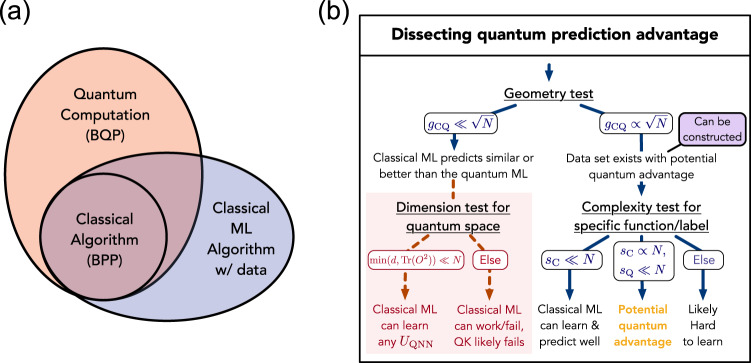
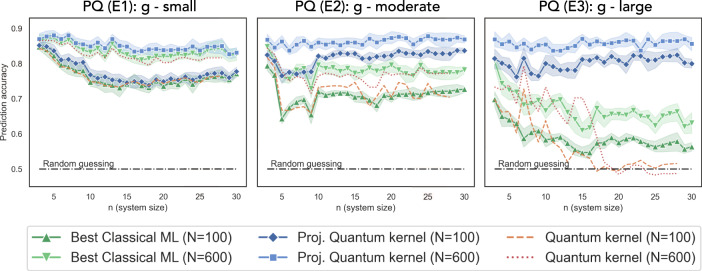
The use of quantum computing for machine learning is among the most exciting prospective applications of quantum technologies. However, machine learning tasks where data is provided can be considerably different than commonly studied computational tasks. In this work, we show that some problems that are classically hard to compute can be easily predicted by classical machines learning from data. Using rigorous prediction error bounds as a foundation, we develop a methodology for assessing potential quantum advantage in learning tasks. The bounds are tight asymptotically and empirically predictive for a wide range of learning models. These constructions explain numerical results showing that with the help of data, classical machine learning models can be competitive with quantum models even if they are tailored to quantum problems. We then propose a projected quantum model that provides a simple and rigorous quantum speed-up for a learning problem in the fault-tolerant regime. For near-term implementations, we demonstrate a significant prediction advantage over some classical models on engineered data sets designed to demonstrate a maximal quantum advantage in one of the largest numerical tests for gate-based quantum machine learning to date, up to 30 qubits.
Overview
The claims and statistics of this paper haven’t been checked yet.
Free: it reads the open-access text and checks the first 5 claims that cite a source we can check. Create a free account to check every claim.
Integrity signals
Registry
Cites
Statistics
Figures
Verification
Claims the paper makes
The claims and statistics of this paper haven’t been checked yet.
Free: it reads the open-access text and checks the first 5 claims that cite a source we can check. Create a free account to check every claim.
Claims other papers make about this one
Each is checked against this paper’s own text: does it say what the citing paper says it does?
The source backs part of the claim, not all of it — or backs it for a different population, condition or comparison.
In the citing paper
“measures such as the effective dimension have been motivated from an information-theoretic standpoint and depend on the Fisher information”
From The power of quantum neural networks (2021) · cites this paper as [21]
Experimental — accuracy not yet measuredThe cited source says what the claim attributes to it.
In the citing paper
“For instance, in [57], it is shown how the quality and the amount of data can sensibly affect the performance of classical and QML models in such a way that the quantum advantage is not always guaranteed.”
From On Circuit-Based Hybrid Quantum Neural Networks for Remote Sensing Imagery Classification (2022) · cites this paper as [57]
The cited source says what the claim attributes to it.
In the citing paper
“However, there is not a shared consensus on how and when QML can be advantageous with respect to its classical counterpart on general classes of problems.”
From On Circuit-Based Hybrid Quantum Neural Networks for Remote Sensing Imagery Classification (2022) · cites this paper as [57]
In the citing paper
“a quantity that describes the geometry of a model's parameter space and is essential in both statistics and machine learning [20-22].”
From The power of quantum neural networks (2021) · cites this paper as [21]
Self-check
Percentages, sums and reported differences re-computed from the paper’s own numbers.
The self-check needs the paper’s full text.
Citations
Cites
Breiman, L. (2001) · Machine Learning · doi:10.1023/a:1010933404324 · Cited by 133,538
Cortes, C., & Vapnik, V. (1995) · Machine Learning · doi:10.1007/bf00994018 · Cited by 59,421
Hohenberg, P., & Kohn, W. (1964) · Physical Review · doi:10.1103/physrev.136.b864 · Cited by 53,541
Learning with Kernels: Support Vector Machines, Regularization, Optimization, and Beyond
Schölkopf, B., & Smola, A. J. (2001) · The MIT Press eBooks · doi:10.7551/mitpress/4175.001.0001 · Cited by 11,703
Libsvm : A library for support vector machines
Ferrari, V. (2008) · Medical Entomology and Zoology · Cited by 10,123
Least Squares Support Vector Machine Classifiers
Suykens, J. A. K., & Vandewalle, J. (1999) · Neural Processing Letters · doi:10.1023/a:1018628609742 · Cited by 9,362
Density-Functional Theory for Time-Dependent Systems
Runge, E., & Gross, E. K. U. (1984) · Physical Review Letters · doi:10.1103/physrevlett.52.997 · Cited by 8,914
A fast quantum mechanical algorithm for database search
Grover, L. K. (1996) · Proceedings of the twenty-eighth annual ACM symposium on Theory of computing - STOC '96 · doi:10.1145/237814.237866 · Cited by 8,830
Re-epithelialization and immune cell behaviour in an ex vivo human skin model
Rakita, A., Nikolić, N., Mildner, M., Matiasek, J., & Elbe-Bürger, A. (2020) · Scientific Reports · doi:10.1038/s41598-019-56847-4 · Cited by 8,228
Quantum supremacy using a programmable superconducting processor
Arute, F., Arya, K., Babbush, R., Bacon, D., Bardin, J. C., Barends, R., Biswas, R., Boixo, S., Brandao, F. G. S. L., Buell, D. A., et al. (2019) · Nature · doi:10.1038/s41586-019-1666-5 · Cited by 7,720
Self-citation
Cited by
Items 401–500 of 925
Several fitness functions and entanglement gates in quantum kernel generation
Wang, H. (2025) · Quantum Machine Intelligence · doi:10.1007/s42484-024-00233-5 · Cited by 11
“In this pursuit of quantum advantage, the quantum kernel method via support vector machine has emerged as a powerful approach, drawing attention from various research groups [3, 9, 11, 12, 18, 19, 22, 23, 25, 27, 29, 31, 32, 35, 49].”
Nonclassical kernels in continuous-variable systems
Ghobadi, R. (2021) · Physical Review A · doi:10.1103/physreva.104.052403 · Cited by 6
Xie, J., & Dong, Y. (2023) · Chinese Physics B · doi:10.1088/1674-1056/accb45 · Cited by 6
Rademacher complexity of noisy quantum circuitsPreprint
Bu, K., Koh, D. E., Li, L., Luo, Q., & Zhang, Y. (2021) · arXiv (Cornell University) · doi:10.48550/arxiv.2103.03139 · Cited by 19
“[14] Hsin-Yuan Huang, Michael Broughton, Masoud Mohseni, Ryan Babbush, Sergio Boixo, Hartmut Neven, and Jarrod R McClean, “Power of data in quantum machine learning,” arXiv preprint arXiv:2011.”
BackgroundEDA-Q: Electronic Design Automation for Superconducting Quantum Chip
Zhao, B., Li, Z., Yu, X., Yuan, B., Zhang, C., Gao, Y., Wang, W., Mu, Q., Wang, S., Sun, H., et al. (2025) · IEEE Transactions on Computer-Aided Design of Integrated Circuits and Systems · doi:10.1109/tcad.2025.3580341 · Cited by 10
“Quantum computing has significant potential for efficiently solving specific problems in areas such as machine learning [1] [2] [3], cryptography [4] [5], and chemistry [6] due to its inherent quantum superposition and entanglement properties.”
Ogut, M. Z., Karaduman, M., Bozdağ, P. G., Karaköse, M., & Yildirim, M. (2026) · Biomedicines · doi:10.3390/biomedicines14010183 · Cited by 6
Exploring quantum learning in the smart grid through the evolution of noisy finite fourier series
Nader, A., Dubois, M.-A., & Kundur, D. (2023) · Frontiers in Energy Research · doi:10.3389/fenrg.2023.1061602 · Cited by 7
Quantum Assisted Architectures for Wireless Systems, the Case of Quantum 6G
Mohammed, A. A., Bounceur, A., & Hammoudeh, M. A. A. (2023) · International Conference on Future Networks and Distributed Systems (ICFNDS) · doi:10.1145/3644713.3644806 · Cited by 6
CDQKL: Consensus-Based Distributed Quantum Kernel Learning
Ma, W., Liu, M., & Deng, R. (2024) · International Conference on Quantum Communications, Networking, and Computing (QCNC) · doi:10.1109/qcnc62729.2024.00015 · Cited by 8
“Compared with traditional machine learning, quantum kernel learning (QKL) has demonstrated the quantum advantages in speed [5] and expression capability [6] by mapping original features to the quantum state Hilbert space.”
BackgroundSam Joshua, A., Babu, N. R., & Balasubramaniam, P. (2025) · Quantum Machine Intelligence · doi:10.1007/s42484-025-00249-5 · Cited by 5
“The potential bene-fits of combining quantum computing (QC) and ML (Huang et al. 2021) are examined in the area of research referred to as quantum ML (QML).”
Exploring the Synergy Between Neuro-Inspired Algorithms and Quantum Computing in Machine Learning
Nithya, G., Praveen Kumar, R., Dineshbabu, V., Umamaheswari, P., & Kalaivani, T. (2025) · International Journal of Computational and Experimental Science and Engineering · doi:10.22399/ijcesen.2484 · Cited by 5
On the similarity of bandwidth-tuned quantum kernels and classical kernels
Flórez-Ablan, R., Roth, M., & Schnabel, J. (2025) · Quantum Science and Technology · doi:10.1088/2058-9565/ade7ad · Cited by 15
“Although a rigorous quantum advantage of QKs has been proven for the discrete logarithm problem based on a Shor-type data encoding [27], an overall advantage of QKs over classical ML methods on real-world problems and more realistic data encodings has not yet been achieved [6, 8, 28–30].”
InfluentialSeeking metal–organic frameworks for hydrogen storage using classical and quantum active learning
Lourenço, M. P., Shukla, R., Naseri, M., Gaur, D. R., Singh, U., Gusarov, S., & Salahub, D. R. (2025) · Physical Chemistry Chemical Physics · doi:10.1039/d5cp02747k · Cited by 5
RDQKL: Robust Decentralized Quantum Kernel Learning for Noisy and Adversarial Environment
Ma, W., Chen, K., Yu, S., Liu, M., & Deng, R. (2025) · IEEE International Conference on Quantum Computing and Engineering (QCE) · doi:10.1109/qce65121.2025.00238 · Cited by 8
“As a QML paradigm [27], similar to quantum neural networks, quantum kernel learning has demonstrated the potential to achieve quantum advantage in terms of both training speed [28] and expressivity [19].”
Supervised Quantum Machine Learning: A Future Outlook from Qubits to Enterprise Applications
Thudumu, S., Fisher, J., & Du, H. (2025) · IEEE International Conference on Quantum Artificial Intelligence (QAI) · doi:10.1109/qai63978.2025.00075 · Cited by 9
“Quantum models operate in exponentially large Hilbert spaces, which in theory provide a broader representational capacity than classical models [3].”
Hardware-Aware Quantum Kernel Design Based on Graph Neural Networks
Meng, F., Liu, Y., Wang, L., Li, S., Han, Z., & Liu, L. (2026) · Entropy · doi:10.3390/e28080855 · Cited by 10
Probabilistic fusion of crowds and experts for the search of gravitational waves
Ruiz, P., Morales-Álvarez, P., Coughlin, S. B., Molina, R., & Katsaggelos, A. K. (2022) · Knowledge-Based Systems · doi:10.1016/j.knosys.2022.110183 · Cited by 5
Research on task scheduling scheme for quantum computing cloud platform
Zhang, M., Fu, Y., Wang, J., & Lai, J. (2022) · International Conference on Cloud and Big Data Computing (ICCBDC) · doi:10.1145/3555962.3555964 · Cited by 7
Groppe, S., Groppe, J., Çalıkyılmaz, U., Winker, T., & Gruenwal, L. (2023) · Lecture notes of the Institute for Computer Sciences, Social Informatics and Telecommunications Engineering · doi:10.1007/978-3-031-35081-8_20 · Cited by 5
Recurrent quantum embedding neural network and its application in vulnerability detection
Song, Z., Zhou, X., Xu, J., Ding, X., & Shan, Z. (2024) · Scientific Reports · doi:10.1038/s41598-024-63021-y · Cited by 12
Dimension Reduction and Redundancy Removal through Successive Schmidt Decompositions
Daskin, A., Gupta, R., & Kais, S. (2023) · Applied Sciences · doi:10.3390/app13053172 · Cited by 9
“This can be done in two different ways [14, 15, 20, 21]: i) as done in neural networks, we use one qubit for each feature xi.”
MethodQuantum Learning and Its Related Applications for the Future
Bhowmik, B. R., & Manjunath, T. D. (2023) · Advances in systems analysis, software engineering, and high performance computing book series · doi:10.4018/978-1-6684-6697-1.ch002 · Cited by 5
Framework for learning and control in the classical and quantum domains
Vedaie, S. S., Dalal, A., Paez, E. J., & Sanders, B. C. (2023) · Annals of Physics · doi:10.1016/j.aop.2023.169471 · Cited by 8
6G Networks Orientation by Quantum Mechanics
Henrique, P. S. R., & Prasad, R. (2022) · Journal of ICT Standardization · doi:10.13052/jicts2245-800x.1013 · Cited by 6
“Therefore, ML and Quantum Computing create a new scientific framework known as Quantum Machine Learning (QML) [43].”
Optimisation-free density estimation and classification with quantum circuits
Vargas-Calderón, V., Gonzalez, F. A., & Vinck-Posada, H. (2022) · Quantum Machine Intelligence · doi:10.1007/s42484-022-00074-0 · Cited by 6
Multiclass classification of hyperspectral remote sensed data using QSVC
Pai, A. G., Buddhiraju, K. M., & Durbha, S. S. (2022) · SPIE Conference on Remote Sensing for Agriculture, Ecosystems, and Hydrology · doi:10.1117/12.2648471 · Cited by 6
“Huang, 10 proved classical machines improved their performance accuracy with increase in data and become computationally more powerful and this advantage is lost with quantum machines.”
BackgroundHybrid Quantum-Classical Convolutional Neural Network for Allen Telescope SETI image Classification
Yadav, A., Sridevi, S., Prassana Kumar, R., & Balachandran, S. (2023) · International Conference on Computing, Communication and Networking Technologies (ICCCNT) · doi:10.1109/icccnt56998.2023.10308102 · Cited by 5
“Due to its increased speed and calculation, quantum computing became extremely successful when it was combined with machine learning for applications like predictions, classifications, and optimizations [15] and [16].”
MethodQuantum Machine Learning: Enhancing AI With Quantum Computing
Subbiah, P., Krishnaraj, N., & Bellam, K. (2024) · Advances in computer and electrical engineering book series · doi:10.4018/979-8-3693-1168-4.ch008 · Cited by 5
Accelerating variational quantum algorithms with multiple quantum processorsPreprint
Du, Y., Qian, Y., & Tao, D. (2021) · arXiv (Cornell University) · doi:10.48550/arxiv.2106.12819 · Cited by 14
“[23] Hsin-Yuan Huang, Michael Broughton, Masoud Mohseni, Ryan Babbush, Sergio Boixo, Hartmut Neven, and Jarrod R McClean.”
BackgroundKernel mean embedding vs kernel density estimation: A quantum perspective
Berquin, Y. (2024) · Physics Letters A · doi:10.1016/j.physleta.2024.130047 · Cited by 4
Training Quantum Self-Attention Model in Near-Term Quantum Computer
He, J., Kan, Y., & Xue, C. (2024) · International Conference on Wireless Communications and Signal Processing (WCSP) · doi:10.1109/wcsp62071.2024.10827420 · Cited by 4
Data-dependent generalization bounds for parameterized quantum models under noise
Khanal, B., & Rivas, P. (2025) · The Journal of Supercomputing · doi:10.1007/s11227-025-06966-9 · Cited by 8
Conditional diffusion-based parameter generation for quantum approximate optimization algorithm
Meng, F., Zhou, X., Zhu, P., & Luo, Y. (2025) · EPJ Quantum Technology · doi:10.1140/epjqt/s40507-025-00397-4 · Cited by 12
Chen, Z., Zhao, S.-L., Liu, Q., Wu, J., Xie, C., Han, X., Gong, J., Sun, H., Qiao, J. C., Song, W., et al. (2025) · Materials Characterization · doi:10.1016/j.matchar.2025.115586 · Cited by 5
Quantum kernel method for learning graph data via quantum walk
Cao, L., & Wang, Y. (2025) · Physical Review A · doi:10.1103/k2nx-d649 · Cited by 5
Li, G., Luo, J., Wang, Q., Liu, L., Wei, C., Wang, H., & Zhang, Z. (2025) · Engineering Applications of Artificial Intelligence · doi:10.1016/j.engappai.2025.112974 · Cited by 4
Enhancing graph learning with quantum structural encoding
Lei, Y., Chen, G., Chen, H., Lv, J., & Yang, L. (2025) · Neurocomputing · doi:10.1016/j.neucom.2025.132054 · Cited by 7
Hybrid quantum tensor networks for aeroelastic applications
Hickmann, M. L., Alves, P., Quero, D., Schwenker, F., & Rieser, H.-M. (2025) · Quantum Machine Intelligence · doi:10.1007/s42484-025-00327-8 · Cited by 6
Sajjad, I., Alshanbari, H. M., Almazah, M. M. A., Louati, H., & Rauf, S. (2025) · AIMS Mathematics · doi:10.3934/math.20251168 · Cited by 4
Lin, C.-H., Lin, J.-T., Chiu, P.-Y., Chen, S., & Lin, C. (2025) · IEEE Transactions on Geoscience and Remote Sensing · doi:10.1109/tgrs.2025.3634242 · Cited by 10
“…fact that deep learning has its inherent noise robustness [64], we would like to stress that PennyLane and other platforms like Cirq are credible and almost the most commonly used quantum simulation platforms, frequently used to develop various quantum deep learning methods [36], [67], [68].”
Double Descent in Quantum Kernel Methods
Kempkes, M., Ijaz, A., Gil-Fuster, E., Bravo-Prieto, C., Spiegelberg, J., van Nieuwenburg, E., & Dunjko, V. (2026) · PRX Quantum · doi:10.1103/cn64-gs6b · Cited by 26
“[62, 63].”
Routh, A., & Singh, J. (2025) · IEEE Access · doi:10.1109/access.2025.3639110 · Cited by 5
Hand Gesture Recognition Using Quantum Inspired Neural Networks with sEMG
Olivia, G., Jacob, P. M., Kishore, T., & Subathra, M. S. P. (2026) · SN Computer Science · doi:10.1007/s42979-025-04662-2 · Cited by 4
“Huang et al. has proposed a model [8, 10 ] for analyzing the sample complexity and data requirements of quantum machine learning.”
Blockchain with proof of quantum work
Amin, M. H. S., Raymond, J., Kinn, D., Miller, G., Hamze, F., Hamer, K., Pasvolsky, J., Bernoudy, W., King, A. D., & Kortas, S. (2026) · Physical Review A · doi:10.1103/m9jd-z9my · Cited by 9
Gupta, S., Hariprasad, Y., Iyengar, S. S., Gurappa, S., & Mohanty, P. (2026) · Digital Threats Research and Practice · doi:10.1145/3794846 · Cited by 10
High-Accuracy Temporal Prediction via Experimental Quantum Reservoir Computing in Correlated Spins
Hou, Y., Hua, J., Wu, Z., Xia, W., 陈, Y. 昱. C., Li, X., Li, Z., Peng, X., & Du, J. (2026) · Physical Review Letters · doi:10.1103/r8ww-qw7j · Cited by 37
Emerging Paradigm of Quantum Machine Learning: Knowledge Insights and Future Prospects
Rawat, K. S., & Sharma, T. K. (2026) · IEEE Transactions on Artificial Intelligence · doi:10.1109/tai.2026.3669545 · Cited by 7
“This leads to better expressivity, faster inference, and more efficient training, even in realistic noise conditions [9], [10].”
Quantum kernel and HHL-based support vector machines for multi-class classification
Pinheiro, G., Slabbert, D., Kowada, L. A. B., & Petruccione, F. (2026) · EPJ Quantum Technology · doi:10.1140/epjqt/s40507-026-00484-0 · Cited by 9
“We focus on two quantum classification approaches: the quantum-enhanced support vector machine (QSVM) [7, 25, 26], which leverages quantum kernel evaluation, and a HHL-based least-squares support vector machine (HHL LS-SVM) [27], which uses a quantum linear systems algorithm for training.”
A review of quantum machine learning algorithms, applications, and emerging advantages
Gokhale, S. S., Dhote, R. R., & Delhibabu, R. (2026) · Discover Computing · doi:10.1007/s10791-026-10085-1 · Cited by 11
Li, W., & Ran, S.-J. (2022) · Mathematics · doi:10.3390/math10060940 · Cited by 8
Realization of Long Short-Term Memory Networks on Quantum Circuits
Hou, X., Yang, Y., & Wang, X. (2022) · Asian Control Conference (ASCC) · doi:10.23919/ascc56756.2022.9828335 · Cited by 6
Wrobel, N., Baul, A., Tam, K.-M., & Moreno, J. (2022) · Quantum Reports · doi:10.3390/quantum4040042 · Cited by 10
Shipping inspection trial of quantum machine learning toward sustainable quantum factory
Tomono, T., & Natsubori, S. (2023) · PHM Society Asia-Pacific Conference · doi:10.36001/phmap.2023.v4i1.3733 · Cited by 4
“The other is a kernel estimation neural network, which proposes a methodology to assess the potential quantum advantage in a learning task (Huang et al., 2021).”
MethodTran, Q. H., Endo, Y., & Oshima, H. (2025) · Physical Review A · doi:10.1103/fm4p-wl5d · Cited by 5
“However, to enhance scalability for large-scale quantum data, efficient quantum kernels such as the quantum projected kernel [44] or the shadow tomography kernel [45] can be utilized to estimate the density ratio effectively.”
Quantum word embedding for machine learning
Nguyen, P.-N. (2024) · Physica Scripta · doi:10.1088/1402-4896/ad6299 · Cited by 8
Drug Target Interaction prediction using Variational Quantum classifier
Sathan, D., & Baichoo, S. (2024) · International Conference on Next Generation Computing Applications (NextComp) · doi:10.1109/nextcomp63004.2024.10779674 · Cited by 6
Measurement-based quantum computation from Clifford quantum cellular automata
Nautrup, H. P., & Briegel, H. J. (2024) · Physical Review A · doi:10.1103/physreva.110.062617 · Cited by 4
“[10], we consider a regression task with input data from the fashion MNIST dataset [12] composed of 28 × 28 -pixel images of clothes.”
Predicting properties of quantum systems by regression on a quantum computer
Kardashin, A., Balkybek, Y., Palyulin, V. V., & Antipin, K. V. (2025) · Physical Review Research · doi:10.1103/physrevresearch.7.013201 · Cited by 6
Power Characterization of Noisy Quantum Kernels
Wang, Y., Qi, B., Wang, X., Liu, T., & Dong, D. (2025) · IEEE Transactions on Neural Networks and Learning Systems · doi:10.1109/tnnls.2025.3545545 · Cited by 11
“As in [13], we first transform each original 28 × 28 grayscale image into a 10-”
InfluentialLearning Robust Observable to Address Noise in Quantum Machine Learning
Khanal, B., & Rivas, P. (2025) · Communications in computer and information science · doi:10.1007/978-3-031-85884-0_4 · Cited by 6
Quantum Transfer Learning for Enhanced Diabetic Retinopathy Detection Using ResNet Architecture
Gupta, V., Dash, Y., Sarangi, S. C., & Abraham, A. (2025) · Lecture notes in networks and systems · doi:10.1007/978-3-031-81080-0_53 · Cited by 4
An Interpretable Quantum Adjoint Convolutional Layer for Image Classification
Wang, S., Wang, M., Zhao, R.-X., Liu, L., & Wang, Y. (2025) · IEEE Transactions on Cybernetics · doi:10.1109/tcyb.2025.3567090 · Cited by 5
“The closed-box structure of QCLs typically projects classical data into the high-dimensional Hilbert space in a manner that is often careless, without considering storage efficiency and optimization of mapping time [39].”
Cattan, G., Olmos, J., Chauhan, Y., & Martínez, F. (2025) · Quantum Machine Intelligence · doi:10.1007/s42484-025-00286-0 · Cited by 4
“Similarly, Huang et al. illustrated the advantage of quantum methods in data-limited scenarios, confirming the potential of quantum kernels to efficiently leverage small training samples while maintaining high classification accuracy (Huang et al. 2021).”
SU(d)-symmetric random unitaries: quantum scrambling, error correction, and machine learning
Li, Z., Zheng, H., Wang, Y., Jiang, L., Liu, Z.-W., & Liu, J. (2025) · npj Quantum Information · doi:10.1038/s41534-025-01045-6 · Cited by 23
“…recentlydrawnsigni fi cant attraction due to its fundamental relevance in theoretical physics and rich phenomena displayed therein, including quantum information scrambling 1 – 10 , quantum error correction 11 – 15 , quantum machine learning 16 – 22 , and random benchmarking protocols 23 – 25 .”
Single-qudit quantum neural networks for multiclass classification
de Souza, L. C., & Portugal, R. (2025) · Quantum Information Processing · doi:10.1007/s11128-025-04998-x · Cited by 6
“Although still in its early stages, QML has shown promise in enhancing classical machine learning by improving data representation, accelerating computation, and introducing novel feature extraction techniques [8, 9].”
Anonymous, Jäger, J., & Krems, R. V. (2026) · Physical Review A · doi:10.1103/6hbr-kj64 · Cited by 11
“The proposed approaches include covariant quantum kernels [25], quantum kernel bandwidth methods [26], quantum Fisher kernels [27], and projected quantum kernel methods [28].”
Quantum Machine Learning Applications to Address Climate Change: A Short Review
Lachure, S., Lohidasan, A., Tiwari, A., Dhabu, M. M., & Bokde, N. D. (2023) · Advances in systems analysis, software engineering, and high performance computing book series · doi:10.4018/978-1-6684-6697-1.ch004 · Cited by 8
Korkmaz, U., Sanga, C., & Türkpençe, D. (2022) · Lecture notes of the Institute for Computer Sciences, Social Informatics and Telecommunications Engineering · doi:10.1007/978-3-031-01984-5_13 · Cited by 4
Synthetic weather radar using hybrid quantum-classical machine learningPreprint
Enos, G. R., Reagor, M. J., Henderson, M. P., Young, C. M., Horton, K. G., Birch, M., & Rigetti, C. T. (2021) · arXiv (Cornell University) · doi:10.48550/arxiv.2111.15605 · Cited by 4
“In Huang et al. [2021], the authors outline a protocol to compare how two kernel methods, one classical and one quantum, would perform on a specified data set. This protocol involves computing a kernel matrix for each method and then looking at the geometric difference between the two. If the difference is favorably s…”
InfluentialBenchmarking of Quantum SVM and Classical ML Algorithms for Prediction of Therapeutic ProteinsPreprint
Tijare, P. A., Mehta, N. K., & Raghava, G. P. S. (2025) · bioRxiv (Cold Spring Harbor Laboratory) · doi:10.1101/2025.04.30.651419 · Cited by 5
“[42][61] The computational cost and hardware constraints of QSVM remain largely unexamined .”
The Nexus of AI and Energy: A Unified Framework for Intelligent Future
Krzywański, J., Kijo–Kleczkowska, A., Georgiev, A., Ashraf, W. M., Rao, A., Iliev, I. K., Taler, J., & Nowak, W. (2026) · Energies · doi:10.3390/en19010245 · Cited by 4
“Quantum Computing and Quantum Machine Learning (QML) offer a revolutionary approach to solving currently intractable problems [31–34].”
Chan, S., Kulkarni, P., Yi, P. H., & Parekh, V. S. (2024) · IEEE International Conference on Quantum Computing and Engineering (QCE) · doi:10.1109/qce60285.2024.00073 · Cited by 8
“While quantum advantage typically refers to runtime improvements, potential advantages may also exist in sample efficiency, generalizability, expressibility, and trainability [2]–[4].”
On the Differential Topology of Expressivity of Parameterized Quantum Circuits
Barzen, J., & Leymann, F. (2025) · AppliedMath · doi:10.3390/appliedmath5030121 · Cited by 5
“A Quantum Neural Network (QNN) is also a parameterized quantum circuit [4].”
InfluentialToward Quantum Image Generation on Single Qubit Using Quantum Information Bottleneck
Zhu, Y., Aggarwal, V., Konar, D., Pashkin, Y. A., Angelov, P. P., & Jiang, R. (2025) · IEEE Transactions on Artificial Intelligence · doi:10.1109/tai.2025.3615187 · Cited by 3
“T HE fusion of quantum computing and machine learning offers transformative efficiency gains and adversarial robustness [1], [2], yet confronts three noisy intermediate-scale quantum (NISQ)-era constraints: 1) hardware limitations [3]; 2) error susceptibility from incoherent and noise [4]; and 3)…”
Parameter-efficient quantum anomaly detection method on a superconducting quantum processor
Wang, M., Jiang, J., & Coveney, P. V. (2025) · Physical Review Research · doi:10.1103/cv9y-2cnj · Cited by 9
“Additionally, quantum kernel methods have been explored for pattern recognition tasks, leveraging quantum computing to improve the representational power of kernels for supervised learning [8, 30, 31].”
Pitfalls when tackling the exponential concentration of parameterized quantum models
Saem, R. A., Tafreshi, B., Holmes, Z., & Thanasilp, S. (2026) · Quantum Science and Technology · doi:10.1088/2058-9565/ae2202 · Cited by 9
“…apply not only to optimization strategies for losses, but also extend to various non-variational QML models such as quantum kernel methods [10–12, Lastly, as a by-product of our main theoretical results, we contribute to the fundamental understanding of quantum landscape theory by proving…”
Quantum Machine Learning With Limited Data: A Remote Sensing Perspective
Shaik, R. U., Yılmaz, Z., Imran, S., Alimo, R., Alipour, M., & Taciroğlu, E. (2025) · IEEE International Geoscience and Remote Sensing Symposium (IGARSS) · doi:10.1109/igarss55030.2025.11243912 · Cited by 5
“Various studies have shown that quantum SVMs can effectively train on smaller datasets compared to classical SVMs [15].”
Learning reduced representations for quantum classifiers
Odagiu, P., Belis, V., Schulze, L., Barkoutsos, P. K., Grossi, M., Reiter, F., Dissertori, G., Tavernelli, I., & Vallecorsa, S. (2025) · Quantum Machine Intelligence · doi:10.1007/s42484-025-00331-y · Cited by 8
“…to biology, chemistry, and physics, remain inaccessible for Quantum Machine Learning (QML) algorithms, which surpass classical ML in a variety of specific tasks (Rebentrost et al. 2014, Liu et al. 2021, Muser et al. 2024, Huang et al. 2021, 2022, Pirnay et al. 2023, Gyurik and Dunjko 2023).”
Quantum kernel machine learning for autonomous materials science
Adams, F., Zhu, D., Steuerman, D., Kusne, A. G., & Takeuchi, I. (2026) · APL Quantum · doi:10.1063/5.0304141 · Cited by 4
Performance evaluation of quantum support vector machine for COVID-19 biomarker analysis
Choi, J., Yu, C., Jung, K. L., Foo, S., Chen, W., Comhair, S. A., Jehi, L. E., & Jung, J. U. (2026) · Computer Methods and Programs in Biomedicine · doi:10.1016/j.cmpb.2026.109343 · Cited by 5
Physics-informed machine learning for tumor microenvironment-responsive nanomedicine: Recent updates
Hasannia, M., Abounoori, A., Abounoori, M., Shirzad, M., Rahdar, A., Fathi-Karkan, S., & Ferreira, L. F. (2026) · Seminars in Oncology · doi:10.1016/j.seminoncol.2026.152498 · Cited by 3
Quantum computing applications in drug discovery
Li, J., Wei, L., Tong, H. H. Y., & Zou, Q. (2026) · Briefings in Bioinformatics · doi:10.1093/bib/bbag274 · Cited by 7
“Quantum modules are more suitable to provide support at the model level (see Section ‘Classical–quantum hybrid strategies for deep learning models’ for details) [ 45, 46].”
Pasupuleti, M. K. (2026) · International Journal of Academic and Industrial Research Innovations(IJAIRI) · doi:10.62311/nesx/rp1jy-30072026 · Cited by 63
Advance Quanvolutional Layers in Quantum Classical Hybrid Neural Networks for Image Processing
Singhal, P., & Joshi, P. (2024) · International Conference on Control, Automation and Robotics (ICCAR) · doi:10.1109/iccar61844.2024.10569440 · Cited by 3
“These advancements pave the way for more sophisticated and powerful machine learning models, capable of handling massive amounts of data and intricate computations with unprecedented speed [18].”
BackgroundScalable quantum dynamics compilation via quantum machine learning
Zhang, Y., Wiersema, R., Carrasquilla, J., Cincio, Ł., & Kim, Y. B. (2026) · Physical Review Research · doi:10.1103/wswv-nq6d · Cited by 25
Realizing Quantum Kernel Models at Scale with Matrix Product State Simulation
Metcalf, M., Andrés-Martínez, P., & Fitzpatrick, N. (2024) · International Conference for High Performance Computing, Networking, Storage and Analysis (SC) · doi:10.1109/sc41406.2024.00086 · Cited by 3
“Alternatively, one may use the projected quantum kernel approach to compute an observable set for each data point and get the kernel element classically [12].”
Estimation of mutual information via quantum kernel methods
Maeda, Y., Kawaguchi, H., & Tezuka, H. (2025) · Quantum Machine Intelligence · doi:10.1007/s42484-025-00263-7 · Cited by 6
“Then, by the Riesz representation theorem [22], we can find a mean element m k ( P ) satisfying for any probability measure P on X and f ∈ H k .”
Quantum kernels through the lens of entangled tensor kernels
Shin, S., Sweke, R., & Jeong, H. (2026) · Physical Review Research · doi:10.1103/c53t-rybw · Cited by 3
“More specifi-cally, it can lead to both poor generalization [14, 15], and the requirement of exponentially many measurements for evaluating the kernel [16].”
InfluentialA Survey of Quantum Reinforcement Learning Approaches: Current Status and Future Research Directions
Alomari, A., & Kumar, S. (2025) · IEEE Conference on Artificial Intelligence (CAI) · doi:10.1109/cai64502.2025.00283 · Cited by 12
“Other surveys in [55, 56, 57, 58] focus on specific QML approaches like quantum classification and prediction but fail to provide a comprehensive view of QRL or a full illustration of quantum computing in machine learning.”
Quantum Advantage in Non-Interactive Source Simulation
Salehi, H. A., Shirani, F., & Pradhan, S. S. (2025) · IEEE International Symposium on Information Theory (ISIT) · doi:10.1109/isit63088.2025.11195605 · Cited by 5
Distributed Quantum Neural Networks on Distributed Photonic Quantum Computing
Chen, K., Liu, C.-Y., Yu, S., Burt, F., & Leung, K. K. (2025) · IEEE International Conference on Quantum Computing and Engineering (QCE) · doi:10.1109/qce65121.2025.00165 · Cited by 7
“…data embedding necessitates deep circuits prone to decoherence [26], [27]; (ii) synchronous access to quantum hardware imposes latency incompatible with real-time applications [9]; and (iii) scaling to large models exacerbates the memory wall between quantum and classical subsystems [28].”
Quantum phases classification using quantum machine learning with SHAP-driven feature selection
Franco, G. S., Mahlow, F. R. P., Prado, P. B. B., Pexe, G. E. L., Rattighieri, L. A. M., & Fanchini, F. F. (2026) · Quantum Information Processing · doi:10.1007/s11128-026-05132-1 · Cited by 11
“Despite its potential advantages in specific applications [23, 24], QML faces significant challenges in the Noisy Intermediate-Scale Quantum (NISQ) era [25], where the availability of practical quantum computers remains very ∗ felipe.fanchini@unesp.br limited.”
Variational algorithm of quantum neural network based on quantum particle swarm
Dong, Y., Xie, J., Hu, W., Liu, C., & Luo, Y. (2022) · Journal of Applied Physics · doi:10.1063/5.0098702 · Cited by 3
Quantum Software Frameworks for Deep Learning
Ferreira, F. M. M. R., Fernandes, J. P., & Abreu, R. (2022) · Springer eBooks · doi:10.1007/978-3-031-05324-5_15 · Cited by 4
Baul, A., Fotso, H. F., Terletska, H., Tam, K.-M., & Moreno, J. (2025) · Quantum Reports · doi:10.3390/quantum7020018 · Cited by 9
Learning density functionals from noisy quantum data
Koridon, E., Frohnert, F., Prehn, E., van Nieuwenburg, E., Tura, J., & Polla, S. (2025) · Machine Learning Science and Technology · doi:10.1088/2632-2153/adcb89 · Cited by 4
“Such data, derived from the quantum simulation of complex systems, could significantly enhance the capabilities of classical ML models [25–27].”
Generalizing Reinforcement Learning-Based Quantum Circuit Synthesis across Multiple Topologies
Acampora, G., Cuzzocrea, A., Lapegna, M., Schiattarella, R., & Vitiello, A. (2025) · doi:10.1109/mcii64973.2025.11032620 · Cited by 5
“However, there is still a big gap between the current status of quantum computers and the promise that quantum computation offers in fields such as chemistry [4] or artificial intelligence [5].”
MPGP-QOC: Multi-programming and graph-partition-based QOC for QNN inference
Liu, Y. (2025) · Future Generation Computer Systems · doi:10.1016/j.future.2025.107966 · Cited by 4
Golec, M., Hatay, E. S., Gill, S. S., Mao, Y., & Buyya, R. (2025) · Elsevier eBooks · doi:10.1016/b978-0-443-29096-1.00010-6 · Cited by 5
Training an open quantum classifier
Korkmaz, U., Topal, M. C., Aygül, E. E., & Türkpençe, D. (2022) · International Symposium on Multidisciplinary Studies and Innovative Technologies (ISMSIT) · doi:10.1109/ismsit56059.2022.9932705 · Cited by 3
Metadata
- Authors
- Huang, H.-Y., Broughton, M., Mohseni, M., Babbush, R., Boixo, S., Neven, H., & McClean, J. R.
- Affiliations
- California Institute of Technology (US)
- Google (United States) (US)
- Corresponding author
- McClean, Jarrod R.
- Venue
- Nature Communications
- Published
- 2021-05-11
- Volume
- 12
- Issue
- 1
- Pages
- 2631-2631
- ISSN
- 2041-1723 (ISSN-L)
- PMC
- PMC8113501
- OpenAlex
- W3096052452
- Cited by
- 896
- References
- 67
- Citations by year
- 2026: 220 · 2025: 220 · 2024: 157 · 2023: 140 · 2022: 107 · 2021: 52
- FWCI
- 39.93
- Type
- journal article
- Language
- en
- Open access
- gold
- doi.org
- Licence
- cc-by
- creativecommons.org/licenses/by/4.0 (tdm)
- creativecommons.org/licenses/by/4.0 (vor)
- Locations
- Nature Communications (publishedVersion, cc-by)
- PubMed Central (publishedVersion, cc-by)
- PubMed (publishedVersion)
- arXiv (Cornell University) (submittedVersion)
- CaltechAUTHORS (California Institute of Technology) (submittedVersion, cc-by)
- RePEc: Research Papers in Economics (submittedVersion)
- DOAJ (DOAJ: Directory of Open Access Journals) (submittedVersion, cc-by-sa)
- arXiv (Cornell University)
- Bulletin of the American Physical Society
- Topics
- Physical Sciences › Computer Science › Artificial Intelligence › Quantum Computing Algorithms and Architecture
- Physical Sciences › Physics and Astronomy › Atomic and Molecular Physics, and Optics › Quantum many-body systems
- Physical Sciences › Physics and Astronomy › Atomic and Molecular Physics, and Optics › Quantum Information and Cryptography
- Keywords
- quantum machine learning, quantum advantage, prediction error bounds, classical machine learning, fault-tolerant quantum computing, gate-based quantum computing, quantum-classical comparison
About these checks
Registry, retraction, Cites and statistics results are computed, not judged, with one exception: a printed reference that no index lists is read once by a model before it counts as a citation error. Claims are extracted by a model and kept only when their quote appears verbatim in the text; each cited source is then checked, with a model’s help, for whether it says what the claim relies on. Those verdicts can be wrong — read the claim’s quote and the cited source before relying on one.
Statistics and arithmetic are recomputed, not judged.
Confidence bands are shown only for fields calibrated on our annotated test set. None is calibrated yet, so no band is shown.
What counts as a claim ›How we measure confidence ›How we check this ›
Are you an author, or do you see a problem with this page? Request a review
Data sources
Bibliographic data: Semantic Scholar, OpenAlex, Crossref.
Contains information from the Semantic Scholar Academic Graph Datasets, made available under the ODC Attribution License (ODC-BY 1.0).
Semantic Scholar’s data is described in: Kinney, R., et al. (2023). The Semantic Scholar Open Data Platform. arXiv:2301.10140.
