

Power of data in quantum machine learning
Open accessThe DOI matches its Crossref record; 67 of the 69 references it cites were found in a registry or an index.
Abstract
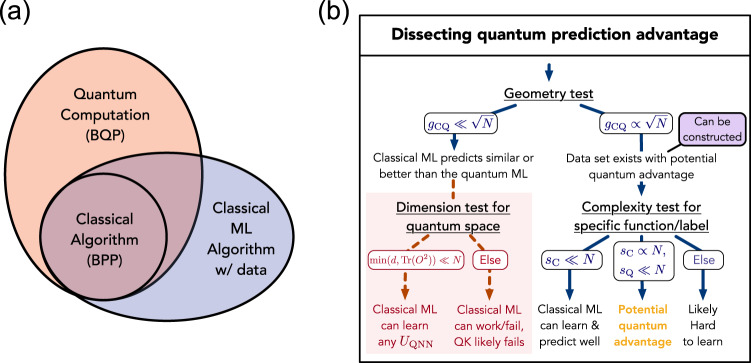
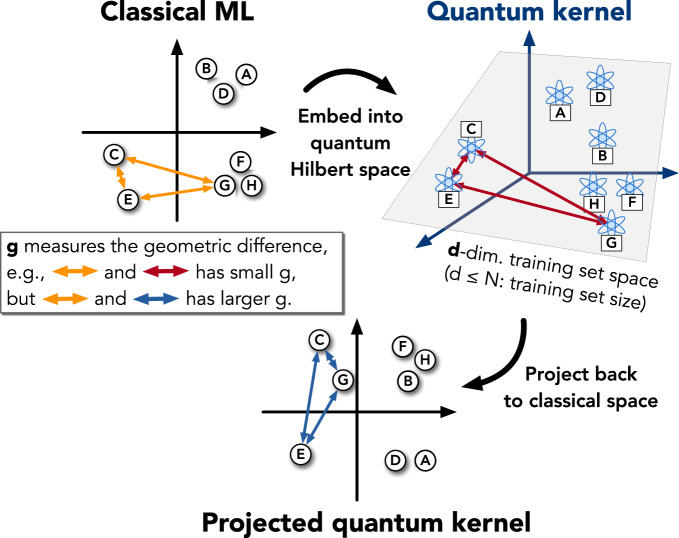
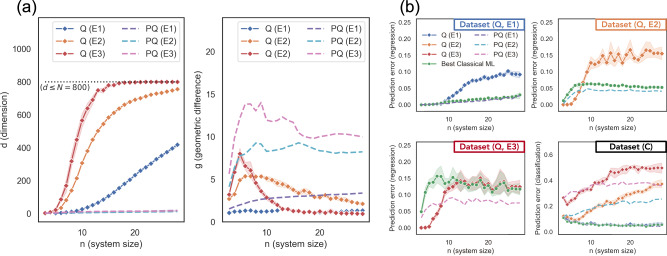
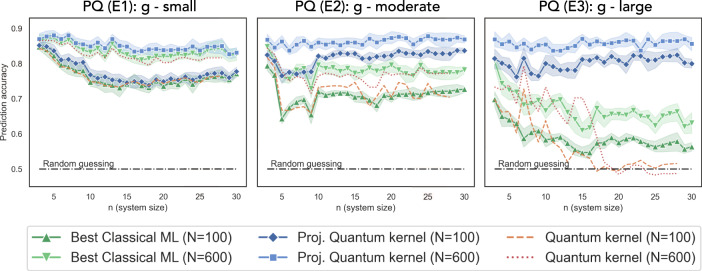
The use of quantum computing for machine learning is among the most exciting prospective applications of quantum technologies. However, machine learning tasks where data is provided can be considerably different than commonly studied computational tasks. In this work, we show that some problems that are classically hard to compute can be easily predicted by classical machines learning from data. Using rigorous prediction error bounds as a foundation, we develop a methodology for assessing potential quantum advantage in learning tasks. The bounds are tight asymptotically and empirically predictive for a wide range of learning models. These constructions explain numerical results showing that with the help of data, classical machine learning models can be competitive with quantum models even if they are tailored to quantum problems. We then propose a projected quantum model that provides a simple and rigorous quantum speed-up for a learning problem in the fault-tolerant regime. For near-term implementations, we demonstrate a significant prediction advantage over some classical models on engineered data sets designed to demonstrate a maximal quantum advantage in one of the largest numerical tests for gate-based quantum machine learning to date, up to 30 qubits.
Overview
The claims and statistics of this paper haven’t been checked yet.
Free: it reads the open-access text and checks the first 5 claims that cite a source we can check. Create a free account to check every claim.
Integrity signals
Registry
Cites
Statistics
Figures
Verification
Claims the paper makes
The claims and statistics of this paper haven’t been checked yet.
Free: it reads the open-access text and checks the first 5 claims that cite a source we can check. Create a free account to check every claim.
Claims other papers make about this one
Each is checked against this paper’s own text: does it say what the citing paper says it does?
The source backs part of the claim, not all of it — or backs it for a different population, condition or comparison.
In the citing paper
“measures such as the effective dimension have been motivated from an information-theoretic standpoint and depend on the Fisher information”
From The power of quantum neural networks (2021) · cites this paper as [21]
Experimental — accuracy not yet measuredThe cited source says what the claim attributes to it.
In the citing paper
“For instance, in [57], it is shown how the quality and the amount of data can sensibly affect the performance of classical and QML models in such a way that the quantum advantage is not always guaranteed.”
From On Circuit-Based Hybrid Quantum Neural Networks for Remote Sensing Imagery Classification (2022) · cites this paper as [57]
The cited source says what the claim attributes to it.
In the citing paper
“However, there is not a shared consensus on how and when QML can be advantageous with respect to its classical counterpart on general classes of problems.”
From On Circuit-Based Hybrid Quantum Neural Networks for Remote Sensing Imagery Classification (2022) · cites this paper as [57]
In the citing paper
“a quantity that describes the geometry of a model's parameter space and is essential in both statistics and machine learning [20-22].”
From The power of quantum neural networks (2021) · cites this paper as [21]
Self-check
Percentages, sums and reported differences re-computed from the paper’s own numbers.
The self-check needs the paper’s full text.
Citations
Cites
Breiman, L. (2001) · Machine Learning · doi:10.1023/a:1010933404324 · Cited by 133,538
Cortes, C., & Vapnik, V. (1995) · Machine Learning · doi:10.1007/bf00994018 · Cited by 59,421
Hohenberg, P., & Kohn, W. (1964) · Physical Review · doi:10.1103/physrev.136.b864 · Cited by 53,541
Learning with Kernels: Support Vector Machines, Regularization, Optimization, and Beyond
Schölkopf, B., & Smola, A. J. (2001) · The MIT Press eBooks · doi:10.7551/mitpress/4175.001.0001 · Cited by 11,703
Libsvm : A library for support vector machines
Ferrari, V. (2008) · Medical Entomology and Zoology · Cited by 10,123
Least Squares Support Vector Machine Classifiers
Suykens, J. A. K., & Vandewalle, J. (1999) · Neural Processing Letters · doi:10.1023/a:1018628609742 · Cited by 9,362
Density-Functional Theory for Time-Dependent Systems
Runge, E., & Gross, E. K. U. (1984) · Physical Review Letters · doi:10.1103/physrevlett.52.997 · Cited by 8,914
A fast quantum mechanical algorithm for database search
Grover, L. K. (1996) · Proceedings of the twenty-eighth annual ACM symposium on Theory of computing - STOC '96 · doi:10.1145/237814.237866 · Cited by 8,830
Re-epithelialization and immune cell behaviour in an ex vivo human skin model
Rakita, A., Nikolić, N., Mildner, M., Matiasek, J., & Elbe-Bürger, A. (2020) · Scientific Reports · doi:10.1038/s41598-019-56847-4 · Cited by 8,228
Quantum supremacy using a programmable superconducting processor
Arute, F., Arya, K., Babbush, R., Bacon, D., Bardin, J. C., Barends, R., Biswas, R., Boixo, S., Brandao, F. G. S. L., Buell, D. A., et al. (2019) · Nature · doi:10.1038/s41586-019-1666-5 · Cited by 7,720
Self-citation
Cited by
Items 101–200 of 925
Quantum pixel representations and compression for N-dimensional images
Amankwah, M. G., Camps, D., Bethel, E. W., Beeumen, R. V., & Perciano, T. (2022) · Scientific Reports · doi:10.1038/s41598-022-11024-y · Cited by 50
Entangled Datasets for Quantum Machine LearningPreprint
Schatzki, L., Arrasmith, A., Coles, P. J., & Cerezo, M. (2021) · arXiv (Cornell University) · doi:10.48550/arxiv.2109.03400 · Cited by 96
“[15] Hsin-Yuan Huang, Michael Broughton, Masoud Mohseni, Ryan Babbush, Sergio Boixo, Hartmut Neven, and Jarrod R McClean, “Power of data in quantum machine learning,” Nature Communications 12, 1–9 (2021).”
BackgroundFederated quanvolutional neural network: a new paradigm for collaborative quantum learning
Bhatia, A. S., Kais, S., & Alam, M. A. (2023) · Quantum Science and Technology · doi:10.1088/2058-9565/acfc61 · Cited by 51
Enhancing quantum adversarial robustness by randomized encodings
Gong, W., Dong, Y., Li, W., & Deng, D.-L. (2024) · Physical Review Research · doi:10.1103/physrevresearch.6.023020 · Cited by 65
Benchmarking Quantum Machine Learning Kernel Training for Classification Tasks
Álvarez-Estévez, D. (2025) · IEEE Transactions on Quantum Engineering · doi:10.1109/tqe.2025.3541882 · Cited by 52
“Recent work has explored alternative approaches, such as the use of projected kernels [14], or the optimization of the number of shots [31].”
How quantum computing can enhance biomarker discovery
Flöther, F. F., Blankenberg, D. J., Demidik, M., Jansen, K., Krishnakumar, R., Krishnakumar, R., Laanait, N., Parida, L., Saab, C. Y., & Utro, F. (2025) · Patterns · doi:10.1016/j.patter.2025.101236 · Cited by 62
“The authors of the manuscript [16] established a relation between the potential advantage in predictive accuracy of a model for a given dataset and a quantum kernel.”
Hamiltonian Operator Approximation for Energy Measurement and Ground-State Preparation
Bespalova, T. A., & Kyriienko, O. (2021) · PRX Quantum · doi:10.1103/prxquantum.2.030318 · Cited by 56
Quantum‐Noise‐Driven Generative Diffusion Models
Parigi, M., Martina, S., & Caruso, F. (2024) · Advanced Quantum Technologies · doi:10.1002/qute.202300401 · Cited by 67
“Even better, we could avoid the encoding of the classical data if we consider quantum data as any result arising from a quantum experiment [71] or produced directly by a quantum sensing technology [72].”
MethodOptimal training of variational quantum algorithms without barren plateausPreprint
Haug, T., & Kim, M. S. (2021) · arXiv (Cornell University) · doi:10.48550/arxiv.2104.14543 · Cited by 71
“Given that these kernels can be effi-ciently computed classically, they are unlikely to provide a direct quantum advantage from data in machine learning [55, 59, 61].”
BackgroundBayesian Quantum Neural Networks
Nguyen, N., & Chen, K. (2022) · IEEE Access · doi:10.1109/access.2022.3168675 · Cited by 52
“Reference [12] provides a theoretical prediction error bounds to assessing potential quantum advantage by using geometry test and complexity test for specific function or label.”
BackgroundA Survey on Intelligent Gesture Recognition Techniques
Ojeda-Castelo, J. J., Capobianco-Uriarte, M. D. L. M., Piedra-Fernandez, J. A., & Ayala, R. (2022) · IEEE Access · doi:10.1109/access.2022.3199358 · Cited by 50
“A topic that is booming at the moment is Quantum Computing and this field has also been involved in AI with the name of Quantum Machine Learning, for example in [93] the authors propose a methodology to evaluate the advantages offered by AI. quantum computing in learning tasks.”
MethodQuantum Transfer Learning for Real-World, Small, and High-Dimensional Remotely Sensed Datasets
Otgonbaatar, S., Schwarz, G., Datcu, M. P., & Kranzlmüller, D. A. (2023) · IEEE Journal of Selected Topics in Applied Earth Observations and Remote Sensing · doi:10.1109/jstars.2023.3316306 · Cited by 50
“In particular, we benchmarked and validated our QML networks placed on the top level of the frozen VGG16 network on the hard-to-classify three-class dataset, because these datasets play a very important role in QML [32].”
BackgroundMethodUnravelling physics beyond the standard model with classical and quantum anomaly detection
Schuhmacher, J., Boggia, L., Belis, V., Puljak, E., Grossi, M., Pierini, M., Vallecorsa, S., Tacchino, F., Barkoutsos, P. K., & Tavernelli, I. (2023) · Machine Learning Science and Technology · doi:10.1088/2632-2153/ad07f7 · Cited by 48
“…kernels will outperform classical kernels if there exists a Kernel matrix for the classification between SM events and artificial anomalies calculated on the IBM quantum processor ibm_cairo using 6 features (corresponding to 6 qubits). bias in the data that is hard to simulate classically [53, 54].”
MethodA Vision for the Future of Multiscale Modeling
Capone, M., Romanelli, M., Castaldo, D., Parolin, G., Bello, A., Gil, G., & Vanzan, M. (2024) · ACS Physical Chemistry Au · doi:10.1021/acsphyschemau.3c00080 · Cited by 48
Explaining quantum circuits with Shapley values: towards explainable quantum machine learning
Heese, R., Gerlach, T., Mücke, S., Müller, S., Jakobs, M., & Piatkowski, N. (2025) · Quantum Machine Intelligence · doi:10.1007/s42484-025-00254-8 · Cited by 77
“To identify possible advantages, the structure of the data seems to be key (Huang et al. 2021; Liu et al. 2021; Caro et al. 2022).”
Quantum self-supervised learning
Jaderberg, B., Anderson, L. W., Xie, W., Albanie, S., Kiffner, M., & Jaksch, D. (2022) · Quantum Science and Technology · doi:10.1088/2058-9565/ac6825 · Cited by 59
“Importantly, early evidence suggests that quantum models can achieve an advantage over their classical counter-parts, yet these works focus only on the supervised learning of either artificial data [36, 39] or simple historical datasets [38].”
BackgroundA Novel Efficient Quantum Random Access Memory
Zidan, M., Abdel‐Aty, A., Khalil, A., Abdel‐Aty, M., & Eleuch, H. (2021) · IEEE Access · doi:10.1109/access.2021.3119588 · Cited by 43
“Moreover, QRAM would provide an exponential speed up for pattern recognition algorithms [11]–[17].”
Quantum Phase Recognition via Quantum Kernel Methods
Wu, Y., Wu, B., Wang, J. B., & Yuan, X. (2023) · Quantum · doi:10.22331/q-2023-04-17-981 · Cited by 74
“Note that for a quantum state | ψ ( x ) i = U | 0 n , Ref [48] proposed an upper bound on estimating h ψ ( x ) |M| ψ ( x ) i in the case of a poly( n ) -depth U associated with | ψ ( x ) i .”
BackgroundMethodInfluentialQuantum feature maps for graph machine learning on a neutral atom quantum processor
Albrecht, B., Dalyac, C., Leclerc, L., Ortiz-Gutiérrez, L., Thabet, S., D'Arcangelo, M., Cline, J., Elfving, V. E., Lassablière, L., Silvério, H., et al. (2023) · Physical Review A · doi:10.1103/physreva.107.042615 · Cited by 66
“As shown in [26], classical ML algorithms can in certain instances learn efficiently from intractable quantum evolutions if they are allowed to be trained on data.”
BackgroundMethodInfluentialDeep Quantum-Transformer Networks for Multimodal Beam Prediction in ISAC Systems
Tariq, S., Arfeto, B. E., Khalid, U., Kim, S., Duong, T. Q., & Shin, H. (2024) · IEEE Internet of Things Journal · doi:10.1109/jiot.2024.3420455 · Cited by 55
“In settings involving large data sets and intricate patterns, QML has a distinct capability to surpass classical models, especially in learning effectively from limited training data [27], [28], [29], [30].”
BackgroundQuantum machine learning with Adaptive Boson Sampling via post-selection
Hoch, F., Caruccio, E., Rodari, G., Francalanci, T., Suprano, A., Giordani, T., Carvacho, G., Spagnolo, N., Koudia, S., Proietti, M., et al. (2025) · Nature Communications · doi:10.1038/s41467-025-55877-z · Cited by 74
“It is worth noting that the ABS scheme has the potential to go beyond quantum kernel methods (see Supplementary Note 7), which may display a limited advantage over classical strategies [60, 61].”
Exploring AI in metasurface structures with forward and inverse design
Yang, G., Xiao, Q., Zhang, Z., Yu, Z., Wang, X., & Lu, Q. (2025) · iScience · doi:10.1016/j.isci.2025.111995 · Cited by 55
“184 Using quantum characteristics can also solve some high-dimensional data problems that are difficult to deal with using classical machine learning.”
Experimental quantum-enhanced kernel-based machine learning on a photonic processor
Yin, Z., Agresti, I., de Felice, G., Brown, D., Toumi, A., Pentangelo, C., Piacentini, S., Crespi, A., Ceccarelli, F., Osellame, R., et al. (2025) · Nature Photonics · doi:10.1038/s41566-025-01682-5 · Cited by 83
“This constitutes a difference between our method and alternative platforms, where entangling gates are typically needed 21,39 .”
InfluentialFederated learning with tensor networks: a quantum AI framework for healthcare
Bhatia, A. S., & Bernal, D. E. (2024) · Machine Learning Science and Technology · doi:10.1088/2632-2153/ad8c11 · Cited by 50
“Huang et al [20] assessed the potential quantum advantage in learning tasks and subsequently conducted a comparative analysis of classical and QML models regarding their ability to predict outcomes in physical experiments [21].”
A Comprehensive Survey on Quantum Machine Learning and Possible Applications
Umer, M. J., & Sharif, M. I. (2022) · International Journal of E-Health and Medical Communications · doi:10.4018/ijehmc.315730 · Cited by 52
“(Huang et al., 2021) 2021 QML Prediction Projected Quantum Model Engineered Dataset (Pomarico et al.”
BackgroundHigh Dimensional Quantum Machine Learning With Small Quantum Computers
Marshall, S. C., Gyurik, C., & Dunjko, V. (2023) · Quantum · doi:10.22331/q-2023-08-09-1078 · Cited by 61
“[36] Hsin-Yuan Huang, Michael Broughton, Masoud Mohseni,”
MethodProblem-Dependent Power of Quantum Neural Networks on Multiclass Classification
Du, Y., Yang, Y., Tao, D., & Hsieh, M.-H. (2023) · Physical Review Letters · doi:10.1103/physrevlett.131.140601 · Cited by 74
“To comprehend the full potential of existing QCs and to spur the development of novel protocols, huge efforts have been made to unveil the learnability of QCs [42–44].”
BackgroundResultStructural risk minimization for quantum linear classifiers
Gyurik, C., Vreumingen, V. D., & Dunjko, V. (2023) · Quantum · doi:10.22331/q-2023-01-13-893 · Cited by 56
“Finally, other related work has studied the generalization performance of quantum machine learning models in order to compare their performance with classical machine learning models [25, 26].”
BackgroundMachine learning and quantum computing for 5G/6G communication networks - A survey
Murugan, S. (2022) · International Journal of Intelligent Networks · doi:10.1016/j.ijin.2022.11.004 · Cited by 34
Nguyen, H. D., & Tran, K. P. (2023) · Springer series in reliability engineering · doi:10.1007/978-3-031-30510-8_2 · Cited by 45
Felefly, T., Roukoz, C., Fares, G., Achkar, S., Yazbek, S., Meyer, P., Kordahi, M., Azoury, F., Nasr, D. N., Nasr, E., et al. (2023) · Journal of Imaging Informatics in Medicine · doi:10.1007/s10278-023-00886-x · Cited by 52
“Few studies have pointed to a potential superiority of QML over classical algorithms under specific circumstances [27–29], and classification tasks with small training datasets might derive some benefit in terms of performance and generalization [30, 31].”
BackgroundFock state-enhanced expressivity of quantum machine learning models
Gan, B. Y., Leykam, D., & Angelakis, D. G. (2022) · EPJ Quantum Technology · doi:10.1140/epjqt/s40507-022-00135-0 · Cited by 57
“One potential way to mitigates these issues is to define the quantum machine learning models in projected Fock spaces, which may lead to potential quantum advantages [74].”
BackgroundKrittanawong, C., Omar, A. M. S., Narula, S., Sengupta, P. P., Glicksberg, B. S., Narula, J., & Argulian, E. (2023) · Life · doi:10.3390/life13041029 · Cited by 45
“, quantum computation) to classify image details and moving images [82,83].”
BackgroundRecent Advances in Deep Learning for Channel Coding: A Survey
Matsumine, T., & Ochiai, H. (2024) · IEEE Open Journal of the Communications Society · doi:10.1109/ojcoms.2024.3472094 · Cited by 46
Digital-care in next generation networks: Requirements and future directions
Ahmad, R., Hämäläinen, M., Wazirali, R., & Abu-Ain, T. (2023) · Computer Networks · doi:10.1016/j.comnet.2023.109599 · Cited by 43
A kernel-based quantum random forest for improved classification
Srikumar, M., Hill, C. D., & Hollenberg, L. C. L. (2024) · Quantum Machine Intelligence · doi:10.1007/s42484-023-00131-2 · Cited by 41
“This form of the IQP embedding is identical to that of Huang et al. (2021) and equivalent to the form presented in Havlíˇcek et al. (2019).”
InfluentialA comparative analysis and noise robustness evaluation in quantum neural networks
Ahmed, T., Kashif, M., Marchisio, A., & Shafique, M. (2025) · Scientific Reports · doi:10.1038/s41598-025-17769-6 · Cited by 60
Quantum Artificial Intelligence for the Science of Climate Change
Singh, M., Dhara, C., Kumar, A., Gill, S. S., & Uhlig, S. (2022) · CRC Press eBooks · doi:10.1201/9781003250357-13 · Cited by 35
Policy gradients using variational quantum circuits
Sequeira, A., Santos, L. P., & Barbosa, L. S. (2023) · Quantum Machine Intelligence · doi:10.1007/s42484-023-00101-8 · Cited by 59
Examining the differential risk from high-level artificial intelligence and the question of control
Kilian, K. A., Ventura, C. J., & Bailey, M. M. (2023) · Futures · doi:10.1016/j.futures.2023.103182 · Cited by 40
“Enabling technologies like quantum computing could trigger an acceleration in race dynamics, while a broadly distributed breakthrough has the potential to shift power dynamics away from countries and companies to populations (Huang, et al., 2021) (Kalluri, 2020).”
BackgroundQuantum-Trained Convolutional Neural Network for Deepfake Audio Detection
Lin, C.-H. A., Liu, C.-Y., Chen, S. Y.-C., & Chen, K.-C. (2025) · 2025 IEEE International Conference on Acoustics, Speech, and Signal Processing Workshops (ICASSPW) · doi:10.1109/icasspw65056.2025.11011133 · Cited by 30
“By leveraging quantum-enhanced techniques, QML can offer unique advantages in scenarios where large-scale data processing and intricate pattern recognition are essential [7].”
A Distributed Learning Scheme for Variational Quantum Algorithms
Du, Y., Qian, Y., Wu, X., & Tao, D. (2022) · IEEE Transactions on Quantum Engineering · doi:10.1109/tqe.2022.3175267 · Cited by 37
Quantum machine learning with adaptive linear optics
Chabaud, U., Markham, D., & Sohbi, A. (2021) · Quantum · doi:10.22331/q-2021-07-05-496 · Cited by 61
An invitation to distributed quantum neural networks
Pira, L., & Ferrie, C. (2023) · Quantum Machine Intelligence · doi:10.1007/s42484-023-00114-3 · Cited by 46
Interpretable Machine Learning Assessment
Han, H., Wu, Y., Wang, J., & Han, A. (2022) · Neurocomputing · doi:10.1016/j.neucom.2023.126891 · Cited by 35
Zhang, Z., Mi, X., Yang, J., Wei, X., Liu, Y., Yan, J., Liu, P., Gu, X., & Yu, T. (2023) · Sensors · doi:10.3390/s23188010 · Cited by 32
Machine learning-assisted carbon dots synthesis and analysis: State of the art and future directions
Yan, F., Bai, R., Huang, J., Bian, X., & Fu, Y. (2025) · TrAC Trends in Analytical Chemistry · doi:10.1016/j.trac.2025.118141 · Cited by 30
Alam, M., & Ghosh, S. (2022) · Frontiers in Physics · doi:10.3389/fphy.2021.755139 · Cited by 36
“Huang et al. [24] fed the expectation values from the QNN to a classical neural network and trained it using binary cross-entropy loss function for binary classi fi cations (Projected Quantum Kernel or PQK).”
MethodInfluentialA Survey on Quantum Computational Finance for Derivatives Pricing and VaR
Gómez, A., Leitao, Á., Manzano, A., Musso, D., Nogueiras, M. R., Ordóñez, G., & Vázquez, C. (2022) · Archives of Computational Methods in Engineering · doi:10.1007/s11831-022-09732-9 · Cited by 49
“Furthermore, QML algorithms can present some interesting theoretical advantages over their classical counterparts, see for example [49], where the authors introduce the concept of “projected quantum kernel” to show numerical results that promise a quantum advantage in learning algorithms.”
BackgroundNonlinear transformations in quantum computation
Holmes, Z., Coble, N. J., Sornborger, A. T., & Subaşı, Y. (2023) · Physical Review Research · doi:10.1103/physrevresearch.5.013105 · Cited by 65
A Quantum-Classical Hybrid Solution for Deep Anomaly Detection
Wang, M., Huang, A., Liu, Y., Xu-ming, Y., Wu, J., & Wang, S. (2023) · Entropy · doi:10.3390/e25030427 · Cited by 45
Parallel Hybrid Networks: An Interplay between Quantum and Classical Neural Networks
Kordzanganeh, M., Kosichkina, D., & Melnikov, A. A. (2023) · Intelligent Computing · doi:10.34133/icomputing.0028 · Cited by 38
“The noise-free barren plateau problem [5] or the curse of dimensionality [6] are examples of the theoretical challenges with QNNs.”
BackgroundQuantum Gaussian process regression for Bayesian optimization
Rapp, F., & Roth, M. (2024) · Quantum Machine Intelligence · doi:10.1007/s42484-023-00138-9 · Cited by 45
“An alternative approach would be to use projected quantum kernels as proposed in Huang et al. (2021) which not only have a linear scaling but also are thought to have beneficial properties when the dimension of the feature space increases significantly.”
Variational quantum policies for reinforcement learning.Preprint
Jerbi, S., Gyurik, C., Marshall, S., Briegel, H. J., & Dunjko, V. (2021) · arXiv (Cornell University) · Cited by 34
Applying quantum autoencoders for time series anomaly detection
Frehner, R., & Stockinger, K. (2025) · Quantum Machine Intelligence · doi:10.1007/s42484-025-00285-1 · Cited by 38
“Recent advancements in quantum computing [8–12] and in particular in quantum machine learning [10, 13–15], with its demonstrated expressive power, present new opportunities to address the complexities of time series anomaly detection.”
Design Space Exploration of Hybrid Quantum–Classical Neural Networks
Kashif, M., & Al-Kuwari, S. M. (2021) · Electronics · doi:10.3390/electronics10232980 · Cited by 39
Quantum neural network autoencoder and classifier applied to an industrial case study
Mangini, S., Marruzzo, A., Piantanida, M., Gerace, D., Bajoni, D., & Macchiavello, C. (2022) · Quantum Machine Intelligence · doi:10.1007/s42484-022-00070-4 · Cited by 44
Mancilla, J., & Père, C. (2022) · Entropy · doi:10.3390/e24111656 · Cited by 40
NISQ Quantum Computing: A Security-Centric Tutorial and Survey [Feature]
Chen, F., Jiang, L., Müller, H. A., Richerme, P., Chu, C., Fu, Z., & Min, Y. (2024) · IEEE Circuits and Systems Magazine · doi:10.1109/mcas.2024.3349665 · Cited by 44
“For example, [93] explores the impact of data in QML models, showcasing quantum advantages through classical data engineering approaches, albeit with results that may not be easily interpretable by humans.”
BackgroundMethodMulti-omic and quantum machine learning integration for lung subtypes classification
Saggi, M. K., Bhatia, A. S., Mensah, I. K., Gowher, H., & Kais, S. (2025) · Future Generation Computer Systems · doi:10.1016/j.future.2025.107905 · Cited by 36
Quantum neural networks force fields generation
Kiss, O., Tacchino, F., Vallecorsa, S., & Tavernelli, I. (2022) · Machine Learning Science and Technology · doi:10.1088/2632-2153/ac7d3c · Cited by 39
Entanglement entropy production in Quantum Neural Networks
Ballarin, M., Mangini, S., Montangero, S., Macchiavello, C., & Mengoni, R. (2023) · Quantum · doi:10.22331/q-2023-05-31-1023 · Cited by 44
Exploiting the Quantum Advantage for Satellite Image Processing: Review and Assessment
Otgonbaatar, S., & Kranzlmüller, D. A. (2023) · IEEE Transactions on Quantum Engineering · doi:10.1109/tqe.2023.3338970 · Cited by 39
“It is important to note that the quality of the datasets used plays a crucial role in data-driven tasks for hybrid classical-quantum approaches [41].”
BackgroundQuantum-Enhanced Support Vector Machine for Large-Scale Multi-class Stellar Classification
Chen, K., Xu, X., Makhanov, H., Chung, H.-H., & Liu, C.-Y. (2024) · Lecture notes in computer science · doi:10.1007/978-981-97-5609-4_12 · Cited by 35
HamLib: A library of Hamiltonians for benchmarking quantum algorithms and hardware
Sawaya, N. P. D., Marti-Dafcik, D., Ho, Y., Tabor, D. P., Bernal, D. E., Magann, A. B., Premaratne, S., Dubey, P. K., Matsuura, A. Y., Bishop, N. C., et al. (2024) · Quantum · doi:10.22331/q-2024-12-11-1559 · Cited by 58
“Though such tasks were originally proposed in the context of classical data such as images or user data, some recent work has gone into the “quantum quantum” version of machine learning, whereby a quantum algorithm is used to analyze quantum data [HBM + 21].”
A novel feature selection method based on quantum support vector machine
Wang, H. (2024) · Physica Scripta · doi:10.1088/1402-4896/ad36ef · Cited by 35
“In the search for quantum advantage, the quantum support vector machines, stand out as a powerful approach, capturing the interest of diverse research groups [3, 9, 11, 12, 15, 16, 19, 20, 22, 23, 25, 27, 28, 30, 36].”
BackgroundJose, P., Hariharan, S., Vimaladevi, M., Sujaudeen, N., Krishnamoorthy, M., & Cherukuri, A. K. (2024) · IET Quantum Communication · doi:10.1049/qtc2.12113 · Cited by 26
Quantum kernels to learn the phases of quantum matter
Sancho-Lorente, T., Román-Roche, J., & Zueco, D. (2022) · Physical Review A · doi:10.1103/physreva.105.042432 · Cited by 40
“From these seminal works, attempts to (rigorously) determine under what conditions q-kernels are superior have been discussed [31, 32].”
BackgroundThe impact of cost function globality and locality in hybrid quantum neural networks on NISQ devices
Kashif, M., & Al-Kuwari, S. M. (2023) · Machine Learning Science and Technology · doi:10.1088/2632-2153/acb12f · Cited by 44
Federated quantum natural gradient descent for quantum federated learning
Qi, J., & Hsieh, M.-H. (2024) · Elsevier eBooks · doi:10.1016/b978-0-44-319037-7.00028-4 · Cited by 37
Advancements in Quantum Computing—Viewpoint: Building Adoption and Competency in Industry
Pfaendler, S. M.-L., Konson, K., & Greinert, F. (2024) · Datenbank-Spektrum · doi:10.1007/s13222-024-00467-4 · Cited by 43
Potential of quantum machine learning for solving the real-world problem of cancer classification
Ghobadi, M. Z., & Afsaneh, E. (2024) · Discover Applied Sciences · doi:10.1007/s42452-024-06220-6 · Cited by 37
“Kernel functions map data points into a higher-dimensional space for easier solving non-linearly separable problems using feature maps [24].”
Training robust and generalizable quantum models
Berberich, J., Fink, D., Pranjić, D., Tutschku, C., & Holm, C. (2024) · Physical Review Research · doi:10.1103/physrevresearch.6.043326 · Cited by 49
“In contrast to existing generalization bounds [24,46–49], the bound (10) is not uniform and explicitly involves the Lipschitz bound (5), i.e., the parameters of the data encoding.”
QMLSC: A quantum multimodal learning model for sentiment classification
Li, Y., Qu, Y., Zhou, R.-G., & Zhang, J. (2025) · Information Fusion · doi:10.1016/j.inffus.2025.103049 · Cited by 39
Heyraud, V., Li, Z., Denis, Z., Boité, A. L., & Ciuti, C. (2022) · Physical Review A · doi:10.1103/physreva.106.052421 · Cited by 45
“Indeed, recent investigations within the quantum kernel framework somehow mitigated the hope for a general quantum advantage [26, 28, 47].”
BackgroundThe Concept of a Quantum Edge Simulator: Edge Computing and Sensing in the Quantum Era
Passian, A., Buchs, G., Seck, C. M., Marino, A. M., & Peters, N. A. (2022) · Sensors · doi:10.3390/s23010115 · Cited by 29
“With reference to the figure above, the following quantum edge use case may be simulated: (1) the quantum edge sensor detects the (example) organic compound RDX (Tetranitro-triazacyclohexane) from a noisy environment; (2) the raw quantum data are properly presented and is stored in a quantum memory or communicated via…”
MethodA Survey on Quantum Computing for Recommendation Systems
Pilato, G., & Vella, F. (2022) · Information · doi:10.3390/info14010020 · Cited by 30
Playing Atari with Hybrid Quantum-Classical Reinforcement LearningPreprint
Lockwood, O., & Si, M. (2021) · arXiv (Cornell University) · doi:10.48550/arxiv.2107.04114 · Cited by 43
“Huang et al. (2020) showed that it is unlikely that QML will offer advantages unless the data has something sufficiently “quantum” about it, such as being generated from quantum circuits.”
BackgroundDequantizing quantum machine learning models using tensor networks
Shin, S., Teo, Y. S., & Jeong, H. (2024) · Physical Review Research · doi:10.1103/physrevresearch.6.023218 · Cited by 50
Shaik, R. U., Unni, A., & Zeng, W. (2022) · Remote Sensing · doi:10.3390/rs14225774 · Cited by 25
Quantum AI simulator using a hybrid CPU–FPGA approach
Suzuki, T., Miyazaki, T., Inaritai, T., & Otsuka, T. (2023) · Scientific Reports · doi:10.1038/s41598-023-34600-2 · Cited by 25
“…kernels inspired by instantaneous quantum polynomials (IQP) [9] can be computationally prohibitive on classical computers as the number of qubits increases; for instance, the number of entangled qubits in the simulation of quantum kernels using state-of-the-art classical platforms is 30 [11].”
BackgroundMethodInfluentialA duplication-free quantum neural network for universal approximation
Hou, X., Zhou, G., Li, Q., Jin, S., & Wang, X. (2023) · Science China Physics Mechanics and Astronomy · doi:10.1007/s11433-023-2098-8 · Cited by 30
“For other ML topics, especially the quantum neural networks (QNNs), the existence of quantum advantage is largely unknown [29], although an interesting result on the prediction advantage for QNNs has been recently achieved [30].”
BackgroundHybrid Quantum Technologies for Quantum Support Vector Machines
Orazi, F., Gasperini, S., Lodi, S., & Sartori, C. (2024) · Information · doi:10.3390/info15020072 · Cited by 24
“In [25], the authors connect the exponential dimension of the feature space to a limitation in the model’s ability to generalize.”
BackgroundElivagar: Efficient Quantum Circuit Search for Classification
Anagolum, S., Alavisamani, N., Das, P., Qureshi, M. K., & Shi, Y. (2024) · International Conference on Architectural Support for Programming Languages and Operating Systems (ASPLOS) · doi:10.1145/3620665.3640354 · Cited by 44
“Various approaches to QML have been proposed, including using quantum circuits as kernel meth-ods [9, 21, 23, 24, 28, 33, 41, 72, 85], and as quantum neural networks [5, 20, 34, 51, 57, 66, 75, 76, 81, 97].”
BackgroundMethodInfluentialOtgonbaatar, S., & Datcu, M. P. (2021) · IEEE Transactions on Geoscience and Remote Sensing · doi:10.1109/tgrs.2021.3110056 · Cited by 27
“In particular, the input data play an important role in a quantum algorithm to obtain quantum advantages, and for example, in scientific studies [9], [10], their authors implied that QML networks achieve quantum advantages over a conventional technique only if classical data are naturally embedded in their input qubit…”
BackgroundWayo, D. D. K., Goliatt, L., & Ganji, M. D. (2025) · Reviews in Chemical Engineering · doi:10.1515/revce-2025-0022 · Cited by 27
“Quantum machine learning (QML) [140, 141] is an emerging field that combines quantum computing [142] with machine learning techniques, o ff ering unprecedented opportunities for accelerating material discovery and design [143].”
Marcantonio, F. D., Incudini, M., Tezza, D., & Grossi, M. (2023) · Quantum Machine Intelligence · doi:10.1007/s42484-023-00107-2 · Cited by 29
“Moreover, some quantum datasets are available, i.e. datasets whose features has be encoded on a quantum system and modified by a unitary transformation, such as the one used in Huang et al. (2021).”
BackgroundMethodInfluentialNumerical evidence against advantage with quantum fidelity kernels on classical data
Slattery, L., Shaydulin, R., Chakrabarti, S., Pistoia, M., Khairy, S., & Wild, S. M. (2023) · Physical Review A · doi:10.1103/physreva.107.062417 · Cited by 38
The Quantum Path Kernel: A Generalized Neural Tangent Kernel for Deep Quantum Machine Learning
Incudini, M., Grossi, M., Mandarino, A., Vallecorsa, S., Pierro, A. D., & Windridge, D. (2023) · IEEE Transactions on Quantum Engineering · doi:10.1109/tqe.2023.3287736 · Cited by 26
“The potential for improvement offered by quantum computing in the machine learning domain may be characterized in terms of its impact on algorithmic efficiency, generalization error, or else its capacity for treating quantum data [3].”
BackgroundResource saving via ensemble techniques for quantum neural networks
Incudini, M., Grossi, M., Ceschini, A., Mandarino, A., Panella, M., Vallecorsa, S., & Windridge, D. (2023) · Quantum Machine Intelligence · doi:10.1007/s42484-023-00126-z · Cited by 28
“To address this issue, quantum neural networks need to be carefully designed (Larocca et al. 2022) and to incorporate expressibility control techniques such as projection (Huang et al. 2021) and bandwidth con-trol (Canatar et al. 2022).”
MethodNeural quantum embedding: Pushing the limits of quantum supervised learning
Hur, T., Araujo, I. F., & Park, D. K. (2024) · Physical Review A · doi:10.1103/physreva.110.022411 · Cited by 38
“It has been extensively explored in the field of quantum machine learning, including theoretical investigations [15, 34, 35] as well as practical applications in areas like drug discovery [36, 37], high energy physics [38, 39], and finance [40, 41].”
BackgroundMethodDifferentiable Physics: A Position PiecePreprint
Ramsundar, B., Krishnamurthy, D., & Viswanathan, V. (2021) · arXiv (Cornell University) · doi:10.48550/arxiv.2109.07573 · Cited by 33
“The description of differential physics and the unique opportunities it enables have been largely synthesized by the talks given in SciML webinar series run by the authors covering areas including ecology[11], drug discovery [12; 13; 14; 15; 16; 17], fluid dynamics [18; 19; 20; 8], quantum chemistry [21; 22; 23; 24],…”
BackgroundMachine learning on quantum experimental data toward solving quantum many-body problems
Cho, G., & Kim, D. (2024) · Nature Communications · doi:10.1038/s41467-024-51932-3 · Cited by 21
“Utilization of the classical shadow as the data for ML would be expected to enable the ML model to learn the nonlinear properties of the state 18,22 .”
BackgroundMethodScalable parameterized quantum circuits classifier
Ding, X., Song, Z., Xu, J., Hou, Y., Yang, T., & Shan, Z. (2024) · Scientific Reports · doi:10.1038/s41598-024-66394-2 · Cited by 36
“Frontier research 1,59–61 has made it clear that quantum neural networks, through the superposition and entan-glement properties of qubits, have demonstrated significant advantages compared to classical neural networks exhibit significant advantages, including fewer parameters, lower resource…”
BackgroundSecurity Aspects of Quantum Machine Learning: Opportunities, Threats and Defenses
Kundu, S., & Ghosh, S. (2022) · ACM Great Lakes Symposium on VLSI (GLSVLSI) · doi:10.1145/3526241.3530833 · Cited by 28
“In [10], the Session 6A: Special Session -1: Machine Learning and Hardware Attacks GLSVLSI ’22, June 6–8, 2022, Irvine, CA, USA”
Pulse-efficient quantum machine learning
Melo, A., Earnest, N., & Tacchino, F. (2023) · Quantum · doi:10.22331/q-2023-10-09-1130 · Cited by 34
“More recently, the fast technological progress and wide availability of noisy quantum processors [9, 10] motivated the emergence of a second generation of QML algorithms based on parameterized quantum circuits (PQCs) [11, 12, 13, 14, 15, 16, 17, 18].”
BackgroundMethodGradDFT. A software library for machine learning enhanced density functional theory
Casares, P. A. M., Baker, J. S., Medvidović, M., dos Reis, R., & Arrazola, J. M. (2024) · The Journal of Chemical Physics · doi:10.1063/5.0181037 · Cited by 25
Transition role of entangled data in quantum machine learning
Wang, X., Du, Y., Tu, Z., Luo, Y., Yuan, X., & Tao, D. (2024) · Nature Communications · doi:10.1038/s41467-024-47983-1 · Cited by 46
“[20] : studying the generalization of quantum kernels; [48] : studying quantum NFL theorem.”
BackgroundWhat can we Learn from Quantum Convolutional Neural Networks?
Umeano, C., Paine, A. E., Elfving, V. E., & Kyriienko, O. (2024) · Advanced Quantum Technologies · doi:10.1002/qute.202400325 · Cited by 33
Predominant Aspects on Security for Quantum Machine Learning: Literature Review
Franco, N., Sakhnenko, A., Stolpmann, L., Thuerck, D., Petsch, F., Rüll, A., & Lorenz, J. M. (2024) · IEEE International Conference on Quantum Computing and Engineering (QCE) · doi:10.1109/qce60285.2024.00173 · Cited by 34
“Many other ML pillars have been successfully ported to QML realm, e.g. quantum reinforcement learning [8, 26], quantum generative adversarial networks [14, 27], quantum Boltzmann machines [28, 29], quantum kernel methods [30].”
Metadata
- Authors
- Huang, H.-Y., Broughton, M., Mohseni, M., Babbush, R., Boixo, S., Neven, H., & McClean, J. R.
- Affiliations
- California Institute of Technology (US)
- Google (United States) (US)
- Corresponding author
- McClean, Jarrod R.
- Venue
- Nature Communications
- Published
- 2021-05-11
- Volume
- 12
- Issue
- 1
- Pages
- 2631-2631
- ISSN
- 2041-1723 (ISSN-L)
- PMC
- PMC8113501
- OpenAlex
- W3096052452
- Cited by
- 896
- References
- 67
- Citations by year
- 2026: 220 · 2025: 220 · 2024: 157 · 2023: 140 · 2022: 107 · 2021: 52
- FWCI
- 39.93
- Type
- journal article
- Language
- en
- Open access
- gold
- doi.org
- Licence
- cc-by
- creativecommons.org/licenses/by/4.0 (tdm)
- creativecommons.org/licenses/by/4.0 (vor)
- Locations
- Nature Communications (publishedVersion, cc-by)
- PubMed Central (publishedVersion, cc-by)
- PubMed (publishedVersion)
- arXiv (Cornell University) (submittedVersion)
- CaltechAUTHORS (California Institute of Technology) (submittedVersion, cc-by)
- RePEc: Research Papers in Economics (submittedVersion)
- DOAJ (DOAJ: Directory of Open Access Journals) (submittedVersion, cc-by-sa)
- arXiv (Cornell University)
- Bulletin of the American Physical Society
- Topics
- Physical Sciences › Computer Science › Artificial Intelligence › Quantum Computing Algorithms and Architecture
- Physical Sciences › Physics and Astronomy › Atomic and Molecular Physics, and Optics › Quantum many-body systems
- Physical Sciences › Physics and Astronomy › Atomic and Molecular Physics, and Optics › Quantum Information and Cryptography
- Keywords
- quantum machine learning, quantum advantage, prediction error bounds, classical machine learning, fault-tolerant quantum computing, gate-based quantum computing, quantum-classical comparison
About these checks
Registry, retraction, Cites and statistics results are computed, not judged, with one exception: a printed reference that no index lists is read once by a model before it counts as a citation error. Claims are extracted by a model and kept only when their quote appears verbatim in the text; each cited source is then checked, with a model’s help, for whether it says what the claim relies on. Those verdicts can be wrong — read the claim’s quote and the cited source before relying on one.
Statistics and arithmetic are recomputed, not judged.
Confidence bands are shown only for fields calibrated on our annotated test set. None is calibrated yet, so no band is shown.
What counts as a claim ›How we measure confidence ›How we check this ›
Are you an author, or do you see a problem with this page? Request a review
Data sources
Bibliographic data: Semantic Scholar, OpenAlex, Crossref.
Contains information from the Semantic Scholar Academic Graph Datasets, made available under the ODC Attribution License (ODC-BY 1.0).
Semantic Scholar’s data is described in: Kinney, R., et al. (2023). The Semantic Scholar Open Data Platform. arXiv:2301.10140.
