

Power of data in quantum machine learning
Open accessThe DOI matches its Crossref record; 67 of the 69 references it cites were found in a registry or an index.
Abstract
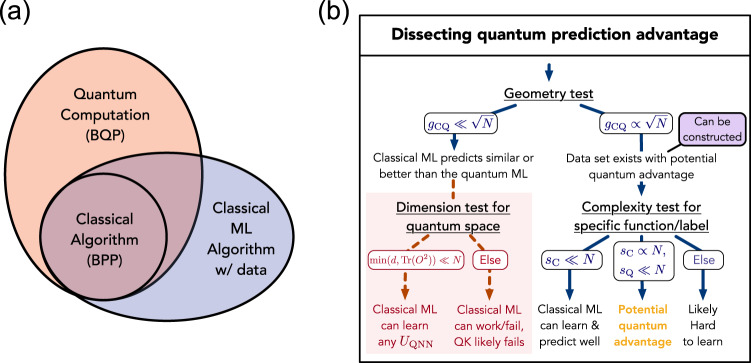
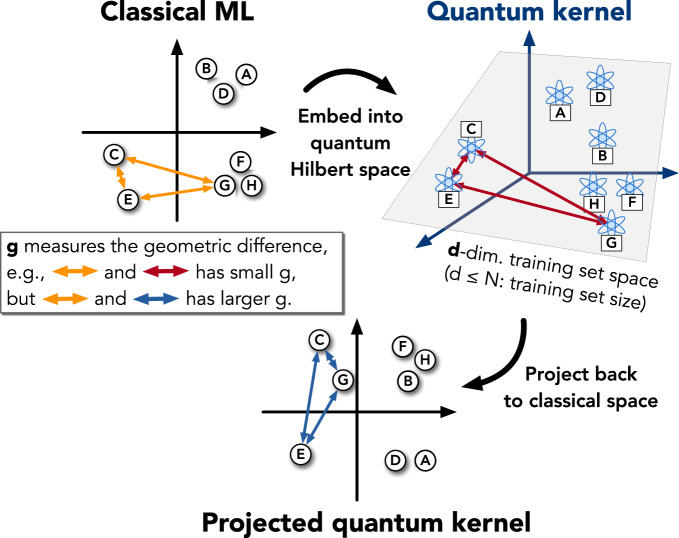
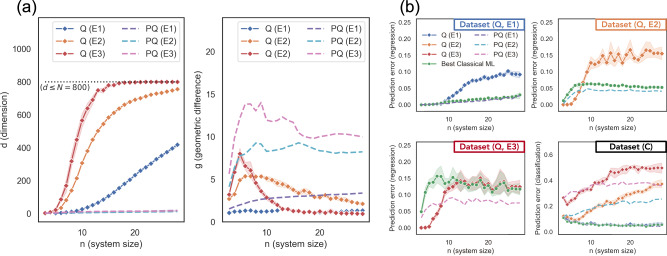
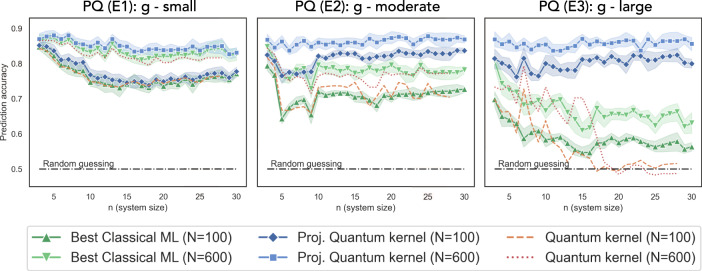
The use of quantum computing for machine learning is among the most exciting prospective applications of quantum technologies. However, machine learning tasks where data is provided can be considerably different than commonly studied computational tasks. In this work, we show that some problems that are classically hard to compute can be easily predicted by classical machines learning from data. Using rigorous prediction error bounds as a foundation, we develop a methodology for assessing potential quantum advantage in learning tasks. The bounds are tight asymptotically and empirically predictive for a wide range of learning models. These constructions explain numerical results showing that with the help of data, classical machine learning models can be competitive with quantum models even if they are tailored to quantum problems. We then propose a projected quantum model that provides a simple and rigorous quantum speed-up for a learning problem in the fault-tolerant regime. For near-term implementations, we demonstrate a significant prediction advantage over some classical models on engineered data sets designed to demonstrate a maximal quantum advantage in one of the largest numerical tests for gate-based quantum machine learning to date, up to 30 qubits.
Overview
The claims and statistics of this paper haven’t been checked yet.
Free: it reads the open-access text and checks the first 5 claims that cite a source we can check. Create a free account to check every claim.
Integrity signals
Registry
Cites
Statistics
Figures
Verification
Claims the paper makes
The claims and statistics of this paper haven’t been checked yet.
Free: it reads the open-access text and checks the first 5 claims that cite a source we can check. Create a free account to check every claim.
Claims other papers make about this one
Each is checked against this paper’s own text: does it say what the citing paper says it does?
The source backs part of the claim, not all of it — or backs it for a different population, condition or comparison.
In the citing paper
“measures such as the effective dimension have been motivated from an information-theoretic standpoint and depend on the Fisher information”
From The power of quantum neural networks (2021) · cites this paper as [21]
Experimental — accuracy not yet measuredThe cited source says what the claim attributes to it.
In the citing paper
“For instance, in [57], it is shown how the quality and the amount of data can sensibly affect the performance of classical and QML models in such a way that the quantum advantage is not always guaranteed.”
From On Circuit-Based Hybrid Quantum Neural Networks for Remote Sensing Imagery Classification (2022) · cites this paper as [57]
The cited source says what the claim attributes to it.
In the citing paper
“However, there is not a shared consensus on how and when QML can be advantageous with respect to its classical counterpart on general classes of problems.”
From On Circuit-Based Hybrid Quantum Neural Networks for Remote Sensing Imagery Classification (2022) · cites this paper as [57]
In the citing paper
“a quantity that describes the geometry of a model's parameter space and is essential in both statistics and machine learning [20-22].”
From The power of quantum neural networks (2021) · cites this paper as [21]
Self-check
Percentages, sums and reported differences re-computed from the paper’s own numbers.
The self-check needs the paper’s full text.
Citations
Cites
Breiman, L. (2001) · Machine Learning · doi:10.1023/a:1010933404324 · Cited by 133,538
Cortes, C., & Vapnik, V. (1995) · Machine Learning · doi:10.1007/bf00994018 · Cited by 59,421
Hohenberg, P., & Kohn, W. (1964) · Physical Review · doi:10.1103/physrev.136.b864 · Cited by 53,541
Learning with Kernels: Support Vector Machines, Regularization, Optimization, and Beyond
Schölkopf, B., & Smola, A. J. (2001) · The MIT Press eBooks · doi:10.7551/mitpress/4175.001.0001 · Cited by 11,703
Libsvm : A library for support vector machines
Ferrari, V. (2008) · Medical Entomology and Zoology · Cited by 10,123
Least Squares Support Vector Machine Classifiers
Suykens, J. A. K., & Vandewalle, J. (1999) · Neural Processing Letters · doi:10.1023/a:1018628609742 · Cited by 9,362
Density-Functional Theory for Time-Dependent Systems
Runge, E., & Gross, E. K. U. (1984) · Physical Review Letters · doi:10.1103/physrevlett.52.997 · Cited by 8,914
A fast quantum mechanical algorithm for database search
Grover, L. K. (1996) · Proceedings of the twenty-eighth annual ACM symposium on Theory of computing - STOC '96 · doi:10.1145/237814.237866 · Cited by 8,830
Re-epithelialization and immune cell behaviour in an ex vivo human skin model
Rakita, A., Nikolić, N., Mildner, M., Matiasek, J., & Elbe-Bürger, A. (2020) · Scientific Reports · doi:10.1038/s41598-019-56847-4 · Cited by 8,228
Quantum supremacy using a programmable superconducting processor
Arute, F., Arya, K., Babbush, R., Bacon, D., Bardin, J. C., Barends, R., Biswas, R., Boixo, S., Brandao, F. G. S. L., Buell, D. A., et al. (2019) · Nature · doi:10.1038/s41586-019-1666-5 · Cited by 7,720
Self-citation
Cited by
Items 801–900 of 925
Quantum Machine Learning for Industrial Artificial Intelligence
Farhan, M. (2026) · Advances in computational intelligence and robotics book series · doi:10.4018/979-8-2600-0156-1.ch012
Toward a User-aware Security Taxonomy for Quantum Computing Platforms
Choudhury, N., & Basu, K. (2026) · IEEE VLSI Test Symposium (VTS) · doi:10.1109/vts69484.2026.11563327
“As a result, quantum computers are increasingly being explored for applications in areas such as chemistry, materials discovery, optimization, machine learning, and cryptography [4]–[7].”
Yadav, P., & Kumari, J. (2026) · Advances in computational intelligence and robotics book series · doi:10.4018/979-8-2600-0156-1.ch011
Pandey, S. (2026) · Advances in computational intelligence and robotics book series · doi:10.4018/979-8-2600-0156-1.ch006
Rath, M., & Date, H. (2026) · Advanced Quantum Technologies · doi:10.1002/qute.70346
“Earlier studies have primarily focused on widely used quantum encoding techniques such as basis encoding, angle encoding, and amplitude encoding [ 3 ].”
Hybrid Multi-Strategy Quantum Embedding With Trainable Parameters for Multi-Class Classification
Borgalli, R. A., Shetty, S., & Raj, U. (2026) · Advances in computational intelligence and robotics book series · doi:10.4018/979-8-2600-0156-1.ch003
Nwachuku, D. N., & Ugochukwu, E. E. (2026) · Nigerian Journal of Physics · doi:10.62292/njp.v35i3.2026.565
Expressive quantum feature maps for hybrid quantum kernel learning in malware detection
Rawat, K. S., & Sharma, T. K. (2026) · Computer Networks · doi:10.1016/j.comnet.2026.112462
Exoplanetary atmospheres retrieval via a quantum extreme learning machine
Vetrano, M., Zingales, T., Palma, G. M., & Lorenzo, S. (2026) · Quantum Machine Intelligence · doi:10.1007/s42484-026-00414-4 · Cited by 1
“…- mon approach consists in reducing their dimension with either convolutional neural networks or principal compo - nent analysis (PCA) (De Lorenzis et al. 2024 ; Huang et al. 2021b; Rebentrost et al. 2014; Senokosov et al. 2024) to extract the most relevant and discernible features of a data - set.”
InfluentialEvaluation of Variational Quantum Classifiers (VQC) for Cyberattack Detection in the NISQ Era
Thomos, A., & Andronikos, T. (2026) · Journal of Sensor and Actuator Networks · doi:10.3390/jsan15040067 · Cited by 1
“This theoretical capacity can be practically unlocked by leveraging the expanded effective dimension of quantum neural networks [87], ensuring superior generalization bounds compared to classical counterparts [88].”
Revolutionizing Agriculture Through Quantum Computing Technologies
Kumar, S., Prajapati, M., & Tunwal, B. (2026) · Advances in computational intelligence and robotics book series · doi:10.4018/979-8-2600-2601-4.ch008
Towards Quantum Machine Learning for Assessing the Resilience of Post-quantum Cryptography
Miszczak, J. A. (2026) · Lecture notes in computer science · doi:10.1007/978-3-032-29918-5_3
“Another proposed architecture involves a quantum generator paired with a classical discriminator [22].”
Auto Quantum Machine Learning for Multisource Classification
Rybotycki, T., Dziura, S., & Gawron, P. (2026) · Lecture notes in computer science · doi:10.1007/978-3-032-29918-5_2
“Moreover, theoretical work has identified learning scenarios in which quantum models offer data-dependent advantages [15].”
ZORLU, G., & Çolak, C. (2026) · Diagnostics · doi:10.3390/diagnostics16131996
“Second, dequantisation results show that, in the small-data regime typical of clinical benchmarks such as WDBC, classical learners with sufficiently expressive kernels can match quantum kernel methods, so that any asymptotic quantum advantage need not yield a measurable empirical gap [12].”
Quantum-classical adaptive autoencoding of time-series signals for secure biometric authentication
Dutta, S., Basu, B., Roy, S., & Roy, U. (2026) · Quantum Machine Intelligence · doi:10.1007/s42484-026-00417-1
“Third, real-hardware validation remains limited, even though finite-shot statistics and NISQ noise directly influence observable measurement distributions (Bravyi 2022 ; Huang et al. 2021 ; Jerbi et al. 2023 ; Kim et al. 2023 ).”
Mitigating vanishing similarity in quantum kernels for DDoS attack detection
Rodríguez-Almazán, A., Rivas, G., Plaza-Martínez, P., Arrieta, A. G., & Alonso, R. S. (2026) · Quantum Machine Intelligence · doi:10.1007/s42484-026-00412-6 · Cited by 1
Magnitude-dependent quantum advantage in Forbush decrease detection: A quantum kernel SVM benchmark
Sierra-Porta, D. (2026) · Astronomy and Computing · doi:10.1016/j.ascom.2026.101160
Quantum Machine Learning for Water Pollution Profiling in the Rio Santiago Basin
Abraham-Mexicano, A., Muro-Medina, C. V., Flores-Payán, V., Pinzón, E. R., Recio-Colmenares, C. L., Recio-Colmenares, R., & García, C. A. G. (2026) · Quantum Reports · doi:10.3390/quantum8030060
“This follows the quantum-kernel view of QML, in which the data encoding circuit defines the effective feature space and therefore the learned similarity measure [21–23].”
Manjunatha, H., Sundaravadivel, P., Torbert, H. A., & Tamil, L. S. (2026) · Real-Time Image Processing and Deep Learning · doi:10.1117/12.3095168
Quantum Kernel Methods for Industrial Anomaly Detection
Tomono, T. (2026) · Communications in computer and information science · doi:10.1007/978-981-95-7829-0_8 · Cited by 2
Quantum fourier transform for unsupervised fault detection in building end-use electricity loads
Zia, H., Malkawi, A. M., & Han, J. M. (2026) · Energy and Buildings · doi:10.1016/j.enbuild.2026.117900
Overcoming Challenges in Implementing Quantum AI
Mahata, A. (2026) · Springer eBooks · doi:10.1007/978-3-032-19536-4_13
Quantum–AI Enabled Opportunity for Maternal and Child Health Trial
Rahman, M., & Roosan, D. (2026) · Springer eBooks · doi:10.1007/978-3-032-19536-4_11
Çolak, C., Yagin, B., ZORLU, G., Al-Hashem, F. H., Alzakari, S. A., Alkhalifa, A. K., & Aghaei, M. (2026) · Journal of Clinical Medicine · doi:10.3390/jcm15145387
“Moreover, for low-dimensional clinical feature sets, a quantum embedding may be only marginally different from a well-tuned classical kernel, which limits the prospect of measurable improvement in concordance [18].”
Mondal, M., Chanda, S., Alawieh, M. M., Sukhadiya, B., Krah, D., Gonsalves, C., Ntolkeras, A., Rizzoli, S. O., & Shaib, A. (2026) · Engineering Applications of Artificial Intelligence · doi:10.1016/j.engappai.2026.115548
“Whereas modifying architectures such as QCNNs [23, 24], tensor network inspired designs [25, 26], problem dependent ansätze [27], and quantum kernel based methods [28, 29] aim to maintain non vanishing gradients by controlling locality, expressivity, or parameterization geometry [30].”
An adaptive quantum-classical approach for scalable clustering and analytical decision-making
Hidayat, R., Novkaniza, F., Rustam, Z., & Akdemir, :. O. (2026) · Decision Analytics Journal · doi:10.1016/j.dajour.2026.100734
Defending against adversarial attacks by quantum autoencoder
Chen, L., Yan, L., & Zhang, S. (2026) · Chinese Journal of Physics · doi:10.1016/j.cjph.2026.07.017
Quantum Laplacian Pyramid Segmentation for Multi-Class Mushroom Classification
Jeyapriya, N., Hannah Inbarani, H., & Jamaludeen, A. (2026) · Journal of Innovative Image Processing · doi:10.36548/jiip.2026.3.011
Hybrid quantum–classical neural kernel emulator for scalable drive-by attack detection
Anbalagan, S. K. P., & Raja, S. K. S. (2026) · Array · doi:10.1016/j.array.2026.101090
Perspective Chapter: Quantum-Enhanced Hyperspectral Image Classification
Halbe, A., Bhirud, S. G., Tambe, G., Patil, P., Hole, V., & Mulla, N. (2026) · IntechOpen eBooks · doi:10.5772/intechopen.1016114
Kautish, A., Sivakumar, A., & Prasad, V. K. (2026) · The Journal of Chemical Physics · doi:10.1063/5.0336022
Karthick, V., & Shajahan, D. (2026) · Next research. · doi:10.1016/j.nexres.2026.102162
Quantum-Driven Finance Revolution Shaping: The Future of Risk Intelligence Security and Market Speed
Irfan, M., & Singh, B. P. (2026) · Advances in computational intelligence and robotics book series · doi:10.4018/979-8-3373-3857-6.ch009
Quantum Neural Networks in the NISQ Era: Architectures, Challenges, and Applications
Palihakkara, K. W., & Jayakody, M. N. (2026) · Proceedings in Technology Transfer · doi:10.1007/978-981-92-0423-6_19
Leakage-aware evaluation of trainable quantum kernels for structured crash telemetry
Elbasri, A., & Elassad, Z. E. A. (2026) · Knowledge-Based Systems · doi:10.1016/j.knosys.2026.116885
GLEAM: Mitigating Barren Plateaus in Hybrid Quantum Machine Learning via Small-World Entanglement
Ding, Z., Xing, F., Xia, Y., & Zeng, P. (2026) · International Conference on Image Processing and Artificial Intelligence (ICIPAI) · doi:10.1109/icipai70034.2026.11605634
“Standard quantum models often underfit these datasets due to limited circuit expressibility [51].”
Eliminating vendor lock-in in quantum machine learning via framework-agnostic neural networks
Kumaresan, P., Singaravelu, S., Rajendran, L., & Sivasubramani, S. (2026) · Frontiers in Quantum Science and Technology · doi:10.3389/frqst.2026.1862700
Jiang, Q., & Dong, Y. (2026) · Neurocomputing · doi:10.1016/j.neucom.2026.134567 · Cited by 1
QMC-Net: Data-Aware Quantum Representations for Remote Sensing Image Classification
Hossain, M. A., Patel, A. V., & Banerjee, B. (2026) · Lecture notes in computer science · doi:10.1007/978-3-032-31441-3_1 · Cited by 3
“Prior work in the broader quantum machine learning literature has established that the expressivity, trainability, and performance of quantum neural networks are strongly influenced by both circuit architecture and input data characteristics [10].”
Quantum Gradient Descent in Neural Network Training Optimization
Rallis, Z., & Vougiouklis, K. (2023) · Journal of Applied Automation Technologies · doi:10.64972/jaat.2023v1.304p18e:242-254
“Therefore, a specific question has been raised: How can a quantum gradient module be designed that improves training behaviour without exceeding measurement budgets and noise limits [15].”
Khurami, M. W., & Hakimi, M. (2026) · Buana Information Technology and Computer Sciences (BIT and CS) · doi:10.36805/5cdcfp74
Robust Hamiltonian estimation with partial prior information via random unsharp Pauli measurements
Zhang, X., Xi, C., Tang, Y., Wang, Y., Wang, C., Gao, H., Fu-li, L., Xiang, Y., Wang, F., & Zhang, P. (2026) · Science China Physics Mechanics and Astronomy · doi:10.1007/s11433-026-3077-5
DistributedEstimator: Distributed training of quantum neural networks via circuit cutting
Singh, P., Toosi, A. N., & Buyya, R. (2026) · Future Generation Computer Systems · doi:10.1016/j.future.2026.108746 · Cited by 2
Quantum-Enhanced Fuzzy K-Nearest Neighbor
Dash, S., & Lohani, Q. M. D. (2026) · IEEE International Conference on Fuzzy Systems (FUZZ-IEEE) · doi:10.1109/fuzz69877.2026.11626467
Salem, M., Pontes, D., Böhm, L., dos Reis, H., Ono, K. S., & Ferrugem, A. P. (2026) · Simpósio Brasileiro de Computação e Comunicação Quânticas (SBCCQ) · doi:10.5753/sbccq.2026.23307
“…VQC can achieve high raw F1, but is more variable and expensive; the QPCA effect is contextual and clearer when representation quality matters more than downstream model capacity [Huang et al. 2021a, Huang et al. 2021b, Schreiber et al. 2023, Preskill 2018, Cerezo et al. 2021, McClean et al. 2018].”
Ventocilla, J. L. R., Alvarado, R. P., Huamaní, J., Milla, E. C., & Esquivel, J. L. A. (2026) · IEEE Access · doi:10.1109/access.2026.3721134
“Recent studies also emphasize that the practical advantages of quantum machine learning depend on the structure of the data and the learning task, and that classical models may remain competitive in many scenarios [22].”
Thompson, D., Mitchell, S., Adams, R., & Brown, J. (2025) · Pharmacophore · doi:10.51847/d59nkxqobj
Gluhovic, J. (2026) · American Journal of Computer Science and Technology · doi:10.11648/j.ajcst.20260903.11
RAQET: a Reconfigurable Accelerator for QNNs Efficient Training
Farid, S., Abdin, T., Imani, H. R., & El‐Ghazawi, T. (2026) · IEEE International Conference on Big Data Security on Cloud, IEEE International Conference on High Performance and Smart Computing, and IEEE International Conference on Intelligent Data and Security (BigDataSecurity/HPSC/IDS) · doi:10.1109/hpsc69479.2026.00018
“They have been explored for applications in optimization, quantum chemistry, finance, cryptography, and materials science [2]–[4].”
Tiwari, A. S., Kape, B., Tyagi, P., Kumar, S., & Singh, G. (2026) · Research Square · doi:10.21203/rs.3.rs-10524017/v1
Ghosh, S., & Vijaysherly, V. (2026) · International Conference on Intelligent and Sustainable AI Systems (ICOSAAS) · doi:10.1109/icosaas68663.2026.11648894
Pitre, T. (2026) · Research Square · doi:10.21203/rs.3.rs-10168629/v1
Meyer, L., Schmid, A., Braun, S., & Keller, L. (2026) · Pharmacophore · doi:10.51847/ytvqqiwlce
Quantum machine learning in diabetes and metabolism: Applications and translational challenges
Riente, A., Serantoni, C., Giulio, M. M. D., Capezzone, S., Esposito, R., Spirito, M. D., & Maulucci, G. (2026) · Computer Methods and Programs in Biomedicine · doi:10.1016/j.cmpb.2026.109609
Chandrakanth, P., & Venugopal, K. (2026) · IEEE Guwahati Subsection Conference (GCON) · doi:10.1109/gcon69192.2026.11648316
“=1 x i , where quantum entanglement provides a natural computational structure [13].”
InfluentialQuantum Fusion Learning for 6G Networks With Kolmogorov–Arnold Networks
Paracha, U. I., Khalid, U., Rizvi, S. M. A., Duong, T. Q., Win, M. Z., & Shin, H. (2026) · IEEE Transactions on Network Science and Engineering · doi:10.1109/tnse.2026.3725065
Quantum-KIP: Kernel Inducing Points for Quantum Privacy
Song, B., Pokhrel, S. R., Vasilakos, A. V., Zhu, T., & Li, G. (2026) · IEEE Transactions on Information Forensics and Security · doi:10.1109/tifs.2026.3725557
“Thus, the fidelity kernel can be replaced by projected quantum kernels [35] or other hardware-aware kernels to improve scalability, reduce kernel concentration, and enhance robustness on noisy quantum devices.”
Data-Centric Quantum Machine Learning: Data-to-Models Continuum
Pias, M. R., Flores, E. D. S., Guterres, B. D. V., Barbosa, K. D. R. C., & Botelho, S. S. D. C. (2026) · IEEE Access · doi:10.1109/access.2026.3723825
“This observation is consistent with the learning theoretic analysis of Huang et al. [11], which argues that data should be treated as a computational resource when evaluating quantum machine learning.”
InfluentialFeng, J. (2026) · Academic Journal of Applied Sciences · doi:10.54097/bzp2nb70
Fulton, C. P., Tsapara, I., & Fulton, L. V. (2026) · Quantum Machine Intelligence · doi:10.1007/s42484-026-00430-4
“These observations align with the growing literature on quantum kernel methods, which finds that performance on classical data is often governed more by data structure than by uniquely quantum effects [22, 23].”
Testing Small Parameterized Quantum Circuits for Molecular Property PredictionPreprint
Uddandam, B. S., Mokashi, C. G., Figueroa, J. R. A., Vijayasankar, K., Sandhu, S., Paul, S., Lin, Y.-T., Jin, Z., dos Reis, R., & Sinitskiy, A. V. (2026) · ChemRxiv · doi:10.26434/chemrxiv.15008061/v1
Farsi, M., Mahmoud, M., & Helmy, A. (2026) · Sensors · doi:10.3390/s26175629
“Quantum advantages depend critically on data structure and access [13]; an experimental demonstration of exponential advantage appears in Huang et al. [47].”
Bhoge, R. R., Keole, R. R., & Karde, P. (2026) · International Journal of Computer Information Systems and Industrial Management Applications · doi:10.70917/ijcisim-2026-5424
Bhullar, A., Newlands, N. K., Ali, R. A., Lord, É., & Champagne, C. (2026) · Computers and Electronics in Agriculture · doi:10.1016/j.compag.2026.112376
Sipakov, R. (2026) · Quantum Reports · doi:10.3390/quantum8030093 · Cited by 1
“Implementation fidelity is necessary to realize a designed quantum model, but it does not confer task relevance; on real data the two axes need not coincide [12,15], echoing the classical observation that similarity indices with different invariances need not track task-grounded measures [29,38,39].”
Metal-Insulator Transition Classification Using Hybrid Quantum Learning Under Data ScarcityPreprint
Datta, G., Aminpour, S., Sharifi, S., & Banad, Y. (2026) · Research Square · doi:10.21203/rs.3.rs-10735326/v1
Quantum deep convolutional neural networks for damage classification
Siddique, A. B., & Cha, Y. (2026) · Computer-Aided Civil and Infrastructure Engineering · doi:10.1016/j.cacaie.2026.100217
Ahmed, M., & Abdulrahman, I. (2026) · Quantum Reports · doi:10.3390/quantum8030094
“More generally, QML performance often depends more on the data and task than on the device [9].”
HYBRID QUANTUM OPTIMIZATION OF DISTILBERT FOR EFFICIENT NATURAL LANGUAGE PROCESSING
Karanath, D., & Mittal, L. K. (2026) · IJRDO -Journal of Computer Science Engineering · doi:10.69980/cse.v12i1.6798
Guehika, A. (2026) · Lecture notes in networks and systems · doi:10.1007/978-3-032-32732-1_45
Das, T., Patro, S., & Lal, S. (2026) · International Conference on Trends in Quantum Computing and Emerging Business Technologies (TQCEBT) · doi:10.1109/tqcebt67648.2026.11681822
“Huang et al. [11] further demonstrate that data availability plays a central role in determining whether quantum or classical models generalize better.”
Boudaoud, S. A., Imache, R., & Djerbi, R. (2026) · International Conference on Trends in Quantum Computing and Emerging Business Technologies (TQCEBT) · doi:10.1109/tqcebt67648.2026.11681625
“Empirical studies show QML achieves 3-15% accuracy improvements on specific tasks but requires 10-1000× more circuit executions than classical counterparts [15].”
A hybrid classical-quantum approach for medical image classification
Pandey, T. N., Singh, S., Verma, S., & Pradhan, S. K. (2026) · Scientific Reports · doi:10.1038/s41598-026-70175-4
Quantum Algorithms for Trading: A Survey of Speedups, Thresholds, and Dequantization
Laura, L., Parrillo, M., Pascucci, A., Rossi, M., & Rughetti, V. (2026) · Information · doi:10.3390/info17090908
Demonstrating Quantum Advantage in GANs: A Comparative Study on Diabetes Healthcare Data
Verma, P., & Vishwakarma, D. K. (2026) · Communications in computer and information science · doi:10.1007/978-3-032-31233-4_6
Error-Corrected Quantum Machine Learning in Financial Forecasting
Nazar, M., Hasan, H. A., Adnan, K. M., Abu-AlShaeer, M. J., & Гнатченко, Д. Д. (2026) · Communications in computer and information science · doi:10.1007/978-3-032-39708-9_23
Shintre, A., Wankhede, A., & Ajankar, S. (2026) · IEEE International Conference on Instrumentation (INSTCon) · doi:10.1109/instcon69741.2026.11691711
“Recent reviews emphasize the importance of measuring training efficiency alongside final accuracy [14], [15].”
Quantum Machine Learning for Enhanced Classification in XR-Based SSVEP BCIs
Angrisani, L., D'Arco, M., D’Iorio, M., & Regio, F. L. (2026) · IEEE International Instrumentation and Measurement Technology Conference · doi:10.1109/i2mtc66907.2026.11694847
“On one hand, achieving parity is a non-trivial milestone; prior benchmarking studies have frequently reported that QSVM implementations fail to match the highly optimized baselines of classical SVMs, often suffering from trainability issues or noise sensitivity when applied to real-world data [23].”
Vesterlund, D. (2026) · Research Square · doi:10.21203/rs.3.rs-11192113/v1
A Hybrid Quantum–Classical Generative Adversarial Network for Synthetic Biological Data Generation
Ghosh, A., Arghya, S. S., & Lokesh, B. (2026) · IEEE Access · doi:10.1109/access.2026.3737965
Two routes for quantum AI in nonlinear dynamics
Zhang, B., Lu, Z., & Yang, Y. (2026) · Science China Physics Mechanics and Astronomy · doi:10.1007/s11433-026-3130-9
A Systematic Literature Review of Quantum Deep Learning in the NISQ Era
Ban, T. Q., Chu, D. M., Pham, H. T. D., & Mengel, S. A. (2026) · International Conference on Software and Computer Applications (ICSCA) · doi:10.1145/3801619.3801625 · Cited by 1
“Several authors have attempted to examine QML [4, 5, 7, 19, 23, 25, 45–47, 54, 55] and illustrate the integration of quantum principles with machine learning methodologies, whereas some examine QDL [10, 18, 62] more thoroughly to reveal the present condition of this field.”
ZORLU, G., & Çolak, C. (2026) · ODÜ Tıp Dergisi · doi:10.56941/odutip.1963069
Tewari, D., Kohli, S., Nisha, J. S., Palanisamy, G., & Veerapu, G. (2026) · International Conference on Innovations in Mechanical, Robotics, Computing and Biomedical Engineering (ICIMRBE) · doi:10.1109/icimrbe70745.2026.11710111
Singh, A., Shukla, V. K., Dhelim, S., & Singh, C. (2026) · Advanced Quantum Technologies · doi:10.1002/qute.70495
Quantum statistical learning theory: concepts, regimes, and open problems
Çatak, F. Ö. (2026) · Quantum Information Processing · doi:10.1007/s11128-026-05356-1
“A statistical advantage concerns improved sample efficiency or stronger generalization behavior, especially in regimes where quantum access to data changes the information-theoretic structure of the learning problem [13, 34, 35].”
Ailabouni, F., Román-Gallego, J.-Á., Grande-Pérez, L., & Gil-González, A. (2026) · Smart Agricultural Technology · doi:10.1016/j.atech.2026.102615
Nazarov, F. M., Sayidkulov, A., & Sariyev, S. (2026) · International Russian Automation Conference (RusAutoCon) · doi:10.1109/rusautocon69876.2026.11707377
“First, all experiments were conducted using a quantum simulator on a classical computer without accounting for noise; results may differ on real NISQ (Noisy Intermediate-Scale Quantum) devices [13], [14], [17].”
CogniQ: An MCP-Driven Architecture for Hybrid Classical-Quantum Brain-Computer Interfaces
Gopakumar, P., Moncy, R., Winson, S., & Sharma, S. (2026) · IEEE World Conference on Applied Intelligence and Computing (AIC) · doi:10.1109/aic70896.2026.11716934
“That correspondence also bounds what such models can deliver: Huang et al. [11] show that access to data narrows the gap between classical and quantum learners on many tasks, McClean et al. [12] identify barren plateaus that impede training of parameterised circuits, and Thanasilp et al. [13] show…”
Siwakoti, P., Windsor, M., Lewis, C., & Segovia-Domínguez, I. (2026) · Lecture notes in computer science · doi:10.1007/978-3-032-40581-4_11
Abdel-Aty, A.-H., Kadry, H., Omer, N., Shaaban, S. M., Eltayeb, H., Ghorashi, S. A., Hafez, M., Voon, B. W. N., & Farsi, M. (2026) · Frontiers in Computational Neuroscience · doi:10.3389/fncom.2026.1900553
“…Abbas et al., 2021), and generalization bounds (Caro et al., 2022; Liu et al., 2021) suggests advantages in terms of data efficiency and complex distribution representation, although the conditions for practical advantage remain under investigation (Schuld and Killoran, 2022; Huang et al., 2021).”
SaberiKamarposhti, M., Rezaei, P., & Rafsanjani, A. S. (2026) · The Journal of Supercomputing · doi:10.1007/s11227-026-08899-3
“Liu et al. [40] proved an exponential speedup for datasets with a specific group-theoretic structure, while Huang et al. [29] showed that classical methods with equivalent data access can match quantum performance, so that any advantage is data-structure dependent.”
Ashakin, M. R., Khan, R., Karim, M., & Roosan, D. (2026) · Proceedings - IEEE Symposium on Computer-Based Medical Systems · doi:10.1109/cbms69103.2026.00138
“It will also be important to test whether the same pattern persists across larger DILI datasets and alternative molecular representations [8], [15], [17].”
Sindhi, M. F., & Buksh, H. (2026) · Research Square · doi:10.21203/rs.3.rs-11322513/v1
Sharma, S. K., Anand, A., & Natya, S. (2026) · IEEE Access · doi:10.1109/access.2026.3743557
Al-Sobhi, M. M., & Sajjad, I. (2026) · AIMS Mathematics · doi:10.3934/math.20261316
Singh, S., Tiwari, S., Bisen, A. S., Swami, S., & Pandey, A. K. (2026) · International Journal of Artificial Intelligence and Machine Learning · doi:10.51483/ijaiml.2875
Hybrid quantum-classical surrogate modeling of façade pressure for natural ventilation control
Zia, H., Dai, T., Malkawi, A. M., & Han, J. M. (2026) · Energy and Buildings · doi:10.1016/j.enbuild.2026.118407
Quantum-Enhanced DenseNet Architecture for Automated Plant Disease Recognition from Leaf Images
Chandanan, V. K. S. A. A. K. (2026) · International Journal of Advanced Research in Science Communication and Technology · doi:10.48175/ijarsct-38939
Metadata
- Authors
- Huang, H.-Y., Broughton, M., Mohseni, M., Babbush, R., Boixo, S., Neven, H., & McClean, J. R.
- Affiliations
- California Institute of Technology (US)
- Google (United States) (US)
- Corresponding author
- McClean, Jarrod R.
- Venue
- Nature Communications
- Published
- 2021-05-11
- Volume
- 12
- Issue
- 1
- Pages
- 2631-2631
- ISSN
- 2041-1723 (ISSN-L)
- PMC
- PMC8113501
- OpenAlex
- W3096052452
- Cited by
- 896
- References
- 67
- Citations by year
- 2026: 220 · 2025: 220 · 2024: 157 · 2023: 140 · 2022: 107 · 2021: 52
- FWCI
- 39.93
- Type
- journal article
- Language
- en
- Open access
- gold
- doi.org
- Licence
- cc-by
- creativecommons.org/licenses/by/4.0 (tdm)
- creativecommons.org/licenses/by/4.0 (vor)
- Locations
- Nature Communications (publishedVersion, cc-by)
- PubMed Central (publishedVersion, cc-by)
- PubMed (publishedVersion)
- arXiv (Cornell University) (submittedVersion)
- CaltechAUTHORS (California Institute of Technology) (submittedVersion, cc-by)
- RePEc: Research Papers in Economics (submittedVersion)
- DOAJ (DOAJ: Directory of Open Access Journals) (submittedVersion, cc-by-sa)
- arXiv (Cornell University)
- Bulletin of the American Physical Society
- Topics
- Physical Sciences › Computer Science › Artificial Intelligence › Quantum Computing Algorithms and Architecture
- Physical Sciences › Physics and Astronomy › Atomic and Molecular Physics, and Optics › Quantum many-body systems
- Physical Sciences › Physics and Astronomy › Atomic and Molecular Physics, and Optics › Quantum Information and Cryptography
- Keywords
- quantum machine learning, quantum advantage, prediction error bounds, classical machine learning, fault-tolerant quantum computing, gate-based quantum computing, quantum-classical comparison
About these checks
Registry, retraction, Cites and statistics results are computed, not judged, with one exception: a printed reference that no index lists is read once by a model before it counts as a citation error. Claims are extracted by a model and kept only when their quote appears verbatim in the text; each cited source is then checked, with a model’s help, for whether it says what the claim relies on. Those verdicts can be wrong — read the claim’s quote and the cited source before relying on one.
Statistics and arithmetic are recomputed, not judged.
Confidence bands are shown only for fields calibrated on our annotated test set. None is calibrated yet, so no band is shown.
What counts as a claim ›How we measure confidence ›How we check this ›
Are you an author, or do you see a problem with this page? Request a review
Data sources
Bibliographic data: Semantic Scholar, OpenAlex, Crossref.
Contains information from the Semantic Scholar Academic Graph Datasets, made available under the ODC Attribution License (ODC-BY 1.0).
Semantic Scholar’s data is described in: Kinney, R., et al. (2023). The Semantic Scholar Open Data Platform. arXiv:2301.10140.
