

Power of data in quantum machine learning
Open accessThe DOI matches its Crossref record; 67 of the 69 references it cites were found in a registry or an index.
Abstract
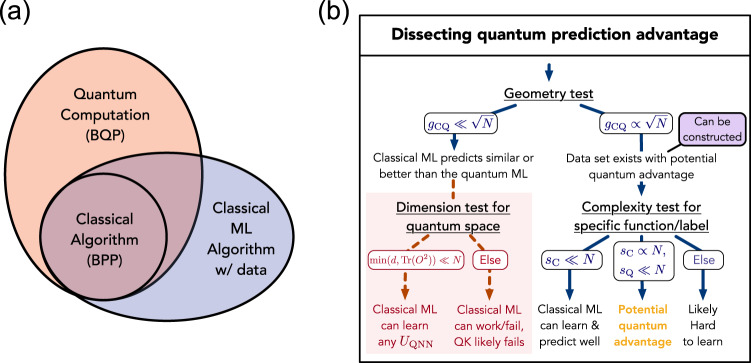
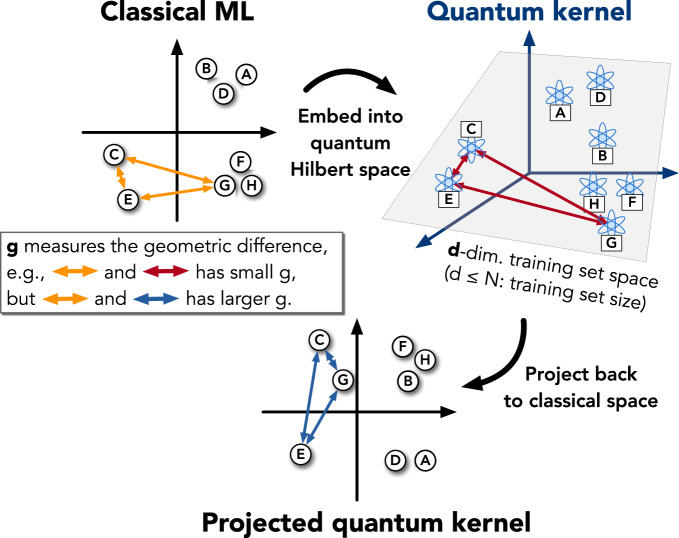
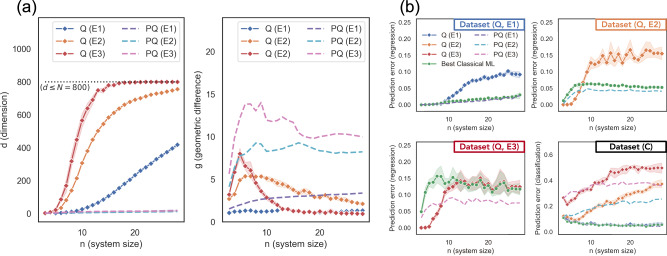
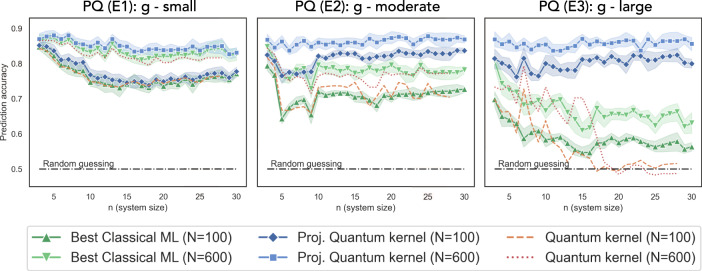
The use of quantum computing for machine learning is among the most exciting prospective applications of quantum technologies. However, machine learning tasks where data is provided can be considerably different than commonly studied computational tasks. In this work, we show that some problems that are classically hard to compute can be easily predicted by classical machines learning from data. Using rigorous prediction error bounds as a foundation, we develop a methodology for assessing potential quantum advantage in learning tasks. The bounds are tight asymptotically and empirically predictive for a wide range of learning models. These constructions explain numerical results showing that with the help of data, classical machine learning models can be competitive with quantum models even if they are tailored to quantum problems. We then propose a projected quantum model that provides a simple and rigorous quantum speed-up for a learning problem in the fault-tolerant regime. For near-term implementations, we demonstrate a significant prediction advantage over some classical models on engineered data sets designed to demonstrate a maximal quantum advantage in one of the largest numerical tests for gate-based quantum machine learning to date, up to 30 qubits.
Overview
The claims and statistics of this paper haven’t been checked yet.
Free: it reads the open-access text and checks the first 5 claims that cite a source we can check. Create a free account to check every claim.
Integrity signals
Registry
Cites
Statistics
Figures
Verification
Claims the paper makes
The claims and statistics of this paper haven’t been checked yet.
Free: it reads the open-access text and checks the first 5 claims that cite a source we can check. Create a free account to check every claim.
Claims other papers make about this one
Each is checked against this paper’s own text: does it say what the citing paper says it does?
The source backs part of the claim, not all of it — or backs it for a different population, condition or comparison.
In the citing paper
“measures such as the effective dimension have been motivated from an information-theoretic standpoint and depend on the Fisher information”
From The power of quantum neural networks (2021) · cites this paper as [21]
Experimental — accuracy not yet measuredThe cited source says what the claim attributes to it.
In the citing paper
“For instance, in [57], it is shown how the quality and the amount of data can sensibly affect the performance of classical and QML models in such a way that the quantum advantage is not always guaranteed.”
From On Circuit-Based Hybrid Quantum Neural Networks for Remote Sensing Imagery Classification (2022) · cites this paper as [57]
The cited source says what the claim attributes to it.
In the citing paper
“However, there is not a shared consensus on how and when QML can be advantageous with respect to its classical counterpart on general classes of problems.”
From On Circuit-Based Hybrid Quantum Neural Networks for Remote Sensing Imagery Classification (2022) · cites this paper as [57]
In the citing paper
“a quantity that describes the geometry of a model's parameter space and is essential in both statistics and machine learning [20-22].”
From The power of quantum neural networks (2021) · cites this paper as [21]
Self-check
Percentages, sums and reported differences re-computed from the paper’s own numbers.
The self-check needs the paper’s full text.
Citations
Cites
Breiman, L. (2001) · Machine Learning · doi:10.1023/a:1010933404324 · Cited by 133,538
Cortes, C., & Vapnik, V. (1995) · Machine Learning · doi:10.1007/bf00994018 · Cited by 59,421
Hohenberg, P., & Kohn, W. (1964) · Physical Review · doi:10.1103/physrev.136.b864 · Cited by 53,541
Learning with Kernels: Support Vector Machines, Regularization, Optimization, and Beyond
Schölkopf, B., & Smola, A. J. (2001) · The MIT Press eBooks · doi:10.7551/mitpress/4175.001.0001 · Cited by 11,703
Libsvm : A library for support vector machines
Ferrari, V. (2008) · Medical Entomology and Zoology · Cited by 10,123
Least Squares Support Vector Machine Classifiers
Suykens, J. A. K., & Vandewalle, J. (1999) · Neural Processing Letters · doi:10.1023/a:1018628609742 · Cited by 9,362
Density-Functional Theory for Time-Dependent Systems
Runge, E., & Gross, E. K. U. (1984) · Physical Review Letters · doi:10.1103/physrevlett.52.997 · Cited by 8,914
A fast quantum mechanical algorithm for database search
Grover, L. K. (1996) · Proceedings of the twenty-eighth annual ACM symposium on Theory of computing - STOC '96 · doi:10.1145/237814.237866 · Cited by 8,830
Re-epithelialization and immune cell behaviour in an ex vivo human skin model
Rakita, A., Nikolić, N., Mildner, M., Matiasek, J., & Elbe-Bürger, A. (2020) · Scientific Reports · doi:10.1038/s41598-019-56847-4 · Cited by 8,228
Quantum supremacy using a programmable superconducting processor
Arute, F., Arya, K., Babbush, R., Bacon, D., Bardin, J. C., Barends, R., Biswas, R., Boixo, S., Brandao, F. G. S. L., Buell, D. A., et al. (2019) · Nature · doi:10.1038/s41586-019-1666-5 · Cited by 7,720
Self-citation
Cited by
Items 601–700 of 925
Application of Innovative Quantum Computing Technologies for Precision Agriculture—A Study
Thankappan, J. C., & Kumar, M. B. S. (2026) · Lecture notes in networks and systems · doi:10.1007/978-981-96-9191-3_48 · Cited by 1
Modular quantum extreme reservoir computing
Lau, H. W., Hayashi, A., Sakurai, A., Munro, W. J., & Nemoto, K. (2026) · Physical Review A · doi:10.1103/111d-yxg8 · Cited by 4
Badnjević, A., & Spahić, L. (2026) · Series in bioengineering · doi:10.1007/978-3-032-14785-1_1 · Cited by 1
Liu, W., Du, B., Liu, W., & Zhu, Y. (2026) · Neural Networks · doi:10.1016/j.neunet.2026.108625 · Cited by 4
Hybrid QNN for Weed or Crop Detection Using DNN and 2-Qubit Circuits
Firdaus, Syafalni, I., Ahmadi, N., Sutisna, N., Mulyawan, R., & Adiono, T. (2025) · International Conference on Electrical Engineering and Informatics · doi:10.1109/iceei68459.2025.11330460 · Cited by 1
Leveraging Quantum Feature Spaces for Industrial Time-Series Anomaly Detection
Tomono, T., & Tsujimura, K. (2025) · IEEE International Conference on Quantum Artificial Intelligence (QAI) · doi:10.1109/qai63978.2025.00017 · Cited by 1
“Additionally, Huang et al. [9] explored how the power of quantum kernel scales with dataset size, showing potential advantages in the small data regime—a characteristic particularly valuable for industrial settings where anomaly data is scarce.”
QO-BRA: A Quantum Operator-Based Autoencoder for De Novo Molecular Design
Yu, Y., Calcagno, F., Li, H., & Batista, V. S. (2026) · Journal of Chemical Theory and Computation · doi:10.1021/acs.jctc.5c01704 · Cited by 1
Quantum artificial intelligence: A comprehensive survey
Jiang, H., Pan, Y., Chen, J., Liu, Z., Sun, L., Li, Q., Zhang, L., Zhu, D., Wang, X., Liu, W., et al. (2026) · Meta-Radiology · doi:10.1016/j.metrad.2026.100205 · Cited by 3
Hangun, B., Altun, O., & Eyecioğlu, Ö. (2026) · IEEE Access · doi:10.1109/access.2026.3668295 · Cited by 1
Liu, H., & Lou, X. (2026) · Quantum Engineering · doi:10.1155/que2/6643049 · Cited by 3
Montalban, I., Combarro, E. F., & Ranilla, J. (2026) · The Journal of Supercomputing · doi:10.1007/s11227-026-08396-7 · Cited by 1
Harnessing quantum dynamics for robust and scalable quantum extreme learning machines
Solanki, P. D., & Pham, A. (2026) · Physical Review A · doi:10.1103/2pm1-wrl6 · Cited by 6
“The intersection of quantum computing and machine learning (ML) has catalyzed the emergence of quantum machine learning (QML), a rapidly evolving field that seeks to harness quantum phenomena to enhance classical data processing and pattern recognition tasks [1–5].”
Gupta, S., Ray, K., Kaiser, S., Hossain, S., & Faubert, J. (2026) · Algorithms · doi:10.3390/a19040279 · Cited by 2
Villalba-Díez, J., González‐Marcos, A., Losada, J. C., & Ordieres-Meré, J. B. (2026) · Quantum Information Processing · doi:10.1007/s11128-026-05144-x · Cited by 1
“Some studies have reported that these hybrid models can offer comparable performance to entirely classical networks while requiring fewer parameters and potentially more efficient learning from limited data [33, 34].”
A fully quantum-native recurrent neural network for end-to-end sequential learning on NISQ hardware
Huang, R., & Yi, H. (2026) · Machine Learning Science and Technology · doi:10.1088/2632-2153/ae601d · Cited by 3
“Despite these constraints, there is a growing consensus that NISQ devices may yield tangible utility in the near term, with one of the most promising avenues being quantum machine learning (QML) [7].”
Deep Variational Quantum Circuits with Barren-Plateau-Free Architectures
Zhang, K., Hsieh, M.-H., & Tao, D. (2026) · Artificial Intelligence Science and Engineering · doi:10.23919/aise.2026.000005 · Cited by 1
Komini, R., Mandilara, A., Maragkopoulos, G., & Syvridis, D. (2026) · IEEE Journal of Selected Topics in Applied Earth Observations and Remote Sensing · doi:10.1109/jstars.2026.3723685 · Cited by 1
“To better understand this behavior, we also evaluate a projected quantum kernel, following the idea of projecting quantum states to measured observable features before applying a classical kernel [35].”
Niazi, S. (2026) · Drug Design Development and Therapy · doi:10.2147/dddt.s590730 · Cited by 1
“9,55 A stringent view treats QML as a hypothesis: it must outperform well-tuned classical deep learning baselines under matched conditions.”
Liang, Y., Ding, W., Xu, H., Wang, H., Shentu, G., Qiu, T., & Ma, H. (2026) · Physica Scripta · doi:10.1088/1402-4896/ae67b8 · Cited by 1
Prasittisopin, L., Sukmas, W., Xu, J.-S., Xu, X.-Y., Rodthongkum, N., Kang, T. H.-K., & Potiyaraj, P. (2026) · Next research. · doi:10.1016/j.nexres.2026.101897 · Cited by 1
Dinuț, I.-C., Constantinescu, R., & Alexandrescu, B. (2026) · Electronics · doi:10.3390/electronics15112489 · Cited by 2
The Potential of Hybrid and Fully Quantum Machine Learning Models: A State-of-the-Art Review
Schlichte, S., Sowinski, C., Feng, Y., Thielen, N., Franke, J. E., & Risch, F. (2025) · doi:10.1109/midcongress66428.2025.11547386 · Cited by 1
“One particularly promising aspect of HQCM is their ability to outperform classical ML-models when trained on small datasets [6]–[8].”
Learning quantum kernels with continuous-variable optical circuits
Mandilara, A., Papadopoulos, A. D., & Syvridis, D. (2026) · Machine Learning Science and Technology · doi:10.1088/2632-2153/ae7baf · Cited by 1
Robust and efficient quantum reservoir computing with a discrete time crystal
Zhang, D., Li, X., Guo, Y., Yu, H., Jin, Y., & Yin, Z. (2026) · Physical Review Applied · doi:10.1103/w2w9-c944 · Cited by 7
Singh, R., & Suseelan, A. D. (2026) · Electronics · doi:10.3390/electronics15132832 · Cited by 1
Wang, G., Warrell, J., & Gerstein, M. (2026) · Physical Review A · doi:10.1103/81xl-nr9q · Cited by 1
Novel Quantum-Classical Hybrid Circuits for Adaptive Hardware-Based Machine Learning
Sihare, S. R., & Cherukuri, A. K. (2026) · SN Computer Science · doi:10.1007/s42979-026-05194-z · Cited by 1
Quantum machine learning for predicting properties of van der Waals bilayers
Chowdhury, C., & Giordano, L. (2026) · The Journal of Chemical Physics · doi:10.1063/5.0330379 · Cited by 1
Shot‐Based Quantum Encoding: A Data‐Loading Paradigm for Quantum Neural Networks
Kyriacou, B., Patapovich, V., Periyasamy, M., & Melnikov, A. A. (2026) · Advanced Computing · doi:10.1002/adco.70004 · Cited by 1
Certified Lower Bounds and Efficient Estimation of Minimum Accuracy in Quantum Kernel Methods
Gonçalves, D. N., Fernandes, T. D., Cordeiro, A. M. M., Lugão, P. H. G., Dias, J. T., & Araújo-Moreira, F. M. (2026) · Quantum Reports · doi:10.3390/quantum8030073 · Cited by 2
General Vapnik–Chervonenkis dimension bounds for quantum circuit learning
Chen, C.-C., Sogabe, M., Shiba, K., Sakamoto, K., & Sogabe, T. (2022) · Journal of Physics Complexity · doi:10.1088/2632-072x/ac9f9b · Cited by 3
Precise Image Generation on Current Noisy Quantum Computing Devices
Rehm, F., Vallecorsa, S., Borras, K., Grossi, M., Krücker, D., & Varo, V. (2023) · Desy publication database (The Deutsches Elektronen-Synchrotron) · doi:10.3204/pubdb-2023-05100 · Cited by 1
Quantum Kernels for Difficult Visual Discrimination
Tomono, T., Tsujimura, K., & Godo, T. (2023) · IEEE International Conference on Quantum Computing and Engineering (QCE) · doi:10.1109/qce57702.2023.10234 · Cited by 1
$$\mathrm{Q(AI)}^2$$: Quantum Artificial Intelligence for the Automotive Industry
Stollenwerk, T., Bhattacharya, S., Cattelan, M., Ciani, A., Compostella, G., Headley, D., Klepsch, J., Klusch, M., Leder, M., Macaluso, A., et al. (2024) · Künstliche Intell. · doi:10.1007/s13218-024-00862-9 · Cited by 1
“This is similar to QKE, but after encoding the feature vector into a quantum state in the high-dimensional Hilbert state space, the state is projected into a lower-dimensional subspace to reduce its expressivity [8], as too much of it can hamper classification success [9].”
Coreset selection can accelerate quantum machine learning models with provable generalization
Huang, Y., Yuan, X., Wang, H., & Du, Y. (2024) · Physical Review Applied · doi:10.1103/physrevapplied.22.014074 · Cited by 3
Enhanced Quantum Neural Networks: A Full Entanglement Scheme for Binary Classification
Sahoo, B., Singhal, P., & Joshi, P. (2024) · IEEE World Conference on Applied Intelligence and Computing (AIC) · doi:10.1109/aic61668.2024.10730837 · Cited by 1
“These advancements enable more robust machine learning models and efficient handling of massive datasets [13].”
BackgroundMax-Cut Linear Binary Classifier Based on Quantum Approximate Optimization Algorithm
Wang, J., Wang, Y., Li, X., Liu, S., Zhuang, J., & Qin, C. (2024) · International Journal of Theoretical Physics · doi:10.1007/s10773-024-05826-1 · Cited by 1
Ding, X., Liu, F., Wang, W., Zhu, Y., Hou, Y., Huang, Y., Xu, J., & Shan, Z. (2024) · Machine Learning Science and Technology · doi:10.1088/2632-2153/ada0a4 · Cited by 5
Quantum Machine Learning: Bridging the Gap Between Theory and Practice
Mounika, M., Reddy, S. P. K., Abhinaya, A., & S, A. G. (2024) · Communications in computer and information science · doi:10.1007/978-3-031-74682-6_7 · Cited by 3
Abdulkadirov, R. I., Lyakhov, P. A., Бутусов, Д., Nagornov, N. N., Reznikov, D., Bobrov, A., & Ивановна, К. Д. (2025) · Mathematics · doi:10.3390/math13050828 · Cited by 1
QuFrame: A Novel Encoding Ensemble Framework for Quantum Neural Networks
Li, T., Zhao, Z., Lu, L., & Yin, J. (2025) · International Conference on Quantum Communications, Networking, and Computing (QCNC) · doi:10.1109/qcnc64685.2025.00097 · Cited by 2
Nerella, A. (2025) · International Journal of Information and Electronics Engineering · doi:10.48047//ijiee.2024.14.4.4 · Cited by 1
Research on Quantum Circuit Learning Models for Molecular Dynamics Simulation
Nishida, Y. (2025) · The Journal of Physical Chemistry A · doi:10.1021/acs.jpca.5c03624 · Cited by 2
Molecular representations of quantum circuits for quantum machine learning
Torabian, E., & Krems, R. V. (2026) · Machine Learning Science and Technology · doi:10.1088/2632-2153/ae47c2 · Cited by 6
“For example, EC can be avoided by restricting the space of QC to covariant quantum kernels [15], or by quantum kernel bandwidth methods [16], quantum Fisher kernels [17], and projected quantum kernel methods [18].”
Quantum Machine Learning with SQUID
Roggero, A., Filipek, J., Hsu, S.-C., & Wiebe, N. (2022) · Quantum · doi:10.22331/q-2022-05-30-727 · Cited by 3
Diabetes Prediction Using Quantum Neurons with Preprocessing Based on Hypercomplex Numbers
Monteiro, C. A., & Neto, F. M. D. P. (2021) · IEEE Symposium Series on Computational Intelligence (SSCI) · doi:10.1109/ssci50451.2021.9660028 · Cited by 2
Information-Theoretic Limits of Quantum Learning via Data Compression
Angrisani, A., Coyle, B., & Kashefi, E. (2025) · IEEE International Conference on Quantum Artificial Intelligence (QAI) · doi:10.1109/qai63978.2025.00011 · Cited by 1
“Broadly, two key motivations drive this field: the potential for quantum algorithms to accelerate classical learning tasks [14]– [16], and the opportunity to exploit genuinely quantum data using quantum processors [17]–[20].”
Quantifying emotions through quantum computations
Singh, J., & Bhangu, K. S. (2023) · International Journal of Quantum Information · doi:10.1142/s0219749923500041 · Cited by 1
Quantum Features and Quantum Neural Network
Mitarai, K. (2022) · The Brain & Neural Networks · doi:10.3902/jnns.29.202 · Cited by 2
Challenges and opportunities in the supervised learning of quantum circuit expectation values
Cantori, S., & Pilati, S. (2025) · Physical review. E · doi:10.1103/9bq5-sqhd · Cited by 3
Quantum K-Nearest Neighbors for Object Recognition
Muntazhar, A. Z. A., Sulistyaningrum, D. R., & Subiono (2024) · Springer proceedings in mathematics & statistics · doi:10.1007/978-981-97-2136-8_11 · Cited by 1
Applying Quantum Autoencoders for Time Series Anomaly DetectionPreprint
Frehner, R., & Stockinger, K. (2024) · Zürcher Hochschule für Angewandte Wissenschaften digital collection (Zurich University of Applied Sciences) · doi:10.48550/arxiv.2410.04154 · Cited by 8
“Recent advancements in quantum computing [8–12] and in particular in quantum machine learning [10, 13–15], with its demonstrated expressive power, present new opportunities to address the complexities of time series anomaly detection.”
Unsupervised Quantum Anomaly Detection on Noisy Quantum ProcessorsPreprint
Pranjić, D., Kunst, P., Knäble, F., Kutzias, D., Klau, D., Tutschku, C., Simon, L., Kraus, M., & Abedi, A. (2025) · Research Square · doi:10.21203/rs.3.rs-6303530/v1 · Cited by 2
Yahweh, B., Ekanem, A. M., George, N. J., Oduntan, E. O., Mohammed, S. S. N., Abdulhamid, A., Takim, B. N., Ante, J. E., Emmanuel, Y., & Essang, S. O. (2025) · Research Square · doi:10.21203/rs.3.rs-7262536/v1 · Cited by 1
The disparate impact of noise on quantum learning algorithms
Angrisani, A. (2023) · theses.fr (ABES) · doi:10.70675/69f942ebz4417z4eceza746z1c9d436d09bb · Cited by 3
Majidi, F. (2026) · Research Square · doi:10.21203/rs.3.rs-10501636/v1 · Cited by 1
Li, S., Salek, M. S., Chowdhury, M., & Wang, Y. (2026) · Physical Review Research · doi:10.1103/wb1b-ntpc
“…19], including finding concise functions to fit exponentially large datasets [20], learning a particular data distribution [18], discovering unknown kernel functions [21], and extracting insights from experimental data points using exponentially fewer data compared to classi-∗ cal approaches [22].”
Quantum Incubation Journey: Theory Founded Use Case and Technology Selection
Senge, S., Leonhardt, T., & Halabi, K. (2021) · Digitale Welt · doi:10.1007/s42354-021-0338-4
From Molecules to Quantum Computers: A Research Retrospective
McClean, J. R. (2021) · Computing in Science & Engineering · doi:10.1109/mcse.2021.3120703
Self-citationWorking capacity of deep networks with topology attacksPreprint
Zhang, L., Chen, Y., & Ali, I. (2021) · Research Square · doi:10.21203/rs.3.rs-1042846/v1
Implementing Quantum-Kernel-Based Classifiers in the NISQ Era
Pillay, S. M., Sinayskiy, I., Jembere, E., & Petruccione, F. (2022) · Communications in computer and information science · doi:10.1007/978-3-030-95070-5_17 · Cited by 2
Quantum Advantage on Machine Learning ModelsPreprint
Tomono, T., & Natsubori, S. (2022) · Research Square · doi:10.21203/rs.3.rs-1728380/v1
Modern Approaches to Topological Quantum Error Correction
Parrado-Rodríguez, P. (2022) · Cronfa (Swansea University) · doi:10.23889/suthesis.60302
The Role of Semantic Hybrid Multi‐Model Multi‐Platform (SHM3P) Databases for IoT
Mehta, S., Tiwari, S. M., Siarry, P., & Jabbar, A. (2022) · Wiley eBooks · doi:10.1002/9781394171460.ch1
Li, W., Lu, Z., & Deng, D.-L. (2022) · SciPost Physics Lecture Notes · doi:10.21468/scipost.report.5323
Li, W., Lu, Z., & Deng, D.-L. (2022) · SciPost Physics Lecture Notes · doi:10.21468/scipost.report.5368
Quantum Graph Neural Networks on a Single QubitPreprint
Zhu, Y., & Jiang, R. (2022) · doi:10.36227/techrxiv.21717470
Quantum Graph Neural Networks on a Single QubitPreprint
Zhu, Y., & Jiang, R. (2022) · doi:10.36227/techrxiv.21717470.v1
Strategiebildung im Quantencomputing – ein holistischer Ansatz für die chemische Industrie
Weiß, H., Volz, D., Kühn, M., & Standen, B. (2022) · Springer eBooks · doi:10.1007/978-3-658-37534-8_14
Sun, T., Chen, Z.-Y., Xue, C., Liu, H., Zhuang, X.-N., Wang, Y.-J., Ma, S.-X., Zhang, H.-F., Wu, Y.-C., & Guo, G. (2025) · Physical Review A · doi:10.1103/4ynz-svzn · Cited by 1
“Recently, it has been demonstrated that classical data can be mapped into a quantum feature space using certain embeddings [14, 15, 17, 18], which is further utilized to approximate a variety of functions.”
Quantum Intelligent Systems and Deep Learning
Swain, B., & Gountia, D. (2023) · Wiley eBooks · doi:10.1002/9781119905172.ch18
Boosted Binary Quantum Classifier via Graphical Kernel
Cai, Y., & Huang, D. (2023) · Entropy · doi:10.3390/e25060870
“Generally, quantum graph representation algorithm bears significant capabilities in extracting some atypical patterns in graphs [36].”
BackgroundOptimized Algorithms for Quantum Machine Learning Circuits
Palani, L., Singh, S. B., Rajendran, B., Bindhumadhava, B. S., & Sudarsan, S. D. (2023) · Lecture notes in networks and systems · doi:10.1007/978-981-99-1203-2_37
Framework for Learning and Control in the Classical and Quantum DomainsPreprint
Vedaie, S. S., Dalal, A., Paez, E. J., & Sanders, B. C. (2023) · arXiv (Cornell University) · doi:10.48550/arxiv.2307.04256 · Cited by 2
Enhanced Generalization of Variational Quantum Learning Under Reduced-Domain Initialization
Wang, Y., & Qi, B. (2023) · Chinese Control Conference (CCC) · doi:10.23919/ccc58697.2023.10240281 · Cited by 2
An Incremental MaxSAT-Based Model to Learn Interpretable and Balanced Classification Rules
Júnior, A. C. S. F., & Rocha, T. A. (2023) · Lecture notes in computer science · doi:10.1007/978-3-031-45368-7_15 · Cited by 2
“The success of Machine Learning (ML) in recent years has led to a growing advancement in studies in this area [2,8,12].”
BackgroundMVITA, M. J., Zulu, N. G., Thethwayo, B., & Makhamisa, S. (2023) · International Conference on Industrial Engineering and Operations Management (IEOM) · doi:10.46254/eu6.20230207
Precise Quantum Angle Generator Designed for Noisy Quantum Devices
Schnake, S., Rehm, F., Krücker, D., Grossi, M., Vallecorsa, S., Varo, V., & Borras, K. (2023) · European Physical Society Conference on High Energy Physics (EPS-HEP) · doi:10.22323/1.449.0573
“Quantum Machine Learning (QML) emerges as a promising domain, showing resilience to noise and yielding favorable outcomes on NISQ devices [3].”
BackgroundSKYNET 2023 Conception of the Artificial Super Intelligence Project. A System Approach. ver. 3Preprint
Novikov, A. (2023) · OSF Preprints (OSF Preprints) · doi:10.31219/osf.io/kqt9p
Quantum Machine Learning: Past, Present, and Future
Yan, T. (2023) · Academic Journal of Computing & Information Science · doi:10.25236/ajcis.2023.061214
Laveraging Machine Learning for Improved Project Inspections and Internal Control Systems
Savković, M., & Lalić, D. Ć. (2024) · Engineering cyber-physical systems and critical infrastructures · doi:10.1007/978-3-031-56322-5_20
A Novel Classical-Quantum Transfer Learning Framework for Image RecognitionPreprint
Ruan, B., Liu, Z., & Li, X. (2024) · SSRN Electronic Journal · doi:10.2139/ssrn.4806924
Precise Quantum Angle Generator Designed for Noisy Quantum Devices
Rehm, F., Vallecorsa, S., Borras, K., Krücker, D., Grossi, M., & Varo, V. (2024) · EPJ Web of Conferences · doi:10.1051/epjconf/202429512006
Chawla, K. (2023) · International Journal of Science and Research (IJSR) · doi:10.21275/sr23516220618
Interpreting variational quantum models with active paths in parameterized quantum circuits
Lee, K., Jeon, H., Lee, D., Kim, B., Bang, J., & Kim, T. (2024) · Machine Learning Science and Technology · doi:10.1088/2632-2153/ad5412
Geometric quantum machine learning for barcode similarity classification
Umeano, C., Scali, S., & Kyriienko, O. (2026) · Physical Review A · doi:10.1103/sylc-gclc · Cited by 5
Imaging Tumor Metabolism and Its Heterogeneity: Special Focus on Radiomics and AI
Papp, L., Haberl, D., Ecsedi, B., Hatt, M., & Lopci, E. (2024) · Interdisciplinary cancer research · doi:10.1007/16833_2024_427
AI Computing in Network Optimization
Srinivasan, V. A. (2024) · Advances in wireless technologies and telecommunication book series · doi:10.4018/979-8-3693-6552-6.ch001
Prepare Linear Distributions with Quantum Arithmetic Units
Li, J. (2024) · Entropy · doi:10.3390/e26110912
Ruihong, 贾. J., Guang, 杨. Y., Min, 聂. N., Yuanhua, 刘. L., & Meiling, 张. Z. (2024) · Laser & Optoelectronics Progress · doi:10.3788/lop223345
Thomas, G. A. S., Muthukaruppasamy, S., Gopal, J. N., Anand, J., & Haribabu, G. N. (2024) · Advances in computational intelligence and robotics book series · doi:10.4018/979-8-3693-8135-9.ch003
Innovative Quantum K-Means Clustering Using a Multi-Distance Measurement Circuit
Abdolahi, R., Soleymani, M. R., & Hamouda, W. (2024) · IEEE International Conference on Quantum Computing and Engineering (QCE) · doi:10.1109/qce60285.2024.00192
Exploring the State Vector Classification Algorithm and Its Quantum Equivalent
Hunt, E., Nguyen, H., & Nguyen, T. N. (2024) · IEEE International Conference on Quantum Computing and Engineering (QCE) · doi:10.1109/qce60285.2024.00193
“While QML methods like the QSVM have been shown to do better on some datasets [6] often crediting the advantage to the quantum kernels, it has been shown that while powerful and have the potential practical QML it has been shown that a more nuanced approach is needed when evaluating QML methods [7].”
Beam Prediction in mmWave V2I Communications with Quantum Transformer Networks
Tariq, S., Arfeto, B. E., Jung, H., & Shin, H. (2024) · International Conference on Information and Communication Technology Convergence (ICTC) · doi:10.1109/ictc62082.2024.10827582
A Lightweight Design for Quantum Networks
Xu, M., Tang, Y., Wang, Y., Zhong, Z., Xu, Z., Li, T., & Fei, L. (2024) · International Conference on Electronic Information Engineering and Computer Technology (EIECT) · doi:10.1109/eiect64462.2024.10867223
“In supervised learning, the quantum classifier predicts the classification function of the training classical or quantum data, constructs the cost function for parameter optimization, and then observes the label to which the new sample belongs[10].”
Classical-Quantum CNN Hybrid for Image Classification
Akrom, M., & Prabowo, W. A. E. (2019) · Techno Com · doi:10.62411/tc.v18i4.12488 · Cited by 1
“With major benefits over conventional approaches, particularly for near-term quantum devices, QML has the potential to propel quantum computing in the noisy intermediate-scale quantum (NISQ) future [29], [30].”
Chen, H., Wang, C., Du, J., Yang, C.-H. H., & Qi, J. (2025) · IEEE International Conference on Acoustics Speech and Signal Processing · doi:10.1109/icassp49660.2025.10890305 · Cited by 1
“To address this issue, we propose integrating quantum machine learning (QML) [6], [7] into lipreading.”
Quantum Kernel-Based Classification: An Optimized Quantum Support Vector Classifier Approach
Liu, X. (2024) · IEEE International Conference on Frontiers Technology of Information and Computer (ICFTIC) · doi:10.1109/icftic64248.2024.10913090
Metadata
- Authors
- Huang, H.-Y., Broughton, M., Mohseni, M., Babbush, R., Boixo, S., Neven, H., & McClean, J. R.
- Affiliations
- California Institute of Technology (US)
- Google (United States) (US)
- Corresponding author
- McClean, Jarrod R.
- Venue
- Nature Communications
- Published
- 2021-05-11
- Volume
- 12
- Issue
- 1
- Pages
- 2631-2631
- ISSN
- 2041-1723 (ISSN-L)
- PMC
- PMC8113501
- OpenAlex
- W3096052452
- Cited by
- 896
- References
- 67
- Citations by year
- 2026: 220 · 2025: 220 · 2024: 157 · 2023: 140 · 2022: 107 · 2021: 52
- FWCI
- 39.93
- Type
- journal article
- Language
- en
- Open access
- gold
- doi.org
- Licence
- cc-by
- creativecommons.org/licenses/by/4.0 (tdm)
- creativecommons.org/licenses/by/4.0 (vor)
- Locations
- Nature Communications (publishedVersion, cc-by)
- PubMed Central (publishedVersion, cc-by)
- PubMed (publishedVersion)
- arXiv (Cornell University) (submittedVersion)
- CaltechAUTHORS (California Institute of Technology) (submittedVersion, cc-by)
- RePEc: Research Papers in Economics (submittedVersion)
- DOAJ (DOAJ: Directory of Open Access Journals) (submittedVersion, cc-by-sa)
- arXiv (Cornell University)
- Bulletin of the American Physical Society
- Topics
- Physical Sciences › Computer Science › Artificial Intelligence › Quantum Computing Algorithms and Architecture
- Physical Sciences › Physics and Astronomy › Atomic and Molecular Physics, and Optics › Quantum many-body systems
- Physical Sciences › Physics and Astronomy › Atomic and Molecular Physics, and Optics › Quantum Information and Cryptography
- Keywords
- quantum machine learning, quantum advantage, prediction error bounds, classical machine learning, fault-tolerant quantum computing, gate-based quantum computing, quantum-classical comparison
About these checks
Registry, retraction, Cites and statistics results are computed, not judged, with one exception: a printed reference that no index lists is read once by a model before it counts as a citation error. Claims are extracted by a model and kept only when their quote appears verbatim in the text; each cited source is then checked, with a model’s help, for whether it says what the claim relies on. Those verdicts can be wrong — read the claim’s quote and the cited source before relying on one.
Statistics and arithmetic are recomputed, not judged.
Confidence bands are shown only for fields calibrated on our annotated test set. None is calibrated yet, so no band is shown.
What counts as a claim ›How we measure confidence ›How we check this ›
Are you an author, or do you see a problem with this page? Request a review
Data sources
Bibliographic data: Semantic Scholar, OpenAlex, Crossref.
Contains information from the Semantic Scholar Academic Graph Datasets, made available under the ODC Attribution License (ODC-BY 1.0).
Semantic Scholar’s data is described in: Kinney, R., et al. (2023). The Semantic Scholar Open Data Platform. arXiv:2301.10140.
