

The DOI matches its Crossref record; 73 of the 73 references it cites were found in a registry or an index; none of the 3 sources its claims cite is checked for support yet.
AI enabled sign language recognition and VR space bidirectional communication using triboelectric smart glove
Open accessAbstract
Sign language recognition, especially the sentence recognition, is of great significance for lowering the communication barrier between the hearing/speech impaired and the non-signers. The general glove solutions, which are employed to detect motions of our dexterous hands, only achieve recognizing discrete single gestures (i.e., numbers, letters, or words) instead of sentences, far from satisfying the meet of the signers’ daily communication. Here, we propose an artificial intelligence enabled sign language recognition and communication system comprising sensing gloves, deep learning block, and virtual reality interface. Non-segmentation and segmentation assisted deep learning model achieves the recognition of 50 words and 20 sentences. Significantly, the segmentation approach splits entire sentence signals into word units. Then the deep learning model recognizes all word elements and reversely reconstructs and recognizes sentences. Furthermore, new/never-seen sentences created by new-order word elements recombination can be recognized with an average correct rate of 86.67%. Finally, the sign language recognition results are projected into virtual space and translated into text and audio, allowing the remote and bidirectional communication between signers and non-signers.
Overview
AI snapshot
Written from the paper’s full text.
TL;DR
The paper presents an AI-enabled sign language recognition and communication system using a 15-channel triboelectric smart glove, deep learning, and a VR interface. It recognizes 50 words and 20 sentences, and with segmentation can reconstruct sentences and recognize new/never-seen sentences at an average correct rate of 86.67%.
Key findings
- Nonsegmentation CNN achieved 91.3% accuracy for 50 words and 95% for sentences; the abstract/discussion report 20 sentences, while Results and Fig. 3j describe 17 sentences.
- Segmentation with a hierarchy classifier achieved 82.81% accuracy for word fragments and 85.58% average correct rate for sentence reconstruction; the single classifier achieved 81.9% and 79.41%, respectively.
- New/never-seen sentences created by recombining learned word units in new orders were recognized at 86.67% average correct rate with the hierarchy classifier, versus 60% with the single classifier.
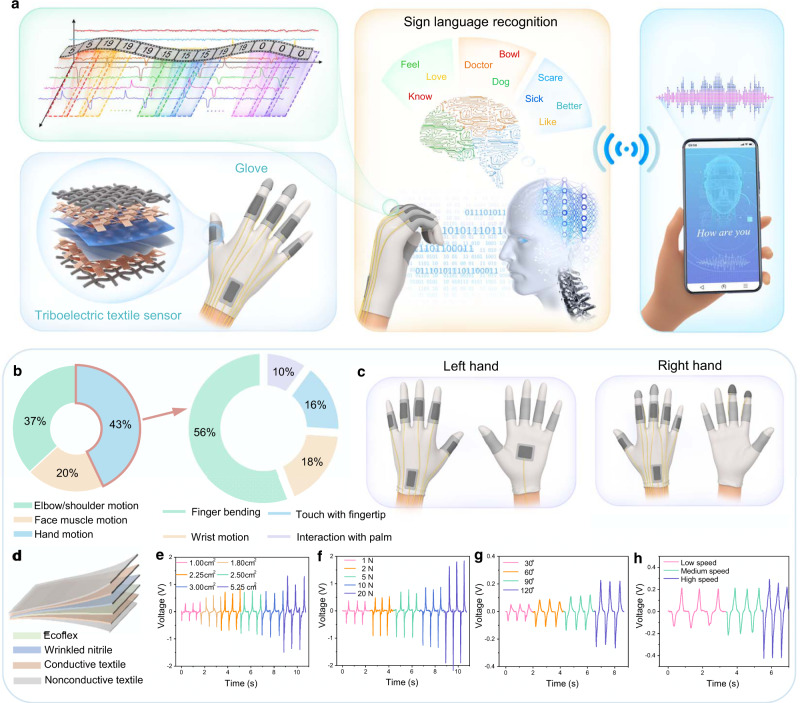
- The glove uses 15 triboelectric sensors; hand motion accounts for 43% of sign language motions, with finger bending (56%), wrist motion (18%), fingertip touch (16%), and palm interaction (10%) among hand motions.
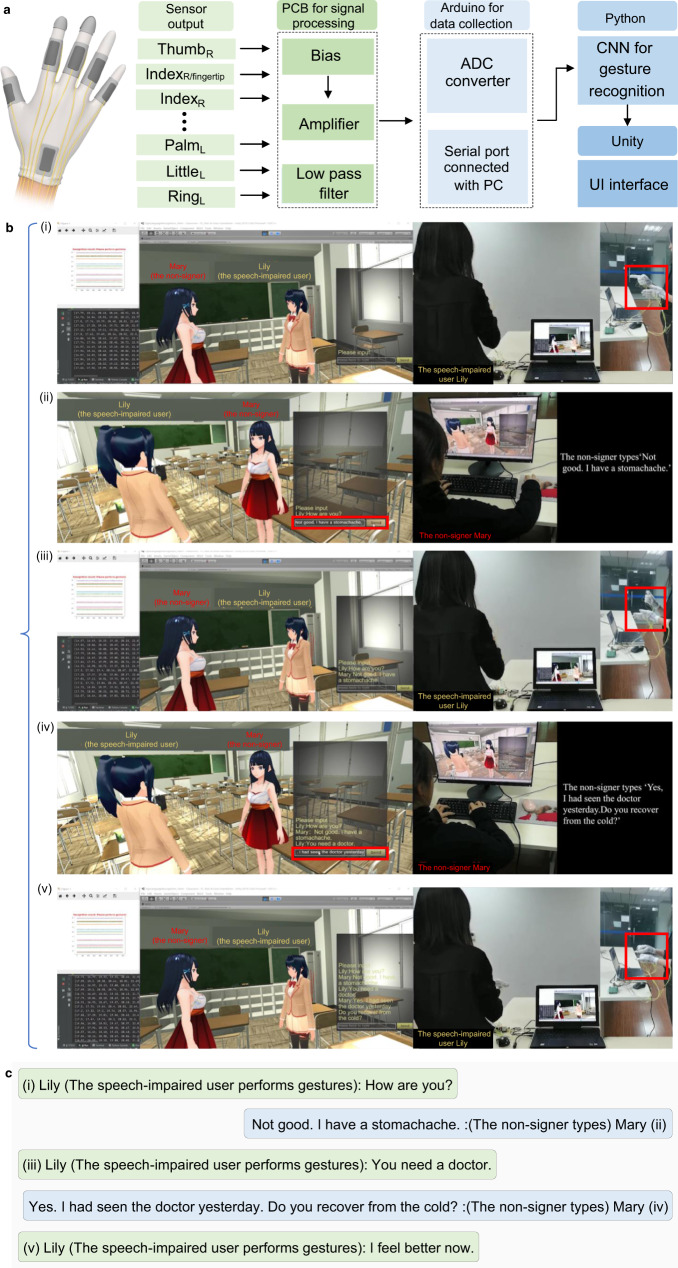
- The VR interface enables bidirectional communication: sign language is translated into text/audio and sent via TCP/IP to a nonsigner, who can type responses; a greeting conversation between avatars Lily and Mary is demonstrated.
Methods
- Triboelectric sensors were fabricated from Ecoflex and wrinkled nitrile with conductive textile electrodes, encapsulated, and stitched/glued onto a cotton glove; 15 sensors were placed on fingers, wrists, right index/middle fingertips, and left palm.
- For nonsegmentation, 100 samples per word and sentence were collected, with 80% training and 20% testing, yielding 5000 word samples and 2000 sentence samples. For segmentation, 50 samples per sentence for 17 sentences (850 total) were split with a 200-point sliding window at 50-point steps, producing 13 elements per 800-point sentence; 60%/20%/20% were used for training/validation/testing, and 5 samples for 3 new sentences tested new-sentence recognition.
- Main analysis used an optimized 1D CNN (5 kernels, 64 filters, 4 convolutional layers), PCA and t-SNE for visualization, single and hierarchy classifiers for segmentation, and a Unity VR interface with TCP/IP client–server communication.
Limitations
- No dedicated Limitations section is present. The paper states that the nonsegmentation method cannot distinguish new/never-seen sentences even when they contain the same word elements in a different order, and it introduces recognition time latency; the segmentation method has compromised recognition accuracy.
- The paper states the demonstration is limited to 50 words and 20 sentences from an American Sign Language phrase book and says the database can be broadened; new-sentence recognition reaches 86.67%, not perfect, and the single classifier is lower at 60%.
- Evident from the text: the VR communication demonstration is a greeting scenario between two avatars under an identical LAN, so broader real-world deployment and larger user populations are not tested in the paper.
Model-written summary. Check it against the paper before relying on it.
Integrity signals
Registry
Cites
Statistics
Figures
Verification
Claims the paper makes
35 Own result · 13 Own interpretation · 8 No basis given · 3 Not checked yet · 1 Own method
A result the paper reports from its own data — it cites no other source for it, so there is none to check. The quote shows it is in the paper.
In the paper
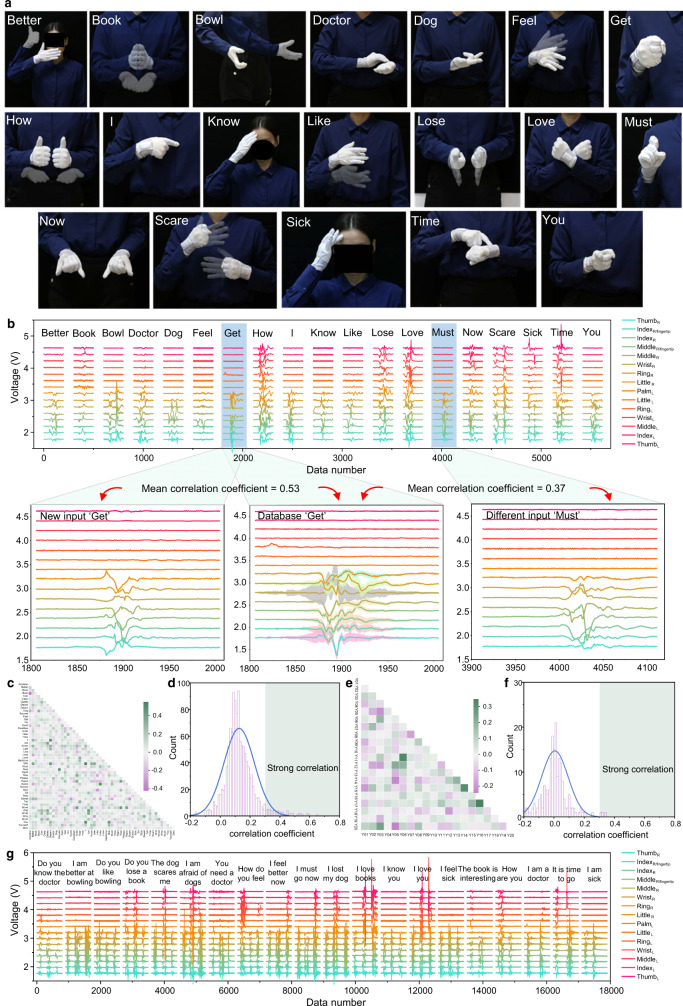
“the mean correlation coefficient 0.53 > 0.3 (threshold value for high similarity) by extracting the average value of 100 data samples and correlating it with the new input, which means the similarity is high between different ‘Get’ data samples.”
§ AI enabled sign language recognition and VR space bidirectional communication using triboelectric smart glove > Results > Data analysis of signals of 50 words and 20 sentences
plaincorrelationaln = 100- Asserted: passes — The authors put it forward as true.
- Checkable: passes — It can be checked against evidence.
- Load-bearing: unclear — It is unclear whether the paper’s conclusions depend on it.
- Based: passes — The paper gives a reason why it holds.
A result the paper reports from its own data — it cites no other source for it, so there is none to check. The quote shows it is in the paper.
In the paper
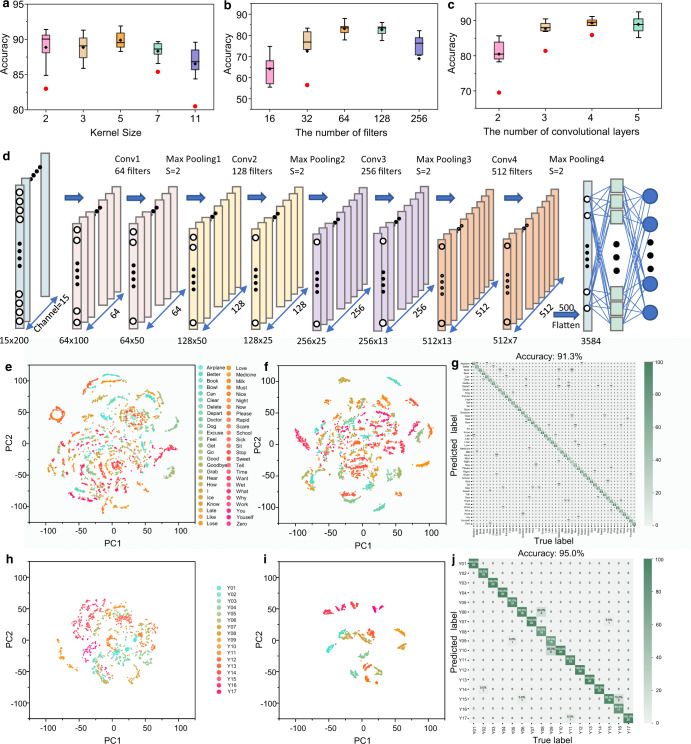
“Therefore, a high sentence recognition accuracy of 95% is obtained, as indicated in Fig. 3j.”
- Also stated in: § Word and sentence recognition upon nonsegmentation method · plain
“j Confusion map of recognizing 17 sentences.”
§ AI enabled sign language recognition and VR space bidirectional communication using triboelectric smart glove > Results > Word and sentence recognition upon nonsegmentation method
plain- Asserted: passes — The authors put it forward as true.
- Checkable: passes — It can be checked against evidence.
- Load-bearing: passes — The paper’s conclusions depend on it.
- Based: passes — The paper gives a reason why it holds.
- Also stated in: § Word and sentence recognition upon nonsegmentation method · plain
A result the paper reports from its own data — it cites no other source for it, so there is none to check. The quote shows it is in the paper.
In the paper
“The system successfully realizes the recognition of 50 words and 20 sentences.”
§ AI enabled sign language recognition and VR space bidirectional communication using triboelectric smart glove > Introduction
plain- Asserted: passes — The authors put it forward as true.
- Checkable: passes — It can be checked against evidence.
- Load-bearing: passes — The paper’s conclusions depend on it.
- Based: passes — The paper gives a reason why it holds.
A result the paper reports from its own data — it cites no other source for it, so there is none to check. The quote shows it is in the paper.
In the paper
“the sentence can be inversely reconstructed and recognition at an average correct rate of 85.58% within hierarchy classifier.”
- Also stated in: § Introduction · plain
“the whole sentence’s information can be reconstructed and recognized with an accuracy of 85.58% upon established correlation between word units and sentences.”
§ AI enabled sign language recognition and VR space bidirectional communication using triboelectric smart glove > Results > Word and sentence recognition upon segmentation method
plaindirect- Asserted: passes — The authors put it forward as true.
- Checkable: passes — It can be checked against evidence.
- Load-bearing: passes — The paper’s conclusions depend on it.
- Based: passes — The paper gives a reason why it holds.
- Also stated in: § Introduction · plain
A result the paper reports from its own data — it cites no other source for it, so there is none to check. The quote shows it is in the paper.
In the paper
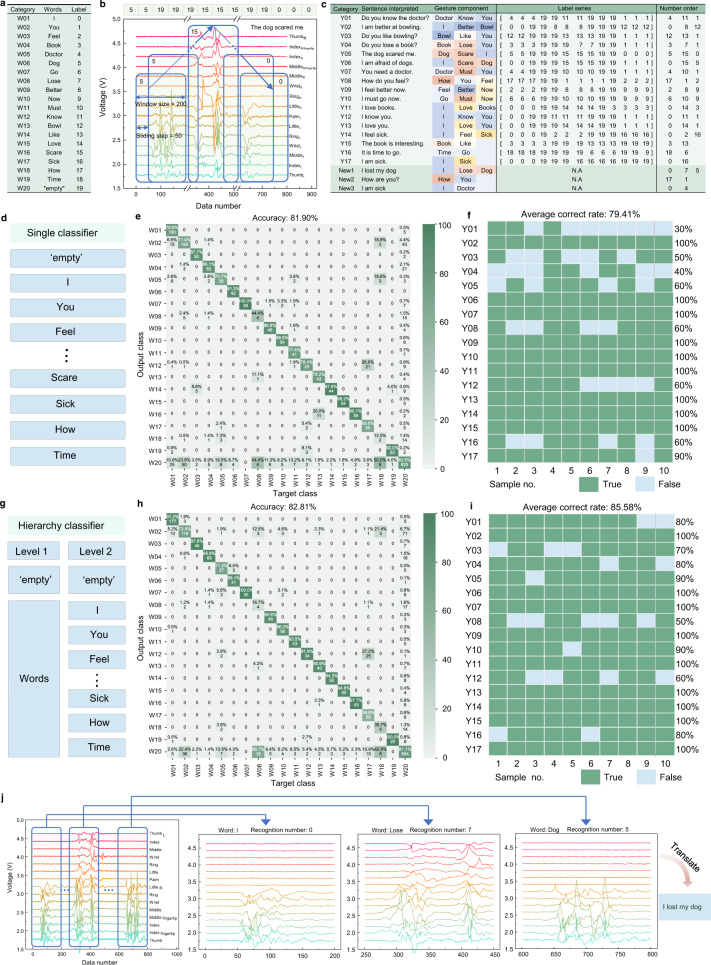
“showing an insufficient average correct rate of 79.41%.”
§ AI enabled sign language recognition and VR space bidirectional communication using triboelectric smart glove > Results > Word and sentence recognition upon segmentation method
plainn = 10- Asserted: passes — The authors put it forward as true.
- Checkable: passes — It can be checked against evidence.
- Load-bearing: passes — The paper’s conclusions depend on it.
- Based: passes — The paper gives a reason why it holds.
A result the paper reports from its own data — it cites no other source for it, so there is none to check. The quote shows it is in the paper.
In the paper
“The nonsegmentation AI framework achieves high accuracy for 50 words (91.3%) and 20 sentences (95%) by independently identifying word and sentence signals.”
§ AI enabled sign language recognition and VR space bidirectional communication using triboelectric smart glove > Introduction
plain- Asserted: passes — The authors put it forward as true.
- Checkable: passes — It can be checked against evidence.
- Load-bearing: passes — The paper’s conclusions depend on it.
- Based: passes — The paper gives a reason why it holds.
A result the paper reports from its own data — it cites no other source for it, so there is none to check. The quote shows it is in the paper.
In the paper
“The nonideal consequence for other sentences, such as Y03, Y04, and Y16, is observed as well.”
§ AI enabled sign language recognition and VR space bidirectional communication using triboelectric smart glove > Results > Word and sentence recognition upon segmentation method
plain- Asserted: passes — The authors put it forward as true.
- Checkable: passes — It can be checked against evidence.
- Load-bearing: unclear — It is unclear whether the paper’s conclusions depend on it.
- Based: passes — The paper gives a reason why it holds.
A result the paper reports from its own data — it cites no other source for it, so there is none to check. The quote shows it is in the paper.
In the paper
“a high recognition accuracy of these 50 words is achieved with the value of 91.3%, as shown in the confusion matrix in Fig. 3g.”
- Also stated in: § Introduction · plain
“The nonsegmentation AI framework achieves high accuracy for 50 words (91.3%)”
§ AI enabled sign language recognition and VR space bidirectional communication using triboelectric smart glove > Results > Word and sentence recognition upon nonsegmentation method
plainn = 20- Asserted: passes — The authors put it forward as true.
- Checkable: passes — It can be checked against evidence.
- Load-bearing: passes — The paper’s conclusions depend on it.
- Based: passes — The paper gives a reason why it holds.
- Also stated in: § Introduction · plain
A result the paper reports from its own data — it cites no other source for it, so there is none to check. The quote shows it is in the paper.
In the paper
“The confusion matrix in Fig. 4e shows an accuracy of 81.9% for the single classifier recognizing word units W01–W20.”
§ AI enabled sign language recognition and VR space bidirectional communication using triboelectric smart glove > Results > Word and sentence recognition upon segmentation method
plainn = 170- Asserted: passes — The authors put it forward as true.
- Checkable: passes — It can be checked against evidence.
- Load-bearing: passes — The paper’s conclusions depend on it.
- Based: passes — The paper gives a reason why it holds.
A result the paper reports from its own data — it cites no other source for it, so there is none to check. The quote shows it is in the paper.
In the paper
“the segmentation approach assisted AI brings the capability of recognizing new/never-seen sentences (average correct rate: 86.67%) that are not included in the database and are created by word element recombination in new orders.”
- Also stated in: § Abstract · plain
“new/never-seen sentences created by new-order word elements recombination can be recognized with an average correct rate of 86.67%.”
§ AI enabled sign language recognition and VR space bidirectional communication using triboelectric smart glove > Introduction
plaindirect- Asserted: passes — The authors put it forward as true.
- Checkable: passes — It can be checked against evidence.
- Load-bearing: passes — The paper’s conclusions depend on it.
- Based: passes — The paper gives a reason why it holds.
- Rests on an assumption: New/never-seen sentences created by new-order word element recombination are valid sign language sentences that a signer would use.
- Also stated in: § Abstract · plain
- It may state two separate claims as one. 23
- Probably not a substantial claim. 6
A result the paper reports from its own data — it cites no other source for it, so there is none to check. The quote shows it is in the paper.
In the paper
“Eventually, it positively contributes to the sentence recognition, which is indicated by the improved average correct rate of 85.58% with a reduced false area in Fig. 4i.”
§ AI enabled sign language recognition and VR space bidirectional communication using triboelectric smart glove > Results > Word and sentence recognition upon segmentation method
hedgeddirect- Asserted: passes — The authors put it forward as true.
- Checkable: passes — It can be checked against evidence.
- Load-bearing: passes — The paper’s conclusions depend on it.
- Based: passes — The paper gives a reason why it holds.
It may state two separate claims as one.
A result the paper reports from its own data — it cites no other source for it, so there is none to check. The quote shows it is in the paper.
In the paper
“the voltage output increases when sensor area, force, bending degree, and bending speed increase.”
§ AI enabled sign language recognition and VR space bidirectional communication using triboelectric smart glove > Results > Glove configuration and sensor characterization
plaindirect- Asserted: passes — The authors put it forward as true.
- Checkable: passes — It can be checked against evidence.
- Load-bearing: unclear — It is unclear whether the paper’s conclusions depend on it.
- Based: passes — The paper gives a reason why it holds.
It may state two separate claims as one.
A result the paper reports from its own data — it cites no other source for it, so there is none to check. The quote shows it is in the paper.
In the paper
“The mean correlation coefficient of 0.37 is larger than 0.3, indicating the high signal similarity between ‘Get’ and ‘Must’ as well”
§ AI enabled sign language recognition and VR space bidirectional communication using triboelectric smart glove > Results > Data analysis of signals of 50 words and 20 sentences
plaincorrelationaln = 100- Asserted: passes — The authors put it forward as true.
- Checkable: passes — It can be checked against evidence.
- Load-bearing: unclear — It is unclear whether the paper’s conclusions depend on it.
- Based: passes — The paper gives a reason why it holds.
It may state two separate claims as one.
A result the paper reports from its own data — it cites no other source for it, so there is none to check. The quote shows it is in the paper.
In the paper
“hand motions fall into four categories, including finger bending (56%), wrist motion (18%), touch with fingertips (16%), and interaction with palm (10%).”
§ AI enabled sign language recognition and VR space bidirectional communication using triboelectric smart glove > Results > Glove configuration and sensor characterization
plain- Asserted: passes — The authors put it forward as true.
- Checkable: passes — It can be checked against evidence.
- Load-bearing: passes — The paper’s conclusions depend on it.
- Based: passes — The paper gives a reason why it holds.
It may state two separate claims as one.
The paper states this without a source or data behind it here, so there is nothing to check it against. The quote shows it is in the paper.
In the paper
“the recognition latency is significantly reduced due to small-distance sliding (50 data points per sliding) as the recognition process will be triggered with each sliding.”
§ AI enabled sign language recognition and VR space bidirectional communication using triboelectric smart glove > Results > Word and sentence recognition upon segmentation method
plaindirect- Asserted: passes — The authors put it forward as true.
- Checkable: passes — It can be checked against evidence.
- Load-bearing: passes — The paper’s conclusions depend on it.
- Based: passes — The paper gives a reason why it holds.
It may state two separate claims as one.
A result the paper reports from its own data — it cites no other source for it, so there is none to check. The quote shows it is in the paper.
In the paper
“the 3rd and 5–10th samples of sentence Y01 are wrongly classified with a poor correct rate of 30%.”
§ AI enabled sign language recognition and VR space bidirectional communication using triboelectric smart glove > Results > Word and sentence recognition upon segmentation method
plainn = 10- Asserted: passes — The authors put it forward as true.
- Checkable: passes — It can be checked against evidence.
- Load-bearing: unclear — It is unclear whether the paper’s conclusions depend on it.
- Based: passes — The paper gives a reason why it holds.
It may state two separate claims as one.
A result the paper reports from its own data — it cites no other source for it, so there is none to check. The quote shows it is in the paper.
In the paper
“It shows the performance of feature clustering is poor with category overlaps before going through the CNN network. After undergoing the feature extraction and classification of CNN, the visualization result realized by t-SNE in Fig. 3f indicates a desirable classification performance of the developed CNN model with clear boundaries among these 50 classes with less overlap.”
§ AI enabled sign language recognition and VR space bidirectional communication using triboelectric smart glove > Results > Word and sentence recognition upon nonsegmentation method
hedgeddirect- Asserted: passes — The authors put it forward as true.
- Checkable: passes — It can be checked against evidence.
- Load-bearing: passes — The paper’s conclusions depend on it.
- Based: passes — The paper gives a reason why it holds.
It may state two separate claims as one.
The paper states this without a source or data behind it here, so there is nothing to check it against. The quote shows it is in the paper.
In the paper
“Then the deep learning model recognizes all word elements and reversely reconstructs and recognizes sentences.”
§ AI enabled sign language recognition and VR space bidirectional communication using triboelectric smart glove > Abstract
plaindirect- Asserted: passes — The authors put it forward as true.
- Checkable: passes — It can be checked against evidence.
- Load-bearing: passes — The paper’s conclusions depend on it.
- Based: passes — The paper gives a reason why it holds.
It may state two separate claims as one.
A result the paper reports from its own data — it cites no other source for it, so there is none to check. The quote shows it is in the paper.
In the paper
“the data analysis proclaims the high similarities of word-to-word and sentence-to-sentence signals.”
§ AI enabled sign language recognition and VR space bidirectional communication using triboelectric smart glove > Results > Data analysis of signals of 50 words and 20 sentences
plaincorrelational- Asserted: passes — The authors put it forward as true.
- Checkable: passes — It can be checked against evidence.
- Load-bearing: passes — The paper’s conclusions depend on it.
- Based: passes — The paper gives a reason why it holds.
It may state two separate claims as one.
The paper states this without a source or data behind it here, so there is nothing to check it against. The quote shows it is in the paper.
In the paper
“the sign language recognition results are projected into virtual space and translated into text and audio, allowing the remote and bidirectional communication between signers and non-signers.”
§ AI enabled sign language recognition and VR space bidirectional communication using triboelectric smart glove > Abstract
plaindirect- Asserted: passes — The authors put it forward as true.
- Checkable: passes — It can be checked against evidence.
- Load-bearing: passes — The paper’s conclusions depend on it.
- Based: passes — The paper gives a reason why it holds.
It may state two separate claims as one.
The paper states this without a source or data behind it here, so there is nothing to check it against. The quote shows it is in the paper.
In the paper
“The system enables the separate and independent recognition of words (i.e., single gestures) and sentences (i.e., continuous multiple gestures) with high accuracies of 91.3% and 95% within nonsegmentation frame.”
§ AI enabled sign language recognition and VR space bidirectional communication using triboelectric smart glove > Discussion
plaindirect- Asserted: passes — The authors put it forward as true.
- Checkable: passes — It can be checked against evidence.
- Load-bearing: passes — The paper’s conclusions depend on it.
- Based: passes — The paper gives a reason why it holds.
It may state two separate claims as one.
A result the paper reports from its own data — it cites no other source for it, so there is none to check. The quote shows it is in the paper.
In the paper
“In comparison, the hierarchy classifier achieves precise identification of 5 samples of New1, 3 samples of New2, and 5 samples of New3.”
§ AI enabled sign language recognition and VR space bidirectional communication using triboelectric smart glove > Results > Recognizing new sentences upon segmentation approach
plainn = 3- Asserted: passes — The authors put it forward as true.
- Checkable: passes — It can be checked against evidence.
- Load-bearing: passes — The paper’s conclusions depend on it.
- Based: passes — The paper gives a reason why it holds.
It may state two separate claims as one.
A result the paper reports from its own data — it cites no other source for it, so there is none to check. The quote shows it is in the paper.
In the paper
“In other words, the hierarchy classifier achieves an average correct rate of 86.67% (see Supplementary Fig. 6b), superior to 60% of the single classifier.”
§ AI enabled sign language recognition and VR space bidirectional communication using triboelectric smart glove > Results > Recognizing new sentences upon segmentation approach
plainn = 5- Asserted: passes — The authors put it forward as true.
- Checkable: passes — It can be checked against evidence.
- Load-bearing: passes — The paper’s conclusions depend on it.
- Based: passes — The paper gives a reason why it holds.
It may state two separate claims as one.
A result the paper reports from its own data — it cites no other source for it, so there is none to check. The quote shows it is in the paper.
In the paper
“Moving forward to the translation (i.e., recognition) stage (see Supplementary Fig. 6a), the single classifier correctly predicts 2 samples of New1, 3 samples of New2, 4 samples of New3 (average correct rate of 60%).”
§ AI enabled sign language recognition and VR space bidirectional communication using triboelectric smart glove > Results > Recognizing new sentences upon segmentation approach
plainn = 3- Asserted: passes — The authors put it forward as true.
- Checkable: passes — It can be checked against evidence.
- Load-bearing: passes — The paper’s conclusions depend on it.
- Based: passes — The paper gives a reason why it holds.
It may state two separate claims as one.
A result the paper reports from its own data — it cites no other source for it, so there is none to check. The quote shows it is in the paper.
In the paper
“As provided in Supplementary Table 2, both classifiers render the label series prediction for the total 15 inputs of these 3 new sentences, although the CNN model never sees or learns the true label series before.”
§ AI enabled sign language recognition and VR space bidirectional communication using triboelectric smart glove > Results > Recognizing new sentences upon segmentation approach
plainn = 5- Asserted: passes — The authors put it forward as true.
- Checkable: passes — It can be checked against evidence.
- Load-bearing: passes — The paper’s conclusions depend on it.
- Based: passes — The paper gives a reason why it holds.
It may state two separate claims as one.
A result the paper reports from its own data — it cites no other source for it, so there is none to check. The quote shows it is in the paper.
In the paper
“In the first step Fig. 5b(i), the speech-impaired user Lily performs sign language ‘How are you?’, which is recognized and converted to text and audio by the deep learning model.”
§ AI enabled sign language recognition and VR space bidirectional communication using triboelectric smart glove > Results > VR communication interface for the signer and nonsigner
plaindirectSingle case- Asserted: passes — The authors put it forward as true.
- Checkable: passes — It can be checked against evidence.
- Load-bearing: passes — The paper’s conclusions depend on it.
- Based: passes — The paper gives a reason why it holds.
It may state two separate claims as one.
A result the paper reports from its own data — it cites no other source for it, so there is none to check. The quote shows it is in the paper.
In the paper
“Overall, the nonsegmentation approach possesses better performance in the aspect of recognition accuracy either for words or sentences but with the shortcoming of apparent recognition time latency and incapability of new sentence recognition.”
§ AI enabled sign language recognition and VR space bidirectional communication using triboelectric smart glove > Results > Recognizing new sentences upon segmentation approach
plaincorrelational- Asserted: passes — The authors put it forward as true.
- Checkable: passes — It can be checked against evidence.
- Load-bearing: passes — The paper’s conclusions depend on it.
- Based: passes — The paper gives a reason why it holds.
It may state two separate claims as one.
A conclusion the paper draws from its own results — it cites no other source for it, so there is none to check. The quote shows it is in the paper.
In the paper
“The VR interface for two-way remote communication, linked with the AI front end for sign language recognition, shows a potential prototype of a future intelligent sign language recognition and communication system.”
§ AI enabled sign language recognition and VR space bidirectional communication using triboelectric smart glove > Introduction
hedgedcorrelational- Asserted: passes — The authors put it forward as true.
- Checkable: passes — It can be checked against evidence.
- Load-bearing: passes — The paper’s conclusions depend on it.
- Based: passes — The paper gives a reason why it holds.
Probably not a substantial claim.
A conclusion the paper draws from its own results — it cites no other source for it, so there is none to check. The quote shows it is in the paper.
In the paper
“The long-length signal of sentence provides more distinguishable features than the single-word signal. Therefore, a high sentence recognition accuracy of 95% is obtained”
§ AI enabled sign language recognition and VR space bidirectional communication using triboelectric smart glove > Results > Word and sentence recognition upon nonsegmentation method
plaindirect- Asserted: passes — The authors put it forward as true.
- Checkable: passes — It can be checked against evidence.
- Load-bearing: passes — The paper’s conclusions depend on it.
- Based: passes — The paper gives a reason why it holds.
It may state two separate claims as one.
A conclusion the paper draws from its own results — it cites no other source for it, so there is none to check. The quote shows it is in the paper.
In the paper
“Overall, the hierarchy classifier improves both the accuracy of recognizing word elements and that of identifying ever-seen/trained sentences.”
§ AI enabled sign language recognition and VR space bidirectional communication using triboelectric smart glove > Results > Word and sentence recognition upon segmentation method
plaindirect- Asserted: passes — The authors put it forward as true.
- Checkable: passes — It can be checked against evidence.
- Load-bearing: passes — The paper’s conclusions depend on it.
- Based: passes — The paper gives a reason why it holds.
It may state two separate claims as one.
A conclusion the paper draws from its own results — it cites no other source for it, so there is none to check. The quote shows it is in the paper.
In the paper
“the single classifier may not be effective enough when reconstructing and recognizing sentences that existed in the dataset, which may hinder the identification of new/never-seen sentences.”
§ AI enabled sign language recognition and VR space bidirectional communication using triboelectric smart glove > Results > Word and sentence recognition upon segmentation method
hedgedconditional- Asserted: passes — The authors put it forward as true.
- Checkable: passes — It can be checked against evidence.
- Load-bearing: passes — The paper’s conclusions depend on it.
- Based: passes — The paper gives a reason why it holds.
It may state two separate claims as one.
A conclusion the paper draws from its own results — it cites no other source for it, so there is none to check. The quote shows it is in the paper.
In the paper
“The VR communication interface linked with AI allows interaction of the speech/hearing disordered and healthy people closely and even remotely, providing a promising platform for the immense interactions between two population groups.”
§ AI enabled sign language recognition and VR space bidirectional communication using triboelectric smart glove > Results > VR communication interface for the signer and nonsigner
plaincorrelational- Asserted: passes — The authors put it forward as true.
- Checkable: passes — It can be checked against evidence.
- Load-bearing: passes — The paper’s conclusions depend on it.
- Based: passes — The paper gives a reason why it holds.
Probably not a substantial claim. It may state two separate claims as one.
- Rests on an assumption: Most current sign language translation systems simply display recognition results on visualized interfaces such as mobile phones and portable displays.
- Rests on an assumption: Most works do not allow interaction between signers and nonsigners.
- Rests on an assumption: There is an acute demand for effective two-way communication between signers and nonsigners.
- Rests on an assumption: The emerging VR interface is an ideal platform for advanced sign language interpretation, visualization, and communication interface.
A conclusion the paper draws from its own results — it cites no other source for it, so there is none to check. The quote shows it is in the paper.
In the paper
“Finally, the embedded VR interface can act as the bridge of user terminals, transmitting messages back and forth, configuring a closed-loop communication system with gloves and AI component.”
§ AI enabled sign language recognition and VR space bidirectional communication using triboelectric smart glove > Discussion
plaindirect- Asserted: passes — The authors put it forward as true.
- Checkable: passes — It can be checked against evidence.
- Load-bearing: passes — The paper’s conclusions depend on it.
- Based: fails — The paper may give no reason why it holds.
Probably not a substantial claim. The paper may give no reason why it holds. It may state two separate claims as one.
- Rests on an assumption: Most current sign language translation systems simply display recognition results on visualized interfaces such as mobile phones and portable displays.
- Rests on an assumption: Most works do not allow interaction between signers and nonsigners.
- Rests on an assumption: There is an acute demand for effective two-way communication between signers and nonsigners.
- Rests on an assumption: The emerging VR interface is an ideal platform for advanced sign language interpretation, visualization, and communication interface.
A conclusion the paper draws from its own results — it cites no other source for it, so there is none to check. The quote shows it is in the paper.
In the paper
“Besides, the intelligent system consist of smart gloves, AI-assisted recognition, and TCP/IP enabled server-client LAN communication in virtual space, providing a reliable and appealing platform for the seamless and immense interactions between nonsigners and signers either remotely or proximately.”
§ AI enabled sign language recognition and VR space bidirectional communication using triboelectric smart glove > Discussion
plaindirect- Asserted: passes — The authors put it forward as true.
- Checkable: fails — It may be too vague to check against evidence.
- Load-bearing: passes — The paper’s conclusions depend on it.
- Based: passes — The paper gives a reason why it holds.
Probably not a substantial claim. It may be too vague to check against evidence.
- Rests on an assumption: Most current sign language translation systems simply display recognition results on visualized interfaces such as mobile phones and portable displays.
- Rests on an assumption: Most works do not allow interaction between signers and nonsigners.
- Rests on an assumption: There is an acute demand for effective two-way communication between signers and nonsigners.
- Rests on an assumption: The emerging VR interface is an ideal platform for advanced sign language interpretation, visualization, and communication interface.
What the paper did — it cites no source for this, so there is none to check. The quote shows it is in the paper.
In the paper
“The authors affirm that the participant provide informed consent for publication of the images in Figs. 2a, 5b, Supplementary Figs. 2a, 8a, and the videos in Supplementary Movies 1, 2, 3.”
§ AI enabled sign language recognition and VR space bidirectional communication using triboelectric smart glove > Methods > VR communication interface building and demonstration
plain- Asserted: passes — The authors put it forward as true.
- Checkable: passes — It can be checked against evidence.
- Load-bearing: fails — The paper’s conclusions may not depend on it.
- Based: passes — The paper gives a reason why it holds.
Probably not a substantial claim. The paper’s conclusions may not depend on it.
In the paper
“Although few works have employed AI-enabled advanced data analytics to achieve highly precise sign language translation, they are still limited to the classification of discrete words that cannot meet the requirement of practical communication in the signer’s daily lives.”
§ AI enabled sign language recognition and VR space bidirectional communication using triboelectric smart glove > Discussion
What the sources say
- Not checked yetcites Supplementary Table 3
plain- Asserted: passes — The authors put it forward as true.
- Checkable: passes — It can be checked against evidence.
- Load-bearing: passes — The paper’s conclusions depend on it.
- Based: passes — The paper gives a reason why it holds.
It may state two separate claims as one.
A conclusion the paper draws from its own results — it cites no other source for it, so there is none to check. The quote shows it is in the paper.
In the paper
“Besides, the small-distance sliding induced recognition brings the potential of the real-time recognition or translation of sentences.”
§ AI enabled sign language recognition and VR space bidirectional communication using triboelectric smart glove > Results > Recognizing new sentences upon segmentation approach
hedgedconditional- Asserted: passes — The authors put it forward as true.
- Checkable: passes — It can be checked against evidence.
- Load-bearing: fails — The paper’s conclusions may not depend on it.
- Based: passes — The paper gives a reason why it holds.
Probably not a substantial claim. The paper’s conclusions may not depend on it.
The paper relies on this without support.
New/never-seen sentences created by new-order word element recombination are valid sign language sentences that a signer would use.
“new/never-seen sentences created by new-order word elements recombination can be recognized with an average correct rate of 86.67%.”
The paper relies on this without support.
The 50 gestures and 20 sentences selected are representative of daily sign language communication.
“we select 50 gestures that are daily used in the signer’s life as demonstration.”
“20 daily sentences are sorted out for subsequent study.”
The paper relies on this without support.
Sign language is not as prevalent as spoken language and is difficult for nonsigners to understand without prior learning.
“sign language is not as prevalent as the speaking language and difficult for nonsigners to understand without prior learning.”
The paper relies on this without support.
Most current sign language translation systems simply display recognition results on visualized interfaces such as mobile phones and portable displays.
“Most current sign language translation systems simply display the recognition result on visualized interfaces such as mobile phones and portable displays.”
The paper relies on this without support.
Most works do not allow interaction between signers and nonsigners.
“since most of works do not allow the interaction between signers and nonsigners.”
The paper relies on this without support.
There is an acute demand for effective two-way communication between signers and nonsigners.
“However, the acute demand of effective two-way communication between the signers and nonsigners is neglected”
The paper relies on this without support.
The emerging VR interface is an ideal platform for advanced sign language interpretation, visualization, and communication interface.
“which would be an ideal platform for an advanced sign language interpretation, visualization, and communication interface.”
Claims other papers make about this one
Each is checked against this paper’s own text: does it say what the citing paper says it does?
In the citing paper
“The deep learning algorithm initially identifies word components, followed by the reconstruction of the original sentences, achieving respective accuracies of 82.81% and 85.58%.”
From Artificial intelligence enhanced sensors - enabling technologies to next-generation healthcare and biomedical platform (2023) · cites this paper as Wen, F. et al. 2021
In the citing paper
“In addition, the segmentation method opens new avenues for recognizing novel or previously unseen sentences.”
From Artificial intelligence enhanced sensors - enabling technologies to next-generation healthcare and biomedical platform (2023) · cites this paper as Wen, F. et al. 2021
In the citing paper
“Therefore, as shown in Fig. 9e Wen et al. demonstrate a sign language recognition and communication system based on smart glove sensors (Wen, F. et al. 2021).”
From Artificial intelligence enhanced sensors - enabling technologies to next-generation healthcare and biomedical platform (2023) · cites this paper as Wen, F. et al. 2021
In the citing paper
“This breakthrough in recognizing both existing and new sentences enhances the practicality of sign language recognition systems, marking a significant step towards minimizing communication obstacles between sign language users and non-signers.”
From Artificial intelligence enhanced sensors - enabling technologies to next-generation healthcare and biomedical platform (2023) · cites this paper as Wen, F. et al. 2021
Self-check
Percentages, sums and reported differences re-computed from the paper’s own numbers.
Each contradiction between two passages listed here was confirmed by an independent check.
Rated minor: it would not touch a result — a value no result rests on, a p-value that stays on the same side of the significance level, or a conflict that is clerical, resolved elsewhere in the paper, or outside its own findings.
In the paper
§ AI enabled sign language recognition and VR space bidirectional communication using triboelectric smart glove > Introduction
“The nonsegmentation AI framework achieves high accuracy for 50 words (91.3%) and 20 sentences (95%) by independently identifying word and sentence signals.”
§ AI enabled sign language recognition and VR space bidirectional communication using triboelectric smart glove > Results > Word and sentence recognition upon nonsegmentation method
“Therefore, a high sentence recognition accuracy of 95% is obtained, as indicated in Fig. 3j.”
Citations
Cites
Double-slit photoelectron interference in strong-field ionization of the neon dimer
Kunitski, M., Eicke, N., Huber, P., Köhler, J., Zeller, S., Voigtsberger, J., Schlott, N., Henrichs, K., Sann, H., Trinter, F., et al. (2019) · Institutional Repository of Leibniz Universität Hannover (Leibniz Universität Hannover) · doi:10.15488/5174 · Cited by 8,378
Double-slit photoelectron interference in strong-field ionization of the neon dimer
Kunitski, M., Eicke, N., Huber, P., Köhler, J., Zeller, S., Voigtsberger, J., Schlott, N., Henrichs, K., Sann, H., Trinter, F., et al. (2019) · Nature Communications · doi:10.1038/s41467-018-07882-8 · Cited by 8,162
U1 snRNP regulates cancer cell migration and invasion in vitro
Oh, J.-M., Venters, C. C., Di, C., Pinto, A. M., Wan, L., Younis, I., Cai, Z., Arai, C., So, B. R., Duan, J., et al. (2020) · Nature Communications · doi:10.1038/s41467-019-13993-7 · Cited by 7,157
Flexible triboelectric generator
Fan, F.-R., Tian, Z.-Q., & Lin Wang, Z. (2012) · Nano Energy · doi:10.1016/j.nanoen.2012.01.004 · Cited by 6,705
Fully integrated wearable sensor arrays for multiplexed in situ perspiration analysis
Gao, W., Emaminejad, S., Nyein, H. Y. Y., Challa, S., Chen, K., Peck, A., Fahad, H. M., Ota, H., Shiraki, H., Kiriya, D., et al. (2016) · Nature · doi:10.1038/nature16521 · Cited by 5,087
Yang, J. C., Mun, J., Kwon, S. Y., Park, S., Bao, Z., & Park, S. (2019) · Advanced Materials · doi:10.1002/adma.201904765 · Cited by 1,641
Grammar, Gesture, and Meaning in American Sign Language
Liddell, S. K. (2003) · Cambridge University Press eBooks · doi:10.1017/cbo9780511615054 · Cited by 1,390
Learning the signatures of the human grasp using a scalable tactile glove
Sundaram, S., Kellnhofer, P., Li, Y., Zhu, J.-Y., Torralba, A., & Matusik, W. (2019) · Nature · doi:10.1038/s41586-019-1234-z · Cited by 1,162
Skin-integrated wireless haptic interfaces for virtual and augmented reality
Yu, X., Xie, Z., Yu, Y., Lee, J., Vazquez-Guardado, A., Luan, H., Ruban, J., Ning, X., Akhtar, A., Li, D., et al. (2019) · Nature · doi:10.1038/s41586-019-1687-0 · Cited by 1,025
Self-citationHergenrother, C. W., Maleszewski, C., Nolan, M. C., Li, J., d’Aubigny, C. D., Shelly, F. C., Howell, E. S., Kareta, T., Izawa, M. R. M., Barucci, M. A., et al. (2019) · Nature Communications · doi:10.1038/s41467-019-09213-x · Cited by 902
Monitoring of the central blood pressure waveform via a conformal ultrasonic device
Wang, C., Li, X., Hu, H., Zhang, L., Huang, Z., Lin, M., Zhang, Z., Yin, Z., Huang, B., Gong, H., et al. (2018) · Nature Biomedical Engineering · doi:10.1038/s41551-018-0287-x · Cited by 895
Self-citationLi, Y., Xiao, K., Huang, C., Wang, J., Gao, M., Hu, A., Tang, Q., Fan, B., Xu, Y., & Chen, X. (2020) · Nano-Micro Letters · doi:10.1007/s40820-020-00525-y · Cited by 892
Sign-to-speech translation using machine-learning-assisted stretchable sensor arrays
Zhou, Z., Chen, K. J., Li, X., Zhang, S., Wu, Y., Zhou, Y., Meng, K., Sun, C., He, Q., Fan, W., et al. (2020) · Nature Electronics · doi:10.1038/s41928-020-0428-6 · Cited by 878
Binodal, wireless epidermal electronic systems with in-sensor analytics for neonatal intensive care
Chung, H. U., Kim, B. H., Lee, J. Y., Lee, J., Xie, Z., Ibler, E. M., Lee, K., Banks, A., Jeong, J. Y., Kim, J., et al. (2019) · Science · doi:10.1126/science.aau0780 · Cited by 807
Self-citationZhu, M., Sun, Z., Zhang, Z., Shi, Q., He, T., Liu, H., Chen, T., & Lee, C. (2020) · Science Advances · doi:10.1126/sciadv.aaz8693 · Cited by 784
Self-citationWearable and Stretchable Strain Sensors: Materials, Sensing Mechanisms, and Applications
Souri, H., Banerjee, H., Jusufi, A., Radacsi, N., Stokes, A. A., Park, I., Sitti, M., & Amjadi, M. (2020) · Advanced Intelligent Systems · doi:10.1002/aisy.202000039 · Cited by 710
A wearable biosensing system with in-sensor adaptive machine learning for hand gesture recognition
Moin, A., Zhou, A., Rahimi, A., Menon, A., Benatti, S., Alexandrov, G., Tamakloe, S., Ting, J., Yamamoto, N. A. D., Khan, Y., et al. (2020) · Nature Electronics · doi:10.1038/s41928-020-00510-8 · Cited by 698
Triboelectric nanogenerator sensors for soft robotics aiming at digital twin applications
Jin, T., Sun, Z., Li, L., Zhang, Q., Zhu, M., Zhang, Z., Yuan, G., Chen, T., Tian, Y., Hou, X., et al. (2020) · Nature Communications · doi:10.1038/s41467-020-19059-3 · Cited by 695
Self-citationShi, Q., Dong, B., He, T., Sun, Z., Zhu, J., Zhang, Z., & Lee, C. (2020) · InfoMat · doi:10.1002/inf2.12122 · Cited by 674
Self-citationA stretchable and biodegradable strain and pressure sensor for orthopaedic application
Boutry, C. M., Kaizawa, Y., Schroeder, B. C., Chortos, A., Legrand, A., Wang, Z., Chang, J., Fox, P., & Bao, Z. (2018) · Nature Electronics · doi:10.1038/s41928-018-0071-7 · Cited by 667
A bionic stretchable nanogenerator for underwater sensing and energy harvesting
Zou, Y., Tan, P., Shi, B., Ouyang, H., Jiang, D., Liu, Z., Li, H., Yu, M., Wang, C., Qu, X., et al. (2019) · Nature Communications · doi:10.1038/s41467-019-10433-4 · Cited by 604
A high performance wearable strain sensor with advanced thermal management for motion monitoring
Tan, C., Dong, Z., Li, Y., Zhao, H., Huang, X., Zhou, Z., Jiang, J.-W., Long, Y., Jiang, P., Zhang, T., et al. (2020) · Nature Communications · doi:10.1038/s41467-020-17301-6 · Cited by 591
Wang, M., Yan, Z., Wang, T., Cai, P., Gao, S., Zeng, Y., Wan, C., Wang, H., Pan, L., Yu, J., et al. (2020) · Nature Electronics · doi:10.1038/s41928-020-0422-z · Cited by 575
Three-dimensional integrated stretchable electronics
Huang, Z., Hao, Y., Li, Y., Hu, H., Wang, C., Nomoto, A., Pan, T., Gu, Y., Chen, Y., Zhang, T., et al. (2018) · Nature Electronics · doi:10.1038/s41928-018-0116-y · Cited by 551
Ultra-sensitive and resilient compliant strain gauges for soft machines
Araromi, O. A., Graule, M. A., Dorsey, K. L., Castellanos, S., Foster, J. R., Hsu, W.-H., Passy, A. E., Vlassak, J. J., Weaver, J. C., Walsh, C. J., et al. (2020) · Nature · doi:10.1038/s41586-020-2892-6 · Cited by 529
Flexible Hybrid Sensors for Health Monitoring: Materials and Mechanisms to Render Wearability
Gao, Y., Yu, L., Yeo, J. C., & Lim, C. T. (2019) · Advanced Materials · doi:10.1002/adma.201902133 · Cited by 515
Wen, F., Sun, Z., He, T., Shi, Q., Zhu, M., Zhang, Z., Li, L., Zhang, T., & Lee, C. (2020) · Advanced Science · doi:10.1002/advs.202000261 · Cited by 482
Self-citationSensitive Wearable Temperature Sensor with Seamless Monolithic Integration
Shin, J., Jeong, B., Kim, J., Nam, V. B., Yoon, Y., Jung, J., Hong, S., Lee, H., Eom, H., Yeo, J., et al. (2020) · Advanced Materials · doi:10.1002/adma.201905527 · Cited by 449
Wang, X., Zhang, Y., Zhang, X., Huo, Z., Li, X., Que, M., Peng, Z., Wang, H., & Pan, C. (2018) · Advanced Materials · doi:10.1002/adma.201706738 · Cited by 437
Hierarchically patterned self-powered sensors for multifunctional tactile sensing
Wang, Y., Wu, H., Xu, L., Zhang, H., Yang, Y., & Wang, Z. L. (2020) · Science Advances · doi:10.1126/sciadv.abb9083 · Cited by 425
Deep learning-enabled triboelectric smart socks for IoT-based gait analysis and VR applications
Zhang, Z., He, T., Zhu, M., Sun, Z., Shi, Q., Zhu, J., Dong, B., Yuce, M. R., & Lee, C. (2020) · npj Flexible Electronics · doi:10.1038/s41528-020-00092-7 · Cited by 425
Self-citationLai, Y., Deng, J., Zhang, S. L., Niu, S., Guo, H., & Wang, Z. L. (2016) · Advanced Functional Materials · doi:10.1002/adfm.201604462 · Cited by 413
Zhu, M., Shi, Q., He, T., Yi, Z., Ma, Y., Yang, B. T., Chen, T., & Lee, C. (2019) · ACS Nano · doi:10.1021/acsnano.8b08329 · Cited by 413
Self-citationEffective Wound Healing Enabled by Discrete Alternative Electric Fields from Wearable Nanogenerators
Long, Y., Wei, H., Li, J., Yao, G., Yu, B., Ni, D., Gibson, A. L., Lan, X., Jiang, Y., Cai, W., et al. (2018) · ACS Nano · doi:10.1021/acsnano.8b07038 · Cited by 397
Wen, Z., Yang, Y., Sun, N., Li, G., Liu, Y., Chen, C., Shi, J., Xie, L., Jiang, H., Bao, D., et al. (2018) · Advanced Functional Materials · doi:10.1002/adfm.201803684 · Cited by 395
Gao, G., Yang, F., Zhou, F., He, J., Lü, W., Xiao, P., Yan, H., Pan, C., Chen, T., & Wang, Z. L. (2020) · Advanced Materials · doi:10.1002/adma.202004290 · Cited by 335
Superpixel-Based Hand Gesture Recognition With Kinect Depth Camera
Wang, C., liu, Z. H., & Chan, S. C. (2014) · IEEE Transactions on Multimedia · doi:10.1109/tmm.2014.2374357 · Cited by 329
Deep learning enabled smart mats as a scalable floor monitoring system
Shi, Q., Zhang, Z., He, T., Sun, Z., Wang, B., Feng, Y., Shan, X., Salam, B., & Lee, C. (2020) · Nature Communications · doi:10.1038/s41467-020-18471-z · Cited by 321
Self-citationA deep-learned skin sensor decoding the epicentral human motions
Kim, K. K., Ha, I., Kim, M., Choi, J., Won, P., Jo, S., & Ko, S. H. (2020) · Nature Communications · doi:10.1038/s41467-020-16040-y · Cited by 318
Ha, M., Lim, S., Cho, S., Lee, Y., Na, S., Baig, C., & Ko, H. (2018) · ACS Nano · doi:10.1021/acsnano.8b01557 · Cited by 316
Porous Ionic Membrane Based Flexible Humidity Sensor and its Multifunctional Applications
Li, T., Li, L., Sun, H., Xu, Y., Wang, X., Luo, H., Liu, Z., & Zhang, T. (2017) · Advanced Science · doi:10.1002/advs.201600404 · Cited by 298
Zhu, M., Yi, Z., Yang, B. T., & Lee, C. (2020) · Nano Today · doi:10.1016/j.nantod.2020.101016 · Cited by 296
Self-citationHigh-efficiency super-elastic liquid metal based triboelectric fibers and textiles
Dong, C., Leber, A., Gupta, T. D., Chandran, R., Volpi, M., Qu, Y., Nguyen-Dang, T., Bartolomei, N., Yan, W., & Sorin, F. (2020) · Nature Communications · doi:10.1038/s41467-020-17345-8 · Cited by 292
Zhu, M., He, T., & Lee, C. (2020) · Applied Physics Reviews · doi:10.1063/5.0016485 · Cited by 289
Self-citationEnhanced succinic acid production by Mannheimia employing optimal malate dehydrogenase
Ahn, J. H., Seo, H., Park, W., Seok, J., Lee, J. A., Kim, W. J., Kim, G. B., Kim, K., & Lee, S. Y. (2020) · Nature Communications · doi:10.1038/s41467-020-15839-z · Cited by 279
Wu, Q. H., Qiao, Y., Guo, R., Naveed, S., Hirtz, T., Li, X., Fu, Y., Wei, Y., Deng, G., Yang, Y., et al. (2020) · ACS Nano · doi:10.1021/acsnano.0c03294 · Cited by 275
He, T., Wang, H., Wang, J., Tian, X., Wen, F., Shi, Q., Ho, J. S., & Lee, C. (2019) · Advanced Science · doi:10.1002/advs.201901437 · Cited by 254
Self-citationSelf-powered electro-tactile system for virtual tactile experiences
Shi, Y., Wang, F., Tian, J., Li, S., Fu, E., Nie, J., Lei, R., Ding, Y., Chen, X., & Wang, Z. L. (2021) · Science Advances · doi:10.1126/sciadv.abe2943 · Cited by 251
Rotation sensing and gesture control of a robot joint via triboelectric quantization sensor
Pu, X., Guo, H., Tang, Q., Chen, J., Feng, L., Liu, G., Wang, X., Xi, Y., Hu, C., & Wang, Z. L. (2018) · Nano Energy · doi:10.1016/j.nanoen.2018.10.044 · Cited by 245
Human–Machine Interfacing Enabled by Triboelectric Nanogenerators and Tribotronics
Ding, W., Wang, A. C., Wu, C., Guo, H., & Wang, Z. L. (2018) · Advanced Materials Technologies · doi:10.1002/admt.201800487 · Cited by 244
Chen, T., Shi, Q., Zhu, M., He, T., Sun, L., Yang, L., & Lee, C. (2018) · ACS Nano · doi:10.1021/acsnano.8b06747 · Cited by 228
Self-citationWearable triboelectric sensors for biomedical monitoring and human-machine interface
Pu, X., An, S., Tang, Q., Guo, H., & Hu, C. (2021) · iScience · doi:10.1016/j.isci.2020.102027 · Cited by 226
Nanogenerator-Based Self-Powered Sensors for Wearable and Implantable Electronics
Li, Z. Y., Zheng, Q., Wang, Z. L., & Li, Z. (2020) · Research · doi:10.34133/2020/8710686 · Cited by 225
Yin, L., Li, Y., Yao, X., Wang, Y., Jia, L., Li, J., Li, Y., Li, Y., & He, D. (2021) · Nano-Micro Letters · doi:10.1007/s40820-021-00604-8 · Cited by 219
Suzuki, K., Yataka, K., Okumiya, Y., Sakakibara, S., Sako, K., Mimura, H., & Inoue, Y. (2016) · ACS Sensors · doi:10.1021/acssensors.6b00145 · Cited by 210
Mamun, M. A. A., & Yuce, M. R. (2020) · Advanced Functional Materials · doi:10.1002/adfm.202005703 · Cited by 202
Wang, J., Wang, H., Thakor, N. V., & Lee, C. (2019) · ACS Nano · doi:10.1021/acsnano.9b00140 · Cited by 179
Self-citationHe, T., Sun, Z., Shi, Q., Zhu, M., Anaya, D. V., Xu, M., Chen, T., Yuce, M. R., Thean, A., & Lee, C. (2019) · Nano Energy · doi:10.1016/j.nanoen.2019.01.091 · Cited by 177
Self-citationWearable Triboelectric–Human–Machine Interface (THMI) Using Robust Nanophotonic Readout
Dong, B., Yang, Y., Shi, Q., Xu, S., Sun, Z., Zhu, S., Zhang, Z., Kwong, D.-L., Zhou, G., Ang, K., et al. (2020) · ACS Nano · doi:10.1021/acsnano.0c03728 · Cited by 175
Self-citationShi, Q., & Lee, C. (2019) · Advanced Science · doi:10.1002/advs.201900617 · Cited by 174
Self-citationRapid Fabrication of Soft, Multilayered Electronics for Wearable Biomonitoring
Bartlett, M. D., Markvicka, E. J., & Majidi, C. (2016) · Advanced Functional Materials · doi:10.1002/adfm.201602733 · Cited by 154
Magnetic Array Assisted Triboelectric Nanogenerator Sensor for Real-Time Gesture Interaction
Qin, K., Chen, C., Pu, X., Tang, Q., He, W., Liu, Y., Zeng, Q., Liu, G., Guo, H., & Hu, C. (2021) · Nano-Micro Letters · doi:10.1007/s40820-020-00575-2 · Cited by 146
Freestanding Triboelectric Nanogenerator Enables Noncontact Motion-Tracking and Positioning
Guo, H., Jia, X., Liu, L., Cao, X., Wang, N., & Wang, Z. L. (2018) · ACS Nano · doi:10.1021/acsnano.8b00140 · Cited by 133
Huang, T., Zhang, Y., He, P., Wang, G., Xia, X., Ding, G., & Tao, T. H. (2020) · Advanced Materials · doi:10.1002/adma.201907336 · Cited by 132
Self-powered gait pattern-based identity recognition by a soft and stretchable triboelectric band
Han, Y., Fang, Y., Cheng, J., Dai, K., Xu, Y., Wang, X., & You, Z. (2018) · Nano Energy · doi:10.1016/j.nanoen.2018.11.078 · Cited by 124
Maharjan, P., Bhatta, T., Salauddin, M., Rasel, M. S., Rahman, M. T., Rana, S. M. S., & Park, J. Y. (2020) · Nano Energy · doi:10.1016/j.nanoen.2020.105071 · Cited by 119
Annular flexible thermoelectric devices with integrated-module architecture
Qu, D., Huang, X., Li, X., Wang, H., & Chen, G. (2020) · npj Flexible Electronics · doi:10.1038/s41528-020-0064-2 · Cited by 82
A Piezoresistive Array Armband With Reduced Number of Sensors for Hand Gesture Recognition
Esposito, D., Andreozzi, E., Gargiulo, G. D., Fratini, A., D’Addio, G., Naik, G. R., & Bifulco, P. (2020) · Frontiers in Neurorobotics · doi:10.3389/fnbot.2019.00114 · Cited by 72
Fusion of Wearable and Contactless Sensors for Intelligent Gesture Recognition
Liang, X., Li, H., Wang, W., Liu, Y., Ghannam, R., Fioranelli, F., & Heidari, H. (2019) · Advanced Intelligent Systems · doi:10.1002/aisy.201900088 · Cited by 64
Pan, J., Luo, Y., Li, Y., Tham, C., Heng, C.-H., & Thean, A. (2020) · IEEE Transactions on Circuits & Systems II Express Briefs · doi:10.1109/tcsii.2020.3010318 · Cited by 58
Highly Selective Biomimetic Flexible Tactile Sensor for Neuroprosthetics
Li, Y., Cao, Z., Li, T., Sun, F., Bai, Y., Lu, Q., Wang, S., Yang, X., Hao, M., Lan, N., et al. (2020) · Research · doi:10.34133/2020/8910692 · Cited by 52
Analog Sensing and Computing Systems with Low Power Consumption for Gesture Recognition
Fan, T., Liu, Z., Luo, Z., Li, J., Tian, X., Chen, Y., Feng, Y., Wang, C., Bi, H., Li, X., et al. (2020) · Advanced Intelligent Systems · doi:10.1002/aisy.202000184 · Cited by 30
The source data and dataset of Fig.2, Fig.3, and Fig. 4
Wen, F. (2021) · Harvard Dataverse · doi:10.7910/dvn/7kjwv3 · Cited by 2
Self-citation
Cited by
Sorted by citations
Sun, Z., Zhu, M., Shan, X., & Lee, C. (2022) · Nature Communications · doi:10.1038/s41467-022-32745-8 · Cited by 532
Self-citationZhang, Z., Wen, F., Sun, Z., Guo, X., He, T., & Lee, C. (2022) · Advanced Intelligent Systems · doi:10.1002/aisy.202100228 · Cited by 490
Self-citationSun, T., Feng, B., Huo, J., Xiao, Y., Wang, W., Peng, J., Li, Z., Du, C., Wang, W., Zou, G., et al. (2024) · Nano-Micro Letters · doi:10.1007/s40820-023-01235-x · Cited by 384
Yang, Y., Guo, X., Zhu, M., Sun, Z., Zhang, Z., He, T., & Lee, C. (2022) · Advanced Energy Materials · doi:10.1002/aenm.202203040 · Cited by 352
Self-citationTriboelectric tactile sensor for pressure and temperature sensing in high-temperature applications
Liu, Y., Wang, J., Liu, T., Wei, Z., Luo, B., Chi, M., Zhang, S., Cai, C., Gao, C., Zhao, T., et al. (2025) · Nature Communications · doi:10.1038/s41467-024-55771-0 · Cited by 333
Metadata
- Authors
- Wen, F., Zhang, Z., He, T., & Lee, C.
- Affiliations
- National University of Singapore (SG)
- Corresponding author
- Lee, Chengkuo
- Venue
- Nature Communications
- Published
- 2021-09-10
- Volume
- 12
- Issue
- 1
- Pages
- 5378-5378
- ISSN
- 2041-1723 (ISSN-L)
- PMC
- PMC8433305
- OpenAlex
- W3197059061
- Semantic Scholar
- 8ee7ba1cc742cb5bfdeeabebcaa913e57a8ec42c
- Cited by
- 494
- References
- 73
- Citations by year
- 2026: 58 · 2025: 121 · 2024: 121 · 2023: 107 · 2022: 78 · 2021: 9
- FWCI
- 48.31
- Type
- journal article
- Language
- en
- Open access
- gold
- doi.org
- Locations
- Nature Communications (publishedVersion, cc-by)
- Europe PMC (PubMed Central) (publishedVersion, other-oa)
- PubMed Central (publishedVersion, cc-by)
- PubMed (publishedVersion)
- National University of Singapore (submittedVersion, cc-by)
- RePEc: Research Papers in Economics (submittedVersion)
- DOAJ (DOAJ: Directory of Open Access Journals) (submittedVersion, cc-by-sa)
- Funders
- National Key Research and Development Program of China (2019YFB2004800, R‐2020‐S‐002)
- Topics
- Physical Sciences › Computer Science › Human-Computer Interaction › Hand Gesture Recognition Systems
- Physical Sciences › Engineering › Biomedical Engineering › Advanced Sensor and Energy Harvesting Materials
- Life Sciences › Neuroscience › Cognitive Neuroscience › Tactile and Sensory Interactions
- Keywords
- sign language recognition, sentence recognition, virtual reality communication, two-way communication, hearing loss, word segmentation, gesture sensing, deep learning
- MeSH terms
- Virtual Reality, Wearable Electronic Devices, Deep Learning, Communication Devices for People with Disabilities, Communication Aids for Disabled, Deafness, Gestures, Humans, Sign Language
About these checks
Registry, retraction, Cites and statistics results are computed, not judged, with one exception: a printed reference that no index lists is read once by a model before it counts as a citation error. Claims are extracted by a model and kept only when their quote appears verbatim in the text; each cited source is then checked, with a model’s help, for whether it says what the claim relies on. Those verdicts can be wrong — read the claim’s quote and the cited source before relying on one.
A language model drew the claims from the paper on 2026-10-09, under version 3 of the claim definition (model deepseek-v4.1-flash, prompt extract-v3).
A second model labelled each claim on 2026-10-09 (model jev-1.13-20260917, definition revision gold-guideline-v0.2).
Statistics and arithmetic are recomputed, not judged.
Confidence bands are shown only for fields calibrated on our annotated test set. None is calibrated yet, so no band is shown.
What counts as a claim ›How we measure confidence ›How we check this ›
Are you an author, or do you see a problem with this page? Request a review
