

Noise-induced barren plateaus in variational quantum algorithms
Open accessThe DOI matches its Crossref record; 120 of the 120 references it cites were found in a registry or an index.
Abstract
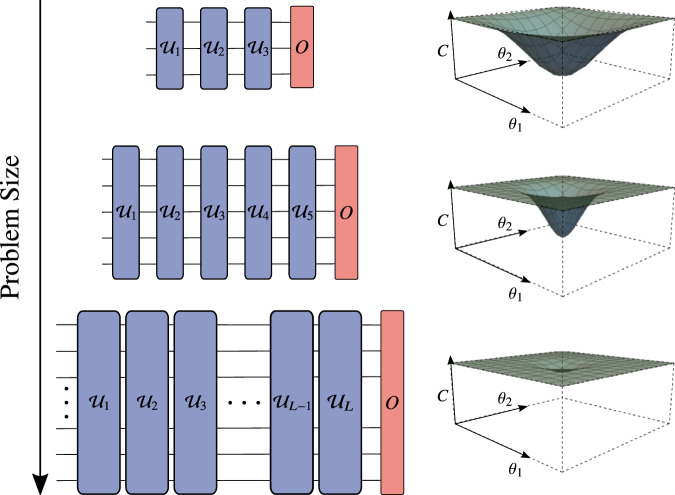
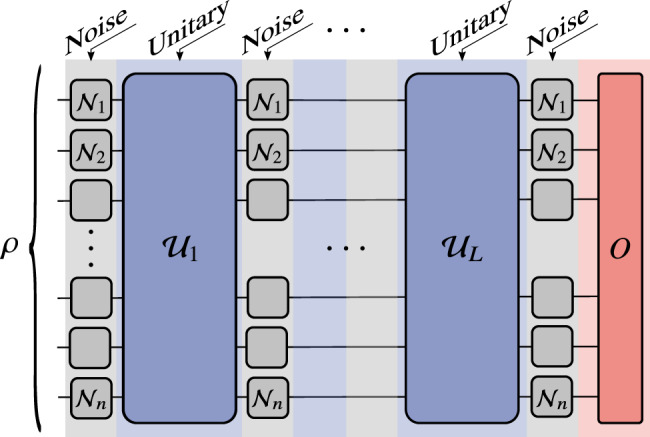
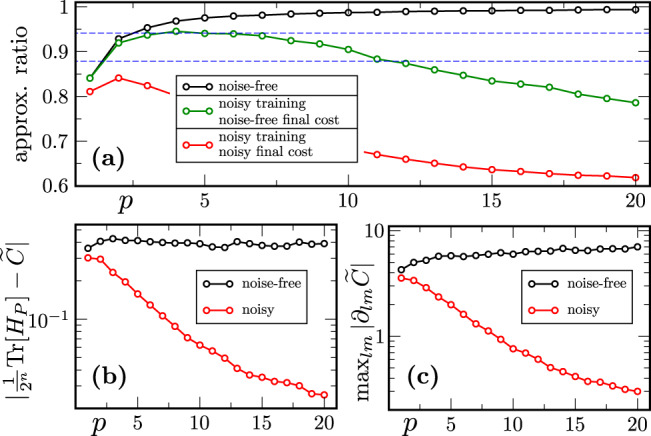
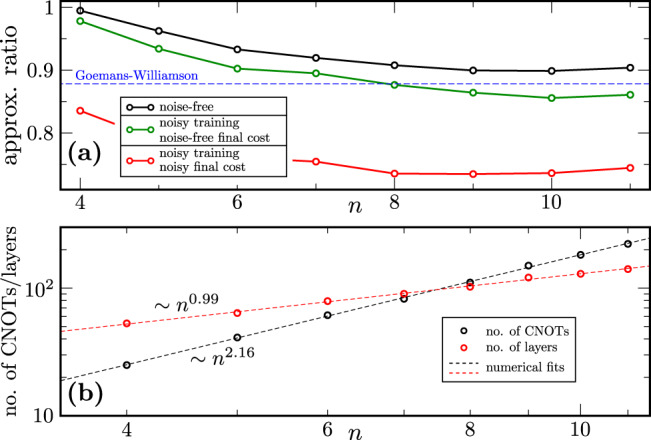
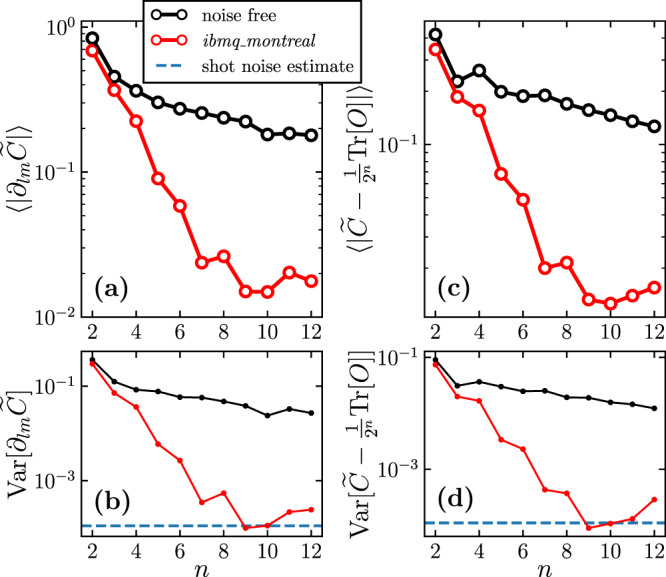
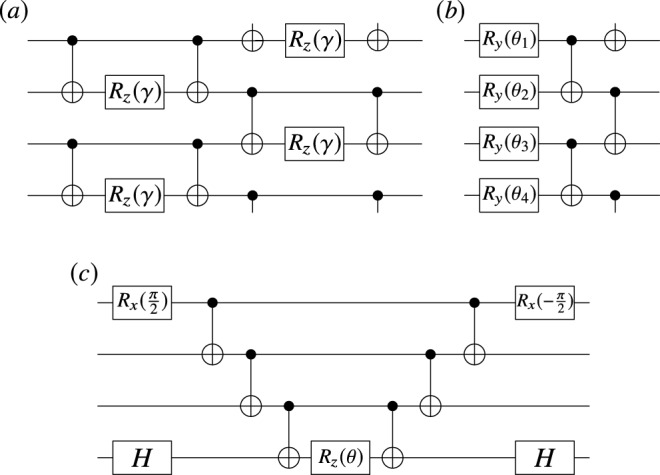
Variational Quantum Algorithms (VQAs) may be a path to quantum advantage on Noisy Intermediate-Scale Quantum (NISQ) computers. A natural question is whether noise on NISQ devices places fundamental limitations on VQA performance. We rigorously prove a serious limitation for noisy VQAs, in that the noise causes the training landscape to have a barren plateau (i.e., vanishing gradient). Specifically, for the local Pauli noise considered, we prove that the gradient vanishes exponentially in the number of qubits n if the depth of the ansatz grows linearly with n . These noise-induced barren plateaus (NIBPs) are conceptually different from noise-free barren plateaus, which are linked to random parameter initialization. Our result is formulated for a generic ansatz that includes as special cases the Quantum Alternating Operator Ansatz and the Unitary Coupled Cluster Ansatz, among others. For the former, our numerical heuristics demonstrate the NIBP phenomenon for a realistic hardware noise model.
Overview
The claims and statistics of this paper haven’t been checked yet.
Free: it reads the open-access text and checks the first 5 claims that cite a source we can check. Create a free account to check every claim.
Integrity signals
Registry
Cites
Statistics
Figures
Verification
Claims the paper makes
The claims and statistics of this paper haven’t been checked yet.
Free: it reads the open-access text and checks the first 5 claims that cite a source we can check. Create a free account to check every claim.
Claims other papers make about this one
Each is checked against this paper’s own text: does it say what the citing paper says it does?
The cited source says what the claim attributes to it.
In the citing paper
“Barren plateau landscapes correspond to gradients that vanish exponentially in the number of qubits.”
From Effect of barren plateaus on gradient-free optimization (2021) · cites this paper as [21]
In the citing paper
“However, we note that in general the scalability of real time angle-finding for a hybrid quantum-classical feedback loop is not clear for variational quantum algorithms, and in particular is expected to be quite hard especially with the presence of noise [57], [4].”
From High-Round QAOA for MAX $k$-SAT on Trapped Ion NISQ Devices (2023) · cites this paper as [57]
In the citing paper
“Second, it is challenging for the random parameters method to efficiently handle barren plateaus, while our method can address this issue by providing quasi-optimal initial guesses46.”
From Data-driven quantum approximate optimization algorithm for power systems (2023) · cites this paper as [46]
Self-check
Percentages, sums and reported differences re-computed from the paper’s own numbers.
The self-check needs the paper’s full text.
Citations
Cites
A Simplex Method for Function Minimization
Nelder, J. A., & Mead, R. (1965) · The Computer Journal · doi:10.1093/comjnl/7.4.308 · Cited by 28,905
Quantum Computation and Quantum Information
Nielsen, M. A., Chuang, I., & Grover, L. K. (2002) · American Journal of Physics · doi:10.1119/1.1463744 · Cited by 21,895
Quantum Computing in the NISQ era and beyond
Preskill, J. (2018) · Quantum · doi:10.22331/q-2018-08-06-79 · Cited by 8,830
Biamonte, J., Wittek, P., Pancotti, N., Rebentrost, P., Wiebe, N., & Lloyd, S. (2017) · Nature · doi:10.1038/nature23474 · Cited by 4,779 · cited 1×
“[59] Jacob Biamonte, Peter Wittek, Nicola Pancotti, Patrick Rebentrost, Nathan Wiebe, and Seth Lloyd, “Quantum machine learning,” Nature 549, 195–202 (2017).”
BackgroundA variational eigenvalue solver on a photonic quantum processor
Peruzzo, A., McClean, J., Shadbolt, P., Yung, M.-H., Zhou, X.-Q., Love, P. J., Aspuru-Guzik, A., & O’Brien, J. L. (2014) · Nature Communications · doi:10.1038/ncomms5213 · Cited by 4,552
Goemans, M. X., & Williamson, D. P. (1995) · Journal of the ACM · doi:10.1145/227683.227684 · Cited by 3,587
Variational quantum algorithms
Cerezo, M., Arrasmith, A., Babbush, R., Benjamin, S. C., Endo, S., Fujii, K., McClean, J. R., Mitarai, K., Yuan, X., Cincio, L., et al. (2021) · Nature Reviews Physics · doi:10.1038/s42254-021-00348-9 · Cited by 3,385 · cited 1×
“At the heart of this discussion are Variational Quantum Algorithms (VQAs), which are believed to be the best hope for near-term quantum advantage [2–4].”
BackgroundSelf-citationCoupled-cluster theory in quantum chemistry
Bartlett, R. J., & Musiał, M. (2007) · Reviews of Modern Physics · doi:10.1103/revmodphys.79.291 · Cited by 3,343
Hardware-efficient variational quantum eigensolver for small molecules and quantum magnets
Kandala, A., Mezzacapo, A., Temme, K., Takita, M., Brink, M., Chow, J. M., & Gambetta, J. M. (2017) · Nature · doi:10.1038/nature23879 · Cited by 2,982
Barren plateaus in quantum neural network training landscapes
McClean, J. R., Boixo, S., Smelyanskiy, V. N., Babbush, R., & Neven, H. (2018) · Nature Communications · doi:10.1038/s41467-018-07090-4 · Cited by 2,329
Research works printed but not linked: 4
- Bauer B Wecker D Millis AJ Hastings MB Troyer M Hybrid quantum-classical approach to correlated materials Phys. Rev. X 2016 6 031045
- Li Y Benjamin SC Efficient variational quantum simulator incorporating active error minimization Phys. Rev. X 2017 7 021050
- Wang Z Hadfield S Jiang Z Rieffel EG Quantum approximate optimization algorithm for maxcut: a fermionic view Phys. Rev. A 2018 97 022304 · DOI · Paper page
- Erdos P Renyi A On random graphs i Publ. math. Debr. 1959 6 18
Cited by
Items 201–300 of 1,010
Tight and Efficient Gradient Bounds for Parameterized Quantum Circuits
Letcher, A., Woerner, S., & Zoufal, C. (2024) · Quantum · doi:10.22331/q-2024-09-25-1484 · Cited by 54
Quantum Generative Training Using Rényi DivergencesPreprint
Kieferová, M., Carlos, O. M., & Wiebe, N. (2021) · arXiv (Cornell University) · doi:10.48550/arxiv.2106.09567 · Cited by 53
Optimized SWAP networks with equivalent circuit averaging for QAOA
Hashim, A., Rines, R., Omole, V., Naik, R., Kreikebaum, J. M., Santiago, D., Chong, F. T., Siddiqi, I. A., & Gokhale, P. (2022) · Physical Review Research · doi:10.1103/physrevresearch.4.033028 · Cited by 54
Mohanty, N., Behera, B. K., & Ferrie, C. (2023) · IEEE Transactions on Quantum Engineering · doi:10.1109/tqe.2023.3303989 · Cited by 52
Quantum interval neural network for uncertain structural static analysis
Zhu, J., Wang, X., Cao, G., Xu, L., & Cao, Y. H. (2025) · International Journal of Mechanical Sciences · doi:10.1016/j.ijmecsci.2025.110646 · Cited by 52
Quantifying the barren plateau phenomenon for a model of unstructured variational ansätzePreprint
Napp, J. (2022) · arXiv (Cornell University) · doi:10.48550/arxiv.2203.06174 · Cited by 52
Adaptive shot allocation for fast convergence in variational quantum algorithmsPreprint
Gu, A., Lowe, A., Dub, P. A., Coles, P. J., & Arrasmith, A. (2021) · arXiv (Cornell University) · doi:10.48550/arxiv.2108.10434 · Cited by 53
Self-citationThermodynamic AI and the Fluctuation Frontier
Coles, P. J., Szczepanski, C., Melanson, D., Donatella, K., Martinez, A., & Sbahi, F. M. (2023) · IEEE International Conference on Rebooting Computing (ICRC) · doi:10.1109/icrc60800.2023.10386858 · Cited by 50
Self-citationQuantum variational learning for quantum error-correcting codes
Cao, C., Zhang, C., Wu, Z., Grassl, M., & Zeng, B. (2022) · Quantum · doi:10.22331/q-2022-10-06-828 · Cited by 50
Automatic quantum circuit encoding of a given arbitrary quantum state
Shirakawa, T., Ueda, H., & Yunoki, S. (2024) · Physical Review Research · doi:10.1103/physrevresearch.6.043008 · Cited by 50
Exponential quantum advantage in processing massive classical dataPreprint
Zhao, H., Zlokapa, A., Neven, H., Babbush, R., Preskill, J., McClean, J. R., & Huang, H.-Y. (2026) · arXiv (Cornell University) · doi:10.48550/arxiv.2604.07639 · Cited by 53
Hybrid Classical–Quantum Transfer Learning for Cardiomegaly Detection in Chest X-rays
Decoodt, P., Liang, T. J., Bopardikar, S., Santhanam, H., Eyembe, A., García-Zapirain, B., & Sierra-Sosa, D. (2023) · Journal of Imaging · doi:10.3390/jimaging9070128 · Cited by 49
Quantum Computing: Foundations, Architecture and Applications
Christopher Columbus, C., Krishnan, P. T., Elamaran, E., Arul, R., & Kumar, T. S. (2025) · Engineering Reports · doi:10.1002/eng2.70337 · Cited by 49
Dynamic parameterized quantum circuits: expressive and barren-plateau freePreprint
Deshpande, A., Hinsche, M., Najafi, K., Sharma, K., Sweke, R., & Zoufal, C. (2024) · arXiv (Cornell University) · doi:10.48550/arxiv.2411.05760 · Cited by 49
Self-citationQuantum Annealing vs. QAOA: 127 Qubit Higher-Order Ising Problems on NISQ Computers
Pelofske, E., Bärtschi, A., & Eidenbenz, S. (2023) · Lecture Notes in Computer Science · doi:10.1007/978-3-031-32041-5_13 · Cited by 47
Quantum variational optimization: The role of entanglement and problem hardness
Díez-Valle, P., Porras, D., & García-Ripoll, J. J. (2021) · Physical Review A · doi:10.1103/physreva.104.062426 · Cited by 47
“Hence, we cannot attribute the effect to vanishing gradients or barren plateaus [53,54], but to an intrinsic limitation of the algorithm.”
BackgroundTowards large-scale quantum optimization solvers with few qubits
Sciorilli, M., Borges, L., Patti, T. L., García-Martín, D., Camilo, G., Anandkumar, A., & Aolita, L. (2025) · Nature Communications · doi:10.1038/s41467-024-55346-z · Cited by 47
“This can flatten out the optimization landscape – causing exponentially-small gradients (barren plateaus) [24] or underparametrization [25] – or render the algorithm classically simulable [20].”
Quantum Graph Neural Network Models for Materials Search
Ryu, J.-Y., Elala, E., & Rhee, J. K. (2023) · Materials · doi:10.3390/ma16124300 · Cited by 48
Danilov, D., Moreno, J. R., Sung, K. J., Motta, M., & Shee, J. (2025) · Journal of Chemical Theory and Computation · doi:10.1021/acs.jctc.5c01407 · Cited by 47
Variational quantum eigensolver for dynamic correlation functions
Chen, H., Nusspickel, M., Tilly, J., & Booth, G. H. (2021) · Physical Review A · doi:10.1103/physreva.104.032405 · Cited by 47
Enabling large-scale and high-precision fluid simulations on near-term quantum computers
Chen, Z., Ma, T.-Y., Ye, C.-C., Xu, L., Bai, W., Zhou, L., Tan, M.-Y., Zhuang, X., Xu, X., Wang, Y., et al. (2024) · Computer Methods in Applied Mechanics and Engineering · doi:10.1016/j.cma.2024.117428 · Cited by 47
Quasiparticle Cooling Algorithms for Quantum Many-Body State Preparation
Lloyd, J., Michailidis, A. A., Mi, X., Smelyanskiy, V., & Abanin, D. A. (2025) · PRX Quantum · doi:10.1103/prxquantum.6.010361 · Cited by 46
Variational quantum time evolution without the quantum geometric tensor
Gacon, J., Nys, J., Rossi, R., Woerner, S., & Carleo, G. (2024) · Physical Review Research · doi:10.1103/physrevresearch.6.013143 · Cited by 47
Falla, J., Langfitt, Q., Alexeev, Y., & Safro, I. (2024) · Quantum Machine Intelligence · doi:10.1007/s42484-024-00178-9 · Cited by 46
Martinez, V., Angrisani, A., Pankovets, E., Fawzi, O., & França, D. S. (2025) · Physical Review Letters · doi:10.1103/j1gg-s6zb · Cited by 46
Beyond unital noise in variational quantum algorithms: noise-induced barren plateaus and limit sets
Singkanipa, P., & Lidar, D. A. (2025) · Quantum · doi:10.22331/q-2025-01-30-1617 · Cited by 48
Universal Compiling and (No-)Free-Lunch Theorems for Continuous-Variable Quantum Learning
Volkoff, T. J., Holmes, Z., & Sornborger, A. T. (2021) · PRX Quantum · doi:10.1103/prxquantum.2.040327 · Cited by 45
Surviving The Barren Plateau in Variational Quantum Circuits with Bayesian Learning InitializationPreprint
Rad, A., Seif, A., & Linke, N. M. (2022) · arXiv (Cornell University) · doi:10.48550/arxiv.2203.02464 · Cited by 45
The impact of cost function globality and locality in hybrid quantum neural networks on NISQ devices
Kashif, M., & Al-Kuwari, S. M. (2023) · Machine Learning Science and Technology · doi:10.1088/2632-2153/acb12f · Cited by 44
Efficient Estimation of Trainability for Variational Quantum Circuits
Heyraud, V., Li, Z., Donatella, K., Boité, A. L., & Ciuti, C. (2023) · PRX Quantum · doi:10.1103/prxquantum.4.040335 · Cited by 46
Elivagar: Efficient Quantum Circuit Search for Classification
Anagolum, S., Alavisamani, N., Das, P., Qureshi, M. K., & Shi, Y. (2024) · International Conference on Architectural Support for Programming Languages and Operating Systems (ASPLOS) · doi:10.1145/3620665.3640354 · Cited by 44
Quantum algorithms for scientific computing
Au-Yeung, R., Camino, B., Rathore, O., & Kendon, V. M. (2024) · Reports on Progress in Physics · doi:10.1088/1361-6633/ad85f0 · Cited by 44
Prog-QAOA: Framework for resource-efficient quantum optimization through classical programs
Bakó, B., Glos, A., Salehi, Ö., & Zimborás, Z. (2025) · Quantum · doi:10.22331/q-2025-03-20-1663 · Cited by 44
Contextual Subspace Variational Quantum Eigensolver
Kirby, W. M., Tranter, A., & Love, P. J. (2021) · Quantum · doi:10.22331/q-2021-05-14-456 · Cited by 45
Entanglement entropy production in Quantum Neural Networks
Ballarin, M., Mangini, S., Montangero, S., Macchiavello, C., & Mengoni, R. (2023) · Quantum · doi:10.22331/q-2023-05-31-1023 · Cited by 44
Quantum computed moments correction to variational estimates
Vallury, H. J., Jones, M. A., Hill, C. D., & Hollenberg, L. C. L. (2020) · Quantum · doi:10.22331/q-2020-12-15-373 · Cited by 44
Qubit-efficient exponential suppression of errorsPreprint
Czarnik, P., Arrasmith, A., Cincio, Ł., & Coles, P. J. (2021) · arXiv (Cornell University) · doi:10.48550/arxiv.2102.06056 · Cited by 45
Self-citationVariational quantum linear solver with a dynamic ansatz
Patil, H. P., Wang, Y., & Krstić, P. (2022) · Physical Review A · doi:10.1103/physreva.105.012423 · Cited by 43
Quantum computational phase transition in combinatorial problems
Zhang, B., Sone, A., & Zhuang, Q. (2022) · npj Quantum Information · doi:10.1038/s41534-022-00596-2 · Cited by 45
Self-citationVariational Quantum Simulators Based on Waveguide QED
Tabares, C., Heras, A. M. D. L., Tagliacozzo, L., Porras, D., & González-Tudela, A. (2023) · Physical Review Letters · doi:10.1103/physrevlett.131.073602 · Cited by 44
Variational Hamiltonian Diagonalization for Dynamical Quantum Simulation
Commeau, B., Cerezo, M., Holmes, Z., Cincio, L., Coles, P. J., & Sornborger, A. (2020) · arXiv · doi:10.48550/arxiv.2009.02559 · Cited by 42
Self-citationA unifying account of warm start guarantees for patches of quantum landscapesPreprint
Mhiri, H., Puig, R., Lerch, S., Rudolph, M. S., Chotibut, T., Thanasilp, S., & Holmes, Z. (2025) · arXiv (Cornell University) · doi:10.48550/arxiv.2502.07889 · Cited by 43
Quantum optimization for training quantum neural networks
Liao, Y., Hsieh, M.-H., & Ferrie, C. (2024) · Quantum Machine Intelligence · doi:10.1007/s42484-024-00169-w · Cited by 41
The barren plateaus of quantum neural networks: review, taxonomy and trends
Qi, H., Wang, L., Zhu, H., Gani, A., & Gong, C. (2023) · Quantum Information Processing · doi:10.1007/s11128-023-04188-7 · Cited by 42
NISQ Quantum Computing: A Security-Centric Tutorial and Survey [Feature]
Chen, F., Jiang, L., Müller, H. A., Richerme, P., Chu, C., Fu, Z., & Min, Y. (2024) · IEEE Circuits and Systems Magazine · doi:10.1109/mcas.2024.3349665 · Cited by 44
Adversarial robustness guarantees for quantum classifiers
Dowling, N., West, M. T., Southwell, A., Nakhl, A. C., Sevior, M. E., Usman, M., & Modi, K. K. (2026) · npj Quantum Information · doi:10.1038/s41534-025-01129-3 · Cited by 43
Neural quantum kernels: Training quantum kernels with quantum neural networks
Rodriguez-Grasa, P., Ban, Y., & Sanz, M. (2025) · Physical Review Research · doi:10.1103/xphb-x2g4 · Cited by 44
Anand, A., Romero, J., Degroote, M., & Aspuru‐Guzik, A. (2021) · Advanced Quantum Technologies · doi:10.1002/qute.202000069 · Cited by 42
Augmenting QAOA Ansatz with Multiparameter Problem-Independent Layer
Chalupnik, M., Melo, H., Alexeev, Y., & Galda, A. (2022) · IEEE International Conference on Quantum Computing and Engineering (QCE) · doi:10.1109/qce53715.2022.00028 · Cited by 41
Effects of noise on the overparametrization of quantum neural networks
García-Martín, D., Larocca, M., & Cerezo, M. (2024) · Physical Review Research · doi:10.1103/physrevresearch.6.013295 · Cited by 42
Self-citationQuantum Circuits For Two-Dimensional Isometric Tensor NetworksPreprint
Slattery, L., & Clark, B. K. (2021) · arXiv (Cornell University) · doi:10.48550/arxiv.2108.02792 · Cited by 41
Natural evolutionary strategies for variational quantum computation
Anand, A., Degroote, M., & Aspuru-Guzik, A. (2021) · Machine Learning: Science and Technology · doi:10.1088/2632-2153/abf3ac · Cited by 40
A Depth-Progressive Initialization Strategy for Quantum Approximate Optimization Algorithm
Lee, X., Xie, N., Cai, D., Saito, Y., & Asai, N. (2023) · Mathematics · doi:10.3390/math11092176 · Cited by 40
Leonidas, I. D., Dukakis, A., Tan, B. Y. L., & Angelakis, D. G. (2024) · Advanced Quantum Technologies · doi:10.1002/qute.202300309 · Cited by 40
Evolutionary Algorithms and Quantum Computing: Recent Advances, Opportunities, and Challenges
Rehman, J. U., Ulum, M. S., Shaffar, A. W., Hakim, A. A., Mujirin, Abdullah, Z., Al-Hraishawi, H., Chatzinotas, S., & Shin, H. (2025) · IEEE Access · doi:10.1109/access.2025.3530952 · Cited by 40
Hybrid Tree Tensor Networks for Quantum Simulation
Schuhmacher, J., Ballarin, M., Baiardi, A., Magnifico, G., Tacchino, F., Montangero, S., & Tavernelli, I. (2025) · PRX Quantum · doi:10.1103/prxquantum.6.010320 · Cited by 40
Gyöngyösi, L., & Imre, S. (2025) · Quantum Information and Computation · doi:10.2478/qic-2025-0006 · Cited by 40
Mancilla, J., & Père, C. (2022) · Entropy · doi:10.3390/e24111656 · Cited by 40
Noisy intermediate scale quantum simulation of time dependent HamiltoniansPreprint
Lau, J. W. Z., Bharti, K., Haug, T., & Kwek, L. C. (2021) · arXiv (Cornell University) · doi:10.48550/arxiv.2101.07677 · Cited by 42
Entanglement-Induced Barren Plateaus
Ortiz Marrero, C., Kieferová, M., & Wiebe, N. (2021) · PRX Quantum · doi:10.1103/prxquantum.2.040316 · Cited by 39
Benchmarking variational quantum eigensolvers for the square-octagon-lattice Kitaev model
Li, A. C. Y., Alam, M. S., Iadecola, T., Jahin, A., Job, J., Kürkçüog̃lu, D. M., Li, R., Orth, P. P., Özgüler, A. B., Perdue, G., et al. (2023) · Physical Review Research · doi:10.1103/physrevresearch.5.033071 · Cited by 39
Laziness, barren plateau, and noises in machine learning
Liu, J., Lin, Z., & Jiang, L. (2024) · Machine Learning Science and Technology · doi:10.1088/2632-2153/ad35a3 · Cited by 39
Du, Y., Huang, T., You, S., Hsieh, M.-H., & Tao, D. (2020) · arXiv (Cornell University) · Cited by 39
Generalized Quantum Assisted Simulator
Haug, T., & Bharti, K. (2020) · arXiv · doi:10.48550/arxiv.2011.14737 · Cited by 38
“[18] Samson Wang, Enrico Fontana, Marco Cerezo, Kunal Sharma, Akira Sone, Lukasz Cincio, and Patrick J Coles, “Noise-induced barren plateaus in variational quantum algorithms,” Nature communications 12, 1–11 (2021).”
BackgroundGeneralized quantum assisted simulator
Haug, T., & Bharti, K. (2022) · Quantum Science and Technology · doi:10.1088/2058-9565/ac83e7 · Cited by 38
Kurita, T., Qassim, H., Ishii, M., Oshima, H., Sato, S., & Emerson, J. (2023) · Quantum · doi:10.22331/q-2023-11-20-1184 · Cited by 38
Calibrating the role of entanglement in variational quantum circuits
Nakhl, A. C., Quella, T., & Usman, M. (2024) · Physical Review A · doi:10.1103/physreva.109.032413 · Cited by 38
Quantum machine learning for drowsiness detection with EEG signals
Lins, I. D., Araújo, L. M. M., Maior, C. B. S., Ramos, P. M. D. S., Moura, M. J. D. C., Ferreira–Martins, A. J., Chaves, R., & Canabarro, A. (2024) · Process Safety and Environmental Protection · doi:10.1016/j.psep.2024.04.032 · Cited by 38
Clustering and enhanced classification using a hybrid quantum autoencoder
Srikumar, M., Hill, C. D., & Hollenberg, L. C. L. (2021) · Quantum Science and Technology · doi:10.1088/2058-9565/ac3c53 · Cited by 38
Optimal Tuning of Quantum Generative Adversarial Networks for Multivariate Distribution Loading
Agliardi, G., & Prati, E. (2022) · Quantum Reports · doi:10.3390/quantum4010006 · Cited by 39
Parallel Hybrid Networks: An Interplay between Quantum and Classical Neural Networks
Kordzanganeh, M., Kosichkina, D., & Melnikov, A. A. (2023) · Intelligent Computing · doi:10.34133/icomputing.0028 · Cited by 38
Symmetry-invariant quantum machine learning force fields
Le, I. N. M., Kiss, O., Schuhmacher, J., Tavernelli, I., & Tacchino, F. (2025) · New Journal of Physics · doi:10.1088/1367-2630/adad0c · Cited by 38
Generative Quantum Machine Learning
Zoufal, C. (2021) · arXiv (Cornell University) · doi:10.3929/ethz-b-000514692 · Cited by 38
An exponentially-growing family of universal quantum circuits
Kordzanganeh, M., Sekatski, P., Fedichkin, L. E., & Melnikov, A. A. (2023) · Machine Learning Science and Technology · doi:10.1088/2632-2153/ace757 · Cited by 37
On the dynamical Lie algebras of quantum approximate optimization algorithms
Allcock, J., Sántha, M., Pei, Y., & Zhang, S. (2026) · Quantum · doi:10.22331/q-2026-05-29-2119 · Cited by 37
QMLSC: A quantum multimodal learning model for sentiment classification
Li, Y., Qu, Y., Zhou, R.-G., & Zhang, J. (2025) · Information Fusion · doi:10.1016/j.inffus.2025.103049 · Cited by 39
Grover-QAOA for 3-SAT: quadratic speedup, fair-sampling, and parameter clustering
Zhang, Z., Paredes, R., Sundar, B., Quiroga, D., Kyrillidis, A., Dueñas‐Osorio, L., Pagano, G., & Hazzard, K. R. A. (2024) · Quantum Science and Technology · doi:10.1088/2058-9565/ad895c · Cited by 36
Meng, F., Li, Z., Yu, X., & Zhang, Z. (2021) · IEEE Transactions on Quantum Engineering · doi:10.1109/tqe.2021.3119010 · Cited by 36
Zoufal, C., Mishmash, R. V., Sharma, N., Kumar, N., Sheshadri, A., Deshmukh, A. A., Ibrahim, N., Gacon, J., & Woerner, S. (2023) · Quantum · doi:10.22331/q-2023-01-26-909 · Cited by 36
Classical splitting of parametrized quantum circuits
Tüysüz, C., Clemente, G., Crippa, A., Hartung, T., Kühn, S., & Jansen, K. (2023) · Quantum Machine Intelligence · doi:10.1007/s42484-023-00118-z · Cited by 37
Effects of Imperfections on Quantum Algorithms: A Software Engineering Perspective
Greiwe, F., Krüger, T., & Mauerer, W. (2023) · IEEE International Conference on Quantum Software (QSW) · doi:10.1109/qsw59989.2023.00014 · Cited by 36
Qibolab: an open-source hybrid quantum operating system
Efthymiou, S., Orgaz, Á., Carobene, R., Cereijo, J., Pasquale, A., Ramos-Calderer, S., Bordoni, S., Fuentes-Ruiz, D., Candido, A., Pedicillo, E., et al. (2024) · Quantum · doi:10.22331/q-2024-02-12-1247 · Cited by 36
Snowmass White Paper: Quantum Computing Systems and Software for High-energy Physics ResearchPreprint
Humble, T. S., Delgado, A., Pooser, R. C., Seck, C. M., Bennink, R. S., Leyton‐Ortega, V., Wang, C. C. J., Dumitrescu, E., Morris, T., Hamilton, K., et al. (2022) · arXiv · doi:10.48550/arxiv.2203.07091 · Cited by 37
Lower bounds on circuit depth of the quantum approximate optimization algorithm
Herrman, R., Ostrowski, J., Humble, T. S., & Siopsis, G. (2021) · Quantum Information Processing · doi:10.1007/s11128-021-03001-7 · Cited by 35
Quantum circuits for partial differential equations in Fourier space
Lubasch, M., Kikuchi, Y., Wright, L., & Keever, C. M. (2025) · Physical Review Research · doi:10.1103/tbzc-w9x8 · Cited by 35
Quantum computing quantum Monte Carlo algorithm
Zhang, Y., Huang, Y., Sun, J., Lv, D., & Yuan, X. (2025) · Physical Review A · doi:10.1103/jt8s-hzhd · Cited by 36
Liu, Z., Shen, P.-X., Li, W., Duan, L.-M., & Deng, D.-L. (2022) · Quantum Science and Technology · doi:10.1088/2058-9565/aca55d · Cited by 34
Emergence of noise-induced barren plateaus in arbitrary layered noise models
Schumann, M., Wilhelm, F. K., & Ciani, A. (2024) · Quantum Science and Technology · doi:10.1088/2058-9565/ad6285 · Cited by 34
Symmetry Breaking in Geometric Quantum Machine Learning in the Presence of Noise
Tüysüz, C., Chang, S. Y., Demidik, M., Jansen, K., Vallecorsa, S., & Grossi, M. (2024) · PRX Quantum · doi:10.1103/prxquantum.5.030314 · Cited by 34
Quantum DeepONet: Neural operators accelerated by quantum computing
Xiao, P., Zheng, M., Jiao, A., Xiu, Y., & Lu, L. (2025) · Quantum · doi:10.22331/q-2025-06-04-1761 · Cited by 34
A hybrid quantum-classical framework for computational fluid dynamics
Ye, C.-C., An, N.-B., Ma, T.-Y., Dou, M., Bai, W., Sun, D.-J., Chen, Z., & Guo, G. (2024) · Physics of Fluids · doi:10.1063/5.0238193 · Cited by 34
Wang, S., Wang, P., Li, G., Zhao, S., Zhao, D., Wang, J., Yuan, F., Dou, M., Gu, Y., Wu, Y.-C., et al. (2025) · Science China Information Sciences · doi:10.1007/s11432-024-4185-1 · Cited by 34
Self-citationNoise-assisted variational quantum thermalization
Foldager, J., Pesah, A. C., & Hansen, L. K. (2022) · Scientific Reports · doi:10.1038/s41598-022-07296-z · Cited by 34
Solving quantum master equations with deep quantum neural networks
Liu, Z., Duan, L., & Deng, D.-L. (2022) · Physical Review Research · doi:10.1103/physrevresearch.4.013097 · Cited by 34
Neural-network-encoded variational quantum algorithms
Miao, J., Hsieh, C., & Zhang, S. (2024) · Physical Review Applied · doi:10.1103/physrevapplied.21.014053 · Cited by 34
Local Disclosure of Quantum Memory in Non-Markovian Dynamics
Bäcker, C., Beyer, K., & Strunz, W. T. (2024) · Physical Review Letters · doi:10.1103/physrevlett.132.060402 · Cited by 33
Evaluating a quantum-classical quantum Monte Carlo algorithm with Matchgate shadows
Huang, B., Chen, Y.-T., Gupt, B., Suchara, M., Tran, A., McArdle, S., & Galli, G. (2024) · Physical Review Research · doi:10.1103/physrevresearch.6.043063 · Cited by 33
Optimization strategies for variational quantum algorithms in noisy landscapes
Novák, V., Zelinka, I., & Snåšel, V. (2026) · Evolutionary Intelligence · doi:10.1007/s12065-026-01248-6 · Cited by 34
Quantum machine learning for quantitative finance
Mironowicz, P., Akshata Shenoy, H., Mandarino, A., Yilmaz, A. E., & Ankenbrand, T. (2026) · Quantum Science and Technology · doi:10.1088/2058-9565/aeb8ed · Cited by 33
Error-mitigated photonic variational quantum eigensolver using a single-photon ququart
Lee, D., Lee, J., Hong, S., Lim, H., Cho, Y., Han, S.-W., Shin, H., Rehman, J. U., & Kim, Y. (2022) · Optica · doi:10.1364/optica.441163 · Cited by 33
Metadata
- Authors
- Wang, S., Fontana, E., Cerezo, M., Sharma, K., Sone, A., Cincio, L., & Coles, P. J.
- Affiliations
- Los Alamos National Laboratory (US)
- Louisiana State University (US)
- Corresponding author
- Wang, Samson
- Cerezo, M.
- Coles, Patrick J.
- Venue
- Nature Communications
- Published
- 2021-11-29
- Volume
- 12
- Issue
- 1
- Pages
- 6961-6961
- ISSN
- 2041-1723 (ISSN-L)
- PMC
- PMC8630047
- OpenAlex
- W3045606049
- Semantic Scholar
- a7da6cf3820d94f250349d658a09004a36b14ff0
- Cited by
- 773
- References
- 115
- Citations by year
- 2026: 150 · 2025: 163 · 2024: 168 · 2023: 135 · 2022: 102 · 2021: 52
- FWCI
- 40.22
- Type
- journal article
- Language
- en
- Open access
- gold
- doi.org
- Licence
- cc-by
- creativecommons.org/licenses/by/4.0 (tdm)
- creativecommons.org/licenses/by/4.0 (vor)
- Locations
- Nature Communications (publishedVersion, cc-by)
- PubMed Central (publishedVersion, cc-by)
- PubMed (publishedVersion)
- Strathprints: The University of Strathclyde institutional repository (University of Strathclyde) (acceptedVersion)
- arXiv (Cornell University) (submittedVersion)
- RePEc: Research Papers in Economics (submittedVersion)
- DOAJ (DOAJ: Directory of Open Access Journals) (submittedVersion, cc-by-sa)
- OSTI OAI (U.S. Department of Energy Office of Scientific and Technical Information) (submittedVersion)
- arXiv (Cornell University)
- Bulletin of the American Physical Society
- Funders
- U.S. Department of Energy
- RCUK | Engineering and Physical Sciences Research Council
- Topics
- Physical Sciences › Computer Science › Artificial Intelligence › Quantum Computing Algorithms and Architecture
- Physical Sciences › Physics and Astronomy › Atomic and Molecular Physics, and Optics › Quantum many-body systems
- Physical Sciences › Physics and Astronomy › Atomic and Molecular Physics, and Optics › Quantum Information and Cryptography
- Keywords
- barren plateaus, variational quantum algorithms, NISQ devices, gradient vanishing, Quantum Alternating Operator Ansatz, unitary coupled cluster ansatz, quantum advantage
About these checks
Registry, retraction, Cites and statistics results are computed, not judged, with one exception: a printed reference that no index lists is read once by a model before it counts as a citation error. Claims are extracted by a model and kept only when their quote appears verbatim in the text; each cited source is then checked, with a model’s help, for whether it says what the claim relies on. Those verdicts can be wrong — read the claim’s quote and the cited source before relying on one.
Statistics and arithmetic are recomputed, not judged.
Confidence bands are shown only for fields calibrated on our annotated test set. None is calibrated yet, so no band is shown.
What counts as a claim ›How we measure confidence ›How we check this ›
Are you an author, or do you see a problem with this page? Request a review
Data sources
Bibliographic data: Semantic Scholar, OpenAlex, Crossref.
Contains information from the Semantic Scholar Academic Graph Datasets, made available under the ODC Attribution License (ODC-BY 1.0).
Semantic Scholar’s data is described in: Kinney, R., et al. (2023). The Semantic Scholar Open Data Platform. arXiv:2301.10140.
