

Noise-induced barren plateaus in variational quantum algorithms
Open accessThe DOI matches its Crossref record; 120 of the 120 references it cites were found in a registry or an index.
Abstract
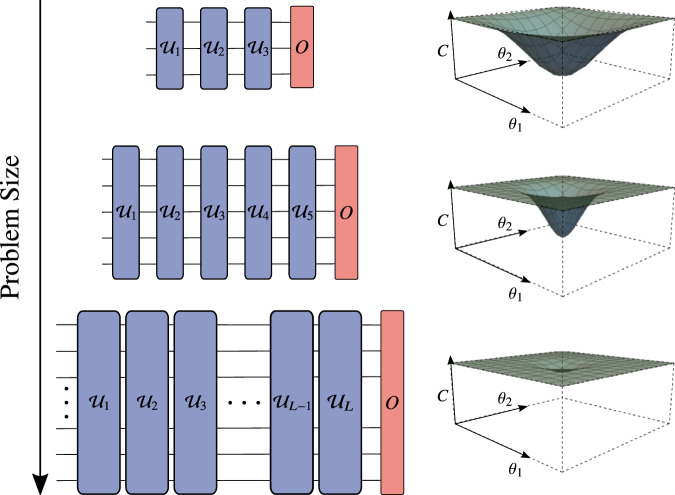
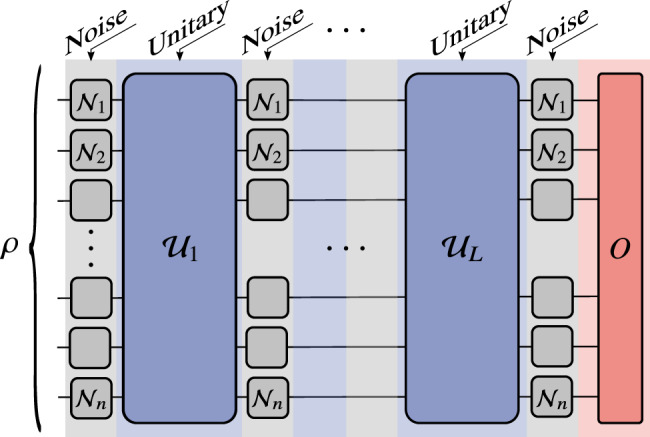
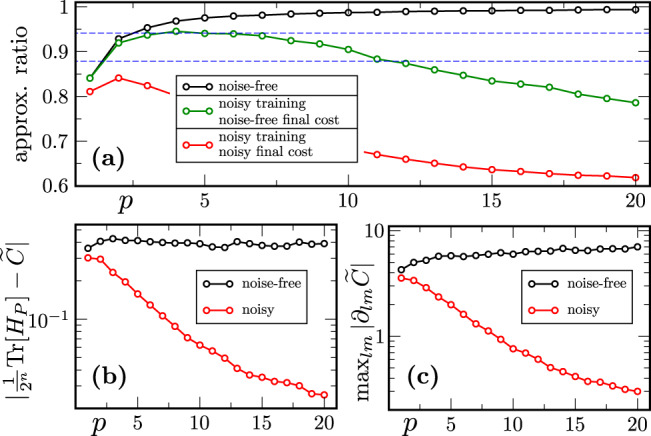
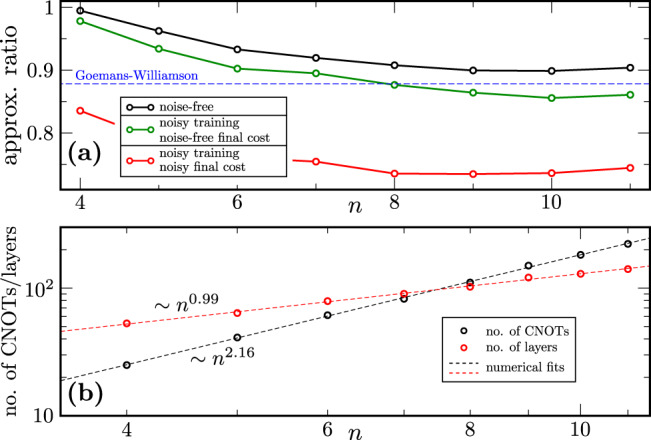
Variational Quantum Algorithms (VQAs) may be a path to quantum advantage on Noisy Intermediate-Scale Quantum (NISQ) computers. A natural question is whether noise on NISQ devices places fundamental limitations on VQA performance. We rigorously prove a serious limitation for noisy VQAs, in that the noise causes the training landscape to have a barren plateau (i.e., vanishing gradient). Specifically, for the local Pauli noise considered, we prove that the gradient vanishes exponentially in the number of qubits n if the depth of the ansatz grows linearly with n . These noise-induced barren plateaus (NIBPs) are conceptually different from noise-free barren plateaus, which are linked to random parameter initialization. Our result is formulated for a generic ansatz that includes as special cases the Quantum Alternating Operator Ansatz and the Unitary Coupled Cluster Ansatz, among others. For the former, our numerical heuristics demonstrate the NIBP phenomenon for a realistic hardware noise model.
Overview
The claims and statistics of this paper haven’t been checked yet.
Free: it reads the open-access text and checks the first 5 claims that cite a source we can check. Create a free account to check every claim.
Integrity signals
Registry
Cites
Statistics
Figures
Verification
Claims the paper makes
The claims and statistics of this paper haven’t been checked yet.
Free: it reads the open-access text and checks the first 5 claims that cite a source we can check. Create a free account to check every claim.
Claims other papers make about this one
Each is checked against this paper’s own text: does it say what the citing paper says it does?
The cited source says what the claim attributes to it.
In the citing paper
“Barren plateau landscapes correspond to gradients that vanish exponentially in the number of qubits.”
From Effect of barren plateaus on gradient-free optimization (2021) · cites this paper as [21]
In the citing paper
“However, we note that in general the scalability of real time angle-finding for a hybrid quantum-classical feedback loop is not clear for variational quantum algorithms, and in particular is expected to be quite hard especially with the presence of noise [57], [4].”
From High-Round QAOA for MAX $k$-SAT on Trapped Ion NISQ Devices (2023) · cites this paper as [57]
In the citing paper
“Second, it is challenging for the random parameters method to efficiently handle barren plateaus, while our method can address this issue by providing quasi-optimal initial guesses46.”
From Data-driven quantum approximate optimization algorithm for power systems (2023) · cites this paper as [46]
Self-check
Percentages, sums and reported differences re-computed from the paper’s own numbers.
The self-check needs the paper’s full text.
Citations
Cites
A Simplex Method for Function Minimization
Nelder, J. A., & Mead, R. (1965) · The Computer Journal · doi:10.1093/comjnl/7.4.308 · Cited by 28,905
Quantum Computation and Quantum Information
Nielsen, M. A., Chuang, I., & Grover, L. K. (2002) · American Journal of Physics · doi:10.1119/1.1463744 · Cited by 21,895
Quantum Computing in the NISQ era and beyond
Preskill, J. (2018) · Quantum · doi:10.22331/q-2018-08-06-79 · Cited by 8,830
Biamonte, J., Wittek, P., Pancotti, N., Rebentrost, P., Wiebe, N., & Lloyd, S. (2017) · Nature · doi:10.1038/nature23474 · Cited by 4,779 · cited 1×
“[59] Jacob Biamonte, Peter Wittek, Nicola Pancotti, Patrick Rebentrost, Nathan Wiebe, and Seth Lloyd, “Quantum machine learning,” Nature 549, 195–202 (2017).”
BackgroundA variational eigenvalue solver on a photonic quantum processor
Peruzzo, A., McClean, J., Shadbolt, P., Yung, M.-H., Zhou, X.-Q., Love, P. J., Aspuru-Guzik, A., & O’Brien, J. L. (2014) · Nature Communications · doi:10.1038/ncomms5213 · Cited by 4,552
Goemans, M. X., & Williamson, D. P. (1995) · Journal of the ACM · doi:10.1145/227683.227684 · Cited by 3,587
Variational quantum algorithms
Cerezo, M., Arrasmith, A., Babbush, R., Benjamin, S. C., Endo, S., Fujii, K., McClean, J. R., Mitarai, K., Yuan, X., Cincio, L., et al. (2021) · Nature Reviews Physics · doi:10.1038/s42254-021-00348-9 · Cited by 3,385 · cited 1×
“At the heart of this discussion are Variational Quantum Algorithms (VQAs), which are believed to be the best hope for near-term quantum advantage [2–4].”
BackgroundSelf-citationCoupled-cluster theory in quantum chemistry
Bartlett, R. J., & Musiał, M. (2007) · Reviews of Modern Physics · doi:10.1103/revmodphys.79.291 · Cited by 3,343
Hardware-efficient variational quantum eigensolver for small molecules and quantum magnets
Kandala, A., Mezzacapo, A., Temme, K., Takita, M., Brink, M., Chow, J. M., & Gambetta, J. M. (2017) · Nature · doi:10.1038/nature23879 · Cited by 2,982
Barren plateaus in quantum neural network training landscapes
McClean, J. R., Boixo, S., Smelyanskiy, V. N., Babbush, R., & Neven, H. (2018) · Nature Communications · doi:10.1038/s41467-018-07090-4 · Cited by 2,329
Research works printed but not linked: 4
- Bauer B Wecker D Millis AJ Hastings MB Troyer M Hybrid quantum-classical approach to correlated materials Phys. Rev. X 2016 6 031045
- Li Y Benjamin SC Efficient variational quantum simulator incorporating active error minimization Phys. Rev. X 2017 7 021050
- Wang Z Hadfield S Jiang Z Rieffel EG Quantum approximate optimization algorithm for maxcut: a fermionic view Phys. Rev. A 2018 97 022304 · DOI · Paper page
- Erdos P Renyi A On random graphs i Publ. math. Debr. 1959 6 18
Cited by
Items 801–900 of 1,010
Chen, X., Gao, P., Qiu, C.-D., Lu, Y.-N., Yang, F., Zhao, Y., Li, H., Zhang, J., Wei, S., Xing, T., et al. (2024) · New Journal of Physics · doi:10.1088/1367-2630/ad309d · Cited by 3
Ding, X., Xu, J., Song, Z., Hou, Y., & Shan, Z. (2024) · Chinese Journal of Physics · doi:10.1016/j.cjph.2024.05.044 · Cited by 3
Quantum sequential scattering model for quantum state learning
Jing, M., Liu, G., Ren, H., & Wang, X. (2024) · Physical Review A · doi:10.1103/physreva.109.062425 · Cited by 3
Wang, S., Li, G., Wang, Z., Chen, Z., Wang, P., Gu, Y., Wu, Y.-C., & Guo, G. (2026) · Physical Review A · doi:10.1103/2p4m-5mt8 · Cited by 3
Self-citationQuantMark: A Benchmarking API for VQE Algorithms
de Griend, A. M.-V., & Nurminen, J. K. (2022) · IEEE Transactions on Quantum Engineering · doi:10.1109/tqe.2022.3159327 · Cited by 3
Li, Z., Meng, F., Zeng, H., Gong, Z., Zhang, Z., & Yu, X. (2023) · Advanced Quantum Technologies · doi:10.1002/qute.202200130 · Cited by 3
Practical limitations of quantum data propagation on noisy quantum processors
Saxena, G., Shalabi, A., & Kyaw, T. H. (2024) · Physical Review Applied · doi:10.1103/physrevapplied.21.054014 · Cited by 3
Sun, S., Kumar, C., Shen, K., Shishenina, E., & Mendl, C. B. (2025) · The Journal of Physical Chemistry A · doi:10.1021/acs.jpca.4c07045 · Cited by 3
Chy, M. S. K., Abdullah, S. M., Nabil, M. A., Alam, A., Himeluzzaman, M., Onik, T. A., Shakil, S. M., & Khan, H. A. (2022) · International Journal of Future Innovative Science and Technology · doi:10.15662/ijfist.2022.0505009 · Cited by 5
Denoising Gradient Descent in Variational Quantum AlgorithmsPreprint
Simon, L., Eble, H., Kowalski, H.-H., & Radons, M. (2024) · Research Square · doi:10.21203/rs.3.rs-4023677/v1 · Cited by 3
Spectral Methods for Quantum Optimal Control: Artificial Boundary ConditionsPreprint
Wodecki, A., Mareček, J., Kungurtsev, V., Eichler, P., Korpas, G., & Intallura, P. M. (2024) · arXiv (Cornell University) · doi:10.48550/arxiv.2403.14436 · Cited by 3
Binkowski, L., Osborne, T. J., Schwiering, M., Schwonnek, R., & Ziegler, T. (2024) · arXiv (Cornell University) · doi:10.48550/arxiv.2411.00435 · Cited by 3
Warehouse optimization using a trapped-ion quantum processorPreprint
Ricardo, A. C., Fernandes, G. P. L. M., Valério, A. G., Farias, T. D. S., Fonseca, M. D. S., Carpio, N. A. C., Bezerra, P. C. C., Maier, C., Ulmanis, J., Monz, T., et al. (2024) · arXiv (Cornell University) · doi:10.48550/arxiv.2411.17575 · Cited by 3
Gaussian boson sampling for binary optimizationPreprint
Cazalis, J., Shah, T., Chai, Y., Kühn, S., & Jansen, K. (2024) · arXiv (Cornell University) · doi:10.3204/pubdb-2025-00090 · Cited by 4
Variational Quantum Algorithms: From Theory to NISQ-Era Applications Challenges and OpportunitiesPreprint
Benamer, H. (2025) · Preprints.org · doi:10.20944/preprints202508.1482.v1 · Cited by 3
Adiabatic Encoding of Pre-trained MPS Classifiers into Quantum CircuitsPreprint
Murota, K. (2025) · arXiv (Cornell University) · doi:10.48550/arxiv.2504.09250 · Cited by 3
Bhowmick, R., Wadhwa, H., Singh, A. K., Sidana, T., Tran, Q. H., & Sabapathy, K. K. (2025) · arXiv (Cornell University) · doi:10.48550/arxiv.2503.16361 · Cited by 3
Herbst, S. (2023) · reposiTUm (TU Wien) · doi:10.34726/hss.2023.111504 · Cited by 3
Shallow Quantum Circuits: Algorithms, Complexity, and Fault Tolerance
Liu, Y. (2024) · eScholarship (California Digital Library) · Cited by 3
From VQE To SQD: Modern Quantum Algorithms For The Electronic Structure ProblemPreprint
Khamadja, A. R., & Rouabah, M. T. (2025) · arXiv (Cornell University) · doi:10.48550/arxiv.2509.21555 · Cited by 7
Hashimoto, H., Nakabayashi, A., Nagano, L., Iiyama, Y., Sawada, R., Tanaka, J., & Terashi, K. (2026) · arXiv (Cornell University) · doi:10.48550/arxiv.2602.03291 · Cited by 3
Circuit Harmonic Matrices: A Spectral Framework for Quantum Machine LearningPreprint
Campbell, K. J. S., Debbio, L. D., & Wallden, P. (2026) · arXiv (Cornell University) · doi:10.48550/arxiv.2604.04292 · Cited by 3
The disparate impact of noise on quantum learning algorithms
Angrisani, A. (2023) · theses.fr (ABES) · doi:10.70675/69f942ebz4417z4eceza746z1c9d436d09bb · Cited by 3
Novák, V., Zelinka, I., Přibylová, L., Martínek, L., Benčurik, V., & Beseda, M. (2026) · arXiv (Cornell University) · doi:10.48550/arxiv.2604.13951 · Cited by 3
Inherent interpretability provides inherent value in quantum machine learningPreprint
Gili, K., & Bradshaw, Z. P. (2026) · arXiv (Cornell University) · doi:10.48550/arxiv.2607.13827 · Cited by 3
Quantum Natural Gradient on Quotient SpacesPreprint
Chen, Z. (2026) · arXiv (Cornell University) · doi:10.48550/arxiv.2608.29350 · Cited by 3
Addressing the gradient vanishing problem in parameterized quantum circuit training and optimization
Cho, J., & Kim, S. (2025) · Advances in computers · doi:10.1016/bs.adcom.2025.06.018 · Cited by 2
Edge-based quantum approximate optimization algorithm for MAX-CUT problem
Seo, Y., & Heo, J. (2025) · Quantum Information Processing · doi:10.1007/s11128-025-04925-0 · Cited by 2
Tensor network-based gene regulatory network inference for single-cell transcriptomic data
Larrarte, O. S., Aizpurua, B., Dastbasteh, R., Otxoa, R. M., & Martínez, J. E. (2026) · iScience · doi:10.1016/j.isci.2026.116619 · Cited by 2
Kanasugi, S., Nakagawa, Y. O., Matsumoto, N., Hidaka, Y., Maruyama, K., & Oshima, H. (2026) · npj Quantum Information · doi:10.1038/s41534-026-01384-y · Cited by 2
Three Birds with One Stone: Improving Performance, Convergence, and System Throughput with NEST
Huo, Y., Quiroga, D., Kyrillidis, A., & Patel, T. (2025) · ACM SIGMETRICS Performance Evaluation Review · doi:10.1145/3771580 · Cited by 2
Quantum circuit-based learning models: bridging quantum computing and machine learning
Fan, F., Shi, Y., Datcu, M., Saux, B. L., Iapichino, L., Bovolo, F., Ullo, S. L., & Zhu, X. X. (2026) · Artificial Intelligence Review · doi:10.1007/s10462-026-11686-4 · Cited by 2
Sahoo, S., Mandal, D., Ali, A., Kaplun, D., Romanov, S., & Sarkar, R. (2026) · Quantum Machine Intelligence · doi:10.1007/s42484-026-00350-3 · Cited by 2
Zhang, H., Guo, Y., Xu, G., Feng, Y., Zhang, J.-N., Yu, H., & Zhao, S. P. (2026) · Physical Review Applied · doi:10.1103/j3d6-wr9v · Cited by 2
Efficient noisy quantum state and process tomography
Li, C., Zhuang, S., Zhang, Y., Wang, J. B., Yuan, X., Wu, Y., & Wang, C. (2026) · Quantum Science and Technology · doi:10.1088/2058-9565/aeae6e · Cited by 2
CQNAS: Convolutional quantum hybrid neural network architecture search for image classification
Kong, D., Jin, J., Cui, X., Yan, J., Tang, J., Fu, Y., Xu, J., & Wang, D. (2026) · Neurocomputing · doi:10.1016/j.neucom.2026.133236 · Cited by 2
Training-Free Quantum Architecture Search Under Realistic Noise via Expressibility-Guided Evolution
Mousavi, S., Mousavi, S., Pettersson, P., & Daneshtalab, M. (2026) · Entropy · doi:10.3390/e28030330 · Cited by 2
Jagannathan, S. K., Thomas Abraham, J. V., Yogesh, C., & Franklin Joel Benedict, T. (2026) · EPJ Web of Conferences · doi:10.1051/epjconf/202636001029 · Cited by 2
Efficiently Architecting VQAs: Expressibility–Trainability–Resources Pareto-Optimality
Sanz, R., Anglés-Castillo, A., Alarcon, E., & Almudéver, C. G. (2026) · IEEE Transactions on Quantum Engineering · doi:10.1109/tqe.2026.3721256 · Cited by 2
Exploiting biased noise in variational quantum models
van Rossum, C., Shrapnel, S., & Gupta, R. S. (2026) · Quantum Science and Technology · doi:10.1088/2058-9565/ae636a · Cited by 2
Hybrid algorithm of quantum gate/annealing and classical computer for truss topology optimization
Wang, Z., & Wang, X. (2026) · Acta Mechanica Sinica · doi:10.1007/s10409-025-25521-x · Cited by 3
Dinuț, I.-C., Constantinescu, R., & Alexandrescu, B. (2026) · Electronics · doi:10.3390/electronics15112489 · Cited by 2
Enhancing classical simulation with noisy quantum devices
Zhang, R., Wei, F., & Wei, Z. (2026) · npj Quantum Information · doi:10.1038/s41534-026-01314-y · Cited by 2
Generalised quantum computational spectroscopy on a quantum chip
Zhai, C., Sun, J., Huang, J., Mao, J., Bao, H., Zhang, S., Vedral, V., Yuan, X., & Wang, J. (2026) · Nature Communications · doi:10.1038/s41467-026-74936-7 · Cited by 2
Ugail, H., & Howard, N. (2026) · PLoS ONE · doi:10.1371/journal.pone.0353739 · Cited by 2
Towada, J. (2026) · IEEE Access · doi:10.1109/access.2026.3714512 · Cited by 2
Information processing in quantum thermodynamic systems: An autonomous Hamiltonian approach
Anonymous, Doucet, E., Touil, A., Deffner, S., & Sone, A. (2026) · Physical review. E · doi:10.1103/rwkz-dc5z · Cited by 2
Self-citationA cross-platform study of near-term quantum optimisation algorithms on the graphene defect problem
McDowall, K., Kapourniotis, T., Oliver, C., Lolur, P., & Γεωργόπουλος, Κ. (2026) · Physica Scripta · doi:10.1088/1402-4896/aea063 · Cited by 2
Reers, V., & Maußner, M. (2026) · IEEE International Conference on Quantum Control, Computing and Learning (qCCL) · doi:10.1109/qccl70331.2026.11668558 · Cited by 2
Transforming machine learning: An exploration of quantum algorithms and their applications
Pawan, Y. V. R. N., & Kolla, B. P. (2025) · Advances in computers · doi:10.1016/bs.adcom.2025.06.005 · Cited by 2
Bhat, R. V., Bhowmick, R., Singh, A. K., & Sabapathy, K. K. (2026) · Physical Review Applied · doi:10.1103/7mh8-fyqv · Cited by 3
Dual-map framework for noise characterization of quantum computers
Sud, J., Marshall, J., Wang, Z., Rieffel, E. G., & Wudarski, F. (2022) · Physical Review A · doi:10.1103/physreva.106.012606 · Cited by 2
Revisiting semiconductor bulk hamiltonians using quantum computers
Pimenta, R. C. D. S., & Bezerra, A. T. (2023) · Physica Scripta · doi:10.1088/1402-4896/acbdc8 · Cited by 2
QC-Forest: A Classical-Quantum Algorithm to Provably Speedup Retraining of Random Forest
Yalovetzky, R., Kumar, N., Li, C., & Pistoia, M. (2026) · Proceedings of the AAAI Symposium Series · doi:10.1609/aaaiss.v10i1.43497 · Cited by 2
Local quantum channels giving rise to quasi-local Gibbs states
Arad, I., Firanko, R., & Gurevich, O. (2026) · Journal of Mathematical Physics · doi:10.1063/5.0274879 · Cited by 2
Exploring the Cost Landscape of Variational Quantum Algorithms
Stiliadou, L., Barzen, J., Leymann, F., Mandl, A., & Weder, B. (2024) · Communications in computer and information science · doi:10.1007/978-3-031-72578-4_7 · Cited by 2
Cohesive Quantum Circuit Layer Construction with Reinforcement Learning
Zorn, M., Stein, J., Altmann, P. J., Kölle, M., Linnhoff–Popien, C., & Gabor, T. (2024) · IEEE International Conference on Quantum Computing and Engineering (QCE) · doi:10.1109/qce60285.2024.00201 · Cited by 2
Chachkarova, E., Tse, T., Yordanov, Y. S., Wei, Y., & Weber, C. (2025) · International Journal of Molecular Sciences · doi:10.3390/ijms26041550 · Cited by 2
Design of quantum approximation optimization algorithm for the maximum cut problem
Wang, Y.-J., Huiming, X., Zhuoyan, X., Zengbin, W., & Sha, S. H. I. (2025) · Acta Physica Sinica · doi:10.7498/aps.74.20241223 · Cited by 2
Drinko, A., Correr, G. I., Medina, I., Azado, P. C., Canabarro, A., & Soares-Pinto, D. O. (2025) · AVS Quantum Science · doi:10.1116/5.0247631 · Cited by 2
Architecture of Quantum Neural Networks: Design and Implementation
Latheef, F. N., & Rubell Marion Lincy, G. (2025) · Springer eBooks · doi:10.1007/978-3-031-87931-9_3 · Cited by 2
Comparative study of quantum and classical algorithms for renewable energy sources
Sinha, P. K., & Marimuthu, R. (2025) · Results in Engineering · doi:10.1016/j.rineng.2025.107062 · Cited by 2
Research on Quantum Circuit Learning Models for Molecular Dynamics Simulation
Nishida, Y. (2025) · The Journal of Physical Chemistry A · doi:10.1021/acs.jpca.5c03624 · Cited by 2
Efficient variational quantum eigensolver methodologies on quantum processors
Pandey, T., Saroni, J., Kazi, A., & Sharma, K. (2026) · Physica Scripta · doi:10.1088/1402-4896/ae9e06 · Cited by 2
Self-citationÖzgüler, A. B. (2026) · Physical review. E · doi:10.1103/mr76-1wtz · Cited by 2
Torta, P. (2024) · SDL · Cited by 2
Nishida, Y., & Aiga, F. (2022) · arXiv (Cornell University) · doi:10.48550/arxiv.2212.03005 · Cited by 2
Quantum Neural Networks: Issues, Training, and Applications
Marrero, C. O., USDOE, Wiebe, N., Furches, J., & Ragone, M. (2023) · OSTI OAI (U.S. Department of Energy Office of Scientific and Technical Information) · doi:10.2172/2337965 · Cited by 2
White, G. A. L. (2024) · arXiv · doi:10.48550/arxiv.2405.05416 · Cited by 2
A Few Shot Learning Scheme for Quantum Natural Language ProcessingPreprint
Rubio-Perez, J. P. (2024) · arXiv (Cornell University) · doi:10.48550/arxiv.2410.01832 · Cited by 2
Prasad, Y. J. D. S. (2025) · doi:10.36227/techrxiv.175750771.12895702/v1 · Cited by 2
Père, C. (2025) · arXiv (Cornell University) · doi:10.48550/arxiv.2509.16410 · Cited by 2
Quantum-centric machine learning for molecular dynamicsPreprint
Tao, Y., Wan, L., Zeng, X., Jin, Y., Jie, L., Li, Z., & Yang, J. (2025) · arXiv (Cornell University) · doi:10.48550/arxiv.2511.07771 · Cited by 2
Uncovering and Circumventing Noise in Quantum Algorithms via MetastabilityPreprint
Sannia, A., Sathe, P., & García-Pintos, L. P. (2025) · arXiv · doi:10.48550/arxiv.2511.09821 · Cited by 2
Ren, M., Chen, Y., Ye, Y., Hsieh, M.-H., Hu, A., & Hsieh, C. (2025) · arXiv (Cornell University) · doi:10.48550/arxiv.2507.07555 · Cited by 2
Generative quantum eigensolver with constrained circuit-cutting overheadPreprint
Nakamura, J., & Sanji, S. (2025) · arXiv (Cornell University) · doi:10.48550/arxiv.2509.08351 · Cited by 2
Noisy Quantum Simulation Using Tracking, Uncomputation and SamplingPreprint
Dangwal, S., Oberoi, T., Sailopal, A., Shah, D., & Chong, F. T. (2025) · arXiv (Cornell University) · doi:10.48550/arxiv.2508.04880 · Cited by 2
Do quantum models make good generative learners?
Gili, K. (2023) · Oxford University Research Archive (ORA) (University of Oxford) · doi:10.5287/ora-erpryxaok · Cited by 2
Investigating Evolving Ansatz VQE Algorithms for Job Shop Scheduling
Leidreiter, D. A. (2023) · elib (German Aerospace Center) · Cited by 2
Exploring trade-offs in quantum optimization with noisy qutrits
Bottrill, G. (2025) · cIRcle (University of British Columbia) · doi:10.14288/1.0450016 · Cited by 2
Maulana, F. (2025) · arXiv (Cornell University) · doi:10.5281/zenodo.18096723 · Cited by 2
Noise Resilience and Robust Convergence Guarantees for the Variational Quantum EigensolverPreprint
Legnini, M., & Berberich, J. (2026) · arXiv (Cornell University) · doi:10.48550/arxiv.2601.16758 · Cited by 2
Analysis of Hessian Scaling for Local and Global Costs in Variational Quantum AlgorithmPreprint
Huang, Y., & Wang, Y. (2026) · arXiv (Cornell University) · doi:10.48550/arxiv.2602.00783 · Cited by 2
Random Quantum Circuits as Seeds for Continuous Generative ModelsPreprint
Hirviniemi, O., Basheer, A., & Cope, T. (2026) · arXiv (Cornell University) · doi:10.48550/arxiv.2602.10049 · Cited by 2
A Shadow Enhanced Greedy Quantum EigensolverPreprint
Erle, J., & Koczor, B. (2026) · arXiv (Cornell University) · doi:10.48550/arxiv.2602.17615 · Cited by 2
Schmitt, S., Ekstrøm, L., Bottarelli, A., & Bonet-Monroig, X. (2026) · arXiv (Cornell University) · doi:10.48550/arxiv.2602.22851 · Cited by 2
Kawase, Y. (2026) · arXiv (Cornell University) · doi:10.48550/arxiv.2603.02804 · Cited by 2
Liegener, K., Mattern, D., Korobov, A., Krüger, L., Geiger, M., Singh, M., Huang, L., Schneider, C., Roy, F., & Filipp, S. (2026) · arXiv (Cornell University) · doi:10.48550/arxiv.2603.03799 · Cited by 2
A Systematic Study of Noise Effects in Hybrid Quantum-Classical Machine LearningPreprint
Bose, B., & Faryad, M. (2026) · arXiv (Cornell University) · doi:10.48550/arxiv.2604.11541 · Cited by 2
Quantum Tilted Loss in Variational Optimization: Theory and ApplicationsPreprint
Qiu, Y., Lumbreras, J., Li, X., & Rebentrost, P. (2026) · arXiv (Cornell University) · doi:10.48550/arxiv.2605.02850 · Cited by 2
Kim, H., & Lee, Y. (2026) · arXiv · doi:10.48550/arxiv.2605.23377 · Cited by 2
Trainable Quantum Channels as Computational Primitives for Quantum LearningPreprint
Wen, J., Zhang, R., Xu, X., Hu, X., Han, J., Qian, L., Wang, T., Wei, S., & Long, G. (2026) · arXiv (Cornell University) · doi:10.48550/arxiv.2606.15808 · Cited by 2
VQE as Initial State Preparation for QPE on Heisenberg Spin-Glass HamiltoniansPreprint
Pelofske, E., & Eidenbenz, S. (2026) · arXiv (Cornell University) · doi:10.48550/arxiv.2606.15061 · Cited by 2
Self-Modulating Quantum Fast-Weight Programmers for Efficient Adaptive Sequential LearningPreprint
Chen, S. Y.-C., Peng, Y., Peng, K. C., Jiang, J.-C., Lin, C. Y., Park, J., Tseng, H.-A., Lin, H.-Y., Chen, K., Liu, C.-Y., et al. (2026) · arXiv (Cornell University) · doi:10.48550/arxiv.2606.24933 · Cited by 3
The trainability of photonic quantum circuitsPreprint
Makarovskiy, A., Taylor, A., Li, Z., Hanks, M., Clark, A., Kim, M. S., Walmsley, I. A., & Clements, W. R. (2026) · arXiv (Cornell University) · doi:10.48550/arxiv.2607.21544 · Cited by 2
Hybrid Quantum Neural Networks: Theory, Implementations, and ApplicationsPreprint
Monbroussou, L., Periyasamy, M., Kuzmin, V., Sekatski, P., Patapovich, V., Sagingalieva, A., & Melnikov, A. A. (2026) · arXiv (Cornell University) · doi:10.48550/arxiv.2608.01194 · Cited by 2
Readout-Rank Laws for Isotropic Quantum TangentsPreprint
Haddou, M. A. B. (2026) · arXiv (Cornell University) · doi:10.48550/arxiv.2608.07628 · Cited by 2
A Theory of Finite-Noise Optima and Generalization in Quantum Machine LearningPreprint
Zhang, Z., Jia, Z., Li, X., & Dong, Y. (2026) · arXiv (Cornell University) · doi:10.48550/arxiv.2608.24229 · Cited by 2
A Representation-Theoretic Framework for Characterizing Barren PlateausPreprint
Alcântara, P., Morais, L., & Chaves, R. (2026) · arXiv (Cornell University) · doi:10.48550/arxiv.2609.04462 · Cited by 2
Batched pattern search for QAOA parameter optimization on cloud-accessed quantum hardwarePreprint
Faryad, M. (2026) · arXiv (Cornell University) · doi:10.48550/arxiv.2609.13669 · Cited by 2
Metadata
- Authors
- Wang, S., Fontana, E., Cerezo, M., Sharma, K., Sone, A., Cincio, L., & Coles, P. J.
- Affiliations
- Los Alamos National Laboratory (US)
- Louisiana State University (US)
- Corresponding author
- Wang, Samson
- Cerezo, M.
- Coles, Patrick J.
- Venue
- Nature Communications
- Published
- 2021-11-29
- Volume
- 12
- Issue
- 1
- Pages
- 6961-6961
- ISSN
- 2041-1723 (ISSN-L)
- PMC
- PMC8630047
- OpenAlex
- W3045606049
- Semantic Scholar
- a7da6cf3820d94f250349d658a09004a36b14ff0
- Cited by
- 773
- References
- 115
- Citations by year
- 2026: 150 · 2025: 163 · 2024: 168 · 2023: 135 · 2022: 102 · 2021: 52
- FWCI
- 40.22
- Type
- journal article
- Language
- en
- Open access
- gold
- doi.org
- Licence
- cc-by
- creativecommons.org/licenses/by/4.0 (tdm)
- creativecommons.org/licenses/by/4.0 (vor)
- Locations
- Nature Communications (publishedVersion, cc-by)
- PubMed Central (publishedVersion, cc-by)
- PubMed (publishedVersion)
- Strathprints: The University of Strathclyde institutional repository (University of Strathclyde) (acceptedVersion)
- arXiv (Cornell University) (submittedVersion)
- RePEc: Research Papers in Economics (submittedVersion)
- DOAJ (DOAJ: Directory of Open Access Journals) (submittedVersion, cc-by-sa)
- OSTI OAI (U.S. Department of Energy Office of Scientific and Technical Information) (submittedVersion)
- arXiv (Cornell University)
- Bulletin of the American Physical Society
- Funders
- U.S. Department of Energy
- RCUK | Engineering and Physical Sciences Research Council
- Topics
- Physical Sciences › Computer Science › Artificial Intelligence › Quantum Computing Algorithms and Architecture
- Physical Sciences › Physics and Astronomy › Atomic and Molecular Physics, and Optics › Quantum many-body systems
- Physical Sciences › Physics and Astronomy › Atomic and Molecular Physics, and Optics › Quantum Information and Cryptography
- Keywords
- barren plateaus, variational quantum algorithms, NISQ devices, gradient vanishing, Quantum Alternating Operator Ansatz, unitary coupled cluster ansatz, quantum advantage
About these checks
Registry, retraction, Cites and statistics results are computed, not judged, with one exception: a printed reference that no index lists is read once by a model before it counts as a citation error. Claims are extracted by a model and kept only when their quote appears verbatim in the text; each cited source is then checked, with a model’s help, for whether it says what the claim relies on. Those verdicts can be wrong — read the claim’s quote and the cited source before relying on one.
Statistics and arithmetic are recomputed, not judged.
Confidence bands are shown only for fields calibrated on our annotated test set. None is calibrated yet, so no band is shown.
What counts as a claim ›How we measure confidence ›How we check this ›
Are you an author, or do you see a problem with this page? Request a review
Data sources
Bibliographic data: Semantic Scholar, OpenAlex, Crossref.
Contains information from the Semantic Scholar Academic Graph Datasets, made available under the ODC Attribution License (ODC-BY 1.0).
Semantic Scholar’s data is described in: Kinney, R., et al. (2023). The Semantic Scholar Open Data Platform. arXiv:2301.10140.
