

Noise-induced barren plateaus in variational quantum algorithms
Open accessThe DOI matches its Crossref record; 120 of the 120 references it cites were found in a registry or an index.
Abstract
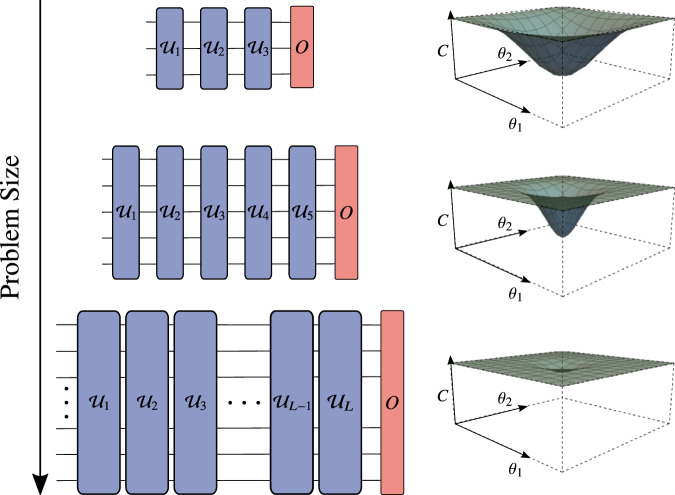
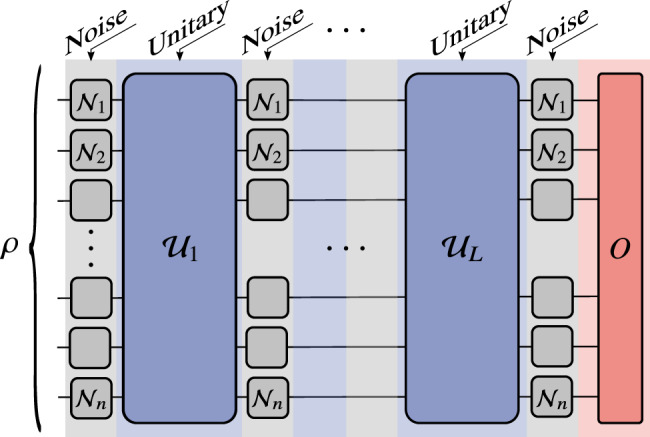
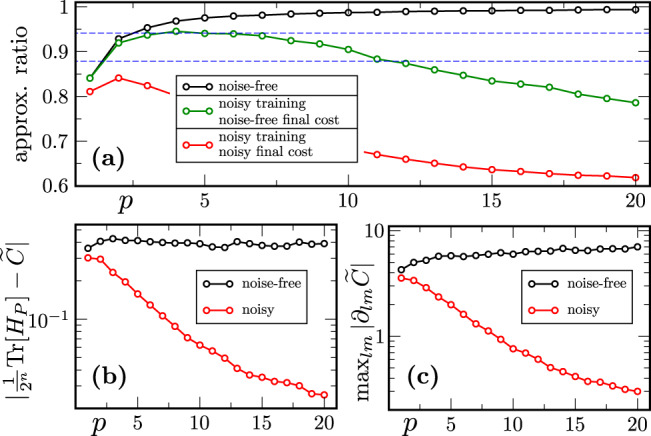
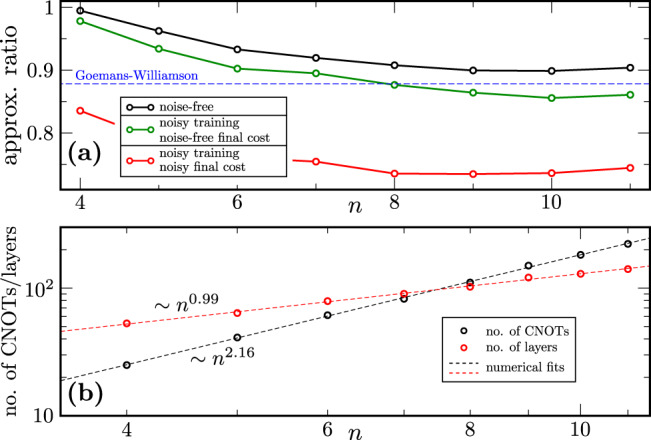
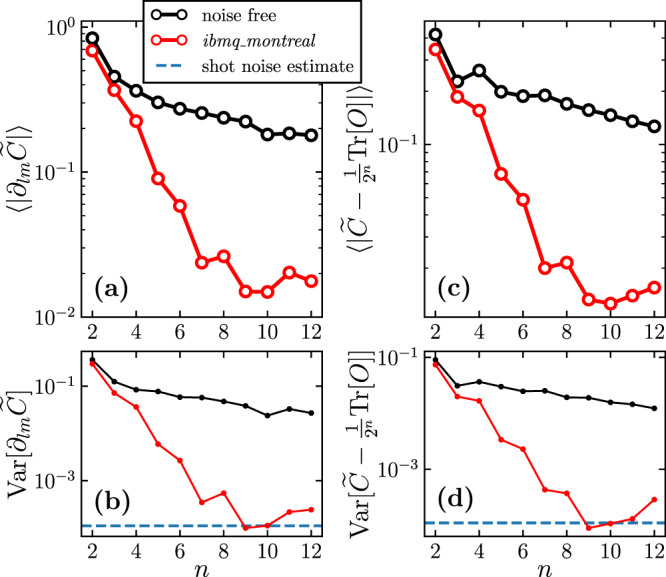
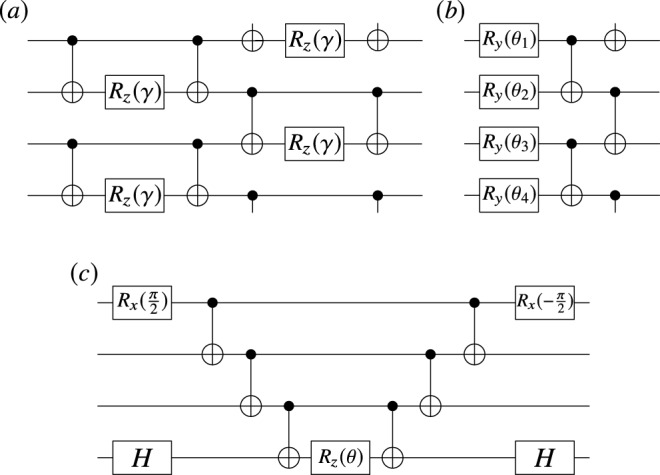
Variational Quantum Algorithms (VQAs) may be a path to quantum advantage on Noisy Intermediate-Scale Quantum (NISQ) computers. A natural question is whether noise on NISQ devices places fundamental limitations on VQA performance. We rigorously prove a serious limitation for noisy VQAs, in that the noise causes the training landscape to have a barren plateau (i.e., vanishing gradient). Specifically, for the local Pauli noise considered, we prove that the gradient vanishes exponentially in the number of qubits n if the depth of the ansatz grows linearly with n . These noise-induced barren plateaus (NIBPs) are conceptually different from noise-free barren plateaus, which are linked to random parameter initialization. Our result is formulated for a generic ansatz that includes as special cases the Quantum Alternating Operator Ansatz and the Unitary Coupled Cluster Ansatz, among others. For the former, our numerical heuristics demonstrate the NIBP phenomenon for a realistic hardware noise model.
Overview
The claims and statistics of this paper haven’t been checked yet.
Free: it reads the open-access text and checks the first 5 claims that cite a source we can check. Create a free account to check every claim.
Integrity signals
Registry
Cites
Statistics
Figures
Verification
Claims the paper makes
The claims and statistics of this paper haven’t been checked yet.
Free: it reads the open-access text and checks the first 5 claims that cite a source we can check. Create a free account to check every claim.
Claims other papers make about this one
Each is checked against this paper’s own text: does it say what the citing paper says it does?
The cited source says what the claim attributes to it.
In the citing paper
“Barren plateau landscapes correspond to gradients that vanish exponentially in the number of qubits.”
From Effect of barren plateaus on gradient-free optimization (2021) · cites this paper as [21]
In the citing paper
“However, we note that in general the scalability of real time angle-finding for a hybrid quantum-classical feedback loop is not clear for variational quantum algorithms, and in particular is expected to be quite hard especially with the presence of noise [57], [4].”
From High-Round QAOA for MAX $k$-SAT on Trapped Ion NISQ Devices (2023) · cites this paper as [57]
In the citing paper
“Second, it is challenging for the random parameters method to efficiently handle barren plateaus, while our method can address this issue by providing quasi-optimal initial guesses46.”
From Data-driven quantum approximate optimization algorithm for power systems (2023) · cites this paper as [46]
Self-check
Percentages, sums and reported differences re-computed from the paper’s own numbers.
The self-check needs the paper’s full text.
Citations
Cites
A Simplex Method for Function Minimization
Nelder, J. A., & Mead, R. (1965) · The Computer Journal · doi:10.1093/comjnl/7.4.308 · Cited by 28,905
Quantum Computation and Quantum Information
Nielsen, M. A., Chuang, I., & Grover, L. K. (2002) · American Journal of Physics · doi:10.1119/1.1463744 · Cited by 21,895
Quantum Computing in the NISQ era and beyond
Preskill, J. (2018) · Quantum · doi:10.22331/q-2018-08-06-79 · Cited by 8,830
Biamonte, J., Wittek, P., Pancotti, N., Rebentrost, P., Wiebe, N., & Lloyd, S. (2017) · Nature · doi:10.1038/nature23474 · Cited by 4,779 · cited 1×
“[59] Jacob Biamonte, Peter Wittek, Nicola Pancotti, Patrick Rebentrost, Nathan Wiebe, and Seth Lloyd, “Quantum machine learning,” Nature 549, 195–202 (2017).”
BackgroundA variational eigenvalue solver on a photonic quantum processor
Peruzzo, A., McClean, J., Shadbolt, P., Yung, M.-H., Zhou, X.-Q., Love, P. J., Aspuru-Guzik, A., & O’Brien, J. L. (2014) · Nature Communications · doi:10.1038/ncomms5213 · Cited by 4,552
Goemans, M. X., & Williamson, D. P. (1995) · Journal of the ACM · doi:10.1145/227683.227684 · Cited by 3,587
Variational quantum algorithms
Cerezo, M., Arrasmith, A., Babbush, R., Benjamin, S. C., Endo, S., Fujii, K., McClean, J. R., Mitarai, K., Yuan, X., Cincio, L., et al. (2021) · Nature Reviews Physics · doi:10.1038/s42254-021-00348-9 · Cited by 3,385 · cited 1×
“At the heart of this discussion are Variational Quantum Algorithms (VQAs), which are believed to be the best hope for near-term quantum advantage [2–4].”
BackgroundSelf-citationCoupled-cluster theory in quantum chemistry
Bartlett, R. J., & Musiał, M. (2007) · Reviews of Modern Physics · doi:10.1103/revmodphys.79.291 · Cited by 3,343
Hardware-efficient variational quantum eigensolver for small molecules and quantum magnets
Kandala, A., Mezzacapo, A., Temme, K., Takita, M., Brink, M., Chow, J. M., & Gambetta, J. M. (2017) · Nature · doi:10.1038/nature23879 · Cited by 2,982
Barren plateaus in quantum neural network training landscapes
McClean, J. R., Boixo, S., Smelyanskiy, V. N., Babbush, R., & Neven, H. (2018) · Nature Communications · doi:10.1038/s41467-018-07090-4 · Cited by 2,329
Research works printed but not linked: 4
- Bauer B Wecker D Millis AJ Hastings MB Troyer M Hybrid quantum-classical approach to correlated materials Phys. Rev. X 2016 6 031045
- Li Y Benjamin SC Efficient variational quantum simulator incorporating active error minimization Phys. Rev. X 2017 7 021050
- Wang Z Hadfield S Jiang Z Rieffel EG Quantum approximate optimization algorithm for maxcut: a fermionic view Phys. Rev. A 2018 97 022304 · DOI · Paper page
- Erdos P Renyi A On random graphs i Publ. math. Debr. 1959 6 18
Cited by
Items 401–500 of 1,010
Generalization error bound for quantum machine learning in NISQ era—a survey
Khanal, B., Rivas, P., Sanjel, A., Sooksatra, K., Quevedo, E., & Rodríguez, A. (2024) · Quantum Machine Intelligence · doi:10.1007/s42484-024-00204-w · Cited by 22
Majid, B., Sofi, S. A., & Jabeen, Z. (2025) · Quantum Machine Intelligence · doi:10.1007/s42484-025-00266-4 · Cited by 22
Quantum Differential Privacy in the Local Model
Angrisani, A., & Kashefi, E. (2025) · IEEE Transactions on Information Theory · doi:10.1109/tit.2025.3552671 · Cited by 22
Quantifying the impact of precision errors on quantum approximate optimization algorithms
Quiroz, G., Titum, P., Lotshaw, P. C., Lougovski, P., Schultz, K., Dumitrescu, E., & Hen, I. (2025) · Physical Review Research · doi:10.1103/physrevresearch.7.023240 · Cited by 22
Special Session: On the Reliability of Conventional and Quantum Neural Network Hardware
Sadi, M., He, Y., Li, Y., Alam, M., Kundu, S., Ghosh, S., Bahrami, J., & Karimi, N. (2022) · IEEE VLSI Test Symposium (VTS) · doi:10.1109/vts52500.2021.9794194 · Cited by 21
Barren plateaus from learning scramblers with local cost functions
Garcia, R. J., Zhao, C., Bu, K., & Jaffe, A. (2023) · Journal of High Energy Physics · doi:10.1007/jhep01(2023)090 · Cited by 21
Universal compilation for quantum state tomography
Hai, V. T., & Ho, L. B. (2023) · Scientific Reports · doi:10.1038/s41598-023-30983-4 · Cited by 21
Long, C. K., Dalton, K., Barnes, C. H. W., Arvidsson-Shukur, D. R. M., & Mertig, N. (2024) · Physical Review A · doi:10.1103/physreva.109.042413 · Cited by 21
Multiobjective Optimization and Network Routing With Near-Term Quantum Computers
Chiew, S.-H., Poirier, K., Mishra, R., Bornheimer, U., Munro, E., Foon, S. H., Chen, C. W., Lim, W. S., & Nga, C. W. (2024) · IEEE Transactions on Quantum Engineering · doi:10.1109/tqe.2024.3386753 · Cited by 22
Barren plateaus swamped with traps
Nemkov, N. A., Kiktenko, E. O., & Fedorov, A. K. (2025) · Physical Review A · doi:10.1103/physreva.111.012441 · Cited by 21
Variational LOCC-Assisted Quantum Circuits for Long-Range Entangled States
Yan, Y., Ma, M., Zhou, Y., & Ma, X. (2025) · Physical Review Letters · doi:10.1103/physrevlett.134.170601 · Cited by 23
Feasibility of performing quantum chemistry calculations on quantum computers
Louvet, T., Ayral, T., & Waintal, X. (2026) · Physical review. B./Physical review. B · doi:10.1103/hpt6-9tnk · Cited by 21
Variational Quantum‐Neural Hybrid Error Mitigation
Zhang, S., Wan, Z., Hsieh, C., Yao, H., & Zhang, S. (2023) · Advanced Quantum Technologies · doi:10.1002/qute.202300147 · Cited by 21
Quantum Natural Policy Gradients: Towards Sample-Efficient Reinforcement Learning
Meyer, N., Scherer, D. D., Plinge, A., Mutschler, C., & Hartmann, M. J. (2023) · IEEE International Conference on Quantum Computing and Engineering (QCE) · doi:10.1109/qce57702.2023.10181 · Cited by 22
Toward Trainability of Deep Quantum Neural NetworksPreprint
Zhang, K., Hsieh, M.-H., Liu, L., & Tao, D. (2021) · arXiv (Cornell University) · doi:10.48550/arxiv.2112.15002 · Cited by 21
Spectral analysis for noise diagnostics and filter-based digital error mitigationPreprint
Fontana, E., Rungger, I., Duncan, R., & Cîrstoiu, C. (2022) · arXiv (Cornell University) · doi:10.48550/arxiv.2206.08811 · Cited by 21
Self-citationCharacterizing Error Mitigation by Symmetry Verification in QAOA
Kakkar, A., Larson, J. M., Galda, A., & Shaydulin, R. (2022) · IEEE International Conference on Quantum Computing and Engineering (QCE) · doi:10.1109/qce53715.2022.00086 · Cited by 20
A fault-tolerant variational quantum algorithm with limited T-depth
Sayginel, H., Jamet, F., Agarwal, A., Browne, D. E., & Rungger, I. (2023) · Quantum Science and Technology · doi:10.1088/2058-9565/ad0571 · Cited by 21
From graphs to qubits: a critical review of quantum graph neural networks
Ceschini, A., Mauro, F., Falco, F. D., Sebastianelli, A., Verdone, A., Rosato, A., Saux, B. L., Panella, M., Gamba, P. E., & Ullo, S. L. (2026) · Neural Computing and Applications · doi:10.1007/s00521-026-12428-x · Cited by 22
Expressibility-induced concentration of quantum neural tangent kernels
Yu, L.-W., Li, W., Ye, Q., Lu, Z., Han, Z., & Deng, D.-L. (2024) · Reports on Progress in Physics · doi:10.1088/1361-6633/ad82cf · Cited by 20
Classical Benchmarks for Variational Quantum Eigensolver Simulations of the Hubbard Model
Alvertis, A. M., Khan, A., Iadecola, T., Orth, P. P., & Tubman, N. M. (2025) · Quantum · doi:10.22331/q-2025-05-20-1748 · Cited by 20
F-Divergences and Cost Function Locality in Generative Modelling with Quantum Circuits
Leadbeater, C., Sharrock, L., Coyle, B., & Benedetti, M. (2021) · Entropy · doi:10.3390/e23101281 · Cited by 20
Post-variational quantum neural networksPreprint
Huang, P., & Rebentrost, P. (2023) · arXiv (Cornell University) · doi:10.48550/arxiv.2307.10560 · Cited by 21
Surrogate optimization of variational quantum circuitsPreprint
Gustafson, E., Tiihonen, J., Chamaki, D., Sorourifar, F., Mullinax, J. W., Li, A. C. Y., Maciejewski, F. B., Sawaya, N. P. D., Krogel, J. T., Neira, D. E. B., et al. (2024) · Jyväskylä University Digital Archive (University of Jyväskylä) · doi:10.48550/arxiv.2404.02951 · Cited by 20
Bharti, K. (2020) · arXiv · doi:10.48550/arxiv.2009.11001 · Cited by 19
Montañez-Barrera, J. A., von Spakovsky, M. R., Damián, C., & Cano-Andrade, S. (2022) · Physical Review A · doi:10.1103/physreva.106.032426 · Cited by 19
Hybrid quantum learning with data reuploading on a small-scale superconducting quantum simulator
Tolstobrov, A., Fedorov, G., Sanduleanu, S. V., Kadyrmetov, S., Vasenin, A. V., Bolgar, A. N., Kalacheva, D. A., Lubsanov, V. B., Dorogov, A., Zotova, J., et al. (2024) · Physical Review A · doi:10.1103/physreva.109.012411 · Cited by 19
Quantum computing and neuroscience for 6G/7G networks: Survey
Glisic, S., & Lorenzo, B. (2024) · Intelligent Systems with Applications · doi:10.1016/j.iswa.2024.200346 · Cited by 19
Exponential qubit reduction in optimization for financial transaction settlement
Huber, E. X., Tan, B. Y. L., Griffin, P., & Angelakis, D. G. (2024) · EPJ Quantum Technology · doi:10.1140/epjqt/s40507-024-00262-w · Cited by 20
Challenges for Quantum Software Engineering: An Industrial Application Scenario Perspective
Carbonelli, C., Felderer, M., Jung, M., Lobe, E., Lochau, M., Luber, S. M., Mauerer, W., Ramler, R., Schaefer, I., & Schroth, C. (2024) · Springer eBooks · doi:10.1007/978-3-031-64136-7_12 · Cited by 19
On Optimizing Hyperparameters for Quantum Neural Networks
Herbst, S., Maio, V. D., & Brandić, I. (2024) · IEEE International Conference on Quantum Computing and Engineering (QCE) · doi:10.1109/qce60285.2024.00174 · Cited by 19
Quantum dynamics simulation of the advection-diffusion equation
Alipanah, H., Zhang, F., Yao, Y.-X., Thompson, R., Nguyen, N., Liu, J., Givi, P., McDermott, B. J., & Mendoza-Arenas, J. J. (2025) · Physical Review Research · doi:10.1103/ndc3-bdwt · Cited by 20
The Effect of Noise on the Performance of Variational Algorithms for Quantum Chemistry
Saib, W., Wallden, P., & Akhalwaya, I. Y. (2021) · IEEE International Conference on Quantum Computing and Engineering (QCE) · doi:10.1109/qce52317.2021.00020 · Cited by 19
Quantifying scrambling in quantum neural networks
Garcia, R. J., Bu, K., & Jaffe, A. (2022) · Journal of High Energy Physics · doi:10.1007/jhep03(2022)027 · Cited by 19
Extending the reach of quantum computing for materials science with machine learning potentials
Schuhmacher, J., Mazzola, G., Tacchino, F., Dmitriyeva, O., Bui, T., Huang, S., & Tavernelli, I. (2022) · AIP Advances · doi:10.1063/5.0099469 · Cited by 19
Quantum Architecture Search with Unsupervised Representation Learning
Sun, Y., Wu, Z., Tresp, V., & Ma, Y. (2026) · Quantum · doi:10.22331/q-2026-02-03-1994 · Cited by 19
Experimental quantum learning of a spectral decomposition
Geller, M. R., Holmes, Z., Coles, P. J., & Sornborger, A. T. (2021) · Physical Review Research · doi:10.1103/physrevresearch.3.033200 · Cited by 19
Self-citationTraining Quantum Neural Networks on NISQ DevicesPreprint
Beer, K., List, D., Müller, G., Osborne, T. J., & Struckmann, C. (2021) · arXiv (Cornell University) · doi:10.48550/arxiv.2104.06081 · Cited by 19
Decomposition-free variational quantum linear solver: Application in computational mechanics
Xu, Y., & Hu, H. (2025) · Computer Methods in Applied Mechanics and Engineering · doi:10.1016/j.cma.2025.118396 · Cited by 18
Assessing the Impact of Noise on Quantum Neural Networks: An Experimental Analysis
Terres-Escudero, E. B., Arias, D., Mentxaka, O., & Bringas, P. G. (2023) · Lecture notes in computer science · doi:10.1007/978-3-031-40725-3_27 · Cited by 18
Benchmarking the Variational Quantum Eigensolver using different quantum hardware
Bentellis, A., Matic-Flierl, A., Mendl, C. B., & Lorenz, J. M. (2023) · IEEE International Conference on Quantum Computing and Engineering (QCE) · doi:10.1109/qce57702.2023.00065 · Cited by 18
Zeng, X., Fan, Y., Liu, J., Li, Z., & Yang, J. (2023) · Journal of Chemical Theory and Computation · doi:10.1021/acs.jctc.3c00527 · Cited by 18
Quantum-Enhanced Representation Learning: A Quanvolutional Autoencoder Approach against DDoS Threats
Rivas, P., Orduz, J., Jui, T. D., DeCusatis, C. M., & Khanal, B. (2024) · Machine Learning and Knowledge Extraction · doi:10.3390/make6020044 · Cited by 18
Energy landscapes for the quantum approximate optimization algorithm
Boy, C., & Wales, D. J. (2024) · Physical Review A · doi:10.1103/physreva.109.062602 · Cited by 18
Distributionally Robust Variational Quantum Algorithms With Shifted Noise
He, Z., Peng, B., Alexeev, Y., & Zhang, Z. (2024) · IEEE Transactions on Quantum Engineering · doi:10.1109/tqe.2024.3409309 · Cited by 19
Estimates of Loss Function Concentration in Noisy Parametrized Quantum Circuits
Crognaletti, G., Grossi, M., & Bassi, A. (2026) · PRX Quantum · doi:10.1103/dw2h-ll6r · Cited by 18
The role of data embedding in equivariant quantum convolutional neural networks
Das, S., Martina, S., & Caruso, F. (2024) · Quantum Machine Intelligence · doi:10.1007/s42484-024-00215-7 · Cited by 18
Noise robust detection of quantum phase transitions
Lively, K., Bode, T., Szangolies, J., Zhu, J., & Fauseweh, B. (2024) · Physical Review Research · doi:10.1103/physrevresearch.6.043254 · Cited by 19
Efficient Quantum Cooling Algorithm for Fermionic Systems
Marti, L., Mansuroglu, R., & Hartmann, M. J. (2025) · Quantum · doi:10.22331/q-2025-02-18-1635 · Cited by 18
Efficient strategies for reducing sampling error in quantum Krylov subspace diagonalization
Lee, G., Choi, S., Huh, J., & Izmaylov, A. F. (2025) · Digital Discovery · doi:10.1039/d4dd00321g · Cited by 20
The travelling salesperson problem and the challenges of near-term quantum advantage
Smith‐Miles, K., Hoos, H. H., Wang, H., Bäck, T., & Osborne, T. J. (2025) · Quantum Science and Technology · doi:10.1088/2058-9565/add61d · Cited by 19
Scalability challenges in variational quantum optimization under stochastic noise
Bärligea, A., Poggel, B., & Lorenz, J. M. (2025) · Physical Review A · doi:10.1103/rgyh-8xw8 · Cited by 19
Variational quantum solver employing the PDS energy functional
Peng, B., & Kowalski, K. (2021) · Quantum · doi:10.22331/q-2021-06-10-473 · Cited by 18
Yalouz, S., Senjean, B., Miatto, F. M., & Dunjko, V. (2021) · Quantum · doi:10.22331/q-2021-11-08-572 · Cited by 18
Resource frugal optimizer for quantum machine learning
Moussa, C., Gordon, M. H., Bączyk, M., Cerezo, M., Cincio, Ł., & Coles, P. J. (2023) · Quantum Science and Technology · doi:10.1088/2058-9565/acef55 · Cited by 18
Self-citationStober, S. T., Harwood, S. M., Trenev, D., Barkoutsos, P. K., Gujarati, T. P., & Mostame, S. (2022) · Physical Review A · doi:10.1103/physreva.105.012425 · Cited by 18
Sbahi, F. M., Martinez, A. J., Patel, S. J., Saberi, D., Yoo, J. H., Roeder, G., & Verdon, G. (2022) · arXiv (Cornell University) · doi:10.48550/arxiv.2206.04663 · Cited by 18
Using a quantum computer to solve a real-world problem -- what can be achieved today?Preprint
Cumming, R., & Thomas, T. (2022) · arXiv (Cornell University) · doi:10.48550/arxiv.2211.13080 · Cited by 19
Evaluating the impact of noise on the performance of the Variational Quantum EigensolverPreprint
Oliv, M., Matic-Flierl, A., Messerer, T., & Lorenz, J. M. (2023) · Research Square · doi:10.21203/rs.3.rs-2640456/v1 · Cited by 18
Preconditioning for a Variational Quantum Linear SolverPreprint
Hosaka, A., Yanagisawa, K., Koshikawa, S., Kudo, I., Xiafukaiti, A., & Yoshida, T. (2023) · arXiv (Cornell University) · doi:10.48550/arxiv.2312.15657 · Cited by 18
EVOVAQ: EVOlutionary algorithms-based toolbox for VAriational Quantum circuits
Acampora, G., Cano, C., Chiatto, A., Soto-Hidalgo, J. M., & Vitiello, A. (2024) · SoftwareX · doi:10.1016/j.softx.2024.101756 · Cited by 18
Quantum quench dynamics as a shortcut to adiabaticityPreprint
Lukin, A., Schiffer, B. F., Braverman, B., Cantu, S., Huber, F., Bylinskii, A., Amato-Grill, J., Maskara, N., Cain, M., Wild, D. S., et al. (2024) · arXiv (Cornell University) · doi:10.48550/arxiv.2405.21019 · Cited by 19
Beyond Belief Propagation: Cluster-Corrected Tensor Network Contraction with Exponential Convergence
Midha, S., & Zhang, Y. (2026) · PRX Quantum · doi:10.1103/sdlx-d3tn · Cited by 17
Accelerating variational quantum eigensolver convergence using parameter transfer
Skogh, M., Leinonen, O., Lolur, P., & Rahm, M. (2023) · Electronic Structure · doi:10.1088/2516-1075/ace86d · Cited by 17
Faster variational quantum algorithms with quantum kernel-based surrogate models
Smith, A. W. R., Paige, A. J., & Kim, M. S. (2023) · Quantum Science and Technology · doi:10.1088/2058-9565/aceb87 · Cited by 17
Distributed quantum neural networks via partitioned features encoding
Kawase, Y. (2024) · Quantum Machine Intelligence · doi:10.1007/s42484-024-00153-4 · Cited by 17
Exploring shallow-depth boson sampling: Toward a scalable quantum advantage
Go, B., Oh, C., Jiang, L., & Jeong, H. (2024) · Physical Review A · doi:10.1103/physreva.109.052613 · Cited by 17
Effect of alternating layered Ansätze on trainability of projected quantum kernels
Suzuki, Y., & Li, M. (2024) · Physical Review A · doi:10.1103/physreva.110.012409 · Cited by 17
Exploiting symmetries in nuclear Hamiltonians for ground state preparation
Gibbs, J., Holmes, Z., & Stevenson, P. D. (2025) · Quantum Machine Intelligence · doi:10.1007/s42484-025-00242-y · Cited by 17
On hybrid quanvolutional neural networks optimization
Ceschini, A., Carbone, A., Sebastianelli, A., Panella, M., & Saux, B. L. (2025) · Quantum Machine Intelligence · doi:10.1007/s42484-025-00241-z · Cited by 18
Qubit-Efficient Quantum Annealing for Stochastic Unit Commitment
Hong, W. J., Xu, W., & Teng, F. (2026) · IEEE Transactions on Power Systems · doi:10.1109/tpwrs.2026.3706404 · Cited by 17
DeepQMLP: A Scalable Quantum-Classical Hybrid Deep Neural Network Architecture for Classification
Alam, M., & Ghosh, S. (2022) · International Conference on VLSI Design · doi:10.1109/vlsid2022.2022.00060 · Cited by 17
Buchs, G., Beck, T. L., Bennink, R. S., Claudino, D., Delgado, A., Fadel, N. A., Groszkowski, P., Hamilton, K. E., Humble, T. S., Kumar, N., et al. (2026) · Future Generation Computer Systems · doi:10.1016/j.future.2026.108487 · Cited by 16
Quantum-classical separations in shallow-circuit-based learning with and without noises
Zhang, Z., Gong, W., Li, W., & Deng, D.-L. (2024) · Communications Physics · doi:10.1038/s42005-024-01783-7 · Cited by 16
Quantum machine learning for multiclass classification beyond kernel methods
Ding, C., Wang, S., Wang, Y., & Gao, W. (2025) · Physical Review A · doi:10.1103/physreva.111.062410 · Cited by 16
Self-citationHacking Cryptographic Protocols with Advanced Variational Quantum Attacks
Aizpurua, B., Bermejo, P., Martínez, J. E., & Orús, R. (2025) · ACM Transactions on Quantum Computing · doi:10.1145/3718349 · Cited by 16
Parameter-efficient Quantum Denoising Diffusion Probabilistic Models with temporal encoding
Zhang, X., & Chen, C. (2025) · Future Generation Computer Systems · doi:10.1016/j.future.2025.107981 · Cited by 16
VAE-QWGAN: addressing mode collapse in quantum GANs via autoencoding priors
Thomas, A. M., Youel, H., & Jose, S. T. (2025) · Quantum Machine Intelligence · doi:10.1007/s42484-025-00314-z · Cited by 16
Quantum Doeblin Coefficients: Interpretations and Applications
George, I., Hirche, C., Nuradha, T., & Wilde, M. M. (2026) · Quantum · doi:10.22331/q-2026-05-22-2115 · Cited by 17
Quantum computing for automotive applications
Riofrío, C. A., Klepsch, J., Finžgar, J. R., Kiwit, F. J., Hölscher, L., Erdmann, M., Müller, L., Kumar, C., Berrada, Y. A., & Luckow, A. (2025) · Elsevier eBooks · doi:10.1016/b978-0-44-330259-6.00020-7 · Cited by 16
Efficient Trainability of Linear Optical Modules in Quantum Optical Neural Networks
Volkoff, T. J. (2021) · Journal of Russian Laser Research · doi:10.1007/s10946-021-09958-1 · Cited by 16
Hybrid quantum-classical algorithms: Foundation, design and applications
Chen, R.-Y.-L., Zhao, B., Song, Z., Zhao, X., Wang, K., & Wang, X. (2021) · Acta Physica Sinica · doi:10.7498/aps.70.20210985 · Cited by 16
Fast-forwarding quantum simulation with real-time quantum Krylov subspace algorithms
Cortes, C. L., DePrince, A. E., & Gray, S. K. (2022) · Physical Review A · doi:10.1103/physreva.106.042409 · Cited by 16
Evolution strategies: application in hybrid quantum-classical neural networks
Friedrich, L., & Maziero, J. (2023) · Quantum Information Processing · doi:10.1007/s11128-023-03876-8 · Cited by 16
Choi, D. S. (2023) · Expeditions with MCUP · doi:10.36304/expwmcup.2023.11 · Cited by 16
Variational preparation of entangled states on quantum computersPreprint
Hai, V. T., Viet, N. T., & Ho, L. B. (2023) · arXiv (Cornell University) · doi:10.48550/arxiv.2306.17422 · Cited by 16
QAOA-MaxCut has barren plateaus for almost all graphsPreprint
Mao, R., Yuan, P., Allcock, J., & Zhang, S. (2025) · arXiv (Cornell University) · doi:10.48550/arxiv.2512.24577 · Cited by 17
Characterizing the Trainability of Instantaneous Quantum Polynomial Circuit Born MachinesPreprint
Shen, K., Pielawa, S., Dunjko, V., & Wang, H. (2026) · arXiv (Cornell University) · doi:10.48550/arxiv.2602.11042 · Cited by 17
High-Round QAOA for MAX $k$-SAT on Trapped Ion NISQ Devices
Pelofske, E., Bärtschi, A., Golden, J., & Eidenbenz, S. (2023) · 2023 IEEE International Conference on Quantum Computing and Engineering (QCE) · doi:10.1109/qce57702.2023.00064 · Cited by 15
Fast-Forwarding with NISQ Processors without Feedback Loop
Lim, K. H., Haug, T., Kwek, L. C., & Bharti, K. (2021) · arXiv · doi:10.48550/arxiv.2104.01931 · Cited by 15
Incudini, M., Martini, F., & Pierro, A. D. (2024) · Advanced Quantum Technologies · doi:10.1002/qute.202300298 · Cited by 15
A general approach to quantum integration of cross sections in high-energy physics
Williams, I., & Pellen, M. (2025) · Quantum Science and Technology · doi:10.1088/2058-9565/adf771 · Cited by 15
Quantum algorithms for geologic fracture networks
Henderson, J. M., Podzorova, M., Cerezo, M., Golden, J. K., Gleyzer, L., Viswanathan, H., & O’Malley, D. (2023) · Scientific Reports · doi:10.1038/s41598-023-29643-4 · Cited by 15
Self-citationKovyrshin, A., Skogh, M., Broo, A., Mensa, S., Sahin, E., Crain, J. N., & Tavernelli, I. (2023) · The Journal of Chemical Physics · doi:10.1063/5.0150291 · Cited by 15
Kim, M. S., Singh, A. K., Venturelli, D., Kaewell, J., & Jamieson, K. (2025) · ACM Annual International Conference on Mobile Computing and Networking (MobiCom) · doi:10.1145/3680207.3723495 · Cited by 15
Xu, X.-F., Xue, C., Zhuang, X., Wang, Y., Sun, T., Fang, Y., Wang, J., Liu, H., Wu, Y.-C., Chen, Z., et al. (2024) · arXiv (Cornell University) · doi:10.48550/arxiv.2402.18940 · Cited by 15
Learning to generate high-dimensional distributions with low-dimensional quantum Boltzmann machinesPreprint
Tüysüz, C., Demidik, M., Coopmans, L., Rinaldi, E., Croft, V. A., Haddad, Y., Rosenkranz, M., & Jansen, K. (2024) · arXiv (Cornell University) · doi:10.48550/arxiv.2410.16363 · Cited by 15
Prasad, Y. J. D. S. (2025) · doi:10.36227/techrxiv.175743242.27149404/v1 · Cited by 15
IQP Born Machines under Data-dependent and Agnostic Initialization StrategiesPreprint
Lerch, S., Bowles, J., Puig, R., Recio-Armengol, E., Holmes, Z., & Thanasilp, S. (2026) · arXiv (Cornell University) · doi:10.48550/arxiv.2603.14576 · Cited by 15
Avoiding barren plateaus in the variational determination of geometric entanglement
Zambrano, L., Muñoz-Moller, A. D., Muñoz, M., Pereira, L., & Delgado, A. (2024) · Quantum Science and Technology · doi:10.1088/2058-9565/ad2a16 · Cited by 14
Metadata
- Authors
- Wang, S., Fontana, E., Cerezo, M., Sharma, K., Sone, A., Cincio, L., & Coles, P. J.
- Affiliations
- Los Alamos National Laboratory (US)
- Louisiana State University (US)
- Corresponding author
- Wang, Samson
- Cerezo, M.
- Coles, Patrick J.
- Venue
- Nature Communications
- Published
- 2021-11-29
- Volume
- 12
- Issue
- 1
- Pages
- 6961-6961
- ISSN
- 2041-1723 (ISSN-L)
- PMC
- PMC8630047
- OpenAlex
- W3045606049
- Semantic Scholar
- a7da6cf3820d94f250349d658a09004a36b14ff0
- Cited by
- 773
- References
- 115
- Citations by year
- 2026: 150 · 2025: 163 · 2024: 168 · 2023: 135 · 2022: 102 · 2021: 52
- FWCI
- 40.22
- Type
- journal article
- Language
- en
- Open access
- gold
- doi.org
- Licence
- cc-by
- creativecommons.org/licenses/by/4.0 (tdm)
- creativecommons.org/licenses/by/4.0 (vor)
- Locations
- Nature Communications (publishedVersion, cc-by)
- PubMed Central (publishedVersion, cc-by)
- PubMed (publishedVersion)
- Strathprints: The University of Strathclyde institutional repository (University of Strathclyde) (acceptedVersion)
- arXiv (Cornell University) (submittedVersion)
- RePEc: Research Papers in Economics (submittedVersion)
- DOAJ (DOAJ: Directory of Open Access Journals) (submittedVersion, cc-by-sa)
- OSTI OAI (U.S. Department of Energy Office of Scientific and Technical Information) (submittedVersion)
- arXiv (Cornell University)
- Bulletin of the American Physical Society
- Funders
- U.S. Department of Energy
- RCUK | Engineering and Physical Sciences Research Council
- Topics
- Physical Sciences › Computer Science › Artificial Intelligence › Quantum Computing Algorithms and Architecture
- Physical Sciences › Physics and Astronomy › Atomic and Molecular Physics, and Optics › Quantum many-body systems
- Physical Sciences › Physics and Astronomy › Atomic and Molecular Physics, and Optics › Quantum Information and Cryptography
- Keywords
- barren plateaus, variational quantum algorithms, NISQ devices, gradient vanishing, Quantum Alternating Operator Ansatz, unitary coupled cluster ansatz, quantum advantage
About these checks
Registry, retraction, Cites and statistics results are computed, not judged, with one exception: a printed reference that no index lists is read once by a model before it counts as a citation error. Claims are extracted by a model and kept only when their quote appears verbatim in the text; each cited source is then checked, with a model’s help, for whether it says what the claim relies on. Those verdicts can be wrong — read the claim’s quote and the cited source before relying on one.
Statistics and arithmetic are recomputed, not judged.
Confidence bands are shown only for fields calibrated on our annotated test set. None is calibrated yet, so no band is shown.
What counts as a claim ›How we measure confidence ›How we check this ›
Are you an author, or do you see a problem with this page? Request a review
Data sources
Bibliographic data: Semantic Scholar, OpenAlex, Crossref.
Contains information from the Semantic Scholar Academic Graph Datasets, made available under the ODC Attribution License (ODC-BY 1.0).
Semantic Scholar’s data is described in: Kinney, R., et al. (2023). The Semantic Scholar Open Data Platform. arXiv:2301.10140.
