

Noise-induced barren plateaus in variational quantum algorithms
Open accessThe DOI matches its Crossref record; 120 of the 120 references it cites were found in a registry or an index.
Abstract
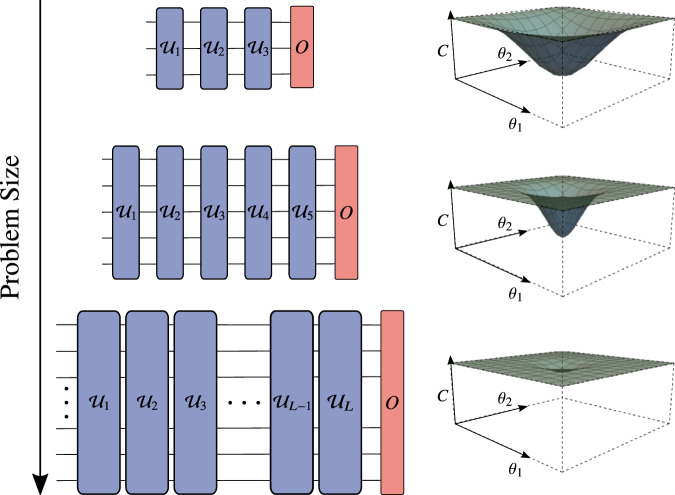
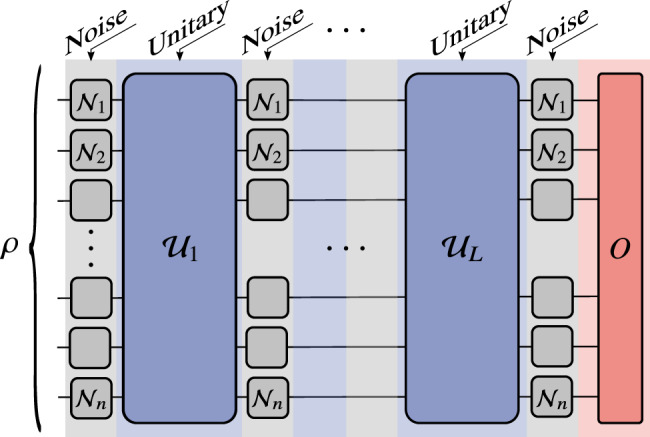
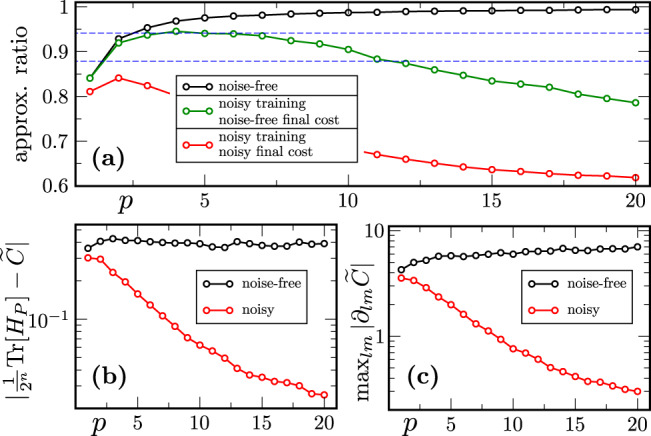
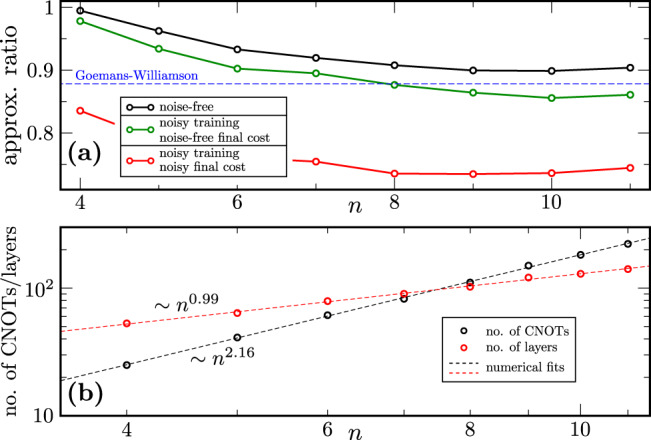
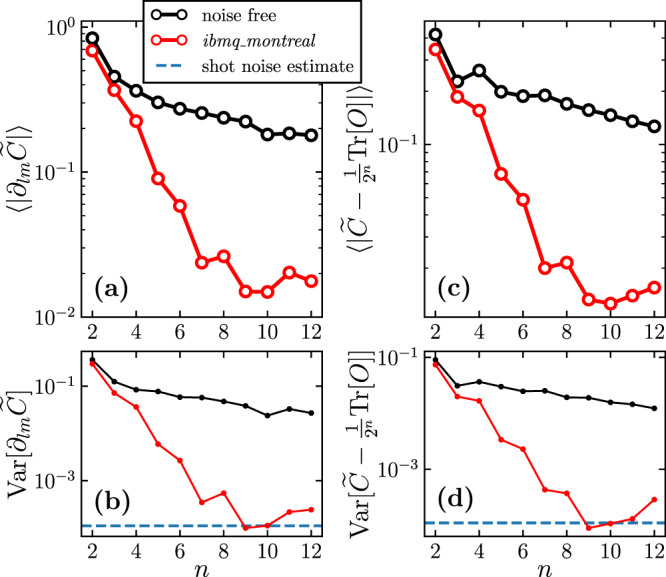
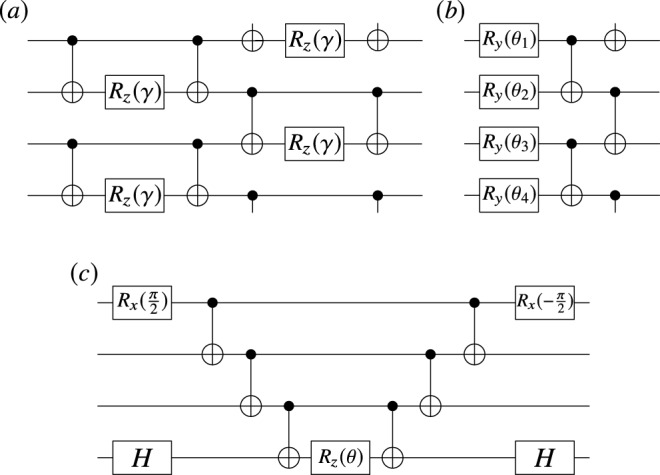
Variational Quantum Algorithms (VQAs) may be a path to quantum advantage on Noisy Intermediate-Scale Quantum (NISQ) computers. A natural question is whether noise on NISQ devices places fundamental limitations on VQA performance. We rigorously prove a serious limitation for noisy VQAs, in that the noise causes the training landscape to have a barren plateau (i.e., vanishing gradient). Specifically, for the local Pauli noise considered, we prove that the gradient vanishes exponentially in the number of qubits n if the depth of the ansatz grows linearly with n . These noise-induced barren plateaus (NIBPs) are conceptually different from noise-free barren plateaus, which are linked to random parameter initialization. Our result is formulated for a generic ansatz that includes as special cases the Quantum Alternating Operator Ansatz and the Unitary Coupled Cluster Ansatz, among others. For the former, our numerical heuristics demonstrate the NIBP phenomenon for a realistic hardware noise model.
Overview
The claims and statistics of this paper haven’t been checked yet.
Free: it reads the open-access text and checks the first 5 claims that cite a source we can check. Create a free account to check every claim.
Integrity signals
Registry
Cites
Statistics
Figures
Verification
Claims the paper makes
The claims and statistics of this paper haven’t been checked yet.
Free: it reads the open-access text and checks the first 5 claims that cite a source we can check. Create a free account to check every claim.
Claims other papers make about this one
Each is checked against this paper’s own text: does it say what the citing paper says it does?
The cited source says what the claim attributes to it.
In the citing paper
“Barren plateau landscapes correspond to gradients that vanish exponentially in the number of qubits.”
From Effect of barren plateaus on gradient-free optimization (2021) · cites this paper as [21]
In the citing paper
“However, we note that in general the scalability of real time angle-finding for a hybrid quantum-classical feedback loop is not clear for variational quantum algorithms, and in particular is expected to be quite hard especially with the presence of noise [57], [4].”
From High-Round QAOA for MAX $k$-SAT on Trapped Ion NISQ Devices (2023) · cites this paper as [57]
In the citing paper
“Second, it is challenging for the random parameters method to efficiently handle barren plateaus, while our method can address this issue by providing quasi-optimal initial guesses46.”
From Data-driven quantum approximate optimization algorithm for power systems (2023) · cites this paper as [46]
Self-check
Percentages, sums and reported differences re-computed from the paper’s own numbers.
The self-check needs the paper’s full text.
Citations
Cites
A Simplex Method for Function Minimization
Nelder, J. A., & Mead, R. (1965) · The Computer Journal · doi:10.1093/comjnl/7.4.308 · Cited by 28,905
Quantum Computation and Quantum Information
Nielsen, M. A., Chuang, I., & Grover, L. K. (2002) · American Journal of Physics · doi:10.1119/1.1463744 · Cited by 21,895
Quantum Computing in the NISQ era and beyond
Preskill, J. (2018) · Quantum · doi:10.22331/q-2018-08-06-79 · Cited by 8,830
Biamonte, J., Wittek, P., Pancotti, N., Rebentrost, P., Wiebe, N., & Lloyd, S. (2017) · Nature · doi:10.1038/nature23474 · Cited by 4,779 · cited 1×
“[59] Jacob Biamonte, Peter Wittek, Nicola Pancotti, Patrick Rebentrost, Nathan Wiebe, and Seth Lloyd, “Quantum machine learning,” Nature 549, 195–202 (2017).”
BackgroundA variational eigenvalue solver on a photonic quantum processor
Peruzzo, A., McClean, J., Shadbolt, P., Yung, M.-H., Zhou, X.-Q., Love, P. J., Aspuru-Guzik, A., & O’Brien, J. L. (2014) · Nature Communications · doi:10.1038/ncomms5213 · Cited by 4,552
Goemans, M. X., & Williamson, D. P. (1995) · Journal of the ACM · doi:10.1145/227683.227684 · Cited by 3,587
Variational quantum algorithms
Cerezo, M., Arrasmith, A., Babbush, R., Benjamin, S. C., Endo, S., Fujii, K., McClean, J. R., Mitarai, K., Yuan, X., Cincio, L., et al. (2021) · Nature Reviews Physics · doi:10.1038/s42254-021-00348-9 · Cited by 3,385 · cited 1×
“At the heart of this discussion are Variational Quantum Algorithms (VQAs), which are believed to be the best hope for near-term quantum advantage [2–4].”
BackgroundSelf-citationCoupled-cluster theory in quantum chemistry
Bartlett, R. J., & Musiał, M. (2007) · Reviews of Modern Physics · doi:10.1103/revmodphys.79.291 · Cited by 3,343
Hardware-efficient variational quantum eigensolver for small molecules and quantum magnets
Kandala, A., Mezzacapo, A., Temme, K., Takita, M., Brink, M., Chow, J. M., & Gambetta, J. M. (2017) · Nature · doi:10.1038/nature23879 · Cited by 2,982
Barren plateaus in quantum neural network training landscapes
McClean, J. R., Boixo, S., Smelyanskiy, V. N., Babbush, R., & Neven, H. (2018) · Nature Communications · doi:10.1038/s41467-018-07090-4 · Cited by 2,329
Research works printed but not linked: 4
- Bauer B Wecker D Millis AJ Hastings MB Troyer M Hybrid quantum-classical approach to correlated materials Phys. Rev. X 2016 6 031045
- Li Y Benjamin SC Efficient variational quantum simulator incorporating active error minimization Phys. Rev. X 2017 7 021050
- Wang Z Hadfield S Jiang Z Rieffel EG Quantum approximate optimization algorithm for maxcut: a fermionic view Phys. Rev. A 2018 97 022304 · DOI · Paper page
- Erdos P Renyi A On random graphs i Publ. math. Debr. 1959 6 18
Cited by
Items 901–1,000 of 1,010
Sample-Based Quantum Linear Solver and Bounds on Krylov-State SamplingPreprint
Park, B., Jeong, K., & Ahn, D. (2026) · arXiv (Cornell University) · doi:10.48550/arxiv.2610.23138 · Cited by 3
Evidence of scaling advantage on an NP-complete problem with enhanced quantum solvers
Lu, Q., Wei, S., Li, K., Gao, P., Yan, B., Zheng, M., Zhang, H., Zeng, J., & Long, G.-L. (2026) · Nature Computational Science · doi:10.1038/s43588-026-01007-8 · Cited by 1
“The emergence of barren plateaus is influenced by several factors, including complexity of the quantum circuit 43 , ansatz expressibility 44 , degree of entanglement in the quantum states 45 , noise 46 and structure of the cost function 43,47 .”
Salehi, R., Malik, A. W., Novotny, M. A., & Khan, S. U. (2026) · Scientific Reports · doi:10.1038/s41598-026-51033-9 · Cited by 1
“Based on this capability, parameterized quantum circuits have been widely used in variational quantum algorithms 56 , which play a vital role in Quantum Chemistry 57 .”
Noise-Induced Transition in Optimal Solutions of Variational Quantum Algorithms
Li, C., & Hernandez, I. (2024) · OSTI OAI (U.S. Department of Energy Office of Scientific and Technical Information) · doi:10.2172/2361123 · Cited by 1
Non-Markovian noise limits for sustaining entanglement in multiparty quantum states
Goswami, S., & Sen, U. (2025) · Physical Review A · doi:10.1103/s963-rsm5 · Cited by 1
Improving Gaussian process with quantum kernel estimation
Zhou, X., Cui, Q., Zhang, M., & Jiang, T. (2025) · Quantum Information Processing · doi:10.1007/s11128-024-04642-0 · Cited by 1
Pande, M. B. (2025) · Lecture notes in electrical engineering · doi:10.1007/978-981-97-4711-5_1 · Cited by 1
Roshani, N., Stein, J., Zorn, M., Kölle, M., Altmann, P. J., & Linnhoff–Popien, C. (2025) · Lecture notes in computer science · doi:10.1007/978-3-031-87327-0_12 · Cited by 1
Perturbative Variational Quantum Eigensolver via Reduced Density Matrices
Zheng, Y., Guo, Y., Zhang, H., Liu, J., Zeng, X., Cai, X., Li, Z., & Yang, J. (2026) · The Journal of Physical Chemistry A · doi:10.1021/acs.jpca.6c02624 · Cited by 2
Hybrid Quantum-Classical Optimization: A Unified Framework for NISQ Applications
Gangula, R. (2025) · Journal of Information Systems Engineering & Management · doi:10.52783/jisem.v10i43s.8387 · Cited by 1
Determinate arbitrary quantum state engineering through one-dimensional quantum walks
Wang, Y., Li, M., & Zhao, Y. (2025) · Physical Review Research · doi:10.1103/2frm-2v6m · Cited by 1
Image classification with hybrid quantum-classical neural networks under qubit flip noise
Ling, Y.-Q., Zhang, J., Zhang, L., Ding, C.-Y., & Huang, H.-L. (2025) · Quantum Information Processing · doi:10.1007/s11128-025-04821-7 · Cited by 1
Variational-adiabatic quantum solver for systems of linear equations with warm starts
Sanavio, C., Mascherpa, F., Marruzzo, A., Amendola, A., & Succi, S. (2026) · International Journal of Modern Physics C · doi:10.1142/s0129183127501087 · Cited by 1
Applications of Quantum Computation in Artificial Neural Network: Opportunities and Challenges
Dey, P. (2025) · Springer eBooks · doi:10.1007/978-981-95-3272-8_14 · Cited by 1
Ho, M., Khoo, J. Y., Mak, A. M., & Carrazza, S. (2026) · Quantum Science and Technology · doi:10.1088/2058-9565/ae6a1c · Cited by 1
Sarkar, R. S., Chakraborty, S., & Adhikari, B. (2025) · IEEE International Conference on Quantum Computing and Engineering (QCE) · doi:10.1109/qce65121.2025.00201 · Cited by 1
Li, X., & Yin, Z. (2026) · Physical review. B./Physical review. B · doi:10.1103/fq4j-2p2l · Cited by 1
Chinnaraju, A. (2025) · JOURNAL OF ADVANCE AND FUTURE RESEARCH · doi:10.56975/jaafr.v3i12.501605 · Cited by 1
Practical protein-pocket hydration-site prediction for drug discovery on a quantum computer
Loco, D., Barkemeyer, K., Carvalho, A. R. R., & Piquemal, J. (2026) · Physical Review Research · doi:10.1103/gyqr-mv1h · Cited by 1
Limit shapes and large deviations in classical and quantum neural networks
Rahmati, M. R., Arce, F., & Gómez‐Flores, W. (2025) · Physica A Statistical Mechanics and its Applications · doi:10.1016/j.physa.2025.131181 · Cited by 1
Generating three-dimensional genome structures with a variational quantum algorithm
Siciliano, A. J., & Wang, Z. (2025) · Briefings in Bioinformatics · doi:10.1093/bib/bbaf663 · Cited by 1
Mitigating barren plateaus in quantum denoising diffusion probabilistic models
Cao, H., Zhang, K., Tao, D., & Su, Z. (2026) · Physical Review A · doi:10.1103/gg2j-xtk6 · Cited by 1
Development of hybrid quantum classifiers for realistic classification tasks
Aminpour, S., Sharifi, S., & Banad, Y. M. (2026) · Journal of Physics Communications · doi:10.1088/2399-6528/ae4440 · Cited by 1
Nguyen, B. T., Nguyen, V., & Thi, H. L. (2026) · International Journal of Modern Physics C · doi:10.1142/s0129183126430011 · Cited by 1
Evolutionary Ansatz Selection for Post-Variational Quantum Neural Networks
Bui, C. V., Nguyen, V. N., & Nguyen, H. A. V. (2025) · International Conference on Computer, Internet of Things and Smart City (CIoTSC) · doi:10.1109/ciotsc67482.2025.11413040 · Cited by 1
Emergent‐Coupling‐Based Ansatz Evaluated on a Superconducting Quantum Processor
Joch, A., Lively, K., & Fauseweh, B. (2026) · Advanced Quantum Technologies · doi:10.1002/qute.70505 · Cited by 2
Majumder, A., Nautrup, H. P., & Briegel, H. J. (2026) · Physical Review A · doi:10.1103/5hzz-v77n · Cited by 1
Deep Variational Quantum Circuits with Barren-Plateau-Free Architectures
Zhang, K., Hsieh, M.-H., & Tao, D. (2026) · Artificial Intelligence Science and Engineering · doi:10.23919/aise.2026.000005 · Cited by 1
Scalable quantum error mitigation with physically informed graph neural networks
Wang, H., Wu, X., Liu, J., He, R., Shang, J., Guo, H., & Chen, Q. (2026) · Quantum Machine Intelligence · doi:10.1007/s42484-026-00462-w · Cited by 1
Komini, R., Mandilara, A., Maragkopoulos, G., & Syvridis, D. (2026) · IEEE Journal of Selected Topics in Applied Earth Observations and Remote Sensing · doi:10.1109/jstars.2026.3723685 · Cited by 1
Study of Effects of Shot Noise on Quantum Machine Learning Models
Etar, A., Tripathi, S. M., Soni, J., Upadhyay, H., & Perez-Pons, A. (2025) · Conference on AI, Science, Engineering, and Technology (AIxSET) · doi:10.1109/aixset65682.2025.00023 · Cited by 1
Hybrid Quantum-Classical Algorithm Design for Coupled Phase-Shift Optimization of STAR-RIS
Lim, S.-C., & Kim, J.-C. (2026) · IEEE Access · doi:10.1109/access.2026.3690802 · Cited by 1
Quantum circuit evolutionary framework applied to the set partitioning problem
Fernandez, B. O., Bloot, R., & Moret, M. A. (2026) · The Journal of Supercomputing · doi:10.1007/s11227-026-08511-8 · Cited by 1
Louise, N., & Kavitha, V. (2026) · International Conference on Artificial Intelligence and Machine Learning Applications Theme: Healthcare and Internet of Things (AIMLA) · doi:10.1109/aimla67915.2026.11522502 · Cited by 1
A variational quantum algorithm for nonlinear finite element analysis of hyperelastic materials
Kouskiya, U., & Oskay, C. (2026) · Computer Methods in Applied Mechanics and Engineering · doi:10.1016/j.cma.2026.119443 · Cited by 1
Marthaler, M., Zapusek, E., & Reiter, F. (2026) · Advances in atomic, molecular, and optical physics · doi:10.1016/bs.aamop.2026.04.001 · Cited by 1
Miriyala, S., & Chirra, V. R. (2026) · Advanced Quantum Technologies · doi:10.1002/qute.70310 · Cited by 1
Quantum optimization algorithms for strongly correlated many-body systems
Pexe, G. E. L., Rattighieri, L. A. M., Prado, P. B. B., Fritsch, A. R., & Fanchini, F. F. (2026) · Journal of Physics Condensed Matter · doi:10.1088/1361-648x/ae9dd5 · Cited by 1
Quantum image representation-based quantum neural networks for binary classification
Tiwari, A., Siyanwal, S., Sakhuja, S., Kumar, S., & Tyagi, P. (2026) · The Journal of Supercomputing · doi:10.1007/s11227-026-08621-3 · Cited by 1
Quantum computing for modeling fluid flow in subsurface environments
Kannan, S. K. N., & Kamrava, S. (2026) · Advances in Water Resources · doi:10.1016/j.advwatres.2026.105383 · Cited by 1
Fourier analysis of quantum neural network with non-linear data embedding
Kang, H., Sevior, M., & Usman, M. (2026) · Quantum Science and Technology · doi:10.1088/2058-9565/aebe60 · Cited by 1
Improving generalization and trainability of quantum eigensolvers via graph neural encoding
Lee, J., & Park, D. K. (2026) · Machine Learning Science and Technology · doi:10.1088/2632-2153/ae7eee · Cited by 1
Optimized Quantum Classifiers for the Prevention of Anxiety Disorders Using Wearable Data
Papamentzelopoulos, S., & Nikoletseas, S. (2026) · Applied Sciences · doi:10.3390/app16126132 · Cited by 1
Daka, C., & Bhattacharyya, S. (2026) · New Journal of Physics · doi:10.1088/1367-2630/ae8053 · Cited by 1
A Quantum-Optimized Training Framework for Radio Frequency Fingerprint Identification
An, T. T., Yin, G., Zhang, J., Ding, Y., Duong, T. Q., & Cotton, S. L. (2026) · IEEE Journal on Selected Areas in Communications · doi:10.1109/jsac.2026.3706263 · Cited by 1
He, C., Li, Q., & Zhang, J. (2026) · Processes · doi:10.3390/pr14132095 · Cited by 1
Niaz, F., Utama, I. B. K. Y., & Jang, Y. M. (2026) · ICT Express · doi:10.1016/j.icte.2026.06.011 · Cited by 2
Novel Quantum-Classical Hybrid Circuits for Adaptive Hardware-Based Machine Learning
Sihare, S. R., & Cherukuri, A. K. (2026) · SN Computer Science · doi:10.1007/s42979-026-05194-z · Cited by 1
Geometric analysis of variational quantum eigensolver
Qin, Z. (2026) · Journal of Physics A Mathematical and Theoretical · doi:10.1088/1751-8121/ae8b60 · Cited by 2
Quantum-Hybrid Deep Learning Ensemble for Credit Card Fraud Detection
Patel, T. K., Hodges, T. M. W., Uehara, G. S., Samanta, S., Wang, D., Ferenczi, A., & Spanias, A. (2026) · IEEE International Conference on AI and Data Analytics (ICAD) · doi:10.1109/icad69378.2026.11609125 · Cited by 1
Shot‐Based Quantum Encoding: A Data‐Loading Paradigm for Quantum Neural Networks
Kyriacou, B., Patapovich, V., Periyasamy, M., & Melnikov, A. A. (2026) · Advanced Computing · doi:10.1002/adco.70004 · Cited by 1
ε-DQML: A Framework for Distributed Quantum Machine Learning over Noises and Link Failures
Zhao, D., Meng, J., & Shang, X. (2026) · doi:10.1145/3833409.3833439 · Cited by 1
Nonclassicality in noisy quantum networks
Doolittle, B. D. (2023) · Illinois Digital Environment for Access to Learning and Scholarship (University of Illinois at Urbana-Champaign) · Cited by 1
Evaluating Quantum Algorithms for Linear Solver Workflows
Kolak, S., Mohammadbagherpoor, H., Daloukas, K., Kafousas, K., Rouet, F.-H., Koutsoyannopoulos, Y., Earnest, N., & Lucas, R. F. (2023) · Lecture notes in computer science · doi:10.1007/978-3-031-40843-4_47 · Cited by 1
Machine Learning Reliability Assessment from Application to Pulse Level
Saravanan, V., & Saeed, S. M. (2023) · Springer eBooks · doi:10.1007/978-3-031-37966-6_7 · Cited by 1
Landscape approximation of low-energy solutions to binary optimization problems
Tan, B. Y. L., Gan, B. Y., Leykam, D., & Angelakis, D. G. (2024) · Physical Review A · doi:10.1103/physreva.109.012433 · Cited by 1
Decoherence-free quantum error mitigation by density matrix vectorization
Shang, Z.-X., Chen, Z., & Cheng, C.-S. (2026) · Physical Review Research · doi:10.1103/kzyj-j3g8 · Cited by 1
Optimizing Quantum Circuits Using Algebraic Expressions
Puram, V., Karuppasamy, K., & Thomas, J. P. (2024) · Lecture notes in computer science · doi:10.1007/978-3-031-63778-0_19 · Cited by 1
Hybrid quantum-classical clustering for preparing a prior distribution of eigenspectrum
Ren, M., Chen, Y., Lai, C.-J., Hsieh, M.-H., & Hu, A. (2026) · npj Quantum Information · doi:10.1038/s41534-026-01194-2 · Cited by 1
$$\mathrm{Q(AI)}^2$$: Quantum Artificial Intelligence for the Automotive Industry
Stollenwerk, T., Bhattacharya, S., Cattelan, M., Ciani, A., Compostella, G., Headley, D., Klepsch, J., Klusch, M., Leder, M., Macaluso, A., et al. (2024) · Künstliche Intell. · doi:10.1007/s13218-024-00862-9 · Cited by 1
A Web Application for Training Quantum Classifiers via Evolutionary Algorithms
Acampora, G., Cano, C., Chiatto, A., Soto-Hidalgo, J. M., & Vitiello, A. (2024) · IEEE International Conference on Fuzzy Systems (FUZZ-IEEE) · doi:10.1109/fuzz-ieee60900.2024.10611855 · Cited by 1
Herbst, S., Cranganore, S. S., Maio, V. D., & Brandić, I. (2025) · International Conference on Learning Representations · doi:10.48550/arxiv.2410.09470 · Cited by 1
Near-term applications of superconducting digital quantum simulation
Yao, Y., & Wang, Z. (2024) · Journal of Zhejiang University. Science A · doi:10.1631/jzus.a2400397 · Cited by 1
Statistical Models of Barren Plateaus and Anti-Concentration of Pauli Observables
Nemkov, N. A. (2025) · Journal of Experimental and Theoretical Physics Letters · doi:10.1134/s0021364025607511 · Cited by 2
QUBO-based training for VQAs on quantum annealers
Acosta, E., Botella, G., & Cano, C. (2026) · Quantum Machine Intelligence · doi:10.1007/s42484-026-00441-1 · Cited by 1
Noise-resilient quantum reinforcement learning
Yue, J.-C., & An, J. (2026) · Physical Review Applied · doi:10.1103/8gfc-2nsc · Cited by 1
Hybrid Quantum Algorithms and Quantum Software Development FrameworksPreprint
Ramouthar, R., & Şeker, H. (2023) · AfricArXiv (OSF Preprints) · doi:10.31730/osf.io/fsw24 · Cited by 1
A Bottom-up Approach to Constructing Symmetric Variational Quantum CircuitsPreprint
Ayeni, B. M. (2023) · arXiv (Cornell University) · doi:10.48550/arxiv.2308.08912 · Cited by 1
Local Hamiltonian decomposition and classical simulation of parametrized quantum circuitsPreprint
Adhikari, B., & Jha, A. (2024) · arXiv (Cornell University) · doi:10.48550/arxiv.2401.13156 · Cited by 1
Sarmina, B. G., Sun, G.-H., & Dong, S. (2024) · arXiv (Cornell University) · doi:10.48550/arxiv.2405.08941 · Cited by 1
The battle of clean and dirty qubits in the era of partial error correction
Bultrini, D., (NNSA), U. N. N. S. A., EPSRC, U., Wang, S., Czarnik, P., Gordon, M. H., Cerezo, M., Coles, P. J., & Cincio, Ł. (2023) · OSTI OAI (U.S. Department of Energy Office of Scientific and Technical Information) · doi:10.2172/2378046 · Cited by 1
Self-citationQuantum Algorithm For Testing Convexity of FunctionPreprint
Nghiem, N. A., & Wei, T.-C. (2024) · arXiv (Cornell University) · doi:10.48550/arxiv.2409.03312 · Cited by 1
Quantum Re-Uploading for Calorimetry: Optimized Architectures with Extended ExpressivityPreprint
Cassé, L., Pfahringer, B., Bifet, A., & Magniette, F. (2024) · HAL · doi:10.48550/arxiv.2412.12397 · Cited by 1
Variational Quantum Algorithms for Many-Body SystemsPreprint
Consiglio, M. (2025) · arXiv (Cornell University) · doi:10.48550/arxiv.2502.11985 · Cited by 1
Quantum Synergy in Retrieval-Augmented Generation for Contextual EnhancementPreprint
Adithi, K., & Kapilavani, R. K. (2025) · Research Square · doi:10.21203/rs.3.rs-6216441/v1 · Cited by 1
Chafachaipa, K., & Danda, R. (2025) · Preprints.org · doi:10.20944/preprints202509.0011.v1 · Cited by 1
Alhammadi, A. (2025) · Research Square · doi:10.21203/rs.3.rs-7508439/v1 · Cited by 1
Accelerating Transpilation in Quantum Machine Learning with Haiqu's Rivet-transpilerPreprint
Kaczmarek, A., & Dulal, D. (2025) · arXiv (Cornell University) · doi:10.48550/arxiv.2508.21342 · Cited by 1
Baek, K., Lee, S., Huh, J., Lee, D., Lee, J., Kim, M. S., & Bang, J. (2025) · arXiv (Cornell University) · doi:10.48550/arxiv.2511.12062 · Cited by 1
Quantum Computing Quantum Monte CarloPreprint
Yuan, X., Zhang, Y., Huang, Y., Sun, J., & Lv, D. (2024) · Research Square · doi:10.21203/rs.3.rs-3911065/v1 · Cited by 1
Parametrized Quantum Circuits for Reinforcement Learning
Andrés Núñez, E. M. (2024) · Institutional Repository of the University of Granada (University of Granada) · Cited by 1
Scalability of Variational Quantum Optimization in the Presence of Noise
Bärligea, A., & München, T. U. (2024) · mediaTUM (Technical University of Munich) · Cited by 1
Theoretical Tools for Quantum Sensor Optimization and Entanglement Quantification
Beckey, J. L. (2024) · CU Scholar (University of Colorado Boulder) · Cited by 1
Quantum-based solutions for the Prognosis and Health Management of Critical Infrastructures
San Martin Silva, G. A. (2025) · eScholarship (California Digital Library) · Cited by 1
Practical Quantum Chemistry on Near Term Quantum Computers
Ralli, A. (2023) · UCL Discovery (University College London) · Cited by 1
Simulation of, and with, first generation quantum computers
Jones, T. (2022) · Oxford University Research Archive (ORA) (University of Oxford) · doi:10.5287/ora-zrerqmjew · Cited by 1
H-EFT-VA: An Effective-Field-Theory Variational Ansatz with Provable Barren Plateau AvoidancePreprint
Hamid, E. I. B. (2026) · arXiv (Cornell University) · doi:10.48550/arxiv.2601.10479 · Cited by 1
Valderrama, S. R., Sayed, A. N., Rojhani, N., Sligar, A., Rosas-Bustos, J. R., Joshi, S., Govia, L. C. G., Ramahi, O. M., & Shaker, G. S. A. (2026) · arXiv (Cornell University) · doi:10.48550/arxiv.2601.11929 · Cited by 1
Efficient quantum machine learning with inverse-probability algebraic correctionsPreprint
Seo, J. (2026) · arXiv (Cornell University) · doi:10.48550/arxiv.2601.16665 · Cited by 1
Noise-Resilient Optimization of Parameterized Quantum Circuits for Near-Term Quantum DevicesPreprint
Deepika, D., Vanishree, K., & Krishna, M. (2026) · Research Square · doi:10.21203/rs.3.rs-8510087/v1 · Cited by 1
Enabling large-scale digital quantum simulations with superconducting qubitsPreprint
Fischer, L. E. (2026) · arXiv (Cornell University) · doi:10.48550/arxiv.2602.04719 · Cited by 1
Haas, M., Kaldenbach, T. N., Hammerschmidt, T., & Barragán-Yani, D. (2026) · arXiv (Cornell University) · doi:10.48550/arxiv.2602.10776 · Cited by 1
Performance comparison of QAOA mixers for ternary portfolio optimization
Yamamura, S., Watanabe, S., Kunimi, M., Saito, K., & Nikuni, T. (2026) · Quantum Information Processing · doi:10.48550/arxiv.2602.21562 · Cited by 1
CaRBM: A Fixed-Depth Quantum Algorithm with Partial Correction for Thermal State PreparationPreprint
Alsheikh, O., Kemper, A. F., Rrapaj, E., Rule, E., & Toga, G. C. (2026) · arXiv (Cornell University) · doi:10.48550/arxiv.2603.17971 · Cited by 1
SpinGQE: A Generative Quantum Eigensolver for Spin HamiltoniansPreprint
Holden, A., Rahat, M. H., & Dade, N. O. O. (2026) · arXiv (Cornell University) · doi:10.48550/arxiv.2603.24298 · Cited by 1
A Resource-Aligned Hybrid Quantum-Classical Framework for Multimodal Face Anti-SpoofingPreprint
Sun, W., Xu, J., & Duan, C. (2026) · arXiv (Cornell University) · doi:10.48550/arxiv.2603.27852 · Cited by 1
Performance evaluation and control improvements for solving optimization problems on NISQ platforms
Gilbert, V. (2024) · theses.fr (ABES) · doi:10.70675/81f9c638z5867z40e4zaed8ze9824ff5a163 · Cited by 1
Classical Regularization in Variational Quantum EigensolversPreprint
Chernyak, Y. (2026) · Research Square · doi:10.21203/rs.3.rs-9168724/v1 · Cited by 1
Graph-Conditioned Meta-Optimizer for QAOA Parameter Generation on Multiple Problem ClassesPreprint
Nguyen, K. X., & Safro, I. (2026) · arXiv (Cornell University) · doi:10.48550/arxiv.2604.25275 · Cited by 1
Decomposing Gradient Suppression in Barren Plateaus: Activity, Sign Organization, and CouplingPreprint
Kang, P. (2026) · arXiv (Cornell University) · doi:10.48550/arxiv.2605.01319 · Cited by 1
Metadata
- Authors
- Wang, S., Fontana, E., Cerezo, M., Sharma, K., Sone, A., Cincio, L., & Coles, P. J.
- Affiliations
- Los Alamos National Laboratory (US)
- Louisiana State University (US)
- Corresponding author
- Wang, Samson
- Cerezo, M.
- Coles, Patrick J.
- Venue
- Nature Communications
- Published
- 2021-11-29
- Volume
- 12
- Issue
- 1
- Pages
- 6961-6961
- ISSN
- 2041-1723 (ISSN-L)
- PMC
- PMC8630047
- OpenAlex
- W3045606049
- Semantic Scholar
- a7da6cf3820d94f250349d658a09004a36b14ff0
- Cited by
- 773
- References
- 115
- Citations by year
- 2026: 150 · 2025: 163 · 2024: 168 · 2023: 135 · 2022: 102 · 2021: 52
- FWCI
- 40.22
- Type
- journal article
- Language
- en
- Open access
- gold
- doi.org
- Licence
- cc-by
- creativecommons.org/licenses/by/4.0 (tdm)
- creativecommons.org/licenses/by/4.0 (vor)
- Locations
- Nature Communications (publishedVersion, cc-by)
- PubMed Central (publishedVersion, cc-by)
- PubMed (publishedVersion)
- Strathprints: The University of Strathclyde institutional repository (University of Strathclyde) (acceptedVersion)
- arXiv (Cornell University) (submittedVersion)
- RePEc: Research Papers in Economics (submittedVersion)
- DOAJ (DOAJ: Directory of Open Access Journals) (submittedVersion, cc-by-sa)
- OSTI OAI (U.S. Department of Energy Office of Scientific and Technical Information) (submittedVersion)
- arXiv (Cornell University)
- Bulletin of the American Physical Society
- Funders
- U.S. Department of Energy
- RCUK | Engineering and Physical Sciences Research Council
- Topics
- Physical Sciences › Computer Science › Artificial Intelligence › Quantum Computing Algorithms and Architecture
- Physical Sciences › Physics and Astronomy › Atomic and Molecular Physics, and Optics › Quantum many-body systems
- Physical Sciences › Physics and Astronomy › Atomic and Molecular Physics, and Optics › Quantum Information and Cryptography
- Keywords
- barren plateaus, variational quantum algorithms, NISQ devices, gradient vanishing, Quantum Alternating Operator Ansatz, unitary coupled cluster ansatz, quantum advantage
About these checks
Registry, retraction, Cites and statistics results are computed, not judged, with one exception: a printed reference that no index lists is read once by a model before it counts as a citation error. Claims are extracted by a model and kept only when their quote appears verbatim in the text; each cited source is then checked, with a model’s help, for whether it says what the claim relies on. Those verdicts can be wrong — read the claim’s quote and the cited source before relying on one.
Statistics and arithmetic are recomputed, not judged.
Confidence bands are shown only for fields calibrated on our annotated test set. None is calibrated yet, so no band is shown.
What counts as a claim ›How we measure confidence ›How we check this ›
Are you an author, or do you see a problem with this page? Request a review
Data sources
Bibliographic data: Semantic Scholar, OpenAlex, Crossref.
Contains information from the Semantic Scholar Academic Graph Datasets, made available under the ODC Attribution License (ODC-BY 1.0).
Semantic Scholar’s data is described in: Kinney, R., et al. (2023). The Semantic Scholar Open Data Platform. arXiv:2301.10140.
