

Noise-induced barren plateaus in variational quantum algorithms
Open accessThe DOI matches its Crossref record; 120 of the 120 references it cites were found in a registry or an index.
Abstract
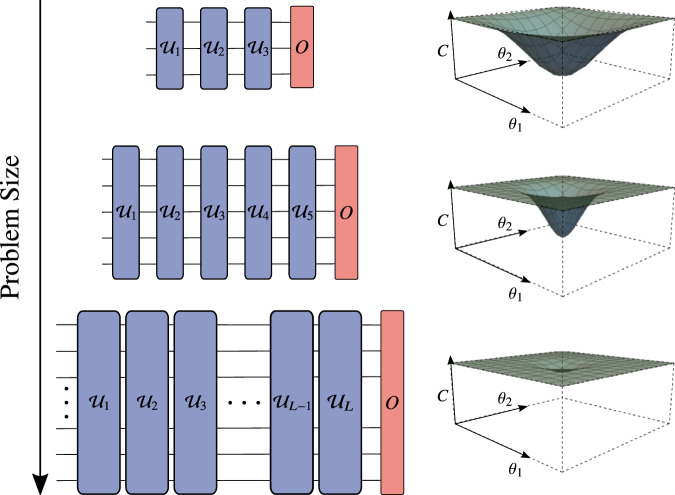
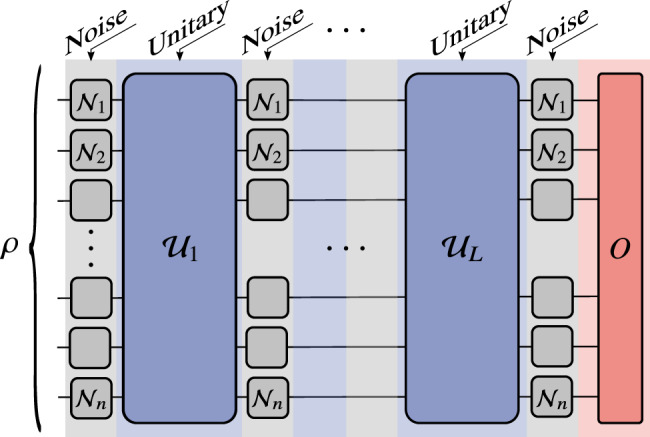
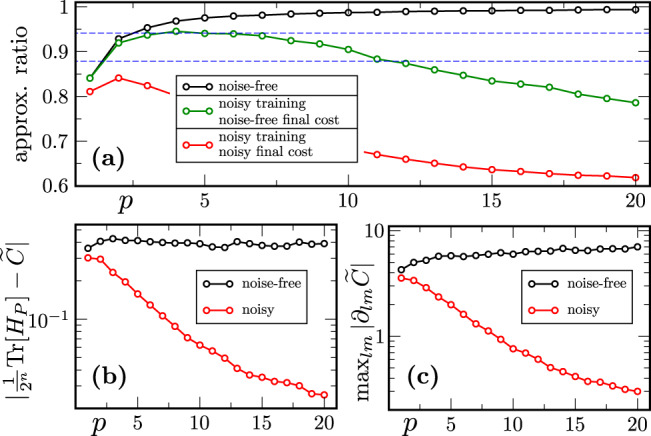
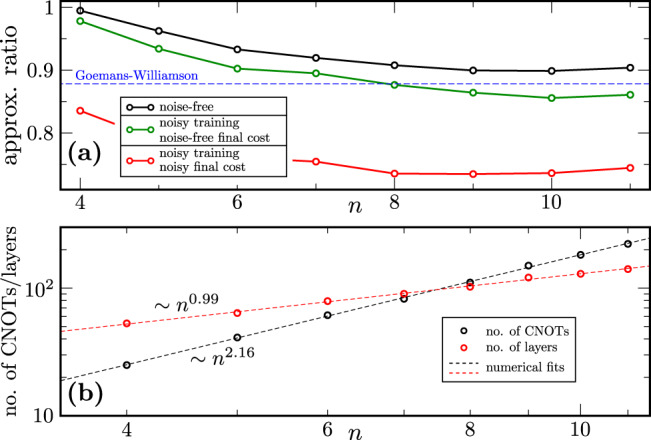
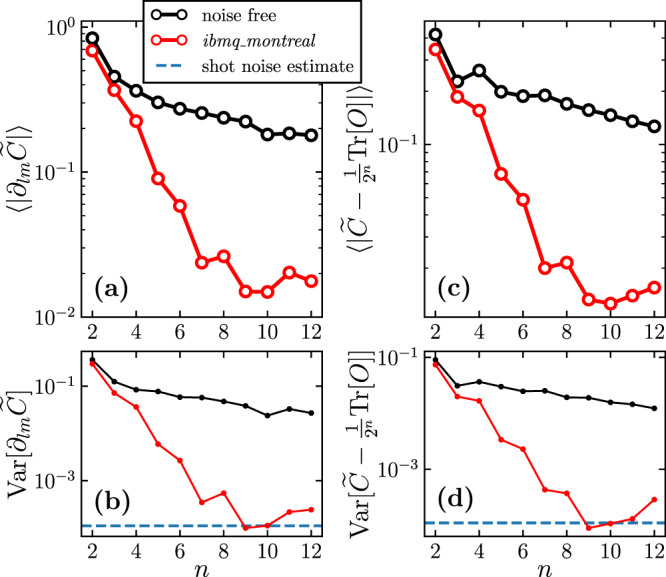
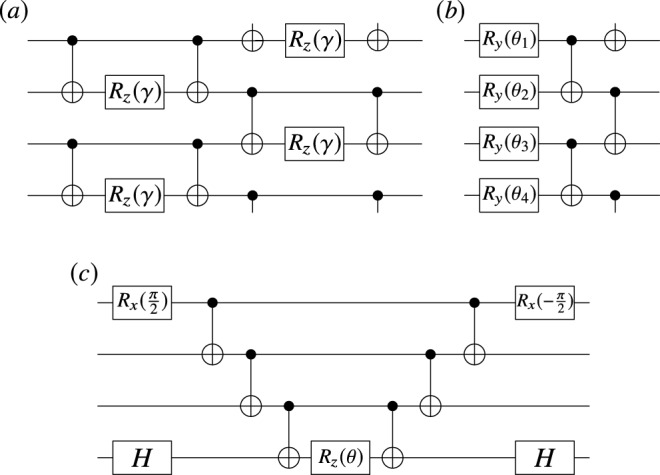
Variational Quantum Algorithms (VQAs) may be a path to quantum advantage on Noisy Intermediate-Scale Quantum (NISQ) computers. A natural question is whether noise on NISQ devices places fundamental limitations on VQA performance. We rigorously prove a serious limitation for noisy VQAs, in that the noise causes the training landscape to have a barren plateau (i.e., vanishing gradient). Specifically, for the local Pauli noise considered, we prove that the gradient vanishes exponentially in the number of qubits n if the depth of the ansatz grows linearly with n . These noise-induced barren plateaus (NIBPs) are conceptually different from noise-free barren plateaus, which are linked to random parameter initialization. Our result is formulated for a generic ansatz that includes as special cases the Quantum Alternating Operator Ansatz and the Unitary Coupled Cluster Ansatz, among others. For the former, our numerical heuristics demonstrate the NIBP phenomenon for a realistic hardware noise model.
Overview
The claims and statistics of this paper haven’t been checked yet.
Free: it reads the open-access text and checks the first 5 claims that cite a source we can check. Create a free account to check every claim.
Integrity signals
Registry
Cites
Statistics
Figures
Verification
Claims the paper makes
The claims and statistics of this paper haven’t been checked yet.
Free: it reads the open-access text and checks the first 5 claims that cite a source we can check. Create a free account to check every claim.
Claims other papers make about this one
Each is checked against this paper’s own text: does it say what the citing paper says it does?
The cited source says what the claim attributes to it.
In the citing paper
“Barren plateau landscapes correspond to gradients that vanish exponentially in the number of qubits.”
From Effect of barren plateaus on gradient-free optimization (2021) · cites this paper as [21]
In the citing paper
“However, we note that in general the scalability of real time angle-finding for a hybrid quantum-classical feedback loop is not clear for variational quantum algorithms, and in particular is expected to be quite hard especially with the presence of noise [57], [4].”
From High-Round QAOA for MAX $k$-SAT on Trapped Ion NISQ Devices (2023) · cites this paper as [57]
In the citing paper
“Second, it is challenging for the random parameters method to efficiently handle barren plateaus, while our method can address this issue by providing quasi-optimal initial guesses46.”
From Data-driven quantum approximate optimization algorithm for power systems (2023) · cites this paper as [46]
Self-check
Percentages, sums and reported differences re-computed from the paper’s own numbers.
The self-check needs the paper’s full text.
Citations
Cites
A Simplex Method for Function Minimization
Nelder, J. A., & Mead, R. (1965) · The Computer Journal · doi:10.1093/comjnl/7.4.308 · Cited by 28,905
Quantum Computation and Quantum Information
Nielsen, M. A., Chuang, I., & Grover, L. K. (2002) · American Journal of Physics · doi:10.1119/1.1463744 · Cited by 21,895
Quantum Computing in the NISQ era and beyond
Preskill, J. (2018) · Quantum · doi:10.22331/q-2018-08-06-79 · Cited by 8,830
Biamonte, J., Wittek, P., Pancotti, N., Rebentrost, P., Wiebe, N., & Lloyd, S. (2017) · Nature · doi:10.1038/nature23474 · Cited by 4,779 · cited 1×
“[59] Jacob Biamonte, Peter Wittek, Nicola Pancotti, Patrick Rebentrost, Nathan Wiebe, and Seth Lloyd, “Quantum machine learning,” Nature 549, 195–202 (2017).”
BackgroundA variational eigenvalue solver on a photonic quantum processor
Peruzzo, A., McClean, J., Shadbolt, P., Yung, M.-H., Zhou, X.-Q., Love, P. J., Aspuru-Guzik, A., & O’Brien, J. L. (2014) · Nature Communications · doi:10.1038/ncomms5213 · Cited by 4,552
Goemans, M. X., & Williamson, D. P. (1995) · Journal of the ACM · doi:10.1145/227683.227684 · Cited by 3,587
Variational quantum algorithms
Cerezo, M., Arrasmith, A., Babbush, R., Benjamin, S. C., Endo, S., Fujii, K., McClean, J. R., Mitarai, K., Yuan, X., Cincio, L., et al. (2021) · Nature Reviews Physics · doi:10.1038/s42254-021-00348-9 · Cited by 3,385 · cited 1×
“At the heart of this discussion are Variational Quantum Algorithms (VQAs), which are believed to be the best hope for near-term quantum advantage [2–4].”
BackgroundSelf-citationCoupled-cluster theory in quantum chemistry
Bartlett, R. J., & Musiał, M. (2007) · Reviews of Modern Physics · doi:10.1103/revmodphys.79.291 · Cited by 3,343
Hardware-efficient variational quantum eigensolver for small molecules and quantum magnets
Kandala, A., Mezzacapo, A., Temme, K., Takita, M., Brink, M., Chow, J. M., & Gambetta, J. M. (2017) · Nature · doi:10.1038/nature23879 · Cited by 2,982
Barren plateaus in quantum neural network training landscapes
McClean, J. R., Boixo, S., Smelyanskiy, V. N., Babbush, R., & Neven, H. (2018) · Nature Communications · doi:10.1038/s41467-018-07090-4 · Cited by 2,329
Research works printed but not linked: 4
- Bauer B Wecker D Millis AJ Hastings MB Troyer M Hybrid quantum-classical approach to correlated materials Phys. Rev. X 2016 6 031045
- Li Y Benjamin SC Efficient variational quantum simulator incorporating active error minimization Phys. Rev. X 2017 7 021050
- Wang Z Hadfield S Jiang Z Rieffel EG Quantum approximate optimization algorithm for maxcut: a fermionic view Phys. Rev. A 2018 97 022304 · DOI · Paper page
- Erdos P Renyi A On random graphs i Publ. math. Debr. 1959 6 18
Cited by
Items 601–700 of 1,010
Permutation-equivariant quantum convolutional neural networks
Das, S., & Caruso, F. (2024) · Quantum Science and Technology · doi:10.1088/2058-9565/ad8e80 · Cited by 10
Identifying Bottlenecks of NISQ-Friendly HHL Algorithms
Marfany, M. A., Sakhnenko, A., & Lorenz, J. M. (2024) · IEEE International Conference on Quantum Computing and Engineering (QCE) · doi:10.1109/qce60285.2024.00041 · Cited by 10
Quantum resources of quantum and classical variational methods
Spriggs, T., Ahmadi, A., Chen, B., & Greplová, E. (2025) · Machine Learning Science and Technology · doi:10.1088/2632-2153/adaca2 · Cited by 9
A coherent approach to quantum-classical optimization
Cáliz, A. N., Riu, J., Bosch, J., Torrente, P., Miralles, J., & Riera, A. (2025) · Communications Physics · doi:10.1038/s42005-025-02111-3 · Cited by 10
Quantum Artificial Intelligence: Some Strategies and Perspectives
Baioletti, M., Fagiolo, F., Loglisci, C. A. A. M. D., Losavio, V. N., Oddi, A., Rasconi, R., & Gentili, P. L. (2025) · AI · doi:10.3390/ai6080175 · Cited by 10
Pitfalls when tackling the exponential concentration of parameterized quantum models
Saem, R. A., Tafreshi, B., Holmes, Z., & Thanasilp, S. (2026) · Quantum Science and Technology · doi:10.1088/2058-9565/ae2202 · Cited by 9
Nguyen, K. X., Bach, B., & Safro, I. (2025) · IEEE International Conference on Quantum Computing and Engineering (QCE) · doi:10.1109/qce65121.2025.00240 · Cited by 9
Improved Iterative Quantum Algorithm for Ground‐State Preparation
Liang, J., Lv, Q.-Q., Shen, S., Li, M., Wang, Z., & Fei, S.-M. (2022) · Advanced Quantum Technologies · doi:10.1002/qute.202200090 · Cited by 9
Quantum Machine Learning Applications in High-Energy Physics
Delgado, A., & Hamilton, K. E. (2022) · International Conference on Computer Aided Design · doi:10.1145/3508352.3561114 · Cited by 9
Fundamental limitations on optimization in variational quantum algorithmsPreprint
Zhang, H.-K., Zhu, C., Liu, G., & Wang, X. (2022) · arXiv (Cornell University) · doi:10.48550/arxiv.2205.05056 · Cited by 9
Ansätze for Noisy Variational Quantum EigensolversPreprint
Ramôa, M. (2022) · arXiv (Cornell University) · doi:10.48550/arxiv.2212.04323 · Cited by 9
Two-Qubit Gate Set Tomography with Fewer CircuitsPreprint
Rudinger, K., Ostrove, C., Seritan, S., Grace, M., Nielsen, E., Blume-Kohout, R., & Young, K. C. (2023) · arXiv · doi:10.48550/arxiv.2307.15767 · Cited by 9
Gharibyan, H., Su, V., & Tepanyan, H. (2023) · arXiv (Cornell University) · doi:10.48550/arxiv.2311.12929 · Cited by 9
Scalable Quantum Algorithms for Noisy Quantum Computers
Gacon, J. (2024) · arXiv (Cornell University) · doi:10.5075/epfl-thesis-11132 · Cited by 9
Quantum Geometric Machine LearningPreprint
Perrier, E. (2024) · arXiv (Cornell University) · doi:10.48550/arxiv.2409.04955 · Cited by 9
Quantum advantage without exponential concentration: Trainable kernels for symmetry-structured dataPreprint
Henderson, L. J., Beer, K., Karuvade, S., Gupta, R. S., White, A., & Shrapnel, S. (2025) · arXiv (Cornell University) · doi:10.48550/arxiv.2509.14337 · Cited by 9
Circuit structure-preserving error mitigation for High-Fidelity Quantum SimulationsPreprint
Shen, R., Chen, T., & Lee, C. H. (2025) · arXiv (Cornell University) · doi:10.48550/arxiv.2505.17187 · Cited by 10
Chakraborty, R., Miller, A., Nykänen, A., Salehi, Ö., Tarocco, F., Pavošević, F., Haase, P. A. B., Stella, M., & Glos, A. (2026) · arXiv (Cornell University) · doi:10.48550/arxiv.2603.23444 · Cited by 9
Almost fault-tolerant quantum machine learning with drastic overhead reduction
Kang, H., Kim, Y., Adermann, E., Sevior, M. E., & Usman, M. (2025) · Quantum Science and Technology · doi:10.1088/2058-9565/ae2157 · Cited by 8
Quantum Enhanced Ensemble GANs for Anomaly Detection in Continuous Biomanufacturing
Kailasanathan, R., Clements, W. R., Boskabadi, M. R., Gibford, S. M., Papadakis, E., Savoie, C. J., & Mansouri, S. S. (2026) · Industrial & Engineering Chemistry Research · doi:10.1021/acs.iecr.5c04183 · Cited by 9
A Channel-Level Diagnostic for Symmetry Breaking in Noisy Equivariant Quantum Neural Networks
Ugail, H., & Howard, N. (2026) · IEEE Access · doi:10.1109/access.2026.3706394 · Cited by 9
Hybrid Classical-Quantum Transfer Learning with Noisy Quantum Circuits
Martín-Pérez, D., Rodríguez-Díaz, F., Gutiérrez‐Avilés, D., Troncoso, A., & Alvarez, F. M. (2026) · Computer Modeling in Engineering & Sciences · doi:10.32604/cmes.2026.082712 · Cited by 8
Rethinking noise in quantum machine learning: When noise improves learning
Zhu, L., Zhang, Z., Dong, Y., & Li, X. (2026) · APL Computational Physics · doi:10.1063/5.0331090 · Cited by 8
Estimating many properties of a quantum state via quantum reservoir processing
Li, Y., Ghosh, S., Shang, J., Xiong, Q., & Zhang, X. (2024) · Physical Review Research · doi:10.1103/physrevresearch.6.013211 · Cited by 8
Sudden death of quantum advantage in correlation generations
Sun, W., Wei, F., Shao, Y., & Wei, Z. (2024) · Science Advances · doi:10.1126/sciadv.adr5002 · Cited by 8
Data-dependent generalization bounds for parameterized quantum models under noise
Khanal, B., & Rivas, P. (2025) · The Journal of Supercomputing · doi:10.1007/s11227-025-06966-9 · Cited by 8
Barren plateaus are amplified by the dimension of qudits
Friedrich, L., Farias, T. D. S., & Maziero, J. (2025) · Quantum Machine Intelligence · doi:10.1007/s42484-025-00282-4 · Cited by 8
Non-Hermitian ground-state-searching algorithm enhanced by a variational toolbox
Chen, Y., Zhang, S., Hsieh, C., & Zhang, S. (2023) · Physical Review A · doi:10.1103/physreva.107.042418 · Cited by 8
Efficient and quantum-adaptive machine learning with fermion neural networks
Zheng, P.-L., Wang, J., & Zhang, Y. (2023) · Physical Review Applied · doi:10.1103/physrevapplied.20.044002 · Cited by 8
Generating hard Ising instances with planted solutions using post-quantum cryptographic protocols
Mandrà, S., Munoz-Bauza, H., Mossi, G., & Rieffel, E. G. (2025) · Future Generation Computer Systems · doi:10.1016/j.future.2025.107721 · Cited by 8
Learning to learn with an evolutionary strategy applied to variational quantum algorithms
Friedrich, L., & Maziero, J. (2025) · Physical Review A · doi:10.1103/physreva.111.022630 · Cited by 9
Engineering analog quantum chemistry Hamiltonians using cold atoms in optical lattices
Argüello-Luengo, J., Shi, T., & González-Tudela, A. (2021) · Physical Review A · doi:10.1103/physreva.103.043318 · Cited by 8
Towards solving the BCS Hamiltonian gap in near-term quantum computers
Sá, N., Oliveira, I. S., & Roditi, I. (2022) · Results in Physics · doi:10.1016/j.rinp.2022.106131 · Cited by 8
Running the Dual-PQC GAN on noisy simulators and real quantum hardware
Chang, S. Y., Agnew, E., Combarro, E. F., Grossi, M., Herbert, S., & Vallecorsa, S. (2023) · Journal of Physics Conference Series · doi:10.1088/1742-6596/2438/1/012062 · Cited by 8
Mitigating Noise-Induced Gradient Vanishing in Variational Quantum Algorithm TrainingPreprint
Wu, A., Li, G., Ding, Y., & Xie, Y. (2021) · arXiv (Cornell University) · doi:10.48550/arxiv.2111.13209 · Cited by 8
Identifying overparameterization in Quantum Circuit Born MachinesPreprint
Delgado, A., Rios, F., & Hamilton, K. E. (2023) · arXiv (Cornell University) · doi:10.48550/arxiv.2307.03292 · Cited by 9
Classical Algorithms for Hamiltonian Dynamics Mean Value and Guided Local Hamiltonian ProblemPreprint
Wu, Y., Zhang, Y., Wang, C., & Yuan, X. (2024) · arXiv (Cornell University) · doi:10.48550/arxiv.2409.04161 · Cited by 8
Clifford Perturbation Approximation for Quantum Error MitigationPreprint
Zhang, R., Shao, Y., Wei, F., Cheng, S., Wei, Z., & Liu, Z. (2024) · arXiv (Cornell University) · doi:10.48550/arxiv.2412.09518 · Cited by 8
Quantum Recurrent Embedding Neural NetworkPreprint
Jing, M., Huang, E., Shi, X., Zhang, S., & Wang, X. (2025) · arXiv (Cornell University) · doi:10.48550/arxiv.2506.13185 · Cited by 8
Quantum latent distributions in deep generative modelsPreprint
Bacarreza, O., Farnsworth, T., Makarovskiy, A., Wallner, H., Hicks, T., Sempere-Llagostera, S., Price, J. J., Francis-Jones, R. J. A., & Clements, W. R. (2025) · arXiv (Cornell University) · doi:10.48550/arxiv.2508.19857 · Cited by 8
You Only Measure Once: On Designing Single-Shot Quantum Machine Learning ModelsPreprint
Liu, C.-Y., Placidi, L., Chen, K., Chen, S. Y.-C., & Matos, G. (2025) · arXiv (Cornell University) · doi:10.48550/arxiv.2509.20090 · Cited by 8
Singh, H., Majumder, S., & Mishra, S. (2025) · The Journal of Chemical Physics · doi:10.1063/5.0249447 · Cited by 7
“…is mainly linked to the size of the system, that is, the number of qubits, it can be linked to other hyperparameters of the quantum circuit, such as, the entanglement of the wave-function [63] or its non-locality [64] and the quantum noise [65], making the current NISQ hardware highly susceptible.”
BackgroundThe Symmetry‐Based Expressive QAOA for the MaxCut Problem
Xiumei, Z., Li, Y., Li, G., Shi, Y., Qin, S., & Gao, F. (2025) · Advanced Quantum Technologies · doi:10.1002/qute.202500199 · Cited by 7
QNAS: A Neural Architecture Search Framework for Accurate and Efficient Quantum Neural Networks
Maleki, K., Marchisio, A., & Shafique, M. (2026) · International Joint Conference on Neural Networks (IJCNN) · doi:10.1109/ijcnn69854.2026.11729739 · Cited by 8
A review of variational quantum algorithms: Insights into fault-tolerant quantum computing
Wang, Z., Huang, J., Ye, R., Li, Q., Ding, Q.-M., Huang, Y., Zhang, T., Zeng, Y., Gao, J., Yuan, X., et al. (2026) · Frontiers of Physics · doi:10.15302/frontphys.2027.023301 · Cited by 7
Noise-Aware Variational Eigensolvers: A Dissipative Route for Lattice Gauge Theories
Cobos, J., Locher, D. F., Bermúdez, A., Müller, M., & Rico, E. (2024) · PRX Quantum · doi:10.1103/prxquantum.5.030340 · Cited by 7
Shallow-depth variational quantum hypothesis testing
Subramanian, M., & Vinjanampathy, S. (2024) · Physical Review A · doi:10.1103/physreva.110.032424 · Cited by 7
Simulating adiabatic quantum computing with parameterized quantum circuits
Kolotouros, I., Petrongonas, I., Prokop, M., & Wallden, P. (2024) · Quantum Science and Technology · doi:10.1088/2058-9565/ad80c0 · Cited by 7
Chan, S., Kulkarni, P., Yi, P. H., & Parekh, V. S. (2024) · IEEE International Conference on Quantum Computing and Engineering (QCE) · doi:10.1109/qce60285.2024.00073 · Cited by 8
Efficient particle-conserving symmetric quantum circuits
Ayeni, B. M. (2025) · Physical Review A · doi:10.1103/physreva.111.022629 · Cited by 7
QENN: breast cancer prediction using quantum-enhanced neural network
Dixit, V., & Rajkumar, K. (2025) · The Journal of Supercomputing · doi:10.1007/s11227-025-07331-6 · Cited by 7
QD-MSA : A quantum distributed tensor network framework for multimodal sentiment analysis
Li, Y., Li, Y., Qi, Z., Yang, H., Shang, R., & Jiao, L. (2025) · Information Fusion · doi:10.1016/j.inffus.2025.103404 · Cited by 8
Zhang, Y., Zhao, J., Jia, Y., & Shen, X. (2025) · Quantum Information Processing · doi:10.1007/s11128-025-04776-9 · Cited by 7
Surrogate optimization of variational quantum circuits
Gustafson, E., Tiihonen, J., Chamaki, D., Sorourifar, F., Mullinax, J. W., Li, A. C. Y., Maciejewski, F. B., Sawaya, N. P. D., Krogel, J. T., Bernal, D. E., et al. (2025) · Proceedings of the National Academy of Sciences · doi:10.1073/pnas.2408530122 · Cited by 7
Heuristic Time Complexity of NISQ Shortest-Vector-Problem Solvers
Prokop, M., & Wallden, P. (2025) · IEEE Transactions on Quantum Engineering · doi:10.1109/tqe.2025.3620104 · Cited by 7
Classical optimization with imaginary-time block encoding on quantum computers: The MaxCut problem
Zhong, D., Francis, A., & Rrapaj, E. (2025) · Physical Review A · doi:10.1103/gtq3-j37b · Cited by 7
Variational quantum thermalizers based on weakly-symmetric nonunitary multi-qubit operations
Zapusek, E., Kirova, K., Hahn, W., Marthaler, M., & Reiter, F. (2026) · Quantum Science and Technology · doi:10.1088/2058-9565/ae2886 · Cited by 7
Practical quantum reservoir computing in Rydberg atom arrays
Liu, D., Jie, Q., Zou, C., Ren, X., & Guo, G. (2026) · Physical Review A · doi:10.1103/pkhd-pl3w · Cited by 7
Policy Gradient Approach to Compilation of Variational Quantum Circuits
Herrera-Martí, D. A. (2022) · Quantum · doi:10.22331/q-2022-09-08-797 · Cited by 7
Dimensionality Reduction with Variational Encoders Based on Subsystem Purification
Selvarajan, R., Sajjan, M., Humble, T. S., & Kais, S. (2023) · Mathematics · doi:10.3390/math11224678 · Cited by 7
Tosi, L., & Rocca, P. (2023) · IEEE Transactions on Microwave Theory and Techniques · doi:10.1109/tmtt.2023.3344878 · Cited by 7
Silva, A. C. D. N., Galvão, L. Q., & Cruz, C. (2024) · Physica Scripta · doi:10.1088/1402-4896/ad6ec3 · Cited by 7
Variational Quantum Linear Solver Enhanced Quantum Support Vector Machine
Yi, J., Suresh, K., Moghiseh, A., & Wehn, N. (2024) · Advances in Artificial Intelligence and Machine Learning · doi:10.54364/aaiml.2024.42124 · Cited by 8
High-fidelity dimer excitations using quantum hardware
Eassa, N. M., Gibbs, J., Holmes, Z., Sornborger, A. T., Cincio, Ł., Hester, G., Kairys, P., Motta, M., Cohn, J., & Banerjee, A. (2024) · Physical review. B./Physical review. B · doi:10.1103/physrevb.110.184414 · Cited by 7
Many-body eigenstates from quantum manifold optimization
Smart, S. E., & Narang, P. (2024) · Physical Review A · doi:10.1103/physreva.110.052430 · Cited by 8
Variational Quantum Simulation of Valence-Bond Solids
Huerga, D. (2022) · Quantum · doi:10.22331/q-2022-12-13-874 · Cited by 7
Deterministic Tensor Network ClassifiersPreprint
Wright, L., Barratt, F., Dborin, J., Wimalaweera, V., Coyle, B., & Green, A. G. (2022) · arXiv · doi:10.48550/arxiv.2205.09768 · Cited by 7
Iqbal, M., Ramo, D. M., & Dreyer, H. (2022) · arXiv (Cornell University) · doi:10.48550/arxiv.2209.07106 · Cited by 7
Hybrid Quantum Algorithms and Quantum Software Development FrameworksPreprint
Ramouthar, R., & Şeker, H. (2023) · doi:10.14293/pr2199.000298.v1 · Cited by 7
Ito, K., & Fujii, K. (2023) · arXiv (Cornell University) · doi:10.48550/arxiv.2312.15791 · Cited by 7
Quantum Approximate Optimization: A Computational Intelligence PerspectivePreprint
Keller, C. M., Misra, S., Bärtschi, A., & Eidenbenz, S. (2024) · arXiv (Cornell University) · doi:10.48550/arxiv.2407.07202 · Cited by 7
State preparation and symmetriesPreprint
Miháliková, I., Carlson, J., Neill, D., & Stetcu, I. (2025) · arXiv (Cornell University) · doi:10.48550/arxiv.2510.06702 · Cited by 7
When quantum resources backfire: Non-gaussianity and symplectic coherence in noisy bosonic circuitsPreprint
Upreti, V., Chabaud, U., Holmes, Z., & Angrisani, A. (2025) · arXiv (Cornell University) · doi:10.48550/arxiv.2510.07264 · Cited by 7
Out of Tune: Demystifying Noise-Effects on Quantum Fourier ModelsPreprint
Franz, M., Strobl, M., Chaichenets, L., Kuehn, E., Streit, A., & Mauerer, W. (2025) · arXiv (Cornell University) · doi:10.48550/arxiv.2506.09527 · Cited by 7
Quantum Deep Learning: A Comprehensive ReviewPreprint
Ji, Y., Chen, Z.-Y., Roth, M., Kreplin, D. A., Schiffer, C., King, M., Anton, O., Alam, M. S., Krutzik, M., Willsch, D., et al. (2026) · arXiv (Cornell University) · doi:10.48550/arxiv.2603.06644 · Cited by 7
How to find expressible and trainable parameterized quantum circuits?Preprint
Röseler, P., Willsch, D., & Michielsen, K. F. L. (2026) · arXiv (Cornell University) · doi:10.48550/arxiv.2603.14451 · Cited by 7
Classical simulation and model concentration in passive linear opticsPreprint
Monbroussou, L., Thomas, H., Mhiri, H., Holmes, Z., & Kashefi, E. (2026) · arXiv (Cornell University) · doi:10.48550/arxiv.2607.24728 · Cited by 7
Evaluating the impact of noise on the performance of the Variational Quantum Eigensolver
Oliv, M., Matic, A., Messerer, T., & Lorenz, J. M. (2022) · arXiv · doi:10.48550/arxiv.2209.12803 · Cited by 6
H-DES: a quantum–classical hybrid differential equation solver
Jaffali, H., Araujo, J. B., Milazzo, N., Reina, M., de Boutray, H., Baumann, K., Holweck, F., Mohdeb, Y., & Katz, R. (2026) · Physica Scripta · doi:10.1088/1402-4896/ae6404 · Cited by 6
Gong, C., Wen, Z.-Y., Deng, Y.-W., Zhou, N., & Zeng, Q.-W. (2024) · Laser Physics Letters · doi:10.1088/1612-202x/ad8742 · Cited by 6
Near-Optimal Parameter Tuning of Level-1 QAOA for Ising Models
Vijendran, V., Koh, D. E., Bae, E., Kwon, H., Lam, P. K., & Assad, S. M. (2026) · Quantum · doi:10.22331/q-2026-07-15-2158 · Cited by 6
Classical and quantum heuristics for the binary paint-shop problem
Vijendran, V., Koh, D. E., Lam, P. K., & Assad, S. M. (2026) · Physical Review Applied · doi:10.1103/dw96-xxfy · Cited by 6
Bistafa, C., Takahashi, N., Koyama, J., Sato, S., & Okuno, Y. (2025) · ACS Omega · doi:10.1021/acsomega.5c07817 · Cited by 7
Tkachenko, N. V., Ren, H., Billings, W. M., Tomann, R., Whaley, K. B., & Head‐Gordon, M. (2025) · Chemical Science · doi:10.1039/d5sc03585f · Cited by 6
Noise-induced equalization in quantum learning models
Scala, F., Guarnieri, G., & Lucchi, A. (2026) · Quantum Science and Technology · doi:10.1088/2058-9565/ae9265 · Cited by 6
Learning parameterized quantum circuits with quantum gradient
Li, K., Wang, Y., Gao, P., & Zheng, S. (2026) · npj Quantum Information · doi:10.1038/s41534-025-01179-7 · Cited by 6
Constraint-aware quantum optimization via Hamming weight operators
Hao, Y., Ding, Q., Yuan, X., & Wang, X. (2026) · Science China Physics Mechanics and Astronomy · doi:10.1007/s11433-025-2895-4 · Cited by 6
Fourier Analysis Perspective on Quantum Neural Networks
Oh, S., Roh, E. J., Vasilakos, A. V., Park, S., & Kim, J. (2026) · Communications Physics · doi:10.1038/s42005-026-02680-x · Cited by 6
Wybo, E., Rönkkö, J., Hirviniemi, O., Finžgar, J. R., & Leib, M. (2026) · Physical Review Research · doi:10.1103/ds1n-wsdm · Cited by 6
Quantum imaginary-time control for accelerating the ground-state preparation
Chen, Y., Chen, Y., Hu, A., Hsieh, C., & Zhang, S. (2023) · Physical Review Research · doi:10.1103/physrevresearch.5.023087 · Cited by 6
Quantum state reconstruction via disentanglement with sequential optimization algorithm
Yao, J. (2024) · Machine Learning Science and Technology · doi:10.1088/2632-2153/ad88d6 · Cited by 6
Dong, W., Wang, Y., & Khan, M. Q. (2025) · Physical Review A · doi:10.1103/physreva.111.062605 · Cited by 6
Shallow quantum circuits are robust hunters for quantum many-body scars
Cenedese, G., Bondani, M., Andreanov, A., Carrega, M., Benenti, G., & Rosa, D. (2025) · The European Physical Journal Plus · doi:10.1140/epjp/s13360-025-06461-3 · Cited by 6
He, G. P. (2026) · Frontiers of Physics · doi:10.15302/frontphys.2026.083201 · Cited by 6
Mode connectivity in the loss landscape of parameterized quantum circuits
Hamilton, K. E., Lynn, E., & Pooser, R. C. (2022) · Quantum Machine Intelligence · doi:10.1007/s42484-021-00059-5 · Cited by 6
Quantum computing for data-centric engineering and science
Herbert, S. (2022) · Data-Centric Engineering · doi:10.1017/dce.2022.36 · Cited by 6
Benchmarking a heuristic Floquet adiabatic algorithm for the Max-Cut problem
Granet, E., & Dreyer, H. (2025) · Scientific Reports · doi:10.1038/s41598-025-13923-2 · Cited by 6
Comparing Quantum Service Offerings
Obst, J., Barzen, J., Beisel, M., Leymann, F., Salm, M., & Truger, F. (2023) · IEEE International Conference on Quantum Computing and Engineering (QCE) · doi:10.1109/qce57702.2023.10206 · Cited by 6
Scalable Quantum Computation of Highly Excited Eigenstates with Spectral TransformsPreprint
Chiew, S.-H., & Kwek, L. C. (2023) · arXiv (Cornell University) · doi:10.48550/arxiv.2302.06638 · Cited by 6
From Quantum Computing to Quantum-inspired Computation for Neuromorphic Advancement – A SurveyPreprint
Jha, R. K. (2023) · doi:10.36227/techrxiv.24053250 · Cited by 7
Metadata
- Authors
- Wang, S., Fontana, E., Cerezo, M., Sharma, K., Sone, A., Cincio, L., & Coles, P. J.
- Affiliations
- Los Alamos National Laboratory (US)
- Louisiana State University (US)
- Corresponding author
- Wang, Samson
- Cerezo, M.
- Coles, Patrick J.
- Venue
- Nature Communications
- Published
- 2021-11-29
- Volume
- 12
- Issue
- 1
- Pages
- 6961-6961
- ISSN
- 2041-1723 (ISSN-L)
- PMC
- PMC8630047
- OpenAlex
- W3045606049
- Semantic Scholar
- a7da6cf3820d94f250349d658a09004a36b14ff0
- Cited by
- 773
- References
- 115
- Citations by year
- 2026: 150 · 2025: 163 · 2024: 168 · 2023: 135 · 2022: 102 · 2021: 52
- FWCI
- 40.22
- Type
- journal article
- Language
- en
- Open access
- gold
- doi.org
- Licence
- cc-by
- creativecommons.org/licenses/by/4.0 (tdm)
- creativecommons.org/licenses/by/4.0 (vor)
- Locations
- Nature Communications (publishedVersion, cc-by)
- PubMed Central (publishedVersion, cc-by)
- PubMed (publishedVersion)
- Strathprints: The University of Strathclyde institutional repository (University of Strathclyde) (acceptedVersion)
- arXiv (Cornell University) (submittedVersion)
- RePEc: Research Papers in Economics (submittedVersion)
- DOAJ (DOAJ: Directory of Open Access Journals) (submittedVersion, cc-by-sa)
- OSTI OAI (U.S. Department of Energy Office of Scientific and Technical Information) (submittedVersion)
- arXiv (Cornell University)
- Bulletin of the American Physical Society
- Funders
- U.S. Department of Energy
- RCUK | Engineering and Physical Sciences Research Council
- Topics
- Physical Sciences › Computer Science › Artificial Intelligence › Quantum Computing Algorithms and Architecture
- Physical Sciences › Physics and Astronomy › Atomic and Molecular Physics, and Optics › Quantum many-body systems
- Physical Sciences › Physics and Astronomy › Atomic and Molecular Physics, and Optics › Quantum Information and Cryptography
- Keywords
- barren plateaus, variational quantum algorithms, NISQ devices, gradient vanishing, Quantum Alternating Operator Ansatz, unitary coupled cluster ansatz, quantum advantage
About these checks
Registry, retraction, Cites and statistics results are computed, not judged, with one exception: a printed reference that no index lists is read once by a model before it counts as a citation error. Claims are extracted by a model and kept only when their quote appears verbatim in the text; each cited source is then checked, with a model’s help, for whether it says what the claim relies on. Those verdicts can be wrong — read the claim’s quote and the cited source before relying on one.
Statistics and arithmetic are recomputed, not judged.
Confidence bands are shown only for fields calibrated on our annotated test set. None is calibrated yet, so no band is shown.
What counts as a claim ›How we measure confidence ›How we check this ›
Are you an author, or do you see a problem with this page? Request a review
Data sources
Bibliographic data: Semantic Scholar, OpenAlex, Crossref.
Contains information from the Semantic Scholar Academic Graph Datasets, made available under the ODC Attribution License (ODC-BY 1.0).
Semantic Scholar’s data is described in: Kinney, R., et al. (2023). The Semantic Scholar Open Data Platform. arXiv:2301.10140.
