

Noise-induced barren plateaus in variational quantum algorithms
Open accessThe DOI matches its Crossref record; 120 of the 120 references it cites were found in a registry or an index.
Abstract
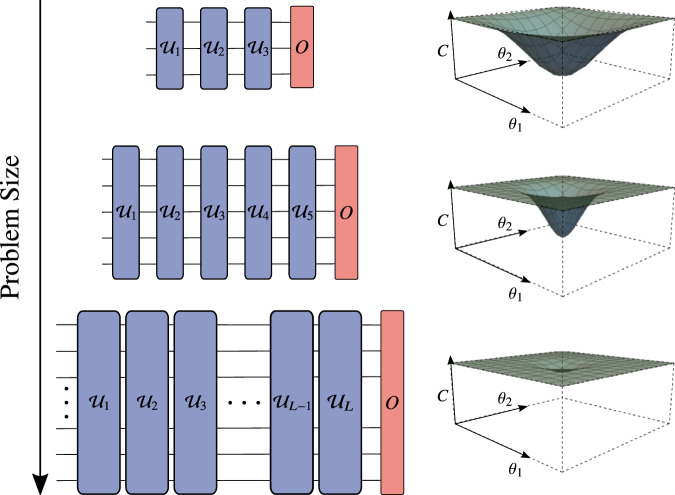
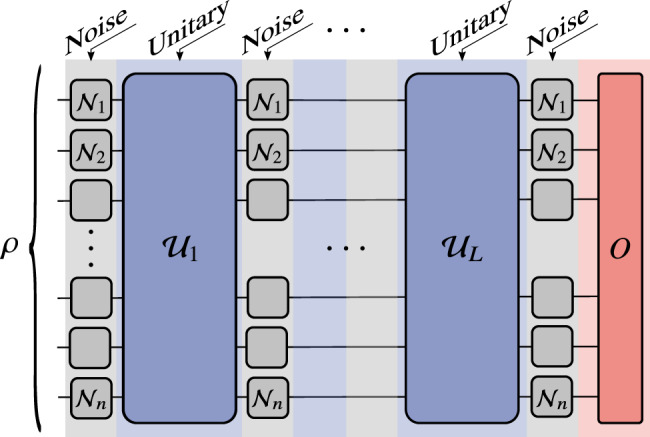
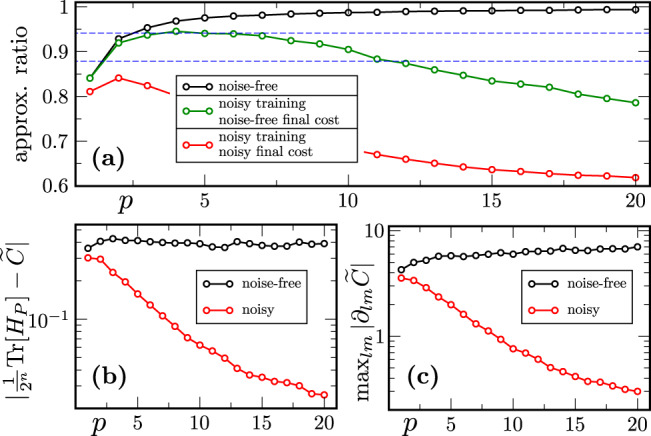
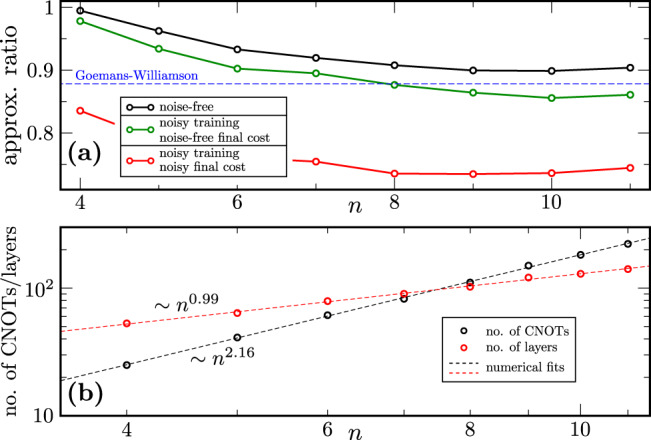
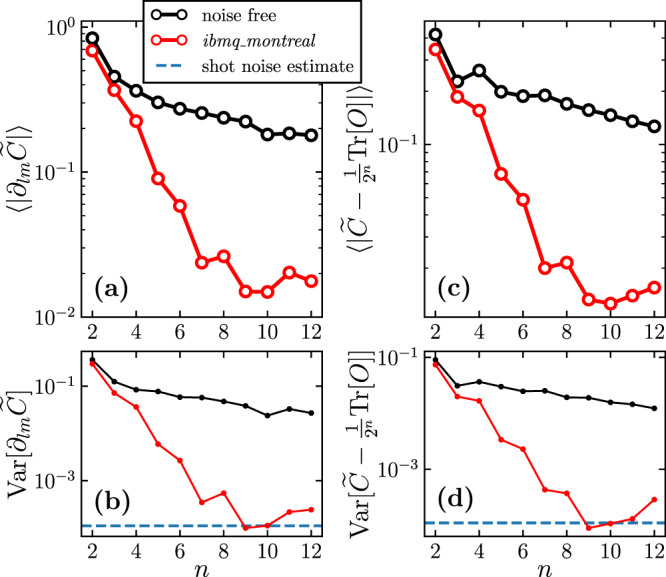
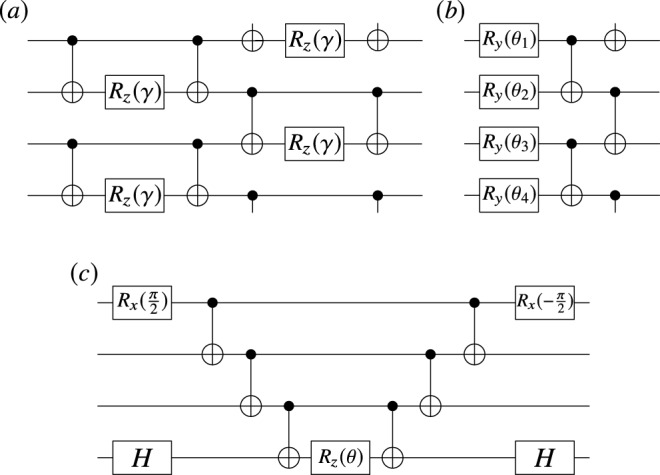
Variational Quantum Algorithms (VQAs) may be a path to quantum advantage on Noisy Intermediate-Scale Quantum (NISQ) computers. A natural question is whether noise on NISQ devices places fundamental limitations on VQA performance. We rigorously prove a serious limitation for noisy VQAs, in that the noise causes the training landscape to have a barren plateau (i.e., vanishing gradient). Specifically, for the local Pauli noise considered, we prove that the gradient vanishes exponentially in the number of qubits n if the depth of the ansatz grows linearly with n . These noise-induced barren plateaus (NIBPs) are conceptually different from noise-free barren plateaus, which are linked to random parameter initialization. Our result is formulated for a generic ansatz that includes as special cases the Quantum Alternating Operator Ansatz and the Unitary Coupled Cluster Ansatz, among others. For the former, our numerical heuristics demonstrate the NIBP phenomenon for a realistic hardware noise model.
Overview
The claims and statistics of this paper haven’t been checked yet.
Free: it reads the open-access text and checks the first 5 claims that cite a source we can check. Create a free account to check every claim.
Integrity signals
Registry
Cites
Statistics
Figures
Verification
Claims the paper makes
The claims and statistics of this paper haven’t been checked yet.
Free: it reads the open-access text and checks the first 5 claims that cite a source we can check. Create a free account to check every claim.
Claims other papers make about this one
Each is checked against this paper’s own text: does it say what the citing paper says it does?
The cited source says what the claim attributes to it.
In the citing paper
“Barren plateau landscapes correspond to gradients that vanish exponentially in the number of qubits.”
From Effect of barren plateaus on gradient-free optimization (2021) · cites this paper as [21]
In the citing paper
“However, we note that in general the scalability of real time angle-finding for a hybrid quantum-classical feedback loop is not clear for variational quantum algorithms, and in particular is expected to be quite hard especially with the presence of noise [57], [4].”
From High-Round QAOA for MAX $k$-SAT on Trapped Ion NISQ Devices (2023) · cites this paper as [57]
In the citing paper
“Second, it is challenging for the random parameters method to efficiently handle barren plateaus, while our method can address this issue by providing quasi-optimal initial guesses46.”
From Data-driven quantum approximate optimization algorithm for power systems (2023) · cites this paper as [46]
Self-check
Percentages, sums and reported differences re-computed from the paper’s own numbers.
The self-check needs the paper’s full text.
Citations
Cites
A Simplex Method for Function Minimization
Nelder, J. A., & Mead, R. (1965) · The Computer Journal · doi:10.1093/comjnl/7.4.308 · Cited by 28,905
Quantum Computation and Quantum Information
Nielsen, M. A., Chuang, I., & Grover, L. K. (2002) · American Journal of Physics · doi:10.1119/1.1463744 · Cited by 21,895
Quantum Computing in the NISQ era and beyond
Preskill, J. (2018) · Quantum · doi:10.22331/q-2018-08-06-79 · Cited by 8,830
Biamonte, J., Wittek, P., Pancotti, N., Rebentrost, P., Wiebe, N., & Lloyd, S. (2017) · Nature · doi:10.1038/nature23474 · Cited by 4,779 · cited 1×
“[59] Jacob Biamonte, Peter Wittek, Nicola Pancotti, Patrick Rebentrost, Nathan Wiebe, and Seth Lloyd, “Quantum machine learning,” Nature 549, 195–202 (2017).”
BackgroundA variational eigenvalue solver on a photonic quantum processor
Peruzzo, A., McClean, J., Shadbolt, P., Yung, M.-H., Zhou, X.-Q., Love, P. J., Aspuru-Guzik, A., & O’Brien, J. L. (2014) · Nature Communications · doi:10.1038/ncomms5213 · Cited by 4,552
Goemans, M. X., & Williamson, D. P. (1995) · Journal of the ACM · doi:10.1145/227683.227684 · Cited by 3,587
Variational quantum algorithms
Cerezo, M., Arrasmith, A., Babbush, R., Benjamin, S. C., Endo, S., Fujii, K., McClean, J. R., Mitarai, K., Yuan, X., Cincio, L., et al. (2021) · Nature Reviews Physics · doi:10.1038/s42254-021-00348-9 · Cited by 3,385 · cited 1×
“At the heart of this discussion are Variational Quantum Algorithms (VQAs), which are believed to be the best hope for near-term quantum advantage [2–4].”
BackgroundSelf-citationCoupled-cluster theory in quantum chemistry
Bartlett, R. J., & Musiał, M. (2007) · Reviews of Modern Physics · doi:10.1103/revmodphys.79.291 · Cited by 3,343
Hardware-efficient variational quantum eigensolver for small molecules and quantum magnets
Kandala, A., Mezzacapo, A., Temme, K., Takita, M., Brink, M., Chow, J. M., & Gambetta, J. M. (2017) · Nature · doi:10.1038/nature23879 · Cited by 2,982
Barren plateaus in quantum neural network training landscapes
McClean, J. R., Boixo, S., Smelyanskiy, V. N., Babbush, R., & Neven, H. (2018) · Nature Communications · doi:10.1038/s41467-018-07090-4 · Cited by 2,329
Research works printed but not linked: 4
- Bauer B Wecker D Millis AJ Hastings MB Troyer M Hybrid quantum-classical approach to correlated materials Phys. Rev. X 2016 6 031045
- Li Y Benjamin SC Efficient variational quantum simulator incorporating active error minimization Phys. Rev. X 2017 7 021050
- Wang Z Hadfield S Jiang Z Rieffel EG Quantum approximate optimization algorithm for maxcut: a fermionic view Phys. Rev. A 2018 97 022304 · DOI · Paper page
- Erdos P Renyi A On random graphs i Publ. math. Debr. 1959 6 18
Cited by
Variational quantum algorithms
Cerezo, M., Arrasmith, A., Babbush, R., Benjamin, S. C., Endo, S., Fujii, K., McClean, J. R., Mitarai, K., Yuan, X., Cincio, L., et al. (2021) · Nature Reviews Physics · doi:10.1038/s42254-021-00348-9 · Cited by 3,385
“[173, 174] it was also shown that in the presence of local Pauli noise, the cost landscape concentrated exponentially with the depth of the ansatz around the value of the cost associated with the maximally mixed state.”
BackgroundSelf-citationNoisy intermediate-scale quantum algorithms
Bharti, K., Cervera-Lierta, A., Kyaw, T. H., Haug, T., Alperin-Lea, S., Anand, A., Degroote, M., Heimonen, H., Kottmann, J. S., Menke, T., et al. (2022) · Reviews of Modern Physics · doi:10.1103/revmodphys.94.015004 · Cited by 2,231
The power of quantum neural networks
Abbas, A., Sutter, D., Zoufal, C., Lucchi, A., Figalli, A., & Woerner, S. (2021) · Nature Computational Science · doi:10.1038/s43588-021-00084-1 · Cited by 1,082
The Variational Quantum Eigensolver: A review of methods and best practices
Tilly, J., Chen, H., Cao, S., Picozzi, D., Setia, K., Li, Y., Grant, E., Wossnig, L., Rungger, I., Booth, G. H., et al. (2022) · Physics Reports · doi:10.1016/j.physrep.2022.08.003 · Cited by 1,031
Challenges and opportunities in quantum machine learning
Cerezo, M., Verdon, G., Huang, H.-Y., Cincio, L., & Coles, P. J. (2022) · Nature Computational Science · doi:10.1038/s43588-022-00311-3 · Cited by 689
Self-citationCai, Z., Babbush, R., Benjamin, S. C., Endo, S., Huggins, W. J., Li, Y., McClean, J. R., & O’Brien, T. E. (2023) · Reviews of Modern Physics · doi:10.1103/revmodphys.95.045005 · Cited by 591
Connecting Ansatz Expressibility to Gradient Magnitudes and Barren Plateaus
Holmes, Z., Sharma, K., Cerezo, M., & Coles, P. J. (2022) · PRX Quantum · doi:10.1103/prxquantum.3.010313 · Cited by 570
Self-citationHybrid Quantum-Classical Algorithms and Quantum Error Mitigation
Endo, S., Cai, Z., Benjamin, S. C., & Yuan, X. (2021) · Journal of the Physical Society of Japan · doi:10.7566/jpsj.90.032001 · Cited by 566
Generalization in quantum machine learning from few training data
Caro, M. C., Huang, H.-Y., Cerezo, M., Sharma, K., Sornborger, A., Cincio, L., & Coles, P. J. (2022) · Nature Communications · doi:10.1038/s41467-022-32550-3 · Cited by 476
Self-citationIntroduction to Haar Measure Tools in Quantum Information: A Beginner's Tutorial
Mele, A. A. (2024) · Quantum · doi:10.22331/q-2024-05-08-1340 · Cited by 476
A review on Quantum Approximate Optimization Algorithm and its variants
Blekos, K., Brand, D., Ceschini, A., Chou, C.-H., Li, R.-H., Pandya, K., & Summer, A. (2024) · Physics Reports · doi:10.1016/j.physrep.2024.03.002 · Cited by 408
Training Variational Quantum Algorithms Is NP-Hard
Bittel, L., & Kliesch, M. (2021) · Physical Review Letters · doi:10.1103/physrevlett.127.120502 · Cited by 398
Quantum Algorithms: A Survey of Applications and End-to-end Complexities
Dalzell, A. M., McArdle, S., Berta, M., Bienias, P., Chen, C.-F., Gilyén, A., Hann, C. T., Kastoryano, M. J., Khabiboulline, E. T., Kubica, A., et al. (2023) · RWTH Publications (RWTH Aachen) · doi:10.18154/rwth-2026-02888 · Cited by 363
Self-citationAbsence of Barren Plateaus in Quantum Convolutional Neural Networks
Pesah, A., Cerezo, M., Wang, S., Volkoff, T., Sornborger, A. T., & Coles, P. J. (2021) · Physical Review X · doi:10.1103/physrevx.11.041011 · Cited by 343
Self-citationAbsence of Barren Plateaus in Quantum Convolutional Neural Networks
Pesah, A., Cerezo, M., Wang, S., Volkoff, T., Sornborger, A. T., & Coles, P. J. (2020) · arXiv · doi:10.48550/arxiv.2011.02966 · Cited by 343
Self-citationFarrell, R. C., Illa, M., Ciavarella, A. N., & Savage, M. J. (2024) · PRX Quantum · doi:10.1103/prxquantum.5.020315 · Cited by 286
Barren plateaus in variational quantum computing
Larocca, M., Thanasilp, S., Wang, S., Sharma, K., Biamonte, J., Coles, P. J., Cincio, L., McClean, J. R., Holmes, Z., & Cerezo, M. (2025) · Nature Reviews Physics · doi:10.1038/s42254-025-00813-9 · Cited by 257
Self-citationEffect of barren plateaus on gradient-free optimization
Arrasmith, A., Cerezo, M., Czarnik, P., Cincio, L., & Coles, P. J. (2021) · Quantum · doi:10.22331/q-2021-10-05-558 · Cited by 248
“Finally, in [20] a noise-induced barren plateau mechanism was found.”
BackgroundSelf-citationQuantum simulations of hadron dynamics in the Schwinger model using 112 qubits
Farrell, R. C., Illa, M., Ciavarella, A. N., & Savage, M. J. (2024) · Physical review. D/Physical review. D. · doi:10.1103/physrevd.109.114510 · Cited by 247
Exploring Entanglement and Optimization within the Hamiltonian Variational Ansatz
Wiersema, R., Zhou, C., de Sereville, Y., Carrasquilla, J. F., Kim, Y. B., & Yuen, H. (2020) · PRX Quantum · doi:10.1103/prxquantum.1.020319 · Cited by 235
Characterizing barren plateaus in quantum ansätze with the adjoint representation
Fontana, E., Herman, D., Chakrabarti, S., Kumar, N., Yalovetzky, R., Heredge, J., Sureshbabu, S. H., & Pistoia, M. (2024) · Nature Communications · doi:10.1038/s41467-024-49910-w · Cited by 239
Self-citationTheory for Equivariant Quantum Neural Networks
Nguyen, Q. T., Schatzki, L., Braccia, P., Ragone, M., Coles, P. J., Sauvage, F., Larocca, M., & Cerezo, M. (2024) · PRX Quantum · doi:10.1103/prxquantum.5.020328 · Cited by 233
Self-citationMulti-angle quantum approximate optimization algorithm
Herrman, R., Lotshaw, P. C., Ostrowski, J., Humble, T. S., & Siopsis, G. (2022) · Scientific Reports · doi:10.1038/s41598-022-10555-8 · Cited by 224
Quantum Computing for High-Energy Physics: State of the Art and Challenges
Di Meglio, A., Jansen, K., Tavernelli, I., Alexandrou, C., Arunachalam, S., Bauer, C. W., Borras, K., Carrazza, S., Crippa, A., Croft, V., et al. (2024) · PRX Quantum · doi:10.1103/prxquantum.5.037001 · Cited by 215
“Finally, barren plateaus can be caused by quantum error processes washing out all landscape features, leading to noise-induced barren plateaus [317, 318].”
BackgroundDiagnosing Barren Plateaus with Tools from Quantum Optimal Control
Larocca, M., Czarnik, P., Sharma, K., Muraleedharan, G., Coles, P. J., & Cerezo, M. (2022) · Quantum · doi:10.22331/q-2022-09-29-824 · Cited by 214
Self-citationChen, S., Cotler, J. S., Huang, H.-Y., & Li, J. Z. (2023) · Nature Communications · doi:10.1038/s41467-023-41217-6 · Cited by 215
Hybrid quantum-classical algorithms in the noisy intermediate-scale quantum era and beyond
Callison, A., & Chancellor, N. (2022) · Physical Review A · doi:10.1103/physreva.106.010101 · Cited by 207
Challenges and opportunities in quantum optimization
Abbas, A., Ambainis, A., Augustino, B., Bärtschi, A., Buhrman, H., Coffrin, C., Cortiana, G., Dunjko, V., Egger, D. J., Elmegreen, B. G., et al. (2024) · Nature Reviews Physics · doi:10.1038/s42254-024-00770-9 · Cited by 201
Theoretical guarantees for permutation-equivariant quantum neural networks
Schatzki, L., Larocca, M., Nguyen, Q. T., Sauvage, F., & Cerezo, M. (2024) · npj Quantum Information · doi:10.1038/s41534-024-00804-1 · Cited by 199
Self-citationAvoiding Barren Plateaus Using Classical Shadows
Sack, S. H., Medina, R. A., Michailidis, A. A., Kueng, R., & Serbyn, M. (2022) · PRX Quantum · doi:10.1103/prxquantum.3.020365 · Cited by 195
Efficient Measure for the Expressivity of Variational Quantum Algorithms
Du, Y., Tu, Z., Yuan, X., & Tao, D. (2022) · Physical Review Letters · doi:10.1103/physrevlett.128.080506 · Cited by 194
Quantum agents in the Gym: a variational quantum algorithm for deep Q-learning
Skolik, A., Jerbi, S., & Dunjko, V. (2022) · Quantum · doi:10.22331/q-2022-05-24-720 · Cited by 191
“[42] Samson Wang, Enrico Fontana, Marco Cerezo, Kunal Sharma, Akira Sone, Lukasz Cincio, and Patrick J Coles.”
BackgroundExponential concentration in quantum kernel methods
Thanasilp, S., Wang, S., Cerezo, M., & Holmes, Z. (2024) · Nature Communications · doi:10.1038/s41467-024-49287-w · Cited by 189
“28.”
Self-citationA comprehensive review of quantum machine learning: from NISQ to fault tolerance
Wang, Y., & Liu, J. (2024) · Reports on Progress in Physics · doi:10.1088/1361-6633/ad7f69 · Cited by 192
On the practical usefulness of the Hardware Efficient Ansatz
Leone, L., Oliviero, S. F. E., Cincio, Ł., & Cerezo, M. (2024) · Quantum · doi:10.22331/q-2024-07-03-1395 · Cited by 189
Self-citationQuantum circuit architecture search for variational quantum algorithms
Du, Y., Huang, T., You, S., Hsieh, M.-H., & Tao, D. (2022) · npj Quantum Information · doi:10.1038/s41534-022-00570-y · Cited by 184
“[24] Samson Wang, Enrico Fontana, Marco Cerezo, Kunal Sharma, Akira Sone, Lukasz Cincio, et al.”
BackgroundQuantum machine learning: from physics to software engineering
Melnikov, A. A., Kordzanganeh, M., Alodjants, A. P., & Lee, R. (2023) · Advances in Physics X · doi:10.1080/23746149.2023.2165452 · Cited by 182
Theory of overparametrization in quantum neural networks
Larocca, M., Ju, N., García-Martín, D., Coles, P. J., & Cerezo, M. (2023) · Nature Computational Science · doi:10.1038/s43588-023-00467-6 · Cited by 176
“[Fμ(θ)]ij G 4 ∑ m≠ψμ Re[⟨ψμ|| ̃ Hi |m⟩ ⟨m| ̃ Hj ||ψμ⟩] (19)”
Self-citationSynergistic pretraining of parametrized quantum circuits via tensor networks
Rudolph, M. S., Miller, J., Motlagh, D., Chen, J., Acharya, A., & Perdomo‐Ortiz, A. (2023) · Nature Communications · doi:10.1038/s41467-023-43908-6 · Cited by 174
Quantum Krylov subspace algorithms for ground- and excited-state energy estimation
Cortes, C. L., & Gray, S. K. (2022) · Physical Review A · doi:10.1103/physreva.105.022417 · Cited by 175
NISQ computing: where are we and where do we go?
Lau, J. W. Z., Lim, K. H., Shrotriya, H., & Kwek, L. C. (2022) · AAPPS Bulletin · doi:10.1007/s43673-022-00058-z · Cited by 173
“This problem is further compounded by the noise and errors in NISQ quantum computers [55].”
BackgroundEscaping from the Barren Plateau Via Gaussian Initializations in Deep Variational Quantum Circuits
Zhang, K., Liu, L., Hsieh, M.-H., & Tao, D. (2022) · neural information processing systems · doi:10.52202/068431-1352 · Cited by 173
A Lie algebraic theory of barren plateaus for deep parameterized quantum circuits
Ragone, M., Bakalov, B. N., Sauvage, F., Kemper, A. F., Ortiz Marrero, C., Larocca, M., & Cerezo, M. (2024) · Nature Communications · doi:10.1038/s41467-024-49909-3 · Cited by 167
“Hardware noise further exacerbates these issues 38 – 40 .”
Self-citationNoisy intermediate-scale quantum (NISQ) algorithms
Bharti, K., Cervera-Lierta, A., Kyaw, T. H., Haug, T., Alperin-Lea, S., Anand, A., Degroote, M., Heimonen, H., Kottmann, J. S., Menke, T., et al. (2021) · arXiv · doi:10.48550/arxiv.2101.08448 · Cited by 166
Understanding quantum machine learning also requires rethinking generalization
Gil-Fuster, E., Eisert, J., & Bravo-Prieto, C. (2024) · Nature Communications · doi:10.1038/s41467-024-45882-z · Cited by 169
Fundamental limits of quantum error mitigation
Takagi, R., Endo, S., Minagawa, S., & Gu, M. (2022) · npj Quantum Information · doi:10.1038/s41534-022-00618-z · Cited by 160
“, p̂ 1⁄4 p̂ð1Þ p̂ðKÞ and q̂ 1⁄4 q̂ð1Þ q̂ðKÞ , it holds that: DLMðp̂; q̂Þ 1⁄4 Dtrðp̂; q̂Þ: (25)”
Trainability of Dissipative Perceptron-Based Quantum Neural Networks
Sharma, K., Cerezo, M., Cincio, L., & Coles, P. J. (2022) · Physical Review Letters · doi:10.1103/physrevlett.128.180505 · Cited by 159
Self-citationOut-of-distribution generalization for learning quantum dynamics
Caro, M. C., Huang, H.-Y., Ezzell, N., Gibbs, J., Sornborger, A. T., Cincio, Ł., Coles, P. J., & Holmes, Z. (2023) · Nature Communications · doi:10.1038/s41467-023-39381-w · Cited by 159
Self-citationQuantum computing models for artificial neural networks
Mangini, S., Tacchino, F., Gerace, D., Bajoni, D., & Macchiavello, C. (2021) · Europhysics Letters (EPL) · doi:10.1209/0295-5075/134/10002 · Cited by 159
Limitations of Variational Quantum Algorithms: A Quantum Optimal Transport Approach
Palma, G. D., Marvian, M., Rouzé, C., & França, D. S. (2023) · PRX Quantum · doi:10.1103/prxquantum.4.010309 · Cited by 154
Entanglement devised barren plateau mitigation
Patti, T. L., Najafi, K., Gao, X., & Yelin, S. F. (2021) · Physical Review Research · doi:10.1103/physrevresearch.3.033090 · Cited by 148
Quantum Algorithms: A Survey of Applications and End-to-end Complexities
Dalzell, A. M., McArdle, S., Berta, M., Bienias, P., Chen, C.-F., Gilyén, A., Hann, C. T., Kastoryano, M. J., Khabiboulline, E. T., Kubica, A., et al. (2025) · Cambridge University Press eBooks · doi:10.1017/9781009639651 · Cited by 147
Self-citationQubit-excitation-based adaptive variational quantum eigensolver
(2021) · doi:10.1038/s42005-021-00730-0 · Cited by 145
Iterative qubit-excitation based variational quantum eigensolver
Yordanov, Y., Armaos, V., Barnes, C., & Arvidsson-Shukur, D. (2021) · doi:10.21203/rs.3.rs-404173/v1 · Cited by 145
Large gradients via correlation in random parameterized quantum circuits
Volkoff, T., & Coles, P. J. (2021) · Quantum Science and Technology · doi:10.1088/2058-9565/abd891 · Cited by 143
“In fact, a recent analysis of cost functions for a large class of noisy RPQCs (e.g., noisy QAOA) indicate the appearance of BPL for noisy circuit depths scaling at least linearly in n with a noise-dependent coefficient [48].”
Self-citationSubtleties in the trainability of quantum machine learning models
Thanasilp, S., Wang, S., Nghiem, N. A., Coles, P. J., & Cerezo, M. (2023) · Quantum Machine Intelligence · doi:10.1007/s42484-023-00103-6 · Cited by 143
Self-citationHuang, H.-L., Xu, X., Guo, C., Tian, G., Wei, S.-J., Sun, X., Bao, W., & Long, G. (2023) · Science China Physics Mechanics and Astronomy · doi:10.1007/s11433-022-2057-y · Cited by 145
Random Quantum Circuits Transform Local Noise into Global White Noise
Dalzell, A. M., Hunter-Jones, N., & Brandão, F. G. S. L. (2024) · Communications in Mathematical Physics · doi:10.1007/s00220-024-04958-z · Cited by 141
Hamiltonian variational ansatz without barren plateaus
Park, C.-Y., & Killoran, N. (2024) · Quantum · doi:10.22331/q-2024-02-01-1239 · Cited by 141
Classical simulations of noisy variational quantum circuits
Fontana, E., Rudolph, M. S., Duncan, R., Rungger, I., & Cîrstoiu, C. (2025) · npj Quantum Information · doi:10.1038/s41534-024-00955-1 · Cited by 143
Self-citationUniversal Sampling Lower Bounds for Quantum Error Mitigation
Takagi, R., Tajima, H., & Gu, M. (2023) · Physical Review Letters · doi:10.1103/physrevlett.131.210602 · Cited by 140
Machine learning for anomaly detection in particle physics
Belis, V., Odagiu, P., & Aarrestad, T. K. (2024) · Reviews in Physics · doi:10.1016/j.revip.2024.100091 · Cited by 138
Equivalence of quantum barren plateaus to cost concentration and narrow gorges
Arrasmith, A., Holmes, Z., Cerezo, M., & Coles, P. J. (2022) · Quantum Science and Technology · doi:10.1088/2058-9565/ac7d06 · Cited by 137
Self-citationArtificial intelligence for quantum computing
Alexeev, Y., Farag, M. H., Patti, T. L., Wolf, M. E., Ares, N., Aspuru‐Guzik, A., Benjamin, S. C., Cai, Z., Cao, S., Chamberland, C., et al. (2025) · Nature Communications · doi:10.1038/s41467-025-65836-3 · Cited by 140
Recent advances for quantum classifiers
Li, W., & Deng, D.-L. (2021) · Science China Physics Mechanics and Astronomy · doi:10.1007/s11433-021-1793-6 · Cited by 137
Unified approach to data-driven quantum error mitigation
Lowe, A., Gordon, M. H., Czarnik, P., Arrasmith, A., Coles, P. J., & Cincio, Ł. (2021) · Physical Review Research · doi:10.1103/physrevresearch.3.033098 · Cited by 136
Self-citationGujju, Y., Matsuo, A., & Raymond, R. (2024) · Physical Review Applied · doi:10.1103/physrevapplied.21.067001 · Cited by 138
Matrix product state pre-training for quantum machine learning
Dborin, J., Barratt, F., Wimalaweera, V., Wright, L., & Green, A. G. (2022) · Quantum Science and Technology · doi:10.1088/2058-9565/ac7073 · Cited by 130
Analyzing the barren plateau phenomenon in training quantum neural networks with the ZX-calculus
Zhao, C., & Gao, X.-S. (2021) · Quantum · doi:10.22331/q-2021-06-04-466 · Cited by 130
Can Error Mitigation Improve Trainability of Noisy Variational Quantum Algorithms?
Wang, S., Czarnik, P., Arrasmith, A., Cerezo, M., Cincio, Ł., & Coles, P. J. (2024) · Quantum · doi:10.22331/q-2024-03-14-1287 · Cited by 133
Self-citationCapacity and Quantum Geometry of Parametrized Quantum Circuits
Haug, T., Bharti, K., & Kim, M. S. (2021) · PRX Quantum · doi:10.1103/prxquantum.2.040309 · Cited by 127
Barren Plateaus Preclude Learning Scramblers
Holmes, Z., Arrasmith, A., Yan, B., Coles, P. J., Albrecht, A., & Sornborger, A. T. (2021) · Physical Review Letters · doi:10.1103/physrevlett.126.190501 · Cited by 125
“[45] Samson Wang, Enrico Fontana, M Cerezo, Kunal Sharma, Akira Sone, Lukasz Cincio, and Patrick J Coles, “Noise-induced barren plateaus in variational quantum algorithms,” arXiv preprint arXiv:2007.”
BackgroundSelf-citationGeneralization despite overfitting in quantum machine learning models
Peters, E., & Schuld, M. (2023) · Quantum · doi:10.22331/q-2023-12-20-1210 · Cited by 125
Barren plateaus preclude learning scramblers
Holmes, Z., Arrasmith, A., Yan, B., Coles, P. J., Albrecht, A., & Sornborger, A. T. (2020) · arXiv · doi:10.48550/arxiv.2009.14808 · Cited by 125
Self-citationQuantum Simulation with Hybrid Tensor Networks
Yuan, X., Sun, J., Liu, J., Zhao, Q., & Zhou, Y. (2021) · Physical Review Letters · doi:10.1103/physrevlett.127.040501 · Cited by 124
Evaluating the noise resilience of variational quantum algorithms
Fontana, E., Fitzpatrick, N., Ramo, D. M., Duncan, R., & Rungger, I. (2021) · Physical Review A · doi:10.1103/physreva.104.022403 · Cited by 122
Self-citationBest practices for portfolio optimization by quantum computing, experimented on real quantum devices
Buonaiuto, G., Gargiulo, F., Pietro, G. D., Esposito, M., & Pota, M. (2023) · Scientific Reports · doi:10.1038/s41598-023-45392-w · Cited by 121
Higher order derivatives of quantum neural networks with barren plateaus
Cerezo, M., & Coles, P. J. (2021) · Quantum Science and Technology · doi:10.1088/2058-9565/abf51a · Cited by 118
Self-citationVariational quantum algorithm for estimating the quantum Fisher information
Beckey, J. L., Cerezo, M., Sone, A., & Coles, P. J. (2022) · Physical Review Research · doi:10.1103/physrevresearch.4.013083 · Cited by 118
Self-citationConstraint Preserving Mixers for the Quantum Approximate Optimization Algorithm
Fuchs, F. G., Lye, K. O., Nilsen, H. M., Stasik, A. J., & Sartor, G. (2022) · Algorithms · doi:10.3390/a15060202 · Cited by 121
Wiersema, R., Kökcü, E., Kemper, A. F., & Bakalov, B. (2024) · npj Quantum Information · doi:10.1038/s41534-024-00900-2 · Cited by 122
Trainability barriers and opportunities in quantum generative modeling
Rudolph, M. S., Lerch, S., Thanasilp, S., Kiss, O., Shaya, O., Vallecorsa, S., Grossi, M., & Holmes, Z. (2024) · npj Quantum Information · doi:10.1038/s41534-024-00902-0 · Cited by 120
Genetic algorithms as classical optimizer for the Quantum Approximate Optimization Algorithm
Acampora, G., Chiatto, A., & Vitiello, A. (2023) · Applied Soft Computing · doi:10.1016/j.asoc.2023.110296 · Cited by 116
Equivariant quantum circuits for learning on weighted graphs
Skolik, A., Cattelan, M., Yarkoni, S., Bäck, T., & Dunjko, V. (2023) · npj Quantum Information · doi:10.1038/s41534-023-00710-y · Cited by 120
Experimental quantum computational chemistry with optimized unitary coupled cluster ansatz
Guo, S., Sun, J., Qian, H., Gong, M., Zhang, Y., Chen, F., Ye, Y., Wu, Y., Cao, S., Liu, K., et al. (2024) · Nature Physics · doi:10.1038/s41567-024-02530-z · Cited by 117
Self-citationGenerative Quantum Machine Learning via Denoising Diffusion Probabilistic Models
Zhang, B., Xu, P., Chen, X., & Zhuang, Q. (2024) · Physical Review Letters · doi:10.1103/physrevlett.132.100602 · Cited by 116
Variational quantum eigensolver with reduced circuit complexity
Zhang, Y., Cincio, Ł., Negre, C. F. A., Czarnik, P., Coles, P. J., Anisimov, P. M., Mniszewski, S. M., Tretiak, S., & Dub, P. A. (2022) · npj Quantum Information · doi:10.1038/s41534-022-00599-z · Cited by 112
Self-citationDoes provable absence of barren plateaus imply classical simulability?
Cerezo, M., Larocca, M., García-Martín, D., Diaz, N. L., Braccia, P., Fontana, E., Rudolph, M. S., Bermejo, P., Ijaz, A., Thanasilp, S., et al. (2025) · Nature Communications · doi:10.1038/s41467-025-63099-6 · Cited by 110
Self-citationQiao, C., Li, M., Liu, Y., & Tian, Z. (2024) · IEEE Communications Surveys & Tutorials · doi:10.1109/comst.2024.3399612 · Cited by 113
On quantum backpropagation, information reuse, and cheating measurement collapse
Abbas, A., King, R., Huang, H.-Y., Huggins, W. J., Movassagh, R., Gilboa, D., & McClean, J. R. (2023) · neural information processing systems · doi:10.52202/075280-1940 · Cited by 109
Benchmarking the performance of portfolio optimization with QAOA
Brandhofer, S., Braun, D., Dehn, V., Hellstern, G., Hüls, M., Ji, Y., Polian, I., Bhatia, A. S., & Wellens, T. (2022) · Quantum Information Processing · doi:10.1007/s11128-022-03766-5 · Cited by 106
“These effects impair the ability of the classical optimization algorithms to converge to the global minimum of the expectation value, eventually leading to a noise-induced barren plateau that incurs an exponential runtime overhead [22].”
BackgroundCervera-Lierta, A., Kottmann, J. S., & Aspuru‐Guzik, A. (2021) · PRX Quantum · doi:10.1103/prxquantum.2.020329 · Cited by 109
Anomaly detection with variational quantum generative adversarial networks
Herr, D., Obert, B., & Rosenkranz, M. (2021) · Quantum Science and Technology · doi:10.1088/2058-9565/ac0d4d · Cited by 105
Barren plateaus in quantum tensor network optimization
Cervero-Martín, E., Plekhanov, K., & Lubasch, M. (2023) · Quantum · doi:10.22331/q-2023-04-13-974 · Cited by 106
Showcasing a Barren Plateau Theory Beyond the Dynamical Lie AlgebraPreprint
Diaz, N. L., García-Martín, D., Kazi, S., Larocca, M., & Cerezo, M. (2023) · arXiv (Cornell University) · doi:10.48550/arxiv.2310.11505 · Cited by 104
Self-citationOverlapped grouping measurement: A unified framework for measuring quantum states
Wu, B., Sun, J., Huang, Q. J., & Yuan, X. (2023) · Quantum · doi:10.22331/q-2023-01-13-896 · Cited by 106
Learning quantum data with the quantum earth mover’s distance
Kiani, B. T., Palma, G. D., Marvian, M., Liu, Z.-W., & Lloyd, S. (2022) · Quantum Science and Technology · doi:10.1088/2058-9565/ac79c9 · Cited by 103
Learning Shallow Quantum Circuits
Huang, H.-Y., Liu, Y., Broughton, M., Kim, I. H., Anshu, A., Landau, Z. A., & McClean, J. R. (2024) · ACM Symposium on Theory of Computing (STOC) · doi:10.1145/3618260.3649722 · Cited by 101
Simulating Noisy Variational Quantum Algorithms: A Polynomial Approach
Shao, Y., Wei, F., Cheng, S., & Liu, Z. (2024) · Physical Review Letters · doi:10.1103/physrevlett.133.120603 · Cited by 102
Hybrid Oscillator-Qubit Quantum Processors: Simulating Fermions, Bosons, and Gauge Fields
Crane, E., Smith, K. C., Tomesh, T., Eickbusch, A., Martyn, J. M., Kühn, S., Funcke, L., DeMarco, M. A., Chuang, I. L., Wiebe, N., et al. (2026) · Physical Review X · doi:10.1103/s5bn-z4jq · Cited by 100
Metadata
- Authors
- Wang, S., Fontana, E., Cerezo, M., Sharma, K., Sone, A., Cincio, L., & Coles, P. J.
- Affiliations
- Los Alamos National Laboratory (US)
- Louisiana State University (US)
- Corresponding author
- Wang, Samson
- Cerezo, M.
- Coles, Patrick J.
- Venue
- Nature Communications
- Published
- 2021-11-29
- Volume
- 12
- Issue
- 1
- Pages
- 6961-6961
- ISSN
- 2041-1723 (ISSN-L)
- PMC
- PMC8630047
- OpenAlex
- W3045606049
- Semantic Scholar
- a7da6cf3820d94f250349d658a09004a36b14ff0
- Cited by
- 773
- References
- 115
- Citations by year
- 2026: 150 · 2025: 163 · 2024: 168 · 2023: 135 · 2022: 102 · 2021: 52
- FWCI
- 40.22
- Type
- journal article
- Language
- en
- Open access
- gold
- doi.org
- Licence
- cc-by
- creativecommons.org/licenses/by/4.0 (tdm)
- creativecommons.org/licenses/by/4.0 (vor)
- Locations
- Nature Communications (publishedVersion, cc-by)
- PubMed Central (publishedVersion, cc-by)
- PubMed (publishedVersion)
- Strathprints: The University of Strathclyde institutional repository (University of Strathclyde) (acceptedVersion)
- arXiv (Cornell University) (submittedVersion)
- RePEc: Research Papers in Economics (submittedVersion)
- DOAJ (DOAJ: Directory of Open Access Journals) (submittedVersion, cc-by-sa)
- OSTI OAI (U.S. Department of Energy Office of Scientific and Technical Information) (submittedVersion)
- arXiv (Cornell University)
- Bulletin of the American Physical Society
- Funders
- U.S. Department of Energy
- RCUK | Engineering and Physical Sciences Research Council
- Topics
- Physical Sciences › Computer Science › Artificial Intelligence › Quantum Computing Algorithms and Architecture
- Physical Sciences › Physics and Astronomy › Atomic and Molecular Physics, and Optics › Quantum many-body systems
- Physical Sciences › Physics and Astronomy › Atomic and Molecular Physics, and Optics › Quantum Information and Cryptography
- Keywords
- barren plateaus, variational quantum algorithms, NISQ devices, gradient vanishing, Quantum Alternating Operator Ansatz, unitary coupled cluster ansatz, quantum advantage
About these checks
Registry, retraction, Cites and statistics results are computed, not judged, with one exception: a printed reference that no index lists is read once by a model before it counts as a citation error. Claims are extracted by a model and kept only when their quote appears verbatim in the text; each cited source is then checked, with a model’s help, for whether it says what the claim relies on. Those verdicts can be wrong — read the claim’s quote and the cited source before relying on one.
Statistics and arithmetic are recomputed, not judged.
Confidence bands are shown only for fields calibrated on our annotated test set. None is calibrated yet, so no band is shown.
What counts as a claim ›How we measure confidence ›How we check this ›
Are you an author, or do you see a problem with this page? Request a review
Data sources
Bibliographic data: Semantic Scholar, OpenAlex, Crossref.
Contains information from the Semantic Scholar Academic Graph Datasets, made available under the ODC Attribution License (ODC-BY 1.0).
Semantic Scholar’s data is described in: Kinney, R., et al. (2023). The Semantic Scholar Open Data Platform. arXiv:2301.10140.
