

Noise-induced barren plateaus in variational quantum algorithms
Open accessThe DOI matches its Crossref record; 120 of the 120 references it cites were found in a registry or an index.
Abstract
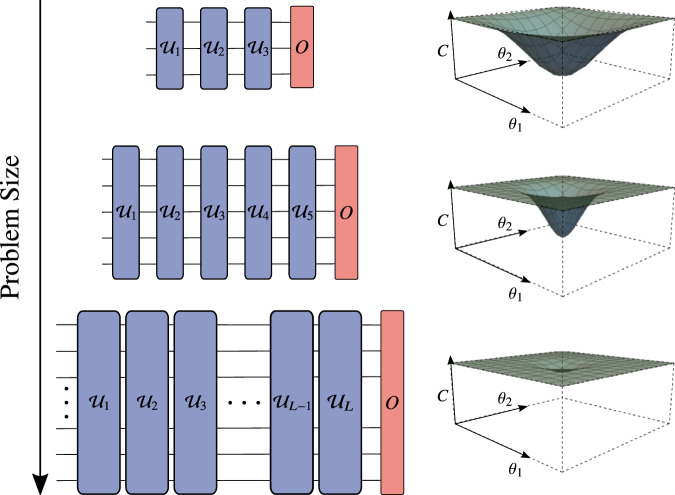
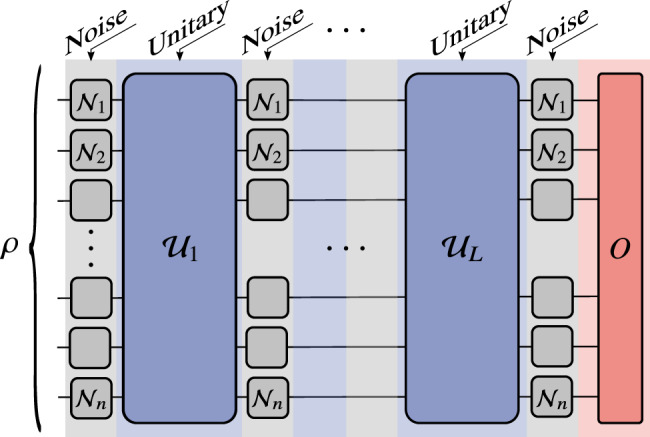
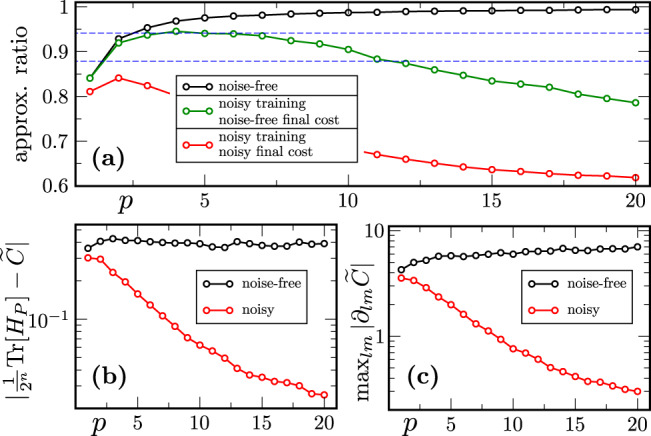
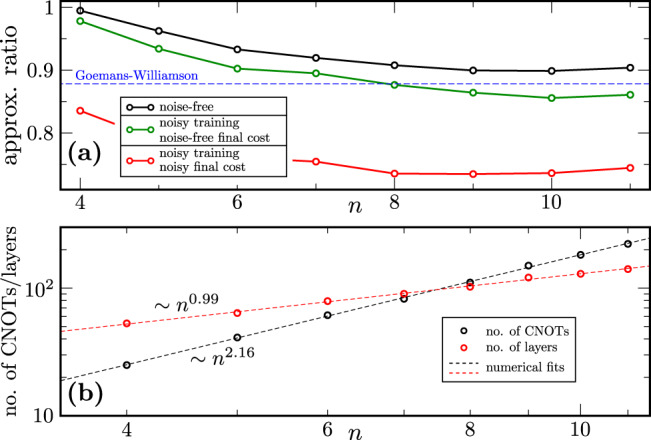
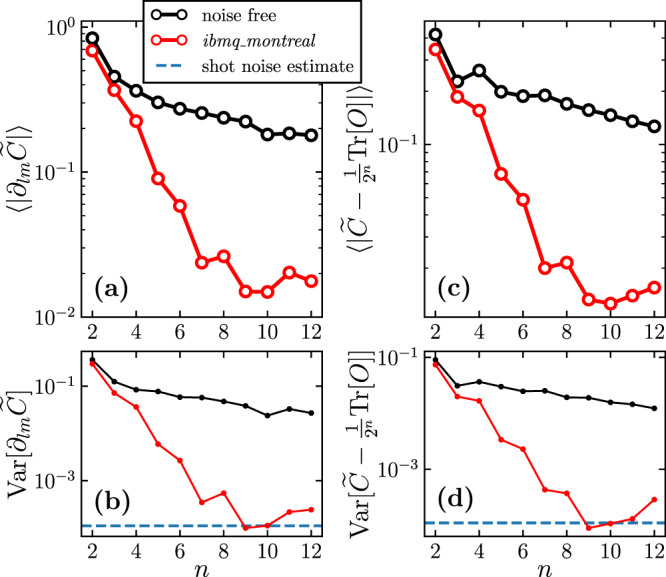
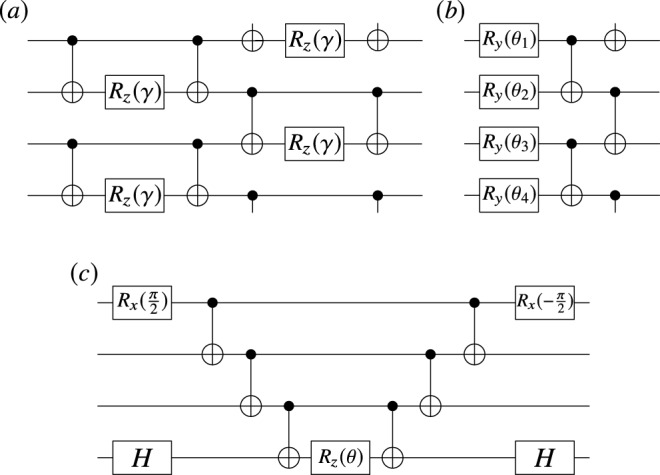
Variational Quantum Algorithms (VQAs) may be a path to quantum advantage on Noisy Intermediate-Scale Quantum (NISQ) computers. A natural question is whether noise on NISQ devices places fundamental limitations on VQA performance. We rigorously prove a serious limitation for noisy VQAs, in that the noise causes the training landscape to have a barren plateau (i.e., vanishing gradient). Specifically, for the local Pauli noise considered, we prove that the gradient vanishes exponentially in the number of qubits n if the depth of the ansatz grows linearly with n . These noise-induced barren plateaus (NIBPs) are conceptually different from noise-free barren plateaus, which are linked to random parameter initialization. Our result is formulated for a generic ansatz that includes as special cases the Quantum Alternating Operator Ansatz and the Unitary Coupled Cluster Ansatz, among others. For the former, our numerical heuristics demonstrate the NIBP phenomenon for a realistic hardware noise model.
Overview
The claims and statistics of this paper haven’t been checked yet.
Free: it reads the open-access text and checks the first 5 claims that cite a source we can check. Create a free account to check every claim.
Integrity signals
Registry
Cites
Statistics
Figures
Verification
Claims the paper makes
The claims and statistics of this paper haven’t been checked yet.
Free: it reads the open-access text and checks the first 5 claims that cite a source we can check. Create a free account to check every claim.
Claims other papers make about this one
Each is checked against this paper’s own text: does it say what the citing paper says it does?
The cited source says what the claim attributes to it.
In the citing paper
“Barren plateau landscapes correspond to gradients that vanish exponentially in the number of qubits.”
From Effect of barren plateaus on gradient-free optimization (2021) · cites this paper as [21]
In the citing paper
“However, we note that in general the scalability of real time angle-finding for a hybrid quantum-classical feedback loop is not clear for variational quantum algorithms, and in particular is expected to be quite hard especially with the presence of noise [57], [4].”
From High-Round QAOA for MAX $k$-SAT on Trapped Ion NISQ Devices (2023) · cites this paper as [57]
In the citing paper
“Second, it is challenging for the random parameters method to efficiently handle barren plateaus, while our method can address this issue by providing quasi-optimal initial guesses46.”
From Data-driven quantum approximate optimization algorithm for power systems (2023) · cites this paper as [46]
Self-check
Percentages, sums and reported differences re-computed from the paper’s own numbers.
The self-check needs the paper’s full text.
Citations
Cites
A Simplex Method for Function Minimization
Nelder, J. A., & Mead, R. (1965) · The Computer Journal · doi:10.1093/comjnl/7.4.308 · Cited by 28,905
Quantum Computation and Quantum Information
Nielsen, M. A., Chuang, I., & Grover, L. K. (2002) · American Journal of Physics · doi:10.1119/1.1463744 · Cited by 21,895
Quantum Computing in the NISQ era and beyond
Preskill, J. (2018) · Quantum · doi:10.22331/q-2018-08-06-79 · Cited by 8,830
Biamonte, J., Wittek, P., Pancotti, N., Rebentrost, P., Wiebe, N., & Lloyd, S. (2017) · Nature · doi:10.1038/nature23474 · Cited by 4,779 · cited 1×
“[59] Jacob Biamonte, Peter Wittek, Nicola Pancotti, Patrick Rebentrost, Nathan Wiebe, and Seth Lloyd, “Quantum machine learning,” Nature 549, 195–202 (2017).”
BackgroundA variational eigenvalue solver on a photonic quantum processor
Peruzzo, A., McClean, J., Shadbolt, P., Yung, M.-H., Zhou, X.-Q., Love, P. J., Aspuru-Guzik, A., & O’Brien, J. L. (2014) · Nature Communications · doi:10.1038/ncomms5213 · Cited by 4,552
Goemans, M. X., & Williamson, D. P. (1995) · Journal of the ACM · doi:10.1145/227683.227684 · Cited by 3,587
Variational quantum algorithms
Cerezo, M., Arrasmith, A., Babbush, R., Benjamin, S. C., Endo, S., Fujii, K., McClean, J. R., Mitarai, K., Yuan, X., Cincio, L., et al. (2021) · Nature Reviews Physics · doi:10.1038/s42254-021-00348-9 · Cited by 3,385 · cited 1×
“At the heart of this discussion are Variational Quantum Algorithms (VQAs), which are believed to be the best hope for near-term quantum advantage [2–4].”
BackgroundSelf-citationCoupled-cluster theory in quantum chemistry
Bartlett, R. J., & Musiał, M. (2007) · Reviews of Modern Physics · doi:10.1103/revmodphys.79.291 · Cited by 3,343
Hardware-efficient variational quantum eigensolver for small molecules and quantum magnets
Kandala, A., Mezzacapo, A., Temme, K., Takita, M., Brink, M., Chow, J. M., & Gambetta, J. M. (2017) · Nature · doi:10.1038/nature23879 · Cited by 2,982
Barren plateaus in quantum neural network training landscapes
McClean, J. R., Boixo, S., Smelyanskiy, V. N., Babbush, R., & Neven, H. (2018) · Nature Communications · doi:10.1038/s41467-018-07090-4 · Cited by 2,329
Research works printed but not linked: 4
- Bauer B Wecker D Millis AJ Hastings MB Troyer M Hybrid quantum-classical approach to correlated materials Phys. Rev. X 2016 6 031045
- Li Y Benjamin SC Efficient variational quantum simulator incorporating active error minimization Phys. Rev. X 2017 7 021050
- Wang Z Hadfield S Jiang Z Rieffel EG Quantum approximate optimization algorithm for maxcut: a fermionic view Phys. Rev. A 2018 97 022304 · DOI · Paper page
- Erdos P Renyi A On random graphs i Publ. math. Debr. 1959 6 18
Cited by
Items 301–400 of 1,010
Sommers, G. M., Huse, D. A., & Gullans, M. J. (2023) · PRX Quantum · doi:10.1103/prxquantum.4.030313 · Cited by 33
Pulse-efficient quantum machine learning
Melo, A., Earnest, N., & Tacchino, F. (2023) · Quantum · doi:10.22331/q-2023-10-09-1130 · Cited by 34
Efficient ground-state-energy estimation and certification on early fault-tolerant quantum computers
Wang, G., França, D. S., Rendon, G., & Johnson, P. D. (2025) · Physical Review A · doi:10.1103/physreva.111.012426 · Cited by 33
Beer, K. (2022) · Institutional Repository of Leibniz Universität Hannover (Leibniz Universität Hannover) · doi:10.15488/11896 · Cited by 33
Symmetric Pruning in Quantum Neural NetworksPreprint
Wang, X., Liu, J., Liu, T., Luo, Y., Du, Y., & Tao, D. (2022) · arXiv (Cornell University) · doi:10.48550/arxiv.2208.14057 · Cited by 33
Non-trivial symmetries in quantum landscapes and their resilience to quantum noise
Fontana, E., Cerezo, M., Arrasmith, A., Rungger, I., & Coles, P. J. (2020) · arXiv · doi:10.48550/arxiv.2011.08763 · Cited by 32
“Hardware noise is expected to modify the cost landscape, and indeed it was recently shown to produce a novel kind of barren plateau whose impact increases with PQC depth [32].”
BackgroundSelf-citationDynamical mean field theory for real materials on a quantum computer
Selisko, J., Amsler, M., Wever, C., Kawashima, Y., Samsonidze, G. G., Haq, R. U., Tacchino, F., Tavernelli, I., & Eckl, T. (2025) · npj Computational Materials · doi:10.1038/s41524-025-01772-6 · Cited by 33
Evaluation of Parameterized Quantum Circuits With Cross-Resonance Pulse-Driven Entanglers
Ibrahim, M. M. A., Mohammadbagherpoor, H., Rios, C., Bronn, N. T., & Byrd, G. T. (2022) · IEEE Transactions on Quantum Engineering · doi:10.1109/tqe.2022.3231124 · Cited by 32
Sequential optimal selections of single-qubit gates in parameterized quantum circuits
Wada, K., Raymond, R., Sato, Y., & Watanabe, H. C. (2024) · Quantum Science and Technology · doi:10.1088/2058-9565/ad4583 · Cited by 32
Improving the efficiency of learning-based error mitigation
Czarnik, P., McKerns, M. M., Sornborger, A. T., & Cincio, Ł. (2025) · Quantum · doi:10.22331/q-2025-05-05-1727 · Cited by 33
A Primer on Quantum Machine LearningPreprint
Chang, S. Y., & Cerezo, M. (2025) · arXiv · doi:10.48550/arxiv.2511.15969 · Cited by 33
Self-citationSimulating noisy variational quantum eigensolver with local noise models
Zeng, J., Wu, Z., Cao, C., Zhang, C., Hou, S., Xu, P., & Zeng, B. (2021) · Quantum Engineering · doi:10.1002/que2.77 · Cited by 32
Enhancing the expressivity of quantum neural networks with residual connections
Wen, J., Huang, Z., Cai, D., & Qian, L. (2024) · Communications Physics · doi:10.1038/s42005-024-01719-1 · Cited by 31
Maciejewski, F. B., Hadfield, S., Hall, B., Hodson, M. J., Dupont, M., Evert, B., Sud, J., Alam, M. S., Wang, Z., Jeffrey, S., et al. (2024) · Physical Review Applied · doi:10.1103/physrevapplied.22.044074 · Cited by 32
A Primer on Security of Quantum Computing Hardware
Ghosh, S., Upadhyay, S., & Saki, A. A. (2025) · Proceedings of the IEEE · doi:10.1109/jproc.2025.3630989 · Cited by 31
Buonaiuto, G., Gargiulo, F., Pietro, G. D., Esposito, M., & Pota, M. (2024) · Quantum Machine Intelligence · doi:10.1007/s42484-024-00144-5 · Cited by 30
Exploiting many-body localization for scalable variational quantum simulation
Cao, C., Zhou, Y., Tannu, S., Shannon, N., & Joynt, R. (2025) · Quantum · doi:10.22331/q-2025-12-12-1942 · Cited by 31
Hassan, S. S., Khan, L. U., Park, Y. M., Guizani, M., Han, Z., Ratnarajah, T., & Hong, C. S. (2025) · IEEE Communications Surveys & Tutorials · doi:10.1109/comst.2025.3610357 · Cited by 31
Avoiding barren plateaus via Gaussian mixture model
Shi, X., & Shang, Y. (2025) · New Journal of Physics · doi:10.1088/1367-2630/ae0823 · Cited by 31
Measurement-induced entanglement phase transitions in variational quantum circuits
Wiersema, R., Zhou, C., Carrasquilla, J., & Kim, Y. B. (2023) · SciPost Physics · doi:10.21468/scipostphys.14.6.147 · Cited by 30
Unsupervised quantum circuit learning in high energy physics
Delgado, A., & Hamilton, K. E. (2022) · Physical review. D/Physical review. D. · doi:10.1103/physrevd.106.096006 · Cited by 30
Retrieving information from a black hole using quantum machine learning
Leone, L., Oliviero, S. F. E., Piemontese, S., True, S., & Hamma, A. (2022) · Physical Review A · doi:10.1103/physreva.106.062434 · Cited by 30
A duplication-free quantum neural network for universal approximation
Hou, X., Zhou, G., Li, Q., Jin, S., & Wang, X. (2023) · Science China Physics Mechanics and Astronomy · doi:10.1007/s11433-023-2098-8 · Cited by 30
Quantum Kernel Alignment with Stochastic Gradient Descent
Gentinetta, G., Sutter, D., Zoufal, C., Fuller, B., & Woerner, S. (2023) · IEEE International Conference on Quantum Computing and Engineering (QCE) · doi:10.1109/qce57702.2023.00036 · Cited by 30
Extending the variational quantum eigensolver to finite temperatures
Selisko, J., Amsler, M., Hammerschmidt, T., Drautz, R., & Eckl, T. (2023) · Quantum Science and Technology · doi:10.1088/2058-9565/ad1340 · Cited by 31
On the universality of Sn-equivariant k-body gates
Kazi, S., Larocca, M., & Cerezo, M. (2024) · New Journal of Physics · doi:10.1088/1367-2630/ad4819 · Cited by 30
Self-citationShen, Y., Camps, D., Szasz, A., Darbha, S., Klymko, K., Williams‐Young, D. B., Tubman, N. M., & Beeumen, R. V. (2025) · Quantum · doi:10.22331/q-2025-08-27-1836 · Cited by 30
Abedi, E., Beigi, S., & Taghavi, L. (2023) · Quantum · doi:10.22331/q-2023-04-27-989 · Cited by 29
Distributed quantum information processing: a review of recent progress
Knörzer, J., Liu, X., Schiffer, B. F., & Tura, J. (2026) · Reports on Progress in Physics · doi:10.1088/1361-6633/ae74e0 · Cited by 29
QMLP: An Error-Tolerant Nonlinear Quantum MLP Architecture using Parameterized Two-Qubit Gates
Chu, C., Chia, N.-H., Jiang, L., & Chen, F. (2022) · International Symposium on Low Power Electronics and Design (ISLPED) · doi:10.1145/3531437.3539719 · Cited by 29
Inference-Based Quantum Sensing
Alderete, C. H., Gordon, M. H., Sauvage, F., Sone, A., Sornborger, A. T., Coles, P. J., & Cerezo, M. (2022) · Physical Review Letters · doi:10.1103/physrevlett.129.190501 · Cited by 29
Self-citationMarcantonio, F. D., Incudini, M., Tezza, D., & Grossi, M. (2023) · Quantum Machine Intelligence · doi:10.1007/s42484-023-00107-2 · Cited by 29
Huang, Y., Shao, Y., Ren, W., Sun, J., & Lv, D. (2023) · Journal of Chemical Theory and Computation · doi:10.1021/acs.jctc.3c00071 · Cited by 29
The battle of clean and dirty qubits in the era of partial error correction
Bultrini, D., Wang, S., Czarnik, P., Gordon, M. H., Cerezo, M., Coles, P. J., & Cincio, Ł. (2023) · Quantum · doi:10.22331/q-2023-07-13-1060 · Cited by 29
Self-citationKashif, M., & Al-Kuwari, S. M. (2023) · International Journal of Parallel Emergent and Distributed Systems · doi:10.1080/17445760.2023.2231163 · Cited by 29
Randomized adaptive quantum state preparation
Magann, A. B., Economou, S. E., & Arenz, C. (2023) · Physical Review Research · doi:10.1103/physrevresearch.5.033227 · Cited by 29
Globally Optimizing QAOA Circuit Depth for Constrained Optimization Problems
Herrman, R., Treffert, L., Ostrowski, J., Lotshaw, P. C., Humble, T. S., & Siopsis, G. (2021) · Algorithms · doi:10.3390/a14100294 · Cited by 30
Fitzek, D., Jonsson, R., Dobrautz, W., & Schäfer, C. (2024) · Quantum · doi:10.22331/q-2024-04-09-1313 · Cited by 29
QNEAT: Natural Evolution of Variational Quantum Circuit Architecture
Giovagnoli, A., Tresp, V., Ma, Y., & Schubert, M. (2023) · Genetic and Evolutionary Computation Conference Companion (GECCO Companion) · doi:10.1145/3583133.3590675 · Cited by 28
Quantum Algorithm for Estimating Largest Eigenvalues
Nghiem, N. A., & Wei, T.-C. (2023) · Physics Letters A · doi:10.1016/j.physleta.2023.129138 · Cited by 28
Performance analysis of multi-angle QAOA for $$p > 1$$
Gaidai, I., & Herrman, R. (2024) · Scientific Reports · doi:10.1038/s41598-024-69643-6 · Cited by 28
Quantum Computing Through the Lens of Control: A Tutorial Introduction
Berberich, J., & Fink, D. (2024) · IEEE Control Systems · doi:10.1109/mcs.2024.3466448 · Cited by 30
Where are we heading with NISQ?Preprint
Ezratty, O. (2023) · arXiv (Cornell University) · doi:10.48550/arxiv.2305.09518 · Cited by 28
A Hybrid Quantum-Classical Generative Adversarial Network for Near-Term Quantum Processors
Boyle, A. O., & Nikandish, G. (2024) · IEEE Access · doi:10.1109/access.2024.3433383 · Cited by 27
A Unified Theory of Quantum Neural Network Loss Landscapes
Anschuetz, E. R. (2025) · International Conference on Learning Representations · doi:10.48550/arxiv.2408.11901 · Cited by 27
A systematic variational approach to band theory in a quantum computer
Sherbert, K., Cerasoli, F., & Nardelli, M. B. (2021) · RSC Advances · doi:10.1039/d1ra07451b · Cited by 28
Conditional Born machine for Monte Carlo event generation
Kiss, O., Grossi, M., Kajomovitz, E., & Vallecorsa, S. (2022) · Physical Review A · doi:10.1103/physreva.106.022612 · Cited by 28
Quantum Simulations of Fermionic Hamiltonians with Efficient Encoding and Ansatz Schemes
Huang, B., Sheng, N., Govoni, M., & Galli, G. (2023) · Journal of Chemical Theory and Computation · doi:10.1021/acs.jctc.2c01119 · Cited by 27
Solution of SAT problems with the adaptive-bias quantum approximate optimization algorithm
Yu, Y., Cao, C., Wang, X., Shannon, N., & Joynt, R. (2023) · Physical Review Research · doi:10.1103/physrevresearch.5.023147 · Cited by 27
Isometric tensor network optimization for extensive Hamiltonians is free of barren plateaus
Miao, Q., & Barthel, T. (2024) · Physical Review A · doi:10.1103/physreva.109.l050402 · Cited by 27
Dissipative Variational Quantum Algorithms for Gibbs State Preparation
Ilin, Y., & Arad, I. (2024) · IEEE Transactions on Quantum Engineering · doi:10.1109/tqe.2024.3511419 · Cited by 27
Artificial intelligence and blockchain for quantum satellites and UAV-based communications: a review
Kumar, A., Awad, A. I., Sharma, G., Krishnamurthi, R., Jain, S., Srikanth, P., Sharma, K., Hedabou, M., & Sood, S. (2025) · Quantum Machine Intelligence · doi:10.1007/s42484-025-00271-7 · Cited by 27
Self-citationSennane, W., Piquemal, J., & Rančić, M. J. (2023) · Physical Review A · doi:10.1103/physreva.107.012416 · Cited by 27
Variational quantum algorithms for machine learning: theory and applicationsPreprint
Mangini, S. (2023) · arXiv (Cornell University) · doi:10.48550/arxiv.2306.09984 · Cited by 27
MLQAOA: Graph Learning Accelerated Hybrid Quantum-Classical Multilevel QAOA
Bach, B., Falla, J., & Safro, I. (2024) · IEEE International Conference on Quantum Computing and Engineering (QCE) · doi:10.1109/qce60285.2024.00072 · Cited by 26
Trade-off between gradient measurement efficiency and expressivity in deep quantum neural networks
Chinzei, K., Yamano, S., Tran, Q. H., Endo, Y., & Oshima, H. (2025) · npj Quantum Information · doi:10.1038/s41534-025-01036-7 · Cited by 26
Smart, S. E., & Mazziotti, D. A. (2022) · Journal of Chemical Theory and Computation · doi:10.1021/acs.jctc.2c00446 · Cited by 26
Mitigating algorithmic errors in quantum optimization through energy extrapolation
Cao, C., Yu, Y., Wu, Z., Shannon, N., Zeng, B., & Joynt, R. (2022) · Quantum Science and Technology · doi:10.1088/2058-9565/ac969c · Cited by 26
Dynamical mean-field theory for the Hubbard-Holstein model on a quantum device
Backes, S., Murakami, Y., 酒井, 志., & Arita, R. (2023) · Physical review. B./Physical review. B · doi:10.1103/physrevb.107.165155 · Cited by 26
Depth analysis of variational quantum algorithms for the heat equation
Guseynov, N., Zhukov, A. A., Pogosov, W. V., & Lebedev, A. V. (2023) · Physical Review A · doi:10.1103/physreva.107.052422 · Cited by 26
Quantum dropout: On and over the hardness of quantum approximate optimization algorithm
Wang, Z., Zheng, P.-L., Wu, B., & Zhang, Y. (2023) · Physical Review Research · doi:10.1103/physrevresearch.5.023171 · Cited by 26
Variational quantum metrology for multiparameter estimation under dephasing noise
Le, T. K., Nguyen, H. Q., & Ho, L. B. (2023) · Scientific Reports · doi:10.1038/s41598-023-44786-0 · Cited by 26
A general framework for differentially private quantum measurements
Angrisani, A., Doosti, M., & Kashefi, E. (2026) · ACM Transactions on Quantum Computing · doi:10.1145/3842143 · Cited by 25
Entanglement diagnostics for efficient VQA optimization
Kim, J., & Oz, Y. (2022) · Journal of Statistical Mechanics Theory and Experiment · doi:10.1088/1742-5468/ac7791 · Cited by 26
Potential Applications of Quantum Computing at Los Alamos National LaboratoryPreprint
Bärtschi, A., Caravelli, F., Coffrin, C., Colina, J., Eidenbenz, S., Jayakumar, A., Kirmani, A. A., Lawrence, S., Lee, M., Lokhov, A. Y., et al. (2024) · arXiv (Cornell University) · doi:10.48550/arxiv.2406.06625 · Cited by 28
A Survey of Quantum Transformers: Architectures, Challenges and OutlooksPreprint
Zhang, H., Zhao, Q., Zhou, M., Feng, L., Niyato, D. T., Zheng, S., & Chen, L. (2025) · arXiv (Cornell University) · doi:10.48550/arxiv.2504.03192 · Cited by 26
Solving lattice gauge theories using the quantum Krylov algorithm and qubitization
Anderson, L. W., Kiffner, M., O’Leary, T., Crain, J. N., & Jaksch, D. (2025) · Quantum · doi:10.22331/q-2025-03-25-1669 · Cited by 25
Köcher, N., Rose, H., Bharadwaj, S. S., Schumacher, J., & Schumacher, S. (2025) · Scientific Reports · doi:10.1038/s41598-025-05660-3 · Cited by 26
Error-Mitigation-Aided Optimization of Parameterized Quantum Circuits: Convergence Analysis
Jose, S. T., & Simeone, O. (2022) · IEEE Transactions on Quantum Engineering · doi:10.1109/tqe.2022.3229747 · Cited by 26
Characterization of variational quantum algorithms using free fermions
Matos, G., Self, C. N., Papić, Z., Meichanetzidis, K., & Dreyer, H. (2023) · Quantum · doi:10.22331/q-2023-03-30-966 · Cited by 25
Quantum neural network cost function concentration dependency on the parametrization expressivity
Friedrich, L., & Maziero, J. (2023) · Scientific Reports · doi:10.1038/s41598-023-37003-5 · Cited by 25
Mitigated barren plateaus in the time-nonlocal optimization of analog quantum-algorithm protocols
Broers, L., & Mathey, L. (2024) · Physical Review Research · doi:10.1103/physrevresearch.6.013076 · Cited by 25
Crippa, A., Romiti, S., Funcke, L., Jansen, K., Kühn, S., Stornati, P., & Urbach, C. (2025) · Communications Physics · doi:10.1038/s42005-025-02243-6 · Cited by 25
Efficient Quantum Optimization via Dynamical Simulation
Çatlı, A. B., Simon, S., & Wiebe, N. (2026) · PRX Quantum · doi:10.1103/t59v-8flk · Cited by 25
SnCQA: A hardware-efficient equivariant quantum convolutional circuit architecture
Zheng, H., Kang, C., Ravi, G. S., Wang, H., Setia, K., Chong, F. T., & Liu, J. (2023) · IEEE International Conference on Quantum Computing and Engineering (QCE) · doi:10.1109/qce57702.2023.00034 · Cited by 25
Quantum-classical hybrid neural networks in the neural tangent kernel regime
Nakaji, K., Tezuka, H., & Yamamoto, N. (2023) · Quantum Science and Technology · doi:10.1088/2058-9565/ad133e · Cited by 25
Quantum Local Differential Privacy and Quantum Statistical Query ModelPreprint
Angrisani, A., & Kashefi, E. (2022) · arXiv (Cornell University) · doi:10.48550/arxiv.2203.03591 · Cited by 24
Quantum Multiple Kernel Learning in Financial Classification TasksPreprint
Miyabe, S., Quanz, B., Shimada, N., Mitra, A., Yamamoto, T., Rastunkov, V., Alevras, D., Metcalf, M., King, D. J. M., Mamouei, M., et al. (2023) · arXiv · doi:10.48550/arxiv.2312.00260 · Cited by 25
Quantum computing critical exponents
Dreyer, H., Bejan, M., & Granet, E. (2021) · Physical Review A · doi:10.1103/physreva.104.062614 · Cited by 24
Simulating Static and Dynamic Properties of Magnetic Molecules with Prototype Quantum Computers
Crippa, L., Tacchino, F., Chizzini, M., Aita, A., Grossi, M., Chiesa, A., Santini, P. M., Tavernelli, I., & Carretta, S. (2021) · Magnetochemistry · doi:10.3390/magnetochemistry7080117 · Cited by 24
Analyzing variational quantum landscapes with information content
Pérez-Salinas, A., Wang, H., & Bonet-Monroig, X. (2024) · npj Quantum Information · doi:10.1038/s41534-024-00819-8 · Cited by 25
Large-scale simulations of Floquet physics on near-term quantum computers
Eckstein, T., Mansuroglu, R., Czarnik, P., Zhu, J., Hartmann, M. J., Cincio, Ł., Sornborger, A. T., & Holmes, Z. (2024) · npj Quantum Information · doi:10.1038/s41534-024-00866-1 · Cited by 24
Limitations of noisy quantum devices in computing and entangling power
Yan, Y., Du, Z., Chen, J., & Ma, X. (2025) · npj Quantum Information · doi:10.1038/s41534-025-01136-4 · Cited by 25
Markov chain Monte Carlo enhanced variational quantum algorithms
Patti, T. L., Shehab, O., Najafi, K., & Yelin, S. F. (2022) · Quantum Science and Technology · doi:10.1088/2058-9565/aca821 · Cited by 24
Approximate Quantum Circuit Reconstruction
Chen, D., Baheri, B., Chaudhary, V., Guan, Q., Xie, N., & Xu, S. (2022) · IEEE International Conference on Quantum Computing and Engineering (QCE) · doi:10.1109/qce53715.2022.00073 · Cited by 24
Accelerating Variational Quantum Algorithms Using Circuit ConcurrencyPreprint
Resch, S., Gutierrez, A., Huh, J. S., Bharadwaj, S., Eckert, Y., Loh, G. H., Oskin, M., & Tannu, S. (2021) · arXiv (Cornell University) · doi:10.48550/arxiv.2109.01714 · Cited by 24
Quantum algorithms for SVD-based data representation and analysis
Bellante, A., Luongo, A., & Zanero, S. (2022) · Quantum Machine Intelligence · doi:10.1007/s42484-022-00076-y · Cited by 24
Simulations of frustrated Ising Hamiltonians using quantum approximate optimization
Lotshaw, P. C., Xu, H., Khalid, B., Buchs, G., Humble, T. S., & Banerjee, A. (2022) · Philosophical Transactions of the Royal Society A Mathematical Physical and Engineering Sciences · doi:10.1098/rsta.2021.0414 · Cited by 23
HQNET: Harnessing Quantum Noise for Effective Training of Quantum Neural Networks in NISQ Era
Kashif, M., & Shafique, M. (2025) · IEEE International Conference on Quantum Artificial Intelligence (QAI) · doi:10.1109/qai63978.2025.00066 · Cited by 23
Iterative layerwise training for the quantum approximate optimization algorithm
Lee, X., Yan, X., Xie, N., Cai, D., Saito, Y., & Asai, N. (2024) · Physical Review A · doi:10.1103/physreva.109.052406 · Cited by 25
Fast-forwarding with NISQ processors without feedback loop
Lim, K. H., Haug, T., Kwek, L. C., & Bharti, K. (2021) · Quantum Science and Technology · doi:10.1088/2058-9565/ac2e52 · Cited by 23
Fair Sampling Error Analysis on NISQ Devices
Golden, J. K., Bärtschi, A., O’Malley, D., & Eidenbenz, S. (2022) · ACM Transactions on Quantum Computing · doi:10.1145/3510857 · Cited by 23
Quantum-assisted Monte Carlo algorithms for fermions
Xu, X., & Li, Y. (2023) · Quantum · doi:10.22331/q-2023-08-03-1072 · Cited by 23
Role of scrambling and noise in temporal information processing with quantum systemsPreprint
Xiong, W., Holmes, Z., Angrisani, A., Suzuki, Y., Chotibut, T., & Thanasilp, S. (2025) · arXiv (Cornell University) · doi:10.48550/arxiv.2505.10080 · Cited by 24
A quantum computing concept for 1-D elastic wave simulation with exponential speedup
Schade, M., Bösch, C., Hapla, V., & Fichtner, A. (2024) · Geophysical Journal International · doi:10.1093/gji/ggae160 · Cited by 22
Training variational quantum algorithms with random gate activation
Liu, S., Zhang, S., Jian, S.-K., & Yao, H. (2023) · Physical Review Research · doi:10.1103/physrevresearch.5.l032040 · Cited by 22
Problem-specific classical optimization of Hamiltonian simulation
Mansuroglu, R., Fischer, F., & Hartmann, M. J. (2023) · Physical Review Research · doi:10.1103/physrevresearch.5.043035 · Cited by 22
Parameter-setting heuristic for the quantum alternating operator ansatz
Sud, J., Hadfield, S., Rieffel, E. G., Tubman, N. M., & Hogg, T. (2024) · Physical Review Research · doi:10.1103/physrevresearch.6.023171 · Cited by 22
Energy-dependent barren plateau in bosonic variational quantum circuits
Zhang, B., & Zhuang, Q. (2024) · Quantum Science and Technology · doi:10.1088/2058-9565/ad80bf · Cited by 22
Cadavid, A. G., Montalban, I., Dalal, A., Solano, E., & Hegade, N. N. (2024) · Physical Review Applied · doi:10.1103/physrevapplied.22.054037 · Cited by 22
Metadata
- Authors
- Wang, S., Fontana, E., Cerezo, M., Sharma, K., Sone, A., Cincio, L., & Coles, P. J.
- Affiliations
- Los Alamos National Laboratory (US)
- Louisiana State University (US)
- Corresponding author
- Wang, Samson
- Cerezo, M.
- Coles, Patrick J.
- Venue
- Nature Communications
- Published
- 2021-11-29
- Volume
- 12
- Issue
- 1
- Pages
- 6961-6961
- ISSN
- 2041-1723 (ISSN-L)
- PMC
- PMC8630047
- OpenAlex
- W3045606049
- Semantic Scholar
- a7da6cf3820d94f250349d658a09004a36b14ff0
- Cited by
- 773
- References
- 115
- Citations by year
- 2026: 150 · 2025: 163 · 2024: 168 · 2023: 135 · 2022: 102 · 2021: 52
- FWCI
- 40.22
- Type
- journal article
- Language
- en
- Open access
- gold
- doi.org
- Licence
- cc-by
- creativecommons.org/licenses/by/4.0 (tdm)
- creativecommons.org/licenses/by/4.0 (vor)
- Locations
- Nature Communications (publishedVersion, cc-by)
- PubMed Central (publishedVersion, cc-by)
- PubMed (publishedVersion)
- Strathprints: The University of Strathclyde institutional repository (University of Strathclyde) (acceptedVersion)
- arXiv (Cornell University) (submittedVersion)
- RePEc: Research Papers in Economics (submittedVersion)
- DOAJ (DOAJ: Directory of Open Access Journals) (submittedVersion, cc-by-sa)
- OSTI OAI (U.S. Department of Energy Office of Scientific and Technical Information) (submittedVersion)
- arXiv (Cornell University)
- Bulletin of the American Physical Society
- Funders
- U.S. Department of Energy
- RCUK | Engineering and Physical Sciences Research Council
- Topics
- Physical Sciences › Computer Science › Artificial Intelligence › Quantum Computing Algorithms and Architecture
- Physical Sciences › Physics and Astronomy › Atomic and Molecular Physics, and Optics › Quantum many-body systems
- Physical Sciences › Physics and Astronomy › Atomic and Molecular Physics, and Optics › Quantum Information and Cryptography
- Keywords
- barren plateaus, variational quantum algorithms, NISQ devices, gradient vanishing, Quantum Alternating Operator Ansatz, unitary coupled cluster ansatz, quantum advantage
About these checks
Registry, retraction, Cites and statistics results are computed, not judged, with one exception: a printed reference that no index lists is read once by a model before it counts as a citation error. Claims are extracted by a model and kept only when their quote appears verbatim in the text; each cited source is then checked, with a model’s help, for whether it says what the claim relies on. Those verdicts can be wrong — read the claim’s quote and the cited source before relying on one.
Statistics and arithmetic are recomputed, not judged.
Confidence bands are shown only for fields calibrated on our annotated test set. None is calibrated yet, so no band is shown.
What counts as a claim ›How we measure confidence ›How we check this ›
Are you an author, or do you see a problem with this page? Request a review
Data sources
Bibliographic data: Semantic Scholar, OpenAlex, Crossref.
Contains information from the Semantic Scholar Academic Graph Datasets, made available under the ODC Attribution License (ODC-BY 1.0).
Semantic Scholar’s data is described in: Kinney, R., et al. (2023). The Semantic Scholar Open Data Platform. arXiv:2301.10140.
