

Noise-induced barren plateaus in variational quantum algorithms
Open accessThe DOI matches its Crossref record; 120 of the 120 references it cites were found in a registry or an index.
Abstract
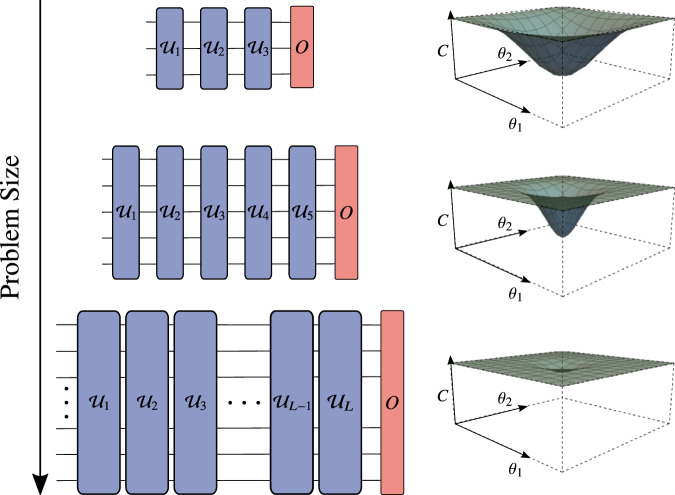
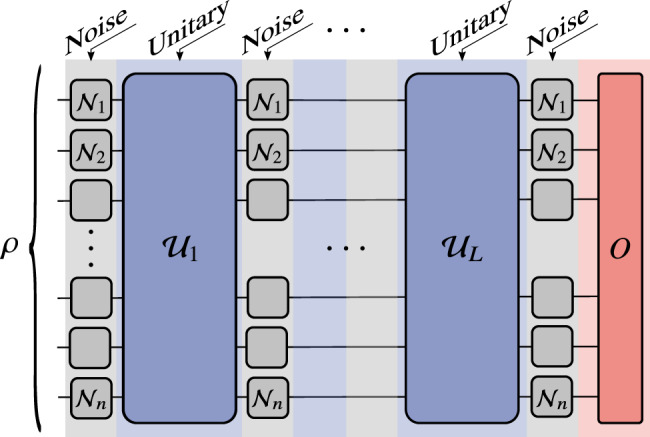
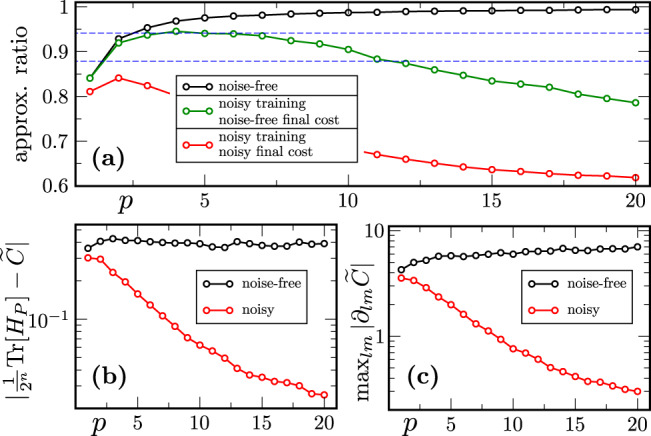
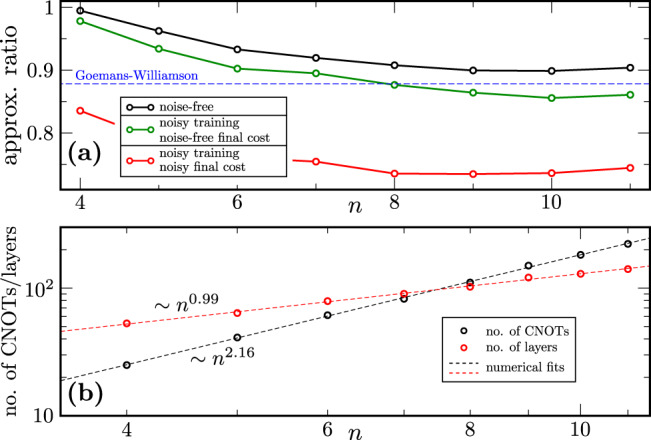
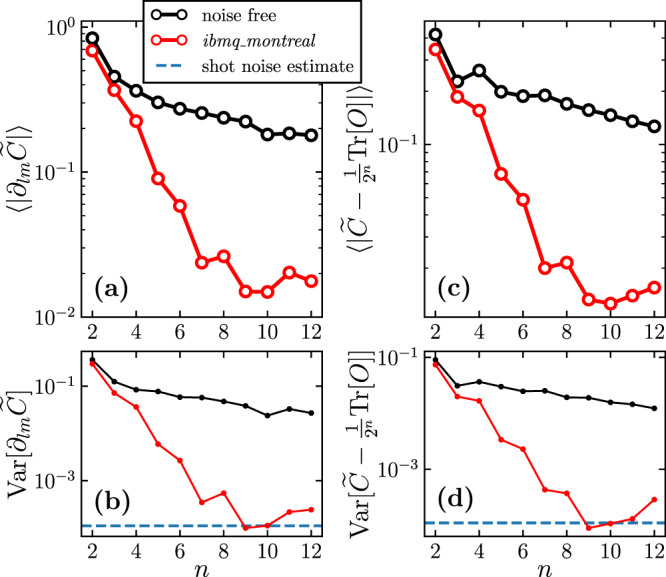
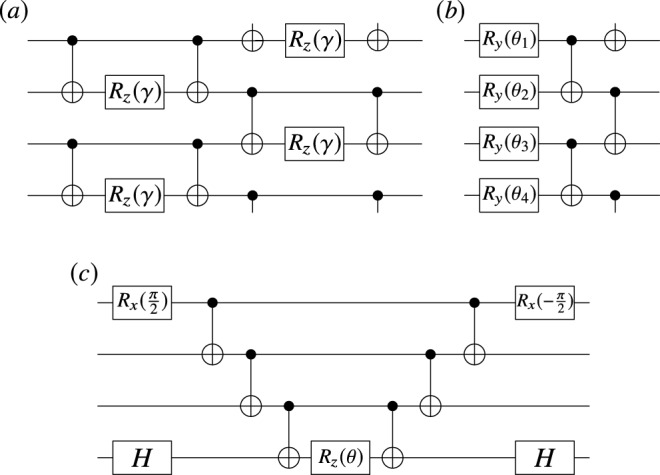
Variational Quantum Algorithms (VQAs) may be a path to quantum advantage on Noisy Intermediate-Scale Quantum (NISQ) computers. A natural question is whether noise on NISQ devices places fundamental limitations on VQA performance. We rigorously prove a serious limitation for noisy VQAs, in that the noise causes the training landscape to have a barren plateau (i.e., vanishing gradient). Specifically, for the local Pauli noise considered, we prove that the gradient vanishes exponentially in the number of qubits n if the depth of the ansatz grows linearly with n . These noise-induced barren plateaus (NIBPs) are conceptually different from noise-free barren plateaus, which are linked to random parameter initialization. Our result is formulated for a generic ansatz that includes as special cases the Quantum Alternating Operator Ansatz and the Unitary Coupled Cluster Ansatz, among others. For the former, our numerical heuristics demonstrate the NIBP phenomenon for a realistic hardware noise model.
Overview
The claims and statistics of this paper haven’t been checked yet.
Free: it reads the open-access text and checks the first 5 claims that cite a source we can check. Create a free account to check every claim.
Integrity signals
Registry
Cites
Statistics
Figures
Verification
Claims the paper makes
The claims and statistics of this paper haven’t been checked yet.
Free: it reads the open-access text and checks the first 5 claims that cite a source we can check. Create a free account to check every claim.
Claims other papers make about this one
Each is checked against this paper’s own text: does it say what the citing paper says it does?
The cited source says what the claim attributes to it.
In the citing paper
“Barren plateau landscapes correspond to gradients that vanish exponentially in the number of qubits.”
From Effect of barren plateaus on gradient-free optimization (2021) · cites this paper as [21]
In the citing paper
“However, we note that in general the scalability of real time angle-finding for a hybrid quantum-classical feedback loop is not clear for variational quantum algorithms, and in particular is expected to be quite hard especially with the presence of noise [57], [4].”
From High-Round QAOA for MAX $k$-SAT on Trapped Ion NISQ Devices (2023) · cites this paper as [57]
In the citing paper
“Second, it is challenging for the random parameters method to efficiently handle barren plateaus, while our method can address this issue by providing quasi-optimal initial guesses46.”
From Data-driven quantum approximate optimization algorithm for power systems (2023) · cites this paper as [46]
Self-check
Percentages, sums and reported differences re-computed from the paper’s own numbers.
The self-check needs the paper’s full text.
Citations
Cites
A Simplex Method for Function Minimization
Nelder, J. A., & Mead, R. (1965) · The Computer Journal · doi:10.1093/comjnl/7.4.308 · Cited by 28,905
Quantum Computation and Quantum Information
Nielsen, M. A., Chuang, I., & Grover, L. K. (2002) · American Journal of Physics · doi:10.1119/1.1463744 · Cited by 21,895
Quantum Computing in the NISQ era and beyond
Preskill, J. (2018) · Quantum · doi:10.22331/q-2018-08-06-79 · Cited by 8,830
Biamonte, J., Wittek, P., Pancotti, N., Rebentrost, P., Wiebe, N., & Lloyd, S. (2017) · Nature · doi:10.1038/nature23474 · Cited by 4,779 · cited 1×
“[59] Jacob Biamonte, Peter Wittek, Nicola Pancotti, Patrick Rebentrost, Nathan Wiebe, and Seth Lloyd, “Quantum machine learning,” Nature 549, 195–202 (2017).”
BackgroundA variational eigenvalue solver on a photonic quantum processor
Peruzzo, A., McClean, J., Shadbolt, P., Yung, M.-H., Zhou, X.-Q., Love, P. J., Aspuru-Guzik, A., & O’Brien, J. L. (2014) · Nature Communications · doi:10.1038/ncomms5213 · Cited by 4,552
Goemans, M. X., & Williamson, D. P. (1995) · Journal of the ACM · doi:10.1145/227683.227684 · Cited by 3,587
Variational quantum algorithms
Cerezo, M., Arrasmith, A., Babbush, R., Benjamin, S. C., Endo, S., Fujii, K., McClean, J. R., Mitarai, K., Yuan, X., Cincio, L., et al. (2021) · Nature Reviews Physics · doi:10.1038/s42254-021-00348-9 · Cited by 3,385 · cited 1×
“At the heart of this discussion are Variational Quantum Algorithms (VQAs), which are believed to be the best hope for near-term quantum advantage [2–4].”
BackgroundSelf-citationCoupled-cluster theory in quantum chemistry
Bartlett, R. J., & Musiał, M. (2007) · Reviews of Modern Physics · doi:10.1103/revmodphys.79.291 · Cited by 3,343
Hardware-efficient variational quantum eigensolver for small molecules and quantum magnets
Kandala, A., Mezzacapo, A., Temme, K., Takita, M., Brink, M., Chow, J. M., & Gambetta, J. M. (2017) · Nature · doi:10.1038/nature23879 · Cited by 2,982
Barren plateaus in quantum neural network training landscapes
McClean, J. R., Boixo, S., Smelyanskiy, V. N., Babbush, R., & Neven, H. (2018) · Nature Communications · doi:10.1038/s41467-018-07090-4 · Cited by 2,329
Noisy intermediate-scale quantum algorithms
Bharti, K., Cervera-Lierta, A., Kyaw, T. H., Haug, T., Alperin-Lea, S., Anand, A., Degroote, M., Heimonen, H., Kottmann, J. S., Menke, T., et al. (2022) · Reviews of Modern Physics · doi:10.1103/revmodphys.94.015004 · Cited by 2,231
The theory of variational hybrid quantum-classical algorithms
McClean, J. R., Romero, J., Babbush, R., & Aspuru-Guzik, A. (2016) · New Journal of Physics · doi:10.1088/1367-2630/18/2/023023 · Cited by 2,227
Some optimal inapproximability results
Håstad, J. (2001) · Journal of the ACM · doi:10.1145/502090.502098 · Cited by 1,902
A Quantum Approximate Optimization Algorithm
Farhi, E., Goldstone, J., & Gutmann, S. (2014) · arXiv · doi:10.48550/arxiv.1411.4028 · Cited by 1,789
Quantum computational chemistry
McArdle, S., Endo, S., Aspuru-Guzik, A., Benjamin, S. C., & Yuan, X. (2020) · Reviews of Modern Physics · doi:10.1103/revmodphys.92.015003 · Cited by 1,621 · cited 4×
“Here the i and j indices range over “occupied” orbitals whereas the a and b indices range over “virtual” orbitals [38, 49].”
BackgroundMethodInfluentialQuantum Chemistry in the Age of Quantum Computing
Cao, Y., Romero, J., Olson, J. P., Degroote, M., Johnson, P. D., Kieferová, M., Kivlichan, I. D., Menke, T., Peropadre, B., Sawaya, N. P. D., et al. (2019) · Chemical Reviews · doi:10.1021/acs.chemrev.8b00803 · Cited by 1,560 · cited 4×
“The action of a UCC ansatz with single ( T 1 ) and double ( T 2 ) excitations is given by | ψ ⟩ = exp( T − T † ) ψ 0 ⟩ , where T = T 1 + T 2 , and where Here the i and j indices range over “occupied” orbitals whereas the a and b indices range over “virtual” or-bitals [50, 69].”
BackgroundMethodInfluentialProof verification and the hardness of approximation problems
Arora, S., Lund, C., Motwani, R., Sudan, M., & Szegedy, M. (1998) · Journal of the ACM · doi:10.1145/278298.278306 · Cited by 1,413
An introduction to quantum machine learning
Schuld, M., Sinayskiy, I., & Petruccione, F. (2015) · Contemporary Physics · doi:10.1080/00107514.2014.964942 · Cited by 1,381 · cited 1×
“[58] Maria Schuld, Ilya Sinayskiy, and Francesco Petruccione, “An introduction to quantum machine learning,” Contemporary Physics 56, 172–185 (2015).”
BackgroundQuantum Chemistry in the Age of Quantum Computing
Cao, Y., Romero, J., Olson, J., Degroote, M., Johnson, P., Kieferová, M., Kivlichan, I., Menke, T., Peropadre, B., Sawaya, N., et al. (n.d.) · OPUS - Open Publications of UTS Scholars (University of Technology Sydney) · Cited by 1,265
The power of quantum neural networks
Abbas, A., Sutter, D., Zoufal, C., Lucchi, A., Figalli, A., & Woerner, S. (2021) · Nature Computational Science · doi:10.1038/s43588-021-00084-1 · Cited by 1,082
Cost function dependent barren plateaus in shallow parametrized quantum circuits
Cerezo, M., Sone, A., Volkoff, T., Cincio, L., & Coles, P. J. (2021) · Nature Communications · doi:10.1038/s41467-021-21728-w · Cited by 1,047
Self-citationBravyi, S. B., & Kitaev, A. Y. (2002) · Annals of Physics · doi:10.1006/aphy.2002.6254 · Cited by 1,033
An adaptive variational algorithm for exact molecular simulations on a quantum computer
Grimsley, H. R., Economou, S. E., Barnes, E., & Mayhall, N. J. (2019) · Nature Communications · doi:10.1038/s41467-019-10988-2 · Cited by 1,033
From the Quantum Approximate Optimization Algorithm to a Quantum Alternating Operator Ansatz
Hadfield, S., Wang, Z., O’Gorman, B., Rieffel, E. G., Venturelli, D., & Biswas, R. (2019) · Algorithms · doi:10.3390/a12020034 · Cited by 772
Ohya, M., & Petz, D. (1993) · doi:10.1007/978-3-642-57997-4 · Cited by 764
Hartree-Fock on a superconducting qubit quantum computer
Collaborators, G. A. Q. A., Arute, F., Arya, K., Babbush, R., Bacon, D., Bardin, J. C., Barends, R., Boixo, S., Broughton, M., Buckley, B. B., et al. (2020) · Science · doi:10.1126/science.abb9811 · Cited by 729
Strategies for quantum computing molecular energies using the unitary coupled cluster ansatz
Romero, J., Babbush, R., McClean, J. R., Hempel, C., Love, P. J., & Aspuru-Guzik, A. (2019) · Quantum Science and Technology · doi:10.1088/2058-9565/aad3e4 · Cited by 726
Training deep quantum neural networks
Beer, K., Bondarenko, D., Farrelly, T., Osborne, T. J., Salzmann, R., Scheiermann, D., & Wolf, R. (2020) · Nature Communications · doi:10.1038/s41467-020-14454-2 · Cited by 726 · cited 1×
“[60] Kerstin Beer, Dmytro Bondarenko, Terry Farrelly, Tobias J Osborne, Robert Salzmann, Daniel Scheiermann, and Ramona Wolf, “Training deep quantum neural networks,” Nature Communications 11, 1–6 (2020).”
BackgroundProgress towards practical quantum variational algorithms
Wecker, D., Hastings, M. B., & Troyer, M. (2015) · Physical Review A · doi:10.1103/physreva.92.042303 · Cited by 716 · cited 2×
“[54] Dave Wecker, Matthew B Hastings, and Matthias Troyer, “Progress towards practical quantum variational algorithms,” Physical Review A 92, 042303 (2015).”
BackgroundThe quest for a Quantum Neural Network
Schuld, M., Sinayskiy, I., & Petruccione, F. (2014) · Quantum Information Processing · doi:10.1007/s11128-014-0809-8 · Cited by 671 · cited 2×
“Our results also generalize to settings that allow for multiple input states or training data, as in machine learning applications, often called quantum neural networks [58–62].”
BackgroundResultConnecting Ansatz Expressibility to Gradient Magnitudes and Barren Plateaus
Holmes, Z., Sharma, K., Cerezo, M., & Coles, P. J. (2022) · PRX Quantum · doi:10.1103/prxquantum.3.010313 · Cited by 570 · cited 1×
“For example, it was proven that the gradient vanishes exponentially in n for randomly initialized, deep Hardware Efficient ansatzes [31, 32] and dissipative quantum neural networks [33], and also for shallow depth with global cost functions [34].”
BackgroundSelf-citationHybrid Quantum-Classical Algorithms and Quantum Error Mitigation
Endo, S., Cai, Z., Benjamin, S. C., & Yuan, X. (2021) · Journal of the Physical Society of Japan · doi:10.7566/jpsj.90.032001 · Cited by 566 · cited 3×
“(3) cannot be implemented as a single gate on a physical device.”
BackgroundInfluentialQuantum approximate optimization of non-planar graph problems on a planar superconducting processor
Harrigan, M. P., Sung, K. J., Neeley, M., Satzinger, K. J., Arute, F., Arya, K., Atalaya, J., Bardin, J. C., Barends, R., Boixo, S., et al. (2021) · Nature Physics · doi:10.1038/s41567-020-01105-y · Cited by 564 · cited 3×
“For combinatorial optimization problems, such as MaxCut on 3-regular graphs, the compilation of a single instance of the problem unitary e−iγHP can require an Ω(n)-depth circuit [54].”
MethodInfluentialTheory of variational quantum simulation
Yuan, X., Endo, S., Zhao, Q., Li, Y., & Benjamin, S. C. (2019) · Quantum · doi:10.22331/q-2019-10-07-191 · Cited by 458 · cited 1×
“By keeping the quantum circuit depth relatively short, VQAs mitigate hardware noise and may enable near-term applications including electronic structure [5–8], dynamics [9– 12], optimization [13–16], linear systems [17, 18], metrology [19, 20], factoring [21], compiling [22–24], and others [25–30].”
BackgroundAn introduction to quantum machine learningPreprint
Schuld, M., Sinayskiy, I., & Petruccione, F. (2014) · Cited by 435
Generalized Unitary Coupled Cluster Wave functions for Quantum Computation
Lee, J., Huggins, W. J., Head-Gordon, M., & Whaley, K. B. (2019) · Journal of Chemical Theory and Computation · doi:10.1021/acs.jctc.8b01004 · Cited by 432 · cited 2×
“This includes the Quantum Alternating Operator Ansatz (QAOA) which is used for solving combinatorial optimization problems [13–16] and the Unitary Coupled Cluster (UCC) Ansatz which is used in the Variational Quantum Eigensolver (VQE) to solve chemistry problems [50–52].”
BackgroundMethodTang, H. L., Shkolnikov, V. O., Barron, G. S., Grimsley, H. R., Mayhall, N. J., Barnes, E., & Economou, S. E. (2021) · PRX Quantum · doi:10.1103/prxquantum.2.020310 · Cited by 408
Tang, H. L., Shkolnikov, V. O., Barron, G. S., Grimsley, H. R., Mayhall, N. J., Barnes, E., & Economou, S. E. (2019) · arXiv · doi:10.48550/arxiv.1911.10205 · Cited by 408
An initialization strategy for addressing barren plateaus in parametrized quantum circuits
Grant, E., Wossnig, L., Ostaszewski, M., & Benedetti, M. (2019) · Quantum · doi:10.22331/q-2019-12-09-214 · Cited by 406 · cited 1×
“Fortunately, investigations into bar-ren plateaus have spawned several promising strategies to avoid them, including local cost functions [34, 40], parameter correlation [37], pre-training [41], and layer-by-layer training [42, 43].”
BackgroundBlume-Kohout, R., Gamble, J. K., Nielsen, E., Rudinger, K., Mizrahi, J., Fortier, K., & Maunz, P. (2017) · Nature Communications · doi:10.1038/ncomms14485 · Cited by 401
Quantum-assisted quantum compiling
Khatri, S., LaRose, R., Poremba, A., Cincio, L., Sornborger, A. T., & Coles, P. J. (2019) · Quantum · doi:10.22331/q-2019-05-13-140 · Cited by 382 · cited 2×
“By keeping the quantum circuit depth relatively short, VQAs mitigate hardware noise and may enable near-term applications including electronic structure [5–8], dynamics [9– 12], optimization [13–16], linear systems [17, 18], metrology [19, 20], factoring [21], compiling [22–24], and others [25–30].”
BackgroundSelf-citationQuantum approximate optimization algorithm for MaxCut: A fermionic view
Wang, Z., Hadfield, S., Jiang, Z., & Rieffel, E. G. (2018) · Physical Review A · doi:10.1103/physreva.97.022304 · Cited by 353 · cited 2×
“Second, it appears that p values that grow at least lightly with n may be needed for quantum advantage in certain optimization problems (for example, [45–47]).”
BackgroundQuantum algorithms for fermionic simulations
Ortiz, G., Gubernatis, J. E., Knill, E., & Laflamme, R. (2001) · Physical Review A · doi:10.1103/physreva.64.022319 · Cited by 347 · cited 3×
“To implement the UCC ansatz on a quantum computer, the excitation operators are first mapped to Pauli operators using JordanWigner or Bravyi-Kitaev mappings [51, 52].”
BackgroundMethodInfluentialAn initialization strategy for addressing barren plateaus in parametrized quantum circuits
Grant, E., Wossnig, L., Ostaszewski, M., & Benedetti, M. (2019) · UCL Discovery (University College London) · Cited by 338
Subspace-search variational quantum eigensolver for excited states
Nakanishi, K. M., Mitarai, K., & Fujii, K. (2019) · Physical Review Research · doi:10.1103/physrevresearch.1.033062 · Cited by 337
Quantum Supremacy through the Quantum Approximate Optimization Algorithm
Farhi, E., & Harrow, A. W. (2016) · arXiv · doi:10.48550/arxiv.1602.07674 · Cited by 331
Layerwise learning for quantum neural networks
Skolik, A., McClean, J. R., Mohseni, M., van der Smagt, P., & Leib, M. (2021) · Quantum Machine Intelligence · doi:10.1007/s42484-020-00036-4 · Cited by 324 · cited 3×
“Indeed, strategies to avoid noise-free barren plateaus [34, 37, 40– 43] do not appear to solve the NIBPs issue.”
BackgroundVariational Quantum Linear Solver
Bravo-Prieto, C., LaRose, R., Cerezo, M., Subasi, Y., Cincio, L., & Coles, P. J. (2019) · arXiv · doi:10.48550/arxiv.1909.05820 · Cited by 284
Self-citationLearning the quantum algorithm for state overlap
Cincio, L., Subaşı, Y., Sornborger, A. T., & Coles, P. J. (2018) · New Journal of Physics · doi:10.1088/1367-2630/aae94a · Cited by 282
Self-citationObstacles to State Preparation and Variational Optimization from Symmetry Protection
Bravyi, S., Kliesch, A., Koenig, R., & Tang, E. (2019) · arXiv · doi:10.48550/arxiv.1910.08980 · Cited by 279
Obstacles to Variational Quantum Optimization from Symmetry Protection
Bravyi, S., Kliesch, A., Koenig, R., & Tang, E. (2020) · Physical Review Letters · doi:10.1103/physrevlett.125.260505 · Cited by 278
Hybrid Quantum-Classical Approach to Quantum Optimal Control
Li, J., Yang, X., Peng, X., & Sun, C.-P. (2017) · Physical Review Letters · doi:10.1103/physrevlett.118.150503 · Cited by 278 · cited 1×
“We bound the second term by using (30), a lemma on the correspondence be-tween commutators and linear combinations of maps of [101], quantum Pinsker’s inequality [102], and (26) to obtain L +1) .”
MethodVariational quantum algorithms for discovering Hamiltonian spectra
Jones, T., Endo, S., McArdle, S., Yuan, X., & Benjamin, S. C. (2019) · Physical Review A · doi:10.1103/physreva.99.062304 · Cited by 256 · cited 2×
“By keeping the quantum circuit depth relatively short, VQAs mitigate hardware noise and may enable near-term applications including electronic structure [3–5], dynamics [6–9], optimization [10–13], linear systems [14, 15], metrology [16], factoring [17], compiling [18–20], and others [21–25].”
BackgroundEffect of barren plateaus on gradient-free optimization
Arrasmith, A., Cerezo, M., Czarnik, P., Cincio, L., & Coles, P. J. (2021) · Quantum · doi:10.22331/q-2021-10-05-558 · Cited by 248
Self-citationExploring Entanglement and Optimization within the Hamiltonian Variational Ansatz
Wiersema, R., Zhou, C., de Sereville, Y., Carrasquilla, J. F., Kim, Y. B., & Yuen, H. (2020) · PRX Quantum · doi:10.1103/prxquantum.1.020319 · Cited by 235
Variational fast forwarding for quantum simulation beyond the coherence time
Cîrstoiu, C., Holmes, Z., Iosue, J., Cincio, L., Coles, P. J., & Sornborger, A. (2020) · npj Quantum Information · doi:10.1038/s41534-020-00302-0 · Cited by 232 · cited 1×
“[10] Cristina Cirstoiu, Zoe Holmes, Joseph Iosue, Lukasz Cincio, Patrick J Coles, and Andrew Sornborger, “Variational fast forwarding for quantum simulation beyond the coherence time,” npj Quantum Information 6, 1–10 (2020).”
BackgroundSelf-citationVariational quantum state diagonalization
LaRose, R., Tikku, A., O’Neel-Judy, É., Cincio, L., & Coles, P. J. (2019) · npj Quantum Information · doi:10.1038/s41534-019-0167-6 · Cited by 199 · cited 1×
“[28] Ryan LaRose, Arkin Tikku, Étude O’Neel-Judy, Lukasz Cincio, and Patrick J Coles, “Variational quantum state diagonalization,” npj Quantum Information 5, 1– 10 (2019).”
BackgroundSelf-citationNoise resilience of variational quantum compiling
Sharma, K., Khatri, S., Cerezo, M., & Coles, P. J. (2020) · New Journal of Physics · doi:10.1088/1367-2630/ab784c · Cited by 196 · cited 1×
“One of the main selling points of VQAs is noise mitigation, and indeed VQAs have shown evidence of optimal parameter resilience to noise in the sense that the global minimum of the landscape may be unaffected by noise [6, 23].”
BackgroundSelf-citationNoise resilience of variational quantum compiling
Sharma, K., Khatri, S., Cerezo, M., & Coles, P. J. (2020) · Civil War Book Review · Cited by 184
Self-citationStrategies for solving the Fermi-Hubbard model on near-term quantum computers
Cade, C., Mineh, L., Montanaro, A., & Stanisic, S. (2020) · Physical Review B · doi:10.1103/physrevb.102.235122 · Cited by 178 · cited 2×
“[74] Chris Cade, Lana Mineh, Ashley Montanaro, and Stasja Stanisic, “Strategies for solving the fermi-hubbard model on near-term quantum computers,” Physical Review B 102, 235122 (2020).”
BackgroundNoisy intermediate-scale quantum (NISQ) algorithms
Bharti, K., Cervera-Lierta, A., Kyaw, T. H., Haug, T., Alperin-Lea, S., Anand, A., Degroote, M., Heimonen, H., Kottmann, J. S., Menke, T., et al. (2021) · arXiv · doi:10.48550/arxiv.2101.08448 · Cited by 166
Variational algorithms for linear algebra
Xu, X., Sun, J., Endo, S., Li, Y., Benjamin, S. C., & Yuan, X. (2021) · Science Bulletin · doi:10.1016/j.scib.2021.06.023 · Cited by 163
Trainability of Dissipative Perceptron-Based Quantum Neural Networks
Sharma, K., Cerezo, M., Cincio, L., & Coles, P. J. (2022) · Physical Review Letters · doi:10.1103/physrevlett.128.180505 · Cited by 159
Self-citationPerformance of the Quantum Approximate Optimization Algorithm on the Maximum Cut Problem
Crooks, G. E. (2018) · arXiv · doi:10.48550/arxiv.1811.08419 · Cited by 158
Reachability Deficits in Quantum Approximate Optimization
Akshay, V., Philathong, H., Morales, M. E. S., & Biamonte, J. D. (2020) · Physical Review Letters · doi:10.1103/physrevlett.124.090504 · Cited by 151
Zero-noise extrapolation for quantum-gate error mitigation with identity insertions
He, A., Nachman, B., de Jong, W. A., & Bauer, C. W. (2020) · Physical Review A · doi:10.1103/physreva.102.012426 · Cited by 150
Entanglement devised barren plateau mitigation
Patti, T. L., Najafi, K., Gao, X., & Yelin, S. F. (2021) · Physical Review Research · doi:10.1103/physrevresearch.3.033090 · Cited by 148
Large gradients via correlation in random parameterized quantum circuits
Volkoff, T., & Coles, P. J. (2021) · Quantum Science and Technology · doi:10.1088/2058-9565/abd891 · Cited by 143
Self-citationNear-optimal quantum circuit for Grover's unstructured search using a transverse field
Jiang, Z., Rieffel, E. G., & Wang, Z. (2017) · Physical Review A · doi:10.1103/physreva.95.062317 · Cited by 142
An Adaptive Optimizer for Measurement-Frugal Variational Algorithms
Kübler, J. M., Arrasmith, A., Cincio, L., & Coles, P. J. (2020) · Quantum · doi:10.22331/q-2020-05-11-263 · Cited by 141
Self-citationEfficient variational simulation of non-trivial quantum states
Ho, W. W., & Hsieh, T. H. (2019) · SciPost Physics · doi:10.21468/scipostphys.6.3.029 · Cited by 139
Variational quantum state eigensolver
Cerezo, M., Sharma, K., Arrasmith, A., & Coles, P. J. (2022) · npj Quantum Information · doi:10.1038/s41534-022-00611-6 · Cited by 136
Self-citationOn barren plateaus and cost function locality in variational quantum algorithms
Uvarov, A. V., & Biamonte, J. D. (2021) · Journal of Physics A: Mathematical and Theoretical · doi:10.1088/1751-8121/abfac7 · Cited by 126 · cited 3×
“Indeed, strategies to avoid noise-free barren plateaus [34, 37, 40– 43] do not appear to solve the NIBPs issue.”
BackgroundHigher order derivatives of quantum neural networks with barren plateaus
Cerezo, M., & Coles, P. J. (2021) · Quantum Science and Technology · doi:10.1088/2058-9565/abf51a · Cited by 118 · cited 2×
“Similar to noise-free barren plateaus, NIBPs present a problem for trainability even when utilizing gradient-free optimizers [39] (e.g. simplex-based methods such as [81] or methods designed specifically for quantum landscapes [82]) or optimization strategies that use higher-order derivatives [38].”
BackgroundMethodSelf-citationVariational Quantum Fidelity Estimation
Cerezo, M., Poremba, A., Cincio, L., & Coles, P. J. (2020) · Quantum · doi:10.22331/q-2020-03-26-248 · Cited by 116
Self-citationA variational toolbox for quantum multi-parameter estimation
Meyer, J. J., Borregaard, J., & Eisert, J. (2021) · npj Quantum Information · doi:10.1038/s41534-021-00425-y · Cited by 111
Machine Learning of Noise-Resilient Quantum Circuits
Cincio, L., Rudinger, K., Sarovar, M., & Coles, P. J. (2021) · PRX Quantum · doi:10.1103/prxquantum.2.010324 · Cited by 111
Self-citationAnschuetz, E., Olson, J., Aspuru-Guzik, A., & Cao, Y. (2019) · Lecture Notes in Computer Science · doi:10.1007/978-3-030-14082-3_7 · Cited by 104 · cited 3×
“Such growth has been shown to be necessary in certain instances of MaxCut [64] as well as for other optimization problems [21, 68], and hence NIBPs are especially relevant in these cases.”
BackgroundMethodNooijen, M. (2000) · Physical Review Letters · doi:10.1103/physrevlett.84.2108 · Cited by 102
Variational-state quantum metrology
Koczor, B., Endo, S., Jones, T., Matsuzaki, Y., & Benjamin, S. C. (2020) · New Journal of Physics · doi:10.1088/1367-2630/ab965e · Cited by 101 · cited 1×
“By keeping the quantum circuit depth relatively short, VQAs mitigate hardware noise and may enable near-term applications including electronic structure [5–8], dynamics [9– 12], optimization [13–16], linear systems [17, 18], metrology [19, 20], factoring [21], compiling [22–24], and others [25–30].”
BackgroundEffects of Quantum Noise on Quantum Approximate Optimization Algorithm
Xue, C., Chen, Z.-Y., Wu, Y.-C., & Guo, G.-P. (2021) · Chinese Physics Letters · doi:10.1088/0256-307x/38/3/030302 · Cited by 100
Classical and Quantum Bounded Depth Approximation Algorithms
Hastings, M. B. (2019) · arXiv · doi:10.48550/arxiv.1905.07047 · Cited by 96
Classical and quantum bounded depth approximation algorithms
Hastings, M. B. (2019) · quantum Information and Computation · doi:10.26421/qic19.13-14-3 · Cited by 96
Simple Mitigation of Global Depolarizing Errors in Quantum Simulations
Vovrosh, J., Khosla, K. E., Greenaway, S., Self, C., Kim, M., & Knolle, J. (2021) · arXiv · doi:10.48550/arxiv.2101.01690 · Cited by 96
Effects of Quantum Noise on Quantum Approximate Optimization Algorithm
Xue, C., Chen, Z.-Y., Wu, Y.-C., & Guo, G.-P. (2019) · arXiv · doi:10.48550/arxiv.1909.02196 · Cited by 96
Simple mitigation of global depolarizing errors in quantum simulations
Vovrosh, J., Khosla, K. E., Greenaway, S., Self, C., Kim, M. S., & Knolle, J. (2021) · Physical Review E · doi:10.1103/physreve.104.035309 · Cited by 94
Demonstration of quantum volume 64 on a superconducting quantum computing system
Jurcevic, P., Javadi-Abhari, A., Bishop, L. S., Lauer, I., Bogorin, D. F., Brink, M., Capelluto, L., Günlük, O., Itoko, T., Kanazawa, N., et al. (2021) · Quantum Science and Technology · doi:10.1088/2058-9565/abe519 · Cited by 85 · cited 1×
“At time of writing this holds the record for the largest quantum volume measured on an IBM Quantum device, which was demonstrated on a line of 6 qubits [80].”
BackgroundCost-Function-Dependent Barren Plateaus in Shallow Quantum Neural Networks.Preprint
Cerezo, M., Sone, A., Volkoff, T. J., Cincio, Ł., & Coles, P. J. (2020) · arXiv (Cornell University) · Cited by 83
Self-citationRelative entropy convergence for depolarizing channels
Müller‐Hermes, A., França, D. S., & Wolf, M. M. (2016) · Journal of Mathematical Physics · doi:10.1063/1.4939560 · Cited by 81
Observation of separated dynamics of charge and spin in the Fermi-Hubbard model
Arute, F., Arya, K., Babbush, R., Bacon, D., Bardin, J. C., Barends, R., Bengtsson, A., Boixo, S., Broughton, M., Buckley, B. B., et al. (2020) · arXiv (Cornell University) · doi:10.48550/arxiv.2010.07965 · Cited by 76
Learning to learn with quantum neural networks via classical neural networks
Verdon, G., Broughton, M., McClean, J. R., Sung, K. J., Babbush, R., Zhang, J., Neven, H., & Mohseni, M. (2019) · arXiv (Cornell University) · doi:10.48550/arxiv.1907.05415 · Cited by 73
On contraction coefficients, partial orders and approximation of capacities for quantum channels
Hirche, C., Rouzé, C., & França, D. S. (2022) · Quantum · doi:10.22331/q-2022-11-28-862 · Cited by 72
Probing quantum processor performance with pyGSTi
Nielsen, E., Rudinger, K., Proctor, T., Russo, A., Young, K., & Blume-Kohout, R. (2020) · Quantum Science and Technology · doi:10.1088/2058-9565/ab8aa4 · Cited by 67
Variational consistent histories as a hybrid algorithm for quantum foundations
Arrasmith, A., Cincio, L., Sornborger, A. T., Zurek, W. H., & Coles, P. J. (2019) · Nature Communications · doi:10.1038/s41467-019-11417-0 · Cited by 66
Self-citationCharacterizing local noise in QAOA circuits
Marshall, J., Wudarski, F., Hadfield, S., & Hogg, T. (2020) · IOP SciNotes · doi:10.1088/2633-1357/abb0d7 · Cited by 61 · cited 1×
“[45] Jeffrey Marshall, Filip Wudarski, Stuart Hadfield, and Tad Hogg, “Characterizing local noise in QAOA circuits,” IOP SciNotes 1, 025208 (2020).”
BackgroundAn inequality for the trace of matrix products, using absolute valuesPreprint
Baumgartner, B. (2011) · arXiv (Cornell University) · doi:10.48550/arxiv.1106.6189 · Cited by 60
A Domain-agnostic, Noise-resistant, Hardware-efficient Evolutionary Variational Quantum Eigensolver
Rattew, A. G., Hu, S., Pistoia, M., Chen, R., & Wood, S. (2019) · arXiv · doi:10.48550/arxiv.1910.09694 · Cited by 59
A semi-agnostic ansatz with variable structure for variational quantum algorithms
Bilkis, M., Cerezo, M., Verdon, G., Coles, P. J., & Cincio, L. (2023) · Quantum Machine Intelligence · doi:10.1007/s42484-023-00132-1 · Cited by 58
Self-citationSubspace variational quantum simulator
Heya, K., Nakanishi, K. M., Mitarai, K., Yan, Z., Zuo, K., Suzuki, Y., Sugiyama, T., Tamate, S., Tabuchi, Y., Fujii, K., et al. (2023) · Physical Review Research · doi:10.1103/physrevresearch.5.023078 · Cited by 56
Subspace Variational Quantum Simulator
Heya, K., Nakanishi, K. M., Mitarai, K., Yan, Z., Zuo, K., Suzuki, Y., Sugiyama, T., Tamate, S., Tabuchi, Y., Fujii, K., et al. (2019) · arXiv · doi:10.48550/arxiv.1904.08566 · Cited by 56
Generalized swap networks for near-term quantum computing
O’Gorman, B., Huggins, W. J., Rieffel, E. G., & Whaley, K. B. (2019) · arXiv (Cornell University) · doi:10.48550/arxiv.1905.05118 · Cited by 55
Robust quantum compilation and circuit optimisation via energy minimisation
Jones, T., & Benjamin, S. C. (2018) · arXiv · doi:10.48550/arxiv.1811.03147 · Cited by 54
Operator Sampling for Shot-frugal Optimization in Variational Algorithms
Arrasmith, A., Cincio, L., Somma, R. D., & Coles, P. J. (2020) · arXiv · doi:10.48550/arxiv.2004.06252 · Cited by 53 · cited 1×
“Intuitively, in-a coherent noise is expected to reduce the magnitude of the gradient and hence hinder trainability, and prelim-inary numerical evidence of this has been seen [48, 49], although the scaling of this effect has not been studied.”
BackgroundSelf-citationMutual information-assisted adaptive variational quantum eigensolver
Zhang, Z.-J., Kyaw, T. H., Kottmann, J. S., Degroote, M., & Aspuru-Guzik, A. (2021) · Quantum Science and Technology · doi:10.1088/2058-9565/abdca4 · Cited by 52
QVECTOR: an algorithm for device-tailored quantum error correction
Johnson, P. D., Romero, J., Olson, J., Cao, Y., & Aspuru-Guzik, A. (2017) · arXiv · doi:10.48550/arxiv.1711.02249 · Cited by 50
Koczor, B., & Benjamin, S. C. (2022) · Physical Review Research · doi:10.1103/physrevresearch.4.023017 · Cited by 50
Error mitigation by training with fermionic linear opticsPreprint
Montanaro, A., & Stanisic, S. (2021) · arXiv (Cornell University) · doi:10.48550/arxiv.2102.02120 · Cited by 50
Noise-resilient variational hybrid quantum-classical optimization
Gentini, L., Cuccoli, A., Pirandola, S., Verrucchi, P., & Banchi, L. (2020) · Physical Review A · doi:10.1103/physreva.102.052414 · Cited by 46
Quantum Hamiltonian-Based Models and the Variational Quantum Thermalizer Algorithm
Verdon, G., Marks, J., Nanda, S., Leichenauer, S., & Hidary, J. (2019) · arXiv · doi:10.48550/arxiv.1910.02071 · Cited by 45 · cited 1×
“[29] Guillaume Verdon, Jacob Marks, Sasha Nanda, Stefan Leichenauer, and Jack Hidary, “Quantum hamiltonianbased models and the variational quantum thermalizer algorithm,” arXiv preprint arXiv:1910.”
BackgroundMoG-VQE: Multiobjective genetic variational quantum eigensolver
Сергеевич, Ч. Д., Samarin, A., Игоревич, У. В., Iorsh, I. V., Оганов, А. Р., & Kyriienko, O. (2020) · arXiv (Cornell University) · doi:10.48550/arxiv.2007.04424 · Cited by 40
Du, Y., Huang, T., You, S., Hsieh, M.-H., & Tao, D. (2020) · arXiv (Cornell University) · Cited by 39
Entanglement-Induced Barren Plateaus
Ortiz Marrero, C., Kieferová, M., & Wiebe, N. (2021) · PRX Quantum · doi:10.1103/prxquantum.2.040316 · Cited by 39
Variational Quantum Linear Solver: A Hybrid Algorithm for Linear SystemsPreprint
Bravo-Prieto, C., LaRose, R., Cerezo, M., Subaşı, Y., Cincio, Ł., & Coles, P. J. (2019) · arXiv (Cornell University) · Cited by 35
Self-citationQuantum compilation and circuit optimisation via energy dissipationPreprint
Jones, T., & Benjamin, S. C. (2018) · arXiv (Cornell University) · Cited by 30
Rosenberg, E. N., Ginsparg, P., & McMahon, P. L. (2022) · Quantum Science and Technology · doi:10.1088/2058-9565/ac3b37 · Cited by 29
Wenzel, D., & Audenaert, K. M. R. (2010) · Linear Algebra and its Applications · doi:10.1016/j.laa.2010.06.039 · Cited by 27
Error mitigation with Clifford quantum-circuit data
Czarnik, P., Arrasmith, A., Coles, P. J., & Cincio, L. (2021) · Quantum · doi:10.22331/q-2021-11-26-592 · Cited by 27
Self-citationError mitigation with Clifford quantum-circuit data
Czarnik, P., Arrasmith, A., Coles, P. J., & Cincio, L. (2020) · arXiv · doi:10.48550/arxiv.2005.10189 · Cited by 27
Self-citationClassical-Quantum Noise Mitigation for NISQ HardwarePreprint
Shaw, A. (2021) · arXiv (Cornell University) · doi:10.48550/arxiv.2105.08701 · Cited by 12
Efficient Mitigation of Depolarizing Errors in Quantum SimulationsPreprint
Vovrosh, J., Khosla, K. E., Greenaway, S., et al. (2021) · arXiv (Cornell University) · Cited by 6
Research works printed but not linked: 4
- Bauer B Wecker D Millis AJ Hastings MB Troyer M Hybrid quantum-classical approach to correlated materials Phys. Rev. X 2016 6 031045
- Li Y Benjamin SC Efficient variational quantum simulator incorporating active error minimization Phys. Rev. X 2017 7 021050
- Wang Z Hadfield S Jiang Z Rieffel EG Quantum approximate optimization algorithm for maxcut: a fermionic view Phys. Rev. A 2018 97 022304 · DOI · Paper page
- Erdos P Renyi A On random graphs i Publ. math. Debr. 1959 6 18
Cited by
Variational quantum algorithms
Cerezo, M., Arrasmith, A., Babbush, R., Benjamin, S. C., Endo, S., Fujii, K., McClean, J. R., Mitarai, K., Yuan, X., Cincio, L., et al. (2021) · Nature Reviews Physics · doi:10.1038/s42254-021-00348-9 · Cited by 3,385
“[173, 174] it was also shown that in the presence of local Pauli noise, the cost landscape concentrated exponentially with the depth of the ansatz around the value of the cost associated with the maximally mixed state.”
BackgroundSelf-citationNoisy intermediate-scale quantum algorithms
Bharti, K., Cervera-Lierta, A., Kyaw, T. H., Haug, T., Alperin-Lea, S., Anand, A., Degroote, M., Heimonen, H., Kottmann, J. S., Menke, T., et al. (2022) · Reviews of Modern Physics · doi:10.1103/revmodphys.94.015004 · Cited by 2,231
The power of quantum neural networks
Abbas, A., Sutter, D., Zoufal, C., Lucchi, A., Figalli, A., & Woerner, S. (2021) · Nature Computational Science · doi:10.1038/s43588-021-00084-1 · Cited by 1,082
The Variational Quantum Eigensolver: A review of methods and best practices
Tilly, J., Chen, H., Cao, S., Picozzi, D., Setia, K., Li, Y., Grant, E., Wossnig, L., Rungger, I., Booth, G. H., et al. (2022) · Physics Reports · doi:10.1016/j.physrep.2022.08.003 · Cited by 1,031
Challenges and opportunities in quantum machine learning
Cerezo, M., Verdon, G., Huang, H.-Y., Cincio, L., & Coles, P. J. (2022) · Nature Computational Science · doi:10.1038/s43588-022-00311-3 · Cited by 689
Self-citation
Metadata
- Authors
- Wang, S., Fontana, E., Cerezo, M., Sharma, K., Sone, A., Cincio, L., & Coles, P. J.
- Affiliations
- Los Alamos National Laboratory (US)
- Louisiana State University (US)
- Corresponding author
- Wang, Samson
- Cerezo, M.
- Coles, Patrick J.
- Venue
- Nature Communications
- Published
- 2021-11-29
- Volume
- 12
- Issue
- 1
- Pages
- 6961-6961
- ISSN
- 2041-1723 (ISSN-L)
- PMC
- PMC8630047
- OpenAlex
- W3045606049
- Cited by
- 773
- References
- 115
- Citations by year
- 2026: 150 · 2025: 163 · 2024: 168 · 2023: 135 · 2022: 102 · 2021: 52
- FWCI
- 40.22
- Type
- journal article
- Language
- en
- Open access
- gold
- doi.org
- Licence
- cc-by
- creativecommons.org/licenses/by/4.0 (tdm)
- creativecommons.org/licenses/by/4.0 (vor)
- Locations
- Nature Communications (publishedVersion, cc-by)
- PubMed Central (publishedVersion, cc-by)
- PubMed (publishedVersion)
- Strathprints: The University of Strathclyde institutional repository (University of Strathclyde) (acceptedVersion)
- arXiv (Cornell University) (submittedVersion)
- RePEc: Research Papers in Economics (submittedVersion)
- DOAJ (DOAJ: Directory of Open Access Journals) (submittedVersion, cc-by-sa)
- OSTI OAI (U.S. Department of Energy Office of Scientific and Technical Information) (submittedVersion)
- arXiv (Cornell University)
- Bulletin of the American Physical Society
- Funders
- U.S. Department of Energy
- RCUK | Engineering and Physical Sciences Research Council
- Topics
- Physical Sciences › Computer Science › Artificial Intelligence › Quantum Computing Algorithms and Architecture
- Physical Sciences › Physics and Astronomy › Atomic and Molecular Physics, and Optics › Quantum many-body systems
- Physical Sciences › Physics and Astronomy › Atomic and Molecular Physics, and Optics › Quantum Information and Cryptography
- Keywords
- barren plateaus, variational quantum algorithms, NISQ devices, gradient vanishing, Quantum Alternating Operator Ansatz, unitary coupled cluster ansatz, quantum advantage
About these checks
Registry, retraction, Cites and statistics results are computed, not judged, with one exception: a printed reference that no index lists is read once by a model before it counts as a citation error. Claims are extracted by a model and kept only when their quote appears verbatim in the text; each cited source is then checked, with a model’s help, for whether it says what the claim relies on. Those verdicts can be wrong — read the claim’s quote and the cited source before relying on one.
Statistics and arithmetic are recomputed, not judged.
Confidence bands are shown only for fields calibrated on our annotated test set. None is calibrated yet, so no band is shown.
What counts as a claim ›How we measure confidence ›How we check this ›
Are you an author, or do you see a problem with this page? Request a review
Data sources
Bibliographic data: Semantic Scholar, OpenAlex, Crossref.
Contains information from the Semantic Scholar Academic Graph Datasets, made available under the ODC Attribution License (ODC-BY 1.0).
Semantic Scholar’s data is described in: Kinney, R., et al. (2023). The Semantic Scholar Open Data Platform. arXiv:2301.10140.
