

Windows of developmental sensitivity to social media
Open accessThe DOI matches its Crossref record; 48 of the 49 references it cites were found in a registry or an index; 25 of the 48 sources its claims cite were checked for support.
Abstract
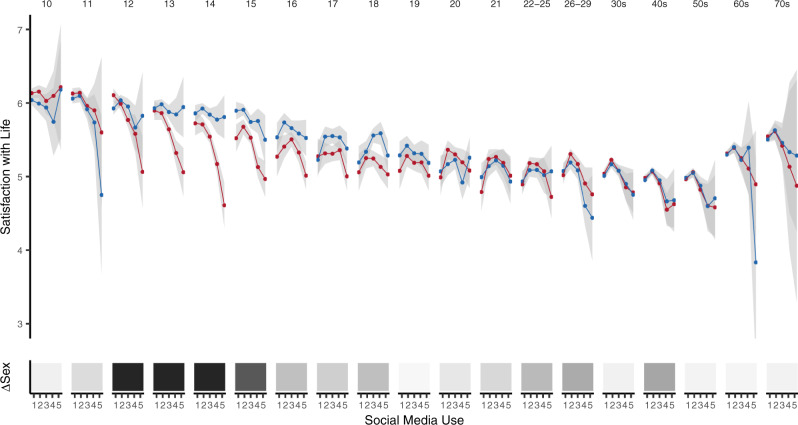
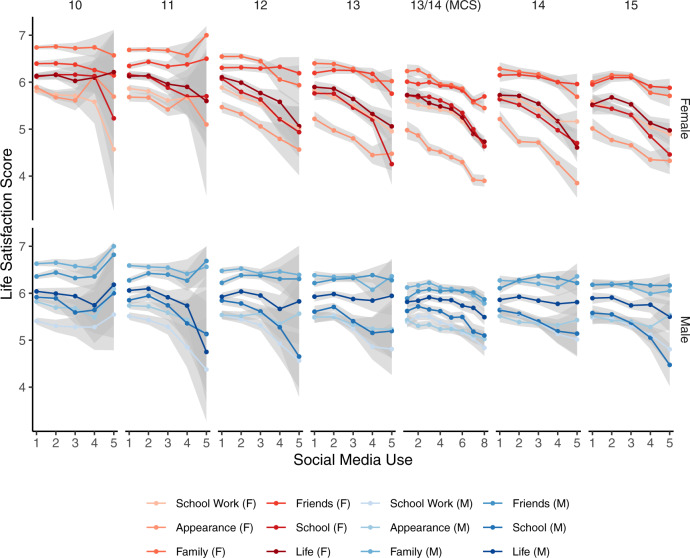
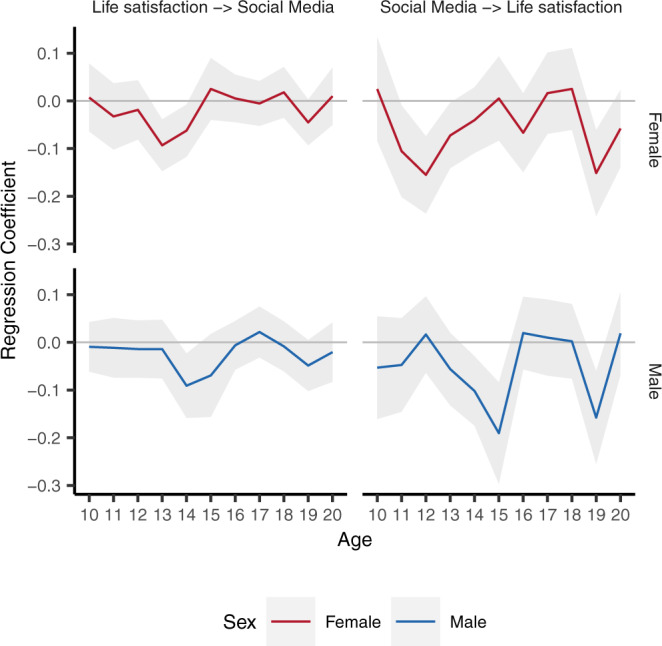
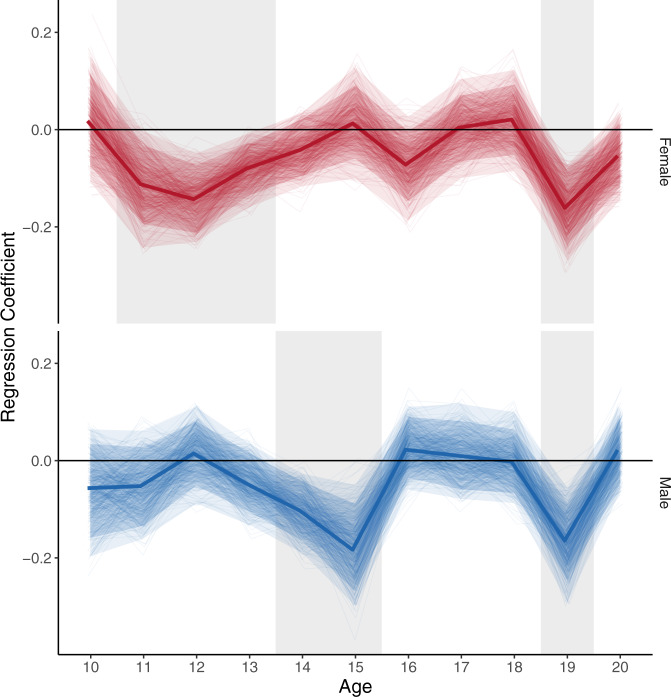
The relationship between social media use and life satisfaction changes across adolescent development. Our analyses of two UK datasets comprising 84,011 participants (10-80 years old) find that the cross-sectional relationship between self-reported estimates of social media use and life satisfaction ratings is most negative in younger adolescents. Furthermore, sex differences in this relationship are only present during this time. Longitudinal analyses of 17,409 participants (10-21 years old) suggest distinct developmental windows of sensitivity to social media in adolescence, when higher estimated social media use predicts a decrease in life satisfaction ratings one year later (and vice-versa: lower estimated social media use predicts an increase in life satisfaction ratings). These windows occur at different ages for males (14-15 and 19 years old) and females (11-13 and 19 years old). Decreases in life satisfaction ratings also predicted subsequent increases in estimated social media use, however, these were not associated with age or sex.
Overview
CoChat Summary
TL;DR
Using two UK longitudinal datasets, the paper finds that the association between estimated social media use and life satisfaction is strongest and most negative in adolescence, with sex differences appearing mainly in early adolescence. In longitudinal analyses of 17,409 adolescents, the authors identify age- and sex-specific “windows of sensitivity” where higher estimated social media use predicts lower life satisfaction one year later.
Key findings
- In cross-sectional analyses of 84,011 participants aged 10–80, the relationship between self-reported social media use and life satisfaction was “most negative in younger adolescents,” and sex differences were “only present during this time.”
- In longitudinal analyses of 17,409 participants aged 10–21, higher estimated social media use predicted lower life satisfaction one year later, and lower estimated social media use predicted higher life satisfaction one year later.
- The longitudinal “windows of sensitivity” differed by sex: females showed effects at ages 11–13 and 19, while males showed effects at ages 14–15 and 19.
- The reverse path also held: decreases in life satisfaction predicted subsequent increases in estimated social media use, and these effects were “not associated with age or sex.”
Methods
- Cross-sectional analysis of two UK datasets: Understanding Society (72,287 participants, surveyed up to seven times between 2011 and 2018) and the Millennium Cohort Study (11,724 participants, 2015 wave; ages 13–14).
- Longitudinal analysis used a Random Intercept Cross-Lagged Panel Model (RI-CLPM) on 17,409 Understanding Society participants aged 10–21 with 52,556 measurement occasions, using robust maximum likelihood, Huber-White standard errors, and FIML for missing data.
- Cross-sectional model comparison used linear/quadratic regressions with Akaike weights; longitudinal model comparison tested equality constraints across age and sex and examined cross-lagged paths between social media use and life satisfaction.
Limitations
- The paper states that causal interpretation would require strong assumptions: no time-varying unobserved confounding, adequate control of time-invariant confounding via the random intercept, no measurement error, a correct one-year time interval, and linear bidirectional links.
- The data are self-report, so the study infers effects of self-estimated social media time rather than objectively measured use.
- Evident from the text: the longitudinal findings are based on annual intervals only, so the authors note that different time frames could yield different results or mechanisms; also, some measures were available only for restricted age ranges, limiting comparisons across ages.
Model-written summary. Check it against the paper before relying on it.
Integrity signals
Registry
Cites
Statistics
Figures
Verification
Claims the paper makes
15 Valid · 1 Not valid · 10 Not checked · 60 Own results and interpretations
The cited sources support only part of this claim — read each source’s verdict below.
In the paper
“and the risk of certain mental health problems such as depression, self-harm, and eating disorders is higher in adolescent females than in males27.”
§ Windows of developmental sensitivity to social media > Introduction
What the sources say
- Partly supportedcites [27] Salk RH Hyde JS Abramson LY Gender differences in depression in representative national samples: Meta-analyses of diagnoses and symptoms Psychol. Bull. 2017 143 783 822 10.1037/bul0000102 28447828 PMC5532074 sourceExperimental — accuracy not yet measured
The Discussion’s Developmental Pattern section reports that the gender difference in depression peaks in adolescence, supporting the depression portion of the claim. The paper does not establish that adolescent females have higher risks of self-harm or eating disorders than males; its Background mentions suicidal behaviors only as a possible later risk associated with subthreshold depression. (LLM, conf=0.90)
plainstates an association- Asserted: passes — The authors put it forward as true.
- Checkable: passes — It can be checked against evidence.
- Load-bearing: passes — The paper’s conclusions depend on it.
- Based: passes — The paper gives a reason why it holds.
- Partly supported
The cited sources support only part of this claim — read each source’s verdict below.
In the paper
“Further, female life satisfaction drops earlier in adolescence25,26”
§ Windows of developmental sensitivity to social media > Introduction
What the sources say
- Partly supportedcites [25] Campbell, O., Bann, D. & Patalay, P. The gender gap in adolescent mental health: a cross-national investigation of 566,827 adolescents across 73 countries. http://medrxiv.org/lookup/doi/10.1101/2020.06.12.20129312 (2020). PMC7960541 33748389 sourceExperimental — accuracy not yet measured
The Results report that girls had lower life satisfaction than boys in most countries. But the Methods (Participants) describe a cross-sectional survey of students aged 15, and the paper does not establish that girls’ life satisfaction drops earlier in adolescence than boys’. (LLM, conf=0.86)
- Not checked — no full text of the sourcecites [26] Orben, A., Lucas, R. E., Fuhrmann, D. & Kievit, R. Trajectories of adolescent life satisfaction. 10.31234/osf.io/y8ruw (2020). PMC9346371 35937913 source
plainstates an association- Asserted: passes — The authors put it forward as true.
- Checkable: passes — It can be checked against evidence.
- Load-bearing: passes — The paper’s conclusions depend on it.
- Based: passes — The paper gives a reason why it holds.
- Partly supported
The cited sources support only part of this claim — read each source’s verdict below.
In the paper
“while experimental evidence is mixed8,9.”
§ Windows of developmental sensitivity to social media > Introduction
What the sources say
- Supportedcites [8] Vanman EJ Baker R Tobin SJ The burden of online friends: The effects of giving up Facebook on stress and well-being J. Soc. Psychol. 2018 158 496 508 10.1080/00224545.2018.1453467 29558267 source
The Discussion (p. 17) contrasts this study’s finding that the Facebook-as-normal group gained well-being with Tromholt’s experimental finding that a no-Facebook group gained well-being. The paper explicitly calls the results an apparent discrepancy, supporting the characterization of experimental evidence as mixed. (LLM, conf=0.92)
- Partly supportedcites [9] Allcott, H. et al. The Welfare Effects of Social Media. https://sites.google.com/site/allcott/research. (2019). sourceExperimental — accuracy not yet measured
The Introduction and §5.3 report experimental evidence that Facebook deactivation improved several well-being measures, while effects measured by daily text messages were not statistically significant. This supports variation across measures in this experiment, but the paper does not establish that experimental evidence across studies is mixed. (LLM, conf=0.80)
plainstates an association- Asserted: passes — The authors put it forward as true.
- Checkable: passes — It can be checked against evidence.
- Load-bearing: passes — The paper’s conclusions depend on it.
- Based: passes — The paper gives a reason why it holds.
- Supported
The sources with a verdict support this claim; the rest weren’t checked yet, have no full text we could read, or their verdicts aren’t rated yet.
In the paper
“Research has highlighted differences between males and females in the links between social media use and well-being in adolescence in a small subset of the analyzed data28, or other datasets10,29–33.”
§ Windows of developmental sensitivity to social media > Introduction
What the sources say
- Supportedcites [28] Booker CL Kelly YJ Sacker A Gender differences in the associations between age trends of social media interaction and well-being among 10–15 year olds in the UK BMC Public Health 2018 18 321 10.1186/s12889-018-5220-4 29554883 PMC5859512 source
The Discussion reports that social media interaction at age 10 was associated with well-being at older ages among females but not males. The paper therefore supports the attributed finding of gender differences in adolescent social-media–well-being links. (LLM, conf=0.92)
- Supportedcites [10] Orben A Dienlin T Przybylski AK Social media’s enduring effect on adolescent life satisfaction Proc. Natl Acad. Sci. USA 2019 116 10226 10228 10.1073/pnas.1902058116 31061122 PMC6534991 source
The paper reports that associations between social media use and adolescent life satisfaction appeared more negative for females across most models, prompting a focused analysis using participants who completed four waves. It cautions that the male and female confidence intervals overlap, so the reported differences should not be read as conclusive. The indexed copy labels these passages “Abstract” and provides no page number. (LLM, conf=0.86)
- Supportedcites [29] Kreski, N. et al. Social media use and depressive symptoms among United States adolescents. J. Adolescent Health10.1016/j.jadohealth.2020.07.006 (2020). PMC7876159 32798102 source
The Results report a positive association between daily social media use and depressive symptoms for girls only in the lowest depression-risk category after stratification. The Discussion contrasts this limited finding with the small, sometimes inverse associations observed among boys. This supports the claim that the paper highlighted sex differences in a subset of its analyzed data. (LLM, conf=0.90)
- Supportedcites [30] Nesi J Prinstein MJ Using social media for social comparison and feedback-seeking: Gender and popularity moderate associations with depressive symptoms J. Abnorm Child Psychol. 2015 43 1427 1438 10.1007/s10802-015-0020-0 25899879 PMC5985443 source
The Abstract reports that gender moderated the association between adolescents’ technology-based social comparison and feedback-seeking and depressive symptoms, with a particularly strong association among females. The Limitations and Conclusions section reiterates this finding. (LLM, conf=0.90)
- Not checked — no full text of the sourcecites [31] Viner RM Roles of cyberbullying, sleep, and physical activity in mediating the effects of social media use on mental health and wellbeing among young people in England: a secondary analysis of longitudinal data Lancet Child Adolesc. Health 2019 3 685 696 10.1016/S2352-4642(19)30186-5 31420213 source
- Not checked — no full text of the sourcecites [32] Twenge JM Martin GN Gender differences in associations between digital media use and psychological well-being: Evidence from three large datasets J. Adolescence 2020 79 91 102 10.1016/j.adolescence.2019.12.018 31926450 source
- Supportedcites [33] Kelly Y Zilanawala A Booker C Sacker A Social media use and adolescent mental health: Findings from the UK millennium cohort study EClinicalMedicine 2019 6 59 68 10.1016/j.eclinm.2018.12.005 31193561 PMC6537508 source
The Results section reports that the association between social media use and depressive symptoms was stronger for girls than for boys. The Discussion likewise identifies this gender difference among UK adolescents, supporting the cited point about differences in the social-media-use and well-being link. (LLM, conf=0.92)
plainstates an association- Asserted: passes — The authors put it forward as true.
- Checkable: passes — It can be checked against evidence.
- Load-bearing: passes — The paper’s conclusions depend on it.
- Based: passes — The paper gives a reason why it holds.
- Supported
The cited sources support only part of this claim — read each source’s verdict below.
In the paper
“It is therefore plausible that these processes heighten adolescents’ sensitivity to the interactive, communicative, and self-portraying nature of social media22, a technology they use more extensively than other age groups23,24.”
§ Windows of developmental sensitivity to social media > Introduction
What the sources say
- Supportedcites [22] Crone EA Konijn EA Media use and brain development during adolescence Nat. Commun. 2018 9 1 10 10.1038/s41467-018-03126-x 29467362 PMC5821838 source
The Introduction links adolescent brain development to heightened sensitivity to social influences through social media. The Conclusion describes social media as a means of connecting with others and presenting oneself, and suggests that developing sensitivities may make adolescents especially susceptible to its effects. The separate claim about how extensively adolescents use it is attributed to other citations. (LLM, conf=0.91)
- Not matchedcites [23] Ofcom. Children and parents: media use and attitudes report 2018. 1–17 https://www.ofcom.org.uk/research-and-data/media-literacy-research/childrens/children-and-parents-media-use-and-attitudes-report-2018 (2019).
We searched by its title and found no matching paper.
- Not matchedcites [24] Pew Research Centre. A quarter of Americans are online almost constantly | Pew Research Center. https://www.pewresearch.org/fact-tank/2021/03/26/about-three-in-ten-u-s-adults-say-they-are-almost-constantly-online/?msclkid=e6109554a61811ec875c44156f6f50c7 (2018).
We searched by its title and found no matching paper.
hedgedstates a possible cause- Asserted: passes — The authors put it forward as true.
- Checkable: passes — It can be checked against evidence.
- Load-bearing: passes — The paper’s conclusions depend on it.
- Based: passes — The paper gives a reason why it holds.
- Supported
47 more claims · 3 with their cited sources checked
Create a free account to see all 86 claims and every source verdict.
- It may state two separate claims as one. 14
- Probably not a substantial claim. 25
Claims other papers make about this one
Each is checked against this paper’s own text: does it say what the citing paper says it does?
The source backs part of the claim, not all of it — or backs it for a different population, condition or comparison.
In the citing paper
“Teens’ developmental stages is another area of differential susceptibility, with younger teens experiencing less life satisfaction and higher depression symptoms when they use more social media, as compared with older teens.137,144”
From Digital Ecosystems, Children, and Adolescents: Technical Report (2026) · cites this paper as [144]
Experimental — accuracy not yet measuredThe source backs part of the claim, not all of it — or backs it for a different population, condition or comparison.
In the citing paper
“In contrast, younger adolescents aged approximately 10-15 years remain comparatively underrepresented in the literature despite occupying a potentially important developmental period marked by increasing social media engagement and evolving identity formation [34, 35].”
From The Complex and Multifaceted Nature of Social Media: Perspectives From Young Adolescents, Parents and Experts (2026) · cites this paper as [35]
Experimental — accuracy not yet measuredThe source backs part of the claim, not all of it — or backs it for a different population, condition or comparison.
In the citing paper
“Social media use increases dramatically in adolescence, and this too might affect the way that the brain develops and could contribute to social pressures, mental ill health, and life satisfaction (figure 3). 189,190”
From The Lancet Psychiatry Commission on youth mental health (2024) · cites this paper as [189]
Experimental — accuracy not yet measuredThe cited source says what the claim attributes to it.
In the citing paper
“In general, early adolescence (10-15 years) 152 may represent a time of relatively greater susceptibility to the effects of social media (eg, lower life satisfaction).144”
From Digital Ecosystems, Children, and Adolescents: Technical Report (2026) · cites this paper as [144]
The cited source says what the claim attributes to it.
In the citing paper
“social media use has differential effects depending on the developmental timing [65]”
From Towards a youth mental health paradigm: a perspective and roadmap (2023) · cites this paper as [65]
4 more claims about this paper
Create a free account to see every claim other papers make about this one.
Statistics recomputed
Every reported test result, recomputed from its test statistic and degrees of freedom. A result shows as not adding up only once an independent check has confirmed it.
- Consistentχ²(434) = 1216.29reported p < .001 · recomputed p < .001
“χ2 (434) = 1216.29, p < .001”
- Consistentχ²(455) = 1234.736reported p < .001 · recomputed p < .001
“χ2 (455) = 1234.736, p < .001”
- Consistentt(3) = 0.33reported p = .77 · recomputed p = .763
“t(3) = 0.33, p = .77”
- Consistentt(37) = 1.74reported p = .09 · recomputed p = .090
“t(37) = 1.74, p = .09”
- Consistentχ²(63) = 2023reported p < .001 · recomputed p < .001
“χ2(63) = 2023, p < .001”
6 more recomputed tests
Create a free account to see every test the Stats check recomputed.
Self-check
Percentages, sums and reported differences re-computed from the paper’s own numbers.
Self-check results appear here once an independent check has confirmed them.
Citations
Cites
lavaan : An R Package for Structural Equation Modeling
Rosseel, Y. (2012) · Journal of Statistical Software · doi:10.18637/jss.v048.i02 · Cited by 27,955
Emerging adulthood: A theory of development from the late teens through the twenties.
Arnett, J. J. (2000) · American Psychologist · doi:10.1037/0003-066x.55.5.469 · Cited by 16,843
A critique of the cross-lagged panel model
Hamaker, E. L., Kuiper, R. M., & Grasman, R. P. P. P. (2015) · Psychological Methods · doi:10.1037/a0038889 · Cited by 4,005
Sawyer, S. M., Azzopardi, P. S., Wickremarathne, D., & Patton, G. C. (2018) · The Lancet Child & Adolescent Health · doi:10.1016/s2352-4642(18)30022-1 · Cited by 3,666
Effect size guidelines for individual differences researchers
Gignac, G. E., & Szodorai, E. T. (2016) · Personality and Individual Differences · doi:10.1016/j.paid.2016.06.069 · Cited by 2,860
Rhemtulla, M., Brosseau-Liard, P. É., & Savalei, V. (2012) · Psychological Methods · doi:10.1037/a0029315 · Cited by 2,816
AIC model selection using Akaike weights
Wagenmakers, E.-J., & Farrell, S. (2004) · Psychonomic Bulletin & Review · doi:10.3758/bf03206482 · Cited by 2,684
Salk, R. H., Hyde, J. S., & Abramson, L. Y. (2017) · Psychological Bulletin · doi:10.1037/bul0000102 · Cited by 2,622
Is Adolescence a Sensitive Period for Sociocultural Processing?
Blakemore, S.-J., & Mills, K. L. (2014) · Annual Review of Psychology · doi:10.1146/annurev-psych-010213-115202 · Cited by 2,264
Self-citationTwenge, J. M., Joiner, T. E., Rogers, M. L., & Martin, G. N. (2018) · Clinical Psychological Science · doi:10.1177/2167702617723376 · Cited by 1,705
Research works printed but not linked: 1
- Grimes, T., Anderson, J. A. & Bergen, L. Media Violence and Aggression: Science and Ideology (SAGE, 2008).
Cited by
The Lancet Psychiatry Commission on youth mental health
McGorry, P. D., Mei, C., Dalal, N., Alvarez-Jimenez, M., Blakemore, S.-J., Browne, V., Dooley, B., Hickie, I. B., Jones, P. B., McDaid, D., et al. (2024) · The Lancet Psychiatry · doi:10.1016/s2215-0366(24)00163-9 · Cited by 663
Self-citationChoukas-Bradley, S., Roberts, S. R., Maheux, A. J., & Nesi, J. (2021) · doi:10.31234/osf.io/ju92a · Cited by 331
Choukas-Bradley, S., Roberts, S. R., Maheux, A. J., & Nesi, J. (2022) · Clinical Child and Family Psychology Review · doi:10.1007/s10567-022-00404-5 · Cited by 333
“Individual differences in pubertal status and timing will also be important to consider: pubertal status has been hypothesized to play a role in adolescents’ responses to SM (Orben et al., 2022), and early pubertal timing has been associated with risk for poor body image and eating disorders (Mendle et al.”
BackgroundTowards a youth mental health paradigm: a perspective and roadmap
Uhlhaas, P. J., Davey, C. G., Mehta, U. M., Shah, J., Torous, J., Allen, N. B., Avenevoli, S., Bella-Awusah, T., Chanen, A., Chen, E. Y. H., et al. (2023) · Molecular Psychiatry · doi:10.1038/s41380-023-02202-z · Cited by 318
“Thus, social media use has differential effects depending on the developmental timing [65], suggesting that sensitive periods during youth may be particularly malleable by environmental exposures [66].”
BackgroundMechanisms linking social media use to adolescent mental health vulnerability
Orben, A., Meier, A., Dalgleish, T., & Blakemore, S.-J. (2024) · Nature Reviews Psychology · doi:10.1038/s44159-024-00307-y · Cited by 220
“Some longitudinal studies found that a decrease in adolescent well-being predicted an increase in social media use 1 year later 47,59 .”
Self-citationSocial Drivers and Algorithmic Mechanisms on Digital Media.
Metzler, H., & Garcia, D. (2024) · Perspectives on Psychological Science · doi:10.1177/17456916231185057 · Cited by 204
“For instance, teen-age girls or already socially disadvantaged individuals may be particularly vulnerable (Allcott et al., 2020; Heffer et al., 2019; Midgley, 2019; Orben et al., 2019, 2022).”
BackgroundHuang, S., Lai, X., Ke, L., Li, Y., Wang, H., Zhao, X., Dai, X., & Wang, Y. (2024) · Psychology Research and Behavior Management · doi:10.2147/prbm.s440889 · Cited by 196
Godard, R., & Holtzman, S. (2023) · Journal of Computer-Mediated Communication · doi:10.1093/jcmc/zmad055 · Cited by 171
A call to action: the second Lancet Commission on adolescent health and wellbeing
Baird, S., Choonara, S., Azzopardi, P. S., Banati, P., Bessant, J., Biermann, O., Capon, A. G., Claeson, M., Collins, P. Y., Wet, N. D., et al. (2025) · The Lancet · doi:10.1016/s0140-6736(25)00503-3 · Cited by 245
Social Media Use and adolescents' mental health and well-being: An umbrella review
Sala, A., Porcaro, L., & Gómez, E. (2024) · Computers in Human Behavior Reports · doi:10.1016/j.chbr.2024.100404 · Cited by 120
Van Bavel, J. J., Robertson, C. E., del Rosario, K., Rasmussen, J., & Rathje, S. (2024) · Annual Review of Psychology · doi:10.1146/annurev-psych-022123-110258 · Cited by 121
Goodyear, V. A., Randhawa, A., Adab, P., Al-Janabi, H., Fenton, S., Jones, K., Michail, M., Morrison, B., Patterson, P., Quinlan, J., et al. (2025) · The Lancet Regional Health - Europe · doi:10.1016/j.lanepe.2025.101211 · Cited by 111
Fassi, L., Thomas, K., Parry, D. A., Leyland-Craggs, A., Ford, T. J., & Orben, A. (2024) · JAMA pediatrics · doi:10.1001/jamapediatrics.2024.2078 · Cited by 109
Self-citationHaltigan, J. D., Pringsheim, T. M., & Rajkumar, G. (2023) · Comprehensive Psychiatry · doi:10.1016/j.comppsych.2022.152362 · Cited by 92
Conte, G., Iorio, G. D., Esposito, D., Romano, S., Panvino, F., Maggi, S., Altomonte, B., Casini, M. P., Ferrara, M., & Terrinoni, A. (2025) · European Child & Adolescent Psychiatry · doi:10.1007/s00787-024-02581-w · Cited by 84
Social media mindsets: a new approach to understanding social media use and psychological well-being
Lee, A. Y., & Hancock, J. T. (2023) · Journal of Computer-Mediated Communication · doi:10.1093/jcmc/zmad048 · Cited by 82
Firth, J., Torous, J., López‐Gil, J. F., Linardon, J., Milton, A., Lambert, J., Smith, L., Jarić, I., Fabian, H., Vancampfort, D., et al. (2024) · World Psychiatry · doi:10.1002/wps.21188 · Cited by 80
“Since then, the nuances of how age may affect the psychological im pacts of Internet use have been deeply explored in a study 20 which analyzed the interaction between social media use, life satisfaction, and developmental stages in a large UK cohort including 84,011 individuals aged 10 to 80 years.”
BackgroundSchmidt-Persson, J., Rasmussen, M. G. B., Sørensen, S. O., Mortensen, S. R., Olesen, L. G., Brage, S., Kristensen, P. L., Bilenberg, N., & Grøntved, A. (2024) · JAMA Network Open · doi:10.1001/jamanetworkopen.2024.19881 · Cited by 73
Social media use in adolescents with and without mental health conditions
Fassi, L., Ferguson, A. M., Przybylski, A. K., Ford, T. J., & Orben, A. C. (2025) · Nature Human Behaviour · doi:10.1038/s41562-025-02134-4 · Cited by 146
Self-citationConnolly, S. E., Constable, H. L., & Mullally, S. L. (2023) · Frontiers in Psychiatry · doi:10.3389/fpsyt.2023.1237052 · Cited by 72
“…exploring other factors which could be driving recent secular changes in child and adolescent MH such as increased exposure to social media (80, 81), increased testing in schools (82), and/or a societal shift to knowledge-based economies that increasingly links life chances with…”
BackgroundSocial Media Use and Depressive Symptoms During Early Adolescence
Nagata, J. M., Otmar, C. D., Shim, J., Balasubramanian, P., Cheng, C. M., Li, E. J., Al-Shoaibi, A. A. A., Shao, I. Y., Ganson, K. T., Testa, A., et al. (2025) · JAMA Network Open · doi:10.1001/jamanetworkopen.2025.11704 · Cited by 71
How social media affects teen mental health: a missing link
Orben, A., & Blakemore, S.-J. (2023) · Nature · doi:10.1038/d41586-023-00402-9 · Cited by 71
Self-citationBenrimoh, D. A., Chheda, F. D., & Margolese, H. C. (2022) · JMIR Mental Health · doi:10.2196/40410 · Cited by 82
“In a recent large study, higher amounts of social media use has been shown to predict later reductions in life satisfaction [9].”
BackgroundRevisiting adolescence as a sensitive period for sociocultural processing
Cheng, T. W., Mills, K. L., & Pfeifer, J. H. (2024) · Neuroscience & Biobehavioral Reviews · doi:10.1016/j.neubiorev.2024.105820 · Cited by 109
Panayiotou, M., Black, L., Carmichael-Murphy, P., Qualter, P., & Humphrey, N. (2023) · Nature Mental Health · doi:10.1038/s44220-023-00063-7 · Cited by 62
Analysis of Social Media Use, Mental Health, and Gender Identity Among US Youths
Coyne, S. M., Weinstein, E., Sheppard, J. A., James, S. L., Gale, M., Alfen, M. V., Ririe, N., Monson, C., Ashby, S., Weston, A., et al. (2023) · JAMA Network Open · doi:10.1001/jamanetworkopen.2023.24389 · Cited by 83
Adolescent user behaviors on short video application, cognitive functioning and academic performance
Xu, Z., Gao, X., Wei, J., Liu, H., & Zhang, Y. (2023) · Computers & Education · doi:10.1016/j.compedu.2023.104865 · Cited by 93
Adolescent Social Media Use through a Self-Determination Theory Lens: A Systematic Scoping Review
West, M., Rice, S., & Vella‐Brodrick, D. (2024) · International Journal of Environmental Research and Public Health · doi:10.3390/ijerph21070862 · Cited by 125
“As social media is constantly evolving, prevalent within adolescents’ lives, and has the potential to strongly influence development and wellbeing, a continued research agenda within the field is critical.”
BackgroundHamilton, J. L., Dreier, M. J., & Boyd, S. I. (2023) · Current Opinion in Psychology · doi:10.1016/j.copsyc.2023.101633 · Cited by 78
Maheux, A. J., Burnell, K., Maza, M. T., Fox, K. A., Telzer, E. H., & Prinstein, M. J. (2025) · Journal of Child Psychology and Psychiatry · doi:10.1111/jcpp.14085 · Cited by 48
Conceptualizing and Measuring Social Media Use in Health and Well-being Studies: Systematic Review
Bekalu, M. A., Sato, T., & Viswanath, K. (2023) · Journal of Medical Internet Research · doi:10.2196/43191 · Cited by 47
“Nevertheless, this focus on young population groups may also be justified in view of recent studies suggesting that younger age represents a window of developmental sensitivity to social media use [25].”
Armitage, J. M., Collishaw, S., & Sellers, R. (2024) · Discover Social Science and Health · doi:10.1007/s44155-024-00076-2 · Cited by 77
“Robust evidence using causally informative designs is limited, and it is likely that associations will vary according to the nature of young people’s interactions with their digital environments, as well by young people’s developmental maturity and sex [128].”
BackgroundScreen media activity in youth: A critical review of mental health and neuroscience findings
Paulus, M. P., Zhao, Y., Potenza, M. N., Aupperle, R. L., Bagot, K. S., & Tapert, S. F. (2023) · Journal of Mood and Anxiety Disorders · doi:10.1016/j.xjmad.2023.100018 · Cited by 68
“…be modulated by a variety of factors (see Table 1), including types of SMA consumed [72], methods used to measure screen time [19], sex-related differences [16], timing of exposure during the lifespan [73], and contexts in which SMA occurs, such as societal changes like the COVID-19 pandemic [23].”
Lahti, H., Kokkonen, M., Hietajärvi, L., Lyyra, N., & Paakkari, L. T. (2024) · Child and Adolescent Psychiatry and Mental Health · doi:10.1186/s13034-024-00754-8 · Cited by 99
“Adolescent age has further been hypothesized as explaining social media threat exposure, on the grounds that periods of increased sensitivity to certain threats are likely to occur in relevant developmental windows [15, 54].”
BackgroundScreen time and suicidal behaviors among U.S. children 9–11 years old: A prospective cohort study
Chu, J., Ganson, K. T., Baker, F. C., Testa, A. M., Jackson, D. B., Murray, S. B., & Nagata, J. M. (2023) · Preventive Medicine · doi:10.1016/j.ypmed.2023.107452 · Cited by 49
Sun, X., Haydel, K. F., Matheson, D., Desai, M., & Robinson, T. N. (2023) · Child Development · doi:10.1111/cdev.13851 · Cited by 38
“…arguments about technology use, which suggests that the sensitivity mechanism may only apply to certain types of technology, such as social media (Orben et al., 2022), and that more research is needed for investigating sensitivity windows for different types of technology adoption and use.”
BackgroundResultInfluentialThe Relationship Between Problematic Social Media Use and Depression: A Meta-Analysis Study
YİĞİTER, M. S., Demir, S., & Doğan, N. (2023) · Current Psychology · doi:10.1007/s12144-023-04972-9 · Cited by 61
“In a study conducted by Orben et al. (2022) that investigated the effects of social media on adolescents' brain development and psychological health, it was found that social media had different effects at different periods during adolescents' development.”
Global Well-Being and Mental Health in the Internet Age
Vuorre, M., & Przybylski, A. K. (2023) · Clinical Psychological Science · doi:10.1177/21677026231207791 · Cited by 60
“Nevertheless, although we found few gender differences, our results are in line with one study that reported that cross-sectional associations between social media use and life satisfaction are more negative at specific time windows in adolescence (Orben et al., 2022).”
Self-citationLong-term impact of digital media on brain development in children
Nivins, S., Sauce, B., Liebherr, M., Judd, N., & Klingberg, T. (2024) · Scientific Reports · doi:10.1038/s41598-024-63566-y · Cited by 60
Marciano, L., Viswanath, K., Morese, R., & Camerini, A.-L. (2022) · Frontiers in Psychiatry · doi:10.3389/fpsyt.2022.981881 · Cited by 36
“present cohort of students does not extend to other age groups, which showed differential effects of social media use (88).”
BackgroundHampton, K. N., & Shin, I. (2022) · Social Science Computer Review · doi:10.1177/08944393221117466 · Cited by 51
“This body of work recognizes that new media can be damaging, beneficial, or benign, depending on type of use, development stage (Orben et al., 2022), individual susceptibility (Beyens et al., 2020), and social context (Livingstone, 2018).”
BackgroundInfluentialSocial media use and adolescents’ well-being: A note on flourishing
Marciano, L., & Viswanath, K. (2023) · Frontiers in Psychology · doi:10.3389/fpsyg.2023.1092109 · Cited by 68
“, first and second high school year) and do not extend to other age groups showing different social media usages (Orben et al., 2022) or students attending different educational paths in Switzerland, like apprenticeships.”
BackgroundEstimating the association between Facebook adoption and well-being in 72 countries
Vuorre, M., & Przybylski, A. K. (2023) · Royal Society Open Science · doi:10.1098/rsos.221451 · Cited by 47
Self-citationMarciano, L., Schulz, P. J., & Camerini, A.-L. (2022) · Computers in Human Behavior · doi:10.1016/j.chb.2022.107390 · Cited by 43
Lin, Y., Fu, S., & Zhou, X. (2023) · Internet Research · doi:10.1108/intr-05-2022-0320 · Cited by 33
A Neuroecosocial Perspective on Adolescent Development
Choudhury, S., Pi‐Sunyer, B. P., & Blakemore, S. (2023) · Annual Review of Developmental Psychology · doi:10.1146/annurev-devpsych-120321-011511 · Cited by 61
Self-citationCausal effect of video gaming on mental well-being in Japan 2020–2022
Egami, H., Rahman, M. S., Yamamoto, T., Egami, C., & Wakabayashi, T. (2024) · Nature Human Behaviour · doi:10.1038/s41562-024-01948-y · Cited by 45
“The age-dependent influence of digital media has garnered considerable attention from policymakers and scholars 50 .”
Raffoul, A., Ward, Z. J., Santoso, M., Kavanaugh, J. R., & Austin, S. B. (2023) · PLoS ONE · doi:10.1371/journal.pone.0295337 · Cited by 48
“A growing body of research documents associations between social media use, social media advertising, and negative mental health outcomes among youth, including depression, anxiety, and eating disorders [3–5].”
BackgroundChildhood Lifestyle Behaviors and Mental Health Symptoms in Adolescence
Haapala, E. A., Leppänen, M. H., Kosola, S. K., Appelqvist‐Schmidlechner, K., Kraav, S., Jussila, J. J., Tolmunen, T., Lubans, D. R., Eloranta, A., Schwab, U., et al. (2025) · JAMA Network Open · doi:10.1001/jamanetworkopen.2024.60012 · Cited by 58
Beyond Code Generation: LLM-supported Exploration of the Program Design Space
Zamfirescu-Pereira, J. D., Jun, E., Terry, M. A., Yang, Q., & Hartmann, B. (2025) · CHI Conference on Human Factors in Computing Systems · doi:10.1145/3706598.3714154 · Cited by 80
Hjetland, G. J., Finserås, T. R., Sivertsen, B., Colman, I., Hella, R. T., Andersen, A. I. O., & Skogen, J. C. (2024) · BMC Public Health · doi:10.1186/s12889-024-20052-4 · Cited by 28
“…is also possible that the relationship between focus on self-presentation and mental health differs between younger and older adolescent, in line with a study showing that the strength of the relationship between social media use and life satisfaction changed depending on the adolescents’ age [52].”
ResultZhao, Y., Paulus, M. P., & Potenza, M. N. (2023) · Journal of Behavioral Addictions · doi:10.1556/2006.2023.00006 · Cited by 36
Unlocking the brain secrets of social media through neuroscience
Montag, C., Marciano, L., Schulz, P. J., & Becker, B. (2023) · Trends in Cognitive Sciences · doi:10.1016/j.tics.2023.09.005 · Cited by 39
Hamilton, J. L., Dalack, M. N., Boyd, S. I., Jorgensen, S. L., Dreier, M. J., Sarna, J., & Brent, D. A. (2024) · Journal of Child Psychology and Psychiatry · doi:10.1111/jcpp.13996 · Cited by 45
Augusti, E., Myhre, M. C., Wentzel‐Larsen, T., & Hafstad, G. S. (2023) · Child Abuse & Neglect · doi:10.1016/j.chiabu.2023.106023 · Cited by 28
“Recent research has also shown that the developmental period of adolescence constitutes sensitive periods for time spent on social media, showing that during the early teens, more time on social media is associated with poorer mental health and life satisfaction in both males and females (Orben et al., 2022).”
McNeilly, E. A., Mills, K. L., Kahn, L. E., Crowley, R. N., Pfeifer, J. H., & Allen, N. B. (2023) · Clinical Psychological Science · doi:10.1177/21677026221125180 · Cited by 35
“…a role in the link between stressful life events and internalizing symptoms (Rodman et al., 2021) and that early adolescence (11–13 years old for girls and 14–15 years old for boys) may be a developmentally sensitive period for the impact of social media on life satisfaction (Orben et al., 2022).”
BackgroundMiller, J., Mills, K. L., Vuorre, M., Orben, A., & Przybylski, A. K. (2023) · Cortex · doi:10.1016/j.cortex.2023.09.009 · Cited by 28
Self-citationArdesch, F. H., van der Vegt, D. D., & Jong, J. C. K. (2023) · JMIR Pediatrics and Parenting · doi:10.2196/46966 · Cited by 48
“The psychiatric profile of the adolescents was not assessed in this study and could be an important factor according to recent research [46].”
Marciano, L., Jindal, S., & Viswanath, K. (2024) · PEDIATRICS · doi:10.1542/peds.2024-066142 · Cited by 46
de Mello, V. O., Cheung, F., & Inzlicht, M. (2022) · doi:10.31234/osf.io/4x5em · Cited by 25
Yu, Y., Dykxhoorn, J. L., & Plackett, R. (2024) · Journal of Medical Internet Research · doi:10.2196/56950 · Cited by 37
“Most previous studies in this area have explored the relationship between social media use and mental health using cross-sectional designs with nonrepresentative data [6,25].”
The Effects of Social Media Consumption on Adolescent Psychological Well-Being
Fumagalli, E., Shrum, L. J., & Lowrey, T. M. (2023) · Journal of the Association for Consumer Research · doi:10.1086/728739 · Cited by 38
“Thus, importantly, the negative effects of social media use appear only at certain ages and at a slightly earlier age for girls than boys (what Orben et al. [2022] refer to as “ windows ” of developmental sensitivity to social media).”
BackgroundMethodInfluentialCascading bidirectional influences of digital media use and mental health in adolescence
Flannery, J. S., Maza, M. T., Kilic, Z., & Telzer, E. H. (2023) · Advances in Child Development and Behavior · doi:10.1016/bs.acdb.2022.10.003 · Cited by 23
“A recent longitudinal investigation of over 17,000 participants across the lifespan demonstrated a bidirectional relationship between social media use and life satisfaction such that decreased life satisfaction predicted subsequent increases in social media use, while higher social media use also predicted decreased l…”
BackgroundInfluentialSocial Media and Adolescent Mental Health
Yue, Z., & Rich, M. (2023) · Current Pediatrics Reports · doi:10.1007/s40124-023-00298-z · Cited by 37
“Elaborating on this, Orben et al. (2022) [41] conducted extensive research involving 84,011 participants.”
Probing the digital exposome: associations of social media use patterns with youth mental health
Pagliaccio, D., Tran, K. T., Visoki, E., DiDomenico, G. E., Auerbach, R. P., & Barzilay, R. (2024) · NPP—Digital Psychiatry and Neuroscience · doi:10.1038/s44277-024-00006-9 · Cited by 23
Rodman, A. M., Burns, J. A., Cotter, G., Ohashi, Y.-G. B., Rich, R. K., & McLaughlin, K. A. (2024) · Affective Science · doi:10.1007/s42761-024-00247-z · Cited by 42
Santos, J. P. L., Soehner, A. M., Biernesser, C. L., Ladouceur, C. D., & Versace, A. (2025) · Archives of Pediatrics and Adolescent Medicine · doi:10.1001/jamapediatrics.2025.1718 · Cited by 32
Digital Media Use and Child Health and Development: A Systematic Review and Meta-Analysis
Teague, S. J., Somoray, K., Shatte, A. B. R., Miller, D., Moss, K., Crawford, A., Wildman, H., Kayal, D., & Hutchinson, D. C. S. (2026) · Archives of Pediatrics and Adolescent Medicine · doi:10.1001/jamapediatrics.2026.0085 · Cited by 63
Digital phenotyping in molecular psychiatry—a missed opportunity?
Montag, C., & Quintana, D. S. (2022) · Molecular Psychiatry · doi:10.1038/s41380-022-01795-1 · Cited by 28
“This said, psychiatric illnesses are characterized by distinct developmental trajectories with adolescents exhibiting speci fi c developmental windows of sensitivity to social media usage [15].”
BackgroundCárdaba, M. Á. M., Díaz, M. V. M., Pérez, P. L., & Castro, J. A. G. (2024) · Journal of Youth and Adolescence · doi:10.1007/s10964-024-02013-7 · Cited by 39
“Furthermore, longitudinal analyses of 17,409 participants (10 – 21 years old) suggested speci fi c developmental periods of sensitivity to social media during adolescence (Orben et al., 2022).”
BackgroundResultThorell, L. B., Autenrieth, M., Riccardi, A., Burén, J., & Nutley, S. B. (2024) · Frontiers in Psychology · doi:10.3389/fpsyg.2024.1437109 · Cited by 40
Forrai, M., Koban, K., & Matthes, J. (2023) · Telematics and Informatics · doi:10.1016/j.tele.2023.101969 · Cited by 32
Hammond, S. P., Polizzi, G., Duddy, C., Bennett-Grant, Y., & Bartholomew, K. J. (2024) · New Media & Society · doi:10.1177/14614448241232065 · Cited by 41
“According to their longitudinal analyses of 17,409 participants (between 10 and 21 years of age), this window first occurs for males aged 14–15 and females aged 11–13 (Orben et al., 2022).”
Backgroundde Mello, V. O., Cheung, F., & Inzlicht, M. (2024) · Communications Psychology · doi:10.1038/s44271-024-00062-z · Cited by 48
Madigan, S., & Reich, S. M. (2023) · JAMA Pediatrics · doi:10.1001/jamapediatrics.2023.3670 · Cited by 18
Ten Myths About the Effect of Social Media Use on Well-Being
Hall, J. A. (2024) · Journal of Medical Internet Research · doi:10.2196/59585 · Cited by 26
“A longitudinal analysis of 84,000 UK adults aged 10-80 years from 2011 to 2018 found that drops in well-being were followed by more social media use over time across all age groups [34].”
Protecting the Developing Mind in a Digital Age: A Global Policy Imperative
Thiagarajan, T. C., Newson, J. J., & Swaminathan, S. (2025) · Journal of Human Development and Capabilities · doi:10.1080/19452829.2025.2518313 · Cited by 20
“…effects of screen time, social media and smartphone use on various mental health outcomes in children have demonstrated negative effects in many cases (e.g. Santos et al. 2023; Twenge, Martin, and Campbell 2018), but also mixed and often contradictory results (e.g. Odgers 2018; Orben et al. 2022).”
Zimmer‐Gembeck, M. J., Hawes, T., Scott, R. A., Campbell, T., & Webb, H. J. (2022) · Computers in Human Behavior · doi:10.1016/j.chb.2022.107569 · Cited by 27
Gerosa, T., Losi, L., & Gui, M. (2024) · Youth & Society · doi:10.1177/0044118x231223218 · Cited by 29
“…found in the literature between precocity of smartphone use and various life outcomes (Dempsey et al., 2019; Jaalouk & Boumosleh, 2018; Lemola et al. 2015) and confirm the fragility of the specific stage of puberty and pre-ado-lescence regarding intensive media usage (Orben et al., 2022).”
Old Strategies, New Environments: Reinforcement Learning on Social Media
Turner, G., Ferguson, A. M., Katiyar, T., Palminteri, S., & Orben, A. C. (2024) · Biological Psychiatry · doi:10.1016/j.biopsych.2024.12.012 · Cited by 37
Self-citationThe State of Evidence in Digital Hate Research: An Umbrella Review
Matthes, J., Koban, K., Bührer, S., Kirchmair, T., Weiß, P., Khaleghipour, M., Saumer, M., & Meerson, R. (2025) · Communication Research · doi:10.1177/00936502251365724 · Cited by 22
“Recent large-scale studies substantiate this emphasis, documenting the strongest negative relationships between social media use and psychological well-being during early and late adolescence for women and mid-and late adolescence for men (Orben et al., 2022).”
Barnes, C., Hall, A., Mantach, S., Oldmeadow, C. J., Attia, J. R., Backholer, K., Williams, C., Tefera, Y., Kay, F. A., & Wolfenden, L. (2026) · BMJ · doi:10.1136/bmj-2026-363695 · Cited by 33
“61 62 Limitations of study Several limitations should be considered when interpreting our findings.”
Álvarez, A. S., & Vicente, M. R. (2023) · Humanities and Social Sciences Communications · doi:10.1057/s41599-023-02110-1 · Cited by 27
Purba, A. K., Henderson, M., Baxter, A. J., Katikireddi, S. V., & Pearce, A. (2023) · European Journal of Public Health · doi:10.1093/eurpub/ckad163 · Cited by 22
Cross‐sectional and longitudinal associations of screen time with adolescent depression and anxiety
Li, S., Batterham, P. J., Whitton, A. E., Maston, K., Khan, A., Christensen, H. M., & Werner‐Seidler, A. (2025) · British Journal of Clinical Psychology · doi:10.1111/bjc.12547 · Cited by 36
“Specifically, higher social media use predicts reduced subsequent life satisfaction in 11–13- year-old females and in 14–15- yearyear-old males, but not males or females in these respective age ranges (Orben et al., 2022).”
Generative Artificial Intelligence Applications Use Among US Youth
Maheux, A. J., Akre, S., Boeldt, D. L., Flannery, J., Richardson, Z., Burnell, K., Telzer, E. H., & Kollins, S. H. (2026) · JAMA Network Open · doi:10.1001/jamanetworkopen.2025.56631 · Cited by 30
Wood, G., Goodyear, V. A., Adab, P., Al‐Janabi, H., Fenton, S. A. M., Jones, K., Michail, M., Morrison, B., Patterson, P. H., Sitch, A. J., et al. (2023) · BMJ Open · doi:10.1136/bmjopen-2023-075832 · Cited by 39
“15 27–29 Furthermore, individual (eg, gender, age, socioeconomic status) 13 16 30–33 and family/home (eg, parental usage and attitudes toward technology) 34–37 factors are also likely to impact on relationships between smartphone/social media use and mental well-being.”
Maheux, A. J., Laurenceau, J., Roberts, S. R., Nesi, J. L., Widman, L. M., & Choukas‐Bradley, S. (2024) · Journal of Youth and Adolescence · doi:10.1007/s10964-024-01998-5 · Cited by 33
“…preoccupation has relied on mostly cross-sectional, between-person designs (see Choukas-Bradley et al., 2022) and focused on late adolescence and early adulthood, despite recent evidence that young adolescents may be at heightened risk for negative effects of digital media use (Orben et al., 2022).”
BackgroundInfluentialSocial Media and Anxiety in Youth
Chochol, M. D., Gandhi, K., & Croarkin, P. E. (2023) · Child and Adolescent Psychiatric Clinics of North America · doi:10.1016/j.chc.2023.02.004 · Cited by 16
Mäder, S., Costantini, D., Fahr, A., & Jordan, M. D. (2024) · Social Science & Medicine · doi:10.1016/j.socscimed.2024.117595 · Cited by 29
Blackwell, C. K., Mansolf, M. A., Rose, T., Pila, S., Cella, D. F., Cohen, A., Leve, L. D., McGrath, M., Neiderhiser, J. M., Urquhart, A., et al. (2025) · Journal of Adolescent Health · doi:10.1016/j.jadohealth.2024.12.003 · Cited by 19
Social uncertainty in the digital world
Ferguson, A. M., Turner, G., & Orben, A. C. (2024) · Trends in Cognitive Sciences · doi:10.1016/j.tics.2024.02.005 · Cited by 16
Self-citationXu, C., Hania, A., & Waqas, M. (2024) · Education and Information Technologies · doi:10.1007/s10639-024-13180-2 · Cited by 36
“Additionally, the overuse of technology poses health risks, includ - ing increased screen time and internet addiction (Orben et al., 2022 ; Przybylski & Weinstein, 2017).”
Perlmutter, E., Dwyer, B., & Torous, J. (2024) · Current Treatment Options in Psychiatry · doi:10.1007/s40501-024-00312-1 · Cited by 14
Digital Media, Cognition, and Brain Development in Adolescence
Marciano, L., Dubicka, B., Magis‐Weinberg, L., Morese, R., Viswanath, K., & Weber, R. (2024) · Springer eBooks · doi:10.1007/978-3-031-69362-5_4 · Cited by 34
Digital Ecosystems, Children, and Adolescents: Technical Report
Munzer, T., Milkovich, L. M., Madigan, S., Tomopoulos, S., Parga-Belinkie, J., Ajumobi, T., Cross, C., Gerwin, R., Council on Communications and Media, Radesky, J., et al. (2026) · Pediatrics · doi:10.1542/peds.2025-075321 · Cited by 14
Gordon, M. S., & Ohannessian, C. M. (2023) · Youth & Society · doi:10.1177/0044118x231180317 · Cited by 32
“Nonetheless, in a recent study, Orben et al. (2022) explored developmental changes in the association between social media use and life satisfaction.”
BackgroundRamadan, O. M. E., Alruwaili, M. M., Alruwaili, A. N., Elsharkawy, N. B., Abdelaziz, E. M., El-Badawy, R. E.-S., & El-Nasr, E. M. S. (2024) · Children · doi:10.3390/children11060634 · Cited by 38
“As adolescents spend more time connected through social media and online platforms, they become more vulnerable to this new form of aggression [6–9].”
BackgroundNagata, J. M., Shim, J. E., Low, P., Ganson, K. T., Testa, A. M., He, J., Santos, G., Brindis, C. D., Baker, F. C., & Shao, I. Y. (2024) · Drug and Alcohol Dependence · doi:10.1016/j.drugalcdep.2024.112504 · Cited by 23
Mayen, S., Reinhardt, A., & Wilhelm, C. (2025) · Journal of Children and Media · doi:10.1080/17482798.2024.2443662 · Cited by 21
“Referring to Orben et al. (2022) observations, we propose that future research exploring the factors shaping potential “windows of developmental sensitivity” to media use effects should consider aspects such as the onset of puberty, cognitive development, shifts in social identity, and changes in…”
Influential
Metadata
- Authors
- Orben, A., Przybylski, A. K., Blakemore, S.-J., & Kievit, R. A.
- Affiliations
- MRC Cognition and Brain Sciences Unit (GB)
- University of Oxford (GB)
- University of Cambridge (GB)
- Corresponding author
- Orben, Amy
- Venue
- Nature Communications
- Published
- 2022-03-28
- Volume
- 13
- Issue
- 1
- Pages
- 1649-1649
- ISSN
- 2041-1723 (ISSN-L)
- PMC
- PMC8960761
- OpenAlex
- W4220990449
- Cited by
- 387
- References
- 49
- Citations by year
- 2026: 108 · 2025: 112 · 2024: 82 · 2023: 61 · 2022: 23
- FWCI
- 99.98
- Type
- journal article
- Language
- en
- Open access
- gold
- doi.org
- Licence
- cc-by
- creativecommons.org/licenses/by/4.0 (tdm)
- creativecommons.org/licenses/by/4.0 (vor)
- Locations
- Nature Communications (publishedVersion, cc-by)
- PubMed Central (publishedVersion, cc-by)
- PubMed (publishedVersion)
- RePEc: Research Papers in Economics (submittedVersion)
- DOAJ (DOAJ: Directory of Open Access Journals) (submittedVersion)
- Radboud Repository (Radboud University) (submittedVersion)
- OSF Preprints (OSF Preprints) (submittedVersion)
- Apollo (University of Cambridge) (submittedVersion, cc-by)
- Radboud Repository (Radboud University) (submittedVersion, other-oa)
- Apollo
- Apollo (cc-by)
- Funders
- RCUK | Economic and Social Research Council (ES/T008709/1)
- RCUK | Medical Research Council (SWAG/076.G101400, SUAG/047 G101400)
- University of Cambridge | Emmanuel College, University of Cambridge (Research Fellowship)
- Wellcome Trust (WT107496/Z/15/Z)
- Jacobs Foundation
- University of Cambridge
- Topics
- Social Sciences › Sociology and Political Science › Impact of Technology on Adolescents
- Social Sciences › Education › Child Development and Digital Technology
- Social Sciences › Psychology › Social Psychology › Psychological Well-being and Life Satisfaction
- Keywords
- social media use, life satisfaction, adolescent development, developmental windows, sex differences, longitudinal change, well-being
- MeSH terms
- Adolescent, Adult, Aged, Aged, 80 and over, Child, Female, Humans, Longitudinal Studies, Male, Middle Aged, Adolescent Development, Young Adult, Self Report, Social Media
About these checks
Registry, retraction, Cites and statistics results are computed, not judged, with one exception: a printed reference that no index lists is read once by a model before it counts as a citation error. Claims are extracted by a model and kept only when their quote appears verbatim in the text; each cited source is then checked, with a model’s help, for whether it says what the claim relies on. Those verdicts can be wrong — read the claim’s quote and the cited source before relying on one.
The claim verdicts this report counts are experimental: their accuracy is not yet measured.
A language model drew the claims from the paper on 2026-10-10, under version 3 of the claim definition (model deepseek-v4.1-flash, prompt extract-v3).
A second model labelled each claim on 2026-10-10 (model jev-1.13-20260917, definition revision gold-guideline-v0.2).
Cited sources are checked with a language model’s help (gpt-6-sol).
Statistics and arithmetic are recomputed, not judged.
Confidence bands are shown only for fields calibrated on our annotated test set. None is calibrated yet, so no band is shown.
What counts as a claim ›How we measure confidence ›How we check this ›
Are you an author, or do you see a problem with this page? Request a review
Data sources
Bibliographic data: Semantic Scholar, OpenAlex, Crossref.
Contains information from the Semantic Scholar Academic Graph Datasets, made available under the ODC Attribution License (ODC-BY 1.0).
Semantic Scholar’s data is described in: Kinney, R., et al. (2023). The Semantic Scholar Open Data Platform. arXiv:2301.10140.
