

Windows of developmental sensitivity to social media
Open accessThe DOI matches its Crossref record; 48 of the 49 references it cites were found in a registry or an index; 25 of the 48 sources its claims cite were checked for support.
Abstract
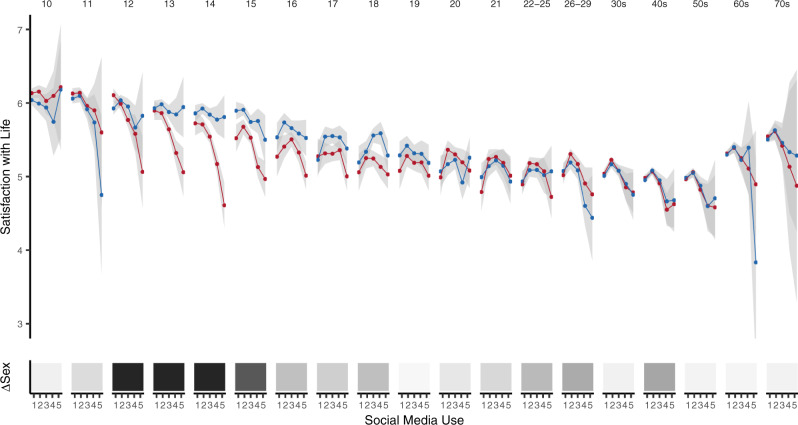
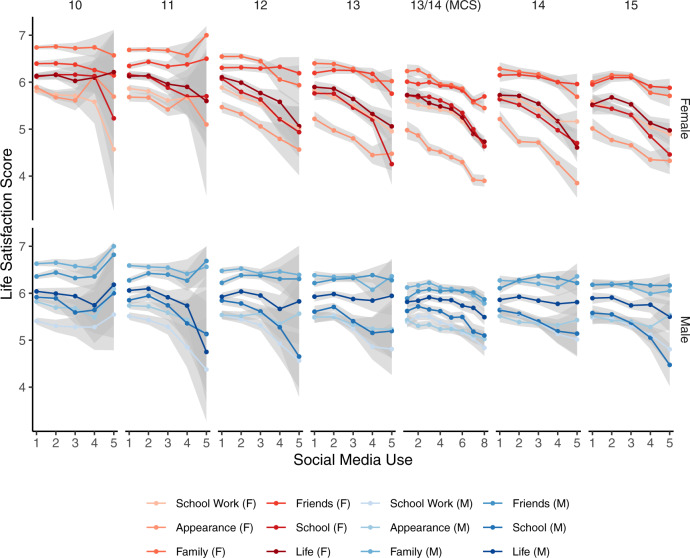
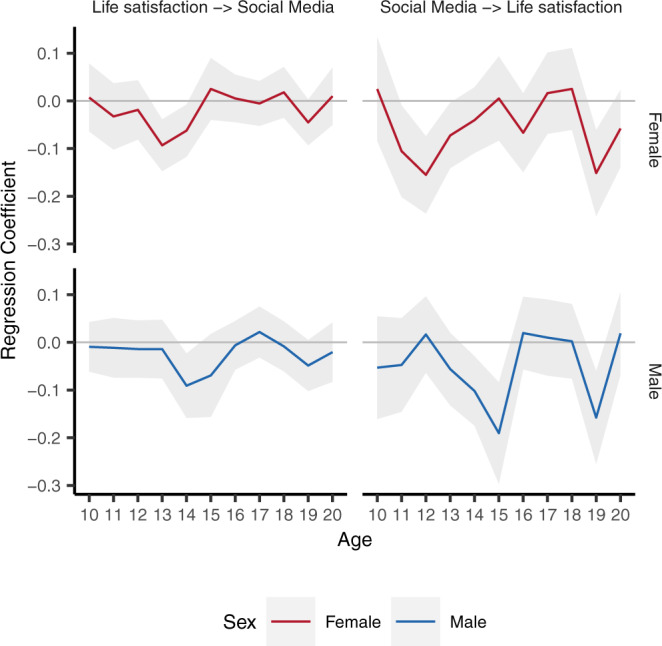
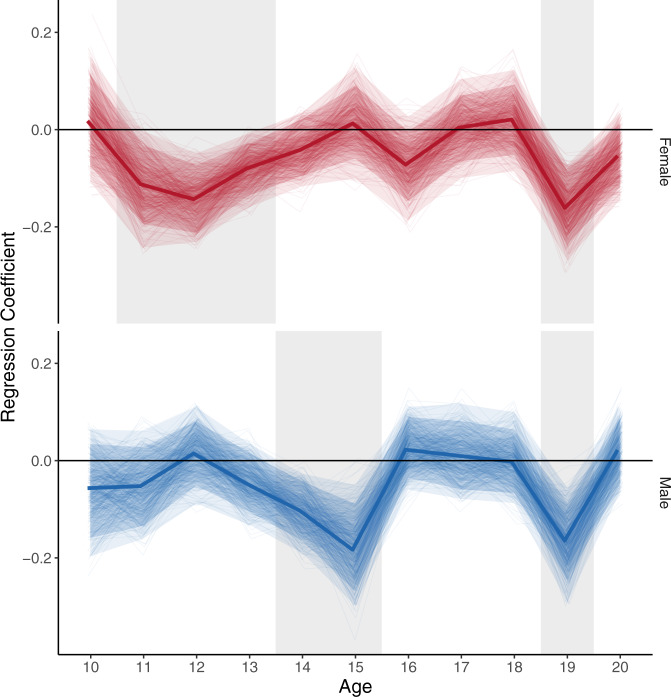
The relationship between social media use and life satisfaction changes across adolescent development. Our analyses of two UK datasets comprising 84,011 participants (10-80 years old) find that the cross-sectional relationship between self-reported estimates of social media use and life satisfaction ratings is most negative in younger adolescents. Furthermore, sex differences in this relationship are only present during this time. Longitudinal analyses of 17,409 participants (10-21 years old) suggest distinct developmental windows of sensitivity to social media in adolescence, when higher estimated social media use predicts a decrease in life satisfaction ratings one year later (and vice-versa: lower estimated social media use predicts an increase in life satisfaction ratings). These windows occur at different ages for males (14-15 and 19 years old) and females (11-13 and 19 years old). Decreases in life satisfaction ratings also predicted subsequent increases in estimated social media use, however, these were not associated with age or sex.
Overview
CoChat Summary
TL;DR
Using two UK longitudinal datasets, the paper finds that the association between estimated social media use and life satisfaction is strongest and most negative in adolescence, with sex differences appearing mainly in early adolescence. In longitudinal analyses of 17,409 adolescents, the authors identify age- and sex-specific “windows of sensitivity” where higher estimated social media use predicts lower life satisfaction one year later.
Key findings
- In cross-sectional analyses of 84,011 participants aged 10–80, the relationship between self-reported social media use and life satisfaction was “most negative in younger adolescents,” and sex differences were “only present during this time.”
- In longitudinal analyses of 17,409 participants aged 10–21, higher estimated social media use predicted lower life satisfaction one year later, and lower estimated social media use predicted higher life satisfaction one year later.
- The longitudinal “windows of sensitivity” differed by sex: females showed effects at ages 11–13 and 19, while males showed effects at ages 14–15 and 19.
- The reverse path also held: decreases in life satisfaction predicted subsequent increases in estimated social media use, and these effects were “not associated with age or sex.”
Methods
- Cross-sectional analysis of two UK datasets: Understanding Society (72,287 participants, surveyed up to seven times between 2011 and 2018) and the Millennium Cohort Study (11,724 participants, 2015 wave; ages 13–14).
- Longitudinal analysis used a Random Intercept Cross-Lagged Panel Model (RI-CLPM) on 17,409 Understanding Society participants aged 10–21 with 52,556 measurement occasions, using robust maximum likelihood, Huber-White standard errors, and FIML for missing data.
- Cross-sectional model comparison used linear/quadratic regressions with Akaike weights; longitudinal model comparison tested equality constraints across age and sex and examined cross-lagged paths between social media use and life satisfaction.
Limitations
- The paper states that causal interpretation would require strong assumptions: no time-varying unobserved confounding, adequate control of time-invariant confounding via the random intercept, no measurement error, a correct one-year time interval, and linear bidirectional links.
- The data are self-report, so the study infers effects of self-estimated social media time rather than objectively measured use.
- Evident from the text: the longitudinal findings are based on annual intervals only, so the authors note that different time frames could yield different results or mechanisms; also, some measures were available only for restricted age ranges, limiting comparisons across ages.
Model-written summary. Check it against the paper before relying on it.
Integrity signals
Registry
Cites
Statistics
Figures
Verification
Claims the paper makes
15 Valid · 1 Not valid · 10 Not checked · 60 Own results and interpretations
The cited sources support only part of this claim — read each source’s verdict below.
In the paper
“and the risk of certain mental health problems such as depression, self-harm, and eating disorders is higher in adolescent females than in males27.”
§ Windows of developmental sensitivity to social media > Introduction
What the sources say
- Partly supportedcites [27] Salk RH Hyde JS Abramson LY Gender differences in depression in representative national samples: Meta-analyses of diagnoses and symptoms Psychol. Bull. 2017 143 783 822 10.1037/bul0000102 28447828 PMC5532074 sourceExperimental — accuracy not yet measured
The Discussion’s Developmental Pattern section reports that the gender difference in depression peaks in adolescence, supporting the depression portion of the claim. The paper does not establish that adolescent females have higher risks of self-harm or eating disorders than males; its Background mentions suicidal behaviors only as a possible later risk associated with subthreshold depression. (LLM, conf=0.90)
plainstates an association- Asserted: passes — The authors put it forward as true.
- Checkable: passes — It can be checked against evidence.
- Load-bearing: passes — The paper’s conclusions depend on it.
- Based: passes — The paper gives a reason why it holds.
- Partly supported
The cited sources support only part of this claim — read each source’s verdict below.
In the paper
“Further, female life satisfaction drops earlier in adolescence25,26”
§ Windows of developmental sensitivity to social media > Introduction
What the sources say
- Partly supportedcites [25] Campbell, O., Bann, D. & Patalay, P. The gender gap in adolescent mental health: a cross-national investigation of 566,827 adolescents across 73 countries. http://medrxiv.org/lookup/doi/10.1101/2020.06.12.20129312 (2020). PMC7960541 33748389 sourceExperimental — accuracy not yet measured
The Results report that girls had lower life satisfaction than boys in most countries. But the Methods (Participants) describe a cross-sectional survey of students aged 15, and the paper does not establish that girls’ life satisfaction drops earlier in adolescence than boys’. (LLM, conf=0.86)
- Not checked — no full text of the sourcecites [26] Orben, A., Lucas, R. E., Fuhrmann, D. & Kievit, R. Trajectories of adolescent life satisfaction. 10.31234/osf.io/y8ruw (2020). PMC9346371 35937913 source
plainstates an association- Asserted: passes — The authors put it forward as true.
- Checkable: passes — It can be checked against evidence.
- Load-bearing: passes — The paper’s conclusions depend on it.
- Based: passes — The paper gives a reason why it holds.
- Partly supported
The cited sources support only part of this claim — read each source’s verdict below.
In the paper
“while experimental evidence is mixed8,9.”
§ Windows of developmental sensitivity to social media > Introduction
What the sources say
- Supportedcites [8] Vanman EJ Baker R Tobin SJ The burden of online friends: The effects of giving up Facebook on stress and well-being J. Soc. Psychol. 2018 158 496 508 10.1080/00224545.2018.1453467 29558267 source
The Discussion (p. 17) contrasts this study’s finding that the Facebook-as-normal group gained well-being with Tromholt’s experimental finding that a no-Facebook group gained well-being. The paper explicitly calls the results an apparent discrepancy, supporting the characterization of experimental evidence as mixed. (LLM, conf=0.92)
- Partly supportedcites [9] Allcott, H. et al. The Welfare Effects of Social Media. https://sites.google.com/site/allcott/research. (2019). sourceExperimental — accuracy not yet measured
The Introduction and §5.3 report experimental evidence that Facebook deactivation improved several well-being measures, while effects measured by daily text messages were not statistically significant. This supports variation across measures in this experiment, but the paper does not establish that experimental evidence across studies is mixed. (LLM, conf=0.80)
plainstates an association- Asserted: passes — The authors put it forward as true.
- Checkable: passes — It can be checked against evidence.
- Load-bearing: passes — The paper’s conclusions depend on it.
- Based: passes — The paper gives a reason why it holds.
- Supported
The sources with a verdict support this claim; the rest weren’t checked yet, have no full text we could read, or their verdicts aren’t rated yet.
In the paper
“Research has highlighted differences between males and females in the links between social media use and well-being in adolescence in a small subset of the analyzed data28, or other datasets10,29–33.”
§ Windows of developmental sensitivity to social media > Introduction
What the sources say
- Supportedcites [28] Booker CL Kelly YJ Sacker A Gender differences in the associations between age trends of social media interaction and well-being among 10–15 year olds in the UK BMC Public Health 2018 18 321 10.1186/s12889-018-5220-4 29554883 PMC5859512 source
The Discussion reports that social media interaction at age 10 was associated with well-being at older ages among females but not males. The paper therefore supports the attributed finding of gender differences in adolescent social-media–well-being links. (LLM, conf=0.92)
- Supportedcites [10] Orben A Dienlin T Przybylski AK Social media’s enduring effect on adolescent life satisfaction Proc. Natl Acad. Sci. USA 2019 116 10226 10228 10.1073/pnas.1902058116 31061122 PMC6534991 source
The paper reports that associations between social media use and adolescent life satisfaction appeared more negative for females across most models, prompting a focused analysis using participants who completed four waves. It cautions that the male and female confidence intervals overlap, so the reported differences should not be read as conclusive. The indexed copy labels these passages “Abstract” and provides no page number. (LLM, conf=0.86)
- Supportedcites [29] Kreski, N. et al. Social media use and depressive symptoms among United States adolescents. J. Adolescent Health10.1016/j.jadohealth.2020.07.006 (2020). PMC7876159 32798102 source
The Results report a positive association between daily social media use and depressive symptoms for girls only in the lowest depression-risk category after stratification. The Discussion contrasts this limited finding with the small, sometimes inverse associations observed among boys. This supports the claim that the paper highlighted sex differences in a subset of its analyzed data. (LLM, conf=0.90)
- Supportedcites [30] Nesi J Prinstein MJ Using social media for social comparison and feedback-seeking: Gender and popularity moderate associations with depressive symptoms J. Abnorm Child Psychol. 2015 43 1427 1438 10.1007/s10802-015-0020-0 25899879 PMC5985443 source
The Abstract reports that gender moderated the association between adolescents’ technology-based social comparison and feedback-seeking and depressive symptoms, with a particularly strong association among females. The Limitations and Conclusions section reiterates this finding. (LLM, conf=0.90)
- Not checked — no full text of the sourcecites [31] Viner RM Roles of cyberbullying, sleep, and physical activity in mediating the effects of social media use on mental health and wellbeing among young people in England: a secondary analysis of longitudinal data Lancet Child Adolesc. Health 2019 3 685 696 10.1016/S2352-4642(19)30186-5 31420213 source
- Not checked — no full text of the sourcecites [32] Twenge JM Martin GN Gender differences in associations between digital media use and psychological well-being: Evidence from three large datasets J. Adolescence 2020 79 91 102 10.1016/j.adolescence.2019.12.018 31926450 source
- Supportedcites [33] Kelly Y Zilanawala A Booker C Sacker A Social media use and adolescent mental health: Findings from the UK millennium cohort study EClinicalMedicine 2019 6 59 68 10.1016/j.eclinm.2018.12.005 31193561 PMC6537508 source
The Results section reports that the association between social media use and depressive symptoms was stronger for girls than for boys. The Discussion likewise identifies this gender difference among UK adolescents, supporting the cited point about differences in the social-media-use and well-being link. (LLM, conf=0.92)
plainstates an association- Asserted: passes — The authors put it forward as true.
- Checkable: passes — It can be checked against evidence.
- Load-bearing: passes — The paper’s conclusions depend on it.
- Based: passes — The paper gives a reason why it holds.
- Supported
The cited sources support only part of this claim — read each source’s verdict below.
In the paper
“It is therefore plausible that these processes heighten adolescents’ sensitivity to the interactive, communicative, and self-portraying nature of social media22, a technology they use more extensively than other age groups23,24.”
§ Windows of developmental sensitivity to social media > Introduction
What the sources say
- Supportedcites [22] Crone EA Konijn EA Media use and brain development during adolescence Nat. Commun. 2018 9 1 10 10.1038/s41467-018-03126-x 29467362 PMC5821838 source
The Introduction links adolescent brain development to heightened sensitivity to social influences through social media. The Conclusion describes social media as a means of connecting with others and presenting oneself, and suggests that developing sensitivities may make adolescents especially susceptible to its effects. The separate claim about how extensively adolescents use it is attributed to other citations. (LLM, conf=0.91)
- Not matchedcites [23] Ofcom. Children and parents: media use and attitudes report 2018. 1–17 https://www.ofcom.org.uk/research-and-data/media-literacy-research/childrens/children-and-parents-media-use-and-attitudes-report-2018 (2019).
We searched by its title and found no matching paper.
- Not matchedcites [24] Pew Research Centre. A quarter of Americans are online almost constantly | Pew Research Center. https://www.pewresearch.org/fact-tank/2021/03/26/about-three-in-ten-u-s-adults-say-they-are-almost-constantly-online/?msclkid=e6109554a61811ec875c44156f6f50c7 (2018).
We searched by its title and found no matching paper.
hedgedstates a possible cause- Asserted: passes — The authors put it forward as true.
- Checkable: passes — It can be checked against evidence.
- Load-bearing: passes — The paper’s conclusions depend on it.
- Based: passes — The paper gives a reason why it holds.
- Supported
47 more claims · 3 with their cited sources checked
Create a free account to see all 86 claims and every source verdict.
- It may state two separate claims as one. 14
- Probably not a substantial claim. 25
Claims other papers make about this one
Each is checked against this paper’s own text: does it say what the citing paper says it does?
The source backs part of the claim, not all of it — or backs it for a different population, condition or comparison.
In the citing paper
“Teens’ developmental stages is another area of differential susceptibility, with younger teens experiencing less life satisfaction and higher depression symptoms when they use more social media, as compared with older teens.137,144”
From Digital Ecosystems, Children, and Adolescents: Technical Report (2026) · cites this paper as [144]
Experimental — accuracy not yet measuredThe source backs part of the claim, not all of it — or backs it for a different population, condition or comparison.
In the citing paper
“In contrast, younger adolescents aged approximately 10-15 years remain comparatively underrepresented in the literature despite occupying a potentially important developmental period marked by increasing social media engagement and evolving identity formation [34, 35].”
From The Complex and Multifaceted Nature of Social Media: Perspectives From Young Adolescents, Parents and Experts (2026) · cites this paper as [35]
Experimental — accuracy not yet measuredThe source backs part of the claim, not all of it — or backs it for a different population, condition or comparison.
In the citing paper
“Social media use increases dramatically in adolescence, and this too might affect the way that the brain develops and could contribute to social pressures, mental ill health, and life satisfaction (figure 3). 189,190”
From The Lancet Psychiatry Commission on youth mental health (2024) · cites this paper as [189]
Experimental — accuracy not yet measuredThe cited source says what the claim attributes to it.
In the citing paper
“In general, early adolescence (10-15 years) 152 may represent a time of relatively greater susceptibility to the effects of social media (eg, lower life satisfaction).144”
From Digital Ecosystems, Children, and Adolescents: Technical Report (2026) · cites this paper as [144]
The cited source says what the claim attributes to it.
In the citing paper
“social media use has differential effects depending on the developmental timing [65]”
From Towards a youth mental health paradigm: a perspective and roadmap (2023) · cites this paper as [65]
4 more claims about this paper
Create a free account to see every claim other papers make about this one.
Statistics recomputed
Every reported test result, recomputed from its test statistic and degrees of freedom. A result shows as not adding up only once an independent check has confirmed it.
- Consistentχ²(434) = 1216.29reported p < .001 · recomputed p < .001
“χ2 (434) = 1216.29, p < .001”
- Consistentχ²(455) = 1234.736reported p < .001 · recomputed p < .001
“χ2 (455) = 1234.736, p < .001”
- Consistentt(3) = 0.33reported p = .77 · recomputed p = .763
“t(3) = 0.33, p = .77”
- Consistentt(37) = 1.74reported p = .09 · recomputed p = .090
“t(37) = 1.74, p = .09”
- Consistentχ²(63) = 2023reported p < .001 · recomputed p < .001
“χ2(63) = 2023, p < .001”
6 more recomputed tests
Create a free account to see every test the Stats check recomputed.
Self-check
Percentages, sums and reported differences re-computed from the paper’s own numbers.
Self-check results appear here once an independent check has confirmed them.
Citations
Cites
lavaan : An R Package for Structural Equation Modeling
Rosseel, Y. (2012) · Journal of Statistical Software · doi:10.18637/jss.v048.i02 · Cited by 27,955
Emerging adulthood: A theory of development from the late teens through the twenties.
Arnett, J. J. (2000) · American Psychologist · doi:10.1037/0003-066x.55.5.469 · Cited by 16,843
A critique of the cross-lagged panel model
Hamaker, E. L., Kuiper, R. M., & Grasman, R. P. P. P. (2015) · Psychological Methods · doi:10.1037/a0038889 · Cited by 4,005
Sawyer, S. M., Azzopardi, P. S., Wickremarathne, D., & Patton, G. C. (2018) · The Lancet Child & Adolescent Health · doi:10.1016/s2352-4642(18)30022-1 · Cited by 3,666
Effect size guidelines for individual differences researchers
Gignac, G. E., & Szodorai, E. T. (2016) · Personality and Individual Differences · doi:10.1016/j.paid.2016.06.069 · Cited by 2,860
Rhemtulla, M., Brosseau-Liard, P. É., & Savalei, V. (2012) · Psychological Methods · doi:10.1037/a0029315 · Cited by 2,816
AIC model selection using Akaike weights
Wagenmakers, E.-J., & Farrell, S. (2004) · Psychonomic Bulletin & Review · doi:10.3758/bf03206482 · Cited by 2,684
Salk, R. H., Hyde, J. S., & Abramson, L. Y. (2017) · Psychological Bulletin · doi:10.1037/bul0000102 · Cited by 2,622
Is Adolescence a Sensitive Period for Sociocultural Processing?
Blakemore, S.-J., & Mills, K. L. (2014) · Annual Review of Psychology · doi:10.1146/annurev-psych-010213-115202 · Cited by 2,264
Self-citationTwenge, J. M., Joiner, T. E., Rogers, M. L., & Martin, G. N. (2018) · Clinical Psychological Science · doi:10.1177/2167702617723376 · Cited by 1,705
Facebook Use Predicts Declines in Subjective Well-Being in Young Adults
Kross, E., Verduyn, P., Demiralp, E., Park, J., Lee, D. S., Lin, N., Shablack, H., Jonides, J., & Ybarra, O. (2013) · PLoS ONE · doi:10.1371/journal.pone.0069841 · Cited by 1,596
The association between adolescent well-being and digital technology use
Orben, A., & Przybylski, A. K. (2019) · Nature Human Behaviour · doi:10.1038/s41562-018-0506-1 · Cited by 1,500
Self-citationThe Differential Susceptibility to Media Effects Model
Valkenburg, P. M., & Peter, J. (2013) · Journal of Communication · doi:10.1111/jcom.12024 · Cited by 1,340
LIFESPAN PSYCHOLOGY: Theory and Application to Intellectual Functioning
Baltes, P. B., Staudinger, U. M., & Lindenberger, U. (1999) · Annual Review of Psychology · doi:10.1146/annurev.psych.50.1.471 · Cited by 1,281
Odgers, C. L., & Jensen, M. R. (2020) · Journal of Child Psychology and Psychiatry · doi:10.1111/jcpp.13190 · Cited by 1,189
A Primer on Maximum Likelihood Algorithms Available for Use With Missing Data
Enders, C. K. (2001) · Structural Equation Modeling: A Multidisciplinary Journal · doi:10.1207/s15328007sem0801_7 · Cited by 1,027
A dynamical model of general intelligence: The positive manifold of intelligence by mutualism.
Van Der Maas, H. L. J., Dolan, C. V., Grasman, R. P. P. P., Wicherts, J. M., Huizenga, H. M., & Raijmakers, M. E. J. (2006) · Psychological Review · doi:10.1037/0033-295x.113.4.842 · Cited by 1,006
Przybylski, A. K., & Weinstein, N. (2017) · Psychological Science · doi:10.1177/0956797616678438 · Cited by 890
Self-citationOptimal time lags in panel studies.
Dormann, C., & Griffin, M. A. (2015) · Psychological Methods · doi:10.1037/met0000041 · Cited by 856 · cited 2×
“A model constraining the cross-lagged paths of interest also suffered a significant drop in model fit: χ2(42) = 77.”
BackgroundMethodThe Process of Successful Ageing
Baltes, M. M., & Carstensen, L. L. (1996) · Ageing and Society · doi:10.1017/s0144686x00003603 · Cited by 848
Nesi, J., & Prinstein, M. J. (2015) · Journal of Abnormal Child Psychology · doi:10.1007/s10802-015-0020-0 · Cited by 758
Social media use and adolescent mental health: Findings from the UK Millennium Cohort Study
Kelly, Y., Zilanawala, A., Booker, C., & Sacker, A. (2018) · EClinicalMedicine · doi:10.1016/j.eclinm.2018.12.005 · Cited by 740
Lachman, M. E. (2004) · Annual Review of Psychology · doi:10.1146/annurev.psych.55.090902.141521 · Cited by 664
Twenge, J. M., & Martin, G. N. (2020) · Journal of Adolescence · doi:10.1016/j.adolescence.2019.12.018 · Cited by 582
Taking Account of Time Lags in Causal Models
Gollob, H. F., & Reichardt, C. S. (1987) · Child Development · doi:10.2307/1130293 · Cited by 572
Simpson's paradox in psychological science: a practical guide
Kievit, R. A., Frankenhuis, W. E., Waldorp, L. J., & Borsboom, D. (2013) · Frontiers in Psychology · doi:10.3389/fpsyg.2013.00513 · Cited by 542
Self-citationSocial media’s enduring effect on adolescent life satisfaction
Orben, A., Dienlin, T., & Przybylski, A. K. (2019) · Proceedings of the National Academy of Sciences · doi:10.1073/pnas.1902058116 · Cited by 485
Self-citationCampbell, O., Bann, D., & Patalay, P. (2020) · doi:10.1101/2020.06.12.20129312 · Cited by 484
Media use and brain development during adolescence
Crone, E. A., & Konijn, E. A. (2018) · Nature Communications · doi:10.1038/s41467-018-03126-x · Cited by 464
A unified framework of longitudinal models to examine reciprocal relations.
Usami, S., Murayama, K., & Hamaker, E. L. (2019) · Psychological Methods · doi:10.1037/met0000210 · Cited by 437
Pfeifer, J. H., & Allen, N. B. (2021) · Biological Psychiatry · doi:10.1016/j.biopsych.2020.09.002 · Cited by 411
Navigating the Social Environment in Adolescence: The Role of Social Brain Development
Andrews, J. L., Ahmed, S. P., & Blakemore, S.-J. (2021) · Biological Psychiatry · doi:10.1016/j.biopsych.2020.09.012 · Cited by 337
Self-citationViner, R. M., Gireesh, A., Stiglic, N., Hudson, L. D., Goddings, A.-L., Ward, J. L., & Nicholls, D. E. (2019) · The Lancet Child & Adolescent Health · doi:10.1016/s2352-4642(19)30186-5 · Cited by 295
Are Social Media Ruining Our Lives? A Review of Meta-Analytic Evidence
Appel, M., Marker, C., & Gnambs, T. (2020) · Review of General Psychology · doi:10.1177/1089268019880891 · Cited by 290
Heffer, T., Good, M., Daly, O., MacDonell, E., & Willoughby, T. (2019) · Clinical Psychological Science · doi:10.1177/2167702618812727 · Cited by 278
Booker, C. L., Kelly, Y. J., & Sacker, A. (2018) · BMC Public Health · doi:10.1186/s12889-018-5220-4 · Cited by 268
Jensen, M., George, M. J., Russell, M. R., & Odgers, C. L. (2019) · Clinical Psychological Science · doi:10.1177/2167702619859336 · Cited by 242
The burden of online friends: The effects of giving up Facebook on stress and well-being
Vanman, E. J., Baker, R., & Tobin, S. J. (2018) · The Journal of Social Psychology · doi:10.1080/00224545.2018.1453467 · Cited by 168
The debate over digital technology and young people
Bell, V., Bishop, D. V. M., & Przybylski, A. K. (2015) · BMJ · doi:10.1136/bmj.h3064 · Cited by 143
Self-citationTrajectories of adolescent life satisfaction
Orben, A., Lucas, R. E., Fuhrmann, D., & Kievit, R. A. (2022) · Royal Society Open Science · doi:10.1098/rsos.211808 · Cited by 109
Self-citationSocial Media Use and Depressive Symptoms Among United States Adolescents
Kreski, N., Platt, J., Rutherford, C., Olfson, M., Odgers, C., Schulenberg, J., & Keyes, K. M. (2021) · Journal of Adolescent Health · doi:10.1016/j.jadohealth.2020.07.006 · Cited by 97
The Welfare Effects of Social Media
Allcott, H., Braghieri, L., Eichmeyer, S., & Gentzkow, M. (2019) · doi:10.3386/w25514 · Cited by 81
The Welfare Effects of Social MediaPreprint
Allcott, H., Braghieri, L., Eichmeyer, S., & Gentzkow, M. A. (2018) · SSRN Electronic Journal · doi:10.2139/ssrn.3308640 · Cited by 27
Understanding Society: Waves 1-8, 2009-2017 and Harmonised BHPS: Waves 1-18, 1991-2009
University Of Essex, I. F. S. (2019) · UK Data Service · doi:10.5255/ukda-sn-6614-12 · Cited by 26
Trajectories of adolescent life satisfaction
Orben, A., Lucas, R. E., Fuhrmann, D., & Kievit, R. (2020) · doi:10.31234/osf.io/y8ruw · Cited by 16
Self-citationWomen's Livelihoods, Global Markets and Citizenship
Thekkudan, J., & Tandon, R. (2009) · IDS Working Papers · doi:10.1111/j.2040-0209.2009.00336_2.x · Cited by 12
CMO report is unable to shed light on impact of screen time and social media on children’s health
Hawkes, N. (2019) · BMJ · doi:10.1136/bmj.l643 · Cited by 12
Millennium Cohort Study: Sixth Survey, 2015
University Of London. Institute Of Education. Centre For Longitudinal Studies (2017) · Colchester, Essex: UK Data Archive · doi:10.5255/ukda-sn-8156-2 · Cited by 3
Research works printed but not linked: 1
- Grimes, T., Anderson, J. A. & Bergen, L. Media Violence and Aggression: Science and Ideology (SAGE, 2008).
Cited by
The Lancet Psychiatry Commission on youth mental health
McGorry, P. D., Mei, C., Dalal, N., Alvarez-Jimenez, M., Blakemore, S.-J., Browne, V., Dooley, B., Hickie, I. B., Jones, P. B., McDaid, D., et al. (2024) · The Lancet Psychiatry · doi:10.1016/s2215-0366(24)00163-9 · Cited by 663
Self-citationChoukas-Bradley, S., Roberts, S. R., Maheux, A. J., & Nesi, J. (2021) · doi:10.31234/osf.io/ju92a · Cited by 331
Choukas-Bradley, S., Roberts, S. R., Maheux, A. J., & Nesi, J. (2022) · Clinical Child and Family Psychology Review · doi:10.1007/s10567-022-00404-5 · Cited by 333
“Individual differences in pubertal status and timing will also be important to consider: pubertal status has been hypothesized to play a role in adolescents’ responses to SM (Orben et al., 2022), and early pubertal timing has been associated with risk for poor body image and eating disorders (Mendle et al.”
BackgroundTowards a youth mental health paradigm: a perspective and roadmap
Uhlhaas, P. J., Davey, C. G., Mehta, U. M., Shah, J., Torous, J., Allen, N. B., Avenevoli, S., Bella-Awusah, T., Chanen, A., Chen, E. Y. H., et al. (2023) · Molecular Psychiatry · doi:10.1038/s41380-023-02202-z · Cited by 318
“Thus, social media use has differential effects depending on the developmental timing [65], suggesting that sensitive periods during youth may be particularly malleable by environmental exposures [66].”
BackgroundMechanisms linking social media use to adolescent mental health vulnerability
Orben, A., Meier, A., Dalgleish, T., & Blakemore, S.-J. (2024) · Nature Reviews Psychology · doi:10.1038/s44159-024-00307-y · Cited by 220
“Some longitudinal studies found that a decrease in adolescent well-being predicted an increase in social media use 1 year later 47,59 .”
Self-citation
Metadata
- Authors
- Orben, A., Przybylski, A. K., Blakemore, S.-J., & Kievit, R. A.
- Affiliations
- MRC Cognition and Brain Sciences Unit (GB)
- University of Oxford (GB)
- University of Cambridge (GB)
- Corresponding author
- Orben, Amy
- Venue
- Nature Communications
- Published
- 2022-03-28
- Volume
- 13
- Issue
- 1
- Pages
- 1649-1649
- ISSN
- 2041-1723 (ISSN-L)
- PMC
- PMC8960761
- OpenAlex
- W4220990449
- Cited by
- 387
- References
- 49
- Citations by year
- 2026: 108 · 2025: 112 · 2024: 82 · 2023: 61 · 2022: 23
- FWCI
- 99.98
- Type
- journal article
- Language
- en
- Open access
- gold
- doi.org
- Licence
- cc-by
- creativecommons.org/licenses/by/4.0 (tdm)
- creativecommons.org/licenses/by/4.0 (vor)
- Locations
- Nature Communications (publishedVersion, cc-by)
- PubMed Central (publishedVersion, cc-by)
- PubMed (publishedVersion)
- RePEc: Research Papers in Economics (submittedVersion)
- DOAJ (DOAJ: Directory of Open Access Journals) (submittedVersion)
- Radboud Repository (Radboud University) (submittedVersion)
- OSF Preprints (OSF Preprints) (submittedVersion)
- Apollo (University of Cambridge) (submittedVersion, cc-by)
- Radboud Repository (Radboud University) (submittedVersion, other-oa)
- Apollo
- Apollo (cc-by)
- Funders
- RCUK | Economic and Social Research Council (ES/T008709/1)
- RCUK | Medical Research Council (SWAG/076.G101400, SUAG/047 G101400)
- University of Cambridge | Emmanuel College, University of Cambridge (Research Fellowship)
- Wellcome Trust (WT107496/Z/15/Z)
- Jacobs Foundation
- University of Cambridge
- Topics
- Social Sciences › Sociology and Political Science › Impact of Technology on Adolescents
- Social Sciences › Education › Child Development and Digital Technology
- Social Sciences › Psychology › Social Psychology › Psychological Well-being and Life Satisfaction
- Keywords
- social media use, life satisfaction, adolescent development, developmental windows, sex differences, longitudinal change, well-being
- MeSH terms
- Adolescent, Adult, Aged, Aged, 80 and over, Child, Female, Humans, Longitudinal Studies, Male, Middle Aged, Adolescent Development, Young Adult, Self Report, Social Media
About these checks
Registry, retraction, Cites and statistics results are computed, not judged, with one exception: a printed reference that no index lists is read once by a model before it counts as a citation error. Claims are extracted by a model and kept only when their quote appears verbatim in the text; each cited source is then checked, with a model’s help, for whether it says what the claim relies on. Those verdicts can be wrong — read the claim’s quote and the cited source before relying on one.
The claim verdicts this report counts are experimental: their accuracy is not yet measured.
A language model drew the claims from the paper on 2026-10-10, under version 3 of the claim definition (model deepseek-v4.1-flash, prompt extract-v3).
A second model labelled each claim on 2026-10-10 (model jev-1.13-20260917, definition revision gold-guideline-v0.2).
Cited sources are checked with a language model’s help (gpt-6-sol).
Statistics and arithmetic are recomputed, not judged.
Confidence bands are shown only for fields calibrated on our annotated test set. None is calibrated yet, so no band is shown.
What counts as a claim ›How we measure confidence ›How we check this ›
Are you an author, or do you see a problem with this page? Request a review
Data sources
Bibliographic data: Semantic Scholar, OpenAlex, Crossref.
Contains information from the Semantic Scholar Academic Graph Datasets, made available under the ODC Attribution License (ODC-BY 1.0).
Semantic Scholar’s data is described in: Kinney, R., et al. (2023). The Semantic Scholar Open Data Platform. arXiv:2301.10140.
