

An analysis of neuroscience and psychiatry papers published from 2009 and 2019 outlines opportunities for increasing discovery of sex differences
Open accessThe DOI matches its Crossref record; 76 of the 76 references it cites were found in a registry or an index.
Abstract
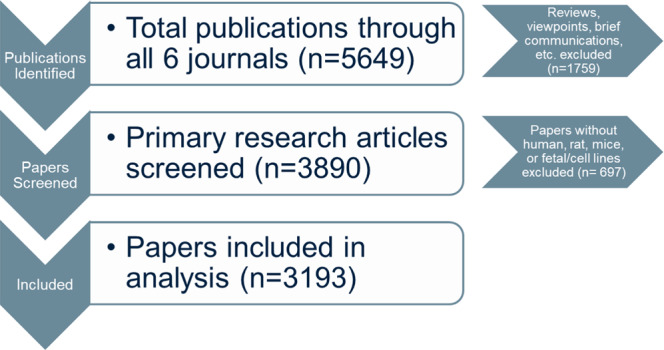
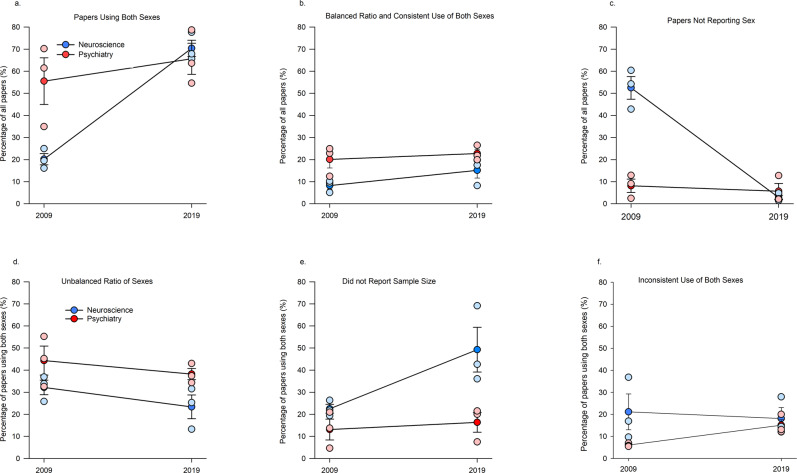
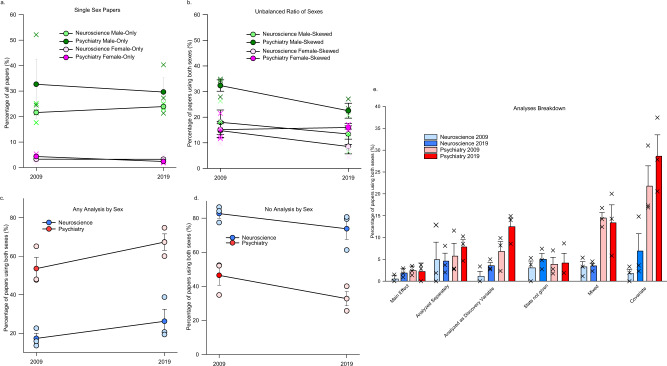
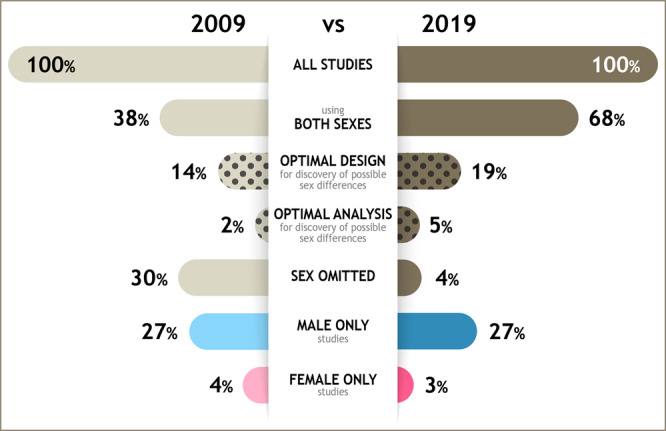
Sex differences exist in many neurological and psychiatric diseases, but these have not always been addressed adequately in research. In order to address this, it is necessary to consider how sex is incorporated into the design (e.g. using a balanced design) and into the analyses (e.g. using sex as a covariate) in the published literature. We surveyed papers published in 2009 and 2019 across six journals in neuroscience and psychiatry. In this sample, we find a 30% increase in the percentage of papers reporting studies that included both sexes in 2019 compared with 2009. Despite this increase, in 2019 only 19% of papers in the sample reported using an optimal design for discovery of possible sex differences, and only 5% of the papers reported studies that analysed sex as a discovery variable. We conclude that progress to date has not been sufficient to address the importance of sex differences in research for discovery and therapeutic potential for neurological and psychiatric disease.
Overview
The claims and statistics of this paper haven’t been checked yet.
Free: it reads the open-access text and checks the first 5 claims that cite a source we can check. Create a free account to check every claim.
Integrity signals
Registry
Cites
Statistics
Figures
Verification
Claims the paper makes
The claims and statistics of this paper haven’t been checked yet.
Free: it reads the open-access text and checks the first 5 claims that cite a source we can check. Create a free account to check every claim.
Claims other papers make about this one
Each is checked against this paper’s own text: does it say what the citing paper says it does?
The cited source says what the claim attributes to it.
In the citing paper
“Some research has excluded females or treated sex/gender as confounds to adjust for, rather than examining sex and gender attributes as substantive predictors, moderators or mediators in their own right, which is suboptimal187,303.”
From Sex and gender in neurodevelopmental conditions (2023) · cites this paper as [303]
Self-check
Percentages, sums and reported differences re-computed from the paper’s own numbers.
The self-check needs the paper’s full text.
Citations
Cites
Sex and Gender Equity in Research: rationale for the SAGER guidelines and recommended use
Heidari, S., Babor, T. F., De Castro, P., Tort, S., & Curno, M. (2016) · Research Integrity and Peer Review · doi:10.1186/s41073-016-0007-6 · Cited by 2,184
Sex and gender: modifiers of health, disease, and medicine
Mauvais-Jarvis, F., Bairey Merz, N., Barnes, P. J., Brinton, R. D., Carrero, J.-J., DeMeo, D. L., De Vries, G. J., Epperson, C. N., Govindan, R., Klein, S. L., et al. (2020) · The Lancet · doi:10.1016/s0140-6736(20)31561-0 · Cited by 2,001 · cited 10×
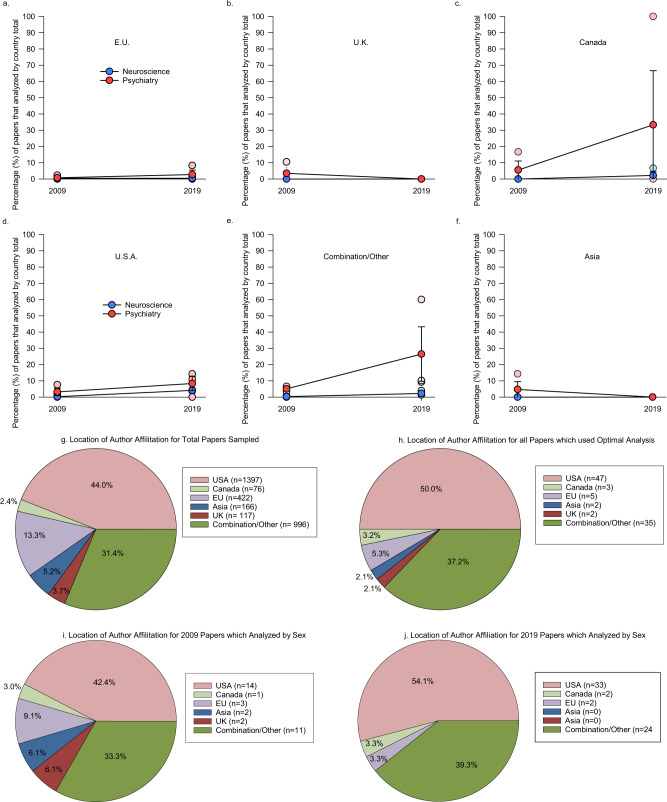
“These included: (1) sample sizes were not given (25%); (2) the proportions (>60% in one sex) of the sexes used in the studies within the paper were substantially different (34%); or (3) both sexes were not used consistently throughout the studies within a particular paper (15%, Fig.”
BackgroundInfluentialPolicy: NIH to balance sex in cell and animal studies
Clayton, J. A., & Collins, F. S. (2014) · Nature · doi:10.1038/509282a · Cited by 1,816
Sex bias in neuroscience and biomedical research
Beery, A. K., & Zucker, I. (2011) · Neuroscience & Biobehavioral Reviews · doi:10.1016/j.neubiorev.2010.07.002 · Cited by 1,763
Different immune cells mediate mechanical pain hypersensitivity in male and female mice
Sorge, R. E., Mapplebeck, J. C. S., Rosen, S., Beggs, S., Taves, S., Alexander, J. K., Martin, L. J., Austin, J.-S., Sotocinal, S. G., Chen, D., et al. (2015) · Nature Neuroscience · doi:10.1038/nn.4053 · Cited by 1,442
Samji, H., Cescon, A., Hogg, R. S., Modur, S. P., Althoff, K. N., Buchacz, K., Burchell, A. N., Cohen, M., Gebo, K. A., Gill, M. J., et al. (2013) · PLoS ONE · doi:10.1371/journal.pone.0081355 · Cited by 1,417
Sex Differences in Pharmacokinetics and Pharmacodynamics
Soldin, O. P., & Mattison, D. R. (2009) · Clinical Pharmacokinetics · doi:10.2165/00003088-200948030-00001 · Cited by 1,163
Sex/Gender Differences in Cardiovascular Disease Prevention: What a Difference a Decade Makes
Mosca, L., Barrett-Connor, E., & Kass Wenger, N. (2011) · Circulation · doi:10.1161/circulationaha.110.968792 · Cited by 1,045
Understanding the impact of sex and gender in Alzheimer’s disease: A call to action
Nebel, R. A., Aggarwal, N. T., Barnes, L. L., Gallagher, A., Goldstein, J. M., Kantarci, K., Mallampalli, M. P., Mormino, E. C., Scott, L., Yu, W. H., et al. (2018) · Alzheimer's & Dementia · doi:10.1016/j.jalz.2018.04.008 · Cited by 839
Female mice liberated for inclusion in neuroscience and biomedical research
Prendergast, B. J., Onishi, K. G., & Zucker, I. (2014) · Neuroscience & Biobehavioral Reviews · doi:10.1016/j.neubiorev.2014.01.001 · Cited by 788
Sex differences in pharmacokinetics predict adverse drug reactions in women
Zucker, I., & Prendergast, B. J. (2020) · Biology of Sex Differences · doi:10.1186/s13293-020-00308-5 · Cited by 777
Sex Differences in Animal Models: Focus on Addiction
Becker, J. B., & Koob, G. F. (2016) · Pharmacological Reviews · doi:10.1124/pr.115.011163 · Cited by 725
Sex Differences in the Brain: The Not So Inconvenient Truth
McCarthy, M. M., Arnold, A. P., Ball, G. F., Blaustein, J. D., & De Vries, G. J. (2012) · The Journal of Neuroscience · doi:10.1523/jneurosci.5372-11.2012 · Cited by 724
Pham, K., Nacher, J., Hof, P. R., & McEwen, B. S. (2003) · European Journal of Neuroscience · doi:10.1046/j.1460-9568.2003.02513.x · Cited by 657
Grandi, S. M., Filion, K. B., Yoon, S., Ayele, H. T., Doyle, C. M., Hutcheon, J. A., Smith, G. N., Gore, G. C., Ray, J. G., Nerenberg, K., et al. (2019) · Circulation · doi:10.1161/circulationaha.118.036748 · Cited by 610
Women’s involvement in clinical trials: historical perspective and future implications
Liu, K. A., & DiPietro Mager, N. A. (2016) · Pharmacy Practice · doi:10.18549/pharmpract.2016.01.708 · Cited by 476
Female rats are not more variable than male rats: a meta-analysis of neuroscience studies
Becker, J. B., Prendergast, B. J., & Liang, J. W. (2016) · Biology of Sex Differences · doi:10.1186/s13293-016-0087-5 · Cited by 473
Sex differences in depression: Insights from clinical and preclinical studies
Eid, R. S., Gobinath, A. R., & Galea, L. A. M. (2019) · Progress in Neurobiology · doi:10.1016/j.pneurobio.2019.01.006 · Cited by 457
Self-citationConsidering sex as a biological variable will require a global shift in science culture
Shansky, R. M., & Murphy, A. Z. (2021) · Nature Neuroscience · doi:10.1038/s41593-021-00806-8 · Cited by 428
Sex differences in vaccine-induced humoral immunity
Fischinger, S., Boudreau, C. M., Butler, A. L., Streeck, H., & Alter, G. (2019) · Seminars in Immunopathology · doi:10.1007/s00281-018-0726-5 · Cited by 410
Comparison and benchmark of name-to-gender inference services
Santamaría, L., & Mihaljević, H. (2018) · PeerJ Computer Science · doi:10.7717/peerj-cs.156 · Cited by 401
Considering sex as a biological variable in preclinical research
Miller, L. R., Marks, C., Becker, J. B., Hurn, P. D., Chen, W., Woodruff, T., McCarthy, M. M., Sohrabji, F., Schiebinger, L., Wetherington, C. L., et al. (2017) · The FASEB Journal · doi:10.1096/fj.201600781r · Cited by 391
Inclusion of females does not increase variability in rodent research studies
Beery, A. K. (2018) · Current Opinion in Behavioral Sciences · doi:10.1016/j.cobeha.2018.06.016 · Cited by 362
A 10-year follow-up study of sex inclusion in the biological sciences
Woitowich, N. C., Beery, A., & Woodruff, T. (2020) · eLife · doi:10.7554/elife.56344 · Cited by 320
Geller, S. E., Koch, A. R., Roesch, P., Filut, A., Hallgren, E., & Carnes, M. (2018) · Academic Medicine · doi:10.1097/acm.0000000000002027 · Cited by 314
Mazure, C. M., & Jones, D. P. (2015) · BMC Women's Health · doi:10.1186/s12905-015-0251-9 · Cited by 305
Sugimoto, C. R., Ahn, Y.-Y., Smith, E., Macaluso, B., & Larivière, V. (2019) · The Lancet · doi:10.1016/s0140-6736(18)32995-7 · Cited by 305
Greater cognitive deterioration in women than men with Alzheimer's disease: A meta analysis
Irvine, K., Laws, K. R., Gale, T. M., & Kondel, T. K. (2012) · Journal of Clinical and Experimental Neuropsychology · doi:10.1080/13803395.2012.712676 · Cited by 290
Sex differences and the neurobiology of affective disorders
Rubinow, D. R., & Schmidt, P. J. (2019) · Neuropsychopharmacology · doi:10.1038/s41386-018-0148-z · Cited by 280
Population-wide analysis of differences in disease progression patterns in men and women
Westergaard, D., Moseley, P., Sørup, F. K. H., Baldi, P., & Brunak, S. (2019) · Nature Communications · doi:10.1038/s41467-019-08475-9 · Cited by 274
Rich-Edwards, J. W., Kaiser, U. B., Chen, G. L., Manson, J. E., & Goldstein, J. M. (2018) · Endocrine Reviews · doi:10.1210/er.2017-00246 · Cited by 273
Sex as an important biological variable in biomedical research
Lee, S. K. (2018) · BMB Reports · doi:10.5483/bmbrep.2018.51.4.034 · Cited by 258
Chronic stress and social housing differentially affect neurogenesis in male and female rats
Westenbroek, C., Den Boer, J. A., Veenhuis, M., & Ter Horst, G. J. (2004) · Brain Research Bulletin · doi:10.1016/j.brainresbull.2004.08.006 · Cited by 249
Reporting and misreporting of sex differences in the biological sciences
Garcia-Sifuentes, Y., & Maney, D. L. (2021) · eLife · doi:10.7554/elife.70817 · Cited by 241
Nielsen, M. W., Andersen, J. P., Schiebinger, L., & Schneider, J. W. (2017) · Nature Human Behaviour · doi:10.1038/s41562-017-0235-x · Cited by 231
Do you know the sex of your cells?
Shah, K., McCormack, C. E., & Bradbury, N. A. (2014) · American Journal of Physiology-Cell Physiology · doi:10.1152/ajpcell.00281.2013 · Cited by 219
Oberlander, J. G., & Woolley, C. S. (2016) · The Journal of Neuroscience · doi:10.1523/jneurosci.4437-15.2016 · Cited by 213
Considering Sex as a Biological Variable Will Be Valuable for Neuroscience Research
Shansky, R. M., & Woolley, C. S. (2016) · The Journal of Neuroscience · doi:10.1523/jneurosci.1390-16.2016 · Cited by 191
Häfner, H., Riecher-Rössler, A., Maurer, K., Fätkenheuer, B., & Löffler, W. (1992) · European Archives of Psychiatry and Clinical Neuroscience · doi:10.1007/bf02191557 · Cited by 190
Quantifying Sex Bias in Clinical Studies at Scale With Automated Data Extraction
Feldman, S., Ammar, W., Lo, K., Trepman, E., van Zuylen, M., & Etzioni, O. (2019) · JAMA Network Open · doi:10.1001/jamanetworkopen.2019.6700 · Cited by 177
González, M., Cabrera‐Socorro, A., Pérez‐García, C. G., Fraser, J. D., López, F. J., Alonso, R., & Meyer, G. (2007) · Journal of Comparative Neurology · doi:10.1002/cne.21419 · Cited by 167
The importance of studying sex differences in disease: The example of multiple sclerosis
Golden, L. C., & Voskuhl, R. (2017) · Journal of Neuroscience Research · doi:10.1002/jnr.23955 · Cited by 166
White, J., Tannenbaum, C., Klinge, I., Schiebinger, L., & Clayton, J. (2021) · The Journal of Clinical Endocrinology & Metabolism · doi:10.1210/clinem/dgab434 · Cited by 162
Problems and Progress regarding Sex Bias and Omission in Neuroscience Research
Will, T. R., Proaño, S. B., Thomas, A. M., Kunz, L. M., Thompson, K. C., Ginnari, L. A., Jones, C. H., Lucas, S.-C., Reavis, E. M., Dorris, D. M., et al. (2017) · eneuro · doi:10.1523/eneuro.0278-17.2017 · Cited by 154
Lewis, C. A., Kimmig, A.-C. S., Zsido, R. G., Jank, A., Derntl, B., & Sacher, J. (2019) · Current Psychiatry Reports · doi:10.1007/s11920-019-1095-z · Cited by 145
Verma, P., Hellemans, K. G. C., Choi, F. Y., Yu, W., & Weinberg, J. (2010) · Physiology & Behavior · doi:10.1016/j.physbeh.2009.11.002 · Cited by 136
Mamlouk, G. M., Dorris, D. M., Barrett, L. R., & Meitzen, J. (2020) · Frontiers in Neuroendocrinology · doi:10.1016/j.yfrne.2020.100835 · Cited by 130
Women in clinical trials: a review of policy development and health equity in the Canadian context
Yakerson, A. (2019) · International Journal for Equity in Health · doi:10.1186/s12939-019-0954-x · Cited by 113
Grégoire, C.-A., Bonenfant, D., Le Nguyen, A., Aumont, A., & Fernandes, K. J. L. (2014) · PLoS ONE · doi:10.1371/journal.pone.0086237 · Cited by 108
Dagytė, G., Van der Zee, E. A., Postema, F., Luiten, P. G. M., Den Boer, J. A., Trentani, A., & Meerlo, P. (2009) · Neuroscience · doi:10.1016/j.neuroscience.2009.05.053 · Cited by 105
Hyatt, C. S., Owens, M. M., Crowe, M. L., Carter, N. T., Lynam, D. R., & Miller, J. D. (2019) · NeuroImage · doi:10.1016/j.neuroimage.2019.116225 · Cited by 103
The promises and pitfalls of sex difference research
Galea, L. A. M., Choleris, E., Albert, A., McCarthy, M. M., & Sohrabji, F. (2019) · Frontiers in Neuroendocrinology · doi:10.1016/j.yfrne.2019.100817 · Cited by 100
Self-citationSex-hormone-driven innate antibodies protect females and infants against EPEC infection
Zeng, Z., Surewaard, B. G. J., Wong, C. H. Y., Guettler, C., Petri, B., Burkhard, R., Wyss, M., Le Moual, H., Devinney, R., Thompson, G. C., et al. (2018) · Nature Immunology · doi:10.1038/s41590-018-0211-2 · Cited by 96
Sex Differences in Maturation and Attrition of Adult Neurogenesis in the Hippocampus
Yagi, S., Splinter, J. E. J., Tai, D., Wong, S. J., Wen, Y., & Galea, L. A. M. (2020) · eNeuro · doi:10.1523/eneuro.0468-19.2020 · Cited by 92
Self-citationGobinath, A. R., Choleris, E., & Galea, L. A. M. (2017) · Journal of Neuroscience Research · doi:10.1002/jnr.23872 · Cited by 87
Self-citationEvaluating sex as a biological variable in preclinical research: the devil in the details
Tannenbaum, C., Schwarz, J. M., Clayton, J. A., de Vries, G. J., & Sullivan, C. (2016) · Biology of Sex Differences · doi:10.1186/s13293-016-0066-x · Cited by 75
Haverfield, J., & Tannenbaum, C. (2021) · Health Research Policy and Systems · doi:10.1186/s12961-021-00741-x · Cited by 74
Implementation of the NIH Sex-Inclusion Policy: Attitudes and Opinions of Study Section Members
Woitowich, N. C., & Woodruff, T. K. (2018) · Journal of Women s Health · doi:10.1089/jwh.2018.7396 · Cited by 73
Benefits of a factorial design focusing on inclusion of female and male animals in one experiment
Buch, T., Moos, K., Ferreira, F. M., Fröhlich, H., Gebhard, C., & Tresch, A. (2019) · Journal of Molecular Medicine · doi:10.1007/s00109-019-01774-0 · Cited by 70
Diurnal coupling between testosterone and cortisol from adolescence to older adulthood
Harden, K. P., Wrzus, C., Luong, G., Grotzinger, A. D., Bajbouj, M., Rauers, A., Wagner, G. G., & Riediger, M. (2016) · Psychoneuroendocrinology · doi:10.1016/j.psyneuen.2016.07.216 · Cited by 63
Effects of the Menstrual Cycle on Neurological Disorders
Roeder, H. J., & Leira, E. C. C. (2021) · Current Neurology and Neuroscience Reports · doi:10.1007/s11910-021-01115-0 · Cited by 57
Genomic architecture of asthma differs by sex
Baye, T. M., Martin, L. J., Myers, J. M. B., Kovacic, M. B., He, H., Lindsey, M., Sivaprasad, U., Chen, W., & Hershey, G. K. K. (2015) · Genomics · doi:10.1016/j.ygeno.2015.03.003 · Cited by 56
Waltz, M., Fisher, J. A., Lyerly, A. D., & Walker, R. L. (2021) · Journal of Women s Health · doi:10.1089/jwh.2020.8674 · Cited by 51
Beyond sex differences: short and long-term implications of motherhood on women’s health
Galea, L. A. M., Qiu, W., & Duarte‐Guterman, P. (2018) · Current Opinion in Physiology · doi:10.1016/j.cophys.2018.06.003 · Cited by 43
Self-citationDiversity in science: next steps for research group leaders
Forrester, N. (2020) · Nature · doi:10.1038/d41586-020-02681-y · Cited by 37
Waltz, M., Saylor, K. W., Fisher, J. A., & Walker, R. L. (2021) · Journal of Women s Health · doi:10.1089/jwh.2020.8997 · Cited by 31
Clinical trials in amyotrophic lateral sclerosis
McDermott, C. J. (2019) · Current Opinion in Neurology · doi:10.1097/wco.0000000000000731 · Cited by 23
Moser, V. A., Christensen, A., Liu, J., Zhou, A. G., Yagi, S., Beam, C. R., Galea, L. A. M., & Pike, C. J. (2018) · Neurobiology of Aging · doi:10.1016/j.neurobiolaging.2018.09.016 · Cited by 20
Self-citationFemale Authorship in Preclinical Cardiovascular Research
Labinaz, A., Marbach, J. A., Jung, R. G., Moreland, R., Motazedian, P., Santo, P. D., Clancy, A. A., MacDonald, Z., Simard, T., Hibbert, B. M., et al. (2019) · JACC Basic to Translational Science · doi:10.1016/j.jacbts.2019.04.004 · Cited by 20
Is it time to resurrect “lazaroids”?
Cahill, L. F., & Hall, E. D. (2016) · Journal of Neuroscience Research · doi:10.1002/jnr.23842 · Cited by 19
Diagnostic and Management Dilemmas in Women Presenting with Acute Coronary Syndromes
Trutter, L., Bigeh, A., Pecci, C., Muzaffar, M., & Gulati, M. (2020) · Current Cardiology Reports · doi:10.1007/s11886-020-01410-1 · Cited by 19
Wickens, M. M., Kirkland, J. M., Knouse, M. C., McGrath, A. G., & Briand, L. A. (2021) · Addiction Biology · doi:10.1111/adb.13051 · Cited by 16
Chasing red herrings and wild geese: Sex differences versus sex dimorphism
Galea, L. A. M. (2021) · Frontiers in Neuroendocrinology · doi:10.1016/j.yfrne.2021.100940 · Cited by 12
Self-citationDo journals instruct authors to address sex and gender in psychological science?
Cavanaugh, C. E., & Hussein, Y. A. (2020) · Research Integrity and Peer Review · doi:10.1186/s41073-020-00100-4 · Cited by 10
Let's Talk About Sex − Not Gender
Goymann, W., & Brumm, H. (2018) · BioEssays · doi:10.1002/bies.201800030 · Cited by 9
Ogle, D. H., & Schanning, K. (2012) · Fisheries · doi:10.1080/03632415.2012.687265 · Cited by 4
Research works printed but not linked: 2
- Miles, J. The importance of sex and gender reporting. Elsevier Connect. https://www.elsevier.com/connect/editors-update/the-importance-of-sex-and-gender-reporting (2020).
- Murphy, K. R., Myors, B. & Wolach, A. Statistical Power Analysis: A Simple and General Model for Traditional and Modern Hypothesis Tests, 4th edn. xiv, 229 (Routledge/Taylor & Francis Group, 2014).
Cited by
Sex and gender in neurodevelopmental conditions
Bölte, S., Neufeld, J., Marschik, P. B., Williams, Z. J., Gallagher, L., & Lai, M.-C. (2023) · Nature Reviews Neurology · doi:10.1038/s41582-023-00774-6 · Cited by 249
Barth, C., Crestol, A., de Lange, A. G., & Galea, L. A. M. (2023) · The Lancet Diabetes & Endocrinology · doi:10.1016/s2213-8587(23)00224-3 · Cited by 179
Self-citationWhy the estrous cycle matters for neuroscience
Rocks, D., Cham, H., & Kundaković, M. (2022) · Biology of Sex Differences · doi:10.1186/s13293-022-00466-8 · Cited by 121
Pape, M., Miyagi, M., Ritz, S. A., Boulicault, M., Richardson, S. S., & Maney, D. L. (2024) · Cell · doi:10.1016/j.cell.2024.02.008 · Cited by 114
Sex Differences in Stress Response: Classical Mechanisms and Beyond
Hodes, G. E., Bangasser, D. A., Sotiropoulos, I., Kokras, N., & Dalla, C. (2023) · Current Neuropharmacology · doi:10.2174/1570159x22666231005090134 · Cited by 113
Metadata
- Authors
- Rechlin, R. K., Splinter, T. F. L., Hodges, T. E., Albert, A. Y., & Galea, L. A. M.
- Affiliations
- University of British Columbia (CA)
- Corresponding author
- Galea, Liisa A. M.
- Venue
- Nature Communications
- Published
- 2022-04-19
- Volume
- 13
- Issue
- 1
- Pages
- 2137-2137
- ISSN
- 2041-1723 (ISSN-L)
- PMC
- PMC9018784
- OpenAlex
- W4224264930
- Cited by
- 218
- References
- 69
- Citations by year
- 2026: 38 · 2025: 45 · 2024: 64 · 2023: 51 · 2022: 20
- FWCI
- 41.71
- Type
- journal article
- Language
- en
- Open access
- gold
- doi.org
- Licence
- cc-by
- creativecommons.org/licenses/by/4.0 (tdm)
- creativecommons.org/licenses/by/4.0 (vor)
- Locations
- Nature Communications (publishedVersion, cc-by)
- PubMed Central (publishedVersion, cc-by)
- PubMed (publishedVersion)
- RePEc: Research Papers in Economics (submittedVersion)
- DOAJ (DOAJ: Directory of Open Access Journals) (submittedVersion, cc-by-sa)
- Funders
- Natural Sciences and Engineering Research Council of Canada (2018-04301)
- Topics
- Health Sciences › Medicine › Public Health, Environmental and Occupational Health › Sex and Gender in Healthcare
- Social Sciences › Psychology › Experimental and Cognitive Psychology › Psychology Research and Bibliometrics
- Social Sciences › Gender Studies › Diversity and Career in Medicine
- Keywords
- sex differences, balanced designs, neurological disorders, mental illness, research reporting practices, neuroscience literature
- MeSH terms
- Female, Humans, Male, Neurosciences, Psychiatry, Publications, Sex Characteristics
About these checks
Registry, retraction, Cites and statistics results are computed, not judged, with one exception: a printed reference that no index lists is read once by a model before it counts as a citation error. Claims are extracted by a model and kept only when their quote appears verbatim in the text; each cited source is then checked, with a model’s help, for whether it says what the claim relies on. Those verdicts can be wrong — read the claim’s quote and the cited source before relying on one.
Statistics and arithmetic are recomputed, not judged.
Confidence bands are shown only for fields calibrated on our annotated test set. None is calibrated yet, so no band is shown.
What counts as a claim ›How we measure confidence ›How we check this ›
Are you an author, or do you see a problem with this page? Request a review
Data sources
Bibliographic data: Semantic Scholar, OpenAlex, Crossref.
Contains information from the Semantic Scholar Academic Graph Datasets, made available under the ODC Attribution License (ODC-BY 1.0).
Semantic Scholar’s data is described in: Kinney, R., et al. (2023). The Semantic Scholar Open Data Platform. arXiv:2301.10140.
