

PAM-flexible genome editing with an engineered chimeric Cas9
Open accessPublished version of a preprint
The DOI matches its Crossref record; 46 of the 50 references it cites were found in a registry or an index.
Abstract
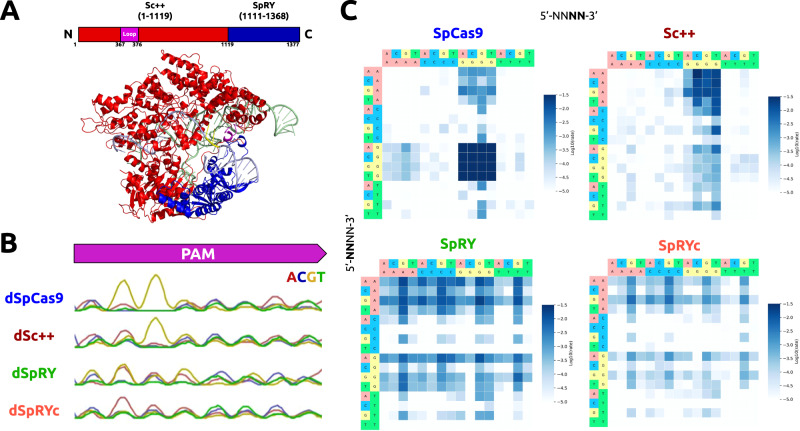
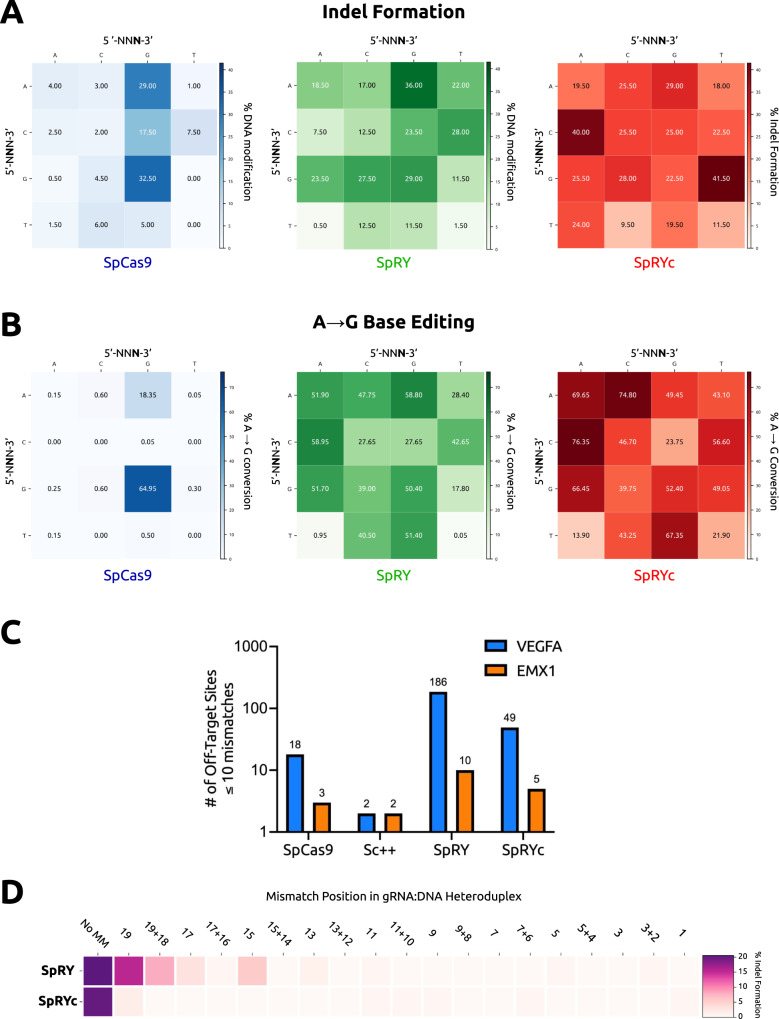
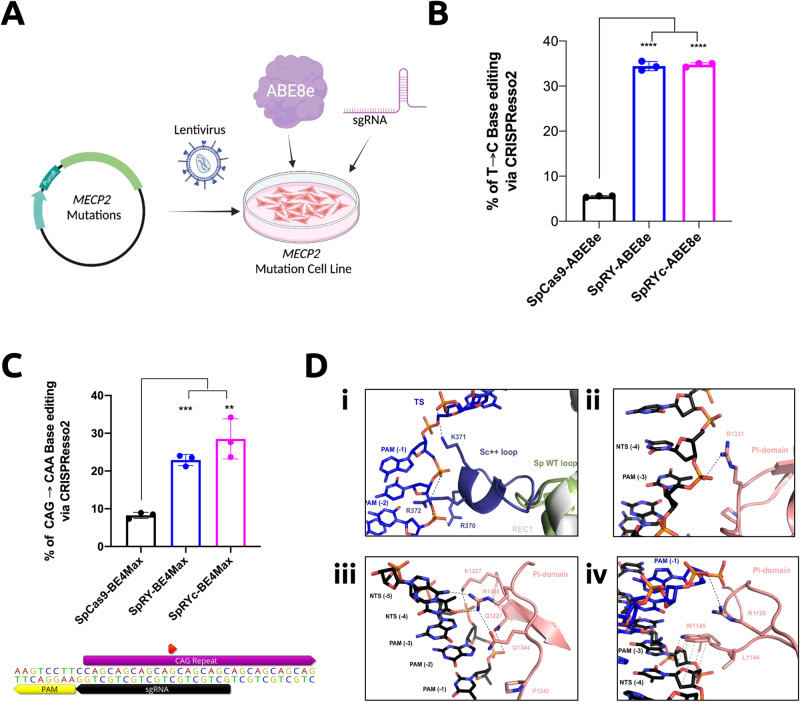
CRISPR enzymes require a defined protospacer adjacent motif (PAM) flanking a guide RNA-programmed target site, limiting their sequence accessibility for robust genome editing applications. In this study, we recombine the PAM-interacting domain of SpRY, a broad-targeting Cas9 possessing an NRN > NYN (R = A or G, Y = C or T) PAM preference, with the N-terminus of Sc + +, a Cas9 with simultaneously broad, efficient, and accurate NNG editing capabilities, to generate a chimeric enzyme with highly flexible PAM preference: SpRYc. We demonstrate that SpRYc leverages properties of both enzymes to specifically edit diverse PAMs and disease-related loci for potential therapeutic applications. In total, the approaches to generate SpRYc, coupled with its robust flexibility, highlight the power of integrative protein design for Cas9 engineering and motivate downstream editing applications that require precise genomic positioning.
Overview
The claims and statistics of this paper haven’t been checked yet.
Free: it reads the open-access text and checks the first 5 claims that cite a source we can check. Create a free account to check every claim.
Integrity signals
Registry
Cites
Statistics
Figures
Verification
Claims the paper makes
The claims and statistics of this paper haven’t been checked yet.
Free: it reads the open-access text and checks the first 5 claims that cite a source we can check. Create a free account to check every claim.
Claims other papers make about this one
Each is checked against this paper’s own text: does it say what the citing paper says it does?
The source backs part of the claim, not all of it — or backs it for a different population, condition or comparison.
In the citing paper
“In general, less stringent PAM variants can produce more off-target editing, which may be undesirable depending on the experimental context.35”
From Adenine base editor for knockout of proteins: A practical guide from design to analysis with updated MultiEditRbatch (2026) · cites this paper as [35]
Experimental — accuracy not yet measured
Self-check
Percentages, sums and reported differences re-computed from the paper’s own numbers.
The self-check needs the paper’s full text.
Citations
Cites
Features and development of Coot
Emsley, P., Lohkamp, B., Scott, W. G., & Cowtan, K. (2010) · Acta Crystallographica Section D Biological Crystallography · doi:10.1107/s0907444910007493 · Cited by 29,915
A Programmable Dual-RNA–Guided DNA Endonuclease in Adaptive Bacterial Immunity
Jinek, M., Chylinski, K., Fonfara, I., Hauer, M., Doudna, J. A., & Charpentier, E. (2012) · Science · doi:10.1126/science.1225829 · Cited by 17,116
Multiplex Genome Engineering Using CRISPR/Cas Systems
Cong, L., Ran, F. A., Cox, D., Lin, S., Barretto, R., Habib, N., Hsu, P. D., Wu, X., Jiang, W., Marraffini, L. A., et al. (2013) · Science · doi:10.1126/science.1231143 · Cited by 15,339
SWISS-MODEL: homology modelling of protein structures and complexes
Waterhouse, A., Bertoni, M., Bienert, S., Studer, G., Tauriello, G., Gumienny, R., Heer, F. T., de Beer, T. A. P., Rempfer, C., Bordoli, L., et al. (2018) · Nucleic Acids Research · doi:10.1093/nar/gky427 · Cited by 13,067
RNA-Guided Human Genome Engineering via Cas9
Mali, P., Yang, L., Esvelt, K. M., Aach, J., Guell, M., DiCarlo, J. E., Norville, J. E., & Church, G. M. (2013) · Science · doi:10.1126/science.1232033 · Cited by 9,210
Self-citationU1 snRNP regulates cancer cell migration and invasion in vitro
Oh, J.-M., Venters, C. C., Di, C., Pinto, A. M., Wan, L., Younis, I., Cai, Z., Arai, C., So, B. R., Duan, J., et al. (2020) · Nature Communications · doi:10.1038/s41467-019-13993-7 · Cited by 7,157
Programmable editing of a target base in genomic DNA without double-stranded DNA cleavage
Komor, A. C., Kim, Y. B., Packer, M. S., Zuris, J. A., & Liu, D. R. (2016) · Nature · doi:10.1038/nature17946 · Cited by 5,437
Programmable base editing of A•T to G•C in genomic DNA without DNA cleavage
Gaudelli, N. M., Komor, A. C., Rees, H. A., Packer, M. S., Badran, A. H., Bryson, D. I., & Liu, D. R. (2017) · Nature · doi:10.1038/nature24644 · Cited by 4,184
High-fidelity CRISPR-Cas9 nucleases with no detectable genome-wide off-target effects
Kleinstiver, B. P., Pattanayak, V., Prew, M. S., Tsai, S. Q., Nguyen, N. T., Zheng, Z., & Joung, J. K. (2016) · Nature · doi:10.1038/nature16526 · Cited by 2,673
Self-citationGUIDE-seq enables genome-wide profiling of off-target cleavage by CRISPR-Cas nucleases
Tsai, S. Q., Zheng, Z., Nguyen, N. T., Liebers, M., Topkar, V. V., Thapar, V., Wyvekens, N., Khayter, C., Iafrate, A. J., Le, L. P., et al. (2015) · Nature Biotechnology · doi:10.1038/nbt.3117 · Cited by 2,268
RNA-programmed genome editing in human cells
Jinek, M., East, A., Cheng, A., Lin, S., Ma, E., & Doudna, J. (2013) · eLife · doi:10.7554/elife.00471 · Cited by 2,098
DNA interrogation by the CRISPR RNA-guided endonuclease Cas9
Sternberg, S. H., Redding, S., Jinek, M., Greene, E. C., & Doudna, J. A. (2014) · Nature · doi:10.1038/nature13011 · Cited by 1,822
CRISPResso2 provides accurate and rapid genome editing sequence analysis
Clement, K., Rees, H., Canver, M. C., Gehrke, J. M., Farouni, R., Hsu, J. Y., Cole, M. A., Liu, D. R., Joung, J. K., Bauer, D. E., et al. (2019) · Nature Biotechnology · doi:10.1038/s41587-019-0032-3 · Cited by 1,660
Engineered CRISPR-Cas9 nucleases with altered PAM specificities
Kleinstiver, B. P., Prew, M. S., Tsai, S. Q., Topkar, V. V., Nguyen, N. T., Zheng, Z., Gonzales, A. P. W., Li, Z., Peterson, R. T., Yeh, J.-R. J., et al. (2015) · Nature · doi:10.1038/nature14592 · Cited by 1,624
Self-citationEvolved Cas9 variants with broad PAM compatibility and high DNA specificity
Hu, J. H., Miller, S. M., Geurts, M. H., Tang, W., Chen, L., Sun, N., Zeina, C. M., Gao, X., Rees, H. A., Lin, Z., et al. (2018) · Nature · doi:10.1038/nature26155 · Cited by 1,552
Short motif sequences determine the targets of the prokaryotic CRISPR defence system
Mojica, F. J. M., Díez-Villaseñor, C., García-Martínez, J., & Almendros, C. (2009) · Microbiology · doi:10.1099/mic.0.023960-0 · Cited by 1,426
Unconstrained genome targeting with near-PAMless engineered CRISPR-Cas9 variants
Walton, R. T., Christie, K. A., Whittaker, M. N., & Kleinstiver, B. P. (2020) · Science · doi:10.1126/science.aba8853 · Cited by 1,233
Self-citationEnhanced proofreading governs CRISPR-Cas9 targeting accuracy
Chen, J. S., Dagdas, Y. S., Kleinstiver, B. P., Welch, M. M., Sousa, A. A., Harrington, L. B., Sternberg, S. H., Joung, J. K., Yildiz, A., & Doudna, J. A. (2017) · Nature · doi:10.1038/nature24268 · Cited by 1,168
Self-citationEngineered CRISPR-Cas9 nuclease with expanded targeting space
Nishimasu, H., Shi, X., Ishiguro, S., Gao, L., Hirano, S., Okazaki, S., Noda, T., Abudayyeh, O. O., Gootenberg, J. S., Mori, H., et al. (2018) · Science · doi:10.1126/science.aas9129 · Cited by 1,100
Huntington's disease: a clinical review
McColgan, P., & Tabrizi, S. J. (2018) · European Journal of Neurology · doi:10.1111/ene.13413 · Cited by 1,089
Richter, M. F., Zhao, K. T., Eton, E., Lapinaite, A., Newby, G. A., Thuronyi, B. W., Wilson, C., Koblan, L. W., Zeng, J., Bauer, D. E., et al. (2020) · Nature Biotechnology · doi:10.1038/s41587-020-0453-z · Cited by 1,020
Improving cytidine and adenine base editors by expression optimization and ancestral reconstruction
Koblan, L. W., Doman, J. L., Wilson, C., Levy, J. M., Tay, T., Newby, G. A., Maianti, J. P., Raguram, A., & Liu, D. R. (2018) · Nature Biotechnology · doi:10.1038/nbt.4172 · Cited by 944
Inference of CRISPR Edits from Sanger Trace Data
Conant, D., Hsiau, T., Rossi, N., Oki, J., Maures, T., Waite, K., Yang, J., Joshi, S., Kelso, R., Holden, K., et al. (2022) · The CRISPR Journal · doi:10.1089/crispr.2021.0113 · Cited by 804
Vakulskas, C. A., Dever, D. P., Rettig, G. R., Turk, R., Jacobi, A. M., Collingwood, M. A., Bode, N. M., McNeill, M. S., Yan, S., Camarena, J., et al. (2018) · Nature Medicine · doi:10.1038/s41591-018-0137-0 · Cited by 782
Broadening the targeting range of Staphylococcus aureus CRISPR-Cas9 by modifying PAM recognition
Kleinstiver, B. P., Prew, M. S., Tsai, S. Q., Nguyen, N. T., Topkar, V. V., Zheng, Z., & Joung, J. K. (2015) · Nature Biotechnology · doi:10.1038/nbt.3404 · Cited by 611
Self-citationCAG Repeat Not Polyglutamine Length Determines Timing of Huntington’s Disease Onset
Lee, J.-M., Correia, K., Loupe, J., Kim, K.-H., Barker, D., Hong, E. P., Chao, M. J., Long, J. D., Lucente, D., Vonsattel, J. P. G., et al. (2019) · Cell · doi:10.1016/j.cell.2019.06.036 · Cited by 538
Protospacer recognition motifs: Mixed identities and functional diversity
Shah, S. A., Erdmann, S., Mojica, F. J. M., & Garrett, R. A. (2013) · RNA Biology · doi:10.4161/rna.23764 · Cited by 341
Identifying and Visualizing Functional PAM Diversity across CRISPR-Cas Systems
Leenay, R. T., Maksimchuk, K. R., Slotkowski, R. A., Agrawal, R. N., Gomaa, A. A., Briner, A. E., Barrangou, R., & Beisel, C. L. (2016) · Molecular Cell · doi:10.1016/j.molcel.2016.02.031 · Cited by 336
A compact, high-accuracy Cas9 with a dinucleotide PAM for in vivo genome editing
Edraki, A., Mir, A., Ibraheim, R., Gainetdinov, I., Yoon, Y., Song, C.-Q., Cao, Y., Gallant, J., Xue, W., Rivera-Pérez, J. A., et al. (2019) · Molecular Cell · doi:10.1016/j.molcel.2018.12.003 · Cited by 265
Self-citationMinimal PAM specificity of a highly similar SpCas9 ortholog
Chatterjee, P., Jakimo, N., & Jacobson, J. M. (2018) · Science Advances · doi:10.1126/sciadv.aau0766 · Cited by 228
Self-citationDNA capture by a CRISPR-Cas9–guided adenine base editor
Lapinaite, A., Knott, G. J., Palumbo, C. M., Lin-Shiao, E., Richter, M. F., Zhao, K. T., Beal, P. A., Liu, D. R., & Doudna, J. A. (2020) · Science · doi:10.1126/science.abb1390 · Cited by 205
Structural Plasticity of PAM Recognition by Engineered Variants of the RNA-Guided Endonuclease Cas9
Anders, C., Bargsten, K., & Jinek, M. (2016) · Molecular Cell · doi:10.1016/j.molcel.2016.02.020 · Cited by 201
DNA Unwinding Is the Primary Determinant of CRISPR-Cas9 Activity
Gong, S., Yu, H. H., Johnson, K. A., & Taylor, D. W. (2018) · Cell Reports · doi:10.1016/j.celrep.2017.12.041 · Cited by 198
A catalogue of biochemically diverse CRISPR-Cas9 orthologs
Gasiunas, G., Young, J. K., Karvelis, T., Kazlauskas, D., Urbaitis, T., Jasnauskaite, M., Grusyte, M. M., Paulraj, S., Wang, P.-H., Hou, Z., et al. (2020) · Nature Communications · doi:10.1038/s41467-020-19344-1 · Cited by 177
Liyanage, V. R. B., & Rastegar, M. (2014) · NeuroMolecular Medicine · doi:10.1007/s12017-014-8295-9 · Cited by 168
Rapid Quantitative Evaluation of CRISPR Genome Editing by TIDE and TIDER
Brinkman, E. K., & van Steensel, B. (2019) · Methods in Molecular Biology · doi:10.1007/978-1-4939-9170-9_3 · Cited by 165
Wilson, K. A., Kellie, J. L., & Wetmore, S. D. (2014) · Nucleic Acids Research · doi:10.1093/nar/gku269 · Cited by 150
An engineered ScCas9 with broad PAM range and high specificity and activity
Chatterjee, P., Jakimo, N., Lee, J., Amrani, N., Rodríguez, T., Koseki, S., Tysinger, E., Qing, R., Hao, S., Sontheimer, E. J., et al. (2020) · Nature Biotechnology · doi:10.1038/s41587-020-0517-0 · Cited by 138
Self-citationA Cas9 with PAM recognition for adenine dinucleotides
Chatterjee, P., Lee, J., Nip, L., Koseki, S. R. T., Tysinger, E., Sontheimer, E. J., Jacobson, J. M., & Jakimo, N. (2020) · Nature Communications · doi:10.1038/s41467-020-16117-8 · Cited by 124
Self-citationEngineer chimeric Cas9 to expand PAM recognition based on evolutionary information
Ma, D., Xu, Z., Zhang, Z., Chen, X., Zeng, X., Zhang, Y., Deng, T., Ren, M., Sun, Z., Jiang, R., et al. (2019) · Nature Communications · doi:10.1038/s41467-019-08395-8 · Cited by 63
Anders, C., & Jinek, M. (2014) · Methods in Enzymology · doi:10.1016/b978-0-12-801185-0.00001-5 · Cited by 62
Scalable characterization of the PAM requirements of CRISPR–Cas enzymes using HT-PAMDA
Walton, R. T., Hsu, J. Y., Joung, J. K., & Kleinstiver, B. P. (2021) · Nature Protocols · doi:10.1038/s41596-020-00465-2 · Cited by 53
Self-citationHung, C. L.-K., Maiuri, T., Bowie, L. E., Gotesman, R., Son, S., Falcone, M., Giordano, J. V., Gillis, T., Mattis, V., Lau, T., et al. (2018) · Molecular Biology of the Cell · doi:10.1091/mbc.e18-09-0590 · Cited by 42
Self-citationGUIDEseq: a bioconductor package to analyze GUIDE-Seq datasets for CRISPR-Cas nucleases
Zhu, L. J., Lawrence, M., Gupta, A., Pagès, H., Kucukural, A., Garber, M., & Wolfe, S. A. (2017) · BMC Genomics · doi:10.1186/s12864-017-3746-y · Cited by 40
Genome-wide detection and analysis of CRISPR-Cas off-targets
Rodríguez, T., Dadafarin, S., Pratt, H., Liu, P., Amrani, N., & Zhu, L. J. (2021) · Progress in molecular biology and translational science · doi:10.1016/bs.pmbts.2021.01.012 · Cited by 19
Self-citationTang, L. (2020) · Nature Methods · doi:10.1038/s41592-020-0861-5 · Cited by 12
Cited by
Past, present, and future of CRISPR genome editing technologies
Pacesa, M., Pelea, O., & Jinek, M. (2024) · Cell · doi:10.1016/j.cell.2024.01.042 · Cited by 609
Design of highly functional genome editors by modelling CRISPR–Cas sequences
Ruffolo, J. A., Nayfach, S., Gallagher, J. P., Bhatnagar, A., Beazer, J., Hussain, R., Russ, J., Yip, J., Hill, E., Pačesa, M., et al. (2025) · Nature · doi:10.1038/s41586-025-09298-z · Cited by 249
Off-target effects in CRISPR-Cas genome editing for human therapeutics: Progress and challenges
Kalter, N., Fuster‐García, C., Silva, A., Ronco-Díaz, V., Roncelli, S., Turchiano, G., Gorodkin, J., Cathomen, T., Benabdellah, K., Lee, C. M., et al. (2025) · Molecular Therapy — Nucleic Acids · doi:10.1016/j.omtn.2025.102636 · Cited by 134
Design of highly functional genome editors by modeling the universe of CRISPR-Cas sequences
Ruffolo, J. A., Nayfach, S., Gallagher, J., Bhatnagar, A., Beazer, J., Hussain, R., Russ, J., Yip, J., Hill, E., Pacesa, M., et al. (2024) · doi:10.1101/2024.04.22.590591 · Cited by 90
Custom CRISPR–Cas9 PAM variants via scalable engineering and machine learning
Silverstein, R. A., Kim, N., Kroell, A.-S., Walton, R. T., Delano, J., Butcher, R. M., Pacesa, M., Smith, B. K., Christie, K. A., Ha, L. L., et al. (2025) · Nature · doi:10.1038/s41586-025-09021-y · Cited by 73
Self-citation
Metadata
- Authors
- Zhao, L., Koseki, S. R. T., Silverstein, R. A., Amrani, N., Peng, C., Kramme, C., Savic, N., Pacesa, M., Rodríguez, T. C., Stan, T., Tysinger, E., Hong, L., Yudistyra, V., Ponnapati, M. R., Jacobson, J. M., Church, G. M., Jakimo, N., Truant, R., Jinek, M., Kleinstiver, B. P., Sontheimer, E. J., & Chatterjee, P.
- Affiliations
- Duke University (US)
- Harvard University (US)
- University of Massachusetts Chan Medical School (US)
- McMaster University (CA)
- MIT Media Lab (US)
- Corresponding author
- Chatterjee, Pranam
- ORCID
- Zhao, Lin
- Koseki, Sabrina R. T.
- Silverstein, Rachel A.
- Amrani, Nadia
- Peng, Christina
- Kramme, Christian
- Pacesa, Martin
- Rodríguez, Tomás C.
- Stan, Teodora
- Tysinger, Emma
- Hong, Lauren
- Yudistyra, Vivian
- Jacobson, Joseph M.
- Church, George M.
- Jakimo, Noah
- Truant, Ray
- Jinek, Martin
- Kleinstiver, Benjamin P.
- Sontheimer, Erik J.
- Chatterjee, Pranam
- Venue
- Nature Communications
- Published
- 2023-10-04
- Volume
- 14
- Issue
- 1
- Pages
- 6175-6175
- ISSN
- 2041-1723 (ISSN-L)
- PMC
- PMC10550912
- OpenAlex
- W4387341290
- Semantic Scholar
- a0e76afc174c72448d6948b91c676be51daaad4e
- Cited by
- 59
- References
- 50
- Citations by year
- 2026: 15 · 2025: 25 · 2024: 17 · 2023: 2
- FWCI
- 5.26
- Type
- journal article
- Language
- en
- Open access
- gold
- doi.org
- Licence
- cc-by
- creativecommons.org/licenses/by/4.0 (tdm)
- creativecommons.org/licenses/by/4.0 (vor)
- Locations
- Nature Communications (publishedVersion, cc-by)
- Research Square (acceptedVersion, cc-by)
- PubMed Central (publishedVersion, cc-by)
- PubMed (publishedVersion)
- Zurich Open Repository and Archive (University of Zurich) (acceptedVersion, cc-by-nc-nd)
- PubMed Central (submittedVersion, cc-by)
- DOAJ (DOAJ: Directory of Open Access Journals) (submittedVersion, cc-by-sa)
- Zurich Open Repository and Archive (University of Zurich)
- Funders
- National Science Foundation
- Howard Hughes Medical Institute
- CHDI Foundation
- Vallee Foundation
- Schweizerischer Nationalfonds zur Förderung der Wissenschaftlichen Forschung (31003A, 182567)
- Krembil Foundation
- National Institutes of Health (1dp2ca281401-01, HL142494, 4dp2ca281401-02)
- Natural Sciences and Engineering Research Council of Canada
- National Heart, Lung, and Blood Institute (P01HL142494)
- National Cancer Institute (DP2-CA281401)
- National Institute of General Medical Sciences (R01GM115911)
- Topics
- Life Sciences › Biochemistry, Genetics and Molecular Biology › Molecular Biology › CRISPR and Genetic Engineering
- Life Sciences › Biochemistry, Genetics and Molecular Biology › Molecular Biology › RNA regulation and disease
- Health Sciences › Medicine › Oncology › CAR-T cell therapy research
- Keywords
- CRISPR/Cas9, protospacer adjacent motif, SpRY, scandium, guide RNA, genome editing, protein engineering
About these checks
Registry, retraction, Cites and statistics results are computed, not judged, with one exception: a printed reference that no index lists is read once by a model before it counts as a citation error. Claims are extracted by a model and kept only when their quote appears verbatim in the text; each cited source is then checked, with a model’s help, for whether it says what the claim relies on. Those verdicts can be wrong — read the claim’s quote and the cited source before relying on one.
Statistics and arithmetic are recomputed, not judged.
Confidence bands are shown only for fields calibrated on our annotated test set. None is calibrated yet, so no band is shown.
What counts as a claim ›How we measure confidence ›How we check this ›
Are you an author, or do you see a problem with this page? Request a review
Data sources
Bibliographic data: Semantic Scholar, OpenAlex, Crossref.
Contains information from the Semantic Scholar Academic Graph Datasets, made available under the ODC Attribution License (ODC-BY 1.0).
Semantic Scholar’s data is described in: Kinney, R., et al. (2023). The Semantic Scholar Open Data Platform. arXiv:2301.10140.
