

Using social and behavioural science to support COVID-19 pandemic response
Open accessThe DOI matches its Crossref record; 257 of the 259 references it cites were found in a registry or an index; 24 of the 89 sources its claims cite were checked for support.
Abstract
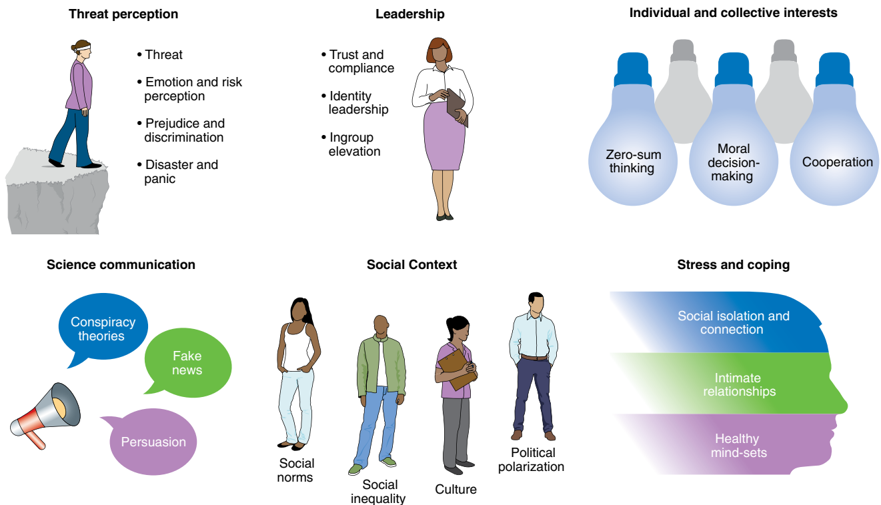
The COVID-19 pandemic represents a massive global health crisis. Because the crisis requires large-scale behaviour change and places significant psychological burdens on individuals, insights from the social and behavioural sciences can be used to help align human behaviour with the recommendations of epidemiologists and public health experts. Here we discuss evidence from a selection of research topics relevant to pandemics, including work on navigating threats, social and cultural influences on behaviour, science communication, moral decision-making, leadership, and stress and coping. In each section, we note the nature and quality of prior research, including uncertainty and unsettled issues. We identify several insights for effective response to the COVID-19 pandemic and highlight important gaps researchers should move quickly to fill in the coming weeks and months.
Overview
CoChat Summary
TL;DR
This perspective argues that social and behavioural science can help align public behaviour with COVID-19 public health recommendations across threat perception, social context, science communication, cooperation, leadership, and stress/coping. It synthesizes prior evidence and policy insights while cautioning that evidence is limited, often drawn from non-pandemic contexts, and in many areas unsettled.
Key findings
- The paper notes the scale of infectious disease threats: the bubonic plague killed approximately 25% of the European population, and by March 2020 COVID-19 had spread to more than 118,000 cases and caused 4,291 deaths in 114 countries. It also notes that 21 countries donated medical supplies to China in February, with China reciprocating widely.
- Fear appeals can change behaviour when people feel capable of dealing with the threat, but produce defensive reactions when people feel helpless; optimism bias can lead people to underestimate personal risk and ignore public health warnings.
- Social norms, inequality, culture, and political polarization shape pandemic behaviour: correcting misperceived norms can help when most people are already doing the desirable behaviour, but descriptive norms can backfire if the behaviour is undesirable unless paired with prescriptive norms.
- Effective communication and leadership may involve credible sources, messages that protect others or align with moral values, prebunking/inoculation against misinformation, accuracy nudges, shared social identity, and leaders modelling prosocial sacrifice; excessive national self-image concerns (“collective narcissism”) can backfire.
Methods
- Design: Perspective/narrative review; no primary data collection or sample. Topics were identified by the corresponding authors as potentially relevant to pandemic response and are explicitly not exhaustive.
- Evidence base: synthesizes prior social and behavioural research on threat perception, social context, science communication, moral decision-making, cooperation, leadership, and stress/coping, drawing on laboratory experiments, correlational studies, field experiments, meta-analyses, and preprints/forthcoming work.
- Analysis: narrative synthesis with policy implications and identified research gaps; no systematic search strategy or quantitative synthesis is reported.
Limitations
- Stated: due to space constraints, the paper provides only a brief summary of each topic; research on these topics is ongoing and in many cases far from settled; there is very little published social science research on the current pandemic, so discussion often draws from different circumstances and evidence quality varies substantially.
- Stated: insights and policy implications should be interpreted with caution.
- Evident: as a perspective rather than a systematic review or empirical study, it does not provide a comprehensive evidence appraisal, and its reliance on preprints and forthcoming sources limits certainty.
Model-written summary. Check it against the paper before relying on it.
Integrity signals
Registry
Cites
Statistics
Figures
Verification
Claims the paper makes
19 Valid · 5 Not valid · 37 Not checked · 13 Own results and interpretations
At least one cited source doesn’t support this claim or points to a different paper, and none confirmed it — see the verdicts below.
In the paper
“For instance, in hypothetical scenarios about deciding whether to go to work while sick, American and British participants reported they would be less willing to stay home when it was uncertain they would infect a co-worker.”
What the sources say
- Disputedcites [176] Kappes, A. et al. Uncertainty about the impact of social decisions increases prosocial behaviour. Nat. Hum. Behav. 2, 573–580 (2018). sourceExperimental — accuracy not yet measured
In the paper’s account of the infectious-disease scenario (Abstract; page not provided), participants facing uncertainty about how severely a co-worker might be affected were more likely to stay home than controls, not less. The paper distinguishes that impact uncertainty from uncertainty about whether a co-worker would be infected. Its Study 6 Methods (page not provided) describe recruitment through AMT, but do not establish the claimed American and British participant groups. (LLM, conf=0.88)
Checked by a reasoning model — may be wrong.
hedgedstates an association- Asserted: passes — The authors put it forward as true.
- Checkable: passes — It can be checked against evidence.
- Load-bearing: passes — The paper’s conclusions depend on it.
- Based: passes — The paper gives a reason why it holds.
- Disputed
The cited sources that could be checked couldn’t confirm or dispute this claim.
In the paper
“Moreover, there is mixed research regarding whether corrections may actually increase belief in the original misinformation 121,124-126 or in other misleading claims that fail to get corrected 127 .”
What the sources say
- Not checked — no full text of the sourcecites [121] Guess, A. & Coppock, A. Does counter-attitudinal information cause backlash? Results from three large survey experiments. Br. J. Polit. Sci. https://doi.org/10.1017/S0007123418000327 (2018). source
- Not matchedcites [124] Wittenberg, C. & Berinsky, A.J. Misinformation and its correction. in Social Media and Democracy: The State of the Field (eds Persily, N. & Tucker, J. A.) (Cambridge University Press, forthcoming).
Its entry has no title and year that we can search by.
- Not checked — no full text of the sourcecites [125] Swire, B. & Ecker, U.K.H. Misinformation and its correction: Cognitive mechanisms and recommendations for mass communication. in Misinformation and Mass Audiences (eds. Southwell, B. G., Thorson, E. A. & Sheble, L.) 195–2011 (University of Texas Press, 2018). source
- Not checked — no full text of the sourcecites [126] Wood, T. & Porter, E. The elusive backfire effect: mass attitudes’ steadfast factual adherence. Polit. Behav. 41, 135–163 (2018). source
- Could not verifycites [127] Pennycook, G., McPhetres, J., Zhang, Y. & Rand, D. Fighting COVID-19 misinformation on social media: Experimental evidence for a scalable accuracy nudge intervention. Preprint at PsyArXiv https://doi.org/10.31234/osf.io/uhbk9 (2020). sourceExperimental — accuracy not yet measured
Citation 127 is attached to the suggestion that corrections may increase belief in other misleading claims that go uncorrected. The Statement of Relevance and Discussion describe an accuracy nudge that improved sharing decisions, not corrections or their effects on belief in uncorrected claims. Searches for correction backfire and uncorrected misinformation found no passage addressing that point; page numbers were unavailable in our copy. (LLM, conf=0.76)
hedgedstates a possible cause- Asserted: passes — The authors put it forward as true.
- Checkable: passes — It can be checked against evidence.
- Load-bearing: passes — The paper’s conclusions depend on it.
- Based: passes — The paper gives a reason why it holds.
The sources with a verdict support this claim; the rest weren’t checked yet, have no full text we could read, or their verdicts aren’t rated yet.
In the paper
“Indeed, laboratory research has found that people prioritize local over global (or international) interests 185,186 .”
What the sources say
- Supportedcites [185] Milinski, M., Hilbe, C., Semmann, D., Sommerfeld, R. & Marotzke, J. Humans choose representatives who enforce cooperation in social dilemmas through extortion. Nat. Commun. 7, 10915 (2016). source
The Results section (‘Voters choose selfish representatives’; page unavailable) reports that participants preferentially re-elected representatives who contributed less to the shared climate account and elected candidates who pledged to contribute less than a fair share. In this simulated international dilemma, that supports the claim that participants favored their own group’s interests over the collective goal; it does not establish that everyone did so. (LLM, conf=0.85)
- Not checked — no full text of the sourcecites [186] Reinders Folmer, C. P. et al. One for all: what representing a group may do to us. J. Exp. Soc. Psychol. 48, 1047–1056 (2012). source
plain- Asserted: passes — The authors put it forward as true.
- Checkable: passes — It can be checked against evidence.
- Load-bearing: passes — The paper’s conclusions depend on it.
- Based: passes — The paper gives a reason why it holds.
- Supported
Every source the paper cites for this claim was checked and supports it.
In the paper
“However, when going to work risked infecting an elderly co-worker who would suffer a serious illness, participants reported they would be more willing to stay home 176 .”
What the sources say
- Supportedcites [176] Kappes, A. et al. Uncertainty about the impact of social decisions increases prosocial behaviour. Nat. Hum. Behav. 2, 573–580 (2018). source
The Study 6 Methods (page not provided) describe a scenario in which going to work could infect an older, vulnerable co-worker who would suffer severely, followed by a rating of willingness to go to work. The reported Study 6 findings (indexed under Abstract; page not provided) say participants given that risk information were significantly more likely to stay home than controls. (LLM, conf=0.92)
hedgedstates a cause- Asserted: passes — The authors put it forward as true.
- Checkable: passes — It can be checked against evidence.
- Load-bearing: passes — The paper’s conclusions depend on it.
- Based: passes — The paper gives a reason why it holds.
- Supported
The sources with a verdict support this claim; the rest weren’t checked yet, have no full text we could read, or their verdicts aren’t rated yet.
In the paper
“Several techniques, such as sanctioning defectors 187 or rewarding cooperators 188 , tend to increase cooperative behaviour in laboratory experiments using economic games.”
What the sources say
- Not checked — no full text of the sourcecites [187] Yamagishi, T. The provision of a sanctioning system as a public good. J. Pers. Soc. Psychol. 51, 110–116 (1986). source
- Supportedcites [188] Rand, D. G., Dreber, A., Ellingsen, T., Fudenberg, D. & Nowak, M. A. Positive interactions promote public cooperation. Science 325, 1272–1275 (2009). source
Citation 188 is attached to rewarding cooperators. The paper’s Abstract reports a laboratory comparison using repeated public goods games and finds that reward maintained public cooperation and, when both reward and punishment were available, increased contributions. (LLM, conf=0.93)
plainstates a cause- Asserted: passes — The authors put it forward as true.
- Checkable: passes — It can be checked against evidence.
- Load-bearing: unclear — It is unclear whether the paper’s conclusions depend on it.
- Based: passes — The paper gives a reason why it holds.
50 more claims · 13 with their cited sources checked
Create a free account to see all 74 claims and to verify the 2 references still open.
- It may state two separate claims as one. 13
- Probably not a substantial claim. 6
Claims other papers make about this one
Each is checked against this paper’s own text: does it say what the citing paper says it does?
The source backs part of the claim, not all of it — or backs it for a different population, condition or comparison.
In the citing paper
“COVID-19 is an international public health crisis, putting substantial burden on medical centers and increasing the psychological toll on health care workers (HCW).”
From Supporting the well-being of health care providers during the COVID-19 pandemic: The CopeColumbia response (2020) · cites this paper as [6]
Experimental — accuracy not yet measuredThe source backs part of the claim, not all of it — or backs it for a different population, condition or comparison.
In the citing paper
“these population-wide measures affected psychological well-being and mental health as well as increased social isolation [68] and loneliness.”
From Psychological correlates of perceived loneliness in college students before and during the COVID-19 stay-at-home period: a longitudinal study (2023) · cites this paper as [68]
Experimental — accuracy not yet measuredThe source backs part of the claim, not all of it — or backs it for a different population, condition or comparison.
In the citing paper
“they may eventually increase the social isolation of students and affect their psychological well-being and mental health [3].”
From Students under lockdown: Comparisons of students’ social networks and mental health before and during the COVID-19 crisis in Switzerland (2020) · cites this paper as [3]
Experimental — accuracy not yet measuredThe source backs part of the claim, not all of it — or backs it for a different population, condition or comparison.
In the citing paper
“effective interventions are hard to scale to a population level (12);”
From Psychological inoculation improves resilience against misinformation on social media (2022) · cites this paper as [12]
Experimental — accuracy not yet measuredThe source backs part of the claim, not all of it — or backs it for a different population, condition or comparison.
In the citing paper
“There is a shortage of studies that test anti-misinformation interventions in an ecologically valid manner, i.e., testing an intervention as consumers would interact with it in online environments (8, 12).”
From Psychological inoculation improves resilience against misinformation on social media (2022) · cites this paper as [12]
Experimental — accuracy not yet measured
6 more claims about this paper
Create a free account to see every claim other papers make about this one.
Citations
Cites
Granovetter, M. S. (1973) · American Journal of Sociology · doi:10.1086/225469 · Cited by 40,491
Zhou, F., Yu, T., Du, R., Fan, G., Liu, Y., Liu, Z., Xiang, J., Wang, Y., Song, B., Gu, X., et al. (2020) · The Lancet · doi:10.1016/s0140-6736(20)30566-3 · Cited by 27,263
The need to belong: Desire for interpersonal attachments as a fundamental human motivation.
Baumeister, R. F., & Leary, M. R. (1995) · Psychological Bulletin · doi:10.1037//0033-2909.117.3.497 · Cited by 23,245
Culture and the self: Implications for cognition, emotion, and motivation.
Markus, H. R., & Kitayama, S. (1991) · Psychological Review · doi:10.1037/0033-295x.98.2.224 · Cited by 21,995
Self-citationThe Psychological Impact of Quarantine and How to Reduce It: Rapid Review of the Evidence
Brooks, S. K., Webster, R. K., Smith, L. E., Woodland, L., Wessely, S., Greenberg, N., & Rubin, G. J. (2020) · doi:10.2139/ssrn.3532534 · Cited by 16,394
The psychological impact of quarantine and how to reduce it: Rapid review of the evidence
Brooks, S. K., Webster, R. K., Smith, L. E., Woodland, L., Wessely, S., Greenberg, N., & Rubin, G. J. (2020) · The Lancet · doi:10.1016/s0140-6736(20)30460-8 · Cited by 16,378
Nudge: improving decisions about health, wealth, and happiness
(2008) · Choice Reviews Online · doi:10.5860/choice.46-0977 · Cited by 11,572
Slovic, P. (1987) · Science · doi:10.1126/science.3563507 · Cited by 9,271
The Elaboration Likelihood Model of Persuasion
Petty, R. E., & Cacioppo, J. T. (1986) · Advances in Experimental Social Psychology · doi:10.1016/s0065-2601(08)60214-2 · Cited by 8,822
Self-citationThe emotional dog and its rational tail: A social intuitionist approach to moral judgment.
Haidt, J. (2001) · Psychological Review · doi:10.1037/0033-295x.108.4.814 · Cited by 8,048
Research works printed but not linked: 3
- Berkowitz, A.D. An overview of the social norms approach. in Changing the Culture of College Drinking: A Socially Situated Health Communication Campaign (eds. Stewart, L. & Lederman, L. C.) 193–214 (Hampton Press, 2005).
- Wittenberg, C. & Berinsky, A.J. Misinformation and its correction. in Social Media and Democracy: The State of the Field (eds Persily, N. & Tucker, J. A.) (Cambridge University Press, forthcoming).
- Ransohoff, K.J. Patients on the Trolley Track: The Moral Cognition of Medical Practitioners and Public Health Professionals. (Harvard Univ. Press, 2011).
Cited by
Items 2,601–2,700 of 5,015
Hanratty, J., Keenan, C., O'Connor, S. R., Leonard, R. A., Chi, Y., Ferguson, J., Axiaq, A., Miller, S. J., Bradley, D., & Dempster, M. (2023) · Campbell Systematic Reviews · doi:10.1002/cl2.1336 · Cited by 9
Association between intentional behavioral changes and well-being during the COVID-19 pandemic
Konishi, N., Kimura, M., & Takeda, Y. (2023) · Frontiers in Psychology · doi:10.3389/fpsyg.2023.1201770 · Cited by 6
Curbing the COVID-19 digital infodemic: strategies and tools
Kassen, M. (2023) · Journal of Public Health Policy · doi:10.1057/s41271-023-00437-2 · Cited by 5
Shahani, R., Asmi, F., Ma, J., Zawar, A., Rufai, O. H., Muhideen, S., Amosun, T. S., & Chu, J. (2023) · Digital Health · doi:10.1177/20552076231185430 · Cited by 7
Turska–Kawa, A., & Stępień-Lampa, N. (2023) · Springer eBooks · doi:10.1007/978-3-031-37608-5_4 · Cited by 6
Alkorashy, H. A. E., Alosaimi, A. A., Alruwaili, N. F., & Alshahrani, S. N. (2023) · Nursing in Critical Care · doi:10.1111/nicc.12980 · Cited by 9
Cultural influence on COVID‐19 cognitions and growth speed: The role of collectivism
Pei, R., Cosme, D., Andrews, M. E., Mattan, B. D., Tartak, J. C., & Falk, E. B. (2023) · Social and Personality Psychology Compass · doi:10.1111/spc3.12908 · Cited by 19
Zubielevitch, E., Sibley, C. G., & Osborne, D. (2023) · European Journal of Social Psychology · doi:10.1002/ejsp.3003 · Cited by 8
Yu, Z., Yang, S., Zheng, H., & Chang, X. (2023) · Journal of Consumer Behaviour · doi:10.1002/cb.2288 · Cited by 5
Pavić, Ž., Kovačević, E., & Šuljok, A. (2023) · Humanities and Social Sciences Communications · doi:10.1057/s41599-023-02439-7 · Cited by 6
Love thy neighbor? The role of trust in neighbors during the COVID-19 crisis
Kim, S. H. (2023) · Health & Place · doi:10.1016/j.healthplace.2023.103164 · Cited by 8
Behavioral intentions and perceived stress under isolated environment
Lin, Y., Wu, L., Ouyang, H., Zhan, J., Wang, J., Liu, W., & Jia, Y. (2023) · Brain and Behavior · doi:10.1002/brb3.3347 · Cited by 5
“And the evidences from social and behavioral sciences showed negative framing usually captures attention, especially for the people with strong emotional responses (Bavel et al., 2020).”
BackgroundBroekaert, J., Torre, D. L., & Hafiz, F. M. F. (2024) · Annals of Operations Research · doi:10.1007/s10479-023-05781-w · Cited by 6
“These psychological effects reflect on behavior, are diverse and socially and culturally dependent, and often relate to fear, stress, morals, and responsibility (Bavel et al., 2020).”
Smith, M. D., Kassa, W., & Wesselbaum, D. (2024) · Global Food Security · doi:10.1016/j.gfs.2024.100742 · Cited by 7
Addressing vaccine hesitancy using local ambassadors: A randomized controlled trial in Indonesia
Islam, A., Kusnadi, G., Rezki, J. F., Sim, A., van Empel, G., Vlassopoulos, M., & Zénou, Y. (2024) · European Economic Review · doi:10.1016/j.euroecorev.2024.104683 · Cited by 8
Síndrome de Burnout em professores durante a pandemia da COVID-19
dos Santos, I. T., Couto, M. F. F., Pereira, M. M., & Braz, M. V. (2023) · Revista Psicologia em Pesquisa · doi:10.34019/1982-1247.2023.v17.35535 · Cited by 12
Zubielevitch, E., Satherley, N., Sibley, C. G., & Osborne, D. (2024) · Group Processes & Intergroup Relations · doi:10.1177/13684302231208382 · Cited by 7
Zhao, S., Zhou, J., & Wang, T. (2024) · Journal of Clinical Psychology · doi:10.1002/jclp.23676 · Cited by 6
The impact of law on moral and social norms: evidence from facemask fines in the UK
Berneri, C., Larcom, S. T., Peng, C., & She, P.-W. (2024) · European Journal of Law and Economics · doi:10.1007/s10657-024-09800-4 · Cited by 7
“We consider our contribution to be particularly important, as during the pandemic, social norms were advocated as an important mechanism to support the state’s pandemic response (Bavel et al., 2020).”
Schütz, D. M., Rossi, T., de Albuquerque, N. S., Costa, D. B., Machado, J. S., Fritsch, L., Gosmann, N., Mastrascusa, R. C., Sessegolo, N. S., Bottega, V. R., et al. (2024) · Healthcare · doi:10.3390/healthcare12090876 · Cited by 7
“One should also bear in mind that the restrictions associated with the pandemic, such as social isolation measures, disruptions in routine healthcare services, and increased stress related to the virus, may accentuate challenges for older individuals [6,14].”
BackgroundSocial status predicts physiological and behavioral responses to chronic stress in rhesus monkeys
Zhang, Z., Dong, X., Liu, Z., & Liu, N. (2024) · iScience · doi:10.1016/j.isci.2024.110073 · Cited by 9
Gender and generosity: How contribution information triggers solidarity behavior during a crisis
Ho, T. Q., Nguyen, L. T.-P., Grote, U., Rahut, D. B., Sonobe, T., & Nguyễn, T. T. (2024) · Journal of Behavioral and Experimental Economics · doi:10.1016/j.socec.2024.102275 · Cited by 5
Zhang, X., & Nekmat, E. (2024) · Public Relations Review · doi:10.1016/j.pubrev.2024.102493 · Cited by 9
Cooking readiness in stressful times: Navigating food choices for a healthier future
de Barcellos, M. D., Perin, M. G., Lähteenmäki, L., & Grunert, K. G. (2024) · Appetite · doi:10.1016/j.appet.2024.107652 · Cited by 8
Elifneh, Y. W., Wonda, T. A., & Abbay, Y. A. (2024) · Cogent Business & Management · doi:10.1080/23311975.2024.2418419 · Cited by 7
“Similarly, Bavel et al. (2020) noted that swift intervention is needed from various disciplines.”
Olebo, D. F., & Igwe, M. C. (2025) · Infection and Drug Resistance · doi:10.2147/idr.s498430 · Cited by 5
Communication Practices to Support Frontline Workers During Public Health Threats
Haas, E. J., & Orstad, S. L. (2025) · Workplace Health & Safety · doi:10.1177/21650799251334146 · Cited by 7
“The identification of effective communication strategies that resonate across cultural contexts while providing social and emotional support is needed (Sahay & Dwyer, 2021; Van Bavel et al., 2020).”
GELECEK SALGINLARA HAZIRLIKTA SAĞLIK EĞİTİMİ VE BİREYSEL DAVRANIŞ MODELLERİ: COVID-19 ÖRNEĞİ
Arıkan, İ. (2020) · Eskişehir Türk Dünyası Uygulama ve Araştırma Merkezi Halk Sağlığı Dergisi · doi:10.35232/estudamhsd.760073 · Cited by 10
“Algılar İnanç COVID-19 algı-inançları Duyarlılık Hastalı a yatkın olma/hastalanma riski COVID-19 riskim her zaman olabilir Ciddiyet/ iddet Hastalı ın iddetli, ciddi seyir gösterece ine inanma COVID-19 oldu umda hayatımı etkileyecek ciddi sonuçlar bekliyorum Faydalar Yeni davranı etkilili ine inanma A ı olursam hasta o…”
Peacebuilding in times of COVID-19: risk-adapted strategies of cooperation and development projects
Eufemia, L., Lozano, C., Rodríguez, T., Río, M. D., Morales-Muñoz, H., Bonatti, M., Sieber, S., & Löhr, K. (2020) · Zeitschrift für Friedens- und Konfliktforschung · doi:10.1007/s42597-020-00040-2 · Cited by 9
“Empirical studies show that COVID-19 lockdown measures are affecting mental health and collective trauma (Montoya 2020; Van Bavel et al. 2020); especially problematic for existing post conflict communities.”
BackgroundSosa, M., Ortíz, E., & Cabello, A. (2020) · Contaduría y Administración · doi:10.22201/fca.24488410e.2020.3020 · Cited by 8
Camerotto, A., Sartorio, A., MAZZETTO, A., Gusella, M., Luppi, O., Lucianò, D., Sofritti, O., Pelati, C., Munno, E., Tessari, A., et al. (2020) · International Journal of Environmental Research and Public Health · doi:10.3390/ijerph17239045 · Cited by 5
Applying Behavioral Economics to Address COVID-19 Fear Among Oral and Maxillofacial Surgery Patients
Wang, T. T., & Wang, S. (2020) · Journal of Oral and Maxillofacial Surgery · doi:10.1016/j.joms.2020.12.020 · Cited by 5
“Optimism bias describes a phenomenon in which individuals are overly confident that bad events are less likely to happen to them and their families than to strangers.(3) While this reduces patient fear, it is still important to inform patients to help them avoid behaviors that can endanger fellow patients, as well as…”
InfluentialDesign for Resilience: Mapping the needs of Brazilian communities to tackle COVID-19 challenges
Braga, M. F., Filho, E. R., Mendonça, R. M. L. O., de Oliveira, L. G. R., & Pereira, H. G. G. (2020) · Strategic Design Research Journal · doi:10.4013/sdrj.2020.133.07 · Cited by 5
“…(3) accelerated research for the development of vaccines and medicines (Lurie et al, 2020), (4) severe travel and human displacement restrictions (Chinazzi et al, 2020), and (5) creation and imposition of social isolation rules aiming at contributing to the disease control (Bavel et al, 2020).”
BackgroundSome recommendations for doing high‐impact research in social psychological science
van der Linden, S. (2021) · Asian Journal Of Social Psychology · doi:10.1111/ajsp.12463 · Cited by 6
Self-citationMartín, J. C., & Román, C. (2021) · Social Sciences · doi:10.3390/socsci10020046 · Cited by 5
Risk Communication in the Age of COVID-19
Koinig, I. (2021) · IntechOpen eBooks · doi:10.5772/intechopen.96390 · Cited by 7
“As pandemics evoke negative emotional responses – first and foremost, fear [29] - that affect whole populations, crisis communication itself should not only center on people [101] but also familiarize them with proper behavior, e.”
BackgroundInfluentialMental Burden of Hospital Workers During the COVID-19 Crisis: A Quanti-Qualitative Analysis
Luquiens, A., Morales, J., Bonneville, M., Potier, H., Perney, P., Faure, G., & Canaguier, A. (2021) · Frontiers in Psychiatry · doi:10.3389/fpsyt.2021.622098 · Cited by 6
“The absence of a psychological airlock or “COVID-free time,” as well as the toxicity of exposure to media, has been highlighted by our sample, and supports previous findings (18, 19).”
BackgroundResultClark, C. A., & Harris, K. M. (2021) · Computers in Human Behavior Reports · doi:10.1016/j.chbr.2021.100095 · Cited by 7
Five Steps Towards Avoiding Narrative Traps in Decision-Making
Dolan, P. J., & Henwood, A. (2021) · Frontiers in Psychology · doi:10.3389/fpsyg.2021.694032 · Cited by 6
“Frontiers in Psychology | www.frontiersin.org 2 August 2021 | Volume 12 | Article 694032 Arguably, another underlying value in society is that human life is a protected or sacred value (Waldmann et al., 2012).”
BackgroundMaking Older Adults' Cognitive Health Visible After Covid-19 Outbreak
Gatta, F. D., Terribili, C., Fabrizi, E., & Moret‐Tatay, C. (2021) · Frontiers in Psychology · doi:10.3389/fpsyg.2021.648208 · Cited by 5
“Quiet is the New Loud”: The Biosociology Debate’s Absent Voices
Ariansen, A. M. S. (2021) · The American Sociologist · doi:10.1007/s12108-021-09494-0 · Cited by 7
Maximizing Millennial Students Role in Combating COVID-19 Hoaxes and Myths
Dewayani, A., Ferdinandus, E. D., Prastio, R. P., Fahmiyah, I., Sofiah, A., Indrawan, R. W., Nurul, M., Aji, G. G., Gofur, N. R. P., Khaerunnisa, S., et al. (2021) · Biomolecular and Health Science Journal · doi:10.20473/bhsj.v4i1.26910 · Cited by 5
Us and the virus: understanding the COVID-19 pandemic through a social psychological lens
Rudert, S. C., Gleibs, I. H., Gollwitzer, M., Hajek, K. V., Harth, N. S., Häusser, J. A., Imhoff, R., & Schneider, D. (2021) · London School of Economics and Political Science Research Online (London School of Economics and Political Science) · Cited by 5
Entre le marteau et l’enclume : le rôle de l’optimisme situé
Guiliani, F., Cisneros, L., Saba, T., & Cachat‐Rosset, G. (2021) · Revue internationale P M E Économie et gestion de la petite et moyenne entreprise · doi:10.7202/1079176ar · Cited by 9
“Selon Van Bavel et al. (2020), l’impact du stress lié à la Covid-19 peut être réduit en travaillant sur l’état d’esprit et l’évaluation des situations sources de stress.”
BackgroundInfluentialMultiplicity Eludes Peer Review: The Case of COVID-19 Research
Gutiérrez-Hernández, O., & García, L. V. (2021) · International Journal of Environmental Research and Public Health · doi:10.3390/ijerph18179304 · Cited by 6
“Never have so many people, or non-specialized journalists, used the terms significant/not significant, subjected (or not) to peer review, and frequently refer to the conclusion’s reliability, relevance, or provisional nature of the published results [26].”
BackgroundIskandarsyah, A., Yudiana, W., Shabrina, A., & Passchier, J. (2022) · International Journal of Public Health Science (IJPHS) · doi:10.11591/ijphs.v11i1.21018 · Cited by 6
Explaining Variation in Parents' and Their Children's Stress During COVID-19 Lockdowns
Toppe, T., Stengelin, R., Schmidt, L. S., Amini, N., & Schuhmacher, N. (2021) · Frontiers in Psychology · doi:10.3389/fpsyg.2021.645266 · Cited by 5
“Particularly studies investigating participants from diverse cultural contexts seem a promising avenue in this arena (Bavel et al., 2020; Katz et al., 2020).”
BackgroundInfluentialThe First Random Observational Survey of Barrier Gestures against COVID-19
Renault, V., Humblet, M., Parisi, G., Donneau, A., Bureau, F., Gillet, L., Fontaine, S., & Saegerman, C. (2021) · International Journal of Environmental Research and Public Health · doi:10.3390/ijerph18199972 · Cited by 7
“Previous experiences of pandemics showed that there was a low level of compliance from the population in adhering to restrictive measures such as isolation [4], highlighting the need to use social and behavioural sciences and studies in order to better manage the risks and improve the compliance of the population with…”
BackgroundSprings, D., Burrell, D. N., Shufutinsky, A., Shipman, K. E., McCargo, T., & Brown-Jackson, K. L. (2021) · International Journal of Sociotechnology and Knowledge Development · doi:10.4018/ijskd.2022040103 · Cited by 5
Vom Paradox zur Resilienz in der Krise: Ein Modell für erfolgreiches Krisenmanagement
Sparr, J. L. (2021) · Gruppe Interaktion Organisation Zeitschrift für Angewandte Organisationspsychologie (GIO) · doi:10.1007/s11612-021-00601-w · Cited by 7
“Allerdings ist Lernen in der Krise oftmals schwieriger als in Routinesituationen (Lee et al. 2020) aufgrund der hohen Tragweite und der defensiven Haltung angesichts der Unsicherheit und Bedrohung (Moynihan 2008; Boin et al., 2013).”
BackgroundRybak, G., Johnson, A. M., & Burton, S. (2021) · Journal of Advertising · doi:10.1080/00913367.2021.1981502 · Cited by 6
“Drawing from CDC (2020a, 2020b) guidance as well as CSR (Schaefer, Terlutter, and Diehl 2020; Nan and Heo 2007), persuasion theory (Petty and Cacioppo 1986), and health promotion (Jetten et al. 2020; Van Bavel et al. 2020) literatures, our objective was to examine the direct and indirect effects of advertised COVID-19…”
BackgroundInfluentialZuo, B., Ye, H., Wen, F., Ke, W., Xiao, H., & Wang, J. (2022) · Group Processes & Intergroup Relations · doi:10.1177/13684302211062367 · Cited by 7
“Doing so will prevent audiences from receiving limited, internally attributed information about such incidents that may lead to more widespread social conflicts and cyberviolence (Gilles et al., 2013; van Bavel et al., 2020).”
BackgroundCoronavirus disease 2019 scenarios for a long-term strategy under fundamental uncertainty
Brom, F. W. A., de Hoog, J., Knottnerus, J. A., Mampuys, R., & van der Lippe, T. (2022) · Journal of Clinical Epidemiology · doi:10.1016/j.jclinepi.2022.02.012 · Cited by 5
Quantal response equilibrium for the Prisoner’s Dilemma game in Markov strategies
Kozitsina, T., Kozitsin, I., & Станиславович, М. И. (2022) · Scientific Reports · doi:10.1038/s41598-022-08426-3 · Cited by 6
“However, questions remain: (1) why does the small-rationality segment play this “dividing” role and (2) how should we interpret strategies that are located near the small-rationality segment? We propose the following answer: one could think about the small-rationality segment as a zone where individuals experience a p…”
BackgroundInfluentialLearning from the Past: Pandemics and the Governance Treadmill
Webster, D. G., Aytur, S., Axelrod, M., Wilson, R. S., Hamm, J. A., Sayed, L., Pearson, A. L., Torres, P. H. C., Akporiaye, A., & Young, O. R. (2022) · Sustainability · doi:10.3390/su14063683 · Cited by 7
Nudges: a promising behavioral public policy tool to reduce vaccine hesitancy
Hortal, A. (2022) · Revista Brasileira de Políticas Públicas · doi:10.5102/rbpp.v12i1.7993 · Cited by 6
Dey, S. R. (2022) · International Social Science Journal · doi:10.1111/issj.12340 · Cited by 5
“Hence, the maintenance of social distance does not necessarily always imply weaker social relationships among individuals (Bavel et al. 2020).”
BackgroundInfluentialHadizadeh-Talasaz, F., Noghabi, A. D., & Mohammadzadeh, F. (2022) · International journal of community based nursing and midwifery · doi:10.30476/ijcbnm.2021.90930.1747 · Cited by 12
Namageyo-Funa, A., Ruffin, J. D., Killerby, M. E., Jalloh, M. F., Scott, C., Lindell, K., Silver, M., Matanock, A. M., Soto, R. A., Donnelly, M. A. P., et al. (2022) · AJPM Focus · doi:10.1016/j.focus.2022.100004 · Cited by 5
Dalecká, A., Tomášková, H., Šlachtová, H., Skýbová, D., & Mad’ar, R. (2022) · International Journal of Public Health · doi:10.3389/ijph.2022.1604395 · Cited by 7
“Evaluating an individual’s mental well-being and its resulting behavioural lifestyle response is, therefore, essential for developing the effective management of the global pandemic [12, 13].”
BackgroundClimate policy support as a tool to control others’ (but not own) environmental behavior?
Kukowski, C. A., Bernecker, K., von der Heyde, L., Boos, M., & Brandstätter, V. (2022) · PLoS ONE · doi:10.1371/journal.pone.0269030 · Cited by 5
“Instead, we suggest providing accurate information on current shortcomings in environmental behavior, tailoring policy communication to social networks to engage wellconnected "key" individuals [83].”
BackgroundSociality and disease: behavioral perspectives in ecological and evolutionary immunology
Rosengaus, R. B., Traniello, J. F. A., & Bakker, T. C. M. (2022) · Behavioral Ecology and Sociobiology · doi:10.1007/s00265-022-03203-8 · Cited by 5
Toeing the party line: Politically driven responses to the coronavirus pandemic in the USA
Douglas, K. M., & Sutton, R. M. (2022) · Journal of Social and Political Psychology · doi:10.5964/jspp.6089 · Cited by 5
“There is ample evidence that political polarization affects attitudes, judgments and behaviors (Van Bavel & Pereira, 2018), and a polarized response to coronavirus has been particularly blatant in the USA (Van Bavel et al., 2020).”
BackgroundSelf-citationGunko, R., Rapeli, L., & Karell, P. (2022) · Sustainability · doi:10.3390/su14159496 · Cited by 6
“Bavel and his colleagues [16] highlighted significant shifts in mental health, as well as social and moral norms, as a consequence of the pandemic.”
BackgroundDavis, A., Munari, S. C., Doyle, J., Sutton, B. A., Cheng, A., Hellard, M. E., & Gibbs, L. F. (2022) · BMC Public Health · doi:10.1186/s12889-022-14185-7 · Cited by 7
Burton-Chellew, M. N., D’Amico, V., & Guérin, C. (2022) · Games · doi:10.3390/g13060069 · Cited by 6
The Black Box as a Control for Payoff-Based Learning in Economic Games
Burton-Chellew, M. N., & West, S. A. (2022) · Games · doi:10.3390/g13060076 · Cited by 5
Jessup, S. C., Knowles, K. A., & Olatunji, B. O. (2022) · International Journal of Cognitive Therapy · doi:10.1007/s41811-022-00148-8 · Cited by 7
Lewicka, M., Hay, J. L., Waters, E. A., Schofield, E., Orom, H., & Kiviniemi, M. T. (2022) · Journal of Prevention · doi:10.1007/s10935-022-00715-x · Cited by 9
“Persuasiveness of the communication could be bolstered if messages are delivered by trusted ingroup models (Bavel et al., 2020).”
BackgroundLee, W., & Ahn, S. (2022) · Korean Journal of Journalism & Communication Studies · doi:10.20879/kjjcs.2022.66.6.011 · Cited by 5
Rosales-Leal, J. I., Vaca, C. S., Ryaboshapka, A., Villafranca, F. D. C., & Escudero, M. Á. R. (2023) · International Journal of Environmental Research and Public Health · doi:10.3390/ijerph20032340 · Cited by 6
“Due to the initial lack of information on the SARS-CoV-2 virus, ignorance of its routes of spread, lack of effective treatment, initial lack of vaccine, and rapid saturation of world hospitals, most countries chose to establish a partial or total confinement of the population in order to try to stop the spread of the…”
BackgroundToo WEIRD, Too Fast? Preprints About COVID-19 in the Psychological Sciences
Puthillam, A. (2023) · Collabra Psychology · doi:10.1525/collabra.74331 · Cited by 10
Youssef, D., Bleibel, L., & Abboud, E. (2023) · Journal of Pharmaceutical Policy and Practice · doi:10.1186/s40545-023-00580-x · Cited by 11
“Of note, conspiracy beliefs could have significant concerns for the prevention, treatment, and aftermath of disease outbreaks [34, 35], such as decreasing compliance with disease-prevention measures [36, 37] as well as increasing people’s reluctance to vaccination [37, 38].”
BackgroundAbukhalaf, A. H. I., Okhai, R., Naser, A. Y., von Meding, J. K., Cohen, S. L., Mehdipour, H., & Abusal, D. M. (2023) · International Journal of Disaster Risk Reduction · doi:10.1016/j.ijdrr.2023.103973 · Cited by 6
Behavioural evidence on COVID-19 vaccine uptake
Robertson, D. A., Timmons, S., & Lunn, P. (2023) · Public Health · doi:10.1016/j.puhe.2023.10.046 · Cited by 5
COVID-19 pandemic: insights into human behaviour
Shah, A. K., Ravichandran, P., & Ravichandran, P. (2020) · International Journal of Community Medicine and Public Health · doi:10.18203/2394-6040.ijcmph20204399 · Cited by 7
Citizen volunteers detect SARS-CoV-2 RNA from outdoor urban fomites
Ardura, A., Dopico, E., Fernández, S., & García‐Vázquez, E. (2021) · The Science of The Total Environment · doi:10.1016/j.scitotenv.2021.147719 · Cited by 6
Klanidhi, K. B., Ranjan, P., Kaur, T., Khan, M., Ghosh, T., Upadhyay, A. D., Chopra, S., Sarkar, S., Kaloiya, G. S., Barre, V. P., et al. (2021) · Diabetes & Metabolic Syndrome Clinical Research & Reviews · doi:10.1016/j.dsx.2021.05.017 · Cited by 6
“Studies conducted in the West have highlighted the problem of these socio-behavioural changes on the individuals [5].”
Promoting Resilience While Mitigating Disease Transmission: An Australian COVID-19 Study
Shearer, F. M., Meagher, N., Chavez, K. M., Carpenter, L., Pirrone, A., Quinn, P., Alisic, E., McCaw, J. M., MacDougall, C., Price, D. J., et al. (2021) · CRC Press eBooks · doi:10.1201/9781003181590-30 · Cited by 5
“Insights from this study have been considered by various policy and strategy structures and this chapter, along with further analyses, can help to inform”
Vally, Z. (2021) · Elsevier eBooks · doi:10.1016/b978-0-12-824289-6.00001-5 · Cited by 10
Lep, Ž., Ilić, S., Teovanović, P., Beyazoglu, K. H., & Damnjanović, K. (2021) · Frontiers in Psychology · doi:10.3389/fpsyg.2021.631791 · Cited by 3
Sarwar, Z., Khan, M. A., & Sarwar, A. (2021) · Gomal University Journal of Research · doi:10.51380/gujr-37-03-03 · Cited by 5
Hidayati, H., Musniati, N., Hidayat, A. A., et al. (2022) · International Journal of Public Health Science (IJPHS) · doi:10.11591/ijphs.v11i1.21059 · Cited by 5
Covid-19 fear scale – translation and validation into brazilian portuguese
Aguiar, M. M., Barros, M. N. D. S., Macedo, A., Puccia, M. I. R., & Pereira, A. T. (2021) · Journal of Human Growth and Development · doi:10.36311/jhgd.v31.12604 · Cited by 10
The Effect of the Fibrotherapy Intervention Program on the Coping Patterns of Fibromyalgia Patients
Cohen-Biton, L., Buskila, D., & Gannot, R. N. (2022) · JCR Journal of Clinical Rheumatology · doi:10.1097/rhu.0000000000001866 · Cited by 7
Mede, N. G. (2022) · Journal of Science Communication · doi:10.22323/2.21050305 · Cited by 8
“…scientists, albeit psychologists, sociologists, and communication scholars contribute substantial knowledge to the solution of societal crises in general [Moser, 2016; Van Bavel et al., 2020] and the combatting of science denial specifically [Ecker et al., 2022; Vraga & van der Linden, 2020].”
BackgroundRandall, W., Sinha, V., & Prybutok, V. R. (2022) · Decision Analytics Journal · doi:10.1016/j.dajour.2022.100095 · Cited by 5
Self-imposed social isolation among clients of social care organisations in the COVID-19 pandemic
Nævestad, T., Orru, K., Nero, K., Schieffelers, A., Olson, A. M., Ludvigsen, J., Airola, M., Savadori, L., Krüger, M., Gabel, F., et al. (2022) · International Journal of Disaster Risk Reduction · doi:10.1016/j.ijdrr.2022.103360 · Cited by 7
“This is surprising, as previous research from the general population indicates that individuals with low education (and low income) were more susceptible to conspiracy beliefs about the pandemic [33,34].”
Capraro, V., Jordan, J., & Tappin, B. M. (2020) · doi:10.31234/osf.io/bqjcv · Cited by 6
Self-citationExplaining Support for COVID-19 Cell Phone Contact TracingPreprint
Rheault, L., & Musulan, A. (2020) · doi:10.31235/osf.io/8wcgz · Cited by 5
COVID-19 Pandemic Highlights the Need for Teaching Health Communication to Public Health Students
Mandelbaum, J. (2020) · Pedagogy in Health Promotion · doi:10.1177/2373379920957970 · Cited by 5
Flipping the Perspective in Contact TracingPreprint
Loh, P. (2020) · arXiv (Cornell University) · doi:10.48550/arxiv.2010.03806 · Cited by 8
“There has been substantial work in the behavioral science domain discussing COVID-19 in particular (see, e.g., the surveys [7, 31]), and it would be beneficial to design a system which naturally aligns with human behavior.”
BackgroundNicholson, E., McDonnell, T., Conlon, C., Barrett, M. J., Cummins, F., Hensey, C. C., & McAuliffe, É. (2020) · Research Square · doi:10.21203/rs.3.rs-56016/v1 · Cited by 5
“Moreover, economic uncertainty and social isolation may increase anxiety and stress (15) and in the present study, stress was found to be a signi cant driver of hesitancy and misunderstanding of public health advice.”
BackgroundExploring the impact of cultural variability on COVID-19-related mortality: A meta-analytic approachPreprint
Erman, A., & Medeiros, M. (2020) · doi:10.21203/rs.3.rs-39104/v1 · Cited by 7
Assessment the Risk Perception of Health Care Workers of Covid-19 DiseasePreprint
Samadipour, E., Ghardashi, F., Zardosht, R., Borzoee, F., & Navipour, E. (2020) · doi:10.21203/rs.3.rs-104039/v1 · Cited by 5
“The high number of deaths as the consequence of the disease highlights the importance of the risk perception (27).”
BackgroundSocial Media, Risk Perceptions Related to COVID ‐19, and Health Outcomes
Wright, K. B. (2021) · Wiley eBooks · doi:10.1002/9781119751809.ch6 · Cited by 7
The best-case heuristic: Relative optimism in relationships, politics, and a global health pandemicPreprint
Sjåstad, H., & Bavel, J. J. V. (2020) · doi:10.31234/osf.io/pcj4f · Cited by 5
Self-citationMeta-research on COVID-19: An overview of the early trendsPreprint
Colavizza, G. (2021) · arXiv (Cornell University) · doi:10.48550/arxiv.2106.02961 · Cited by 9
“An early and visible contribution discussed an array of insights and open challenges related to COVID-19 from the perspective of social and behavioural sciences [11].”
Behavioural economics and the COVID-induced education crisis
Biddle, N. (2021) · OECD education working papers · doi:10.1787/eba2b867-en · Cited by 15
Lisi, M. (2022) · doi:10.31234/osf.io/hx4r3 · Cited by 5
Metadata
- Authors
- Bavel, J. J. V., Baicker, K., Boggio, P. S., Capraro, V., Cichocka, A., Cikara, M., Crockett, M. J., Crum, A. J., Douglas, K. M., Druckman, J. N., Drury, J., Dube, O., Ellemers, N., Finkel, E. J., Fowler, J. H., Gelfand, M., Han, S., Haslam, S. A., Jetten, J., Kitayama, S., Mobbs, D., Napper, L. E., Packer, D. J., Pennycook, G., Peters, E., Petty, R. E., Rand, D. G., Reicher, S. D., Schnall, S., Shariff, A., Skitka, L. J., Smith, S. S., Sunstein, C. R., Tabri, N., Tucker, J. A., Linden, S. V. D., Lange, P. V., Weeden, K. A., Wohl, M. J. A., Zaki, J., Zion, S. R., & Willer, R.
- Affiliations
- New York University (US)
- Universidade Presbiteriana Mackenzie (BR)
- Middlesex University London (GB)
- University of Kent (GB)
- Harvard University (US)
- Yale University (US)
- Stanford University (US)
- Northwestern University (US)
- University of Sussex (GB)
- University of Chicago (US)
- Utrecht University (NL)
- University of California San Diego (US)
- University of Maryland, College Park (US)
- Peking University (CN)
- The University of Queensland (AU)
- University of Michigan (US)
- California Institute of Technology (US)
- Lehigh University (US)
- University of Regina (CA)
- University of Oregon (US)
- The Ohio State University (US)
- Massachusetts Institute of Technology (US)
- University of St Andrews (GB)
- University of Cambridge (GB)
- University of British Columbia (CA)
- University of Illinois Chicago (US)
- University of California, Berkeley (US)
- Carleton University (CA)
- Cornell University (US)
- Corresponding author
- Bavel, Jay J. Van
- Willer, Robb
- ORCID
- Bavel, Jay J. Van
- Baicker, Katherine
- Boggio, Paulo S.
- Capraro, Valerio
- Cichocka, Aleksandra
- Cikara, Mina
- Crockett, Molly J.
- Crum, Alia J.
- Douglas, Karen M.
- Druckman, James N.
- Drury, John
- Ellemers, Naomi
- Finkel, Eli J.
- Fowler, James H.
- Gelfand, Michele
- Han, Shihui
- Haslam, S. Alexander
- Jetten, Jolanda
- Kitayama, Shinobu
- Mobbs, Dean
- Napper, Lucy E.
- Packer, Dominic J.
- Pennycook, Gordon
- Peters, Ellen
- Petty, Richard E.
- Rand, David G.
- Reicher, Stephen D.
- Schnall, Simone
- Shariff, Azim
- Skitka, Linda J.
- Sunstein, Cass R.
- Tabri, Nassim
- Tucker, Joshua A.
- Linden, Sander van der
- Weeden, Kim A.
- Wohl, Michael J. A.
- Zaki, Jamil
- Zion, Sean R.
- Willer, Robb
- Venue
- Nature Human Behaviour
- Published
- 2020-04-30
- Volume
- 4
- Issue
- 5
- Pages
- 460-471
- ISSN
- 2397-3374 (ISSN-L)
- OpenAlex
- W3016902371
- Semantic Scholar
- d81abcd7f053b136423f1e7f57928524e8b0e1a0
- Cited by
- 4,964
- References
- 259
- Citations by year
- 2026: 177 · 2025: 288 · 2024: 483 · 2023: 741 · 2022: 1094 · 2021: 1474 · 2020: 702
- FWCI
- 175.81
- Type
- journal article
- Language
- en
- Open access
- bronze
- doi.org
- Licence
- www.springernature.com/gp/researchers/text-and-data-mining (tdm)
- www.springernature.com/gp/researchers/text-and-data-mining (vor)
- Locations
- Nature Human Behaviour (publishedVersion)
- PubMed (publishedVersion)
- Middlesex University Research Repository (Middlesex University Of London) (acceptedVersion)
- Kent Academic Repository (University of Kent) (acceptedVersion)
- DSpace@MIT (Massachusetts Institute of Technology) (submittedVersion, cc-by-nc-sa)
- Sussex Research Online (University of Sussex) (submittedVersion)
- CaltechAUTHORS (California Institute of Technology) (submittedVersion)
- RePEc: Research Papers in Economics (submittedVersion)
- BOA (University of Milano-Bicocca) (submittedVersion)
- Carleton University's Institutional Repository (MacOdrum Library, Carleton University) (submittedVersion, other-oa)
- Utrecht University Repository (Utrecht University) (submittedVersion)
- Figshare (submittedVersion)
- VU Research Portal (submittedVersion, other-oa)
- Utrecht University Repository (Utrecht University) (submittedVersion, other-oa)
- Data Archiving and Networked Services (DANS) (submittedVersion, other-oa)
- Funders
- U.S. Department of Health and Human Services (2P50 MH094258)
- National Institute of Mental Health (P50MH094258)
- Topics
- Social Sciences › Sociology and Political Science › COVID-19 Prevention and Impact
- Social Sciences › Communication › Communication and COVID-19 Impact
- Physical Sciences › Mathematics › Modeling and Simulation › COVID-19 epidemiological studies
- Keywords
- COVID-19 pandemic, pandemic response, behavior change, science communication, ethical decision-making, leadership, stress coping, psychological burden, public health recommendations
- MeSH terms
- Betacoronavirus, COVID-19, SARS-CoV-2, Adaptation, Psychological, Communicable Disease Control, Decision Making, Humans, Human Activities, Health Knowledge, Attitudes, Practice, Leadership, Pneumonia, Viral, Public Health, Quarantine, Stress, Psychological, Global Health, Coronavirus, Coronavirus Infections, Pandemics, Social Media, Epidemiological Monitoring
About these checks
Registry, retraction, Cites and statistics results are computed, not judged, with one exception: a printed reference that no index lists is read once by a model before it counts as a citation error. Claims are extracted by a model and kept only when their quote appears verbatim in the text; each cited source is then checked, with a model’s help, for whether it says what the claim relies on. Those verdicts can be wrong — read the claim’s quote and the cited source before relying on one.
The claim verdicts this report counts are experimental: their accuracy is not yet measured.
A language model drew the claims from the paper on 2026-10-10, under version 3 of the claim definition (model deepseek-v4.1-flash, prompt extract-v3).
A second model labelled each claim on 2026-10-10 (model jev-1.13-20260917, definition revision gold-guideline-v0.2).
Cited sources are checked with a language model’s help (gpt-6-sol).
Statistics and arithmetic are recomputed, not judged.
Confidence bands are shown only for fields calibrated on our annotated test set. None is calibrated yet, so no band is shown.
What counts as a claim ›How we measure confidence ›How we check this ›
Are you an author, or do you see a problem with this page? Request a review
Data sources
Bibliographic data: Semantic Scholar, OpenAlex, Crossref.
Contains information from the Semantic Scholar Academic Graph Datasets, made available under the ODC Attribution License (ODC-BY 1.0).
Semantic Scholar’s data is described in: Kinney, R., et al. (2023). The Semantic Scholar Open Data Platform. arXiv:2301.10140.
