

Using social and behavioural science to support COVID-19 pandemic response
Open accessThe DOI matches its Crossref record; 257 of the 259 references it cites were found in a registry or an index; 24 of the 89 sources its claims cite were checked for support.
Abstract
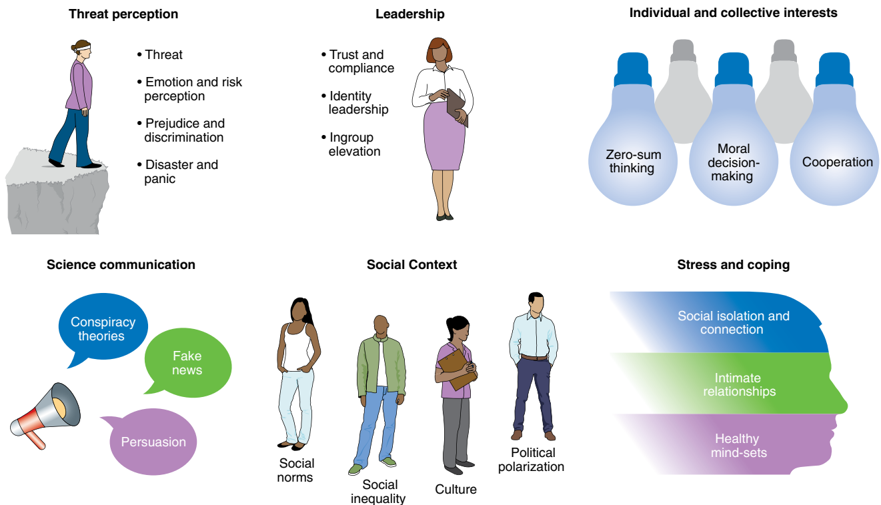
The COVID-19 pandemic represents a massive global health crisis. Because the crisis requires large-scale behaviour change and places significant psychological burdens on individuals, insights from the social and behavioural sciences can be used to help align human behaviour with the recommendations of epidemiologists and public health experts. Here we discuss evidence from a selection of research topics relevant to pandemics, including work on navigating threats, social and cultural influences on behaviour, science communication, moral decision-making, leadership, and stress and coping. In each section, we note the nature and quality of prior research, including uncertainty and unsettled issues. We identify several insights for effective response to the COVID-19 pandemic and highlight important gaps researchers should move quickly to fill in the coming weeks and months.
Overview
CoChat Summary
TL;DR
This perspective argues that social and behavioural science can help align public behaviour with COVID-19 public health recommendations across threat perception, social context, science communication, cooperation, leadership, and stress/coping. It synthesizes prior evidence and policy insights while cautioning that evidence is limited, often drawn from non-pandemic contexts, and in many areas unsettled.
Key findings
- The paper notes the scale of infectious disease threats: the bubonic plague killed approximately 25% of the European population, and by March 2020 COVID-19 had spread to more than 118,000 cases and caused 4,291 deaths in 114 countries. It also notes that 21 countries donated medical supplies to China in February, with China reciprocating widely.
- Fear appeals can change behaviour when people feel capable of dealing with the threat, but produce defensive reactions when people feel helpless; optimism bias can lead people to underestimate personal risk and ignore public health warnings.
- Social norms, inequality, culture, and political polarization shape pandemic behaviour: correcting misperceived norms can help when most people are already doing the desirable behaviour, but descriptive norms can backfire if the behaviour is undesirable unless paired with prescriptive norms.
- Effective communication and leadership may involve credible sources, messages that protect others or align with moral values, prebunking/inoculation against misinformation, accuracy nudges, shared social identity, and leaders modelling prosocial sacrifice; excessive national self-image concerns (“collective narcissism”) can backfire.
Methods
- Design: Perspective/narrative review; no primary data collection or sample. Topics were identified by the corresponding authors as potentially relevant to pandemic response and are explicitly not exhaustive.
- Evidence base: synthesizes prior social and behavioural research on threat perception, social context, science communication, moral decision-making, cooperation, leadership, and stress/coping, drawing on laboratory experiments, correlational studies, field experiments, meta-analyses, and preprints/forthcoming work.
- Analysis: narrative synthesis with policy implications and identified research gaps; no systematic search strategy or quantitative synthesis is reported.
Limitations
- Stated: due to space constraints, the paper provides only a brief summary of each topic; research on these topics is ongoing and in many cases far from settled; there is very little published social science research on the current pandemic, so discussion often draws from different circumstances and evidence quality varies substantially.
- Stated: insights and policy implications should be interpreted with caution.
- Evident: as a perspective rather than a systematic review or empirical study, it does not provide a comprehensive evidence appraisal, and its reliance on preprints and forthcoming sources limits certainty.
Model-written summary. Check it against the paper before relying on it.
Integrity signals
Registry
Cites
Statistics
Figures
Verification
Claims the paper makes
19 Valid · 5 Not valid · 37 Not checked · 13 Own results and interpretations
At least one cited source doesn’t support this claim or points to a different paper, and none confirmed it — see the verdicts below.
In the paper
“For instance, in hypothetical scenarios about deciding whether to go to work while sick, American and British participants reported they would be less willing to stay home when it was uncertain they would infect a co-worker.”
What the sources say
- Disputedcites [176] Kappes, A. et al. Uncertainty about the impact of social decisions increases prosocial behaviour. Nat. Hum. Behav. 2, 573–580 (2018). sourceExperimental — accuracy not yet measured
In the paper’s account of the infectious-disease scenario (Abstract; page not provided), participants facing uncertainty about how severely a co-worker might be affected were more likely to stay home than controls, not less. The paper distinguishes that impact uncertainty from uncertainty about whether a co-worker would be infected. Its Study 6 Methods (page not provided) describe recruitment through AMT, but do not establish the claimed American and British participant groups. (LLM, conf=0.88)
Checked by a reasoning model — may be wrong.
hedgedstates an association- Asserted: passes — The authors put it forward as true.
- Checkable: passes — It can be checked against evidence.
- Load-bearing: passes — The paper’s conclusions depend on it.
- Based: passes — The paper gives a reason why it holds.
- Disputed
The cited sources that could be checked couldn’t confirm or dispute this claim.
In the paper
“Moreover, there is mixed research regarding whether corrections may actually increase belief in the original misinformation 121,124-126 or in other misleading claims that fail to get corrected 127 .”
What the sources say
- Not checked — no full text of the sourcecites [121] Guess, A. & Coppock, A. Does counter-attitudinal information cause backlash? Results from three large survey experiments. Br. J. Polit. Sci. https://doi.org/10.1017/S0007123418000327 (2018). source
- Not matchedcites [124] Wittenberg, C. & Berinsky, A.J. Misinformation and its correction. in Social Media and Democracy: The State of the Field (eds Persily, N. & Tucker, J. A.) (Cambridge University Press, forthcoming).
Its entry has no title and year that we can search by.
- Not checked — no full text of the sourcecites [125] Swire, B. & Ecker, U.K.H. Misinformation and its correction: Cognitive mechanisms and recommendations for mass communication. in Misinformation and Mass Audiences (eds. Southwell, B. G., Thorson, E. A. & Sheble, L.) 195–2011 (University of Texas Press, 2018). source
- Not checked — no full text of the sourcecites [126] Wood, T. & Porter, E. The elusive backfire effect: mass attitudes’ steadfast factual adherence. Polit. Behav. 41, 135–163 (2018). source
- Could not verifycites [127] Pennycook, G., McPhetres, J., Zhang, Y. & Rand, D. Fighting COVID-19 misinformation on social media: Experimental evidence for a scalable accuracy nudge intervention. Preprint at PsyArXiv https://doi.org/10.31234/osf.io/uhbk9 (2020). sourceExperimental — accuracy not yet measured
Citation 127 is attached to the suggestion that corrections may increase belief in other misleading claims that go uncorrected. The Statement of Relevance and Discussion describe an accuracy nudge that improved sharing decisions, not corrections or their effects on belief in uncorrected claims. Searches for correction backfire and uncorrected misinformation found no passage addressing that point; page numbers were unavailable in our copy. (LLM, conf=0.76)
hedgedstates a possible cause- Asserted: passes — The authors put it forward as true.
- Checkable: passes — It can be checked against evidence.
- Load-bearing: passes — The paper’s conclusions depend on it.
- Based: passes — The paper gives a reason why it holds.
The sources with a verdict support this claim; the rest weren’t checked yet, have no full text we could read, or their verdicts aren’t rated yet.
In the paper
“Indeed, laboratory research has found that people prioritize local over global (or international) interests 185,186 .”
What the sources say
- Supportedcites [185] Milinski, M., Hilbe, C., Semmann, D., Sommerfeld, R. & Marotzke, J. Humans choose representatives who enforce cooperation in social dilemmas through extortion. Nat. Commun. 7, 10915 (2016). source
The Results section (‘Voters choose selfish representatives’; page unavailable) reports that participants preferentially re-elected representatives who contributed less to the shared climate account and elected candidates who pledged to contribute less than a fair share. In this simulated international dilemma, that supports the claim that participants favored their own group’s interests over the collective goal; it does not establish that everyone did so. (LLM, conf=0.85)
- Not checked — no full text of the sourcecites [186] Reinders Folmer, C. P. et al. One for all: what representing a group may do to us. J. Exp. Soc. Psychol. 48, 1047–1056 (2012). source
plain- Asserted: passes — The authors put it forward as true.
- Checkable: passes — It can be checked against evidence.
- Load-bearing: passes — The paper’s conclusions depend on it.
- Based: passes — The paper gives a reason why it holds.
- Supported
Every source the paper cites for this claim was checked and supports it.
In the paper
“However, when going to work risked infecting an elderly co-worker who would suffer a serious illness, participants reported they would be more willing to stay home 176 .”
What the sources say
- Supportedcites [176] Kappes, A. et al. Uncertainty about the impact of social decisions increases prosocial behaviour. Nat. Hum. Behav. 2, 573–580 (2018). source
The Study 6 Methods (page not provided) describe a scenario in which going to work could infect an older, vulnerable co-worker who would suffer severely, followed by a rating of willingness to go to work. The reported Study 6 findings (indexed under Abstract; page not provided) say participants given that risk information were significantly more likely to stay home than controls. (LLM, conf=0.92)
hedgedstates a cause- Asserted: passes — The authors put it forward as true.
- Checkable: passes — It can be checked against evidence.
- Load-bearing: passes — The paper’s conclusions depend on it.
- Based: passes — The paper gives a reason why it holds.
- Supported
The sources with a verdict support this claim; the rest weren’t checked yet, have no full text we could read, or their verdicts aren’t rated yet.
In the paper
“Several techniques, such as sanctioning defectors 187 or rewarding cooperators 188 , tend to increase cooperative behaviour in laboratory experiments using economic games.”
What the sources say
- Not checked — no full text of the sourcecites [187] Yamagishi, T. The provision of a sanctioning system as a public good. J. Pers. Soc. Psychol. 51, 110–116 (1986). source
- Supportedcites [188] Rand, D. G., Dreber, A., Ellingsen, T., Fudenberg, D. & Nowak, M. A. Positive interactions promote public cooperation. Science 325, 1272–1275 (2009). source
Citation 188 is attached to rewarding cooperators. The paper’s Abstract reports a laboratory comparison using repeated public goods games and finds that reward maintained public cooperation and, when both reward and punishment were available, increased contributions. (LLM, conf=0.93)
plainstates a cause- Asserted: passes — The authors put it forward as true.
- Checkable: passes — It can be checked against evidence.
- Load-bearing: unclear — It is unclear whether the paper’s conclusions depend on it.
- Based: passes — The paper gives a reason why it holds.
50 more claims · 13 with their cited sources checked
Create a free account to see all 74 claims and to verify the 2 references still open.
- It may state two separate claims as one. 13
- Probably not a substantial claim. 6
Claims other papers make about this one
Each is checked against this paper’s own text: does it say what the citing paper says it does?
The source backs part of the claim, not all of it — or backs it for a different population, condition or comparison.
In the citing paper
“COVID-19 is an international public health crisis, putting substantial burden on medical centers and increasing the psychological toll on health care workers (HCW).”
From Supporting the well-being of health care providers during the COVID-19 pandemic: The CopeColumbia response (2020) · cites this paper as [6]
Experimental — accuracy not yet measuredThe source backs part of the claim, not all of it — or backs it for a different population, condition or comparison.
In the citing paper
“these population-wide measures affected psychological well-being and mental health as well as increased social isolation [68] and loneliness.”
From Psychological correlates of perceived loneliness in college students before and during the COVID-19 stay-at-home period: a longitudinal study (2023) · cites this paper as [68]
Experimental — accuracy not yet measuredThe source backs part of the claim, not all of it — or backs it for a different population, condition or comparison.
In the citing paper
“they may eventually increase the social isolation of students and affect their psychological well-being and mental health [3].”
From Students under lockdown: Comparisons of students’ social networks and mental health before and during the COVID-19 crisis in Switzerland (2020) · cites this paper as [3]
Experimental — accuracy not yet measuredThe source backs part of the claim, not all of it — or backs it for a different population, condition or comparison.
In the citing paper
“effective interventions are hard to scale to a population level (12);”
From Psychological inoculation improves resilience against misinformation on social media (2022) · cites this paper as [12]
Experimental — accuracy not yet measuredThe source backs part of the claim, not all of it — or backs it for a different population, condition or comparison.
In the citing paper
“There is a shortage of studies that test anti-misinformation interventions in an ecologically valid manner, i.e., testing an intervention as consumers would interact with it in online environments (8, 12).”
From Psychological inoculation improves resilience against misinformation on social media (2022) · cites this paper as [12]
Experimental — accuracy not yet measured
6 more claims about this paper
Create a free account to see every claim other papers make about this one.
Citations
Cites
Granovetter, M. S. (1973) · American Journal of Sociology · doi:10.1086/225469 · Cited by 40,491
Zhou, F., Yu, T., Du, R., Fan, G., Liu, Y., Liu, Z., Xiang, J., Wang, Y., Song, B., Gu, X., et al. (2020) · The Lancet · doi:10.1016/s0140-6736(20)30566-3 · Cited by 27,263
The need to belong: Desire for interpersonal attachments as a fundamental human motivation.
Baumeister, R. F., & Leary, M. R. (1995) · Psychological Bulletin · doi:10.1037//0033-2909.117.3.497 · Cited by 23,245
Culture and the self: Implications for cognition, emotion, and motivation.
Markus, H. R., & Kitayama, S. (1991) · Psychological Review · doi:10.1037/0033-295x.98.2.224 · Cited by 21,995
Self-citationThe Psychological Impact of Quarantine and How to Reduce It: Rapid Review of the Evidence
Brooks, S. K., Webster, R. K., Smith, L. E., Woodland, L., Wessely, S., Greenberg, N., & Rubin, G. J. (2020) · doi:10.2139/ssrn.3532534 · Cited by 16,394
The psychological impact of quarantine and how to reduce it: Rapid review of the evidence
Brooks, S. K., Webster, R. K., Smith, L. E., Woodland, L., Wessely, S., Greenberg, N., & Rubin, G. J. (2020) · The Lancet · doi:10.1016/s0140-6736(20)30460-8 · Cited by 16,378
Nudge: improving decisions about health, wealth, and happiness
(2008) · Choice Reviews Online · doi:10.5860/choice.46-0977 · Cited by 11,572
Slovic, P. (1987) · Science · doi:10.1126/science.3563507 · Cited by 9,271
The Elaboration Likelihood Model of Persuasion
Petty, R. E., & Cacioppo, J. T. (1986) · Advances in Experimental Social Psychology · doi:10.1016/s0065-2601(08)60214-2 · Cited by 8,822
Self-citationThe emotional dog and its rational tail: A social intuitionist approach to moral judgment.
Haidt, J. (2001) · Psychological Review · doi:10.1037/0033-295x.108.4.814 · Cited by 8,048
Research works printed but not linked: 3
- Berkowitz, A.D. An overview of the social norms approach. in Changing the Culture of College Drinking: A Socially Situated Health Communication Campaign (eds. Stewart, L. & Lederman, L. C.) 193–214 (Hampton Press, 2005).
- Wittenberg, C. & Berinsky, A.J. Misinformation and its correction. in Social Media and Democracy: The State of the Field (eds Persily, N. & Tucker, J. A.) (Cambridge University Press, forthcoming).
- Ransohoff, K.J. Patients on the Trolley Track: The Moral Cognition of Medical Practitioners and Public Health Professionals. (Harvard Univ. Press, 2011).
Cited by
Items 2,101–2,200 of 5,015
A Study of the Effectiveness of Governmental Strategies for Managing Mortality from COVID-19
Clyde, W., Kakolyris, A., & Koimisis, G. (2021) · Eastern Economic Journal · doi:10.1057/s41302-021-00202-x · Cited by 9
Busaad, Y., & Alnaim, M. (2021) · International Journal of Instruction · doi:10.29333/iji.2021.14457a · Cited by 9
Prihadi, K. D., Wan, S. Y., Lee, V., & Ismail, H. N. (2022) · International Journal of Public Health Science (IJPHS) · doi:10.11591/ijphs.v11i1.21245 · Cited by 14
Gerrits, L. (2021) · Landscape Ecology · doi:10.1007/s10980-021-01363-y · Cited by 10
Wang, W., Li, S., Li, J., & Wang, Y. (2021) · Frontiers in Psychology · doi:10.3389/fpsyg.2021.736002 · Cited by 10
Suzuki, K., Hasegawa, T., Kano, N., & Okamoto, Y. (2021) · Public Administration and Policy · doi:10.1108/pap-08-2021-0046 · Cited by 9
Understanding the characteristics of COVID-19 misinformation communities through graphlet analysis
Ashford, J. R., Turner, L. D., Whitaker, R. M., Preece, A. D., & Felmlee, D. (2021) · Online Social Networks and Media · doi:10.1016/j.osnem.2021.100178 · Cited by 13
Metcalf, C. J. E., Andriamandimby, S. F., Baker, R. E., Glennon, E. E., Hampson, K., Hollingsworth, T. D., Klepac, P., & Wesolowski, A. (2021) · Epidemics · doi:10.1016/j.epidem.2021.100507 · Cited by 10
Do social media reduce compliance with COVID-19 preventive measures?
Pavelea, A. M., Neamţu, B., & Pavel, A. (2021) · Policy Studies · doi:10.1080/01442872.2021.2000595 · Cited by 10
“It is argued that people who trust the government will be more likely to adhere to the rules imposed or suggested by government authorities (Van Bavel et al. 2020).”
BackgroundCan Virtual Assistants Perform Cognitive Assessment in Older Adults? A Review
Moret‐Tatay, C., Iborra-Marmolejo, I., Jorques-Infante, M. J., Esteve‐Rodrigo, J. V., Schwanke, C. H. A., & Irigaray, T. Q. (2021) · Medicina · doi:10.3390/medicina57121310 · Cited by 10
“The unprecedented nature of the current situation has highlighted the invisibility of older people in public data analysis, where the older the person, the greater the risk of increasing their health risk and dying [10].”
To board or not to board? Understanding the drivers of intention to fly during the COVID-19 crisis
Pinho, L. F., Naranjo-Zolotov, M., & Pinto, D. C. (2021) · Current Issues in Tourism · doi:10.1080/13683500.2021.2005552 · Cited by 10
“Contemporary top research at Nature (Van Bavel et al., 2020) indicates social and behavioural factors like social influence as important predictors to support the COVID-19 pandemic response.”
BackgroundLermer, E., Hudecek, M. F. C., Gaube, S., Raue, M., & Batz, F. (2021) · Frontiers in Psychology · doi:10.3389/fpsyg.2021.769206 · Cited by 12
Géa, L. P., Upfold, C., Qureshi, A., Moulden, H. M., Mамак, М., Bradford, J., & Chaimowitz, G. A. (2021) · Journal of Psychiatric Research · doi:10.1016/j.jpsychires.2021.12.019 · Cited by 10
“Moreover, research regarding health crises response has shown that the success of healthcare policies relies, in part, on the public ’ s perception of personal and societal risk (Bavel et al., 2020; Byrd and Bia ł ek, 2021; Dryhurst et al., 2020).”
How has the University Community Been Coping During the COVID-19 Pandemic? An Iranian Survey
Ahmadi, F., Çetrez, Ö., Akhavan, S., Khodayarifard, M., & Zandi, S. (2022) · Frontiers in Sociology · doi:10.3389/fsoc.2021.645670 · Cited by 12
A dual-process approach to prosocial behavior under COVID-19 uncertainty
Costa, D., Fernandes, N., Arantes, J., & Keating, J. (2022) · PLoS ONE · doi:10.1371/journal.pone.0266050 · Cited by 13
“Likewise, moral decision-making during a pandemic typically involves uncertainty [9].”
BackgroundInfluentialLou, N. M., Noels, K. A., Zhang, Y. S. D., & Kurl, S. (2022) · International Journal of Intercultural Relations · doi:10.1016/j.ijintrel.2022.04.006 · Cited by 14
“…healthcare system, more language barriers, have less family support, experience more discrimination, and feel less secure about their cultural identity as they are still adapting and developing a sense of belonging to the new society (Bae, 2020; Lou, 2021; Usama et al., 2021; Ward et al., 2021).”
Posttraumatic Growth in Radiation Medicine During the COVID-19 Outbreak
Kapur, A., Rudin, B., & Potters, L. (2022) · Advances in Radiation Oncology · doi:10.1016/j.adro.2022.100975 · Cited by 10
“First, the COVID19 pandemic is an unprecedented health crisis, and therefore the insights from social and behavioral sciences may help understand the psychological effect that is currently still being assessed.(18) And second, because even for traumatic incidents with precedents, there are mixed results on the relatio…”
Helweg‐Larsen, M., Peterson, L. M., & DiMuccio, S. H. (2022) · Psychology and Health · doi:10.1080/08870446.2022.2060979 · Cited by 9
“The psychological literature is particularly well suited for examining how to change people’s behaviors (Bavel et al., 2020) and perceived risk is one extensively studied predictor of health behavior change (Ferrer & Klein, 2015).”
BackgroundAnalysis of the Impact of the COVID-19 Pandemic on the Future of Public Transport: Example of Warsaw
Bauer, M., & Bauer, K. (2022) · Sustainability · doi:10.3390/su14127268 · Cited by 11
Dankulov, M. M., Tadić, B., & Melnik, R. (2022) · Frontiers in Physics · doi:10.3389/fphy.2022.936618 · Cited by 11
“Multiple other factors may play a role [18], depending on the population genetic features and social life [19].”
BackgroundNurturing urban innovation and knowledge in the ongoing COVID-19 world
Mittal, B., & Woodside, A. G. (2022) · Journal of Innovation & Knowledge · doi:10.1016/j.jik.2022.100217 · Cited by 16
Akbar, M. B., Singh, L., Deshpande, S., & Amoncar, N. (2022) · Health Marketing Quarterly · doi:10.1080/07359683.2022.2092325 · Cited by 10
Ferreira, K. P. M., Oliveira, M. D., BARBOSA, R. A. F., Moura, R. D. A., Delabrida, Z. N. C., Costa, Í. M., & Melo, C. D. F. (2022) · Estudos de Psicologia (Campinas) · doi:10.1590/1982-0275202239e200160 · Cited by 9
Schütz, D. M., Borges, L., Ferreira, H. G., & Irigaray, T. Q. (2021) · Psico-USF · doi:10.1590/1413-8271202126nesp12 · Cited by 14
Pugliese, E., Mosca, O., Paolini, D., Mancini, F., Puntonieri, D., & Maricchiolo, F. (2022) · Current Psychology · doi:10.1007/s12144-022-03374-7 · Cited by 11
The impact of social cohesion on stock market resilience: Evidence from COVID-19
Ashraf, B. N., & Goodell, J. W. (2022) · Journal of Behavioral and Experimental Finance · doi:10.1016/j.jbef.2022.100749 · Cited by 10
Consumer pandemic animosity: scale development and validation
Rojas‐Méndez, J. I., Massi, M., & Gallito, E. (2022) · International Marketing Review · doi:10.1108/imr-07-2021-0231 · Cited by 15
Schmitz, M., Wollast, R., Bigot, A., & Luminet, O. (2022) · Health Psychology and Behavioral Medicine · doi:10.1080/21642850.2022.2120882 · Cited by 10
“05.01, B-1348 Louvain-laNeuve, Belgium to overcome the pandemic (Van Bavel et al., 2020).”
MethodInfluentialAn Investigation into Memorable Messages about COVID-19
Hample, J. (2022) · Journal of Health Communication · doi:10.1080/10810730.2022.2147256 · Cited by 9
“…(e.g., Gantiva, Jiménez-Leal, & Urriago-Rayo, 2021; Kachurka, Krawczyk, & Rachubik, 2021; & Motta, Sylvester, Callaghan, & Lunz-Trujillo, 2021) and in applying existing social science theories to message production (e.g., Bavel et al., 2020; Malecki, Keating, & Safdar, 2021; & Reddy & Gupta, 2020).”
Prokopowicz, P., Mikołajewski, D., & Mikołajewska, E. (2022) · Sensors · doi:10.3390/s22239214 · Cited by 12
Liu, L., Mirkovski, K., Lowry, P. B., & Vu, Q. (2023) · Data and Information Management · doi:10.1016/j.dim.2023.100039 · Cited by 16
Atkinson, M., Neville, F., Ntontis, E., & Reicher, S. D. (2023) · Risk Analysis · doi:10.1111/risa.14155 · Cited by 9
“…information and the necessary resources to do so—see Michie et al., 2011; Reicher & Drury, 2021), and whereas there are multiple psychological determinants of adherence (van Bavel et al., 2020), one consideration which has consistently been found to be of importance is the perception of risk.”
BackgroundSelf-citationCOVID research across the social sciences in 2020: a bibliometric approach
Thomson, R., Mosier, R., & Worosz, M. R. (2023) · Scientometrics · doi:10.1007/s11192-023-04714-5 · Cited by 14
Hammersley, M. (2023) · Zeitschrift für Evaluation · doi:10.31244/zfe.2023.02.03 · Cited by 10
Micropublishing During and After the COVID-19 Era
Yamada, Y. (2020) · Collabra Psychology · doi:10.1525/collabra.370 · Cited by 10
Rivers, A. S., & Sanford, K. (2020) · Personal Relationships · doi:10.1111/pere.12362 · Cited by 10
Benchmarking SARS CoV-2 Infection in the Workplace to Support Continuity of Operations
Iddins, B. O., Waugh, M. H., Buck, B., Cato, T., Graham, D. E., Attia, K., Jones, D. R., Partin, A. M., Shourbaji, R., & Wesh, C. (2021) · Journal of Occupational and Environmental Medicine · doi:10.1097/jom.0000000000002188 · Cited by 9
Silk, M. J., Carrignon, S., Bentley, R. A., & Fefferman, N. H. (2021) · Proceedings of the Royal Society B Biological Sciences · doi:10.1098/rspb.2021.0834 · Cited by 10
Zając, A. A., Wielechowski, M., & Czech, K. (2021) · Journal of Modern Science · doi:10.13166/jms/143524 · Cited by 9
“From the global health crisis (Bavel et al., 2020), the novel coronavirus pandemic has rapidly evolved into a global meltdown (Aggarwal et al., 2020).”
Sampaio, L. R., Constantino, M. K. R., Pires, M. F. D. N., Santos, T. D. L. S., Caetano, L. M., Dell’Agli, B. A. V., & dos Santos, I. T. (2022) · Trends in Psychology · doi:10.1007/s43076-021-00130-x · Cited by 10
Iverson, K. M., Dardis, C. M., Cowlishaw, S., Webermann, A. R., Shayani, D. R., Dichter, M. E., Mitchell, K. S., Mattocks, K. M., Gerber, M. R., & Portnoy, G. A. (2022) · Journal of General Internal Medicine · doi:10.1007/s11606-022-07589-z · Cited by 16
“Funding The larger study was supported, in part, by the Department of Veterans Affairs, Veterans Health Administration, Health Services Research and Development (HSR&D) Services as part of Dr. Iverson’s HSR&D Career Development Award (10-029), Investigator Initiated Award (16-062), and a Presidential Early Career Awar…”
MethodHow did the COVID-19 pandemic affect cooperation and interdependence?Preprint
Beltrán, D. G., Ayers, J. D., Alcock, J., Baciu, C., Claessens, S., Cronk, L., Hudson, N., Miller, G., Tidball, K. G., Winfrey, P., et al. (2020) · PsyArXiv (OSF Preprints) · doi:10.31234/osf.io/pk6jy · Cited by 9
Misinformation about COVID-19: Psychological Insights
Anastasiades, E., Argyrides, M., & Mousoulidou, M. (2021) · Encyclopedia · doi:10.3390/encyclopedia1040091 · Cited by 12
Olschewski, S., Luckman, A., Mason, A., et al. (2022) · doi:10.31234/osf.io/7csbt · Cited by 9
Lee, S.-H., Kao, H.-T., & Kung, P.-C. (2022) · Sustainability · doi:10.3390/su14095719 · Cited by 15
Informal payments by patients, institutional trust and institutional asymmetry
Horodnic, A. V., Williams, C. C., Ciobanu, C. I., & Druguș, D. (2022) · Frontiers in Psychology · doi:10.3389/fpsyg.2022.1015208 · Cited by 12
He, Z., & Chen, M. (2024) · Computers in Human Behavior · doi:10.1016/j.chb.2024.108276 · Cited by 11
Zozmann, H., Schüler, L., Fu, X., & Gawel, E. (2024) · PLoS ONE · doi:10.1371/journal.pone.0296145 · Cited by 14
Ma, Q., & Xie, Y. (2024) · Behavioral Sciences · doi:10.3390/bs14070600 · Cited by 13
“By implementing interventions, participants may realize that they can leverage the stress response for positive outcomes [75,76].”
BackgroundChang, M. (2024) · Social Science Computer Review · doi:10.1177/08944393241268526 · Cited by 11
“Previous studies suggest that risks associated with societal crises like COVID-19 become politicized, exacerbating political polarization (Hart et al., 2020; Van Bavel et al., 2020).”
Evolution of cooperation with asymmetric rewards
Geng, Y., Lu, Y., Hong, L. E., & Shi, L. (2024) · Applied Mathematics and Computation · doi:10.1016/j.amc.2024.129075 · Cited by 15
Xin, X., Jia, N., & Ling, S. (2024) · Transportation Research Part A Policy and Practice · doi:10.1016/j.tra.2024.104342 · Cited by 12
Basir, F. A., Nisar, K. S., Alsulami, I. M., et al. (2025) · The European Physical Journal Plus · doi:10.1140/epjp/s13360-025-06108-3 · Cited by 8
Qiu, X., Zhang, J., & Yi, C. (2025) · Public Management Review · doi:10.1080/14719037.2025.2501004 · Cited by 11
“This study has answered the academic call for incorporating behavioural insights to advance towards these goals (Van Bavel et al. 2020; Yusuf et al. 2023).”
Adaptive human behavior and delays in information availability autonomously modulate epidemic waves
Mahmud, M. S., Eshun, S., Espinoza, B., & Kadelka, C. (2025) · PNAS Nexus · doi:10.1093/pnasnexus/pgaf145 · Cited by 17
“This nuanced representation of behavioral changes allows us to simulate real-world scenarios where the timing and intensity of behavioral responses play a critical role in determining the trajectory and potential waves of epidemics.”
Authentic emergency department leadership during a pandemic
Lang, E., Ovens, H. J., Schull, M. J., et al. (2020) · Canadian Journal of Emergency Medicine · doi:10.1017/cem.2020.360 · Cited by 8
“1 At the other extreme, staff may feel that they are being exposed to undue risk, that messaging around pandemic operational changes is inconsistent and or unclear, and that there is a lack of trust in the leadership team's ability to see the department through this storm largely unscathed.”
BackgroundLatinx COVID-19 outcomes: Expanding the role of representative bureaucracy
Medina, P. S., & Azevedo, L. (2021) · Administrative Theory & Praxis · doi:10.1080/10841806.2021.1910411 · Cited by 9
“Further, distrust of health-care providers is historically prevalent among racially and ethnically underrepresented groups (Bavel et al., 2020).”
BackgroundInfluentialWidodo, A., & Wartoyo, F. X. (2020) · International Conference on Learning Innovation and Quality Education (ICLIQE) · doi:10.1145/3452144.3452163 · Cited by 11
“Lockdown or large-scale social restrictions carried out to inhibit the spread of the Covid-19 outbreak [1].”
BackgroundPublic opinions and knowledge about microorganisms
Špernjak, A., Puhmeister, A. J., & Šorgo, A. (2021) · Research in Science & Technological Education · doi:10.1080/02635143.2021.1952407 · Cited by 10
“…which permits non-commercial re-use, distribution, and reproduction in any medium, provided the original work is properly cited, and is not altered, transformed, or built upon in any way. locally and globally (Fetzel et al., 2020; Van Bavel et al. 2020).”
BackgroundInfluentialProspect theory: an analysis of corporate actions and priorities in pandemic crisis
Tapas, P., & Pillai, D. (2021) · International Journal of Innovation Science · doi:10.1108/ijis-10-2020-0241 · Cited by 10
Thompson, J. E., Squiers, L., Frasier, A. M., et al. (2022) · American Journal of Health Promotion · doi:10.1177/08901171221086962 · Cited by 8
“Because managing the COVID-19 crisis continues to require large-scale behavior change, particularly wearing face coverings in many public settings, insights from social and behavioral science can be instrumental in guiding the development of effective intervention and communication efforts.(9) Previous studies have sh…”
BackgroundKearney, M. D., Bornstein, M., Fall, M., Nianogo, R. A., Glik, D. C., & Massey, P. M. (2022) · BMJ Open · doi:10.1136/bmjopen-2021-057914 · Cited by 9
“9 Many behaviours associated with preventing COVID-19 were already familiar to residents of African nations who experienced Ebola outbreaks, including hand washing, use of personal protective equipment and social distancing.”
BackgroundSelf-Reported Anxiety in Spain: A Gendered Approach One Year After the Start of COVID-19 Pandemic
Jacques‐Aviñó, C., López‐Jiménez, T., Bennett, M., Medina‐Perucha, L., León-Gómez, B. B., & Berenguera, A. (2022) · Frontiers in Public Health · doi:10.3389/fpubh.2022.873891 · Cited by 11
“Therefore, it is important to understand epidemiology, social science, biomedicine and citizen science as inherently political and as tools that explicitly works toward advancing social justice (50, 71, 72).”
BackgroundBehavioral Economics in the Epidemiology of the COVID-19 Pandemic: Theory and Simulations
Marin-Lopez, B. A., Jimenez‐Gomez, D., & Abellán‐Perpiñán, J. (2022) · International Journal of Environmental Research and Public Health · doi:10.3390/ijerph19159557 · Cited by 10
“In addition, several articles have echoed the importance of policymakers taking into account individuals’ cognitive biases, as this allows for more efficient policy design, including policies related to public health [3,7,8].”
BackgroundGut and oral microbiota associations with viral mitigation behaviors during the COVID-19 pandemic
Li, K., Methé, B. A., Fitch, A. C., Gentry, H., Kessinger, C. J., Patel, A. V., Petraglia, V., Swamy, P., & Morris, A. (2022) · Frontiers in Cellular and Infection Microbiology · doi:10.3389/fcimb.2022.966361 · Cited by 10
“Especially in the early pandemic phase in 2020 prior to vaccine and other pharmaceutical prophylaxis interventions, a variety of strategies were implemented to minimize the spread of the virus including social distancing, self-isolation, working from home and increased hygiene measures (Bavel et al., 2020).”
BackgroundWei, C., Li, Q., Lian, Z., Luo, Y., Song, S., & Chen, H. (2022) · International Journal of Environmental Research and Public Health · doi:10.3390/ijerph191912365 · Cited by 9
“The pandemic can influence individual trust in the government, doctors, and strangers [20].”
BackgroundInfluentialKhan, A. R., Abedin, S., Rahman, M., & Khan, S. (2022) · PLOS Global Public Health · doi:10.1371/journal.pgph.0001157 · Cited by 13
“Economic position and social inequality are also associated with the level of trust in the healthcare systems [4], which in turn affects the testing rates, case counts, and data for infected individuals.”
BackgroundOlechnowicz, C., Leahy, J. E., Gardner, A. M., & Sponarski, C. C. (2023) · Ticks and Tick-borne Diseases · doi:10.1016/j.ttbdis.2023.102120 · Cited by 10
Post COVID-19: The effect of virtual workplace practices on social sustainable development policy
Dessouky, N. F. E. (2023) · International Journal of Public Policy and Administration Research · doi:10.18488/74.v10i1.3285 · Cited by 9
Education data needs and challenges for building back from COVID-19
Recch, F., Petherick, A., Hinton, R., Nagesh, R., Furst, R., & Goldszmidt, R. B. (2023) · Epidemics · doi:10.1016/j.epidem.2023.100673 · Cited by 13
Busch, M., Lindermayer, T., Schuster, K., Zhang, J., & von Terzi, P. (2023) · i-com · doi:10.1515/icom-2023-0006 · Cited by 11
Wu, X., Xie, Y. Y., Tan, X. Q., & Peng, Y. M. (2023) · International Public Management Journal · doi:10.1080/10967494.2023.2172118 · Cited by 9
“For example, trust in the government was correlated with decisions to abide by mandated social distancing policies and using clinics for care during the Ebola outbreak (Bavel et al. 2020).”
BackgroundResultCraig, M., & Vijaykumar, S. (2023) · Social Media + Society · doi:10.1177/20563051231161298 · Cited by 12
“An integral part of combative strategies is the dissemination of “corrective information,” which involves debunking misleading claims circulating on social media (Bavel et al., 2020).”
BackgroundThe Moral Foundations of Vaccine Passports
Harjani, T., He, H., & Chao, M. M. (2023) · Journal of Business Ethics · doi:10.1007/s10551-023-05427-8 · Cited by 9
“Thus, although the study of communication framing, informed by behavioural and social sciences, has been called upon to inform policy (Rimal & Lapinski, 2009; van Bavel et al., 2020), the direct application of results gleaned from online experiments are necessary but not sufficient to inform policy.”
Vansteenkiste, M., Waterschoot, J., Morbée, S., Oost, P. V., Schmitz, M., Klein, O., Luminet, O., Yzerbyt, V. Y., & den Bergh, O. V. (2023) · Social Issues and Policy Review · doi:10.1111/sipr.12101 · Cited by 9
“…and sustained adherence to health recommendations to contain virus circulation, social scientists in general, and psychologists in particular, were underrepresented when it came to providing policymakers with evidence-informed and evidence-based advice (Kazak, 2020; Van Bavel et al., 2020).”
BackgroundPredicting health behaviors during the COVID-19 pandemic: A longitudinal study
Wollast, R., Schmitz, M., Bigot, A., Brisbois, M., & Luminet, O. (2024) · PLoS ONE · doi:10.1371/journal.pone.0299868 · Cited by 10
Puukko, S., Heino, M. T. J., Kostamo, K., Saurio, K. J., Sniehotta, F. F., & Hankonen, N. E. (2024) · Translational Behavioral Medicine · doi:10.1093/tbm/ibae024 · Cited by 9
“For example, in recent years, the role of behavioral and social sciences in addressing the covid-19 pandemic was highlighted by institutional actors [6], and scientists alike [7].”
BackgroundWei, L., & Huang, Q. (2024) · Journal of Medical Internet Research · doi:10.2196/49422 · Cited by 11
“Insufficient knowledge led the public to experience a high degree of uncertainty and a strong sense of insecurity, which potentially impacted their social trust [46,47].”
Odetokun, I. A., Oniyanda, O., Raza, A., Akpabio, U., Musawa, A. I., Hambali, I. U., Adamu, S. G., Oyafajo, L. A., Alhaji, N. B., & Fasina, F. O. (2024) · Discover Public Health · doi:10.1186/s12982-024-00195-w · Cited by 7
“Risk communication and community engagement (RCCE) are germane in infectious disease control, as well as public knowledge, attitudes, and perceptions (KAP), which significantly influence behavioural change and public health crises such as pandemics [13, 14].”
A dataset for the perceived vulnerability to disease scale in Japan before the spread of COVID-19
Yamada, Y., Xu, H.-Q., & Sasaki, K. (2020) · F1000Research · doi:10.12688/f1000research.23713.2 · Cited by 8
Is there a regional culture in Russia? Opportunities of using a sociocultural approach in economics
Bryzgalin, V. A., & Nikishina, E. (2020) · Voprosy Ekonomiki · doi:10.32609/0042-8736-2020-7-108-126 · Cited by 18
From Climate Change to Pandemics: Decision Science Can Help Scientists Have Impact
Baker, C. M., Campbell, P. T., Chadès, I., Dean, A. J., Hester, S. M., Holden, M. H., McCaw, J. M., McVernon, J., Moss, R. G., Shearer, F. M., et al. (2022) · Frontiers in Ecology and Evolution · doi:10.3389/fevo.2022.792749 · Cited by 13
“2015), and incentive theory and behavioural sciences can help predict people’s response to policy change (Laffont & Martimort 2009; Bavel et al. 2020).”
BackgroundKlimanska, M. B., Klymanska, L. D., & Haletska, I. (2020) · Journal of Education Culture and Society · doi:10.15503/jecs2020.2.444.460 · Cited by 8
The perception concerning the COVID-19 pandemic: case of Turkey
HOŞGÖR, H., Aközlü, Z., & Hoşgör, D. G. (2021) · The European Research Journal · doi:10.18621/eurj.774757 · Cited by 8
“On the other hand, slowing down of the transmission also required significant behavioral changes in individuals [2].”
BackgroundGani, W. (2021) · African Development Review · doi:10.1111/1467-8268.12518 · Cited by 7
“Way & McComas, 2020; Sibley et al., 2020; Bavel et al., 2020).”
Altering Intention to Mudik during COVID-19 Pandemic: A Salient Cue and Simple Reminder Nudge
Prasetyo, D. B., & Sofyan, L. (2020) · Psychology and Developing Societies · doi:10.1177/0971333621990459 · Cited by 17
“Simon’s bounded rationality (1972) and Kahneman’s dual process theory (2011) have agreed that human beings have limited capacity to process information, and it gets more challenging during this pandemic where fear and anxiety govern individual emotion and cognition (Van Bavel et al., 2020).”
BackgroundInfluentialAn experimental investigation of resilience decision making in repeated disasters
Dormady, N., Greenbaum, R. T., & Young, K. A. (2021) · Environment Systems & Decisions · doi:10.1007/s10669-021-09818-y · Cited by 13
MAHAMA, I., ASANTE, F. L., Mensah, J. K., Kwaw, R., Amponsah, M. A., Nartey, P., & OPOKU, E. B. (2021) · Journal of Educational Technology and Online Learning · doi:10.31681/jetol.905277 · Cited by 10
Socioeconomic Correlates of Anti-Science Attitudes in the US
Hu, M., Rao, A., Kejriwal, M., & Lerman, K. (2021) · Future Internet · doi:10.3390/fi13060160 · Cited by 12
Can we replicate real human behaviour using artificial neural networks?
Jäger, G., & Reisinger, D. (2022) · Mathematical and Computer Modelling of Dynamical Systems · doi:10.1080/13873954.2022.2039717 · Cited by 11
Schoeni, R. F., Wiemers, E., Seltzer, J. A., & Langa, K. M. (2021) · Preventive Medicine · doi:10.1016/j.ypmed.2021.106726 · Cited by 10
“Messages that emphasize a shared fate, with all segments of the population vulnerable to the pandemic, also may reduce political polarization (Van Bavel et al., 2020).”
Çetin, M., & Kökalan, Ö. (2021) · Anales de Psicología · doi:10.6018/analesps.446891 · Cited by 13
“…constitutes an effective measure in the pandemic process, and it reduces social interaction, which plays an important role in dealing with the negative psychological outcomes of the pandemic, boosting the loneliness levels that will increase these negative outcomes (Van Bavel et al., 2020).”
BackgroundWise reasoning and political leadership amid COVID-19 pandemic: an exploratory study on Ghana
Kutor, S. K., Kyeremeh, E., Owusu, B., Amoak, D., & Ishola, T. O. (2021) · International Journal of Public Leadership · doi:10.1108/ijpl-03-2021-0018 · Cited by 11
Zheng, Y., Wu, C., Zheng, X., & Pan, J. (2021) · Applied Psychology · doi:10.1111/apps.12351 · Cited by 9
Politik und Verwaltung in der Corona-Krise
Blum, S., Loer, K., Reiter, R., & Töller, A. E. (2021) · dms – der moderne staat – Zeitschrift für Public Policy Recht und Management · doi:10.3224/dms.v14i2.16 · Cited by 14
Moon, C., & Travaglino, G. A. (2021) · Journal of Pacific Rim Psychology · doi:10.1177/18344909211056855 · Cited by 12
Tweet Analysis for Enhancement of COVID-19 Epidemic Simulation: A Case Study in Japan
Tran, V., & Matsui, T. (2022) · Frontiers in Public Health · doi:10.3389/fpubh.2022.806813 · Cited by 9
“(19) observed that, especially in the current COVID-19 pandemic, “Social networks can amplify the spread of behaviors that are both harmful and beneficial during an epidemic, and these effects may spread through the network to friends, friends’ friends and even friends’ friends’ friends.”
BackgroundBrown, L. R., Williams, A. J., Shaw, K., Özakinci, G., & van Beusekom, M. M. (2021) · BJGP Open · doi:10.3399/bjgpo.2021.0151 · Cited by 11
“In addition, partnerships between community leads and public health authorities help to ensure that messages reach underserved communities (31).”
Backgroundde Ridder, D. T. D., Aarts, H., Benjamins, J. S., Glebbeek, M., Leplaa, H. J., Leseman, P. P. M., Potgieter, R., Tummers, L. G., & Zondervan-Zwijnenburg, M. A. J. (2021) · Journal of Community & Applied Social Psychology · doi:10.1002/casp.2593 · Cited by 11
“In debates about the best public health response to the COVID-19 pandemic, references have been made to the crucial role of behavioural science in designing effective prevention campaigns (Bonell et al., 2020; Van Bavel et al., 2020).”
BackgroundMancini, T., Imperato, C., Vesco, S., & Rossi, M. (2021) · Journal of Refugee Studies · doi:10.1093/jrs/feab082 · Cited by 9
Metadata
- Authors
- Bavel, J. J. V., Baicker, K., Boggio, P. S., Capraro, V., Cichocka, A., Cikara, M., Crockett, M. J., Crum, A. J., Douglas, K. M., Druckman, J. N., Drury, J., Dube, O., Ellemers, N., Finkel, E. J., Fowler, J. H., Gelfand, M., Han, S., Haslam, S. A., Jetten, J., Kitayama, S., Mobbs, D., Napper, L. E., Packer, D. J., Pennycook, G., Peters, E., Petty, R. E., Rand, D. G., Reicher, S. D., Schnall, S., Shariff, A., Skitka, L. J., Smith, S. S., Sunstein, C. R., Tabri, N., Tucker, J. A., Linden, S. V. D., Lange, P. V., Weeden, K. A., Wohl, M. J. A., Zaki, J., Zion, S. R., & Willer, R.
- Affiliations
- New York University (US)
- Universidade Presbiteriana Mackenzie (BR)
- Middlesex University London (GB)
- University of Kent (GB)
- Harvard University (US)
- Yale University (US)
- Stanford University (US)
- Northwestern University (US)
- University of Sussex (GB)
- University of Chicago (US)
- Utrecht University (NL)
- University of California San Diego (US)
- University of Maryland, College Park (US)
- Peking University (CN)
- The University of Queensland (AU)
- University of Michigan (US)
- California Institute of Technology (US)
- Lehigh University (US)
- University of Regina (CA)
- University of Oregon (US)
- The Ohio State University (US)
- Massachusetts Institute of Technology (US)
- University of St Andrews (GB)
- University of Cambridge (GB)
- University of British Columbia (CA)
- University of Illinois Chicago (US)
- University of California, Berkeley (US)
- Carleton University (CA)
- Cornell University (US)
- Corresponding author
- Bavel, Jay J. Van
- Willer, Robb
- ORCID
- Bavel, Jay J. Van
- Baicker, Katherine
- Boggio, Paulo S.
- Capraro, Valerio
- Cichocka, Aleksandra
- Cikara, Mina
- Crockett, Molly J.
- Crum, Alia J.
- Douglas, Karen M.
- Druckman, James N.
- Drury, John
- Ellemers, Naomi
- Finkel, Eli J.
- Fowler, James H.
- Gelfand, Michele
- Han, Shihui
- Haslam, S. Alexander
- Jetten, Jolanda
- Kitayama, Shinobu
- Mobbs, Dean
- Napper, Lucy E.
- Packer, Dominic J.
- Pennycook, Gordon
- Peters, Ellen
- Petty, Richard E.
- Rand, David G.
- Reicher, Stephen D.
- Schnall, Simone
- Shariff, Azim
- Skitka, Linda J.
- Sunstein, Cass R.
- Tabri, Nassim
- Tucker, Joshua A.
- Linden, Sander van der
- Weeden, Kim A.
- Wohl, Michael J. A.
- Zaki, Jamil
- Zion, Sean R.
- Willer, Robb
- Venue
- Nature Human Behaviour
- Published
- 2020-04-30
- Volume
- 4
- Issue
- 5
- Pages
- 460-471
- ISSN
- 2397-3374 (ISSN-L)
- OpenAlex
- W3016902371
- Semantic Scholar
- d81abcd7f053b136423f1e7f57928524e8b0e1a0
- Cited by
- 4,964
- References
- 259
- Citations by year
- 2026: 177 · 2025: 288 · 2024: 483 · 2023: 741 · 2022: 1094 · 2021: 1474 · 2020: 702
- FWCI
- 175.81
- Type
- journal article
- Language
- en
- Open access
- bronze
- doi.org
- Licence
- www.springernature.com/gp/researchers/text-and-data-mining (tdm)
- www.springernature.com/gp/researchers/text-and-data-mining (vor)
- Locations
- Nature Human Behaviour (publishedVersion)
- PubMed (publishedVersion)
- Middlesex University Research Repository (Middlesex University Of London) (acceptedVersion)
- Kent Academic Repository (University of Kent) (acceptedVersion)
- DSpace@MIT (Massachusetts Institute of Technology) (submittedVersion, cc-by-nc-sa)
- Sussex Research Online (University of Sussex) (submittedVersion)
- CaltechAUTHORS (California Institute of Technology) (submittedVersion)
- RePEc: Research Papers in Economics (submittedVersion)
- BOA (University of Milano-Bicocca) (submittedVersion)
- Carleton University's Institutional Repository (MacOdrum Library, Carleton University) (submittedVersion, other-oa)
- Utrecht University Repository (Utrecht University) (submittedVersion)
- Figshare (submittedVersion)
- VU Research Portal (submittedVersion, other-oa)
- Utrecht University Repository (Utrecht University) (submittedVersion, other-oa)
- Data Archiving and Networked Services (DANS) (submittedVersion, other-oa)
- Funders
- U.S. Department of Health and Human Services (2P50 MH094258)
- National Institute of Mental Health (P50MH094258)
- Topics
- Social Sciences › Sociology and Political Science › COVID-19 Prevention and Impact
- Social Sciences › Communication › Communication and COVID-19 Impact
- Physical Sciences › Mathematics › Modeling and Simulation › COVID-19 epidemiological studies
- Keywords
- COVID-19 pandemic, pandemic response, behavior change, science communication, ethical decision-making, leadership, stress coping, psychological burden, public health recommendations
- MeSH terms
- Betacoronavirus, COVID-19, SARS-CoV-2, Adaptation, Psychological, Communicable Disease Control, Decision Making, Humans, Human Activities, Health Knowledge, Attitudes, Practice, Leadership, Pneumonia, Viral, Public Health, Quarantine, Stress, Psychological, Global Health, Coronavirus, Coronavirus Infections, Pandemics, Social Media, Epidemiological Monitoring
About these checks
Registry, retraction, Cites and statistics results are computed, not judged, with one exception: a printed reference that no index lists is read once by a model before it counts as a citation error. Claims are extracted by a model and kept only when their quote appears verbatim in the text; each cited source is then checked, with a model’s help, for whether it says what the claim relies on. Those verdicts can be wrong — read the claim’s quote and the cited source before relying on one.
The claim verdicts this report counts are experimental: their accuracy is not yet measured.
A language model drew the claims from the paper on 2026-10-10, under version 3 of the claim definition (model deepseek-v4.1-flash, prompt extract-v3).
A second model labelled each claim on 2026-10-10 (model jev-1.13-20260917, definition revision gold-guideline-v0.2).
Cited sources are checked with a language model’s help (gpt-6-sol).
Statistics and arithmetic are recomputed, not judged.
Confidence bands are shown only for fields calibrated on our annotated test set. None is calibrated yet, so no band is shown.
What counts as a claim ›How we measure confidence ›How we check this ›
Are you an author, or do you see a problem with this page? Request a review
Data sources
Bibliographic data: Semantic Scholar, OpenAlex, Crossref.
Contains information from the Semantic Scholar Academic Graph Datasets, made available under the ODC Attribution License (ODC-BY 1.0).
Semantic Scholar’s data is described in: Kinney, R., et al. (2023). The Semantic Scholar Open Data Platform. arXiv:2301.10140.
