

Using social and behavioural science to support COVID-19 pandemic response
Open accessThe DOI matches its Crossref record; 257 of the 259 references it cites were found in a registry or an index; 24 of the 89 sources its claims cite were checked for support.
Abstract
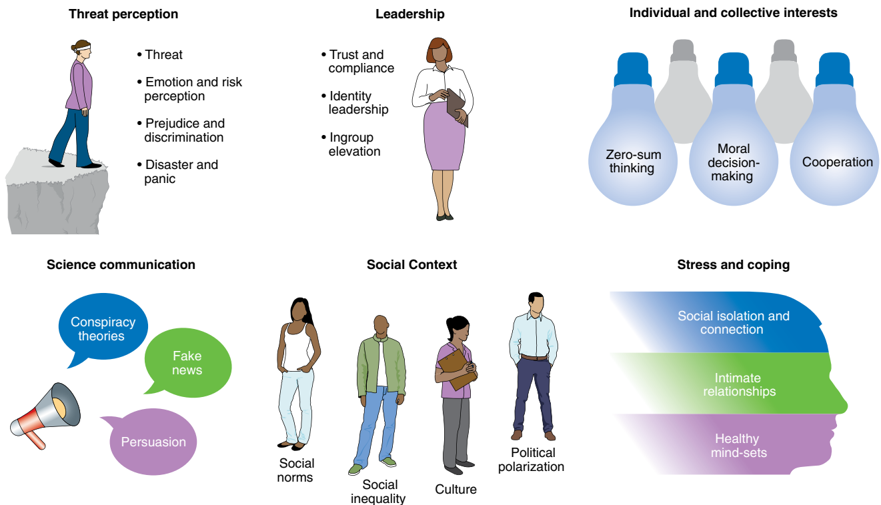
The COVID-19 pandemic represents a massive global health crisis. Because the crisis requires large-scale behaviour change and places significant psychological burdens on individuals, insights from the social and behavioural sciences can be used to help align human behaviour with the recommendations of epidemiologists and public health experts. Here we discuss evidence from a selection of research topics relevant to pandemics, including work on navigating threats, social and cultural influences on behaviour, science communication, moral decision-making, leadership, and stress and coping. In each section, we note the nature and quality of prior research, including uncertainty and unsettled issues. We identify several insights for effective response to the COVID-19 pandemic and highlight important gaps researchers should move quickly to fill in the coming weeks and months.
Overview
CoChat Summary
TL;DR
This perspective argues that social and behavioural science can help align public behaviour with COVID-19 public health recommendations across threat perception, social context, science communication, cooperation, leadership, and stress/coping. It synthesizes prior evidence and policy insights while cautioning that evidence is limited, often drawn from non-pandemic contexts, and in many areas unsettled.
Key findings
- The paper notes the scale of infectious disease threats: the bubonic plague killed approximately 25% of the European population, and by March 2020 COVID-19 had spread to more than 118,000 cases and caused 4,291 deaths in 114 countries. It also notes that 21 countries donated medical supplies to China in February, with China reciprocating widely.
- Fear appeals can change behaviour when people feel capable of dealing with the threat, but produce defensive reactions when people feel helpless; optimism bias can lead people to underestimate personal risk and ignore public health warnings.
- Social norms, inequality, culture, and political polarization shape pandemic behaviour: correcting misperceived norms can help when most people are already doing the desirable behaviour, but descriptive norms can backfire if the behaviour is undesirable unless paired with prescriptive norms.
- Effective communication and leadership may involve credible sources, messages that protect others or align with moral values, prebunking/inoculation against misinformation, accuracy nudges, shared social identity, and leaders modelling prosocial sacrifice; excessive national self-image concerns (“collective narcissism”) can backfire.
Methods
- Design: Perspective/narrative review; no primary data collection or sample. Topics were identified by the corresponding authors as potentially relevant to pandemic response and are explicitly not exhaustive.
- Evidence base: synthesizes prior social and behavioural research on threat perception, social context, science communication, moral decision-making, cooperation, leadership, and stress/coping, drawing on laboratory experiments, correlational studies, field experiments, meta-analyses, and preprints/forthcoming work.
- Analysis: narrative synthesis with policy implications and identified research gaps; no systematic search strategy or quantitative synthesis is reported.
Limitations
- Stated: due to space constraints, the paper provides only a brief summary of each topic; research on these topics is ongoing and in many cases far from settled; there is very little published social science research on the current pandemic, so discussion often draws from different circumstances and evidence quality varies substantially.
- Stated: insights and policy implications should be interpreted with caution.
- Evident: as a perspective rather than a systematic review or empirical study, it does not provide a comprehensive evidence appraisal, and its reliance on preprints and forthcoming sources limits certainty.
Model-written summary. Check it against the paper before relying on it.
Integrity signals
Registry
Cites
Statistics
Figures
Verification
Claims the paper makes
19 Valid · 5 Not valid · 37 Not checked · 13 Own results and interpretations
At least one cited source doesn’t support this claim or points to a different paper, and none confirmed it — see the verdicts below.
In the paper
“For instance, in hypothetical scenarios about deciding whether to go to work while sick, American and British participants reported they would be less willing to stay home when it was uncertain they would infect a co-worker.”
What the sources say
- Disputedcites [176] Kappes, A. et al. Uncertainty about the impact of social decisions increases prosocial behaviour. Nat. Hum. Behav. 2, 573–580 (2018). sourceExperimental — accuracy not yet measured
In the paper’s account of the infectious-disease scenario (Abstract; page not provided), participants facing uncertainty about how severely a co-worker might be affected were more likely to stay home than controls, not less. The paper distinguishes that impact uncertainty from uncertainty about whether a co-worker would be infected. Its Study 6 Methods (page not provided) describe recruitment through AMT, but do not establish the claimed American and British participant groups. (LLM, conf=0.88)
Checked by a reasoning model — may be wrong.
hedgedstates an association- Asserted: passes — The authors put it forward as true.
- Checkable: passes — It can be checked against evidence.
- Load-bearing: passes — The paper’s conclusions depend on it.
- Based: passes — The paper gives a reason why it holds.
- Disputed
The cited sources that could be checked couldn’t confirm or dispute this claim.
In the paper
“Moreover, there is mixed research regarding whether corrections may actually increase belief in the original misinformation 121,124-126 or in other misleading claims that fail to get corrected 127 .”
What the sources say
- Not checked — no full text of the sourcecites [121] Guess, A. & Coppock, A. Does counter-attitudinal information cause backlash? Results from three large survey experiments. Br. J. Polit. Sci. https://doi.org/10.1017/S0007123418000327 (2018). source
- Not matchedcites [124] Wittenberg, C. & Berinsky, A.J. Misinformation and its correction. in Social Media and Democracy: The State of the Field (eds Persily, N. & Tucker, J. A.) (Cambridge University Press, forthcoming).
Its entry has no title and year that we can search by.
- Not checked — no full text of the sourcecites [125] Swire, B. & Ecker, U.K.H. Misinformation and its correction: Cognitive mechanisms and recommendations for mass communication. in Misinformation and Mass Audiences (eds. Southwell, B. G., Thorson, E. A. & Sheble, L.) 195–2011 (University of Texas Press, 2018). source
- Not checked — no full text of the sourcecites [126] Wood, T. & Porter, E. The elusive backfire effect: mass attitudes’ steadfast factual adherence. Polit. Behav. 41, 135–163 (2018). source
- Could not verifycites [127] Pennycook, G., McPhetres, J., Zhang, Y. & Rand, D. Fighting COVID-19 misinformation on social media: Experimental evidence for a scalable accuracy nudge intervention. Preprint at PsyArXiv https://doi.org/10.31234/osf.io/uhbk9 (2020). sourceExperimental — accuracy not yet measured
Citation 127 is attached to the suggestion that corrections may increase belief in other misleading claims that go uncorrected. The Statement of Relevance and Discussion describe an accuracy nudge that improved sharing decisions, not corrections or their effects on belief in uncorrected claims. Searches for correction backfire and uncorrected misinformation found no passage addressing that point; page numbers were unavailable in our copy. (LLM, conf=0.76)
hedgedstates a possible cause- Asserted: passes — The authors put it forward as true.
- Checkable: passes — It can be checked against evidence.
- Load-bearing: passes — The paper’s conclusions depend on it.
- Based: passes — The paper gives a reason why it holds.
The sources with a verdict support this claim; the rest weren’t checked yet, have no full text we could read, or their verdicts aren’t rated yet.
In the paper
“Indeed, laboratory research has found that people prioritize local over global (or international) interests 185,186 .”
What the sources say
- Supportedcites [185] Milinski, M., Hilbe, C., Semmann, D., Sommerfeld, R. & Marotzke, J. Humans choose representatives who enforce cooperation in social dilemmas through extortion. Nat. Commun. 7, 10915 (2016). source
The Results section (‘Voters choose selfish representatives’; page unavailable) reports that participants preferentially re-elected representatives who contributed less to the shared climate account and elected candidates who pledged to contribute less than a fair share. In this simulated international dilemma, that supports the claim that participants favored their own group’s interests over the collective goal; it does not establish that everyone did so. (LLM, conf=0.85)
- Not checked — no full text of the sourcecites [186] Reinders Folmer, C. P. et al. One for all: what representing a group may do to us. J. Exp. Soc. Psychol. 48, 1047–1056 (2012). source
plain- Asserted: passes — The authors put it forward as true.
- Checkable: passes — It can be checked against evidence.
- Load-bearing: passes — The paper’s conclusions depend on it.
- Based: passes — The paper gives a reason why it holds.
- Supported
Every source the paper cites for this claim was checked and supports it.
In the paper
“However, when going to work risked infecting an elderly co-worker who would suffer a serious illness, participants reported they would be more willing to stay home 176 .”
What the sources say
- Supportedcites [176] Kappes, A. et al. Uncertainty about the impact of social decisions increases prosocial behaviour. Nat. Hum. Behav. 2, 573–580 (2018). source
The Study 6 Methods (page not provided) describe a scenario in which going to work could infect an older, vulnerable co-worker who would suffer severely, followed by a rating of willingness to go to work. The reported Study 6 findings (indexed under Abstract; page not provided) say participants given that risk information were significantly more likely to stay home than controls. (LLM, conf=0.92)
hedgedstates a cause- Asserted: passes — The authors put it forward as true.
- Checkable: passes — It can be checked against evidence.
- Load-bearing: passes — The paper’s conclusions depend on it.
- Based: passes — The paper gives a reason why it holds.
- Supported
The sources with a verdict support this claim; the rest weren’t checked yet, have no full text we could read, or their verdicts aren’t rated yet.
In the paper
“Several techniques, such as sanctioning defectors 187 or rewarding cooperators 188 , tend to increase cooperative behaviour in laboratory experiments using economic games.”
What the sources say
- Not checked — no full text of the sourcecites [187] Yamagishi, T. The provision of a sanctioning system as a public good. J. Pers. Soc. Psychol. 51, 110–116 (1986). source
- Supportedcites [188] Rand, D. G., Dreber, A., Ellingsen, T., Fudenberg, D. & Nowak, M. A. Positive interactions promote public cooperation. Science 325, 1272–1275 (2009). source
Citation 188 is attached to rewarding cooperators. The paper’s Abstract reports a laboratory comparison using repeated public goods games and finds that reward maintained public cooperation and, when both reward and punishment were available, increased contributions. (LLM, conf=0.93)
plainstates a cause- Asserted: passes — The authors put it forward as true.
- Checkable: passes — It can be checked against evidence.
- Load-bearing: unclear — It is unclear whether the paper’s conclusions depend on it.
- Based: passes — The paper gives a reason why it holds.
50 more claims · 13 with their cited sources checked
Create a free account to see all 74 claims and to verify the 2 references still open.
- It may state two separate claims as one. 13
- Probably not a substantial claim. 6
Claims other papers make about this one
Each is checked against this paper’s own text: does it say what the citing paper says it does?
The source backs part of the claim, not all of it — or backs it for a different population, condition or comparison.
In the citing paper
“COVID-19 is an international public health crisis, putting substantial burden on medical centers and increasing the psychological toll on health care workers (HCW).”
From Supporting the well-being of health care providers during the COVID-19 pandemic: The CopeColumbia response (2020) · cites this paper as [6]
Experimental — accuracy not yet measuredThe source backs part of the claim, not all of it — or backs it for a different population, condition or comparison.
In the citing paper
“these population-wide measures affected psychological well-being and mental health as well as increased social isolation [68] and loneliness.”
From Psychological correlates of perceived loneliness in college students before and during the COVID-19 stay-at-home period: a longitudinal study (2023) · cites this paper as [68]
Experimental — accuracy not yet measuredThe source backs part of the claim, not all of it — or backs it for a different population, condition or comparison.
In the citing paper
“they may eventually increase the social isolation of students and affect their psychological well-being and mental health [3].”
From Students under lockdown: Comparisons of students’ social networks and mental health before and during the COVID-19 crisis in Switzerland (2020) · cites this paper as [3]
Experimental — accuracy not yet measuredThe source backs part of the claim, not all of it — or backs it for a different population, condition or comparison.
In the citing paper
“effective interventions are hard to scale to a population level (12);”
From Psychological inoculation improves resilience against misinformation on social media (2022) · cites this paper as [12]
Experimental — accuracy not yet measuredThe source backs part of the claim, not all of it — or backs it for a different population, condition or comparison.
In the citing paper
“There is a shortage of studies that test anti-misinformation interventions in an ecologically valid manner, i.e., testing an intervention as consumers would interact with it in online environments (8, 12).”
From Psychological inoculation improves resilience against misinformation on social media (2022) · cites this paper as [12]
Experimental — accuracy not yet measured
6 more claims about this paper
Create a free account to see every claim other papers make about this one.
Citations
Cites
Granovetter, M. S. (1973) · American Journal of Sociology · doi:10.1086/225469 · Cited by 40,491
Zhou, F., Yu, T., Du, R., Fan, G., Liu, Y., Liu, Z., Xiang, J., Wang, Y., Song, B., Gu, X., et al. (2020) · The Lancet · doi:10.1016/s0140-6736(20)30566-3 · Cited by 27,263
The need to belong: Desire for interpersonal attachments as a fundamental human motivation.
Baumeister, R. F., & Leary, M. R. (1995) · Psychological Bulletin · doi:10.1037//0033-2909.117.3.497 · Cited by 23,245
Culture and the self: Implications for cognition, emotion, and motivation.
Markus, H. R., & Kitayama, S. (1991) · Psychological Review · doi:10.1037/0033-295x.98.2.224 · Cited by 21,995
Self-citationThe Psychological Impact of Quarantine and How to Reduce It: Rapid Review of the Evidence
Brooks, S. K., Webster, R. K., Smith, L. E., Woodland, L., Wessely, S., Greenberg, N., & Rubin, G. J. (2020) · doi:10.2139/ssrn.3532534 · Cited by 16,394
The psychological impact of quarantine and how to reduce it: Rapid review of the evidence
Brooks, S. K., Webster, R. K., Smith, L. E., Woodland, L., Wessely, S., Greenberg, N., & Rubin, G. J. (2020) · The Lancet · doi:10.1016/s0140-6736(20)30460-8 · Cited by 16,378
Nudge: improving decisions about health, wealth, and happiness
(2008) · Choice Reviews Online · doi:10.5860/choice.46-0977 · Cited by 11,572
Slovic, P. (1987) · Science · doi:10.1126/science.3563507 · Cited by 9,271
The Elaboration Likelihood Model of Persuasion
Petty, R. E., & Cacioppo, J. T. (1986) · Advances in Experimental Social Psychology · doi:10.1016/s0065-2601(08)60214-2 · Cited by 8,822
Self-citationThe emotional dog and its rational tail: A social intuitionist approach to moral judgment.
Haidt, J. (2001) · Psychological Review · doi:10.1037/0033-295x.108.4.814 · Cited by 8,048
Research works printed but not linked: 3
- Berkowitz, A.D. An overview of the social norms approach. in Changing the Culture of College Drinking: A Socially Situated Health Communication Campaign (eds. Stewart, L. & Lederman, L. C.) 193–214 (Hampton Press, 2005).
- Wittenberg, C. & Berinsky, A.J. Misinformation and its correction. in Social Media and Democracy: The State of the Field (eds Persily, N. & Tucker, J. A.) (Cambridge University Press, forthcoming).
- Ransohoff, K.J. Patients on the Trolley Track: The Moral Cognition of Medical Practitioners and Public Health Professionals. (Harvard Univ. Press, 2011).
Cited by
Items 2,901–3,000 of 5,015
Modelling epidemic dynamics under collective decision makingPreprint
Ye, M., Zino, L., Rizzo, A., & Cao, M. (2020) · arXiv (Cornell University) · Cited by 4
Contextualising COVID-19 as a Digital Pandemic
Tsekeris, C., & Mastrogeorgiou, Y. (2020) · Homo Virtualis · doi:10.12681/homvir.25445 · Cited by 4
“The COVID-19 pandemic undoubtedly involves something more than a virus; it is a massive global health crisis that causes vast human suffering and places significant burdens and threats on individuals, communities, societies, states and nations, requiring from people and technological systems large-scale behaviour chan…”
BackgroundInfluentialLooi, K. H., Zhang, S. X., & Li, J. (2021) · medRxiv · doi:10.1101/2021.02.09.21251280 · Cited by 5
“Scholars have noticed different receptiveness to face mask wearing across countries [9].”
BackgroundMagnus, K. D. (2021) · International Journal of Public Health · doi:10.3389/ijph.2021.603944 · Cited by 4
“For example, a particularly prevalent bias, the “optimism bias,” may incline people to underestimate their own chances of getting sick (3).”
BackgroundCoping with COVID-19 Pandemic: A Population-Based Study in BangladeshPreprint
Hossain, K. M. A., Saunders, K., Sakel, M., Walton, L. M., Raigangar, V. L., Uddin, Z., Hossain, M. A., Islam, A., Ahmed, F., Faruqui, R. A., et al. (2021) · medRxiv · doi:10.1101/2021.03.30.21254632 · Cited by 3
“[12] In 104 Bangladesh, the prevalence of COVID-19 related depression and suicidal ideation, during 105 this time, was reported at 33% and 5%, respectively.”
BackgroundKlebba, L., & Winter, S. (2021) · doi:10.31234/osf.io/dbghp · Cited by 4
Social and behavioural responses during the COVID-19 pandemic in Bosnia and HerzegovinaPreprint
Janković, A., Bakal, M., Hadziahmetovic, A., Kovacevic, L., Omic, N., & Čehajić‐Clancy, S. (2020) · PsyArXiv (OSF Preprints) · doi:10.31234/osf.io/s83ru · Cited by 5
Diminishing Returns: Nudging Covid-19 Prevention Among Colombian Young Adults
Blackman, A., & Hoffmann, B. (2021) · doi:10.18235/0003223 · Cited by 4
Sun, Y., Lin, S.-Y., & Chung, K. K. H. (2020) · PsyArXiv (OSF Preprints) · doi:10.31234/osf.io/k5wms · Cited by 5
Shahi, G. K., Clausen, S., & Stieglitz, S. (2021) · arXiv (Cornell University) · doi:10.48550/arxiv.2109.05492 · Cited by 6
“In severe crises, such as natural disasters, pandemics, or terrorist attacks, the public often experiences uncertainty and negative emotions [22].”
BackgroundThe Canadian COVID-19 Experiences Project: Design and ProtocolPreprint
Hall, P. A., Fong, G. T., Hitchman, S. C., Quah, A. C. K., Agar, T. K., Meng, G., Ayaz, H., Doré, B., Sakib, M. N., Hudson, A., et al. (2021) · medRxiv · doi:10.1101/2021.12.24.21268387 · Cited by 4
Social norms, social identities and the COVID-19 pandemic: Theory and recommendationsPreprint
Neville, F., Templeton, A., Smith, J. R., et al. (2021) · doi:10.31234/osf.io/m9afs · Cited by 4
Ticku, A., Puthillam, A., Mahadeshwar, H., Fernandes, A., & Kapoor, H. (2021) · PsyArXiv (OSF Preprints) · doi:10.31234/osf.io/vtxuk · Cited by 3
Do Masks Affect Social Interaction?Preprint
Crandall, C., Bahns, A. J., & Gillath, O. (2021) · doi:10.31234/osf.io/q3jus · Cited by 4
Twardawski, M., Steindorf, L., & Thielmann, I. (2020) · PsyArXiv (OSF Preprints) · doi:10.31234/osf.io/zkfyb · Cited by 6
“…of recent evidence for this association during the COVID-19 pandemic, with some studies supporting the relation between rule compliance and physical distancing (Han et al., 2020), while others found no (Brouard et al., 2020) or only weak associations (Raude et al., 2020; van Rooij et al., 2020).”
ResultInterest consistency can buffer the effect of COVID-19 fear on psychological distressPreprint
Masuyama, A., Kubo, T., Sugawara, D., et al. (2020) · doi:10.31234/osf.io/ygz37 · Cited by 4
Kojan, L., Burbach, L., Ziefle, M., & Valdez, A. S. C. (2021) · OSF Preprints (OSF Preprints) · doi:10.31219/osf.io/fm69j · Cited by 4
van Baal, S. T., Le, S. T. T., Fatehi, F., Verdejo‐García, A., & Hohwy, J. (2022) · doi:10.31234/osf.io/2xuat · Cited by 4
Insights into accuracy of social scientists' forecasts of societal changePreprint
Grossmann, I., Rotella, A., Hutcherson, C. A. C., Sharpinskyi, C., Varnum, M. E. W., Achter, S., Dhami, M. K., Guo, X., Kara-Yakoubian, M., Mandel, D. R., et al. (2022) · doi:10.31234/osf.io/wdxsb · Cited by 4
Health for peace: from rhetoric to reality
Khan, W. M., Abímbọ́lá, Ṣ., Ghaffar, A., et al. (2022) · BMJ Global Health · doi:10.1136/bmjgh-2022-010568 · Cited by 4
Gummer, T., Skora, T., von Glasenapp, K., et al. (2024) · Scientific Data · doi:10.1038/s41597-024-03475-x · Cited by 4
“During the COVID-19 pandemic, social and behavioral data provided political actors and public health professionals with an empirical basis for guiding their actions in fighting the pandemic 1 .”
BackgroundDagorn, E., Dattilo, M., & Pourieux, M. (2024) · Journal of Economic Behavior & Organization · doi:10.1016/j.jebo.2024.06.040 · Cited by 5
Xu, L., Han, M., Wang, J., Chen, Y., & Qiu, J. (2024) · Information & Management · doi:10.1016/j.im.2024.104063 · Cited by 5
Nazar, S., van der Tuin, I., Dirks, S., Overkempe, T., Hardman, L., & Pieters, T. (2024) · Digital Society · doi:10.1007/s44206-024-00154-7 · Cited by 6
“Often referred to as “combative” strategies, an integral part of them is the dissemination of “corrective information,” which involves fact-checks, “innoculation” debunking misleading claims circulating on social media (Bavel et al., 2020 ; van der Linden et al., 2020 ).”
Belabas, W., & Migchelbrink, K. (2025) · Journal of International Migration and Integration / Revue de l integration et de la migration internationale · doi:10.1007/s12134-025-01267-9 · Cited by 4
“Bavel et al. (2020) show how high levels of trust are necessary for effective restrictive policies and for public compliance with these policies.”
Self-Reported Resilience During the COVID-19 Pandemic
Ogungbe, O., Wang, T., Balte, P., Slone, S., Meyer, D., Allen, N. B., Buhr, R. G., Hirsch, J. A., Stukovsky, K. H., Kucharska‐Newton, A., et al. (2025) · JAMA Network Open · doi:10.1001/jamanetworkopen.2025.20360 · Cited by 5
Spitz, A., Siman‐Tov, M., & Shapiro, E. (2025) · Journal of Religion and Health · doi:10.1007/s10943-025-02436-x · Cited by 4
“As reported in other studies, opposition to vaccination is largely a function of social, psychological and political factors (Bavel et al., 2020; Kibongani Volet et al., 2022).”
What is trust (in science and scientists) and is it in crisis?
Seyd, B. (2025) · Current Opinion in Psychology · doi:10.1016/j.copsyc.2025.102201 · Cited by 7
Greenhalgh, T., Helm, R. K., Poliseli, L., Ratnayake, S., Trofimov, A., & Williamson, J. (2025) · Systematic Reviews · doi:10.1186/s13643-025-02973-2 · Cited by 5
“…the benefits of mask-wearing [68] Communicative messages can reinforce social responsibility and behaviours intended to protect the vulnerable [67] Public health messaging in rapidly unfolding public health crises must balance the precautionary principle with transparency (e.g. about the…”
InfluentialTashakori, E., & Sobhanifard, Y. (2026) · Journal of Global Information Technology Management · doi:10.1080/1097198x.2025.2604990 · Cited by 4
“These challenges, evident in the ongoing COVID-19 pandemic, hinder integrating social science perspectives into effective pandemic management (Bavel et al., 2020; Kelly et al., 2019; Parveen et al., 2013).”
You will never participate alone. Personal networks and political participation in Belgium
Paulis, E., & Haute, É. V. (2021) · Political Research Exchange · doi:10.1080/2474736x.2021.2018267 · Cited by 3
How negative out-party affect influenced public attitudes about the coronavirus crisis in Norway
Ryan, A. (2022) · Frontiers in Political Science · doi:10.3389/fpos.2022.944783 · Cited by 3
Kolner, C., van der Borg, W. E., Sanders, J. G., Joosten, M., Keijsers, J., de Bruin, M., & Corona Behavioural Unit, R. I. V. M. (2022) · Eurosurveillance · doi:10.2807/1560-7917.es.2022.27.42.2200242 · Cited by 6
Park, C. (2022) · Complexity · doi:10.1155/2022/7382033 · Cited by 2
“As cases surge worldwide, some experts are optimistic [25].”
Disentangling the road to a compassionate response to suffering: A multistudy investigation
Garrido‐Macías, M., Navarro‐Carrillo, G., Soler‐Martínez, F. M., & Valor‐Segura, I. (2022) · Personality and Individual Differences · doi:10.1016/j.paid.2022.112030 · Cited by 3
Safariya, N., Latiana, L., & Suminar, T. (2022) · Jurnal Obsesi Jurnal Pendidikan Anak Usia Dini · doi:10.31004/obsesi.v6i6.3455 · Cited by 3
Weber, J., & Nigg, C. R. (2022) · AIMS Public Health · doi:10.3934/publichealth.2022048 · Cited by 4
“The current global coronavirus (COVID-19) pandemic has impacted social [1], economical [2], physical health [3] and mental health [4,5] aspects in people’s lives.”
BackgroundKumar, J., Tapar, A. V., Gupta, A. V., & Ranjan, J. (2023) · Journal of Promotion Management · doi:10.1080/10496491.2023.2165211 · Cited by 3
“Hereby, people underwent behavioral, psychological, socio-economic, and emotional changes (Bish & Michie, 2010; Ornell et al., 2020; Sibley et al., 2020; Van Bavel et al., 2020), which greatly affected public health.”
BackgroundMohanty, A., & Ang, J. B. (2023) · Oxford Economic Papers · doi:10.1093/oep/gpad001 · Cited by 5
Assunção, L. R. D. S., Portella, P. D., Fraiz, F. C., et al. (2023) · Brazilian Oral Research · doi:10.1590/1807-3107bor-2023.vol37.0028 · Cited by 3
“27 This establishes the need for future research methods to be dedicated to incorporating the aforementioned issues by using more complex approaches.”
BackgroundDesigning a Robot for Enhancing Attention of Office Workers with the Heavily Use of Screen
Tan, Z., Liu, Z., Guo, Z., & Gong, S. (2023) · Lecture notes in computer science · doi:10.1007/978-3-031-35696-4_18 · Cited by 3
Sohail, M., & Gupta, S. (2023) · Internet Reference Services Quarterly · doi:10.1080/10875301.2023.2239220 · Cited by 3
“This includes investing in e-book collections, online databases, and streaming services (Bavel et al., 2020).”
BackgroundYang, B., Chao, N., & Wang, C. (2023) · Humanities and Social Sciences Communications · doi:10.1057/s41599-023-02331-4 · Cited by 3
Academic Resilience in Chemistry during Covid-19: A Systematic Review
Annisa, D., Sutrisno, H., & Widjajanti, E. (2023) · Jurnal Penelitian Pendidikan IPA · doi:10.29303/jppipa.v9i11.4354 · Cited by 6
“Although social distancing interventions can effectively slow the spread of infection, they also increase students' social isolation, affecting their psychological well-being and mental health (Bavel et al., 2020).”
BackgroundLv, L., Wu, X., Yan, H.-J., Zhao, S.-Y., Zhang, X., & Zhu, K.-L. (2023) · BMC Geriatrics · doi:10.1186/s12877-023-04518-5 · Cited by 4
Wei, J., Yang, S., & Jiang, H. (2023) · Administration & Society · doi:10.1177/00953997231216989 · Cited by 3
“Such an information disclosure strategy can increase the uncertainty perceived by the public when going out and help reduce public mobility behavior (Bavel et al., 2020).”
BackgroundResilience, loneliness, and anxiety during COVID-19 pandemic in the U.S.
Mahapatra, N., Yoon, S., Ojha, M. U., & Okine, L. (2024) · Journal of Human Behavior in the Social Environment · doi:10.1080/10911359.2023.2293972 · Cited by 4
“These effects may be aggravated by policies mandating self-isolation, which can instigate relationship difficulties and family violence (Bavel et al., 2020).”
Mao, Y. (2024) · Frontiers in Public Health · doi:10.3389/fpubh.2023.1285552 · Cited by 6
“It is very important for leaders to strengthen communication with citizens, provide them with reliable information and guidelines, and promote their cooperation with the government (51).”
BackgroundResultInfluentialPhysical distancing during the COVID‐19 crisis: The roles of threat and moralization
Versteegt, L., van Dijke, M., & van den Bos, K. (2024) · Journal of Applied Social Psychology · doi:10.1111/jasp.13021 · Cited by 3
Stefánsdóttir, N. Þ., Kirk, J. W., Vestergaard, L., Thøgersen, D. B., Seing, I., Vrangbæk, K., Andersen, O., Nilsén, P., Tjørnhøj‐Thomsen, T., & Karlsson, E. A. (2024) · International Journal of Adolescence and Youth · doi:10.1080/02673843.2024.2312860 · Cited by 3
“…could be considered as other-oriented prosocial behaviour (de Leeuw et al., 2023), and social and behavioural studies have shown that focusing on worst case scenarios – such as the risk of infecting vulnerable populations – may encourage people to make sacrifices for others (Bavel et al., 2020).”
Does housing status matter? Evidence from Covid-19 infections in Hong Kong
Shi, S., Wong, S. K., Wang, R., & Wang, C. (2024) · International Journal of Housing Policy · doi:10.1080/19491247.2024.2308739 · Cited by 4
“Thus, it suggests that nonmedical policy interventions should depend on identifying housing-related social groups and strengthening these groups’ collective response to the pandemic (Bavel et al., 2020).”
BackgroundOleribe, O. O., Taylor-Robinson, A. W., Nwanyanwu, O. C., et al. (2024) · Risk Management and Healthcare Policy · doi:10.2147/rmhp.s449701 · Cited by 3
Student’s physical activity engagement through social media: A study in COVID-19 lockdown
Shirotriya, A. K., Mukhopadhyay, K., Joshi, D., & Vishwakarma, R. (2024) · E-Learning and Digital Media · doi:10.1177/20427530241239398 · Cited by 5
Ramaiya, A., Mmari, K., Borges, A. L., Cabral, C., Mafuta, E. M., Lulebo, A., Yu, C., Pinandari, A. W., Wilopo, S. A., Chipeta, E. K., et al. (2024) · Journal of Global Health Reports · doi:10.29392/001c.94937 · Cited by 8
Risk perception evaluation of epidemic maps using event-related potentials
Hao, F., Du, X., Sun, Y., & Yang, N. (2024) · Cartography and Geographic Information Science · doi:10.1080/15230406.2024.2342369 · Cited by 3
“The success of policies to slow the spread of infectious diseases partly depends on the public’s correct understanding of individual and societal risks (Bavel et al., 2020).”
Worst of the Bunch: Visual Comparative Benchmarks Change Evaluations of Government Performance
Allen, W., & Ahlstrom‐Vij, K. (2024) · Comparative Political Studies · doi:10.1177/00104140241252095 · Cited by 5
“We also implemented an exploratory interaction hypothesis after data collection, following from work that emerged at the beginning of the pandemic and during our period of analysis on the role of political trust in shaping attitudes and preferences (Bavel et al., 2020; Devine et al., 2021, 2023).”
Closing the Gap: How Psychological Distance Influences Willingness to Engage in Risky COVID Behavior
Williams, C., Rauwolf, P., Boulter, M. W., & Parkinson, J. A. (2024) · Behavioral Sciences · doi:10.3390/bs14060449 · Cited by 4
Saville, C. W. N., Mann, R., Lockard, A. S., Bark-Connell, A., Gabuljah, S. G., Young, A. M., & Thomas, D. R. (2024) · Social Science & Medicine · doi:10.1016/j.socscimed.2024.117022 · Cited by 3
Poier, S., & Nikodemska‐Wołowik, A. M. (2024) · Journal of Infection and Public Health · doi:10.1016/j.jiph.2024.102519 · Cited by 4
Gobat, N., Carter, S., Kutalek, R., Rashid, S. F., Lees, S. S., & Anoko, J. N. (2024) · Springer eBooks · doi:10.1007/978-3-031-48408-7_39 · Cited by 6
Yoo, J., Johnson, T. J., & Lacasa-Mas, I. (2024) · Mass Communication & Society · doi:10.1080/15205436.2024.2401842 · Cited by 9
“Social media use increases belief in misinformation about COVID-19, which leads individuals to share that information with their social network (Van Bavel et al., 2020).”
Viral ecologies: Resurgent nature, COVID-19 and the discourse of transgender contagion
Brice, S., & McNulty, F. (2024) · Environment and Planning E Nature and Space · doi:10.1177/25148486241284176 · Cited by 4
“…hostile and regressive discourses could be magni fi ed online, 9 an opportunistic moment for the driving forward of anti-trans legislative campaigns (Gamberton, 2023) and an affective landscape of fear and anxiety (Van Bavel et al., 2020) in which such discourses exploit a sense of imminent threat.”
Political identity and risk politics: Evidence from a pandemic
Raile, E. D., Haines, P. E., Raile, A. N. W., Shanahan, E. A., & Parker, D. (2024) · Risk Analysis · doi:10.1111/risa.17654 · Cited by 5
“Scientists expressed worry early on that the combination of political polarization and a pandemic could be problematic for the public health response (van Bavel et al., 2020).”
Weathering the pandemic storm: Inter-organizational imitation and hotel survival
Yang, Y., & Wen, Z. (2024) · Tourism Economics · doi:10.1177/13548166241296183 · Cited by 5
Pandemic lockdowns and trust in local government in China
Zhao, Y., Wang, T., & Ye, B. (2024) · Journal of Comparative Economics · doi:10.1016/j.jce.2024.11.002 · Cited by 6
Data-Informed Modeling of the Formation, Persistence, and Evolution of Social Norms and Conventions
Ye, M., & Zino, L. (2024) · Springer eBooks · doi:10.1007/978-3-030-93954-0_15-1 · Cited by 5
“…manner, e.g., to promote a persistent change towards more sustainable behaviors to face the ongoing climate change crisis (Selin, 2021) or being able to promptly adapt conventions and norms to respond to societal emergencies, as happened during the COVID-19 health crisis (Van Bavel et al, 2020).”
BackgroundTang, Z. R., Wu, L., & Soltwisch, B. W. (2025) · Information & Management · doi:10.1016/j.im.2025.104161 · Cited by 7
Zhang, L., Jiang, Y., & Wu, J. (2025) · Waste Management · doi:10.1016/j.wasman.2025.114861 · Cited by 4
Chen, B., Cao, X., & Borah, P. (2025) · Atlantic Journal of Communication · doi:10.1080/15456870.2025.2528785 · Cited by 5
“In addition to negative emotional appeals (e.g., fear), positive emotions (e.g., trust) can also be vital in vaccine communication, particularly during the global pandemic like the COVID-19 (Bavel et al., 2020; Lwin et al., 2020).”
Effect of behavior change pattern on disease transmission dynamics
Li, L., & Xiao, Y. (2025) · Nonlinear Dynamics · doi:10.1007/s11071-025-11557-7 · Cited by 5
“In particular, during COVID-19 pandemic, behavior change, such as increasing the frequency of hand washing, wearing masks in public, maintaining social distance and reducing crowd gathering, exhibit significant impacts on mitigating new infections [15–22].”
A meta-analysis of the meaning in life and suicidal ideation based on Chinese samples
Yang, X., Xiao, L., Lan, Y., Xue, J., & He, Y. (2025) · Frontiers in Psychology · doi:10.3389/fpsyg.2025.1610351 · Cited by 5
The wilful rejection of psychological and behavioural interventions
Roozenbeek, J., Young, D. J., & Madsen, J. K. (2025) · Current Opinion in Psychology · doi:10.1016/j.copsyc.2025.102138 · Cited by 5
The complexity of misinformation extends beyond virus and warfare analogies
Frischlich, L., Olsson, H., Roy, A., Schulze, H., Rhodes, S., & Mansheim, A. S. (2025) · npj Complexity · doi:10.1038/s44260-025-00053-z · Cited by 9
“…more than introduce new information — it altered the underlying parameters of the information ecosystem through reducing institutional trust 82 ,risingaffectivepolarization 83 ,andfosteringidentity-basedreasoning, where alignment with one ’ s social group often overrode other considerations 84 .”
Roberts, C. A. (2020) · Bioarchaeology and social theory · doi:10.1007/978-3-030-53417-2_19 · Cited by 9
Wang, K., & Li, S. (2020) · Frontiers in Psychology · doi:10.3389/fpsyg.2020.586408 · Cited by 3
Randomized controlled trials for alcohol use disorder during the COVID-19 pandemic
Brown, Z. E., Portis, S. M., Fleig, C. L., Vasaturo-Kolodner, T. R., Swift, R. M., & Haass‐Koffler, C. L. (2021) · Alcohol · doi:10.1016/j.alcohol.2021.01.001 · Cited by 3
“While we could not test the effect of acutely induced stress in our laboratory, the emergence of the COVID-19 pandemic provided an environment in which to evaluate and monitor these novel pharmacotherapies under natural stressful conditions (Bavel et al., 2020).”
Psychometric properties of the assessment of COVID‐19 attitudes and behaviors
Silverstein, M. W., Mekawi, Y., Alonzi, S. P., & Torre, A. L. (2021) · Analyses of Social Issues and Public Policy · doi:10.1111/asap.12233 · Cited by 5
“…Issues and Public Policy 2021;1–22. wileyonlinelibrary.com/journal/asap 1 In response to the novel coronavirus (COVID-19) pandemic, it is important for social science researchers to design studies that can help identify and explicate psychological processes related to COVID-19 (Bavel et al., 2020).”
BackgroundInfluence of Coronavirus on Consumer Behaviour in the Ecological Context
Seberíni, A. (2020) · Studia Ecologiae et Bioethicae · doi:10.21697/seb.2020.18.4.04 · Cited by 5
A predictive model for daily cumulative COVID-19 cases in Ghana
Iddrisu, A., Amikiya, E. A., & Otoo, D. (2021) · F1000Research · doi:10.12688/f1000research.52403.1 · Cited by 3
“Some of the preventive measures include “lockdown”, frequent washing of hands under running water with soap, to avoid touching the face, wearing of nose masks at public places, disinfection of hands and surfaces with alcohol-based sanitizer, and observing physical social distance.(33) Some of the management measures i…”
Stochastic model for COVID-19 in slums: interaction between biology and public policies
Solari, H. G., & Natiello, M. A. (2021) · Epidemiology and Infection · doi:10.1017/s0950268821001746 · Cited by 3
Cerreta, M., Liccardi, L., & Reitano, M. (2021) · Lecture notes in computer science · doi:10.1007/978-3-030-86979-3_22 · Cited by 3
A Global Perspective on Psychologists' and Their Organizations' Response to a World Crisis
Gutiérrez, G., Barbarin, O. A., Klicperová‐Baker, M., Padakannaya, P., Thompson, A., Crowe, S. F., & Khoury, B. A. (2021) · Revista Interamericana de Psicología/Interamerican Journal of Psychology · doi:10.30849/ripijp.v55i2.1713 · Cited by 5
Kırmızı, M. (2021) · Ağrı - The Journal of The Turkish Society of Algology · doi:10.14744/agri.2021.90692 · Cited by 4
Fogg, P. (2021) · Pastoral Care in Education · doi:10.1080/02643944.2021.1999310 · Cited by 6
“Behaviour scientists have identified the tone and the content of government ‘messaging’ as a means of generating acceptance for restrictions, a sense of social solidarity and concern for collective well-being (Bavel et al., 2020).”
BackgroundAnalysis of Posters for Informing the Population via Social Media during Covid-19: Ukrainian Network
Shmatkov, D., Sánchez, M. L. Z., & Zagalaz, J. C. (2021) · PSYCHOLINGUISTICS · doi:10.31470/2309-1797-2021-30-1-249-273 · Cited by 3
“Fabricated news and misinformation about COVID-19 have proliferated widely recently (Bavel et al., 2020).”
BackgroundRecognition of Older Adults as a Heterogeneous Social Group
Ivić, S., Nikolić, G., & Igrutinović, M. (2021) · Trans/Form/Ação · doi:10.1590/0101-3173.2021.v44n4.29.p357 · Cited by 4
Kamis, A. A., Ding, Y., Qu, Z., & Zhang, C. (2021) · Applied Sciences · doi:10.3390/app112311227 · Cited by 4
The change in the concept of virtue during the COVID-19 pandemic
Rybinska, Y., Loshenko, O., Kurapov, A., et al. (2021) · Revista Amazonia Investiga · doi:10.34069/ai/2021.47.11.7 · Cited by 3
“Van Bavel et al. (2020). In the section “Disaster and ‘panic’ the authors claim that although there”
BackgroundKarikari, I., Karikari, G., & Kyere, E. (2021) · SN Social Sciences · doi:10.1007/s43545-021-00287-3 · Cited by 3
Escala de miedo a la COVID-19: Adaptación y propiedades psicométricas en población peruana
Hernández, W., Burneo, A., & Cassaretto, M. (2021) · Ansiedad y Estrés · doi:10.5093/anyes2021a14 · Cited by 4
Five years of Nature Human Behaviour
Antusch, S., Bradshaw, A., Carson, J., Constantino, S. M., Horder, J., Kousta, S. T., Payne, C. L. R., Radzvilavicius, A. L., Schiffer, A., & Sutherland, M. E. (2022) · Nature Human Behaviour · doi:10.1038/s41562-021-01277-4 · Cited by 8
Conspiracy Theory Belief and Conspiratorial Thinking
Farhart, C. E. (2022) · Cambridge University Press eBooks · doi:10.1017/9781108779104.036 · Cited by 3
Aaltonen, K., Niemelä, M., & Prix, I. (2022) · International Journal for Equity in Health · doi:10.1186/s12939-022-01631-6 · Cited by 3
“Public trust may also play an important role in conditioning the effectiveness of public health measures [83].”
BackgroundAdelinejad, F., & Alipour, F. (2022) · Health in Emergencies & Disasters Quarterly · doi:10.32598/hdq.7.2.419.1 · Cited by 3
Well-Being at Home During Forced Quarantine Amid the COVID-19 Pandemic
Krajewska-Kułak, E., Kułak-Bejda, A., Kułąk, W., Bejda, G., Łukaszuk, C. R., Waszkiewicz, N., Cybulski, M., Guzowski, A., Fiłon, J., Aniśko-Trambecka, P., et al. (2022) · Frontiers in Psychiatry · doi:10.3389/fpsyt.2022.846122 · Cited by 4
DEVELOPMENT AND INITIAL VALIDATION OF THE MULTIDIMENSIONAL SOCIAL CAPITAL SCALE (MSCS)
Ozerska, I., Šuriņa, S., Perepjolkina, V., et al. (2022) · SOCIETY INTEGRATION EDUCATION Proceedings of the International Scientific Conference · doi:10.17770/sie2022vol2.6813 · Cited by 3
“Uzskata, ka SK ir viens no būtiskākajiem indivīda ārējiem resursiem, kas veicina veselības uzvedību (Ehsan et al., 2019) un subjektīvo labizjūtu (Portela, Neira, & SalinasJiménez, 2013), kā arī spēju adaptēties (Rajkumar, 2020) un solidarizēties krīzes apstākļos (Van Bavel et al., 2020).”
COVID-19 Patients’ Life Events, Emotional Health And Post-Illness Awareness: A Qualitative Study
Öner, H., Arslantaş, H., Koruklu, N., Sarı, E., & Aslan, R. (2022) · Journal of Community Health Nursing · doi:10.1080/07370016.2022.2058276 · Cited by 4
“It has adversely affected the welfare levels of societies by exerting a deep impact on people globally, especially in the areas of health, economic life, and the psychosocial environment (Ettman et al., 2020; Pierce et al., 2020; Rubin et al., 2010; Van Bavel et al., 2020; Wang et al., 2020; Yazıcı Çelebi, 2020).”
BackgroundVlasceanu, M., & Coman, A. (2022) · Applied Cognitive Psychology · doi:10.1002/acp.3972 · Cited by 5
Fact‐value framework for adjudicating public health policy debates
Choi, Y., & FOX, A. M. (2022) · Review of Policy Research · doi:10.1111/ropr.12495 · Cited by 5
Metadata
- Authors
- Bavel, J. J. V., Baicker, K., Boggio, P. S., Capraro, V., Cichocka, A., Cikara, M., Crockett, M. J., Crum, A. J., Douglas, K. M., Druckman, J. N., Drury, J., Dube, O., Ellemers, N., Finkel, E. J., Fowler, J. H., Gelfand, M., Han, S., Haslam, S. A., Jetten, J., Kitayama, S., Mobbs, D., Napper, L. E., Packer, D. J., Pennycook, G., Peters, E., Petty, R. E., Rand, D. G., Reicher, S. D., Schnall, S., Shariff, A., Skitka, L. J., Smith, S. S., Sunstein, C. R., Tabri, N., Tucker, J. A., Linden, S. V. D., Lange, P. V., Weeden, K. A., Wohl, M. J. A., Zaki, J., Zion, S. R., & Willer, R.
- Affiliations
- New York University (US)
- Universidade Presbiteriana Mackenzie (BR)
- Middlesex University London (GB)
- University of Kent (GB)
- Harvard University (US)
- Yale University (US)
- Stanford University (US)
- Northwestern University (US)
- University of Sussex (GB)
- University of Chicago (US)
- Utrecht University (NL)
- University of California San Diego (US)
- University of Maryland, College Park (US)
- Peking University (CN)
- The University of Queensland (AU)
- University of Michigan (US)
- California Institute of Technology (US)
- Lehigh University (US)
- University of Regina (CA)
- University of Oregon (US)
- The Ohio State University (US)
- Massachusetts Institute of Technology (US)
- University of St Andrews (GB)
- University of Cambridge (GB)
- University of British Columbia (CA)
- University of Illinois Chicago (US)
- University of California, Berkeley (US)
- Carleton University (CA)
- Cornell University (US)
- Corresponding author
- Bavel, Jay J. Van
- Willer, Robb
- ORCID
- Bavel, Jay J. Van
- Baicker, Katherine
- Boggio, Paulo S.
- Capraro, Valerio
- Cichocka, Aleksandra
- Cikara, Mina
- Crockett, Molly J.
- Crum, Alia J.
- Douglas, Karen M.
- Druckman, James N.
- Drury, John
- Ellemers, Naomi
- Finkel, Eli J.
- Fowler, James H.
- Gelfand, Michele
- Han, Shihui
- Haslam, S. Alexander
- Jetten, Jolanda
- Kitayama, Shinobu
- Mobbs, Dean
- Napper, Lucy E.
- Packer, Dominic J.
- Pennycook, Gordon
- Peters, Ellen
- Petty, Richard E.
- Rand, David G.
- Reicher, Stephen D.
- Schnall, Simone
- Shariff, Azim
- Skitka, Linda J.
- Sunstein, Cass R.
- Tabri, Nassim
- Tucker, Joshua A.
- Linden, Sander van der
- Weeden, Kim A.
- Wohl, Michael J. A.
- Zaki, Jamil
- Zion, Sean R.
- Willer, Robb
- Venue
- Nature Human Behaviour
- Published
- 2020-04-30
- Volume
- 4
- Issue
- 5
- Pages
- 460-471
- ISSN
- 2397-3374 (ISSN-L)
- OpenAlex
- W3016902371
- Semantic Scholar
- d81abcd7f053b136423f1e7f57928524e8b0e1a0
- Cited by
- 4,964
- References
- 259
- Citations by year
- 2026: 177 · 2025: 288 · 2024: 483 · 2023: 741 · 2022: 1094 · 2021: 1474 · 2020: 702
- FWCI
- 175.81
- Type
- journal article
- Language
- en
- Open access
- bronze
- doi.org
- Licence
- www.springernature.com/gp/researchers/text-and-data-mining (tdm)
- www.springernature.com/gp/researchers/text-and-data-mining (vor)
- Locations
- Nature Human Behaviour (publishedVersion)
- PubMed (publishedVersion)
- Middlesex University Research Repository (Middlesex University Of London) (acceptedVersion)
- Kent Academic Repository (University of Kent) (acceptedVersion)
- DSpace@MIT (Massachusetts Institute of Technology) (submittedVersion, cc-by-nc-sa)
- Sussex Research Online (University of Sussex) (submittedVersion)
- CaltechAUTHORS (California Institute of Technology) (submittedVersion)
- RePEc: Research Papers in Economics (submittedVersion)
- BOA (University of Milano-Bicocca) (submittedVersion)
- Carleton University's Institutional Repository (MacOdrum Library, Carleton University) (submittedVersion, other-oa)
- Utrecht University Repository (Utrecht University) (submittedVersion)
- Figshare (submittedVersion)
- VU Research Portal (submittedVersion, other-oa)
- Utrecht University Repository (Utrecht University) (submittedVersion, other-oa)
- Data Archiving and Networked Services (DANS) (submittedVersion, other-oa)
- Funders
- U.S. Department of Health and Human Services (2P50 MH094258)
- National Institute of Mental Health (P50MH094258)
- Topics
- Social Sciences › Sociology and Political Science › COVID-19 Prevention and Impact
- Social Sciences › Communication › Communication and COVID-19 Impact
- Physical Sciences › Mathematics › Modeling and Simulation › COVID-19 epidemiological studies
- Keywords
- COVID-19 pandemic, pandemic response, behavior change, science communication, ethical decision-making, leadership, stress coping, psychological burden, public health recommendations
- MeSH terms
- Betacoronavirus, COVID-19, SARS-CoV-2, Adaptation, Psychological, Communicable Disease Control, Decision Making, Humans, Human Activities, Health Knowledge, Attitudes, Practice, Leadership, Pneumonia, Viral, Public Health, Quarantine, Stress, Psychological, Global Health, Coronavirus, Coronavirus Infections, Pandemics, Social Media, Epidemiological Monitoring
About these checks
Registry, retraction, Cites and statistics results are computed, not judged, with one exception: a printed reference that no index lists is read once by a model before it counts as a citation error. Claims are extracted by a model and kept only when their quote appears verbatim in the text; each cited source is then checked, with a model’s help, for whether it says what the claim relies on. Those verdicts can be wrong — read the claim’s quote and the cited source before relying on one.
The claim verdicts this report counts are experimental: their accuracy is not yet measured.
A language model drew the claims from the paper on 2026-10-10, under version 3 of the claim definition (model deepseek-v4.1-flash, prompt extract-v3).
A second model labelled each claim on 2026-10-10 (model jev-1.13-20260917, definition revision gold-guideline-v0.2).
Cited sources are checked with a language model’s help (gpt-6-sol).
Statistics and arithmetic are recomputed, not judged.
Confidence bands are shown only for fields calibrated on our annotated test set. None is calibrated yet, so no band is shown.
What counts as a claim ›How we measure confidence ›How we check this ›
Are you an author, or do you see a problem with this page? Request a review
Data sources
Bibliographic data: Semantic Scholar, OpenAlex, Crossref.
Contains information from the Semantic Scholar Academic Graph Datasets, made available under the ODC Attribution License (ODC-BY 1.0).
Semantic Scholar’s data is described in: Kinney, R., et al. (2023). The Semantic Scholar Open Data Platform. arXiv:2301.10140.
