

Using social and behavioural science to support COVID-19 pandemic response
Open accessThe DOI matches its Crossref record; 257 of the 259 references it cites were found in a registry or an index; 24 of the 89 sources its claims cite were checked for support.
Abstract
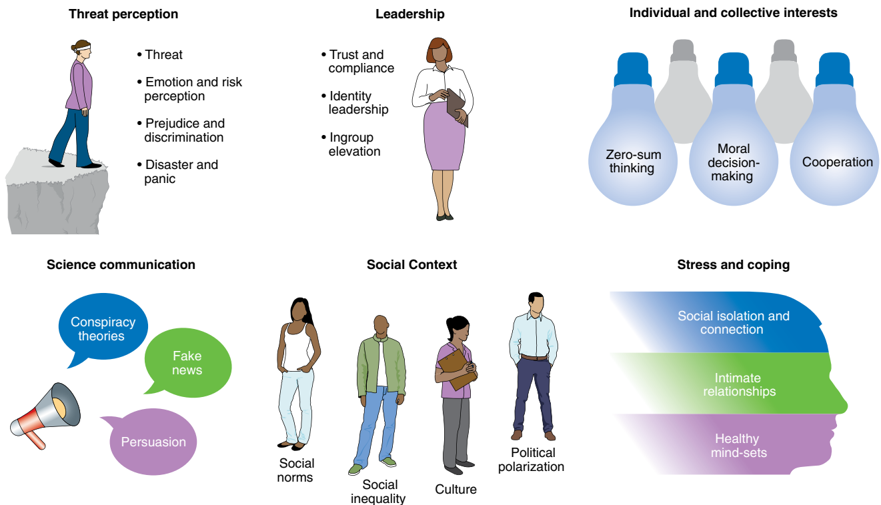
The COVID-19 pandemic represents a massive global health crisis. Because the crisis requires large-scale behaviour change and places significant psychological burdens on individuals, insights from the social and behavioural sciences can be used to help align human behaviour with the recommendations of epidemiologists and public health experts. Here we discuss evidence from a selection of research topics relevant to pandemics, including work on navigating threats, social and cultural influences on behaviour, science communication, moral decision-making, leadership, and stress and coping. In each section, we note the nature and quality of prior research, including uncertainty and unsettled issues. We identify several insights for effective response to the COVID-19 pandemic and highlight important gaps researchers should move quickly to fill in the coming weeks and months.
Overview
CoChat Summary
TL;DR
This perspective argues that social and behavioural science can help align public behaviour with COVID-19 public health recommendations across threat perception, social context, science communication, cooperation, leadership, and stress/coping. It synthesizes prior evidence and policy insights while cautioning that evidence is limited, often drawn from non-pandemic contexts, and in many areas unsettled.
Key findings
- The paper notes the scale of infectious disease threats: the bubonic plague killed approximately 25% of the European population, and by March 2020 COVID-19 had spread to more than 118,000 cases and caused 4,291 deaths in 114 countries. It also notes that 21 countries donated medical supplies to China in February, with China reciprocating widely.
- Fear appeals can change behaviour when people feel capable of dealing with the threat, but produce defensive reactions when people feel helpless; optimism bias can lead people to underestimate personal risk and ignore public health warnings.
- Social norms, inequality, culture, and political polarization shape pandemic behaviour: correcting misperceived norms can help when most people are already doing the desirable behaviour, but descriptive norms can backfire if the behaviour is undesirable unless paired with prescriptive norms.
- Effective communication and leadership may involve credible sources, messages that protect others or align with moral values, prebunking/inoculation against misinformation, accuracy nudges, shared social identity, and leaders modelling prosocial sacrifice; excessive national self-image concerns (“collective narcissism”) can backfire.
Methods
- Design: Perspective/narrative review; no primary data collection or sample. Topics were identified by the corresponding authors as potentially relevant to pandemic response and are explicitly not exhaustive.
- Evidence base: synthesizes prior social and behavioural research on threat perception, social context, science communication, moral decision-making, cooperation, leadership, and stress/coping, drawing on laboratory experiments, correlational studies, field experiments, meta-analyses, and preprints/forthcoming work.
- Analysis: narrative synthesis with policy implications and identified research gaps; no systematic search strategy or quantitative synthesis is reported.
Limitations
- Stated: due to space constraints, the paper provides only a brief summary of each topic; research on these topics is ongoing and in many cases far from settled; there is very little published social science research on the current pandemic, so discussion often draws from different circumstances and evidence quality varies substantially.
- Stated: insights and policy implications should be interpreted with caution.
- Evident: as a perspective rather than a systematic review or empirical study, it does not provide a comprehensive evidence appraisal, and its reliance on preprints and forthcoming sources limits certainty.
Model-written summary. Check it against the paper before relying on it.
Integrity signals
Registry
Cites
Statistics
Figures
Verification
Claims the paper makes
19 Valid · 5 Not valid · 37 Not checked · 13 Own results and interpretations
At least one cited source doesn’t support this claim or points to a different paper, and none confirmed it — see the verdicts below.
In the paper
“For instance, in hypothetical scenarios about deciding whether to go to work while sick, American and British participants reported they would be less willing to stay home when it was uncertain they would infect a co-worker.”
What the sources say
- Disputedcites [176] Kappes, A. et al. Uncertainty about the impact of social decisions increases prosocial behaviour. Nat. Hum. Behav. 2, 573–580 (2018). sourceExperimental — accuracy not yet measured
In the paper’s account of the infectious-disease scenario (Abstract; page not provided), participants facing uncertainty about how severely a co-worker might be affected were more likely to stay home than controls, not less. The paper distinguishes that impact uncertainty from uncertainty about whether a co-worker would be infected. Its Study 6 Methods (page not provided) describe recruitment through AMT, but do not establish the claimed American and British participant groups. (LLM, conf=0.88)
Checked by a reasoning model — may be wrong.
hedgedstates an association- Asserted: passes — The authors put it forward as true.
- Checkable: passes — It can be checked against evidence.
- Load-bearing: passes — The paper’s conclusions depend on it.
- Based: passes — The paper gives a reason why it holds.
- Disputed
The cited sources that could be checked couldn’t confirm or dispute this claim.
In the paper
“Moreover, there is mixed research regarding whether corrections may actually increase belief in the original misinformation 121,124-126 or in other misleading claims that fail to get corrected 127 .”
What the sources say
- Not checked — no full text of the sourcecites [121] Guess, A. & Coppock, A. Does counter-attitudinal information cause backlash? Results from three large survey experiments. Br. J. Polit. Sci. https://doi.org/10.1017/S0007123418000327 (2018). source
- Not matchedcites [124] Wittenberg, C. & Berinsky, A.J. Misinformation and its correction. in Social Media and Democracy: The State of the Field (eds Persily, N. & Tucker, J. A.) (Cambridge University Press, forthcoming).
Its entry has no title and year that we can search by.
- Not checked — no full text of the sourcecites [125] Swire, B. & Ecker, U.K.H. Misinformation and its correction: Cognitive mechanisms and recommendations for mass communication. in Misinformation and Mass Audiences (eds. Southwell, B. G., Thorson, E. A. & Sheble, L.) 195–2011 (University of Texas Press, 2018). source
- Not checked — no full text of the sourcecites [126] Wood, T. & Porter, E. The elusive backfire effect: mass attitudes’ steadfast factual adherence. Polit. Behav. 41, 135–163 (2018). source
- Could not verifycites [127] Pennycook, G., McPhetres, J., Zhang, Y. & Rand, D. Fighting COVID-19 misinformation on social media: Experimental evidence for a scalable accuracy nudge intervention. Preprint at PsyArXiv https://doi.org/10.31234/osf.io/uhbk9 (2020). sourceExperimental — accuracy not yet measured
Citation 127 is attached to the suggestion that corrections may increase belief in other misleading claims that go uncorrected. The Statement of Relevance and Discussion describe an accuracy nudge that improved sharing decisions, not corrections or their effects on belief in uncorrected claims. Searches for correction backfire and uncorrected misinformation found no passage addressing that point; page numbers were unavailable in our copy. (LLM, conf=0.76)
hedgedstates a possible cause- Asserted: passes — The authors put it forward as true.
- Checkable: passes — It can be checked against evidence.
- Load-bearing: passes — The paper’s conclusions depend on it.
- Based: passes — The paper gives a reason why it holds.
The sources with a verdict support this claim; the rest weren’t checked yet, have no full text we could read, or their verdicts aren’t rated yet.
In the paper
“Indeed, laboratory research has found that people prioritize local over global (or international) interests 185,186 .”
What the sources say
- Supportedcites [185] Milinski, M., Hilbe, C., Semmann, D., Sommerfeld, R. & Marotzke, J. Humans choose representatives who enforce cooperation in social dilemmas through extortion. Nat. Commun. 7, 10915 (2016). source
The Results section (‘Voters choose selfish representatives’; page unavailable) reports that participants preferentially re-elected representatives who contributed less to the shared climate account and elected candidates who pledged to contribute less than a fair share. In this simulated international dilemma, that supports the claim that participants favored their own group’s interests over the collective goal; it does not establish that everyone did so. (LLM, conf=0.85)
- Not checked — no full text of the sourcecites [186] Reinders Folmer, C. P. et al. One for all: what representing a group may do to us. J. Exp. Soc. Psychol. 48, 1047–1056 (2012). source
plain- Asserted: passes — The authors put it forward as true.
- Checkable: passes — It can be checked against evidence.
- Load-bearing: passes — The paper’s conclusions depend on it.
- Based: passes — The paper gives a reason why it holds.
- Supported
Every source the paper cites for this claim was checked and supports it.
In the paper
“However, when going to work risked infecting an elderly co-worker who would suffer a serious illness, participants reported they would be more willing to stay home 176 .”
What the sources say
- Supportedcites [176] Kappes, A. et al. Uncertainty about the impact of social decisions increases prosocial behaviour. Nat. Hum. Behav. 2, 573–580 (2018). source
The Study 6 Methods (page not provided) describe a scenario in which going to work could infect an older, vulnerable co-worker who would suffer severely, followed by a rating of willingness to go to work. The reported Study 6 findings (indexed under Abstract; page not provided) say participants given that risk information were significantly more likely to stay home than controls. (LLM, conf=0.92)
hedgedstates a cause- Asserted: passes — The authors put it forward as true.
- Checkable: passes — It can be checked against evidence.
- Load-bearing: passes — The paper’s conclusions depend on it.
- Based: passes — The paper gives a reason why it holds.
- Supported
The sources with a verdict support this claim; the rest weren’t checked yet, have no full text we could read, or their verdicts aren’t rated yet.
In the paper
“Several techniques, such as sanctioning defectors 187 or rewarding cooperators 188 , tend to increase cooperative behaviour in laboratory experiments using economic games.”
What the sources say
- Not checked — no full text of the sourcecites [187] Yamagishi, T. The provision of a sanctioning system as a public good. J. Pers. Soc. Psychol. 51, 110–116 (1986). source
- Supportedcites [188] Rand, D. G., Dreber, A., Ellingsen, T., Fudenberg, D. & Nowak, M. A. Positive interactions promote public cooperation. Science 325, 1272–1275 (2009). source
Citation 188 is attached to rewarding cooperators. The paper’s Abstract reports a laboratory comparison using repeated public goods games and finds that reward maintained public cooperation and, when both reward and punishment were available, increased contributions. (LLM, conf=0.93)
plainstates a cause- Asserted: passes — The authors put it forward as true.
- Checkable: passes — It can be checked against evidence.
- Load-bearing: unclear — It is unclear whether the paper’s conclusions depend on it.
- Based: passes — The paper gives a reason why it holds.
50 more claims · 13 with their cited sources checked
Create a free account to see all 74 claims and to verify the 2 references still open.
- It may state two separate claims as one. 13
- Probably not a substantial claim. 6
Claims other papers make about this one
Each is checked against this paper’s own text: does it say what the citing paper says it does?
The source backs part of the claim, not all of it — or backs it for a different population, condition or comparison.
In the citing paper
“COVID-19 is an international public health crisis, putting substantial burden on medical centers and increasing the psychological toll on health care workers (HCW).”
From Supporting the well-being of health care providers during the COVID-19 pandemic: The CopeColumbia response (2020) · cites this paper as [6]
Experimental — accuracy not yet measuredThe source backs part of the claim, not all of it — or backs it for a different population, condition or comparison.
In the citing paper
“these population-wide measures affected psychological well-being and mental health as well as increased social isolation [68] and loneliness.”
From Psychological correlates of perceived loneliness in college students before and during the COVID-19 stay-at-home period: a longitudinal study (2023) · cites this paper as [68]
Experimental — accuracy not yet measuredThe source backs part of the claim, not all of it — or backs it for a different population, condition or comparison.
In the citing paper
“they may eventually increase the social isolation of students and affect their psychological well-being and mental health [3].”
From Students under lockdown: Comparisons of students’ social networks and mental health before and during the COVID-19 crisis in Switzerland (2020) · cites this paper as [3]
Experimental — accuracy not yet measuredThe source backs part of the claim, not all of it — or backs it for a different population, condition or comparison.
In the citing paper
“effective interventions are hard to scale to a population level (12);”
From Psychological inoculation improves resilience against misinformation on social media (2022) · cites this paper as [12]
Experimental — accuracy not yet measuredThe source backs part of the claim, not all of it — or backs it for a different population, condition or comparison.
In the citing paper
“There is a shortage of studies that test anti-misinformation interventions in an ecologically valid manner, i.e., testing an intervention as consumers would interact with it in online environments (8, 12).”
From Psychological inoculation improves resilience against misinformation on social media (2022) · cites this paper as [12]
Experimental — accuracy not yet measured
6 more claims about this paper
Create a free account to see every claim other papers make about this one.
Citations
Cites
Granovetter, M. S. (1973) · American Journal of Sociology · doi:10.1086/225469 · Cited by 40,491
Zhou, F., Yu, T., Du, R., Fan, G., Liu, Y., Liu, Z., Xiang, J., Wang, Y., Song, B., Gu, X., et al. (2020) · The Lancet · doi:10.1016/s0140-6736(20)30566-3 · Cited by 27,263
The need to belong: Desire for interpersonal attachments as a fundamental human motivation.
Baumeister, R. F., & Leary, M. R. (1995) · Psychological Bulletin · doi:10.1037//0033-2909.117.3.497 · Cited by 23,245
Culture and the self: Implications for cognition, emotion, and motivation.
Markus, H. R., & Kitayama, S. (1991) · Psychological Review · doi:10.1037/0033-295x.98.2.224 · Cited by 21,995
Self-citationThe Psychological Impact of Quarantine and How to Reduce It: Rapid Review of the Evidence
Brooks, S. K., Webster, R. K., Smith, L. E., Woodland, L., Wessely, S., Greenberg, N., & Rubin, G. J. (2020) · doi:10.2139/ssrn.3532534 · Cited by 16,394
The psychological impact of quarantine and how to reduce it: Rapid review of the evidence
Brooks, S. K., Webster, R. K., Smith, L. E., Woodland, L., Wessely, S., Greenberg, N., & Rubin, G. J. (2020) · The Lancet · doi:10.1016/s0140-6736(20)30460-8 · Cited by 16,378
Nudge: improving decisions about health, wealth, and happiness
(2008) · Choice Reviews Online · doi:10.5860/choice.46-0977 · Cited by 11,572
Slovic, P. (1987) · Science · doi:10.1126/science.3563507 · Cited by 9,271
The Elaboration Likelihood Model of Persuasion
Petty, R. E., & Cacioppo, J. T. (1986) · Advances in Experimental Social Psychology · doi:10.1016/s0065-2601(08)60214-2 · Cited by 8,822
Self-citationThe emotional dog and its rational tail: A social intuitionist approach to moral judgment.
Haidt, J. (2001) · Psychological Review · doi:10.1037/0033-295x.108.4.814 · Cited by 8,048
Research works printed but not linked: 3
- Berkowitz, A.D. An overview of the social norms approach. in Changing the Culture of College Drinking: A Socially Situated Health Communication Campaign (eds. Stewart, L. & Lederman, L. C.) 193–214 (Hampton Press, 2005).
- Wittenberg, C. & Berinsky, A.J. Misinformation and its correction. in Social Media and Democracy: The State of the Field (eds Persily, N. & Tucker, J. A.) (Cambridge University Press, forthcoming).
- Ransohoff, K.J. Patients on the Trolley Track: The Moral Cognition of Medical Practitioners and Public Health Professionals. (Harvard Univ. Press, 2011).
Cited by
Items 2,801–2,900 of 5,015
Compensatory control in public emergencies
Tingting, R. A. O., Xiaowen, Z. H. U., Shenlong, Y. A. N. G., & Bai, J. (2022) · Advances in Psychological Science · doi:10.3724/sp.j.1042.2022.01119 · Cited by 8
Securitization Outside the West: West African Security Reconceptualised
Kaunert, C., & Ezeokafor, E. (2022) · Routledge eBooks · doi:10.4324/9781003133216 · Cited by 9
COVID-19 salgını sürecinde alkol ve madde bağımlılarının kullanım ve tedavi deneyimleri
Semerci, M., Acar, B., & Yaman, Ö. M. (2022) · Journal of Dependence · doi:10.51982/bagimli.1008263 · Cited by 4
“Stres ve kaygının tetiklendiği durumlardan biri de sosyal izolasyonun bireylere aileleriyle aynı ortamda ve yakın sınırlar içerisinde bulunma zorunluluğu getirmesidir (13).”
BackgroundThe National Peculiarities of Coronavirus-Related Social Advertising in Russia and China
Вепрева, И. (2022) · Quaestio Rossica · doi:10.15826/qr.2022.1.657 · Cited by 4
Dawe‐Lane, E., Mutepua, M., Morris, D., Odoi, C. M., Wilson, E., Evans, J., Pinfold, V., Wykes, T., Jilka, S., & Simblett, S. K. (2022) · JMIR Mental Health · doi:10.2196/31251 · Cited by 4
“Communication via technology could be an effective coping strategy that individuals employ to maintain social connection, access support, and manage the psychological effects of lockdown [4,9-11].”
Variability and strictness in COVID-19 government response: A macro-regional assessment
Donadelli, M., Gufler, I., Kizys, R., & Lucchetta, M. (2022) · Journal of Government and Economics · doi:10.1016/j.jge.2022.100039 · Cited by 4
Asri, A., Asri, V., Renerte, B., Föllmi-Heusi, F., Leuppi, J. D., Muser, J. M., Nüesch, R., Schuler, D., & Fischbacher, U. (2022) · PLoS ONE · doi:10.1371/journal.pone.0268775 · Cited by 5
“Various public-health campaigns have already benefited from psycho-logically motivated approaches [5], and we hereby acknowledge the importance of understanding the complex social and behavioral factors influencing the public acceptance of science-based public-health recommendations [6–10].”
Ochnik, D., Rogowska, A. M., Arzenšek, A., & Benatov, J. (2022) · International Journal of Environmental Research and Public Health · doi:10.3390/ijerph19116766 · Cited by 5
“Trust in institutions is crucial during a crisis as it elevates the government’s capacity to pursue redistributed polices [34] and encourages adherence to health policies [35].”
BackgroundMathonnat, J., Audibert, M., & Nossek, V. (2022) · Revue d économie du développement · doi:10.3917/edd.351.0111 · Cited by 6
Kusumarini, R. R. A. P. I., Fariyanti, A., & Tinaprilla, N. (2022) · Jurnal Ilmu Keluarga dan Konsumen · doi:10.24156/jikk.2022.15.2.192 · Cited by 4
Nawyn, S. J., Karaoğlu, E., Gasteyer, S. P., Mansour, R., Ghassani, A., & Marquart‐Pyatt, S. T. (2022) · Frontiers in Public Health · doi:10.3389/fpubh.2022.870158 · Cited by 4
“(9), using Soper (8) as a reference point, provided a detailed literature review of the scholarship on practicing risk avoidance protocols in the ensuing 100 years.”
MethodMultidisciplinary expert group: communication measures to increase vaccine compliance in adults
Hastall, M. R., Koinig, I., Kunze, U., Meixner, O., Sachse, K., & Würzner, R. (2022) · Wiener Medizinische Wochenschrift · doi:10.1007/s10354-022-00946-x · Cited by 6
“The emotionalization of messages and storytelling are very important tools for delivering messages to the general population [21].”
BackgroundKim, H. H. (2022) · Political Studies Review · doi:10.1177/14789299221106006 · Cited by 8
“Previous research on the determinants of political trust has emphasized the importance of conducting multilevel analysis (Hakhverdian and Mayne, 2012; Mauk, 2021; Van Erkel and Van der Meer, 2016).”
BackgroundInfluentialAustin, J. D., Burke, K. R., Lee, E. J., Hillyer, G. C., Schmitt, K. M., McDonald, J. A., Shelton, R. C., Terry, M. B., & Tehranifar, P. (2022) · Journal of Community Health · doi:10.1007/s10900-022-01115-2 · Cited by 4
“, Tuskegee, Henrietta Lacks), are less willing to adopt recommended safety measures, and more wary about the health information [3, 6, 7].”
BackgroundBenefits and use of blockchain technology to support supply chain during COVID-19
Ciaburro, G. (2022) · Elsevier eBooks · doi:10.1016/b978-0-323-99878-9.00003-0 · Cited by 7
“The evident need for an effective experimentation to produce an anti-COVID-19 vaccine was immediately understood (Van Bavel et al., 2020).”
BackgroundReshaped and Reduced Dimensionality Reduction Data Technique on Association Rule Mining
Siswanto, B., Tanuar, E., & Rahmania, R. (2021) · International Symposium on Materials and Electrical Engineering (ISMEE) · doi:10.1109/ismee54273.2021.9774190 · Cited by 4
Dewa, C. S., Che, Z., Guggenbickler, A. M., Phan, R. Q., & Pollock, B. (2022) · PLoS ONE · doi:10.1371/journal.pone.0270488 · Cited by 4
Behavioral Approach to the COVID-19 Vaccination Policy: An Empirical Study in Serbia
Mojašević, A. S., Vučetić, D., Vučković, J. P., & Stefanović, S. (2022) · Sustainability · doi:10.3390/su141710728 · Cited by 5
The COVID-19 Pandemic: Managing Unplanned Change as the New Normal in the Workplace
Olckers, C., & Koekemoer, E. (2022) · Springer eBooks · doi:10.1007/978-3-031-09803-1_3 · Cited by 5
Urban Green Space for Sustainable Environmental Health in Relation to Pandemic Crises
Azhar, A. S. N., Hussain, M. R. M., & Tukiman, I. (2022) · International Journal of Built Environment and Sustainability · doi:10.11113/ijbes.v9.n2-2.1029 · Cited by 4
“The period of quarantine, fears of contagion, frustration and boredom, and a lack of knowledge are all factors that have a severe influence on people's mental health (Brooks et al., 2020).”
BackgroundInfluentialGuo, Y., Zhang, H., Xie, Y., Tian, X., Luo, N., & Zhang, Y. (2022) · International Journal of Environmental Research and Public Health · doi:10.3390/ijerph191912079 · Cited by 4
“Effective interventions can change people’s mindsets about stress [43].”
BackgroundBurton, L., Wall, A., & Perkins, E. (2022) · International Journal of Environmental Research and Public Health · doi:10.3390/ijerph191912056 · Cited by 5
“A large body of research suggests that people tend to prefer leaders who cultivate a sense that ”we’re in this together”, giving a sense of collective self-efficacy and hope [17,18].”
BackgroundCOVID-19 and Government Communication in Poland
Winiarska‐Brodowska, M. (2022) · Springer studies in media and political communication · doi:10.1007/978-3-031-09230-5_17 · Cited by 4
Association between social capital and COVID-19 preventive behaviors: Country-level ecological study
Khin, Y. P., Matsuyama, Y., & Fujiwara, T. (2022) · International Journal of Disaster Risk Reduction · doi:10.1016/j.ijdrr.2022.103335 · Cited by 5
Practical behavioural solutions to COVID-19: Changing the role of behavioural science in crises
Tanis, C. C., Nauta, F. H., Boersma, M. J., Steenhoven, M. V. V. D., Borsboom, D., & Blanken, T. F. (2022) · PLoS ONE · doi:10.1371/journal.pone.0272994 · Cited by 4
“The most recent COVID-19 crisis clearly demonstrates the role of behaviour and behavioural change [5, 6].”
Taghia, J., Kulyk, V., İckin, S., Folkesson, M., Nyström, C., Ȧgren, K., Brezicka, T., Vingare, T., Karlsson, J., Fritzell, I., et al. (2022) · Scientific Reports · doi:10.1038/s41598-022-22350-6 · Cited by 5
No-vaxxers are different in public good games
Basili, M., Muscillo, A., & Pin, P. (2022) · Scientific Reports · doi:10.1038/s41598-022-22390-y · Cited by 4
Reducing COVID vaccine hesitancy by inducing a comparative mindset
Hao, X. B., Anand, M., Han, H., Wang, T., & Rao, A. R. (2022) · Vaccine · doi:10.1016/j.vaccine.2022.10.077 · Cited by 5
Arhiri, L., Gherman, M.-A., & Holman, A. C. (2022) · International Journal of Environmental Research and Public Health · doi:10.3390/ijerph192214859 · Cited by 6
“The public’s rejection of scientific empirical results and research methods can have deleterious effects on public health, the environment, and the economy [70,71].”
BackgroundTrust as a daily defense against collective disease threats
Murray, S. L., Xia, J., Lamarche, V. M., Seery, M. D., McNulty, J. K., Griffin, D. W., Ward, D. E., & Hicks, L. L. (2022) · Current Research in Ecological and Social Psychology · doi:10.1016/j.cresp.2022.100071 · Cited by 3
Aliabadi, S. F., Heydari, A., Fatemi, F., Yoshany, N., Lotfi, M. H., Sarsangi, A., & Hanna, F. S. (2022) · BMC Public Health · doi:10.1186/s12889-022-14805-2 · Cited by 7
“Being cognizant of cultural and social factors in different communities contribute to managers and organizational decision makers to take measures in line with reducing the possible harms based on available resources [5].”
BackgroundScience, Technology, and Innovation Policy in Response to the COVID-19 Crisis: The Case of Russia
Анатольевич, Г. М., Гохберг, Л., & Kuznetsova, T. (2022) · Science, technology and innovation studies · doi:10.1007/978-3-031-13142-4_14 · Cited by 6
Appeals to Consensus and Partisan Politics in Parliamentary Discourse on the Pandemic
Figgou, L., & Andreouli, E. (2022) · Political Psychology · doi:10.1111/pops.12874 · Cited by 6
Hanimann, A. (2023) · Swiss Political Science Review · doi:10.1111/spsr.12554 · Cited by 7
Epidemic dynamics in census-calibrated modular contact network
Jain, K., Bhatnagar, V., & Kaur, S. (2023) · Network Modeling Analysis in Health Informatics and Bioinformatics · doi:10.1007/s13721-022-00402-1 · Cited by 4
“This accommodates the recent recommendations to align social and behavioral sciences with the epidemic spreading models (Van Bavel et al. 2020; Jain et al. 2022). iv.”
Backgroundvan Baal, S. T., Verdejo‐García, A., & Hohwy, J. (2023) · BMC Public Health · doi:10.1186/s12889-023-15031-0 · Cited by 4
“Much research focuses on designing public health communication to achieve optimal public health guideline adherence [1].”
BackgroundWhat Really Drives the Spread of COVID-19 Tweets: A Revisit from Perspective of Content
Chuai, Y., Chang, Y., & Zhao, J. (2022) · IEEE International Conference on Data Science and Advanced Analytics (DSAA) · doi:10.1109/dsaa54385.2022.10032328 · Cited by 7
“As negative emotions increase, people may rely on negative information about COVID-19 more than other information to make decisions [16].”
BackgroundInfluentialCommunity Coping Strategies for COVID-19 in Bangladesh: A Nationwide Cross-Sectional Survey
Hossain, K. M. A., Shafin, R., Yeasmin, M. H., Jahid, I. K., Hossain, M. A., Rana, S., Kabir, M. F., Chokrovorty, S. K., & Faruqui, R. A. (2023) · COVID · doi:10.3390/covid3030024 · Cited by 5
Hoffmann, K., Michalak, M., Bońka, A., et al. (2023) · Healthcare · doi:10.3390/healthcare11060914 · Cited by 4
“It is also important to improve individual and collective understanding of behaviors and attitudes towards the restrictions [66,67].”
BackgroundMatsunaga, L. H., Aoki, T., Faiad, C., Aldrich, D. P., Tseng, P.-H., & Aida, J. (2023) · Journal of Health Communication · doi:10.1080/10810730.2023.2193149 · Cited by 4
ASLAN, A. (2023) · Journal of Business Research - Turk · doi:10.20491/isarder.2023.1612 · Cited by 4
Axiosphere of Social Advertising Poster about Coronavirus in Russia and China
Вепрева, И. Т., & Yang, Z. (2023) · Nauchnyi Dialog · doi:10.24224/2227-1295-2023-12-2-102-123 · Cited by 6
Shou, Y., Farrer, L. M., Gulliver, A., Newman, E. J., Batterham, P. J., & Smithson, M. J. (2023) · Journal of Health Communication · doi:10.1080/10810730.2023.2197403 · Cited by 6
“…risk communication during a health crisis should present clear and consistent messaging to let the public understand and trust the information, and endorse protective behaviors and other health recommendations (Bavel et al., 2020; van der Bles et al., 2019; World Health Organization, 2017).”
BackgroundZhao, C., Zhang, J., Hou, X., Yeung, C. H., & Zeng, A. (2023) · PLoS Computational Biology · doi:10.1371/journal.pcbi.1011083 · Cited by 6
“[1] Jay J Van Bavel, Katherine Baicker, Paulo S Boggio, Valerio Capraro, Aleksandra Cichocka, Mina Cikara, Molly J Crockett, Alia J Crum, Karen M Douglas, James N Druckman, et al.”
Panic buying in the second wave of COVID-19: the moderating effect of past buying experience
Akoijam, S. L. S., Mazumder, S. B. A., & Sharma, L. (2023) · Journal of Asia Business Studies · doi:10.1108/jabs-03-2022-0117 · Cited by 5
Domestic violence towards children in Kenya and Zambia during the COVID-19 pandemic
Moon, C., Lim, S., & Kim, Y. (2023) · Public Health · doi:10.1016/j.puhe.2023.05.008 · Cited by 5
Campbell, J. T., Bennett-Brown, M., Marcotte, A. S., Kaufman, E. M., Moscovici, Z., Adams, O. R., Lovins, S., Garcia, J. R., & Gesselman, A. N. (2023) · Sexuality & Culture · doi:10.1007/s12119-023-10097-9 · Cited by 5
“However, social norms and resulting social influence are important components of sustained public healthcare (Bavel et al., 2020; Berkowitz, 2005).”
BackgroundRisk perception in the era of COVID ‐19 and related factors among nurses: A cross‐sectional study
Zhao, L., Huang, H., Liu, P., Xu, L., Deng, W., Tian, F., & Tan, L. (2023) · Nursing Open · doi:10.1002/nop2.1811 · Cited by 6
Zhang, X., English, A. S., Kulich, S. J., & Chen, Y. (2023) · Social and Personality Psychology Compass · doi:10.1111/spc3.12793 · Cited by 6
The Role of Honor Concerns in Disclosing (vs. Hiding) COVID-19 Diagnosis: Insights from Türkiye
Batur, S. C., Doğulu, C., Akbaş, G., Yet, B., & Üskül, A. K. (2023) · Sex Roles · doi:10.1007/s11199-023-01373-x · Cited by 4
Callimaci, A., Fortin, A., Lux, G., Caron, M., & Smaïli, N. (2023) · Accounting Education · doi:10.1080/09639284.2023.2232342 · Cited by 5
Bridging online and offline dynamics of the face mask infodemic
Uyheng, J., Robertson, D. C., & Carley, K. M. (2023) · BMC Digital Health · doi:10.1186/s44247-023-00026-z · Cited by 4
“This affirms the need for sustained and targeted public health communication, both online and offline, with messages that mobilize identityaligned narratives and originating from politically trustworthy sources of information [1, 7].”
BackgroundInfluentialNeill, R. D., McFadden, P., Manthorpe, J., Mallett, J., Currie, D., Schroder, H. S., Ravalier, J. M., Nicholl, P., Moriarty, J., McGrory, S., et al. (2023) · BioMed · doi:10.3390/biomed3030030 · Cited by 8
Grady, J. C., Mulpeter, E., Brimdyr, K., & Cadwell, K. (2023) · Frontiers in Public Health · doi:10.3389/fpubh.2023.1197256 · Cited by 4
“Empirical research explains that “one of the central emotional responses during a pandemic is fear” (38).”
BackgroundA Passage Retrieval Transformer-Based Re-Ranking Model for Truthful Consumer Health Search
Upadhyay, R., Pasi, G., & Viviani, M. (2023) · Lecture notes in computer science · doi:10.1007/978-3-031-43412-9_21 · Cited by 4
Avdagic, S., & Sedelmeier, U. (2023) · European Journal of Political Research · doi:10.1111/1475-6765.12628 · Cited by 5
Ferguson, E., & Mills, R. (2023) · Global Discourse · doi:10.1332/20437897y2023d000000008 · Cited by 5
Network Analysis of Social Measures, Culture Dimensions, and Covid-19 Related Behavioural Choices
Dimdiņš, Ģ., & Vanags, E. (2023) · Human, Technologies and Quality of Education · doi:10.22364/htqe.2023.01 · Cited by 4
“An opposite pattern might have been better predicted from theoretical reasoning (Van Bavel et al., 2020), and the observed result is generally not in line with findings from other related research (Cislak et al., 2021; Moscatelli et al., 2021).”
BackgroundResultInfluentialCarol, S., David, L., Malešević, S., & Uzelac, G. (2023) · International Sociology · doi:10.1177/02685809231214168 · Cited by 6
“Welfare chauvinism and deservingness theory describe the idea that only individuals who have contributed to the welfare state are also eligible to be supported in times of need to prevent free riding (Andersen and Bjørklund, 1990; Van Oorschot, 2000).”
BackgroundCOVID-19 and child education outcomes in Southern Ghana
Okyere, C. Y., Otchere, F., Darko, J. K., & Osei, C. K. (2024) · Heliyon · doi:10.1016/j.heliyon.2024.e26238 · Cited by 6
“TPB has emerged as one of the theoretical frameworks employed in explaining the COVID-19 related preventive health behaviours [37 – 45].”
MethodMaleki, M., Mead, E., Arani, M., & Agarwal, N. (2023) · Hawaii International Conference on System Sciences (HICSS) · doi:10.24251/hicss.2023.284 · Cited by 5
Cultural dynamics influencing decision-making during the COVID-19 pandemic: the Italian case
Costa, S., & Carrus, G. (2024) · Frontiers in Psychology · doi:10.3389/fpsyg.2024.1294190 · Cited by 4
Suicide on Italian Instagram: Insights and implications for prevention and support
Olcese, M., Antichi, L., Madera, F., Cardinali, P., Prestía, D., Serafini, G., Dèttore, D., Casale, S., Giannini, M., Martinotti, G., et al. (2024) · Journal of Community & Applied Social Psychology · doi:10.1002/casp.2844 · Cited by 5
LIFE STORY OF PATIENT WITH SUPERVISION’S FIGHTING AGAINST COVID-19 IN SURAKARTA INDONESIA
Demartoto, A., Sunesti, Y., Haryono, B., et al. (2020) · Jurnal Analisa Sosiologi · doi:10.20961/jas.v9i2.44436 · Cited by 4
“From a mindset practiced and improved through a series of experiences and learning, we can have good habits such as healthy lifestyle, positive thinking, clear response to something, and it even impacts on self healing (Van Bavel et al, 2020).”
BackgroundPerception of the risk of the COVID-19 disease and its related factors in Paraguay
Ríos-González, C. M., & Ríos-González, D. (2020) · Revista del Nacional (Itaguá) · doi:10.18004/rdn2020.dic.02.004.015 · Cited by 8
“De hecho, en conjunto, el comportamiento de la gente puede influir de manera fundamental y alterar la propagación de una pandemia((14-17)), y, como tales, se sabe que son determinantes importantes de la voluntad del público de cooperar y adoptar comportamientos de protección de la salud durante pandemias, incluyendo e…”
BackgroundEl aprendizaje-servicio como pedagogía durante la pandemia. El proyecto “UCA te da la Mano”
Brenlla, M. E., Buzzini, E., González, G., Gómez, C., Hermida, J., Lamas, M. C., Pereyra, F., & García, M. (2020) · RIDAS Revista Iberoamericana de Aprendizaje y Servicio · doi:10.1344/ridas2020.10.10 · Cited by 6
Sentiments in Russian Medical Professional Discourse during the Covid-19 Pandemic
Ovchinnikova, I., Магдановна, Е. Л., & Nurbakova, D. (2020) · HAL · Cited by 5
Boutebal, S. E., Yahi, S., & Madani, A. (2021) · Indian Journal of Public Health Research & Development · doi:10.37506/ijphrd.v12i1.13882 · Cited by 4
General Knowledge and Perception of Portuguese Children About COVID-19
Toniolo, B. P., Baptista, J. P., Ramos, C., Piñeiro-Naval, V., & Gradim, A. (2021) · Advances in intelligent systems and computing · doi:10.1007/978-3-030-68418-1_19 · Cited by 5
Chung, A. Q. H., Lessard, L., Andreev, P., & O’Reilly, P. (2021) · Hawaii International Conference on System Sciences (HICSS) · doi:10.24251/hicss.2021.423 · Cited by 5
“Such preventive behaviours include, among others, social distancing, increased handwashing, reduced face touching, and mask wearing [3, 4].”
BackgroundGojković, V., Očovaj, S. B., Dostanić, J., & Djuric, M. P. (2021) · Psihologija · doi:10.2298/psi200730001g · Cited by 6
“Quarantined life is associated with increased rage, anger, and aggression that are most evident through increased family violence (Peterman et al., 2020), and various forms of disinhibited behavior (Brooks et al., 2020; Van Bavel et al., 2020).”
BackgroundDeepTrace: Improving Pandemic Health Care by Identifying Disparities and Determinants
Liu, J., Aló, R., & Bautista, Y. J. P. (2021) · IEEE International Conference on Big Data and Smart Computing (BigComp) · doi:10.1109/bigcomp51126.2021.00017 · Cited by 4
“Experimental Analysis Based on Dataset 3 People’s behavior can indicate and affect people’s health [26]–[28].”
MethodOraby, T. F., Tyshenko, M. G., & Bhattacharyya, S. K. (2022) · IntechOpen eBooks · doi:10.5772/intechopen.96689 · Cited by 4
“Factors include perception of susceptibility to the infection, severity of the infection, perception of the effectiveness of ongoing public health measures, and their ability to conduct the activity safely (self-efficacy) [16].”
BackgroundThe role of mental health to overcoming the coronavirus disease-19 pandemic
Dania, I. A., & Novziransyah, N. (2021) · Universa Medicina · doi:10.18051/univmed.2021.v40.69-76 · Cited by 4
“field many people who do not comply with these recommendations are doing just fine.((42)) Univ Med Vol.”
BackgroundUsing Complexity to Calibrate Legal Response to Covid-19
Malcai, O., & Shur‐Ofry, M. (2021) · Frontiers in Physics · doi:10.3389/fphy.2021.650943 · Cited by 6
Rethinking territoriality concept on public space after pandemic COVID-19
Yong, S. D., Rachmawati, M., & Defiana, I. (2021) · International Journal of Public Health Science (IJPHS) · doi:10.11591/ijphs.v10i4.20825 · Cited by 4
(2021) · Journal of Occupational and Environmental Medicine · doi:10.1097/jom.0000000000002146 · Cited by 4
Linking COVID-19 Perception With Socioeconomic Conditions Using Twitter Data
Sert, E., Okan, O., Özbilen, A., Ertekin, Ş., & Özdemir, S. (2021) · IEEE Transactions on Computational Social Systems · doi:10.1109/tcss.2021.3089657 · Cited by 5
Индивидуальные различия в решениях о физическом дистанцировании во время пандемии COVID-19
Zirenko, M. S., & Kornilova, T. V. (2021) · Психология Журнал Высшей школы экономики · doi:10.17323/1813-8918-2021-2-276-286 · Cited by 5
“…is viewed as including multiple psychological processes of decision-making on individual and societal levels: threat and risk perception, moral emotions, panic development, compliance with social norms, influence of misinformation, suggestion, empathy, coping with stress, etc. (Bavel et al., 2020).”
BackgroundThe HCT Index: a typology and index of health conspiracy theories with examples of use
Stubbersfield, J., Widger, T., Russell, A., & Tehrani, J. J. (2021) · Wellcome Open Research · doi:10.12688/wellcomeopenres.16790.1 · Cited by 2
Kaya, M., & KOŞAN, Y. (2021) · International Journal of Psychology and Educational Studies · doi:10.52380/ijpes.2021.8.4.461 · Cited by 6
“In the first three months, this virus reached about 120,000 cases and caused 4,300 deaths in 114 countries around the globe (Van Bavel et al., 2020).”
Double Jab: Survey Evidence on Vaccine Hesitancy, Beliefs, and Attitudes in India
Tagat, A., Kapoor, H., Arora, V., Chakravarty, S., Mukherjee, S., & Roy, S. (2022) · Health Communication · doi:10.1080/10410236.2022.2028480 · Cited by 5
Air Quality During Mobility Restrictions in Sao Paulo State Municipalities
Cirqueira, S. S. R., Rodrigues, P. F., Branco, P. T. B. S., Vormittag, E., Nunes, R. A. O., Anastacio, A. V. B., Veras, M. M., Sousa, S. I. V., & Saldiva, P. H. N. (2021) · Environmental Pollution · doi:10.1016/j.envpol.2022.118984 · Cited by 6
“This behaviour was observed in other countries and have been attributed to different economic, cultural, political and emotional factors (Ajzenman, Cavalcanti, and Da Mata 2020; Bavel et al. 2020; Hoeben et al. 2021).”
BackgroundAndrews, G. J., Crooks, V. A., Pearce, J. R., & Messina, J. P. (2021) · Global perspectives on health geography · doi:10.1007/978-3-030-70179-6_1 · Cited by 6
COVID-19 Fears and Preventive Behaviors among Prison Staff
Gonçalves, L. C., Baggio, S., Schnyder, N., Zaballa, M.-E., Baysson, H., Guessous, I., Rossegger, A., Endrass, J., Wolff, H. J., Stringhini, S., et al. (2022) · Victims & Offenders · doi:10.1080/15564886.2022.2041518 · Cited by 5
“Maybe there is also a certain optimism bias among prison staff (Van Bavel et al., 2020).”
BackgroundInfluentialSantana, A. P., Korn, L., Betsch, C., & BOHM, R. M. (2022) · PLoS ONE · doi:10.1371/journal.pone.0265892 · Cited by 12
“looseness influence how communities engage in collective efforts [32].”
BackgroundWang, C., & Li, H. (2022) · International Journal of Environmental Research and Public Health · doi:10.3390/ijerph19074033 · Cited by 5
“It takes time to trace the virus’ origin and morbidity patterns, and a lack of evidence hinders further research into identifying evolving scenarios in heterogeneous social contexts [74].”
BackgroundKasatpibal, N., Oberdorfer, P., Katip, W., Mektrirat, R., Wattananandkul, U., & Thummathai, K. (2022) · Medicina · doi:10.3390/medicina58040505 · Cited by 7
“Previous studies demonstrated that the practices in the prevention of COVID-19 are different according to knowledge [11], attitudes [12], sex, age, education level, occupation [13], and COVID-19 perception [14,15].”
BackgroundInvestigating Employee Engagement: Will Occupational Health Safety Actually Impact Employee Loyalty?
Suardi, L. S., Putra, R. M., Agustin, P., & Maharani, A. (2022) · Jurnal Manajemen dan Organisasi · doi:10.29244/jmo.v13i1.34664 · Cited by 8
COVID-19 citation pandemic within the psychological knowledge domain
Pajić, D. (2022) · Current Psychology · doi:10.1007/s12144-022-03146-3 · Cited by 3
What determines a country's proactiveness during a pandemic?
Sekar, S., Subhakaran, S. E., & Jino, M. J. (2022) · International Journal of Disaster Risk Reduction · doi:10.1016/j.ijdrr.2022.103200 · Cited by 5
Kopecký, K., Voráč, D., Mikulcová, K., Krejčí, V., & García, G. G. (2022) · Libri · doi:10.1515/libri-2021-0048 · Cited by 4
Development and Validation of the COVID-19 Worries and Fears Scale
Cuadrado, E., Arenas, A., Moyano, M., & Gamma, M. L. (2023) · International Journal of Public Health · doi:10.3389/ijph.2022.1604600 · Cited by 4
“COVID-19-Related Worries and Fears Over Time To better manage the pandemic, understanding people’s worries and fears about the virus over time is important [21].”
BackgroundMegasari, A. L., Yunita, F. A., Hutomo, C. S., et al. (2022) · JMM (Jurnal Masyarakat Mandiri) · doi:10.31764/jmm.v6i2.6996 · Cited by 4
“1079 Anis Laela Megasari, Pemberian Edukasi Untuk… Selain itu, kegiatan ini dapat menurunkan Angka Kematian Bayi (AKB) (Van Bavel et al., 2020).”
Rajaonah, B., & Zio, E. (2021) · Journal of risk analysis and crisis response · doi:10.2991/jracr.k.210707.001 · Cited by 4
Looi, K. H. (2022) · Malaysian Journal of Medical Sciences · doi:10.21315/mjms2022.29.1.15 · Cited by 4
“Ethnicity is another factor that has affected face mask wearing adherence during the COVID-19 pandemic (5, 7, 10, 11, 12).”
BackgroundInfluentialA vision for actionable science in a pandemic
(2020) · Nature Communications · doi:10.1038/s41467-020-18056-w · Cited by 5
“This active and self-con fi dent role of behavioural scientists 16 also fuelled the debate about the general validity, replicability and policy-readiness of socio-behavioural research 17 .”
BackgroundLee, W. K., & Shin, S. R. (2022) · 보건교육·건강증진학회지 · doi:10.14367/kjhep.2022.39.2.27 · Cited by 4
Liu, J., Aló, R., & Bautista, Y. J. P. (2020) · International Conference on Intelligent Data Science Technologies and Applications (IDSTA) · doi:10.1109/idsta50958.2020.9264064 · Cited by 4
“People’s behavior can indicate and affect people’s health [43], [45], [46].”
BackgroundDavis, M., Gilbar, O., & Padilla-Medina, D. M. (2020) · medRxiv · doi:10.1101/2020.06.08.20125914v1.full.pdf · Cited by 5
Metadata
- Authors
- Bavel, J. J. V., Baicker, K., Boggio, P. S., Capraro, V., Cichocka, A., Cikara, M., Crockett, M. J., Crum, A. J., Douglas, K. M., Druckman, J. N., Drury, J., Dube, O., Ellemers, N., Finkel, E. J., Fowler, J. H., Gelfand, M., Han, S., Haslam, S. A., Jetten, J., Kitayama, S., Mobbs, D., Napper, L. E., Packer, D. J., Pennycook, G., Peters, E., Petty, R. E., Rand, D. G., Reicher, S. D., Schnall, S., Shariff, A., Skitka, L. J., Smith, S. S., Sunstein, C. R., Tabri, N., Tucker, J. A., Linden, S. V. D., Lange, P. V., Weeden, K. A., Wohl, M. J. A., Zaki, J., Zion, S. R., & Willer, R.
- Affiliations
- New York University (US)
- Universidade Presbiteriana Mackenzie (BR)
- Middlesex University London (GB)
- University of Kent (GB)
- Harvard University (US)
- Yale University (US)
- Stanford University (US)
- Northwestern University (US)
- University of Sussex (GB)
- University of Chicago (US)
- Utrecht University (NL)
- University of California San Diego (US)
- University of Maryland, College Park (US)
- Peking University (CN)
- The University of Queensland (AU)
- University of Michigan (US)
- California Institute of Technology (US)
- Lehigh University (US)
- University of Regina (CA)
- University of Oregon (US)
- The Ohio State University (US)
- Massachusetts Institute of Technology (US)
- University of St Andrews (GB)
- University of Cambridge (GB)
- University of British Columbia (CA)
- University of Illinois Chicago (US)
- University of California, Berkeley (US)
- Carleton University (CA)
- Cornell University (US)
- Corresponding author
- Bavel, Jay J. Van
- Willer, Robb
- ORCID
- Bavel, Jay J. Van
- Baicker, Katherine
- Boggio, Paulo S.
- Capraro, Valerio
- Cichocka, Aleksandra
- Cikara, Mina
- Crockett, Molly J.
- Crum, Alia J.
- Douglas, Karen M.
- Druckman, James N.
- Drury, John
- Ellemers, Naomi
- Finkel, Eli J.
- Fowler, James H.
- Gelfand, Michele
- Han, Shihui
- Haslam, S. Alexander
- Jetten, Jolanda
- Kitayama, Shinobu
- Mobbs, Dean
- Napper, Lucy E.
- Packer, Dominic J.
- Pennycook, Gordon
- Peters, Ellen
- Petty, Richard E.
- Rand, David G.
- Reicher, Stephen D.
- Schnall, Simone
- Shariff, Azim
- Skitka, Linda J.
- Sunstein, Cass R.
- Tabri, Nassim
- Tucker, Joshua A.
- Linden, Sander van der
- Weeden, Kim A.
- Wohl, Michael J. A.
- Zaki, Jamil
- Zion, Sean R.
- Willer, Robb
- Venue
- Nature Human Behaviour
- Published
- 2020-04-30
- Volume
- 4
- Issue
- 5
- Pages
- 460-471
- ISSN
- 2397-3374 (ISSN-L)
- OpenAlex
- W3016902371
- Semantic Scholar
- d81abcd7f053b136423f1e7f57928524e8b0e1a0
- Cited by
- 4,964
- References
- 259
- Citations by year
- 2026: 177 · 2025: 288 · 2024: 483 · 2023: 741 · 2022: 1094 · 2021: 1474 · 2020: 702
- FWCI
- 175.81
- Type
- journal article
- Language
- en
- Open access
- bronze
- doi.org
- Licence
- www.springernature.com/gp/researchers/text-and-data-mining (tdm)
- www.springernature.com/gp/researchers/text-and-data-mining (vor)
- Locations
- Nature Human Behaviour (publishedVersion)
- PubMed (publishedVersion)
- Middlesex University Research Repository (Middlesex University Of London) (acceptedVersion)
- Kent Academic Repository (University of Kent) (acceptedVersion)
- DSpace@MIT (Massachusetts Institute of Technology) (submittedVersion, cc-by-nc-sa)
- Sussex Research Online (University of Sussex) (submittedVersion)
- CaltechAUTHORS (California Institute of Technology) (submittedVersion)
- RePEc: Research Papers in Economics (submittedVersion)
- BOA (University of Milano-Bicocca) (submittedVersion)
- Carleton University's Institutional Repository (MacOdrum Library, Carleton University) (submittedVersion, other-oa)
- Utrecht University Repository (Utrecht University) (submittedVersion)
- Figshare (submittedVersion)
- VU Research Portal (submittedVersion, other-oa)
- Utrecht University Repository (Utrecht University) (submittedVersion, other-oa)
- Data Archiving and Networked Services (DANS) (submittedVersion, other-oa)
- Funders
- U.S. Department of Health and Human Services (2P50 MH094258)
- National Institute of Mental Health (P50MH094258)
- Topics
- Social Sciences › Sociology and Political Science › COVID-19 Prevention and Impact
- Social Sciences › Communication › Communication and COVID-19 Impact
- Physical Sciences › Mathematics › Modeling and Simulation › COVID-19 epidemiological studies
- Keywords
- COVID-19 pandemic, pandemic response, behavior change, science communication, ethical decision-making, leadership, stress coping, psychological burden, public health recommendations
- MeSH terms
- Betacoronavirus, COVID-19, SARS-CoV-2, Adaptation, Psychological, Communicable Disease Control, Decision Making, Humans, Human Activities, Health Knowledge, Attitudes, Practice, Leadership, Pneumonia, Viral, Public Health, Quarantine, Stress, Psychological, Global Health, Coronavirus, Coronavirus Infections, Pandemics, Social Media, Epidemiological Monitoring
About these checks
Registry, retraction, Cites and statistics results are computed, not judged, with one exception: a printed reference that no index lists is read once by a model before it counts as a citation error. Claims are extracted by a model and kept only when their quote appears verbatim in the text; each cited source is then checked, with a model’s help, for whether it says what the claim relies on. Those verdicts can be wrong — read the claim’s quote and the cited source before relying on one.
The claim verdicts this report counts are experimental: their accuracy is not yet measured.
A language model drew the claims from the paper on 2026-10-10, under version 3 of the claim definition (model deepseek-v4.1-flash, prompt extract-v3).
A second model labelled each claim on 2026-10-10 (model jev-1.13-20260917, definition revision gold-guideline-v0.2).
Cited sources are checked with a language model’s help (gpt-6-sol).
Statistics and arithmetic are recomputed, not judged.
Confidence bands are shown only for fields calibrated on our annotated test set. None is calibrated yet, so no band is shown.
What counts as a claim ›How we measure confidence ›How we check this ›
Are you an author, or do you see a problem with this page? Request a review
Data sources
Bibliographic data: Semantic Scholar, OpenAlex, Crossref.
Contains information from the Semantic Scholar Academic Graph Datasets, made available under the ODC Attribution License (ODC-BY 1.0).
Semantic Scholar’s data is described in: Kinney, R., et al. (2023). The Semantic Scholar Open Data Platform. arXiv:2301.10140.
