

Using social and behavioural science to support COVID-19 pandemic response
Open accessThe DOI matches its Crossref record; 257 of the 259 references it cites were found in a registry or an index; 24 of the 89 sources its claims cite were checked for support.
Abstract
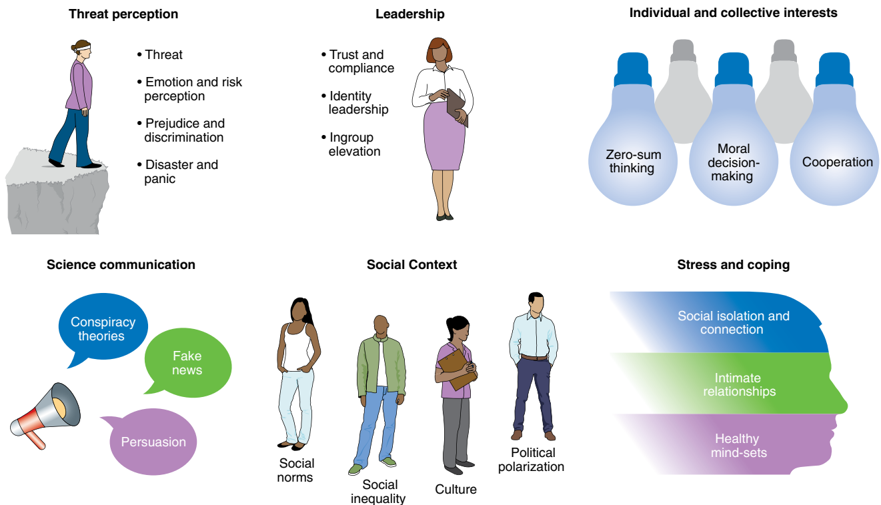
The COVID-19 pandemic represents a massive global health crisis. Because the crisis requires large-scale behaviour change and places significant psychological burdens on individuals, insights from the social and behavioural sciences can be used to help align human behaviour with the recommendations of epidemiologists and public health experts. Here we discuss evidence from a selection of research topics relevant to pandemics, including work on navigating threats, social and cultural influences on behaviour, science communication, moral decision-making, leadership, and stress and coping. In each section, we note the nature and quality of prior research, including uncertainty and unsettled issues. We identify several insights for effective response to the COVID-19 pandemic and highlight important gaps researchers should move quickly to fill in the coming weeks and months.
Overview
CoChat Summary
TL;DR
This perspective argues that social and behavioural science can help align public behaviour with COVID-19 public health recommendations across threat perception, social context, science communication, cooperation, leadership, and stress/coping. It synthesizes prior evidence and policy insights while cautioning that evidence is limited, often drawn from non-pandemic contexts, and in many areas unsettled.
Key findings
- The paper notes the scale of infectious disease threats: the bubonic plague killed approximately 25% of the European population, and by March 2020 COVID-19 had spread to more than 118,000 cases and caused 4,291 deaths in 114 countries. It also notes that 21 countries donated medical supplies to China in February, with China reciprocating widely.
- Fear appeals can change behaviour when people feel capable of dealing with the threat, but produce defensive reactions when people feel helpless; optimism bias can lead people to underestimate personal risk and ignore public health warnings.
- Social norms, inequality, culture, and political polarization shape pandemic behaviour: correcting misperceived norms can help when most people are already doing the desirable behaviour, but descriptive norms can backfire if the behaviour is undesirable unless paired with prescriptive norms.
- Effective communication and leadership may involve credible sources, messages that protect others or align with moral values, prebunking/inoculation against misinformation, accuracy nudges, shared social identity, and leaders modelling prosocial sacrifice; excessive national self-image concerns (“collective narcissism”) can backfire.
Methods
- Design: Perspective/narrative review; no primary data collection or sample. Topics were identified by the corresponding authors as potentially relevant to pandemic response and are explicitly not exhaustive.
- Evidence base: synthesizes prior social and behavioural research on threat perception, social context, science communication, moral decision-making, cooperation, leadership, and stress/coping, drawing on laboratory experiments, correlational studies, field experiments, meta-analyses, and preprints/forthcoming work.
- Analysis: narrative synthesis with policy implications and identified research gaps; no systematic search strategy or quantitative synthesis is reported.
Limitations
- Stated: due to space constraints, the paper provides only a brief summary of each topic; research on these topics is ongoing and in many cases far from settled; there is very little published social science research on the current pandemic, so discussion often draws from different circumstances and evidence quality varies substantially.
- Stated: insights and policy implications should be interpreted with caution.
- Evident: as a perspective rather than a systematic review or empirical study, it does not provide a comprehensive evidence appraisal, and its reliance on preprints and forthcoming sources limits certainty.
Model-written summary. Check it against the paper before relying on it.
Integrity signals
Registry
Cites
Statistics
Figures
Verification
Claims the paper makes
19 Valid · 5 Not valid · 37 Not checked · 13 Own results and interpretations
At least one cited source doesn’t support this claim or points to a different paper, and none confirmed it — see the verdicts below.
In the paper
“For instance, in hypothetical scenarios about deciding whether to go to work while sick, American and British participants reported they would be less willing to stay home when it was uncertain they would infect a co-worker.”
What the sources say
- Disputedcites [176] Kappes, A. et al. Uncertainty about the impact of social decisions increases prosocial behaviour. Nat. Hum. Behav. 2, 573–580 (2018). sourceExperimental — accuracy not yet measured
In the paper’s account of the infectious-disease scenario (Abstract; page not provided), participants facing uncertainty about how severely a co-worker might be affected were more likely to stay home than controls, not less. The paper distinguishes that impact uncertainty from uncertainty about whether a co-worker would be infected. Its Study 6 Methods (page not provided) describe recruitment through AMT, but do not establish the claimed American and British participant groups. (LLM, conf=0.88)
Checked by a reasoning model — may be wrong.
hedgedstates an association- Asserted: passes — The authors put it forward as true.
- Checkable: passes — It can be checked against evidence.
- Load-bearing: passes — The paper’s conclusions depend on it.
- Based: passes — The paper gives a reason why it holds.
- Disputed
The cited sources that could be checked couldn’t confirm or dispute this claim.
In the paper
“Moreover, there is mixed research regarding whether corrections may actually increase belief in the original misinformation 121,124-126 or in other misleading claims that fail to get corrected 127 .”
What the sources say
- Not checked — no full text of the sourcecites [121] Guess, A. & Coppock, A. Does counter-attitudinal information cause backlash? Results from three large survey experiments. Br. J. Polit. Sci. https://doi.org/10.1017/S0007123418000327 (2018). source
- Not matchedcites [124] Wittenberg, C. & Berinsky, A.J. Misinformation and its correction. in Social Media and Democracy: The State of the Field (eds Persily, N. & Tucker, J. A.) (Cambridge University Press, forthcoming).
Its entry has no title and year that we can search by.
- Not checked — no full text of the sourcecites [125] Swire, B. & Ecker, U.K.H. Misinformation and its correction: Cognitive mechanisms and recommendations for mass communication. in Misinformation and Mass Audiences (eds. Southwell, B. G., Thorson, E. A. & Sheble, L.) 195–2011 (University of Texas Press, 2018). source
- Not checked — no full text of the sourcecites [126] Wood, T. & Porter, E. The elusive backfire effect: mass attitudes’ steadfast factual adherence. Polit. Behav. 41, 135–163 (2018). source
- Could not verifycites [127] Pennycook, G., McPhetres, J., Zhang, Y. & Rand, D. Fighting COVID-19 misinformation on social media: Experimental evidence for a scalable accuracy nudge intervention. Preprint at PsyArXiv https://doi.org/10.31234/osf.io/uhbk9 (2020). sourceExperimental — accuracy not yet measured
Citation 127 is attached to the suggestion that corrections may increase belief in other misleading claims that go uncorrected. The Statement of Relevance and Discussion describe an accuracy nudge that improved sharing decisions, not corrections or their effects on belief in uncorrected claims. Searches for correction backfire and uncorrected misinformation found no passage addressing that point; page numbers were unavailable in our copy. (LLM, conf=0.76)
hedgedstates a possible cause- Asserted: passes — The authors put it forward as true.
- Checkable: passes — It can be checked against evidence.
- Load-bearing: passes — The paper’s conclusions depend on it.
- Based: passes — The paper gives a reason why it holds.
The sources with a verdict support this claim; the rest weren’t checked yet, have no full text we could read, or their verdicts aren’t rated yet.
In the paper
“Indeed, laboratory research has found that people prioritize local over global (or international) interests 185,186 .”
What the sources say
- Supportedcites [185] Milinski, M., Hilbe, C., Semmann, D., Sommerfeld, R. & Marotzke, J. Humans choose representatives who enforce cooperation in social dilemmas through extortion. Nat. Commun. 7, 10915 (2016). source
The Results section (‘Voters choose selfish representatives’; page unavailable) reports that participants preferentially re-elected representatives who contributed less to the shared climate account and elected candidates who pledged to contribute less than a fair share. In this simulated international dilemma, that supports the claim that participants favored their own group’s interests over the collective goal; it does not establish that everyone did so. (LLM, conf=0.85)
- Not checked — no full text of the sourcecites [186] Reinders Folmer, C. P. et al. One for all: what representing a group may do to us. J. Exp. Soc. Psychol. 48, 1047–1056 (2012). source
plain- Asserted: passes — The authors put it forward as true.
- Checkable: passes — It can be checked against evidence.
- Load-bearing: passes — The paper’s conclusions depend on it.
- Based: passes — The paper gives a reason why it holds.
- Supported
Every source the paper cites for this claim was checked and supports it.
In the paper
“However, when going to work risked infecting an elderly co-worker who would suffer a serious illness, participants reported they would be more willing to stay home 176 .”
What the sources say
- Supportedcites [176] Kappes, A. et al. Uncertainty about the impact of social decisions increases prosocial behaviour. Nat. Hum. Behav. 2, 573–580 (2018). source
The Study 6 Methods (page not provided) describe a scenario in which going to work could infect an older, vulnerable co-worker who would suffer severely, followed by a rating of willingness to go to work. The reported Study 6 findings (indexed under Abstract; page not provided) say participants given that risk information were significantly more likely to stay home than controls. (LLM, conf=0.92)
hedgedstates a cause- Asserted: passes — The authors put it forward as true.
- Checkable: passes — It can be checked against evidence.
- Load-bearing: passes — The paper’s conclusions depend on it.
- Based: passes — The paper gives a reason why it holds.
- Supported
The sources with a verdict support this claim; the rest weren’t checked yet, have no full text we could read, or their verdicts aren’t rated yet.
In the paper
“Several techniques, such as sanctioning defectors 187 or rewarding cooperators 188 , tend to increase cooperative behaviour in laboratory experiments using economic games.”
What the sources say
- Not checked — no full text of the sourcecites [187] Yamagishi, T. The provision of a sanctioning system as a public good. J. Pers. Soc. Psychol. 51, 110–116 (1986). source
- Supportedcites [188] Rand, D. G., Dreber, A., Ellingsen, T., Fudenberg, D. & Nowak, M. A. Positive interactions promote public cooperation. Science 325, 1272–1275 (2009). source
Citation 188 is attached to rewarding cooperators. The paper’s Abstract reports a laboratory comparison using repeated public goods games and finds that reward maintained public cooperation and, when both reward and punishment were available, increased contributions. (LLM, conf=0.93)
plainstates a cause- Asserted: passes — The authors put it forward as true.
- Checkable: passes — It can be checked against evidence.
- Load-bearing: unclear — It is unclear whether the paper’s conclusions depend on it.
- Based: passes — The paper gives a reason why it holds.
50 more claims · 13 with their cited sources checked
Create a free account to see all 74 claims and to verify the 2 references still open.
- It may state two separate claims as one. 13
- Probably not a substantial claim. 6
Claims other papers make about this one
Each is checked against this paper’s own text: does it say what the citing paper says it does?
The source backs part of the claim, not all of it — or backs it for a different population, condition or comparison.
In the citing paper
“COVID-19 is an international public health crisis, putting substantial burden on medical centers and increasing the psychological toll on health care workers (HCW).”
From Supporting the well-being of health care providers during the COVID-19 pandemic: The CopeColumbia response (2020) · cites this paper as [6]
Experimental — accuracy not yet measuredThe source backs part of the claim, not all of it — or backs it for a different population, condition or comparison.
In the citing paper
“these population-wide measures affected psychological well-being and mental health as well as increased social isolation [68] and loneliness.”
From Psychological correlates of perceived loneliness in college students before and during the COVID-19 stay-at-home period: a longitudinal study (2023) · cites this paper as [68]
Experimental — accuracy not yet measuredThe source backs part of the claim, not all of it — or backs it for a different population, condition or comparison.
In the citing paper
“they may eventually increase the social isolation of students and affect their psychological well-being and mental health [3].”
From Students under lockdown: Comparisons of students’ social networks and mental health before and during the COVID-19 crisis in Switzerland (2020) · cites this paper as [3]
Experimental — accuracy not yet measuredThe source backs part of the claim, not all of it — or backs it for a different population, condition or comparison.
In the citing paper
“effective interventions are hard to scale to a population level (12);”
From Psychological inoculation improves resilience against misinformation on social media (2022) · cites this paper as [12]
Experimental — accuracy not yet measuredThe source backs part of the claim, not all of it — or backs it for a different population, condition or comparison.
In the citing paper
“There is a shortage of studies that test anti-misinformation interventions in an ecologically valid manner, i.e., testing an intervention as consumers would interact with it in online environments (8, 12).”
From Psychological inoculation improves resilience against misinformation on social media (2022) · cites this paper as [12]
Experimental — accuracy not yet measured
6 more claims about this paper
Create a free account to see every claim other papers make about this one.
Citations
Cites
Granovetter, M. S. (1973) · American Journal of Sociology · doi:10.1086/225469 · Cited by 40,491
Zhou, F., Yu, T., Du, R., Fan, G., Liu, Y., Liu, Z., Xiang, J., Wang, Y., Song, B., Gu, X., et al. (2020) · The Lancet · doi:10.1016/s0140-6736(20)30566-3 · Cited by 27,263
The need to belong: Desire for interpersonal attachments as a fundamental human motivation.
Baumeister, R. F., & Leary, M. R. (1995) · Psychological Bulletin · doi:10.1037//0033-2909.117.3.497 · Cited by 23,245
Culture and the self: Implications for cognition, emotion, and motivation.
Markus, H. R., & Kitayama, S. (1991) · Psychological Review · doi:10.1037/0033-295x.98.2.224 · Cited by 21,995
Self-citationThe Psychological Impact of Quarantine and How to Reduce It: Rapid Review of the Evidence
Brooks, S. K., Webster, R. K., Smith, L. E., Woodland, L., Wessely, S., Greenberg, N., & Rubin, G. J. (2020) · doi:10.2139/ssrn.3532534 · Cited by 16,394
The psychological impact of quarantine and how to reduce it: Rapid review of the evidence
Brooks, S. K., Webster, R. K., Smith, L. E., Woodland, L., Wessely, S., Greenberg, N., & Rubin, G. J. (2020) · The Lancet · doi:10.1016/s0140-6736(20)30460-8 · Cited by 16,378
Nudge: improving decisions about health, wealth, and happiness
(2008) · Choice Reviews Online · doi:10.5860/choice.46-0977 · Cited by 11,572
Slovic, P. (1987) · Science · doi:10.1126/science.3563507 · Cited by 9,271
The Elaboration Likelihood Model of Persuasion
Petty, R. E., & Cacioppo, J. T. (1986) · Advances in Experimental Social Psychology · doi:10.1016/s0065-2601(08)60214-2 · Cited by 8,822
Self-citationThe emotional dog and its rational tail: A social intuitionist approach to moral judgment.
Haidt, J. (2001) · Psychological Review · doi:10.1037/0033-295x.108.4.814 · Cited by 8,048
Research works printed but not linked: 3
- Berkowitz, A.D. An overview of the social norms approach. in Changing the Culture of College Drinking: A Socially Situated Health Communication Campaign (eds. Stewart, L. & Lederman, L. C.) 193–214 (Hampton Press, 2005).
- Wittenberg, C. & Berinsky, A.J. Misinformation and its correction. in Social Media and Democracy: The State of the Field (eds Persily, N. & Tucker, J. A.) (Cambridge University Press, forthcoming).
- Ransohoff, K.J. Patients on the Trolley Track: The Moral Cognition of Medical Practitioners and Public Health Professionals. (Harvard Univ. Press, 2011).
Cited by
Items 3,101–3,200 of 5,015
Climate action: the best gift for global health
Salas, R. N. (2020) · BMJ · doi:10.1136/bmj.m4723 · Cited by 3
Torres, M. A., Delva, S., Fried, E. N., Gomez, J. A., Nguyen, N. T. H., Przekop, K. A., Shelton, E. F., Stolberg, K. C., Wyszynski, S. I., Yaffa, L. S., et al. (2021) · Behavioral Ecology and Sociobiology · doi:10.1007/s00265-021-02988-4 · Cited by 3
Dimensionality on the Mayor of Surakarta`S (2016-2021) Javanese Covid-19 Posters
Burhanudin, H., Sumarlam, S., & Rakhmawati, A. (2021) · Humaniora · doi:10.21512/humaniora.v12i2.7009 · Cited by 3
Barzinjy, A. A., Aziz, K. F., Hussen, B. M., Qader, S. S., Hamad, S. M., Qader, A. S., & Jamal, A. L. (2021) · Journal of Public Health · doi:10.1007/s10389-021-01568-0 · Cited by 3
“This also means that one must retreat from public discourse and illogical and unscientific resources, especially this can be achieved by taking realistic steps to assemble your plans and defend yourself in a logical and proper way (Van Bavel et al. 2020).”
BackgroundDuay, M., Morgiève, M., & Niculita‐Hirzel, H. (2021) · International Journal of Environmental Research and Public Health · doi:10.3390/ijerph18094888 · Cited by 4
“Thus, the more negative emotions that individuals have, the more they will rely on negative information [57].”
BackgroundPsykisk helse gjennom meningsfull aktivitet når krisen inntreffer
Gjærum, R. G., Melbøe, L., Kane, A. A., & Hirsti, S. R. (2021) · Tidsskrift for psykisk helsearbeid · doi:10.18261/issn.1504-3010-2021-02-02 · Cited by 3
Barriers and Facilitators of Adherence to the COVID-19 Prevention Guidelines: A Qualitative Study
Dehghani, S., Pooladi, A., Nouri, B., & Valiee, S. (2021) · Caspian Journal of Health Research · doi:10.32598/cjhr.6.1.343.1 · Cited by 4
Karaarslan, E., & Erkmen, T. (2021) · Business And Management Studies An International Journal · doi:10.15295/bmij.v9i2.1784 · Cited by 3
Sustainability Practices: Local and Global
Seppi, J. S. (2021) · Advances in human services and public health (AHSPH) book series · doi:10.4018/978-1-7998-7495-9.ch009 · Cited by 3
Türkiye’de Covid-19’a yönelik ilk psikososyal tepkiler: Bir içerik analizi
Akgün, B. M., & Aydın, A. (2021) · Turkish Journal of Family Medicine & Primary Care · doi:10.21763/tjfmpc.925644 · Cited by 4
Choi, S., Merrell, W. N., & Ackerman, J. M. (2022) · Journal of Health Psychology · doi:10.1177/13591053211067100 · Cited by 3
Impact of COVID-19 in Mexico: A vision
Hernandez, J., Paez, D. M. S., Galindo, R. R., et al. (2021) · Transdisciplinary Journal of Engineering & Science · doi:10.22545/2020/00145 · Cited by 3
Majumdar, S., Acholia, P., Saraf, S., & Khurana, S. (2022) · SAGE Open · doi:10.1177/21582440221079878 · Cited by 4
“Pandemics often create a sense of shared fate and suffering, which can accentuate prosocial behaviors toward others in the community, particularly toward those who are perceived to be going through the same experience (Van Bavel et al., 2020).”
BackgroundHarmony and Aversion in the Face of a Pandemic1
Hitokoto, H., & Adeclas, J. (2022) · Japanese Psychological Research · doi:10.1111/jpr.12416 · Cited by 5
Home Quarantine Behavior in College Students: The Internal Mechanism and Cross-National Differences
Yang, X., Wang, J., Liu, R.-D., Ding, Y., Hong, W., Yang, Y., & Hwang, J. (2022) · Psychology Research and Behavior Management · doi:10.2147/prbm.s359983 · Cited by 3
Novak, A. M., Katz, A. A., Bitan, M., & Lev‐Ari, S. (2022) · International Journal of Environmental Research and Public Health · doi:10.3390/ijerph19138041 · Cited by 3
“Our role as health promoters is to inform policymakers on the most effective ways to prompt high adherence in their population and educate them on the populations that require special attention in this matter [21].”
BackgroundChen, C., Wu, H. Y., Yeh, M., & Wang, A. H. (2022) · Scientific Reports · doi:10.1038/s41598-022-15567-y · Cited by 3
Sero-epidemiological survey of SARS-Cov2 in urban slums of a capital city: A cross- sectional study
Nirala, S. K., Naik, B. N., Chaudhary, N., Ranjan, A., Mahto, M., Pandey, S., Singh, C. M., & Singh, P. K. (2022) · Journal of Family Medicine and Primary Care · doi:10.4103/jfmpc.jfmpc_2127_21 · Cited by 3
“The COVID‐19 (coronavirus disease) crisis has shown that humans are assailable and are not undeceivable.[1] Thus, communities need to be prepared against the threat of unforeseen pandemics.”
BackgroundCatholic Impact Evolution Through Public Twitter Data During COVID-19
Caño-Marín, E., González‐Tejero, C. B., Guijarro-García, M., & García, F. J. S. (2022) · International Journal of Cloud Applications and Computing · doi:10.4018/ijcac.305211 · Cited by 3
Takemura, Y., Sato, K., Kondo, K., & Kondo, N. (2022) · SSM - Population Health · doi:10.1016/j.ssmph.2022.101186 · Cited by 5
“People with an optimistic perception of contracting COVID-19 may not wear a mask and may go outside without precaution, which can increase their probability of acquiring the infection and spreading it (Bavel et al., 2020; Chen et al., 2021; H. Kim & Niederdeppe, 2013).”
Cities Under Lockdown: Mobility and Access Inequalities Stemming from COVID-19 in Urban Colombia
Oviedo, D. R., Guzmán, L. A., Arellana, J., Sabogal-Cardona, O., Moncada, C. A., & Scholl, L. (2022) · Transport and sustainability · doi:10.1108/s2044-994120220000017006 · Cited by 4
“Some authors argue that behavioral and social sciences will play a significant role in addressing such changes to inform decisions in the short and medium-term (van Bavel et al., 2020).”
BackgroundGaa, P. K., Sulley, S., Boahen, S., et al. (2022) · Journal of Public Health Research · doi:10.1177/22799036221129417 · Cited by 3
Hubenschmid, L., Helmreich, I., Köber, G., Gilan, D., Frenzel, S. B., van Dick, R., & Lieb, K. (2022) · Frontiers in Public Health · doi:10.3389/fpubh.2022.991292 · Cited by 3
Tafi, V., Coles, B. A., Goodman, S., Yates, S., & Elsey, C. (2023) · Critical Discourse Studies · doi:10.1080/17405904.2023.2186449 · Cited by 3
“These have related to the origin of, and potential cure for, the virus as well as around the measures put in place to suppress its spread, ideas that can, in turn, lead to a reduction in adherence to health safeguarding measures (van Bavel et al., 2020).”
BackgroundFactors associated with COVID-19 vaccination in Belize
Ríos-Zertuche, D., Daga, G., Iorillo, F., Rivera, A. M. A., Diaz-Musa, M., Beer, N. L., Bóo, F. L., & Sabido, J. (2023) · Vaccine X · doi:10.1016/j.jvacx.2023.100380 · Cited by 4
“Social and behavioral sciences can play a pivotal role in effectively targeting messages and interventions to promote vaccine uptake [6].”
BackgroundMindHive: An Online Citizen Science Tool and Curriculum for Human Brain and Behavior Research
Dikker, S., Shevchenko, Y., Burgas, K., Chaloner, K., Sole, M., Yetman-Michaelson, L., Davidesco, I., Martin, R., & Matuk, C. F. (2022) · Connected Science Learning · doi:10.1080/24758779.2022.12318663 · Cited by 5
Liggans, G. L., Dutilly, D., Carrington-Liggans, K., Cartagena, M., Idjagboro, C., Williams, L. B., Lewis, G. S., Russell, M. B., & Sudler, R. (2020) · Journal of Agriculture Food Systems and Community Development · doi:10.5304/jafscd.2020.101.007 · Cited by 2
“Organizations have recognized the need for taking a similar approach to drive compliance with interventions designed to limit the spread of COVID-19 (Van Bavel et al., 2020; West, Michie, Rubin, & Amlôt, 2020).”
BackgroundANXIETY AND AGGRESSION DURING SOCIAL DISTANCING IMPOSED BY THE COVID-19 PANDEMIC
Chiru, A. I., & Răban-Motounu, N. (2020) · CURRENT TRENDS IN NATURAL SCIENCES · doi:10.47068/ctns.2020.v9i18.024 · Cited by 2
Cooperation and Acting for the Greater Good During the COVID-19 Pandemic
Capraro, V., Boggio, P. S., BOHM, R. M., Perc, M., & Sjåstad, H. (2023) · Oxford University Press eBooks · doi:10.1093/oso/9780197615133.003.0013 · Cited by 16
Self-citationExponential-Growth Prediction Bias and Compliance with Safety Measures in the Times of Covid-19Preprint
Banerjee, R., Bhattacharya, J., & Majumdar, P. (2020) · SSRN Electronic Journal · doi:10.2139/ssrn.3602433 · Cited by 3
“Our paper is closest in spirit to an important contribution by Wise et al. (2020) who, like us, use an online sample (but only of U.”
BackgroundSarma, U., & Ghosh, B. (2020) · SSRN Electronic Journal · doi:10.1101/2020.05.20.20107169 · Cited by 5
“controlling overhyped panic stemming from either political polarization or media misinformation [28] could also be prioritized to bring forward a robust and collaborative global effort to fight the pandemic.”
BackgroundRespostas Empreendedoras de Enfrentamento a Eventos Catastróficos e Situações de Crise
Nassif, V. M. J., Rossetto, D. E., & Júnior, E. I. (2020) · REGEPE Entrepreneurship and Small Business Journal · doi:10.14211/regepe.v9i4.2010 · Cited by 3
COVID-19, Family Dynamics, and Perceived Mental Health Among Families in SingaporePreprint
Yang, Y., Chua, J. J. E., Khng, K. H., et al. (2020) · doi:10.31234/osf.io/b3cua · Cited by 3
Kreysa, H., Schneider, D., Kowallik, A. E., Dastgheib, S. S., Doğdu, C., Kühn, G., Ruttloff, J. M., & Schweinberger, S. R. (2021) · doi:10.31234/osf.io/7dwce · Cited by 3
Why is right-wing media consumption associated with lower compliance with COVID-19 measures?Preprint
Ponizovskiy, V., Grigoryan, L. K., & Hofmann, W. (2020) · doi:10.31234/osf.io/5b3cn · Cited by 3
Iachini, T., Frassinetti, F., Ruotolo, F., Sbordone, F. L., Ferrara, A., Arioli, M., Pazzaglia, F., Bosco, A., Candini, M., Lopez, A., et al. (2020) · doi:10.31234/osf.io/r7usv · Cited by 3
“In conclusion, the institutional communication should provide clear information on the dangerousness of the infection and at the same time highlight that it can be controlled by following the health instructions (Kazak, 2020; Bavel et al., 2020).”
BackgroundInfluentialZingora, T., Graf, S., Hřebı́čková, M., Točík, J., Lacko, D., Birtel, M. D., Voca, S., & Rupar, M. (2021) · doi:10.31234/osf.io/ry7se · Cited by 3
Figueiras, M. J., Ghorayeb, J., Coutinho, M. V. C., Marôco, J. P., & Thomas, J. (2020) · doi:10.31234/osf.io/fsyxn · Cited by 3
Machine Learning Models for Predicting, Understanding and Influencing Health PerceptionPreprint
Aka, A., & Bhatia, S. (2021) · doi:10.31234/osf.io/u83qh · Cited by 3
Editorial: Coronavirus Disease (COVID-19): Psychological Reactions to the Pandemic
Sokołowska, J., Ayton, P., & Brandstätter, E. (2021) · Frontiers in Psychology · doi:10.3389/fpsyg.2021.745941 · Cited by 5
Campanati, A., Martina, E., Diotallevi, F., et al. (2021) · Human Vaccines & Immunotherapeutics · doi:10.1080/21645515.2021.1967043 · Cited by 3
Inhibitory control hinders habit changePreprint
Horváth, K., Németh, D., & Janacsek, K. (2021) · doi:10.31234/osf.io/96jr2 · Cited by 3
Early detection of COVID-19 mortality risk using non-invasive clinical characteristicsPreprint
Mahdavi, M., Choubdar, H., Zabeh, E., Rieder, M. J., Safavi‐Naeini, S., Khanlarzadeh, V., Jobbágy, Z., Ghorbani, A., Abedini, A., Kiani, A., et al. (2020) · Research Square · doi:10.21203/rs.3.rs-86363/v1 · Cited by 3
“Furthermore, strict preventive measures, social isolation, and the distress caused by the diagnosis of the disease could lead to the activation of psychological defensive behaviors in patients where they underestimate their symptoms and do not seek immediate medical assistance [15].”
BackgroundRaman, G., & Peng, J. C. (2020) · Research Square · doi:10.21203/rs.3.rs-130437/v1 · Cited by 3
“Mitigation of the coronavirus disease 2019 (COVID-19) pandemic hinges on effecting massive behavioral 29 changes in individuals across the world, at least until pharmaceutical interventions are developed and made 30 available at scale [1, 2].”
BackgroundPeters, G.-J., Kwaśnicka, D., Crutzen, R., ten Hoor, G. A., Varol, T., Berry, E., van Beurden, S. B., Beyene, K. A., Campbell, K. A., Castillo-Eito, L., et al. (2021) · OSF Preprints (OSF Preprints) · doi:10.31219/osf.io/b8n5g · Cited by 3
Xie, W., Campbell, S., & Zhang, W. (2020) · PsyArXiv (OSF Preprints) · doi:10.31234/osf.io/3j69f · Cited by 6
I Don’t Want to Go Back: Examining the Return to Physical Workspaces During COVID-19Preprint
Liu, Z., Egdom, D. V., Flin, R. H., Spitzmueller, C., Adepoju, O. E., & Krishnamoorti, R. (2020) · PsyArXiv (OSF Preprints) · doi:10.31234/osf.io/un2bp · Cited by 3
High trait self-control and low boredom proneness help COVID-19 homeschoolersPreprint
Martarelli, C., Pacozzi, S. G., Bieleke, M., & Wolff, W. (2020) · PsyArXiv (OSF Preprints) · doi:10.31234/osf.io/z2avp · Cited by 4
Krawiec, J. M., Piaskowska, O. M., Piesiewicz, P. F., et al. (2021) · doi:10.31234/osf.io/8sepk · Cited by 3
Anxiety Levels among Healthcare Professionals during Covid-19 Pandemic: A Multifactorial StudyPreprint
Malik, A., Hafeez, M., Waquar, S., Rana, M. A., & Alam, R. (2020) · medRxiv · doi:10.1101/2020.10.14.20212167 · Cited by 3
“Significant efforts had been made worldwide in ruling out anxiety and anxiety-related issues from the health care professionals (Van Bavel et al., 2020).”
BackgroundSimor, P., Polner, B., Báthori, N., et al. (2020) · doi:10.31234/osf.io/wceqt · Cited by 3
Confirmed cases and deaths by COVID-19: A comparison among the BRICS countriesPreprint
Júnior, C. S. D., & Verona, A. P. (2020) · doi:10.31219/osf.io/dmtfy · Cited by 3
Lockdowns lose one third of their impact on mobility in a monthPreprint
Joshi, Y. V., & Musalem, A. (2021) · SSRN Electronic Journal · doi:10.2139/ssrn.3944052 · Cited by 3
Tuen, Y. J., Bulley, A., Palombo, D. J., et al. (2022) · doi:10.31219/osf.io/6baqf · Cited by 3
Before Fighting, Know your Enemy: What do we Measure With our Scales of Conspiracism?Preprint
Bonetto, É., Arciszewski, T., & Delouvée, S. (2023) · PsyArXiv (OSF Preprints) · doi:10.31234/osf.io/6yt8h · Cited by 3
Robertson, D. J., Shephard, M. P., Anderson, A., Huhe, N., Rapp, D. N., & Madsen, J. K. (2023) · Frontiers in Psychology · doi:10.3389/fpsyg.2023.1236748 · Cited by 3
Wang, W., Taylor, M., Gibson, S., Ingram, B., Dawson, A., & Wilson, A. E. (2023) · PsyArXiv (OSF Preprints) · doi:10.31234/osf.io/exu2n · Cited by 3
Ramaiya, A., Mmari, K., Borges, A. L., et al. (2023) · medRxiv · doi:10.1101/2023.11.03.23298048 · Cited by 3
“Past studies have shown that trusting the government is associated with adhering to policies proposed by the government (39–41).”
BackgroundComputational Analysis of 100K Choice DilemmasPreprint
Bhatia, S., van Baal, S. T., Wang, F., & Walasek, L. (2024) · doi:10.31234/osf.io/hzv7c · Cited by 3
Njagi, D., Nyikuri, M., & Ndembi, N. (2024) · BMJ Global Health · doi:10.1136/bmjgh-2024-015548 · Cited by 3
Georgescu, R. I., & Bodislav, D. A. (2025) · Encyclopedia · doi:10.3390/encyclopedia5020060 · Cited by 3
“These narratives increased tension within families and communities by developing a sense of us versus them [31].”
InfluentialHasak, L. R., & Toomarian, E. Y. (2022) · The Conversation · doi:10.64628/aai.u44swxtjk · Cited by 4
Codagnone, C., Bogliacino, F., Gómez, C. E., Folkvord, F., Liva, G., Charris, R., Montealegre, F., Lupiáñez‐Villanueva, F., & Veltri, G. (2021) · Social Indicators Research · doi:10.1007/s11205-021-02697-5 · Cited by 45
Mgbere, O. O., Iloanusi, S., Yunusa, I. U., Iloanusi, N.-J. R., Gohil, S., & Essien, E. J. (2023) · Online Journal of Public Health Informatics · doi:10.2196/50967 · Cited by 2
“Accurate public risk perceptions are critical to effectively managing COVID-19, especially considering that people’s behavior can fundamentally influence and alter the spread of a pandemic [31-33].”
BackgroundZhang, N., Cao, Y., & Zhang, L. (2024) · International Journal of Disaster Risk Reduction · doi:10.1016/j.ijdrr.2024.104260 · Cited by 7
Åberg, L., Osika, W., Kollberg, G., & Einhorn, S. (2024) · Journal of Public Health · doi:10.1007/s10389-024-02257-4 · Cited by 2
“Bavel (2020) suggests that behaviour change appears when intense fear is combined with a sense of self-efficacy.”
InfluentialVirtual resonance: analyzing IPA usage intensity under COVID-19's isolating canopy
Jo, H., & Baek, E.-M. (2024) · Scientific Reports · doi:10.1038/s41598-024-64809-8 · Cited by 2
Wu, P., & Sun, Z. (2024) · Heliyon · doi:10.1016/j.heliyon.2024.e34271 · Cited by 2
“Culture and social norms are fundamental factors that impact the effectiveness of national emergency policies [4 – 7].”
BackgroundWang, Z., & Qu, G. (2024) · Frontiers in Public Health · doi:10.3389/fpubh.2024.1396013 · Cited by 2
Backlash against expert recommendations: Reactions to COVID-19 advice in Latin America
Albornoz, F., Bottan, N. L., Cruces, G., Hoffmann, B., & Lombardi, M. C. (2024) · Journal of Economic Behavior & Organization · doi:10.1016/j.jebo.2024.106752 · Cited by 2
Thilakasiri, I., Fonseka, T., Mapa, I., Godaliyadda, R. I., Herath, V. R., Usoof-Thowfeek, R., Rathnayake, A., Ekanayake, P., & Ekanayake, J. B. (2025) · Frontiers in Psychology · doi:10.3389/fpsyg.2024.1491805 · Cited by 2
Asimov: A Remote Laboratory for Experimentation in Educational Robotics
Maruyama, G. Y., Junior, A. A. D. C., de Lima, A. C., et al. (2024) · Brazilian Symposium on Robotics and Workshop on Robotics in Education (SBR/WRE) · doi:10.1109/sbr/wre63066.2024.10838153 · Cited by 2
“For example, in 2020, the world faced a severe health crisis, the COVID-19 (coronavirus disease) pandemic [4].”
Jutzi, C. A., Möller, J., Klackl, J., Rosenzweig, T., Reiß, S., Franchina, V., & Jonas, E. (2025) · Journal of Applied Social Psychology · doi:10.1111/jasp.13087 · Cited by 3
From information to action: modelling social and cognitive factors in health decisions
Yu, J., & Bekerian, D. A. (2025) · BMC Public Health · doi:10.1186/s12889-025-21721-8 · Cited by 4
Li, W. W., Miller, D., Rouen, C., Yang, F., & Yu, H. (2025) · BJPsych Open · doi:10.1192/bjo.2024.869 · Cited by 2
Critical Thinking in Contemporary and Future Societies
Power, S. A., & Vélez, G. (2025) · Springer eBooks · doi:10.1007/978-3-031-82640-5_6 · Cited by 2
Social Context and Public Health Compliance: Mask wearing during the COVID-19 pandemic
Shockey, J. W. (2025) · SSM - Qualitative Research in Health · doi:10.1016/j.ssmqr.2025.100564 · Cited by 2
A Cross-National Study on Prosocial Behaviors in Emerging Adulthood During the COVID-19 Pandemic
van Meegen, M., der Graaff, J. V., Branje, S., Padilla‐Walker, L. M., Carlo, G., Berger, C., Carrizales, A., Garandeau, C. F., Gerbino, M., Gülseven, Z., et al. (2025) · Emerging Adulthood · doi:10.1177/21676968251339685 · Cited by 4
“Perhaps social identi fi cation was related to adherence in countries with moderately strict measures because these environments strike a balance be-tween external enforcement and internal motivation from social identi fi cation (Van Bavel et al., 2020).”
Bennett, M., López‐Jiménez, T., Medina‐Perucha, L., León-Gómez, B. B., Berenguera, A., & Jacques‐Aviñó, C. (2025) · BMC Psychology · doi:10.1186/s40359-025-02611-5 · Cited by 3
Al-Abri, F. A., & Mohd, M. H. (2025) · Brazilian Journal of Physics · doi:10.1007/s13538-025-01819-5 · Cited by 2
Did early diagnostic confirmation save lives during the COVID-19 pandemic? Evidence from China
Chen, S., Jin, Z., Bärnighausen, T., & Bloom, D. E. (2025) · China Economic Review · doi:10.1016/j.chieco.2025.102487 · Cited by 2
Tang, Y., Zhai, S., Zhang, J., & Tao, J. (2025) · Nonlinear Dynamics · doi:10.1007/s11071-025-11506-4 · Cited by 2
“In real-world situations, human behavior patterns are influenced by the disease itself, and the evolution of the disease [11,22–25] also provides feedback on human behavior.”
Impact of vaccination behavior on COVID-19 dynamics and economic outcomes
Alsammani, A., Ngonghala, C. N., & Martcheva, M. (2025) · Mathematical Biosciences & Engineering · doi:10.3934/mbe.2025084 · Cited by 7
Enhancing Disease Control in Resource-Limited Settings Through Bidirectional Behavioral Responses
Halder, S., Panda, S., Samadder, A., & Chattopadhyay, J. (2025) · Bulletin of Mathematical Biology · doi:10.1007/s11538-025-01514-1 · Cited by 4
Xiao, M., Zhang, C., Chen, X., Su, Y., Wei, J., Zhuang, Y., Wu, J., Gao, D., & Xu, J. (2025) · BMC Psychiatry · doi:10.1186/s12888-025-07303-3 · Cited by 6
Kamalrathne, T., Amaratunga, D., & Haigh, R. (2025) · Progress in Disaster Science · doi:10.1016/j.pdisas.2025.100489 · Cited by 2
Perspective Chapter: The Role of Data Quality Dimensions in Data-Driven Decision-Making
Vágner, A. (2026) · IntechOpen eBooks · doi:10.5772/intechopen.1013233 · Cited by 3
Huot, S., & Chheang, S. (2026) · IGI Global eBooks · doi:10.4018/979-8-3373-6786-6.ch009 · Cited by 3
Nelson, L. M. (2026) · Frontiers in Public Health · doi:10.3389/fpubh.2026.1794313 · Cited by 2
Chung, H., & Muntaner, C. (2026) · Health Politics · doi:10.66534/hp.2026.0002 · Cited by 3
Behavioural Emergency Management: Theoretical Framework and Research Prospects
Xu, B., & Zhu, A. (2026) · Journal of Contingencies and Crisis Management · doi:10.1111/1468-5973.70148 · Cited by 4
Pärnamets, P., Alfano, M., Ross, R. M., & Bavel, J. J. V. (2026) · Judgment and Decision Making · doi:10.1017/jdm.2026.10033 · Cited by 2
Self-citationSystemic resilience of megacities against respiratory epidemics: A multi-scale coupled framework
Li, W., Cai, M., & Wang, W. (2026) · Reliability Engineering & System Safety · doi:10.1016/j.ress.2026.112941 · Cited by 2
Feedbacks between community lockdowns and vaccination incentives in epidemic dynamics
Dang, S., Ши, Л., Gosak, M., Hu, K., & Perc, M. (2026) · Physica A Statistical Mechanics and its Applications · doi:10.1016/j.physa.2026.131772 · Cited by 3
COVID-19 and Ethics: A Latin American Perspective
Díaz, I. S., López, R., & Valera, L. (2020) · Asia Pacific Journal of Public Health · doi:10.1177/1010539520957814 · Cited by 2
Pelicon, K., Krajnc, I., Petek, K., et al. (2020) · Slovenian Medical Journal · doi:10.6016/zdravvestn.3126 · Cited by 2
“To bridge this gap and to trigger the widespread adjustment in behaviour that was needed to curb the spread of severe acute respiratory syndrome coronavirus 2 (SARSCoV-2), it was essential for the public to be given understandable, accurate, trustworthy, and timely information that was tailored to their needs and circ…”
BackgroundSocial Psychological Bulletin special topic on Psychosocial functioning during the COVID-19 pandemic
Cantarero, K., Białobrzeska, O., & van Tilburg, W. A. P. (2020) · Social Psychological Bulletin · doi:10.32872/spb.4683 · Cited by 2
“…and explain people’s behavior, attitudes and emotions during the COVID-19 outbreak, and to test theories in the novel context that it offers (e.g., Bavel et al., 2020; Brooks et al., 2020; Cantarero, Van Tilburg, & Smoktunowicz, 2020; Dolinski, Dolinska, Zmaczynska-Witek, Banach, & Kulesza,…”
BackgroundWen, F., Ye, H., Wang, Y., Xu, Y., & Zuo, B. (2021) · Frontiers in Psychology · doi:10.3389/fpsyg.2021.600523 · Cited by 2
REMOTE AIR TRAFFIC CONTROL (ATC) TUTORING ASSISTANT TOOL
Liang, M., & Evans, N. (2021) · INTED proceedings · doi:10.21125/inted.2021.0331 · Cited by 2
Gonaim, F. A. (2021) · International Journal of Education Culture and Society · doi:10.11648/j.ijecs.20210602.13 · Cited by 4
“Communication in crisis become a sensitive issue as the panic cause misunderstanding, rumors, and fake news [5].”
Metadata
- Authors
- Bavel, J. J. V., Baicker, K., Boggio, P. S., Capraro, V., Cichocka, A., Cikara, M., Crockett, M. J., Crum, A. J., Douglas, K. M., Druckman, J. N., Drury, J., Dube, O., Ellemers, N., Finkel, E. J., Fowler, J. H., Gelfand, M., Han, S., Haslam, S. A., Jetten, J., Kitayama, S., Mobbs, D., Napper, L. E., Packer, D. J., Pennycook, G., Peters, E., Petty, R. E., Rand, D. G., Reicher, S. D., Schnall, S., Shariff, A., Skitka, L. J., Smith, S. S., Sunstein, C. R., Tabri, N., Tucker, J. A., Linden, S. V. D., Lange, P. V., Weeden, K. A., Wohl, M. J. A., Zaki, J., Zion, S. R., & Willer, R.
- Affiliations
- New York University (US)
- Universidade Presbiteriana Mackenzie (BR)
- Middlesex University London (GB)
- University of Kent (GB)
- Harvard University (US)
- Yale University (US)
- Stanford University (US)
- Northwestern University (US)
- University of Sussex (GB)
- University of Chicago (US)
- Utrecht University (NL)
- University of California San Diego (US)
- University of Maryland, College Park (US)
- Peking University (CN)
- The University of Queensland (AU)
- University of Michigan (US)
- California Institute of Technology (US)
- Lehigh University (US)
- University of Regina (CA)
- University of Oregon (US)
- The Ohio State University (US)
- Massachusetts Institute of Technology (US)
- University of St Andrews (GB)
- University of Cambridge (GB)
- University of British Columbia (CA)
- University of Illinois Chicago (US)
- University of California, Berkeley (US)
- Carleton University (CA)
- Cornell University (US)
- Corresponding author
- Bavel, Jay J. Van
- Willer, Robb
- ORCID
- Bavel, Jay J. Van
- Baicker, Katherine
- Boggio, Paulo S.
- Capraro, Valerio
- Cichocka, Aleksandra
- Cikara, Mina
- Crockett, Molly J.
- Crum, Alia J.
- Douglas, Karen M.
- Druckman, James N.
- Drury, John
- Ellemers, Naomi
- Finkel, Eli J.
- Fowler, James H.
- Gelfand, Michele
- Han, Shihui
- Haslam, S. Alexander
- Jetten, Jolanda
- Kitayama, Shinobu
- Mobbs, Dean
- Napper, Lucy E.
- Packer, Dominic J.
- Pennycook, Gordon
- Peters, Ellen
- Petty, Richard E.
- Rand, David G.
- Reicher, Stephen D.
- Schnall, Simone
- Shariff, Azim
- Skitka, Linda J.
- Sunstein, Cass R.
- Tabri, Nassim
- Tucker, Joshua A.
- Linden, Sander van der
- Weeden, Kim A.
- Wohl, Michael J. A.
- Zaki, Jamil
- Zion, Sean R.
- Willer, Robb
- Venue
- Nature Human Behaviour
- Published
- 2020-04-30
- Volume
- 4
- Issue
- 5
- Pages
- 460-471
- ISSN
- 2397-3374 (ISSN-L)
- OpenAlex
- W3016902371
- Semantic Scholar
- d81abcd7f053b136423f1e7f57928524e8b0e1a0
- Cited by
- 4,964
- References
- 259
- Citations by year
- 2026: 177 · 2025: 288 · 2024: 483 · 2023: 741 · 2022: 1094 · 2021: 1474 · 2020: 702
- FWCI
- 175.81
- Type
- journal article
- Language
- en
- Open access
- bronze
- doi.org
- Licence
- www.springernature.com/gp/researchers/text-and-data-mining (tdm)
- www.springernature.com/gp/researchers/text-and-data-mining (vor)
- Locations
- Nature Human Behaviour (publishedVersion)
- PubMed (publishedVersion)
- Middlesex University Research Repository (Middlesex University Of London) (acceptedVersion)
- Kent Academic Repository (University of Kent) (acceptedVersion)
- DSpace@MIT (Massachusetts Institute of Technology) (submittedVersion, cc-by-nc-sa)
- Sussex Research Online (University of Sussex) (submittedVersion)
- CaltechAUTHORS (California Institute of Technology) (submittedVersion)
- RePEc: Research Papers in Economics (submittedVersion)
- BOA (University of Milano-Bicocca) (submittedVersion)
- Carleton University's Institutional Repository (MacOdrum Library, Carleton University) (submittedVersion, other-oa)
- Utrecht University Repository (Utrecht University) (submittedVersion)
- Figshare (submittedVersion)
- VU Research Portal (submittedVersion, other-oa)
- Utrecht University Repository (Utrecht University) (submittedVersion, other-oa)
- Data Archiving and Networked Services (DANS) (submittedVersion, other-oa)
- Funders
- U.S. Department of Health and Human Services (2P50 MH094258)
- National Institute of Mental Health (P50MH094258)
- Topics
- Social Sciences › Sociology and Political Science › COVID-19 Prevention and Impact
- Social Sciences › Communication › Communication and COVID-19 Impact
- Physical Sciences › Mathematics › Modeling and Simulation › COVID-19 epidemiological studies
- Keywords
- COVID-19 pandemic, pandemic response, behavior change, science communication, ethical decision-making, leadership, stress coping, psychological burden, public health recommendations
- MeSH terms
- Betacoronavirus, COVID-19, SARS-CoV-2, Adaptation, Psychological, Communicable Disease Control, Decision Making, Humans, Human Activities, Health Knowledge, Attitudes, Practice, Leadership, Pneumonia, Viral, Public Health, Quarantine, Stress, Psychological, Global Health, Coronavirus, Coronavirus Infections, Pandemics, Social Media, Epidemiological Monitoring
About these checks
Registry, retraction, Cites and statistics results are computed, not judged, with one exception: a printed reference that no index lists is read once by a model before it counts as a citation error. Claims are extracted by a model and kept only when their quote appears verbatim in the text; each cited source is then checked, with a model’s help, for whether it says what the claim relies on. Those verdicts can be wrong — read the claim’s quote and the cited source before relying on one.
The claim verdicts this report counts are experimental: their accuracy is not yet measured.
A language model drew the claims from the paper on 2026-10-10, under version 3 of the claim definition (model deepseek-v4.1-flash, prompt extract-v3).
A second model labelled each claim on 2026-10-10 (model jev-1.13-20260917, definition revision gold-guideline-v0.2).
Cited sources are checked with a language model’s help (gpt-6-sol).
Statistics and arithmetic are recomputed, not judged.
Confidence bands are shown only for fields calibrated on our annotated test set. None is calibrated yet, so no band is shown.
What counts as a claim ›How we measure confidence ›How we check this ›
Are you an author, or do you see a problem with this page? Request a review
Data sources
Bibliographic data: Semantic Scholar, OpenAlex, Crossref.
Contains information from the Semantic Scholar Academic Graph Datasets, made available under the ODC Attribution License (ODC-BY 1.0).
Semantic Scholar’s data is described in: Kinney, R., et al. (2023). The Semantic Scholar Open Data Platform. arXiv:2301.10140.
