

Using social and behavioural science to support COVID-19 pandemic response
Open accessThe DOI matches its Crossref record; 257 of the 259 references it cites were found in a registry or an index; 24 of the 89 sources its claims cite were checked for support.
Abstract
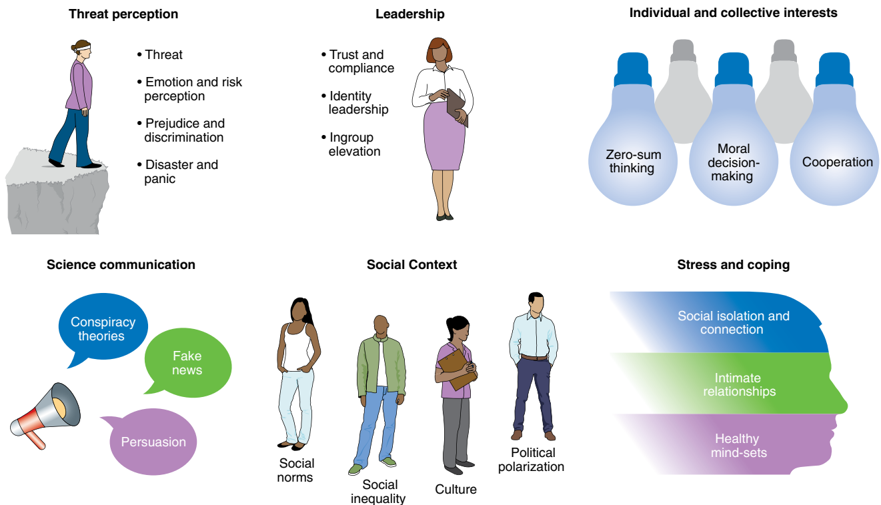
The COVID-19 pandemic represents a massive global health crisis. Because the crisis requires large-scale behaviour change and places significant psychological burdens on individuals, insights from the social and behavioural sciences can be used to help align human behaviour with the recommendations of epidemiologists and public health experts. Here we discuss evidence from a selection of research topics relevant to pandemics, including work on navigating threats, social and cultural influences on behaviour, science communication, moral decision-making, leadership, and stress and coping. In each section, we note the nature and quality of prior research, including uncertainty and unsettled issues. We identify several insights for effective response to the COVID-19 pandemic and highlight important gaps researchers should move quickly to fill in the coming weeks and months.
Overview
CoChat Summary
TL;DR
This perspective argues that social and behavioural science can help align public behaviour with COVID-19 public health recommendations across threat perception, social context, science communication, cooperation, leadership, and stress/coping. It synthesizes prior evidence and policy insights while cautioning that evidence is limited, often drawn from non-pandemic contexts, and in many areas unsettled.
Key findings
- The paper notes the scale of infectious disease threats: the bubonic plague killed approximately 25% of the European population, and by March 2020 COVID-19 had spread to more than 118,000 cases and caused 4,291 deaths in 114 countries. It also notes that 21 countries donated medical supplies to China in February, with China reciprocating widely.
- Fear appeals can change behaviour when people feel capable of dealing with the threat, but produce defensive reactions when people feel helpless; optimism bias can lead people to underestimate personal risk and ignore public health warnings.
- Social norms, inequality, culture, and political polarization shape pandemic behaviour: correcting misperceived norms can help when most people are already doing the desirable behaviour, but descriptive norms can backfire if the behaviour is undesirable unless paired with prescriptive norms.
- Effective communication and leadership may involve credible sources, messages that protect others or align with moral values, prebunking/inoculation against misinformation, accuracy nudges, shared social identity, and leaders modelling prosocial sacrifice; excessive national self-image concerns (“collective narcissism”) can backfire.
Methods
- Design: Perspective/narrative review; no primary data collection or sample. Topics were identified by the corresponding authors as potentially relevant to pandemic response and are explicitly not exhaustive.
- Evidence base: synthesizes prior social and behavioural research on threat perception, social context, science communication, moral decision-making, cooperation, leadership, and stress/coping, drawing on laboratory experiments, correlational studies, field experiments, meta-analyses, and preprints/forthcoming work.
- Analysis: narrative synthesis with policy implications and identified research gaps; no systematic search strategy or quantitative synthesis is reported.
Limitations
- Stated: due to space constraints, the paper provides only a brief summary of each topic; research on these topics is ongoing and in many cases far from settled; there is very little published social science research on the current pandemic, so discussion often draws from different circumstances and evidence quality varies substantially.
- Stated: insights and policy implications should be interpreted with caution.
- Evident: as a perspective rather than a systematic review or empirical study, it does not provide a comprehensive evidence appraisal, and its reliance on preprints and forthcoming sources limits certainty.
Model-written summary. Check it against the paper before relying on it.
Integrity signals
Registry
Cites
Statistics
Figures
Verification
Claims the paper makes
19 Valid · 5 Not valid · 37 Not checked · 13 Own results and interpretations
At least one cited source doesn’t support this claim or points to a different paper, and none confirmed it — see the verdicts below.
In the paper
“For instance, in hypothetical scenarios about deciding whether to go to work while sick, American and British participants reported they would be less willing to stay home when it was uncertain they would infect a co-worker.”
What the sources say
- Disputedcites [176] Kappes, A. et al. Uncertainty about the impact of social decisions increases prosocial behaviour. Nat. Hum. Behav. 2, 573–580 (2018). sourceExperimental — accuracy not yet measured
In the paper’s account of the infectious-disease scenario (Abstract; page not provided), participants facing uncertainty about how severely a co-worker might be affected were more likely to stay home than controls, not less. The paper distinguishes that impact uncertainty from uncertainty about whether a co-worker would be infected. Its Study 6 Methods (page not provided) describe recruitment through AMT, but do not establish the claimed American and British participant groups. (LLM, conf=0.88)
Checked by a reasoning model — may be wrong.
hedgedstates an association- Asserted: passes — The authors put it forward as true.
- Checkable: passes — It can be checked against evidence.
- Load-bearing: passes — The paper’s conclusions depend on it.
- Based: passes — The paper gives a reason why it holds.
- Disputed
The cited sources that could be checked couldn’t confirm or dispute this claim.
In the paper
“Moreover, there is mixed research regarding whether corrections may actually increase belief in the original misinformation 121,124-126 or in other misleading claims that fail to get corrected 127 .”
What the sources say
- Not checked — no full text of the sourcecites [121] Guess, A. & Coppock, A. Does counter-attitudinal information cause backlash? Results from three large survey experiments. Br. J. Polit. Sci. https://doi.org/10.1017/S0007123418000327 (2018). source
- Not matchedcites [124] Wittenberg, C. & Berinsky, A.J. Misinformation and its correction. in Social Media and Democracy: The State of the Field (eds Persily, N. & Tucker, J. A.) (Cambridge University Press, forthcoming).
Its entry has no title and year that we can search by.
- Not checked — no full text of the sourcecites [125] Swire, B. & Ecker, U.K.H. Misinformation and its correction: Cognitive mechanisms and recommendations for mass communication. in Misinformation and Mass Audiences (eds. Southwell, B. G., Thorson, E. A. & Sheble, L.) 195–2011 (University of Texas Press, 2018). source
- Not checked — no full text of the sourcecites [126] Wood, T. & Porter, E. The elusive backfire effect: mass attitudes’ steadfast factual adherence. Polit. Behav. 41, 135–163 (2018). source
- Could not verifycites [127] Pennycook, G., McPhetres, J., Zhang, Y. & Rand, D. Fighting COVID-19 misinformation on social media: Experimental evidence for a scalable accuracy nudge intervention. Preprint at PsyArXiv https://doi.org/10.31234/osf.io/uhbk9 (2020). sourceExperimental — accuracy not yet measured
Citation 127 is attached to the suggestion that corrections may increase belief in other misleading claims that go uncorrected. The Statement of Relevance and Discussion describe an accuracy nudge that improved sharing decisions, not corrections or their effects on belief in uncorrected claims. Searches for correction backfire and uncorrected misinformation found no passage addressing that point; page numbers were unavailable in our copy. (LLM, conf=0.76)
hedgedstates a possible cause- Asserted: passes — The authors put it forward as true.
- Checkable: passes — It can be checked against evidence.
- Load-bearing: passes — The paper’s conclusions depend on it.
- Based: passes — The paper gives a reason why it holds.
The sources with a verdict support this claim; the rest weren’t checked yet, have no full text we could read, or their verdicts aren’t rated yet.
In the paper
“Indeed, laboratory research has found that people prioritize local over global (or international) interests 185,186 .”
What the sources say
- Supportedcites [185] Milinski, M., Hilbe, C., Semmann, D., Sommerfeld, R. & Marotzke, J. Humans choose representatives who enforce cooperation in social dilemmas through extortion. Nat. Commun. 7, 10915 (2016). source
The Results section (‘Voters choose selfish representatives’; page unavailable) reports that participants preferentially re-elected representatives who contributed less to the shared climate account and elected candidates who pledged to contribute less than a fair share. In this simulated international dilemma, that supports the claim that participants favored their own group’s interests over the collective goal; it does not establish that everyone did so. (LLM, conf=0.85)
- Not checked — no full text of the sourcecites [186] Reinders Folmer, C. P. et al. One for all: what representing a group may do to us. J. Exp. Soc. Psychol. 48, 1047–1056 (2012). source
plain- Asserted: passes — The authors put it forward as true.
- Checkable: passes — It can be checked against evidence.
- Load-bearing: passes — The paper’s conclusions depend on it.
- Based: passes — The paper gives a reason why it holds.
- Supported
Every source the paper cites for this claim was checked and supports it.
In the paper
“However, when going to work risked infecting an elderly co-worker who would suffer a serious illness, participants reported they would be more willing to stay home 176 .”
What the sources say
- Supportedcites [176] Kappes, A. et al. Uncertainty about the impact of social decisions increases prosocial behaviour. Nat. Hum. Behav. 2, 573–580 (2018). source
The Study 6 Methods (page not provided) describe a scenario in which going to work could infect an older, vulnerable co-worker who would suffer severely, followed by a rating of willingness to go to work. The reported Study 6 findings (indexed under Abstract; page not provided) say participants given that risk information were significantly more likely to stay home than controls. (LLM, conf=0.92)
hedgedstates a cause- Asserted: passes — The authors put it forward as true.
- Checkable: passes — It can be checked against evidence.
- Load-bearing: passes — The paper’s conclusions depend on it.
- Based: passes — The paper gives a reason why it holds.
- Supported
The sources with a verdict support this claim; the rest weren’t checked yet, have no full text we could read, or their verdicts aren’t rated yet.
In the paper
“Several techniques, such as sanctioning defectors 187 or rewarding cooperators 188 , tend to increase cooperative behaviour in laboratory experiments using economic games.”
What the sources say
- Not checked — no full text of the sourcecites [187] Yamagishi, T. The provision of a sanctioning system as a public good. J. Pers. Soc. Psychol. 51, 110–116 (1986). source
- Supportedcites [188] Rand, D. G., Dreber, A., Ellingsen, T., Fudenberg, D. & Nowak, M. A. Positive interactions promote public cooperation. Science 325, 1272–1275 (2009). source
Citation 188 is attached to rewarding cooperators. The paper’s Abstract reports a laboratory comparison using repeated public goods games and finds that reward maintained public cooperation and, when both reward and punishment were available, increased contributions. (LLM, conf=0.93)
plainstates a cause- Asserted: passes — The authors put it forward as true.
- Checkable: passes — It can be checked against evidence.
- Load-bearing: unclear — It is unclear whether the paper’s conclusions depend on it.
- Based: passes — The paper gives a reason why it holds.
50 more claims · 13 with their cited sources checked
Create a free account to see all 74 claims and to verify the 2 references still open.
- It may state two separate claims as one. 13
- Probably not a substantial claim. 6
Claims other papers make about this one
Each is checked against this paper’s own text: does it say what the citing paper says it does?
The source backs part of the claim, not all of it — or backs it for a different population, condition or comparison.
In the citing paper
“COVID-19 is an international public health crisis, putting substantial burden on medical centers and increasing the psychological toll on health care workers (HCW).”
From Supporting the well-being of health care providers during the COVID-19 pandemic: The CopeColumbia response (2020) · cites this paper as [6]
Experimental — accuracy not yet measuredThe source backs part of the claim, not all of it — or backs it for a different population, condition or comparison.
In the citing paper
“these population-wide measures affected psychological well-being and mental health as well as increased social isolation [68] and loneliness.”
From Psychological correlates of perceived loneliness in college students before and during the COVID-19 stay-at-home period: a longitudinal study (2023) · cites this paper as [68]
Experimental — accuracy not yet measuredThe source backs part of the claim, not all of it — or backs it for a different population, condition or comparison.
In the citing paper
“they may eventually increase the social isolation of students and affect their psychological well-being and mental health [3].”
From Students under lockdown: Comparisons of students’ social networks and mental health before and during the COVID-19 crisis in Switzerland (2020) · cites this paper as [3]
Experimental — accuracy not yet measuredThe source backs part of the claim, not all of it — or backs it for a different population, condition or comparison.
In the citing paper
“effective interventions are hard to scale to a population level (12);”
From Psychological inoculation improves resilience against misinformation on social media (2022) · cites this paper as [12]
Experimental — accuracy not yet measuredThe source backs part of the claim, not all of it — or backs it for a different population, condition or comparison.
In the citing paper
“There is a shortage of studies that test anti-misinformation interventions in an ecologically valid manner, i.e., testing an intervention as consumers would interact with it in online environments (8, 12).”
From Psychological inoculation improves resilience against misinformation on social media (2022) · cites this paper as [12]
Experimental — accuracy not yet measured
6 more claims about this paper
Create a free account to see every claim other papers make about this one.
Citations
Cites
Granovetter, M. S. (1973) · American Journal of Sociology · doi:10.1086/225469 · Cited by 40,491
Zhou, F., Yu, T., Du, R., Fan, G., Liu, Y., Liu, Z., Xiang, J., Wang, Y., Song, B., Gu, X., et al. (2020) · The Lancet · doi:10.1016/s0140-6736(20)30566-3 · Cited by 27,263
The need to belong: Desire for interpersonal attachments as a fundamental human motivation.
Baumeister, R. F., & Leary, M. R. (1995) · Psychological Bulletin · doi:10.1037//0033-2909.117.3.497 · Cited by 23,245
Culture and the self: Implications for cognition, emotion, and motivation.
Markus, H. R., & Kitayama, S. (1991) · Psychological Review · doi:10.1037/0033-295x.98.2.224 · Cited by 21,995
Self-citationThe Psychological Impact of Quarantine and How to Reduce It: Rapid Review of the Evidence
Brooks, S. K., Webster, R. K., Smith, L. E., Woodland, L., Wessely, S., Greenberg, N., & Rubin, G. J. (2020) · doi:10.2139/ssrn.3532534 · Cited by 16,394
The psychological impact of quarantine and how to reduce it: Rapid review of the evidence
Brooks, S. K., Webster, R. K., Smith, L. E., Woodland, L., Wessely, S., Greenberg, N., & Rubin, G. J. (2020) · The Lancet · doi:10.1016/s0140-6736(20)30460-8 · Cited by 16,378
Nudge: improving decisions about health, wealth, and happiness
(2008) · Choice Reviews Online · doi:10.5860/choice.46-0977 · Cited by 11,572
Slovic, P. (1987) · Science · doi:10.1126/science.3563507 · Cited by 9,271
The Elaboration Likelihood Model of Persuasion
Petty, R. E., & Cacioppo, J. T. (1986) · Advances in Experimental Social Psychology · doi:10.1016/s0065-2601(08)60214-2 · Cited by 8,822
Self-citationThe emotional dog and its rational tail: A social intuitionist approach to moral judgment.
Haidt, J. (2001) · Psychological Review · doi:10.1037/0033-295x.108.4.814 · Cited by 8,048
Research works printed but not linked: 3
- Berkowitz, A.D. An overview of the social norms approach. in Changing the Culture of College Drinking: A Socially Situated Health Communication Campaign (eds. Stewart, L. & Lederman, L. C.) 193–214 (Hampton Press, 2005).
- Wittenberg, C. & Berinsky, A.J. Misinformation and its correction. in Social Media and Democracy: The State of the Field (eds Persily, N. & Tucker, J. A.) (Cambridge University Press, forthcoming).
- Ransohoff, K.J. Patients on the Trolley Track: The Moral Cognition of Medical Practitioners and Public Health Professionals. (Harvard Univ. Press, 2011).
Cited by
Items 3,201–3,300 of 5,015
Gender Disparity in Awareness and Perception towards Novel Corona Virus (COVID-19)
Kaur, M., Sharma, P., & Sidhu, K. (2021) · doi:10.48165/ijee.2021.57320 · Cited by 2
Yamada, Y. (2021) · The Japanese journal of psychology · doi:10.4992/jjpsy.92sp.editorial · Cited by 2
Evaluation of anxiety in individuals with end-stage lung disease during covid-19 pandemic
Yıldız, M., Beyoğlu, M. A., Şahin, M. F., & Aksu, K. (2021) · Ankara Medical Journal · doi:10.5505/amj.2021.63439 · Cited by 2
Liu, J., Cheng, L., Sarker, A., Li, Y., & Aló, R. (2021) · IEEE International Conference on Big Data (BigData) · doi:10.1109/bigdata52589.2021.9671860 · Cited by 2
“People’s behavior can indicate and affect people’s health [26], [28], [29].”
BackgroundIncorporating Well-Being and Mental Health Research to Improve Pandemic Response
Daly, M., & Delaney, L. D. (2021) · LSE Public Policy Review · doi:10.31389/lseppr.48 · Cited by 2
Zhang, N., Ye, H., Zheng, J., Leng, X., Meng, D., & Li, Y. (2022) · Remote Sensing · doi:10.3390/rs14040921 · Cited by 3
Religious beliefs and the behavior of people during COVID-19 crisis
Chowdhury, M. S. (2022) · International Journal of Social Science Research and Review · doi:10.47814/ijssrr.v5i3.185 · Cited by 2
Arreeras, T., Chansuk, C., & Arimura, M. (2022) · International Conference on Decision Aid Sciences and Applications (DASA) · doi:10.1109/dasa54658.2022.9765315 · Cited by 2
Frenzel, S. B., Junker, N. M., Avanzi, L., Erkens, V. A., Haslam, S. A., Haslam, C., Häusser, J. A., Knorr, D., Meyer, I., Mojzisch, A., et al. (2022) · Psychologica Belgica · doi:10.5334/pb.1043 · Cited by 3
Self-citationBalancing timeliness of reporting with increasing testing probability for epidemic data
Pritchard, A. J., Silk, M. J., Carrignon, S., Bentley, R. A., & Fefferman, N. H. (2022) · Infectious Disease Modelling · doi:10.1016/j.idm.2022.04.001 · Cited by 4
“Furthermore, the emergent use of protective behaviors can result in the construction of a new social norm (Bavel et al., 2020; Cialdini & Trost, 1998; McAlaney & McMahon, 2007), which may normalize behaviors that are more effective at mitigating a disease than in a norm-naive public.”
BackgroundEmbedded Social Science and the British Government COVID-19 Response: An Ethnographic Study
Tasker, A. J., & Irvine, L. (2022) · Anthropology in Action · doi:10.3167/aia.2022.290107 · Cited by 4
Hudecek, M. F. C., Fischer, P., Gaube, S., & Lermer, E. (2022) · Journal of Open Psychology Data · doi:10.5334/jopd.64 · Cited by 2
“Corresponding findings can help to design evidence-based measures so that acceptance among the population is as high as possible (Van Bavel et al., 2020).”
BackgroundGologram, M., Lomiguen, C. M., Chin, J., & Terrell, M. (2022) · The American Journal of Cosmetic Surgery · doi:10.1177/07488068221110719 · Cited by 2
Maruyama, G. Y., Junior, A. A. D. C., de Lima, A. C., et al. (2022) · doi:10.14210/cotb.v13.p059-065 · Cited by 2
“Por exemplo, no ano de 2020 o mundo passou a enfrentar uma grave crise sanitária, a pandemia de COVID-19 (doença do coronavírus) [5].”
BackgroundResponse to COVID 19 Pandemic in MENA Region. Practices and Polices
Hussain, H. Y., Rebai, W. K., Bouguerra, H., Risheed, M. S. B., & Hussein, M. A. (2022) · Scholars Journal of Medical Case Reports · doi:10.36347/sjmcr.2022.v10i07.026 · Cited by 2
Jou, Y., Mariñas, K. A., Saflor, C. S., Young, M. N., Prasetyo, Y. T., & Persada, S. F. (2022) · Healthcare · doi:10.3390/healthcare10081483 · Cited by 4
Fu, X., & Xu, Y. (2022) · Frontiers in Psychology · doi:10.3389/fpsyg.2022.984222 · Cited by 2
Reid, A. E., Eamiello, M. L., Mah, A. Y. J., Dixon–Gordon, K. L., Lickel, B. A., Markowitz, E. M., Nteta, T. M., Ginn, J. C., & Suh, S. M. (2022) · Social Psychological and Personality Science · doi:10.1177/19485506221121204 · Cited by 4
Contested bodies and delayed decisions: Attitudes to COVID-19 vaccines among Jamaicans
Smith, A. Y. (2022) · OPERA · doi:10.18601/16578651.n32.10 · Cited by 2
“It can also be used to shed light on Jamaica’s low rate of COVID-19 vaccination uptake and is useful to understand public risk perception considering the growing number of COVID-19-related deaths both worldwide (Bavel et al., 2020) and specifically in Jamaica (Kim et al., 2021).”
BackgroundPutri, N. P., Subramaniam, G., Sivasamugham, L. A., Gopinathan, S., Raman, M., & Sam, T. H. (2022) · Journal of Liaquat University of Medical & Health Sciences · doi:10.22442/jlumhs.2022.00959 · Cited by 2
The influencing factors of compliance with health protocols related to Covid-19: a scoping review
Yavari, R., Rezaei, Z., & Mohammadi, N. K. (2022) · Health Monitor Journal of the Iranian Institute for Health Sciences Research · doi:10.52547/payesh.21.5.491 · Cited by 2
Tourism developmente policy and the use of scenario analisis: a synthesis model
Martins, M., Guerra, R. J. D. C., & Santos, L. (2022) · PASOS Revista de Turismo y Patrimonio Cultural · doi:10.25145/j.pasos.2022.20.074 · Cited by 2
Agbede, G. T., & Mheta, G. (2022) · International Journal of Research in Business and Social Science (2147-4478) · doi:10.20525/ijrbs.v11i10.2108 · Cited by 2
Lapses in the Person Radar: ADHD Symptoms Predict Difficulty in Interpersonal Distancing
Brown, C. R. H., & Forster, S. (2023) · Journal of Attention Disorders · doi:10.1177/10870547221149200 · Cited by 2
“Social distancing measures include both the proactive avoidance of social situations (e.g., remaining at home when possible) and interpersonal distancing (e.g., maintaining a minimum physical interpersonal distance of 1–2 m when in social contexts; Bavel et al., 2020).”
BackgroundChhatwal, P., Papaioanou, M., Fazel, S. S., & Sibbald, S. L. (2022) · Western Undergraduate Research Journal Health and Natural Sciences · doi:10.5206/wurjhns.2021-22.1 · Cited by 2
Residential mobility predicts COVID-19 and seasonal flu vaccination behaviors in the United States
Zhang, N., Jiang, T., Zhang, Y., & Zhao, G. (2023) · Frontiers in Public Health · doi:10.3389/fpubh.2022.1064962 · Cited by 2
Ambiguous COVID-19 Messaging Increases Unsafe Socializing Intentions
Hopkins, V. C., Pickup, M. A., & Matthews, S. (2023) · Journal of Behavioral Public Administration · doi:10.30636/jbpa.61.299 · Cited by 4
Intention to Vaccinate against COVID-19 among Young Adults: The Role of Conspiratorial Thinking
Hromatko, I., Mikac, U., & Tadinac, M. (2023) · Vaccines · doi:10.3390/vaccines11020321 · Cited by 3
Gichuhi, J. M., Oginde, D. A., & Wambua, P. (2023) · Journal of Economics and Business · doi:10.31014/aior.1992.06.01.490 · Cited by 7
Lubin, R. E., Edmondson, D. E., & Otto, M. W. (2023) · Psychology Health & Medicine · doi:10.1080/13548506.2023.2185644 · Cited by 3
Valla, L., Hjellset, V. T., Småstuen, M. C., & Sparboe-Nilsen, B. (2023) · PLoS ONE · doi:10.1371/journal.pone.0282653 · Cited by 3
“Social distance is as such replaced by physical distance, implying that there is still a social relationship between individuals, even if they are physically separated [35].”
BackgroundEconomic bifurcations in pandemic leadership: Power in abundance or agency amid scarcity?
Uyheng, J., & Montiel, C. J. (2023) · British Journal of Social Psychology · doi:10.1111/bjso.12646 · Cited by 2
Powell, W. A. (2023) · PLoS ONE · doi:10.1371/journal.pone.0280509 · Cited by 4
“…education community is unable to teach the population in general, and students in particular, how to critically evaluate evidence, then this continuous rise in scientific skepticism has the potential to result in catastrophic effects on public health, the economy, and the environment [37,38].”
BackgroundFreire, P. D. S., Kempner-Moreira, F., & Margherita, A. (2023) · Sustainability · doi:10.3390/su15075836 · Cited by 5
Police Social Capital and the Effectiveness of Emergency Policing in China During COVID-19
Lin, H., Wu, T. S., Liu, H., & Kaunert, C. (2023) · Policing A Journal of Policy and Practice · doi:10.1093/police/paac112 · Cited by 2
Mau, M., Nielsen, D. S., Jakobsen, I. S., Klausen, S. H., & Roessler, K. K. (2023) · Nordic Psychology · doi:10.1080/19012276.2023.2217521 · Cited by 3
“This was an effective strategy against disease transmission, as no vaccine existed against the virus; however, it simultaneously also limited the opportunities for social contact (Van Bavel et al., 2020).”
Park, S., ahn, H.-K., & So, W.-Y. (2023) · Journal of Men s Health · doi:10.22514/jomh.2023.031 · Cited by 2
Hossain, M. F., Shi, Y., & Jahan, M. (2023) · Millennial Asia · doi:10.1177/09763996231174268 · Cited by 3
“On the one hand, two types of cultural ‘tightness’ and ‘looseness’ are found in society (Beugelsdijk et al., 2017, p. 34; Van Bavel et al., 2020).”
The Extent of Incorporating Health Education Requirements in Middle School Science Textbooks
Aldahmash, A. H., & Almutairi, S. A. (2023) · Sustainability · doi:10.3390/su151411005 · Cited by 3
Conceptual replication study of fifteen JDM effects: Insights from the Polish sample
Sobków, A., Sobczak, A., Latacz, K., Gambuś, P., Tyc, A., Goryczka, K., Barcik, K., Janosz, A., Hetmańczuk, W., Gonczar, T., et al. (2022) · Polish Psychological Bulletin · doi:10.24425/ppb.2022.141862 · Cited by 6
Stern, C., & Ruisch, B. C. (2023) · Perspectives on Psychological Science · doi:10.1177/17456916231185298 · Cited by 2
“In this case, researchers will need to explore how to simultaneously employ strategies that mitigate bias when group memberships are accessible (e.g., highlighting shared goals; Van Bavel et al., 2020).”
Co-production and COVID-19: Digital diaries as a platform for participating in COVID-19 research
Chambers, M., Deokota, D., Dien, R., & Nguyen, Y. H. (2021) · Policy Press eBooks · doi:10.56687/9781447361794-014 · Cited by 4
The Impact of Loss Aversion on People’s Behavior in Different Markets
Yang, Y. (2023) · Advances in Economics Management and Political Sciences · doi:10.54254/2754-1169/14/20230851 · Cited by 4
Conspiracy Theories: A Cultural Evolution Theory Approach
Stubbersfield, J. (2023) · Oxford University Press eBooks · doi:10.1093/oxfordhb/9780198869252.013.72 · Cited by 7
Factors of early COVID ‐19 prevention policy engagement in France and in the United States
Lauby, F., & McKinley, C. J. (2023) · Politics & Policy · doi:10.1111/polp.12556 · Cited by 2
Bär, K. A., Xavier, T. A., Martelli, G. M., Benedetti, F. J., Troncoso, M. P., & Costenaro, R. G. S. (2023) · Revista gaúcha de enfermagem · doi:10.1590/1983-1447.2023.20220288.pt · Cited by 2
Non-standard employment and COVID-19 testing in South Korean workers
Hwang, S. (2023) · Public Health · doi:10.1016/j.puhe.2023.09.025 · Cited by 2
Makkulawu, A. R., Ahmad, I., Aman, A., Muhtar, I., Gaffar, I., & Febrianti, N. (2023) · Jurnal Penelitian Pendidikan IPA · doi:10.29303/jppipa.v9i10.5140 · Cited by 2
“This position describes a very favorable situation because there is a balance between opportunity and strength factors (Bavel et al., 2020).”
BackgroundModelling Workplace Ostracism among Workforces amid Pandemic Outbreaks
Othman, N. A. F., Izhan, F. F. A., Sundram, V. P. K., Majid, M., Din, S. Z. M., Munir, Z. A., & Razali, M. Z. M. (2023) · Information Management and Business Review · doi:10.22610/imbr.v15i4(si)i.3579 · Cited by 4
“Due to fear, the behavior of people was changing towards preventing and avoiding themselves from being infected with the virus (Bavel et al., 2020), with some practicing ostracism towards each other in their workplace.”
BackgroundConsiderações sobre o papel das ciências comportamentais nas políticas de enfrentamento à Covid-19
da Rocha, C. A. A., & Hunziker, M. H. L. (2023) · Revista Brasileira de Terapia Comportamental e Cognitiva · doi:10.31505/rbtcc.v25i1.1781 · Cited by 2
Lazo, G. M., Miranda, R., & Oriol, X. (2024) · Revista de Psicología · doi:10.18800/psico.202401.008 · Cited by 2
Dispositional compassion shifts social preferences in systematic ways
Ocampo, J. M. A., & Keltner, D. J. (2023) · Journal of Personality · doi:10.1111/jopy.12896 · Cited by 4
Inequality and vulnerability of informal employment during the pandemic
Ryandika, R., Meifrinaldi, Pribadi, K. S., Martek, I., & Chan, T. K. (2023) · Construction Economics and Building · doi:10.5130/ajceb.v23i3/4.8404 · Cited by 4
Ideologiczne podstawy akceptacji przemocy wobec migrantów
Winiewski, M. H., Świderska, A., & Bulska, D. (2024) · Wydawnictwo Liberi Libri eBooks · doi:10.47943/lib.9788363487645.rozdzial04 · Cited by 15
Postawy Polaków i Polek wobec mniejszości: raport z Polskiego Sondażu Uprzedzeń 2021
Mirucka, M., Zochniak, K., & Bulska, D. (2024) · Wydawnictwo Liberi Libri eBooks · doi:10.47943/lib.9788363487645.rozdzial01 · Cited by 3
Aljasim, L., Javed, N. B., Cordoba, C., et al. (2024) · Frontiers in Public Health · doi:10.3389/fpubh.2024.1295566 · Cited by 2
Pokharel, M., Lillie, H. M., Jensen, J. D., King, A. J., Ratcliff, C. L., & Barbour, J. B. (2024) · Health Communication · doi:10.1080/10410236.2024.2309003 · Cited by 5
“These factors would emphasize the influence of political party on precautionary behaviors while limiting the influence of actual regional norms due to limited exposure (Van Bavel et al., 2020).”
Rivera, E. P., Urioste-Stone, S. M. D., Rickard, L. N., Caprara, A., & Estrada, L. N. (2024) · Current Issues in Tourism · doi:10.1080/13683500.2024.2309164 · Cited by 2
“Attention should be put on the balance between risk-elevating and risk-minimising messages since strong fear appeals with few efficacy messages can produce defensive responses (Bavel et al., 2020).”
Falsification of home rapid antigen lateral flow tests during the COVID-19 pandemic
Ray, D., Dhami, R., Lecouturier, J., McGowan, L. J., Mukherjee, A., Vlaev, I., Kelly, M. P., & Sniehotta, F. F. (2024) · Scientific Reports · doi:10.1038/s41598-024-53383-8 · Cited by 3
Meaning of life and death during COVID-19 pandemic: A cultural and religious narratives
Buqa, W. (2024) · HTS Teologiese Studies / Theological Studies · doi:10.4102/hts.v80i1.9258 · Cited by 4
Feedback control of the COVID-19 outbreak based on active disturbance rejection control
Zhang, H., Tan, W., Yu, M., et al. (2024) · Applied Mathematics in Science and Engineering · doi:10.1080/27690911.2024.2325520 · Cited by 2
Ma, X., Chen, B., & Zhao, Y. (2024) · Globalization and Health · doi:10.1186/s12992-024-01018-y · Cited by 4
“Nonetheless, there are substantial cultural differences in protective behaviors between communities and regions within a country [67, 68], and the influence of political ideology transcends physical space [69].”
BackgroundProtective action in the workplace in the time of COVID‐19: The role of worker representation
Ollé‐Espluga, L., Castiblanque, R. P., Llorens, C., Esteve‐Matalí, L., & Navarro, A. (2024) · American Journal of Industrial Medicine · doi:10.1002/ajim.23578 · Cited by 2
Akyürek, G., Bilgin, N., & Çalış, H. T. (2024) · Occupational Therapy In Health Care · doi:10.1080/07380577.2024.2324286 · Cited by 2
“In addition, family relationships were damaged by quarantine, financial issues and forced isolation (Bavel et al., 2020).”
Yan, J., Fang, Z., Chen, L., Tang, J., Lu, Q., & Lin, X. (2024) · Journal of Housing and the Built Environment · doi:10.1007/s10901-024-10120-x · Cited by 3
“…healthcare medical capability that have been existing before the pandemic (Comber et al., 2011; Lee et al., 2014), and mask mandatory, social distance and vaccination requirements have occurred after the COVID-19 outbreak (Bavel et al., 2020; Chen et al., 2020; Nikiforiadis et al., 2022).”
InfluentialGazadinda, R., Rizki, M. F., Azka, R. H., Putri, E. A., Damayanti, M., & Utomo, F. W. (2024) · Journal of Educational Health and Community Psychology · doi:10.12928/jehcp.v13i1.27423 · Cited by 2
Pseudosciences and the Current Challenges Imposed on Science Teaching
de Souza, D. V. L., & de Oliveira, I. M. (2024) · Educação & Realidade · doi:10.1590/2175-6236121157vs02 · Cited by 4
Lockdown during the COVID-19 pandemic: lessons from a polarized scenario in Brazil
Camacho, K. G., Moore, D. C. B. C., Junqueira-Marinho, M. D. F., et al. (2024) · Frontiers in Psychology · doi:10.3389/fpsyg.2024.1310594 · Cited by 2
Evolutionary game dynamics and the phase portrait diversity in a pandemic scenario
Mendonça, J. P., Brum, A. A., Lyra, M. L., et al. (2024) · Applied Mathematics and Computation · doi:10.1016/j.amc.2024.128749 · Cited by 2
The effect of heterogeneous distributions of social norms on the spread of infectious diseases
Vilone, D., Vriens, E., & Andrighetto, G. (2024) · Journal of Physics Complexity · doi:10.1088/2632-072x/ad459f · Cited by 4
“Since the COVID-19 pandemic requires large-scale behaviour change, insights from the social and behavioural sciences have been shown to be crucial to help align human behaviour with the recommendations of epidemiologists and public health experts [2].”
BackgroundZhang, W., Wu, Y., & Deng, G. (2024) · Transportation Research Part A Policy and Practice · doi:10.1016/j.tra.2024.104089 · Cited by 2
The determinants of Trump's defeat in 2020: what if the COVID-19 pandemic did not matter?
Luartz, L. A., Camatarri, S., & Gallina, M. (2024) · Journal of Elections Public Opinion and Parties · doi:10.1080/17457289.2024.2349535 · Cited by 2
“While Van Bavel et al. (2020) suggest increased regulation and government organization towards responsive measures during the pandemic can increase government support, Trump opted to politicize mitigation efforts through contradictory action that prolonged the crisis and his declining approval…”
Presidents and vaccines: head of state inoculation as a tool for vaccine promotion
Collart, L., Lunanga, E., Stoop, N., & Verpoorten, M. (2024) · Frontiers in Public Health · doi:10.3389/fpubh.2024.1364927 · Cited by 2
Galdikiene, L., Jaraitė, J., & Kajackaite, A. (2024) · Journal of Behavioral and Experimental Economics · doi:10.1016/j.socec.2024.102246 · Cited by 5
Histéresis y resiliencia en la vida cotidiana postpandemia en España
Alaminos, A., & Alaminos-Fernández, P. (2024) · Revista Internacional de Sociología · doi:10.3989/ris.2024.82.2.22-095 · Cited by 5
Gupta, P., Mahajan, A., Chander, V., & Barwal, V. K. (2023) · Indian Journal of Public Health · doi:10.4103/ijph.ijph_1525_22 · Cited by 2
Ogunyinka, I. A., Yusuff, K. B., Erah, P. O., Mohammed, Y., & Wada, Y. H. (2024) · Annals of African Medicine · doi:10.4103/aam.aam_201_23 · Cited by 2
“[36] Some cultures such as those of Africa and Asia thrive on interdependence or communal relationships.”
The effect of the global COVID-19 pandemic on the secondary sector in Côte d‘Ivoire
Dago, D. A. (2024) · Cogent Economics & Finance · doi:10.1080/23322039.2024.2376952 · Cited by 2
“In response, the Ivorian government and others worldwide have implemented a range of measures, including fiscal stimulus packages, monetary policy adjustments, and targeted sectoral supports, to cushion the economic (Ashraf, 2020; Bavel et al., 2020) blow.”
An Evolving Landscape of the Psychology of Judgment and Decision-Making: A Bibliometric Analysis
Ngamake, S. T., Raveepatarakul, J., & Sawang, S. (2024) · Administrative Sciences · doi:10.3390/admsci14080162 · Cited by 4
The Impact of Crisis on Consumers' Value Systems
Woo, H., Shin, D. C., Jung, S., & Jin, B. E. (2024) · Journal of the Korean Society of Clothing and Textiles · doi:10.5850/jksct.2024.48.3.433 · Cited by 4
Culture and effectiveness of distance restriction policies: evidence from the COVID-19 pandemic
Xu, Y., Dong, C., & Shao, W. (2024) · Journal of The Royal Society Interface · doi:10.1098/rsif.2024.0159 · Cited by 1
“Therefore, in a country with higher indulgence, people may have a more optimistic attitude towards COVID-19 and may have a more difficult time coordinating themselves in the face of the pandemic [67].”
Çat, O., Chang, J., Hlatky, R., Li, H., & Nielson, D. (2024) · PNAS Nexus · doi:10.1093/pnasnexus/pgae189 · Cited by 5
“…behavioral “nudges” in survey experiments describing broadly followed norms of conforming behavior, priming prosocial motives to protect others, and providing information on efficacy all prove effective in decreasing vaccine hesitancy measured as attitudes and self-reported intentions (5 – 10).”
Elayan, S., & Sykora, M. D. (2024) · Journal of Computational Social Science · doi:10.1007/s42001-024-00314-2 · Cited by 5
“High arousal negative emotions specifically were shown to be most relevant and of consequence in behavioural choices during health crises [95].”
InfluentialHuang, J. W., Kwan, M., Kan, Z., Kieu, M., Lee, J., Schwanen, T., & Yamada, I. (2024) · Social Science & Medicine · doi:10.1016/j.socscimed.2024.117247 · Cited by 2
SIR–Bass modeling approach to quantify the effects of intervention adoption on disease transmission
Yadav, P. K., & Goel, P. (2024) · International Journal of Biomathematics · doi:10.1142/s1793524524501055 · Cited by 3
The Fitness-Validation Model of Propagandist Persuasion and the 5Ds of Propaganda
Adam‐Troian, J. (2024) · Journal of Media Psychology Theories Methods and Applications · doi:10.1027/1864-1105/a000442 · Cited by 4
Systemic View of the Role of Higher Educational Institutions in the Great Reset
Bach, M. P., Vugec, D. S., Khawaja, S., Qureshi, F. H., & Fildor, D. (2024) · Systems · doi:10.3390/systems12090323 · Cited by 2
Knowledge attitude practice among oncologists and health care workers during COVID19 pandemic
Soliman, S. H., & Atef, M. M. (2024) · Journal of the Egyptian National Cancer Institute · doi:10.1186/s43046-024-00231-5 · Cited by 2
The relevance of risk perception and coping strategies for COVID-19 situation reports
Gerhold, L., Sterl, S., Glunz, E., Witt, F., & Stelzmann, D. (2024) · International Journal of Mass Emergencies & Disasters · doi:10.1177/02807270241277809 · Cited by 4
“An explanation for these results might be that people tend to be inappropriately optimistic and think that the illness is less likely to affect them when compared to others (van Bavel et al. 2020).”
Screen use and mental health: the need to strengthen the information ecosystem
Broilo, P. L., Fortes, A. B., & Lisbôa, C. S. D. M. (2024) · Academia Mental Health and Well-Being · doi:10.20935/mhealthwellb7332 · Cited by 2
Gheorghe, I.-R., Popa-Velea, O., Gheorghe, C.-M., & Diaconescu, L. V. (2024) · Social Sciences · doi:10.3390/socsci13100536 · Cited by 4
Zhao, M., & Tian, B. (2024) · Behavioral Sciences · doi:10.3390/bs14100927 · Cited by 2
Buttenheim, A. M., Köhler, T., Eyal, K. C., & Maughan‐Brown, B. (2024) · Journal of Health Communication · doi:10.1080/10810730.2024.2399568 · Cited by 1
“…is free and easy to get; prosocial messages highlighting the benefits of vaccination to others and to society; and ownership or “reserved for you” messages that increase motivation to vaccinate by inducing a feeling of exclusivity (Milkman et al., 2021; Rabb et al., 2022; Van Bavel et al., 2020).”
Quantum-Like Approaches Unveil the Intrinsic Limits of Predictability in Compartmental Models
Rojas-Venegas, J. A., Gallarta-Sáenz, P., Hurtado-Heredia, R., Gómez‐Gardeñes, J., & Soriano‐Paños, D. (2024) · Entropy · doi:10.3390/e26100888 · Cited by 2
“Focusing on real data, such challenge can be attributed to the unpredictability and intricacies of the variety of biological and social factors neglected in simple compartmental models but ultimately shaping the long-term propagation of infectious diseases Bavel et al. [2020], Markov et al. [2023].”
BackgroundContagion of fear: Investigating the psychology and effects of mass hysteria
Pradhan, L., Sahoo, A., Sahu, P., et al. (2024) · Odisha Journal of Psychiatry · doi:10.4103/ojp.ojp_25_24 · Cited by 2
Travel behavior before and after COVID-19. A hybrid choice model applied to a panel dataset
Sottile, E., Tuveri, G., Piras, F., & Meloni, I. (2024) · Transportation Research Interdisciplinary Perspectives · doi:10.1016/j.trip.2024.101265 · Cited by 6
Who Plays an Important Role for Information Networks of COVID-19 in Latin America?
Yum, S. (2024) · Disaster Medicine and Public Health Preparedness · doi:10.1017/dmp.2024.285 · Cited by 2
Lim, I., Kim, Y., & Kim, S. (2024) · Risk Analysis · doi:10.1111/risa.17675 · Cited by 3
“…on the link between media exposure and risk perception has examined changes in the public’s psychological responses and behavioral intentions regarding various risk issues, including swine flu (Ho, 2012; Ho et al., 2013), MERS (Choi et al., 2017), and COVID-19 (Bavel et al., 2020; Liu et al., 2020).”
InfluentialHow the pandemic affected psychological research
Gollwitzer, M., Nuding, S., Schramm, L. F. F., Glöckner, A., Gruber, R., Hajek, K. V., Häusser, J. A., Imhoff, R., & Rudert, S. C. (2024) · Royal Society Open Science · doi:10.1098/rsos.241311 · Cited by 2
Senarath, N., Dedunupitiya, W., Ilangarathna, G. A., Thilakasiri, I., Samarakoon, B., Ramanayake, L., Godaliyadda, R. I., Ekanayake, P., Herath, V. R., Pinnawala, M., et al. (2024) · Humanities and Social Sciences Communications · doi:10.1057/s41599-024-04099-7 · Cited by 5
“Only the questions with a factor loading above 0.4 were deemed to be representative of the underlying factor and the 0.4-factor-loading threshold was selected consistent with literature (Bavel et al. 2020; Hou 2023; Watson & Thompson 2006).”
Influential
Metadata
- Authors
- Bavel, J. J. V., Baicker, K., Boggio, P. S., Capraro, V., Cichocka, A., Cikara, M., Crockett, M. J., Crum, A. J., Douglas, K. M., Druckman, J. N., Drury, J., Dube, O., Ellemers, N., Finkel, E. J., Fowler, J. H., Gelfand, M., Han, S., Haslam, S. A., Jetten, J., Kitayama, S., Mobbs, D., Napper, L. E., Packer, D. J., Pennycook, G., Peters, E., Petty, R. E., Rand, D. G., Reicher, S. D., Schnall, S., Shariff, A., Skitka, L. J., Smith, S. S., Sunstein, C. R., Tabri, N., Tucker, J. A., Linden, S. V. D., Lange, P. V., Weeden, K. A., Wohl, M. J. A., Zaki, J., Zion, S. R., & Willer, R.
- Affiliations
- New York University (US)
- Universidade Presbiteriana Mackenzie (BR)
- Middlesex University London (GB)
- University of Kent (GB)
- Harvard University (US)
- Yale University (US)
- Stanford University (US)
- Northwestern University (US)
- University of Sussex (GB)
- University of Chicago (US)
- Utrecht University (NL)
- University of California San Diego (US)
- University of Maryland, College Park (US)
- Peking University (CN)
- The University of Queensland (AU)
- University of Michigan (US)
- California Institute of Technology (US)
- Lehigh University (US)
- University of Regina (CA)
- University of Oregon (US)
- The Ohio State University (US)
- Massachusetts Institute of Technology (US)
- University of St Andrews (GB)
- University of Cambridge (GB)
- University of British Columbia (CA)
- University of Illinois Chicago (US)
- University of California, Berkeley (US)
- Carleton University (CA)
- Cornell University (US)
- Corresponding author
- Bavel, Jay J. Van
- Willer, Robb
- ORCID
- Bavel, Jay J. Van
- Baicker, Katherine
- Boggio, Paulo S.
- Capraro, Valerio
- Cichocka, Aleksandra
- Cikara, Mina
- Crockett, Molly J.
- Crum, Alia J.
- Douglas, Karen M.
- Druckman, James N.
- Drury, John
- Ellemers, Naomi
- Finkel, Eli J.
- Fowler, James H.
- Gelfand, Michele
- Han, Shihui
- Haslam, S. Alexander
- Jetten, Jolanda
- Kitayama, Shinobu
- Mobbs, Dean
- Napper, Lucy E.
- Packer, Dominic J.
- Pennycook, Gordon
- Peters, Ellen
- Petty, Richard E.
- Rand, David G.
- Reicher, Stephen D.
- Schnall, Simone
- Shariff, Azim
- Skitka, Linda J.
- Sunstein, Cass R.
- Tabri, Nassim
- Tucker, Joshua A.
- Linden, Sander van der
- Weeden, Kim A.
- Wohl, Michael J. A.
- Zaki, Jamil
- Zion, Sean R.
- Willer, Robb
- Venue
- Nature Human Behaviour
- Published
- 2020-04-30
- Volume
- 4
- Issue
- 5
- Pages
- 460-471
- ISSN
- 2397-3374 (ISSN-L)
- OpenAlex
- W3016902371
- Semantic Scholar
- d81abcd7f053b136423f1e7f57928524e8b0e1a0
- Cited by
- 4,964
- References
- 259
- Citations by year
- 2026: 177 · 2025: 288 · 2024: 483 · 2023: 741 · 2022: 1094 · 2021: 1474 · 2020: 702
- FWCI
- 175.81
- Type
- journal article
- Language
- en
- Open access
- bronze
- doi.org
- Licence
- www.springernature.com/gp/researchers/text-and-data-mining (tdm)
- www.springernature.com/gp/researchers/text-and-data-mining (vor)
- Locations
- Nature Human Behaviour (publishedVersion)
- PubMed (publishedVersion)
- Middlesex University Research Repository (Middlesex University Of London) (acceptedVersion)
- Kent Academic Repository (University of Kent) (acceptedVersion)
- DSpace@MIT (Massachusetts Institute of Technology) (submittedVersion, cc-by-nc-sa)
- Sussex Research Online (University of Sussex) (submittedVersion)
- CaltechAUTHORS (California Institute of Technology) (submittedVersion)
- RePEc: Research Papers in Economics (submittedVersion)
- BOA (University of Milano-Bicocca) (submittedVersion)
- Carleton University's Institutional Repository (MacOdrum Library, Carleton University) (submittedVersion, other-oa)
- Utrecht University Repository (Utrecht University) (submittedVersion)
- Figshare (submittedVersion)
- VU Research Portal (submittedVersion, other-oa)
- Utrecht University Repository (Utrecht University) (submittedVersion, other-oa)
- Data Archiving and Networked Services (DANS) (submittedVersion, other-oa)
- Funders
- U.S. Department of Health and Human Services (2P50 MH094258)
- National Institute of Mental Health (P50MH094258)
- Topics
- Social Sciences › Sociology and Political Science › COVID-19 Prevention and Impact
- Social Sciences › Communication › Communication and COVID-19 Impact
- Physical Sciences › Mathematics › Modeling and Simulation › COVID-19 epidemiological studies
- Keywords
- COVID-19 pandemic, pandemic response, behavior change, science communication, ethical decision-making, leadership, stress coping, psychological burden, public health recommendations
- MeSH terms
- Betacoronavirus, COVID-19, SARS-CoV-2, Adaptation, Psychological, Communicable Disease Control, Decision Making, Humans, Human Activities, Health Knowledge, Attitudes, Practice, Leadership, Pneumonia, Viral, Public Health, Quarantine, Stress, Psychological, Global Health, Coronavirus, Coronavirus Infections, Pandemics, Social Media, Epidemiological Monitoring
About these checks
Registry, retraction, Cites and statistics results are computed, not judged, with one exception: a printed reference that no index lists is read once by a model before it counts as a citation error. Claims are extracted by a model and kept only when their quote appears verbatim in the text; each cited source is then checked, with a model’s help, for whether it says what the claim relies on. Those verdicts can be wrong — read the claim’s quote and the cited source before relying on one.
The claim verdicts this report counts are experimental: their accuracy is not yet measured.
A language model drew the claims from the paper on 2026-10-10, under version 3 of the claim definition (model deepseek-v4.1-flash, prompt extract-v3).
A second model labelled each claim on 2026-10-10 (model jev-1.13-20260917, definition revision gold-guideline-v0.2).
Cited sources are checked with a language model’s help (gpt-6-sol).
Statistics and arithmetic are recomputed, not judged.
Confidence bands are shown only for fields calibrated on our annotated test set. None is calibrated yet, so no band is shown.
What counts as a claim ›How we measure confidence ›How we check this ›
Are you an author, or do you see a problem with this page? Request a review
Data sources
Bibliographic data: Semantic Scholar, OpenAlex, Crossref.
Contains information from the Semantic Scholar Academic Graph Datasets, made available under the ODC Attribution License (ODC-BY 1.0).
Semantic Scholar’s data is described in: Kinney, R., et al. (2023). The Semantic Scholar Open Data Platform. arXiv:2301.10140.
