

Highly accurate protein structure prediction for the human proteome
Open accessThe DOI matches its Crossref record; 77 of the 83 references it cites were found in a registry or an index; 18 of the 24 sources its claims cite were checked for support.
Abstract
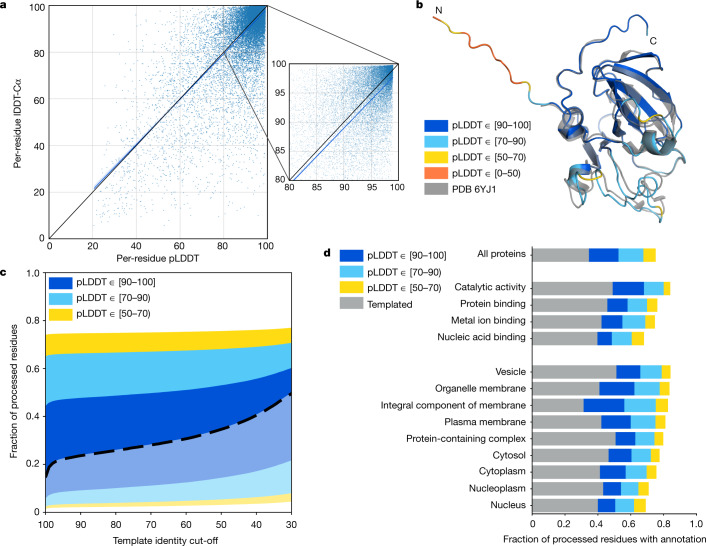
Protein structures can provide invaluable information, both for reasoning about biological processes and for enabling interventions such as structure-based drug development or targeted mutagenesis. After decades of effort, 17% of the total residues in human protein sequences are covered by an experimentally determined structure 1 . Here we markedly expand the structural coverage of the proteome by applying the state-of-the-art machine learning method, AlphaFold 2 , at a scale that covers almost the entire human proteome (98.5% of human proteins). The resulting dataset covers 58% of residues with a confident prediction, of which a subset (36% of all residues) have very high confidence. We introduce several metrics developed by building on the AlphaFold model and use them to interpret the dataset, identifying strong multi-domain predictions as well as regions that are likely to be disordered. Finally, we provide some case studies to illustrate how high-quality predictions could be used to generate biological hypotheses. We are making our predictions freely available to the community and anticipate that routine large-scale and high-accuracy structure prediction will become an important tool that will allow new questions to be addressed from a structural perspective.
Overview
CoChat Summary
TL;DR
AlphaFold2 was applied to 98.5% of human proteins, producing confident predictions for 58% of residues and very high confidence for 36% of all residues. The paper introduces pLDDT, pTM and an experimentally resolved head to interpret the dataset, presents case studies, and releases predictions freely.
Key findings
- The dataset covers 98.5% of human proteins with full-chain predictions, amounting to 10,537,122 residues (92.5% of residues); 58.0% of residues were predicted confidently (pLDDT > 70), and 35.7% of total residues fell in the highest accuracy band (pLDDT > 90), double the residues covered by experimental structures.
- At the per-protein level, 43.8% of proteins had a confident prediction on at least three quarters of their sequence, and 1,290 proteins contained a substantial region (>200 residues) with pLDDT ≥ 70 and no good template.
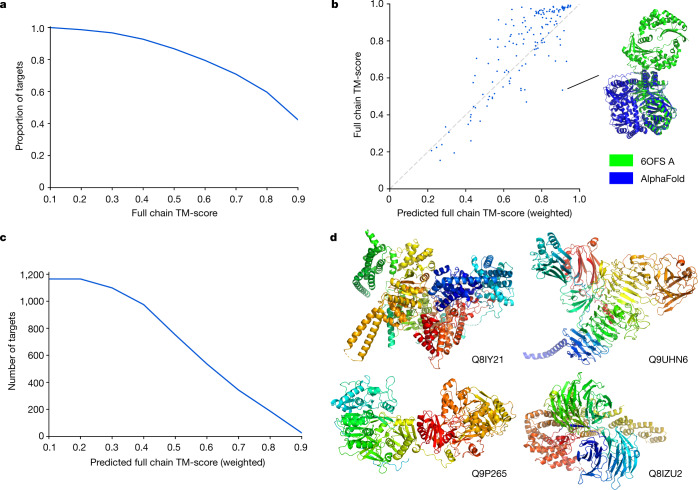
- On a held-out set of long PDB chains (n = 151), 70% of predictions had a TM-score > 0.7; pTM correlated with actual TM-score at Pearson’s r = 0.84, and among human proteins enriched for novel multidomain predictions, 187 had pTM > 0.8 and 343 had pTM > 0.7.
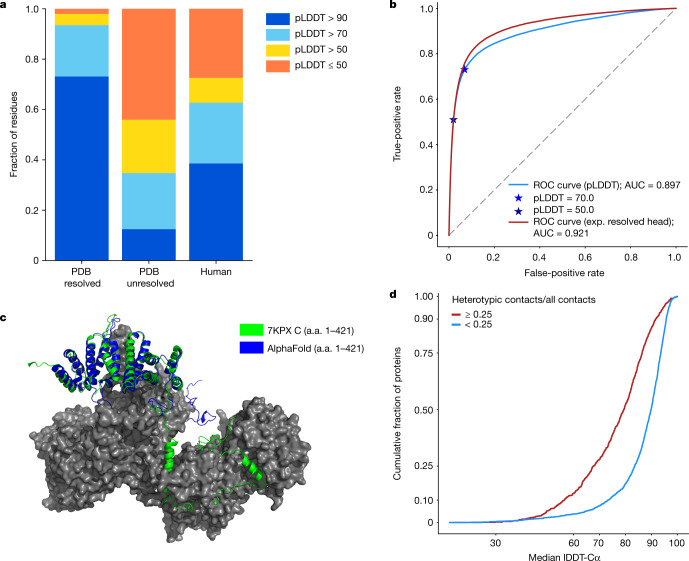
- pLDDT performed as a competitive disorder predictor on the CAID benchmark with AUC 0.897, while the experimentally resolved head achieved AUC 0.921; case studies proposed mechanistic hypotheses for G6Pase-α, DGAT2 and wolframin.
Methods
- AlphaFold2 was applied to the UniProt human reference proteome (release 2021_02), attempting all sequences of 16–2,700 amino acids and excluding residue codes B, J, O, U, Z or X; the pipeline used MSA construction, template search, inference with five models, model ranking by mean pLDDT, and constrained relaxation, with Reduced BFD and reduced ensembling.
- Evaluation used a recent PDB dataset of 12,494 chains, CAMEO targets from 21 March 2020 to 13 March 2021, and the CAID Disprot-PDB benchmark; metrics included pLDDT, pTM, the experimentally resolved head, TM-score, lDDT-Cα and AUC.
- Case-study analyses used PyMOL, P2Rank, AutoDockTools, AutoDock Vina and TM-align; inference for the human proteome used 930 GPU days, with an estimated 510 core days for other pipeline stages from scratch.
Limitations
- The paper states that low-confidence regions may reflect intrinsic disorder or regions structured only in complex, and that some proportion of proteins without confident predictions will be genuine failures where a fixed structure exists but AlphaFold does not predict it.
- The paper states that inter-domain accuracy is expected to be lower than within-domain accuracy, that some multidomain proteins may have mobile domains with no fixed packing, and that the case-study biological hypotheses require experimental confirmation.
- Evident from the text: predictions are single-chain and exclude sequences longer than 2,700 residues, so complex-dependent structure and larger proteins are not directly addressed.
Model-written summary. Check it against the paper before relying on it.
Integrity signals
Registry
Cites
Statistics
Figures
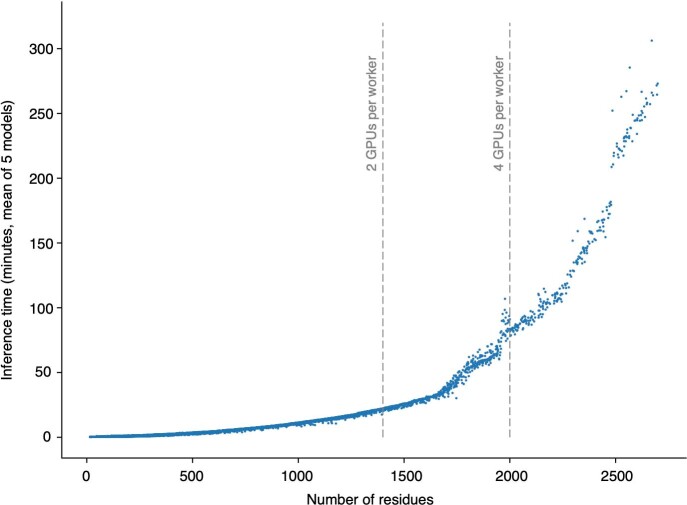
![Extended Data Fig. 7 Relationship between sequence length and run time for the non-inference stages of the pipeline. On the basis of 240 human protein sequences, chosen by stratified sampling from the length buckets: [16, 500), [500, 1,000), [1,000, 1,500), [1,500, 2,000), [2,000, 2,500) and [2,500, 2,700]. The relax plot shows five times more points, since five relaxed models are generated per protein. Coefficients for the quadratic lines of best fit were computed with Numpy polyfit.](https://figures.cochat.ai/paper-figures/c9bdcad64694429b95a292e248c7f05a/highly-accurate-protein-structure-prediction-for-the-human-proteome-figure-11.jpg)
Verification
Claims the paper makes
14 Valid · 1 Not valid · 5 Not checked · 44 Own results and interpretations
The cited sources support only part of this claim — read each source’s verdict below.
In the paper
“This system used a completely different model from our CASP13 entry31, and demonstrated a considerable improvement over previous methods in terms of providing routinely high accuracy29,30.”
§ Highly accurate protein structure prediction for the human proteome > Main
What the sources say
- Partly supportedcites [29] Kryshtafovych A Schwede T Topf M Fidelis K Moult J Critical assessment of methods of protein structure prediction (CASP)-round XIII Proteins 2019 87 1011 1020 10.1002/prot.25823 31589781 PMC6927249 sourceExperimental — accuracy not yet measured
The PROGRESS IN CASP13 section reports a dramatic improvement in model accuracy over earlier CASP rounds, and TEMPLATE FREE MODELING says DeepMind’s A7D group had the most accurate results overall. Those passages concern CASP13 methods, not the different system in the citing sentence; they do not establish that AlphaFold2 routinely achieved high accuracy. (LLM, conf=0.84)
- Supportedcites [30] Pereira, J. et al. High-accuracy protein structure prediction in CASP14. Proteins10.1002/prot.26171 (2021). 34218458 source
The Abstract reports a large leap in high accuracy due to AF2. The Conclusions say AF2 substantially outperformed its predecessor and produced the best models for 89 of 97 CASP14 targets, supporting both the improvement and its routine high accuracy. (LLM, conf=0.94)
boostedstates a cause- Asserted: passes — The authors put it forward as true.
- Checkable: passes — It can be checked against evidence.
- Load-bearing: passes — The paper’s conclusions depend on it.
- Based: passes — The paper gives a reason why it holds.
- Partly supported
Every source the paper cites for this claim was checked and supports it.
In the paper
“We note that the accuracy of AlphaFold was validated in CASP142, which focuses on challenging proteins that are dissimilar to structures already available in the PDB.”
§ Highly accurate protein structure prediction for the human proteome > Model confidence and added coverage
What the sources say
- Supportedcites [2] Jumper, J. et al. Highly accurate protein structure prediction with AlphaFold. Nature10.1038/s41586-021-03819-2 (2021). PMC8371605 34265844 source
The paper’s CASP14 assessment passage (section and page not provided in our copy) says AlphaFold was entered into CASP14, describes it as a blind accuracy assessment, and reports that AlphaFold’s structures were substantially more accurate than competing methods. This supports the attributed claim that its accuracy was validated in CASP14. (LLM, conf=0.94)
plain- Asserted: passes — The authors put it forward as true.
- Checkable: passes — It can be checked against evidence.
- Load-bearing: unclear — It is unclear whether the paper’s conclusions depend on it.
- Based: passes — The paper gives a reason why it holds.
- Supported
The cited sources support only part of this claim — read each source’s verdict below.
In the paper
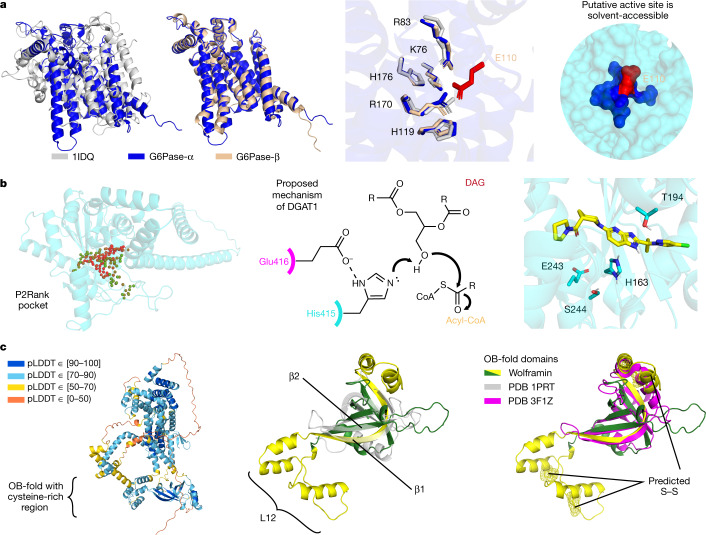
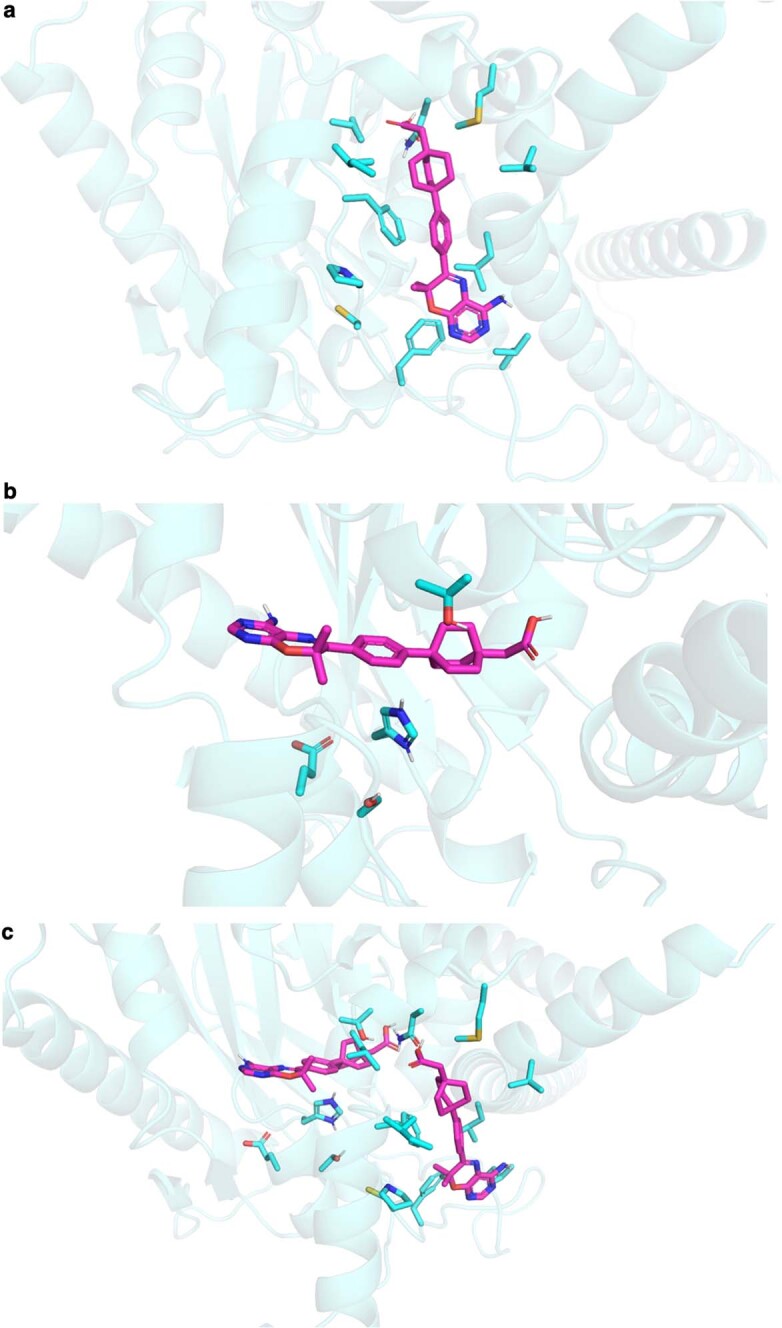
“Despite being the most similar chain, 3F1Z lacks the cysteines that are present in wolframin, which could form disulfide cross-links in the endoplasmic reticulum59.”
§ Highly accurate protein structure prediction for the human proteome > Highlighted predictions > Wolframin
What the sources say
- Partly supportedcites [59] Fass D Thorpe C Chemistry and enzymology of disulfide cross-linking in proteins Chem. Rev. 2018 118 1169 1198 10.1021/acs.chemrev.7b00123 28699750 PMC5808910 sourceExperimental — accuracy not yet measured
Section 2, “Which Proteins Contain Disulfides” (page unavailable), says that proteins in or passing through the ER can have cysteines positioned to form disulfide bonds. It does not address wolframin, 3F1Z, or whether their cysteine residues differ, so it supports only the general possibility of ER disulfide cross-linking. (LLM, conf=0.86)
hedged- Asserted: passes — The authors put it forward as true.
- Checkable: passes — It can be checked against evidence.
- Load-bearing: unclear — It is unclear whether the paper’s conclusions depend on it.
- Based: passes — The paper gives a reason why it holds.
- Partly supported
The sources with a verdict support this claim; the rest weren’t checked yet, have no full text we could read, or their verdicts aren’t rated yet.
In the paper
“Comparing our prediction for this region (median pLDDT of 86.0) to existing PDB chains using TM-align42,57 identified 3F1Z58 as the most similar known chain (TM-score of 0.472) (Fig. 3c, magenta).”
§ Highly accurate protein structure prediction for the human proteome > Highlighted predictions > Wolframin
What the sources say
- Not checked — no full text of the sourcecites [42] Zhang Y Skolnick J Scoring function for automated assessment of protein structure template quality Proteins 2004 57 702 710 10.1002/prot.20264 15476259 source
- Supportedcites [57] Zhang Y Skolnick J TM-align: a protein structure alignment algorithm based on the TM-score Nucleic Acids Res. 2005 33 2302 2309 10.1093/nar/gki524 15849316 PMC1084323 source
The citation is attached to “using TM-align,” identifying the method used by the citing authors, not attributing their 3F1Z match or TM-score to this source. The source’s Results (Benchmark test; page unavailable) describes TM-align as a tool for comparing protein structures and reporting TM-scores. (LLM, conf=0.93)
- Supportedcites [58] Das D The structure of KPN03535 (gi|152972051), a novel putative lipoprotein from Klebsiella pneumoniae, reveals an OB-fold Acta Crystallogr. F 2010 66 1254 1260 10.1107/S1744309109018168 PMC2954213 20944219 source
The citation is attached to 3F1Z, identifying the PDB chain used in the citing authors’ comparison. The source paper’s Materials and methods section states that its KPN03535 structure was deposited under accession code 3f1z; the pLDDT and TM-score describe the citing authors’ own analysis, not a result attributed to this source. (LLM, conf=0.93)
plainstates an association- Asserted: passes — The authors put it forward as true.
- Checkable: passes — It can be checked against evidence.
- Load-bearing: unclear — It is unclear whether the paper’s conclusions depend on it.
- Based: passes — The paper gives a reason why it holds.
Every source the paper cites for this claim was checked and supports it.
In the paper
“A recent evolutionary analysis suggested domains for wolframin, which our prediction largely supports55.”
§ Highly accurate protein structure prediction for the human proteome > Highlighted predictions > Wolframin
What the sources say
- Supportedcites [55] Schäffer DE Iyer LM Burroughs AM Aravind L Functional innovation in the evolution of the calcium-dependent system of the eukaryotic endoplasmic reticulum Front. Genet. 2020 11 34 10.3389/fgene.2020.00034 32117448 PMC7016017 source
The Results section, “Domain Architectural Anatomy and Functional Analysis of the Wolframin Protein,” reports the paper’s proposed domain assignments for wolframin, including Sel1-like repeats, an EF-hand region, and an OB-fold domain (Figure 4A). The citing authors’ statement that their own prediction largely supports those assignments is not a finding attributed to this source. (LLM, conf=0.93)
plainstates an association- Asserted: passes — The authors put it forward as true.
- Checkable: passes — It can be checked against evidence.
- Load-bearing: unclear — It is unclear whether the paper’s conclusions depend on it.
- Based: passes — The paper gives a reason why it holds.
- Supported
36 more claims · 4 with their cited sources checked
Create a free account to see all 64 claims and every source verdict.
- It may state two separate claims as one. 13
- Probably not a substantial claim. 12
Claims other papers make about this one
Each is checked against this paper’s own text: does it say what the citing paper says it does?
The source backs part of the claim, not all of it — or backs it for a different population, condition or comparison.
In the citing paper
“While AF2 performs exceptionally well on these types of folds on average”
From The power and pitfalls of AlphaFold2 for structure prediction beyond rigid globular proteins (2024) · cites this paper as [5]
Experimental — accuracy not yet measuredThe source backs part of the claim, not all of it — or backs it for a different population, condition or comparison.
In the citing paper
“For the majority of globular proteins, AF2 provides accurate, reliable models with high pLDDT (> 70) or low PAE values (< 5 Å) highlighting confidence in the prediction of the position of the atomic coordinates, which match experimentally determined native structures5,17,23,59”
From The power and pitfalls of AlphaFold2 for structure prediction beyond rigid globular proteins (2024) · cites this paper as [5]
Experimental — accuracy not yet measuredThe source backs part of the claim, not all of it — or backs it for a different population, condition or comparison.
In the citing paper
“The lower confidence bands appear to correlate well with backbone flexibility and intrinsic disorder (13) (Figure 2).”
From AlphaFold Protein Structure Database: massively expanding the structural coverage of protein-sequence space with high-accuracy models (2022) · cites this paper as [13]
Experimental — accuracy not yet measuredThe source backs part of the claim, not all of it — or backs it for a different population, condition or comparison.
In the citing paper
“One of the major insights leveraged by AlphaFold 1,2 comes from the use of evolutionary covariations that can be extracted from large-scale multiple sequence alignments.[49][50][51][52][53][54]”
From AlphaFold and Implications for Intrinsically Disordered Proteins (2021) · cites this paper as [2]
Experimental — accuracy not yet measuredThe source backs part of the claim, not all of it — or backs it for a different population, condition or comparison.
In the citing paper
“DeepMind’s AlphaFold2 success in sequence-based protein structure prediction,4 as well as the RoseTTAFold70 open-source counterpart, and the publicly available AlphaFold2 prediction of all human proteins203 are major steps that benefit the scientific community.”
From AlphaFold, Artificial Intelligence (AI), and Allostery (2022) · cites this paper as [203]
Experimental — accuracy not yet measured
16 more claims about this paper
Create a free account to see every claim other papers make about this one.
Citations
Cites
Highly accurate protein structure prediction with AlphaFold
Jumper, J., Evans, R., Pritzel, A., Green, T., Figurnov, M., Ronneberger, O., Tunyasuvunakool, K., Bates, R., Žídek, A., Potapenko, A., et al. (2021) · Nature · doi:10.1038/s41586-021-03819-2 · Cited by 43,764 · cited 1×
“[16, 500), [500, 1,000), [1,000, 1,500), [1,500, 2,000), [2,000, 2,500) and [2,500, 2,700].”
Self-citationGene Ontology: tool for the unification of biology
Ashburner, M., Ball, C. A., Blake, J. A., Botstein, D., Butler, H., Cherry, J. M., Davis, A. P., Dolinski, K., Dwight, S. S., Eppig, J. T., et al. (2000) · Nature Genetics · doi:10.1038/75556 · Cited by 43,206
Trott, O., & Olson, A. J. (2010) · Journal of Computational Chemistry · doi:10.1002/jcc.21334 · Cited by 38,412
AutoDock4 and AutoDockTools4: Automated docking with selective receptor flexibility
Morris, G. M., Huey, R., Lindstrom, W., Sanner, M. F., Belew, R. K., Goodsell, D. S., & Olson, A. J. (2009) · Journal of Computational Chemistry · doi:10.1002/jcc.21256 · Cited by 25,486
Initial sequencing and analysis of the human genome
International Human Genome Sequencing Consortium, Whitehead Institute for Biomedical Research, C. F. G. R., Lander, E. S., Linton, L. M., Birren, B., Nusbaum, C., Zody, M. C., Baldwin, J., Devon, K., Dewar, K., et al. (2001) · Nature · doi:10.1038/35057062 · Cited by 24,216
Self-citationThe sequence of the human genome
Venter, J. C., Adams, M. D., Myers, E. W., Li, P. W., Mural, R. J., Sutton, G. G., Smith, H. O., Yandell, M., Evans, C. A., Holt, R. A., et al. (2001) · Science · doi:10.1126/science.1058040 · Cited by 13,909
SWISS-MODEL: homology modelling of protein structures and complexes
Waterhouse, A., Bertoni, M., Bienert, S., Studer, G., Tauriello, G., Gumienny, R., Heer, F. T., de Beer, T. A. P., Rempfer, C., Bordoli, L., et al. (2018) · Nucleic Acids Research · doi:10.1093/nar/gky427 · Cited by 13,067
Pfam: The protein families database in 2021
Mistry, J., Chuguransky, S., Williams, L., Qureshi, M., Salazar, G. A., Sonnhammer, E. L. L., Tosatto, S. C. E., Paladin, L., Raj, S., Richardson, L. J., et al. (2021) · Nucleic Acids Research · doi:10.1093/nar/gkaa913 · Cited by 7,452
Self-citationUniProt: the universal protein knowledgebase in 2021
The UniProt Consortium, Bateman, A., Martin, M.-J., Orchard, S., Magrane, M., Agivetova, R., Ahmad, S., Alpi, E., Bowler-Barnett, E. H., Britto, R., et al. (2021) · Nucleic Acids Research · doi:10.1093/nar/gkaa1100 · Cited by 6,372
Self-citationThe Gene Ontology Resource: 20 years and still GOing strong
The Gene Ontology Consortium (2019) · Nucleic Acids Research · doi:10.1093/nar/gky1055 · Cited by 4,747
Cited by
Items 201–300 of 3,208
Stafie, C. S., Sufaru, I.-G., Ghiciuc, C. M., Stafie, I.-I., Sufaru, E.-C., Solomon, S. M., & Hancianu, M. (2023) · Diagnostics · doi:10.3390/diagnostics13121995 · Cited by 93
“These approaches often leverage modern DL methods such as convolutional neural networks [84].”
MethodDelling, J. P., & Boeckers, T. M. (2021) · Journal of Neurodevelopmental Disorders · doi:10.1186/s11689-021-09397-8 · Cited by 109
Conformational ensembles of intrinsically disordered proteins and flexible multidomain proteins
Thomasen, F. E., & Lindorff-Larsen, K. (2022) · Biochemical Society Transactions · doi:10.1042/bst20210499 · Cited by 90
Progress at protein structure prediction, as seen in CASP15
Elofsson, A. (2023) · Current Opinion in Structural Biology · doi:10.1016/j.sbi.2023.102594 · Cited by 92
Protein–RNA interaction prediction with deep learning: structure matters
Wei, J., Chen, S., Zong, L., Gao, X., & Li, Y. (2021) · Briefings in Bioinformatics · doi:10.1093/bib/bbab540 · Cited by 105
“Considering the recent progress of AlphaFold and the tremendous amount of structure data produced by it [60], the study of the RBP–RNA interactions will be promoted significantly by deep learning methods [17, 152] operating directly on the structure data.”
BackgroundChemical reprogramming for cell fate manipulation: Methods, applications, and perspectives
Wang, J., Sun, S., & Deng, H. (2023) · Cell Stem Cell · doi:10.1016/j.stem.2023.08.001 · Cited by 91
Structure of the cytoplasmic ring of the Xenopus laevis nuclear pore complex
Zhu, X., Huang, G., Zeng, C., Zhan, X., Liang, K., Xu, Q., Zhao, Y., Wang, P., Wang, Q., Zhou, Q., et al. (2022) · Science · doi:10.1126/science.abl8280 · Cited by 89
“Near the end of our study, DeepMind released a database of 20,000 predicted structures of the human proteome, which includes that of humanNup93 (54).”
Applications of Artificial Intelligence in Drug Repurposing
Wan, Z., Sun, X., Li, Y., Chu, T., Hao, X., Cao, Y., & Zhang, P. (2025) · Advanced Science · doi:10.1002/advs.202411325 · Cited by 129
Chen, Y., Jin, S., Zhang, M., Hu, Y., Wu, K.-L., Chung, A., Wang, S., Tian, Z., Wang, Y., Wolynes, P. G., et al. (2022) · Nature Communications · doi:10.1038/s41467-022-33111-4 · Cited by 90
(2022) · doi:10.1101/2022.03.25.485857 · Cited by 90
Multimodal Machine Learning in Image-Based and Clinical Biomedicine: Survey and Prospects
Warner, E., Lee, J., Hsu, W., Syeda-Mahmood, T., Kahn, C. E., Gevaert, O., & Rao, A. (2024) · International Journal of Computer Vision · doi:10.1007/s11263-024-02032-8 · Cited by 91
“Transformers and attention were originally applied to natural language [53–55] but have since been applied to images [56, 57], including histopathology slides [13, 58], and protein prediction [59].”
BackgroundRestoring protein glycosylation with GlycoShape
Ives, C. M., Singh, O., D’Andrea, S., Fogarty, C. A., Harbison, A. M., Satheesan, A., Tropea, B., & Fadda, E. (2024) · Nature Methods · doi:10.1038/s41592-024-02464-7 · Cited by 104
“A pLDDT value below 70 is reported to indicate a lower degree of confidence in the AlphaFold 3D structure prediction 61 , yet the results of a community-based exhaustive evaluation 62 suggest that the user should feel justified in selecting alternative sidechain orientations for residues with an…”
BackgroundVARIDT 2.0: structural variability of drug transporter
Fu, T., Li, F., Zhang, Y., Yin, J., Qiu, W., Li, X., Liu, X., Xin, W., Wang, C., Yu, L., et al. (2021) · Nucleic Acids Research · doi:10.1093/nar/gkab1013 · Cited by 90
“To cope with the lack of DT structures, the SWISS-MODEL (63) can thus be adopted to predict DT structure by homology modeling, and AlphaFold (64,65) can facilitate the determination of transporter’s structure.”
MethodInfluentialMetal3D: a general deep learning framework for accurate metal ion location prediction in proteins
Dürr, S. L., Levy, A., & Rothlisberger, U. (2023) · Nature Communications · doi:10.1038/s41467-023-37870-6 · Cited by 88
“For human palmitoyltransferase ZDHHC23 (Uniprot Q8IYP9) a high con fi dence AlphaFold2 prediction exists but AlphaFill cannotplacethezincionsbecausethesequenceidentity is24%tothe closest PDB structure (PDB 6BMS 47 ), i.e. below the 25% cutoff.”
Accurate prediction of transition metal ion location via deep learning
Dürr, S. L., Levy, A., & Rothlisberger, U. (2022) · doi:10.1101/2022.08.22.504853 · Cited by 88
Targeting SLC transporters: small molecules as modulators and therapeutic opportunities
Schlessinger, A., Zatorski, N., Hutchinson, K., & Colas, C. (2023) · Trends in Biochemical Sciences · doi:10.1016/j.tibs.2023.05.011 · Cited by 94
A generalizable nanopore sensor for highly specific protein detection at single-molecule precision
Ahmad, M., Ha, J., Mayse, L. A., Presti, M. F., Wolfe, A. J., Moody, K. J., Loh, S. N., & Movileanu, L. (2023) · Nature Communications · doi:10.1038/s41467-023-36944-9 · Cited by 91
The Large Language Models on Biomedical Data Analysis: A Survey
Lan, W., Tang, Z., Liu, M., Chen, Q., Peng, W., Chen, Y. P., & Pan, Y. F. (2025) · IEEE Journal of Biomedical and Health Informatics · doi:10.1109/jbhi.2025.3530794 · Cited by 114
“Therefore, the prediction and assessment of protein structure is important to understanding biological processes and molecular mechanisms [55], [56].”
A Hairpin Motif in the Amyloid-β Peptide Is Important for Formation of Disease-Related Oligomers
Khaled, M., Rönnbäck, I., Ilag, L. L., Gräslund, A., Strodel, B., & Österlund, N. (2023) · Journal of the American Chemical Society · doi:10.1021/jacs.3c03980 · Cited by 90
Liang, G., Cao, W., Tang, D., Zhang, H., Yu, Y., Ding, J., Karges, J., & Xiao, H. (2024) · ACS Nano · doi:10.1021/acsnano.3c11154 · Cited by 89
Current perspectives and trend of computer-aided drug design: a review and bibliometric analysis
Wu, Z., Chen, S., Wang, Y., Li, F., Xu, H., Li, M., Zeng, Y., Wu, Z., & Gao, Y. (2024) · International Journal of Surgery · doi:10.1097/js9.0000000000001289 · Cited by 109
“The neural network of AlphaFold2 can predict the structure of a typical protein within minutes, achieving laboratory-level accuracy [163] .”
Self-citationPDBe-KB: collaboratively defining the biological context of structural data
PDBe-KB consortium, Varadi, M., Anyango, S., Armstrong, D., Berrisford, J., Choudhary, P., Deshpande, M., Nadzirin, N., Nair, S. S., Pravda, L., et al. (2022) · Nucleic Acids Research · doi:10.1093/nar/gkab988 · Cited by 82
“While the aggregated views of proteins already provided an overview of all the protein structures available in the PDB, we have expanded the scope to include predicted models from data providers such as SWISS-MODEL and AlphaFold DB (14,49) (Figure 5).”
MethodSelf-citationMartín‐Dacal, M., Fernández‐Calvo, P., Jiménez‐Sandoval, P., López, G., Garrido‐Arandia, M., Rebaque, D., del Hierro, I., Torres, M. Á., Torres, M. Á. M., Berlanga, D. J., et al. (2023) · The Plant Journal · doi:10.1111/tpj.16088 · Cited by 83
AlphaFold illuminates half of the dark human proteins
Binder, J. L., Berendzen, J., Stevens, A. O., He, Y., Wang, J., Dokholyan, N. V., & Oprea, T. I. (2022) · Current Opinion in Structural Biology · doi:10.1016/j.sbi.2022.102372 · Cited by 81
Harnessing the potential of machine learning for advancing “Quality by Design” in biomanufacturing
Walsh, I., Myint, M., Nguyen-Khuong, T., Ho, Y. S., Ng, S. K., & Lakshmanan, M. (2022) · mAbs · doi:10.1080/19420862.2021.2013593 · Cited by 81
“69 However, to achieve the same ML performance for CQA prediction of a protein therapeutic from their sequence, measurements from bioreactor should also be considered.”
BackgroundBartolec, T. K., Vázquez-Campos, X., Norman, A., Luong, C., Johnson, M., Payne, R. J., Wilkins, M. R., Mackay, J. P., & Low, J. K. K. (2023) · Proceedings of the National Academy of Sciences · doi:10.1073/pnas.2219418120 · Cited by 79
“In lieu of experimental structures, machine learning-based structural modelers such as AlphaFold2 (6) have been shown to be highly accurate under controlled tests (7) and have greatly expanded the coverage of structural proteomes across a range of species (8, 9).”
Saliva biomarkers in oral disease
Zhou, Y., & Liu, Z. (2023) · Clinica Chimica Acta · doi:10.1016/j.cca.2023.117503 · Cited by 108
Chemistry Nobel goes to developers of AlphaFold AI that predicts protein structures
Callaway, E. (2024) · Nature · doi:10.1038/d41586-024-03214-7 · Cited by 88
The case for post-predictional modifications in the AlphaFold Protein Structure Database
Bagdonas, H., Fogarty, C. A., Fadda, E., & Agirre, J. (2021) · Nature Structural & Molecular Biology · doi:10.1038/s41594-021-00680-9 · Cited by 83
Machine learning solutions for predicting protein–protein interactions
Casadio, R., Martelli, P. L., & Savojardo, C. (2022) · WIREs Computational Molecular Science · doi:10.1002/wcms.1618 · Cited by 80
Sala, D., Hildebrand, P. W., & Meiler, J. (2023) · Frontiers in Molecular Biosciences · doi:10.3389/fmolb.2023.1121962 · Cited by 80
“AF2 makes it straightforward to predict a protein structure from a protein sequence and has provided millions of protein models with estimated accuracy (Tunyasuvunakool et al., 2021).”
BackgroundSex and gender considerations in Alzheimer’s disease: The Women’s Brain Project contribution
Castro‐Aldrete, L., Moser, M. V., Putignano, G., Ferretti, M. T., Dimech, A. S., & Chadha, A. S. (2023) · Frontiers in Aging Neuroscience · doi:10.3389/fnagi.2023.1105620 · Cited by 98
“Furthermore, these algorithms may be used to discover prospective therapeutic targets that might be specific to one sex or to investigate sex-based variations in protein structure and function in the human genome (Tunyasuvunakool et al., 2021).”
BackgroundRecent advances in predicting and modeling protein–protein interactions
Durham, J., Zhang, J., Humphreys, I. R., Pei, J., & Cong, Q. (2023) · Trends in Biochemical Sciences · doi:10.1016/j.tibs.2023.03.003 · Cited by 89
Glycosylated queuosines in tRNAs optimize translational rate and post-embryonic growth
Zhao, X., Ma, D., Ishiguro, K., Saito, H., Akichika, S., Matsuzawa, I., Mito, M., Irie, T., Ishibashi, K., Wakabayashi, K., et al. (2023) · Cell · doi:10.1016/j.cell.2023.10.026 · Cited by 87
“61,62 A known glycosyltransferase with the highest similarity to the N-terminal domain (NTD) (pfam00535) of human QTGAL was searched against the Dali server, 63 yielding E. coli chondroitin polymerase (K4CP) (Figure S10C), 64 a GT2 glycosyl-transferase, complexed with UDP-glucuronic acid…”
Wee, J., & Wei, G. (2024) · Journal of Chemical Information and Modeling · doi:10.1021/acs.jcim.4c00976 · Cited by 121
(2022) · doi:10.1101/2022.12.11.519936 · Cited by 80
Functional unknomics: Systematic screening of conserved genes of unknown function
Rocha, J. J., Jayaram, S. A., Stevens, T. J., Muschalik, N., Shah, R. D., Emran, S., Robles, C., Freeman, M., & Munro, S. (2023) · PLOS Biology · doi:10.1371/journal.pbio.3002222 · Cited by 70
Cunningham, O., Scott, M., Zhou, Z. S., & Finlay, W. J. J. (2021) · mAbs · doi:10.1080/19420862.2021.1999195 · Cited by 84
Becker, J., Fakhiri, J., & Grimm, D. (2022) · Pathogens · doi:10.3390/pathogens11070756 · Cited by 79
Predicting the pathogenicity of missense variants using features derived from AlphaFold2
Schmidt, A., Röner, S., Mai, K., Klinkhammer, H., Kircher, M., & Ludwig, K. U. (2023) · Bioinformatics · doi:10.1093/bioinformatics/btad280 · Cited by 79
“the quality score of AlphaFold2, pLDDT, which, in addition to its technical sources, has been previously associated with intrinsically disordered protein regions (Ruff and Pappu 2021; Tunyasuvunakool et al. 2021).”
BackgroundInfluentialPredicting glycan structure from tandem mass spectrometry via deep learning
Urban, J., Jin, C., Thomsson, K. A., Karlsson, N. G., Ives, C. M., Fadda, E., & Bojar, D. (2024) · Nature Methods · doi:10.1038/s41592-024-02314-6 · Cited by 79
Predicting the pathogenicity of missense variants using features derived from AlphaFold2
Schmidt, A., Röner, S., Mai, K., Klinkhammer, H., Kircher, M., & Ludwig, K. U. (2022) · doi:10.1101/2022.03.05.483091 · Cited by 79
Role of glypican-1 in regulating multiple cellular signaling pathways
Pan, J., & Ho, M. (2021) · American Journal of Physiology-Cell Physiology · doi:10.1152/ajpcell.00290.2021 · Cited by 88
Cyclic peptide structure prediction and design using AlphaFold
Rettie, S. A., Campbell, K. V., Bera, A. K., Kang, A., Kozlov, S., De La Cruz, J., Adebomi, V., Zhou, G., DiMaio, F., Ovchinnikov, S., et al. (2023) · bioRxiv (Cold Spring Harbor Laboratory) · doi:10.1101/2023.02.25.529956 · Cited by 76
“…RoseTTAFold, have demonstrated remarkable accuracy in predicting the three-dimensional structure of proteins from their amino acid sequences ( 1 , 2 ) and have now been successfully applied to predict the protein structures and protein-protein interaction networks at the proteome scale ( 3 , 4 ).”
Vps13-like proteins provide phosphatidylethanolamine for GPI anchor synthesis in the ER
Toulmay, A., Whittle, F. B., Yang, J., Bai, X., Diarra, J., Banerjee, S., Levine, T. P., Golden, A., & Prinz, W. A. (2022) · Journal of Cell Biology · doi:10.1083/jcb.202111095 · Cited by 75
“We also compared the full-length structures of Fmp27, Hob2, and Atg2 we generated with RoseTTAFold with the recently published predicted structures of these proteins generated by the protein structure prediction program AlphaFold (Tunyasuvunakool et al., 2021).”
Xu, Y., Huang, H., Lu, H., Wu, M., Lin, M., Zhang, C., Zhao, Z., Li, W., Zhang, C., Li, X., et al. (2022) · Frontiers in Microbiology · doi:10.3389/fmicb.2021.820380 · Cited by 77
Structural and biochemical insights into lipid transport by VPS13 proteins
Adlakha, J., Hong, Z., Li, P., & Reinisch, K. M. (2022) · Journal of Cell Biology · doi:10.1083/jcb.202202030 · Cited by 74
Saboury, B., Bradshaw, T., Boellaard, R., Buvat, I., Dutta, J., Hatt, M., Jha, A. K., Li, Q., Liu, C., McMeekin, H., et al. (2022) · Journal of Nuclear Medicine · doi:10.2967/jnumed.121.263703 · Cited by 91
“New AI approaches are revolutionizing our understanding of protein – ligand interactions ( 56 ).”
BackgroundGao, M., Ren, J., Gong, Y., Fang, M., Yang, J., & Li, Z. (2023) · Aggregate · doi:10.1002/agt2.462 · Cited by 79
Emerging roles of RNA ac4C modification and NAT10 in mammalian development and human diseases
Zhang, Y., Lei, Y., Dong, Y., Chen, S., Sun, S., Zhou, F., Zhao, Z., Chen, B., Lv, W., Chen, J., et al. (2023) · Pharmacology & Therapeutics · doi:10.1016/j.pharmthera.2023.108576 · Cited by 86
Mechanism for feature learning in neural networks and backpropagation-free machine learning models
Radhakrishnan, A., Beaglehole, D., Pandit, P., & Belkin, M. (2024) · Science · doi:10.1126/science.adi5639 · Cited by 174
Stable peptide-assembled nanozyme mimicking dual antifungal actions
Yuan, Y., Chen, L., Song, K., Cheng, M., Fang, L., Kong, L., Yu, L., Wang, R., Fu, Z., Sun, M., et al. (2024) · Nature Communications · doi:10.1038/s41467-024-50094-6 · Cited by 99
“Of noted, other heptapeptide, such as IRIRICI (IR-7), retained assembly in nanoribbons rather than nanotubes whether under extended sonication time or increased concentration of Ni(Ac) 2 (Supplementary 33).”
AlphaFold two years on: Validation and impact
Kovalevskiy, O., Mateos-Garcia, J., & Tunyasuvunakool, K. (2024) · Proceedings of the National Academy of Sciences · doi:10.1073/pnas.2315002121 · Cited by 75
Self-citationGlycerolipid Synthesis and Lipid Droplet Formation in the Endoplasmic Reticulum
Farese, R. V., & Walther, T. C. (2022) · Cold Spring Harbor Perspectives in Biology · doi:10.1101/cshperspect.a041246 · Cited by 84
Sun, J., Sun, W., Zhang, G., Lv, B., & Li, C. (2022) · Metabolic Engineering · doi:10.1016/j.ymben.2022.01.011 · Cited by 79
Huang, G., Liu, D., Wang, W., Wu, Q., Chen, J., Pan, X., Shen, H., & Yan, N. (2022) · Cell Reports · doi:10.1016/j.celrep.2022.110735 · Cited by 83
Structure of the RAF1-HSP90-CDC37 complex reveals the basis of RAF1 regulation
García‐Alonso, S., Mesa, P., Ovejero, L. D. L. P., Aizpurua, G., Lechuga, C. G., Zarzuela, E., Santiveri, C. M., Sanclemente, M., Muñoz, J., Musteanu, M., et al. (2022) · Molecular Cell · doi:10.1016/j.molcel.2022.08.012 · Cited by 78
HDOCK update for modeling protein‐ RNA / DNA complex structures
Li, H., Huang, E., Zhang, Y., Huang, S., & Xiao, Y. (2022) · Protein Science · doi:10.1002/pro.4441 · Cited by 83
“18 Therefore, it has become easy for researchers to obtain the desired protein structures.”
BackgroundFonin, A. V., Antifeeva, I. A., Kuznetsova, I. М., Константинович, Т. К., Zaslavsky, B. Y., Kulkarni, P., & Uversky, V. N. (2022) · Essays in Biochemistry · doi:10.1042/ebc20220052 · Cited by 80
Structural insights into the mechanism of leptin receptor activation
Saxton, R. A., Caveney, N. A., Moya-Garzón, M. D., Householder, K. D., Rodriguez, G. E., Burdsall, K. A., Long, J. Z., & García, K. C. (2023) · Nature Communications · doi:10.1038/s41467-023-37169-6 · Cited by 96
Zhang, J., Wang, H., Luo, Z., Yang, Z., Zhang, Z., Wang, P., Li, M., Zhang, Y., Feng, Y., Lu, D., et al. (2023) · Communications Biology · doi:10.1038/s42003-023-05523-5 · Cited by 93
“The complex structures of the eight dual enzyme systems were predicted using the protein structure prediction tool AlphaFold2 66 , as shown in Fig.”
InfluentialToxicology and pharmacology of botulinum and tetanus neurotoxins: an update
Pirazzini, M., Montecucco, C., & Rossetto, O. (2022) · Archives of Toxicology · doi:10.1007/s00204-022-03271-9 · Cited by 90
The structure and function of olfactory receptors
Wu, C., Xu, M., Dong, J., Cui, W., & Yuan, S. (2024) · Trends in Pharmacological Sciences · doi:10.1016/j.tips.2024.01.004 · Cited by 90
Enhanced Protein-Protein Interaction Discovery via AlphaFold-Multimer
Kim, A.-R., Hu, Y., Comjean, A., Rodiger, J., Mohr, S. E., & Perrimon, N. (2024) · bioRxiv (Cold Spring Harbor Laboratory) · doi:10.1101/2024.02.19.580970 · Cited by 70
Novel machine learning approaches revolutionize protein knowledge
Bordin, N., Dallago, C., Heinzinger, M., Kim, S., Littmann, M., Rauer, C., Steinegger, M., Rost, B., & Orengo, C. (2023) · Trends in Biochemical Sciences · doi:10.1016/j.tibs.2022.11.001 · Cited by 72
“A large new collection of in silico predicted structures is available through the AF Protein Structure Database (AFDB) ix [35], which has been analyzed through fold recognition algorithms to re fi ne protein families and to discover novel”
Tsai, Y.-X., Chang, N.-E., Reuter, K., Chang, H., Yang, T., von Bülow, S., Sehrawat, V., Zerrouki, N., Tuffery, M., Gecht, M., et al. (2024) · Cell · doi:10.1016/j.cell.2024.01.034 · Cited by 79
Continuous evolution of user-defined genes at 1 million times the genomic mutation rate
Rix, G., Williams, R. L., Hu, V. J., Spinner, A., Pisera, A. (., Marks, D. S., & Liu, C. C. (2024) · Science · doi:10.1126/science.adm9073 · Cited by 71
Continuous evolution of user-defined genes at 1-million-times the genomic mutation rate
Rix, G., Williams, R. L., Spinner, H., Hu, V. J., Marks, D. S., & Liu, C. C. (2023) · doi:10.1101/2023.11.13.566922 · Cited by 71
Omics-based interdisciplinarity is accelerating plant breeding
Shen, Y., Zhou, G., Liang, C., & Tian, Z. (2022) · Current Opinion in Plant Biology · doi:10.1016/j.pbi.2021.102167 · Cited by 75
Genetic engineering meets hematopoietic stem cell biology for next-generation gene therapy
Ferrari, S., Valeri, E., Conti, A., Scala, S., Aprile, A., Di Micco, R., Kajaste-Rudnitski, A., Montini, E., Ferrari, G., Aiuti, A., et al. (2023) · Cell Stem Cell · doi:10.1016/j.stem.2023.04.014 · Cited by 70
Equivariant quantum circuits for learning on weighted graphs
Skolik, A., Cattelan, M., Yarkoni, S., Bäck, T., & Dunjko, V. (2023) · npj Quantum Information · doi:10.1038/s41534-023-00710-y · Cited by 120
How NINJ1 mediates plasma membrane rupture and why NINJ2 cannot
Sahoo, B., Mou, Z., Liu, W., Dubyak, G., & Dai, X. (2024) · Cell · doi:10.1016/j.cell.2024.11.021 · Cited by 88
Enzyme specificity prediction using cross-attention graph neural networks
Cui, H., Su, Y., Dean, T. J., Yu, T., Zhang, Z., Peng, J., Shukla, D., & Zhao, H. (2025) · Nature · doi:10.1038/s41586-025-09697-2 · Cited by 109
“All apo enzyme models were sourced from the FTP archive of the AlphaFold Protein Structure Database 59 , following the procedures outlined in the AlphaFill documentation.”
A cryo-ET survey of microtubules and intracellular compartments in mammalian axons
Foster, H. E., Ventura Santos, C., & Carter, A. P. (2022) · Journal of Cell Biology · doi:10.1083/jcb.202103154 · Cited by 69
Impact of Type II LRRK2 inhibitors on signaling and mitophagy
Tasegian, A., Singh, F., Ganley, I. G., Reith, A. D., & Alessi, D. R. (2021) · Biochemical Journal · doi:10.1042/bcj20210375 · Cited by 69
Diffusion models in protein structure and docking
Yim, J., Stärk, H., Corso, G., Jing, B., Barzilay, R., & Jaakkola, T. (2024) · Wiley Interdisciplinary Reviews Computational Molecular Science · doi:10.1002/wcms.1711 · Cited by 108
“58 Since RMSD requires protein lengths to be the same, it is more common to use the TM-score which can perform alignments between proteins of different lengths.”
BackgroundThe Fra-1/AP-1 Oncoprotein: From the “Undruggable” Transcription Factor to Therapeutic Targeting
Casalino, L., Talotta, F., Cimmino, A., & Verde, P. (2022) · Cancers · doi:10.3390/cancers14061480 · Cited by 76
“Recently, based on the machine-learning-based AlphaFold method [5], the structures of each component of the human proteome have been predicted and made available [6].”
MethodDisordered–Ordered Protein Binary Classification by Circular Dichroism Spectroscopy
Micsonai, A., Moussong, É., Murvai, N., Tantos, Á., Tőke, O., Réfrégiers, M., Wien, F., & Kardos, J. (2022) · Frontiers in Molecular Biosciences · doi:10.3389/fmolb.2022.863141 · Cited by 69
T-Cell Engagers in Solid Cancers—Current Landscape and Future Directions
Shanshal, M., Caimi, P. F., Adjei, A. A., & Ma, W. W. (2023) · Cancers · doi:10.3390/cancers15102824 · Cited by 79
“The design of an effective BsAbs involves multiple processes, and for the purposes of this review we will summarize it into four key steps: (A) lead identification, which is the detailed analysis/identification of the antibody-binding site for an antigen e.g., protein docking [9,10]; (B) predicting the antibody struct…”
BackgroundCross-protein transfer learning substantially improves disease variant prediction
(2023) · doi:10.1186/s13059-023-03024-6 · Cited by 68
“Also, we leveraged AlphaFold2 structure models to provide the specific structure of proteins in a representation that allows use of features based on protein geometry [30, 31].”
MethodInfluentialAssigning functionality to cysteines by base editing of cancer dependency genes
Li, H., Ma, T., Remsberg, J. R., Won, S. J., DeMeester, K. E., Njomen, E., Ogasawara, D., Zhao, K. T., Huang, T. P., Lu, B., et al. (2023) · Nature Chemical Biology · doi:10.1038/s41589-023-01428-w · Cited by 62
Cross-protein transfer learning substantially improves disease variant prediction
Jagota, M., Ye, C., Albors, C., Rastogi, R., Koehl, A., Ioannidis, N., & Song, Y. S. (2022) · doi:10.1101/2022.11.15.516532 · Cited by 68
Hasanzadeh, A., Hamblin, M. R., Kiani, J., Noori, H., Hardie, J. M., Karimi, M., & Shafiee, H. (2022) · Nano Today · doi:10.1016/j.nantod.2022.101665 · Cited by 74
Protein–Ligand Blind Docking Using CB-Dock2
Liu, Y., & Cao, Y. (2023) · Methods in molecular biology · doi:10.1007/978-1-0716-3441-7_6 · Cited by 95
Understanding the cell: Future views of structural biology
Beck, M., Covino, R., Hänelt, I., & Müller-McNicoll, M. (2024) · Cell · doi:10.1016/j.cell.2023.12.017 · Cited by 86
“6,142,143 The algorithm capitalizes on the wealth of publicly available information in both sequence and structural space, in addition to considering fundamental biophysical and chemical principles of how amino acids engage with each other.”
BackgroundProtein design via deep learning
Ding, W., Nakai, K., & Gong, H. (2022) · Briefings in Bioinformatics · doi:10.1093/bib/bbac102 · Cited by 66
The ugly, bad, and good stories of large-scale biomolecular simulations
Gupta, C., Sarkar, D., Tieleman, D. P., & Singharoy, A. (2022) · Current Opinion in Structural Biology · doi:10.1016/j.sbi.2022.102338 · Cited by 66
Defining the Scope of AI Regulations
Schuett, J. (2019) · Law Innovation and Technology · doi:10.1080/17579961.2023.2184135 · Cited by 207
Recent advances in RNA structurome
Xu, B., Zhu, Y., Cao, C., Chen, H., Jin, Q., Li, G., Ma, J., Yang, S. L., Zhao, J., Zhu, J., et al. (2022) · Science China Life Sciences · doi:10.1007/s11427-021-2116-2 · Cited by 64
“AlphaFold has recently made a breakthrough in protein structure prediction through a new machine learning method (Jumper et al., 2021; Tunyasuvunakool et al., 2021) that relies on large database of structures.”
MethodA structure and evolutionary-based classification of solute carriers
Ferrada, E., & Superti‐Furga, G. (2022) · iScience · doi:10.1016/j.isci.2022.105096 · Cited by 74
Terahertz Circular Dichroism Spectroscopy of Molecular Assemblies and Nanostructures
Choi, W. J., Lee, S. H., Park, B. C., & Kotov, N. A. (2022) · Journal of the American Chemical Society · doi:10.1021/jacs.2c04817 · Cited by 72
Visualizing RNA conformational and architectural heterogeneity in solution
Ding, J., Lee, Y.-T., Bhandari, Y., Schwieters, C. D., Fan, L., Yu, P., Tarosov, S. G., Stagno, J. R., Ma, B., Nussinov, R., et al. (2023) · Nature Communications · doi:10.1038/s41467-023-36184-x · Cited by 66
The origin and structural evolution of de novo genes in Drosophila
Peng, J., & Zhao, L. (2024) · Nature Communications · doi:10.1038/s41467-024-45028-1 · Cited by 71
Pervasive mislocalization of pathogenic coding variants underlying human disorders
Lacoste, J., Haghighi, M., Haider, S., Reno, C., Lin, Z.-Y., Segal, D., Qian, W. W., Xiong, X., Teelucksingh, T., Miglietta, E., et al. (2024) · Cell · doi:10.1016/j.cell.2024.09.003 · Cited by 65
Antiviral signalling by a cyclic nucleotide activated CRISPR protease
Rouillon, C., Schneberger, N., Chi, H., Blumenstock, K., Da Vela, S., Ackermann, K., Moecking, J., Peter, M. F., Boenigk, W., Seifert, R., et al. (2023) · Nature · doi:10.1038/s41586-022-05571-7 · Cited by 66
AlphaDesign: A de novo protein design framework based on AlphaFold
Jendrusch, M., Korbel, J. O., & Sadiq, S. K. (2021) · doi:10.1101/2021.10.11.463937 · Cited by 65
“AF has been applied at a proteome-wide scale across several species, resulting in a new database of predicted structures [17].”
BackgroundMethod of the Year: protein structure prediction
Marx, V. (2022) · Nature Methods · doi:10.1038/s41592-021-01359-1 · Cited by 78
Díaz‐Holguín, A., Saarinen, M., Vo, D. D., Sturchio, A., Branzell, N., de Vaca, I. C., Hu, H., Mitjavila-Domènech, N., Lindqvist, A., Baranczewski, P., et al. (2024) · Science Advances · doi:10.1126/sciadv.adn1524 · Cited by 80
The era of high-quality chemical probes
Licciardello, M. P., & Workman, P. (2022) · RSC Medicinal Chemistry · doi:10.1039/d2md00291d · Cited by 77
Guerra, J. V. D. S., Filho, H. V. R., Jara, G. E., Bortot, L. O., Pereira, J. G. D. C., & de Oliveira, P. S. L. (2021) · BMC Bioinformatics · doi:10.1186/s12859-021-04519-4 · Cited by 81
“In the meantime, advances in computational resources have driven the use of in silico methods to simulate the dynamics of biomolecules and carried out the implementation of artificial intelligence to model biomolecular structures [3].”
Background
Metadata
- Authors
- Tunyasuvunakool, K., Adler, J., Wu, Z., Green, T., Zielinski, M., Žídek, A., Bridgland, A., Cowie, A., Meyer, C., Laydon, A., Velankar, S., Kleywegt, G. J., Bateman, A., Evans, R., Pritzel, A., Figurnov, M., Ronneberger, O., Bates, R., Kohl, S. A. A., Potapenko, A., Ballard, A. J., Romera-Paredes, B., Nikolov, S., Jain, R., Clancy, E., Reiman, D., Petersen, S., Senior, A. W., Kavukcuoglu, K., Birney, E., Kohli, P., Jumper, J., & Hassabis, D.
- Affiliations
- Google DeepMind (United Kingdom) (GB)
- European Bioinformatics Institute (GB)
- Corresponding author
- Tunyasuvunakool, Kathryn
- Jumper, John
- Hassabis, Demis
- ORCID
- Tunyasuvunakool, Kathryn
- Adler, Jonas
- Wu, Zachary
- Green, Tim
- Žídek, Augustin
- Meyer, Clemens
- Laydon, Agata
- Velankar, Sameer
- Kleywegt, Gerard J.
- Bateman, Alex
- Evans, Richard
- Pritzel, Alexander
- Figurnov, Michael
- Ronneberger, Olaf
- Bates, Russ
- Kohl, Simon A. A.
- Potapenko, Anna
- Ballard, Andrew J.
- Nikolov, Stanislav
- Jain, Rishub
- Clancy, Ellen
- Reiman, David
- Petersen, Stig
- Senior, Andrew W.
- Birney, Ewan
- Kohli, Pushmeet
- Jumper, John
- Hassabis, Demis
- Venue
- Nature
- Published
- 2021-07-22
- Volume
- 596
- Issue
- 7873
- Pages
- 590-596
- ISSN
- 0028-0836 (ISSN-L)
- 1476-4687
- PMC
- PMC8387240
- OpenAlex
- W3183475563
- Semantic Scholar
- 1fb3ad9969245795f268636eff9a145337144718
- Cited by
- 3,025
- References
- 83
- Citations by year
- 2026: 346 · 2025: 517 · 2024: 580 · 2023: 701 · 2022: 692 · 2021: 181
- FWCI
- 169.53
- Type
- journal article
- Language
- en
- Open access
- hybrid
- doi.org
- Licence
- cc-by
- creativecommons.org/licenses/by/4.0 (tdm)
- creativecommons.org/licenses/by/4.0 (vor)
- Locations
- Nature (publishedVersion, cc-by)
- Europe PMC (PubMed Central) (publishedVersion, other-oa)
- PubMed Central (publishedVersion, cc-by)
- PubMed (publishedVersion)
- RePEc: Research Papers in Economics (submittedVersion)
- Funders
- European Bioinformatics Institute
- DeepMind
- Topics
- Life Sciences › Biochemistry, Genetics and Molecular Biology › Molecular Biology › Protein Structure and Dynamics
- Life Sciences › Biochemistry, Genetics and Molecular Biology › Molecular Biology › Machine Learning in Bioinformatics
- Life Sciences › Biochemistry, Genetics and Molecular Biology › Structural Biology › Enzyme Structure and Function
- Keywords
- protein structure prediction, human proteome, AlphaFold2, structural coverage, intrinsically disordered regions, multidomain proteins, protein structure database
- MeSH terms
- Deep Learning, Glucose-6-Phosphatase, Humans, Membrane Proteins, Models, Molecular, Protein Conformation, Reproducibility of Results, Protein Folding, Computational Biology, Proteome, Diacylglycerol O-Acyltransferase, Datasets as Topic
About these checks
Registry, retraction, Cites and statistics results are computed, not judged, with one exception: a printed reference that no index lists is read once by a model before it counts as a citation error. Claims are extracted by a model and kept only when their quote appears verbatim in the text; each cited source is then checked, with a model’s help, for whether it says what the claim relies on. Those verdicts can be wrong — read the claim’s quote and the cited source before relying on one.
The claim verdicts this report counts are experimental: their accuracy is not yet measured.
A language model drew the claims from the paper on 2026-10-10, under version 3 of the claim definition (model deepseek-v4.1-flash, prompt extract-v3).
A second model labelled each claim on 2026-10-10 (model jev-1.13-20260917, definition revision gold-guideline-v0.2).
Cited sources are checked with a language model’s help (gpt-6-sol).
Statistics and arithmetic are recomputed, not judged.
Confidence bands are shown only for fields calibrated on our annotated test set. None is calibrated yet, so no band is shown.
What counts as a claim ›How we measure confidence ›How we check this ›
Are you an author, or do you see a problem with this page? Request a review
Data sources
Bibliographic data: Semantic Scholar, OpenAlex, Crossref.
Contains information from the Semantic Scholar Academic Graph Datasets, made available under the ODC Attribution License (ODC-BY 1.0).
Semantic Scholar’s data is described in: Kinney, R., et al. (2023). The Semantic Scholar Open Data Platform. arXiv:2301.10140.
