

Highly accurate protein structure prediction for the human proteome
Open accessThe DOI matches its Crossref record; 77 of the 83 references it cites were found in a registry or an index; 18 of the 24 sources its claims cite were checked for support.
Abstract
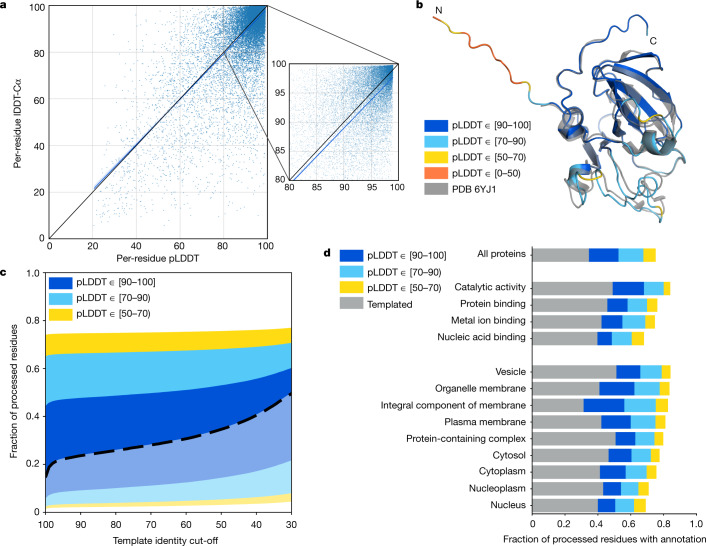
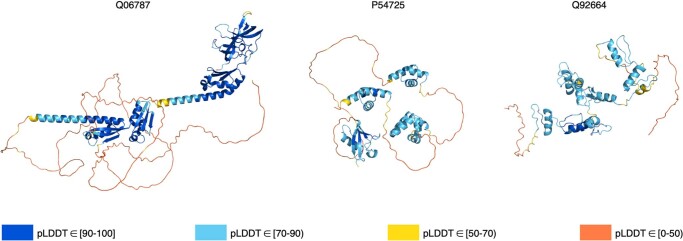
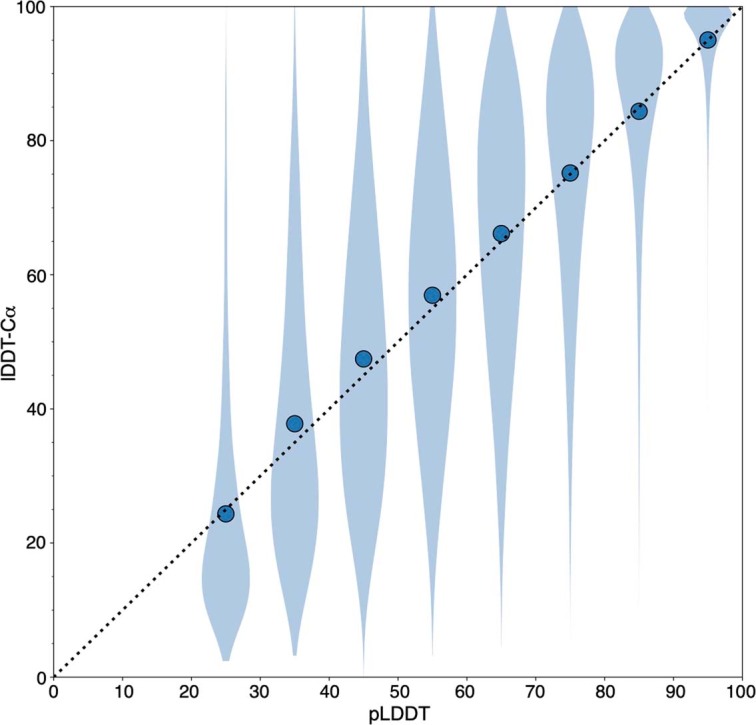
Protein structures can provide invaluable information, both for reasoning about biological processes and for enabling interventions such as structure-based drug development or targeted mutagenesis. After decades of effort, 17% of the total residues in human protein sequences are covered by an experimentally determined structure 1 . Here we markedly expand the structural coverage of the proteome by applying the state-of-the-art machine learning method, AlphaFold 2 , at a scale that covers almost the entire human proteome (98.5% of human proteins). The resulting dataset covers 58% of residues with a confident prediction, of which a subset (36% of all residues) have very high confidence. We introduce several metrics developed by building on the AlphaFold model and use them to interpret the dataset, identifying strong multi-domain predictions as well as regions that are likely to be disordered. Finally, we provide some case studies to illustrate how high-quality predictions could be used to generate biological hypotheses. We are making our predictions freely available to the community and anticipate that routine large-scale and high-accuracy structure prediction will become an important tool that will allow new questions to be addressed from a structural perspective.
Overview
CoChat Summary
TL;DR
AlphaFold2 was applied to 98.5% of human proteins, producing confident predictions for 58% of residues and very high confidence for 36% of all residues. The paper introduces pLDDT, pTM and an experimentally resolved head to interpret the dataset, presents case studies, and releases predictions freely.
Key findings
- The dataset covers 98.5% of human proteins with full-chain predictions, amounting to 10,537,122 residues (92.5% of residues); 58.0% of residues were predicted confidently (pLDDT > 70), and 35.7% of total residues fell in the highest accuracy band (pLDDT > 90), double the residues covered by experimental structures.
- At the per-protein level, 43.8% of proteins had a confident prediction on at least three quarters of their sequence, and 1,290 proteins contained a substantial region (>200 residues) with pLDDT ≥ 70 and no good template.
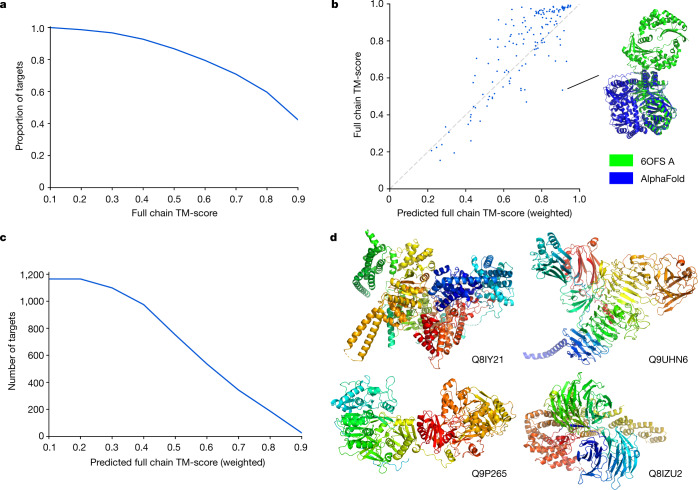
- On a held-out set of long PDB chains (n = 151), 70% of predictions had a TM-score > 0.7; pTM correlated with actual TM-score at Pearson’s r = 0.84, and among human proteins enriched for novel multidomain predictions, 187 had pTM > 0.8 and 343 had pTM > 0.7.
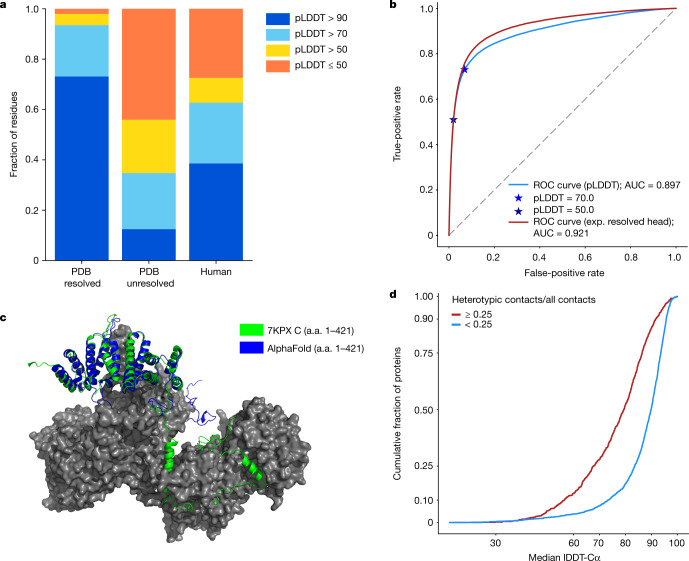
- pLDDT performed as a competitive disorder predictor on the CAID benchmark with AUC 0.897, while the experimentally resolved head achieved AUC 0.921; case studies proposed mechanistic hypotheses for G6Pase-α, DGAT2 and wolframin.
Methods
- AlphaFold2 was applied to the UniProt human reference proteome (release 2021_02), attempting all sequences of 16–2,700 amino acids and excluding residue codes B, J, O, U, Z or X; the pipeline used MSA construction, template search, inference with five models, model ranking by mean pLDDT, and constrained relaxation, with Reduced BFD and reduced ensembling.
- Evaluation used a recent PDB dataset of 12,494 chains, CAMEO targets from 21 March 2020 to 13 March 2021, and the CAID Disprot-PDB benchmark; metrics included pLDDT, pTM, the experimentally resolved head, TM-score, lDDT-Cα and AUC.
- Case-study analyses used PyMOL, P2Rank, AutoDockTools, AutoDock Vina and TM-align; inference for the human proteome used 930 GPU days, with an estimated 510 core days for other pipeline stages from scratch.
Limitations
- The paper states that low-confidence regions may reflect intrinsic disorder or regions structured only in complex, and that some proportion of proteins without confident predictions will be genuine failures where a fixed structure exists but AlphaFold does not predict it.
- The paper states that inter-domain accuracy is expected to be lower than within-domain accuracy, that some multidomain proteins may have mobile domains with no fixed packing, and that the case-study biological hypotheses require experimental confirmation.
- Evident from the text: predictions are single-chain and exclude sequences longer than 2,700 residues, so complex-dependent structure and larger proteins are not directly addressed.
Model-written summary. Check it against the paper before relying on it.
Integrity signals
Registry
Cites
Statistics
Figures
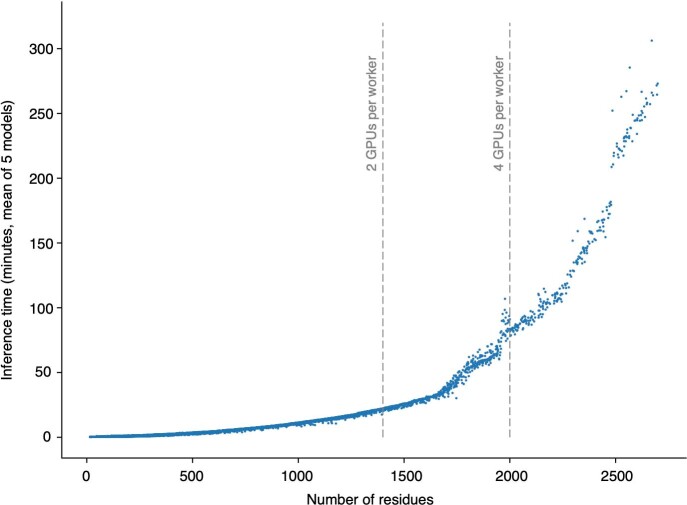
![Extended Data Fig. 7 Relationship between sequence length and run time for the non-inference stages of the pipeline. On the basis of 240 human protein sequences, chosen by stratified sampling from the length buckets: [16, 500), [500, 1,000), [1,000, 1,500), [1,500, 2,000), [2,000, 2,500) and [2,500, 2,700]. The relax plot shows five times more points, since five relaxed models are generated per protein. Coefficients for the quadratic lines of best fit were computed with Numpy polyfit.](https://figures.cochat.ai/paper-figures/c9bdcad64694429b95a292e248c7f05a/highly-accurate-protein-structure-prediction-for-the-human-proteome-figure-11.jpg)
Verification
Claims the paper makes
14 Valid · 1 Not valid · 5 Not checked · 44 Own results and interpretations
The cited sources support only part of this claim — read each source’s verdict below.
In the paper
“This system used a completely different model from our CASP13 entry31, and demonstrated a considerable improvement over previous methods in terms of providing routinely high accuracy29,30.”
§ Highly accurate protein structure prediction for the human proteome > Main
What the sources say
- Partly supportedcites [29] Kryshtafovych A Schwede T Topf M Fidelis K Moult J Critical assessment of methods of protein structure prediction (CASP)-round XIII Proteins 2019 87 1011 1020 10.1002/prot.25823 31589781 PMC6927249 sourceExperimental — accuracy not yet measured
The PROGRESS IN CASP13 section reports a dramatic improvement in model accuracy over earlier CASP rounds, and TEMPLATE FREE MODELING says DeepMind’s A7D group had the most accurate results overall. Those passages concern CASP13 methods, not the different system in the citing sentence; they do not establish that AlphaFold2 routinely achieved high accuracy. (LLM, conf=0.84)
- Supportedcites [30] Pereira, J. et al. High-accuracy protein structure prediction in CASP14. Proteins10.1002/prot.26171 (2021). 34218458 source
The Abstract reports a large leap in high accuracy due to AF2. The Conclusions say AF2 substantially outperformed its predecessor and produced the best models for 89 of 97 CASP14 targets, supporting both the improvement and its routine high accuracy. (LLM, conf=0.94)
boostedstates a cause- Asserted: passes — The authors put it forward as true.
- Checkable: passes — It can be checked against evidence.
- Load-bearing: passes — The paper’s conclusions depend on it.
- Based: passes — The paper gives a reason why it holds.
- Partly supported
Every source the paper cites for this claim was checked and supports it.
In the paper
“We note that the accuracy of AlphaFold was validated in CASP142, which focuses on challenging proteins that are dissimilar to structures already available in the PDB.”
§ Highly accurate protein structure prediction for the human proteome > Model confidence and added coverage
What the sources say
- Supportedcites [2] Jumper, J. et al. Highly accurate protein structure prediction with AlphaFold. Nature10.1038/s41586-021-03819-2 (2021). PMC8371605 34265844 source
The paper’s CASP14 assessment passage (section and page not provided in our copy) says AlphaFold was entered into CASP14, describes it as a blind accuracy assessment, and reports that AlphaFold’s structures were substantially more accurate than competing methods. This supports the attributed claim that its accuracy was validated in CASP14. (LLM, conf=0.94)
plain- Asserted: passes — The authors put it forward as true.
- Checkable: passes — It can be checked against evidence.
- Load-bearing: unclear — It is unclear whether the paper’s conclusions depend on it.
- Based: passes — The paper gives a reason why it holds.
- Supported
The cited sources support only part of this claim — read each source’s verdict below.
In the paper
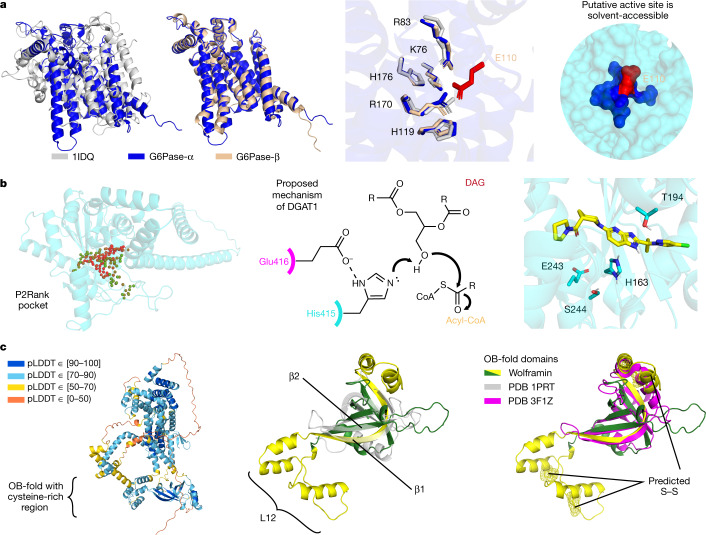
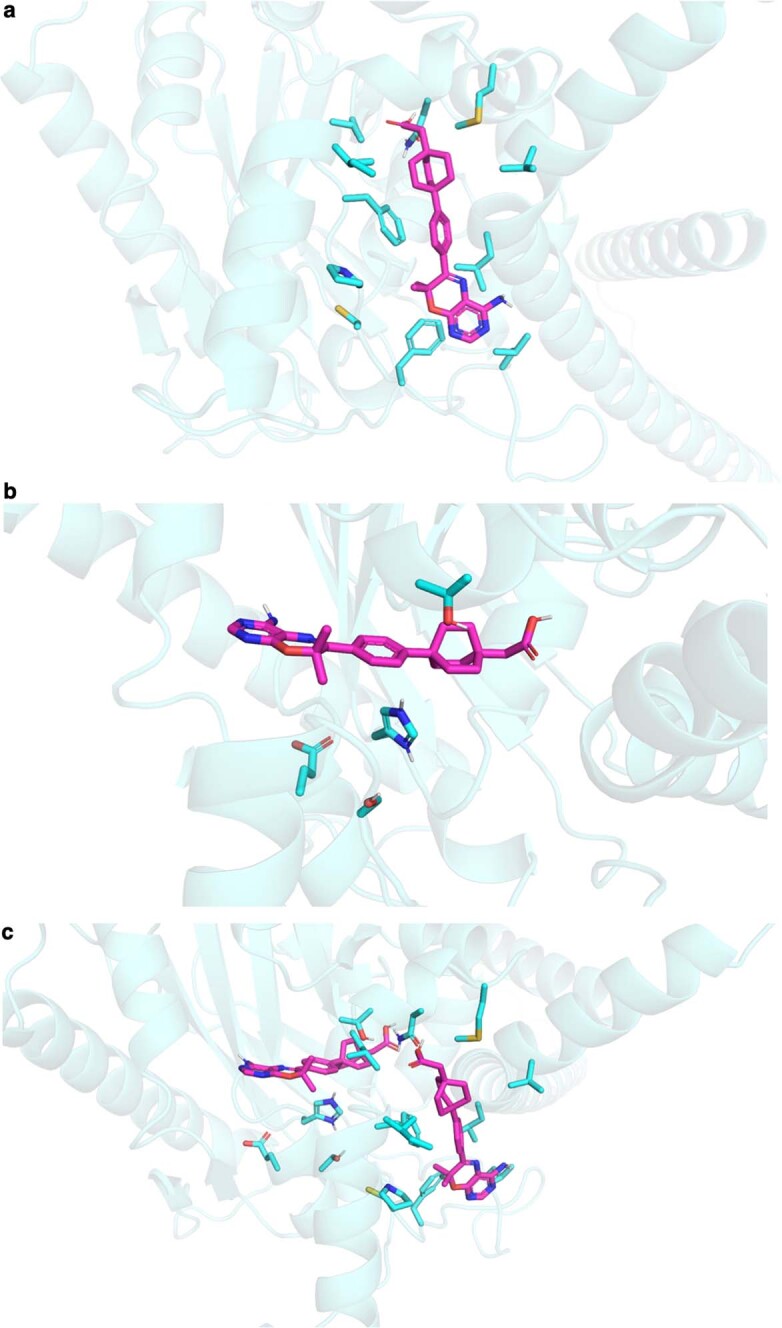
“Despite being the most similar chain, 3F1Z lacks the cysteines that are present in wolframin, which could form disulfide cross-links in the endoplasmic reticulum59.”
§ Highly accurate protein structure prediction for the human proteome > Highlighted predictions > Wolframin
What the sources say
- Partly supportedcites [59] Fass D Thorpe C Chemistry and enzymology of disulfide cross-linking in proteins Chem. Rev. 2018 118 1169 1198 10.1021/acs.chemrev.7b00123 28699750 PMC5808910 sourceExperimental — accuracy not yet measured
Section 2, “Which Proteins Contain Disulfides” (page unavailable), says that proteins in or passing through the ER can have cysteines positioned to form disulfide bonds. It does not address wolframin, 3F1Z, or whether their cysteine residues differ, so it supports only the general possibility of ER disulfide cross-linking. (LLM, conf=0.86)
hedged- Asserted: passes — The authors put it forward as true.
- Checkable: passes — It can be checked against evidence.
- Load-bearing: unclear — It is unclear whether the paper’s conclusions depend on it.
- Based: passes — The paper gives a reason why it holds.
- Partly supported
The sources with a verdict support this claim; the rest weren’t checked yet, have no full text we could read, or their verdicts aren’t rated yet.
In the paper
“Comparing our prediction for this region (median pLDDT of 86.0) to existing PDB chains using TM-align42,57 identified 3F1Z58 as the most similar known chain (TM-score of 0.472) (Fig. 3c, magenta).”
§ Highly accurate protein structure prediction for the human proteome > Highlighted predictions > Wolframin
What the sources say
- Not checked — no full text of the sourcecites [42] Zhang Y Skolnick J Scoring function for automated assessment of protein structure template quality Proteins 2004 57 702 710 10.1002/prot.20264 15476259 source
- Supportedcites [57] Zhang Y Skolnick J TM-align: a protein structure alignment algorithm based on the TM-score Nucleic Acids Res. 2005 33 2302 2309 10.1093/nar/gki524 15849316 PMC1084323 source
The citation is attached to “using TM-align,” identifying the method used by the citing authors, not attributing their 3F1Z match or TM-score to this source. The source’s Results (Benchmark test; page unavailable) describes TM-align as a tool for comparing protein structures and reporting TM-scores. (LLM, conf=0.93)
- Supportedcites [58] Das D The structure of KPN03535 (gi|152972051), a novel putative lipoprotein from Klebsiella pneumoniae, reveals an OB-fold Acta Crystallogr. F 2010 66 1254 1260 10.1107/S1744309109018168 PMC2954213 20944219 source
The citation is attached to 3F1Z, identifying the PDB chain used in the citing authors’ comparison. The source paper’s Materials and methods section states that its KPN03535 structure was deposited under accession code 3f1z; the pLDDT and TM-score describe the citing authors’ own analysis, not a result attributed to this source. (LLM, conf=0.93)
plainstates an association- Asserted: passes — The authors put it forward as true.
- Checkable: passes — It can be checked against evidence.
- Load-bearing: unclear — It is unclear whether the paper’s conclusions depend on it.
- Based: passes — The paper gives a reason why it holds.
Every source the paper cites for this claim was checked and supports it.
In the paper
“A recent evolutionary analysis suggested domains for wolframin, which our prediction largely supports55.”
§ Highly accurate protein structure prediction for the human proteome > Highlighted predictions > Wolframin
What the sources say
- Supportedcites [55] Schäffer DE Iyer LM Burroughs AM Aravind L Functional innovation in the evolution of the calcium-dependent system of the eukaryotic endoplasmic reticulum Front. Genet. 2020 11 34 10.3389/fgene.2020.00034 32117448 PMC7016017 source
The Results section, “Domain Architectural Anatomy and Functional Analysis of the Wolframin Protein,” reports the paper’s proposed domain assignments for wolframin, including Sel1-like repeats, an EF-hand region, and an OB-fold domain (Figure 4A). The citing authors’ statement that their own prediction largely supports those assignments is not a finding attributed to this source. (LLM, conf=0.93)
plainstates an association- Asserted: passes — The authors put it forward as true.
- Checkable: passes — It can be checked against evidence.
- Load-bearing: unclear — It is unclear whether the paper’s conclusions depend on it.
- Based: passes — The paper gives a reason why it holds.
- Supported
36 more claims · 4 with their cited sources checked
Create a free account to see all 64 claims and every source verdict.
- It may state two separate claims as one. 13
- Probably not a substantial claim. 12
Claims other papers make about this one
Each is checked against this paper’s own text: does it say what the citing paper says it does?
The source backs part of the claim, not all of it — or backs it for a different population, condition or comparison.
In the citing paper
“While AF2 performs exceptionally well on these types of folds on average”
From The power and pitfalls of AlphaFold2 for structure prediction beyond rigid globular proteins (2024) · cites this paper as [5]
Experimental — accuracy not yet measuredThe source backs part of the claim, not all of it — or backs it for a different population, condition or comparison.
In the citing paper
“For the majority of globular proteins, AF2 provides accurate, reliable models with high pLDDT (> 70) or low PAE values (< 5 Å) highlighting confidence in the prediction of the position of the atomic coordinates, which match experimentally determined native structures5,17,23,59”
From The power and pitfalls of AlphaFold2 for structure prediction beyond rigid globular proteins (2024) · cites this paper as [5]
Experimental — accuracy not yet measuredThe source backs part of the claim, not all of it — or backs it for a different population, condition or comparison.
In the citing paper
“The lower confidence bands appear to correlate well with backbone flexibility and intrinsic disorder (13) (Figure 2).”
From AlphaFold Protein Structure Database: massively expanding the structural coverage of protein-sequence space with high-accuracy models (2022) · cites this paper as [13]
Experimental — accuracy not yet measuredThe source backs part of the claim, not all of it — or backs it for a different population, condition or comparison.
In the citing paper
“One of the major insights leveraged by AlphaFold 1,2 comes from the use of evolutionary covariations that can be extracted from large-scale multiple sequence alignments.[49][50][51][52][53][54]”
From AlphaFold and Implications for Intrinsically Disordered Proteins (2021) · cites this paper as [2]
Experimental — accuracy not yet measuredThe source backs part of the claim, not all of it — or backs it for a different population, condition or comparison.
In the citing paper
“DeepMind’s AlphaFold2 success in sequence-based protein structure prediction,4 as well as the RoseTTAFold70 open-source counterpart, and the publicly available AlphaFold2 prediction of all human proteins203 are major steps that benefit the scientific community.”
From AlphaFold, Artificial Intelligence (AI), and Allostery (2022) · cites this paper as [203]
Experimental — accuracy not yet measured
16 more claims about this paper
Create a free account to see every claim other papers make about this one.
Citations
Cites
Highly accurate protein structure prediction with AlphaFold
Jumper, J., Evans, R., Pritzel, A., Green, T., Figurnov, M., Ronneberger, O., Tunyasuvunakool, K., Bates, R., Žídek, A., Potapenko, A., et al. (2021) · Nature · doi:10.1038/s41586-021-03819-2 · Cited by 43,764 · cited 1×
“[16, 500), [500, 1,000), [1,000, 1,500), [1,500, 2,000), [2,000, 2,500) and [2,500, 2,700].”
Self-citationGene Ontology: tool for the unification of biology
Ashburner, M., Ball, C. A., Blake, J. A., Botstein, D., Butler, H., Cherry, J. M., Davis, A. P., Dolinski, K., Dwight, S. S., Eppig, J. T., et al. (2000) · Nature Genetics · doi:10.1038/75556 · Cited by 43,206
Trott, O., & Olson, A. J. (2010) · Journal of Computational Chemistry · doi:10.1002/jcc.21334 · Cited by 38,412
AutoDock4 and AutoDockTools4: Automated docking with selective receptor flexibility
Morris, G. M., Huey, R., Lindstrom, W., Sanner, M. F., Belew, R. K., Goodsell, D. S., & Olson, A. J. (2009) · Journal of Computational Chemistry · doi:10.1002/jcc.21256 · Cited by 25,486
Initial sequencing and analysis of the human genome
International Human Genome Sequencing Consortium, Whitehead Institute for Biomedical Research, C. F. G. R., Lander, E. S., Linton, L. M., Birren, B., Nusbaum, C., Zody, M. C., Baldwin, J., Devon, K., Dewar, K., et al. (2001) · Nature · doi:10.1038/35057062 · Cited by 24,216
Self-citationThe sequence of the human genome
Venter, J. C., Adams, M. D., Myers, E. W., Li, P. W., Mural, R. J., Sutton, G. G., Smith, H. O., Yandell, M., Evans, C. A., Holt, R. A., et al. (2001) · Science · doi:10.1126/science.1058040 · Cited by 13,909
SWISS-MODEL: homology modelling of protein structures and complexes
Waterhouse, A., Bertoni, M., Bienert, S., Studer, G., Tauriello, G., Gumienny, R., Heer, F. T., de Beer, T. A. P., Rempfer, C., Bordoli, L., et al. (2018) · Nucleic Acids Research · doi:10.1093/nar/gky427 · Cited by 13,067
Pfam: The protein families database in 2021
Mistry, J., Chuguransky, S., Williams, L., Qureshi, M., Salazar, G. A., Sonnhammer, E. L. L., Tosatto, S. C. E., Paladin, L., Raj, S., Richardson, L. J., et al. (2021) · Nucleic Acids Research · doi:10.1093/nar/gkaa913 · Cited by 7,452
Self-citationUniProt: the universal protein knowledgebase in 2021
The UniProt Consortium, Bateman, A., Martin, M.-J., Orchard, S., Magrane, M., Agivetova, R., Ahmad, S., Alpi, E., Bowler-Barnett, E. H., Britto, R., et al. (2021) · Nucleic Acids Research · doi:10.1093/nar/gkaa1100 · Cited by 6,372
Self-citationThe Gene Ontology Resource: 20 years and still GOing strong
The Gene Ontology Consortium (2019) · Nucleic Acids Research · doi:10.1093/nar/gky1055 · Cited by 4,747
Cited by
Items 101–200 of 3,208
Intrinsic protein disorder and conditional folding in AlphaFoldDB
Piovesan, D., Monzon, A. M., & Tosatto, S. C. E. (2022) · Protein Science · doi:10.1002/pro.4466 · Cited by 160
“7,10 IDRs lacking a fixed tertiary structure are well-known in structural biology 11 and have been associated with a variety of biological functions.”
BackgroundPlant metabolic gene clusters in the multi-omics era
Zhan, C., Shen, S., Yang, C., Liu, Z., Fernie, A. R., Graham, I. A., & Luo, J. (2022) · Trends in Plant Science · doi:10.1016/j.tplants.2022.03.002 · Cited by 158
Discovery and significance of protein-protein interactions in health and disease
Greenblatt, J. F., Alberts, B. M., & Krogan, N. J. (2024) · Cell · doi:10.1016/j.cell.2024.10.038 · Cited by 156
State-specific protein–ligand complex structure prediction with a multiscale deep generative model
Qiao, Z., Nie, W., Vahdat, A., Miller, T. F., & Anandkumar, A. (2024) · Nature Machine Intelligence · doi:10.1038/s42256-024-00792-z · Cited by 156
“…on a standard GPU once all auxiliary features are gathered, thereby enabling the exploration of protein–ligand interactions on the vast space of sequence and chemical spaces by leveraging rapidly evolving databases of computationally modelled protein structures 9,54 and chemical substances 55,56 .”
AlphaFold2 structures guide prospective ligand discovery
Lyu, J., Kapolka, N., Gumpper, R., Alon, A., Wang, L., Jain, M. K., Barros-Álvarez, X., Sakamoto, K., Kim, Y., DiBerto, J., et al. (2024) · Science · doi:10.1126/science.adn6354 · Cited by 158
“AF2 has demonstrated an unprecedented ability to predict protein structures with atomic accuracy ( 19 ) and operates at scale ( 21 , 22 ).”
BackgroundThe power and pitfalls of AlphaFold2 for structure prediction beyond rigid globular proteins
Agarwal, V., & McShan, A. C. (2024) · Nature Chemical Biology · doi:10.1038/s41589-024-01638-w · Cited by 155
“The authors of AF2 note that, because it is trained on both apo and holo structures from the PDB, models may still be consistent with the expected structure in the presence of ligands or cofactors despite their absence in the AF2 workflow 1,5 .”
BackgroundInfluentialATG9A and ATG2A form a heteromeric complex essential for autophagosome formation
van Vliet, A. R., Chiduza, G. N., Maslen, S. L., Pye, V. E., Joshi, D., De Tito, S., Jefferies, H. B. J., Christodoulou, E., Roustan, C., Punch, E., et al. (2022) · Molecular Cell · doi:10.1016/j.molcel.2022.10.017 · Cited by 153
The midnolin-proteasome pathway catches proteins for ubiquitination-independent degradation
Gu, X., Nardone, C., Kamitaki, N., Mao, A., Elledge, S. J., & Greenberg, M. E. (2023) · Science · doi:10.1126/science.adh5021 · Cited by 153
Benchmarking AlphaFold2 on peptide structure prediction
McDonald, E. F., Jones, T., Plate, L., Meiler, J., & Gulsevin, A. (2023) · Structure · doi:10.1016/j.str.2022.11.012 · Cited by 152
Structural basis for channel conduction in the pump-like channelrhodopsin ChRmine
Kishi, K. E., Kim, Y. S., Fukuda, M., Inoue, M., Kusakizako, T., Wang, P. Y., Ramakrishnan, C., Byrne, E. F. X., Thadhani, E., Paggi, J. M., et al. (2022) · Cell · doi:10.1016/j.cell.2022.01.007 · Cited by 149
Structural basis for channel conduction in the pump-like channelrhodopsin ChRmine
(2021) · doi:10.1101/2021.08.15.456392 · Cited by 149
Structure, substrate recognition and initiation of hyaluronan synthase
Maloney, F. P., Kuklewicz, J., Corey, R. A., Bi, Y., Ho, R., Mateusiak, Ł., Pardon, E., Steyaert, J., Stansfeld, P. J., & Zimmer, J. (2022) · Nature · doi:10.1038/s41586-022-04534-2 · Cited by 154
Organic reaction mechanism classification using machine learning
Burés, J., & Larrosa, I. (2023) · Nature · doi:10.1038/s41586-022-05639-4 · Cited by 180
Making it Rain: Cloud-Based Molecular Simulations for Everyone
Arantes, P. R., Polêto, M. D., Pedebos, C., & Ligabue-Braun, R. (2021) · Journal of Chemical Information and Modeling · doi:10.1021/acs.jcim.1c00998 · Cited by 148
Ghalkhani, M., & Habibi, S. R. (2022) · Energies · doi:10.3390/en16010185 · Cited by 191
“• Deep reinforcement learning: – AlphaFold has been developed by Google DeepMind for predicting the protein structures in the human proteome [68].”
An atlas of protein homo-oligomerization across domains of life
Schweke, H., Pacesa, M., Levin, T., Goverde, C. A., Kumar, P., Duhoo, Y., Dornfeld, L. J., Dubreuil, B., Georgeon, S., Ovchinnikov, S., et al. (2024) · Cell · doi:10.1016/j.cell.2024.01.022 · Cited by 144
Cryo-EM advances in RNA structure determination
Ma, H., Jia, X., Zhang, K., & Su, Z. (2022) · Signal Transduction and Targeted Therapy · doi:10.1038/s41392-022-00916-0 · Cited by 165
An atlas of protein homo-oligomerization across domains of life
Schweke, H., Levin, T., Pacesa, M., Goverde, C. A., Kumar, P., Duhoo, Y., Dornfeld, L. J., Dubreuil, B., Georgeon, S., Ovchinnikov, S., et al. (2023) · doi:10.1101/2023.06.09.544317 · Cited by 144
Improved AlphaFold modeling with implicit experimental information
Terwilliger, T. C., Poon, B. K., Afonine, P. V., Schlicksup, C. J., Croll, T. I., Millán, C., Richardson, J. S., Read, R. J., & Adams, P. D. (2022) · Nature Methods · doi:10.1038/s41592-022-01645-6 · Cited by 140
“In particular, machine-learning methods typically do not yield accurate predictions for all of the residues in a protein ( 10 ).”
BackgroundInfluentialImproved AlphaFold modeling with implicit experimental information
Terwilliger, T. C., Poon, B. K., Afonine, P. V., Schlicksup, C. J., Croll, T. I., Millán, C., Richardson, J. S., Read, R. J., & Adams, P. D. (2022) · doi:10.1101/2022.01.07.475350 · Cited by 140
(2022) · doi:10.1016/j.str.2022.05.001 · Cited by 139
Managing innovation in the era of AI
Tekić, Ž., & Füller, J. (2023) · Technology in Society · doi:10.1016/j.techsoc.2023.102254 · Cited by 177
Unke, O. T., Stöhr, M., Ganscha, S., Unterthiner, T., Maennel, H., Kashubin, S., Ahlin, D., Gastegger, M., Sandonas, L. M., Berryman, J. T., et al. (2024) · Science Advances · doi:10.1126/sciadv.adn4397 · Cited by 218
Protein language model embeddings for fast, accurate, alignment-free protein structure prediction
Weissenow, K., Heinzinger, M., & Rost, B. (2021) · doi:10.1101/2021.07.31.454572 · Cited by 139
“One solution is to generate multiple MSAs with different parameters, alignment tools and databases (Jain et al., 2021; Zhang et al., 2020), rendering the input generation even more time-consuming, e.g. 212 minutes for our test sets of 31 proteins on an Intel Xeon Gold 6248 (Results).”
BackgroundLeene, J. V., Eeckhout, D., Gadeyne, A., Matthijs, C., Han, C., Winne, N. D., Persiau, G., Slijke, E. V. D., Persyn, F., Mertens, T., et al. (2022) · Nature Plants · doi:10.1038/s41477-022-01269-w · Cited by 145
Large language models surpass human experts in predicting neuroscience results
Luo, X., Rechardt, A., Sun, G., Nejad, K. K., Yáñez, F., Yilmaz, B., Lee, K., Cohen, A. O., Borghesani, V., Pashkov, A., et al. (2024) · Nature Human Behaviour · doi:10.1038/s41562-024-02046-9 · Cited by 139
“This approach could take several forms, including specialist solutions that address specific challenges, such as in protein folding 3 , drug discovery 4 and materials science 5 .”
Burley, S. K., Berman, H. M., Duarte, J. M., Feng, Z., Flatt, J. W., Hudson, B. P., Lowe, R., Peisach, E., Piehl, D. W., Rose, Y., et al. (2022) · Biomolecules · doi:10.3390/biom12101425 · Cited by 173
Analysis of AlphaMissense data in different protein groups and structural context
Tordai, H., Torres, O., Csepi, M., Padányi, R., Lukács, G. L., & Hegedűs, T. (2024) · Scientific Data · doi:10.1038/s41597-024-03327-8 · Cited by 135
“Because of the small size of this dataset we tested this possibility on soluble proteins, by excluding those residues from the calculations, which residues exhibit a pLDDT score lower than 50 in AlphaFold structures as a proxy for intrinsically disordered regions 22 .”
BackgroundCHARMM at 45: Enhancements in Accessibility, Functionality, and Speed
Hwang, W., Austin, S. L., Blondel, A., Boittier, E. D., Boresch, S., Buck, M., Buckner, J., Caflisch, A., Chang, H.-T., Cheng, X., et al. (2024) · The Journal of Physical Chemistry B · doi:10.1021/acs.jpcb.4c04100 · Cited by 136
Benchmarking Refined and Unrefined AlphaFold2 Structures for Hit Discovery
(2023) · doi:10.1021/acs.jcim.2c01219 · Cited by 136
Structure of a human replisome shows the organisation and interactions of a DNA replication machine
Jones, M. L., Baris, Y., Taylor, M. R. G., & Yeeles, J. T. P. (2021) · The EMBO Journal · doi:10.15252/embj.2021108819 · Cited by 134
Role of artificial intelligence in revolutionizing drug discovery
Rehman, A. U., Li, M., Wu, B., Ali, Y., Rasheed, S., Shaheen, S., Liu, X., Luo, R., & Zhang, J. (2024) · Fundamental Research · doi:10.1016/j.fmre.2024.04.021 · Cited by 209
“In July 2021, the predicted three-dimensional models for the whole human proteome generated using Al-phaFold, were made available to the public, as recently reported in Nature [ 63 ].”
Zheng, L., Meng, J., Jiang, K., Lan, H., Wang, Z., Lin, M., Li, W., Guo, H., Wei, Y., & Mu, Y. (2022) · Briefings in Bioinformatics · doi:10.1093/bib/bbac051 · Cited by 134
“The Arabidopsis thalian protein structures were obtained from AlphaFold2 protein structure database [52].”
MethodThe gut microbe Bacteroides fragilis ameliorates renal fibrosis in mice
Zhou, W., Wu, W., Si, Z.-L., Liu, H., Wang, H., Jiang, H., Liu, Y., Alolga, R. N., Chen, C., Liu, S., et al. (2022) · Nature Communications · doi:10.1038/s41467-022-33824-6 · Cited by 156
Kincore: a web resource for structural classification of protein kinases and their inhibitors
Modi, V., & Dunbrack, R. L. (2022) · Nucleic Acids Research · doi:10.1093/nar/gkab920 · Cited by 133
“Finally, we downloaded the predicted structures of human kinases predicted by AlphaFold2 (44) that have been deposited at the European Bioinformatics Institute (http: //alphafold.ebi.ac.uk) (45) and ran the Kincore Python3 script to assign our kinase states to the predicted structures.”
MethodKincore: a web resource for structural classification of protein kinases and their inhibitors
(2021) · doi:10.1101/2021.02.12.430923 · Cited by 133
Artificial Intelligence in Pharmaceutical Sciences
Lu, M., Yin, J., Zhu, Q., Lin, G., Mou, M., Liu, F., Pan, Z., You, N., Lian, X., Li, F., et al. (2023) · Engineering · doi:10.1016/j.eng.2023.01.014 · Cited by 161
The structural coverage of the human proteome before and after AlphaFold
Porta-Pardo, E., Ruiz-Serra, V., Valentini, S., & Valencia, A. (2022) · PLOS Computational Biology · doi:10.1371/journal.pcbi.1009818 · Cited by 131
“We also extracted pLDDT values for each residue from the AlphaFold models, as these are stored as if they were the B-factor of the protein coordinates file [19,21].”
BackgroundMethodInfluentialGame changers in science and technology - now and beyond
Betz, U. A. K., Arora, L., Assal, R. A., de Azevedo, H. F. Z., Baldwin, J., Becker, M. S., Bostock, S., Cheng, V. W. T., Egle, T., Ferrari, N., et al. (2023) · Technological Forecasting and Social Change · doi:10.1016/j.techfore.2023.122588 · Cited by 182
Machine learning in nuclear physics at low and intermediate energies
He, W., Li, Q., G., Y., Niu, Z.-M., Pei, J., & Zhang, Y. (2023) · Science China Physics Mechanics and Astronomy · doi:10.1007/s11433-023-2116-0 · Cited by 153
Zheng, W., Wuyun, Q., Li, Y., Zhang, C., Freddolino, L., & Zhang, Y. (2024) · Nature Methods · doi:10.1038/s41592-023-02130-4 · Cited by 130
“The PLM feature minimizes a loss function defined by where L is the length of the protein and N is the number of aligned sequences in the MSA, σ in indicates the amino acid type of n th sequence and i th position in the MSA; and h and P are field and coupling parameters respectively.”
InfluentialThe structural coverage of the human proteome before and after AlphaFold
(2021) · doi:10.1101/2021.08.03.454980 · Cited by 131
The impact of AlphaFold Protein Structure Database on the fields of life sciences
Varadi, M., & Velankar, S. (2023) · PROTEOMICS · doi:10.1002/pmic.202200128 · Cited by 124
“In particular, pLDDT scores below50 can correspondwith certain classes of intrinsically disordered regions [21, 22], but such scores can also reflect genuinely poor quality predictions, most often caused by shallow multiple sequence alignments that underlay the prediction process [10].”
BackgroundSelf-citationAlphaFold2 protein structure prediction: Implications for drug discovery
Borkakoti, N., & Thornton, J. M. (2023) · Current Opinion in Structural Biology · doi:10.1016/j.sbi.2022.102526 · Cited by 128
Ins and outs of AlphaFold2 transmembrane protein structure predictions
Hegedűs, T., Geisler, M., Lukács, G. L., & Farkas, B. (2022) · Cellular and Molecular Life Sciences · doi:10.1007/s00018-021-04112-1 · Cited by 127
“Although this means that the high accuracy and reliability of AF2 observed in CASP14 can be transferred to predicting the structure of any protein sequences (or whole proteomes) [3, 5], this has not been validated yet and scientists do not have a clear indication how well AF2-predicted structures can be trusted.”
BackgroundMethodInfluentialStructure determination of inactive-state GPCRs with a universal nanobody
Robertson, M. J., Papasergi-Scott, M. M., He, F., Seven, A. B., Meyerowitz, J., Panova, O., Peroto, M. C., Che, T., & Skiniotis, G. (2022) · Nature Structural & Molecular Biology · doi:10.1038/s41594-022-00859-8 · Cited by 128
The structural context of posttranslational modifications at a proteome-wide scale
Bludau, I., Willems, S., Zeng, W.-F., Strauss, M. T., Hansen, F. M., Tanzer, M. C., Karayel, O., Schulman, B. A., & Mann, M. (2022) · PLOS Biology · doi:10.1371/journal.pbio.3001636 · Cited by 123
“The other 18 proteins did not have a complete structure deposited in AlphaFold DB [13,14].”
BackgroundAlphaFold2 versus experimental structures: evaluation on G protein-coupled receptors
He, X.-H., You, C., Jiang, H., Jiang, Y., Xu, H., & Cheng, X. (2022) · Acta Pharmacologica Sinica · doi:10.1038/s41401-022-00938-y · Cited by 108
“With the powerful algorithm, the AlphaFold2 developers predicted structures for most human proteome and publicly released the predicted models [15].”
MethodWang, S., Xie, J., Pei, J., & Lai, L. (2023) · Journal of Molecular Biology · doi:10.1016/j.jmb.2023.168141 · Cited by 133
Valentine, W. J., Yanagida, K., Kawana, H., Kono, N., Noda, N. N., Aoki, J., & Shindou, H. (2021) · Journal of Biological Chemistry · doi:10.1016/j.jbc.2021.101470 · Cited by 142
“Nomenclature for the currently known GPATs (GPAT1-4, all AGPAT-family enzymes) is generally accurate and uniformly adopted; therefore, no revision is proposed for their current nomenclature, which is shown in Table 2 along with enzyme information registered in NCBI.”
MethodInfluentialYeast Surface Display System: Strategies for Improvement and Biotechnological Applications
Teymennet‐Ramírez, K. V., Martínez‐Morales, F., & Trejo‐Hernández, M. R. (2022) · Frontiers in Bioengineering and Biotechnology · doi:10.3389/fbioe.2021.794742 · Cited by 140
Sequence-based drug design as a concept in computational drug design
Chen, L., Fan, Z., Chang, J., Yang, R., Hou, H., Guo, H., Zhang, Y., Yang, T., Zhou, C., Sui, Q., et al. (2023) · Nature Communications · doi:10.1038/s41467-023-39856-w · Cited by 124
Angelopoulos, A. N., Bates, S., Fannjiang, C., Jordan, M. I., & Zrnic, T. (2023) · Science · doi:10.1126/science.adi6000 · Cited by 650
“For example, accurate predictions of three-dimensional structures have been made for a vast catalog of known protein sequences [1, 2] and are now being used in proteomics studies [3, 4].”
BackgroundA structural biology community assessment of AlphaFold 2 applications
Akdel, M., Pires, D. E. V., Porta Pardo, E., Jänes, J., Zalevsky, A. O., Mészáros, B., Bryant, P., Good, L. L., Laskowski, R. A., Pozzati, G., et al. (2021) · doi:10.1101/2021.09.26.461876 · Cited by 122
Self-citationDrug discovery is an eternal challenge for the biomedical sciences
Li, H., Wei, W., & Xu, H. (2022) · Acta Materia Medica · doi:10.15212/amm-2022-1001 · Cited by 134
“Beyond experimental methods, the success of Alphafold-2 has enabled the prediction of accurate three-dimensional structures of drug targets on a large scale [9].”
BackgroundFast and efficient DNA replication with purified human proteins
Baris, Y., Taylor, M. R. G., Aria, V., & Yeeles, J. T. P. (2022) · Nature · doi:10.1038/s41586-022-04759-1 · Cited by 123
Identification and functional characterization of transcriptional activators in human cells
Alerasool, N., Leng, H., Lin, Z.-Y., Gingras, A.-C., & Taipale, M. (2022) · Molecular Cell · doi:10.1016/j.molcel.2021.12.008 · Cited by 120
Structure of the human inner kinetochore bound to a centromeric CENP-A nucleosome
Yatskevich, S., Muir, K. W., Bellini, D., Zhang, Z., Yang, J., Tischer, T., Predin, M., Dendooven, T., McLaughlin, S. H., & Barford, D. (2022) · Science · doi:10.1126/science.abn3810 · Cited by 120
Functional annotation of enzyme-encoding genes using deep learning with transformer layers
Kim, G. B., Kim, J. Y., Lee, J. A., Norsigian, C. J., Palsson, B. O., & Lee, S. Y. (2023) · Nature Communications · doi:10.1038/s41467-023-43216-z · Cited by 118
“Therehavebeenotherattemptstocreatehigh-performanceneural networks for biological sequences, such as splitting datasets based on sequence identities 10,39 , using learned protein representations 39 , and incorporating evolutionary information 40,41 .”
Mechanism of an intramembrane chaperone for multipass membrane proteins
Smalinskaitė, L., Kim, M. K., Lewis, A. J. O., Keenan, R. J., & Hegde, R. S. (2022) · Nature · doi:10.1038/s41586-022-05336-2 · Cited by 114
Leveraging crosslinking mass spectrometry in structural and cell biology
Graziadei, A., & Rappsilber, J. (2022) · Structure · doi:10.1016/j.str.2021.11.007 · Cited by 113
He, B., Bai, X., Tan, Y., Xie, W., Feng, Y. F., & Yang, G. (2022) · Synthetic and Systems Biotechnology · doi:10.1016/j.synbio.2022.01.001 · Cited by 125
“AlphaFold2 [188] and RoseTTAFold [189], will accelerate the elucidation of the structure-function relationship.”
BackgroundApplication of Molecular Simulation Methods in Food Science: Status and Prospects
Yu, Y., Xu, S., He, R., & Liang, G. (2023) · Journal of Agricultural and Food Chemistry · doi:10.1021/acs.jafc.2c06789 · Cited by 118
Liesenfeld, A., Lopez, A., & Dingemanse, M. (2023) · Proceedings of the 5th International Conference on Conversational User Interfaces · doi:10.1145/3571884.3604316 · Cited by 111
“system predicting the structure of nearly all known proteins [53], where decades of prior work had reached a comparatively meagre 17%) has only been possible thanks to openly deposited structural data in the Protein Data Bank that goes back half a century [3].”
BackgroundHot spots-making directed evolution easier
Yu, H., Ma, S., Li, Y., & Dalby, P. A. (2022) · Biotechnology Advances · doi:10.1016/j.biotechadv.2022.107926 · Cited by 121
PDBsum extras: SARS‐CoV ‐2 and AlphaFold models
Laskowski, R. A., & Thornton, J. M. (2021) · Protein Science · doi:10.1002/pro.4238 · Cited by 122
“In mid-2021, they released their source code and made public almost 350,000 protein models from various species, including human.(24) This resulted in much excitement in the structural biology community.”
BackgroundComputer especially AI-assisted drug virtual screening and design in traditional Chinese medicine
Lin, Y., Zhang, Y., Wang, D., Yang, B., & Shen, Y.-Q. (2022) · Phytomedicine · doi:10.1016/j.phymed.2022.154481 · Cited by 107
Zuppi, M., Hendrickson, H. L., O'Sullivan, J. M., & Vatanen, T. (2022) · Frontiers in Cellular and Infection Microbiology · doi:10.3389/fcimb.2021.822562 · Cited by 139
Seipin forms a flexible cage at lipid droplet formation sites
Arlt, H., Sui, X., Folger, B., Adams, C., Chen, X., Remme, R., Hamprecht, F. A., DiMaio, F., Liao, M., Goodman, J. M., et al. (2022) · Nature Structural & Molecular Biology · doi:10.1038/s41594-021-00718-y · Cited by 107
USP14-regulated allostery of the human proteasome by time-resolved cryo-EM
Zhang, S., Zou, S., Yin, D., Zhao, L., Finley, D., Wu, Z., & Mao, Y. (2022) · Nature · doi:10.1038/s41586-022-04671-8 · Cited by 107
Self-citationParvin, N., Joo, S., Jung, J. H., & Mandal, T. K. (2025) · Nanomaterials · doi:10.3390/nano15120895 · Cited by 154
“Transformer-based models, such as attention mechanisms in multimodal AI, have enhanced diagnostic precision by integrating heterogeneous data sources [50–54].”
TMbed: transmembrane proteins predicted through language model embeddings
Bernhofer, M., & Rost, B. (2022) · BMC Bioinformatics · doi:10.1186/s12859-022-04873-x · Cited by 106
Understanding a protein fold: The physics, chemistry, and biology of α-helical coiled coils
Woolfson, D. N. (2023) · Journal of Biological Chemistry · doi:10.1016/j.jbc.2023.104579 · Cited by 106
“Moreover, I am sure that this will grow with the application of AlphaFold2 to entire proteomes and the development of AlphaFold2 Multimer (3, 4, 242).”
Advances in computational structure-based antibody design
Hummer, A. M., Abanades, B., & Deane, C. M. (2022) · Current Opinion in Structural Biology · doi:10.1016/j.sbi.2022.102379 · Cited by 106
Implications of AlphaFold 2 for crystallographic phasing by molecular replacement
McCoy, A. J., Sammito, M. D., & Read, R. J. (2022) · Acta Crystallographica Section D Structural Biology · doi:10.1107/s2059798321012122 · Cited by 104
The accuracy of protein structures in solution determined by AlphaFold and NMR
Fowler, N. J., & Williamson, M. P. (2022) · Structure · doi:10.1016/j.str.2022.04.005 · Cited by 104
From interaction networks to interfaces, scanning intrinsically disordered regions using AlphaFold2
Bret, H., Gao, J., Zea, D. J., Andreani, J., & Guerois, R. (2024) · Nature Communications · doi:10.1038/s41467-023-44288-7 · Cited by 103
“AlphaFold2 structure predictions for the entire human proteome 16 hinted that low prediction quality could pinpoint regions likelytobeintrinsicallydisordered.”
Masson, P., & Lushchekina, S. V. (2022) · Molecules · doi:10.3390/molecules27206861 · Cited by 132
BioSeq-Diabolo: Biological sequence similarity analysis using Diabolo
Li, H., & Liu, B. (2023) · PLoS Computational Biology · doi:10.1371/journal.pcbi.1011214 · Cited by 107
From interaction networks to interfaces: Scanning intrinsically disordered regions using AlphaFold2
Bret, H., Andreani, J., & Guerois, R. (2023) · doi:10.1101/2023.05.25.542287 · Cited by 103
Emerging Role of TCA Cycle-Related Enzymes in Human Diseases
Kang, W., SUZUKI, M. T., Saitô, T., & Miyado, K. (2021) · International Journal of Molecular Sciences · doi:10.3390/ijms222313057 · Cited by 120
“1) were analyzed by the simplified version of AlphaFold2 with Colab notebook (https://colab.research.google.com/github/sokrypton/ColabFold/blob/main/AlphaFold2.ipynb, accessed on 26 October 2021).”
BackgroundInfluentialCyclic peptide structure prediction and design using AlphaFold2
Rettie, S. A., Campbell, K. V., Bera, A. K., Kang, A., Kozlov, S., Bueso, Y. F., De La Cruz, J., Ahlrichs, M., Cheng, S., Gerben, S. R., et al. (2025) · Nature Communications · doi:10.1038/s41467-025-59940-7 · Cited by 102
“…and RoseTTAFold, have demonstrated remarkable accuracy in predicting the three-dimensional structure of proteins from their amino acid sequences 1,2 and have now been successfully applied to predict the protein structures and protein-protein interaction networks at the proteome scale 3,4 .”
Iturria-Medina, Y., Adewale, Q., Khan, A. F., Ducharme, S., Rosa-Neto, P., O’Donnell, K., Petyuk, V. A., Gauthier, S., De Jager, P. L., Breitner, J., et al. (2022) · Science Advances · doi:10.1126/sciadv.abo6764 · Cited by 100
Seven technologies to watch in 2022
Eisenstein, M. S. (2022) · Nature · doi:10.1038/d41586-022-00163-x · Cited by 105
Deep-learning-based single-domain and multidomain protein structure prediction with D-I-TASSER
Zheng, W. H., Wuyun, Q., Li, Y., Liu, Q., Zhou, X., Peng, C., Zhu, Y., Freddolino, L., & Zhang, Y. (2025) · Nature Biotechnology · doi:10.1038/s41587-025-02654-4 · Cited by 147
“…structure predictions for all 19,512 sequences of the human proteome, where 73% of full-chain sequences (or 81% of domains) are foldable using D-I-TASSER, providing information that is highly complementary to the recently released human protein models built by the AlphaFold2 program 12,23 .”
Moi, D., Bernard, C., Steinegger, M., Nevers, Y., Langleib, M., & Dessimoz, C. (2025) · Nature Structural & Molecular Biology · doi:10.1038/s41594-025-01649-8 · Cited by 97
“Now, the widespread availability of accurate structural models based on artificial intelligence (AI) predictions 10,11 opens up the prospect of reconstructing trees from structures.”
Potential Autoimmunity Resulting from Molecular Mimicry between SARS-CoV-2 Spike and Human Proteins
Nunez-Castilla, J., Stebliankin, V., Baral, P., Balbin, C. A., Sobhan, M., Cickovski, T., Mondal, A. M., Narasimhan, G., Chapagain, P., Mathee, K., et al. (2022) · Viruses · doi:10.3390/v14071415 · Cited by 100
“For all 1D-mimics with corresponding structural representation from either PDB (Berman et al., 2000) or AlphaFold2 (Tunyasuvunakool et al., 2021) 3D models of human proteins, TM-align (Zhang and Skolnick, 2005) was used to generate a structural alignment and Root Mean Square Deviation (RMSD) for all input-hit (1D-mimi…”
MethodInfluentialKiller, M., Wald, J., Pieprzyk, J., Marlovits, T. C., & Löw, C. (2021) · Science Advances · doi:10.1126/sciadv.abk3259 · Cited by 94
Dong, C., Zheng, Y., Long-Iyer, K., Wright, E. C., Li, Y., & Tian, L. (2022) · Annual Review of Neuroscience · doi:10.1146/annurev-neuro-110520-031137 · Cited by 99
“…rational design and computational approaches, including machine learning, as applied in iSeroSnFR (Unger et al. 2020) or the recently developed AlphaFold 2.0 for protein structure prediction with unprecedented accuracy ( Jumper et al. 2021, Tunyasuvunakool et al. 2021) to achieve these goals.”
MethodInfluentialIntrinsically disordered proteins: modes of binding with emphasis on disordered domains
Morris, O. M., Torpey, J. H., & Isaacson, R. L. (2021) · Open Biology · doi:10.1098/rsob.210222 · Cited by 98
“:210222 8 residues that exist in disordered regions [69].”
BackgroundA deep generative model for multi-view profiling of single-cell RNA-seq and ATAC-seq data
Li, G., Fu, S., Wang, S., Zhu, C., Duan, B., Tang, C., Chen, X., Chuai, G., Wang, P. Q., & Liu, Q. (2022) · Genome biology · doi:10.1186/s13059-021-02595-6 · Cited by 109
“…embedding models, such as Transformer and BERT, show high performance on extreme sparse NLP tasks [21] and sequence or structured tasks like protein-structured prediction [22], indicating their potential in capturing the weak correlation from high-dimensional high-sparsity biological data.”
BackgroundPredicting functional effect of missense variants using graph attention neural networks
Zhang, H., Xu, M. S., Fan, X., Chung, W. K., & Shen, Y. (2022) · Nature Machine Intelligence · doi:10.1038/s42256-022-00561-w · Cited by 98
How accurately can one predict drug binding modes using AlphaFold models?
(2023) · doi:10.7554/elife.89386.2 · Cited by 98
“Up-todate AF2 models for any human protein are readily available for download (Tunyasuvunakool et al., 2021; Varadi et al., 2022).”
BackgroundBenchmarking the Accuracy of AlphaFold 2 in Loop Structure Prediction
Stevens, A. O., & He, Y. (2022) · Biomolecules · doi:10.3390/biom12070985 · Cited by 96
“The pLDDT score of AlphaFold 2 has been suggested to be an indicator of the flexibility/disorder of a residue/region [30].”
BackgroundMethodInfluentialA Transformer-Based Ensemble Framework for the Prediction of Protein–Protein Interaction Sites
Mou, M., Pan, Z., Zhou, Z., Zheng, L., Zhang, H., Shi, S., Li, F., Sun, X., & Zhu, F. (2023) · Research · doi:10.34133/research.0240 · Cited by 117
“This limitation can be partially alleviated through the use of advanced protein structure prediction tools such as AlphaFold2 [55,56], RoseTTAFold [57], ESMFold [52], and RGN2 [53].”
MethodAlphaFold3 takes a step toward decoding molecular behavior and biological computation
Roy, R., & Al‐Hashimi, H. M. (2024) · Nature Structural & Molecular Biology · doi:10.1038/s41594-024-01350-2 · Cited by 101
The European Bioinformatics Institute (EMBL-EBI) in 2021
Cantelli, G., Bateman, A., Brooksbank, C., Petrov, A. I., Malik-Sheriff, R. S., Ide-Smith, M., Hermjakob, H., Flicek, P., Apweiler, R., Birney, E., et al. (2022) · Nucleic Acids Research · doi:10.1093/nar/gkab1127 · Cited by 96
“The predictions are generated using AlphaFold 2, an artificial intelligence (AI) system developed by DeepMind (4) and applied to the whole human proteome (5).”
MethodSelf-citationAlphaFold 2 and NMR Spectroscopy: Partners to Understand Protein Structure, Dynamics and Function
Laurents, D. V. (2022) · Frontiers in Molecular Biosciences · doi:10.3389/fmolb.2022.906437 · Cited by 95
“This has enabled the method to be applied to whole proteomes of proteins and the structures predicted by AlphaFold 2 for the human proteome and 20 other proteomes are now publicly available (Tunyasuvunakool et al., 2021) at https://alphafold.ebi.ac.uk.”
MethodMINSTED nanoscopy enters the Ångström localization range
Weber, M., von der Emde, H., Leutenegger, M., Gunkel, P., Sambandan, S., Khan, T. A., Keller-Findeisen, J., Cordes, V. C., & Hell, S. W. (2023) · Nature Biotechnology · doi:10.1038/s41587-022-01519-4 · Cited by 94
Protein folds vs. protein folding: Differing questions, different challenges
Chen, S.-J., Hassan, M., Jernigan, R. L., Jia, K., Kihara, D., Kloczkowski, A., Kotelnikov, S., Kozakov, D., Liang, J., Liwo, A., et al. (2023) · Proceedings of the National Academy of Sciences · doi:10.1073/pnas.2214423119 · Cited by 93
Metadata
- Authors
- Tunyasuvunakool, K., Adler, J., Wu, Z., Green, T., Zielinski, M., Žídek, A., Bridgland, A., Cowie, A., Meyer, C., Laydon, A., Velankar, S., Kleywegt, G. J., Bateman, A., Evans, R., Pritzel, A., Figurnov, M., Ronneberger, O., Bates, R., Kohl, S. A. A., Potapenko, A., Ballard, A. J., Romera-Paredes, B., Nikolov, S., Jain, R., Clancy, E., Reiman, D., Petersen, S., Senior, A. W., Kavukcuoglu, K., Birney, E., Kohli, P., Jumper, J., & Hassabis, D.
- Affiliations
- Google DeepMind (United Kingdom) (GB)
- European Bioinformatics Institute (GB)
- Corresponding author
- Tunyasuvunakool, Kathryn
- Jumper, John
- Hassabis, Demis
- ORCID
- Tunyasuvunakool, Kathryn
- Adler, Jonas
- Wu, Zachary
- Green, Tim
- Žídek, Augustin
- Meyer, Clemens
- Laydon, Agata
- Velankar, Sameer
- Kleywegt, Gerard J.
- Bateman, Alex
- Evans, Richard
- Pritzel, Alexander
- Figurnov, Michael
- Ronneberger, Olaf
- Bates, Russ
- Kohl, Simon A. A.
- Potapenko, Anna
- Ballard, Andrew J.
- Nikolov, Stanislav
- Jain, Rishub
- Clancy, Ellen
- Reiman, David
- Petersen, Stig
- Senior, Andrew W.
- Birney, Ewan
- Kohli, Pushmeet
- Jumper, John
- Hassabis, Demis
- Venue
- Nature
- Published
- 2021-07-22
- Volume
- 596
- Issue
- 7873
- Pages
- 590-596
- ISSN
- 0028-0836 (ISSN-L)
- 1476-4687
- PMC
- PMC8387240
- OpenAlex
- W3183475563
- Semantic Scholar
- 1fb3ad9969245795f268636eff9a145337144718
- Cited by
- 3,025
- References
- 83
- Citations by year
- 2026: 346 · 2025: 517 · 2024: 580 · 2023: 701 · 2022: 692 · 2021: 181
- FWCI
- 169.53
- Type
- journal article
- Language
- en
- Open access
- hybrid
- doi.org
- Licence
- cc-by
- creativecommons.org/licenses/by/4.0 (tdm)
- creativecommons.org/licenses/by/4.0 (vor)
- Locations
- Nature (publishedVersion, cc-by)
- Europe PMC (PubMed Central) (publishedVersion, other-oa)
- PubMed Central (publishedVersion, cc-by)
- PubMed (publishedVersion)
- RePEc: Research Papers in Economics (submittedVersion)
- Funders
- European Bioinformatics Institute
- DeepMind
- Topics
- Life Sciences › Biochemistry, Genetics and Molecular Biology › Molecular Biology › Protein Structure and Dynamics
- Life Sciences › Biochemistry, Genetics and Molecular Biology › Molecular Biology › Machine Learning in Bioinformatics
- Life Sciences › Biochemistry, Genetics and Molecular Biology › Structural Biology › Enzyme Structure and Function
- Keywords
- protein structure prediction, human proteome, AlphaFold2, structural coverage, intrinsically disordered regions, multidomain proteins, protein structure database
- MeSH terms
- Deep Learning, Glucose-6-Phosphatase, Humans, Membrane Proteins, Models, Molecular, Protein Conformation, Reproducibility of Results, Protein Folding, Computational Biology, Proteome, Diacylglycerol O-Acyltransferase, Datasets as Topic
About these checks
Registry, retraction, Cites and statistics results are computed, not judged, with one exception: a printed reference that no index lists is read once by a model before it counts as a citation error. Claims are extracted by a model and kept only when their quote appears verbatim in the text; each cited source is then checked, with a model’s help, for whether it says what the claim relies on. Those verdicts can be wrong — read the claim’s quote and the cited source before relying on one.
The claim verdicts this report counts are experimental: their accuracy is not yet measured.
A language model drew the claims from the paper on 2026-10-10, under version 3 of the claim definition (model deepseek-v4.1-flash, prompt extract-v3).
A second model labelled each claim on 2026-10-10 (model jev-1.13-20260917, definition revision gold-guideline-v0.2).
Cited sources are checked with a language model’s help (gpt-6-sol).
Statistics and arithmetic are recomputed, not judged.
Confidence bands are shown only for fields calibrated on our annotated test set. None is calibrated yet, so no band is shown.
What counts as a claim ›How we measure confidence ›How we check this ›
Are you an author, or do you see a problem with this page? Request a review
Data sources
Bibliographic data: Semantic Scholar, OpenAlex, Crossref.
Contains information from the Semantic Scholar Academic Graph Datasets, made available under the ODC Attribution License (ODC-BY 1.0).
Semantic Scholar’s data is described in: Kinney, R., et al. (2023). The Semantic Scholar Open Data Platform. arXiv:2301.10140.
