

Toroidal topology of population activity in grid cells
Open accessPublished version of a preprint
The DOI matches its Crossref record; 85 of the 85 references it cites were found in a registry or an index.
Abstract
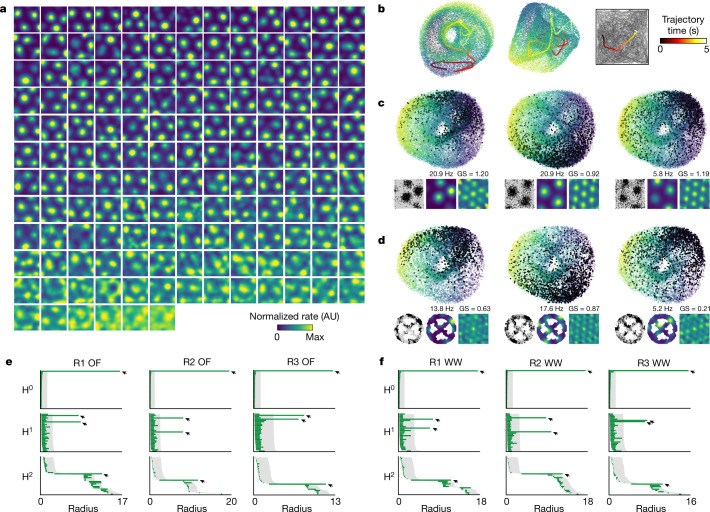
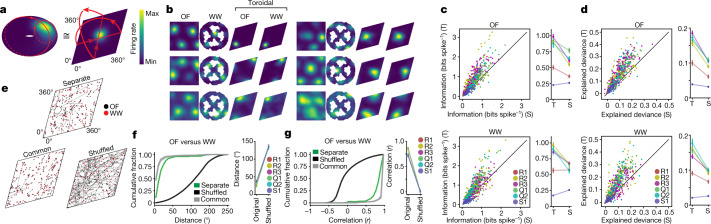
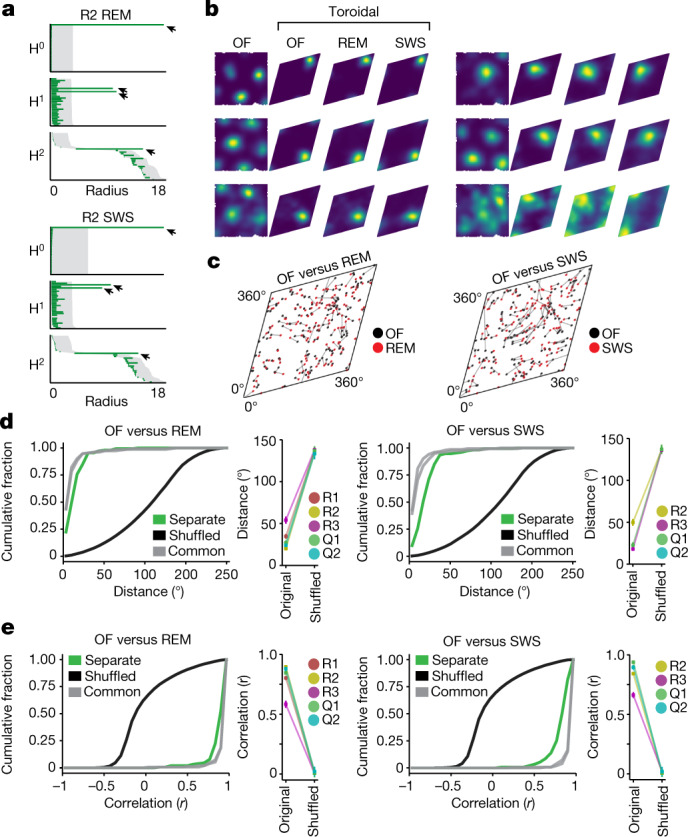
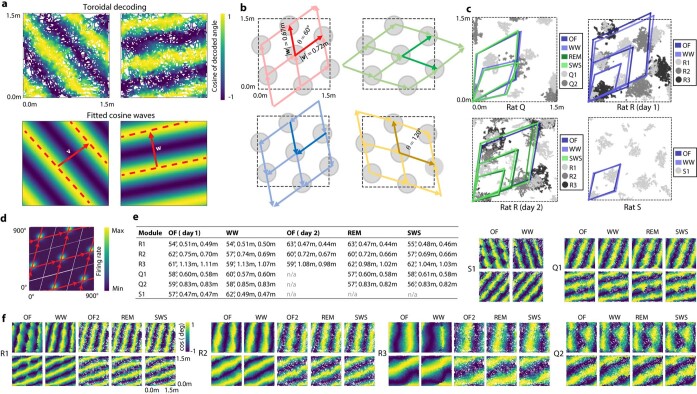
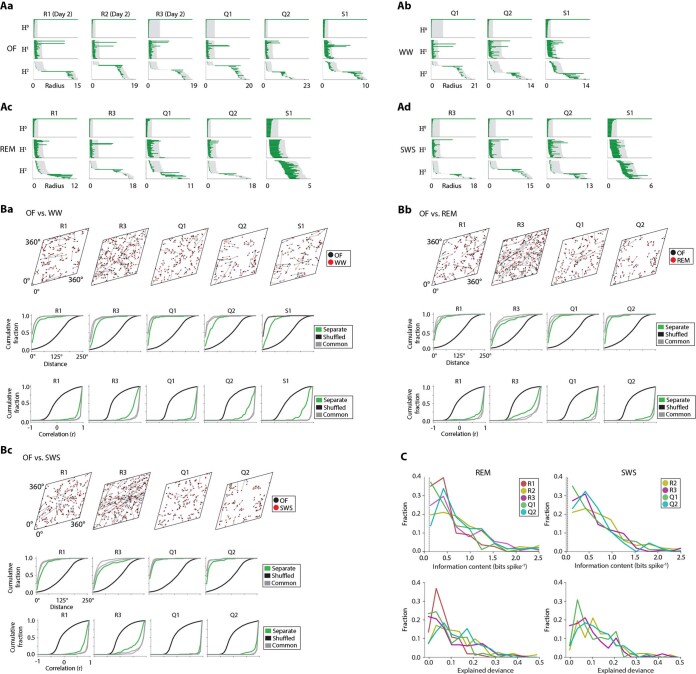
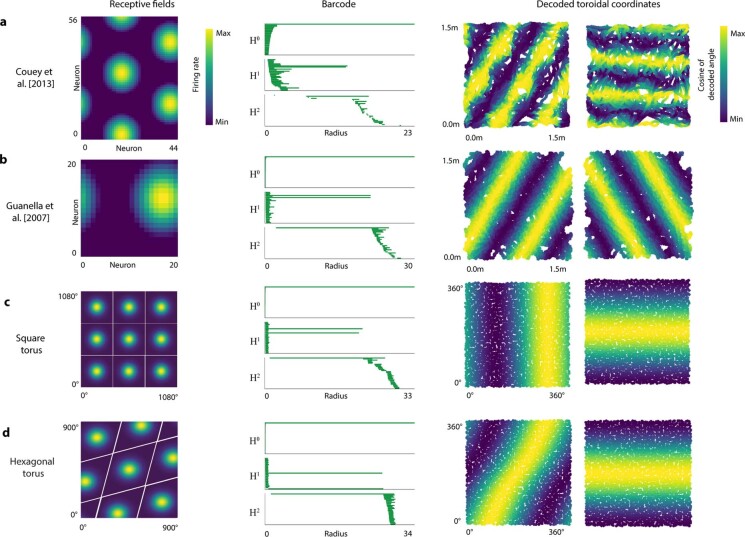
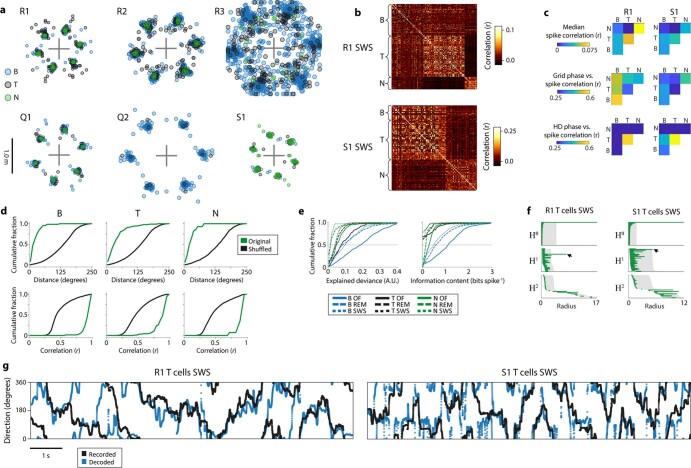
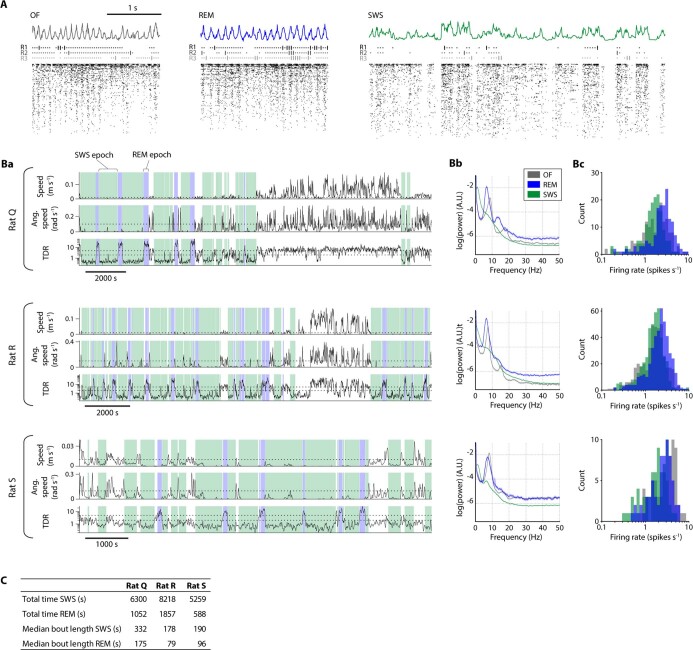
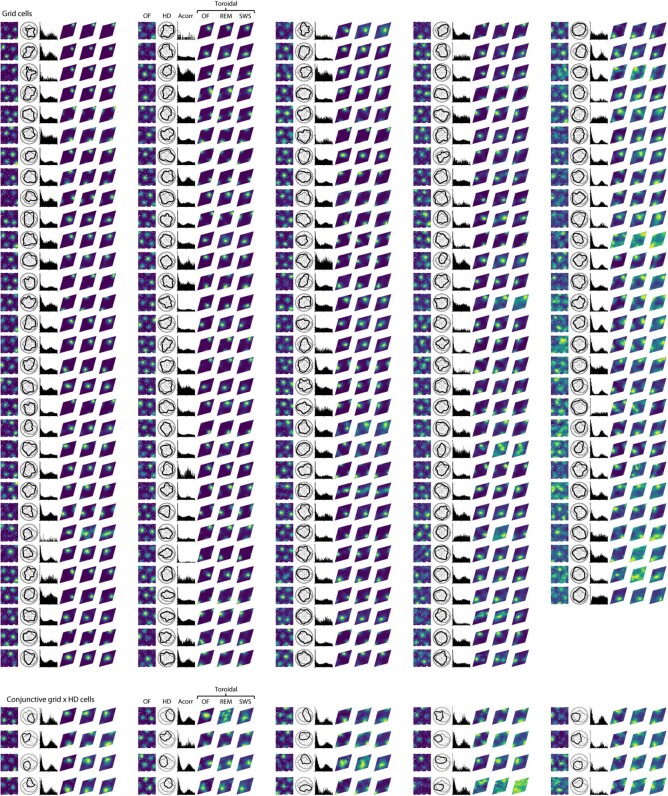
The medial entorhinal cortex is part of a neural system for mapping the position of an individual within a physical environment 1 . Grid cells, a key component of this system, fire in a characteristic hexagonal pattern of locations 2 , and are organized in modules 3 that collectively form a population code for the animal’s allocentric position 1 . The invariance of the correlation structure of this population code across environments 4,5 and behavioural states 6,7 , independent of specific sensory inputs, has pointed to intrinsic, recurrently connected continuous attractor networks (CANs) as a possible substrate of the grid pattern 1,8–11 . However, whether grid cell networks show continuous attractor dynamics, and how they interface with inputs from the environment, has remained unclear owing to the small samples of cells obtained so far. Here, using simultaneous recordings from many hundreds of grid cells and subsequent topological data analysis, we show that the joint activity of grid cells from an individual module resides on a toroidal manifold, as expected in a two-dimensional CAN. Positions on the torus correspond to positions of the moving animal in the environment. Individual cells are preferentially active at singular positions on the torus. Their positions are maintained between environments and from wakefulness to sleep, as predicted by CAN models for grid cells but not by alternative feedforward models 12 . This demonstration of network dynamics on a toroidal manifold provides a population-level visualization of CAN dynamics in grid cells.
Overview
The claims and statistics of this paper haven’t been checked yet.
Free: it reads the open-access text and checks the first 5 claims that cite a source we can check. Create a free account to check every claim.
Integrity signals
Registry
Cites
Statistics
Figures
Verification
Claims the paper makes
The claims and statistics of this paper haven’t been checked yet.
Free: it reads the open-access text and checks the first 5 claims that cite a source we can check. Create a free account to check every claim.
Claims other papers make about this one
Each is checked against this paper’s own text: does it say what the citing paper says it does?
The cited source says what the claim attributes to it.
In the citing paper
“For all topological analyses, the six-dimensional pointcloud was further downsampled using the procedure proposed by Gardner et al. This was done to reduce the impact of spurious activity, as persistent homology can be sensitive to outliers.11”
From Coherently remapping toroidal cells but not Grid cells are responsible for path integration in virtual agents (2023) · cites this paper as [11]
The cited source says what the claim attributes to it.
In the citing paper
“This was done to reduce the impact of spurious activity, as persistent homology can be sensitive to outliers.11”
From Coherently remapping toroidal cells but not Grid cells are responsible for path integration in virtual agents (2023) · cites this paper as [11]
Self-check
Percentages, sums and reported differences re-computed from the paper’s own numbers.
The self-check needs the paper’s full text.
Citations
Cites
UMAP: Uniform Manifold Approximation and Projection
McInnes, L., Healy, J., Saul, N., & Großberger, L. (2018) · Journal of Open Source Software · doi:10.21105/joss.00861 · Cited by 9,826
UMAP: Uniform Manifold Approximation and Projection for Dimension Reduction
McInnes, L., Healy, J., & Melville, J. (2018) · arXiv · doi:10.48550/arxiv.1802.03426 · Cited by 7,101
Microstructure of a spatial map in the entorhinal cortex
Hafting, T., Fyhn, M., Molden, S., Moser, M.-B., & Moser, E. I. (2005) · Nature · doi:10.1038/nature03721 · Cited by 4,068
Self-citationFully integrated silicon probes for high-density recording of neural activity
Jun, J. J., Steinmetz, N. A., Siegle, J. H., Denman, D. J., Bauza, M., Barbarits, B., Lee, A. K., Anastassiou, C. A., Andrei, A., Aydın, Ç., et al. (2017) · Nature · doi:10.1038/nature24636 · Cited by 2,190
Self-citationDynamics of pattern formation in lateral-inhibition type neural fields
Amari, S.-I. (1977) · Biological Cybernetics · doi:10.1007/bf00337259 · Cited by 2,060
Path integration and the neural basis of the 'cognitive map'
McNaughton, B. L., Battaglia, F. P., Jensen, O., Moser, E. I., & Moser, M.-B. (2006) · Nature Reviews Neuroscience · doi:10.1038/nrn1932 · Cited by 2,024
Self-citationTaube, J., Muller, R., & Ranck, J. (1990) · The Journal of Neuroscience · doi:10.1523/jneurosci.10-02-00420.1990 · Cited by 1,809
Conjunctive Representation of Position, Direction, and Velocity in Entorhinal Cortex
Sargolini, F., Fyhn, M., Hafting, T., McNaughton, B. L., Witter, M. P., Moser, M.-B., & Moser, E. I. (2006) · Science · doi:10.1126/science.1125572 · Cited by 1,485
Self-citationMemory of sequential experience in the hippocampus during slow wave sleep
Lee, A. K., & Wilson, M. A. (2002) · Neuron · doi:10.1016/s0896-6273(02)01096-6 · Cited by 1,296
Neuropixels 2.0: A miniaturized high-density probe for stable, long-term brain recordings.
Steinmetz, N. A., Aydin, C., Lebedeva, A., Okun, M., Pachitariu, M., Bauza, M., Beau, M., Bhagat, J., Böhm, C., Broux, M., et al. (2021) · Science · doi:10.1126/science.abf4588 · Cited by 1,173
Self-citation
Research works printed but not linked: 6
- Skaggs W Mcnaughton B Gothard K An information-theoretic approach to deciphering the hippocampal code Adv. Neural Inf. Process. Syst. 1992 5 1030 1037
- Bellman, R. Dynamic Programming (Princeton Univ. Press, 1957).
- Spivak, D. I. Metric realization of fuzzy simplicial sets https://www.semanticscholar.org/paper/metric-realization-of-fuzzy-simplicial-sets-spivak/a73fb9d562a3850611d2615ac22c3a8687fa745e (Semantic Scholar, 2009).
- Hatcher, A. Algebraic Topology (Cambridge University Press, 2002).
- Tsodyks M Sejnowski TJ Associative memory and hippocampal place cells Int. J. Neural Syst. 1995 6 81 86
- Stepanyuk A Self-organization of grid fields under supervision of place cells in a neuron model with associative plasticity Biol. Inspired Cogn. Archit. 2015 13 48 62
Cited by
Items 401–486 of 486
The Learning Hypothesis on Spatial Receptive Field Remapping
Kuo, H. (2024) · Digital Access to Scholarship at Harvard (DASH) (Harvard University)
Houichime, T., Souhar, A., & Amrani, Y. (2025) · SSRN Electronic Journal · doi:10.2139/ssrn.5957256 · Cited by 4
Retinotopy constrains the topology of neural manifolds in macaque visual cortexPreprint
Ardalani, R., Kurth, A. C., & Morales-Gregorio, A. (2025) · bioRxiv (Cold Spring Harbor Laboratory) · doi:10.64898/2025.12.22.695909
Houichime, T., Souhar, A., & Amrani, Y. (2025) · Research Square · doi:10.21203/rs.3.rs-8428646/v1
Spatially Periodic Computation in the Entorhinal-Hippocampal Circuit During NavigationPreprint
Zhang, B., Guan, X., Mobbs, D., & Liu, J. (2025) · eLife · doi:10.7554/elife.107517.2
Nestor, T. (2025) · Research Square · doi:10.21203/rs.3.rs-8443771/v1
Titanium Nitride: An Emerging Material in Scalable Biosensors
Li, Z., Tang, X., Cao, J., Zhang, K., Chen, C. Q., & Xie, S. (2026) · Advanced Materials Technologies · doi:10.1002/admt.202502242
Spatially Periodic Computation in the Entorhinal-Hippocampal Circuit During NavigationPreprint
Zhang, B., Guan, X., Mobbs, D., & Liu, J. (2026) · eLife · doi:10.7554/elife.107517.3
Understanding and manipulating color representations in CLIP
Zhou, P., Wang, J., Dai, Y., Du, H., Gu, Y., & Xu, Y. (2026) · Neurocomputing · doi:10.1016/j.neucom.2026.132890
From genes to dynamics: Examining brain cell types in action may reveal the logic of brain function
de la Prida, L. M. (2026) · The Transmitter · doi:10.53053/okgj7174
Gaussian Process Inference Reveals Non‐Separability of Position and Velocity Tuning in Grid Cells
Jiang, L., Ganguli, S., & Giocomo, L. M. (2026) · Hippocampus · doi:10.1002/hipo.70083
Possibility of More Than Two 1-Dimensional Holes in the Neuronal Manifold
Vijayakumar, A. (2025) · International Conference on Smart and Intelligent Systems (SISCON) · doi:10.1109/siscon66686.2025.11409028
“Assumptions A.1 and A.2 align with the continuous at-tractor network (CAN) model for grid cell dynamics [2], particularly over short time horizons and when aggregated over populations.”
InfluentialPerceptual Processes as Charting Operators
Neri, P. (2026) · Neural Computation · doi:10.1162/neco.a.1506
Directional dynamics in the entorhinal cortex of male mice driven by behavioral constraints
Liu, R., Hao, J., Zhang, X., Wen, S., Yang, Y., Cai, H., Gao, K., Kropff, E., & Miao, C. (2026) · Nature Communications · doi:10.1038/s41467-026-70289-3
“If this were the case, temporal correlations between pairs of HD F cells with similar preferred direction should be preserved in the assisted session despite the loss in selectivity 16,32,33 .”
Resonance-Dependent Pattern Dynamics in a Neural Field for Spatial Coding
Chen, Y. L., Qian, Y., & Peng, J. (2026) · Biomimetics · doi:10.3390/biomimetics11040224
“Finally, we explore how these dynamical mechanisms can be related, within a common dynamical framework of attractor-based representations, to activity tracking in head-direction systems and to lattice-like representations in grid-cell networks [5,7,9,11,12].”
The evolving conscious agent, II
Yifeng, C., & Sanders, J. W. (2026) · International Journal on Software Tools for Technology Transfer · doi:10.1007/s10009-026-00858-w
“For example animals with grid cells (see Moser, [19]) are to some extent aware of location: rats are able to return where they previously found food in a maze.”
What Are the Contributions of Modeling to Bridging the Gaps between Methods and across Species?
Bičanski, A. (2026) · Springer eBooks · doi:10.1007/978-3-032-20563-6_5
Uncovering the representational geometry of durationsPreprint
Grasso, C. L., Nalborczyk, L., & van Wassenhove, V. (2026) · bioRxiv (Cold Spring Harbor Laboratory) · doi:10.64898/2026.03.29.715088
“…example, neural population activity has been shown to exhibit structured geometries including ring-like and toroidal manifolds, providing concrete examples of how continuous variables can be represented through recurrent low-dimensional organisation (e.g., Gardner et al., 2022; Russo et al., 2020).”
The Brain’s Extended Navigation Network: Insights from Single-Neuron Studies
Patai, E. Z., Brown, T. I., Ciocchi, S., Goard, M. J., Jadhav, S. P., Keshavarzi, S., Krupic, J., Laurens, J., Vervaeke, K., & Jeffery, K. J. (2026) · Springer eBooks · doi:10.1007/978-3-032-20563-6_12
Büchel, P. K., & Kunz, L. (2026) · Springer eBooks · doi:10.1007/978-3-032-20563-6_6
The Wave and the Torus: Why Integrated Information Is Grain Diversity, Not Scalar ConsciousnessPreprint
L.-Dellamary, L. E. (2026) · Preprints.org · doi:10.20944/preprints202603.2521.v1 · Cited by 1
Lebovici, V. (2023) · theses.fr (ABES) · doi:10.70675/73b3f02fz6061z4912zbceeze596d4068b3d
Low-rank network models of neural computations
Valente, A. (2022) · theses.fr (ABES) · doi:10.70675/51cf5234z10f7z42b2z8d46z13894170c780
Nordlund, M. (2022) · theses.fr (ABES) · doi:10.70675/85f2c44az19d3z405bza14azf37b15517fc4
Towards optogenetic cortical implants for auditory restoration
Verdier, A. (2024) · theses.fr (ABES) · doi:10.70675/a44ccf79zd97fz41bfzb8c8zc79b2fee37f9
The evolution and impact of group collaboration in crisis response
Zhang, A., Kong, D., Lai, J., Zhang, G., Li, J., Wang, Y., Li, Y., & González, M. C. (2026) · Communications Physics · doi:10.1038/s42005-026-02588-6 · Cited by 2
O'Reilly-Shah, V. (2026) · SSRN Electronic Journal · doi:10.2139/ssrn.6491118
ZHANG, J., Lei, H., Kuiliang, L., Jing, W., & Ming, J. (2026) · Advances in Psychological Science · doi:10.3724/sp.j.1042.2026.1010
Neurodatascience: Past, Present, and Future
Cooper, K. W., Shahbaba, B., & Fortin, N. J. (2026) · Data Science in Science · doi:10.1080/26941899.2026.2619222
Topological Data Analysis for Neural Time Series: Persistent Homology and Brain Dynamics
Bush, J. (2026) · Springer eBooks · doi:10.1007/978-3-030-93954-0_90-1
Tracking the Fidelity of Internal Neural Representations with Error-In-Variables RegressionPreprint
Garon, I., Keeley, S., & Williams, A. H. (2026) · bioRxiv (Cold Spring Harbor Laboratory) · doi:10.64898/2026.04.22.720005
“Unsupervised manifold inference models (Wu et al. 2017; Chaudhuri et al. 2019; Jensen et al. 2020; Gardner et al. 2022) have complementary strengths and weaknesses.”
Local Learning with Boosting-based Backpropagation-Free Graph Neural Networks
Pasa, L., Frazzetto, P., Navarin, N., & Sperduti, A. (2026) · Machine Learning · doi:10.1007/s10994-026-07041-x
“…evidence of the presence of structured information storage in the brain (Ormrod, 2020 ), exemplified by cognitive maps for the representation of spatial relationships (Grieves & Jeffery, 2017) or the topological structures found in neural manifolds (Chaudhuri et al., 2019; Gardner et al., 2022).”
Abramson, S., Zur, D., Tzadok, G., Kolan, S., Laskar, S., Rechnitz, O., Balasubramanian, V., Morris, G., Benisty, H., & Derdikman, D. (2026) · bioRxiv (Cold Spring Harbor Laboratory) · doi:10.64898/2026.05.10.724068
“Our results may be related to foundational observations of structured grid cell phase shifts and modularity, which theoretically permit global affine transformations of the spatial map 8,38,39 .”
Canedo, C., & Rueda, C. (2026) · Chaos Solitons & Fractals · doi:10.1016/j.chaos.2026.118532
Thiem, L., Vaupel, M., Wienecke, S., Eidsvik, J., Taweesintananon, K., & Landrø, M. (2026) · The Journal of the Acoustical Society of America · doi:10.1121/10.0043844
A Two-Dimensional Grid-Cell Code for Three-Dimensional Navigation in Freely Flying BatsPreprint
Qi, K. K., & Yartsev, M. M. (2026) · bioRxiv (Cold Spring Harbor Laboratory) · doi:10.64898/2026.06.10.728358 · Cited by 2
“The detailed theoretical framework of persistent cohomology is as described elsewhere 13,14,55 .”
InfluentialCarballosa, A., & Torcini, A. (2026) · Journal of Neuroscience Methods · doi:10.1016/j.jneumeth.2026.110835
Zhou, Y., Zheng, H., Deng, L., & Wu, Y. (2026) · arXiv (Cornell University) · doi:10.48550/arxiv.2606.22604
“…have been widely used to model continuous variables and cognitive states (Khona and Fiete, 2022), including head direction (Angelaki and Laurens, 2020; Kim et al., 2017), spatial location (Gardner et al., 2022; Burak and Fiete, 2009), and working memory (Wojtak et al., 2023; Wimmer et al., 2014).”
Stimulus and circuit contributions to the information geometry of neural manifoldsPreprint
Goedeke, S., Kautz, J., & Leibold, C. (2026) · bioRxiv (Cold Spring Harbor Laboratory) · doi:10.64898/2026.06.21.733384
CANNs: A Toolkit for Research on Continuous Attractor Neural NetworksPreprint
He, S., Tuerhong, A., She, S., Chu, T., Wu, Y., Zuo, J., & Wu, S. (2026) · arXiv (Cornell University) · doi:10.48550/arxiv.2606.27783
“The attractor perspective has since been extended to spike-frequency adaptation [Mi et al., 2014, Li et al., 2025], theta rhythmicity [Chu et al., 2024, Ji et al., 2025b,a], hierarchical path integration [Chu et al., 2025], and toroidal population geometry in grid cells [Gardner et al., 2022].”
Pospelov, N., Plusnin, V. V., Rogozhnikova, O., Ivanova, A., Sotskov, V. P., Orobets, M., Toropova, K. A., Ivashkina, O. I., Аветисов, В. А., & Anokhin, K. V. (2026) · arXiv (Cornell University) · doi:10.48550/arxiv.2607.00851
“…count + 1); in the real network two small non-trivial eigenvalues lie below the bulk (weakly coupled modules), whereas in the shuffled network the small eigenvalues merge continuously into the bulk, with a sharp peak at 1 and weight near the bipartite limit of 2, typical of sparse tree-like graphs.”
Computational demands shape seizure susceptibility in recurrent neural networksPreprint
Li, M., Eydam, S., Ramzan, I., Polygalov, D., Huang, A. J. Y., Taguas, I., Nemeth, H., Yanagihara, D., McHugh, T. J., & Kang, L. (2026) · bioRxiv (Cold Spring Harbor Laboratory) · doi:10.64898/2026.07.02.735135
“MEC contains grid cells that encode space through continuous attractor dynamics 17–19 , whereas CA3 is believed to store episodic memories as a discrete attractor 20–24 .”
Lee, H., Bowler, J. C., & Heys, J. G. (2026) · bioRxiv (Cold Spring Harbor Laboratory) · doi:10.64898/2026.07.09.737618
Constructing mesoscale functionomics by neural dynamics subspace clustering
Cai, Y., Xu, X., Xiao, G., Ling, H., Shi, Z., Wang, M., Wang, M., Chen, F., Wu, J., & Dai, Q. (2026) · National Science Review · doi:10.1093/nsr/nwag420
“A generalization of this intuition in large populations of neurons is that knowing a part of the neural population, the rest of the network should be statistically predictable, implying a lower-dimensional latent variable may describe the population activity [38 –40 ].”
Topological Data Analysis for Neural Time Series: Persistent Homology and Brain Dynamics
Bush, J. (2026) · Springer eBooks · doi:10.1007/978-3-032-16368-4_90
Emergent topological structure in spontaneous brain-organoid activityPreprint
Bodnia, E., Basart, M., Hai, S., Ford, L. K., Miolane, N., Kosik, K. S., Bouwmeester, D., & Carr, L. D. (2026) · bioRxiv (Cold Spring Harbor Laboratory) · doi:10.64898/2026.07.17.739228
Prior experience dynamically determines differential cue weighting in the medial entorhinal cortexPreprint
Klein, P., Throm, B., Allen, K. L., & Monyer, H. (2026) · bioRxiv (Cold Spring Harbor Laboratory) · doi:10.64898/2026.07.22.739574
Ultraslow oscillations as a temporal scaffold for coordinating episodic memories
Fernández-León, J. A., Sarramone, L., & Presso, M. (2026) · Scientific Reports · doi:10.1038/s41598-026-59875-z
The fiber of multiparameter persistent homology for simplicial complexesPreprint
Harrington, H. A., Tillmann, U., & Torras-Pérez, M. (2026) · arXiv (Cornell University) · doi:10.48550/arxiv.2608.04640
Working memory retention by medial entorhinal cortex low-dimensional neural dynamicsPreprint
Yuan, L., Wang, J., Li, X., Li, W., Aljadeff, J., Leutgeb, J. K., & Leutgeb, S. (2026) · bioRxiv (Cold Spring Harbor Laboratory) · doi:10.64898/2026.08.18.745500
Zhou, Q., Duan, X., & Yu, G. (2026) · Information Processing & Management · doi:10.1016/j.ipm.2026.105094
Hwang, J., Neupane, S., Jazayeri, M., & Fiete, I. (2026) · bioRxiv (Cold Spring Harbor Laboratory) · doi:10.64898/2026.08.25.747129
“A distinctive feature of the scaffold in Vector-HaSH, motivated by the invariance of grid cells across time, environments, and behavioral states (Yoon et al. 2013; Gardner et al. 2022; Trettel et al. 2019; Dong and Fiete 2024), is that its structure is innate rather than learned.”
Neural spiketrains and population vectors entangle neural representationsPreprint
Vaupel, M., Olsen, V. K., Gaukstad, S., Hermansen, E., & Dunn, B. A. (2026) · bioRxiv (Cold Spring Harbor Laboratory) · doi:10.64898/2026.08.27.744867
“This is adapted from the method developed by Gardner et al. 38 .”
InfluentialSelf-citationSarramone, L., Presso, M., & Fernández-León, J. A. (2026) · Scientific Reports · doi:10.1038/s41598-026-70192-3
Pop, M., & SALAORU, T. A. (2026) · INCAS BULLETIN · doi:10.13111/2066-8201.2026.18.3.15
Structure Guides Function: Beyond Pairwise Neural Interactions
Maier, A. (2026) · The Journal of Comparative Neurology · doi:10.1002/cne.70213
Dimensionality—neuroscience’s red herring?
Perich, M. G. (2026) · The Transmitter · doi:10.53053/fteu9810
A shared manifold for scalable temporal representations in self-paced timingPreprint
Serrano, M., Castelli, M., Peng, Y., Sharott, A., & Dupret, D. (2026) · bioRxiv (Cold Spring Harbor Laboratory) · doi:10.64898/2026.09.03.749079
Principal bundle geometry of qualia: Understanding the quality of consciousness from symmetry
Oizumi, M., Lim, C., & Kanai, R. (2026) · PNAS Nexus · doi:10.1093/pnasnexus/pgag261 · Cited by 2
Ren, Y., Chen, Z., Deans, H., Wu, Y. N., & Zhang, W. (2026) · bioRxiv (Cold Spring Harbor Laboratory) · doi:10.64898/2026.09.02.748767
“The CANs can be regarded as a cortical hypercolumn, and have been widely used in neuroscience research [18, 22, 33, 35, 36], including the primary visual cortex [36, 37], prefontal cortex [38, 39], the head direction system [32], place cells [40], and grid cells [41, 42], etc.”
In Search of Unity in Diversity: A Unifying View on Emergence at ScalesPreprint
Karki, S. (2026) · SSRN Electronic Journal · doi:10.2139/ssrn.7459642
Wang, Y., Hu, J., Xu, S., Xu, X., Pan, X., & Wang, R. (2026) · Neural Networks · doi:10.1016/j.neunet.2026.109666
Chen, Y., Wang, T., Wang, W., & Liu, F. (2026) · Cognitive Neurodynamics · doi:10.1007/s11571-026-10555-8
“2i), which revealed a toroidal manifold topology characterized by two independent loops ( H 1 ) and one void ( H 2 ), as expected for a two-dimensional continuous-attractor organization (Chaudhuri et al. 2019 ; Gardner et al. 2022; Kang et al. 2021).”
Identifying Neural State Changes due to Gain versus Off-Manifold DisplacementPreprint
McKenzie, S. (2026) · PubMed Central · doi:10.48550/arxiv.2609.21272
Rostami, M. (2026) · arXiv (Cornell University) · doi:10.48550/arxiv.2609.21965
“…manifold from data with persistent homology extends to color the program that has mapped the toroidal and ring topologies of neural population codes ( Gardner et al., 2022 ; Singh et al., 2008 ; Carlsson et al., 2008 ), and suggests that “how many dimensions” is, for any sensory system, a…”
InfluentialRetrospective Grid Cells in the Medial Entorhinal Cortex Encode Past Paths During Spatial Navigation
Liu, R., Yuan, X., He, Z., Jin, H., Tian, J., Chen, C., Liu, Y., Zhang, X., Wen, S., Kropff, E., et al. (2026) · Advanced Science · doi:10.1002/advs.77884
“Previous studies have demonstrated the presence of prospective and retrospective information in MEC and hippocampal CA1 [ 18, 26–32, 34, 52–57 ].”
Grid-cell firing fields lack local sixfold symmetryPreprint
Kerscher, A. (2026) · arXiv (Cornell University) · doi:10.48550/arxiv.2609.31145
Causal event structure shapes convergent reactivation signatures in human cortex and language modelPreprint
Zhang, Z., Chen, Y., Liu, Q., Zhao, X., Ding, X., Fei, X., Du, J., Bao, Y., Gao, J., Huang, X., et al. (2026) · bioRxiv (Cold Spring Harbor Laboratory) · doi:10.64898/2026.09.28.754904
“Studies showing that neural population geometry can express abstract task structure, and that complex activity patterns can occupy low-dimensional manifolds, pro-66 vide a basis for this possibility [14, 15].”
Curvature Under Attack in hZACH-ViT: Gauge Symmetry, Boundary Saturation, and Adversarial FailurePreprint
Angelakis, A., & Gomez‐Barrero, M. (2026) · arXiv (Cornell University) · doi:10.48550/arxiv.2610.00680
“Representation geometry can constrain accessible computation in biological and artificial sys-2 tems (Sadtler et al., 2014; Chaudhuri et al., 2019; Gardner et al., 2022; Chung and Abbott, 2021).”
Neural Dissociation of Cognitive Maps and Graphs in the Human BrainPreprint
Xu, Y., Hinrichs, M. A. B., Bottini, R., & Doeller, C. F. (2026) · bioRxiv (Cold Spring Harbor Laboratory) · doi:10.64898/2026.10.09.757922
Ferreira, J. M. A., & Tukaiev, S. (2026) · Advances in Molecular Imaging · doi:10.4236/ami.2026.154004
Core–periphery organization reveals functional heterogeneity in spatial coding ensembles
Qian, R., Wang, T., Chen, Y., Wang, W., & Liu, F. (2026) · Biophysics Reviews · doi:10.1063/5.0357348
Predictive Grid Cell Coding Does Not Require Explicit PlanningPreprint
Sinha, A., Fasehun, O. C., & Redman, W. T. (2026) · bioRxiv (Cold Spring Harbor Laboratory) · doi:10.64898/2026.10.09.757963
“We describe, in brief, the post-processing performed [27], as well as the post-processing we performed on the downloaded data.”
InfluentialOntic state recovery through predictionPreprint
Zhang, P., Nguyen, Q.-H., Lei, Y., & Chao, W. (2026) · arXiv (Cornell University) · doi:10.48550/arxiv.2610.27139
“This organization can constrain which patterns are learned (Sadtler et al., 2014) and take forms such as the toroidal geometry of grid-cell activity (Gardner et al., 2022).”
A new neural code for position: generalizable spatial maps in mouse medial frontal cortexPreprint
Sen, R., Posani, L., Medoff, A., Zhang, B., Abbott, L. F., Axel, R., & Fusi, S. (2026) · bioRxiv (Cold Spring Harbor Laboratory) · doi:10.64898/2026.10.21.759829
Firing rate adaptation in grid cells produces macroscopic hexadirectional modulationPreprint
Reggio, G., kim, M.-S., Ji, Z., Bush, D., Barry, C., & Burgess, N. (2026) · bioRxiv (Cold Spring Harbor Laboratory) · doi:10.64898/2026.10.19.760191
“We defined conjunctive cell as having Rayleigh vector length greater than 0.3 following previous literature (Gardner et al., 2022).”
InfluentialThe multi-scale geometry of neural encodingPreprint
Azeglio, S., Laquitaine, S., Bernardo, A. D., Ferrari, U., & Chalk, M. (2026) · bioRxiv (Cold Spring Harbor Laboratory) · doi:10.64898/2026.10.22.761206
What makes you think? On the emergence of neural dynamics from complex network interactions.
Szeier, S. (2026) · Lund University Publications (Lund University)
Manifolds for the neural representation of 3D spatial experiencePreprint
Doudlah, R. C., Xiao, M., Postlewaite, S., Kim, B., Cowan, N. J., & Rosenberg, A. (2026) · bioRxiv (Cold Spring Harbor Laboratory) · doi:10.64898/2026.10.22.760836
“…these representations in R N (i.e., place cells (O’Keefe, 1976)) is derived in part from input from grid cells, although their population activity within individual modules evolves on a toroidal manifold rather than reflecting the topology of the physical space they encode (Gardner et al., 2022).”
Shaped by What's Missing: Topological Invariance Simplification Discovers Behavioral TransitionsPreprint
Bian, K., Leonardis, E. J., Yang, Y., Zhang, C., Wang, Y., & Pereira, T. (2026) · arXiv (Cornell University) · doi:10.48550/arxiv.2611.00688
ToroFit: Fitting Wedge Sums of Tori to High-Dimensional DataPreprint
Bhatia, T., Perea, J. A., & Zikry, T. M. (2026) · arXiv (Cornell University) · doi:10.48550/arxiv.2611.06990
MAG-S3 and MAG-S3b: recording the quantum compass, CISS non-reciprocity and cryptochrome order
Julia, R. (2026) · Zenodo (CERN European Organization for Nuclear Research) · doi:10.5281/zenodo.24043499
Metadata
- Authors
- Gardner, R. J., Hermansen, E., Pachitariu, M., Burak, Y., Baas, N. A., Dunn, B. A., Moser, M.-B., & Moser, E. I.
- Affiliations
- Norwegian University of Science and Technology (NO)
- Howard Hughes Medical Institute (US)
- Hebrew University of Jerusalem (IL)
- Corresponding author
- Gardner, Richard J.
- Baas, Nils A.
- Dunn, Benjamin A.
- Moser, Edvard I.
- ORCID
- Venue
- Nature
- Published
- 2022-01-12
- Volume
- 602
- Issue
- 7895
- Pages
- 123-128
- ISSN
- 0028-0836 (ISSN-L)
- 1476-4687
- PMC
- PMC8810387
- OpenAlex
- W4205399426
- Cited by
- 428
- References
- 80
- Citations by year
- 2026: 79 · 2025: 108 · 2024: 99 · 2023: 89 · 2022: 48
- FWCI
- 44.35
- Type
- journal article
- Language
- en
- Open access
- hybrid
- doi.org
- Licence
- cc-by
- creativecommons.org/licenses/by/4.0 (tdm)
- creativecommons.org/licenses/by/4.0 (vor)
- Locations
- Nature (publishedVersion, cc-by)
- PubMed Central (publishedVersion, cc-by)
- PubMed (publishedVersion)
- Funders
- Kavli Foundation
- Norges Teknisk-Naturvitenskapelige Universitet
- Gatsby Charitable Foundation
- Israel Science Foundation
- Norges Forskningsråd (223262, 295721)
- Mattilsynet
- Division of Mathematical Sciences
- H2020 European Research Council (951319)
- Topics
- Life Sciences › Neuroscience › Cognitive Neuroscience › Memory and Neural Mechanisms
- Life Sciences › Neuroscience › Cognitive Neuroscience › Neural dynamics and brain function
- Social Sciences › Psychology › Experimental and Cognitive Psychology › Spatial Cognition and Navigation
- Keywords
- grid cells, continuous attractor networks, toroidal manifold, population activity, medial entorhinal cortex, spatial representation, topological data analysis, recurrent connectivity, sleep and wakefulness
- MeSH terms
- Grid Cells, Action Potentials, Animals, Male, Models, Neurological, Sleep, Space Perception, Wakefulness, Entorhinal Cortex, Rats, Long-Evans, Rats
About these checks
Registry, retraction, Cites and statistics results are computed, not judged, with one exception: a printed reference that no index lists is read once by a model before it counts as a citation error. Claims are extracted by a model and kept only when their quote appears verbatim in the text; each cited source is then checked, with a model’s help, for whether it says what the claim relies on. Those verdicts can be wrong — read the claim’s quote and the cited source before relying on one.
Statistics and arithmetic are recomputed, not judged.
Confidence bands are shown only for fields calibrated on our annotated test set. None is calibrated yet, so no band is shown.
What counts as a claim ›How we measure confidence ›How we check this ›
Are you an author, or do you see a problem with this page? Request a review
Data sources
Bibliographic data: Semantic Scholar, OpenAlex, Crossref.
Contains information from the Semantic Scholar Academic Graph Datasets, made available under the ODC Attribution License (ODC-BY 1.0).
Semantic Scholar’s data is described in: Kinney, R., et al. (2023). The Semantic Scholar Open Data Platform. arXiv:2301.10140.
