

Toroidal topology of population activity in grid cells
Open accessPublished version of a preprint
The DOI matches its Crossref record; 85 of the 85 references it cites were found in a registry or an index.
Abstract
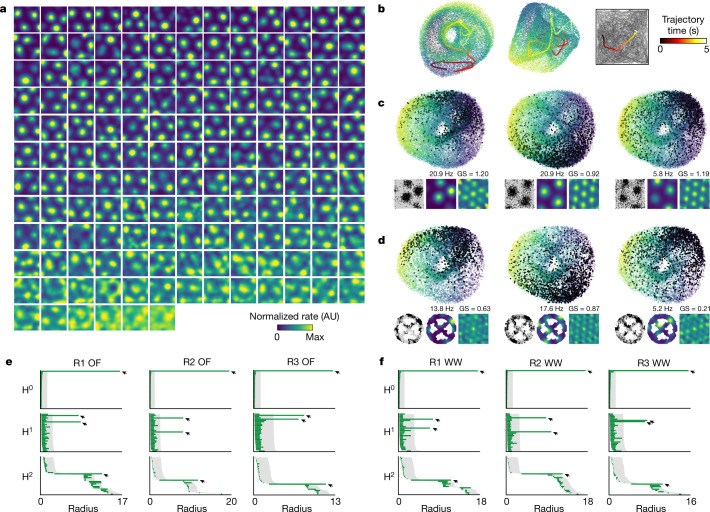
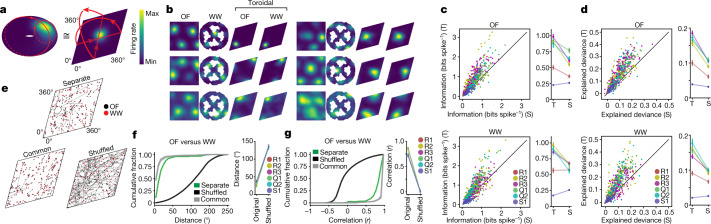
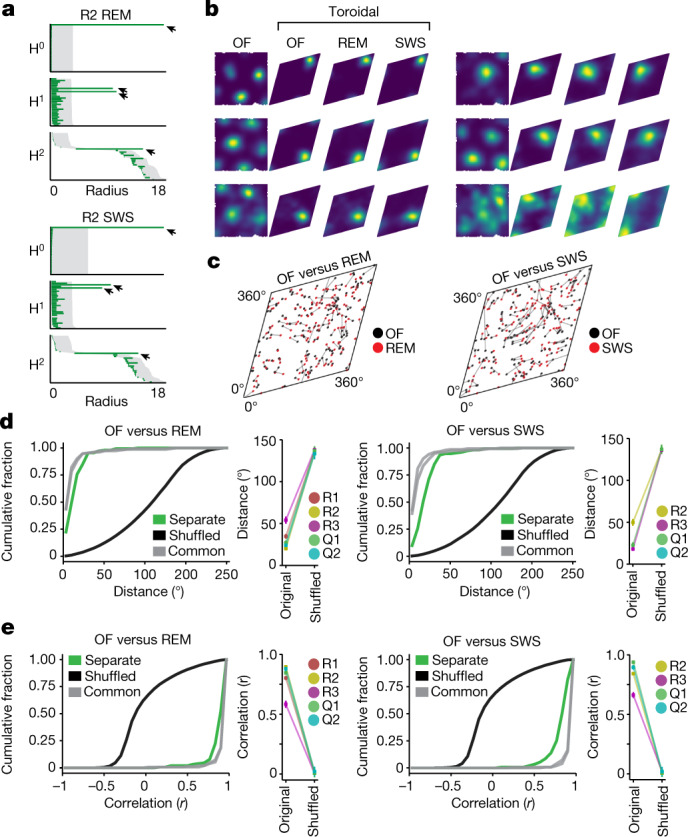
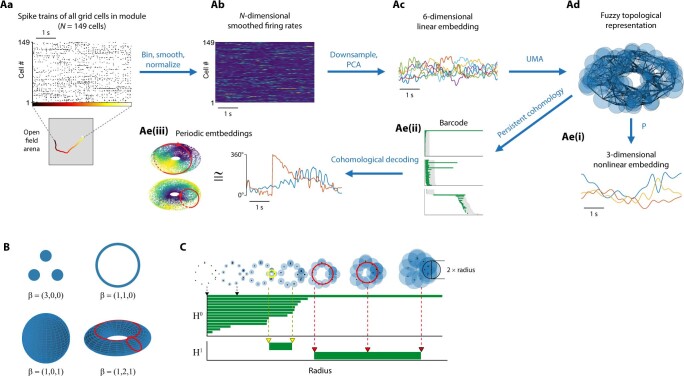
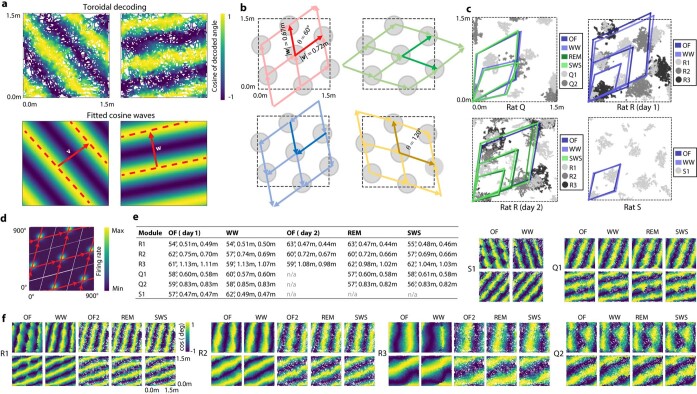
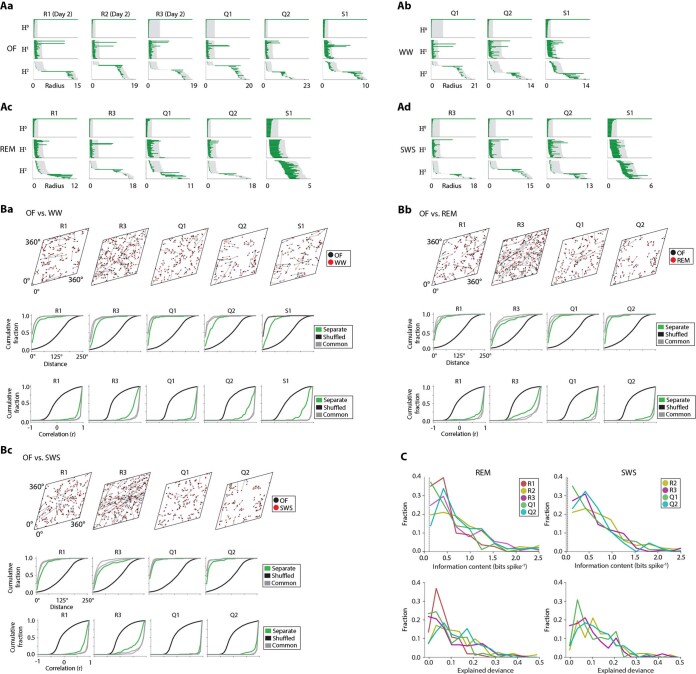
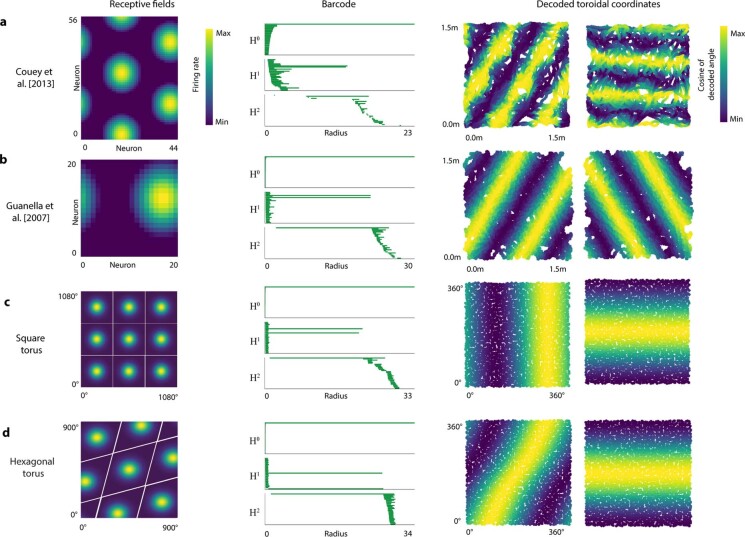
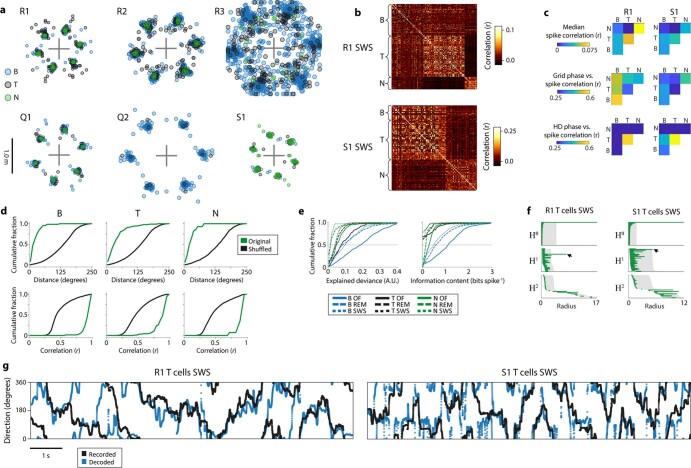
The medial entorhinal cortex is part of a neural system for mapping the position of an individual within a physical environment 1 . Grid cells, a key component of this system, fire in a characteristic hexagonal pattern of locations 2 , and are organized in modules 3 that collectively form a population code for the animal’s allocentric position 1 . The invariance of the correlation structure of this population code across environments 4,5 and behavioural states 6,7 , independent of specific sensory inputs, has pointed to intrinsic, recurrently connected continuous attractor networks (CANs) as a possible substrate of the grid pattern 1,8–11 . However, whether grid cell networks show continuous attractor dynamics, and how they interface with inputs from the environment, has remained unclear owing to the small samples of cells obtained so far. Here, using simultaneous recordings from many hundreds of grid cells and subsequent topological data analysis, we show that the joint activity of grid cells from an individual module resides on a toroidal manifold, as expected in a two-dimensional CAN. Positions on the torus correspond to positions of the moving animal in the environment. Individual cells are preferentially active at singular positions on the torus. Their positions are maintained between environments and from wakefulness to sleep, as predicted by CAN models for grid cells but not by alternative feedforward models 12 . This demonstration of network dynamics on a toroidal manifold provides a population-level visualization of CAN dynamics in grid cells.
Overview
The claims and statistics of this paper haven’t been checked yet.
Free: it reads the open-access text and checks the first 5 claims that cite a source we can check. Create a free account to check every claim.
Integrity signals
Registry
Cites
Statistics
Figures
Verification
Claims the paper makes
The claims and statistics of this paper haven’t been checked yet.
Free: it reads the open-access text and checks the first 5 claims that cite a source we can check. Create a free account to check every claim.
Claims other papers make about this one
Each is checked against this paper’s own text: does it say what the citing paper says it does?
The cited source says what the claim attributes to it.
In the citing paper
“For all topological analyses, the six-dimensional pointcloud was further downsampled using the procedure proposed by Gardner et al. This was done to reduce the impact of spurious activity, as persistent homology can be sensitive to outliers.11”
From Coherently remapping toroidal cells but not Grid cells are responsible for path integration in virtual agents (2023) · cites this paper as [11]
The cited source says what the claim attributes to it.
In the citing paper
“This was done to reduce the impact of spurious activity, as persistent homology can be sensitive to outliers.11”
From Coherently remapping toroidal cells but not Grid cells are responsible for path integration in virtual agents (2023) · cites this paper as [11]
Self-check
Percentages, sums and reported differences re-computed from the paper’s own numbers.
The self-check needs the paper’s full text.
Citations
Cites
UMAP: Uniform Manifold Approximation and Projection
McInnes, L., Healy, J., Saul, N., & Großberger, L. (2018) · Journal of Open Source Software · doi:10.21105/joss.00861 · Cited by 9,826
UMAP: Uniform Manifold Approximation and Projection for Dimension Reduction
McInnes, L., Healy, J., & Melville, J. (2018) · arXiv · doi:10.48550/arxiv.1802.03426 · Cited by 7,101
Microstructure of a spatial map in the entorhinal cortex
Hafting, T., Fyhn, M., Molden, S., Moser, M.-B., & Moser, E. I. (2005) · Nature · doi:10.1038/nature03721 · Cited by 4,068
Self-citationFully integrated silicon probes for high-density recording of neural activity
Jun, J. J., Steinmetz, N. A., Siegle, J. H., Denman, D. J., Bauza, M., Barbarits, B., Lee, A. K., Anastassiou, C. A., Andrei, A., Aydın, Ç., et al. (2017) · Nature · doi:10.1038/nature24636 · Cited by 2,190
Self-citationDynamics of pattern formation in lateral-inhibition type neural fields
Amari, S.-I. (1977) · Biological Cybernetics · doi:10.1007/bf00337259 · Cited by 2,060
Path integration and the neural basis of the 'cognitive map'
McNaughton, B. L., Battaglia, F. P., Jensen, O., Moser, E. I., & Moser, M.-B. (2006) · Nature Reviews Neuroscience · doi:10.1038/nrn1932 · Cited by 2,024
Self-citationTaube, J., Muller, R., & Ranck, J. (1990) · The Journal of Neuroscience · doi:10.1523/jneurosci.10-02-00420.1990 · Cited by 1,809
Conjunctive Representation of Position, Direction, and Velocity in Entorhinal Cortex
Sargolini, F., Fyhn, M., Hafting, T., McNaughton, B. L., Witter, M. P., Moser, M.-B., & Moser, E. I. (2006) · Science · doi:10.1126/science.1125572 · Cited by 1,485
Self-citationMemory of sequential experience in the hippocampus during slow wave sleep
Lee, A. K., & Wilson, M. A. (2002) · Neuron · doi:10.1016/s0896-6273(02)01096-6 · Cited by 1,296
Neuropixels 2.0: A miniaturized high-density probe for stable, long-term brain recordings.
Steinmetz, N. A., Aydin, C., Lebedeva, A., Okun, M., Pachitariu, M., Bauza, M., Beau, M., Bhagat, J., Böhm, C., Broux, M., et al. (2021) · Science · doi:10.1126/science.abf4588 · Cited by 1,173
Self-citation
Research works printed but not linked: 6
- Skaggs W Mcnaughton B Gothard K An information-theoretic approach to deciphering the hippocampal code Adv. Neural Inf. Process. Syst. 1992 5 1030 1037
- Bellman, R. Dynamic Programming (Princeton Univ. Press, 1957).
- Spivak, D. I. Metric realization of fuzzy simplicial sets https://www.semanticscholar.org/paper/metric-realization-of-fuzzy-simplicial-sets-spivak/a73fb9d562a3850611d2615ac22c3a8687fa745e (Semantic Scholar, 2009).
- Hatcher, A. Algebraic Topology (Cambridge University Press, 2002).
- Tsodyks M Sejnowski TJ Associative memory and hippocampal place cells Int. J. Neural Syst. 1995 6 81 86
- Stepanyuk A Self-organization of grid fields under supervision of place cells in a neuron model with associative plasticity Biol. Inspired Cogn. Archit. 2015 13 48 62
Cited by
Items 301–400 of 486
Stabilization of memory on neural manifolds through multiple synaptic time scalesPreprint
Chechelnizki, G., Shaham, N., Salhov, A., & Burak, Y. (2025) · bioRxiv (Cold Spring Harbor Laboratory) · doi:10.1101/2025.01.30.635710 · Cited by 1
Self-citationClaudi, F., Chandra, S., & Fiete, I. (2025) · eLife · doi:10.7554/elife.107224.1 · Cited by 1
Chu, T., Wu, Y., Qiu, W., Jiang, Z., Burgess, N., Hong, B., & Wu, S. (2025) · bioRxiv (Cold Spring Harbor Laboratory) · doi:10.1101/2025.09.07.674775 · Cited by 1
“…and theoretical studies has suggested that CANNs are a canonical model for simulating spatial representation in the hippocampal-entorhinal system [22, 23, 24, 25, 26, 19, 27], we therefore adopt a CANN to model the sub-network formed by the place cell ensemble in HPC, referred to as P-CANN…”
Spatially periodic computation in the entorhinal-hippocampal circuit during navigationPreprint
Zhang, B., Guan, X., Mobbs, D., & Liu, J. (2026) · eLife · doi:10.7554/elife.107517 · Cited by 1
“Grid cells exhibit hexagonal firing patterns with nearly invariant orientations ( Hafting et al., 2005 ; Sargolini et al., 2006 ; Krupic et al., 2012 ; Gardner et al., 2022 ).”
Basu, R., Mozaffarilegha, M., Bölükbaşı, I., Üstüner, C., & Ito, H. (2025) · bioRxiv (Cold Spring Harbor Laboratory) · doi:10.1101/2025.09.15.676202 · Cited by 1
V1 interlaminar coherence decreases with interocular conflictPreprint
Carlson, B. M., Mitchell, B., Westerberg, J. A., Poggi, P. G., Woodman, G., & Maier, A. (2025) · bioRxiv (Cold Spring Harbor Laboratory) · doi:10.1101/2025.10.04.680461 · Cited by 1
“Certain aspects of neuronal population responses are invisible to the study of one neuron at a time, or even pairs of neurons at a time (34–36 , Evaluating magnitude-squared coherence for V1 LFPs can serve as a heuristic for the laminar structure of coherence within single cortical columns (25, 42).”
Topological decoding of grid cell activity via path lifting to covering spacesPreprint
Yao, Y., & Yoon, I. H. R. (2025) · bioRxiv (Cold Spring Harbor Laboratory) · doi:10.1101/2025.10.17.683158 · Cited by 1
“Grid cell activity was generated using a continuous attractor network (CAN) model [5, 20], implemented on a 56 × 44 grid cell network with a shared spatial resolution.”
InfluentialHansen, E. C. A., Sanderson, N., Nourin, S., Candat, V., Curto, C., & Sumbre, G. (2025) · bioRxiv (Cold Spring Harbor Laboratory) · doi:10.1101/2025.10.26.684564 · Cited by 1
“Recently, experimental evidence for attractor circuits has been observed in the head direction system of drosophila [23], the entorhinal cortex of rodents [24], and somatosensory cortex [25].”
What Neuroscience Can Teach AI About Learning in Continuously Changing EnvironmentsPreprint
Durstewitz, D., Averbeck, B. B., & Koppe, G. (2025) · arXiv (Cornell University) · doi:10.48550/arxiv.2507.02103 · Cited by 1
Innate development of cognitive functions and motor programs by chemoaffinityPreprint
Schuessler, F., Ciceri, S., & Sprekeler, H. (2026) · bioRxiv (Cold Spring Harbor Laboratory) · doi:10.64898/2026.01.30.702840 · Cited by 1
“S1) [7], as observed in newborn rats [18].”
InfluentialLearning sculpts orthogonal task manifolds for continual skill learning in recurrent networksPreprint
Liu, Z., Kurth, A. C., Osako, Y., & Asabuki, T. (2026) · bioRxiv (Cold Spring Harbor Laboratory) · doi:10.64898/2026.02.15.705283 · Cited by 2
“…diverse brain regions and behaviors, including motor cortex during movement generation (Churchland et al., 2012; Gallego et al., 2018), prefrontal cortex during context-54 dependent decision making (Mante et al., 2013), and navigation-related circuits (Harvey et al., 2012; Gardner et al., 2022).”
A multiplexed striatal architecture for generalized spatial goal progressPreprint
Takakuwa, N., Golipour, Z., & Ito, H. (2026) · bioRxiv (Cold Spring Harbor Laboratory) · doi:10.64898/2026.04.08.716650 · Cited by 1
“For quantitative analyses, persistent homology (PH) was computed on the three-dimensional UMAP embeddings described above using the ripser Python library for homology groups H0 and H1 66,67 .”
Stimulus symmetries can confound representational similarity analysesPreprint
Pashakhanloo, F., & Zavatone-Veth, J. A. (2026) · arXiv.org · doi:10.48550/arxiv.2605.21324 · Cited by 1
“The brain uses manifold-tiling codes to represent a range of physical and abstract variables, and they emerge through learning in a variety of model settings (Gardner et al., 2022; Hubel & Wiesel, 1962; Sengupta et al., 2018).”
Spinal rotational dynamics orchestrate locomotor recoveryPreprint
Colard, J., Harnie, J., Berg, R. W., & Frigon, A. (2026) · bioRxiv (Cold Spring Harbor Laboratory) · doi:10.64898/2026.07.21.739844 · Cited by 1
“During locomotion following spinal transection, the activity of the spinal motoneuron population continuously cycles through all phases, consistent with a limit-cycle attractor 17,18 , whereas the resulting global EMG activity remains alternating (Fig.”
The lattice scales of grid-cell activityPreprint
Veselov, A., Kerscher, A., Stemmler, M., & Herz, A. V. M. (2026) · bioRxiv (Cold Spring Harbor Laboratory) · doi:10.64898/2026.08.07.743499 · Cited by 1
“Rat R was recorded by Gardner et al., 12 the four other animals by Vollan et al. 13 Reference lines indicate RoR=1 and the peak-selection bound RoR 24 ( f =1/2) ≈ 1 .”
NeuralFieldManifold: Uncovering the Manifold Geometry of Local Field PotentialsPreprint
Fallah, K., Chen, H. N., Singha, R. G., Kong, E., Turi, G. F., Losonczy, A., & Zabeh, E. (2026) · bioRxiv (Cold Spring Harbor Laboratory) · doi:10.64898/2026.10.28.762631 · Cited by 1
MAG-S2: the shape of the quantum compass signal
Julia, R. (2026) · Zenodo (CERN European Organization for Nuclear Research) · doi:10.5281/zenodo.24029864 · Cited by 1
Circuit mechanisms for disentangled representations and generalization in the hippocampus
Tang, W., Chang, H., Liu, C., Perez-Hernandez, S., Zheng, W. Y., Park, J., Karaba, L. A., Oliva, A., & Fernandez-Ruiz, A. (2026) · Nature Neuroscience · doi:10.1038/s41593-026-02491-x
Spatially Periodic Computation in the Entorhinal-Hippocampal Circuit During NavigationPreprint
Zhang, B., Guan, X., Mobbs, D., & Liu, J. (2022) · bioRxiv (Cold Spring Harbor Laboratory) · doi:10.1101/2022.01.29.478346
Yates, D. M. (2022) · Nature reviews. Neuroscience · doi:10.1038/s41583-022-00565-w
Profound impact of hippocampal output on the interpretation of tactile input patterns in SI neuronsPreprint
Etemadi, L., Enander, J. M. D., & Jörntell, H. (2022) · bioRxiv (Cold Spring Harbor Laboratory) · doi:10.1101/2022.11.27.518101
“…orthogonality of these response states suggested the presence of attractor-type dynamics (Norrlid et al., 2021; Ringach, 2009), reminiscent of what has also been proposed to characterize the neuron population activity dynamics in the hippocampus (Gardner et al., 2022; Gardner et al., 2019).”
BackgroundInfluentialSymmetry and Network Topology in Neuronal Circuits: Complicity of Form and Function
Stewart, I. N. (2022) · International Journal of Bifurcation and Chaos · doi:10.1142/s0218127422300336
Editor's evaluation: Histological E-data Registration in rodent Brain Spaces
Wolff, M. (2022) · eLife · doi:10.7554/elife.83496.sa0
Purohit, P., Dutta, P., & Roy, P. K. (2023) · Frontiers in Computational Neuroscience · doi:10.3389/fncom.2023.1136985
“Recently, the 3-D visualization of the experimentally obtained grid cell activity yielded a torus geometry where points on the torus correspond to the position in the physical space and thus validated the toroidal topology used in the theoretical models of the grid cell networks (Gardner et al., 2022; Hermansen et al.…”
MethodLiao, Y., Yu, N., & Yan, J. (2023) · Biomimetics · doi:10.3390/biomimetics8050427
Grid Cell Firing Patterns Maintain their Hexagonal Firing Patterns on a Circular TrackPreprint
Yim, M. Y., Walton, S., & Hedrick, K. R. (2023) · bioRxiv (Cold Spring Harbor Laboratory) · doi:10.1101/2023.09.14.557783
“A second approach using methods from topology has also been used to conclude that grid cell activity in a pinwheel maze arises from an underlying hexagonal lattice (Gardner et al., 2022).”
BackgroundMethodInfluentialMittal, D., & Narayanan, R. (2023) · bioRxiv (Cold Spring Harbor Laboratory) · doi:10.1101/2023.11.28.568983
Nevjen, F., & Dunn, B. A. (2024) · eLife · doi:10.7554/elife.92517
Self-citationIntroduction: How Should One Think About Nervous Systems?
Traub, R. D., & Draguhn, A. (2024) · Springer eBooks · doi:10.1007/978-3-031-54537-5_1
Modelling as a bridge between maps, spatial concepts, and the territory
Eide, Ø. (2024) · Routledge eBooks · doi:10.4324/9781032695891-4
Computational Modeling of the Interactions Between Episodic Memory and Cognitive Control
Chateau-Laurent, H. (2024) · theses.fr (ABES) · doi:10.70675/9ef353f0z7248z4f1ez8ab4ze909cd8fde13 · Cited by 1
Grid cell populations maintain their hexagonal firing patterns on a circular trackPreprint
Yim, M. Y., Walton, S., & Hedrick, K. R. (2024) · Research Square · doi:10.21203/rs.3.rs-4468831/v1
Probing Individual Differences in the Topological Landscape of Naturalistic Brain DynamicsPreprint
Xian, J., He, Y., Yan, Y., Tian, X., Peng, Y., Lou, J., Liu, X., Wang, Q., Gao, T., Wang, Q., et al. (2024) · bioRxiv (Cold Spring Harbor Laboratory) · doi:10.1101/2024.06.20.599966
Cao, Q., Suri, G., Cheng, S., Liu, Y., Liu, J., Wen, S., Zhong, M., Hao, J., Yao, S., Yang, Y., et al. (2026) · Nature Communications · doi:10.1038/s41467-026-78673-9
Reviewer #1 (Public Review): Neural Trajectories of Conceptually Related Events
Schafer, M., Kamilar-Britt, P., Sahani, V., et al. (2024) · eLife · doi:10.7554/elife.96895.1.sa1
Reviewer #2 (Public Review): Neural Trajectories of Conceptually Related Events
Schafer, M., Kamilar-Britt, P., Sahani, V., et al. (2024) · eLife · doi:10.7554/elife.96895.1.sa0
eLife Assessment: Neural Trajectories of Conceptually Related Events
Diedrichsen, J. (2024) · eLife · doi:10.7554/elife.96895.1.sa2
Neural Trajectories of Conceptually Related EventsPreprint
Schafer, M., Kamilar-Britt, P., Sahani, V., Bachi, K., & Schiller, D. (2024) · eLife · doi:10.7554/elife.96895.1 · Cited by 3
Brains Over Brawn: Small AI Labs in the Age of Datacenter-Scale Compute
Put, J., Michiels, N., Vanherle, B., & Zoomers, B. (2024) · Communications in computer and information science · doi:10.1007/978-3-031-66705-3_2
Separated attractors in neural landscape of motor cortex encoding motor learningPreprint
Liu, X., Wu, Y., Ru, X., Li, R., Si, K., & Gong, W. (2024) · bioRxiv (Cold Spring Harbor Laboratory) · doi:10.1101/2024.10.01.611949
“For example, it has been shown that the intrinsic activity space of individual grid cells forms a ring, where specific locations on the ring correspond to the animal's position in a real environment[34].”
BackgroundMinimum Grid Cells for Place Cell Activity in Eleven EnclosuresPreprint
Aggarwal, A. (2024) · bioRxiv (Cold Spring Harbor Laboratory) · doi:10.1101/2024.11.15.623794
“Instead, the grid cell-based place cell firing model explains the place cell firing adequately but we think that it is not a motor or path integration model alone [34].”
Wiring of a low-dimensional integrator network
Hu, B., & Friedrich, R. W. (2024) · Nature Neuroscience · doi:10.1038/s41593-024-01702-7
Alpha Shapes and Optimal Transport on the Sphere
Carlsson, E., & DePaul, G. (2026) · Foundations of Computational Mathematics · doi:10.1007/s10208-026-09765-7
Neural dynamics of reversal learning in the prefrontal cortex and recurrent neural networksPreprint
Kim, C. M., Chow, C. C., & Averbeck, B. B. (2024) · eLife · doi:10.7554/elife.103660.1
A new dynamic shift mechanism based on cyclic group theory for continuous attractor neural networks
Zhang, Z., Zhao, H., Tang, F., Li, Y., & Feng, X. (2024) · Nonlinear Dynamics · doi:10.1007/s11071-024-10658-z
“( Colorfigureonline) more significant role than previously thought, particularly in modeling the intricate firing patterns of grid cells and encoding the position of a moving animal within the toroidal (doughnut-shaped) topology [13].”
Huber, D. E. (2024) · eLife · doi:10.7554/elife.95733.2
Rotationally Stable Dynamics Over Long Timescales Emerge in Neuronal DevelopmentPreprint
Burrows, D. R. W., & Rosch, R. E. (2025) · bioRxiv (Cold Spring Harbor Laboratory) · doi:10.1101/2024.12.31.630917
Redman, W. T., Acosta–Mendoza, S., Wei, X.-X., & Goard, M. J. (2025) · eLife · doi:10.7554/elife.100652.2
Kümpfbeck, F. S., Nagele, J., Felmy, F., & Herz, A. V. M. (2025) · bioRxiv (Cold Spring Harbor Laboratory) · doi:10.1101/2025.02.13.638108
Redman, W. T., Acosta–Mendoza, S., Wei, X.-X., & Goard, M. J. (2025) · eLife · doi:10.7554/elife.100652.3.sa4
Perceptual-Cognitive Training Paradigms for Understanding Cognition and Cortical Visual Impairments
Pandey, A., Shrestha, D., & Neupane, S. (2025) · IntechOpen eBooks · doi:10.5772/intechopen.1009575
Self-sustained and oscillatory activity in two types of attractor networks
Wang, T., Gui, J.-X., Zuo, M., Wang, W., & Liu, F. (2025) · Nonlinear Dynamics · doi:10.1007/s11071-025-11038-x
“Similarly, head-direction cells in the posterior subiculum and anterior dorsal nucleus rely on ring attractor networks to represent heading direction, while grid cells (GCs) in the medial entorhinal cortex use toroidal attractor networks to encode spatial location [11, 12].”
Jangjoo, F. (2026) · PLoS ONE · doi:10.1371/journal.pone.0322347
“In this study, the neural data used for analysis were recorded from grid cells [33] in the medial entorhinal cortex by Gard-ner et al. [34].”
Intrinsic and circuit mechanisms of predictive coding in a grid cell network modelPreprint
Shaikh, I., & Assisi, C. G. (2025) · bioRxiv (Cold Spring Harbor Laboratory) · doi:10.1101/2025.04.11.648301
“The hexagonal symmetric activity patterns of the grid cells are phase-shifted relative to each other and can be mapped to a low-dimensional toroidal manifold Gardner et al. [2022].”
Spatial periodicity in grid cell firing is explained by a neural sequence code of 2-D trajectoriesPreprint
Rebecca, R. G., Ascoli, G. A., Sutton, N. M., & Dannenberg, H. (2025) · eLife · doi:10.7554/elife.96627.2
Claudi, F., Chandra, S., & Fiete, I. (2025) · bioRxiv (Cold Spring Harbor Laboratory) · doi:10.1101/2025.05.07.652608 · Cited by 3
“To quantify the structure of the resulting population states, we use persistent homology, a Topological Data Analysis [66, 67] technique that has been applied with success in neuroscience [68, 3, 44].”
InfluentialNeural dynamics of reversal learning in the prefrontal cortex and recurrent neural networksPreprint
Kim, C. M., Chow, C. C., & Averbeck, B. B. (2025) · eLife · doi:10.7554/elife.103660.2 · Cited by 1
Claudi, F., Chandra, S., & Fiete, I. (2025) · eLife · doi:10.7554/elife.107224
Chen, L., Dong, L. L., Shin, J. H., Shahid, F., Malone, T. J., Ma, Y., Vasu, S. O., Tien, N.-W., Cekada, K., Zhang, K. J., et al. (2025) · bioRxiv (Cold Spring Harbor Laboratory) · doi:10.1101/2025.07.30.667696
Nestor, T. (2026) · SSRN Electronic Journal · doi:10.2139/ssrn.5373371
Geometric sparsification in recurrent neural networks
Mackey, W., Schizas, I. D., Deighton, J., Boothe, D. L., & Maroulas, V. (2025) · npj Artificial Intelligence · doi:10.1038/s44387-025-00013-x · Cited by 1
“Our original interest, however, was in the structures underlying navigation in RNNs, and navigation simulations [1, 11, 13, 33, 37] provided inspiration for our constructions.”
InfluentialSchonsheck, N., & Giusti, C. (2025) · bioRxiv (Cold Spring Harbor Laboratory) · doi:10.1101/2025.08.27.672728 · Cited by 1
“Raw data for the grid cell experiments were acquired from the published data of [43] and associated Jupyter notebooks.”
InfluentialGrid cells encode reward distance during path integration in cue-rich environmentsPreprint
Kuroki, S., & Royer, S. (2025) · bioRxiv (Cold Spring Harbor Laboratory) · doi:10.1101/2025.09.03.674124
Time Series Analysis of Spiking Neural Systems via Transfer Entropy and Directed Persistent HomologyPreprint
Peek, D., Pritam, S., Skerritt, M. P., & Chalup, S. K. (2025) · SSRN Electronic Journal · doi:10.2139/ssrn.5459120
Lagrangian Field Approach to Einstein–Maxwell Equation for Brain Toroidal Topology
Rivas, M., & Reina, M. (2025) · Symmetry · doi:10.3390/sym17091511
Spatially Periodic Computation in the Entorhinal-Hippocampal Circuit During NavigationPreprint
Zhang, B., Guan, X., Mobbs, D., & Liu, J. (2025) · eLife · doi:10.7554/elife.107517.1
Intrinsic and circuit mechanisms of predictive coding in a grid cell network modelPreprint
Shaikh, I., & Assisi, C. G. (2025) · eLife · doi:10.7554/elife.108142
Chaudhuri, R., Zheng, Y., O’Reilly, R. C., & Ranganath, C. (2025) · bioRxiv (Cold Spring Harbor Laboratory) · doi:10.1101/2025.09.19.677454
“…from medial entorhinal cortex in two recently published studies, one containing recordings of multiple grid cell modules from rats foraging in open field environments 41 and the other containing recordings of putative grid cells from mice running on a one-dimensional virtual reality track 42 .”
Kim, C. M., Chow, C. C., & Averbeck, B. B. (2025) · eLife · doi:10.7554/elife.103660.3.sa4
Topology across scales on heterogeneous cell data
Torras-Pérez, M., Yoon, I., Weeratunga, P., Ho, L.-P., Byrne, H., Tillmann, U., & Harrington, H. (2025) · PLoS Comput. Biol. · doi:10.1371/journal.pcbi.1013460 · Cited by 2
Sufficient conditions for offline reactivation in recurrent neural networks
Krishna, N. H., Bredenberg, C., Levenstein, D., Richards, B. A., & Lajoie, G. (2024) · International Conference on Learning Representations · doi:10.48550/arxiv.2505.17003 · Cited by 1
“…8], and motor [9] cortices reactivate representations associated with recent experiences; and sleep activity in the anterior thalamus [10] and entorhinal cortex [11] is constrained to the same neural manifolds that represent head direction and spatial position in those circuits during wakefulness.”
BackgroundMethodFlexible neural representations of abstract structural knowledge in the human Entorhinal CortexPreprint
Mark, S., Schwartenbeck, P., Hahamy, A., Samborska, V., Baram, A. B., & Behrens, T. E. J. (2025) · eLife · doi:10.7554/elife.101134.2
High-resolution spatial memory requires grid-cell-like neural codesPreprint
Cotteret, M., Kymn, C. J., Greatorex, H., Ziegler, M., Chicca, E., & Sommer, F. T. (2025) · arXiv (Cornell University) · doi:10.48550/arxiv.2507.00598
“4a would be suitable, while a torus would enable the boundary-free manipulation of 2D positions (Chaudhuri et al. 2019; Gardner et al. 2022; McNaughton et al. 2006).”
Modulation of Nonlinear Neural Dynamics for Closed-Loop Deep Brain Stimulation Systems
Li, Y., & Shanechi, M. M. (2025) · Annual International Conference of the IEEE Engineering in Medicine and Biology Society (EMBC) · doi:10.1109/embc58623.2025.11252898
“First, we construct input-output (IO) models on two common geometries found in neuroscience: the torus and the band [13]–[15].”
InfluentialJankowski, M. M., Polterovich, A., Kazakov, A., Niediek, J., & Nelken, I. (2023) · Figshare · doi:10.6084/m9.figshare.23935953
Jankowski, M. M., Polterovich, A., Kazakov, A., Niediek, J., & Nelken, I. (2023) · Figshare · doi:10.6084/m9.figshare.23935962
Jankowski, M. M., Polterovich, A., Kazakov, A., Niediek, J., & Nelken, I. (2023) · Figshare · doi:10.6084/m9.figshare.23935959
Jankowski, M. M., Polterovich, A., Kazakov, A., Niediek, J., & Nelken, I. (2023) · Figshare · doi:10.6084/m9.figshare.23935944
Jankowski, M. M., Polterovich, A., Kazakov, A., Niediek, J., & Nelken, I. (2023) · Figshare · doi:10.6084/m9.figshare.23935923
Jankowski, M. M., Polterovich, A., Kazakov, A., Niediek, J., & Nelken, I. (2023) · Figshare · doi:10.6084/m9.figshare.23935935
Jankowski, M. M., Polterovich, A., Kazakov, A., Niediek, J., & Nelken, I. (2023) · Figshare · doi:10.6084/m9.figshare.23935926
Jankowski, M. M., Polterovich, A., Kazakov, A., Niediek, J., & Nelken, I. (2023) · Figshare · doi:10.6084/m9.figshare.23935920
Jankowski, M. M., Polterovich, A., Kazakov, A., Niediek, J., & Nelken, I. (2023) · Figshare · doi:10.6084/m9.figshare.23935947
Jankowski, M. M., Polterovich, A., Kazakov, A., Niediek, J., & Nelken, I. (2023) · Figshare · doi:10.6084/m9.figshare.23935950
Quantitative modeling of the emergence of macroscopic grid-like representations
Khalid, I. B., Reifenstein, E. T., Auer, N., Kunz, L., & Kempter, R. (2024) · Refubium (Universitätsbibliothek der Freien Universität Berlin) · doi:10.17169/refubium-45066
Jankowski, M. M., Polterovich, A., Kazakov, A., Niediek, J., & Nelken, I. (2023) · Figshare · doi:10.6084/m9.figshare.23935965
Jankowski, M. M., Polterovich, A., Kazakov, A., Niediek, J., & Nelken, I. (2023) · Figshare · doi:10.6084/m9.figshare.23935938
Jankowski, M. M., Polterovich, A., Kazakov, A., Niediek, J., & Nelken, I. (2023) · Figshare · doi:10.6084/m9.figshare.23935932
Jankowski, M. M., Polterovich, A., Kazakov, A., Niediek, J., & Nelken, I. (2023) · Figshare · doi:10.6084/m9.figshare.23935956
Jankowski, M. M., Polterovich, A., Kazakov, A., Niediek, J., & Nelken, I. (2023) · Figshare · doi:10.6084/m9.figshare.23935941
Jankowski, M. M., Polterovich, A., Kazakov, A., Niediek, J., & Nelken, I. (2023) · Figshare · doi:10.6084/m9.figshare.23935929
Jankowski, M. M., Polterovich, A., Kazakov, A., Niediek, J., & Nelken, I. (2023) · Figshare · doi:10.6084/m9.figshare.23935968
All-optical approaches for investigating downstream readout of hippocampal activity patterns
Bäumler, E. (2024) · UCL Discovery (University College London)
Inference and Generalisation in the Hippocampal-Entorhinal Circuit
Horan, M. (2025) · UCL Discovery (University College London)
Reconstructing Neural Dynamics Underlying Cognitive Flexibility Using Parameter-Evolving RNNs
Thurm, M. I. (2025) · heiDOK (Heidelberg University) · doi:10.11588/heidok.00037427
Metadata
- Authors
- Gardner, R. J., Hermansen, E., Pachitariu, M., Burak, Y., Baas, N. A., Dunn, B. A., Moser, M.-B., & Moser, E. I.
- Affiliations
- Norwegian University of Science and Technology (NO)
- Howard Hughes Medical Institute (US)
- Hebrew University of Jerusalem (IL)
- Corresponding author
- Gardner, Richard J.
- Baas, Nils A.
- Dunn, Benjamin A.
- Moser, Edvard I.
- ORCID
- Venue
- Nature
- Published
- 2022-01-12
- Volume
- 602
- Issue
- 7895
- Pages
- 123-128
- ISSN
- 0028-0836 (ISSN-L)
- 1476-4687
- PMC
- PMC8810387
- OpenAlex
- W4205399426
- Cited by
- 428
- References
- 80
- Citations by year
- 2026: 79 · 2025: 108 · 2024: 99 · 2023: 89 · 2022: 48
- FWCI
- 44.35
- Type
- journal article
- Language
- en
- Open access
- hybrid
- doi.org
- Licence
- cc-by
- creativecommons.org/licenses/by/4.0 (tdm)
- creativecommons.org/licenses/by/4.0 (vor)
- Locations
- Nature (publishedVersion, cc-by)
- PubMed Central (publishedVersion, cc-by)
- PubMed (publishedVersion)
- Funders
- Kavli Foundation
- Norges Teknisk-Naturvitenskapelige Universitet
- Gatsby Charitable Foundation
- Israel Science Foundation
- Norges Forskningsråd (223262, 295721)
- Mattilsynet
- Division of Mathematical Sciences
- H2020 European Research Council (951319)
- Topics
- Life Sciences › Neuroscience › Cognitive Neuroscience › Memory and Neural Mechanisms
- Life Sciences › Neuroscience › Cognitive Neuroscience › Neural dynamics and brain function
- Social Sciences › Psychology › Experimental and Cognitive Psychology › Spatial Cognition and Navigation
- Keywords
- grid cells, continuous attractor networks, toroidal manifold, population activity, medial entorhinal cortex, spatial representation, topological data analysis, recurrent connectivity, sleep and wakefulness
- MeSH terms
- Grid Cells, Action Potentials, Animals, Male, Models, Neurological, Sleep, Space Perception, Wakefulness, Entorhinal Cortex, Rats, Long-Evans, Rats
About these checks
Registry, retraction, Cites and statistics results are computed, not judged, with one exception: a printed reference that no index lists is read once by a model before it counts as a citation error. Claims are extracted by a model and kept only when their quote appears verbatim in the text; each cited source is then checked, with a model’s help, for whether it says what the claim relies on. Those verdicts can be wrong — read the claim’s quote and the cited source before relying on one.
Statistics and arithmetic are recomputed, not judged.
Confidence bands are shown only for fields calibrated on our annotated test set. None is calibrated yet, so no band is shown.
What counts as a claim ›How we measure confidence ›How we check this ›
Are you an author, or do you see a problem with this page? Request a review
Data sources
Bibliographic data: Semantic Scholar, OpenAlex, Crossref.
Contains information from the Semantic Scholar Academic Graph Datasets, made available under the ODC Attribution License (ODC-BY 1.0).
Semantic Scholar’s data is described in: Kinney, R., et al. (2023). The Semantic Scholar Open Data Platform. arXiv:2301.10140.
