

Toroidal topology of population activity in grid cells
Open accessPublished version of a preprint
The DOI matches its Crossref record; 85 of the 85 references it cites were found in a registry or an index.
Abstract
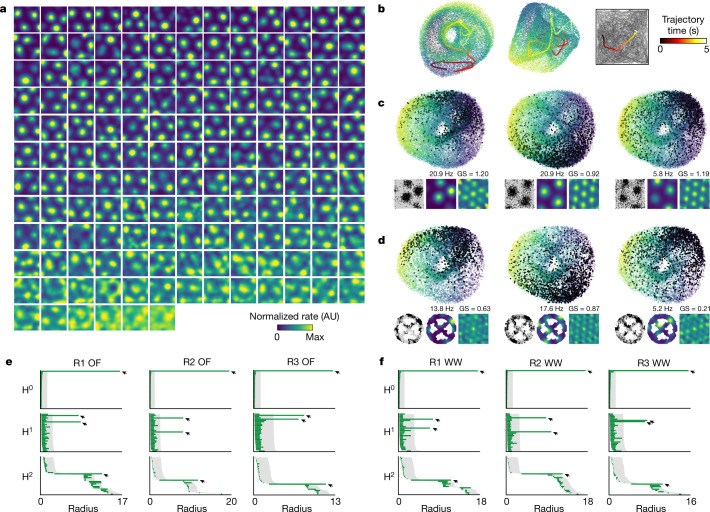
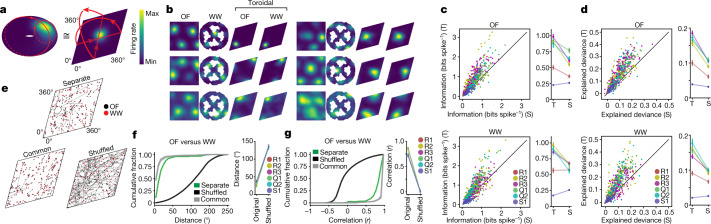
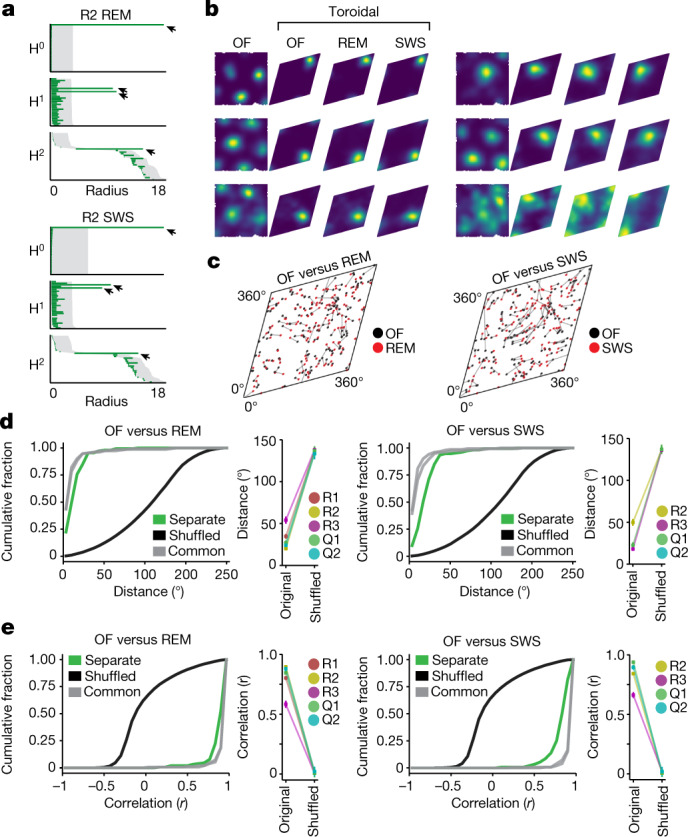
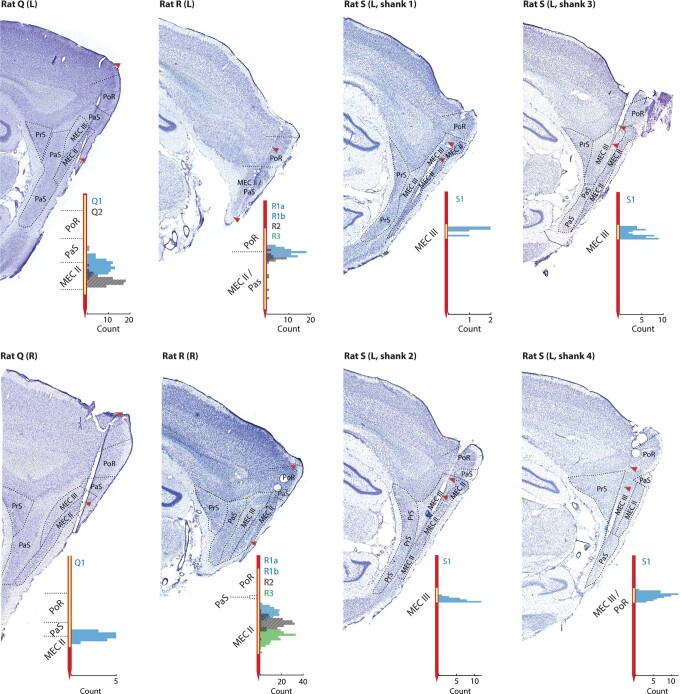
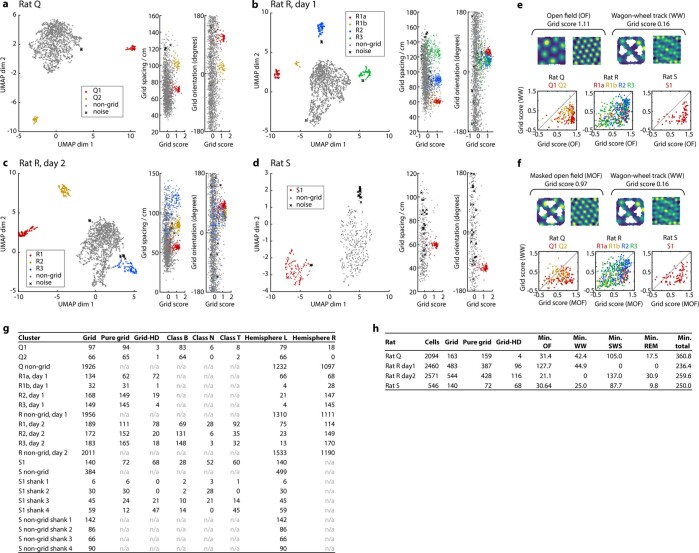
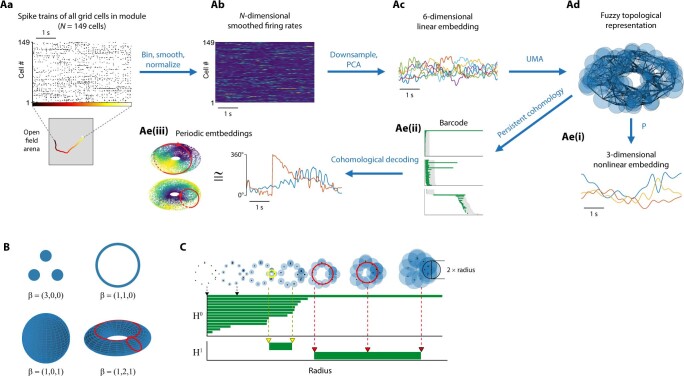
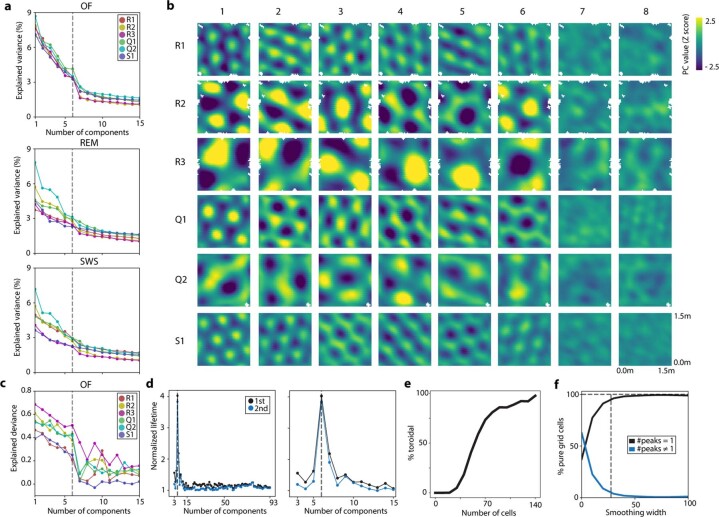
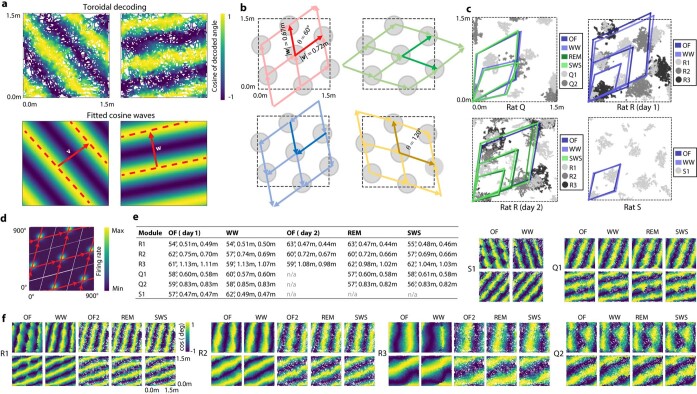
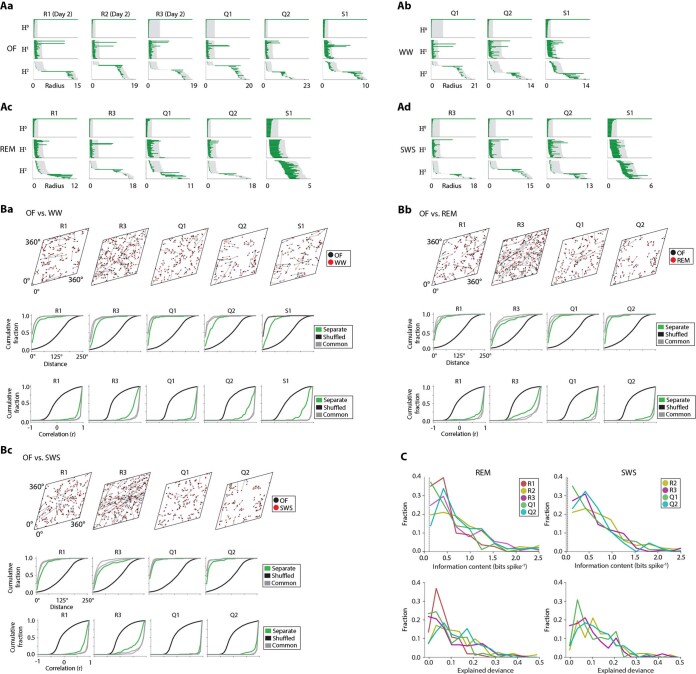
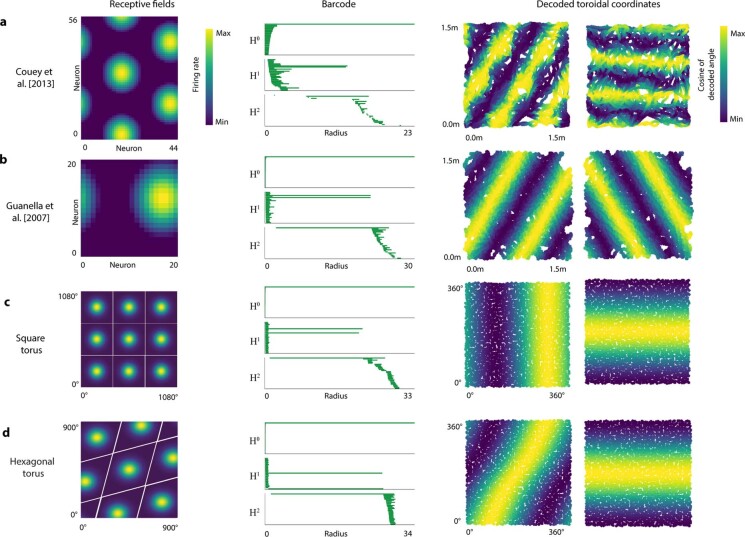
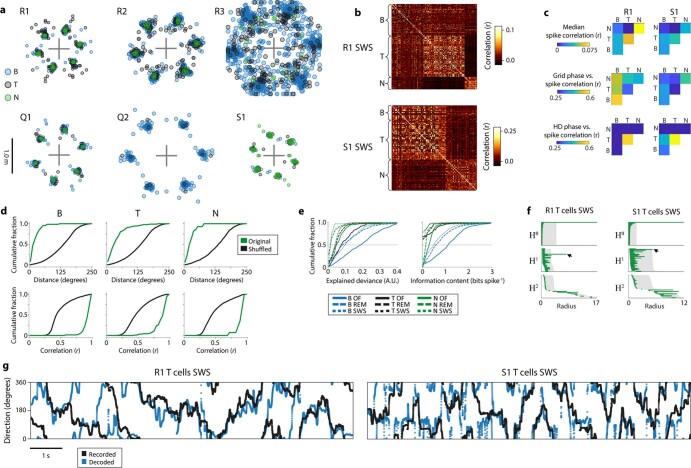
The medial entorhinal cortex is part of a neural system for mapping the position of an individual within a physical environment 1 . Grid cells, a key component of this system, fire in a characteristic hexagonal pattern of locations 2 , and are organized in modules 3 that collectively form a population code for the animal’s allocentric position 1 . The invariance of the correlation structure of this population code across environments 4,5 and behavioural states 6,7 , independent of specific sensory inputs, has pointed to intrinsic, recurrently connected continuous attractor networks (CANs) as a possible substrate of the grid pattern 1,8–11 . However, whether grid cell networks show continuous attractor dynamics, and how they interface with inputs from the environment, has remained unclear owing to the small samples of cells obtained so far. Here, using simultaneous recordings from many hundreds of grid cells and subsequent topological data analysis, we show that the joint activity of grid cells from an individual module resides on a toroidal manifold, as expected in a two-dimensional CAN. Positions on the torus correspond to positions of the moving animal in the environment. Individual cells are preferentially active at singular positions on the torus. Their positions are maintained between environments and from wakefulness to sleep, as predicted by CAN models for grid cells but not by alternative feedforward models 12 . This demonstration of network dynamics on a toroidal manifold provides a population-level visualization of CAN dynamics in grid cells.
Overview
The claims and statistics of this paper haven’t been checked yet.
Free: it reads the open-access text and checks the first 5 claims that cite a source we can check. Create a free account to check every claim.
Integrity signals
Registry
Cites
Statistics
Figures
Verification
Claims the paper makes
The claims and statistics of this paper haven’t been checked yet.
Free: it reads the open-access text and checks the first 5 claims that cite a source we can check. Create a free account to check every claim.
Claims other papers make about this one
Each is checked against this paper’s own text: does it say what the citing paper says it does?
The cited source says what the claim attributes to it.
In the citing paper
“For all topological analyses, the six-dimensional pointcloud was further downsampled using the procedure proposed by Gardner et al. This was done to reduce the impact of spurious activity, as persistent homology can be sensitive to outliers.11”
From Coherently remapping toroidal cells but not Grid cells are responsible for path integration in virtual agents (2023) · cites this paper as [11]
The cited source says what the claim attributes to it.
In the citing paper
“This was done to reduce the impact of spurious activity, as persistent homology can be sensitive to outliers.11”
From Coherently remapping toroidal cells but not Grid cells are responsible for path integration in virtual agents (2023) · cites this paper as [11]
Self-check
Percentages, sums and reported differences re-computed from the paper’s own numbers.
The self-check needs the paper’s full text.
Citations
Cites
UMAP: Uniform Manifold Approximation and Projection
McInnes, L., Healy, J., Saul, N., & Großberger, L. (2018) · Journal of Open Source Software · doi:10.21105/joss.00861 · Cited by 9,826
UMAP: Uniform Manifold Approximation and Projection for Dimension Reduction
McInnes, L., Healy, J., & Melville, J. (2018) · arXiv · doi:10.48550/arxiv.1802.03426 · Cited by 7,101
Microstructure of a spatial map in the entorhinal cortex
Hafting, T., Fyhn, M., Molden, S., Moser, M.-B., & Moser, E. I. (2005) · Nature · doi:10.1038/nature03721 · Cited by 4,068
Self-citationFully integrated silicon probes for high-density recording of neural activity
Jun, J. J., Steinmetz, N. A., Siegle, J. H., Denman, D. J., Bauza, M., Barbarits, B., Lee, A. K., Anastassiou, C. A., Andrei, A., Aydın, Ç., et al. (2017) · Nature · doi:10.1038/nature24636 · Cited by 2,190
Self-citationDynamics of pattern formation in lateral-inhibition type neural fields
Amari, S.-I. (1977) · Biological Cybernetics · doi:10.1007/bf00337259 · Cited by 2,060
Path integration and the neural basis of the 'cognitive map'
McNaughton, B. L., Battaglia, F. P., Jensen, O., Moser, E. I., & Moser, M.-B. (2006) · Nature Reviews Neuroscience · doi:10.1038/nrn1932 · Cited by 2,024
Self-citationTaube, J., Muller, R., & Ranck, J. (1990) · The Journal of Neuroscience · doi:10.1523/jneurosci.10-02-00420.1990 · Cited by 1,809
Conjunctive Representation of Position, Direction, and Velocity in Entorhinal Cortex
Sargolini, F., Fyhn, M., Hafting, T., McNaughton, B. L., Witter, M. P., Moser, M.-B., & Moser, E. I. (2006) · Science · doi:10.1126/science.1125572 · Cited by 1,485
Self-citationMemory of sequential experience in the hippocampus during slow wave sleep
Lee, A. K., & Wilson, M. A. (2002) · Neuron · doi:10.1016/s0896-6273(02)01096-6 · Cited by 1,296
Neuropixels 2.0: A miniaturized high-density probe for stable, long-term brain recordings.
Steinmetz, N. A., Aydin, C., Lebedeva, A., Okun, M., Pachitariu, M., Bauza, M., Beau, M., Bhagat, J., Böhm, C., Broux, M., et al. (2021) · Science · doi:10.1126/science.abf4588 · Cited by 1,173
Self-citation
Research works printed but not linked: 6
- Skaggs W Mcnaughton B Gothard K An information-theoretic approach to deciphering the hippocampal code Adv. Neural Inf. Process. Syst. 1992 5 1030 1037
- Bellman, R. Dynamic Programming (Princeton Univ. Press, 1957).
- Spivak, D. I. Metric realization of fuzzy simplicial sets https://www.semanticscholar.org/paper/metric-realization-of-fuzzy-simplicial-sets-spivak/a73fb9d562a3850611d2615ac22c3a8687fa745e (Semantic Scholar, 2009).
- Hatcher, A. Algebraic Topology (Cambridge University Press, 2002).
- Tsodyks M Sejnowski TJ Associative memory and hippocampal place cells Int. J. Neural Syst. 1995 6 81 86
- Stepanyuk A Self-organization of grid fields under supervision of place cells in a neuron model with associative plasticity Biol. Inspired Cogn. Archit. 2015 13 48 62
Cited by
Items 101–200 of 486
Modeling the neurocognitive dynamics of language across the lifespan
Guichet, C., Banjac, S., Achard, S., Mermillod, M., & Baciu, M. (2024) · Human Brain Mapping · doi:10.1002/hbm.26650 · Cited by 16
“, 2011), topological (Gardner et al., 2021; Giusti et al., 2015), and theoretical justification for quantifying how the synergy-redundancy balance evolves across the lifespan to mitigate cognitive decline (Gatica et al.”
BackgroundNeural Activity in Quarks Language: Lattice Field Theory for a Network of Real Neurons
Bardella, G., Franchini, S., Pan, L., Balzan, R., Ramawat, S., Brunamonti, E., Pani, P., & Ferraina, S. (2024) · Entropy · doi:10.3390/e26060495 · Cited by 25
“Ωz := {Ωxyz ∈ {0,1} Vxyz : xy ∈ L2, α ∈ S}, (6)”
Zhou, Q., Duan, X., & Yu, G. (2025) · Chaos Solitons & Fractals · doi:10.1016/j.chaos.2025.116498 · Cited by 17
Piray, P., & Daw, N. D. (2025) · Nature Communications · doi:10.1038/s41467-025-62733-7 · Cited by 22
“In particular, new electrophysiological techniques now enable simultaneous recording of hundreds of MEC neurons during navigation 82 .”
Symmetries and continuous attractors in disordered neural circuits
Clark, D. G., Abbott, L. F., & Sompolinsky, H. (2026) · Nature Neuroscience · doi:10.1038/s41593-026-02452-4 · Cited by 17
Donato, F., Schwartzlose, A. X., & Mendes, R. A. V. (2023) · Annual Review of Neuroscience · doi:10.1146/annurev-neuro-090922-010618 · Cited by 22
Clark, H., & Nolan, M. F. (2024) · eLife · doi:10.7554/elife.89356 · Cited by 17
Spatio-temporal transformers for decoding neural movement control
Candelori, B., Bardella, G., Spinelli, I., Ramawat, S., Pani, P., Ferraina, S., & Scardapane, S. (2025) · Journal of Neural Engineering · doi:10.1088/1741-2552/adaef0 · Cited by 18
Evolution of Brains and Computers: The Roads Not Taken
Solé, R., & Seoane, L. F. (2022) · Entropy · doi:10.3390/e24050665 · Cited by 14
Printing technologies for monitoring crop health
Panáček, D., Kupka, V., Nalepa, M., Dědek, I., Álvarez-Diduk, R., Olenik, S., Flauzino, J. M. R., Zdražil, J., Jakubec, P., Zdražil, L., et al. (2026) · Nature Communications · doi:10.1038/s41467-026-68778-6 · Cited by 16
“This is not a theoreticalcuriosity:neural population activity canorganize on a torus, reminding us that real biological processes often evolve along low-dimensional, manifold structure 332 .”
Quantitative modeling of the emergence of macroscopic grid-like representations
Khalid, I. B., Reifenstein, E. T., Auer, N., Kunz, L., & Kempter, R. (2024) · eLife · doi:10.7554/elife.85742 · Cited by 14
Nonlinear partial differential equations in neuroscience: From modeling to mathematical theory
Carrillo, J. A., & Roux, P. (2025) · Mathematical Models and Methods in Applied Sciences · doi:10.1142/s0218202525400044 · Cited by 21
A cognitive–motor framework for spatial navigation in aging and early-stage Alzheimer's disease
Hill, P. F., & Ekstrom, A. D. (2025) · Cortex · doi:10.1016/j.cortex.2025.02.003 · Cited by 14
Spatial reasoning via recurrent neural dynamics in mouse retrosplenial cortex
Voigts, J., Kanitscheider, I., Miller, N. J., Toloza, E. H. S., Newman, J. P., Fiete, I., & Harnett, M. T. (2025) · Nature Neuroscience · doi:10.1038/s41593-025-01944-z · Cited by 17
“Further, hippocampal circuits contribute to spatial computations beyond representing space by learning environmental topology 29 and constraining spatial coding using attractor dynamics 19,30,31 shaped by previous experience 32 .”
Jankowski, M. M., Polterovich, A., Kazakov, A., Niediek, J., & Nelken, I. (2023) · BMC Biology · doi:10.1186/s12915-023-01660-9 · Cited by 16
“Other sensors can be added as well, such as motion capture setups [57, 58] and a more powerful video processing component.”
BackgroundRepix: reliable, reusable, versatile chronic Neuropixels implants using minimal componentsPreprint
Horan, M., Regester, D., Mazuski, C. N., Jahans-Price, T., Bailey, S., Thompson, E., Slonina, Z., Plattner, V. M., Menichini, E., Toksöz, I., et al. (2024) · eLife · doi:10.7554/elife.98977.1 · Cited by 14
Sutton, N. M., Gutiérrez-Guzmán, B. E., Dannenberg, H., & Ascoli, G. A. (2024) · International Journal of Molecular Sciences · doi:10.3390/ijms25116059 · Cited by 13
“Such firing is predicted to occur along a toroidal manifold [44].”
BackgroundSimony, E., Grossman, S., & Malach, R. (2024) · Proceedings of the National Academy of Sciences · doi:10.1073/pnas.2319709121 · Cited by 15
From sensory to perceptual manifolds: The twist of neural geometry
Ma, H., Jiang, L., Liu, T., & Liu, J. (2025) · Science Advances · doi:10.1126/sciadv.adv0431 · Cited by 13
“Previous studies on neural geometry have shown that neural manifolds can faithfully represent both stimulus ( 13, 18, 47 ) and action spaces ( 20 , 21 , 48 ).”
Processing of cell assemblies in the lateral entorhinal cortex
Traub, R. D., & Whittington, M. A. (2022) · Reviews in the Neurosciences · doi:10.1515/revneuro-2022-0011 · Cited by 15
“Gardner et al. (2022) have demonstrated the technical feasibility of recording simultaneously (but extracellularly) from hundreds of neurons in the medial entorhinal cortex.”
BackgroundParra, S., Díaz, H., Zainos, A., Álvarez, M., Zizumbo, J., Rivera‐Yoshida, N., Pujalte, S., Bayones, L., Romo, R., & Rossi-Pool, R. (2022) · Proceedings of the National Academy of Sciences · doi:10.1073/pnas.2213847119 · Cited by 14
“In other reports, this algo-rithm has revealed interesting dynamic and geometric properties (46, 47).”
Grid codes underlie multiple cognitive maps in the human brain
Chen, D., Axmacher, N., & Wang, L. (2024) · Progress in Neurobiology · doi:10.1016/j.pneurobio.2024.102569 · Cited by 13
Homological Landscape of Human Brain Functional Sub-Circuits
Duong-Tran, D. A., Kaufmann, R. M., Chen, J., Wang, X., Garai, S., Xu, F. H., Bao, J., Amico, E., Kaplan, A. D., Petri, G., et al. (2024) · Mathematics · doi:10.3390/math12030455 · Cited by 15
“…complex networks, higher-order interactions among neuron populations, at the whole-brain level, have been shown to unravel complementary insights that otherwise, would not be fully appreciated by conventional node-based (zeroth-order) or edge-based (first-order) investigations [2,4–6, 30, 31 ].”
A topological deep learning framework for neural spike decoding
Mitchell, E. C., Story, B., Boothe, D. L., Franaszczuk, P. J., & Maroulas, V. (2024) · Biophysical Journal · doi:10.1016/j.bpj.2024.01.025 · Cited by 13
Feedforward amplification in recurrent networks underlies paradoxical neural codingPreprint
Daie, K., Fontolan, L., Druckmann, S., & Svoboda, K. (2023) · bioRxiv (Cold Spring Harbor Laboratory) · doi:10.1101/2023.08.04.552026 · Cited by 18
“2019), ego-centric position (Gardner et al. 2022), behavioral context (Mante et al.”
BackgroundMethodSLAy-ing oversplitting errors in high-density electrophysiology spike sortingPreprint
Koukuntla, S., DeWeese, T., Cheng, A., Mildren, R. L., Lawrence, A., Graves, A. R., Cullen, K. E., Colonell, J. I., Harris, T. D., & Charles, A. S. (2025) · bioRxiv (Cold Spring Harbor Laboratory) · doi:10.1101/2025.06.20.660590 · Cited by 14
“By providing an automated method to correct template matching errors, SLAy stands to improve the efficiency of ephys data processing while maintaining the validity of downstream scientific conclusions.”
Noise-driven bifurcations in a nonlinear Fokker–Planck system describing stochastic neural fields
Carrillo, J. A., Roux, P., & Solem, S. (2023) · Physica D Nonlinear Phenomena · doi:10.1016/j.physd.2023.133736 · Cited by 12
“Furthermore, novel evidence pointing towards a toroidal connectivity for grid cells has recently been provided in [18] by using topological data analysis tools.”
MethodQuantifying the distribution of feature values over data represented in arbitrary dimensional spaces
Sebastian, E. R., Esparza, J., & de la Prida, L. M. (2024) · PLoS Computational Biology · doi:10.1371/journal.pcbi.1011768 · Cited by 12
An abstract categorical decision code in dorsal premotor cortex
Diaz-deLeon, G., Álvarez, M., Bayones, L., Zainos, A., Zizumbo, J., Parra, S., Pujalte, S., Romo, R., Rossi-Pool, R., & de Lafuente, V. (2022) · Proceedings of the National Academy of Sciences · doi:10.1073/pnas.2214562119 · Cited by 14
“This method was recently applied to identify grid cells in the entorhinal cortex and reveal the toroidal geometry underlying their responses 38.”
A Taxonomy of Neuroscientific Strategies Based on Interaction Orders
Neri, M., Brovelli, A., Castro, S., Fraisopi, F., Gatica, M., Herzog, R. A., Mediano, P. A. M., Mindlin, I., Petri, G., Bor, D., et al. (2025) · European Journal of Neuroscience · doi:10.1111/ejn.16676 · Cited by 15
Topological insights into the neural basis of flexible behavior
Rouse, T. C., Ni, A. M., Huang, C., & Cohen, M. R. (2023) · Proceedings of the National Academy of Sciences · doi:10.1073/pnas.2219557120 · Cited by 11
Visual boundary cues suffice to anchor place and grid cells in virtual reality
Yang, X., Cacucci, F., Burgess, N., Wills, T. J., & Chen, G. (2024) · Current Biology · doi:10.1016/j.cub.2024.04.026 · Cited by 13
Structured Dynamics in the Algorithmic Agent
Ruffini, G., Castaldo, F., & Vohryzek, J. (2025) · Entropy · doi:10.3390/e27010090 · Cited by 14
Excitatory-inhibitory recurrent dynamics produce robust visual grids and stable attractors
Zhang, X., Long, X., Zhang, S., & Chen, Z. S. (2022) · Cell Reports · doi:10.1016/j.celrep.2022.111777 · Cited by 14
“Furthermore, our E/I-RNN models reveal torus-like manifolds and attractors in a low-dimensional space, consistent with the other experimental and computational findings (Gardner et al. 2022; Sorscher et al. 2020).”
MethodResultBayones, L., Zainos, A., Álvarez, M., Romo, R., Franci, A., & Rossi-Pool, R. (2024) · Proceedings of the National Academy of Sciences · doi:10.1073/pnas.2316765121 · Cited by 12
“This method was recently used in a variety of contexts, from sorting neuron types (30, 31) to uncovering the toroidal geometry underlying grid cell response (32).”
Extreme manufacturing of minimally invasive intracortical neural electrodes
Xu, M., Zhu, Z., Ma, H., Zhou, G., Iliasov, A., Chen, Z., Tsang, W. M., Wu, J., Li, C., Wei, X., et al. (2025) · International Journal of Extreme Manufacturing · doi:10.1088/2631-7990/ae2579 · Cited by 11
Multiple bumps can enhance robustness to noise in continuous attractor networks
Wang, R., & Kang, L. (2022) · PLoS Computational Biology · doi:10.1371/journal.pcbi.1010547 · Cited by 15
Fernández-León, J. A., Uysal, A. K., & Ji, D. (2022) · Scientific Reports · doi:10.1038/s41598-022-25863-2 · Cited by 10
Stereotyped goal-directed manifold dynamics in the insular cortex
Talpir, I., & Livneh, Y. (2024) · Cell Reports · doi:10.1016/j.celrep.2024.114027 · Cited by 10
Kristensen, S. S., Kesgin, K., & Jörntell, H. (2024) · Communications Biology · doi:10.1038/s42003-024-06743-z · Cited by 14
Neural models and algorithms for sensorimotor control of an octopus arm
Wang, T., Halder, U., Gribkova, E., Gillette, R., Gazzola, M., & Mehta, P. G. (2025) · Biological Cybernetics · doi:10.1007/s00422-025-01019-z · Cited by 11
“III-A.).”
Noise-driven bifurcations in a neural field system modelling networks of grid cells
Carrillo, J. A., Holden, H., & Solem, S. (2022) · Journal of Mathematical Biology · doi:10.1007/s00285-022-01811-6 · Cited by 16
“In accordance with previous experimental studies and general belief in the field, the results in Gardner et al. (2022) provided further evidence in favour of describing the grid cell network by continuous attractor network dynamics through a system of neural field models (Ermentrout and Terman…”
BackgroundResultInfluentialFlexible neural representations of abstract structural knowledge in the human entorhinal cortexPreprint
Mark, S., Schwartenbeck, P., Hahamy, A., Samborska, V., Baram, A. B., & Behrens, T. E. J. (2026) · eLife · doi:10.7554/elife.101134 · Cited by 11
“A mathematical corollary is that grid cells’ activity lies in the same low-dimensional subspace (manifold, ( Yoon et al .”
InfluentialA hippocampal population code for rapid generalizationPreprint
Tang, W., Chang, H., Liu, C., Perez-Hernandez, S., Zheng, W. Y., Park, J., Oliva, A., & Fernández‐Ruiz, A. (2025) · bioRxiv (Cold Spring Harbor Laboratory) · doi:10.1101/2025.03.15.643456 · Cited by 11
“Persistent (co)homology is a tool in topological data analysis with recent success in describing the ring topology of head direction cells 60 , torus of grid cells 61 and place fields in the hippocampus and subiculum 49 .”
InfluentialCognitive Maps for a Non-Euclidean Environment: Path Integration and Spatial Memory on a Sphere
Kim, M., & Doeller, C. F. (2024) · Psychological Science · doi:10.1177/09567976241279291 · Cited by 9
“…imply that a minimal experience with a typical environment is necessary for maturation of 2D grid fields that are anchored to an environment, but the topology of grid cells for a 2D flat surface is preconfigured independently of experience (Gardner et al., 2022; Ulsaker-Janke et al., 2023).”
Materials Selection Principles for Designing Electro‐Thermal Neurons
Jardali, F., Chong, J. L., Yu, Y., Williams, R. S., Kumar, S., Shamberger, P. J., & Brown, T. D. (2025) · Advanced Electronic Materials · doi:10.1002/aelm.202400938 · Cited by 9
The postsubiculum as a head-direction cortex
Duszkiewicz, A. J., Fricker, D., Burgalossi, A., & Peyrache, A. (2025) · Trends in Neurosciences · doi:10.1016/j.tins.2025.09.004 · Cited by 9
Explicit error coding can mediate gain recalibration in continuous bump attractor networks
Secer, G., Knierim, J. J., & Cowan, N. J. (2025) · Nature Communications · doi:10.1038/s41467-025-63817-0 · Cited by 9
“Similar approaches have recently been applied to explore the evolution of high-dimensional neural data within low-dimensional structures 6,15,65 .”
Large-scale electrophysiology at single-spike resolution
Siegle, J. H., & Steinmetz, N. A. (2026) · Nature reviews. Neuroscience · doi:10.1038/s41583-026-01042-4 · Cited by 14
Tracking the topology of neural manifolds across populations
Yoon, I. H. R., Henselman‐Petrusek, G., Yu, Y., Ghrist, R., Smith, S. L., & Giusti, C. (2024) · Proceedings of the National Academy of Sciences · doi:10.1073/pnas.2407997121 · Cited by 13
Lefebvre, J., & Hutt, A. (2023) · Chaos An Interdisciplinary Journal of Nonlinear Science · doi:10.1063/5.0167771 · Cited by 9
Beshkov, K., Fyhn, M., Hafting, T., & Einevoll, G. T. (2024) · iScience · doi:10.1016/j.isci.2024.109370 · Cited by 12
“In the context of grid cells, pre-viousworkhasmadeuseofclusteringmethodstoidentifycellswhoseactivityplaysaroleingeneratingatorus 25 (theneuralmanifoldregularly observed in grid cell recordings).”
BackgroundQuantifying Extrinsic Curvature in Neural Manifolds
Acosta, F., Sanborn, S., Duc, K. D., Madhav, M. S., & Miolane, N. (2022) · 2023 IEEE/CVF Conference on Computer Vision and Pattern Recognition Workshops (CVPRW) · doi:10.1109/cvprw59228.2023.00068 · Cited by 14
“Learning the Topology of Neural Manifolds Methods based on topological data analysis (TDA), such as persistent homology, have begun to reveal topological structure in neural representations and the task variables they encode [10, 14, 21, 26].”
BackgroundModeled grid cells aligned by a flexible attractorPreprint
Benas, S., Fernández, X., & Kropff, E. (2023) · eLife · doi:10.7554/elife.89851 · Cited by 9
Huber, D. E. (2025) · eLife · doi:10.7554/elife.95733 · Cited by 8
Redman, W. T., Acosta–Mendoza, S., Wei, X.-X., & Goard, M. J. (2025) · eLife · doi:10.7554/elife.100652.3 · Cited by 8
The sloppy relationship between neural circuit structure and function
Hennig, M. H. (2022) · The Journal of Physiology · doi:10.1113/jp282757 · Cited by 9
“A more complex manifold was recently characterised in grid cell populations of the medial entorhinal cortex (Gardner et al., 2022), which has a doughnut-shaped geometry as predicted by theoretical work (Chaudhuri et al.”
BackgroundMethodConnecting Connectomes to Physiology
Borst, A., & Leibold, C. (2023) · Journal of Neuroscience · doi:10.1523/jneurosci.2208-22.2023 · Cited by 9
“At the same time, we witness simultaneous optical (Ghosh et al., 2011; Aimon et al., 2019; Kim and Schnitzer, 2022) and electrical (Buzsaki et al., 2015; Jun et al., 2017; Steinmetz et al., 2019; Allen et al., 2019; Gardner et al., 2022) recordings of many hundreds of neurons.”
BackgroundThalamocortical interactions shape hierarchical neural variability during stimulus perception
Campo, A. T., Zainos, A., Vázquez, Y., Segarra, R. A., Álvarez, M., Deco, G., Díaz, H., Parra, S., Romo, R., & Rossi-Pool, R. (2024) · iScience · doi:10.1016/j.isci.2024.110065 · Cited by 8
“We next characterize the neuronal activity of each area according to both sources of variability.”
Low-dimensional neural manifolds for the control of constrained and unconstrained movementsPreprint
Altan, E., Ma, X., Miller, L. E., Perreault, E. J., & Solla, S. A. (2023) · bioRxiv (Cold Spring Harbor Laboratory) · doi:10.1101/2023.05.25.542264 · Cited by 10
Huang, L.-W., Garden, D. L. F., McClure, C., & Nolan, M. F. (2024) · eLife · doi:10.7554/elife.92854 · Cited by 8
Spatial periodicity in grid cell firing is explained by a neural sequence code of 2-D trajectoriesPreprint
Rebecca, R. G., Ascoli, G. A., Sutton, N. M., & Dannenberg, H. (2025) · eLife · doi:10.7554/elife.96627 · Cited by 8
Functional independence of entorhinal grid cell modules enables remapping in hippocampal place cellsPreprint
Lykken, C. M., Kanter, B. R., Nagelhus, A., Carpenter, J., Guardamagna, M., Moser, E. I., & Moser, M. (2025) · bioRxiv (Cold Spring Harbor Laboratory) · doi:10.1101/2025.09.24.677985 · Cited by 10
Self-citationWhat neuroscience can tell AI about learning in continuously changing environments
Durstewitz, D., Averbeck, B. B., & Koppe, G. (2025) · Nature Machine Intelligence · doi:10.1038/s42256-025-01146-z · Cited by 12
Nair, A., Vinograd, A., Liu, M., Mountoufaris, G., Linderman, S. W., & Anderson, D. J. (2025) · Neuron · doi:10.1016/j.neuron.2025.11.003 · Cited by 11
Neural population activity for memory: Properties, computations, and codes
Dupret, D., Fusi, S., & Panzeri, S. (2025) · Neuron · doi:10.1016/j.neuron.2025.11.007 · Cited by 8
“Curved spaces can result from attractor dynamics 105,106 .”
Intrinsic theta oscillation in the attractor network of grid cells
Wang, Z., Wang, T., Yang, F., Liu, F., & Wang, W. (2023) · iScience · doi:10.1016/j.isci.2023.106351 · Cited by 7
“Notably, both the assumptions and predictions of the CANmodel and its extensions have been extensively validated in experiments.(4,12,17,22,23)”
BackgroundAttractor-Based Models for Sequences and Pattern Generation in Neural Circuits
Alvarez, J. L., Morrison, K., & Curto, C. (2026) · Neural Computation · doi:10.1162/neco.a.1492 · Cited by 11
Simulation of oscillatory dynamics induced by an approximation of grid cell output
Traub, R. D., Whittington, M. A., & Cunningham, M. O. (2022) · Reviews in the Neurosciences · doi:10.1515/revneuro-2022-0107 · Cited by 8
Ohki, T., Kunii, N., & Chao, Z. C. (2023) · Reviews in the Neurosciences · doi:10.1515/revneuro-2022-0137 · Cited by 8
Etemadi, L., Enander, J. M. D., & Jörntell, H. (2023) · iScience · doi:10.1016/j.isci.2023.106885 · Cited by 9
“15,16 More recently, we showed that manipulation of the internal cortical state through electrical activation of a remote neocortical area can change the preferred network solutions, or the types of response states observed in SI neurons, for every given tactile input pattern.”
DREiMac: Dimensionality Reduction with Eilenberg-MacLane Coordinates
Perea, J. A., Scoccola, L., & Tralie, C. J. (2023) · The Journal of Open Source Software · doi:10.21105/joss.05791 · Cited by 12
“Topological coordinatization is witnessing increased application in domains such as neuroscience (Gardner et al., 2022; Kang et al., 2021; Rybakken et al., 2019), dynamical systems (Vejdemo-Johansson et al., 2015), and dimensionality reduction (Scoccola & Perea, 2023).”
BackgroundOngstad, S. (2022) · Biosemiotics · doi:10.1007/s12304-022-09477-9 · Cited by 7
“On the day of finishing this article a Norwegian newspaper announced that a research group (Gardner et al., 2021) at the Norwegian University of Science and Technology, NTNU, lead by the Nobel prize winners E.”
BackgroundNeurons in the human entorhinal cortex map abstract emotion spacePreprint
Qasim, S. E., Reinacher, P. C., Brandt, A., Schulze‐Bonhage, A., & Kunz, L. (2023) · bioRxiv (Cold Spring Harbor Laboratory) · doi:10.1101/2023.08.10.552884 · Cited by 7
Disentangling Representations through Multi-task Learning
Vafidis, P., Bhargava, A., & Rangel, A. (2025) · International Conference on Learning Representations · doi:10.48550/arxiv.2407.11249 · Cited by 7
“We learn abstract representations in the form of a 2D ”sheet” continuous attractor, while the computational substrate for path integration is a 2D toroidal attractor (Gardner et al., 2022; Sorscher et al., 2023) – not an abstract representation.”
Tiwari, A., & Roy, B. K. (2025) · International Journal of Bifurcation and Chaos · doi:10.1142/s021812742530006x · Cited by 6
An independent coding scheme for idiothetic distance in the hippocampus
Nordlund, M., Levernier, N., Trippa, M., Bourboulou, R., Marti, G., Monasson, R., Rouault, H., Epsztein, J., & Koenig, J. (2025) · Current Biology · doi:10.1016/j.cub.2025.07.050 · Cited by 6
“13,15,34 To test whether similar dynamics might underlie relative distance coding, we looked for rigid distance relationships between hippocampal firing across laps in the CP condition.”
InfluentialMonths-long stability of the head-direction system
Carrasco, S. S., Viejo, G. D., & Peyrache, A. (2026) · Nature · doi:10.1038/s41586-025-10096-w · Cited by 8
Querying hippocampal replay with subcortical inputs
Peyrache, A. (2022) · Current Opinion in Neurobiology · doi:10.1016/j.conb.2022.102645 · Cited by 8
Dynamical self-organization and efficient representation of space by grid cells
DiTullio, R. W., & Balasubramanian, V. (2021) · Current Opinion in Neurobiology · doi:10.1016/j.conb.2021.11.007 · Cited by 7
Versteeg, C., Sedler, A. R., McCart, J., & Pandarinath, C. (2023) · PubMed Central · doi:10.48550/arxiv.2309.06402 · Cited by 8
“While obtaining interpretable dynamics is our primary goal, models that allow unsupervised recovery of the embedding geometry may provide additional insight about the computations performed by the neural system [43, 7].”
A topological perspective on the dual nature of the neural state space and the correlation structurePreprint
Vaupel, M., Hermansen, E., & Dunn, B. A. (2023) · bioRxiv (Cold Spring Harbor Laboratory) · doi:10.1101/2023.10.17.562775 · Cited by 6
“A similar setup for preprocessing the neural data as in [17] was used.”
BackgroundMethodInfluentialSelf-citationGao, R., Jiang, C., & Zhang, Y. (2025) · Neurocomputing · doi:10.1016/j.neucom.2025.130814 · Cited by 5
Three types of remapping with linear decoders: A population-geometric perspective
Martín-Sánchez, G., Machens, C. K., & Podlaski, W. F. (2025) · PLoS Computational Biology · doi:10.1371/journal.pcbi.1013545 · Cited by 5
“We made this choice for simplicity, but we note that our model can be straightforwardly extended to a “twisted” torus topology [133], which would correspond to the hexagonal geometry observed in grid cell data [91].”
Neural sampling from cognitive maps enables goal-directed imagination and planning
Lin, H., Yang, Y., Zhao, R. J., Pezzulo, G., & Maass, W. (2026) · Nature Machine Intelligence · doi:10.1038/s42256-026-01254-4 · Cited by 7
Five discoveries of Volodymyr Betz. Part one. Betz and the islands of entorhinal cortex
Medvediev, V. V., Cherkasov, V., Vaslovych, V. V., & Tsymbaliuk, V. (2023) · Ukrainian Scientific Medical Youth Journal · doi:10.32345/usmyj.1(136).2023.30-59 · Cited by 5
Shin, J. D., Tang, W., & Jadhav, S. P. (2023) · STAR Protocols · doi:10.1016/j.xpro.2023.102513 · Cited by 6
“Note: The hyperparameters used here are similar to previous studies.(12,13) ’cosine’, ’n_components’, 3, ’save_template_file’, ’all_umap_trials_novel.”
ResultLee, J., Mun, J., Choo, M., & Park, S. (2025) · npj Digital Medicine · doi:10.1038/s41746-025-01635-w · Cited by 5
Grid cell modules coordination improves accuracy and reliability for spatial navigation
Sarramone, L., & Fernández-León, J. A. (2025) · Cognitive Neurodynamics · doi:10.1007/s11571-025-10263-9 · Cited by 5
“…perspective, however, it should be quoted that the methodology presented in this work is an ideal-ization of how grid cell networks work that has been recently confirmed (Gardner et al. 2022), and our place field definition has been used in other works (Banino et al. 2018; Sorscher et al. 2019).”
Noisy Dynamical Systems Evolve Error Correcting Codes and Modularity
McCourt, T., Fiete, I., & Chuang, I. L. (2026) · PRX Life · doi:10.1103/7kcl-jshm · Cited by 5
“In particular, several examples of low dimensional manifolds have been discovered in the activity of particular neural circuits Chaudhuri et al. (2019); Gardner et al. (2022), which can be identified as topological codes.”
BackgroundFlexible neural representations of abstract structural knowledge in the human Entorhinal CortexPreprint
Mark, S., Schwartenbeck, P., Hahamy, A., Samborska, V., Baram, A. B., & Behrens, T. E. J. (2024) · eLife · doi:10.7554/elife.101134.1 · Cited by 5
Coordinated representational drift supports stable place coding in hippocampal CA1Preprint
Sylte, O. C., Kilias, A., Bartos, M., & Sauer, J. (2025) · bioRxiv (Cold Spring Harbor Laboratory) · doi:10.1101/2025.02.04.636428 · Cited by 8
Linking the structure of neuronal mechanisms to the structure of qualia
Maier, A., & Tsuchiya, N. (2026) · Philosophy and the Mind Sciences · doi:10.33735/phimisci.2025.11778 · Cited by 6
“…or abstractions of neuronal response data in multidimensional “latent spaces” yielded a plethora of remarkable new insights (Derdikman and Moser, 2010; Chen et al., 2014; Gallego et al., 2020; Deitch et al., 2021; Okazawa et al., 2021; Gardner et al., 2022; Rouse et al., 2023) (Figure 7a).”
Shaping Slow Manifolds in Equivariant Recurrent Neural Networks
Bernardo, A. D., Valente, A., Mastrogiuseppe, F., & Ostojic, S. (2026) · Neural Computation · doi:10.1162/neco.a.1577 · Cited by 4
Spatial periodicity in grid cell firing is explained by a neural sequence code of 2-D trajectories
Rebecca, R. G., Ascoli, G. A., Sutton, N. M., & Dannenberg, H. (2025) · eLife · doi:10.1101/2023.05.30.542747 · Cited by 4
Estimating neuronal firing density: A quantitative analysis of firing rate map algorithms
Grieves, R. M. (2023) · PLoS Computational Biology · doi:10.1371/journal.pcbi.1011763 · Cited by 5
A 0.00426 mm2 77.6-dB Dynamic Range VCO-Based CTDSM for Multi-Channel Neural Recording
Wang, S., Yang, X., Wang, C., Vilouras, A., & López, C. M. (2022) · Electronics · doi:10.3390/electronics11213477 · Cited by 4
Mingliang, 徐. X., Fangyuan, 李. L., Yueqi, 刘. L., Jinhui, 张. Z., Yazhou, 师. S., & Fei, 何. H. (2023) · Chinese Journal of Lasers · doi:10.3788/cjl221482 · Cited by 4
Constructing neural networks with pre-specified dynamics
Mininni, C. J., & Zanutto, B. S. (2024) · Scientific Reports · doi:10.1038/s41598-024-69747-z · Cited by 4
“It is known that the probability of finding a linearly separable problem increases with the dimensionality of the input vector (the number of neurons in our case) for a constant number of patterns to separate 15,45 .”
BackgroundMethodThe role of oscillations in grid cells’ toroidal topology
di Sarra, G., Jha, S., & Roudi, Y. (2025) · PLoS Computational Biology · doi:10.1371/journal.pcbi.1012776 · Cited by 6
“While in real data, the toroidal topology was reported for samples with largest population activity [12], we found that this is not true for random samples.”
Influential
Metadata
- Authors
- Gardner, R. J., Hermansen, E., Pachitariu, M., Burak, Y., Baas, N. A., Dunn, B. A., Moser, M.-B., & Moser, E. I.
- Affiliations
- Norwegian University of Science and Technology (NO)
- Howard Hughes Medical Institute (US)
- Hebrew University of Jerusalem (IL)
- Corresponding author
- Gardner, Richard J.
- Baas, Nils A.
- Dunn, Benjamin A.
- Moser, Edvard I.
- ORCID
- Venue
- Nature
- Published
- 2022-01-12
- Volume
- 602
- Issue
- 7895
- Pages
- 123-128
- ISSN
- 0028-0836 (ISSN-L)
- 1476-4687
- PMC
- PMC8810387
- OpenAlex
- W4205399426
- Cited by
- 428
- References
- 80
- Citations by year
- 2026: 79 · 2025: 108 · 2024: 99 · 2023: 89 · 2022: 48
- FWCI
- 44.35
- Type
- journal article
- Language
- en
- Open access
- hybrid
- doi.org
- Licence
- cc-by
- creativecommons.org/licenses/by/4.0 (tdm)
- creativecommons.org/licenses/by/4.0 (vor)
- Locations
- Nature (publishedVersion, cc-by)
- PubMed Central (publishedVersion, cc-by)
- PubMed (publishedVersion)
- Funders
- Kavli Foundation
- Norges Teknisk-Naturvitenskapelige Universitet
- Gatsby Charitable Foundation
- Israel Science Foundation
- Norges Forskningsråd (223262, 295721)
- Mattilsynet
- Division of Mathematical Sciences
- H2020 European Research Council (951319)
- Topics
- Life Sciences › Neuroscience › Cognitive Neuroscience › Memory and Neural Mechanisms
- Life Sciences › Neuroscience › Cognitive Neuroscience › Neural dynamics and brain function
- Social Sciences › Psychology › Experimental and Cognitive Psychology › Spatial Cognition and Navigation
- Keywords
- grid cells, continuous attractor networks, toroidal manifold, population activity, medial entorhinal cortex, spatial representation, topological data analysis, recurrent connectivity, sleep and wakefulness
- MeSH terms
- Grid Cells, Action Potentials, Animals, Male, Models, Neurological, Sleep, Space Perception, Wakefulness, Entorhinal Cortex, Rats, Long-Evans, Rats
About these checks
Registry, retraction, Cites and statistics results are computed, not judged, with one exception: a printed reference that no index lists is read once by a model before it counts as a citation error. Claims are extracted by a model and kept only when their quote appears verbatim in the text; each cited source is then checked, with a model’s help, for whether it says what the claim relies on. Those verdicts can be wrong — read the claim’s quote and the cited source before relying on one.
Statistics and arithmetic are recomputed, not judged.
Confidence bands are shown only for fields calibrated on our annotated test set. None is calibrated yet, so no band is shown.
What counts as a claim ›How we measure confidence ›How we check this ›
Are you an author, or do you see a problem with this page? Request a review
Data sources
Bibliographic data: Semantic Scholar, OpenAlex, Crossref.
Contains information from the Semantic Scholar Academic Graph Datasets, made available under the ODC Attribution License (ODC-BY 1.0).
Semantic Scholar’s data is described in: Kinney, R., et al. (2023). The Semantic Scholar Open Data Platform. arXiv:2301.10140.
