

A compute-in-memory chip based on resistive random-access memory
Open accessThe DOI matches its Crossref record; 65 of the 66 references it cites were found in a registry or an index; 15 of the 35 sources its claims cite were checked for support.
Abstract
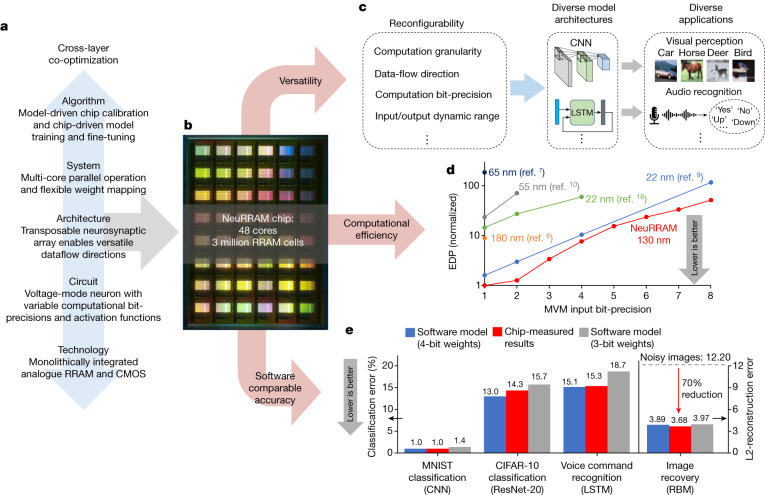
Abstract Realizing increasingly complex artificial intelligence (AI) functionalities directly on edge devices calls for unprecedented energy efficiency of edge hardware. Compute-in-memory (CIM) based on resistive random-access memory (RRAM) 1 promises to meet such demand by storing AI model weights in dense, analogue and non-volatile RRAM devices, and by performing AI computation directly within RRAM, thus eliminating power-hungry data movement between separate compute and memory 2–5 . Although recent studies have demonstrated in-memory matrix-vector multiplication on fully integrated RRAM-CIM hardware 6–17 , it remains a goal for a RRAM-CIM chip to simultaneously deliver high energy efficiency, versatility to support diverse models and software-comparable accuracy. Although efficiency, versatility and accuracy are all indispensable for broad adoption of the technology, the inter-related trade-offs among them cannot be addressed by isolated improvements on any single abstraction level of the design. Here, by co-optimizing across all hierarchies of the design from algorithms and architecture to circuits and devices, we present NeuRRAM—a RRAM-based CIM chip that simultaneously delivers versatility in reconfiguring CIM cores for diverse model architectures, energy efficiency that is two-times better than previous state-of-the-art RRAM-CIM chips across various computational bit-precisions, and inference accuracy comparable to software models quantized to four-bit weights across various AI tasks, including accuracy of 99.0 percent on MNIST 18 and 85.7 percent on CIFAR-10 19 image classification, 84.7-percent accuracy on Google speech command recognition 20 , and a 70-percent reduction in image-reconstruction error on a Bayesian image-recovery task.
Overview
CoChat Summary
TL;DR
NeuRRAM is a 48-core RRAM compute-in-memory chip that co-optimizes device, circuit, architecture, system, and algorithm choices to support reconfigurable AI inference with hardware-measured accuracy. The paper reports better energy-delay product than prior RRAM-CIM chips and benchmark results of 99.0% on MNIST, 85.7% on CIFAR-10, 84.7% on Google speech commands, and a 70% reduction in image-reconstruction error on MNIST image recovery.
Key findings
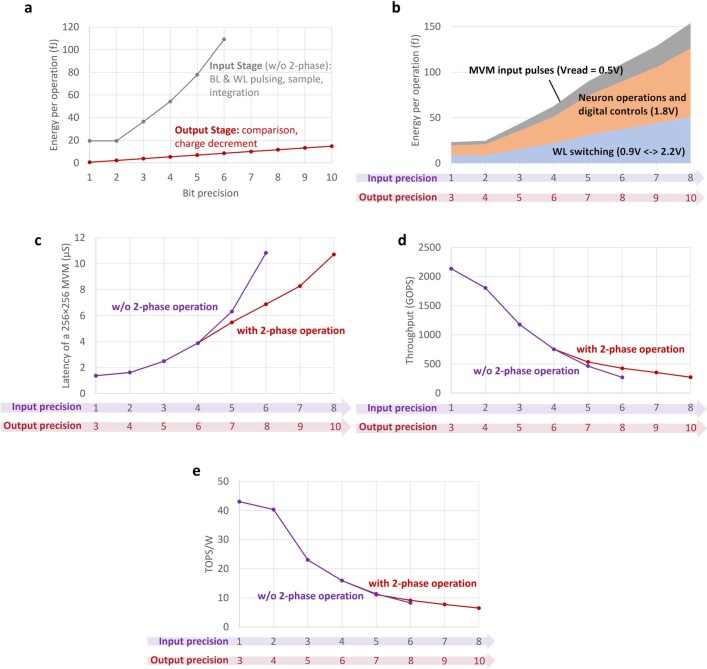
- The chip achieves an energy-delay product that is 1.6× to 2.3× lower than previous state-of-the-art RRAM-CIM chips, and 7× to 13× higher computational density at various MVM bit-precisions.
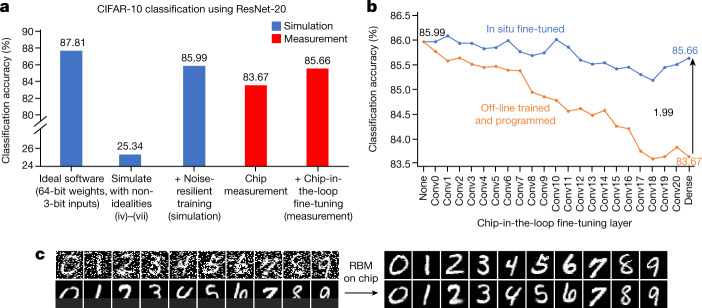
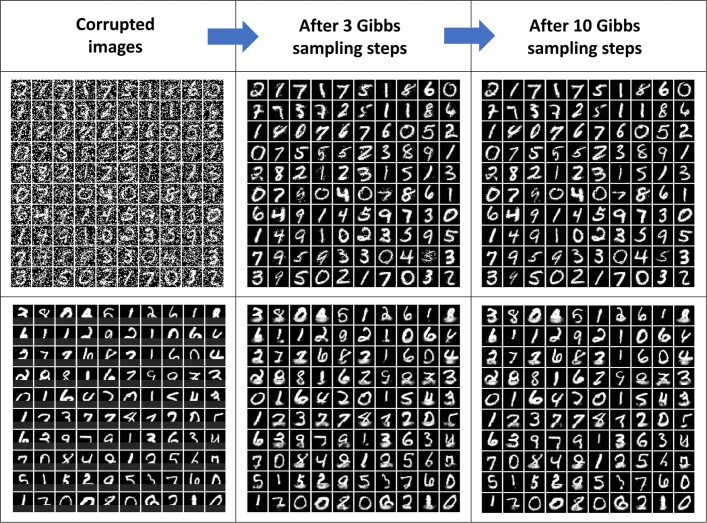
- Fully hardware-measured benchmark results include 99.0% MNIST accuracy, 85.7% CIFAR-10 accuracy, 84.7% Google speech command accuracy, and 70% lower image-reconstruction error on the Bayesian image-recovery task.
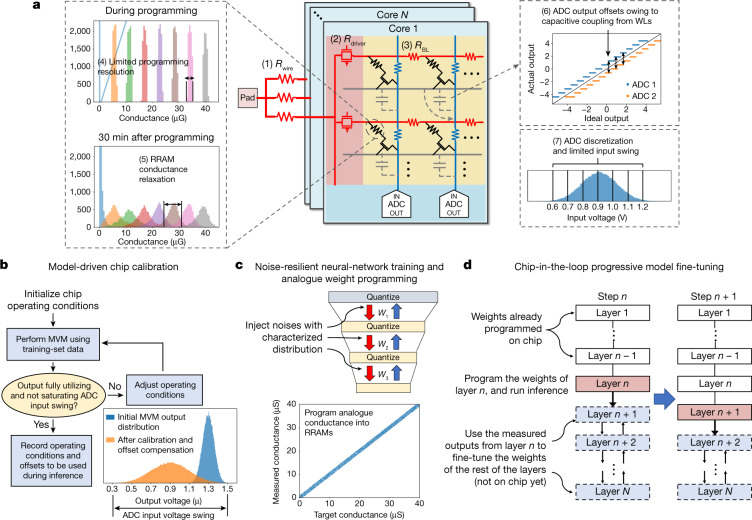
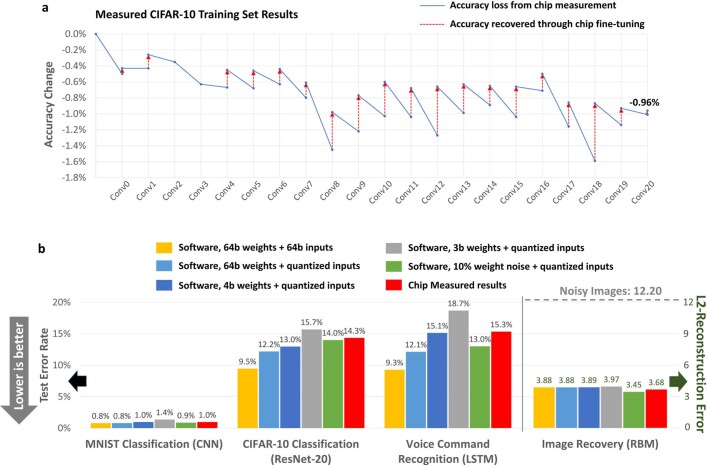
- Hardware-algorithm co-optimization improved CIFAR-10 classification from 25.34% accuracy without noise injection to 85.99% with noise injection; chip-in-the-loop progressive fine-tuning improved cumulative CIFAR-10 test-set accuracy by 1.99%.
- The authors report that the measured CIFAR-10 accuracy for deep ResNet-20 inference on-chip was 83.67%, which remained 3.36% below the 87.03% of the corresponding 4-bit-weight software model.
Methods
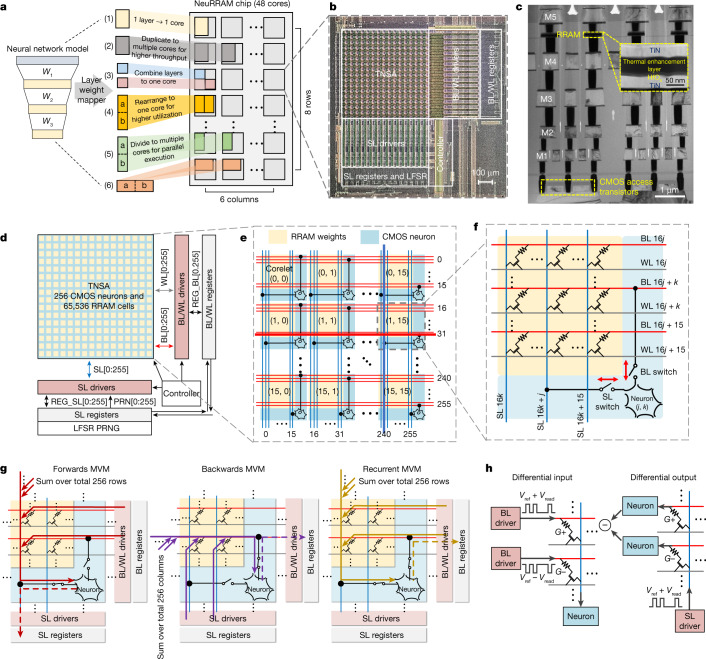
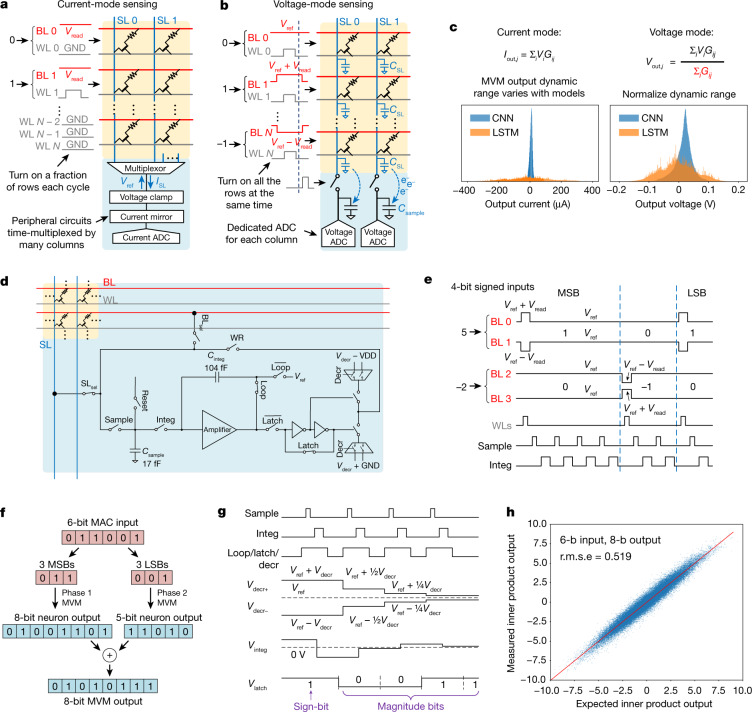
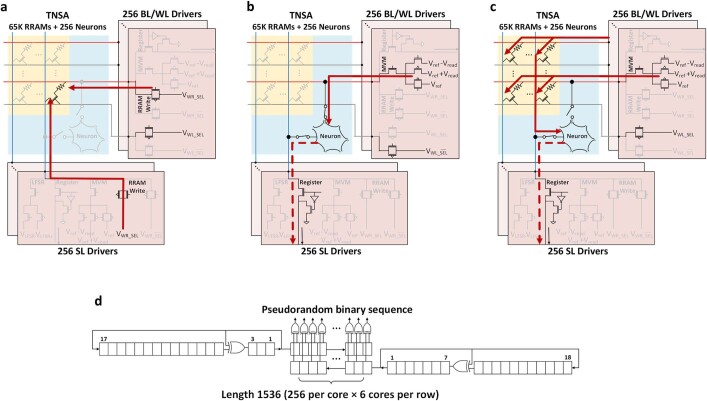
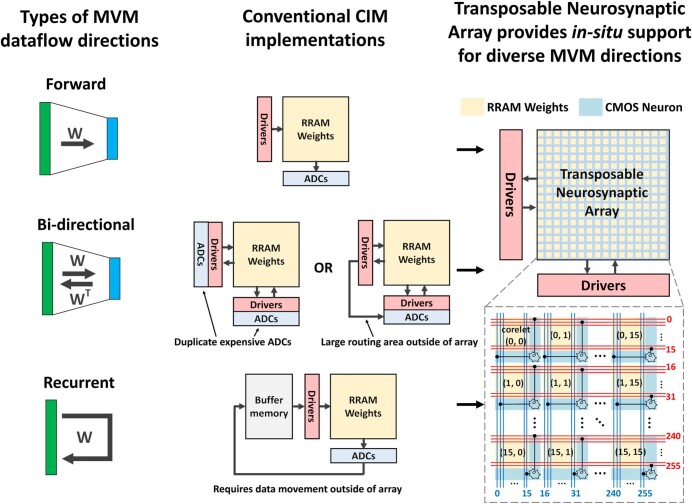
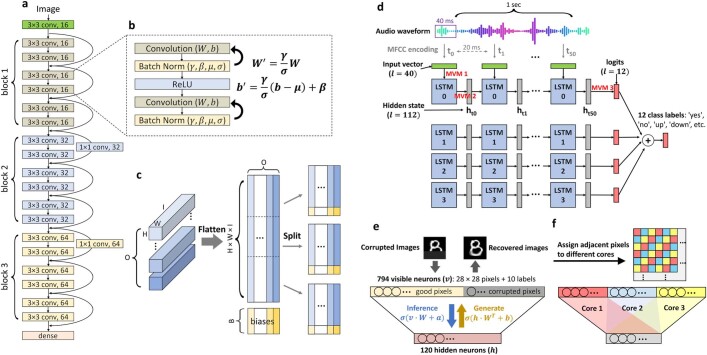
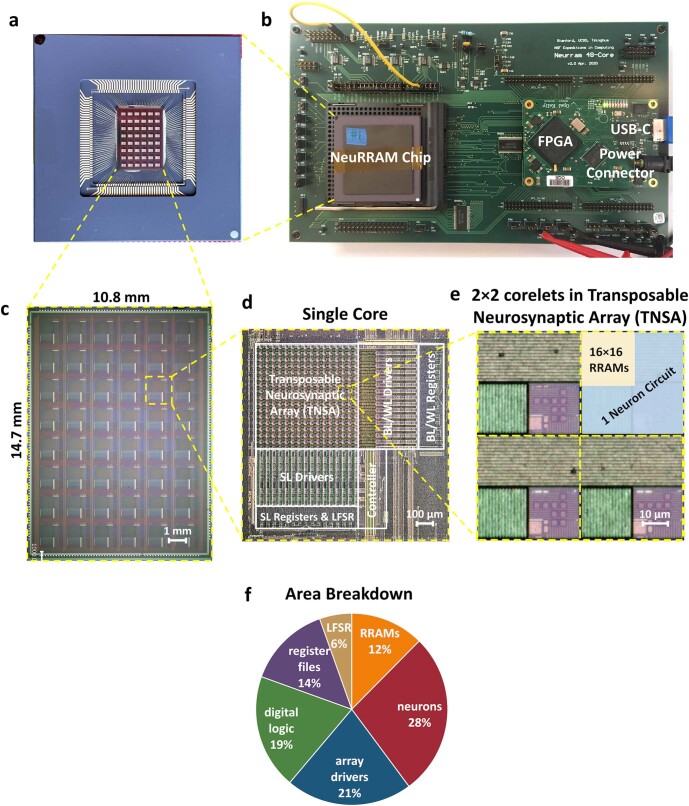
- Built a 48-core NeuRRAM chip with 3 million RRAM devices in a 130-nm CMOS process, using a bidirectional transposable neurosynaptic array (TNSA) and a voltage-mode neuron circuit.
- Evaluated the chip on multiple AI tasks: MNIST and CIFAR-10 image classification, Google speech command recognition, and MNIST image recovery with CNNs, LSTMs, and an RBM; all benchmark results were obtained from hardware measurements on complete datasets.
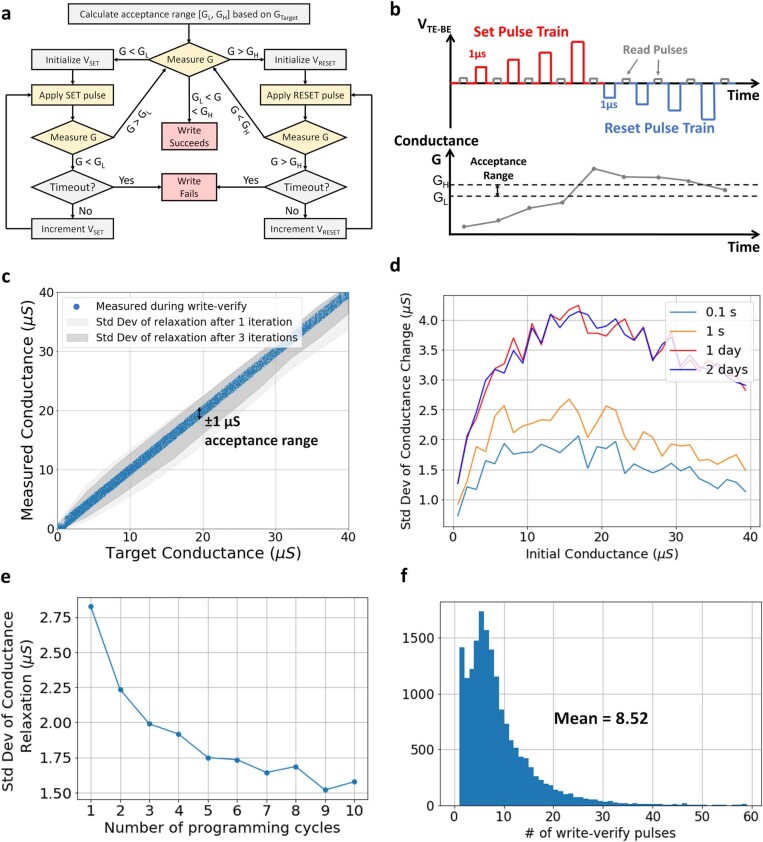
- Used model calibration, noise-resilient training, iterative write–verify programming, and chip-in-the-loop progressive fine-tuning; weights were mapped across cores with strategies for balancing load and mitigating voltage drop.
Limitations
- The paper states that the reported throughput and energy-efficiency numbers are peak values at 100% array utilization and do not include energy/time for buffering or moving intermediate data; this is an explicit limitation of the measurement scope.
- The paper notes that some on-chip accuracies are still below full-precision digital implementations, mainly because of ≤4-bit quantization of inputs and activations, especially sensitive input and output layers.
- Evident from the text: the implementation relies on an FPGA board for partial-sum accumulation, average pooling, buffers, and other operations, so the system is not a fully self-contained chip-level AI system in the demonstrated setup.
Model-written summary. Check it against the paper before relying on it.
Integrity signals
Registry
Cites
Statistics
Figures
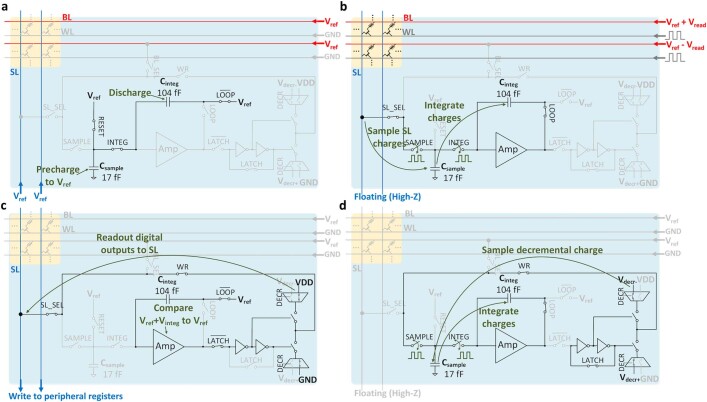
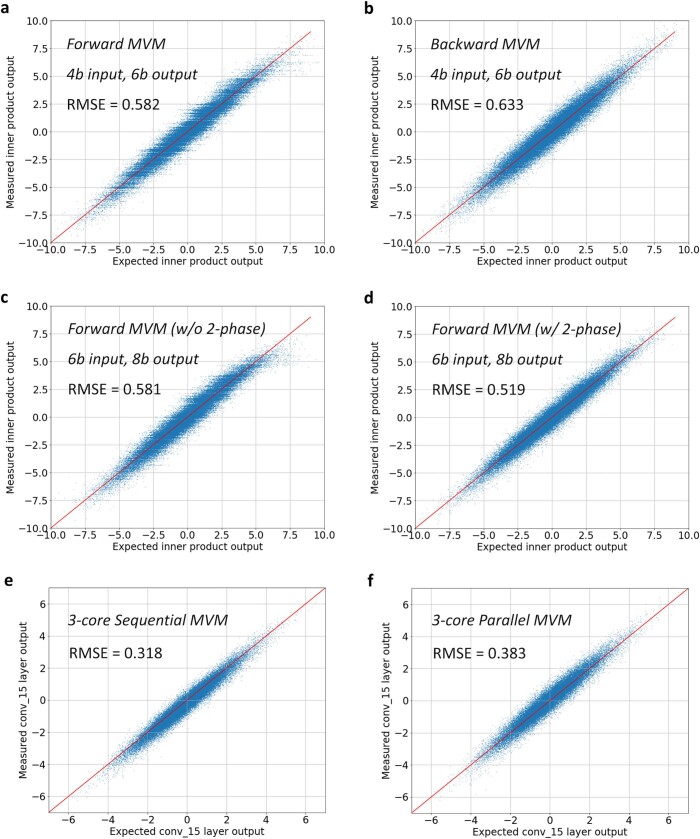
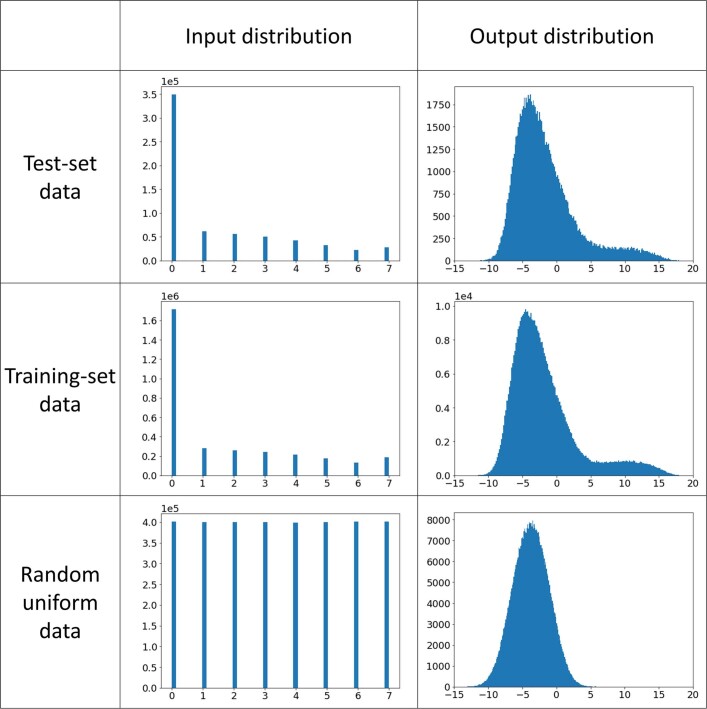
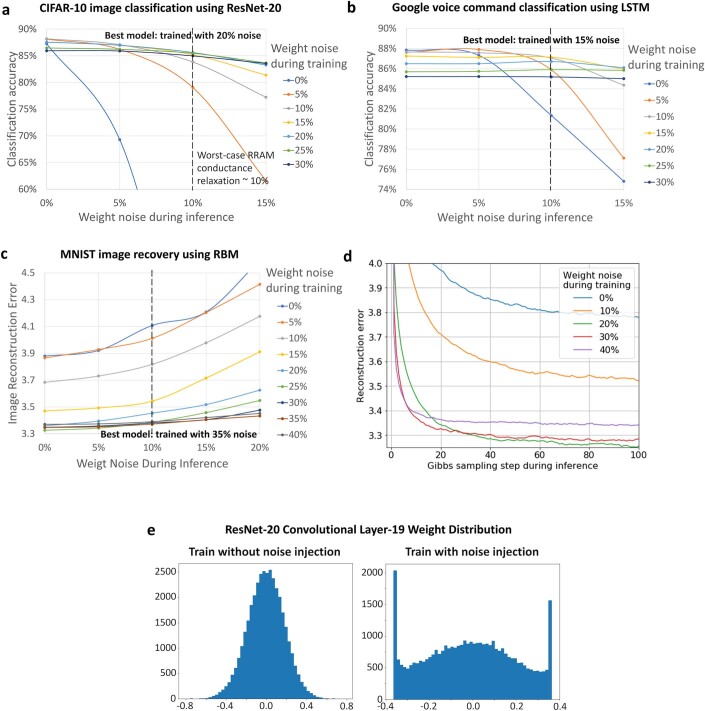
Verification
Claims the paper makes
7 Valid · 1 Not valid · 7 Not checked · 130 Own results and interpretations
The cited sources support only part of this claim — read each source’s verdict below.
In the paper
“The accuracy gap mainly comes from low-precision (≤4-bit) quantization of inputs and activations, especially on the most sensitive input and output layers46.”
§ A compute-in-memory chip based on resistive random-access memory > Hardware-algorithm co-optimizations
What the sources say
- Partly supportedcites [46] Choi, J. et al. PACT: parameterized clipping activation for quantized neural networks. Preprint at https://arxiv.org/abs/1805.06085 (2018). sourceExperimental — accuracy not yet measured
Section A.3 (pp. 11–12) finds that aggressively quantizing the first or last layer can noticeably degrade accuracy, while using 8 bits for those layers causes little degradation in the tested model. Section 5.1 (p. 7) also finds that activation accuracy improves with precision. But it does not establish that the accuracy gap mainly comes from inputs and activations, and it reports less than a 1% validation-error difference when activation precision is at least 4 bits, so the claim’s ≤4-bit framing is too broad. (LLM, conf=0.86)
plainstates a cause- Asserted: passes — The authors put it forward as true.
- Checkable: passes — It can be checked against evidence.
- Load-bearing: passes — The paper’s conclusions depend on it.
- Based: passes — The paper gives a reason why it holds.
- Partly supported
The cited sources support only part of this claim — read each source’s verdict below.
In the paper
“The accuracies of some of our quantized models are lower than that of the state-of-the-art quantized model because we apply <4-bit quantization to the most sensitive input and output layers of the neural networks”
§ A compute-in-memory chip based on resistive random-access memory > Methods > Noise-resilient neural-network training
What the sources say
- Supportedcites [46] Choi, J. et al. PACT: parameterized clipping activation for quantized neural networks. Preprint at https://arxiv.org/abs/1805.06085 (2018). source
Section A.3 (pp. 11–12) reports that aggressively quantizing the first or last layer can noticeably degrade accuracy; its table shows substantially higher validation error when those layers use 2 bits. The comparison with a state-of-the-art model describes the citing authors’ own results, not a finding attributed to PACT. (LLM, conf=0.88)
- Not matchedcites [54] Esser, S. K., Mckinstry, J. L., Bablani, D., Appuswamy, R. & Modha, D. S. Learned step size quantization. In International Conference on Learning Representations (ICLR) (2020).
Its entry has no title and year that we can search by.
plainstates a cause- Asserted: passes — The authors put it forward as true.
- Checkable: passes — It can be checked against evidence.
- Load-bearing: unclear — It is unclear whether the paper’s conclusions depend on it.
- Based: passes — The paper gives a reason why it holds.
- Supported
A result the paper reports from its own data — it cites no other source for it, so there is none to check. The quote shows it is in the paper.
In the paper
“we achieve a 0.98% error rate on MNIST handwritten digit recognition using a 7-layer CNN”
§ A compute-in-memory chip based on resistive random-access memory > Hardware-algorithm co-optimizations
plain- Asserted: passes — The authors put it forward as true.
- Checkable: passes — It can be checked against evidence.
- Load-bearing: passes — The paper’s conclusions depend on it.
- Based: passes — The paper gives a reason why it holds.
A result the paper states — it cites no source for it, so there is none to check. The quote shows it is in the paper.
In the paper
“Some of these numbers are not yet to the accuracies achieved by full-precision digital implementations.”
§ A compute-in-memory chip based on resistive random-access memory > Hardware-algorithm co-optimizations
plain- Asserted: passes — The authors put it forward as true.
- Checkable: passes — It can be checked against evidence.
- Load-bearing: unclear — It is unclear whether the paper’s conclusions depend on it.
- Based: passes — The paper gives a reason why it holds.
A result the paper reports from its own data — it cites no other source for it, so there is none to check. The quote shows it is in the paper.
In the paper
“a 14.34% error rate on CIFAR-10 object classification using ResNet-20”
§ A compute-in-memory chip based on resistive random-access memory > Hardware-algorithm co-optimizations
plain- Asserted: passes — The authors put it forward as true.
- Checkable: passes — It can be checked against evidence.
- Load-bearing: passes — The paper’s conclusions depend on it.
- Based: passes — The paper gives a reason why it holds.
72 more claims
Create a free account to see all 145 claims and to verify the 2 references still open.
- Probably not a substantial claim. 37
- It may state two separate claims as one. 41
Claims other papers make about this one
Each is checked against this paper’s own text: does it say what the citing paper says it does?
The source backs part of the claim, not all of it — or backs it for a different population, condition or comparison.
In the citing paper
“So far, several groups and companies have claimed the realization of hybrid CMOS/memristor implementations of ANNs53–61, —from now on, memristive ANNs— with performance that is superior to that of fully-CMOS counterparts.”
From Hardware implementation of memristor-based artificial neural networks (2024) · cites this paper as [60]
Experimental — accuracy not yet measuredThe source backs part of the claim, not all of it — or backs it for a different population, condition or comparison.
In the citing paper
“Although several compute-in-memory or near-memory approaches based on SRAMs and digital compute35–38 have been presented in the literature, most of these do not address the energy and time costs of reloading weights, thus making direct side-by-side comparisons against NVM-based weight-stationary approaches difficult.”
From An analog-AI chip for energy-efficient speech recognition and transcription (2023) · cites this paper as [7]
Experimental — accuracy not yet measuredThe cited source says what the claim attributes to it.
In the citing paper
“Some groups prefer to incorporate a transistor in series to each MIM cell to obtain a better control over the currents through the device (i.e., improve conductance controllability and minimize sneak path currents)53–55,60,61,102,113,167,194,218–222,).”
From Hardware implementation of memristor-based artificial neural networks (2024) · cites this paper as [60]
The cited source says what the claim attributes to it.
In the citing paper
“Then, analogue VMM has been demonstrated both for binary inputs and weights218–220, as well as for binary inputs and analogue/multilevel weights60,85,105,217.”
From Hardware implementation of memristor-based artificial neural networks (2024) · cites this paper as [60]
The cited source says what the claim attributes to it.
In the citing paper
“These results imply that with better architecture, materials, and hardware-software co-design [161], in-memory computing can set new standards for parallel processing.”
From Brain-inspired computing systems: a systematic literature review (2024) · cites this paper as [161]
2 more claims about this paper
Create a free account to see every claim other papers make about this one.
Citations
Cites
Deep Residual Learning for Image Recognition
He, K., Zhang, X., Ren, S., & Sun, J. (2016) · 2016 IEEE Conference on Computer Vision and Pattern Recognition (CVPR) · doi:10.1109/cvpr.2016.90 · Cited by 235,474
Hochreiter, S., & Schmidhuber, J. (1997) · Neural Computation · doi:10.1162/neco.1997.9.8.1735 · Cited by 102,318
LeCun, Y., Bengio, Y., & Hinton, G. (2015) · Nature · doi:10.1038/nature14539 · Cited by 84,126
Gradient-based learning applied to document recognition
Lecun, Y., Bottou, L., Bengio, Y., & Haffner, P. (1998) · Proceedings of the IEEE · doi:10.1109/5.726791 · Cited by 58,805
Multilayer feedforward networks are universal approximators
Hornik, K., Stinchcombe, M., & White, H. (1989) · Neural Networks · doi:10.1016/0893-6080(89)90020-8 · Cited by 21,728
International Conference on Learning Representations (ICLR 2013)
松尾, 豊. (2013) · 人工知能学会誌 = Journal of Japanese Society for Artificial Intelligence · Cited by 6,286
In-Datacenter Performance Analysis of a Tensor Processing Unit
Jouppi, N. P., Young, C., Patil, N., Patterson, D., Agrawal, G., Bajwa, R., Bates, S., Bhatia, S., Boden, N., Borchers, A., et al. (2017) · Proceedings of the 44th Annual International Symposium on Computer Architecture · doi:10.1145/3079856.3080246 · Cited by 4,537
Eyeriss: An Energy-Efficient Reconfigurable Accelerator for Deep Convolutional Neural Networks
Chen, Y.-H., Krishna, T., Emer, J. S., & Sze, V. (2017) · IEEE Journal of Solid-State Circuits · doi:10.1109/jssc.2016.2616357 · Cited by 3,247 · cited 1×
“Extended Data Table 2 shows that such scaling will enable NeuRRAM to deliver higher energy and area efficiency than today’s state-of-the-art edge inference accelerators 58–61 .”
BackgroundTraining and operation of an integrated neuromorphic network based on metal-oxide memristors
Prezioso, M., Merrikh-Bayat, F., Hoskins, B. D., Adam, G. C., Likharev, K. K., & Strukov, D. B. (2015) · Nature · doi:10.1038/nature14441 · Cited by 3,001 · cited 2×
“…based on resistive random-access memory (RRAM) 1 promises to meet such demand by storing AI model weights in dense, analogue and non-volatile RRAM devices, and by performing AI computation directly within RRAM, thus eliminating power-hungry data movement between separate compute and memory 2–5 .”
Wong, H.-S. P., Lee, H.-Y., Yu, S., Chen, Y.-S., Wu, Y., Chen, P.-S., Lee, B., Chen, F. T., & Tsai, M.-J. (2012) · Proceedings of the IEEE · doi:10.1109/jproc.2012.2190369 · Cited by 2,757
Self-citation
Research works printed but not linked: 1
- Koller, D. & Friedman, N. Probabilistic Graphical Models: Principles and Techniques (Adaptive Computation and Machine Learning series) (MIT Press, 2009).
Cited by
Items 401–500 of 925
Impedance Spectroscopy of Ferroelectric Capacitors and Ferroelectric Tunnel Junctions
Benatti, L., Vecchi, S., & Puglisi, F. M. (2022) · IEEE International Integrated Reliability Workshop final report · doi:10.1109/iirw56459.2022.10032741 · Cited by 5
Dopant-Dependent Flicker Noise of Hafnium Oxide Ferroelectric Field Effect Transistor
Hessler, D., Olivo, R. R., Seidel, K., Hoffmann, R., De, S., & Raffel, Y. (2024) · IEEE Electron Devices Technology & Manufacturing Conference (EDTM) · doi:10.1109/edtm58488.2024.10512251 · Cited by 5
Jiang, P., Song, D., Huang, M., Yang, F., Wang, L., Liu, P., Miao, X., & Wang, X. (2025) · Science China Information Sciences · doi:10.1007/s11432-024-4240-x · Cited by 10
Park, S., Kim, J., Koo, W. W., et al. (2023) · Technical digest - International Electron Devices Meeting/Technical digest · doi:10.1109/iedm45741.2023.10413744 · Cited by 5
Wang, J., Gu, Z., Wang, H., Hao, Z., Zhang, B., Zhao, W. S., & Zhang, Y. (2023) · Design, Automation, and Test in Europe · doi:10.23919/date56975.2023.10137323 · Cited by 5
Im, J., Kim, J., Hwang, J., Park, M., Koo, R., Ko, J., Park, S., Choi, W. Y., & Lee, J. (2024) · IEEE Electron Device Letters · doi:10.1109/led.2024.3406033 · Cited by 4
The physics and promise of phase change memory in non-von Neumann computing and machine learning
Mishra, A., Dwivedi, D. K., & Singh, P. K. (2025) · Journal of Materials Chemistry C · doi:10.1039/d5tc02344k · Cited by 5
Investigating the impact of 3D trench structures on HfO 2 -based ferroelectric capacitors
Zheng, Z., Zhou, Z., Chen, Y., Wang, X., Jiao, L., Zhang, D., Feng, Y., & Gong, X. (2025) · Nanoscale Advances · doi:10.1039/d5na00659g · Cited by 4
Neuromorphic auditory classification based on a single dynamical electrochemical memristor
Chen, P., Xiong, X., Zhang, B., Ye, Y., Pan, G., & Lin, P. (2024) · Neuromorphic Computing and Engineering · doi:10.1088/2634-4386/ad33cc · Cited by 5
Wang, W., Li, E., Zhai, X., Niu, Y., & Chen, W. (2024) · IEEE Transactions on Electron Devices · doi:10.1109/ted.2024.3485029 · Cited by 5
Neuromorphic Hebbian learning with magnetic tunnel junction synapses
Zhou, P., Edwards, A. J., Mancoff, F. B., Aggarwal, S., Heinrich-Barna, S. K., & Friedman, J. S. (2025) · Communications Engineering · doi:10.1038/s44172-025-00479-2 · Cited by 18
In-memory analog computing for non-negative matrix factorization
Wang, S., Luo, Y., Zuo, P., Li, Y. B., Pan, L., Ielmini, D., & Sun, Z. (2026) · Nature Communications · doi:10.1038/s41467-026-68609-8 · Cited by 7
An Organic Ferroelectric Synaptic Transistor
Feng, Z., Wu, J., 杨, W. 伟. Y., 李, W. 伟. L., Feng, G., Zhu, Q., Meng, X., 郭, X. 小. G., Tian, B., Chu, J., et al. (2025) · Chinese Physics Letters · doi:10.1088/0256-307x/42/5/056302 · Cited by 5
Shekinah Archita, S., & Ravi, V. K. K. (2025) · Physica Scripta · doi:10.1088/1402-4896/adae42 · Cited by 5
On-chip optical memristors based on ferroelectric-doped graphene
Zhang, Y., Chen, B., Wang, J., Luo, Z., Tian, R., Yao, D., Wang, X., Liu, Y., Hao, Y., Han, G., et al. (2025) · Optica · doi:10.1364/optica.543416 · Cited by 4
Variation-resilient spike-timing-dependent plasticity in memristors using bursting neuron circuit
Liu, Y. F., Zhao, J., Xiao, Y., Chen, P., Chen, H., He, E., Lin, P., & Pan, G. (2025) · Neuromorphic Computing and Engineering · doi:10.1088/2634-4386/add9c0 · Cited by 4
Thermal Analysis and Evaluation of Memristor-Based Compute-in-Memory Chips
Ma, A., Gao, B., Yao, P., Tang, J., Qian, H., & Wu, H. (2025) · Chips · doi:10.3390/chips4010009 · Cited by 5
Self-citationAn Encoded Photodetector Array for High-Frame-Rate Compressed Sensing and Computational Imaging
Pan, W., Yang, Z., Hao, Z., Sun, C., Xiong, B., Wang, J., Han, Y., Li, H., Gan, L., Luo, Y., et al. (2024) · IEEE Sensors Journal · doi:10.1109/jsen.2024.3506937 · Cited by 6
Ali, A. I., & Son, J. Y. (2025) · Journal of the Korean Ceramic Society · doi:10.1007/s43207-025-00503-3 · Cited by 4
All‐Ferroelectric Memtransistors for Brain‐Inspired Computing
Zeng, J., Ye, C., Wu, G., Wang, H., Zhao, Q., Wu, S., Wang, X., Lin, T., Ge, J., Shen, H., et al. (2026) · Advanced Functional Materials · doi:10.1002/adfm.202531393 · Cited by 4
Rethinking 1T1R architecture and OxRAM stack for memristive neural network inference in-memory
Lopez, J. M., Barraud, S., Cooper, D., Jannaud, A., Grenier, A., Souhaité, A., Pedini, J.-M., Comboroure, C., Gharbi, A., Boulard, F., et al. (2025) · Frontiers in Nanotechnology · doi:10.3389/fnano.2025.1549547 · Cited by 4
Update Disturbance‐Resilient Analog ReRAM Crossbar Arrays for In‐Memory Deep Learning Accelerators
Choi, W., Stecconi, T., Falcone, D. F., Galetta, M., Clerico, V., Zaccaria, E., Ram, M. S., Porta, A. L., Horst, F., Jubin, D., et al. (2025) · Advanced Science · doi:10.1002/advs.202504578 · Cited by 9
Recent progress on integrated neuromorphic chips
Gu, X., Bian, L., Lu, C., Song, C., Wang, Y., Zhang, J., & Zhao, Y. (2026) · The Innovation Informatics · doi:10.59717/j.xinn-inform.2026.100027 · Cited by 5
Fayza, F., Demirkiran, C., Rao, S. S. P., Bunandar, D., Gupta, U., & Joshi, A. (2025) · Communications Physics · doi:10.1038/s42005-025-02300-0 · Cited by 10
MOF thin film memristor prototype of 10×10 memory cells for automated electronic data recording
Bachinin, S. V., Lubimova, A., Polushkin, A. S., et al. (2023) · Photonics and Nanostructures - Fundamentals and Applications · doi:10.1016/j.photonics.2023.101222 · Cited by 4
Photon-controlled memristive synapses: recent progress toward brain-inspired neuromorphic computing
Patil, P. P., Raju, T. D., Nirmal, K. A., Dongale, T. D., Kim, K. H., & Kim, T. G. (2026) · Materials Horizons · doi:10.1039/d5mh02338f · Cited by 6
Xie, W., Sang, H., Kwon, B., Im, D., Kim, S., Kim, S., Lee, K., & Yoo, H. (2024) · IEEE Journal of Solid-State Circuits · doi:10.1109/jssc.2024.3470033 · Cited by 6
Dong, S., Li, M., Liu, Z., Hu, J. Z., Ding, Y., Sun, Y., & Chen, Z. (2025) · The Journal of Physical Chemistry Letters · doi:10.1021/acs.jpclett.5c00194 · Cited by 4
NoisyDECOLLE: Robust Local Learning for SNNs on Neuromorphic Hardware
Stadtmann, T., Wahl, B., & Gemmeke, T. (2023) · International Conference on Machine Learning and Applications · doi:10.1109/icmla58977.2023.00231 · Cited by 4
Protected memristive implementations of cryptographic functions
Chen, Z., Chen, L.-W., Zhao, X., Li, K., Schmidt, H., Polian, I., & Du, N. (2025) · Philosophical Transactions of the Royal Society A Mathematical Physical and Engineering Sciences · doi:10.1098/rsta.2023.0389 · Cited by 5
Ultrahigh-precision analog computing using memory-switching geometric ratio of transistors
Yangdong, X.-J., Wang, C., Zhao, Y., Wang, Z.-C., Yang, Z., Liu, Z., Yu, W., Zeng, Z., Wang, S., Wei, W., et al. (2025) · Science Advances · doi:10.1126/sciadv.ady4798 · Cited by 6
Sb-contacted MoS2 flash memory for analogue in-memory searches
Gao, G., Wen, B., Yang, N., Du, Z., Jiang, M., Mao, R., Qiu, R., Cao, Y., Xue, H., Zou, D., et al. (2025) · Nature Nanotechnology · doi:10.1038/s41565-025-02089-7 · Cited by 14
Non-volatile resistive switching characteristics in Cu 2− x S-based memristor
Lee, S., Byeon, J., Park, S., et al. (2025) · Nanoscale · doi:10.1039/d5nr02524a · Cited by 4
Zhao, X., Liu, L., Liu, Y., Gao, B., & Sun, H. (2024) · Microelectronics Journal · doi:10.1016/j.mejo.2024.106189 · Cited by 4
Self-citationHan, L., Huang, P. C., Wang, Y., Zhou, Z., Yang, H., Chen, Y., Liu, X., & Kang, J. (2025) · Science China Information Sciences · doi:10.1007/s11432-023-4021-y · Cited by 7
Enhancing IoT security with threshold switching-based unified security primitives
Zhang, G., Kan, J., Fan, X., Luo, Q., Sun, J., Gao, D., & Zhang, Y. (2025) · Nanotechnology · doi:10.1088/1361-6528/adb980 · Cited by 8
Liu, J., Zhang, L., Li, J., Du, S., Jin, H. L., Liu, H., Cao, K., Zhang, H., & Kang, W. (2024) · IEEE Transactions on Magnetics · doi:10.1109/tmag.2024.3491334 · Cited by 5
Kang, J., Lee, S., Kim, T.-Y., Hu, S., Lee, S., Lee, K., Park, J., Kim, I. H., Hwang, G. W., Kim, S., et al. (2025) · Small · doi:10.1002/smll.202505708 · Cited by 5
Difficulties and approaches in enabling learning-in-memory using crossbar arrays of memristors
Wang, W. J., Li, Y., & Wang, M. (2024) · Neuromorphic Computing and Engineering · doi:10.1088/2634-4386/ad6732 · Cited by 6
Magnetic tunnel junctions with superlattice barriers
Su, J.-C., Cheng, S.-H., Huang, S.-Y., & Hsueh, W. (2024) · Journal of Applied Physics · doi:10.1063/5.0228748 · Cited by 4
Memristive floating-point Fourier neural operator network for efficient scientific modeling
Li, J., Tian, J., Lin, Y., Zhou, Z., Li, Y., Gao, B., Tang, J., Chen, J., He, Y., Qian, H., et al. (2025) · Science Advances · doi:10.1126/sciadv.adv4446 · Cited by 6
Self-citationDevelopment of a Neuromorphic Network Using BioSFQ Circuits
(2025) · doi:10.1109/tasc.2025.3538699 · Cited by 4
Huang, Y.-H., Yu, H.-Y., Chih, Y.-D., Wang, Y., King, Y., & Lin, C. J. (2024) · IEEE Transactions on Electron Devices · doi:10.1109/ted.2023.3346857 · Cited by 4
Reliability-Enhanced Reverse Forming Operation Scheme for Analog Resistive Random-Access Memory
Jiang, Z., Xi, Y., Lu, Y., Tang, J., Hu, R., Du, Y., Gao, B., Qian, H., & Wu, H. (2024) · IEEE Electron Device Letters · doi:10.1109/led.2024.3521924 · Cited by 5
Self-citationGhorbani, H., Eslami, N., & Moaiyeri, M. H. (2025) · Future Generation Computer Systems · doi:10.1016/j.future.2025.108191 · Cited by 5
Bit slicing approaches for variability aware ReRAM CIM macros
Bengel, C., Dixius, L., Waser, R. M., Wouters, D. J., & Menzel, S. (2023) · it - Information Technology · doi:10.1515/itit-2023-0018 · Cited by 4
LUT-based RRAM Model for Neural Accelerator Circuit Simulation
Uhlmann, M., Rizzi, T., Wen, J., Quesada, E. P.-B., Beattie, B. A., Ochs, K., Pérez, E., Ostrovskyy, P., Carta, C., Wenger, C., et al. (2023) · IEEE/ACM International Symposium on Nanoscale Architectures (NANOARCH) · doi:10.1145/3611315.3633273 · Cited by 6
Forward stagewise regression with multilevel memristor for sparse coding
Wu, C., Xue, Y., Bao, H., Yang, L., Li, J., Tian, J., Ren, S., Li, Y., & Miao, X. (2023) · Journal of Semiconductors · doi:10.1088/1674-4926/44/10/104101 · Cited by 4
Zhao, X., Liu, L., Liu, Y., Gao, B., & Sun, H. (2024) · IEEE International Symposium on Circuits and Systems proceedings · doi:10.1109/iscas58744.2024.10558665 · Cited by 3
Self-citationМизгинов, Д. С., Telminov, O. A., Yanovich, S., Zhevnenko, D. A., Meshchaninov, F. P., & Gornev, E. S. (2023) · Crystals · doi:10.3390/cryst13020323 · Cited by 6
Rudge, Z. A., Dold, D., Fieback, M., Izzo, D., & Hamdioui, S. (2025) · Acta Astronautica · doi:10.1016/j.actaastro.2025.10.049 · Cited by 7
Lambertini, A., Zanotti, T., Pavan, P., Padovani, A., & Puglisi, F. M. (2025) · APL Machine Learning · doi:10.1063/5.0274233 · Cited by 6
LightML: A Photonic Accelerator for Efficient General Purpose Machine Learning
Liu, L., Kari, S. R., Xin, X., Youngblood, N., Zhang, Y., & Yang, J. (2025) · Proceedings - International Symposium on Computer Architecture/Proceedings · doi:10.1145/3695053.3731053 · Cited by 4
Xiao, F., Tan, D., Tian, L., Luo, Z., Yang, Q., Gan, X., Zhang, D., Alexe, M., Chu, Z., Zhang, J., et al. (2025) · Advanced Functional Materials · doi:10.1002/adfm.202523298 · Cited by 6
Bent-Pyramid: Towards A Quasi-Stochastic Data Representation for AI Hardware
Agwa, S. O., & Prodromakis, T. (2023) · IEEE Interregional NEWCAS Conference (NEWCAS) · doi:10.1109/newcas57931.2023.10198194 · Cited by 3
Tsuda, K., Furutani, K., Yakubo, Y., Godo, H., Ando, Y., Kosuge, A., Nakura, T., & Yamazaki, S. (2024) · IEEE Journal of the Electron Devices Society · doi:10.1109/jeds.2024.3439712 · Cited by 3
CMOS+X Technologies for Neuro-Vector-Symbolic Computing
Zheng, L., & Li, H. (2024) · Conference digest · doi:10.1109/drc61706.2024.10605469 · Cited by 4
Shin, H. G., Kim, S. H., Kim, E. H., Gu, J. H., Kim, J., Kim, S.-G., Kim, S. H., Kim, H., Kim, S., Choe, D.-H., et al. (2025) · npj Computational Materials · doi:10.1038/s41524-025-01864-3 · Cited by 4
Zhang, G., Wang, Z., Luo, Q., Yu, B., Li, C., Wan, Q. C., & Zhang, Y. (2025) · IEEE Transactions on Electron Devices · doi:10.1109/ted.2025.3556101 · Cited by 3
Wang, X., Chen, X., Long, Y., Liu, J., Lin, F., Yin, J., Liu, Y., & Guo, W. (2026) · Nature Electronics · doi:10.1038/s41928-025-01551-7 · Cited by 7
Jang, C., Singh, B., Niu, J., Lee, S., Lee, N., & Lee, S. (2025) · ACS Applied Materials & Interfaces · doi:10.1021/acsami.5c16543 · Cited by 4
Energy-Efficient Brain Floating Point Convolutional Neural Network Using Memristors
Tong, S.-Q., Bao, H., Li, J.-C., Yang, L., Zhou, H.-J., Li, Y., & Miao, X.-S. (2024) · IEEE Transactions on Electron Devices · doi:10.1109/ted.2024.3379953 · Cited by 3
Li, H., Wang, R., Kong, N., Zeng, S., Du, L., Li, H., Xu, W., Xie, R., Luo, C., Wu, J., et al. (2025) · Advanced Powder Technology · doi:10.1016/j.apt.2025.104964 · Cited by 5
RRAM-Based Isotropic CNNs with High Robustness and Resource Utilization Rate
Zhou, W., Ren, Y., Zhou, J., Ding, C., Liu, Z., & Wong, N. (2025) · IEEE Electron Devices Technology & Manufacturing Conference (EDTM) · doi:10.1109/edtm61175.2025.11040595 · Cited by 4
Communication-aware in-memory wireless neural networks
Yang, Z.-Z., Wang, C., Zhao, Y., Ruan, G.-J., Yangdong, X.-J., Yang, Y., Pan, C., Cheng, B., Liang, S.-J., & Miao, F. (2026) · Nature Electronics · doi:10.1038/s41928-026-01577-5 · Cited by 5
Privacy-preserving data analysis using a memristor chip with colocated authentication and processing
Liu, Z., Wang, Z., Ding, C., Lin, B., Tang, J., Gao, B., Wong, N., & Wu, H. (2026) · Science Advances · doi:10.1126/sciadv.ady5485 · Cited by 6
Self-citationAthena, F. F., Gong, N., Muralidhar, R., Solomon, P. M., Vogel, E. M., Narayanan, V., & Ando, T. (2023) · IEEE Transactions on Electron Devices · doi:10.1109/ted.2023.3308527 · Cited by 4
Giacomo, S. D., Ronchi, M., Amadori, M., Borghi, G., Carminati, M., & Fiorini, C. E. (2025) · IEEE Transactions on Radiation and Plasma Medical Sciences · doi:10.1109/trpms.2025.3530774 · Cited by 4
ReDiM: An Efficient Strategy for Read Disturb Mitigation in RRAM-Based Accelerators
Wen, J., Baroni, A., Mistroni, A., Perez, E., Zambelli, C., Wenger, C., Krstic, M. D., & Poehls, L. M. B. (2025) · IEEE International On-Line Testing Symposium (IOLTS) · doi:10.1109/iolts65288.2025.11117065 · Cited by 3
Synaptogen: A Cross-Domain Generative Device Model for Large-Scale Neuromorphic Circuit Design
Hennen, T., Brackmann, L., Ziegler, T., Siegel, S., Menzel, S., Waser, R. M., Wouters, D. J., & Bedau, D. (2024) · IEEE Transactions on Electron Devices · doi:10.1109/ted.2024.3427616 · Cited by 5
Power efficient MoS2 synaptic devices based on Maxwell–Wagner interfacial charging in binary oxides
Zou, J., Lin, S., Huang, T., Liu, H., Liu, Y., Zhong, Y., Lin, Y. C., Wang, H., Shen, S., Xu, M., et al. (2023) · 2D Materials · doi:10.1088/2053-1583/ad015f · Cited by 3
Reconfigurable Event-Driven Spiking Neuromorphic Computing near High-Bandwidth Memory
Hota, G., Frank, G., Wang, K., Uppal, A., Olajide, O., Liu, J., Bansal, S., Yoshimoto, K. K., Wang, Q., Deiss, S. R., et al. (2023) · IEEE Biomedical Circuits and Systems Conference (BioCAS) · doi:10.1109/biocas58349.2023.10388692 · Cited by 4
Self-citationGhazal, O. G., Wang, W. J., Kvatinsky, S., Merchant, F., Yakovlev, A., & Shafik, R. (2025) · Philosophical Transactions of the Royal Society A Mathematical Physical and Engineering Sciences · doi:10.1098/rsta.2023.0393 · Cited by 4
Wu, Q., Yang, H., Liu, Y., Cao, Y., Han, Y., Jiang, H., Zhou, K., Yi, H., Yang, J., & Liu, Q. (2024) · IEEE Transactions on Circuits and Systems I Regular Papers · doi:10.1109/tcsi.2024.3458436 · Cited by 3
Liquid-phase deposited 2D SnS-SnS2 composite films for memristor and synapse emulation
Zhang, Z., Tang, X., Gao, Y., Ma, X., Chang, K., Chen, L., Xue, S., Cai, G., & Zhao, J. (2025) · Chemical Engineering Journal · doi:10.1016/j.cej.2025.168557 · Cited by 3
Conductance Variation-Assisted Adversarial Attack Robustness on 40nm TaOx-based ReRAM CiM
Yamauchi, K., Misawa, N., Awamura, S., Morimoto, M., Matsui, C., & Takeuchi, K. (2025) · IEEE International Reliability Physics Symposium proceedings · doi:10.1109/irps48204.2025.10982818 · Cited by 3
Specific ADC of NVM-Based Computation-in-Memory for Deep Neural Networks
Shi, A., Zhang, Y., Han, L., Zhou, Z., Chen, Y., Yang, H., Liu, L., Shen, L., Liu, X., Kang, J., et al. (2024) · IEEE Transactions on Circuits and Systems I Regular Papers · doi:10.1109/tcsi.2024.3430290 · Cited by 3
Ying, H., Xu, M., Xie, K., Li, Z., Wang, X., & Zheng, X. (2025) · ACS Applied Materials & Interfaces · doi:10.1021/acsami.5c03429 · Cited by 3
Kaneda, M., Tsuruoka, S., Shinya, H., Fukushima, T., Endo, T., Tadano, Y., Takeda, T., Masago, A., Tanaka, M., Katayama‐Yoshida, H., et al. (2025) · Advanced Functional Materials · doi:10.1002/adfm.202415648 · Cited by 3
Impact of Variability Compensation on the Performance of an RRAM-based 3-SAT Solver
Heittmann, A., Hizzani, M., & Strachan, J. P. (2025) · IEEE International Symposium on Circuits and Systems proceedings · doi:10.1109/iscas56072.2025.11043674 · Cited by 2
Flexible switching devices with dynamic anchoring of Ag/Ag+ coupling for reservoir computing
Liu, X., Pan, J., Li, W., et al. (2025) · Journal of Energy Chemistry · doi:10.1016/j.jechem.2025.06.015 · Cited by 3
NeuroTorch: DRAM-free nonvolatile memory-based hybrid training compute-in-memory system simulator
Ko, J., Lee, K.-H., Lee, K.-H., Hwang, J., Park, M., Im, J., Kim, J., Koo, R.-H., Park, S., Kim, J.-J., et al. (2025) · Neurocomputing · doi:10.1016/j.neucom.2025.130539 · Cited by 4
Ghafoor, F., Kim, H., Zhang, H., Ghafoor, B., Lee, M., Shi, T., & Kim, D. (2026) · Advanced Composites and Hybrid Materials · doi:10.1007/s42114-025-01566-w · Cited by 4
Wang, W., Zhai, X., Qiu, J., Xie, H., Wang, L., Xia, Y., & Chen, W. (2025) · IEEE Transactions on Circuits and Systems I Regular Papers · doi:10.1109/tcsi.2025.3620879 · Cited by 4
Hasler, J., & Basu, A. (2025) · Neuromorphic Computing and Engineering · doi:10.1088/2634-4386/ad9b4a · Cited by 4
Reynolds, G., Jiang, X., Wang, S., Serb, A., Stathopolous, S., & Prodromakis, T. (2024) · Electronics · doi:10.3390/electronics14010030 · Cited by 6
Lin, Y., Zhang, Q., Gao, B., Tang, J., Zhao, H., Qin, Q., Wang, Z., Qian, H., & Wu, H. (2024) · IEEE Transactions on Electron Devices · doi:10.1109/ted.2024.3497917 · Cited by 7
Self-citationEdge Artificial Intelligence for Electrical Anomaly Detection Based on Process-In-Memory Chip
Jin, J., Qiu, X., & Lu, C. (2024) · Electronics · doi:10.3390/electronics13214255 · Cited by 3
Bottom electrode reactivity and bonding strength effect on resistive switching in HfO2-based RRAM
Jung, S.-W., Lee, K., Kim, M., Cho, J., Park, S. H., Lee, H.-G., Noh, J., & Choi, B. (2025) · Materials Science in Semiconductor Processing · doi:10.1016/j.mssp.2025.109438 · Cited by 3
Neuromorphic engineering: Artificial brains for artificial intelligence
Leugering, J. (2024) · Annals of the New York Academy of Sciences · doi:10.1111/nyas.15256 · Cited by 5
Wen, J., Vargas, F. L., Zhu, F., Reiser, D., Baroni, A., Fritscher, M., Pérez, E., Reichenbach, M., Wenger, C., & Krstic, M. D. (2025) · Microelectronics Reliability · doi:10.1016/j.microrel.2025.115630 · Cited by 5
Park, D., Park, H., Yeo, I., Kim, J., Lee, S., Lee, S., Shin, H., Pae, S.-I., Fan, D., Kung, J., et al. (2026) · IEEE Internet of Things Journal · doi:10.1109/jiot.2025.3633487 · Cited by 9
Energy efficiency and design challenges in analogue memristive chips
James, A. P. (2024) · Nature Reviews Electrical Engineering · doi:10.1038/s44287-023-00008-3 · Cited by 3
Kim, S. M., Kim, K. M., Choi, J. H., Kang, S. M., Bang, M. K., Park, S. H., Lee, E. G., Park, S. B., Hong, C. S., & Hong, S. H. (2023) · IEEE Access · doi:10.1109/access.2023.3234323 · Cited by 4
Metadata
- Authors
- Wan, W., Kubendran, R., Schaefer, C., Eryilmaz, S. B., Zhang, W., Wu, D., Deiss, S., Raina, P., Qian, H., Gao, B., Joshi, S., Wu, H., Wong, H.-S. P., & Cauwenberghs, G.
- Affiliations
- University of California San Diego (US)
- University of Pittsburgh (US)
- University of Notre Dame (US)
- Stanford University (US)
- Tsinghua University (CN)
- Corresponding author
- Wan, Weier
- Gao, Bin
- Joshi, Siddharth
- Wu, Huaqiang
- Wong, H.-S. Philip
- Cauwenberghs, Gert
- ORCID
- Venue
- Nature
- Published
- 2022-08-17
- Volume
- 608
- Issue
- 7923
- Pages
- 504-512
- ISSN
- 0028-0836 (ISSN-L)
- 1476-4687
- PMC
- PMC9385482
- OpenAlex
- W4292121737
- Cited by
- 943
- References
- 65
- Citations by year
- 2026: 235 · 2025: 273 · 2024: 246 · 2023: 167 · 2022: 22
- FWCI
- 48.45
- Type
- journal article
- Language
- en
- Open access
- hybrid
- doi.org
- Licence
- cc-by
- creativecommons.org/licenses/by/4.0 (tdm)
- creativecommons.org/licenses/by/4.0 (vor)
- Locations
- Nature (publishedVersion, cc-by)
- PubMed Central (publishedVersion, cc-by)
- PubMed (publishedVersion)
- RePEc: Research Papers in Economics (submittedVersion)
- eScholarship (California Digital Library) (submittedVersion, cc-by)
- Funders
- National Science Foundation (1317470)
- Western Digital
- University of Pennsylvania
- Pennsylvania State University
- Stanford SystemX Alliance
- National Natural Science Foundation of China (61851404)
- Office of Naval Research
- Topics
- Physical Sciences › Engineering › Electrical and Electronic Engineering › Advanced Memory and Neural Computing
- Physical Sciences › Engineering › Electrical and Electronic Engineering › Ferroelectric and Negative Capacitance Devices
- Physical Sciences › Computer Science › Computer Vision and Pattern Recognition › Advanced Neural Network Applications
- Keywords
- in-memory computing, resistive random access memory, neuromorphic hardware, edge AI, energy efficiency, weight quantization, hardware-software co-optimization, non-volatile memory, image classification, voice command recognition
About these checks
Registry, retraction, Cites and statistics results are computed, not judged, with one exception: a printed reference that no index lists is read once by a model before it counts as a citation error. Claims are extracted by a model and kept only when their quote appears verbatim in the text; each cited source is then checked, with a model’s help, for whether it says what the claim relies on. Those verdicts can be wrong — read the claim’s quote and the cited source before relying on one.
The claim verdicts this report counts are experimental: their accuracy is not yet measured.
A language model drew the claims from the paper on 2026-09-29, under version 3 of the claim definition (model deepseek-v4.1-flash, prompt extract-v3).
A second model labelled each claim on 2026-09-29 (model jev-1.13-20260917, definition revision gold-guideline-v0.2).
Cited sources are checked with a language model’s help (gpt-6-sol).
Statistics and arithmetic are recomputed, not judged.
Confidence bands are shown only for fields calibrated on our annotated test set. None is calibrated yet, so no band is shown.
What counts as a claim ›How we measure confidence ›How we check this ›
Are you an author, or do you see a problem with this page? Request a review
Data sources
Bibliographic data: Semantic Scholar, OpenAlex, Crossref.
Contains information from the Semantic Scholar Academic Graph Datasets, made available under the ODC Attribution License (ODC-BY 1.0).
Semantic Scholar’s data is described in: Kinney, R., et al. (2023). The Semantic Scholar Open Data Platform. arXiv:2301.10140.
