

A compute-in-memory chip based on resistive random-access memory
Open accessThe DOI matches its Crossref record; 65 of the 66 references it cites were found in a registry or an index; 15 of the 35 sources its claims cite were checked for support.
Abstract
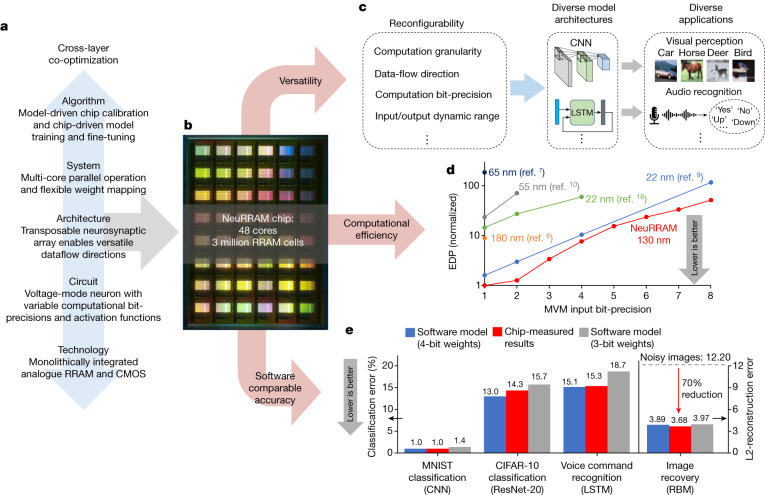
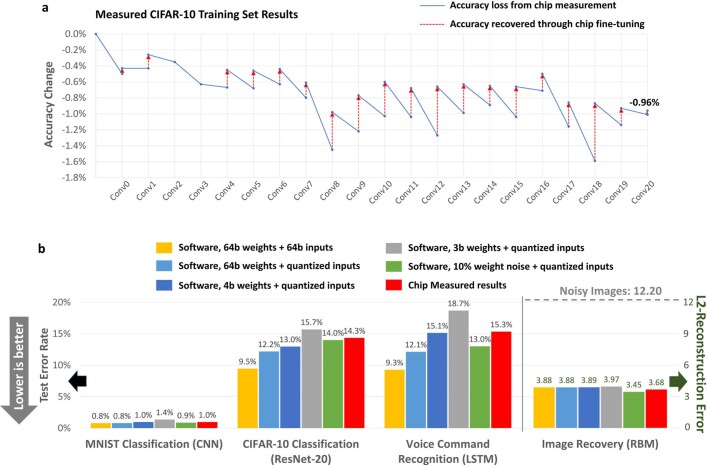
Abstract Realizing increasingly complex artificial intelligence (AI) functionalities directly on edge devices calls for unprecedented energy efficiency of edge hardware. Compute-in-memory (CIM) based on resistive random-access memory (RRAM) 1 promises to meet such demand by storing AI model weights in dense, analogue and non-volatile RRAM devices, and by performing AI computation directly within RRAM, thus eliminating power-hungry data movement between separate compute and memory 2–5 . Although recent studies have demonstrated in-memory matrix-vector multiplication on fully integrated RRAM-CIM hardware 6–17 , it remains a goal for a RRAM-CIM chip to simultaneously deliver high energy efficiency, versatility to support diverse models and software-comparable accuracy. Although efficiency, versatility and accuracy are all indispensable for broad adoption of the technology, the inter-related trade-offs among them cannot be addressed by isolated improvements on any single abstraction level of the design. Here, by co-optimizing across all hierarchies of the design from algorithms and architecture to circuits and devices, we present NeuRRAM—a RRAM-based CIM chip that simultaneously delivers versatility in reconfiguring CIM cores for diverse model architectures, energy efficiency that is two-times better than previous state-of-the-art RRAM-CIM chips across various computational bit-precisions, and inference accuracy comparable to software models quantized to four-bit weights across various AI tasks, including accuracy of 99.0 percent on MNIST 18 and 85.7 percent on CIFAR-10 19 image classification, 84.7-percent accuracy on Google speech command recognition 20 , and a 70-percent reduction in image-reconstruction error on a Bayesian image-recovery task.
Overview
CoChat Summary
TL;DR
NeuRRAM is a 48-core RRAM compute-in-memory chip that co-optimizes device, circuit, architecture, system, and algorithm choices to support reconfigurable AI inference with hardware-measured accuracy. The paper reports better energy-delay product than prior RRAM-CIM chips and benchmark results of 99.0% on MNIST, 85.7% on CIFAR-10, 84.7% on Google speech commands, and a 70% reduction in image-reconstruction error on MNIST image recovery.
Key findings
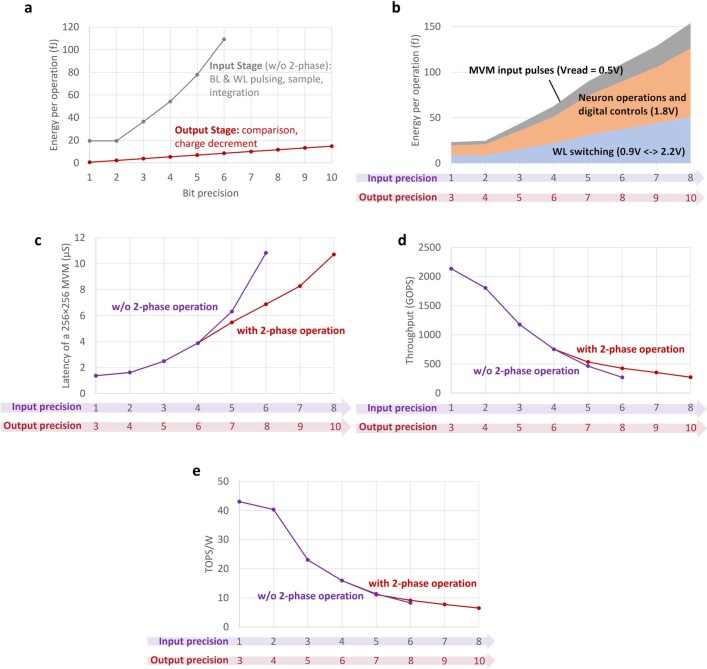
- The chip achieves an energy-delay product that is 1.6× to 2.3× lower than previous state-of-the-art RRAM-CIM chips, and 7× to 13× higher computational density at various MVM bit-precisions.
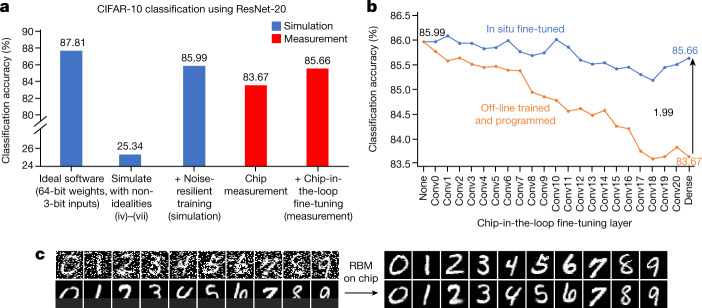
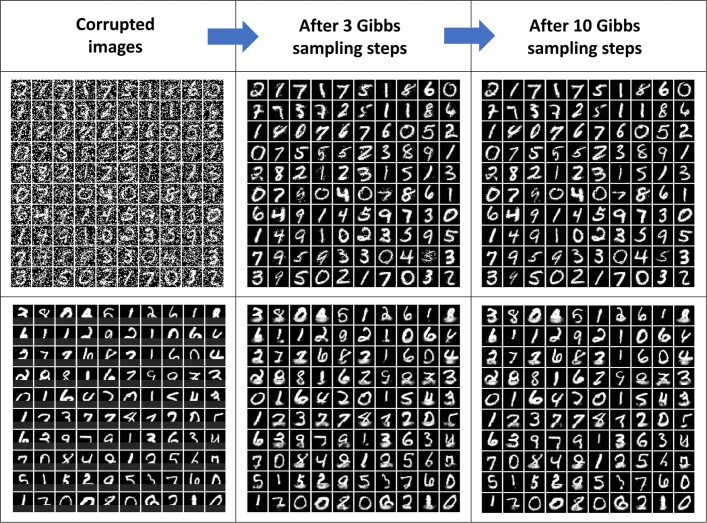
- Fully hardware-measured benchmark results include 99.0% MNIST accuracy, 85.7% CIFAR-10 accuracy, 84.7% Google speech command accuracy, and 70% lower image-reconstruction error on the Bayesian image-recovery task.
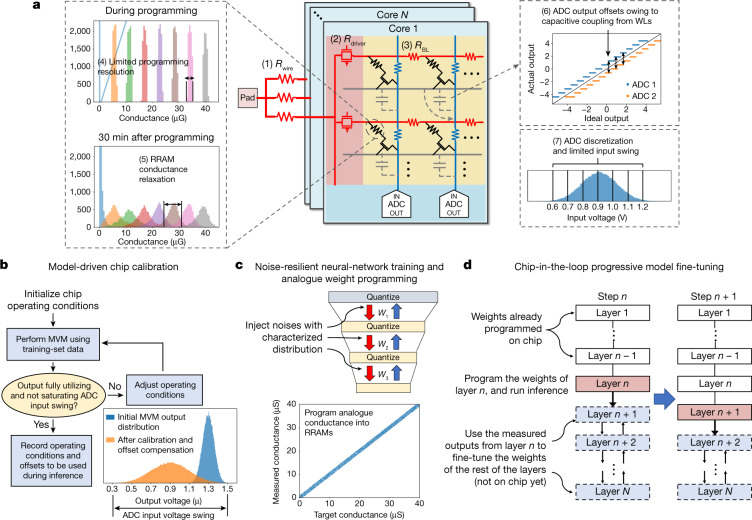
- Hardware-algorithm co-optimization improved CIFAR-10 classification from 25.34% accuracy without noise injection to 85.99% with noise injection; chip-in-the-loop progressive fine-tuning improved cumulative CIFAR-10 test-set accuracy by 1.99%.
- The authors report that the measured CIFAR-10 accuracy for deep ResNet-20 inference on-chip was 83.67%, which remained 3.36% below the 87.03% of the corresponding 4-bit-weight software model.
Methods
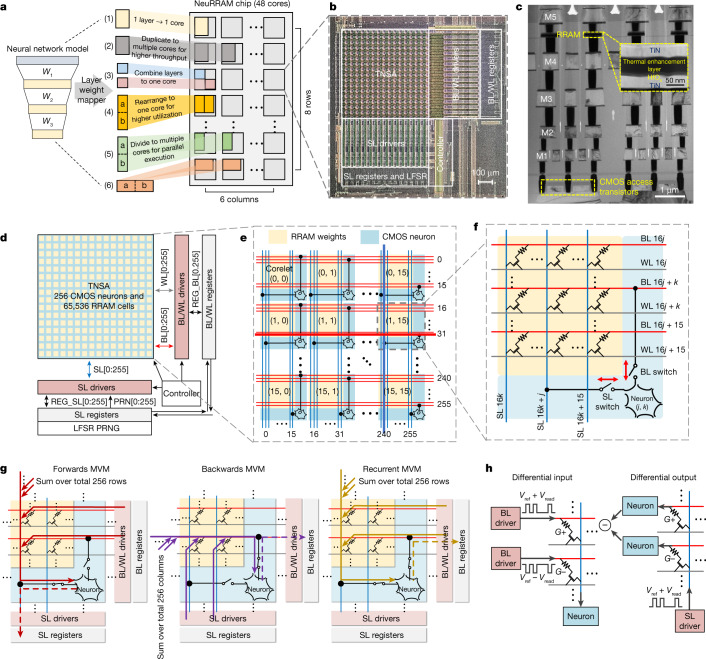
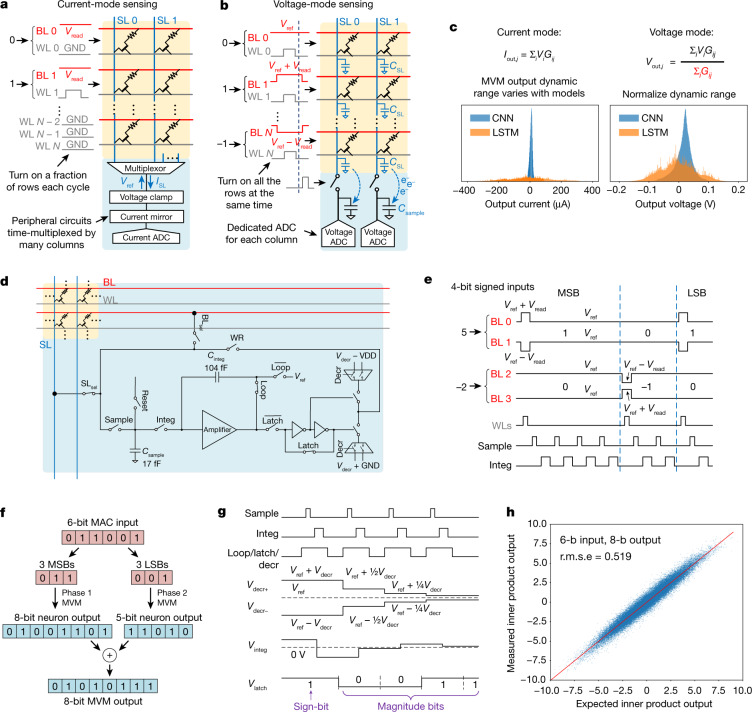
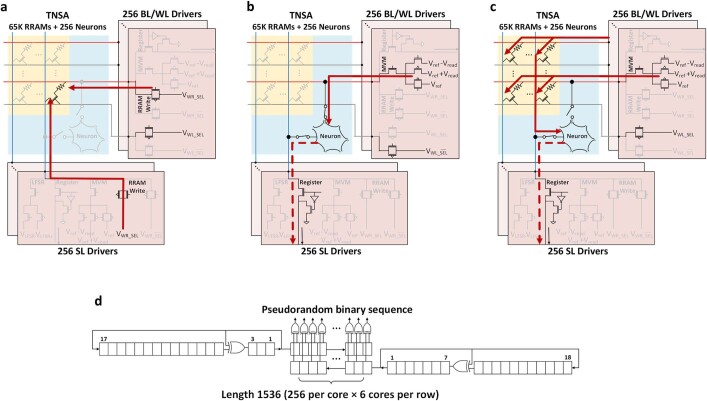
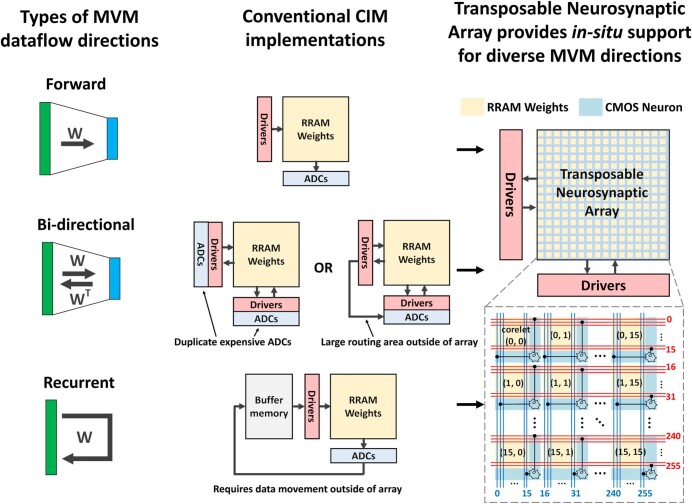
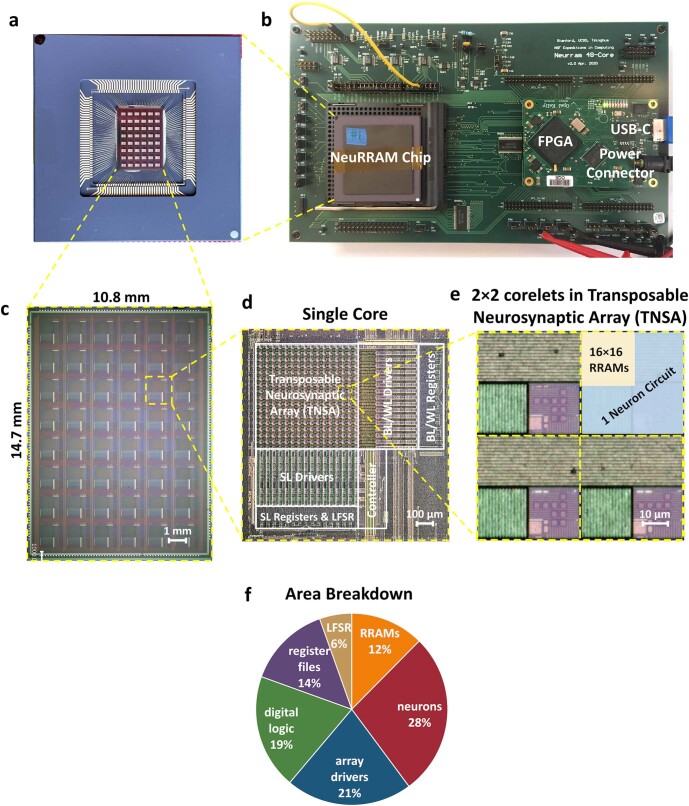
- Built a 48-core NeuRRAM chip with 3 million RRAM devices in a 130-nm CMOS process, using a bidirectional transposable neurosynaptic array (TNSA) and a voltage-mode neuron circuit.
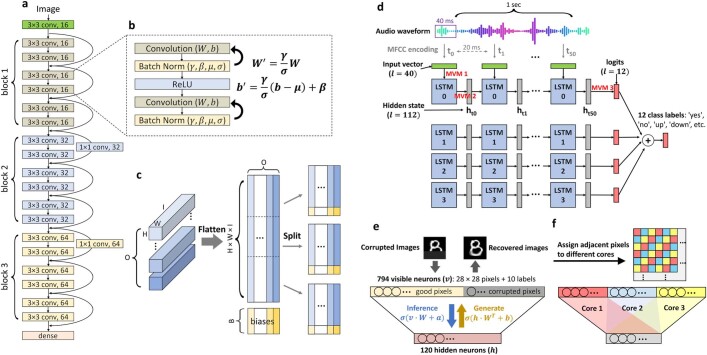
- Evaluated the chip on multiple AI tasks: MNIST and CIFAR-10 image classification, Google speech command recognition, and MNIST image recovery with CNNs, LSTMs, and an RBM; all benchmark results were obtained from hardware measurements on complete datasets.
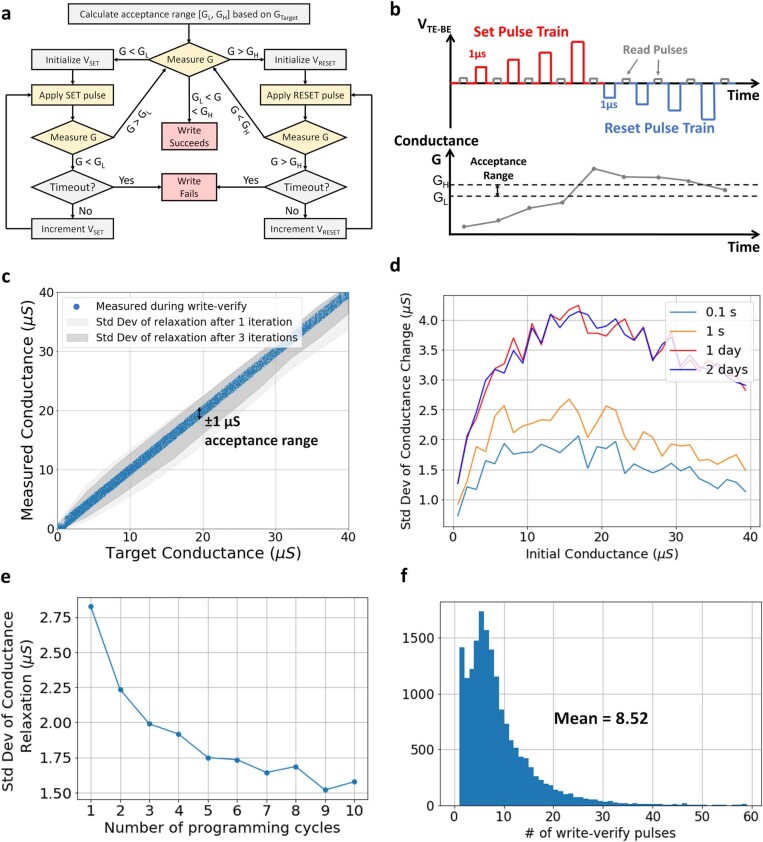
- Used model calibration, noise-resilient training, iterative write–verify programming, and chip-in-the-loop progressive fine-tuning; weights were mapped across cores with strategies for balancing load and mitigating voltage drop.
Limitations
- The paper states that the reported throughput and energy-efficiency numbers are peak values at 100% array utilization and do not include energy/time for buffering or moving intermediate data; this is an explicit limitation of the measurement scope.
- The paper notes that some on-chip accuracies are still below full-precision digital implementations, mainly because of ≤4-bit quantization of inputs and activations, especially sensitive input and output layers.
- Evident from the text: the implementation relies on an FPGA board for partial-sum accumulation, average pooling, buffers, and other operations, so the system is not a fully self-contained chip-level AI system in the demonstrated setup.
Model-written summary. Check it against the paper before relying on it.
Integrity signals
Registry
Cites
Statistics
Figures
Verification
Claims the paper makes
7 Valid · 1 Not valid · 7 Not checked · 130 Own results and interpretations
The cited sources support only part of this claim — read each source’s verdict below.
In the paper
“The accuracy gap mainly comes from low-precision (≤4-bit) quantization of inputs and activations, especially on the most sensitive input and output layers46.”
§ A compute-in-memory chip based on resistive random-access memory > Hardware-algorithm co-optimizations
What the sources say
- Partly supportedcites [46] Choi, J. et al. PACT: parameterized clipping activation for quantized neural networks. Preprint at https://arxiv.org/abs/1805.06085 (2018). sourceExperimental — accuracy not yet measured
Section A.3 (pp. 11–12) finds that aggressively quantizing the first or last layer can noticeably degrade accuracy, while using 8 bits for those layers causes little degradation in the tested model. Section 5.1 (p. 7) also finds that activation accuracy improves with precision. But it does not establish that the accuracy gap mainly comes from inputs and activations, and it reports less than a 1% validation-error difference when activation precision is at least 4 bits, so the claim’s ≤4-bit framing is too broad. (LLM, conf=0.86)
plainstates a cause- Asserted: passes — The authors put it forward as true.
- Checkable: passes — It can be checked against evidence.
- Load-bearing: passes — The paper’s conclusions depend on it.
- Based: passes — The paper gives a reason why it holds.
- Partly supported
The cited sources support only part of this claim — read each source’s verdict below.
In the paper
“The accuracies of some of our quantized models are lower than that of the state-of-the-art quantized model because we apply <4-bit quantization to the most sensitive input and output layers of the neural networks”
§ A compute-in-memory chip based on resistive random-access memory > Methods > Noise-resilient neural-network training
What the sources say
- Supportedcites [46] Choi, J. et al. PACT: parameterized clipping activation for quantized neural networks. Preprint at https://arxiv.org/abs/1805.06085 (2018). source
Section A.3 (pp. 11–12) reports that aggressively quantizing the first or last layer can noticeably degrade accuracy; its table shows substantially higher validation error when those layers use 2 bits. The comparison with a state-of-the-art model describes the citing authors’ own results, not a finding attributed to PACT. (LLM, conf=0.88)
- Not matchedcites [54] Esser, S. K., Mckinstry, J. L., Bablani, D., Appuswamy, R. & Modha, D. S. Learned step size quantization. In International Conference on Learning Representations (ICLR) (2020).
Its entry has no title and year that we can search by.
plainstates a cause- Asserted: passes — The authors put it forward as true.
- Checkable: passes — It can be checked against evidence.
- Load-bearing: unclear — It is unclear whether the paper’s conclusions depend on it.
- Based: passes — The paper gives a reason why it holds.
- Supported
A result the paper reports from its own data — it cites no other source for it, so there is none to check. The quote shows it is in the paper.
In the paper
“we achieve a 0.98% error rate on MNIST handwritten digit recognition using a 7-layer CNN”
§ A compute-in-memory chip based on resistive random-access memory > Hardware-algorithm co-optimizations
plain- Asserted: passes — The authors put it forward as true.
- Checkable: passes — It can be checked against evidence.
- Load-bearing: passes — The paper’s conclusions depend on it.
- Based: passes — The paper gives a reason why it holds.
A result the paper states — it cites no source for it, so there is none to check. The quote shows it is in the paper.
In the paper
“Some of these numbers are not yet to the accuracies achieved by full-precision digital implementations.”
§ A compute-in-memory chip based on resistive random-access memory > Hardware-algorithm co-optimizations
plain- Asserted: passes — The authors put it forward as true.
- Checkable: passes — It can be checked against evidence.
- Load-bearing: unclear — It is unclear whether the paper’s conclusions depend on it.
- Based: passes — The paper gives a reason why it holds.
A result the paper reports from its own data — it cites no other source for it, so there is none to check. The quote shows it is in the paper.
In the paper
“a 14.34% error rate on CIFAR-10 object classification using ResNet-20”
§ A compute-in-memory chip based on resistive random-access memory > Hardware-algorithm co-optimizations
plain- Asserted: passes — The authors put it forward as true.
- Checkable: passes — It can be checked against evidence.
- Load-bearing: passes — The paper’s conclusions depend on it.
- Based: passes — The paper gives a reason why it holds.
72 more claims
Create a free account to see all 145 claims and to verify the 2 references still open.
- Probably not a substantial claim. 37
- It may state two separate claims as one. 41
Claims other papers make about this one
Each is checked against this paper’s own text: does it say what the citing paper says it does?
The source backs part of the claim, not all of it — or backs it for a different population, condition or comparison.
In the citing paper
“So far, several groups and companies have claimed the realization of hybrid CMOS/memristor implementations of ANNs53–61, —from now on, memristive ANNs— with performance that is superior to that of fully-CMOS counterparts.”
From Hardware implementation of memristor-based artificial neural networks (2024) · cites this paper as [60]
Experimental — accuracy not yet measuredThe source backs part of the claim, not all of it — or backs it for a different population, condition or comparison.
In the citing paper
“Although several compute-in-memory or near-memory approaches based on SRAMs and digital compute35–38 have been presented in the literature, most of these do not address the energy and time costs of reloading weights, thus making direct side-by-side comparisons against NVM-based weight-stationary approaches difficult.”
From An analog-AI chip for energy-efficient speech recognition and transcription (2023) · cites this paper as [7]
Experimental — accuracy not yet measuredThe cited source says what the claim attributes to it.
In the citing paper
“Some groups prefer to incorporate a transistor in series to each MIM cell to obtain a better control over the currents through the device (i.e., improve conductance controllability and minimize sneak path currents)53–55,60,61,102,113,167,194,218–222,).”
From Hardware implementation of memristor-based artificial neural networks (2024) · cites this paper as [60]
The cited source says what the claim attributes to it.
In the citing paper
“Then, analogue VMM has been demonstrated both for binary inputs and weights218–220, as well as for binary inputs and analogue/multilevel weights60,85,105,217.”
From Hardware implementation of memristor-based artificial neural networks (2024) · cites this paper as [60]
The cited source says what the claim attributes to it.
In the citing paper
“These results imply that with better architecture, materials, and hardware-software co-design [161], in-memory computing can set new standards for parallel processing.”
From Brain-inspired computing systems: a systematic literature review (2024) · cites this paper as [161]
2 more claims about this paper
Create a free account to see every claim other papers make about this one.
Citations
Cites
Deep Residual Learning for Image Recognition
He, K., Zhang, X., Ren, S., & Sun, J. (2016) · 2016 IEEE Conference on Computer Vision and Pattern Recognition (CVPR) · doi:10.1109/cvpr.2016.90 · Cited by 235,474
Hochreiter, S., & Schmidhuber, J. (1997) · Neural Computation · doi:10.1162/neco.1997.9.8.1735 · Cited by 102,318
LeCun, Y., Bengio, Y., & Hinton, G. (2015) · Nature · doi:10.1038/nature14539 · Cited by 84,126
Gradient-based learning applied to document recognition
Lecun, Y., Bottou, L., Bengio, Y., & Haffner, P. (1998) · Proceedings of the IEEE · doi:10.1109/5.726791 · Cited by 58,805
Multilayer feedforward networks are universal approximators
Hornik, K., Stinchcombe, M., & White, H. (1989) · Neural Networks · doi:10.1016/0893-6080(89)90020-8 · Cited by 21,728
International Conference on Learning Representations (ICLR 2013)
松尾, 豊. (2013) · 人工知能学会誌 = Journal of Japanese Society for Artificial Intelligence · Cited by 6,286
In-Datacenter Performance Analysis of a Tensor Processing Unit
Jouppi, N. P., Young, C., Patil, N., Patterson, D., Agrawal, G., Bajwa, R., Bates, S., Bhatia, S., Boden, N., Borchers, A., et al. (2017) · Proceedings of the 44th Annual International Symposium on Computer Architecture · doi:10.1145/3079856.3080246 · Cited by 4,537
Eyeriss: An Energy-Efficient Reconfigurable Accelerator for Deep Convolutional Neural Networks
Chen, Y.-H., Krishna, T., Emer, J. S., & Sze, V. (2017) · IEEE Journal of Solid-State Circuits · doi:10.1109/jssc.2016.2616357 · Cited by 3,247 · cited 1×
“Extended Data Table 2 shows that such scaling will enable NeuRRAM to deliver higher energy and area efficiency than today’s state-of-the-art edge inference accelerators 58–61 .”
BackgroundTraining and operation of an integrated neuromorphic network based on metal-oxide memristors
Prezioso, M., Merrikh-Bayat, F., Hoskins, B. D., Adam, G. C., Likharev, K. K., & Strukov, D. B. (2015) · Nature · doi:10.1038/nature14441 · Cited by 3,001 · cited 2×
“…based on resistive random-access memory (RRAM) 1 promises to meet such demand by storing AI model weights in dense, analogue and non-volatile RRAM devices, and by performing AI computation directly within RRAM, thus eliminating power-hungry data movement between separate compute and memory 2–5 .”
Wong, H.-S. P., Lee, H.-Y., Yu, S., Chen, Y.-S., Wu, Y., Chen, P.-S., Lee, B., Chen, F. T., & Tsai, M.-J. (2012) · Proceedings of the IEEE · doi:10.1109/jproc.2012.2190369 · Cited by 2,757
Self-citationIn-memory computing with resistive switching devices
Ielmini, D., & Wong, H.-S. P. (2018) · Nature Electronics · doi:10.1038/s41928-018-0092-2 · Cited by 2,298
Self-citationFully hardware-implemented memristor convolutional neural network
Yao, P., Wu, H., Gao, B., Tang, J., Zhang, Q., Zhang, W., Yang, J. J., & Qian, H. (2020) · Nature · doi:10.1038/s41586-020-1942-4 · Cited by 2,179 · cited 5×
“…results using a mixture of hardware characterization and software simulation, for example, emulate the array-level MVM process in software using measured device characteristics 3,5,21,24 , such an approach often fails to model the complete set of non-idealities existing in realistic hardware.”
InfluentialSelf-citationThe future of electronics based on memristive systems
Zidan, M. A., Strachan, J. P., & Lu, W. D. (2018) · Nature Electronics · doi:10.1038/s41928-017-0006-8 · Cited by 2,138
ISAAC: a convolutional neural network accelerator with in-situ analog arithmetic in crossbars
Shafiee, A., Nag, A., Muralimanohar, N., Balasubramonian, R., Strachan, J. P., Hu, M., Williams, R. S., & Srikumar, V. (2016) · ACM SIGARCH Computer Architecture News · doi:10.1145/3007787.3001139 · Cited by 1,536
Equivalent-accuracy accelerated neural-network training using analogue memory
Ambrogio, S., Narayanan, P., Tsai, H., Shelby, R. M., Boybat, I., di Nolfo, C., Sidler, S., Giordano, M., Bodini, M., Farinha, N. C. P., et al. (2018) · Nature · doi:10.1038/s41586-018-0180-5 · Cited by 1,151 · cited 4×
“Although these studies proposed various techniques to mitigate the impacts of analogue-related hardware non-idealities on inference accuracy, the AI benchmark results reported were often obtained by performing software emulation based on characterized device data 3,5,21,24 .”
InfluentialFully memristive neural networks for pattern classification with unsupervised learning
Wang, Z., Joshi, S., Savel’ev, S., Song, W., Midya, R., Li, Y., Rao, M., Yan, P., Asapu, S., Zhuo, Y., et al. (2018) · Nature Electronics · doi:10.1038/s41928-018-0023-2 · Cited by 1,106 · cited 1×
“…1.6-times to 2.3-times lower EDP and 7-times to 13-times higher computational density (measured by throughput per million of RRAMs) at various MVM input and output bit-precisions than previous state-of-the-art RRAM-based CIM chips, despite being fabricated at an older technology node 17–27 , 36 .”
InfluentialSelf-citationTowards artificial general intelligence with hybrid Tianjic chip architecture
Pei, J., Deng, L., Song, S., Zhao, M., Zhang, Y., Wu, S., Wang, G., Zou, Z., Wu, Z., He, W., et al. (2019) · Nature · doi:10.1038/s41586-019-1424-8 · Cited by 1,082 · cited 1×
“Extended Data Table 2 shows that such scaling will enable NeuRRAM to deliver higher energy and area efficiency than today’s state-of-the-art edge inference accelerators 58–61 .”
Self-citationSpeech Commands: A Dataset for Limited-Vocabulary Speech Recognition
Warden, P. (2018) · arXiv · doi:10.48550/arxiv.1804.03209 · Cited by 1,033 · cited 3×
“…four-bit weights across various AI tasks, including accuracy of 99.0 percent on MNIST 18 and 85.7 percent on CIFAR-10 19 image classification, 84.7-percent accuracy on Google speech command recognition 20 , and a 70-percent reduction in image-reconstruction error on a Bayesian image-recovery task.”
BackgroundMethodInfluentialBurr, G. W., Shelby, R. M., Sidler, S., di Nolfo, C., Jang, J., Boybat, I., Shenoy, R. S., Narayanan, P., Virwani, K., Giacometti, E. U., et al. (2015) · IEEE Transactions on Electron Devices · doi:10.1109/ted.2015.2439635 · Cited by 936 · cited 3×
“Although these studies proposed various techniques to mitigate the impacts of analogue-related hardware non-idealities on inference accuracy, the AI benchmark results reported were often obtained by performing software emulation based on characterized device data 3,5,21,24 .”
MethodFace classification using electronic synapses
Yao, P., Wu, H., Gao, B., Eryilmaz, S. B., Huang, X., Zhang, W., Zhang, Q., Deng, N., Shi, L., Wong, H.-S. P., et al. (2017) · Nature Communications · doi:10.1038/ncomms15199 · Cited by 909 · cited 2×
“…1.6-times to 2.3-times lower EDP and 7-times to 13-times higher computational density (measured by throughput per million of RRAMs) at various MVM input and output bit-precisions than previous state-of-the-art RRAM-based CIM chips, despite being fabricated at an older technology node 17–27 , 36 .”
InfluentialSelf-citationISAAC: A Convolutional Neural Network Accelerator with In-Situ Analog Arithmetic in Crossbars
Shafiee, A., Nag, A., Muralimanohar, N., Balasubramonian, R., Strachan, J. P., Hu, M., Williams, R. S., & Srikumar, V. (2016) · 2016 ACM/IEEE 43rd Annual International Symposium on Computer Architecture (ISCA) · doi:10.1109/isca.2016.12 · Cited by 775
A fully integrated reprogrammable memristor–CMOS system for efficient multiply–accumulate operations
Cai, F., Correll, J. M., Lee, S. H., Lim, Y., Bothra, V., Zhang, Z., Flynn, M. P., & Lu, W. D. (2019) · Nature Electronics · doi:10.1038/s41928-019-0270-x · Cited by 728 · cited 1×
“…bidirectional (forwards and backwards) dataflow requires either dupli-cating power-hungry and area-hungry ADCs at both ends of the RRAM array 11,34 or dedicating a large area to routing both rows and columns of the array to shared data converters 15 ; the recurrent connections require…”
PACT: Parameterized Clipping Activation for Quantized Neural Networks
Choi, J., Wang, Z., Venkataramani, S., Chuang, P. I.-J., Srinivasan, V., & Gopalakrishnan, K. (2018) · arXiv · doi:10.48550/arxiv.1805.06085 · Cited by 703 · cited 3×
“We perform the quantized training using the parameterized clipping activation technique 46 .”
BackgroundMethodA crossbar array of magnetoresistive memory devices for in-memory computing
Jung, S., Lee, H., Myung, S., Kim, H., Yoon, S. K., Kwon, S.-W., Ju, Y., Kim, M., Yi, W., Han, S., et al. (2022) · Nature · doi:10.1038/s41586-021-04196-6 · Cited by 644 · cited 1×
“These techniques can be more generally applied to other non-volatile resistive memory technologies such as phase-change memory 8,17,21,23,24 , magnetoresistive RAM 48 and ferroelectric field-effect transistors 49 .”
Pattern classification by memristive crossbar circuits using ex situ and in situ training
Alibart, F., Zamanidoost, E., & Strukov, D. B. (2013) · Nature Communications · doi:10.1038/ncomms3072 · Cited by 642
Sparse coding with memristor networks
Sheridan, P. M., Cai, F., Du, C., Ma, W., Zhang, Z., & Lu, W. D. (2017) · Nature Nanotechnology · doi:10.1038/nnano.2017.83 · Cited by 619
Ferroelectric FET analog synapse for acceleration of deep neural network training
Jerry, M., Chen, P.-Y., Zhang, J., Sharma, P., Ni, K., Yu, S., & Datta, S. (2017) · 2017 IEEE International Electron Devices Meeting (IEDM) · doi:10.1109/iedm.2017.8268338 · Cited by 599
High precision tuning of state for memristive devices by adaptable variation-tolerant algorithm
Alibart, F., Gao, L., Hoskins, B. D., & Strukov, D. B. (2012) · Nanotechnology · doi:10.1088/0957-4484/23/7/075201 · Cited by 557 · cited 2×
“In contrast, we utilize the intrinsic analogue programmability of RRAM 42 to directly store high-precision weights and train the neural networks to tolerate the lower SNR.”
Accurate deep neural network inference using computational phase-change memory
Joshi, V., Le Gallo, M., Haefeli, S., Boybat, I., Nandakumar, S. R., Piveteau, C., Dazzi, M., Rajendran, B., Sebastian, A., & Eleftheriou, E. (2020) · Nature Communications · doi:10.1038/s41467-020-16108-9 · Cited by 490 · cited 5×
“…results using a mixture of hardware characterization and software simulation, for example, emulate the array-level MVM process in software using measured device characteristics 3,5,21,24 , such an approach often fails to model the complete set of non-idealities existing in realistic hardware.”
InfluentialPUMA: A Programmable Ultra-efficient Memristor-based Accelerator for Machine Learning Inference
Ankit, A., Hajj, I. E., Chalamalasetti, S. R., Ndu, G., Foltin, M., Williams, R. S., Faraboschi, P., Hwu, W.-M. W., Strachan, J. P., Roy, K., et al. (2019) · Proceedings of the Twenty-Fourth International Conference on Architectural Support for Programming Languages and Operating Systems · doi:10.1145/3297858.3304049 · Cited by 424 · cited 2×
“Although there are studies on such full-chip architecture and scheduling 37,38,53 , they are outside the scope of this study.”
Learning to Quantize Deep Networks by Optimizing Quantization Intervals With Task Loss
Jung, S., Son, C., Lee, S., Son, J., Han, J.-J., Kwak, Y., Hwang, S. J., & Choi, C. (2019) · 2019 IEEE/CVF Conference on Computer Vision and Pattern Recognition (CVPR) · doi:10.1109/cvpr.2019.00448 · Cited by 385 · cited 1×
“A similar phenomenon has been reported in neural-network quantization literature where a model trained with quantization occasionally outperforms a full-precision model 54,55 .”
BackgroundAccurate deep neural network inference using computational phase-change memory
Joshi, V., Gallo, M. L., Haefeli, S., Boybat, I., Nandakumar, S. R., Piveteau, C., Dazzi, M., Rajendran, B., Sebastian, A., & Eleftheriou, E. S. (2020) · RePEc: Research Papers in Economics · doi:10.3929/ethz-b-000416797 · Cited by 379
UNPU: An Energy-Efficient Deep Neural Network Accelerator With Fully Variable Weight Bit Precision
Lee, J., Kim, C., Kang, S., Shin, D., Kim, S., & Yoo, H.-J. (2019) · IEEE Journal of Solid-State Circuits · doi:10.1109/jssc.2018.2865489 · Cited by 335
Liu, Q., Gao, B., Yao, P., Wu, D., Chen, J., Pang, Y., Zhang, W., Liao, Y., Xue, C.-X., Chen, W.-H., et al. (2020) · 2020 IEEE International Solid- State Circuits Conference - (ISSCC) · doi:10.1109/isscc19947.2020.9062953 · Cited by 308 · cited 1×
“…ADCs at both ends of the RRAM array 11,34 or dedicating a large area to routing both rows and columns of the array to shared data converters 15 ; the recurrent connections require writing the outputs to a buffer memory outside of the RRAM array, and reading them back for the next time-step…”
BackgroundSelf-citationXue, C.-X., Chen, W.-H., Liu, J.-S., Li, J.-F., Lin, W.-Y., Lin, W.-E., Wang, J.-H., Wei, W.-C., Chang, T.-W., Chang, T.-C., et al. (2019) · 2019 IEEE International Solid- State Circuits Conference - (ISSCC) · doi:10.1109/isscc.2019.8662395 · Cited by 291
CMOS-integrated memristive non-volatile computing-in-memory for AI edge processors
Chen, W.-H., Dou, C., Li, K.-X., Lin, W.-Y., Li, P.-Y., Huang, J.-H., Wang, J.-H., Wei, W.-C., Xue, C.-X., Chiu, Y.-C., et al. (2019) · Nature Electronics · doi:10.1038/s41928-019-0288-0 · Cited by 276
A Methodology to Improve Linearity of Analog RRAM for Neuromorphic Computing
Wu, W., Wu, H., Gao, B., Yao, P., Zhang, X., Peng, X., Yu, S., & Qian, H. (2018) · 2018 IEEE Symposium on VLSI Technology · doi:10.1109/vlsit.2018.8510690 · Cited by 197 · cited 1×
“The RRAM device stack consists of a titanium nitride (TiN) bottom-electrode layer, a hafnium oxide (HfO x ) switching layer, a tantalum oxide (TaO x ) thermal-enhancement layer 52 and a TiN top-electrode layer.”
MethodSelf-citationMochida, R., Kouno, K., Hayata, Y., Nakayama, M., Ono, T., Suwa, H., Yasuhara, R., Katayama, K., Mikawa, T., & Gohou, Y. (2018) · 2018 IEEE Symposium on VLSI Technology · doi:10.1109/vlsit.2018.8510676 · Cited by 194
Stepanovic, D., & Nikolic, B. (2013) · IEEE Journal of Solid-State Circuits · doi:10.1109/jssc.2013.2239005 · Cited by 192
Su, J.-W., Si, X., Chou, Y.-C., Chang, T.-W., Huang, W.-H., Tu, Y.-N., Liu, R., Lu, P.-J., Liu, T.-W., Wang, J.-H., et al. (2020) · 2020 IEEE International Solid- State Circuits Conference - (ISSCC) · doi:10.1109/isscc19947.2020.9062949 · Cited by 189 · cited 1×
“…bidirectional (forwards and backwards) dataflow requires either dupli-cating power-hungry and area-hungry ADCs at both ends of the RRAM array 11,34 or dedicating a large area to routing both rows and columns of the array to shared data converters 15 ; the recurrent connections require writing…”
BackgroundXue, C.-X., Chiu, Y.-C., Liu, T.-W., Huang, T.-Y., Liu, J.-S., Chang, T.-W., Kao, H.-Y., Wang, J.-H., Wei, S.-Y., Lee, C.-Y., et al. (2020) · Nature Electronics · doi:10.1038/s41928-020-00505-5 · Cited by 181 · cited 1×
“Some previous work obtained a higher SNR by limiting each RRAM cell to store a single bit, and encoding higher-precision weights using multiple cells 9,10,16 .”
Khaddam-Aljameh, R., Stanisavljevic, M., Fornt Mas, J., Karunaratne, G., Brändli, M., Liu, F., Singh, A., Müller, S. M., Egger, U., Petropoulos, A., et al. (2022) · IEEE Journal of Solid-State Circuits · doi:10.1109/jssc.2022.3140414 · Cited by 144
Wan, W., Kubendran, R., Eryilmaz, S. B., Zhang, W., Liao, Y., Wu, D., Deiss, S., Gao, B., Raina, P., Joshi, S., et al. (2020) · 2020 IEEE International Solid- State Circuits Conference - (ISSCC) · doi:10.1109/isscc19947.2020.9062979 · Cited by 143
Self-citationLi, H., Wu, T. F., Rahimi, A., Li, K.-S., Rusch, M., Lin, C.-H., Hsu, J.-L., Sabry, M. M., Eryilmaz, S. B., Sohn, J., et al. (2016) · 2016 IEEE International Electron Devices Meeting (IEDM) · doi:10.1109/iedm.2016.7838428 · Cited by 136
Self-citationHung, J.-M., Xue, C.-X., Kao, H.-Y., Huang, Y.-H., Chang, F.-C., Huang, S.-P., Liu, T.-W., Jhang, C.-J., Su, C.-I., Khwa, W.-S., et al. (2021) · Nature Electronics · doi:10.1038/s41928-021-00676-9 · Cited by 135
An analog VLSI recurrent neural network learning a continuous-time trajectory
Cauwenberghs, G. (1996) · IEEE Transactions on Neural Networks · doi:10.1109/72.485671 · Cited by 127 · cited 1×
“The registers of the two chains are XORed to generate spatially uncorrelated random numbers 51 .”
Self-citationKhaddam-Aljameh, R., Stanisavljevic, M., Fornt Mas, J., Karunaratne, G., Braendli, M., Liu, F., Singh, A., Müller, S. M., Egger, U., Petropoulos, A., et al. (2021) · 2021 Symposium on VLSI Circuits · doi:10.23919/vlsicircuits52068.2021.9492362 · Cited by 124 · cited 2×
“Although most previous efforts (with a few exceptions 8,17 ) have reported benchmark results using a mixture of hardware characterization and software simulation, for example, emulate the array-level MVM process in software using measured device characteristics 3,5,21,24 , such an approach often…”
MethodResultZimmer, B., Venkatesan, R., Shao, Y. S., Clemons, J., Fojtik, M., Jiang, N., Keller, B., Klinefelter, A., Pinckney, N., Raina, P., et al. (2020) · IEEE Journal of Solid-State Circuits · doi:10.1109/jssc.2019.2960488 · Cited by 122
Self-citationBanbury, C., Reddi, V. J., Torelli, P., Holleman, J., Jeffries, N., Kiraly, C., Montino, P., Kanter, D., Ahmed, S., Pau, D., et al. (2021) · arXiv · doi:10.48550/arxiv.2106.07597 · Cited by 121 · cited 1×
“None of the studies have experimentally measured multiple edge AI applications with complexity matching those in MLPerf Tiny, a commonly used benchmark suite for edge AI hardware 28 .”
Guo, R., Liu, Y., Zheng, S., Wu, S.-Y., Ouyang, P., Khwa, W.-S., Chen, X., Chen, J., Li, X., Liu, L., et al. (2019) · Symposium on VLSI Circuits · doi:10.23919/vlsic.2019.8778028 · Cited by 101
Investigation of statistical retention of filamentary analog RRAM for neuromophic computing
Zhao, M., Wu, H., Gao, B., Zhang, Q., Wu, W., Wang, S., Xi, Y., Wu, D., Deng, N., Yu, S., et al. (2017) · 2017 IEEE International Electron Devices Meeting (IEDM) · doi:10.1109/iedm.2017.8268522 · Cited by 95
Self-citationNarayanan, P., Ambrogio, S., Okazaki, A., Hosokawa, K., Tsai, H., Nomura, A., Yasuda, T., Mackin, C., Lewis, S. C., Friz, A., et al. (2021) · IEEE Transactions on Electron Devices · doi:10.1109/ted.2021.3115993 · Cited by 85
Yan, B., Yang, Q., Chen, W.-H., Chang, K.-T., Su, J.-W., Hsu, C.-H., Li, S.-H., Lee, H.-Y., Sheu, S.-S., Ho, M.-S., et al. (2019) · 2019 Symposium on VLSI Technology · doi:10.23919/vlsit.2019.8776485 · Cited by 84
Mismatch Characterization of Small Metal Fringe Capacitors
Tripathi, V., & Murmann, B. (2014) · IEEE Transactions on Circuits and Systems I: Regular Papers · doi:10.1109/tcsi.2014.2332264 · Cited by 71
FPSA: A Full System Stack Solution for Reconfigurable ReRAM-based NN Accelerator Architecture
Ji, Y., Zhang, Y., Xie, X., Li, S., Wang, P., Hu, X., Zhang, Y., & Xie, Y. (2019) · Proceedings of the Twenty-Fourth International Conference on Architectural Support for Programming Languages and Operating Systems · doi:10.1145/3297858.3304048 · Cited by 63
Design Considerations for Efficient Deep Neural Networks on Processing-in-Memory Accelerators
Yang, T.-J., & Sze, V. (2019) · 2019 IEEE International Electron Devices Meeting (IEDM) · doi:10.1109/iedm19573.2019.8993662 · Cited by 55 · cited 1×
“Meanwhile, attaining algorithmic resiliency to hardware non-idealities becomes more difficult for more complex AI tasks owing to using less over-parameterized models on the edge 29,30 .”
MethodTxSim: Modeling Training of Deep Neural Networks on Resistive Crossbar Systems
Roy, S., Sridharan, S., Jain, S., & Raghunathan, A. (2021) · IEEE Transactions on Very Large Scale Integration (VLSI) Systems · doi:10.1109/tvlsi.2021.3063543 · Cited by 52
Experimental demonstration of array-level learning with phase change synaptic devices
Eryilmaz, S. B., Kuzum, D., Jeyasingh, R. G. D., Kim, S., BrightSky, M., Lam, C., & Wong, H.-S. P. (2013) · 2013 IEEE International Electron Devices Meeting · doi:10.1109/iedm.2013.6724691 · Cited by 51
Self-citationOn-Chip Trainable 1.4M 6T2R PCM Synaptic Array with 1.6K Stochastic LIF Neurons for Spiking RBM
Ishii, M., Shin, U., Hosokawa, K., BrightSky, M., Haensch, W., Kim, S., Lewis, S., Okazaki, A., Okazawa, J., Ito, M., et al. (2019) · 2019 IEEE International Electron Devices Meeting (IEDM) · doi:10.1109/iedm19573.2019.8993466 · Cited by 43 · cited 1×
“This results in a more compact design than other work that merges ADC and neuron activation functions within the same module 12,13 .”
ResultWan, W., Kubendran, R., Gao, B., Joshi, S., Raina, P., Wu, H., Cauwenberghs, G., & Wong, H. S. P. (2020) · 2020 IEEE Symposium on VLSI Technology · doi:10.1109/vlsitechnology18217.2020.9265066 · Cited by 42
Self-citationTraining a Probabilistic Graphical Model With Resistive Switching Electronic Synapses
Eryilmaz, S. B., Neftci, E. O., Joshi, S., Kim, S., BrightSky, M. J., Lung, H.-L., Lam, C. H., Cauwenberghs, G., & Wong, H. ‐. P. (2016) · eScholarship (California Digital Library) · Cited by 38
Self-citationTraining a Probabilistic Graphical Model With Resistive Switching Electronic Synapses
Eryilmaz, S. B., Neftci, E., Joshi, S., Kim, S., BrightSky, M., Lung, H.-L., Lam, C., Cauwenberghs, G., & Wong, H.-S. P. (2016) · IEEE Transactions on Electron Devices · doi:10.1109/ted.2016.2616483 · Cited by 34
Self-citationJiang, Z., Qin, S., Li, H., Fujii, S., Lee, D., Wong, S. S., & Wong, H. ‐. P. (2019) · IEEE Transactions on Electron Devices · doi:10.1109/ted.2019.2950595 · Cited by 33
Self-citationDigitally assisted data converter design
(2013) · doi:10.1109/esscirc.2013.6649063 · Cited by 32
weierwan/Neurram_48core: Initial Release
Wan, W. (2022) · Zenodo · doi:10.5281/zenodo.6558399 · Cited by 1
Self-citationweierwan/Neurram_48core: Initial Release
Wan, W. (2022) · Zenodo (CERN European Organization for Nuclear Research) · doi:10.5281/zenodo.6558398 · Cited by 1
Self-citation
Research works printed but not linked: 1
- Koller, D. & Friedman, N. Probabilistic Graphical Models: Principles and Techniques (Adaptive Computation and Machine Learning series) (MIT Press, 2009).
Cited by
Thousands of conductance levels in memristors monolithically integrated on CMOS
Yang, J., Rao, M., Tang, H., Wu, J.-B., Song, W., Zhang, M., Yin, W., Zhuo, Y., Kiani, F., Chen, B., et al. (2022) · doi:10.21203/rs.3.rs-1939455/v1 · Cited by 504
Hardware implementation of memristor-based artificial neural networks
Aguirre, F., Sebastian, A., Le Gallo, M., Song, W., Wang, T., Yang, J. J., Lu, W., Chang, M.-F., Ielmini, D., Yang, Y., et al. (2024) · Nature Communications · doi:10.1038/s41467-024-45670-9 · Cited by 564
“Also, many papers 55,60,99,100 , have explored the case of ANNs with binarized inputs, as they employ the simplest DACs (1-bit).”
Thousands of conductance levels in memristors integrated on CMOS
(2023) · doi:10.1038/s41586-023-05759-5 · Cited by 503
Memristor‐Based Neuromorphic Chips
Duan, X., Cao, Z., Gao, K., Yan, W., Sun, S., Zhou, G., Wu, Z., Ren, F., & Sun, B. (2024) · Advanced Materials · doi:10.1002/adma.202310704 · Cited by 432
Neuromorphic computing at scale
Kudithipudi, D., Schuman, C., Vineyard, C. M., Pandit, T., Merkel, C., Kubendran, R., Aimone, J. B., Orchard, G., Mayr, C., Benosman, R., et al. (2025) · Nature · doi:10.1038/s41586-024-08253-8 · Cited by 357
“Several emergent devices have addressed device non-idealities by using some form of online training 121,146,157 .”
Self-citation
Metadata
- Authors
- Wan, W., Kubendran, R., Schaefer, C., Eryilmaz, S. B., Zhang, W., Wu, D., Deiss, S., Raina, P., Qian, H., Gao, B., Joshi, S., Wu, H., Wong, H.-S. P., & Cauwenberghs, G.
- Affiliations
- University of California San Diego (US)
- University of Pittsburgh (US)
- University of Notre Dame (US)
- Stanford University (US)
- Tsinghua University (CN)
- Corresponding author
- Wan, Weier
- Gao, Bin
- Joshi, Siddharth
- Wu, Huaqiang
- Wong, H.-S. Philip
- Cauwenberghs, Gert
- ORCID
- Venue
- Nature
- Published
- 2022-08-17
- Volume
- 608
- Issue
- 7923
- Pages
- 504-512
- ISSN
- 0028-0836 (ISSN-L)
- 1476-4687
- PMC
- PMC9385482
- OpenAlex
- W4292121737
- Cited by
- 943
- References
- 65
- Citations by year
- 2026: 235 · 2025: 273 · 2024: 246 · 2023: 167 · 2022: 22
- FWCI
- 48.45
- Type
- journal article
- Language
- en
- Open access
- hybrid
- doi.org
- Licence
- cc-by
- creativecommons.org/licenses/by/4.0 (tdm)
- creativecommons.org/licenses/by/4.0 (vor)
- Locations
- Nature (publishedVersion, cc-by)
- PubMed Central (publishedVersion, cc-by)
- PubMed (publishedVersion)
- RePEc: Research Papers in Economics (submittedVersion)
- eScholarship (California Digital Library) (submittedVersion, cc-by)
- Funders
- National Science Foundation (1317470)
- Western Digital
- University of Pennsylvania
- Pennsylvania State University
- Stanford SystemX Alliance
- National Natural Science Foundation of China (61851404)
- Office of Naval Research
- Topics
- Physical Sciences › Engineering › Electrical and Electronic Engineering › Advanced Memory and Neural Computing
- Physical Sciences › Engineering › Electrical and Electronic Engineering › Ferroelectric and Negative Capacitance Devices
- Physical Sciences › Computer Science › Computer Vision and Pattern Recognition › Advanced Neural Network Applications
- Keywords
- in-memory computing, resistive random access memory, neuromorphic hardware, edge AI, energy efficiency, weight quantization, hardware-software co-optimization, non-volatile memory, image classification, voice command recognition
About these checks
Registry, retraction, Cites and statistics results are computed, not judged, with one exception: a printed reference that no index lists is read once by a model before it counts as a citation error. Claims are extracted by a model and kept only when their quote appears verbatim in the text; each cited source is then checked, with a model’s help, for whether it says what the claim relies on. Those verdicts can be wrong — read the claim’s quote and the cited source before relying on one.
The claim verdicts this report counts are experimental: their accuracy is not yet measured.
A language model drew the claims from the paper on 2026-09-29, under version 3 of the claim definition (model deepseek-v4.1-flash, prompt extract-v3).
A second model labelled each claim on 2026-09-29 (model jev-1.13-20260917, definition revision gold-guideline-v0.2).
Cited sources are checked with a language model’s help (gpt-6-sol).
Statistics and arithmetic are recomputed, not judged.
Confidence bands are shown only for fields calibrated on our annotated test set. None is calibrated yet, so no band is shown.
What counts as a claim ›How we measure confidence ›How we check this ›
Are you an author, or do you see a problem with this page? Request a review
Data sources
Bibliographic data: Semantic Scholar, OpenAlex, Crossref.
Contains information from the Semantic Scholar Academic Graph Datasets, made available under the ODC Attribution License (ODC-BY 1.0).
Semantic Scholar’s data is described in: Kinney, R., et al. (2023). The Semantic Scholar Open Data Platform. arXiv:2301.10140.
