

A compute-in-memory chip based on resistive random-access memory
Open accessThe DOI matches its Crossref record; 65 of the 66 references it cites were found in a registry or an index; 15 of the 35 sources its claims cite were checked for support.
Abstract
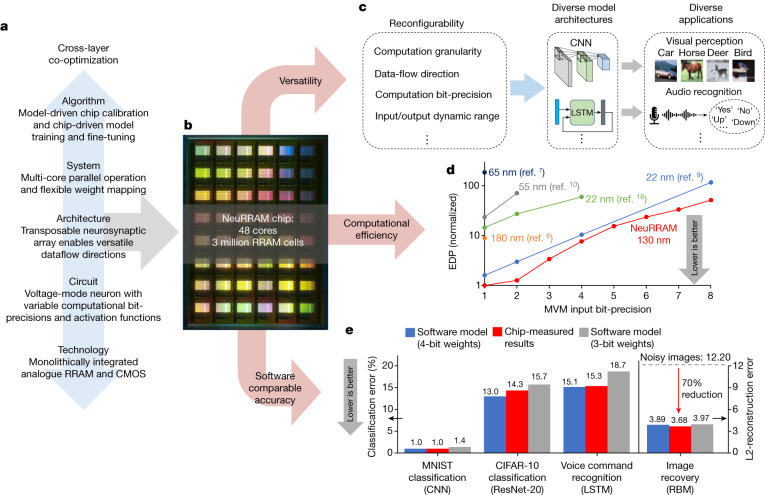
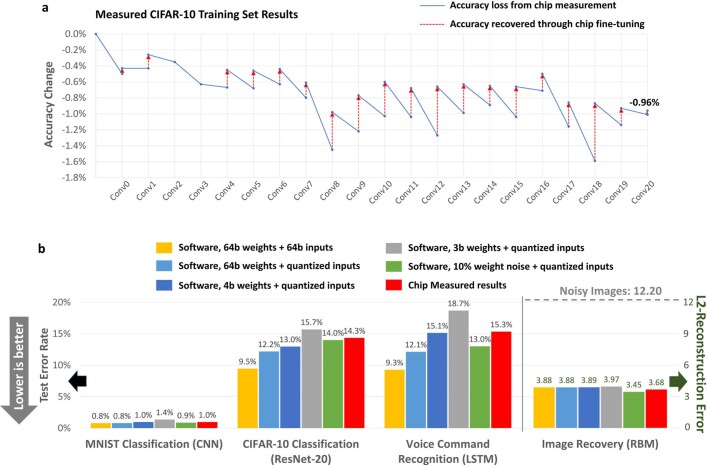
Abstract Realizing increasingly complex artificial intelligence (AI) functionalities directly on edge devices calls for unprecedented energy efficiency of edge hardware. Compute-in-memory (CIM) based on resistive random-access memory (RRAM) 1 promises to meet such demand by storing AI model weights in dense, analogue and non-volatile RRAM devices, and by performing AI computation directly within RRAM, thus eliminating power-hungry data movement between separate compute and memory 2–5 . Although recent studies have demonstrated in-memory matrix-vector multiplication on fully integrated RRAM-CIM hardware 6–17 , it remains a goal for a RRAM-CIM chip to simultaneously deliver high energy efficiency, versatility to support diverse models and software-comparable accuracy. Although efficiency, versatility and accuracy are all indispensable for broad adoption of the technology, the inter-related trade-offs among them cannot be addressed by isolated improvements on any single abstraction level of the design. Here, by co-optimizing across all hierarchies of the design from algorithms and architecture to circuits and devices, we present NeuRRAM—a RRAM-based CIM chip that simultaneously delivers versatility in reconfiguring CIM cores for diverse model architectures, energy efficiency that is two-times better than previous state-of-the-art RRAM-CIM chips across various computational bit-precisions, and inference accuracy comparable to software models quantized to four-bit weights across various AI tasks, including accuracy of 99.0 percent on MNIST 18 and 85.7 percent on CIFAR-10 19 image classification, 84.7-percent accuracy on Google speech command recognition 20 , and a 70-percent reduction in image-reconstruction error on a Bayesian image-recovery task.
Overview
CoChat Summary
TL;DR
NeuRRAM is a 48-core RRAM compute-in-memory chip that co-optimizes device, circuit, architecture, system, and algorithm choices to support reconfigurable AI inference with hardware-measured accuracy. The paper reports better energy-delay product than prior RRAM-CIM chips and benchmark results of 99.0% on MNIST, 85.7% on CIFAR-10, 84.7% on Google speech commands, and a 70% reduction in image-reconstruction error on MNIST image recovery.
Key findings
- The chip achieves an energy-delay product that is 1.6× to 2.3× lower than previous state-of-the-art RRAM-CIM chips, and 7× to 13× higher computational density at various MVM bit-precisions.
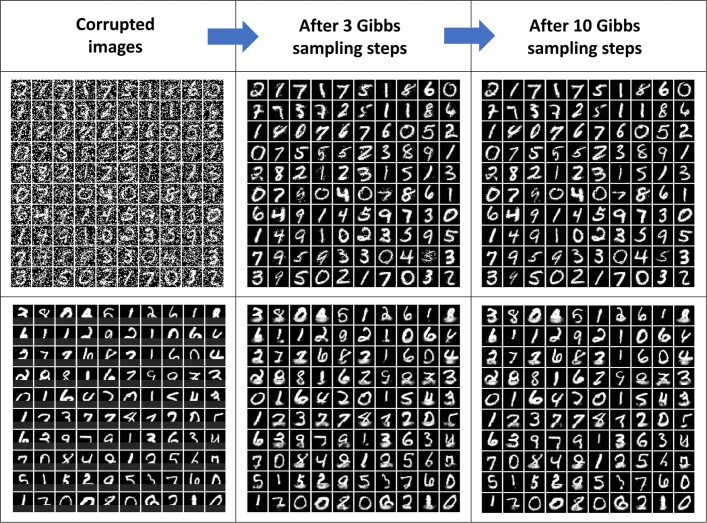
- Fully hardware-measured benchmark results include 99.0% MNIST accuracy, 85.7% CIFAR-10 accuracy, 84.7% Google speech command accuracy, and 70% lower image-reconstruction error on the Bayesian image-recovery task.
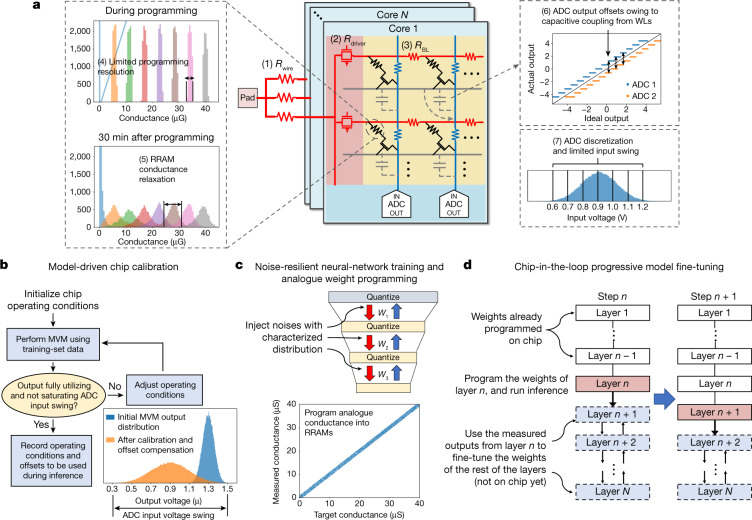
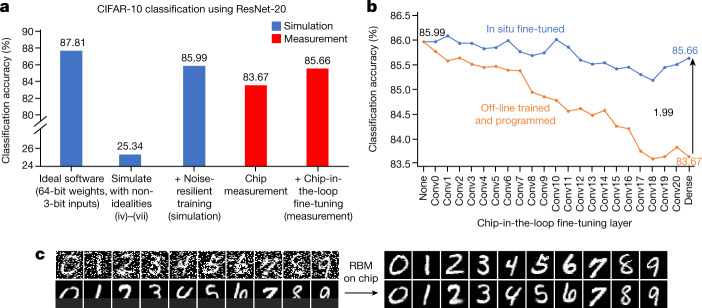
- Hardware-algorithm co-optimization improved CIFAR-10 classification from 25.34% accuracy without noise injection to 85.99% with noise injection; chip-in-the-loop progressive fine-tuning improved cumulative CIFAR-10 test-set accuracy by 1.99%.
- The authors report that the measured CIFAR-10 accuracy for deep ResNet-20 inference on-chip was 83.67%, which remained 3.36% below the 87.03% of the corresponding 4-bit-weight software model.
Methods
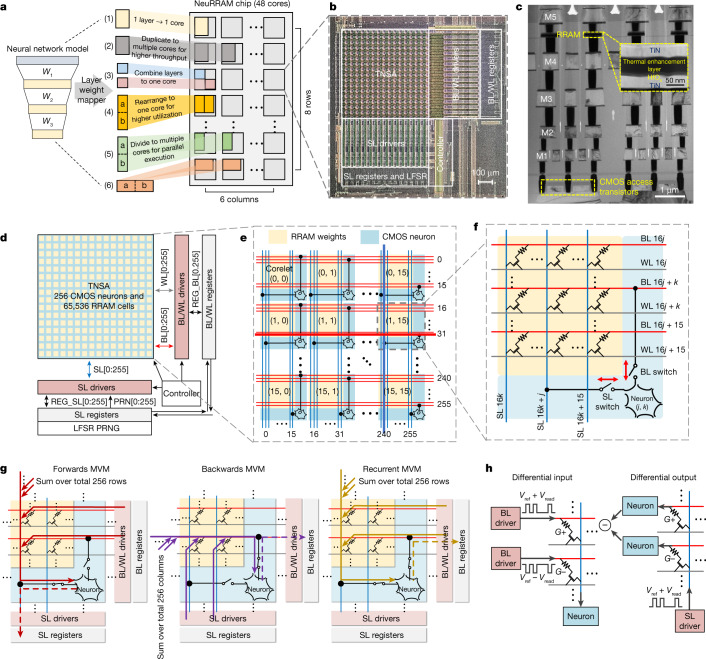
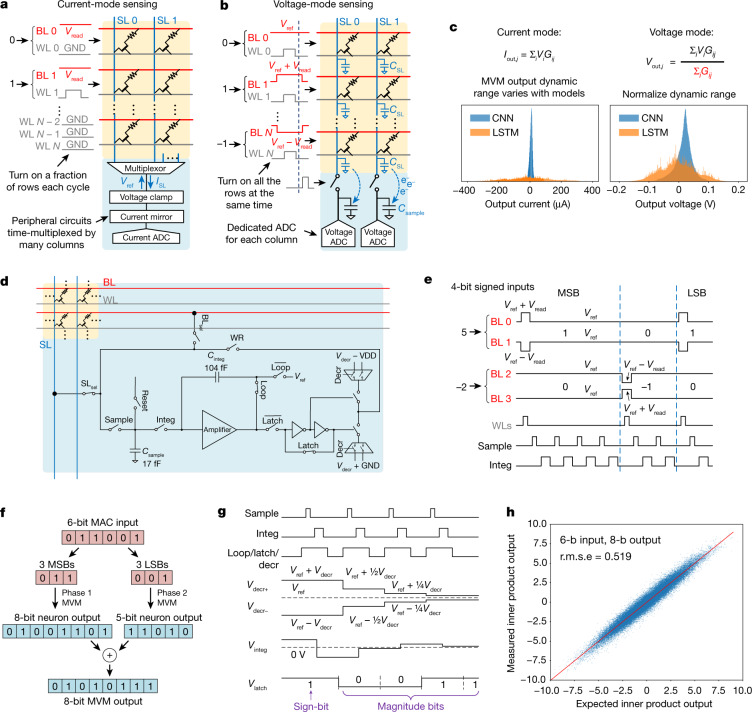
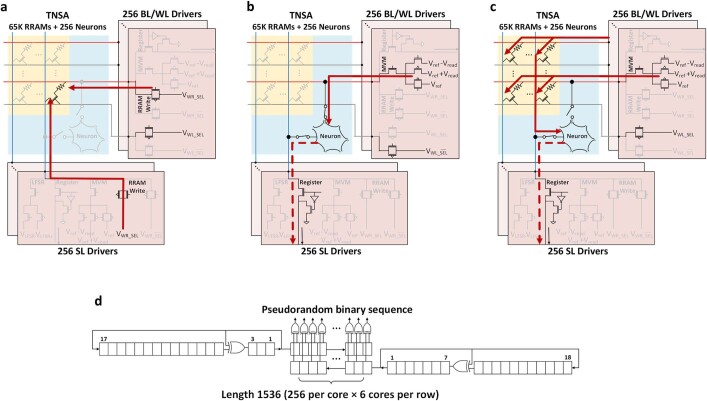
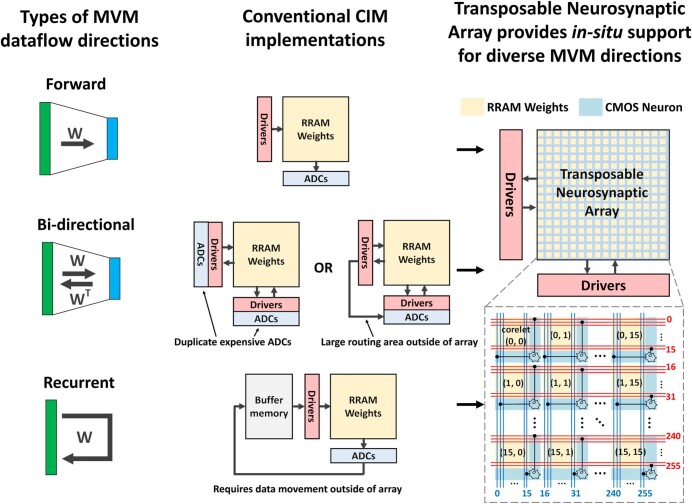
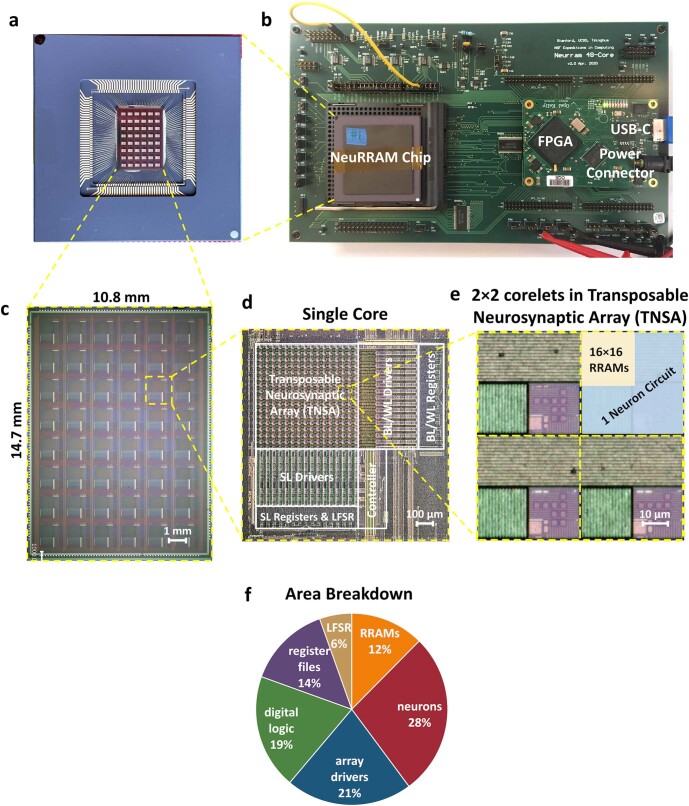
- Built a 48-core NeuRRAM chip with 3 million RRAM devices in a 130-nm CMOS process, using a bidirectional transposable neurosynaptic array (TNSA) and a voltage-mode neuron circuit.
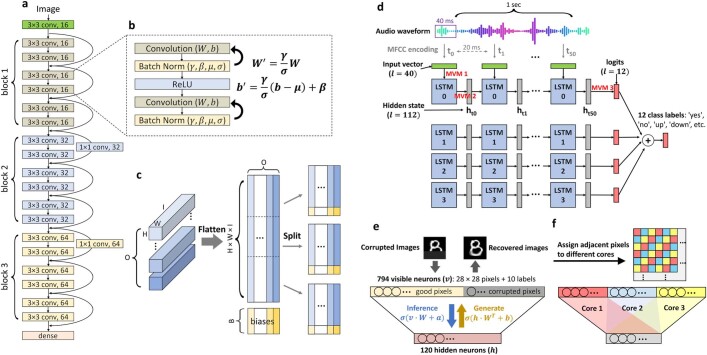
- Evaluated the chip on multiple AI tasks: MNIST and CIFAR-10 image classification, Google speech command recognition, and MNIST image recovery with CNNs, LSTMs, and an RBM; all benchmark results were obtained from hardware measurements on complete datasets.
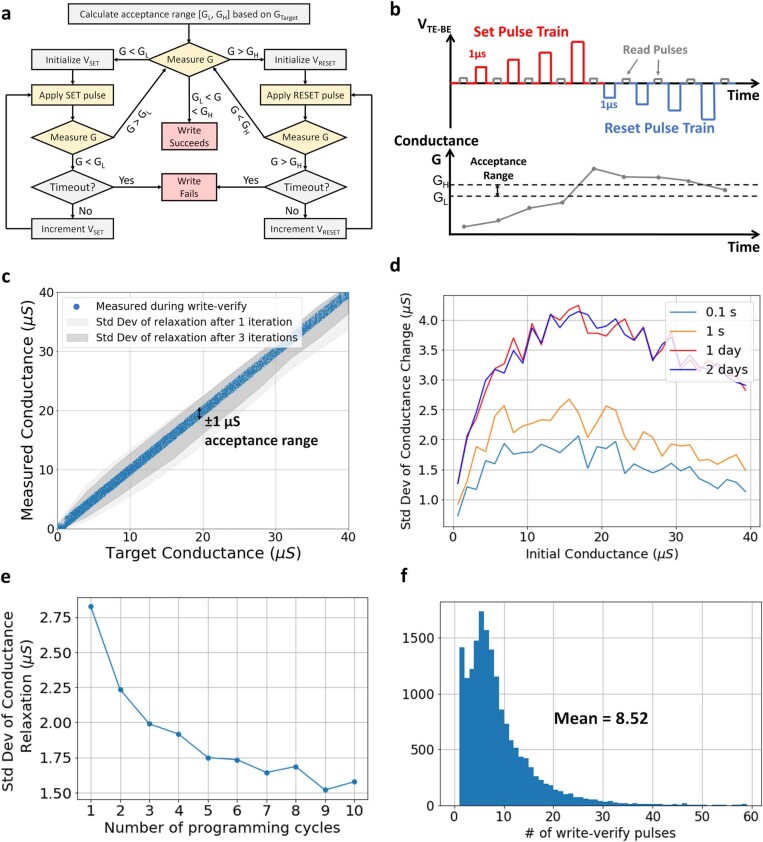
- Used model calibration, noise-resilient training, iterative write–verify programming, and chip-in-the-loop progressive fine-tuning; weights were mapped across cores with strategies for balancing load and mitigating voltage drop.
Limitations
- The paper states that the reported throughput and energy-efficiency numbers are peak values at 100% array utilization and do not include energy/time for buffering or moving intermediate data; this is an explicit limitation of the measurement scope.
- The paper notes that some on-chip accuracies are still below full-precision digital implementations, mainly because of ≤4-bit quantization of inputs and activations, especially sensitive input and output layers.
- Evident from the text: the implementation relies on an FPGA board for partial-sum accumulation, average pooling, buffers, and other operations, so the system is not a fully self-contained chip-level AI system in the demonstrated setup.
Model-written summary. Check it against the paper before relying on it.
Integrity signals
Registry
Cites
Statistics
Figures
Verification
Claims the paper makes
7 Valid · 1 Not valid · 7 Not checked · 130 Own results and interpretations
The cited sources support only part of this claim — read each source’s verdict below.
In the paper
“The accuracy gap mainly comes from low-precision (≤4-bit) quantization of inputs and activations, especially on the most sensitive input and output layers46.”
§ A compute-in-memory chip based on resistive random-access memory > Hardware-algorithm co-optimizations
What the sources say
- Partly supportedcites [46] Choi, J. et al. PACT: parameterized clipping activation for quantized neural networks. Preprint at https://arxiv.org/abs/1805.06085 (2018). sourceExperimental — accuracy not yet measured
Section A.3 (pp. 11–12) finds that aggressively quantizing the first or last layer can noticeably degrade accuracy, while using 8 bits for those layers causes little degradation in the tested model. Section 5.1 (p. 7) also finds that activation accuracy improves with precision. But it does not establish that the accuracy gap mainly comes from inputs and activations, and it reports less than a 1% validation-error difference when activation precision is at least 4 bits, so the claim’s ≤4-bit framing is too broad. (LLM, conf=0.86)
plainstates a cause- Asserted: passes — The authors put it forward as true.
- Checkable: passes — It can be checked against evidence.
- Load-bearing: passes — The paper’s conclusions depend on it.
- Based: passes — The paper gives a reason why it holds.
- Partly supported
The cited sources support only part of this claim — read each source’s verdict below.
In the paper
“The accuracies of some of our quantized models are lower than that of the state-of-the-art quantized model because we apply <4-bit quantization to the most sensitive input and output layers of the neural networks”
§ A compute-in-memory chip based on resistive random-access memory > Methods > Noise-resilient neural-network training
What the sources say
- Supportedcites [46] Choi, J. et al. PACT: parameterized clipping activation for quantized neural networks. Preprint at https://arxiv.org/abs/1805.06085 (2018). source
Section A.3 (pp. 11–12) reports that aggressively quantizing the first or last layer can noticeably degrade accuracy; its table shows substantially higher validation error when those layers use 2 bits. The comparison with a state-of-the-art model describes the citing authors’ own results, not a finding attributed to PACT. (LLM, conf=0.88)
- Not matchedcites [54] Esser, S. K., Mckinstry, J. L., Bablani, D., Appuswamy, R. & Modha, D. S. Learned step size quantization. In International Conference on Learning Representations (ICLR) (2020).
Its entry has no title and year that we can search by.
plainstates a cause- Asserted: passes — The authors put it forward as true.
- Checkable: passes — It can be checked against evidence.
- Load-bearing: unclear — It is unclear whether the paper’s conclusions depend on it.
- Based: passes — The paper gives a reason why it holds.
- Supported
A result the paper reports from its own data — it cites no other source for it, so there is none to check. The quote shows it is in the paper.
In the paper
“we achieve a 0.98% error rate on MNIST handwritten digit recognition using a 7-layer CNN”
§ A compute-in-memory chip based on resistive random-access memory > Hardware-algorithm co-optimizations
plain- Asserted: passes — The authors put it forward as true.
- Checkable: passes — It can be checked against evidence.
- Load-bearing: passes — The paper’s conclusions depend on it.
- Based: passes — The paper gives a reason why it holds.
A result the paper states — it cites no source for it, so there is none to check. The quote shows it is in the paper.
In the paper
“Some of these numbers are not yet to the accuracies achieved by full-precision digital implementations.”
§ A compute-in-memory chip based on resistive random-access memory > Hardware-algorithm co-optimizations
plain- Asserted: passes — The authors put it forward as true.
- Checkable: passes — It can be checked against evidence.
- Load-bearing: unclear — It is unclear whether the paper’s conclusions depend on it.
- Based: passes — The paper gives a reason why it holds.
A result the paper reports from its own data — it cites no other source for it, so there is none to check. The quote shows it is in the paper.
In the paper
“a 14.34% error rate on CIFAR-10 object classification using ResNet-20”
§ A compute-in-memory chip based on resistive random-access memory > Hardware-algorithm co-optimizations
plain- Asserted: passes — The authors put it forward as true.
- Checkable: passes — It can be checked against evidence.
- Load-bearing: passes — The paper’s conclusions depend on it.
- Based: passes — The paper gives a reason why it holds.
72 more claims
Create a free account to see all 145 claims and to verify the 2 references still open.
- Probably not a substantial claim. 37
- It may state two separate claims as one. 41
Claims other papers make about this one
Each is checked against this paper’s own text: does it say what the citing paper says it does?
The source backs part of the claim, not all of it — or backs it for a different population, condition or comparison.
In the citing paper
“So far, several groups and companies have claimed the realization of hybrid CMOS/memristor implementations of ANNs53–61, —from now on, memristive ANNs— with performance that is superior to that of fully-CMOS counterparts.”
From Hardware implementation of memristor-based artificial neural networks (2024) · cites this paper as [60]
Experimental — accuracy not yet measuredThe source backs part of the claim, not all of it — or backs it for a different population, condition or comparison.
In the citing paper
“Although several compute-in-memory or near-memory approaches based on SRAMs and digital compute35–38 have been presented in the literature, most of these do not address the energy and time costs of reloading weights, thus making direct side-by-side comparisons against NVM-based weight-stationary approaches difficult.”
From An analog-AI chip for energy-efficient speech recognition and transcription (2023) · cites this paper as [7]
Experimental — accuracy not yet measuredThe cited source says what the claim attributes to it.
In the citing paper
“Some groups prefer to incorporate a transistor in series to each MIM cell to obtain a better control over the currents through the device (i.e., improve conductance controllability and minimize sneak path currents)53–55,60,61,102,113,167,194,218–222,).”
From Hardware implementation of memristor-based artificial neural networks (2024) · cites this paper as [60]
The cited source says what the claim attributes to it.
In the citing paper
“Then, analogue VMM has been demonstrated both for binary inputs and weights218–220, as well as for binary inputs and analogue/multilevel weights60,85,105,217.”
From Hardware implementation of memristor-based artificial neural networks (2024) · cites this paper as [60]
The cited source says what the claim attributes to it.
In the citing paper
“These results imply that with better architecture, materials, and hardware-software co-design [161], in-memory computing can set new standards for parallel processing.”
From Brain-inspired computing systems: a systematic literature review (2024) · cites this paper as [161]
2 more claims about this paper
Create a free account to see every claim other papers make about this one.
Citations
Cites
Deep Residual Learning for Image Recognition
He, K., Zhang, X., Ren, S., & Sun, J. (2016) · 2016 IEEE Conference on Computer Vision and Pattern Recognition (CVPR) · doi:10.1109/cvpr.2016.90 · Cited by 235,474
Hochreiter, S., & Schmidhuber, J. (1997) · Neural Computation · doi:10.1162/neco.1997.9.8.1735 · Cited by 102,318
LeCun, Y., Bengio, Y., & Hinton, G. (2015) · Nature · doi:10.1038/nature14539 · Cited by 84,126
Gradient-based learning applied to document recognition
Lecun, Y., Bottou, L., Bengio, Y., & Haffner, P. (1998) · Proceedings of the IEEE · doi:10.1109/5.726791 · Cited by 58,805
Multilayer feedforward networks are universal approximators
Hornik, K., Stinchcombe, M., & White, H. (1989) · Neural Networks · doi:10.1016/0893-6080(89)90020-8 · Cited by 21,728
International Conference on Learning Representations (ICLR 2013)
松尾, 豊. (2013) · 人工知能学会誌 = Journal of Japanese Society for Artificial Intelligence · Cited by 6,286
In-Datacenter Performance Analysis of a Tensor Processing Unit
Jouppi, N. P., Young, C., Patil, N., Patterson, D., Agrawal, G., Bajwa, R., Bates, S., Bhatia, S., Boden, N., Borchers, A., et al. (2017) · Proceedings of the 44th Annual International Symposium on Computer Architecture · doi:10.1145/3079856.3080246 · Cited by 4,537
Eyeriss: An Energy-Efficient Reconfigurable Accelerator for Deep Convolutional Neural Networks
Chen, Y.-H., Krishna, T., Emer, J. S., & Sze, V. (2017) · IEEE Journal of Solid-State Circuits · doi:10.1109/jssc.2016.2616357 · Cited by 3,247 · cited 1×
“Extended Data Table 2 shows that such scaling will enable NeuRRAM to deliver higher energy and area efficiency than today’s state-of-the-art edge inference accelerators 58–61 .”
BackgroundTraining and operation of an integrated neuromorphic network based on metal-oxide memristors
Prezioso, M., Merrikh-Bayat, F., Hoskins, B. D., Adam, G. C., Likharev, K. K., & Strukov, D. B. (2015) · Nature · doi:10.1038/nature14441 · Cited by 3,001 · cited 2×
“…based on resistive random-access memory (RRAM) 1 promises to meet such demand by storing AI model weights in dense, analogue and non-volatile RRAM devices, and by performing AI computation directly within RRAM, thus eliminating power-hungry data movement between separate compute and memory 2–5 .”
Wong, H.-S. P., Lee, H.-Y., Yu, S., Chen, Y.-S., Wu, Y., Chen, P.-S., Lee, B., Chen, F. T., & Tsai, M.-J. (2012) · Proceedings of the IEEE · doi:10.1109/jproc.2012.2190369 · Cited by 2,757
Self-citation
Research works printed but not linked: 1
- Koller, D. & Friedman, N. Probabilistic Graphical Models: Principles and Techniques (Adaptive Computation and Machine Learning series) (MIT Press, 2009).
Cited by
Items 801–900 of 925
Reconfigurable neuromorphic system based on memristive devices
Shchanikov, S., Bordanov, I., Владимирович, К. Л., & Mikhailov, A. (2026) · The European Physical Journal Special Topics · doi:10.1140/epjs/s11734-026-02525-2 · Cited by 1
Xiao, J., Wang, H., Xu, C., et al. (2026) · Applied Physics Letters · doi:10.1063/5.0342723
Wei, D., Qu, J., Zeng, Y., Zhang, D., & Qiao, L. (2026) · IEEE Transactions on Very Large Scale Integration (VLSI) Systems · doi:10.1109/tvlsi.2026.3677368
A One‐Transistor Logic Gate with 50% Smaller Footprint by Foundry Process and Beyond
Dai, M., Lin, Z., Zhang, S. Y., Lv, M., Ji, X., Zhang, X., Li, J., Kuang, Y., & Dong, Y. (2025) · Advanced Functional Materials · doi:10.1002/adfm.202421204 · Cited by 1
Xu, K., Sheng, C., Xia, D., Qiu, Z., Cong, C., Liu, R., & Hu, L. (2026) · Small Methods · doi:10.1002/smtd.70740
Interfacial coupling-enabled non-volatile self-rectifying molecular memristors
Li, M., Hao, J., Zhang, L., et al. (2026) · Science China Materials · doi:10.1007/s40843-026-4128-7
A ReRAM-Based Adaptive Binary Neural Network Accelerator for Efficient Inference
Dang, P., Huang, B., & Li, H. (2025) · International Symposium of Electronics Design Automation (ISEDA) · doi:10.1109/iseda65950.2025.11100389 · Cited by 1
Liu, X., Wang, M., Li, Y., Wang, L., Qiu, J., Cheng, L., Shi, T., Zhang, X., Chen, X., Wang, W., et al. (2025) · Advanced Functional Materials · doi:10.1002/adfm.202523251 · Cited by 2
FAME: An Open-source Fast Memory-Efficient Simulation Framework for Non-Ideal ReRAM
Zhang, X., Yang, W., & Sheng, W. (2024) · IEEE Advanced Information Management, Communicates, Electronic and Automation Control Conference (IMCEC) · doi:10.1109/imcec59810.2024.10575790
Electrical performance study of carbon-based memristor with additional MXene capping layer
Lu, H., & Wang, L. (2024) · Functional Materials Letters · doi:10.1142/s1793604724500085
Rossetti, D., Xu, Y., Asselta, L., Yang, J. J., Williams, R. S., & Corinto, F. (2026) · Advanced Electronic Materials · doi:10.1002/aelm.70580
Zhou, Z., Fu, Y., Li, J., Li, Y., & Miao, X. (2026) · IEEE International Symposium on Circuits and Systems proceedings · doi:10.1109/iscas66217.2026.11561964
Research on Artificial Neural Network Inference Accuracy Control for HfO 2 Thin-Film Memristors
Luo, W. (2024) · International Symposium on Integrated Circuit Design and Integrated Systems (ICDIS) · doi:10.1145/3702191.3702195
Is There A Pure Electronic Ferroelectric?
Wang, X., Teng, G., Meng, X., Cheng, Z., Lin, T., Shen, H., Wang, X., Wang, J., & Chu, J. (2025) · Advanced Electronic Materials · doi:10.1002/aelm.202500683 · Cited by 2
Solving linear programming in one step with RRAM-based analog matrix computing
Luo, Y., & Sun, Z. X. (2026) · Frontiers in Nanotechnology · doi:10.3389/fnano.2026.1882288
Yu, R., Zou, C., Li, J., Gao, B., Tang, J., Qian, H., & Wu, H. (2025) · IEEE Transactions on Computer-Aided Design of Integrated Circuits and Systems · doi:10.1109/tcad.2025.3600366
Self-citationFixed-Point Splitting Quantization: Improving Accuracy for Compute-in-Memory Vector Retrieval
You, S., Gao, S., Xu, Q., Li, X., & Chen, W. (2025) · Communications in computer and information science · doi:10.1007/978-981-95-4094-5_20
Research and Application of Compute-in-Memory Architectures: RRAM, MRAM, and FeRAM
Chen, Y. (2025) · Transactions on Computer Science and Intelligent Systems Research · doi:10.62051/e68jey36
OptiRange: An Efficient ReRAM-Based PIM Accelerator with ADC Resolution Optimization
Jeon, S.-W., Ji, G., Kim, Y., Park, Y., Kim, S., & Ryu, S. (2025) · doi:10.1109/iccad66269.2025.11240769
Enhancing Robustness of Content-Addressable Memories for In-Memory Search
Liu, L., Pereira, T. S., Sharifi, M. M., Ren, P., Wen, B., Li, C., Ni, K., Niemier, M., & Hu, X. S. (2026) · IEEE VLSI Test Symposium (VTS) · doi:10.1109/vts69484.2026.11563370 · Cited by 1
Fang, Z., Zhu, M., Xu, H., & Zhang, L. (2026) · Electronics · doi:10.3390/electronics15112333
CIMFlow: Modelling Dataflow in Cross-Layer Compute-in-Memory Deep Learning Accelerators
Cubero-Cascante, J., Schneider, L. T. R., Pelke, R., Vaidyanathan, A. M., Leupers, R., & Joseph, J. M. (2025) · ACM Transactions on Embedded Computing Systems · doi:10.1145/3760780
AM5: Bulk Logic-in-Memory Using MRAM NAND Crossbar
Mosquera, C., Garzón, E., Lanuzza, M., Teman, A., & Yavits, L. (2026) · IEEE Journal on Emerging and Selected Topics in Circuits and Systems · doi:10.1109/jetcas.2026.3689530
Materials chemistry of resistive switching in memristors
Guan, P., Ning, K., Qin, L., Xiao, S., Li, Y., Li, H., & Zhai, T. (2026) · Scientia Sinica Chimica · doi:10.1360/ssc-2026-0131
Thermodynamic constraints as organizing principles of neural efficiency and cognitive architecture
Torres–Martínez, S. (2026) · Biosystems · doi:10.1016/j.biosystems.2026.105921
Anand, A. Y., Thomas, A., Dayal, G., et al. (2026) · SSRN Electronic Journal · doi:10.2139/ssrn.6257410
Kim, S., Byun, J., Kim, H., Son, J., & Kim, S. (2025) · IEEE Transactions on Electron Devices · doi:10.1109/ted.2025.3566348
Lookup Table-based Computing: A Survey from Software Implementations to Hardware Architectures
Dai, W., Chen, X., Chen, H., Song, S., Li, S., Hong, T., & Song, Z. (2026) · ACM Computing Surveys · doi:10.1145/3779417 · Cited by 2
Large-Margin Dynamic Memory Refresh for Persistent In-Memory Computing and Learning
Sebt, S., Leugering, J., Gennis, G., & Cauwenberghs, G. (2026) · IEEE Journal on Emerging and Selected Topics in Circuits and Systems · doi:10.1109/jetcas.2026.3704740
Self-citationDiao, Z., Tohei, T., & Sakai, A. (2026) · SSRN Electronic Journal · doi:10.2139/ssrn.7243398
Women in Circuits [Guest Editorial]
Gu, Q. J. (2022) · IEEE Solid-State Circuits Magazine · doi:10.1109/mssc.2022.3207334
A Highly Robust MoS2-xOδ Volatile Memtransistor Array for Reservoir Computing
Deng, W., Xin, Y., Tang, D., Yin, W., Xu, H., Zhang, H., Su, R., & Luo, W. (2026) · Nano Letters · doi:10.1021/acs.nanolett.6c02779
Computing in a memory with physics
Zheng, X., & Valov, I. (2026) · Science · doi:10.1126/science.aei8090
Das, S. K., Naha, K., Bhattacharjee, D., Hussain, S. A., & Bhattacharjee, D. (2026) · ACS Applied Engineering Materials · doi:10.1021/acsaenm.6c00145
Interface-type resistive switching in sodium ion-doped AlOx memristors for neuromorphic computing
Cho, S. Y., Park, Y., Hong, J., Ham, W., Lee, J., Kwon, J., & Namgung, S. D. (2026) · Ceramics International · doi:10.1016/j.ceramint.2026.02.430
Neuromorphic Denoising with Fully Analog Memristive In‐Memory Computing
Shi, D., Zhang, T., Li, Y., Tao, Y., Yan, B. Y., & Yang, Y. (2026) · Advanced Intelligent Systems · doi:10.1002/aisy.70419 · Cited by 1
Hardware validation of 130nm CMOS-integrated RRAM for accelerating vector–matrix multiplication
Thileeban, R., Uhlmann, M., Reddy, K. D. S., Rizzi, T., Quesada, E. P.-B., Wenger, C., & Pérez, E. (2026) · Microelectronic Engineering · doi:10.2139/ssrn.7163848
Dey, S., Saha, M., Nawaz, S. M., Mandal, A., & Mallik, A. B. (2025) · Advanced Materials Technologies · doi:10.1002/admt.202501216
Low-Rank Compensation in Hybrid 3D-RRAM/SRAM Computing-in-Memory System for Edge Computing
Tang, W., Nie, L., Ma, C., Wu, H., Yuan, Y., Zhang, S., Liu, Q., & Zhang, F. (2025) · Eng—Advances in Engineering · doi:10.3390/eng6120332
Self-citationThRIve: Thermally Robust CNN Inference via Low-Rank Adaptation in Heterogeneous PIM Architectures
Sharma, V., Dhingra, P., Doppa, J. R., & Pande, P. P. (2025) · ACM Transactions on Design Automation of Electronic Systems · doi:10.1145/3774328 · Cited by 1
On the Viability of End-to-End Neural Networks in the Analog Domain
Ige, A., Ayyappan, P. R., & Hasler, J. (2026) · IEEE Journal on Emerging and Selected Topics in Circuits and Systems · doi:10.1109/jetcas.2026.3703087
Ricci, S., Mannocci, P., Porzani, M., Bridarolli, D., Carletti, F., Farronato, M., & Ielmini, D. (2026) · Advanced Electronic Materials · doi:10.1002/aelm.202600012
Guo, Q., Xie, J., Sun, G., et al. (2026) · SSRN Electronic Journal · doi:10.2139/ssrn.6533233
Reconfigurable Two-Dimensional Activation Neuron Device
Yi, J., Zhang, Q., Zhang, P., Wang, C., Li, W., Zhou, G., Qiu, G., Lin, X., Chen, Z., Wu, D., et al. (2026) · Nano Letters · doi:10.1021/acs.nanolett.6c02085
Self-citationElsheikh, A. A., Fouda, M. E., & Eltawil, A. M. (2026) · Neurocomputing · doi:10.1016/j.neucom.2026.134040
Fault Tolerance Framework for Memristor based Binarized Neural Networks
Qian, J., Yang, Y. S., & Huang, C. (2023) · IEEE International Conference on Memristive Computing and Applications (ICMCA) · doi:10.1109/icmca59770.2023.10480978
Li, M., Wang, Z., Ye, Z., Pan, T., & Wang, H. (2025) · IEEE International Conference on Computer Design: VLSI in Computers and Processors (ICCD) · doi:10.1109/iccd65941.2025.00041 · Cited by 2
A Study on Performance Enhancement of TiO 2 /HfO 2 Memristors through Rapid Thermal Annealing
Wu, Y., Hu, Y., Qu, Y., Sang, P., Wu, J., Zhan, X., & Chen, J. (2025) · IEEE International Conference on ASIC (ASICON) · doi:10.1109/asicon66040.2025.11326297
Thermal analysis and management for RRAM-based computing-in-memory chips
Ma, A., Gao, B., Yu, R., Zhang, Q., Yao, P., Tang, J., Qian, H., & Wu, H. (2026) · Science China Information Sciences · doi:10.1007/s11432-025-4708-9
Self-citationHwang, J., Kim, J., Cho, J., Shin, H., Bae, J., Park, M.-K., & Lee, J. (2026) · Nano Energy · doi:10.1016/j.nanoen.2026.112320
Research on Emerging Hardware-Software Co-Design for AI Workloads Acceleration
Lin, J. (2026) · IEEE International Conference on Information Technology, Big Data and Artificial Intelligence (ICIBA) · doi:10.1109/iciba68339.2026.11651680
A framework for analog-digital mixed-precision neural network training and inference
Vasilopoulos, A., Boulharts, E., Lammie, C., Büchel, J., Benmeziane, H., Gallo, M. L., & Sebastian, A. (2025) · IEEE International Symposium on Circuits and Systems proceedings · doi:10.1109/iscas56072.2025.11043537 · Cited by 2
Li, Y., Zhang, Y., Wang, X., Zhao, Z., Xing, G., Liu, L., Dong, F., Guo, Z., Gao, X., & Xing, G. (2025) · Journal of Applied Physics · doi:10.1063/5.0293805 · Cited by 2
Analog Computing with High Precision and Reliability (Invited)
Song, W., & Yang, J. J. (2025) · IEEE International Reliability Physics Symposium proceedings · doi:10.1109/irps48204.2025.10983907
Sle, Y., Park, J., Vincent, P., Lee, W., Jeon, J., & Cho, H. S. (2026) · Engineering Applications of Artificial Intelligence · doi:10.1016/j.engappai.2026.116185
Han, L., Huang, P. C., Zhou, Z., Chen, Y., Yang, H., Liu, X., & Kang, J. (2024) · Design, Automation, and Test in Europe · doi:10.23919/date58400.2024.10546661
Synaptic uncertainty for in-memory computing
Bonnet, D. (2024) · theses.fr (ABES) · doi:10.70675/5d34cb96z0f54z44b0zb3aez48f1fbf1e560
Relaxor ferroelectrics for neuromorphic computing
Cheng, L. (2024) · theses.fr (ABES) · doi:10.70675/fbc0cc50z8b92z47f4z9ee2z91e531f5d3a0
Probabilistic Spiking Neural Network with Correlation-Based Memristive Synaptic Update
Kunitsyn, D., Sboev, A. G., Davydov, Y., Vlasov, D., Serenko, A., & Rybka, R. (2025) · Moscow University Physics Bulletin · doi:10.3103/s002713492570300x · Cited by 2
Memory-Efficient Feature Merging for Residual Connections with Layer-Centric Tile Fusion
Zhang, H., He, J., Gui, Y., Peng, S., Huang, L., Yan, X., & Fan, Y. (2025) · Electronics · doi:10.3390/electronics14163269
Ng, D., Lam, K. H., Bu, S. Q., Lo, W. C., Chan, C. H., Ng, R., Chan, S., Mak, M., Wong, H., Chim, S., et al. (2026) · Journal of Low Power Electronics and Applications · doi:10.3390/jlpea16030022
Self-citationLee, B., & Springer, T. (2026) · Mediterranean Conference on Embedded Computing (MECO) · doi:10.1109/meco70748.2026.11579016
Split-Gate Memtransistors for Energy-Efficient Adaptive Reinforcement Learning
Qian, J. H., Liu, K. J., Ns, J., Wu, R., Liu, S. E., Chapagain, A., Trdinich, Z. J., Jayasuriya, D., Yan, X., Trivedi, A. R., et al. (2026) · ACS Nano · doi:10.1021/acsnano.6c04411
Locking Tetrahedral Ge Coordination Enables Stable Multilevel Phase-Change Memory
Liu, R., Liu, L., Chen, Y., Zhang, H., Liu, K., Feng, D., Zhai, J., Zhou, X., Song, S., & Song, Z. (2026) · ACS Applied Materials & Interfaces · doi:10.1021/acsami.5c18011
End-to-End Design Flow for Resistive Neural Accelerators
Uhlmann, M., Rizzi, T., Wen, J., Quesada, E. P.-B., Beattie, B. A., Ochs, K., Pérez, E., Ostrovskyy, P., Carta, C., Wenger, C., et al. (2025) · IEEE Transactions on Computer-Aided Design of Integrated Circuits and Systems · doi:10.1109/tcad.2025.3597237 · Cited by 1
Reddy, B. N. K., & Krishna, Y. C. (2026) · IEEE Transactions on Consumer Electronics · doi:10.1109/tce.2026.3675248 · Cited by 1
A Data-Driven Framework for Modeling Non-Idealities in Analog In-Memory Computing Hardware
Vasilopoulos, A., Kersting, B., Büchel, J., Sebastian, A., & Gallo, M. L. (2026) · IEEE Journal on Emerging and Selected Topics in Circuits and Systems · doi:10.1109/jetcas.2026.3705427
Seo, H., Song, M., Ko, H. W., Kang, J., Lee, G., Park, S.-Y., Kim, H. J., Mun, S., Park, M.-C., & Yoon, K. J. (2025) · Cell Reports Physical Science · doi:10.1016/j.xcrp.2025.102966
OAH-CIM: Outlier-Aware Hybrid RRAM-SRAM CIM Accelerator with Variation-Robust Sparsity
Zhou, Z., Hu, T., Bao, H., Zhou, H., Fu, Y., Li, J., Chen, J., Li, Y., & Miao, X. (2026) · Asia and South Pacific Design Automation Conference (ASP-DAC) · doi:10.1109/asp-dac66049.2026.11420538
Fault-free analogue computing with imperfect hardware
Xu, Z., Liu, J., Huang, S., Li, Z., Wang, S., Wen, B., Mao, R., Jiang, M., Pedretti, G., Ignowski, J., et al. (2026) · Nature Electronics · doi:10.1038/s41928-026-01638-9 · Cited by 4
Anand, A. Y., Thomas, A., Dayal, G., Gondhalekar, J., & Jinesh, K. B. (2026) · Optical Materials · doi:10.1016/j.optmat.2026.118277
Han, M., Wu, J. X., Dong, J., Wang, Y., Liu, H., & Qu, G. (2025) · IEEE Transactions on Computer-Aided Design of Integrated Circuits and Systems · doi:10.1109/tcad.2025.3608002 · Cited by 1
RRAM-Based Spectral-Domain Convolution Accelerator for Reliable and Energy-Efficient CNN Inference
Wen, J., Baroni, A., Wenger, C., Krstic, M. D., & Poehls, L. M. B. (2025) · IEEE Transactions on Very Large Scale Integration (VLSI) Systems · doi:10.1109/tvlsi.2025.3644141 · Cited by 2
Joint Hardware-Workload Co-Optimization for In-Memory Computing Accelerators
Krestinskaya, O., Fouda, M. E., Eltawil, A. M., & Salama, K. N. (2026) · IEEE Access · doi:10.1109/access.2026.3671360 · Cited by 2
More than MACs: exploring the role of neuromorphic engineering in the age of LLMs
Olin-Ammentorp, W. (2026) · Neuromorphic Computing and Engineering · doi:10.1088/2634-4386/ae5088
Beom, J.-S., & Kim, N.-S. (2025) · IEEE Transactions on Electron Devices · doi:10.1109/ted.2025.3644274
Pioneering real-time genomic analysis by in-memory computing
Zhu, K., & Lanza, M. (2025) · Nature Computational Science · doi:10.1038/s43588-025-00883-w
Li, R. K., Jiang, X., Zhao, X., Zhang, H., Xu, Q., & Wang, G. (2026) · Coatings · doi:10.3390/coatings16060715
Xu, P., Mou, X., Gao, B., Wei, Q., Yao, P., Tang, J., Qian, H., & Wu, H. (2024) · IEEE Transactions on Circuits & Systems II Express Briefs · doi:10.1109/tcsii.2024.3442873
Self-citationZhang, J., Chaocheng, S., Yan, J., Pei, Y., Xu, J., Yan, X., & Zhao, J. (2026) · 中国科学通报:英文版 · doi:10.1016/j.scib.2026.06.005
Gopi, A., Pallathuvalappil, S., George, E., & James, A. (2025) · IEEE Journal of Microwaves · doi:10.1109/jmw.2025.3581235
FLAMES: Framework for Learning With Analog MEmory Systems
Aghapour, M., Kenarangi, F., & Partin-Vaisband, I. (2025) · IEEE Transactions on Circuits and Systems I Regular Papers · doi:10.1109/tcsi.2025.3615114
Sequence Detection in Bilayer 1T1R RRAM Device with Integrated State MachinePreprint
Singh, S., Paul, G., Bende, A., et al. (2024) · Research Square · doi:10.21203/rs.3.rs-4194643/v1
Neurosynaptic Core Prototype for Memristor Crossbar Arrays Diagnostics
Alyaev, I. V., Surazhevsky, I. A., Ichyotkin, D. V., Rylkov, V. V., & Demin, V. A. (2025) · Electronics · doi:10.3390/electronics14244965 · Cited by 1
Vulnerability Analysis of Timing Side-Channels in Multi-Tenant ReRAM Crossbars
Sifat, M. B. U., Chugh, H., Hasan, N., & Rashed, M. R. H. (2026) · IEEE Dallas Circuits and Systems Conference (DCAS) · doi:10.1109/dcas69364.2026.11544917
Metadata
- Authors
- Wan, W., Kubendran, R., Schaefer, C., Eryilmaz, S. B., Zhang, W., Wu, D., Deiss, S., Raina, P., Qian, H., Gao, B., Joshi, S., Wu, H., Wong, H.-S. P., & Cauwenberghs, G.
- Affiliations
- University of California San Diego (US)
- University of Pittsburgh (US)
- University of Notre Dame (US)
- Stanford University (US)
- Tsinghua University (CN)
- Corresponding author
- Wan, Weier
- Gao, Bin
- Joshi, Siddharth
- Wu, Huaqiang
- Wong, H.-S. Philip
- Cauwenberghs, Gert
- ORCID
- Venue
- Nature
- Published
- 2022-08-17
- Volume
- 608
- Issue
- 7923
- Pages
- 504-512
- ISSN
- 0028-0836 (ISSN-L)
- 1476-4687
- PMC
- PMC9385482
- OpenAlex
- W4292121737
- Cited by
- 943
- References
- 65
- Citations by year
- 2026: 235 · 2025: 273 · 2024: 246 · 2023: 167 · 2022: 22
- FWCI
- 48.45
- Type
- journal article
- Language
- en
- Open access
- hybrid
- doi.org
- Licence
- cc-by
- creativecommons.org/licenses/by/4.0 (tdm)
- creativecommons.org/licenses/by/4.0 (vor)
- Locations
- Nature (publishedVersion, cc-by)
- PubMed Central (publishedVersion, cc-by)
- PubMed (publishedVersion)
- RePEc: Research Papers in Economics (submittedVersion)
- eScholarship (California Digital Library) (submittedVersion, cc-by)
- Funders
- National Science Foundation (1317470)
- Western Digital
- University of Pennsylvania
- Pennsylvania State University
- Stanford SystemX Alliance
- National Natural Science Foundation of China (61851404)
- Office of Naval Research
- Topics
- Physical Sciences › Engineering › Electrical and Electronic Engineering › Advanced Memory and Neural Computing
- Physical Sciences › Engineering › Electrical and Electronic Engineering › Ferroelectric and Negative Capacitance Devices
- Physical Sciences › Computer Science › Computer Vision and Pattern Recognition › Advanced Neural Network Applications
- Keywords
- in-memory computing, resistive random access memory, neuromorphic hardware, edge AI, energy efficiency, weight quantization, hardware-software co-optimization, non-volatile memory, image classification, voice command recognition
About these checks
Registry, retraction, Cites and statistics results are computed, not judged, with one exception: a printed reference that no index lists is read once by a model before it counts as a citation error. Claims are extracted by a model and kept only when their quote appears verbatim in the text; each cited source is then checked, with a model’s help, for whether it says what the claim relies on. Those verdicts can be wrong — read the claim’s quote and the cited source before relying on one.
The claim verdicts this report counts are experimental: their accuracy is not yet measured.
A language model drew the claims from the paper on 2026-09-29, under version 3 of the claim definition (model deepseek-v4.1-flash, prompt extract-v3).
A second model labelled each claim on 2026-09-29 (model jev-1.13-20260917, definition revision gold-guideline-v0.2).
Cited sources are checked with a language model’s help (gpt-6-sol).
Statistics and arithmetic are recomputed, not judged.
Confidence bands are shown only for fields calibrated on our annotated test set. None is calibrated yet, so no band is shown.
What counts as a claim ›How we measure confidence ›How we check this ›
Are you an author, or do you see a problem with this page? Request a review
Data sources
Bibliographic data: Semantic Scholar, OpenAlex, Crossref.
Contains information from the Semantic Scholar Academic Graph Datasets, made available under the ODC Attribution License (ODC-BY 1.0).
Semantic Scholar’s data is described in: Kinney, R., et al. (2023). The Semantic Scholar Open Data Platform. arXiv:2301.10140.
