

A compute-in-memory chip based on resistive random-access memory
Open accessThe DOI matches its Crossref record; 65 of the 66 references it cites were found in a registry or an index; 15 of the 35 sources its claims cite were checked for support.
Abstract
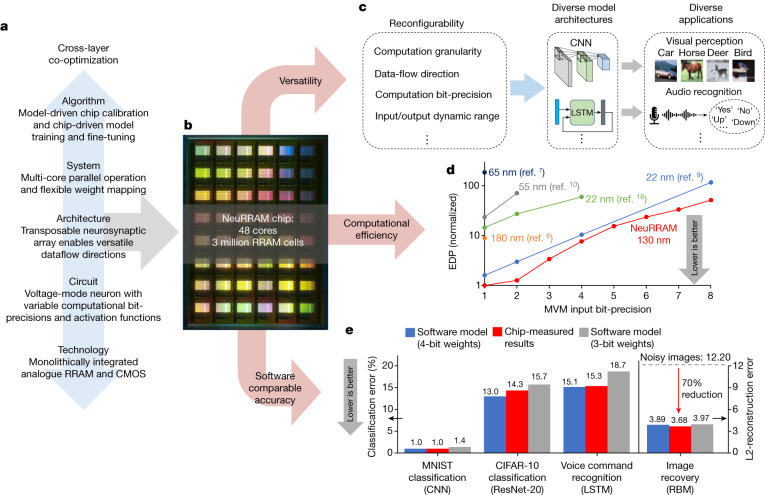
Abstract Realizing increasingly complex artificial intelligence (AI) functionalities directly on edge devices calls for unprecedented energy efficiency of edge hardware. Compute-in-memory (CIM) based on resistive random-access memory (RRAM) 1 promises to meet such demand by storing AI model weights in dense, analogue and non-volatile RRAM devices, and by performing AI computation directly within RRAM, thus eliminating power-hungry data movement between separate compute and memory 2–5 . Although recent studies have demonstrated in-memory matrix-vector multiplication on fully integrated RRAM-CIM hardware 6–17 , it remains a goal for a RRAM-CIM chip to simultaneously deliver high energy efficiency, versatility to support diverse models and software-comparable accuracy. Although efficiency, versatility and accuracy are all indispensable for broad adoption of the technology, the inter-related trade-offs among them cannot be addressed by isolated improvements on any single abstraction level of the design. Here, by co-optimizing across all hierarchies of the design from algorithms and architecture to circuits and devices, we present NeuRRAM—a RRAM-based CIM chip that simultaneously delivers versatility in reconfiguring CIM cores for diverse model architectures, energy efficiency that is two-times better than previous state-of-the-art RRAM-CIM chips across various computational bit-precisions, and inference accuracy comparable to software models quantized to four-bit weights across various AI tasks, including accuracy of 99.0 percent on MNIST 18 and 85.7 percent on CIFAR-10 19 image classification, 84.7-percent accuracy on Google speech command recognition 20 , and a 70-percent reduction in image-reconstruction error on a Bayesian image-recovery task.
Overview
CoChat Summary
TL;DR
NeuRRAM is a 48-core RRAM compute-in-memory chip that co-optimizes device, circuit, architecture, system, and algorithm choices to support reconfigurable AI inference with hardware-measured accuracy. The paper reports better energy-delay product than prior RRAM-CIM chips and benchmark results of 99.0% on MNIST, 85.7% on CIFAR-10, 84.7% on Google speech commands, and a 70% reduction in image-reconstruction error on MNIST image recovery.
Key findings
- The chip achieves an energy-delay product that is 1.6× to 2.3× lower than previous state-of-the-art RRAM-CIM chips, and 7× to 13× higher computational density at various MVM bit-precisions.
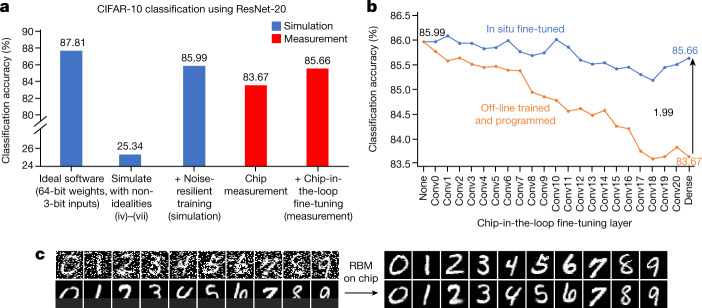
- Fully hardware-measured benchmark results include 99.0% MNIST accuracy, 85.7% CIFAR-10 accuracy, 84.7% Google speech command accuracy, and 70% lower image-reconstruction error on the Bayesian image-recovery task.
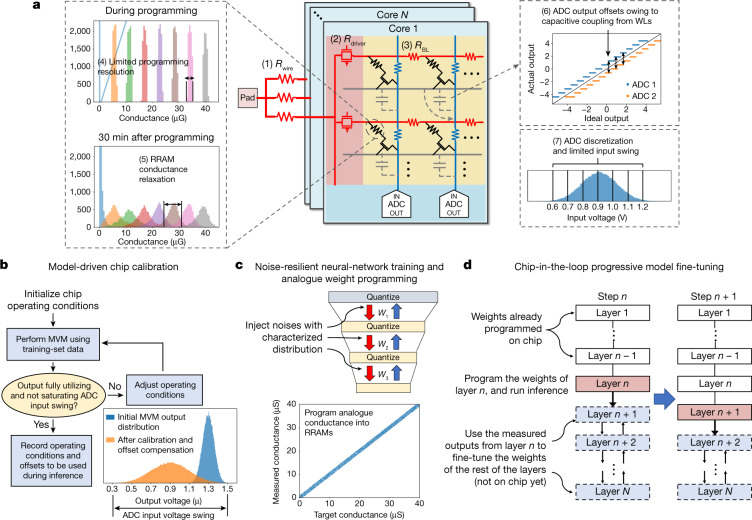
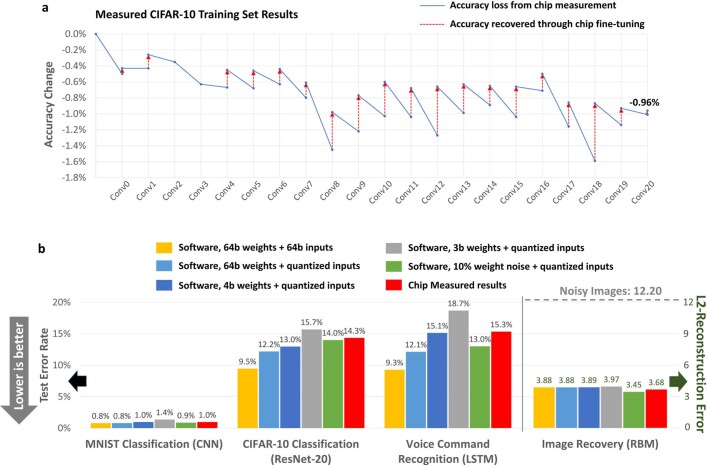
- Hardware-algorithm co-optimization improved CIFAR-10 classification from 25.34% accuracy without noise injection to 85.99% with noise injection; chip-in-the-loop progressive fine-tuning improved cumulative CIFAR-10 test-set accuracy by 1.99%.
- The authors report that the measured CIFAR-10 accuracy for deep ResNet-20 inference on-chip was 83.67%, which remained 3.36% below the 87.03% of the corresponding 4-bit-weight software model.
Methods
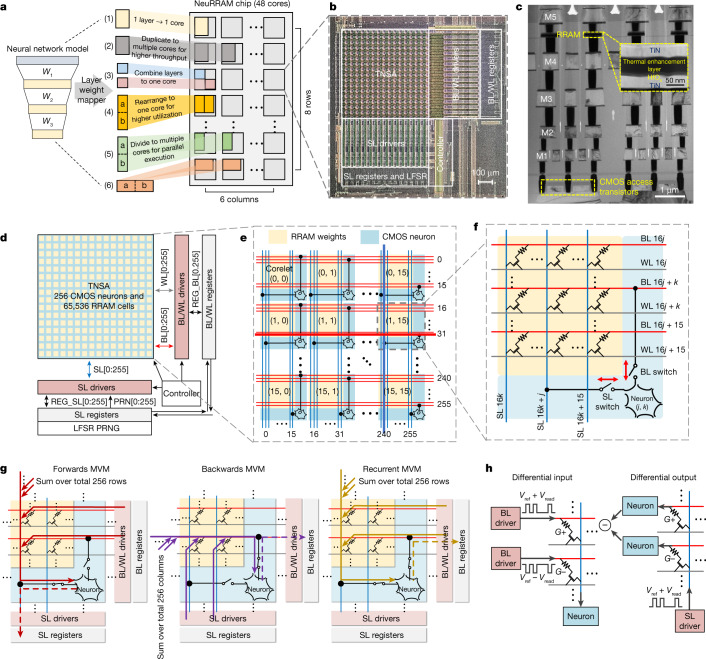
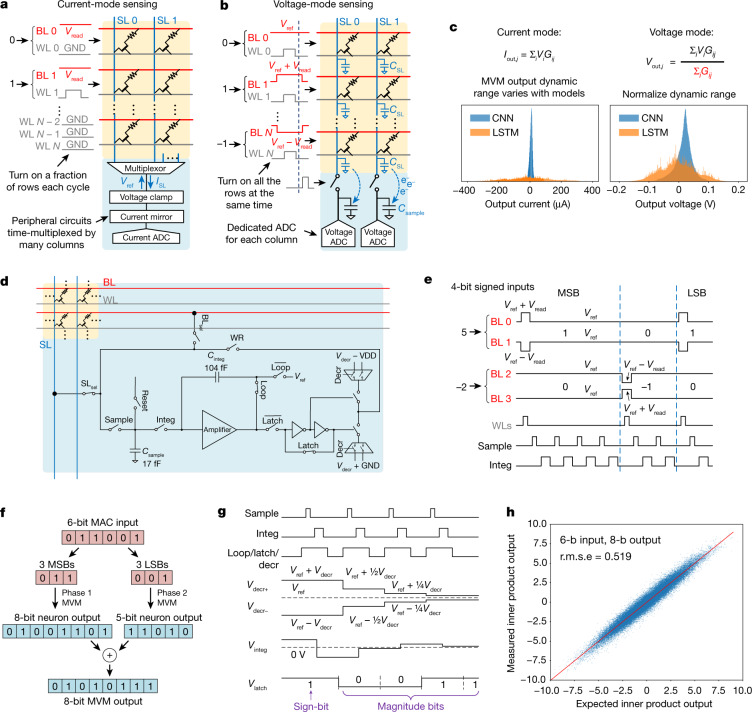
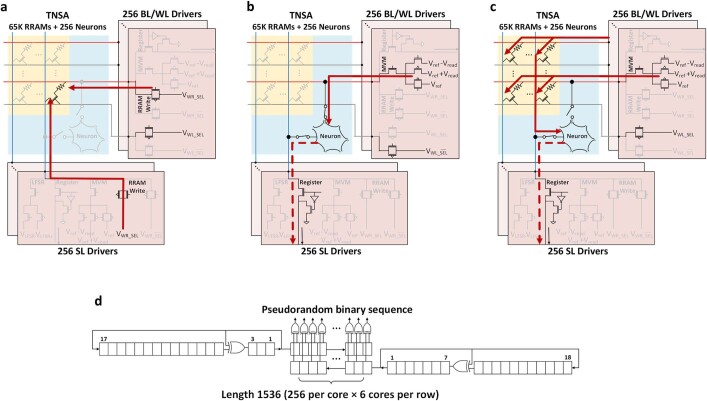
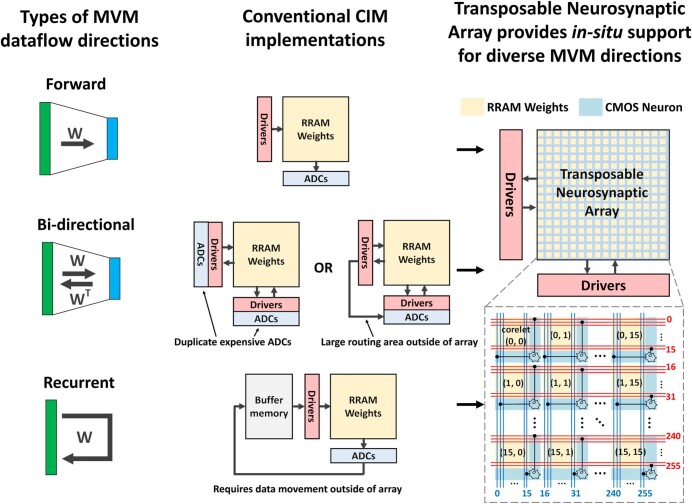
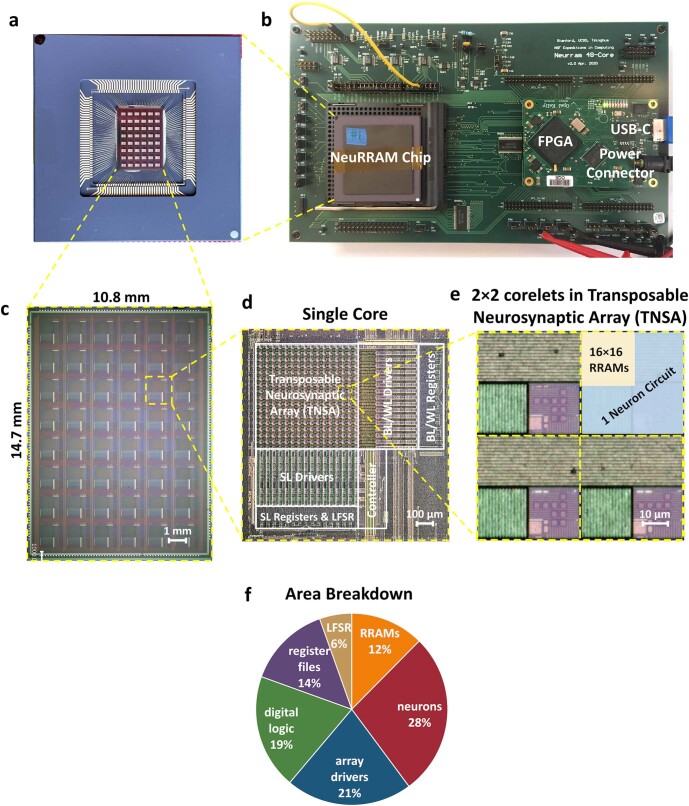
- Built a 48-core NeuRRAM chip with 3 million RRAM devices in a 130-nm CMOS process, using a bidirectional transposable neurosynaptic array (TNSA) and a voltage-mode neuron circuit.
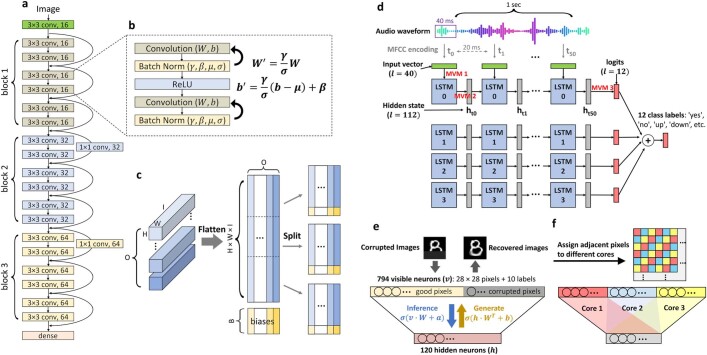
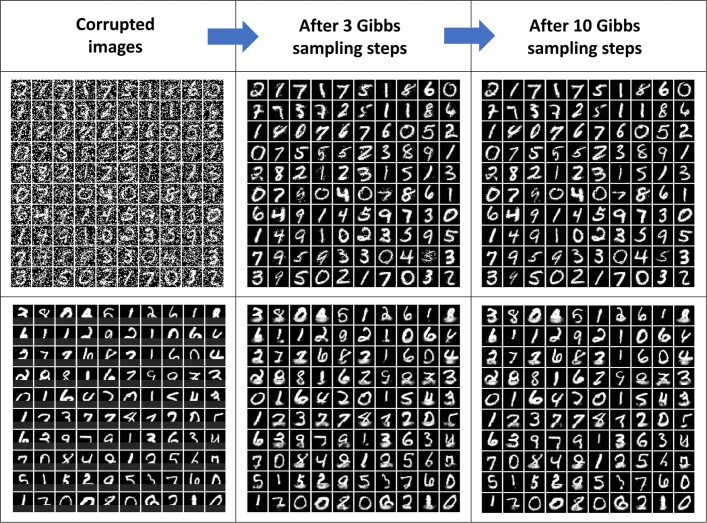
- Evaluated the chip on multiple AI tasks: MNIST and CIFAR-10 image classification, Google speech command recognition, and MNIST image recovery with CNNs, LSTMs, and an RBM; all benchmark results were obtained from hardware measurements on complete datasets.
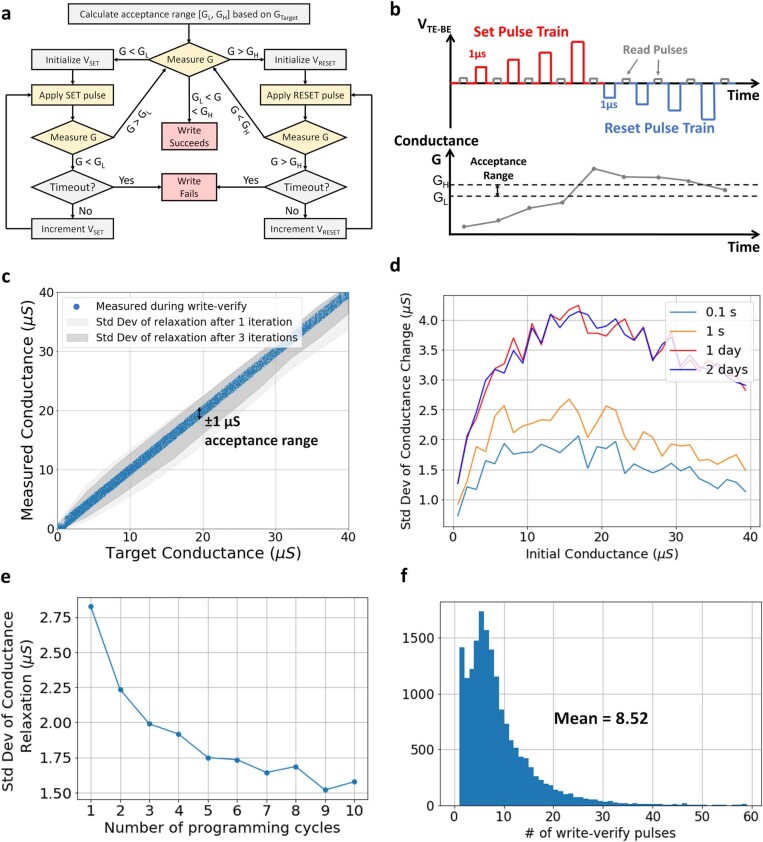
- Used model calibration, noise-resilient training, iterative write–verify programming, and chip-in-the-loop progressive fine-tuning; weights were mapped across cores with strategies for balancing load and mitigating voltage drop.
Limitations
- The paper states that the reported throughput and energy-efficiency numbers are peak values at 100% array utilization and do not include energy/time for buffering or moving intermediate data; this is an explicit limitation of the measurement scope.
- The paper notes that some on-chip accuracies are still below full-precision digital implementations, mainly because of ≤4-bit quantization of inputs and activations, especially sensitive input and output layers.
- Evident from the text: the implementation relies on an FPGA board for partial-sum accumulation, average pooling, buffers, and other operations, so the system is not a fully self-contained chip-level AI system in the demonstrated setup.
Model-written summary. Check it against the paper before relying on it.
Integrity signals
Registry
Cites
Statistics
Figures
Verification
Claims the paper makes
7 Valid · 1 Not valid · 7 Not checked · 130 Own results and interpretations
The cited sources support only part of this claim — read each source’s verdict below.
In the paper
“The accuracy gap mainly comes from low-precision (≤4-bit) quantization of inputs and activations, especially on the most sensitive input and output layers46.”
§ A compute-in-memory chip based on resistive random-access memory > Hardware-algorithm co-optimizations
What the sources say
- Partly supportedcites [46] Choi, J. et al. PACT: parameterized clipping activation for quantized neural networks. Preprint at https://arxiv.org/abs/1805.06085 (2018). sourceExperimental — accuracy not yet measured
Section A.3 (pp. 11–12) finds that aggressively quantizing the first or last layer can noticeably degrade accuracy, while using 8 bits for those layers causes little degradation in the tested model. Section 5.1 (p. 7) also finds that activation accuracy improves with precision. But it does not establish that the accuracy gap mainly comes from inputs and activations, and it reports less than a 1% validation-error difference when activation precision is at least 4 bits, so the claim’s ≤4-bit framing is too broad. (LLM, conf=0.86)
plainstates a cause- Asserted: passes — The authors put it forward as true.
- Checkable: passes — It can be checked against evidence.
- Load-bearing: passes — The paper’s conclusions depend on it.
- Based: passes — The paper gives a reason why it holds.
- Partly supported
The cited sources support only part of this claim — read each source’s verdict below.
In the paper
“The accuracies of some of our quantized models are lower than that of the state-of-the-art quantized model because we apply <4-bit quantization to the most sensitive input and output layers of the neural networks”
§ A compute-in-memory chip based on resistive random-access memory > Methods > Noise-resilient neural-network training
What the sources say
- Supportedcites [46] Choi, J. et al. PACT: parameterized clipping activation for quantized neural networks. Preprint at https://arxiv.org/abs/1805.06085 (2018). source
Section A.3 (pp. 11–12) reports that aggressively quantizing the first or last layer can noticeably degrade accuracy; its table shows substantially higher validation error when those layers use 2 bits. The comparison with a state-of-the-art model describes the citing authors’ own results, not a finding attributed to PACT. (LLM, conf=0.88)
- Not matchedcites [54] Esser, S. K., Mckinstry, J. L., Bablani, D., Appuswamy, R. & Modha, D. S. Learned step size quantization. In International Conference on Learning Representations (ICLR) (2020).
Its entry has no title and year that we can search by.
plainstates a cause- Asserted: passes — The authors put it forward as true.
- Checkable: passes — It can be checked against evidence.
- Load-bearing: unclear — It is unclear whether the paper’s conclusions depend on it.
- Based: passes — The paper gives a reason why it holds.
- Supported
A result the paper reports from its own data — it cites no other source for it, so there is none to check. The quote shows it is in the paper.
In the paper
“we achieve a 0.98% error rate on MNIST handwritten digit recognition using a 7-layer CNN”
§ A compute-in-memory chip based on resistive random-access memory > Hardware-algorithm co-optimizations
plain- Asserted: passes — The authors put it forward as true.
- Checkable: passes — It can be checked against evidence.
- Load-bearing: passes — The paper’s conclusions depend on it.
- Based: passes — The paper gives a reason why it holds.
A result the paper states — it cites no source for it, so there is none to check. The quote shows it is in the paper.
In the paper
“Some of these numbers are not yet to the accuracies achieved by full-precision digital implementations.”
§ A compute-in-memory chip based on resistive random-access memory > Hardware-algorithm co-optimizations
plain- Asserted: passes — The authors put it forward as true.
- Checkable: passes — It can be checked against evidence.
- Load-bearing: unclear — It is unclear whether the paper’s conclusions depend on it.
- Based: passes — The paper gives a reason why it holds.
A result the paper reports from its own data — it cites no other source for it, so there is none to check. The quote shows it is in the paper.
In the paper
“a 14.34% error rate on CIFAR-10 object classification using ResNet-20”
§ A compute-in-memory chip based on resistive random-access memory > Hardware-algorithm co-optimizations
plain- Asserted: passes — The authors put it forward as true.
- Checkable: passes — It can be checked against evidence.
- Load-bearing: passes — The paper’s conclusions depend on it.
- Based: passes — The paper gives a reason why it holds.
72 more claims
Create a free account to see all 145 claims and to verify the 2 references still open.
- Probably not a substantial claim. 37
- It may state two separate claims as one. 41
Claims other papers make about this one
Each is checked against this paper’s own text: does it say what the citing paper says it does?
The source backs part of the claim, not all of it — or backs it for a different population, condition or comparison.
In the citing paper
“So far, several groups and companies have claimed the realization of hybrid CMOS/memristor implementations of ANNs53–61, —from now on, memristive ANNs— with performance that is superior to that of fully-CMOS counterparts.”
From Hardware implementation of memristor-based artificial neural networks (2024) · cites this paper as [60]
Experimental — accuracy not yet measuredThe source backs part of the claim, not all of it — or backs it for a different population, condition or comparison.
In the citing paper
“Although several compute-in-memory or near-memory approaches based on SRAMs and digital compute35–38 have been presented in the literature, most of these do not address the energy and time costs of reloading weights, thus making direct side-by-side comparisons against NVM-based weight-stationary approaches difficult.”
From An analog-AI chip for energy-efficient speech recognition and transcription (2023) · cites this paper as [7]
Experimental — accuracy not yet measuredThe cited source says what the claim attributes to it.
In the citing paper
“Some groups prefer to incorporate a transistor in series to each MIM cell to obtain a better control over the currents through the device (i.e., improve conductance controllability and minimize sneak path currents)53–55,60,61,102,113,167,194,218–222,).”
From Hardware implementation of memristor-based artificial neural networks (2024) · cites this paper as [60]
The cited source says what the claim attributes to it.
In the citing paper
“Then, analogue VMM has been demonstrated both for binary inputs and weights218–220, as well as for binary inputs and analogue/multilevel weights60,85,105,217.”
From Hardware implementation of memristor-based artificial neural networks (2024) · cites this paper as [60]
The cited source says what the claim attributes to it.
In the citing paper
“These results imply that with better architecture, materials, and hardware-software co-design [161], in-memory computing can set new standards for parallel processing.”
From Brain-inspired computing systems: a systematic literature review (2024) · cites this paper as [161]
2 more claims about this paper
Create a free account to see every claim other papers make about this one.
Citations
Cites
Deep Residual Learning for Image Recognition
He, K., Zhang, X., Ren, S., & Sun, J. (2016) · 2016 IEEE Conference on Computer Vision and Pattern Recognition (CVPR) · doi:10.1109/cvpr.2016.90 · Cited by 235,474
Hochreiter, S., & Schmidhuber, J. (1997) · Neural Computation · doi:10.1162/neco.1997.9.8.1735 · Cited by 102,318
LeCun, Y., Bengio, Y., & Hinton, G. (2015) · Nature · doi:10.1038/nature14539 · Cited by 84,126
Gradient-based learning applied to document recognition
Lecun, Y., Bottou, L., Bengio, Y., & Haffner, P. (1998) · Proceedings of the IEEE · doi:10.1109/5.726791 · Cited by 58,805
Multilayer feedforward networks are universal approximators
Hornik, K., Stinchcombe, M., & White, H. (1989) · Neural Networks · doi:10.1016/0893-6080(89)90020-8 · Cited by 21,728
International Conference on Learning Representations (ICLR 2013)
松尾, 豊. (2013) · 人工知能学会誌 = Journal of Japanese Society for Artificial Intelligence · Cited by 6,286
In-Datacenter Performance Analysis of a Tensor Processing Unit
Jouppi, N. P., Young, C., Patil, N., Patterson, D., Agrawal, G., Bajwa, R., Bates, S., Bhatia, S., Boden, N., Borchers, A., et al. (2017) · Proceedings of the 44th Annual International Symposium on Computer Architecture · doi:10.1145/3079856.3080246 · Cited by 4,537
Eyeriss: An Energy-Efficient Reconfigurable Accelerator for Deep Convolutional Neural Networks
Chen, Y.-H., Krishna, T., Emer, J. S., & Sze, V. (2017) · IEEE Journal of Solid-State Circuits · doi:10.1109/jssc.2016.2616357 · Cited by 3,247 · cited 1×
“Extended Data Table 2 shows that such scaling will enable NeuRRAM to deliver higher energy and area efficiency than today’s state-of-the-art edge inference accelerators 58–61 .”
BackgroundTraining and operation of an integrated neuromorphic network based on metal-oxide memristors
Prezioso, M., Merrikh-Bayat, F., Hoskins, B. D., Adam, G. C., Likharev, K. K., & Strukov, D. B. (2015) · Nature · doi:10.1038/nature14441 · Cited by 3,001 · cited 2×
“…based on resistive random-access memory (RRAM) 1 promises to meet such demand by storing AI model weights in dense, analogue and non-volatile RRAM devices, and by performing AI computation directly within RRAM, thus eliminating power-hungry data movement between separate compute and memory 2–5 .”
Wong, H.-S. P., Lee, H.-Y., Yu, S., Chen, Y.-S., Wu, Y., Chen, P.-S., Lee, B., Chen, F. T., & Tsai, M.-J. (2012) · Proceedings of the IEEE · doi:10.1109/jproc.2012.2190369 · Cited by 2,757
Self-citation
Research works printed but not linked: 1
- Koller, D. & Friedman, N. Probabilistic Graphical Models: Principles and Techniques (Adaptive Computation and Machine Learning series) (MIT Press, 2009).
Cited by
Thousands of conductance levels in memristors monolithically integrated on CMOS
Yang, J., Rao, M., Tang, H., Wu, J.-B., Song, W., Zhang, M., Yin, W., Zhuo, Y., Kiani, F., Chen, B., et al. (2022) · doi:10.21203/rs.3.rs-1939455/v1 · Cited by 504
Hardware implementation of memristor-based artificial neural networks
Aguirre, F., Sebastian, A., Le Gallo, M., Song, W., Wang, T., Yang, J. J., Lu, W., Chang, M.-F., Ielmini, D., Yang, Y., et al. (2024) · Nature Communications · doi:10.1038/s41467-024-45670-9 · Cited by 564
“Also, many papers 55,60,99,100 , have explored the case of ANNs with binarized inputs, as they employ the simplest DACs (1-bit).”
Thousands of conductance levels in memristors integrated on CMOS
(2023) · doi:10.1038/s41586-023-05759-5 · Cited by 503
Memristor‐Based Neuromorphic Chips
Duan, X., Cao, Z., Gao, K., Yan, W., Sun, S., Zhou, G., Wu, Z., Ren, F., & Sun, B. (2024) · Advanced Materials · doi:10.1002/adma.202310704 · Cited by 432
Neuromorphic computing at scale
Kudithipudi, D., Schuman, C., Vineyard, C. M., Pandit, T., Merkel, C., Kubendran, R., Aimone, J. B., Orchard, G., Mayr, C., Benosman, R., et al. (2025) · Nature · doi:10.1038/s41586-024-08253-8 · Cited by 357
“Several emergent devices have addressed device non-idealities by using some form of online training 121,146,157 .”
Self-citationLe Gallo, M., Khaddam-Aljameh, R., Stanisavljevic, M., Vasilopoulos, A., Kersting, B., Dazzi, M., Karunaratne, G., Brändli, M., Singh, A., Müller, S. M., et al. (2023) · Nature Electronics · doi:10.1038/s41928-023-01010-1 · Cited by 310
Recent Advances and Future Prospects for Memristive Materials, Devices, and Systems
Song, M.-K., Kang, J.-H., Zhang, X., Ji, W., Ascoli, A., Messaris, I., Demirkol, A. S., Dong, B., Aggarwal, S., Wan, W., et al. (2023) · ACS Nano · doi:10.1021/acsnano.3c03505 · Cited by 300
Self-citationA review of memristor: material and structure design, device performance, applications and prospects
Xiao, Y., Jiang, B., Zhang, Z., Ke, S., Jin, Y., Wen, X., & Ye, C. (2023) · Science and Technology of Advanced Materials · doi:10.1080/14686996.2022.2162323 · Cited by 295
“Fully hardware-measured inference accuracy on NeuRRAM was comparable to software models quantized to 4-bit weights across a variety of AI tasks (Figure 12(e)), including accuracy of 99% on MNIST and 85.7% on CIFAR-10 image classification, 84.7% on Google speech command recognition [226].”
MethodInfluentialAn analog-AI chip for energy-efficient speech recognition and transcription
Ambrogio, S., Narayanan, P., Okazaki, A., Fasoli, A., Mackin, C., Hosokawa, K., Nomura, A., Yasuda, T., Chen, A., Friz, A., et al. (2023) · Nature · doi:10.1038/s41586-023-06337-5 · Cited by 269
Rasch, M. J., Mackin, C., Le Gallo, M., Chen, A., Fasoli, A., Odermatt, F., Li, N., Nandakumar, S. R., Narayanan, P., Tsai, H., et al. (2023) · Nature Communications · doi:10.1038/s41467-023-40770-4 · Cited by 213
“Some prior works propose using on-chip or chip-in-the-loop training methods 38,43,49,55,61 , which can greatly increase the attainable accuracy by addressing the speci fi c fabrication variations found on that particular chip.”
BackgroundProgramming memristor arrays with arbitrarily high precision for analog computing
Song, W., Rao, M., Li, Y., Li, C., Zhuo, Y., Cai, F., Wu, M., Yin, W., Li, Z., Wei, Q., et al. (2024) · Science · doi:10.1126/science.adi9405 · Cited by 193
Organic mixed conductors for bioinspired electronics
Gkoupidenis, P., Zhang, Y., Kleemann, H., Ling, H., Santoro, F., Fabiano, S., Salleo, A., & van de Burgt, Y. (2023) · Nature Reviews Materials · doi:10.1038/s41578-023-00622-5 · Cited by 180
“Alternative algorithms such as evolutionary strategies to determine hyperparameters or train spiking neural networks could also prove useful for OEC-RAM devices that require low power and are easy to tune 113,116 .”
Chen, S., Zhang, T., Tappertzhofen, S., Yang, Y., & Valov, I. (2023) · Advanced Materials · doi:10.1002/adma.202301924 · Cited by 177
Ielmini, D., & Pedretti, G. (2025) · Chemical Reviews · doi:10.1021/acs.chemrev.4c00845 · Cited by 181
The growing memristor industry
Lanza, M., Pazos, S., Aguirre, F., Sebastian, A., Le Gallo, M., Alam, S. M., Ikegawa, S., Yang, J. J., Vianello, E., Chang, M.-F., et al. (2025) · Nature · doi:10.1038/s41586-025-08733-5 · Cited by 177
“91,103) to 512 × 1,024 (ref.”
Low-dimensional nanostructures for monolithic 3D-integrated flexible and stretchable electronics
Hua, Q., & Shen, G. (2024) · Chemical Society Reviews · doi:10.1039/d3cs00918a · Cited by 176
Higher-dimensional processing using a photonic tensor core with continuous-time data
Dong, B., Aggarwal, S., Zhou, W., Ali, U. E., Farmakidis, N., Lee, J. S., He, Y., Li, X., Kwong, D.-L., Wright, C. D., et al. (2023) · Nature Photonics · doi:10.1038/s41566-023-01313-x · Cited by 169
“Various mechanisms have been explored to store memories in physical states of materials (redox 19 , phase change 20 , ferroelectric 21 and magnetoresistive 22 ) to enable such in-memory computing.”
BackgroundA full spectrum of computing-in-memory technologies
Sun, Z., Kvatinsky, S., Si, X., Mehonić, A., Cai, Y., & Huang, R. (2023) · Nature Electronics · doi:10.1038/s41928-023-01053-4 · Cited by 201
“These advantages have created various CIM research directions aimed at delivering computer performance improvements in the post-Moore era and building computing accelerators for applications such as artificial intelligence (AI) 8 .”
BackgroundIn-memory computing with emerging memory devices: Status and outlook
Mannocci, P., Farronato, M., Lepri, N., Cattaneo, L., Glukhov, A., Sun, Z., & Ielmini, D. (2023) · APL Machine Learning · doi:10.1063/5.0136403 · Cited by 192
Memristor-based hardware accelerators for artificial intelligence
Huang, Y., Ando, T., Sebastian, A., Chang, M., Yang, J. J., & Xia, Q. (2024) · Nature Reviews Electrical Engineering · doi:10.1038/s44287-024-00037-6 · Cited by 196
“An in-memory computing chip with 48 memristive computing cores, each consisting of 256 × 256 multilevel memristive cells (TiN/TaO x /HfO x /TiN memristor) and shared neuron circuits in between, has been demonstrated 38 .”
InfluentialTechnology and Integration Roadmap for Optoelectronic Memristor
Wang, J., Ilyas, N., Ren, Y., Ji, Y., Li, S., Li, C., Liu, F., Gu, D., & Ang, K. (2023) · Advanced Materials · doi:10.1002/adma.202307393 · Cited by 175
Hänsch, W., Raghunathan, A., Roy, K., Chakrabarti, B., Phatak, C., Wang, C., & Guha, S. (2023) · Advanced Materials · doi:10.1002/adma.202204944 · Cited by 167
A Survey on Deep Learning Hardware Accelerators for Heterogeneous HPC Platforms
Silvano, C., Ielmini, D., Ferrandi, F., Fiorin, L., Curzel, S., Benini, L., Conti, F., Garofalo, A., Zambelli, C., Calore, E., et al. (2025) · ACM Computing Surveys · doi:10.1145/3729215 · Cited by 266
Roadmap to neuromorphic computing with emerging technologies
Mehonić, A., Ielmini, D., Roy, K., Mutlu, O., Kvatinsky, S., Serrano‐Gotarredona, T., Linares-Barranco, B., Spiga, S., Savel'ev, S. E., Balanov, A. G., et al. (2024) · APL Materials · doi:10.1063/5.0179424 · Cited by 201
Park, J., Kumar, A., Zhou, Y., Oh, S., Kim, J. H., Shi, Y., Jain, S., Hota, G., Qiu, E., Nagle, A. L., et al. (2024) · Nature Communications · doi:10.1038/s41467-024-46682-1 · Cited by 172
“Neurosynaptic coresconstructedby CMOS-RRAMintegrationhaveshowndynamically high-performance recon fi gurable data fl ow and energy ef fi ciency of 74 TMACS/W 15,16 .”
Self-citationFusion of memristor and digital compute-in-memory processing for energy-efficient edge computing
Wen, T.-H., Hung, J.-M., Huang, W.-H., Jhang, C.-J., Lo, Y.-C., Hsu, H.-H., Ke, Z.-E., Chen, Y.-C., Chin, Y.-H., Su, C.-I., et al. (2024) · Science · doi:10.1126/science.adf5538 · Cited by 131
Reconfigurable Neuromorphic Computing: Materials, Devices, and Integration
Xu, M., Chen, X., Guo, Y., Wang, Y., Qiu, D., Du, X., Cui, Y. L., Wang, X., & Xiong, J. (2023) · Advanced Materials · doi:10.1002/adma.202301063 · Cited by 130
Moiré synaptic transistor with room-temperature neuromorphic functionality
Yan, X., Zheng, Z., Sangwan, V. K., Qian, J. H., Wang, X., Liu, S. E., Watanabe, K., Taniguchi, T., Xu, S., Jarillo‐Herrero, P., et al. (2023) · Nature · doi:10.1038/s41586-023-06791-1 · Cited by 155
“When coupled with recent advances in large-area, single-crystal two-dimensional material growth techniques 47,48 and wafer-scale aligned transfer methods 49 , MSTs have the potential for scaling in crossbar architectures 45 that can implement complex neuromodulation and biomimicking functionalities.”
CMOS-compatible electrochemical synaptic transistor arrays for deep learning accelerators
Cui, J., An, F., Qian, J., Wu, Y., Sloan, L. L., Pidaparthy, S., Zuo, J., & Cao, Q. (2023) · Nature Electronics · doi:10.1038/s41928-023-00939-7 · Cited by 136
“…a challenge because in most non-volatile memristive devices—includ-ing those based on phase-change materials 7 , filament-forming metal oxides 8–10 and ferroelectric oxides 11 —conductance increase Article https://doi.org/10.1038/s41928-023-00939-7 integration, we fabricate ECRAM…”
BackgroundInfluentialNeural inference at the frontier of energy, space, and time
Modha, D. S., Akopyan, F., Andreopoulos, A., Appuswamy, R., Arthur, J. V., Cassidy, A. S., Datta, P., DeBole, M. V., Esser, S. K., Otero, C. O., et al. (2023) · Science · doi:10.1126/science.adh1174 · Cited by 115
CMOS-compatible neuromorphic devices for neuromorphic perception and computing: a review
Zhu, Y., Mao, H., Zhu, Y., Wang, X., Fu, C., Ke, S., Wan, C., & Wan, Q. C. (2023) · International Journal of Extreme Manufacturing · doi:10.1088/2631-7990/acef79 · Cited by 124
Jeon, K., Ryu, J. J., Im, S., Seo, H. K., Eom, T., Ju, H., Yang, M. K., Jeong, D. S., & Kim, G. H. (2024) · Nature Communications · doi:10.1038/s41467-023-44620-1 · Cited by 108
New-Generation Ferroelectric AlScN Materials
Zhang, Y., Zhu, Q., Tian, B., & Duan, C. (2024) · Nano-Micro Letters · doi:10.1007/s40820-024-01441-1 · Cited by 150
“Thanks to the science and technology advancement, a large number of NVMs emerge, including NAND flash, resistive random-access memory (RRAM), magneto-resistive RAM (MRAM), phase change RAM (PCRAM) and ferroelectric memory (FeM) [15–18].”
BackgroundZahoor, F., Hussin, F. A., Bature, U. I., Gupta, S., Khanday, F. A., Chattopadhyay, A., & Abbas, H. (2023) · Discover Nano · doi:10.1186/s11671-023-03775-y · Cited by 122
“This article which was published in Nature claims the chip to be of fingertip size, having more processing capabilities and less battery consumption than the current state-of-the-art chips [36].”
BackgroundResistive Memory Devices at the Thinnest Limit: Progress and Challenges
Li, X., Chen, N., Wang, B., Niu, M., Xu, M., Miao, X., & Li, X. (2024) · Advanced Materials · doi:10.1002/adma.202307951 · Cited by 108
Novel nanocomposite-superlattices for low energy and high stability nanoscale phase-change memory
Wu, X., Khan, A. I., Lee, H., Hsu, C.-F., Zhang, H. R., Yu, H., Roy, N., Davydov, A. V., Takeuchi, I., Bao, X., et al. (2024) · Nature Communications · doi:10.1038/s41467-023-42792-4 · Cited by 117
Self-citationSelf‐Rectifying Memristors for Three‐Dimensional In‐Memory Computing
Ren, S., Dong, A., Yang, L., Xue, Y., Li, J., Yu, Y., Zhou, H., Zuo, W., Li, Y., Cheng, W., et al. (2024) · Advanced Materials · doi:10.1002/adma.202307218 · Cited by 96
A memristor-based adaptive neuromorphic decoder for brain–computer interfaces
Liu, Z., Mei, J., Tang, J., Xu, M., Gao, B., Wang, K., Ding, S., Liu, Q., Qin, Q., Chen, W., et al. (2025) · Nature Electronics · doi:10.1038/s41928-025-01340-2 · Cited by 138
Self-citationLi, Y., Tang, J., Gao, B., Yao, J. N., Fan, A., Yan, B., Yang, Y., Xi, Y., Li, Y., Li, J., et al. (2023) · Nature Communications · doi:10.1038/s41467-023-42981-1 · Cited by 104
“By virtue of Ohm ’ s law and Kirchhoff ’ s current law, the current outputs on the SLs represent the MVM results 36 .”
Self-citationBrain-Inspired Computing: A Systematic Survey and Future Trends
Li, G., Deng, L., Tang, H., Pan, G., Tian, Y., Roy, K., & Maass, W. (2024) · Proceedings of the IEEE · doi:10.1109/jproc.2024.3429360 · Cited by 158
“The software toolchain developed for the NeuRRAM chip [343] enables quick implementation of various machine learning applications.”
Energy-efficient high-fidelity image reconstruction with memristor arrays for medical diagnosis
Zhao, H., Liu, Z., Tang, J., Gao, B., Qin, Q., Li, J., Zhou, Y., Yao, P., Xi, Y., Lin, Y., et al. (2023) · Nature Communications · doi:10.1038/s41467-023-38021-7 · Cited by 102
“1a), showing appealing advantages in terms of energy ef fi ciency and speed compared to conventional hardware 30 – 32 .”
Self-citationBroadband Visual Adaption and Image Recognition in a Monolithic Neuromorphic Machine Vision System
Cai, Y., Wang, F., Wang, X., Li, S., Wang, Y., Yang, J., Yan, T., Zhan, X., Wang, F., Cheng, R., et al. (2022) · Advanced Functional Materials · doi:10.1002/adfm.202212917 · Cited by 83
Multisensory Ferroelectric Semiconductor Synapse for Neuromorphic Computing
Zeng, J., Feng, G., Wu, G., Liu, J., Zhao, Q., Wang, H., Wu, S., Wang, X., Chen, Y., Han, S., et al. (2024) · Advanced Functional Materials · doi:10.1002/adfm.202313010 · Cited by 89
Liu, L., Wang, D., Wang, D., Sun, Y., Lin, H., Gong, X., Zhang, Y., Tang, R., Mai, Z., Hou, Z., et al. (2024) · Nature Communications · doi:10.1038/s41467-024-48631-4 · Cited by 111
“There is pressing need to explore the uniqueness among different memory features and synergistic integration with CMOS in order to achieve optimal performance in neuromorphic DNN computing.”
MethodInfluentialPedersen, J. E., Abreu, S., Jobst, M., Lenz, G., Fra, V., Bauer, F. C., Muir, D. R., Zhou, P., Vogginger, B., Heckel, K., et al. (2024) · Nature Communications · doi:10.1038/s41467-024-52259-9 · Cited by 129
“NIR is available at neuroir.org The human brain is an exemplar of computational ef fi ciency, out-performing today ’ s advanced machine learning models and hardware in multiple measures, particularly regarding energy consumption.”
BackgroundDenRAM: neuromorphic dendritic architecture with RRAM for efficient temporal processing with delays
D’Agostino, S., Moro, F., Torchet, T., Demirağ, Y., Grenouillet, L., Castellani, N., Indiveri, G., Vianello, E., & Payvand, M. (2024) · Nature Communications · doi:10.1038/s41467-024-47764-w · Cited by 111
“…operation of RRAM devices and RRAM conductance relaxation 58 (which restrains the mapping of full-precision simulation weights to RRAM devices), we utilized noise-aware training 40 by injecting a Gaussian noise to trained network weights using the “ straight-through estimator" technique.”
Toward a Brain–Neuromorphics Interface
Wan, C., Pei, M., Shi, K., Cui, H., Long, H., Qiao, L., Xing, Q., & Wan, Q. C. (2024) · Advanced Materials · doi:10.1002/adma.202311288 · Cited by 72
Emerging memristive neurons for neuromorphic computing and sensing
Li, Z., Tang, W., Zhang, B., Yang, R., & Miao, X. (2023) · Science and Technology of Advanced Materials · doi:10.1080/14686996.2023.2188878 · Cited by 77
“Fortunately, the memristive device has emerged as a novel neuromorphic device in the last decades [22– 28].”
BackgroundA mixed-precision memristor and SRAM compute-in-memory AI processor
Khwa, W.-S., Wen, T.-H., Hsu, H.-H., Huang, W.-H., Chang, Y., Chiu, T.-C., Ke, Z.-E., Chin, Y.-H., Wen, H.-J., Hsu, W., et al. (2025) · Nature · doi:10.1038/s41586-025-08639-2 · Cited by 95
Using the IBM analog in-memory hardware acceleration kit for neural network training and inference
Gallo, M. L., Lammie, C., Büchel, J., Carta, F., Fagbohungbe, O. I., Mackin, C., Tsai, H.-Y. S., Narayanan, V., Sebastian, A., Maghraoui, K. E., et al. (2023) · APL Machine Learning · doi:10.1063/5.0168089 · Cited by 102
Bioinspired Artificial Visual System Based on 2D WSe 2 Synapse Array
Gong, Y., Xie, P., Xing, X., Lv, Z., Xie, T., Zhu, S., Hsu, H., Zhou, Y., & Han, S. (2023) · Advanced Functional Materials · doi:10.1002/adfm.202303539 · Cited by 79
The road to commercial success for neuromorphic technologies
Muir, D. R., & Sheik, S. (2025) · Nature Communications · doi:10.1038/s41467-025-57352-1 · Cited by 118
“…logic fabrication, encompassing fl ash-based memory 86 , capacitor-based approaches 71 , fl oating-gate transistors 87 , ferro-electric RAM 88 , resistive RAM 89 – 93 , Phase-Change Memory 52,94,95 , as well as other approaches which are more dif fi cult to integrate into the VLSI fabrication process.”
Bonnet, D., Hirtzlin, T., Majumdar, A., Dalgaty, T., Esmanhotto, E., Meli, V., Castellani, N., Martin, S., Nodin, J.-F., Bourgeois, G., et al. (2023) · Nature Communications · doi:10.1038/s41467-023-43317-9 · Cited by 110
“We relied on energy per operation number of three industrial platforms employing resistive memory 3 , magnetoelectric memory (MRAM) 39 , and phase change memory 7 .”
Influential34.8 A 22nm 16Mb Floating-Point ReRAM Compute-in-Memory Macro with 31.2TFLOPS/W for AI Edge Devices
Wen, T.-H., Hsu, H.-H., Khwa, W.-S., Huang, W.-H., Ke, Z.-E., Chin, Y.-H., Wen, H.-J., Chang, Y., Hsu, W., Lo, C., et al. (2024) · Digest of technical papers/Digest of technical papers - IEEE International Solid-State Circuits Conference · doi:10.1109/isscc49657.2024.10454468 · Cited by 78
Boosting flexible electronics with integration of two‐dimensional materials
Hou, C., Zhang, S., Liu, R., Gemming, T., Bachmatiuk, A., Zhao, H., Jia, H., Huang, S., Zhou, W., Xu, J., et al. (2024) · InfoMat · doi:10.1002/inf2.12555 · Cited by 75
Matsukatova, A. N., Prudnikov, N. V., Kulagin, V. A., Battistoni, S., Minnekhanov, A. A., Trofimov, A. D., Несмелов, А. А., Zavyalov, S. A., Malakhova, Y. N., Parmeggiani, M., et al. (2023) · Advanced Intelligent Systems · doi:10.1002/aisy.202200407 · Cited by 73
Kim, K., Song, M. S., Hwang, H., Hwang, S., & Kim, H. (2024) · Frontiers in Neuroscience · doi:10.3389/fnins.2024.1279708 · Cited by 81
Jain, S., Li, S., Zheng, H., Li, L., Fong, X., & Ang, K. (2025) · Nature Communications · doi:10.1038/s41467-025-58039-3 · Cited by 96
“Furthermore, these enhancements are shown to be comparable to those achieved by conventional oxide-based memristors 9,21,55 – 57 , with the added advantages of superior switching voltage, faster switching and reduced thickness as shown in Supplementary Table 11.”
Ji, X., Dong, Z., Han, Y., Lai, C. S., & Qi, D. (2023) · IEEE Transactions on Circuits and Systems for Video Technology · doi:10.1109/tcsvt.2023.3275708 · Cited by 68
Mosaic: in-memory computing and routing for small-world spike-based neuromorphic systems
Dalgaty, T., Moro, F., Demirağ, Y., Prà, A. D., Indiveri, G., Vianello, E., & Payvand, M. (2024) · Nature Communications · doi:10.1038/s41467-023-44365-x · Cited by 88
“To mitigate these detrimental effects at the weight transfer stage, we adapted the noise-resilient training method for RRAM devices 73,74 .”
Ye, W., Wang, L., Zhou, Z., An, J., Li, W., Gao, H., Li, Z., Yue, J., Hu, H., Xu, X., et al. (2023) · IEEE Journal of Solid-State Circuits · doi:10.1109/jssc.2023.3280357 · Cited by 72
“Previous arts have already paid considerable research endeavors to develop fully integrated RRAM nvCIM chips based on the production-ready foundry RRAMs [23], [24], [25], [26], [27], [28], [29], [30], [31], [32], [33], [34], [35], [36], [37], [38], [39].”
BackgroundDemonstration of Multiply-Accumulate Operation With 28 nm FeFET Crossbar Array
De, S., Muller, F., Laleni, N., Lederer, M., Raffel, Y., Mojumder, S., Vardar, A., Abdulazhanov, S., Ali, T., Dünkel, S., et al. (2022) · IEEE Electron Device Letters · doi:10.1109/led.2022.3216558 · Cited by 59
“A details analysis of the WRITE-to-READ delay on similar devices is shown elsewhere [19].”
MethodTripathy, A., Patne, A. Y., Mohapatra, S., & Mohapatra, S. S. (2024) · International Journal of Molecular Sciences · doi:10.3390/ijms252212368 · Cited by 71
Jiang, M., Shan, K., He, C., & Li, C. (2023) · Nature Communications · doi:10.1038/s41467-023-41647-2 · Cited by 98
“Meanwhile, current mixed-signal design provides more fl exibility, and can take advantage of the rapid development of memristor-based AI accelerators, as they share the same data fl ow 49,50 .”
Baek, Y., Bae, B., Shin, H., Sonnadara, C. S. S., Cho, H., Lin, C., Mu, Y., Shen, C., Shah, S. S., Wang, G., et al. (2025) · npj Unconventional Computing · doi:10.1038/s44335-025-00040-6 · Cited by 114
“To advance near-sensor computing, future research should focus on heterogeneous 3D integration 148 , where sensor arrays, AI accelerators, and memory units are vertically stacked to reduce footprint and improve computational ef fi ciency 137 .”
Wang, H., Guan, Z., Li, J., Luo, Z. L., Du, X., Wang, Z., Zhao, H., Shen, S., Yin, Y., & Li, X. (2024) · Advanced Materials · doi:10.1002/adma.202211305 · Cited by 70
Open-loop analog programmable electrochemical memory array
Chen, P., Liu, F., Lin, P., Li, P., Xiao, Y., Zhang, B., & Pan, G. (2023) · Nature Communications · doi:10.1038/s41467-023-41958-4 · Cited by 67
“On the other hand, these analog-valued arrays execute matrix multiplications in analog-input-analog-weight fashion 10 – 12 , providing a signi fi cant upgrade from a digital implementation in terms of parallelism and computing ef fi ciency 7,12,13 .”
Ran, H., Ren, Z., Li, J., Sun, B. T., Wang, T., Gu, D., Wang, W., Hu, X., Dong, Z., Song, Q., et al. (2024) · Advanced Functional Materials · doi:10.1002/adfm.202418113 · Cited by 63
Jebali, F., Majumdar, A., Turck, C., Harabi, K.-E., Faye, M.-C., Muhr, E., Walder, J.-P., Bilousov, O., Michaud, A., Vianello, E., et al. (2024) · Nature Communications · doi:10.1038/s41467-024-44766-6 · Cited by 58
“To overcome these challenges, integrated memristor-based AI systems employ complex peripheral circuits, which are tuned for a particular supply voltage 10 – 16 .”
An Electromagnetic Perspective of Artificial Intelligence Neuromorphic Chips
Li, E., Ma, H., Ahmed, M., Tao, T., Gu, Z., Chen, M., Chen, Q., Li, D., & Chen, W. (2023) · Electromagnetic Science · doi:10.23919/emsci.2023.0015 · Cited by 68
Li, S., Kong, W., Wang, Y., & Yuan, L. (2024) · Energy · doi:10.1016/j.energy.2024.133017 · Cited by 68
Multi-State Memristors and Their Applications: An Overview
Wang, C., Si, Z., Jiang, X., Malik, A., Pan, Y., Stathopoulos, S., Serb, A., Wang, S., Prodromakis, T., & Papavassiliou, C. (2022) · IEEE Journal on Emerging and Selected Topics in Circuits and Systems · doi:10.1109/jetcas.2022.3223295 · Cited by 54
“Notably, a fully integrated CMOS/Memristor CIM chip which incorporates 3 million analog RRAM cells was presented recently [78].”
BackgroundIsmail, M., Rasheed, M., Mahata, C., Kang, M., & Kim, S. (2023) · Journal of Alloys and Compounds · doi:10.1016/j.jallcom.2023.170846 · Cited by 57
Hu, Y., Song, Y., Zhu, X., Guo, X., Lu, S., Zhang, Q., He, L., Franken, C. A. A., Powell, K. B., Warner, H., et al. (2025) · Nature Communications · doi:10.1038/s41467-025-62635-8 · Cited by 103
Side-Channel Attack Analysis on In-Memory Computing Architectures
Wang, Z., Meng, F.-H., Park, Y., Eshraghian, J. K., & Lu, W. D. (2023) · IEEE Transactions on Emerging Topics in Computing · doi:10.1109/tetc.2023.3257684 · Cited by 73
“Tile areas of RRAM-based IMC prototype chips vary due to different array sizes and peripheral circuit designs, but most demonstrated tile areas are on the millimeter scale [45] [46] [47] [48].”
BackgroundYu, E., Gaurav Kumar, K., Saxena, U., & Roy, K. (2024) · Scientific Reports · doi:10.1038/s41598-024-59298-8 · Cited by 65
Biological research and self-driving labs in deep space supported by artificial intelligence
Sanders, L. M., Scott, R. T., Yang, J. H., Qutub, A. A., Garcia Martin, H., Berrios, D. C., Hastings, J. J. A., Rask, J., Mackintosh, G., Hoarfrost, A. L., et al. (2023) · Nature Machine Intelligence · doi:10.1038/s42256-023-00618-4 · Cited by 49
“…to operations in the deep space environment and biosciences domain, such as (1) compute-in-memory solutions based on resistive random-access memory 149 , (2) advances in the reliability of space-grade graphic processing units and field programmable gate array devices 150 , (3) self-repairing…”
BackgroundWang, Z., Song, Y., Zhang, G., Luo, Q., Xu, K., Gao, D., Yu, B., Loke, D. K., Zhong, S., & Zhang, Y. (2024) · International Journal of Extreme Manufacturing · doi:10.1088/2631-7990/ad2fea · Cited by 55
Bulk‐Switching Memristor‐Based Compute‐In‐Memory Module for Deep Neural Network Training
Wu, Y., Wang, Q., Wang, Z., Wang, X., Ayyagari, B., Krishnan, S. A., Chudzik, M. P., & Lu, W. D. (2023) · Advanced Materials · doi:10.1002/adma.202305465 · Cited by 67
Recent Progress in Neuromorphic Computing from Memristive Devices to Neuromorphic Chips
Xiao, Y., Gao, C., Jin, J., Sun, W., Wang, B., Bao, Y., Liu, C., Huang, W., Zeng, H., & Yu, Y. (2024) · Advanced Devices & Instrumentation · doi:10.34133/adi.0044 · Cited by 69
A neotype self-rectifying Cu3SnS4-MoO3 synaptic memristor for neuromorphic applications
Wei, W., Sun, H., Dong, X., Lu, Q., Yang, F., Zhao, Y., Chen, J., Zhang, X., & Li, Y. (2024) · Chemical Engineering Journal · doi:10.1016/j.cej.2024.148848 · Cited by 52
Neuromorphic devices for electronic skin applications
Patil, C. S., Ghode, S. B., Kim, J., Kamble, G. U., Kundale, S. S., Mannan, A., Ko, Y., Noman, M. A., Saqib, Q. M., Patil, S. R., et al. (2025) · Materials Horizons · doi:10.1039/d4mh01848f · Cited by 58
A Systematic Literature Review on Binary Neural Networks
Sayed, R., Azmi, H., Shawkey, H., Khalil, A. H., & Refky, M. A. (2023) · IEEE Access · doi:10.1109/access.2023.3258360 · Cited by 62
Volatile threshold switching memristor: An emerging enabler in the AIoT era
Zuo, W., Zhu, Q., Fu, Y., Zhang, Y., Wan, T., Li, Y., Xu, M., & Miao, X. (2023) · Journal of Semiconductors · doi:10.1088/1674-4926/44/5/053102 · Cited by 57
Restricted Boltzmann Machines Implemented by Spin–Orbit Torque Magnetic Tunnel Junctions
Li, X., Wan, C., Zhang, R., Zhao, M., Xiong, S., Kong, D., Luo, X., He, B., Liu, S., Xia, J., et al. (2024) · Nano Letters · doi:10.1021/acs.nanolett.3c04820 · Cited by 53
Integrated Memristor Network for Physiological Signal Processing
Cai, L., Yu, L., Yue, W., Zhu, Y., Yang, Z., Li, Y., Tao, Y., & Yang, Y. (2023) · Advanced Electronic Materials · doi:10.1002/aelm.202300021 · Cited by 50
The rise of memtransistors for neuromorphic hardware and In-memory computing
Bae, J., Won, J., & Shim, W. (2024) · Nano Energy · doi:10.1016/j.nanoen.2024.109646 · Cited by 48
Review of Memristors for In‐Memory Computing and Spiking Neural Networks
Shooshtari, M., Serrano‐Gotarredona, T., & Linares‐Barranco, B. (2025) · Advanced Intelligent Systems · doi:10.1002/aisy.202500806 · Cited by 75
Zhu, H., Gu, J., Wang, H., Jiang, Z., Zhang, Z., Tang, R., Feng, C., Han, S., Chen, R. T., & Pan, D. Z. (2024) · IEEE International Symposium on High-Performance Computer Architecture (HPCA) · doi:10.1109/hpca57654.2024.00059 · Cited by 83
“B features a slightly higher energy cost than MRR due to the unshared modulation cost of op1 (op1-mod and op1-DAC), the full-range feature results in > 2 × smaller energy cost for other parts(op2-DAC, det, ADC), as avoiding the need of running PTC twice for full-range inputs.”
BackgroundResistive Switching Devices for Neuromorphic Computing: From Foundations to Chip Level Innovations
Mohanan, K. U. (2024) · Nanomaterials · doi:10.3390/nano14060527 · Cited by 54
“The biggest performance gain reported among RRAM-based deep learning chips (at the time of publication) has been reported by the “NeuRRAM” chip [17] (see Figure 8g).”
BackgroundKwak, H., Kim, N., Jeon, S., Kim, S., & Woo, J. (2024) · Nano Convergence · doi:10.1186/s40580-024-00415-8 · Cited by 58
“Research on resistive random-access memory (ReRAM), noted for its potential benefits including multi-level state capacity and symmetric operation, has been actively pursued, with promising system-level chip results reported [32, 33].”
BackgroundIn-Memory Computing for Machine Learning and Deep Learning
Lepri, N., Glukhov, A., Cattaneo, L., Farronato, M., Mannocci, P., & Ielmini, D. (2023) · IEEE Journal of the Electron Devices Society · doi:10.1109/jeds.2023.3265875 · Cited by 59
“The voltage across the sample capacitance is finally collected by the ADC [155].”
MethodChiu, Y.-C., Khwa, W.-S., Li, C.-Y., Hsieh, F.-L., Chien, Y.-A., Lin, G.-Y., Chen, P., Pan, T.-H., You, D.-Q., Chen, F.-Y., et al. (2023) · Digest of technical papers/Digest of technical papers - IEEE International Solid-State Circuits Conference · doi:10.1109/isscc42615.2023.10067563 · Cited by 56
Oh, J., Kim, S., Lee, C., Cha, J., Yang, S. Y., Im, S. G., Park, C., Jang, B. C., & Choi, S. (2023) · Advanced Materials · doi:10.1002/adma.202300023 · Cited by 45
Electrochemical ohmic memristors for continual learning
Chen, S., Yang, Z., Hartmann, H., Besmehn, A., Yang, Y., & Valov, I. (2025) · Nature Communications · doi:10.1038/s41467-025-57543-w · Cited by 64
Efficient scaling of large language models with mixture of experts and 3D analog in-memory computing
Büchel, J., Vasilopoulos, A., Simon, W., Boybat, I., Tsai, H.-Y. S., Burr, G. W., Castro, H., Filipiak, B., Gallo, M. L., Rahimi, A., et al. (2025) · Nature Computational Science · doi:10.1038/s43588-024-00753-x · Cited by 71
Fast and robust analog in-memory deep neural network training
Rasch, M. J., Carta, F., Fagbohungbe, O. I., & Gokmen, T. (2024) · Nature Communications · doi:10.1038/s41467-024-51221-z · Cited by 75
“ManyrecentAIMCprototypechip-buildingeffortsto date have been focused on accelerating the inference phase of deep neural networks (DNNs) trained in digital 6 – 12 .”
Ye, N., Cao, L., Yang, L., Zhang, Z., Fang, Z., Gu, Q., & Yang, G. (2023) · Communications Engineering · doi:10.1038/s44172-023-00074-3 · Cited by 49
Zhong, S., Su, L., Xu, M., Loke, D. K., Yu, B., Zhang, Y., & Zhao, R. J. (2024) · Nano-Micro Letters · doi:10.1007/s40820-024-01550-x · Cited by 53
Improving DNN Accuracy on MLC PIM via Non-Ideal PIM Device Fine-Tuning
Lv, H., Zhang, L., & Wang, Y. (2024) · IEEE Transactions on Computer-Aided Design of Integrated Circuits and Systems · doi:10.1109/tcad.2024.3521195 · Cited by 40
“Differently, variation-aware training [18], [19] improves model robustness against device variation by embedding the statistical device variation into the training process, such that the DNN model can learn to tolerate the device variation itself.”
Metadata
- Authors
- Wan, W., Kubendran, R., Schaefer, C., Eryilmaz, S. B., Zhang, W., Wu, D., Deiss, S., Raina, P., Qian, H., Gao, B., Joshi, S., Wu, H., Wong, H.-S. P., & Cauwenberghs, G.
- Affiliations
- University of California San Diego (US)
- University of Pittsburgh (US)
- University of Notre Dame (US)
- Stanford University (US)
- Tsinghua University (CN)
- Corresponding author
- Wan, Weier
- Gao, Bin
- Joshi, Siddharth
- Wu, Huaqiang
- Wong, H.-S. Philip
- Cauwenberghs, Gert
- ORCID
- Venue
- Nature
- Published
- 2022-08-17
- Volume
- 608
- Issue
- 7923
- Pages
- 504-512
- ISSN
- 0028-0836 (ISSN-L)
- 1476-4687
- PMC
- PMC9385482
- OpenAlex
- W4292121737
- Cited by
- 943
- References
- 65
- Citations by year
- 2026: 235 · 2025: 273 · 2024: 246 · 2023: 167 · 2022: 22
- FWCI
- 48.45
- Type
- journal article
- Language
- en
- Open access
- hybrid
- doi.org
- Licence
- cc-by
- creativecommons.org/licenses/by/4.0 (tdm)
- creativecommons.org/licenses/by/4.0 (vor)
- Locations
- Nature (publishedVersion, cc-by)
- PubMed Central (publishedVersion, cc-by)
- PubMed (publishedVersion)
- RePEc: Research Papers in Economics (submittedVersion)
- eScholarship (California Digital Library) (submittedVersion, cc-by)
- Funders
- National Science Foundation (1317470)
- Western Digital
- University of Pennsylvania
- Pennsylvania State University
- Stanford SystemX Alliance
- National Natural Science Foundation of China (61851404)
- Office of Naval Research
- Topics
- Physical Sciences › Engineering › Electrical and Electronic Engineering › Advanced Memory and Neural Computing
- Physical Sciences › Engineering › Electrical and Electronic Engineering › Ferroelectric and Negative Capacitance Devices
- Physical Sciences › Computer Science › Computer Vision and Pattern Recognition › Advanced Neural Network Applications
- Keywords
- in-memory computing, resistive random access memory, neuromorphic hardware, edge AI, energy efficiency, weight quantization, hardware-software co-optimization, non-volatile memory, image classification, voice command recognition
About these checks
Registry, retraction, Cites and statistics results are computed, not judged, with one exception: a printed reference that no index lists is read once by a model before it counts as a citation error. Claims are extracted by a model and kept only when their quote appears verbatim in the text; each cited source is then checked, with a model’s help, for whether it says what the claim relies on. Those verdicts can be wrong — read the claim’s quote and the cited source before relying on one.
The claim verdicts this report counts are experimental: their accuracy is not yet measured.
A language model drew the claims from the paper on 2026-09-29, under version 3 of the claim definition (model deepseek-v4.1-flash, prompt extract-v3).
A second model labelled each claim on 2026-09-29 (model jev-1.13-20260917, definition revision gold-guideline-v0.2).
Cited sources are checked with a language model’s help (gpt-6-sol).
Statistics and arithmetic are recomputed, not judged.
Confidence bands are shown only for fields calibrated on our annotated test set. None is calibrated yet, so no band is shown.
What counts as a claim ›How we measure confidence ›How we check this ›
Are you an author, or do you see a problem with this page? Request a review
Data sources
Bibliographic data: Semantic Scholar, OpenAlex, Crossref.
Contains information from the Semantic Scholar Academic Graph Datasets, made available under the ODC Attribution License (ODC-BY 1.0).
Semantic Scholar’s data is described in: Kinney, R., et al. (2023). The Semantic Scholar Open Data Platform. arXiv:2301.10140.
