

Evidence for the utility of quantum computing before fault tolerance
Open accessThe DOI matches its Crossref record; 43 of the 43 references it cites were found in a registry or an index.
Abstract
Quantum computing promises to offer substantial speed-ups over its classical counterpart for certain problems. However, the greatest impediment to realizing its full potential is noise that is inherent to these systems. The widely accepted solution to this challenge is the implementation of fault-tolerant quantum circuits, which is out of reach for current processors. Here we report experiments on a noisy 127-qubit processor and demonstrate the measurement of accurate expectation values for circuit volumes at a scale beyond brute-force classical computation. We argue that this represents evidence for the utility of quantum computing in a pre-fault-tolerant era. These experimental results are enabled by advances in the coherence and calibration of a superconducting processor at this scale and the ability to characterize 1 and controllably manipulate noise across such a large device. We establish the accuracy of the measured expectation values by comparing them with the output of exactly verifiable circuits. In the regime of strong entanglement, the quantum computer provides correct results for which leading classical approximations such as pure-state-based 1D (matrix product states, MPS) and 2D (isometric tensor network states, isoTNS) tensor network methods 2,3 break down. These experiments demonstrate a foundational tool for the realization of near-term quantum applications 4,5 .
Overview
The claims and statistics of this paper haven’t been checked yet.
Free: it reads the open-access text and checks the first 5 claims that cite a source we can check. Create a free account to check every claim.
Integrity signals
Registry
Cites
Statistics
Figures
Verification
Claims the paper makes
The claims and statistics of this paper haven’t been checked yet.
Free: it reads the open-access text and checks the first 5 claims that cite a source we can check. Create a free account to check every claim.
Claims other papers make about this one
Each is checked against this paper’s own text: does it say what the citing paper says it does?
The cited source says what the claim attributes to it.
In the citing paper
“However, mobile qubit architectures, such as QCCD and optical tweezers24,25, can distribute resources more efficiently than stationary qubit architectures26–28, because qubits flow through the QPU like bits in a classical processor, with separated memory structures, data buses and logic units, each optimized for their purpose12.”
From A 98-qubit trapped-ion quantum computer with all-to-all connectivity (2026) · cites this paper as [26]
Self-check
Percentages, sums and reported differences re-computed from the paper’s own numbers.
The self-check needs the paper’s full text.
Citations
Cites
Quantum Computing in the NISQ era and beyond
Preskill, J. (2018) · Quantum · doi:10.22331/q-2018-08-06-79 · Cited by 8,830
Quantum supremacy using a programmable superconducting processor
Arute, F., Arya, K., Babbush, R., Bacon, D., Bardin, J. C., Barends, R., Biswas, R., Boixo, S., Brandao, F. G. S. L., Buell, D. A., et al. (2019) · Nature · doi:10.1038/s41586-019-1666-5 · Cited by 7,720
The density-matrix renormalization group in the age of matrix product states
Schollwöck, U. (2011) · Annals of Physics · doi:10.1016/j.aop.2010.09.012 · Cited by 4,818 · cited 2×
“Tensor networks have been widely used to approximate and compress quantum state vectors that arise in the study of the low-energy eigenstates of and time evolution by local Hamiltonians 2,32,33 and, more recently, have been successfully used to simulate low-depth noisy quantum circuits 34–36 .”
MethodCharge-insensitive qubit design derived from the Cooper pair box
Koch, J., Yu, T. M., Gambetta, J., Houck, A. A., Schuster, D. I., Majer, J., Blais, A., Devoret, M. H., Girvin, S. M., & Schoelkopf, R. J. (2007) · Physical Review A · doi:10.1103/physreva.76.042319 · Cited by 3,351 · cited 1×
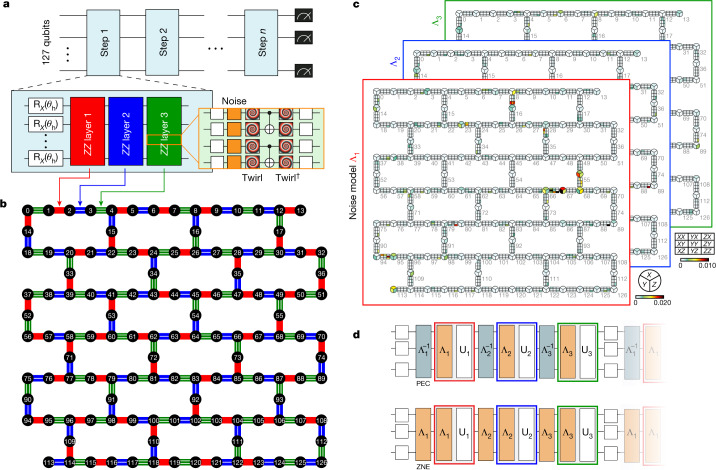
“For the experimental implementation, we primarily used the IBM Eagle processor ibm_kyiv, composed of 127 fixed-frequency transmon qubits 15 with heavy-hex connectivity and median T 1 and T 2 times of 288 μs and 127 μs, respectively.”
MethodPurification of Noisy Entanglement and Faithful Teleportation via Noisy Channels
Bennett, C. H., Brassard, G., Popescu, S., Schumacher, B., Smolin, J. A., & Wootters, W. K. (1996) · Physical Review Letters · doi:10.1103/physrevlett.76.722 · Cited by 2,961 · cited 1×
“…restricting to jump operators acting on local pairs of qubits yields a sparse noise model that can be efficiently learned for many qubits and that accurately captures the noise associated with layers of two-qubit Clifford gates, including crosstalk, when combined with random Pauli twirls 23,24 .”
BackgroundNoisy intermediate-scale quantum algorithms
Bharti, K., Cervera-Lierta, A., Kyaw, T. H., Haug, T., Alperin-Lea, S., Anand, A., Degroote, M., Heimonen, H., Kottmann, J. S., Menke, T., et al. (2022) · Reviews of Modern Physics · doi:10.1103/revmodphys.94.015004 · Cited by 2,231
Improved simulation of stabilizer circuits
Aaronson, S., & Gottesman, D. (2004) · Physical Review A · doi:10.1103/physreva.70.052328 · Cited by 1,515 · cited 1×
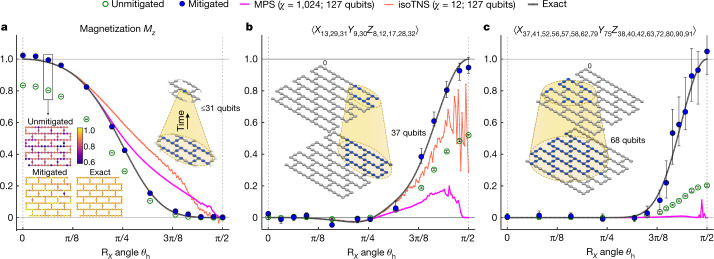
“Clifford circuits serve as useful benchmarks of estimates produced by error mitigation, as they can be efficiently simulated classically 29 .”
BackgroundError Mitigation for Short-Depth Quantum Circuits
Temme, K., Bravyi, S., & Gambetta, J. M. (2017) · Physical Review Letters · doi:10.1103/physrevlett.119.180509 · Cited by 1,379 · cited 2×
“based on pulse stretching 9,17,18 or subcircuit repetition 20–22 have circum-vented the need for precise noise learning, while relying on simplistic assumptions about the device noise.”
BackgroundSelf-citationEvolution of entanglement entropy in one-dimensional systems
Calabrese, P., & Cardy, J. (2005) · Journal of Statistical Mechanics: Theory and Experiment · doi:10.1088/1742-5468/2005/04/p04010 · Cited by 1,295 · cited 1×
“As entanglement (bond dimension) of a generic state grows linearly (exponentially) with time evolution until it saturates the volume law, deep quantum circuits are inherently difficult for tensor networks 37 .”
BackgroundError mitigation extends the computational reach of a noisy quantum processor
Kandala, A., Temme, K., Córcoles, A. D., Mezzacapo, A., Chow, J. M., & Gambetta, J. M. (2019) · Nature · doi:10.1038/s41586-019-1040-7 · Cited by 871 · cited 2×
“based on pulse stretching 9,17,18 or subcircuit repetition 20–22 have circum-vented the need for precise noise learning, while relying on simplistic assumptions about the device noise.”
BackgroundSelf-citation
Research works printed but not linked: 5
- Shor, P. W. in Proc. 35th Annual Symposium on Foundations of Computer Science 124–134 (IEEE, 1994).
- Kitaev, A. Y. Quantum measurements and the Abelian Stabilizer Problem. Preprint at https://arxiv.org/abs/quant-ph/9511026 (1995). · arXiv
- Li Y Benjamin SC Efficient variational quantum simulator incorporating active error minimization Phys. Rev. X 2017 7 021050
- Endo S Benjamin SC Li Y Practical quantum error mitigation for near-future applications Phys. Rev. X 2018 8 031027
- Zhou Y Stoudenmire EM Waintal X What limits the simulation of quantum computers? Phys. Rev. X 2020 10 041038
Cited by
Items 201–300 of 1,005
Research Trends in Quantum Computers by Focusing on Qubits as Their Building Blocks
Dejpasand, M. T., & Ghamsari, M. S. (2023) · Quantum Reports · doi:10.3390/quantum5030039 · Cited by 37
“After a brief introduction to the different components of a quantum computer, the first question that arises is how close we are to building an ideal quantum computer that would be capable of performing fully controllable operations (fault-tolerant era) [6].”
BackgroundOptimal joint cutting of two-qubit rotation gates
Ufrecht, C., Herzog, L. S., Scherer, D. D., Periyasamy, M., Rietsch, S., Plinge, A., & Mutschler, C. (2024) · Physical Review A · doi:10.1103/physreva.109.052440 · Cited by 36
“Even though recent progress [9] suggests that quantum hardware based on superconducting qubits might be on the verge of entering a so-called utility regime where the first practically interesting problems might be approached, to achieve relevant hardware size, modular quantum computing has been…”
BackgroundAcceptor-Induced Bulk Dielectric Loss in Superconducting Circuits on Silicon
Zhang, Z.-H., Godeneli, K., He, J., Odeh, M., Zhou, H., Meesala, S., & Sipahigil, A. (2024) · Physical Review X · doi:10.1103/physrevx.14.041022 · Cited by 36
“Superconducting quantum processors are a leading platform for quantum computation [1, 2] and simulation [3].”
BackgroundMethodKea, K., Kim, D., Huot, C., Kim, T.-K., & Han, Y. (2024) · Entropy · doi:10.3390/e26110954 · Cited by 36
Quantum error mitigation in quantum annealing
Raymond, J., Amin, M. H. S., King, A. D., Harris, R., Bernoudy, W., Berkley, A. J., Boothby, K., Smirnov, A. Y., Altomare, F., Babcock, M. C., et al. (2025) · npj Quantum Information · doi:10.1038/s41534-025-00977-3 · Cited by 36
Quantum Algorithms for Quantum Molecular Systems: A Survey
Zhang, Y., Zhang, X., Sun, J., Lin, H., Huang, Y., Lv, D., & Yuan, X. (2025) · Wiley Interdisciplinary Reviews Computational Molecular Science · doi:10.1002/wcms.70020 · Cited by 38
“Experimental demonstrations using platforms like superconducting transmon qubits and trapped ions have validated these methods on toy models, including spin systems and Schwinger models [98–100].”
High-Fidelity Electron Spin Gates for Scaling Diamond Quantum Registers
Joas, T., Ferlemann, F., Sailer, R., Vetter, P. J., Zhang, J., Said, R. S., Teraji, T., Onoda, S., Calarco, T., Genov, G. T., et al. (2025) · Physical Review X · doi:10.1103/physrevx.15.021069 · Cited by 37
Deep Circuit Compression for Quantum Dynamics via Tensor Networks
Gibbs, J., & Cincio, Ł. (2025) · Quantum · doi:10.22331/q-2025-07-09-1789 · Cited by 36
“The dynamic simulation of quantum many-body systems was an initial motivation for the use of quantum computers [1], and is still considered a leading application for achieving quantum advantage [2].”
Park, G., Gray, J., & Chan, G. K. (2025) · Physical review. B./Physical review. B · doi:10.1103/7jzt-xhn6 · Cited by 36
“In addition to advancing classical simulation techniques, such numerical methods also provide a valuable tool for benchmarking quantum devices [40, 94, 95].”
InfluentialWeaving, T., Ralli, A., Love, P. J., Succi, S., & Coveney, P. V. (2025) · npj Quantum Information · doi:10.1038/s41534-024-00952-4 · Cited by 36
Efficient Self-Consistent Learning of Gate Set Pauli Noise
Chen, S., Zhang, Z., Jiang, L., & Flammia, S. T. (2026) · PRX Quantum · doi:10.1103/1pnv-t9px · Cited by 36
Overhead-constrained circuit knitting for variational quantum dynamics
Gentinetta, G., Metz, F., & Carleo, G. (2024) · Quantum · doi:10.22331/q-2024-03-21-1296 · Cited by 35
“The direct application of circuit knitting to a trotterized simulation of dynamics, as performed in the recent utility experiments by IBM [12] is prohibitively expensive.”
BackgroundMethodTowards quantum-enabled cell-centric therapeuticsPreprint
Basu, S., Born, J., Bose, A., Capponi, S., Chalkia, D., Chan, T. A.-T., Doğa, H., Flöther, F. F., Getz, G. A., Goldsmith, M., et al. (2023) · arXiv (Cornell University) · doi:10.48550/arxiv.2307.05734 · Cited by 36
“However, evidence of quantum utility through quantum error mitigation have started emerging for nontrivial problems [87].”
BackgroundHuggins, W. J., Khattar, T., Xu, A., Harrigan, M. P., Kang, C., Low, G. H., Fowler, A. G., Rubin, N. C., & Babbush, R. (2025) · arXiv (Cornell University) · doi:10.48550/arxiv.2511.08508 · Cited by 34
Montañez-Barrera, J. A., & Michielsen, K. (2025) · npj Quantum Information · doi:10.1038/s41534-025-01082-1 · Cited by 34
Oh, J., Zaman, R., Murthy, A. A., Bal, M., Crisa, F., Zhu, S., Torres‐Castanedo, C. G., Kopas, C., Mutus, J., Jing, D., et al. (2024) · ACS Nano · doi:10.1021/acsnano.4c05251 · Cited by 34
Belaloui, N. E., Tounsi, A., Khamadja, A. R., Louamri, M. M., Benslama, A., Bernal, D. E., & Rouabah, M. T. (2025) · Journal of Chemical Theory and Computation · doi:10.1021/acs.jctc.4c01657 · Cited by 35
Network requirements for distributed quantum computation
Jacinto, H., Gouzien, É., & Sangouard, N. (2026) · Physical Review Research · doi:10.1103/v9ln-c4v2 · Cited by 34
“Available quantum processors, with typical error rates of 10 − 3 per operation [4–6], must incorporate fault-tolerant quantum error correction to implement such sequences of operations reliably [7].”
Improved quantum computation using operator backpropagation
Fuller, B., Tran, M. C., Lykov, D., Johnson, C., Rossmannek, M., Wei, K. X., He, A., Kim, Y., Vu, D., Sharma, K., et al. (2026) · npj Quantum Information · doi:10.1038/s41534-026-01196-0 · Cited by 34
“The noise learning and noise amplification procedures used to apply PEA were performed as in [6].”
Self-citationAdaptive quantum error mitigation using pulse-based inverse evolutions
Henao, I., Santos, J. P., & Uzdin, R. (2023) · npj Quantum Information · doi:10.1038/s41534-023-00785-7 · Cited by 35
Assessing and advancing the potential of quantum computing: A NASA case study
Rieffel, E. G., Asanjan, A. A., Alam, M. S., Anand, N., Bernal, D. E., Block, S., Brady, L. T., Cotton, S., Izquierdo, Z. G., Grabbe, S. R., et al. (2024) · Future Generation Computer Systems · doi:10.1016/j.future.2024.06.012 · Cited by 34
“With the development of more competitive classical [71], quantum [105, 113, 155], or “quantum-inspired” [156, 157] heuristics, it is becoming of utmost importance to identify classes of instances which are well suited to transversally benchmark such devices.”
BackgroundSymmetric Clifford twirling for cost-optimal quantum error mitigation in early FTQC regime
Tsubouchi, K., Mitsuhashi, Y., Sharma, K., & Yoshioka, N. (2025) · npj Quantum Information · doi:10.1038/s41534-025-01050-9 · Cited by 34
“In other words, it is impossible to insert additional Clifford operations in between, thus prohibiting full Clifford twirling.”
Quantum-machine-assisted drug discovery
Zhou, Y., Chen, J., Cheng, J., Cao, X., Zhang, Y., Karemore, G., Žitnik, M., Chong, F. T., Liu, J., Fu, T., et al. (2026) · npj Drug Discovery. · doi:10.1038/s44386-025-00033-2 · Cited by 33
“More broadly, pre–fault-tolerant “utility” under error mitigation has been documented on large devices [32].”
InfluentialTermanova, A., Melnikov, A. A., Mamenchikov, E., Belokonev, N., Dolgov, S., Berezutskii, A. V., Ellerbrock, R., Mansell, C., & Perelshtein, M. R. (2024) · New Journal of Physics · doi:10.1088/1367-2630/ad985b · Cited by 33
“12(b), we present the results of the comparison in terms of the accuracy of our algorithm with the Trotter decomposition that was used in a recent quantum utility work [63].”
MethodLall, D., Agarwal, A., Zhang, W., Lindoy, L. P., Lindström, T., Webster, S., Hall, S., Chancellor, N., Wallden, P., García−Patrón, R., et al. (2025) · doi:10.59161/azye8097 · Cited by 33
Feniou, C., Hassan, M., Claudon, B., Courtat, A., Adjoua, O., Maday, Y., & Piquemal, J. (2025) · Scientific Reports · doi:10.1038/s41598-025-99962-1 · Cited by 34
“Ising models have already been studied using various methods in quantum regimes that claim to surpass the memory capacity of classical computers 41,42 , and these studies, in combination with ours, demonstrate promising results in the potential of useful quantum computation before the era of…”
End-to-End Workflow for Machine-Learning-Based Qubit Readout With QICK and hls4ml
Guglielmo, G. D., Du, B., Campos, J., Boltasseva, A. E., Dixit, A. V., Fahim, F., Kudyshev, Z. A., Lopez, S., Ma, R., Perdue, G., et al. (2025) · IEEE Transactions on Quantum Engineering · doi:10.1109/tqe.2025.3604712 · Cited by 33
“Noisy intermediate-scale quantum (NISQ) devices with more than a hundred qubits are now in operation, showing significant progress toward computational quantum advantages [2], [3], [4].”
Optimization strategies for variational quantum algorithms in noisy landscapes
Novák, V., Zelinka, I., & Snåšel, V. (2026) · Evolutionary Intelligence · doi:10.1007/s12065-026-01248-6 · Cited by 34
“This design isolates the interaction between the optimizer and finite-shot noise without modeling hardware-specific coherent errors [ 50 – 54].”
Quantum-Enhanced Dark Matter Search Using Cat States
Zheng, P., Cai, Y., Xu, B., Wen, S., Zhang, L., Ni, Z., Mai, J., Zeng, Y., Lin, L., Hu, L., et al. (2026) · Physical Review Letters · doi:10.1103/wbhn-v1sw · Cited by 32
Dynamical mean field theory for real materials on a quantum computer
Selisko, J., Amsler, M., Wever, C., Kawashima, Y., Samsonidze, G. G., Haq, R. U., Tacchino, F., Tavernelli, I., & Eckl, T. (2025) · npj Computational Materials · doi:10.1038/s41524-025-01772-6 · Cited by 33
“(cid:129) applying the same calibration scheme to other gate-error mitigation methods, e.g., for probabilistic error cancellation or ampli fi cation 70 .”
Dual-frame optimization for informationally complete quantum measurements
Fischer, L. E., Dao, T. K. L., Tavernelli, I., & Tacchino, F. (2024) · Physical Review A · doi:10.1103/physreva.109.062415 · Cited by 32
Mauron, L., & Carleo, G. (2025) · arXiv (Cornell University) · doi:10.48550/arxiv.2503.08247 · Cited by 33
“In parallel, quantum simulation experiments have demonstrated the ability to prepare and probe complex many-body states [16], with recent work showing efficient preparation of multi-dimensional spin glasses up to unprecedented system sizes [17].”
Priyadarshini, I. (2024) · Quantum Machine Intelligence · doi:10.1007/s42484-024-00201-z · Cited by 31
“In recent years, quantum computing has sparked a revolution in computational science, promising unprecedented computational power and the ability to tackle complex problems previously deemed intractable by classical computing methods (Kim et al. 2023).”
Quantum algorithms for inverse participation ratio estimation in multiqubit and multiqudit systems
Liu, Y., Sierant, P., Stornati, P., Lewenstein, M., & Płodzień, M. (2025) · Physical Review A · doi:10.1103/physreva.111.052614 · Cited by 31
“More-over, quantum computing has already reached a point in which non-trivial computational tasks may be performed in gate-based settings on quantum processors [18–20] despite operating in the presence of noise and errors and still belonging to the Noisy Intermediate-Scale Quantum (NISQ) era [21].”
Simulating fully gauge-fixed SU(2) Hamiltonian dynamics on digital quantum computers
Froland, H., Grabowska, D. M., & Li, Z. (2026) · Physical review. D/Physical review. D. · doi:10.48550/arxiv.2512.22782 · Cited by 31
A robust large-period discrete time crystal and its signature in a digital quantum computer
Chen, T., Shen, R., Lee, C. H., Bo, Y. A. N. G., & Bomantara, R. W. (2026) · Quantum Science and Technology · doi:10.1088/2058-9565/ae3851 · Cited by 33
“In particular, achieving a large-size higher-period DTC beyond the period-doubling type in a system of qubits is not just a quantitative change since generating the necessary Z n symmetry from the native Z 2 symmetry of qubits is a highly nontrivial task.”
Quantum computing with trapped ions: a beginner’s guide
Bernardini, F., Chakraborty, A., & ORDÓÑEZ, C. R. (2023) · European Journal of Physics · doi:10.1088/1361-6404/ad06be · Cited by 31
“While there have been recent breakthroughs in building quantum machines [18–21], we are still in the very early stages of QC, and there is no consensus within the scientific community regarding the best platform for realizing a quantum bit (qubit).”
BackgroundMaciejewski, F. B., Hadfield, S., Hall, B., Hodson, M. J., Dupont, M., Evert, B., Sud, J., Alam, M. S., Wang, Z., Jeffrey, S., et al. (2024) · Physical Review Applied · doi:10.1103/physrevapplied.22.044074 · Cited by 32
Faster and shorter synthesis of Hamiltonian simulation circuitsPreprint
de Brugière, T. G., & Martiel, S. (2024) · arXiv (Cornell University) · doi:10.48550/arxiv.2404.03280 · Cited by 31
“Among the various algorithms and experiments developed for such devices, many are dedicated to quantum chemistry, condensed matter applications, or combinatorial optimization, including the famous VQE algorithm [13], the recent quantum utility experiments [8], or the seminal work on QAOA [6].”
BackgroundLiu, Y., Liu, J., Raney, J. R., & Wang, P. (2023) · Extreme Mechanics Letters · doi:10.1016/j.eml.2023.102117 · Cited by 30
Empirical Learning of Dynamical Decoupling on Quantum Processors
Tong, C., Zhang, H., & Pokharel, B. (2025) · PRX Quantum · doi:10.1103/h7pq-s159 · Cited by 32
“Prime examples of this innovation include the probabilistic error cancellation [32], probabilistic error amplification [18], and read-out error mitigation [33–36], which have enabled state-of-the-art quantum computing experiments [18].”
BackgroundCross-Platform Autonomous Control of Minimal Kitaev Chains
van Driel, D., Koch, R., Sietses, V. P. M., ten Haaf, S. L. D., Liu, C.-X., Zatelli, F., Roovers, B., Bordin, A., van Loo, N., Wang, G., et al. (2026) · PRX Intelligence · doi:10.1103/ryll-qb42 · Cited by 30
Phase-Sensitive Quantum Measurement without Controlled Operations
Yang, Y., Christianen, A., Bañuls, M. C., Wild, D. S., & Cirac, J. I. (2024) · Physical Review Letters · doi:10.1103/physrevlett.132.220601 · Cited by 30
“This is equivalent to zero-noise extrapolation with an exponential fitting function [35, 43, 44].”
Operator dynamics in Floquet many-body systems
Yoshimura, T., Garratt, S. J., & Chalker, J. T. (2025) · Physical review. B./Physical review. B · doi:10.1103/physrevb.111.094316 · Cited by 30
“Discussions of operator paths are relevant to questions about the complexity of simulating quantum dynamics on classical computers (and hence also for discussions of quantum advantage [56, 57]).”
Behrends, J., & Béri, B. (2025) · PRX Quantum · doi:10.1103/gskb-t5ql · Cited by 30
“While random circuit sampling [4–6] and Hamiltonian dynamics [7] have been demonstrated on quantum computers, significantly reducing noise is believed to be necessary for these systems to not be classically efficiently simulable [8–10].”
Volumetric Benchmarking of Error Mitigation with Qermit
Cîrstoiu, C., Dilkes, S., Mills, D., Sivarajah, S., & Duncan, R. (2023) · Quantum · doi:10.22331/q-2023-07-13-1059 · Cited by 30
“In future work we will explore the performance of combined methods, which is particularly well motivated by recent results that show significant improvements when using Pauli frame randomisation, ZNE and dynamical decoupling in combination, and with additional bespoke device calibration [47, 48].”
MethodComplexity of life sciences in quantum and AI era
Pyrkov, A. N., Aliper, A., Bezrukov, D. S., Podolskiy, D. I., Ren, F., & Zhavoronkov, A. A. (2024) · Wiley Interdisciplinary Reviews Computational Molecular Science · doi:10.1002/wcms.1701 · Cited by 30
“75,76 The first aspect per-tains to the classical difficulty of the computational problem, which is determined by either the best-known classical algorithm or a provable upper bound.”
BackgroundLanguage models for quantum simulation
Melko, R. G., & Carrasquilla, J. (2024) · Nature Computational Science · doi:10.1038/s43588-023-00578-0 · Cited by 31
“Very recent demonstrations, such as the time evolution of a two-dimensional quantum Ising model performed by an IBM super-conducting quantum circuit 4,33 , are good candidates for simulation by time-dependent variational Monte Carlo based on language model quantum states.”
Adaptive variational simulation for open quantum systems
Chen, H., Gomes, N., Niu, S., & de Jong, W. A. (2024) · Quantum · doi:10.22331/q-2024-02-13-1252 · Cited by 31
“For instance, the most advanced experiments on IBM’s 127-qubit chip have been constrained to circuit depths of less than 100 [74].”
BackgroundA call for responsible quantum technology
Gasser, U., de Jong, E. J., & Kop, M. (2024) · Nature Physics · doi:10.1038/s41567-024-02462-8 · Cited by 30
Zhao, H., Bukov, M., Heyl, M., & Moessner, R. (2024) · Physical Review Letters · doi:10.1103/physrevlett.133.010603 · Cited by 31
“The rapid development of quantum processors holds the promise of resolving this key problem through digital quantum simulation (DQS) [3–11].”
BackgroundHigh- E J / E C transmon qudits with up to 12 levels
Wang, Z., Parker, R. W., Champion, E., & Blok, M. S. (2025) · Physical Review Applied · doi:10.1103/physrevapplied.23.034046 · Cited by 29
Benchmarking quantum optimization for the maximum-cut problem on a superconducting quantum computer
Dupont, M., Sundar, B., Evert, B., Bernal, D. E., Peng, Z., Jeffrey, S., & Hodson, M. J. (2025) · Physical Review Applied · doi:10.1103/physrevapplied.23.014045 · Cited by 29
“To perform random compilation, we utilize the TrueQ package [98]. b. Readout Error Mitigation— Readout errors are a significant source of noise in contemporary quantum computers [99–101].”
Hamiltonian learning for 300 trapped ion qubits with long-range couplings
Guo, S., Wu, Y., Ye, J., Zhang, L., Wang, Y., Lian, W., Yao, R., Xu, Y., Zhang, C., Xu, Y., et al. (2025) · Science Advances · doi:10.1126/sciadv.adt4713 · Cited by 31
“We use a monolithic 3D Paul trap [1–3] with an RF frequency of ω rf = 2 π × 35 .”
InfluentialSelf-citationInteracting non-Hermitian edge and cluster bursts on a digital quantum processor
Koh, J. M., Xue, W., Tai, T., Koh, D. E., & Lee, C. H. (2026) · Nature Communications · doi:10.1038/s41467-026-75904-x · Cited by 30
“A general method for mitigating inaccuracy of expectation values due to hardware noise is zero-noise extrapolation (ZNE), which functions by collecting additional data at ampli fi ed noise levels and then extra-polating into the zero-noise limit 42,138 – 141 .”
Distributed quantum information processing: a review of recent progress
Knörzer, J., Liu, X., Schiffer, B. F., & Tura, J. (2026) · Reports on Progress in Physics · doi:10.1088/1361-6633/ae74e0 · Cited by 29
Patel, H. E., Pathak, V., Can, O., Potter, A. C., & Franz, M. (2024) · Physical Review Letters · doi:10.1103/physrevlett.132.017002 · Cited by 29
Variational quantum algorithm for ergotropy estimation in quantum many-body batteries
Hoang, D. T., Metz, F., Thomasen, A. M. D., Anh-Tai, T. D., Busch, T., & Fogarty, T. (2024) · Physical Review Research · doi:10.1103/physrevresearch.6.013038 · Cited by 29
“While the most recent state-of-the-art quantum computers operate on more than 100 qubits and feature small error rates [55], the freely available quantum devices are still small in size and very noisy.”
BackgroundTensor network noise characterization for near-term quantum computers
Mangini, S., Cattaneo, M., Cavalcanti, D., Filippov, S., Rossi, M. A. C., & García-Pérez, G. (2024) · Physical Review Research · doi:10.1103/physrevresearch.6.033217 · Cited by 29
“1 (much larger than current two-qubit error rates [1, 54]).”
BackgroundMethodInfluentialA Universal Protocol for Quantum-Enhanced Sensing via Information ScramblingPreprint
Kobrin, B., Schuster, T., Block, M., Wu, W., Mitchell, B., Davis, E. J., & Yao, N. Y. (2024) · arXiv (Cornell University) · doi:10.48550/arxiv.2411.12794 · Cited by 29
Pietikäinen, I., Černotík, O., Eickbusch, A., Maiti, A., Garmon, J. W. O., Filip, R., & Girvin, S. M. (2024) · PRX Quantum · doi:10.1103/prxquantum.5.040307 · Cited by 29
Bounding the Systematic Error in Quantum Error Mitigation due to Model Violation
Govia, L. C. G., Majumder, S., Barron, S. V., Mitchell, B., Seif, A., Kim, Y., Wood, C. J., Pritchett, E., Merkel, S., & McKay, D. C. (2025) · PRX Quantum · doi:10.1103/prxquantum.6.010354 · Cited by 28
Self-citationDigitized counterdiabatic quantum critical dynamics
Visuri, A.-M., Cadavid, A. G., Bhargava, B. A., Romero, S. V., Grabarits, A., Chandarana, P., Solano, E., del Campo, A., & Hegade, N. N. (2026) · npj Quantum Information · doi:10.1038/s41534-026-01208-z · Cited by 28
“Similar techniques have been applied in a heavy-hexagonal architecture [47].”
Engineering Clock Transitions in Molecular Lanthanide Complexes
Stewart, R., Canaj, A. B., Liu, S., Martí, E. R., Celmina, A., Nichol, G. S., Cheng, H., Murrie, M., & Hill, S. (2024) · Journal of the American Chemical Society · doi:10.1021/jacs.3c09353 · Cited by 28
Quantum Computing Through the Lens of Control: A Tutorial Introduction
Berberich, J., & Fink, D. (2024) · IEEE Control Systems · doi:10.1109/mcs.2024.3466448 · Cited by 30
“Although QEM faces fundamental limitations concerning the size of the errors that can be mitigated [68], [69], it has proven to be useful and has, for example, played an important role in the recent demonstration of the utility of current quantum computers by [10].”
BackgroundMethodReadout Error Mitigation for Mid-Circuit Measurements and Feedforward
Koh, J. M., Koh, D. E., & Thompson, J. (2026) · PRX Quantum · doi:10.1103/cj89-4h5t · Cited by 29
“This improves accuracy of results on the measured observables, which would otherwise be distorted by readout noise, as is appropriate for our purpose of investigating the effectiveness of our PROM protocol.”
Error Mitigation of Fault-Tolerant Quantum Circuits with Soft InformationPreprint
Zhou, Z., Pexton, S., Kubica, A., & Ding, Y. (2025) · arXiv (Cornell University) · doi:10.48550/arxiv.2512.09863 · Cited by 28
Reference Architecture of a Quantum-Centric SupercomputerPreprint
Seelam, S., Chow, J. M., Corcoles, A. D., Sheldon, S., Mittal, T., Kandala, A., Dague, S., Hincks, I., Horii, H., Johnson, B., et al. (2026) · arXiv (Cornell University) · doi:10.48550/arxiv.2603.10970 · Cited by 28
“Quantum computers have demonstrated utility in simulating quantum systems beyond brute-force classical approaches [1], [2].”
Self-citationA Hybrid Quantum-Classical Generative Adversarial Network for Near-Term Quantum Processors
Boyle, A. O., & Nikandish, G. (2024) · IEEE Access · doi:10.1109/access.2024.3433383 · Cited by 27
“In the hardware front, there are continuous efforts to enhance performance of quantum computers through improving fidelity of qubits [20], [29], integrating more qubits [20], [30], and developing efficient interface electronic circuits [31], [32].”
BackgroundReadout error mitigated quantum state tomography tested on superconducting qubits
Aasen, A. S., Giovanni, A. D., Rotzinger, H., Ustinov, A. V., & Gärttner, M. (2024) · Communications Physics · doi:10.1038/s42005-024-01790-8 · Cited by 28
“Thecore idea here is to encode logical qubits in multiple noisy physical qubits.”
BackgroundEfficient learning for linear properties of bounded-gate quantum circuits
Du, Y., Hsieh, M.-H., & Tao, D. (2025) · Nature Communications · doi:10.1038/s41467-025-59198-z · Cited by 27
“Accordingly, there is a pressing need for innovative approaches to effectively uncover the dynamics of modern quantum computers with hundreds or thousands of qubits 15,16 .”
Quantum Artificial Intelligence Scalability in the NISQ Era: Pathways to Quantum Utility
Moreau, G. S., Pisani, L., Profir, M., Podda, C., Leoni, L., & Cao, G. (2025) · Advanced Quantum Technologies · doi:10.1002/qute.202400716 · Cited by 27
Efficient quantum circuit compilation for near-term quantum advantage
Guo, Y., & Yang, S. (2025) · EPJ Quantum Technology · doi:10.1140/epjqt/s40507-025-00368-9 · Cited by 27
“We note that while error mitigation techniques [13, 60] are widely applied to improve the measurements of expectation values [17], they are insufficient to overcome this limitation.”
Variational preparation of normal matrix product states on quantum computers
Jaderberg, B., Pennington, G., Marshall, K. V., Anderson, L. W., Agarwal, A., Lindoy, L. P., Rungger, I., Mensa, S., & Crain, J. N. (2026) · Physical Review Research · doi:10.1103/m5kb-4f43 · Cited by 27
“In a wider scope, we are in an era where experiments on quantum computers regularly probe physics that cannot be exactly classically verified [84, 85], in-citing the development of new tensor network techniques [86, 87].”
Shen, R., Chen, T., Yang, B., Zhong, Y., & Lee, C. H. (2025) · npj Quantum Information · doi:10.1038/s41534-025-01122-w · Cited by 30
Waintal, X. (2023) · Proceedings of the National Academy of Sciences · doi:10.1073/pnas.2313269120 · Cited by 28
“001 level with more than a hundred qubits [21].”
BackgroundMethodZhang, Y., Oberg, C. P., Hu, Y., Xu, H., Yan, M., Scholes, G. D., & Wang, M. (2024) · The Journal of Physical Chemistry Letters · doi:10.1021/acs.jpclett.4c00264 · Cited by 27
Quantum Large Language Models via Tensor Network DisentanglersPreprint
Aizpurua, B., Loren, F., Jahromi, S. S., Singh, S., & Orús, R. (2024) · arXiv (Cornell University) · doi:10.48550/arxiv.2410.17397 · Cited by 27
“The combination of advanced error-mitigation strategies [12] with the hardware roadmaps of major quantum processor providers [13] suggests that reliable variational quantum circuits operating on hundreds of qubits will be feasible in the near future.”
BackgroundRuntime Quantum Advantage with Digital Quantum OptimizationPreprint
Chandarana, P., Cadavid, A. G., Romero, S. V., Simen, A., Solano, E., & Hegade, N. N. (2025) · arXiv (Cornell University) · doi:10.48550/arxiv.2505.08663 · Cited by 27
Experimental Sample-Efficient Quantum State Tomography via Parallel Measurements
Hu, C.-K., Wei, C., Liu, C. L., Che, L., Zhou, Y., Xie, G., Qin, H., Hu, G., Yuan, H., Zhou, R., et al. (2024) · Physical Review Letters · doi:10.1103/physrevlett.133.160801 · Cited by 26
Pruned-ADAPT-VQE: Compacting Molecular Ansätze by Removing Irrelevant Operators
Vaquero-Sabater, N., Carreras, A., & Casanova, D. (2025) · Journal of Chemical Theory and Computation · doi:10.1021/acs.jctc.5c00535 · Cited by 27
Superconducting qubit-resonator quantum processor with effective all-to-all connectivity
Renger, M., Verjauw, J., Wurz, N., Hosseinkhani, A., Ockeloen-Korppi, C. F., Liu, W., Rath, A., Thapa, M., Vigneau, F., Wybo, E., et al. (2026) · Physical Review Research · doi:10.1103/8x68-cx1w · Cited by 26
Efficient ground state preparation in variational quantum eigensolver with symmetry-breaking layers
Park, C.-Y. (2024) · APL Quantum · doi:10.1063/5.0186205 · Cited by 26
Jensen, P. W. K., Kjellgren, E. R., Reinholdt, P., Ziems, K. M., Coriani, S., Kongsted, J., & Sauer, S. P. A. (2024) · Journal of Chemical Theory and Computation · doi:10.1021/acs.jctc.4c00069 · Cited by 27
Complexity of Digital Quantum Simulation in the Low-Energy Subspace: Applications and a Lower Bound
Gong, W., Zhou, S., & Li, T. (2024) · Quantum · doi:10.22331/q-2024-07-15-1409 · Cited by 26
Quantum computers, quantum computing, and quantum thermodynamics
Cleri, F. (2024) · Frontiers in Quantum Science and Technology · doi:10.3389/frqst.2024.1422257 · Cited by 26
Computational Complexity of Isometric Tensor-Network States
Malz, D., & Trivedi, R. (2025) · PRX Quantum · doi:10.1103/prxquantum.6.020310 · Cited by 26
Quantum computing for discrete optimization: A highlight of three technologies
Bochkarev, A. A., Heese, R., Jäger, S., Schiewe, P., & Schöbel, A. (2025) · European Journal of Operational Research · doi:10.1016/j.ejor.2025.07.063 · Cited by 26
“There is evidence that also without FTQC, quantum computations can be practically relevant for certain use cases (Kim et al., 2023).”
Google Quantum AI's Quest for Error-Corrected Quantum ComputersPreprint
AbuGhanem, M. (2024) · arXiv · doi:10.48550/arxiv.2410.00917 · Cited by 26
Reliable high-accuracy error mitigation for utility-scale quantum circuitsPreprint
Aharonov, D., Alberton, O., Arad, I., Atia, Y., Bairey, E., Dov, M. B., Berkovitch, A., Brakerski, Z., Cohen, I., Fuchs, E., et al. (2025) · arXiv (Cornell University) · doi:10.48550/arxiv.2508.10997 · Cited by 26
Hartnett, G. S., Najafi, K., Khindanov, A., Liao, H., Schutzman, M., Hush, M., Biercuk, M. J., & Baum, Y. (2026) · arXiv (Cornell University) · doi:10.48550/arxiv.2605.04025 · Cited by 26
Provable bounds for noise-free expectation values computed from noisy samples
Barron, S. V., Egger, D. J., Pelofske, E., Bärtschi, A., Eidenbenz, S., Lehmkuehler, M., & Woerner, S. (2024) · Nature Computational Science · doi:10.1038/s43588-024-00709-1 · Cited by 25
“The most prominent examples are probabilistic error cancellation (PEC) 15,16 and zero-noise extrapolation (ZNE) 17 .”
InfluentialComplete Self-Testing of a System of Remote Superconducting Qubits
Storz, S., Kulikov, A., Schär, J., Barizien, V., Valcarce, X., Berterottière, F., Sangouard, N., Bancal, J.-D., & Wallraff, A. J. (2025) · Physical Review Letters · doi:10.1103/nv7d-k3wr · Cited by 25
“With the maturing of quantum information processing units based on superconducting circuits [2–5], neutral atoms [6] or trapped ions [7], verifying the correct operation of such systems has become crucial as well.”
Distributing Quantum Computations, by Shots
Bisicchia, G., García-Alonso, J. M., Murillo, J. M., & Brogi, A. (2023) · Lecture notes in computer science · doi:10.1007/978-3-031-48421-6_25 · Cited by 25
Wiring surface loss of a superconducting transmon qubit
Smirnov, N. S., Krivko, E. A., Solovyova, A. A., Ivanov, А. I., & Rodionov, I. A. (2024) · Scientific Reports · doi:10.1038/s41598-024-57248-y · Cited by 25
“Quantum processors and simulators comprising tens or even hundreds superconducting qubits have recently been demonstrated 1–5 .”
BackgroundModeling the performance of early fault-tolerant quantum algorithms
Liang, Q., Zhou, Y., Dalal, A., & Johnson, P. D. (2024) · Physical Review Research · doi:10.1103/physrevresearch.6.023118 · Cited by 25
“Despite significant experimental and theoretical progress [2, 3], noisy intermediate-scale quantum (NISQ) devices have yet to exhibit the capacity to solve practical real-world problems with valuable outcomes.”
BackgroundQuST: Optimizing Quantum Neural Network Against Spatial and Temporal Noise Biases
Li, T., Lu, L., Zhao, Z., Tan, Z., Tan, S., & Yin, J. (2024) · IEEE Transactions on Computer-Aided Design of Integrated Circuits and Systems · doi:10.1109/tcad.2024.3471949 · Cited by 25
“Therefore, researchers have proposed several methods to alleviate the quantum noise, including quantum error correction [7], quantum error mitigation [8], [9], [10], [11], quantum compiler optimizations [12], [13], etc.”
Noise-agnostic quantum error mitigation with data augmented neural models
Liao, M., Zhu, Y., Chiribella, G., & Yang, Y. (2025) · npj Quantum Information · doi:10.1038/s41534-025-00960-y · Cited by 26
“A promising technique to restore quantum advantages in realistic noisy devices is quantum error mitigation [1], including zero-noise extrapolation (ZNE) [2–6], Clifford data regression (CDR) [7–10], probablistic error cancellation [2, 11, 12], and virtual purification [13–15].”
Resource-efficient generalized quantum subspace expansion
Yang, B., Yoshioka, N., Harada, H., Hakkaku, S., Tokunaga, Y., Hakoshima, H., Yamamoto, K., & Endo, S. (2025) · Physical Review Applied · doi:10.1103/physrevapplied.23.054021 · Cited by 26
Programmable Quantum Simulations on a Trapped-Ion Quantum Computer with a Global Drive
Shapira, Y., Markov, J., Akerman, N., Stern, A., & Ozeri, R. (2025) · Physical Review Letters · doi:10.1103/physrevlett.134.010602 · Cited by 24
Metadata
- Authors
- Kim, Y., Eddins, A., Anand, S., Wei, K. X., van den Berg, E., Rosenblatt, S., Nayfeh, H., Wu, Y., Zaletel, M., Temme, K., & Kandala, A.
- Affiliations
- IBM Research - Cambridge (United States) (US)
- University of California, Berkeley (US)
- IBM (United States) (US)
- RIKEN (JP)
- Lawrence Berkeley National Laboratory (US)
- Corresponding author
- Eddins, Andrew
- Kandala, Abhinav
- ORCID
- Venue
- Nature
- Published
- 2023-06-14
- Volume
- 618
- Issue
- 7965
- Pages
- 500-505
- ISSN
- 0028-0836 (ISSN-L)
- 1476-4687
- PMC
- PMC10266970
- OpenAlex
- W4380627387
- Semantic Scholar
- f9253a3e2627f1c2a0a7e2cea320a4ec4e4d2ff9
- Cited by
- 1,050
- References
- 41
- Citations by year
- 2026: 226 · 2025: 399 · 2024: 358 · 2023: 67
- FWCI
- 98.85
- Type
- journal article
- Language
- en
- Open access
- hybrid
- doi.org
- Licence
- cc-by
- creativecommons.org/licenses/by/4.0 (tdm)
- creativecommons.org/licenses/by/4.0 (vor)
- Locations
- Nature (publishedVersion, cc-by)
- PubMed Central (publishedVersion, cc-by)
- PubMed (publishedVersion)
- eScholarship (California Digital Library) (submittedVersion, cc-by)
- OSTI OAI (U.S. Department of Energy Office of Scientific and Technical Information) (submittedVersion)
- RePEc: Research Papers in Economics (submittedVersion)
- Funders
- National Science Foundation (DEAC02-05CH11231, 2137603, 2138259, 2138296, 2138307, 2138286)
- U.S. Department of Energy (-AC02-05CH11231, 05CH11231, DE AC02 05CH11231, DESC0022716, DE-AC02-)
- National Energy Research Scientific Computing Center (DE–AC02–05CH11231, 05CH11231, AC02-05CH11231)
- Office of Science (DEAC02–05CH11231, AC02-05CH11231, DE-AC02)
- Office of Advanced Cyberinfrastructure (#2138286, #2138296, 2138259, #2138307, 2137603)
- Basic Energy Sciences (DE-AC02, DE-AC02-05CH11231., AC02–05CH11231)
- Lawrence Berkeley National Laboratory (AC02‐05CH11231, DE-AC02-05CH11231, 05CH11231)
- Topics
- Physical Sciences › Computer Science › Artificial Intelligence › Quantum Computing Algorithms and Architecture
- Physical Sciences › Physics and Astronomy › Atomic and Molecular Physics, and Optics › Quantum Information and Cryptography
- Physical Sciences › Physics and Astronomy › Atomic and Molecular Physics, and Optics › Quantum many-body systems
- Keywords
- quantum computing, NISQ devices, superconducting qubits, noise characterization, tensor network states, matrix product states, entanglement, quantum advantage
About these checks
Registry, retraction, Cites and statistics results are computed, not judged, with one exception: a printed reference that no index lists is read once by a model before it counts as a citation error. Claims are extracted by a model and kept only when their quote appears verbatim in the text; each cited source is then checked, with a model’s help, for whether it says what the claim relies on. Those verdicts can be wrong — read the claim’s quote and the cited source before relying on one.
Statistics and arithmetic are recomputed, not judged.
Confidence bands are shown only for fields calibrated on our annotated test set. None is calibrated yet, so no band is shown.
What counts as a claim ›How we measure confidence ›How we check this ›
Are you an author, or do you see a problem with this page? Request a review
Data sources
Bibliographic data: Semantic Scholar, OpenAlex, Crossref.
Contains information from the Semantic Scholar Academic Graph Datasets, made available under the ODC Attribution License (ODC-BY 1.0).
Semantic Scholar’s data is described in: Kinney, R., et al. (2023). The Semantic Scholar Open Data Platform. arXiv:2301.10140.
